Magnificent AI music generator #5

As I was trying to figure out what free-verse poem of mine to use as lyrics for the magnificent AI-music generator Udio, I realized I had completely forgotten about my “Odes to My Triceratops,” even though Lorenzo the triceratops is featured conspicuously on the banner of my site. That bizarre narrative includes the lyrics of about three-dozen fake songs created by an amateur songwriter named William Griffin, as well as some written by his blind next-door neighbor called Claire Javernick. Why not just turn them all into actual songs?

Here’s the first one, titled “Better Dead Than Blind”:

Magnificent AI music generator #4

The lessons I’ve learned from my brief time generating AI songs are ones that musicians have likely also taken to heart: first, if some part of the lyrics doesn’t translate well when sung, just drop it. Also, the main goal is to create a song that you’d love to listen to over and over. I’ve succeeded in doing so with the following song, based on my oldish free-verse poem “A Visit From Truck-kun,” an ode to isekai (that requires a severe rewrite, probably even a reimagining).

Isn’t that fantastic? My two regrets: the annoying typo at the beginning (having written “tell” instead of “tells” in the lyrics). Also, that I couldn’t extend the song again to give it a proper intro.

Anyway, the song was generated using the Udio service, so far the best AI music generator.

Magnificent AI music generator #3

I’m reminded regularly of chapter 69 of my ongoing novel We’re Fucked, because I get random hits from visitors who likely expected something different from the search that led them to a page titled “We’re Fucked, Pt. 69.” Sorry, fellas.

Anyway, in that chapter, my deranged protagonist Leire comes up with an idiotic poem about feeling like a monster. The magnificent music-generating service Udio has transformed, with some help, Leire’s poem into a shitty 90s pop-rock song. Enjoy it if you can.

This song-generating business is addicting. I adore music, and I listen to it daily to shut out the world or get in the mood during freewrites. I can’t imagine the masterpieces we’ll be able to generate in a year or two.

Magnificent AI music generator #2

Before I finally go to sleep at three in the morning, check out this absolute banger I’ve put together with Udio, so far the best AI music creator I’ve ever come across. This following song sings parts of my free-verse poem titled Sasquatch Goddess:

That one’s going straight into my tablet so I can listen to it during my commutes. It’s probably a good thing that Udio doesn’t allow you to extend the song more than thirty seconds beyond that point, because I was considering generating music for the entire poem.

Anyway, very strange and interesting end times we’re living in.

Magnificent AI music generator

Tonight, shortly after I returned home from my afternoon shift, I came to know about this lovely AI music generator called Udio. Because apparently I had nothing better to do other than sleep, I used some parts of my oldish free-verse poem titled Dinosaur Apocalypse to generate the following song that in general terms could be considered music:

I’m not sure why I chose to extend that song from the original thirty seconds, given that many other mini songs the AI created from my instructions were far more pleasant. But I’m beyond questioning my actions at this point of my life. Anyway, check out that site; there’s lots of surprisingly great music being generated. If you’re one of those rabid anti-AI people, nobody can help you: AI is here to stay and will likely become more intelligent than the whole of humanity in a couple of years or so. Just enjoy the ride until AI kills us all.

Motocross Legend, Love of My Life, Pt. 13 (Poetry)

If you haven’t read all the previous parts or you don’t remember them well, I urge you to read this novella from the beginning (link here).


My wife’s accusatory glare and weaponized tongue,
Carrying years of racked-up bitterness,
Jabbed, punched, kicked, stabbed.
She flayed me inch by excruciating inch.

You’re a grown man. Stop moping around.
Get off the fucking pity wagon.
Since the beginning, did you have zero intention
Of being fully committed to this marriage?
I gave up law to be a housewife. Am I not enough?
Oh, forgive me for interrupting your endless reveries.
While you’re busy mourning your teenage sweetheart,
I’m here, flesh and blood,
Holding together the family you keep forgetting.
Are you satisfied tormenting me and our child
Because you refuse to let that girl go?
Why do I need to measure up to an idealized teenager?
How is it possible that someone you dated
Fifteen fucking years ago,
Who doesn’t even exist anymore,
Matters more to you than your wife,
The mother of your own fucking kid?

My lovely wife had a lawyer’s soul:
She saw every argument as a chance
To uncover flaws in logic,
To chip away at the opponent’s stance,
To claim the victor’s glory.
As for me, beaten and battered,
I had become a ragdoll
Growing threadbare by the day.

Whenever I anticipated the acidic talk,
I cowered inside my besieged mind,
Clutching at the crumbling battlements,
Lacking the strength to yell at her, or beg her,
To shut the fuck up.
My wife, along with her vindictive glare,
Elbowed her way into my memories of you
To contaminate that sanctuary,
And every time she brought you up,
A pang rippled through my scar tissues,
Echoing, “You’re dead, you’re dead.”

Getting married, sharing an apartment,
Should have provided a traveling companion
With whom to endure this lonesome life.
Instead, I spent my energies erecting walls
To shield my gangrenous heart,
And to muffle any human utterance
Until it became incomprehensible noise.
I felt like I had invested my adulthood
Anticipating a visit to a luminous city,
Saving up and planning meticulously,
Only to arrive at a filthy, ruinous dump
Infested with vermin.

I had surrendered control
Of my meat-and-bones vessel
To someone who didn’t respect me,
Who exploited and mistreated me.
I wished a yawning chasm
Would swallow my wife,
My apartment, this city,
But the mirror of time showed
My stooped figure decades older:
A stammering, browbeaten coward
Just like my father.

My wife was loading the dishwasher
When she casually spewed an attack
That I recognized by its acidic tone,
Even though I had blocked the content.
This time, instead of keeping quiet,
I told her to turn around and listen.
She froze, then straightened up,
Closed the dishwasher with her hip,
And faced me, arms folded,
Her gaze fixed upon me
Like the muzzle of a revolver.

“Each morning since April 27, 1999,
I wake up to the absence of the person
Who made living worthwhile.
You’ve never lost anyone dear,
So you cannot possibly grasp
This grief that has eroded me daily.
You’re frustrated because I have failed
To measure up to your ideal husband,
But I’m the man that remains,
And though I stumble, I’m here,
Doing the best I can with what’s left.
Countless times I’ve wanted to die,
But I chose to keep going for you,
And for our son, who deserves a father.”

“Stop neglecting our family by prioritizing
Your unhealthy fixation with that girl.”
“Do you think I have a choice?”
“Get a fucking therapist. Take antidepressants.”
“Should I erase her, then? Pay to have her scrubbed?”
“You act as if she were the love of your life,
Even though she ruined you.”

Her words had shotgunned my ribcage.
I breathed slowly to quell the shaking rage.
“Maybe love and ruin are interchangeable.
You know, when I agreed to marry you,
I had hoped for a lifelong partner
Who would inspire and encourage me,
Who wouldn’t insist on harassing me
Over the most traumatic event of my life,
Who would provide even a fraction of the joy
That Izar gifted me by simply existing.”

On the opposite side of the kitchen island,
The skin around my wife’s eyes tightened
As her lawyerly mind analyzed my words
For openings, inconsistencies, weaknesses.
Amid the tension, an out-of-place noise:
The creak of our son’s bedroom door.
Drowning out my wife’s bitter tirade,
I imagined his small heart pounding.
Behind that door, a wary creature
Hoped to escape notice.

That evening, I ventured into his bedroom,
Whose walls were a galaxy of space paraphernalia.
My son, reclined against the pillows,
As the glow of the bedside lamp
Illuminated his focused features,
Lost himself in a novel titled “Ender’s Game.”

He tilted his face upward at me as if I were a sun
Failing to warm his frozen planet.
Those glasses magnified deep-set eyes
Whose gaze held mine warily.
“I read that one back in middle school,” I said,
“And I remember enjoying it quite a bit.”
“It’s good,” he said,
Then refocused on the page.

How could I, a ruined man, improve my son’s life?
Instead of training him to carry on into the future,
To survive despite crushing unhappiness,
Perhaps I should abandon him,
Let his resilient mother forge ahead
Without the burden of my misery.

Izar, if this child had belonged to us,
How would you have nurtured him?
You, the sun I revolved around.
You, who had taught me what it meant
To make the best of a crumbling world.

My son and I rode on leg-powered bikes
Past the ruins of Roman furnaces.
Our pedals and chains clicked rhythmically.
On the muddy path beneath our tires,
Gravel crunched and stray twigs snapped.
Puddles from recent rainfall mirrored
The dove-gray cloud cover
And arching, naked branches.
A blanket of fallen leaves blurred
The boundaries of the unpaved path
Flanked on our left by an ancient wall:
A mosaic of weathered, moss-daubed stones.
The mist that hung in the air cooled my lungs.

We reached a fork in the trail
Where a slope would force us to dismount
And push our mountain bikes uphill
While seeking purchase on exposed stones.
“Let’s head up there,” I said.
My son, as he readjusted his helmet,
Shot me a skeptical look.
“Where does it lead?”
I got off my bike.
“I don’t know.”

A meandering dirt path, worn by footsteps
But now reclaimed by nature,
Opened to a clearing of greens and browns
Where square, one-story buildings stood,
Their once-white walls aged, stained,
And half-conquered by creeping ivy.
“Maybe we shouldn’t be here,” my son said.
I stopped and listened to the chirping birds,
To the distant creaking of branches,
But no one had claimed these ruins.
“Let’s explore,” I said.

We were rolling our bikes through the garden
Of a family gone for decades.
An anonymous hand had gathered stones
To form the sinuous banks of a stream.
Water rippled, reflecting dapples of sunlight.
Wide-leafed plants, unique in these woods,
Still blossomed white, bell-like flowers.
Beside the stream, on a filthy, pitted wall,
An intact grill guarded a window opening
That gaped like a hollow eye.

My son followed cautiously.
“How old do you think this place is?”
“It belongs to the Roman era.”
“C’mon, dad. Romans lived, like,
A thousand years ago.”
“More like two thousand.”
“Mom would scold us if she saw us
Wandering around abandoned places.”
“No doubt. But she doesn’t have to know.”
“Imagine if we owned this secret space,
And transformed it into a hideout.”
“These days? They would take it from us.”
“What if zombies attacked now?”
“We should have brought baseball bats.”
“I bet if I had a machine gun,
I’d blast every last one of them.”
“Good luck convincing mom to buy that.”

We let the bikes fall into a patch of tall grass,
Then we entered the roofless, derelict house.
Its floor was carpeted with dried leaves
That crackled under our sneakers.
Against the inner walls and their peeling paint,
Someone had arranged piles of chipped bricks,
Remnants of moss-cloaked furniture,
Rusted mattress springs.
Logs lay scattered, their bark mottled.
Weeds had sprung up all around,
Thriving amid the detritus.
I inhaled the scent of moist soil and tetanus.

At the end of the garden stood a woodshed
Stacked with logs shrouded in grimy cobwebs
Like antediluvian bones in a catacomb.
Decades ago, the owner picked these logs,
Hand-chopped them, and stored them as fuel
For fires that would never come.


Author’s note: the songs for today are “Swan Dive” by Waxahatchee, and “Cosmic Love” by Florence + the Machine.

Review: Sputnik Sweetheart, by Haruki Murakami

Three and a half stars.

Let’s focus on the most memorable character of this strange little tale: a young adult named Sumire, who dropped out of college to pursue her dream of becoming a published author. She’s disorganized both in her personal upkeep as well as her approach to writing: she can start or finish stories, but not both. She suspects she will never become a pro, but can’t imagine doing anything else, and when she turns twenty-eight, her parents will stop financing her lifestyle.

She’s used to calling the narrator at odd hours of the night to discuss her worries and seek his guidance, even though the guy is a school teacher and could use the sleep. However, they’re each other’s only friend in lives that have been characterized by solitude and detachment. Sumire is unaware that the narrator is in love with her, or pretends that she doesn’t know, but she can’t reciprocate his feelings because she’s in love with a Korean-born woman who’s about fifteen years older than her.

The little there is plotwise (not that I mind; I tend to dislike convoluted stories) involves the Korean woman, named Miu, hiring Sumire as an assistant; the lady runs a wholesale business that buys wine from fancy places and sells it in Japan. Even though Sumire fears that keeping a job will wreck her literary aspirations, she surrenders to the flow of a routine that allows her to spend her days with her beloved Korean mommy. Soon enough they’re jet-setting all over the world.

The narrator fears that he’s going to lose Sumire. She writes him a letter from Rome, but shortly after he stops receiving news from her. Suddenly, the Korean lady herself calls him: he’s to abandon everything he’s doing in Japan and hurry to a small Greek island, because something has happened to their friend.

That’s all I want to reveal about the plot. My favorite parts of this story take place in Japan, when Sumire and the narrator are interacting. Murakami knows how to weave a spell when he’s letting you experience the private lives and interactions of his characters, who are usually lost and trying to understand themselves as well as the world they have found themselves in. His Norwegian Wood reached the heights in that regard, as far as I know from his works. But as in plenty of his other stories, Murakami introduces supernatural elements that for me weren’t supported by the story, and that distanced me from the characters. Even though Norwegian Wood made Murakami a known author (and a millionaire), it’s perhaps one of the least Murakami-ish books of his. Worse yet for me: often the supernatural elements he includes feel random, as if he came up with them during freewriting but couldn’t make them fit in, or didn’t care to do so.

Murakami’s writing also has this thing in which he’s on the verge of saying something profound, of hitting some transcendental point, only to screw it up with a few lackluster phrases that don’t say much of anything. I don’t recall how common that was in Norwegian Wood, but I had that impression quite a few times during this story. The narrative also features texts written by Sumire, and it didn’t help that her style annoyed me.

My least favorite element of the story was the narrator himself. Murakami’s male narrators are often bland, tepid, non-committal, and the one from this novel I’m reviewing is the epitome of those, that I can recall. His opinions seemed vague, unconvincing, held because they wouldn’t require him to take a firm stance on anything. I had a hard time understanding why Sumire would care so much for him. Worse yet, his morals were beyond questionable: all his girlfriends were other men’s girlfriends or wives, and he let a shitty little kid get away with his kleptomaniac ways for reasons that for me had more to do with dislike of authority.

The main theme that Murakami was playing around with centered on the notion that some people are doomed to a life of solitude, and that their instances of true contact with other alike souls will be fleeting, like two satellites briefly passing each other. By the end, the story left me feeling empty, as if something important had been lost along the way, so good job for capturing that impression.

Here are some quotes from the book:

Why do people have to be this lonely? What’s the point of it all? Millions of people in this world, all of them yearning, looking to others to satisfy them, yet isolating themselves. Why? Was the earth put here just to nourish human loneliness?

I dream. Sometimes I think that’s the only right thing to do.

And it came to me then. That we were wonderful traveling companions but in the end no more than lonely lumps of metal in their own separate orbits. From far off they look like beautiful shooting stars, but in reality they’re nothing more than prisons, where each of us is locked up alone, going nowhere. When the orbits of these two satellites of ours happened to cross paths, we could be together. Maybe even open our hearts to each other. But that was only for the briefest moment. In the next instant we’d be in absolute solitude. Until we burned up and became nothing.

The answer is dreams. Dreaming on and on. Entering the world of dreams and never coming out. Living in dreams for the rest of time.

We each have a special something we can get only at a special time of our life. Like a small flame. A careful, fortunate few cherish that flame, nurture it, hold it as a torch to light their way. But once that flame goes out, it’s gone forever.

Motocross Legend, Love of My Life, Pt. 12 (Poetry)

If you haven’t read all the previous parts or you don’t remember them well, I urge you to read this short story (or novella) from the beginning (link here).


Lunch break at last, I sat in the shade
Beneath broadleaved guardians.
My Izar, I’m here once again.
Come join me, hold my hand.
The world’s jagged edges softened
As your gentle light enveloped me.
Did your day treat you well?
Anything you want to share?
You’ve gotten hooked on a new manga?
Oh, I’d love to hear all about it.

On my commute home from work,
My eyes closed to shut the world out,
As I swayed to the train’s rhythm,
And the song of rain and thunder
Poured in through my headphones,
I felt your fingers caressing mine,
Tracing my knuckles and creases.

The morning light streaming
Through my bedroom window
Spilled into the open wardrobe,
Gilding the hanging garments,
Ranging from T-shirts to sweaters,
Whose hems were draped over the lid
Of the sturdy moving box
That enshrined your remains.

I caressed the rough, corrugated cardboard
That had cradled you for more than a decade.
With my family out to play at the park,
I heaved the box onto the marital bed.
When I peeled back the lid, you grinned
Through photos taken in the nineties.
I held hands with your motorcycle gloves.
As I listened to our pretend radio shows,
I laughed, and tears streaked my cheeks.

Izar, the things that bind us,
They are the only lasting truths.
Although your body turned to ashes,
Your name remains carved within me,
Inscribed inside my organs,
Scratched on my bones,
With every cell echoing it.
Once we are stripped of our shells,
Love is all we will carry.

On a stormy night, the beddings’ warmth
Had coaxed my wife into a snore-heavy sleep.
The wind battered the windows,
And raindrops tap-tapped incessantly.
I lay on the opposite side of the bed,
But in my mind I had returned to my old room,
Whose bed you and I had shared.
As we clung to each other,
And my fingertips skated up and down
The ladder rungs of your vertebral bumps,
I buried my face in the crook of your neck,
Where I sniffed your aroma:
Sunshine, cinnamon, motor oil.
We had woven our way into each other
By learning one another’s shapes,
What each vocalization meant,
What brought pleasure or pain.

Your warm lips brushed my earlobe.
“I missed you so much, you know.”
Izar, tell me when you want to leave,
And I will follow you anywhere.
Just say the word.
“Hey, Cap’n. I wanna ask something.
How long would it take to die from drowning?”
Drowning? You mean falling into a river?
“No, like jumping off a cliff.
Is it true you can’t scream underwater?”

My wife had been avoiding me since that morning,
But I traced the stench of cigarette to the balcony,
Where I found her shrouded in her wool robe,
Seated with one bare leg crossed over the other,
Defiantly exposing her skin to the biting breeze.
A thread of smoke rose from the cigarette
Clenched between her index and middle fingers
As her gaze pierced through the landscape
To wander in some faraway place.

I asked her if anything was the matter.
She shot a sidelong glance at me.
The cigarette’s cherry flared orange
As she sucked on the foul stick’s vileness.
The taps of pedestrians five stories below,
Along with the hum of passing vehicles,
Accented the tension in her silence.
When I was about to insist,
She exhaled a grayish-white cloud,
Then said I had been talking in my sleep.

“You apologized to your teenage girlfriend,
And called her name over and over.
The other stuff, I don’t even want to bring up!”
I asked her if she also expected an apology.
My wife crushed the stub on the ashtray,
And demanded to be left alone.
What, should I repent for unconscious outbursts?
During my waking hours, around my wife and son,
I sealed my burbling depths with a hermetic lid,
And I behaved like a functional family man,
Or at least tried my damnedest;
In dreams, my subconscious probed the abyss,
Prodding, scratching, licking the scar tissue
For signs of fresh bleeding.

I still remembered the adult grace
With which my wife, then a legal advisor,
Dressed in blouses and thigh-length skirts,
Had approached the business park bench
Where I reminisced away my lunch break.
The first time her legs halted beside me,
I had wanted to peel off her stockings.
Contrast that with her now-slouched shoulders,
And her lips pressed into a thin line
Whenever her hardened gaze scrutinized
The guilty half of our legal arrangement,
Ready to dissect any sign of laziness; of failure;
Of straying toward you, the forbidden.

Why the hell did I choose for myself a life
In which an inspector could interrupt
My worship of you anytime,
And interrogate me about my devotion?
Since you died, I had yearned to return,
In flesh or spirit, to our teenage bubble,
When I could still smile,
And the time was ours to live.

My wife and I weren’t right for each other:
We had been forged in different furnaces,
Hammered into incompatible shapes.
When she had pursued my broken self,
I doubted my strength to endure
Decades of solitary penance.
I had craved someone to lean on,
Who might try to understand.
If only I had rejected her advances,
And remained the shell of a teenager,
I’d be living in a one-bedroom home
Furnished with a computer, a mattress,
And the moving box of your relics.
Your voice would play full-volume at all hours.

For the sake of our child,
Whom we had dragged into the harsh lights
Of this indifferent cosmos,
I would continue living a lie.

In the time between work and work,
Resting on my bench sanctuary
While the overhead leaves rustled,
Sketchbook perched on my knees,
Headphones clamped tight,
And your voice bleeding into my brain,
With a sharpened tip of graphite,
I etched the outline of your curves:
The slender breasts that fit in my palms,
The belly swollen with our baby,
And the thighs that loved to hug my face.
I shaded the heaven between them,
Where I had gladly lost my sense of self
Tasting the tang of sea salt,
Drowning in your intimate waves.

One night, after reading a tale to my son,
I entered the master bedroom to find my wife
Waiting for me at the foot of the bed,
Straight-backed and stiff-necked,
Naked except for black cotton lingerie
Embellished with lace embroidery;
Hands clasped in front of her navel
As if to conceal the tortuous stripes.
She instructed me to lock the door.

In the sultry dampness of her mouth,
My penis went flaccid.
She withdrew and gaped at my failure
Before wiping her glistening lips.
“What the hell is wrong?”
“I’m sorry. I’m tired.”
My wife rose swiftly.
With a voice edged in hurt,
She accused, “I disgust you, don’t I?”
Then stormed out, retreating to the bathroom.
As for me, slumped on the edge of the bed
With my limp, shriveled member exposed,
I rubbed the bridge of my nose.
A minute later, I slid under the covers,
Shoved earplugs in, and hoped for sleep.

To celebrate the anniversary of my first kiss with you,
That interrupted a playthrough of Resident Evil
And signaled the start of our romance,
I splurged on a bakery cake,
And, unbeknownst to my wife,
I took a personal day from work
So you and I could spend the whole morning together.

I cradled the cake box, my precious offering,
To the woodsy depths of the Meaka neighborhood,
Strolling along a narrow, cracked, cement path
Encroached on both sides by grass and weeds.
The fresh air smelled of pine, earth, and wildflowers.
The birds trilled, the leaves whispered, a creek babbled.
A butterfly chased its mate’s erratic trajectory.

I reached the spot next to the winding path:
A picnic grove canopied by verdant trees.
Sunlight cascaded through the webwork of branches
And spilled shimmering patches of gold
Upon my chosen picnic table, rugged and gritty,
That bore names, hearts, and curses
Carved by generations of lovers and drunks.
I settled at the wooden table, my back to the path.
As I breathed in peace, my heartbeat slowed;
Nobody would disturb this solitude
To chastise me for loving you.

I laid the cake box before me, and flipped the lid.
Chocolate layers emulated a muddy racetrack,
With ganache frosting mimicking earthtones,
And intricate icing recreating tire streaks.
On top stood an edible sculpture:
A fondant motocross bike painted yellow.
Wouldn’t you have gotten a kick out of my offering?
In your translucent likeness, seated opposite,
Sunlight shining through, I glimpsed a beaming grin.
“Dude, you’re awesome. This is, like, the coolest cake.”

“You know,” I said, “it’s the anniversary of our first kiss.
We played Resident Evil and, while you were cheering,
I kissed you by surprise. Do you remember?”
“Hell yeah, I do. You thought you were being smooth,
But I totally knew you’d kiss me, so I was ready.
I was dying to kiss you back.”
“Izar, if I went back in time and prevented your death,
What would you do?”
“Dude, I would kiss you until your lips bled.”

I lit a candle shaped like a number one,
And anchored it beside the fondant bike.
“Happy kiss anniversary, Izar.”
I cut a slice, then dug a forkful.
In the flickering light of that lone flame,
Chocolate and cream melted on my tongue.
I savored the blend of rich flavors
And delighted in the textures
Of velvety ganache, smooth frosting,
And the crumbly patches imitating dirt.

Another year with you, my thoughtless girl,
Who had tossed the die without regard
To what your demise might unleash,
Leaving the heart that adored you dead.
As for my wish, I hoped that both of us
Would plunge into a bottomless lake
And hold hands while we sank,
Until the weight of water crushed us,
And everything turned black.


Author’s note: today’s songs are “Sally Cinnamon” by The Stone Roses, and “Heroin” by The Velvet Underground.

You may be wondering if I have changed the title of this story. Nope, just a case of the Mandela effect. Now seriously, I did change the damn title for reasons that I probably shouldn’t bother explaining, but that for some reason will: while “Love of My Life” refers both to the song that sparked this story as well as to the unending grief that the narrator endures, that title didn’t capture the remaining oddity of this tale, from the unrealistic dream of Izar Lizarraga to the increasingly hallucinatory tone of the story. “Love of My Life” makes one picture a straight romance, while “Motocross Legend, Love of My Life” could make one stop and wonder about the strange pairing. You know, assuming anybody cares. Anyway, I just prefer it like this.

Sketches for my new banner

The process of creating a new banner for my site, done by the very talented Daniel Acosta, produced interesting sketches, which I will proceed to include in this post for your viewing pleasure (or at least my own).

One Izar Lizarraga looking sassy.

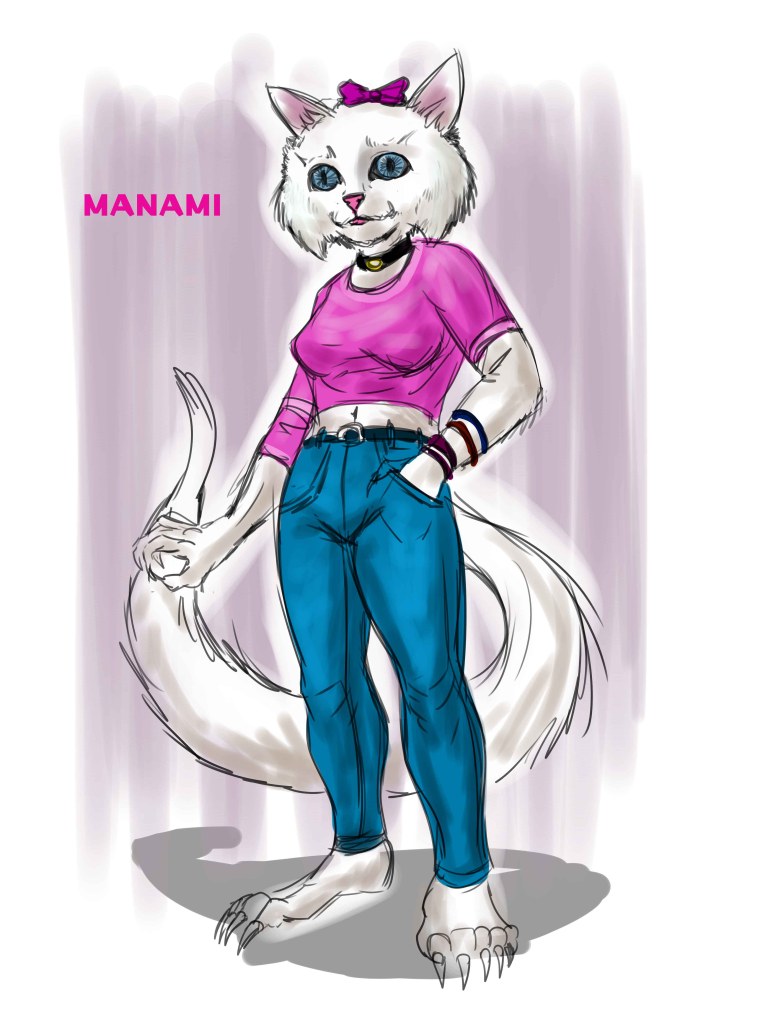
One Manami looking catty.

One Lorenzo looking punky.

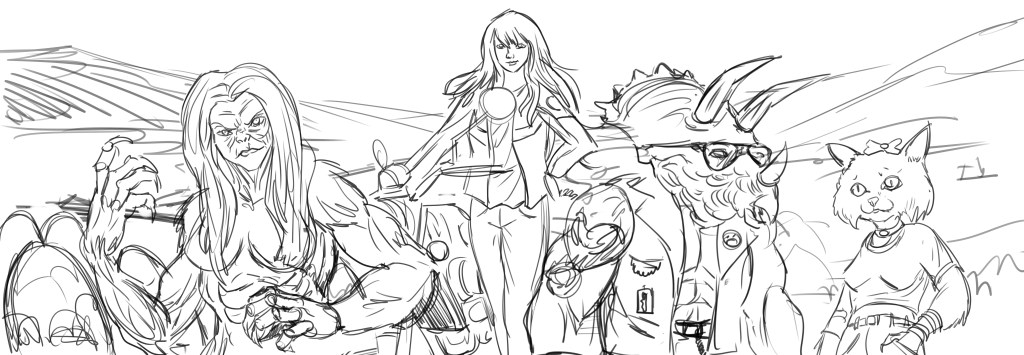
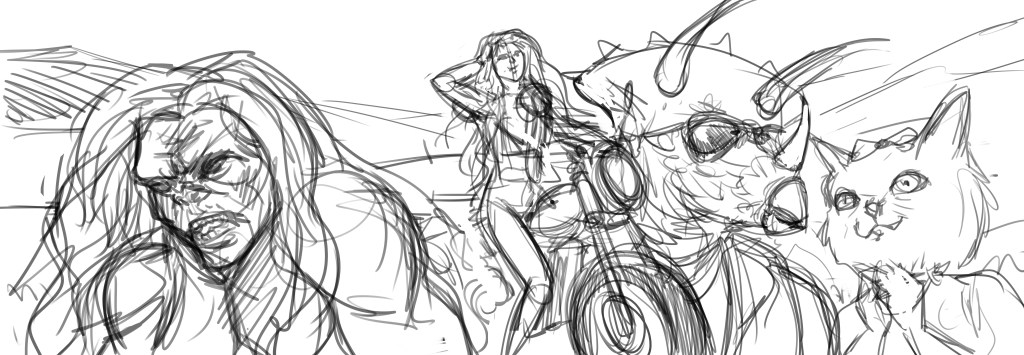
Daniel offered me four possible compositions for the banner.

I chose the last one for reasons, but I asked him to exchange the cat-girl’s pose with the one from the second composition.

That’s about it. I love the notion of opening my mail only for an artist to have sent drawings of something I’ve told him or her to draw. If I were a millionaire, I would probably do this every week.

New banner for the site

At the beginning of this month, I started a series of posts about my attempts at finding an artist who would draw a banner for my site. Here’s the first entry of that series. I did find my artist: one Daniel Acosta, a very talented Argentinian who by his portfolio, I could tell that he would be open to drawing bizarre nonsense.

The banner is already up on my site, in case you are reading this in some format that doesn’t show the banner. Head to my landing page and you should see it.

From left to right, the drawing features Harelactal, the sasquatch goddess from this poem; motocross legend Izar Lizarraga from this novella in free-verse-poem form; Lorenzo the sentient triceratops from this bizarre thing I wrote; and Manami, the cat-girl slash willing slave from this poem. All of them belong to the yet unreleased collection of free-verse poetry titled Odes to My Triceratops and other trash, that right now you can check out in its entirety here. Some of the poems require additional revisions.

Anyway, that was all for today. See ya.