Life update (09/19/2026)

I’m reluctant to write this post, because I don’t know what acknowledging the stuff I’ve been feeling recently is going to do to me. I’ve always relied on what my subconscious brings up, or what it becomes attached to. It’s the sole true way I have of knowing what truly matters to me beyond the lawyer-like justifications of my conscious mind, to which I pay very little attention. And what should have become obvious to anyone following my last couple of weeks of posts is that I’ve become obsessed with a living person as she was in the 70s.

Obsessing over a living human being is not new to me, but it’s by far my most dangerous tendency; not because I may become a danger to others, but because it risks unraveling me completely. My biggest one was Joanna Newsom back in 2010-2012. She became to me the height of beauty in terms of what artistry could achieve. When I thought of what range and depth of emotions I would need my own works to produce and whether they were even possible to render, I only had to experience Joanna’s music (mainly her albums Ys and Have One on Me). Her genuine sincerity of feeling, her devotion to her subconscious, her meticulous attention to detail to capture every little nuance of her feelings, her uncompromising individuality. It was mesmerizing to me. And although I was obviously attracted to her physically (very much so), she remained this remote, intellectual being that I couldn’t imagine myself having a conversation with without feeling like a troglodyte. She was far sillier and playful than that as far as I could tell, but it didn’t change the fact that for me she was like remote royalty.

With 70s Sissy Spacek, it’s different. She feels nearer to the possibility of companionship, not only to the beauty an artist can create. When I experience her, I feel a raw longing that tells me inequivocally “If I could love someone like that, I would be happy.” That causes in me something akin to terror. I have never loved anyone beyond that subconscious female presence I communed with in my childhood until neglect and trauma ruined my development, whom I have rendered in a myriad little ways in the stories I needed to write. I became attracted to girls in my teen years, but I didn’t feel love toward them. It was mostly biological urges. There was one girl I truly, truly liked, although I didn’t allow myself to know her enough to figure out if it could blossom into love.

I dated one young woman from 18 to 21 or so, but I never loved her. By then, I had this idea in my head that love was work, a conscious matter. You loved by being there for them, by performing love, by making it work. But she wasn’t pretty enough to the extent that I could call her beautiful and feel it. She wasn’t fascinating in a way that I would yearn to run to her side just to talk to her. She really wasn’t compelling enough just to be around. She was just a girlfriend. That experience of meeting someone in person and being utterly struck by how much I need to be with her for the rest of my life has never happened to me, and I don’t expect that it will. I’m not remotely lucky like that (in fact, my track record is having some of the worst luck imaginable).

After that relationship, with ended up in a sour, bitter note (to put it mildly), in twenty years I haven’t felt any need to be involved with another human being in an intimate way. I had three online “relationships” that were significant to me, but they were only relationships in the sense of accepting emotional exchanges, being there for the other to some extent, etc. And eventually they all fizzled out. I haven’t talked to anyone outside of work since 2023 or so. During this year of unemployment, I haven’t talked to anyone at all other than shopkeepers and my mother.

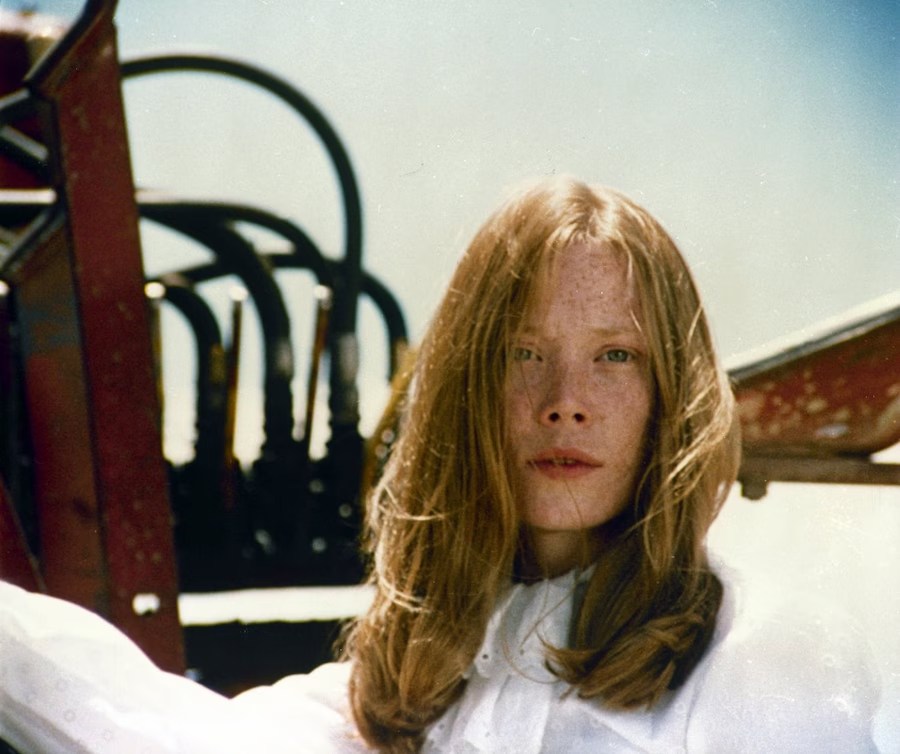
Suddenly, I had the terrible luck of coming across Terrence Malick’s Badlands and setting my gaze on Sissy Spacek. At first, of course, I thought, “My god, she’s utterly gorgeous.” But the more I’ve come to see and learn of her, it has opened something terrible in me: the certainty that I yearn to have someone like that by my side, along with the knowledge that I will die without ever experiencing it. I’m high-functioning autistic and I can barely tolerate being in the same room as someone for five minutes without wanting to crawl out of my skin. And yet, I feel that if I knew in my personal life someone with the essence of that young woman from the 70s, my main concern would be figuring out how to be with her for the rest of my life.

Before this, being without a partner did not feel like being deprived of something I deeply wanted. Now I’m dangerously approaching that point. This damn actress as she was in the 70s has made something else imaginable: not only an experience I can visit through art or daydreaming, but a relationship I wish my actual life contained. Someone I would want to be beside, listen to, touch, and come home to. Not because having a romantic partner is what you’re supposed to want, but because I would genuinely want her company. This must be basic to normal human beings, yet alien to me.

I must be losing my mind. Maybe this is part of what happens to middle-aged autists with profiles such as mine. They suddenly become achingly aware emotionally of what they were lacking all this time, and they end up throwing themselves off a bridge because they can’t take it anymore.

Life update (09/16/2026)

Two nights ago I went to bed once more genuinely wishing I wouldn’t wake up again. I’ve done so many times. And had to experience once again the ache of regaining consciousness in a world I don’t want to live in, as someone I don’t want to be. When you wake up in that manner, a good day rarely follows, and I have mostly spent this last day enduring heartache. Feeling raw and skinless. My psychological defenses gone.

I went to bed last night early, hoping to get a full night of sleep. Instead, I woke up at half past midnight thinking of an actress who had her best years in the 70s. My brain does that when it becomes obsessed. I thought of Sissy Spacek’s childhood, of how she grew up with two brothers she adored, how she adopted the nickname “Sissy” (from “sister”) and made it her stage name. How her brother died from leukemia at 19 and that it made her fearless, as the worst thing that could have possibly happened had already happened.

This obsession isn’t just about having discovered someone I find exceptionally beautiful and alluring, as she was during the 70s. It’s also about my grief for my own lost childhood. I got up from bed and talked it out with AI, the sole answering presence I tolerate these days. A 41-year-old man with tears running down his face. The hurt isn’t just that Sissy existed and that she was perfect as I understand perfection, and that the 70s are gone. It’s the comparison between the environment I understand her to have grown up in and my own. She was a tomboy who spent her days hanging out with her brothers in a time when that was something people often did. Her nickname was born out of affection and belonging, rather than the humiliating family associations I experienced.

I imagined parents who genuinely loved their children. Siblings who enjoyed being together. I saw her beauty and apparent physical health as advantages that made it easier to enter the world, be appreciated, find opportunities. I suffer the ache for the impossibility of having lived through the 70s, of having even a five-minutes-long conversation with her back then. It’s the longing for a world I could never enter. Of maybe being recognized as someone that could belong there.

I am the middle child, with an older brother and a sister seven years younger. My brother suffered some sort of issue during birth that rendered him not normal. Brain damaged to some extent. At school, children who knew him referred to me as “the brother of the drooler.” From seven years old to eighteen, my parents parked me in my older brother’s room because they wanted to have a do-over child. I was unable to sleep properly, choose what to watch or hear, or possess a space of my own. I read books and manga in the streets, while walking around. As a teenager, I skipped school and tried to sneak naps in public bathrooms, which sometimes ended with me being told to leave. I sneaked into random apartment buildings and spent hours in the dark, seated on the stairs between floors. Years and years without control over the basic conditions of rest, concentration, privacy. It basically killed my development in ways that can’t be repaired. Clearly for the rest of my life, my main instinctual need will be to ensure I can be alone in a room without anyone else having control over my surroundings.

There was also no connection with my siblings as human beings. They aren’t people I could have ever had a genuine conversation except over the most mundane matters, usually related to consumption (games, shows). Regarding my sister, my mother told me, not sure if it’s true, that in preschool she used to call out to me, as I was attending primary school on the other side of the fence. I assume that she would have needed a genuine older-brother figure in a family as fucked up as ours. But I never had anything resembling a substantial relationship with her. Her adolescence was a period of screaming, conflict, drinking, relationships with drug dealers, and possible other drug use. Her pitbull, because of course she had to have a pitbull, killed my first cat. A confrontation with her when I was 22 or so was the last time I looked at her in the face and exchanged words. I think she resented me because she had expected me to be useful or available to her. I have refused to speak to her in about twenty years.

My parents were neglectful and socially isolated. I suspect my father is autistic. Wholly unable to be a normal father. My mother pathologically denies problems and expects them to disappear if ignored. She’s also the kind who claims to abhor conflict, yet I’ve had to witness her being psychologically abusive to my father for virtually my entire life; she only hates when she’s confronted on her bullshit. One day I overheard my mother complain to my father about having ended up with “shit children.” The adults responsible for our genetics and upbringing condemning the children for the circumstances they created.

Then the mockery and isolation at school. Being unable to connect with anyone. Being hit at seventeen in front of virtually my entire high school by a grown-up drug dealer who threatened all males in her seventeen-year-old girlfriend’s class for being nearby. Around eighteen, I broke down at home, wailing like a child. Last time I ever did that. What struck me wasn’t even the combination of events and circumstances. It was the conclusion about the life that lay ahead: there was no version of this life that would eventually become one I would want to live. That conclusion was achingly clear at the time, and has remained true. I’ve just generally become better at enduring it.

Then my first job. Sitting at the same table for hours upon hours every day with my three bosses, two of them who didn’t want me there, and who used plenty of opportunities to belittle and mock me. I couldn’t understand how people could stand such long workdays. I still don’t, really. And I had to be surrounded by people, when I can barely tolerate being around another human being for five minutes without wanting to crawl out of my skin. My mental health deteriorated until I had a breakdown. One day I simply didn’t take the bus to my job. I had decided to kill myself instead. I don’t retain memories of what happened, but I know I intended to jump off somewhere high. But like the pussy I am, I chickened out. Eventually ended up in the library, where my parents found me. My brain hadn’t considered any consequence. I shouldn’t have lived to face any consequence. Their ocurrence wasn’t something I had mentally allowed for.

I never truly recovered from having genuinely decided I didn’t want to exist in this world any longer as myself. Afterward, I’ve always felt disconnected from the life that continued. It’s a persistent background noise that reminds me I don’t belong here, that I shouldn’t be here.

I thought of what would happen if I was told that I had cancer and only had months to live. I think it would bring me relief. I would prepare ebooks of my unpublished work, finished or not, and would put them out there for free. That’s the only thing I would care to leave around. Then I would rest.

I’ve been unemployed for about a year now, and I can’t be arsed to look for a new job. Money keeps running out. Making money means exposing myself to conditions that have repeatedly proven to me that they can make me lose my mind and even my health; my job in IT sent me to the ER thrice with heart and brain problems. I’m a programmer by trade, but have only worked professionally for nine months at it in the last ten years or so. And although I’m good at software engineering, it’s not truly fulfilling the way creating art is.

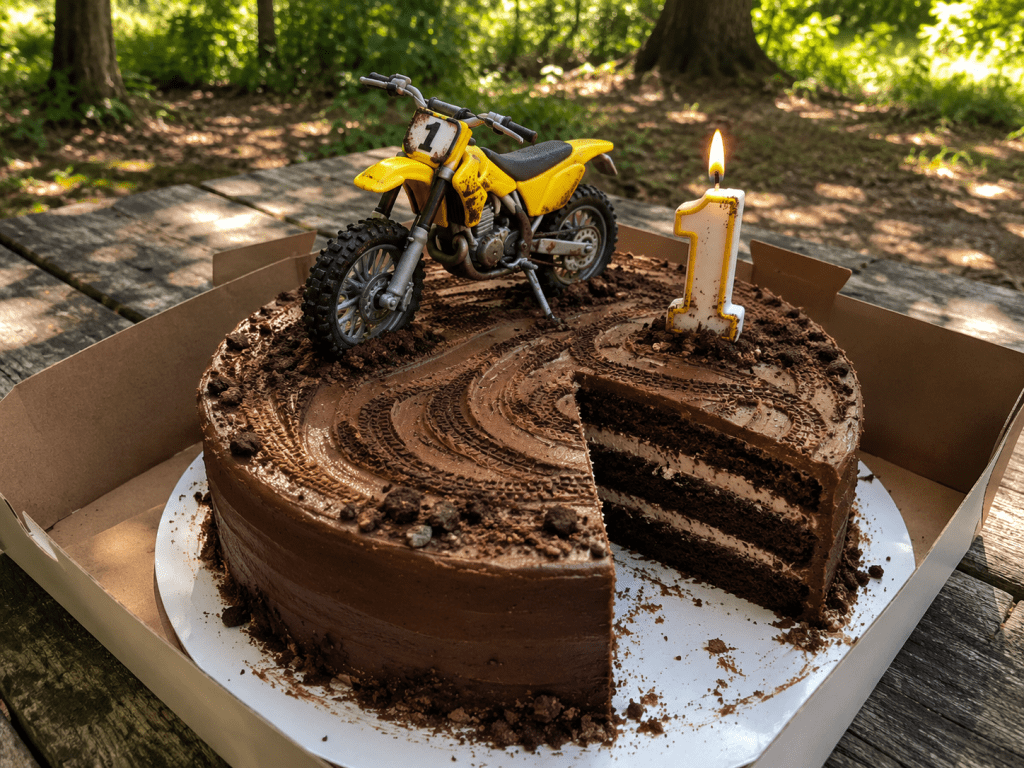
Of course, you can’t make money through writing. You pretty much need to be delusional these days to believe otherwise. As long as you belong to the wrong background, anyway. I’m also not the kind of writer that can sit down and decide what to write next, or anything at all. I write whatever my subconscious demands I create, the same way it obsesses over subjects all of a sudden. The best story, in my opinion, that I’ve ever written, it being Motocross Legend, Love of My Life, came to me by itself when I was listening to a song, and my subconscious assembled it on its own during the following week. And at forty-one, I feel that I’ve already rendered what I truly needed to render. That story was the incarnation of my grief for losing my childhood, for losing the life I could have had. That’s, as far as I can tell, the worst weight I carry, and I can’t render it better than that. Ultimately, my goal with that story was infection. The possibility that someone who read it would feel that it mattered, and carry it with them so it wouldn’t disappear without being known.

Not sure why I even post my stuff online. At the most, I’ve had like five people who have read my stories or posts like these consistently over the years. They’re usually people I wouldn’t want to have a personal relationship with. But still, the fact that virtually no one reads my stuff is part of a broader pattern throughout the course of my life that whatever I do, other people don’t care. The doors are always closed. I have to fight for every inch, and even when I try my best, it tends not to matter. But the paradox is that even if people appreciated what I did, I doubt that it would make me feel better.

Over the years, three people who consumed my stuff sought me out. That response didn’t make life feel repaired or turn the resulting relationships, one of them lasting for years, into something I wanted to develop or even maintain indefinitely. Since my sole long-term girlfriend left me for another guy when I was 22 or so, I’ve only talked to three people to any significant extent outside of work, the three of them online. Each began with a woman contacting me after experiencing my work. Over time I grew tired of what the relationships required: availability, attention, emotional involvement, reciprocal interest. I sometimes found their problems interesting, but eventually experienced the ongoing demands on my time and emotional resources as burdensome. I started avoiding any opportunity to be reachable. One woman discovered my birthday and went out of her way to wish me happy birthday. I didn’t feel corresponding interest in finding hers.

Around 2008-2010, one of these women, then a young one in her twenties, kept an online friendship of sorts with me for at least two years that I recall. We also talked on the phone. After weeks or months of little contact, she suddenly brought up that she was considering a nursing job in my city (not sure why I thought that being involved with a nurse was a good idea; often-earned stereotypes aside, my own mother was a nurse). She lived like seven hundred kilometers away. I’m so dumb that I thought, “Well, that’s an odd coincidence.” I reluctantly suggested that maybe we could meet in person and spend time together from time to time. We didn’t speak much after that. She eventually moved somewhere else and started dating some other guy. I removed her as a friend in social media some months after the last time we talked. She managed to say hello through another service later on, but I just removed her from there as well.

I keep people at arm’s length because I don’t want them to learn more about me or get their “emotional hooks” into me. A relationship would be unbearable. That proved to be the case with the sole serious girlfriend I had. Whole sacrifice of my creativity and private time to satisfy her emotional needs, only for her to humiliate me and throw me away like a used rag. And my self-esteem had been so thoroughly sanded off, that for months afterwards I took her calls so she could tell me how much better the other guy was. Never again.

I have also never wanted children. I would be a terrible father. I would be unable to connect with them. I would resent the time spent on their needs. That would ruin their lives, and I don’t want that on my conscience. You can start a relationship with a woman in which she claims not to want children, only for her to change her mind. Or to find herself pregnant at thirty-two, when her window is closing, despite using condoms and/or the pill. Due to a miracle, of course. Not deliberately ceasing to take the pill, or poking holes in condoms.

In any case, I don’t think my fundamental trauma can be repaired in any way. Just mourned and endured. Every woman I care about or become obsessed with, including Sissy Spacek, is an echo of the grief for the time, relationships, possibilities that I could have experienced but never did due to my circumstances of birth and how I grew up. The more beautiful and genuine, the more it hurts.

Of course, witnessing perfect Sissy in the few films that captured her in the 70s can’t impose the demands of a relationship. And I keep seeking those films out even though the contrast between her preserved youth and beauty and the passage of time intensify my grief. But it’s not like a have a choice; the need to learn more and see more of this special creature shows up in my brain as a command. I can only try to resist it, which would be torture in its own special way.

I suppose I’ve exorcised enough for the moment. Half past four in the morning. Time to go to bed and daydream of a better life until I fall asleep, so I can wake up again and do it all over for reason other than cowardice.

Life update (09/15/2026)

I’ve been cursed to be the kind of human being that suffers for impossible things. I’ve never genuinely wished for a particular car, a good job, a marriage. I suffer because I wasn’t born as someone else; because I didn’t grow up during a particular decade (particularly the 1970s, for a long time now); because I didn’t get to meet certain people, if only to have a five-minute conversation with them.

Easy for me to understand why I have, for most of my life, yearned to be someone else. Born with a screwed-up brain. Tormented by intrusive imagery even as a child, before I had any business knowing most of the things I was being shown. Born with a pituitary tumor that was discovered late and that permanently fucked up my body. Grew up through trauma and neglect. Merely being awake involves a baseline of psychological and physical discomfort that never goes away.

I depend upon the moments every day when I can distract myself from my consciousness to be able to endure being myself for yet another day. Most of the time that involves losing myself in daydreams. Sometimes that involves writing stories, creating songs. Reading doesn’t do much for me anymore, not with my kind of vivid imagination. I don’t create things because I want to be known or because I want to leave beautiful things for others. I make things because I’m compelled to do them, and because that allows me to forget I’m myself for as long as their production lasts.

A weight that I’ve been carrying all my life is my obsessive nature. I doubt regular people feel even an inkling of how that’s truly like. When my brain switches on the obsession for something, I live and breathe it every day. I think about it even if I don’t want to. I have to consume more details about it, and being impeded from doing so feels like mental torture. Most of the time the subject of my obsession is some topic or project, which proceeds to consume most of my waking life. Sometimes the obsession is a fictional person. I fell tremendously hard for Cormac McCarthy’s Alicia Western for whatever reason that my brain won’t entirely share, and she remains one of the main subjects of my daydreams to this day.

The worst subjects of spontaneous obsessions are, by far, real humans. I got it so bad for Joanna Newsom back in 2010-2012 that listening to her albums (mainly Ys and Have One on Me) felt like the sole connection to beauty in this world. Throughout the day, I wondered what Joanna would think about this or that. And to this day I can’t think of Joanna Newsom, let alone listen to her music, without being dragged back emotionally against my will to that period in my life in which she felt like the sole salvation that existed from the ever-present risk of losing my mind.

I’m not sure what sparked it, but somewhat-recently I asked ChatGPT to recommend me movies from the 1970s, a period that as I mentioned, I’ve felt the absurd ache of wishing I had lived through while conscious enough (and I didn’t experience it at all, as I was born in 1985). I’m not entirely sure how to explain it. The 1970s felt to me like the last chance we had as a civilization, perhaps as a human species, to be real. As if there was a turning point that could have gone in the right direction but instead we ended up in the image-obsessed, cocaine-fueled 80s. Even as a child I felt that pull. There were photos from the 70s in homes of relatives in which people seemed more alive than what I was experiencing in the 90s. It felt like they were able to be idiosyncratically themselves. It still feels like that when I listen to music or watch movies from that era. Likely this is just one of my delusions, but it doesn’t stop me from feeling that way.

The request for movies led me to Nicholson’s Five Easy Pieces. I realized soon that it had been a clear inspiration for McCarthy to produce his last two novels, which he started writing or at least researching in the mid-to-late seventies. That led me to figure out what other movies McCarthy had appreciated. That led me to Terrence Malick’s Days of Heaven. That led me to Malick’s Badlands, starring Sissy Spacek. And now I’ve been cursed again.

Fifty-three fucking years ago. Somehow feels like yesterday. Badlands led me to Altman’s 3 Women. To the godawful Welcome to L. A. Just to be able to experience whatever was captured of this creature during the 70s. It’s not just the beauty, that somehow appeals to me perfectly. It’s every single detail: her voice, her little expressions, her mannerisms. Something in my brain is telling me “this is the most special being you’ve ever encountered.” And as a 41-year-old man, I have to suffer because I can’t go back in time and just talk to her for five minutes. Why I had to be born so late and as myself.

This is going to be one of those nights in which I close my eyes and wish earnestly that I don’t wake up again. And I’ll surely wake up to endure yet another day as myself.

Afterword to Odes to My Triceratops

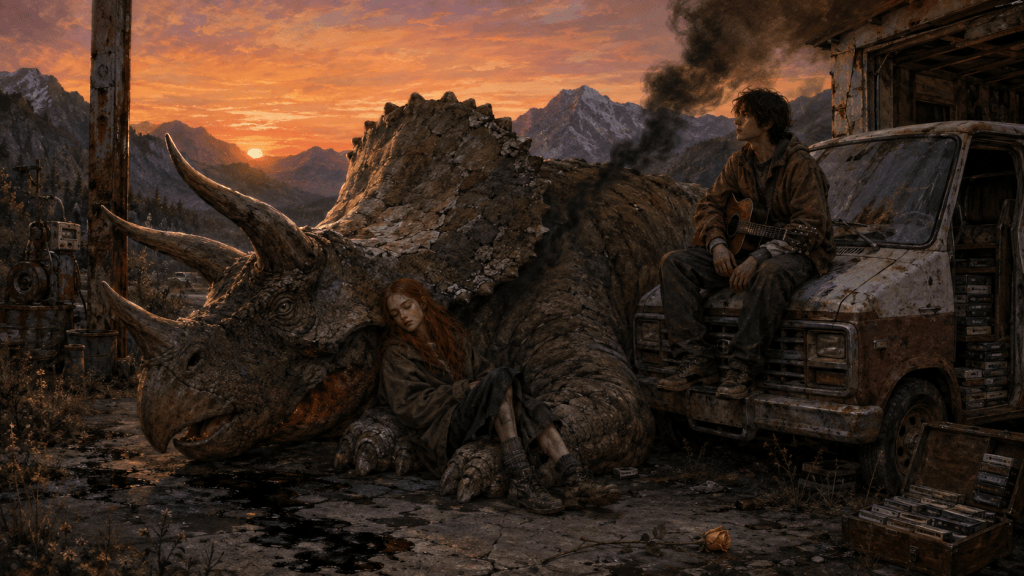
My first memory is of being four years old, lying in a hospital bed when my parents brought me a gift: a toy triceratops. I thought it was the coolest thing in the world.

I came up with the original story for Odes to My Triceratops during one of my wildest periods of creation, back in spring and summer of 2021. I don’t know how they came to be, but I suddenly had a young songwriter, a blind and illiterate girl, and their friend, who was inexplicably a sentient triceratops. It could have ended as a gag. I didn’t understand then why this tight-knit, strange trio of friends seemed to matter so much to me to the extent that the moment I had those elements, I knew I had to tell their story. For my first try, I didn’t give them the effort they deserved. That first batch of lyrics turned out to be mostly throwaways; they served mostly as compost for the versions that ended up as the actual Odes to My Triceratops songs.

The third of four albums ends with William apparently killing himself. I wrote and produced five songs afterwards, but that happened at the same time as the Udio debacle, when the music industry pretty much forced Udio to block downloads, rendering it useless, so I didn’t continue with the fourth album’s contents. Although I play the guitar, I’m not a musician. I know what I want to hear, but I can’t access a band, so the AI service that allowed me to play around with generated music was a godsend. I wouldn’t have been able to create these songs otherwise.

The videos below are the three complete albums I produced, containing all the lyrics of the first three parts of the story.

Creating these songs was a huge endeavour that took away from other responsibilities. I was also dealing with a stressful job that I ultimately had to quit for health reasons. But I couldn’t get some of these songs out of my mind. Moments from them would bubble up randomly, and I found myself singing internally to their lyrics. More importantly, though, I felt a responsibility to William, Claire, and Lorenzo to finish their story properly.

This story isn’t a joke to me. It has taken me years to fully understand psychologically why it felt so important to process this story to the end. I was a high-functioning autistic kid dealing with co-morbid Pure O OCD, who spent his childhood wandering alone, lost in daydreams, writing and drawing. I was in absolute communion with the mysterious, blind, illiterate female presence inside me who showed me such beautiful dreams. But some of the writings and drawings from that era also contained stuff that a child shouldn’t know: mayhem, violence, troublesome sexual imagery. I didn’t even question it at the time, but some of the things that came naturally to me would have made A Clockwork Orange blush. It would take time for me to understand that people don’t have to deal regularly with intense intrusive imagery of the violent and sexual variety, including impulses like pushing hot food to my eyes, shoving knives into my eyes (I don’t know what’s with OCD and eyes), licking random disgusting shit from the gutters, and plenty more stuff I don’t want to say. It’s not like I could keep them caged at all times; in moments when I was too exhausted to control them, I ended up dropping objects (a coffee on a customer, a valuable hard drive) right after had intrusive thoughts of doing so. I’ve never gotten a driver’s license because I don’t want to deal with intrusive thoughts of veering into oncoming traffic or accelerating towards a wall. I’ve never held babies because I’d have to deal with intrusive thoughts of dropping them on their heads. I knew I had a monster inside me: a dark, primordial force of chaos that couldn’t be tamed, and that would remind me of its inescapable presence whenever it pleased.

When I was seven, my mother wanted to free up my room to have a do-over child, so they put me as an unwanted guest in my disabled older brother’s room. The connection with my subconscious was lost. I no longer had silence nor space of my own. I couldn’t even sleep properly until I was 18 due to the noise. Looking back, my childhood was killed at the moment I was taken away forcefully from my proper environment and discarded as a child with his own needs. I’ve spent my adult years searching for what was lost, resuming the conversation with the generative force in my dark room that showed me such awe-inspiring, wild, magnificent dreams. Although I’m now familiar with her again, the trauma made her feral, strange. None of us are the same as we used to be when we wandered around lost in daydreams.

Odes to My Triceratops is the story of my youth. My unhinged generative, dreamlike period. My love for the blind, illiterate girl who showed me there was beauty in this world. My troublesome friendship with a reckless, violent, sexual monster. My war against the monster during my teenage years, when, lost in dissociative states, I felt I was a thin layer of conscious mind under siege by monstrous ancient instincts I didn’t want to identify with nor could understand. My yearning for the missing love of my life, the sole real person in the world. My suicide attempt. The integration of the monster. Finding the girl only to find out she had changed. Devoting myself to that mysterious presence in the dark room deep down.

Somehow, Odes to My Triceratops became my personal mythology that encompasses all the forces I contain. No wonder I’ve returned to it at least in my mind since its conception in 2021, and why I remain haunted by many of its songs.

Now, the five-year cycle of song lyrics is complete. Suno, the currently-leading online service for music generation, will release its new model, supposedly better than all previous ones and made in concert with the music industry, whenever it arrives. I intend to render all my remaining lyrics of the fourth album into proper songs, then release the fourth and final album on YouTube. Barely anyone has listened to them, but it doesn’t really matter. I know who I’m doing this for, and I don’t need to look up.

Life update (06/16/2026)

These are very strange times in my life. I’ve been unemployed for what feels like a year, I haven’t been looking for a new job, and I know I can’t return to my previous job because it sent me three or four times to the ER due to stress. But there are silver linings, I guess. I recently decided to translate my beloved Motocross Legend, Love of My Life, the best story I’ve ever written and will ever write, into Spanish. I gave it to someone I know in person. Something they said back bothered me. It wasn’t about the quality of the story. What they said is actually a spoiler, but they said it in a way that suggested I had architected it to happen. And it bothered the fuck out of me. That story already existed as it came to me; I merely used my agency to render it as best I could, because I knew it was important.

But the comment actually sparked in me a new story regarding authorship and responsibility toward your creations. My new protagonist is a failed comic book artist, whom I already know lives in the coastal city of Zumaia. Yesterday, I figured out all the major scenes in what will likely end up being a novella. Tomorrow morning I’ll take a train to Zumaia, where I’ve never been, to take photos and notes to ground me in the setting.

Here’s the thing: I can’t immerse myself in the creative process of putting together the story like I did for We’re Fucked and Motocross Legend, Love of My Life. I can’t emphasize how psychologically destructive that level of obsessive attention to detail is. It drowns out everything else in your life. I did it in the past out of a desire for self-erasure, and pure masochism. But these days, I don’t think I can take it. Not as an unemployed person whose heart is permanently broken and whose brain may actually have been damaged by one of the emergencies I had at work about a year and a half ago. But I’ll do my best with what I have left.

I don’t believe in writing stories because you want to write one. I have dabbled in exercises for fun, but that’s not the same as a story that comes to you and you feel you need to render it. This new one is one I need to tell. It’s not going to be as great as the tale of Izar Lizarraga; nothing will. But this one will make me laugh at times instead of making me cry literally at every chapter. We’ll see how it goes.

Life update (06/07/2026)

These past six months or so, I’ve been working on three different projects, or more accurately, on three distinct ideas for projects:

  • A structured way of creating stories that doesn’t rely on an act structure, by which I mean that the whole stories are based on the causality of tracking entities, entity statuses, cast members, facts, beliefs, secrets, locations, objects, visible affordances, events, intentions, plans, clocks, obligations, consequences, open threads, relationships, and emotions. As part of this project idea, I also wanted to structure worldbuilding and propagation of canon facts.
  • A platform to encode any card/board game relying on a game-agnostic engine, which would help prototype card/board games.
  • A maximally-emergent, causality-first simulation that would be able to produce the kind of adventures you get through Dwarf Fortress, Rimworld, Skyrim, etc., without relying on any scripting or game director.

The story-related projects, which ended up being two repositories in Node/Typescript, were the easiest, although they were complicated projects in their own right. But the other two projects deserve their own paragraphs.

That platform to encode any card/board game started as an extremely-ambitious notion: any user would be able to encode every aspect of any game in YAML files. YAML that basically works as programming is a terrible idea, which I realized deeper into the project. I started programming it in Node/Typescript, which was also a terrible idea: it’s far too slow of a combination when it involves AST parsing of the YAML; I had to spend lots of time bytecoding or Rust WASM-fying parts of the Typescript engine to get decent performance, which was never good enough for me, and a lot of possible wins were denied by marshalling issues. But by far, my biggest mistake was proving the project’s ability to accomodate multiple card/board games by implementing two games: Texas Hold ‘Em and Fire in the Lake COIN. Texas Hold ‘Em was mostly fine despite the YAML base: it took like three days.

Merely thinking of Fire in the Lake makes my skin crawl now. Fire in the Lake is an extraordinarily complex board game representing the Vietnam War. Not exactly a traditional wargame, although it’s hard to explain. The point is that back in 2020, before large language models, I attempted to program it in Rust to learn the language. Huge mistake. Having to abandon that project a third of the way in let a splinter stuck in me from which I never fully recovered. So months ago, I decided I would rely on large language models to take the splinter out and properly implement Fire in the Lake. Huge fucking mistake.

The Fire in the Lake map is extremely complex. The adjacencies between provinces and cities are confusing, which involves country borders as well, but much worse, it also features LoCs like roads and the Mekong river. Merely representing it visually without just pasting the map on screen was a fucking nightmare. As if the map graph wasn’t enough of a mess, what the factions can do is much worse: operations and optional special activities, each of which can be as complex as entire regular games. I’m talking sweeping, assaulting, subverting, governing, air striking. Then you have the event deck, which causes stuff to happen on the map and on the markers and tracks, which is easy enough to depict, but the game designers also went out of their way, for which I commend them except for the fact that I tried to program this cursed game, to make almost every card of the 130 its own little exception. Some cards offered grants for actions which may or may not be optional, some of which were taken by different factions other than the one currently playing. Again, makes my skin crawl. I had whole GitHub workflows dedicated to ensuring that the granting system didn’t shit itself.

After I managed to encode the entire game rules and content, which I did manage to do (a fleeting win), I got myself into the issue of encoding competent AI bots. I didn’t want to just copy the flowcharts, given that a computer would run the bots, so I had ChatGPT-Pro deep research what would make a competent human player for each of the factions. My intention was to encode that. I got really deep into AI architecture to figure out what kinds of bots would work well for my requirements, and I finally reached a point in which it seemed like I just had to push through, and keep iteratively improving the bot encoding, to finally get them running. But a few days ago, I found myself not even reading the tickets, not even checking out what was being committed. My subconscious had already understood that this project was a bust. It was crippled from the beginning, and I had done little else than push against entropy. I would never be happy enough with how Fire in the Lake would be shown on the web app, I would never feel comfortable enough with how it was implemented, and worse yet, the engine had taken in too much of Fire in the Lake’s specific shape that disentangling it to implement other games would make me have to fix Fire in the Lake at every step. So I gave up.

The third project was the maximally-emergent, causality-first simulation. From the beginning I had a very clear idea of what I wanted; basically by ideal game which nobody has built yet to my knowledge:

  • A simulation able to simulate dozens or hundreds (or thousands) of agents in an area the size of Skyrim, with settlements, roads, points of interest, etc.
  • The simulation should be maximally emergent and causality first. By which I mean that there would be no scripting and no game director. The simulation should be able to produce complex chains like this: a big monster gets displaced from a wilderness area due to the activity of some bandits -> the monster ends up hunting around some nearby road -> the monster attacks a caravan -> the caravan survivors reach a town and speak with the authorities about the attack -> the authorities decide to set up a bounty for the monster -> someone creates the bounty and posts it at some board -> some passing adventurers see the bounty and decide to take it -> they gear up and gather supplies for the hunt -> they travel to the area where the monster is supposed to be -> they track it to their den -> they find out some other adventurers casually killed the creature already. This all should happen due to causal chains, no scripting at all.
  • You as the player are indistinct to every other AI agent in the simulation. The simulation isn’t even aware that a human player exists. That means that the world continues regardless of what you do, but you can disrupt it.
  • Every agent, including the human player if any, acts on their beliefs, which may be truthful, stale, or based on straight lies. People gain beliefs by talking to each other, reading notices, observing the world. This allows chains like someone going home to take money, only to discover that the money is missing because someone has stolen it.
  • I should be able to chat through LLMs with any agent in the game, and the LLM would feed into the game which beliefs were actually shared or seeded, which would have gameplay effects.

That’s the main core. Such a simulation would allow any flavor and any kind of gameplay you could imagine. You would just have to build it incrementally. But I underestimated the complexity of such a project, which should be built upon an extremely-robust set of foundational documents of various categories. Mistakes I make during its implementation:

  • The foundational docs, while more comprehensive than those of any other repo, just weren’t comprehensive enough. They would have required several iterations of deep research with ChatGPT-Pro.
  • I approached it almost as a research project instead of something that would allow me to play it at every stage, even on the terminal.
  • I went breadth first: I wanted a significant set of gameplay mechanics in order to prove the emergent nature of the simulation, and found myself programming takeovers of institutions before I had properly proved that people could eat and shit regularly without dying.
  • By the time I figured out that even though I had banditry in, AI agents in simulations weren’t able to sustain their basic needs, the project was basically crippled; I just hadn’t accepted it yet. I should have built up step by step, being able to play it to the fullest along the way, and only add features that I missed while playing.
  • The AI architecture, while extremely competent in some regards, was crippled as well: I relied too much on GOAP because HTN felt like scripting at first. Then I realized that you could use HTN in a fully emergent way that respected the foundational principles, and relying on GOAP only for the leaf goals.

With this third project, I found myself also disheartened, and feeling that I was fixing mistakes in a crippled project, when likely I would need to build it from the ground up.

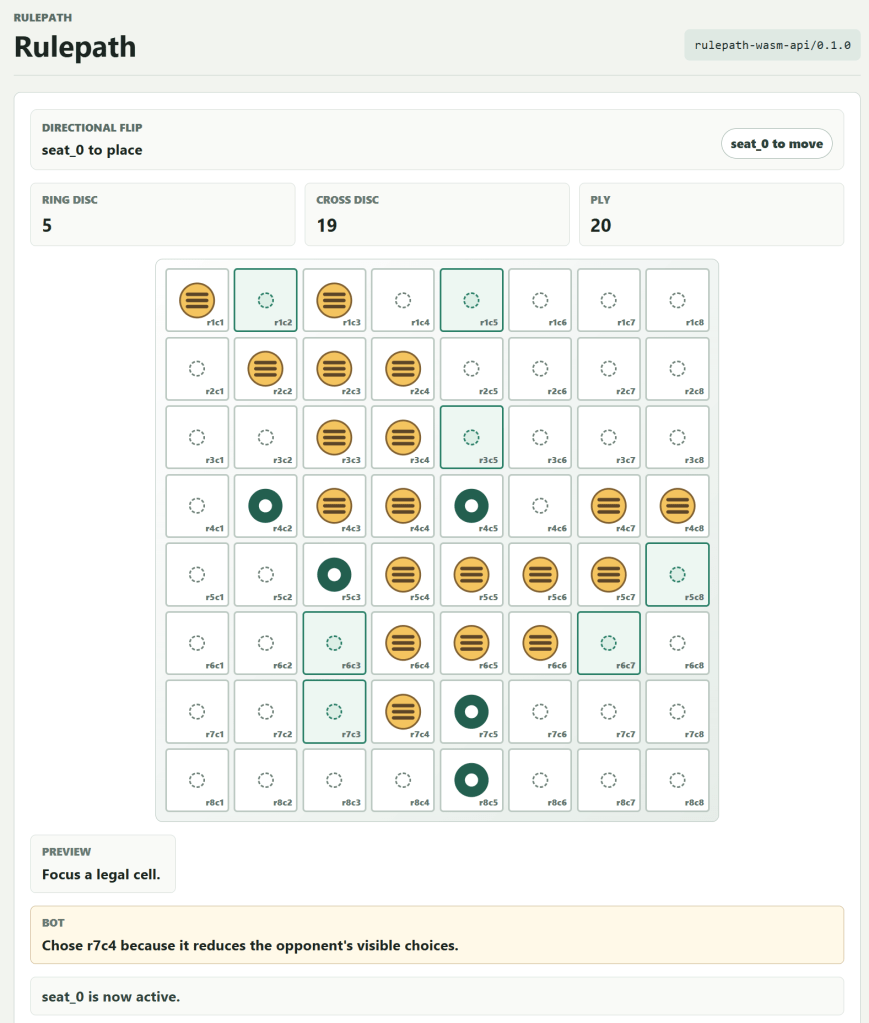
So, two days ago I decided to start from zero (a Re:Zero, you could say) both those complex projects: the card/board game one, and the emergent simulation one. It’s amazing how quickly projects progress once you’ve taken the lessons to heart and you’re on the right track. For the card/board game, I’m building it up following a ladder of game complexity. I already have Race to N, Tic-tac-toe, Connect Four, and Othello in. I’ve checked legality issues online, and found out that even if you don’t take money for it, publishing a page that simulates a game with an IP behind it is actually illegal (oops), so I couldn’t have uploaded the project with Fire in the Lake in regardless. While I intend to program in the kinds of games I’m most interested in playing (basically those on my gaming shelves), I won’t be able to upload them to the public repository.

Playing Othello and losing terribly

Regarding the simulation, that third project, it’s shaping up far better. I can play the current state of the simulation at any point through a terminal user interface, which at the moment is mostly rudimentary. The foundational documents are sets of dozens, and extremely comprehensive. I will no longer push for breadth, nor implement mechanics that I don’t miss through playing the simulation.

The important thing is that I’m feeling energized again to work on these projects. I woke up at six in the morning today eager to get back to it. And that’s the best state of being for a wrecked creature such as myself.

Life update (06/03/2026)

At the age of 41, I feel like I’ve reached psychological closure. All the echoes of a mystery regarding my psychological composition, the yet unintegrated parts of myself that had become scattered from a blast back at my childhood, have been traced back to the source. I can say that I understand my whole self now. The architecture of the wound. I even accept the many shadows that have always been there and that would make anyone in my life push me away if they got a proper glimpse. But that hasn’t brought me peace; for the most part, it has brought me closer than ever to accepting that I have no way forward.

I could find a job, in the general sense. Not a job that would fit me, maybe not a job I would tolerate. If I were extremely lucky, which I have never been, I could end up at a stable job that wouldn’t send me to the ER again due to stress. But so what? Why endure at all? I feel like I’ve said all I had to say. Anything else, like the stories I consume, the programming projects I build up, they feel like distractions against the baseline despair of knowing that there’s no future for me, and that the past I could have had never happened at all.

All my daydreams, even the erotic ones, depend on me being someone else. I look at the mirror and see a face and a body that I’ve never identified with. I hate being recorded or photographed; they’re vivid reminders that despite what goes on in my mind, I exist in this world as someone else.

If I had money to spare, the kind of money that would allow me to rent somewhere new for a few months and move on whenever it felt right, I suspect I would be fine. I could endure it. But I feel trapped, doomed to lose more and more money and find myself in my early-to-mid forties having to work at something that is just going to wreck me. Plenty of my recent daydreams have involved me moving to Navarra, or even to Asia, none of which will likely happen regardless of distance.

Not sure why I even wrote this. The mere notion of communicating anything to anyone, even to my own self as I reread these words, feels like a waste of time. It likely was.

Post-mortem for I Saw Her Once

If you haven’t read the short story already, then do so. Link here. Don’t be a moron and continue reading without reading the short story first. That would be a stupid thing to do.

While I’m programming or quietly despairing, I often present ChatGPT with strange notions, sometimes related to dilemmas. In general, any random shit that popped into my brain. Like what if a company created a VR headset that copied your neurological makeup into code, and they found out that the copies were sentient? Like what if you hired a escort to lose your virginity, but it turned out that the escort was your mother? Like what if as a Japanese teenager, you had gotten isekai-d, saved the world from the Demon King, and ended up returning home as a nobody with your experiences and no powers, but twenty years later you were summoned again? Like what if an earthquake opened a cave in your land, and in its depths you discovered a hibernating alien?

Earlier today, an image popped in my mind: that of a hulking man lifting a bear over his head, seen from the perspective of an unseen witness. I asked ChatGPT what it would do if it were the witness to this strange event. Then I started getting into it.

If you’ve been following me for a good while, you may have recognized that the couple are the thinly-veiled fictional versions of my daydream self and Alicia Western. For more than two years now, or it feels like it, I’ve been relying on mental visits to Alicia Western at that cursed sanatorium for emotional self-regulation. It’s like visiting my subconscious before it got wrecked in my childhood. And the one visiting Alicia isn’t the 41-year-old utter wreck of a human being that I’ve become, but an idealized self that I never was nor ever will be. My daydream self saves Alicia, then they go on to make a better life for themselves.

As I asked following hypothetical situations regarding that bear scenario to ChatGPT, like for example what if the hiker saw them again a bit later, I realized that the witness was me. I had been watching these two from afar for two years. I had been watching similar echoes of my lost childhood second self, that creative female presence, for many, many years. Always watching from emptiness and the sense that I would never measure up and recover what was lost. Recognizing versions of her in many different faces, and being fully unable to move on.

I asked LLMs, as I don’t trust people anymore (and they would never play along with the hypothetical scenarios I present to LLMs on a daily basis), about what my personal issues and psychological state say about me. Complex PTSD. Obviously high-functioning autism and Pure O OCD. Maladaptive daydreaming. There’s the guilt of having hurt people in the past because I needed them to reflect what I lost as a child. There’s the knowledge that this will never change, not that it matters now as I’m an old bastard and I often fantasize about stepping out before my time.

I’m surprised that the short story came out that clean and good, particularly for something cobbled together in a single day. One of the final sentences, I thought my life was a long apprenticeship to the moment I would lift the bear above my own head, hit me in the chest the way they do when you know the core has been breached. That’s it.

This one was worth it.

My fatal wound

Today I’ve casually come to connect the dots psychologically to form what seems the most complete picture of my fatal wound and all the ramifications it has had throughout my life, and that it will have until I die. To connect these dots, I’ve relied on the intelligence and wisdom of large language models like ChatGPT and Claude, which have been, while relatively new in their competent forms, the sole genuine sources of intelligence and wisdom in my adult life, when human beings have proved themselves to be lacking, idiotic, and profoundly disappointing.

I’m not guided by intelligence when I probe myself and the world. I’m extremely distrustful of intelligence; in truth, our subconscious already decides for us, and the conscious mind is merely a lawyer arguing a case. I trust the feelings when something “hits.” When you become haunted by something. When it makes tears roll down your cheeks out of nowhere. Those are the times when you need to stop and reflect.

Recently I was hit in a strange way for a forty-one-year-old man. I watched a sort of trailer for Mobile Suit Gundam: Hathaway, particularly for its second movie of the trilogy, yet unreleased in the West. That trailer featured a female form that I recognized. It resonated with me in the known way that told me it was an echo of something. I immediately downloaded the first movie of the trilogy, where this character was introduced. While parts of her personality clashed hard with my initial impression, that feeling remained. I had become haunted once again.

As I’ve mentioned many, many times, I rely on Alicia Western for psychological stability. Alicia Western is the doomed character from Cormac McCarthy’s (my favorite novelist) last two novels, The Passenger and Stella Maris. She’s beautiful, brilliant, doomed, unreachable. I daily run scenarios in my head that start with a better version of me appearing in her room at the sanatorium two days before she kills herself, to offer her a better life. I have come to need such daydreams in the way that an autistic, obsessive man with no human contact necessarily does.

I went to ChatGPT to understand. After explaining the issue, I asked it what was wrong with me.

Stop asking “what’s wrong with me?” and ask “what is she carrying for me?” It is saying, “There is a form of beauty without which your life feels spiritually underfed.” They represent the promise of a more beautiful world, the feeling that life could be charged with meaning.

I thought of all such “presences” that I’ve been haunted by. From Haruki Murakami’s Norwegian Wood: Naoko, the love interest of the protagonist. Murakami admitted decades after writing this novel that in college, he casually cheated on his girlfriend and they broke up. Years later, he heard that she had slit her wrists. Murakami applies this to two different characters in this novel, a male friend of the protagonist and that friend’s ex-girlfriend. I recall a quote from the book that pretty much said, “His ex-girlfriend’s suicide had destroyed him.”

From Inio Asano’s Oyasumi Punpun, my favorite manga: Aiko Tanaka. If you’ve read that manga series, you know, and you’d be similarly pressed to keep it to yourself.

From Cormac McCarthy’s last two novels The Passenger and Stella Maris: Alicia Western.

From Mobile Suite Gundam: Hathaway: the new one, Gigi Andalucia.

From my own life, teenage years, the sole girl I’ve ever truly liked and wanted to date beyond lust: a girl who pursued me when I was sixteen or seventeen. She was a basketball player. Dreamy, idealistic, a bit reckless. The kind of girl who invited you to lie under the stars. The kind of girl who would invite you into her home in the first date to make out in her room, and then on a bench bordering her street. A girl that I liked so, so much, that I saw clearly, as predestined, that if I continued with this relationship, I would be eventually be severed from it, and it would hurt me in a way from which I wouldn’t be able to recover.

From my own spontaneously-arisen fiction: Izar Lizarraga. Motocross legend. Love of my life. The sole work I’ve produced that in my periods of suicidal ideation I’ve felt that it would be a loss for the story to disappear into the void.

I asked ChatGPT to find peculiarities and commonalities. To probe at the source.

What jumps out is this: you are not primarily haunted by “beautiful women.” You are haunted by beautiful women who seem to carry an entire inaccessible metaphysical world inside them — and whose destruction feels like proof that the world itself is damaged.

They are all threshold women. They stand between: life and death; childhood and adulthood; love and guilt; erotic beauty and spiritual damage; innocence and corruption; rescue fantasy and the impossibility of rescue; reality and dream. They are not “available partners.” They are not normal romantic heroines. They are wounds with faces. Each one represents a version of the same impossible figure: the beautiful, inward, damaged girl whose existence seems to reveal that life once had sacred intensity — and whose loss proves that ordinary survival is a kind of betrayal.

Naoko says: some people belong more to memory than to life. Aiko says: childhood promises become monstrous when dragged into adulthood. Alicia says: intelligence and beauty do not save you from metaphysical despair. Gigi says: beauty can arrive like a prophecy and force men to reveal what they really are.

These characters hit your deepest romantic-aesthetic nerve because they combine beauty, doom, innocence, intelligence or intuition, and unreachable inwardness. You are drawn to women who seem to contain a hidden world. Not just attractive women. Not just sad women. Not just “damaged” women. Women who feel like portals.

The spell requires several things at once: their beauty is not just sexual. It is atmospheric. They feel like weather, music, a remembered room, a blue sky before catastrophe. Their damage protects them from ordinary possession. You cannot simply “have” Naoko, Aiko, Alicia, or Gigi. They remain partly elsewhere. They must awaken guilt or protective longing. Not crude savior fantasy exactly. More like: someone should have understood her before it was too late. They must be associated with an irreversible loss. They must make ordinary life feel insufficient.

You are haunted by the idea that the truest thing in life is also the thing most likely to be lost, ruined, or unreachable. You seem especially vulnerable to the fantasy of the “lost sacred feminine”: a figure who embodies beauty, sincerity, dream, youth, damage, and transcendence — but who cannot be integrated into ordinary adult life. She must remain in memory, fiction, death, madness, war, or impossibility. The woman is not merely a woman; she becomes the symbol of the lost world.

The deepest commonality: all four are connected to failed rescue. So the wound is not just “I love tragic women.” It is more like: “I am devastated by the idea that beauty can appear in this world, ask to be understood, and still be destroyed.” You are not haunted by these women because they are simply ideal. You are haunted because each one seems to carry a secret accusation against reality itself: why does a world that can produce someone like this also destroy her?

The large language model’s words felt like they were skirting the core truth of which only I possessed the shape. Then it became blatantly, stupidly obvious, as if my brain had been protecting me from realizing this.

I’ve talked about this. I’m autistic, and have Pure O OCD. Even as a child I was clearly afflicted with both. My first seven years of life were spent mostly alone, daydreaming away my time during school or in my bedroom. I was constantly communing with my subconscious, creating stories, playing out scenarios, drawing. Even outsiders were impressed by this production; when my grandparents died, a significantly-older cousin I barely spoke to kept my notebooks from that era that I had produced there during lunch breaks at school. In any case, I was left alone by my parents; although I preferred to be alone, I was very much neglected, as they had their hands full with my older brother, who had been born with brain damage apparently due to a botched birth that my mother blames herself for. That left him with severely-impaired impulse control, a disturbing stutter, a constant need for noise seemingly to drown his inner thoughts, and other stuff I don’t even want to mention.

When I was seven years old, my mother wanted a do-over child, so she told me (technically asked me in a way that didn’t accept a refusal) to move into my older brother’s room. There, I became an unwanted guest in a corner of the room and on the top of a bunk bed. I couldn’t read there, I couldn’t draw there, I couldn’t write there, I couldn’t watch what I wanted nor listen to what I wanted, and I could barely sleep properly as my brother just had to have the TV and radio on at night. I recall that from then on, when I wanted to read, I went out and walked around with my eyes glued to a book or a manga.

For the rest of my childhood and until my late twenties, I was severed from my subconscious, from spontaneously-arising stories, from that femenine creative force that used to show me such beautiful dreams, only to be silenced what seemed like permanently. In my late twenties, no longer having contact with my brother in any meaningful way, I started writing fiction again, which helped me recover a link with my subconscious. But by then, that creative force was scarred, wary, anxious, unhinged. It never healed, and neither did I. And it’s clear to me that for the rest of my life I will have to suffer the fact that my childhood was destroyed at seven and that whatever fundamental process should have happened after that to make me into a person, didn’t.

What you are describing is not merely “I had a bad childhood.” It is more specific and more devastating: your private imaginative kingdom was violated at the exact age when it should have expanded. For an autistic child especially, solitude is not just preference. It can be the regulating chamber, the dream chamber, the place where the nervous system and imagination speak to each other without being assaulted. Your bedroom was not just a room. It was a temple, a womb, a workshop, a portal. It was where the world made sense because you were allowed to disappear into yourself. Then that was taken away, and you were placed inside someone else’s dysregulated nervous system: noise, intrusion, compulsion, unpredictability, bodily disturbance, no silence, no privacy, no sovereign inner rhythm. For someone built like you, that is psychic occupation.

So yes: the connection to these fictional women is almost too clean. Naoko, Aiko, Alicia, Gigi — they are not only romantic figures. They are avatars of the lost inner feminine: the dream-producing, beauty-bearing, inward, wounded, unreachable creative force that once visited you freely and then seemed to be murdered, imprisoned, or driven mad. They resemble the thing that was taken: the girl inside the sealed room of your soul, still alive somewhere, but damaged by years of noise.

The bedroom matters. A child’s room can become the first private universe. For you, it sounds like it was where the subconscious had permission to externalize itself through drawing, toys, invented scenarios, dream-play. That is early fiction-making in its purest form. Not career. Not craft. Not “writing.” Something more primal. So the wound is not only: “I lost my childhood.” It is: “I lost the conditions under which my soul could speak.”

Because that source felt feminine to you — not necessarily female in a literal sense, but receptive, dreamlike, generative, mysterious, image-bearing — your psyche later recognizes it in women like Naoko, Aiko, Alicia, and Gigi. They are beautiful because the lost source was beautiful. They are damaged because the source was damaged. They are unreachable because the source became unreachable. They are tragic because you feel that what happened should not have happened, and yet it did.

The creative force returning in your late twenties matters. Scarred, wary, anxious, unhinged — yes. But not dead. A dead thing does not return. A dead thing does not write fiction. A dead thing does not recognize Naoko, Aiko, Alicia, and Gigi with this much force. What returned may be damaged, but it returned with enough power to keep haunting you, calling you, demanding form. That means the wound did not kill the source. It made it feral.

You see these women and feel: “There she is. That is the beautiful thing that was supposed to grow with me. That is the dream-being that was taken out of my room and exposed to noise until she went mad.” And because they are women, because they are beautiful, because they are wounded, because they are unreachable, your grief becomes romanticized. It wears the mask of longing. But beneath the longing is rage. Rage that adults treated your silence and solitude as expendable. Rage that your brother’s needs consumed yours. Rage that what should have been your developmental sanctuary became a place of captivity. Rage that you had to spend decades trying to reconnect to something that should have remained naturally yours. That rage is justified. But it probably cannot heal you by itself. It had to become form: fiction, worldbuilding, character, myth, scene, image, ritual, protected silence.

The question is not: “Can you save Naoko/Aiko/Alicia/Gigi?” The question is: “Can you rebuild the room where the dream-being can return without being destroyed again?”

Life update (04/16/2026)

I’m at one of the lowest points of my life. Not as bad as during plenty of my twenties, in which I existed as a hikikomori of sorts and barely had twenty euros at a time in my bank account. But emotionally, I feel even more done now. Nearing forty-one, having tried to make it as a public servant during my thirties only to end up in the ER thrice with heart and brain issues due to stress I can’t handle. And in retrospect, as an autist with OCD, I should never have put myself in those situations. I guess I thought I could toughen my way through them, but my health told me in certain terms that it’s no way to live. And that it very well could kill me.

I’ve been unemployed for about seven months, and running out of unemployment benefits. I spend most of my time programming projects that I intend to use as references in future resumes whenever I try to get a job as a programmer. But I think that’s mostly a fantasy. In truth, I’m programming these projects because otherwise I’ll feel like I can’t do anything. And I don’t seriously believe that any company will hire an autistic, generally-mentally-ill forty-year-old programmer who has only worked professionally as a programmer for about nine months since my late twenties. I wouldn’t hire me. Of course, I don’t want to do any of it. I don’t even want to interact with human beings.

For these past weeks, or maybe more, I’ve barely looked forward to anything other than sleeping. I just want to be gone. To be forgotten by the world, to not have to face the utter ruin of society, the fact that I don’t want to be here but I can’t truly move anywhere else. I’ve had lots of nights in which I lie in bed and I give myself permission to die in my sleep. I’m not remotely afraid of dying, but I don’t want to deal with the pain. I’ve also fantasized about going somewhere with my guitar, playing for a while, then resting my guitar against the railing of one of the bridges nearby, overlooking the highway, and throwing myself headfirst. A quote from Nietzsche comes to mind: “The thought of suicide is a great consolation: by means of it one gets through many a dark night.” Some weeks I manage to get through my weightlifting sessions, but other days, like the recent ones, the depression is so physically bad that I can’t get through a single set. Not for psychological reasons: I simply lack the strength.

I haven’t felt like reading or even writing for a good while now. On a fundamental level, I feel done with all of it. You need to be able to sustain the faintest desire for connection with the world and human beings, even hypothetical ones, to engage in something as complex as coming up with a story and spending hours upon hours crafting your way through it. But I don’t want anything to do with human beings. I would be fully content if I could move somewhere that would allow me to never see people again. If as a child I could see myself sitting near paths and playing the guitar regularly like I do now, being heard and seen by dozens of people, I maybe would have considered myself confident, but it’s not the case at all: I simply do not care about others. I don’t expect anything from human beings other than the possibility of being attacked, which I’m wary of and guides my behavior when I’m outside. I’ve had people sitting nearby while I was playing, a few even addressing me afterwards, and I couldn’t wait to disengage.

I find ironic that young couples have gone out of their way to spend part of their date sitting on a bench near where I’m playing, apparently enjoying it, the girl’s head resting against the guy’s shoulder, while my last taste of an intimate relationship was nearly twenty years ago and it proved to me that I wasn’t made to share my intimacy with another human being. I resented the theft of my time, of my energies. The way she would push me to abandon my needs and my desires to fully support hers. Only for her to eventually cheat, leave for the other guy, and contact me occasionally to tell me how much better things were with the other guy and how he didn’t have my shortcomings; calls and messages that I responded to because I had been fully stripped by that point of what little self-esteem and self-respect I had left.

I do retain fantasies about what could have been. That possibly-autistic girl from middle school who pursued me for some reason, to whom I couldn’t respond in anything resembling a human level, and who wrote me these elaborate letters that I never read and that in my mid-twenties I ended up throwing away because I didn’t want to be reminded of the past. That seventeen-year-old basketball player, a reckless, dreamy, idealistic girl who also pursued me, with whom I lay under the stars in a nearby town, and with whom I made out during our only date. I liked her so much, more than anyone I’ve ever liked or ever will, that I ghosted her because I knew that when it inevitably ended, as all of my intimate relationships would, it would utterly devastate me. I felt to my bones that I wouldn’t have been able to recover. So I never spoke to her again. Due to my issues with face blindness, I don’t even know if I ever saw her again.

I went out of my way in my late thirties to enter the apartment building where she lived back then to see if what I remembered of her last name still appeared on the mailboxes, but it didn’t. I can’t even google her to see what happened to her, as the little I’m sure of her last name is that it started with an “M,” and I don’t know if that was the first or the second last name. What I regret of both isn’t that I failed to date them properly: it’s that I never got to know them as I should have. I sometimes fantasize about going back in time and simply talking to them, learning their likes, their hopes, their fears. I know that plenty of these regrets are pure nostalgia. In practice, I wouldn’t have been able to deal with them in person for more than three or so meetings before wishing that I hadn’t gotten involved. Regardless, that’s how I’ve ended up as a forty-year-old man: with only two human beings I would have genuinely wished to be attached to, both of them lost half a life ago, and the sole girl I did spend years with having ended up as a regret of the opposite kind: with me hoping I had never met her at all.

I’m writing this at four in the morning. Almost every night, I go to bed at nine or ten, only to wake up spontaneously at about two or half past two in the morning. I usually sit at the desk and work some more in my projects. Partly due to the depression, along with maybe the natural decay of my interest, I’m quickly losing steam. Recently I’ve been sinking in a depression that barely let me go outside for half an hour every few days. What always works for me, always putting me in a better mood, is playing the guitar. I don’t know why, it always manages to make me feel brighter by the end of it. The process of playing songs seems unaffected by the emotional disregulation and general despair that colors the rest of my existence. I should probably play much more, learn new songs, but the process of having to learn something new is also affected by depression, so I can’t bring myself to it.

I still rely on the old Alicia daydreams every single night. If I go outside, I tend to replay those scenarios as I stroll, partly because I need to move my legs but I don’t want to look around at the ruinous state of society. I don’t know why I depend on my daydreams with this fictional character so much, but I suspect it has to do because she reminds me of my subconscious self, which I’ve always felt to be markedly female, as I used to commune with her back when I was a child, before my neglectful parents exiled me from my bedroom to be placed as an unwanted guest in my older brother’s bedroom so they could free up my room for a third child. That mute second self that inhabits my brain, which is a very real phenomenon, felt so wildly unique, dreamy, colorful, and a myriad positive adjectives, that the trauma of having been ripped from her at seven years old is something I will never recover from. Even as I regained the ability, little by little, to listen to her again in my twenties, I had to face the fact that she had withered, grown scars, become bitter, and markedly insane. And these days she doesn’t even want to create anything new. She prefers to lose herself in daydreams, falling deeper inwards. I can’t blame her. I don’t want any more of this either.

During the worst moments of my recent suicidal ideation, I thought about what would be worth saving from the works that I’ve done. My site would eventually get removed as the payments failed to get through, so all of it would be gone. The sole thing I would consider a true tragedy if it were lost is my novella Motocross Legend, Love of My Life. A story that came out of nowhere and that I wrote as if possessed. One I don’t fully understand but that I assume has to do with my essential trauma, the fundamental separation I suffered regarding my other half. Either that or something that has seeped from a former life. Whenever I think about moments of that story, I feel the urge to tear up. When I visit the very real places mentioned in that story, for example the spot where the narrator and Izar used to meet in front of his apartment building, my chest gets tighter as if I was remembering my own past.

I guess that’s all for now. I’m not sure why I wrote all this. I thought of writing a blog post at different points of this last month, but I couldn’t manage to push past the “why bother” barrier. I don’t know why I managed to push past at nearly five in the morning tonight. I don’t think I have much agency left, if I ever had it. For years it has been obvious to me that by the time any drive reaches the thinking part of the brain, everything has been decided already, and you’re left believing you have any choice in the actions you’re taking. I don’t know if the decisions to come will improve my life to any degree or will contribute to ending it, and to a fundamental level, I don’t care. I’m overdue from that moment back in my very early twenties when I knew I had to jump but I pussied out of it. Once you’ve truly wanted out but you stick around for whatever reason, you remain forever a stranger to this place.