
Tag: art
Covers of “The Burning Heart Inside Your Throat” from Odes to My Triceratops, Vol. 1
I’m remaking my old Udio-era songs with the new Suno 6.0, which is terrible for making songs from zero, but amazing at remixing them.
This song, the first album’s closer, is one of my favorites from William’s middle-school era, but the quality of the audio was so bad that it hurt to listen. Now that we’ve gotten the boys in the studio again, the song can finally be listened to in all its magnificence.
Chainsmoker Cat
Banger opening of the year for this vile, harrowing tale of addiction, poverty, and mental illness featuring cat-girls. Their existence in the setting makes zero sense.
I never thought I would see Fight Club references in an anime opening. Below is the full song with lyrics, which speak directly to my heart.
Chainsaw Man season two trailer
So, after the extremely popular season one and the extremely popular Reze movie, now comes season two:
It seems they won’t censor the Chinese devil hunter’s whores. The Assassins arc was amazing, so we’re in for a treat. And of course, anything Chainsaw Man-related reminds me of the fact that the second half of the story (not related to this new season) is utterly unnecessary and dogshit. I wonder if they’ll actually make an anime adaptation out of it.
Some thoughts on Re:Zero
There are very few modern franchises of which I think fondly other than Re:Zero, which started, as many of its kind do, in the Japanese web-novel circle back in 2012. It turned into regular light novels, then anime, then manga. The anime itself is tremendously popular, with its excellent adaptation of the sixth arc now ongoing on the fourth season of the anime. Opening for the fourth season below:
The author struck gold from the start: an isekai story, which tend to be power fantasies, in which the protagonist is one of the weakest characters by far. Personality-wise, he starts out as awkward, embarrassing, performative, and with a you-owe-me mentality that became one of the first major conflicts in the story, when he gets himself beaten to a pulp by a flashy knight, then rejected by his love interest. Subaru, which is the protagonist’s name, is a flawed kid with a lot of growing up to do. And grow up he does, until we come to see him as mostly admirable.
In the beginning, the protagonist’s sole power is a curse: time resets whenever he dies. But he suffers each death, which takes a tremendous toll on his psyche. At one point early on, he completely breaks down mentally and intends to flee, only for one of the bonds he made in this new world to convince him otherwise. As if his curse wasn’t enough, he’s also prohibited from telling anyone about it, lest his own or other people’s hearts burst.
I find the worldbuilding of this series fascinating. It’s, of course, a sword & sorcery universe based loosely around high-medieval Europe. But there are contrasting or even contradicting elements that make the characters and plots unique. You have your run-of-the-mill elemental magic. Then you have spirit contracts, in which spirits, created or not, can be contracted to serve a human being. Then you have the witch factors: supernatural powers above all magic and spirit powers, which can rewrite reality; the whole notion of characters able to eat people’s memories, not only those people’s own memories but other people’s memories of the victim, is absolutely brilliant, and used to great effect in the series. Finally, we get bug-level powers like those carried by a single person at a time through heredity, which are in-story treated as a universal break in logic.
Plenty of the situations presented in this story could only happen here. Like the hunt for the White Whale, an ancient creature created by a godlike being; the whale flies around seemingly without aim, and is treated as a natural disaster that casually can erase people from other people’s memories, even rewriting reality to retroactively remove them from their past. The battle against it involves a whole army as well as loads of supernatural bullshit. The worldbuilding and story are the kind of uniquely strange and absurd, yet played straight, that only the Japanese seem to know how to do it anymore.
I love the colorful cast of characters. Apart from the protagonist, we have the half-elf, half-witch Emilia, who could have been played as a simple romantic interest; instead, she’s awkward, sheltered, naïve, and treats Subaru more like her own child than a love interest. Ram, an abrasive child prodigy who had her power stolen, her kin slaughtered, and is often the sole person keeping it together under pressure. Rem, a vicious, flail-wielding demon who is as likely to crush someone’s head as to pour her whole reserves of empathy into you. Beatrice, a solitary, reserved bookish type with a speech tic whom, I suppose, spent hundreds of years in a library because nobody would come for her. Julius, a kid raised in poverty who decided to become the best knight in the kingdom, and for whom the straightjacket of that position has become an inevitable way of life. Priscilla, a gorgeous, arrogant bastard of a woman who is nonetheless extraordinarily competent and is as likely as to call you a commoner and chop your head off than to instantly slice a bunch of demonic beasts into pieces. I could go on and on. This series is notorious for creating memorable characters.
I have my gripes with the series. I love the colorful, distinct visual style in general, although it clashes with the inherent darkness of the story. But at times, particularly during the second season of the anime by the end, as far as I recall, it sinks into a childishness that took be a bit out of it. I’m remembering now Emilia believing that she got pregnant out of a simple kiss. Echoing a certain stick swinger from a later arc, don’t let her go outside. I must also admit that I find the sin archbishops a bit grating at times.
Speaking of inherent darkness, this clip from the fourth season is a great recent example of how fucking dark it can get. Of which I can remember now, it’s my favorite of those dark moments. And you should absolutely not watch it if you intend to watch the whole series. Not that it will make much sense even if you do.
Due to autism, I have a peculiar relationship with shows. In real life, looking at human faces disturbs me. Whatever part of my brain should process them properly doesn’t. I can’t properly put it into words; all I know is that real human faces look wrong, I can’t interpret them properly, and the whole thing makes me want to look away. Very common for autists. It also happens when I watch movies or TV shows featuring regular humans. Getting into a series for me involves getting over my intense dislike of watching human beings interacting with each other as well as emoting. But that doesn’t happen with anime.
Anyway, if you like anime, particularly the genuinely, uncompromisingly Japanese anime, you should likely be watching Re:Zero already. Or reading the light novels. I’m already at volume 28.
I’ll have to mention that, for whatever reason, back in 2020-2021, I wrote a lot of Re:Zero fanfiction. I quit when the narrative neared the end of the second season of the anime, because my take had diverged significantly from the original. Here’s my interpretation of when Subaru met the godlike Witch of Greed, Echidna (a favorite character of mine). The video below is how that meeting played out in the original.
Guns N’ Roses’ Sweet Child O’ Mine live
I’ve been heavily into Guns N’ Roses recently, wishing I could be transported back to the eighties or seventies. The nineties would do too. Just nowhen after those goddamn towers.
Below is a good live version of my favorite of their songs.
Remembering Attack on Titan
Shingeki no Kyojin came and went, its main bulk plenty of years ago, but as I was thinking of worldbuilding earlier, this story’s popped into my mind. There aren’t many worlds as strange, compelling, tension-filled, yet internally coherent as that one. I have my issues with the ending (I think Isayama should have gone the whole way), but most of the series remains amazing, a hard-to-compare classic of modern fiction.
And those openings from the near-perfect first two seasons. Gave me chills all over again.
The following is an ending, but I love it.
Post-mortem for I Saw Her Once
If you haven’t read the short story already, then do so. Link here. Don’t be a moron and continue reading without reading the short story first. That would be a stupid thing to do.
While I’m programming or quietly despairing, I often present ChatGPT with strange notions, sometimes related to dilemmas. In general, any random shit that popped into my brain. Like what if a company created a VR headset that copied your neurological makeup into code, and they found out that the copies were sentient? Like what if you hired a escort to lose your virginity, but it turned out that the escort was your mother? Like what if as a Japanese teenager, you had gotten isekai-d, saved the world from the Demon King, and ended up returning home as a nobody with your experiences and no powers, but twenty years later you were summoned again? Like what if an earthquake opened a cave in your land, and in its depths you discovered a hibernating alien?
Earlier today, an image popped in my mind: that of a hulking man lifting a bear over his head, seen from the perspective of an unseen witness. I asked ChatGPT what it would do if it were the witness to this strange event. Then I started getting into it.
If you’ve been following me for a good while, you may have recognized that the couple are the thinly-veiled fictional versions of my daydream self and Alicia Western. For more than two years now, or it feels like it, I’ve been relying on mental visits to Alicia Western at that cursed sanatorium for emotional self-regulation. It’s like visiting my subconscious before it got wrecked in my childhood. And the one visiting Alicia isn’t the 41-year-old utter wreck of a human being that I’ve become, but an idealized self that I never was nor ever will be. My daydream self saves Alicia, then they go on to make a better life for themselves.
As I asked following hypothetical situations regarding that bear scenario to ChatGPT, like for example what if the hiker saw them again a bit later, I realized that the witness was me. I had been watching these two from afar for two years. I had been watching similar echoes of my lost childhood second self, that creative female presence, for many, many years. Always watching from emptiness and the sense that I would never measure up and recover what was lost. Recognizing versions of her in many different faces, and being fully unable to move on.
I asked LLMs, as I don’t trust people anymore (and they would never play along with the hypothetical scenarios I present to LLMs on a daily basis), about what my personal issues and psychological state say about me. Complex PTSD. Obviously high-functioning autism and Pure O OCD. Maladaptive daydreaming. There’s the guilt of having hurt people in the past because I needed them to reflect what I lost as a child. There’s the knowledge that this will never change, not that it matters now as I’m an old bastard and I often fantasize about stepping out before my time.
I’m surprised that the short story came out that clean and good, particularly for something cobbled together in a single day. One of the final sentences, I thought my life was a long apprenticeship to the moment I would lift the bear above my own head, hit me in the chest the way they do when you know the core has been breached. That’s it.
This one was worth it.
I Saw Her Once (Fiction)
The bear was upside down before I understood what I was seeing.
I had been hiking alone in a reserve a state away from home, the kind of late-September afternoon when the sun hits the pine bark sideways and turns every needle into a small bright knife. My pack had begun cutting into my left shoulder six miles back. I hadn’t crossed another person since dawn. The trail noises had reduced themselves to my own boots on packed dirt, the squeak of a strap, a single jay somewhere I never managed to locate. I was pleased about that. The aloneness.
I came around a bend and there they were. A young woman, slender, blonde, walking maybe thirty yards ahead. Beside her a man so big I couldn’t at first read him as a man. Six foot five at least, frame doubled by muscle, arms hanging away from his torso the way arms do when there’s too much shoulder to fold them flat. They walked at her pace; he had shortened his stride to match her. They looked mismatched only the way mythological things look mismatched. The girl too delicate. The man too large. Both of them untroubled by the world.
I slowed without deciding to. I didn’t want to overtake them. I wanted, I suppose, to keep them in front of me for a while, the way you keep a deer in front of you on a road, alert to the fact that you’re sharing the path with something more graceful than yourself.
A bear came out of the trees.
It came out on their side of the path, twenty feet ahead of them. Enormous. Brown, late-season, a sloping head and a chest that filled the gap between two trunks.
My breath stopped. My hand went up to wave. I intended to shout, do whatever a person does when he’s about to share a trail with a bear and two strangers.
But they were already looking at it, calm like at a bus stop when the bus appears. A slight courteous lift of attention. The woman didn’t reach for the man. The man didn’t push the woman behind him. They stood there as if they had been expecting weather.
The bear charged. A full, low, ground-eating run with its head dropped and its ears flattened. Forty feet to twenty in less than a breath.
The man stepped forward as if to greet a friend’s dog. He stepped into the bear. He caught its paws. His hands closed around the bear’s forelegs at the moment of contact and then the bear went up like nothing that size is supposed to go up. The man’s arms locked, his chest opened, and the bear lifted off the ground in a long pivoting motion. Some kind of throw. The animal kept moving for half a second after it had already lost the ground, the back legs scrabbling at air, and then the world inverted and the bear was face-up above the man’s head. Belly to the sky.
I have rehearsed this sentence so many times that it has worn a groove in me. The bear was face-up above his head, paws splayed, mouth slightly open, eyes confused in something more uncomprehending than fear or anger or surrender. A bear’s eyes trying to understand how the world had changed so quickly beneath it.
The man laughed like you laugh at a child who has tried something brave and failed. He held the bear there for a moment, then rolled it down across his chest and lowered it onto its back on the trail. The bear flailed. The man knelt beside it and put one hand on its belly. He stroked the fur. He spoke.
The bear stopped fighting. It lay there for what must have been ten seconds. Then it rolled, slowly, and got its feet under it, and walked back into the trees. Embarrassed, almost. Like a guest who has tripped over the rug and decided to leave the party. It ducked its head as it went between the trunks.
The woman laughed, bright and clear, and lifted her hand and waved at the bear’s retreating back.
The man turned to her and said something I couldn’t catch. She answered. He shook his head, smiling, and she put her arm on his forearm, and they kept walking.
I hadn’t moved. I hadn’t breathed. I stood on the trail with my legs going soft at the knees and tried to assemble explanations. Trained bear. Stunt. Hallucination. Dehydration. Some elaborate hoax with cameras I couldn’t pick out of the canopy. None of them fit. The bear had smelled like a bear. The man hadn’t braced like a man preparing for an act. The woman had waved.
I waited a long time before walking on, long enough that the patch of trail where it had happened had begun to lose its strangeness. The boot prints were already softening at the edges. A wet smear in the dust where the bear had been on its back. The smell of it lingered low to the ground.
I followed the path slowly, keeping their distance. After a while I could no longer make them out. By the time I reached the next switchback, the afternoon had gone to gold.
* * *
I had set up my tent two miles back and meant to be there before dark. A simple plan, before that bear. After the bear I walked without a plan, my eyes drifting sideways into the trees. Every dark shape between trunks asked me to confirm it wasn’t what I thought.
The light slid down through the canopy in long warm panels. The trail descended through scrub and then climbed again, and on the second climb I came around a bend and there they were a second time, walking toward me from the opposite direction.
She was on his shoulders. The man carried her like fathers carry their daughters at parades. Her slender thighs framed his neck. One of his hands rested across her shin, large enough to cover most of it. Her hands were folded loosely in her own lap. She was looking up at the canopy when I first came into view, and the sunset light had got into her hair and did what sunset light does to blonde hair that no photograph has ever made me believe afterward.
I had time to register her face before they registered mine. To her, the bear had been an interruption, and not even an interesting one. Her face had the private, settled pleasure of someone being carried home by a person she trusted.
The man caught me first. His head lifted slightly. His pace didn’t change. The woman’s eyes came down a second later, found me, and stayed.
“Evening,” the man said. A voice warmer than I had braced for.
“Evening,” she said.
I had imagined, in the two miles between the first encounter and this one, what I would do if I saw them again. I had imagined questions. I had imagined a careful, journalistic approach. I had imagined silently filming on my phone. What I did was lift one hand, and nod, and say:
“Evening.”
They passed me on my right, his shoulder a foot from mine, her foot in its small canvas shoe at the height of my chin. She smelled like sweat and a clean soap I didn’t recognize. The smell stayed in the air for a second after they were gone. I kept walking, and they kept walking, and none of us looked back, and the trail returned to its noises.
By the last mile to camp, my hands were cold even though the air was still warm. They had been comfortable being seen. Either they didn’t care what I had witnessed, or what I had witnessed was so small compared to what they actually were that my witnessing didn’t count.
I slept poorly. Things moved in the trees and I called them deer. In the morning I packed the tent before sunrise and drove home in one long ugly stretch, drinking gas-station coffee and saying out loud, periodically, to nobody:
“It was a trained bear.”
I didn’t report it. I told no one. For three months I had a private collection of two people whom the world didn’t seem to be missing. I checked the local news for that reserve and found nothing about bears, nothing about stunts, nothing about a giant and a blonde. The forest had absorbed them as completely as it had absorbed me.
* * *
I was on the couch eating something and the segment came on the way real news now arrives, sandwiched between the disposable. A young woman at a podium. Hair pulled back. A gray blazer. She was thanking some institution I didn’t catch, and her name was on the lower third of the screen in small white letters, and I sat forward and the food in my lap went onto the floor.
It was her. Her cheekbones and her mouth and the peculiar curve of her smile I remembered from the trail. She had not yet learned to stand at a podium; she had her weight on one hip like teenagers stand at school assemblies.
The anchor was saying she had done something I didn’t understand. Some problem in physics. Decades old. A class of equations whose name I caught and lost and caught again. A breakthrough. Multiple senior figures in the field were on record as saying her result reorganized things they had spent careers failing to organize. She was twenty-one.
She spoke for maybe forty seconds. She thanked her advisor. She thanked a man whose name I would later learn was her boyfriend. She said something about her mother that I couldn’t parse on the first pass, something about how her mother had taught her to look at problems like you look at weather, and then the segment cut to the anchor and to other news, and I sat with my food on the floor and the television talking about a fire somewhere and a tax thing somewhere else, and I said out loud:
“Of course.”
Of course she was the terrifying one.
I had spent three months arranging the man into the central position. He had been the impossibility. He had lifted the bear. He was the one I had to revise around. The woman had been the decoration on the impossibility, the small soft thing he carried on his shoulders, the witness whose calm had unsettled me only because his strength had occupied the foreground. But I had read the picture backwards. Strength breaks the world from the outside. Her mind had found the hinges.
I rewound the segment. I rewound it again. I watched her thank her advisor. I watched the curve of her smile. I watched her say her mother’s name. I wrote her name down on the back of an envelope and then, later that night, on the inside cover of a notebook, and then, later still, into a search bar.
* * *
I had seen something impossible. Now one of the participants was a public person. I had every right to want to know who she was. It was reasonable to read about her, to find her interviews, to learn the boyfriend’s name and the boyfriend’s businesses and the town where they lived, in a house that even from the property records had too many bedrooms.
She had been born in a small town in Tennessee whose name I won’t write here, because I learned to type it from memory and I don’t want to type it from memory anymore. Her mother had died of breast cancer when she was twelve. Her father had hanged himself in the garage when she was fifteen. She had been raised after that by a great-aunt who appeared in one local newspaper article and never anywhere else. She had gone to a state university on a scholarship at sixteen and disappeared into graduate school within two years.
There were three long interviews online by the time I started looking, and one new one each month that fall. I watched them all in order, and then out of order, and then in order again. The interviewers didn’t know what to do with her. She answered questions with a long pause and then a slightly different question that turned out to be the better question. She had a habit of looking at the camera once per interview, only once, for less than a second, as if she had remembered partway through that the camera was there.
I read her papers. I don’t mean I understood them. I mean I downloaded them and opened them and ran my eyes along the abstract until the sentences stopped resembling sentences. There were diagrams I pretended to follow. There were words I learned to pronounce in my head without learning what they referred to. The papers had four authors, then three, then one. By the third paper she was first author and the others had thanked her in a footnote in a language that read, to my untrained eye, like apology.
Her boyfriend was photographed beside her at two public events. He was identified by name in captions. He had built something in software in his twenties and bought something in real estate in his thirties and sat on the boards of several things whose function I didn’t need to learn to dislike. He was thirty-four. The man on the trail. The bear-lifter. The captions didn’t say six foot five but my memory did.
They lived in a house in a town in the southern Midwest I had never had reason to look up. I looked it up. The county assessor’s website was public. I told myself I was only confirming, only confirming. The house had eleven bedrooms. The property had a private lake. I closed the tab and opened it again the next day to check whether I had imagined the lake.
I wasn’t sleeping well. I was eating standing up. I was canceling small social things on the grounds of work and then not doing the work. None of this was alarming to me at the time. It seemed, instead, like preparation. Like I was getting ready for something whose shape I had not yet caught.
* * *
It ran on a science news site I had bookmarked because it covered her work more carefully than anything else. The headline used her name and the word expecting. The body of the post was three paragraphs and mostly congratulatory. There was a photograph at the top, taken at some kind of donor event: the boyfriend in a dark jacket with one arm around her waist, his hand resting low on her belly, not yet showing, already proprietary. She was smiling at someone off camera. He was looking at her.
I read it twice. Then I went into the kitchen and broke a plate against the counter. I broke another. I picked up a chair and brought it down against the floor until the seat split along the grain and both my hands were bruised. I went into the bedroom and tore the curtain rod off the wall. I went into the bathroom and punched the mirror. It didn’t break. I punched it again. It broke on the third hit. I cut the side of my hand open along the meat below the little finger.
I cried like I hadn’t cried since I was a child. I cried with my mouth open and my breath ragged and snot on my chin. I said things out loud in the empty apartment that I will write here once and then never again.
I should have been the one impregnating her. Why am I not as rich and as powerful and strong as that man?
I said them more than once. I said them as if saying them harder would make them less true. I said them until the words came apart in my mouth and meant nothing, and then I sat down on the bathroom floor with my hand bleeding into a towel and waited for whatever I had become to leave the apartment so that I could be myself again. It didn’t leave.
I cleaned up the glass eventually. I taped the curtain rod back to the wall, but it didn’t hold. I threw the chair out. I bandaged my hand. The next morning I made an appointment with a therapist I found by typing the word therapist into the same search bar I had used for her name.
The therapist was a careful woman in her fifties with gray hair cut short and a yellow legal pad she never wrote on while I was speaking. I went to her for nine weeks. I told her some of it. I told her about the breakup of a relationship that had ended two years before the trail, and the job I had stopped caring about, and my mother who was alive and well in Florida and not actually the problem. I did not tell her about the bear. I did not tell her about the woman. I told her about a celebrity I was, I said, mildly fixated on, and the therapist made the careful noises a therapist makes when she suspects you’re not yet telling the truth.
I left the ninth session worse than when I went in. Not because the therapy had hurt. Because it had failed to reach the thing that hurt. I had paid a woman nine times to listen to a version of me that wasn’t me. The real me was at home reading her papers and not sleeping. The real me had a list of every public event she had attended that year. The real me was already planning the trip.
Outside the ninth session, the world had the flat, clear emptiness of a bell after the ringing stops. Meaning had a specific location now, and I was not allowed near it.
If I could not measure up to her worth, then my life was worthless.
* * *
I drove back to the reserve in late February. The drive was eleven hours. I did it in one go, like I had driven home in September, on bad coffee and a kind of fluorescent calm. The forest in winter was a different country. The pines held the snow in their lower branches. The trail had been packed by other boots into a hard gray ribbon that squeaked under my own. There were fewer people. Also, the trailhead signage made clear, fewer bears. Most were denned. Most were sleeping. A few young males remained restless in mild winters. The sign listed precautions. I read the word few.
I had brought bear spray. In the parking lot, I took it out of my pack and put it back in my pack three times. The third time I left it in the car.
I walked the trail. I knew the bend. I had been carrying the bend in my chest for months. I knew the bend like you know a song you haven’t heard in years but could hum from the first note. The trees around it were thinner in winter, and the trail dust had become packed snow, but the shape of the path was the same.
I stood at the bend for a long time.
The treeline on the side the bear had come from was quieter than I had expected. I had imagined, somewhere in the part of me that planned this, that the bear would be waiting. I had imagined an arrangement, a kind of mythological appointment. The bear would emerge. We would face each other. The forest would have arranged it, like it had arranged the man and the woman.
A jay called once, far away. A clump of snow slid off a branch and broke quietly on the ground.
I walked further. I left the main trail at a place I had no business leaving it. I followed an animal track up into a stand of older pine. I made noise, but not the deliberate hiker’s noise that tells bears you are coming. I made the other kind of noise. The kind that says here I am.
Nothing came.
I sat down against a tree about a mile off the path and waited. I sat there for what must have been two hours. The cold worked its way up through my pants. My hands inside my gloves went numb and then woke up and then went numb again. I thought about the woman. About the boyfriend’s hand on her belly. About the bear face-up above his head. About the wave she had given the bear, the small courteous wave, the wave of a person for whom the impossible had been one more pleasantness in a pleasant afternoon.
I came here hoping a bear would attack me so I could prove I was worthy of a woman I had never spoken to.
I said it out loud to the trees, because if I didn’t say it out loud, I would lose it. The sentence sat in the cold air for a moment and didn’t go away.
I started crying, sitting against the tree, like I had cried on the bathroom floor, only quieter. It had the shape of an animal making a sound it cannot help.
I got up after a while. I walked back to the trail. I walked back to the trailhead. I drove to the ranger station at the edge of the reserve, and I went inside, and I told the man at the desk that I wasn’t safe to drive home. He asked me a few questions, and he made two phone calls, and he sat with me until somebody came.
* * *
The ward is a long pale corridor and twelve rooms and a common room with two televisions, one of which is always on a cooking channel and one of which is always on the news. I have been here eleven weeks. The intake was longer than I had braced for and shorter than the people here in their fourth and fifth months tell me theirs was. I don’t know how long my stay will be. The therapist who comes to see me on Tuesdays and Fridays says it depends, and when I ask what it depends on he says, gently, on me.
There’s an old man who used to be a high school principal and now believes his daughter is calling him from inside the wall. There is a woman my age who does not speak. There is a young man with red hair who is recovering from something he will not name and who has, twice now, lent me a book. We eat at long tables. We are allowed outside in a fenced courtyard with two picnic tables and one maple tree that is starting to leaf out.
I called them crazy people in my head for the first week and I sat at the far end of the long table and held myself apart and thought that I was different. I had seen something. They had seen things too, but mine was real. The bear was real. The woman was real. My pain had a referent in the physical world. Theirs had only the inside of their heads.
In the second week the old man whose daughter calls him from inside the wall sat down beside me at breakfast and asked me, very politely, what I was in for. I didn’t know how to answer. I said something vague. He nodded. He said, with no irony at all, that he understood, and that the food was better on Wednesdays, and that the woman who did not speak had been a violinist before, and that I shouldn’t be afraid of her quiet. He patted my hand once and went back to his eggs.
I went back to my room and lay on the bed and stared at the ceiling, and after a while I started crying again, the same animal sound from the forest.
The therapist here is a man in his forties named David. He wears the same two sweaters in rotation. He doesn’t write while I talk. He hasn’t, in eleven weeks, asked me whether the bear scene happened. On purpose, I think. He must have understood very early that the bear was a door I had nailed shut and that opening it would only make me defend it harder.
He asks instead about her. He asks how I talk about her. What words I use. He has pointed out, out loud, that I don’t use her name. He has pointed out that I call her she and her and the woman and once, by accident, the goddess, and when he repeated that word back to me my whole face went hot like a child’s face does when an adult quotes them to themselves.
In our sixth session he said:
“You don’t talk about her like a person. You talk about her like a verdict.”
I sat with that for a long time.
“You didn’t see her.”
* * *
In the ninth week David gave me an assignment. He asked me to write one true sentence about her that didn’t contain the words goddess, genius, bear, boyfriend, child, or worth. I told him the assignment was reductive. I told him it was the kind of exercise you give to a freshman in a creative writing class. I told him he was trying to shrink her, the same thing as trying to shrink what I had seen, the same thing as trying to shrink me.
“Try anyway,” he said.
I went back to my room. I sat with the notebook on the desk and the pen in my hand and I waited for a sentence to come. The ones that came were all variations on the ones he had forbidden me. They came in waves. Each one a small private offering at the altar I had been tending all winter.
Then, almost as a joke, as the smallest possible insult to the assignment, I wrote:
She is a person.
It looked wrong on the page. Too small. Like the kind of thing you say about a stranger at a bus stop. It looked insulting. She had reorganized a field. She had been carried on the shoulders of a man who had lifted a bear above his head. She had waved at the bear. She had thanked her mother on national television in a sentence about weather. “She is a person” was a lie of scale.
I wrote another sentence underneath it.
I saw her once.
Twice, technically. Once on the trail before the bear. Once on the man’s shoulders at sunset. The television and the interviews and the photographs didn’t count as seeing. I had seen her once and once.
I kept going.
She did not see me until sunset.
She hadn’t registered me at the first encounter. She had been looking at the bear. She had registered me only on the second pass, when she was being carried, when her eyes had come down out of the canopy and found mine and held them for a polite second and let them go.
She said hello.
So had he. A couple on a hike that had passed a stranger. They had said the small word people say to each other in the woods.
The four sentences lay there on the page like four small stones. I had spent five months building a cathedral and the cathedral had four stones in its foundation and the rest had been air.
* * *
I still think about the bear. I think about its paws in his hands, and its pale belly turned to the sky, and its stunned animal eyes trying to understand how the world had changed so quickly beneath it. I think about the wet smear in the dust where it had been. I think about the way it ducked its head as it went back between the trunks.
I thought my life was a long apprenticeship to the moment I would lift the bear above my own head.
Then I thought I was the bear. I thought I had been hauled into the air by something I did not understand and held there, exposed, in a posture not meant for my body, and put down on the ground to wander back into the trees with my head down.
Now, on good mornings, I think I was only the person watching from the trail.
THE END
Review: Mobile Suit Gundam: Hathaway
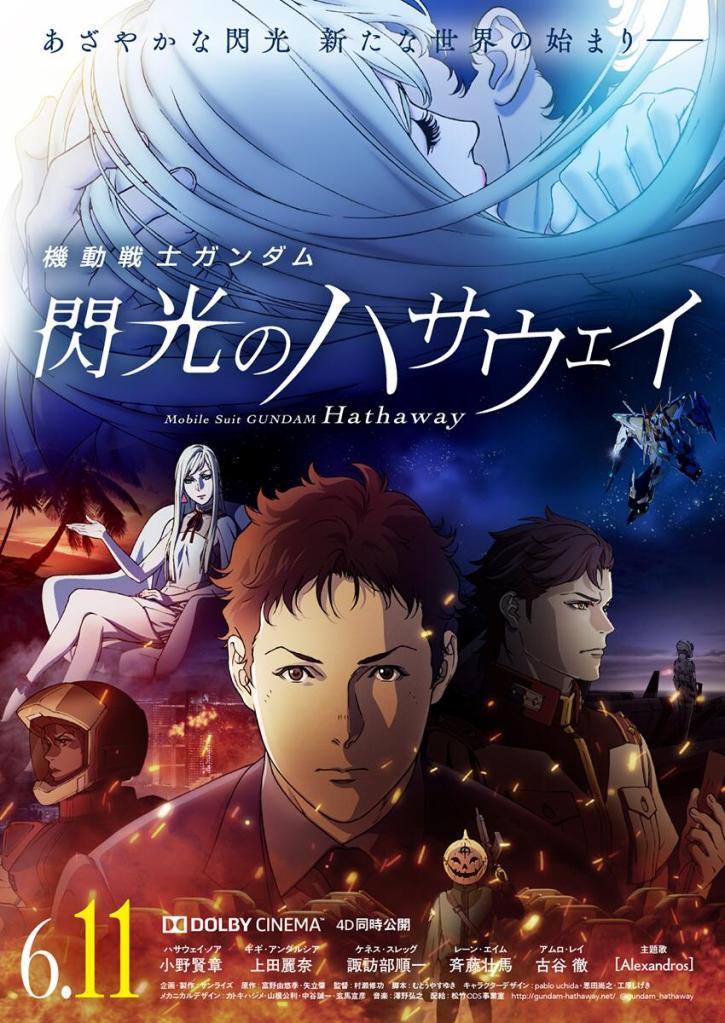
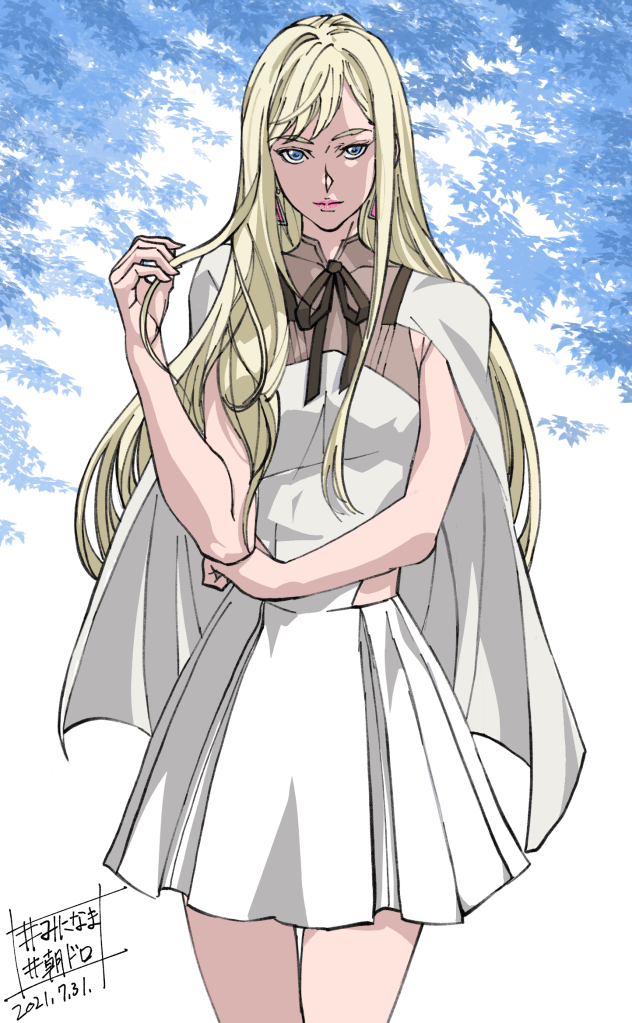
This is the first movie of a trilogy that modernizes the Mobile Suit Gundam franchise, or something. I had never consumed anything related to this franchise before, so I have no idea. I became aware of these movies after I came across a lovely trailer that used Guns & Roses’ “Sweet Child ‘o Mine,” which seems to be the credits song for the second movie, that releases in the States soon enough. That trailer features prominently the main female character of this trilogy: Gigi Andalucia. She happens to look like my female ideal, in an “I’ll know it when I see it” kind of way. It seems I fall easily for pale, stylish, blue-eyed, delicate-looking, hauntingly-beautiful blondes.
Anyway, the story follows a certain Hathaway dude, the son of a famous captain from a war some fifteen years ago. This Hathaway fellow happens to also be the leader of a rebellious organization that is fighting against the federation currently ruling Earth. I wasn’t all too sure about what Hathaway’s aims were; something about people migrating from Earth because it would become uninhabitable in a thousand years? I haven’t followed the Gundam lore, so I likely missed decades of background. This franchise is old.
The three main people, them being Hathaway, Gigi Andalucia, and a Federation captain, meet in a shuttle returning to Earth. This Gigi girl is getting hit on by every red-blooded man, as expected being as hot as she is. Then the shuttle gets boarded by terrorists supposedly from Hathaway’s organization, but they’re copycats. Hathaway gets pissed and drops them with the help of the captain. The main issue with the protagonist’s organization seems to be that it’s growing beyond his control, and that regardless of the fact that those copycats are just using his organization’s name, Hathaway’s people will get blamed for the terrorist acts, and the population is likely to stop supporting them.
We get to know more of this Gigi Andalucia girl. And oh man, she’s trouble. Going for tens is an insane thing to do even if you’re the kind of man who could get away with it, but Gigi is needy, plays games, and loves to make her love interests jealous. She knows everyone she meets is aching to bring her to bed. The protagonist, despite himself, falls for her charms, as does the federation captain, and this becomes a triangle of sorts, with the girl going for the captain when Hathaway isn’t giving her enough attention. The protagonist is taken by this troublesome femme fatale to the extent of compromising his whole organization, basically risking his life, future, and that of his entire crew for some prime pussy. I don’t know if I can blame him. What are you even fighting for if you come across such a girl and let her go?
I guess that’s all I have to say plot-wise. I understood about half of the political stuff. I was very intrigued by the worldbuilding. Visually, the movie is impressive. 3D used well for machines, landscapes, water, etc. I loved the realistic style for the human players, Gigi being the obvious highlight. Beautiful, sophisticated locations. The movie was often delightful solely for the visuals.
Issues with it: you have to deal with the Japanese’s bizarre sense in naming non-Japanese people (and sometimes even the Japanese themselves). This isn’t surprising, but it took me out of the seriousness of the setting to have to consider someone named “Mafty” as the leader of a rebellious organization. I’m quite sure there was someone named Quacks somewhere. I suspect this is from the source material, most quite old. Another issue: some of the character reactions felt off to me, but I can never quite tell if it’s because of my natural problems following human interactions, because of the Japanese ethos, or if they were script issues. Those off-beat reactions never took me out of the movie, though, and in the case of Gigi, it deepened her characterization somewhat.
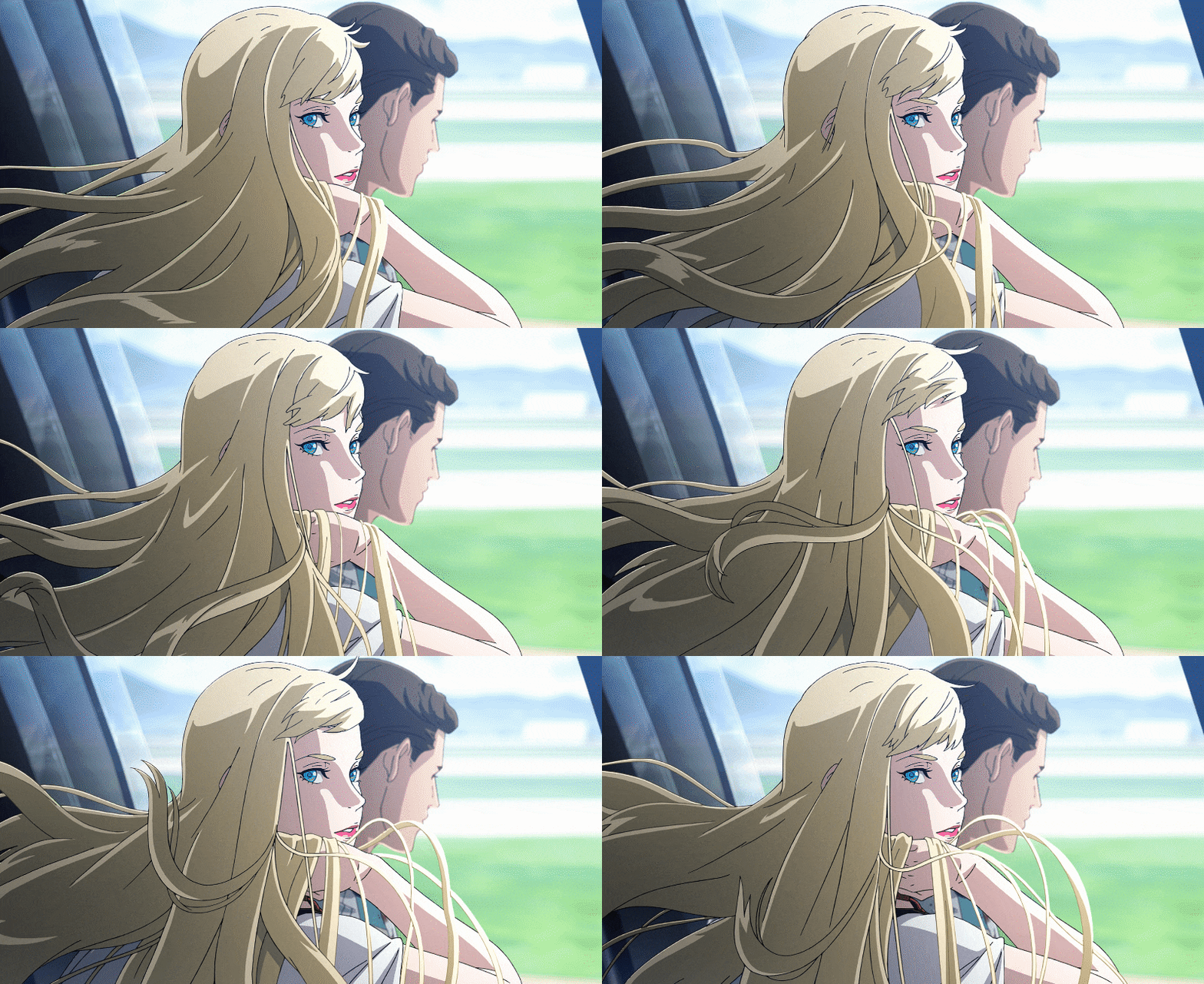
Anyway, come for the hot blonde, stay for the hot blonde and also most everything else. I should check out more modern anime movies. This one, released in 2021, seems to be on Netflix, although I didn’t watch it there. Hopefully the second movie will release in Spanish cinemas.
 The Domains of the Emperor Owl
You must be logged in to post a comment.