Review: My Extraordinary Ordinary Life, by Sissy Spacek

The moment I was introduced to Spacek, I knew I was fucked. Her beauty struck me, of course; if I had to picture physical perfection, 1972’s Sissy Spacek as Badlands captured her may be as close as it gets. But it was her peculiar way of speaking, her strange little mannerisms, and the way she inhabited each moment that made me feel: here’s a whole person. For someone like me who isn’t interested in people, who can’t really connect with them, that had only happened once before: when I became massively obsessed with Joanna Newsom back in 2011-2013. I knew what was happening to me, and I didn’t want to stop it even if I could. It was a matter of time until I got through the account of her life by the lady herself (to be fair, also the other woman who has a co-writing credit.)

Maybe a couple of months ago, I was investigating the movies that influenced Cormac McCarthy while working on his final two books, The Passenger and Stella Maris. The reason for this is that I had been obsessed for a good while with Alicia Western, the doomed genius around which both of those books orbit. I knew that McCarthy started drafting and researching that story in the mid-to-late seventies. Without even looking up what the man himself had said about his favorite movies from the seventies, I watched Nicholson’s Five Easy Pieces, and I was struck immediately by the similarities between the protagonists of both that movie and McCarthy’s books: both named Bobby, both having a special relationship with their musician sister, both unable to find in life any situation that felt worth inhabiting permanently anymore.

I looked up whether McCarthy had said anything about Five Easy Pieces. He called it his favorite at some point. He had also praised Terrence Malick’s Days of Heaven. That led me straight to Malick’s 1973 masterpiece Badlands, starring Sissy Spacek, and thus this curse began.

Her autobiography was written when she was as old as her beloved, saintly mother was when she died. I needed to learn from Sissy’s own words how she had experienced her life, what lessons she had learned, and as many details of the vanishing world she had lived through as she cared to record.

Sissy came from Czech, German, English and Irish ancestry, hardworking old European immigrants. Sissy writes at length about the relatives that came before her extraordinary self popped up into the world; many of them were daring, industrious, and knew how to stand tall when push came to shove. I recall an anecdote about one of her relatives, who owned a bank during the Depression. Citizens were pulling all their money out of banks, and her relative knew that a similar horde would come to his bank, so he went to whatever reserve owned his bank’s money, got them to give all of it in cash to him, then rushed back home. When the terrified customers came to take their money out of the bank, he showed to them whole pallets full of cash and told them that while other banks were going bust, his was healthy. His bank was saved that day, and I feel that the whole episode exemplifies Sissy’s attitude and grit toward the awful nonsense that life threw at her (her music career failing, family members dying, muggings, being defrauded, her daughters constantly getting injured): she just picked herself up, stood tall (as tall as a five-foot-two woman can), and kept going.

She grew up in Quitman, Texas, a tiny town of about 1,300 people. Sissy called her youth there idyllic. She spent those years, from an irresponsibly young age, exploring the town and its surroundings barefoot, often following and being involved in her older brothers’ hijinks, whom she idolized. I think she must have been about six years old when, alone at home, she casually entered her neighbor’s home and wandered around while the neighbor was at work; the neighbor didn’t lock the door (it was that kind of town). She also crossed the town to visit her mother and father at work. She was a headstrong tomboy who loved to pick up treasures from trash dumps, mount cows, end up dirty. She had a terribly ambitious streak that remained later in life when she pursued movie roles she had fixated on: riding, hula-hoop, twirling contests; whatever it was, she had to win.

As a teenager, she dreamed of becoming a songwriter. Apparently she went everywhere with a guitar, played for many of the townspeople at various occasions. In general, her talents were welcomed. She always got the feeling, though, that her time was running out to make it as a musician; she believed that by twenty she would already be too old for the industry. Sissy never ended up making it as a songwriter (even though she got an album published in the eighties), but the movie people recognized her appeal, and she got to play the guitar and sing in a few movies during the seventies, for example in this excerpt from The Girls of Huntington House:

She treats us with an intimate panorama of the people who inhabited sixties Quitman. Her mother’s friends. Her favorite shop vendors. The town’s switch operator. Sissy’s little friends and boyfriends. Her account gave me the impression of a town where everyone had a place, everybody knew everybody else, and like her mother later in life attempted when she got to New York, they wouldn’t abandon a homeless man to sleep in the streets.

Sissy was barely conscious when she lost her two sisters. They died in infancy. The biggest shock, which as she mentioned made her fearless, became her fuel to pursue her ambitions in the world, was losing her beloved older brother Robbie to leukemia when she was still in high school. They moved for a while to Houston so that they could follow Robbie’s treatments. His deterioration was a long process; Robbie still lived when Sissy tried to get a foothold in New York. She moved with her first cousin Rip Torn, who was an accomplished actor already. His wife, Geraldine Page, a natural at Broadway plays, took Sissy under her wing. Sissy watched plays nearly every day, and was included, even while underage, in conversations with important artists, most of whom Sissy wasn’t aware of.

She told that one day, as she was playing a song about her brother’s illness, one of the guys in that circle got into his head that the song was about Sissy, then underage, having sex. The guy had either written or directed a movie about a very young woman’s precocious activities, and he tried to interview Sissy about her experiences. The whole thing got really awkward. That guy ended up writing or directing the famous movie Easy Rider some time later.

The distance from home, from her brother Robbie’s illness, let Sissy believe that things would work out just fine in her absence, until she got a heartbreaking letter from her brother, which is reproduced I assume verbatim in the book. He sounds terrified and lonely, knowing that he would die without having experienced the world. He begged for Sissy to write him every day, and so she did.

That initial short period in New York ended, and she returned to her family in Houston. Robbie died shortly after. Sissy had to return and finish high school, but she no longer felt like she belonged there. Most of the activities that had felt so important before (twirling with the marching band, for example) now seemed utterly pointless. Sissy said something to effect that Robbie’s death had made her fearless, had provided her with the fuel to pursue what truly mattered to her, and to let go of what didn’t. She briefly attended college, but she couldn’t fathom having to study for four or more years longer. She felt her place was in New York, and that a career as a songwriter was just a lucky audition away.

Her parents promised to finance her dreams for four years, but if she hadn’t made it by then, she would need to return and go to college. She moved to New York and lived in small apartments with roommates. One of the roommates, whom Sissy referred to, if I recall correctly, only as “Club Girl,” casually stole Sissy’s clothes, even when she installed a lock in her wardrobe. This Club Girl got Sissy a temporary job as a receptionist. A couple of months or so after she had last stepped into that office, Club Girl returned home freaking out, saying that they (including Sissy) had been found out, that they were in deep shit. Turns out that Club Girl had been signing Sissy’s name and pretending that she was still working there, while Club Girl cashed in the checks. Sissy went to the office and explained that she hadn’t been involved with any of it. When she returned home, Club Girl had thrown Sissy’s stuff into the hallway, and had stolen some of Sissy’s clothes. Club Girl had enough sense to leave Sissy’s two guitars outside; Sissy said that otherwise she would have broken the door down to rescue them.

I’ve always thought that you need to be a special brand of crazy to want to live in a city like New York, that you likely seek chaos because there’s something wrong with your brain. Sissy’s experiences only strengthened that impression: she was mugged a few times; one of them, she had to chase down and wrestle her guitar case out of the mugger’s hands, who could have very well stabbed her. One time she got her literal piggy bank broken by one of those muggers, while she took off her mother’s ring and put it in her mouth to prevent it from being stolen.

Gorgeous as she was, she found work modeling, but only for teen clothes. She was also the face of Chanel 5 for a while. But the auditions to make it as a songwriter weren’t going well. Some shitheads told her straight to go back to Texas, grow older, and lose the accent. Another company told her that her niche was already filled by a certain Loretta Lynn, someone Sissy had never heard of (if you know Sissy’s movie history, you know how ironic that is).

Sissy was losing faith when she got the opportunity to star in a movie. She was hanging out in Andy Warhol’s studio at the time, and I guess someone recognized that she’d look good for the role. It was a significant part in a movie alongside Lee Marvin and Gene Hackman, titled Prime Cut (link for my review of the movie). She appeared almost entirely naked. Sissy doesn’t speak very positively of this movie; she mainly refers to the fact that she doesn’t like her acting in it, and that “they exploited me, but I exploited them.” It was her stepping stone.

Sissy became good friends with a fellow actress named Janit Baldwin, who played the other main trafficked girl. Their friendship extended for a few years afterwards before they lost touch. They even lived together for a while. Regarding other co-stars, Sissy was surprised that Gene Hackman, notorious for playing utter scumbags, was a very nice and decent guy. She recalls him helping her and Janit do art collages in their trailer. Gene Hackman ended up dying in his nineties of cardiovascular disease, so deep into Alzheimer’s that he likely didn’t realize that he had been living around the corpse of his much younger wife for about a week.

Experiencing Los Angeles for a while convinced Sissy that living in New York had been a bad idea. She never lived there again.

Sissy found herself preparing a new film with a then novice filmmaker named Terrence Malick, for what would become his first film, titled Badlands. It was a tiny production in which everyone had to pitch in and work hard. Sissy said that those days felt like they were at the center of the world. Badlands became a nexus of meaning in Sissy’s life: it was the movie that made her believe that she should continue in the industry, the one that taught her that filmmaking could be art, the one that convinced her that she should face the world as little Sissy from Texas instead of pretending to be someone else, and the movie in which she met her soulmate and love of her life, Jack Fisk.

Jack Fisk, slightly older than Sissy, was already an incredibly talented, driven, hardworking art designer. His best friend was a peculiar young man, then utterly unknown, named David Lynch. They had met in high school, and Jack believed so much in his friend David’s vision that some of Jack’s full paychecks went to finance David’s work. Over the course of his career, Jack has been recognized by many as the most talented art director in the entire world, having been the dynamo behind artistically striking films like The Revenant, The Master, There Will Be Blood, Killers of the Flower Moon, among many others.

Jack Fisk fell in love with Sissy the moment he saw her descend the stairs for the first time at the home Terrence Malick was renting for the production. Jack seemed to take the opportunity throughout the production to shoot his shot, hiding around in the set, including inside drawers, little items for her to find. The first time he invited her on a date, the boat they were on sank due to a flash flood, and they ended up lost in a torrential rain for a good while. Sissy said that with Fisk, she felt she could truly be herself, that it was like hanging out with her brothers or with her best friend. They got married one or two years later (with only their beloved dog Five and David Lynch as witnesses), and they’ve remained together ever since.

Janit Baldwin, Sissy’s co-star from Prime Cut, apparently had a role in Badlands: she played Sissy’s character’s best friend. Malick filmed a scene in which Sissy and Janit made out like teenagers, trying to train for their eventual boyfriends. Malick ended up cutting Baldwin’s role entirely from the film. Regarding the lesbian kissing scene, Malick discarded it because it felt “weird.” Where is the footage, Malick? Anyway, Janit’s mother plays a role in the film, as the deaf maid that Martin Sheen almost kills.

Janit ended up quitting the industry a mere ten years later. Although I wasn’t very impressed by her work in Prime Cut, it feels weird to have briefly encountered a whole person who inhabited Sissy’s present, and who eventually failed at her own ambitions and retired to a private life. I’m also unlikely to ever see her again in anything.

When Sissy watched Badlands in the theater, she was overjoyed. She felt that even if she never starred in a movie again, she had already appeared in a near-perfect film. But Badlands was very much ahead of its time (it became a huge influence for Tarantino and similar filmmakers years later), and the movie scene didn’t know what to do with Sissy. Starring in Badlands barely got her any work. Sissy mentions starring during that period in two forgettable movies that barely paid; I suspect she refers to Ginger in the Morning and The Girls of Huntington House (links for my reviews). Oof. Reading the autobiography made me realize that the most poignant moment from Ginger in the Morning, an anecdote about deer hunting, came straight from Sissy’s brother Robbie’s experience. That whole movie was built entirely around Sissy’s appeal as a human being, so I’m assuming the she freely talked about her past to the screenwriter.

Significant movie offers were drying up. Sissy worked as an assistant to her husband, Jack Fisk, until she had to face that she really wasn’t very good at it. She was working on the set of then-established director Brian de Palma, known for being grumpy and demanding. Jack was away for some reason when the set had to be repainted. Sissy had missed some of the basics of painting a set, so she ruined it. She got the impression that Brian de Palma regarded her from then on as the worst set designer he had ever worked with.

Sissy hadn’t finished working with Brian de Palma, though. A little film named Carrie came to be, and after Sissy read the screenplay, she decided that she absolutely had to do that movie. But she was also auditioning for an advertisement, which would pay well and conflicted with the Carrie audition. She asked Brian de Palma whether she should go for the audition or for the movie. Brian told her that he and the producers already favored another actress for Carrie’s role, so Sissy should audition for the advertisement. That pissed Sissy off to no end. She decided to ditch the advertisement, and instead prepare herself for the audition: she would show up as Carrie was supposed to be. Vaseline on her hair, unwashed face, an old sailor uniform her mother had made for her when she was young. When Sissy showed up like that to the audition, the makeup people rushed to her, intending to undo the disaster. Sissy ran away from them shouting, “No, no, no!” and did the audition. As Brian de Palma said it, the moment Sissy’s audition reel played in the room for the director and producers, they knew immediately they had their Carrie.

Carrie became the movie that Sissy was recognized the most for. Even fifty years later, people who don’t know her from anything else still remember her as “the girl from Carrie.” Now that a new rendition of Carrie is doing the rounds, a reimagining for the modern times, I keep getting increasing hits on some of my Sissy Spacek posts, likely from people who watched the new Carrie, proceeded to watch the original, and realized that Sissy Spacek was special.

After this movie became a worldwide hit, Sissy was suddenly everywhere. Interviews, magazine covers. But her movie roles afterwards didn’t become as huge as they likely should have. Sissy was uncomfortable with the Hollywood machinery, and she preferred to star in family-like affairs.

By that time (maybe even before she filmed Carrie), she had starred in the godawful Welcome to LA, an ensemble piece built almost inexplicably around a terrible set of songs, where the script kept reaching for profound statements that fell flat, and the characters kept looking at the camera like they were in an episode of The Office. I recommend against watching that movie even though Sissy is mostly compelling in it; she plays a maid who cleans while topless and casually prostitutes herself on the side.
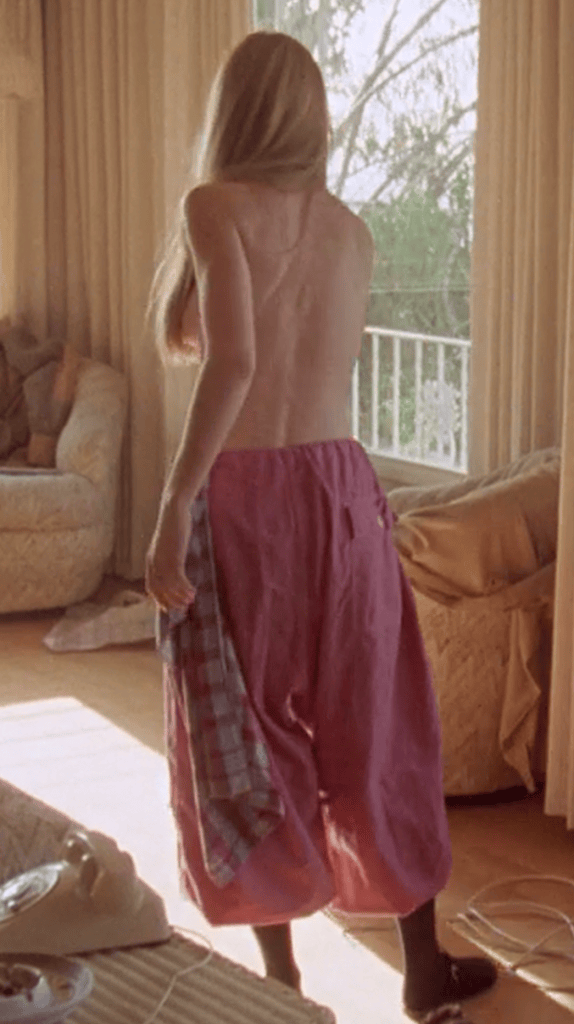
Pictured: Sissy’s beautiful back in an awful film

Honestly, that movie was a ruin, and I feel like it poisoned my brain. I was surprised when Sissy briefly mentioned it in her autobiography, although it was mainly in the context of Robert Altman, a famous independent filmmaker at the time, discovering Sissy in the dailies, and choosing her for his next movie, 3 Women. I can’t say that I enjoyed the movie a lot, although Sissy is delightful in it, playing a childlike waif. I suspect that Sissy was ambivalent about the movie as well, but that may be me wanting her to feel ambivalent about it.

One of the highlights of the movie is when a main character gives birth. Sissy’s co-star Shelley Duvall (who was famously tortured by Kubrick in The Shining just a couple of years later) walked slowly, hands bloody, eyes wild, to Sissy’s character, then slapped Sissy hard for reasons. It was a haunting moment of the movie, and after the scene ended, Sissy approached the film crowd, including the director Altman, as they were gathered around some screens seemingly enthralled. Sissy though they were watching the replay of the emotionally grueling scene she had just finished, but they were watching a sports match. That had to be disappointing.

She lost many opportunities because she simply didn’t care to belong to the Hollywood machinery. Her biggest role, the one that ended up earning her the sole Oscar, was pushed upon her in the strangest way. A famous female country singer that showed up in talk shows often, a certain Loretta Lynn, kept announcing that a movie about her life was in the works, and that “little Sissy Spacek” was going to play Loretta. There was just a problem: Sissy hadn’t been told this, or asked for that matter. Whenever Loretta said this on TV, Sissy got pissed and yelled at the screen. She absolutely didn’t want to do a biopic, which she felt ended up mostly as jokes, with people lip syncing through it, and the screenplay lacking bite because the artists had to look good. Sissy went out of her way to face Loretta and tell her in person that she wouldn’t do the damn film, but when Sissy met Loretta, she was struck by that fierce woman, a small, headstrong dynamo that was uniquely herself.

Sissy ended up agreeing to do the movie, which was titled Coal Miner’s Daughter. She spent a lot of time with Loretta and became like sisters, to the extent that when Loretta was close to dying, Sissy accepted an award for her, and almost cried through her speech. I have yet to watch the movie (I haven’t gotten through all of Sissy’s work from the seventies). People seem to remember it as a genuine film that showed ugliness and grittiness when it should. Sissy played and sang all of the songs.

Earning the Oscar undid Sissy to a significant extent. She was required to do interviews everywhere. Her hometown of Quitman declared a Sissy Spacek Day, and changed the name of a major street to hers. But what truly broke her was flying from country to country, doing round after round of interviews in which she had to invent new things to say. One of those days, while in England, she was so utterly drained from that nonsense that she found herself out of it while booked for a talk show. The other interviewee, also an actress, tried to dissuade Sissy from doing the interview given the state that Sissy was in, but Sissy was too out of it even to refuse. She ended up having a mental breakdown while being interviewed, falling into a sort of dissociative state in which she couldn’t understand what the host was saying to her, or what the other interviewee was saying to defend her. She only understood that the host was tearing into her. It seemingly was so bad, that when she was at the airport trying to return home, people who had seen the interview and recognized her looked at her with concern. I haven’t found that interview, and I should probably be glad about that.

This is an interview from that era, likely from the circuit of interviews she had to give, in which she sounds diminished from the effort, compared with other interviews.

That post-Oscar period was definitely a turning point. She and Jack had been living in Topanga Canyon, in a beautiful home that mostly Jack put together, but one time that they returned home, they found it ransacked. They had even stolen Sissy’s two guitars from her songwriter days in New York. Then Sissy and Jack found out that someone had jacked into their phone lines and racked up about $3000 in calls. They had enough, so they moved to a historical farm in Virginia. By then, her beloved mother was dead, she was pregnant with her first child, and she wanted to give her children a childhood like the one she had in Quitman, growing up in a small community in which you could get to know individual people and be treated like one of them, instead of like a fancy Hollywood actress.

The stories she tells of living in Virginia are strange in the sense of how peculiar the people she interacted with were. For example, close to their home, a farm belonging to the Jefferson family still operated, an unbroken line from Thomas Jefferson himself. Many of the characters Sissy met seemed picked from some bizarre branch of old England that had been transplanted to Virginia. In any case, Sissy was well known by cashiers and small town people; when I looked up Sissy’s videos, I came across quite a few comments like “I used to serve Sissy at this shop back in Virginia during the eighties; she was delightful.” Sissy was a small-town girl at heart, and she has remained so.

Sissy mentions how moving to Virginia meant for the Hollywood people that basically she had retired. Although she didn’t, her post-Oscar career is comprised, at least until the time this autobiography was released about fifteen years ago, of small independent films, some that involved people she had worked with before and whom she loved, like Tommy Lee Jones, David Lynch, and such. She emphasizes that her films were family affairs: her entire family moved to the location for a while, and her daughters sometimes contributed or even acted in them. One of her daughters, Schuyler Fisk, became an accomplished singer-songwriter and also an actress, although I haven’t heard her or watched her in anything.

I don’t mean to imply that Sissy basically disappeared after her Oscar. She received further Oscar nominations for Missing, The River, Crimes of the Heart, and In the Bedroom. Yet, they are movies whose existence I was fully unaware of before I researched Sissy’s life. In a strange way, it feels like an alternate dimension where Sissy Spacek was a thing got merged with mine, and it was only at forty-one years old when I found myself thinking, “How on Earth did I miss her and everything she did for the four decades I’ve been alive?”

Once Sissy had her children, I believe she mentioned that she finally had found what she was on this Earth for. She and her husband devoted themselves to raising their children and giving them the best childhoods they could. Her two daughters became free-spirited artists who weren’t afraid of much, sometimes to their detriment. Sissy shares anecdotes of bizarre accidents their daughters suffered or were involved in. One of them involved Jack recovering at home from a hernia surgery, only for her daughter to call home saying that someone had been run over. They thought it was the girl’s cousin. Jack, at the risk of his stitches unraveling, ran to the site of the accident, only to find out that one of their dear dogs, unfortunately named Lucky, had been run over by a truck. In another occasion, the family was getting a friend accustomed to horses, when Schuyler fell from a tree and dislocated her shoulder terribly, to the extent that she had to wear a cast for months. They had the family friend drive a van to the hospital, and as if that wasn’t enough, she misjudged the height of an underpass, and the van ended up with its top sheared off.

Sissy is also candid about her own goofiness, her proneness to accidents. She had already broken some toes when, during a reunion in which she was to cook for the guests (even though she isn’t into cooking and isn’t good at it), she realized that a stray cat had jumped onto the table and was about to ruin the turkey. Sissy ran to shoo the cat away, with enough bad luck that she banged her toe real bad. She didn’t know how bad yet, but she had snapped it in half; she mentions that the toe ended up sideways. After getting rid of the cat, in pain, she sat at the table, then fainted. She was awakened by her husband. Sissy thought that something had happened to her eyes, as she only saw red and they burned terribly; it turns out she had fainted into the spaghetti sauce.

Her autobiography ends shortly after her father died when he was ninety, which was followed by the death of another one of their elder relatives that had been living with them and helping with their children and the farm. Looking back, one of the things that pains me the most from reading this autobiography is that I was reading the account of a dead world, even beyond what Sissy expected when she finished this at sixty-two. Most of the intimate family members and friend from the art world, like Rip Torn, David Lynch, Diane Keaton, Bill Paxton, Shelley Duvall… they’re all gone as of 2026. Sissy is now seventy-six years old, a happy grandmother that probably doesn’t have much longer to go.

Bill Paxton was a teenager working for Jack Fisk, alongside Sissy, in the early seventies. He even housesat for them at their Topanga Canyon home for a while, and got their parrot killed. David Lynch was Jack’s intimate friend; he worked on art direction for some of David’s films, and even starred briefly in Eraserhead. Sissy starred in one of David’s films back in the nineties. Here are both Bill Paxton and David Lynch honoring Sissy for her deserved star at Hollywood Boulevard:

I recall Sissy mentioning in one of her interviews from the last two decades that nostalgia was increasingly rushing at her feet. Something to that effect anyway. I can’t imagine how she must feel now. She said that the seventies was a magical decade for her, and even in her autobiography, the details from that era are more vivid and meaningful that most everything that came afterwards. I never got to live an extraordinary life like hers, but I also don’t have to live through reaching her old age feeling that all of it has mostly disappeared. As for me, I have to deal with the grief of arriving too late: discovering Sissy’s existence when her life is already complete, encountering friendships on the page that no longer exist outside it, wanting to inhabit a world I can only read about.

Sissy Spacek is a small-town girl who forever remained genuinely herself.

Five Easy Pieces’ links to The Passenger/Stella Maris

I’ve been on a binge of 70s movies lately. I wanted films from that era that provided the feeling of inhabiting the 1970s. One that ChatGPT recommended was Jack Nicholson’s 1970 movie Five Easy Pieces. I actually tried watching it years ago, but I didn’t connect with it enough, so I quit about a quarter of the way through. This time I felt differently.

It follows the character of Bobby Dupea, a former pianist prodigy who abandoned his family, who are a bunch of intellectuals and artists, to live as a drifter of sorts, never settling for long enough at a single place and among a single group of people. I got into this binge of 70s movies because I remain haunted by Cormac McCarthy’s last two novels, The Passenger and Stella Maris, both of which belong to the same story set in that era. And I was surprised to find out that Five Easy Pieces undoubtedly influenced McCarthy’s last two works.

McCarthy died about three years ago, so one might think that a movie from 1970 is a bit too distant to be considered a clear inspiration to his last two books. But The Passenger and Stella Maris were conceived, worked on, and majorly planned in the mid-to-late 70s, as well as early 80s. It pertained the real-life institutionalization of McCarthy’s love-of-his-life Augusta Britt, who ended up in some mental hospital somehow related to Stella Maris. As I kept watching Nicholson’s movie, the similarities became obvious.

Bobby Dupea, the movie’s protagonist, comes from a highly cultured/intellectual family. He’s a musical prodigy. His sister is a musician. His sister desperately wants him back. Bobby abandoned his privileged/intellectual origin. Bobby is angry, restless, alienated. He can’t tolerate the feeling that a life is settling into place. He moves from place to place. He has an almost pathological resistance to permanence.

Bobby Western, the protagonist of The Passenger, comes from an intellectually and scientifically exceptional family. He plays mandolin; deeply associated with music. His sister Alicia is a musician/intellectual. Alicia’s entire relationship with Bobby is haunted by his absence and her longing for him. Bobby has abandoned conventional society and spends his life moving around. He’s restless, melancholic, alienated. He’s made flight his mode of existence. He moves from place to place, ultimately leaving America. Bobby’s entire existence becomes a kind of permanent exile.

In the movie, Bobby’s explanation for his restlessness is that he can’t bear the moment when a new life starts to look like a settled life. He gets frightened when something begins acquiring the shape of a future. Bobby Western feels that he can’t become anyone because the world no longer provides a place in which such a becoming is possible. You see the family resemblance.

In the movie, Bobby’s sister is the person from his old life who still wants him back. She’s a musician, she understands him in ways no one else does, and she serves as the emotional bridge between Bobby and the world he rejected. Alicia fills a far more elaborate version of the same structural position. In the movie: sister waits, brother comes home, brother leaves again. In McCarthy’s story, it turns much darker: sister needs brother, brother fails to save her, sister dies, brother spends the rest of his life unable to return home.

Both Bobbys possess the capacity for civilized/intellectual life but refuse to inhabit it. I can imagine that McCarthy felt reflected in Nicholson’s character. Dupea can play Chopin beautifully, but he lives as an oil worker. He’s capable of being something “higher,” yet he’s miserable when he inhabits that world. Bobby Western is a physicist, mathematically gifted, musically inclined, yet he doesn’t belong to any of those worlds. He’s a diver, a smuggler, a mechanic, a gambler, a fisherman, a wanderer. Dupea runs away from society. Western runs away from civilization. Ultimately, McCarthy’s protagonist seems to run away from existence itself.

I asked ChatGPT if McCarthy had mentioned Five Easy Pieces at all. Not only he had: he mentioned the movie was one of his favorites. One of the references mentions it as his favorite. So that’s that.

I’m sure this won’t matter to anyone who doesn’t occupy my mental headspace, and who doesn’t retain an unhealthy attachment to Alicia Western and therefore to McCarthy’s last two novels. But I found it interesting enough to record nonetheless.

Neural Pulse, Pt. 11 (Fiction)

In an electric flash and crackle, my muscles seized, and my vision flared white. As I crumpled backward like a dead weight, my left arm and the side of my head slammed into the control panel. My brain thrummed with electricity. It reeked of burning.

In the whiteness, the silhouette of a spacesuit materialized, looming over me. Several shadows clamped onto my arms with claws. One shadow dug its knees into my abdomen and crushed my face between its palms. I tried to scream, but only a ragged whimper escaped my throat. The tangle of shadows obscured my sight, swallowing me. A shadow snatched my hair and pulled; hundreds of points on my scalp prickled tight. Another shadow smothered my nose and mouth.

When I could feel my arms again, I lashed out at the shadows, thrashing as I braced myself against the control panel and the seat. I lunged for a silhouette—Mara’s spacesuit—but she sidestepped, and I plummeted onto the cockpit floor. A blow to the crown of my head plunged me into a murky confusion.

My wrists were bound behind my back—duct tape, I glimpsed, as Mara, crouched by my knees, finished wrapping my ankles. She straightened and hobbled backward. She stepped on the electroshock lance lying discarded on the floor and slipped, but the oxygen recycler clipped to the back of her suit arrested her fall as it struck the hatch.

Gauges of different shapes bulged on her belt like ammunition magazines. The suit’s chest inflated and deflated rhythmically. Mara unlatched her helmet and pulled it off, revealing her ashen face: mouth agape with baby-pink lips; livid, doubled bags under her eyes; strands of black hair plastered to her forehead with sweat. She leaned back against the hatch, gasping through her mouth, the corners glistening with saliva as she scrutinized me with intense, glazed eyes.

The cockpit reeked of sweat and burnt fuses. The shadows had congealed into a mass of human-shaped silhouettes, their hatred addling my brains, boiling me in a cauldron. Mara’s outline, as if traced with a thick black marker, pulsed and expanded.

No more anticipating how to defend myself, because I have you trapped. Thanks to you, the station doesn’t know we came down to the planet. With the tools of the xenobiologist you murdered, I will rip out your tongue, gouge out your eyes, bore into your face.

Mara crouched, setting her helmet on the floor. Exhaustion contorted her actress-like features, as if some illness burdened her with insomnia and pain.

“I thought I was marooned on this planet. I could have just called the station for rescue, but they’d fire me for nothing, and my pride would rather I suffocated than admit I needed help. Now I know—when we found the artifact, I should have tied you up then. Because you, being you, would just stick your nose right up to an alien machine that, for all you knew, could have detonated the outpost. And to understand what drove you to kill that xenobiologist, I imitated you. I stuck my nose up to that thing, and I saw my reflection. Now I know. Unfortunately, I know.” She regarded me like a comatose patient and waved a gloved palm. “Can you hear me? Did I scramble your brain?”

“I hear.”

My voice emerged as a rasp. I coughed. My mouth tasted of metal.

“And you understand?”

I nodded.

The black veil obscuring the cockpit stirred, rippling. Concentrated energy, like the air crackling before a storm. With Mara’s every gesture, the shadows shifted. Their bony claws crushed my thighs, cinching around my spine through suit, skin, and flesh.

A bead of sweat trickled down Mara’s forehead. She rubbed her face, swallowed. Her pupils constricted.

“Is that what you think? That I’ve convinced myself I’ve subdued you? That you’ll fool me until I let you go? That then you’ll finally strangle me? And even if the station calls it murder, no one will bother investigating, because most people who knew me would thank you for killing me.”

“I’m not thinking. When I try, my brain protests.”

Mara hunched down opposite me, reaching out to study the blow on my head, but halfway there her features pinched. She drew herself up, crossing her arms.

“I heard you telling me to come closer. Because you’ll break free, dig your nails into my corneas, and rip my jaw apart.”

My guts roiled; acid surged up my throat.

“You think I think things like that?”

“I feel this second consciousness… it betrays your thoughts as clearly as if you spoke them aloud. Maybe I’ll never understand how the artifact interfered with our minds, not just our language, but it’s a trick.”

I pushed my torso off the floor, sliding my back up the side of a seat inch by inch, trying not to provoke her, until my stomach settled. My head ached where she’d struck me. The throbbing in my skull clouded and inflamed my thoughts.

“You saw him. Jing. What I did.”

“I saw someone down there. I’d need dental records or DNA to be sure, but I trust elimination. I thought you’d claim it was an accident.”

“It was. I attacked the shadows. You feel them, don’t you?”

Mara took a deep breath.

“They’re pawing at me, trying to suffocate me. Products of my own besieged brain, I know, but I can hardly call them pleasant.”

“I wanted to keep it from affecting you. But at least now you understand.”

“Make no mistake. That xenobiologist is lying with his face beaten to a pulp in the second sublevel of an alien outpost because you are you.”

I pressed my lips together, erecting a wall against escaping words. I looked away from Mara’s eyes, concentrating on deepening my breaths. The muscles in my forearms were taut. Pain flared in my constricted wrists. This woman had fired an electroshock lance at me, beaten me, bound me, and now she was assaulting my character.

With her boot-tip, Mara nudged her helmet; it wobbled like a small boat.

“Although the jolts in my neurons, the shadows, and this other consciousness intruding in my mind unnerve me, the effect isn’t so different from how I’ve always felt around people. The two consciousnesses will learn to get along.”

“If you’re not exaggerating,” I said gravely, “I am truly sorry, Mara.”

She pushed damp strands of hair from her forehead and scrubbed it with the back of her glove, smudging it with dust. The corners of her lips sagged as if weights hung from them.

“Thanks for the sympathy.”

“Were you afraid I planned to do the same thing to you as I did to Jing?”

“Can you blame me for removing the opportunity?”

She limped heavily over to my seat and sat down sideways. As she leaned an elbow on the control panel, a shadow shoved my torso against the seat I leaned on; my lungs emptied. I shuddered, sinking into black water.

Mara had said we imagined the shadows, even if they affected us. I writhed onto my back, pushing with my heels until my head touched the cockpit hatch. My wrists throbbed, crushed tight. A shadow pressed down on my chest like someone sitting there, yet no physical presence had stopped me from moving. The artifact had hijacked my senses.

Mara regarded me from above, pale and cold like a queen enthroned.

“I wouldn’t have killed you,” I said. “You’re my friend.”

“Am I?”

Between the pulses of my headache, I tried to decipher her expression.

“To me, you are.”

“I like you. I tolerate you. But often, being around you feels like rolling in nettles, Kirochka.”

“Almost everything irritates you.”

“You’re incapable of seeing people as anything other than reflections of yourself. What you instinctively feel is right, you impose as right for everyone.” She shook her head, then leaned forward, her tone hardening as if she were tired of holding back. “You insist you have to drag me away from my interests, my studies, as if imitating your actions and hobbies would somehow make me impulsive and reckless too. Admit it or not, you think the rest of humanity are just primitive creatures evolving towards becoming you.” She jabbed a finger at her chest. “I need time to myself, Kirochka. Solitude. Reading. Designing one of my machines, or building it. You think people need to be prevented from thinking.”

Exhaustion was crushing me. I imagined another version of myself laughing, suggesting a drink or a movie, assuming Mara’s mood could be cured by a few laps in the pool. But my vision blurred. I blinked, swallowed to make my vocal cords obey.

“We’ve had good times.”

“The best were when I was enduring idiots and tolerating awful music.”

“You showed them you’re smart. Got half the tracking team to stop calling you ‘black dwarf’.”

“Yes, because those morons’ gossip was costing me sleep. You think I need to prove anything to them? They can believe whatever they want.”

Shadows crouched nearby, focusing their hatred on me, clawing at my skin, crushing my flesh with bony grips. They tormented me like chronic pain, but while Mara and I talked, I kept the torture submerged.

“Things went well for you, for a while, with that man you met. I don’t take credit, but would you have met him dining alone?”

The woman, deflated, blinked her glazed eye, rubbing it as if removing grit.

“You’re right. I miss things by focusing on research instead of acting like a savage. But I assure you, Kirochka, we’re too different for me ever to consider you a friend. Sooner or later, we’d stop tolerating each other.”

“We can bridge the differences.”

“You talk to fill silences. You pressure people for attention. You live for interaction. I could never sustain a friendship with someone like that.”

“Do you use me to get things?”

“Everyone uses everyone, if only to feel better about themselves. I just refrain from feeding illusions.” She drew herself up, as if recalling an injustice, and rebuked me with her eyes. “Besides, I didn’t stop running because I was lazy. I barely eat, and nobody’s chasing me in my apartment. Running bores me to death.”

“I wanted the company.”

Mara shook her head. Her tired gaze roamed the cockpit, as if seeing through the walls.

“When you called a few hours ago, I thought you wanted to drag me out drinking with you and the other pilots. I considered pretending I’d fallen asleep with the sound nullifier on. I should have.”

I contorted like a snake, sliding my back up the hatch. I leaned the oxygen recycler back, resting my head against the cool metal. Judging by the ache, when I undressed, my arms would be covered in lurid bruises.

“I consider you a friend. You listen when I need it. My professional peers, the ones who think they’re my friends, even my boyfriend—they’d tell me to shut up for ruining the mood.”

“When have you ever listened to me?”

“I want to. But I have to pry the words out of you.”

“Maybe that should have told you something, Kirochka.”

“That you hate me.”

She sighed, the effort seeming immense, like lifting a great weight.

“I don’t like human beings. I would have chosen to be anything else.”

Flashes on the communications monitor distracted me. Though Mara was still speaking, her words faded to a murmur beneath my notice. The headache pulsed, reddening my vision. Why did the monitor alert snag my attention? I snapped fully alert. It meant an incoming call.


Author’s note: I wrote this novella in Spanish about ten years ago. It’s contained in the collection titled Los dominios del emperador búho.

Today’s song is “Body Betrays Itself” by Pharmakon.

Neural Pulse, Pt. 10 (Fiction)

Paralyzed, I choked. I sucked in a lungful of hot air and collapsed to my knees before the xenobiologist. I pressed my hands against his suit’s chest. I pounded on him. No one would recognize Jing from what was left of his blood-drenched face. I stammered, repeating, “no, no, no,” while my fingers traced the helmet’s dents, the jagged shards of the broken visor jutting from the frame.

Pooling blood submerged the ruin of bone and flesh that was his face. When I tilted Jing’s body, the helmet spilled a tongue of blood onto the stone floor, slick with sliding globules of brain matter.

I staggered back, fists clenched, shuddering violently as if seized by frost.

Jing’s right hand was clamped around the handle of an automatic core drill. Perhaps the xenobiologist had approached to help me.

I shut my eyes, covered my visor with a palm. I pictured Jing standing beside me, an echo asking if I needed help. No, I hadn’t killed him. When I opened my eyes, the corpse lay sprawled on its side, the dented helmet cradling the ruin of his head.

Jing hadn’t known he was dealing with a live nuclear device. The flood of that feeling had swept over me. Had I seen the xenobiologist stop beside me? Had I decided to smash his face in with the crowbar?

I stumbled about, gasping for breath. My brain felt like it was on fire, seizing with electric spasms. Red webs pulsed at the edges of my vision, flaring brightly before fading. Before I knew it, I’d crossed the room that contained the construction robots, and was sprinting up the ramp. The oval beam of my flashlight jerked and warped, sliding over the protrusions and crevices of the rock face. My arms felt like spent rubber bands, especially the right, aching from fingertips to shoulder blades. Every balancing lurch, every push against the rock to keep climbing, intensified the ache.

I passed the first sublevel. My breath fogged the visor; I saw the flashlight beam dimly, as through a mist. My hair, pulled back at my nape, was soaked through, plastered to my skin.

I burst onto the surface, into the emptiness of the dome. I staggered, kicking through the sandy earth. I gasped for air and ran. I pictured myself training on a circuit—something that relaxed me at the academy after piloting, just as going to the gym with Mara relaxed me on the station—but now I was running from the consequences, from an earthquake tearing the earth apart like cloth. If I slowed, the fissure would overtake and swallow me.

I vaulted over the embankment to the left of the esplanade, where I’d hidden before, landing on my knees and one forearm. I scrambled backward, kicking up dirt, and pressed myself flat against the embankment’s exposed rock face.

The radio. I navigated the visor options until I muted my comm signal. When the notification confirmed I was off-frequency, I jammed my fists against my knees, my mouth stretched wide in a scream.

I drew a ragged breath. Beads of sweat dripped from my forehead onto the visor; the material wicked them away, like water hitting hot pavement. Mara would have reached the cockpit by now, found me missing. Nothing could make Jing’s death look like an accident. How would my friend look at me? What would she think when she found out? She’d think… because I killed the xenobiologist… I might kill her too.

I buried my helmeted head in my forearms. I welcomed the dimness. How had I let this happen? I knew I should have destroyed the artifact—just as I knew I had to fight back when those shadows grabbed me, tried to rip me open with their claws. I’d struck the shadows with the crowbar before I’d even consciously decided to. On other expeditions, while waiting for scientists and soldiers to emerge from some dense alien jungle, I’d monitor their radio chatter, trusting my instincts to warn me if I should suggest aborting the mission. Just as piloting was like flowing in a dance of thrust and gravity, the way dancing came naturally to others, I imagined. Now my instincts screamed at me to flee, to run from this embankment away from the ship, to strike out across the planet, heedless of survival. My instinct had been supplanted by another. And I knew the difference.

I peeked around the side of the embankment. The scarred esplanade remained deserted. The crystalline dome watched the minutes pass like some ancient ruin.

If Mara found out the artifact made me kill Jing, maybe she’d understand the danger, agree to destroy it. I was counting on her reasoning, on that cold logic that had so often irritated me. But if I waited too long to face her, she’d suspect my motives.

As I straightened up and stepped, dizzy, onto the esplanade, an electric spike lanced through my neurons, blurring my vision. I stumbled around until it subsided. I stopped before the central crater, hunching over to examine its charcoal-gray cracks and ridges. Crushed bones.

I activated the radio. The visor display indicated it was locking onto Mara’s signal. She’d see mine pop up, too, unless she was distracted. In the center of my darkened visor, the arctic-blue star shone through the thin atmosphere like a quivering ball of fluff.

“Where are you, Mara?”

“Cockpit.”

The shadows intercepted the transmission, projecting their hatred at me. It distracted me from Mara’s tone—was there suspicion coloring her voice? I waited a few seconds. Would she demand an explanation? Why was she silent?

“Good,” I said. “Stay there. I need to talk to you.”

As I climbed the slope skirting the hill towards the ship, the reality of my decision hit me. I was about to lock myself in the cockpit’s confined space with Mara. Her shadows would envelop me, sink their claws into my skin, force themselves down my throat to suffocate me. I wanted desperately to rip off my helmet, wipe the sweat from my face. I needed a shower, a moment to think.

I located the ship’s tower. Several meters ahead lay three cargo containers and scattered tools. Inside the cargo hold, chunks of the robots and the materializer were heaped like scrap in a landfill.

I scrambled up the boarding ladder to the airlock hatch. Opened it, scrambled inside, sealed it shut. The chamber pressurized with a series of hisses and puffs. I unsealed my helmet. Holding it upside down, steam poured out as if from a pot of fresh soup. I gulped the ship’s cool, filtered air and opened the inner door to the cockpit.

“Mara.”

Empty. Indicators blinked. On the monitors, ship status displays and sector topographical maps cycled. Lines of text scrolled.

My seat held a roll of electrical tape. As I turned it over in my fingers, an electric jolt made me clench my teeth, squeeze my eyes shut. My neurons hummed.

The door to the airlock chamber clicked shut with a heavy mechanical thud. The thick metal muffled the hissing. Leaning back against my seat’s headrest, still clutching the tape, I froze. The air grew heavy. The cockpit lights seemed to dim, the edges of my perception closing in. A dozen shadows waited in the airlock chamber, their concentrated beams of hatred probing the metal door, seeking to burn me.

The door slid open.

I tensed, lips parting. What could I possibly say?

Mara emerged sideways through the gap, head bowed. As she stepped through, she shouldered the door shut behind her. The glowing diodes and bright screens of the control panel glinted on her helmet’s visor. She whipped around to face me. Her right arm shot out, leveling an electroshock lance. The two silver prongs at its tip lunged like viper fangs.


Author’s note: I originally wrote this novella in Spanish about ten years ago. It’s contained in the collection titled Los dominios del emperador búho.

Neural Pulse, Pt. 9 (Fiction)

I edged a handspan of my helmet over the side of the embankment, to keep watch on the entrance of the shell of hexagonal panels. With the planet’s rotation, the star’s descending angle had lightened the blackness of the opening to a steel gray. I waited, lying prone, sunk a few centimeters into the sandy earth. From the gloom within the dome, I sensed the hollow vastness, the floor furrowed with the scars of ruts where maintenance robots had engraved circular tracks.

My helmet’s indicator notified me it had located Mara’s signal. I took a deep breath and waited for the woman to emerge. As if an army were cresting a hill, I sensed the shadows approaching. My heart hammered, and blood roared in my ears. I would stay out of sight.

From the gloom at the dome’s opening, a spacesuit frayed into view, venturing onto the esplanade, the containers following. I scooted sideways so the embankment hid me, and avoided breathing heavily lest the radio transmit it.

I peeked out. The woman and the containers had disappeared. And Jing? I had lost his signal.

Mara’s measured voice burst into my helmet.

“How goes it, Kirochka?”

I flinched, stirring the sandy earth, feeling the urge to leap up and sprint. Shadows were approaching from the opposite side of the embankment. They would surround me, press in on me, crush me against the earth until I suffocated.

“Something like that,” my voice trembled. “I’m in the cabin.”

“See you in a moment.”

What was keeping Jing? How could I wait for him to show himself? I had to seize the chance to break the artifact before Mara could stop me.

I scrambled up, slipping, spraying spadefuls of earth. I crossed the esplanade and plunged into the dome’s gloom. After descending the ramp about ten meters, I remembered to switch on my flashlight. I sprinted in a descending spiral, bracing a gloved palm when needed against the central pillar or the uneven rock wall. I filled my burning lungs with fresh, recycled air. My leg muscles throbbed.

A honey-colored light bathed me the instant I tripped. The maintenance robot tumbled through the air and bounced off the wall. I cartwheeled down the spiral, slamming against the excavated rock as my flashlight beam flared white off every surface my helmet struck. I slid prone down the ramp, bracing myself against the central pillar with my hands to stop.

I coughed. Sat up. My body’s tremors made the flashlight beam quiver. I shook the dust and sandy earth from my gloves. They were scuffed. Bristling fibers poked through the padding.

A chill ran through me from head to toe. I checked the oxygen levels on my lens. No leaks. On my vital signs display, my pulse fluctuated in the triple digits.

When I got up, I descended the ramp carefully, but within seconds, I was running. We had stolen the other robot, so I wouldn’t trip over that one.

The lens indicator alerted that it had locked onto Jing’s signal, and I slowed my pace. I breathed through my nose, but sweating as if in a jungle, I had to flare my nostrils to their limit to draw in enough air. I felt my way down the spiraling ramp.

I reached the entrance to a basement and peered in, exposing only a handspan of my helmet. I had expected to find the first sublevel, with the exposed mineral vein and the materializer, but I must have rolled past it tumbling downhill. Two of the construction robots lay gutted, and the third was missing an arm.

I hastened, walking just short of a run, to the back of the basement, where my flashlight beam mingled with the artifact’s tangle of levitating energy. I leaned against the curved, ribbed metal of a strut and scanned the entrance ramp. Perhaps Jing was dismantling the materializer on the first sublevel. Mara would have discovered I had deceived her.

I hunched before the undulating membranes of purple and pink energy. I probed the invisible shell containing the energy, as if hoping to find some crack through which to pry it open like a pistachio nut. I threw a punch, but the shell held. My hand ached as if I had struck a wall. When I gritted my teeth and struck again, a jolt shuddered up from my hand to my back.

I backed away. Bit my lower lip, refraining from growling. Jing would hear.

I took a running start and kicked the shell. It held. I kicked and kicked it until I slipped and fell flat on my ass. The radio would transmit my panting.

I swept the floor with my flashlight beam, searching for something that could help. I peered through the doorway to the adjacent basement area. Deserted. I ran to the dismembered ruins of the robots with their viscera of cables and circuits. Jing had left behind his crowbar and a meter. I gripped the crowbar.

I positioned myself in the middle of the basement and aimed my flashlight at the artifact. I brandished the crowbar, sprinted, and delivered a heavy blow against the shell, but the impact jarred the crowbar from my hand; it struck my shoulder and clattered to the floor. I trembled, seething. I hunched over, drew myself in, clenched my fists, and a growl escaped my lips, exploding into a guttural scream. My eardrums ached.

“Kirochka,” Jing said over the radio, startled. “Do you need help?”

I picked the crowbar up off the floor. I struck the artifact again and again, gasping for breath between each blow. The shell resisted as if, instead of being made of some penetrable material, I faced a repelling energy field. It would prevent me from breaking through, just as on a microscopic scale, atoms would never truly touch.

I leaned a forearm against the artifact, suppressing a gasp. Behind me, several shadows burst into the basement like an invading army through breaches in a rampart. I scrambled around the strut to my right, putting the artifact between myself and the spacesuited silhouette blocking the exit. My flashlight beam dazzled Jing, while his forced me to squint. The shadows coalesced into a wall, blocking my escape.

Here you are, of course. Acting on your own, against the majority decision. When I met you, I sensed you were unbalanced. That thing has damaged you because you’re too stupid to realize you should keep your distance from an unknown object, and now you intend to deprive humanity of a discovery that could lead to unimaginable technologies. You’re a miserable egoist, whatever your name is. An idiot who can barely pilot, clinging to that frigid scientist because no one else would bother paying you any attention.

I lashed the artifact with the crowbar. The phalanges of my hand screamed as if the blows had opened some fissure, yet I struck and struck again.

Out of the corner of my eye, I glimpsed Jing circling the artifact. I was dizzy, short of breath. The shadows flowed together shoulder to shoulder, hemming me in between them and the infinite volume of rock at my back.

A jolt shook my neurons, bleached my vision white. I shook my head. I pressed the tip of the crowbar against the invisible shell and, trembling down to my toes, leaned my weight onto the artifact as if I could force open a crack through which that tangle of energy would spill.

“You’ll break it, despite what your colleague decided,” Jing said.

“No, I’m just hitting it with the crowbar to see if it sounds like a gong.”

“You were right. Taking the artifact to the station would be madness. It should stay here, studied only by a small group of scientists, in quarantine. Never mind who gets the credit. But if you break it… maybe you’ll prevent a disaster.”

I coughed, spraying the inside of my visor with saliva. The air inside my helmet had grown sauna-hot, and my body was slick with sweat. I gripped the crowbar with both hands, spread my legs to brace myself, and lashed the shell. Each blow resonated through the fibers of my arms, making them vibrate like taut strings.

Deafened by a torrent of noise from which screams and roars emerged, the shadows surged against me. They climbed onto my back, pressed me down against the artifact. Through the suit, their bony claws seized my thighs, dug into my breasts, clamped against my head like a vise, probed my mouth, clawed at my uvula. I roared and lashed at the shadows again and again. With each impact, my arm muscles caught fire.

The shadows flew away from me at tens of kilometers per hour, as if ejected into space during a decompression. I stood on two trembling legs. My vision had clouded red. The crowbar hung from the end of my limp right arm, and when I let it fall, it bounced with a muffled thud.

The red haze was evaporating. I blinked, panting. Sweat dripped onto the smoked lens as the material struggled to defog. I leaned against the artifact’s invisible shell, which supported me solid as no object humans could ever build.

My vision cleared. Jing lay supine on the floor, his visor shattered. Behind the breach in the dented helmet, an eyeball had sunk into a gory mass of black hair strands, pulped flesh, cartilage, and bone. Chocolate-brown blood had spattered the rock and welled from the pulp of his face as if from a sponge, filling the helmet’s bucket.


Author’s note: I wrote this novella in Spanish about ten years ago. It’s contained in the collection titled Los dominios del emperador búho.

Today’s song is “Gyroscope” by Boards of Canada.

The Scrap Colossus, Pt. 19 (Fiction)

Hunger and sex tingling at the base of my skull, I set the excerpt beside me on the eroded, lichen-stained stone blocks. The roar of a passing car from the abutting road faded, allowing the chorus of birds to swell in a contest of chirps and warbles. Through the gap between two dilapidated walls, the nearest apartment building emerged, its bricks a medley of rust red, chocolate brown, and burnt orange. The windows reflected the sun’s warm glow. Over a balcony’s parapet, a woman’s bust, wearing a blue robe, watered a row of potted plants, her wet, dark hair gleaming as if lacquered. Overhead, puffy clouds stretched across an azure canvas, drifting slowly by like towering snowdrifts. A wash of sunlight bathed the world, but the undersides of some clouds had darkened from a ghostly white to a charcoal gray.

“Gorgeous, isn’t it?” Elena said in a measured tone. “Gigantic cotton balls in creative and unique shapes, suspended who knows how many kilometers above our heads. A painting ready to be rendered. Our lives look so tiny and lackluster compared to nature. Have we really improved much from the days when we lay in a field and stared at the sky? And at night? We’ve never seen those stars our ancestors took for granted. We never learned the stories they read in those constellations. Besides, imagine the amount of UFOs they must’ve witnessed zipping around up there, without comprehending what the fuck they were looking at.”

“As if we understand. By the way, iron age life expectancy hovered around twenty years. Half of children didn’t make it to puberty. Trepanning was used as a cure for migraines. People died from a mild infection, or from shitting. There were no books, no movies, no computers, and you were lucky if you had a wooden horse, and a piece of hard bread to gnaw at.”

Elena had crossed her alabaster ankles, smooth skin revealed beneath the hems of her black joggers, that had slipped up the shins as she reclined in the lawn chair. The pack of cookies rested on her lap. Her pallid face bloomed in the sunlight like an unfurled moonflower. I beheld a quasi-mythical creature, rare as the sight of a narwhal’s tooth cleaving the surface of the Arctic Ocean.

“Well, aren’t you full of facts? You’ll explode like a piñata. But you’re right. Most people’s lives throughout the ages were wasted in perpetual crises. And here we are, wasting our lives in the midst of supposed plenty, and still suffering.” She shifted in the chair, the plastic strips creaking as she brushed cookie crumbs off her hoodie. Her pale blues searched my face anxiously. “Come on, blurt it out. You know I’m waiting for the verdict.”

“I’m still coming to my senses. Let’s recap: a man and a woman locked in a relationship without the slightest interference. He refuses to leave that secluded clearing because the outside world is… meaningless and hostile. Worse than the risk of starvation. Their relationship is as co-dependent as that of a parasite and host, and maybe I should be disturbed by the cannibalism, but… reverting to a primal state, losing yourself in intimacy with the sole existence that matters in the universe, feels holy to me.”

Elena’s gaze slid down to her fingers clutching the pack of chocolate cookies. The inner corners of her blonde eyebrows slanted upwards. As if she had won a struggle with herself, her pale blues snapped up and locked with my eyes. Her mouth curved into an impish smile.

“What deeper connection could exist, what greater intimacy and trust, than allowing your beloved to tear out and devour pieces of your body?”

“Yeah. Remind me to never stick my dick in your mouth.”

After an explosive “pfft,” Elena erupted into a hearty laugh—a wild blend of a crow’s cawing and a hyena’s yapping—that rattled her shoulders. Doubled over, she let her head slump between her arms while her almond-blonde hair shimmered like spun gold in the sunlight. She raised her head, revealing her cheeks flushed pink. I couldn’t help but grin. As her laughter dwindled into a chuckle, she leaned to the side and plunged a hand into her open backpack. With a crisp crinkle of plastic, Elena fished out the bag of salted peanuts and lobbed it at me. I caught it by pressing the bag against my chest.

“Is this your way of telling me to stuff my own mouth?”

“You need to eat. You were starving yourself while you read about a guy feasting on his girl. At least nibble on some nuts, you big, bearded weirdo.”

I shrugged, then tore the bag open, unleashing the scent of salty, roasted peanuts. I poured a handful and shoved them into my mouth. My taste buds tingled with salt as I crunched down the nuts. Elena picked up a cookie from the pack on her lap and bit it in half, her head tilted back slightly, exposing her throat as she studied me.

“Allow me to ruin the moment,” I said, “by bringing up that being eaten alive must be one of the most horrifying ways to die. I read about a teenager, I think in Russia, who texted her mother as a family of bears were gorging themselves on her flesh, and I wish I could scrub that shit out of my brain.”

Elena swallowed. A shadow passed over her face despite the sunlight streaming down.

“I read that too. Funny how we cling to such horrific stories. Like picking at scabs. We can’t wait for the apocalypse, huh? Maybe we’ll get to chew on each other. Yeah, I doubt I meant the cannibalism literally. It’s more of… what would you call it? A metaphor?”

“Or a symbol.”

“Well, who the fuck cares about the labels academicians slap on things. What matters is the experience. I didn’t come up with that particular element of the story, though. My monster presented it to me, as in, ‘Oh, you should have the narrator feed from that lagoon woman for nourishment,’ and I went along. Felt right.”

Elena wedged the rest of the cookie into her mouth. I tossed another handful of peanuts into mine.

“At a middle level of meaning,” Elena continued, her voice distorted by cookie chunks, “I suppose it relates to how I imagine complete intimacy: letting someone peel away all the layers of yourself, exposing what you try to conceal, the parts that disgust and shame you, and learning they can accept those too. Most people can’t handle seeing what’s beneath someone else’s skin, let alone consuming it. They want sanitized relationships that don’t make them question their own humanity. No dirt, no grime, no stink. But in that clearing… that’s what love might look like if we stripped away the social conditioning that turns us into dishonest creatures, instead of the wild animals we really are. Neither of them is trying to change the other. The narrator accepts that she needs to submerge in stagnant water for dozens of minutes at a time, and return to his embrace soaking wet and covered in pond scum. And she accepted him from the moment he stepped into that clearing. Two people finding comfort in their shared fucked-up-ness. Cannibalism as communion. Total surrender. She’d rather be devoured piece by piece than let him leave. And he’d rather starve than return to a world that doesn’t contain her.”

Elena’s features twisted in tension—brows knotted and lips pursed as if battling an internal pressure. She had hunched slightly, shoulders drawn inward. Her expression melted, and she pressed a hand against her stomach.

“Almost burped. I don’t know why I eat these cookies. They always make me feel bloated.”

“Is that what you want?”

“Is what what I want?”

“To live in isolation with someone who loves you.”

She whipped her head to stare at me with wide, naked eyes, her lips parted. I had never witnessed her speechless, as if she had short-circuited. When the power flickered back to those pale blues, Elena averted her gaze and fiddled with the zipper of her hoodie.

“Straight to the point, huh? Bold motherfucker.”

“And I expect a bold answer.”

Elena reached down for the carton of orange juice, unscrewed the cap, and guzzled, her throat contracting as she swallowed. After setting the carton on the ground, she fixated on the eroded stones beside me rather than meeting my eyes. Her upper lip glistened from moisture.

“I guess you expect me to say that I want to be with someone who sees the real me, who shows me how it feels to be loved and accepted. Who makes me feel less alone in the world. Sadly, I was tempted to pretend I haven’t fantasized about that, but the ghosts in my daydreams aren’t flesh and blood, which means I can spend eternity in their company.”

“And shape them to your liking.”

“Sure. They can’t leave. They can’t disappoint me.”

“Or hurt you.”

Elena’s pale blues flicked up to my face, then away, as her shoulders stiffened.

“Listen, Jon. When real humans are involved, my body, my brain, they react in predictable ways. As if those people and I belonged to separate species. A relationship that works in my imagination would turn unbearable in person. I’d grow to hate their voice, their breath, their smell, the sound of them breathing. To the extent that I’d want to strangle them. I’d unconsciously push them away until they gave up on me. And I’m not sure I’m capable of loving someone. I can’t even stand myself.” Elena exhaled, then rubbed her eyelids as if to hide in that darkness. “To survive, we tell ourselves stories about how we’d love to spend our limited lives, but it all boils down to how you’re wired, how your neurological makeup processes reality. And to me, it feels like a nonsensical succession of bristly, abrasive stimuli. Add in the horror of inhabiting a mortal body. Your skin itches, your guts twist, your head aches. In constant conflict with the sack of flesh and bones you’re forced to nourish and maintain. Pissing and shitting and horking snot and vomiting, bleeding out every month if you’ve got a cunt, then menopause and wrinkles and everything sagging to shit. I’d rather free my consciousness from this monkey suit and install it in a robotic body that would allow me to modulate sensory input, or even turn it off. Instead, I’m trapped in a puppet of decaying meat colonized by trillions of microbes. And it will fail on you one day, you know. Despite everything you’ve sacrificed, it will betray you. At the very least, your neurons will fry and you’ll lose track of where and who you are. And in the end, the Earth, the sun, the universe itself will succumb to entropy, so none of it matters. What a nightmare. If my brain hadn’t been shaped so strangely, maybe I wouldn’t feel trapped in this miserable hellhole of a world. All I see in the mirror is a broken, twisted, parasitic organism doomed to an eternity of solitude. Might be the least she deserves for being defective and bringing misery to others.”

“You have a right to be happy, Elena. Try to extract as much joy from this nonsense as you can.”

Elena dropped the cookie pack into her backpack before curling into herself, hugging her knees to her chest. The parallel white stripes rippled along the creased fabric of her joggers, evoking a flag fluttering in the breeze. Her tired eyes, stark against the dark shadows beneath them, locked onto me with an unblinking intensity.

“Let me get to the point, Johnny. That story was inspired by something stronger than love. Something that has kept me alive despite my longing for death.”

“Stronger than love, huh?”

“Oh, yes. Like a black hole to a star. A force of nature that warps the fabric of reality. A gravitational pull that can’t be resisted or escaped, that bends the light of the stars and the flow of time. Want to hear the details?”

“I want to hear everything about you. Lay it on me.”

“What a gracious gentleman. Well, let me bring you back to the days when I worked as bookstore clerk, or whatever the fuck they call that. In Gros. That daily sacrifice to the gods of the rat race for the sole purpose of amassing money, a purpose to which we’re born enslaved. Anyway, I include the hour-long commute each way in crowded buses and trains. How many times did some motherfucker rip a fart, forcing everyone in the vicinity to inhale his putrid gases? A wafting shit mist that clung to the inside of your nostrils.” Elena rubbed her face with her palms. “Let’s move on. Whenever I stocked the shelves, or dealt with my coworkers and customers, or just sat in the back room with my face in my hands, I yearned to hide from this world that grinds us into dust, that demands we participate in its meaningless rituals until we’re hollowed out. I longed to escape to a secluded place where I could be my true self, where no one would find me and drag me back. Once you know that such a sanctuary exists, even in your imagination, the tiny, sterile reality you’ve been confined to from birth asphyxiates you. I’ve been there, Jon. In that secluded clearing. Not literally eating people, obviously—although my intrusive thoughts love to provide detailed instructions from time to time. Inside that sanctuary, the mere thought of returning to the cold machinery of society made my blood curdle.” She rested her chin on her knees, her pale blues vacant as if gazing into another dimension. “I’ll open up about something hard for me to articulate. I’ve never before attempted to put it into words. But that’s the point of these meetings, right?” Elena’s fingers dug into her kneecaps. She closed her eyes, her features strained. “In that sanctuary, I was rarely alone. You could say I retreated to the clearing to meet someone. A presence that had become more real than my own body. Whose words mattered more than food, or air, or sunlight. Whose existence justified mine. Whose essence, freely shared, I consumed, trying to transform myself into someone deserving of her gifts. She was the reason I kept going, the reason I woke up every morning. Because I knew she’d be there.”

Elena’s breath hitched. We had stepped past her writing onto the jagged brink of an unhealed wound. Her furrowed brows and the tension around her mouth betrayed her struggle to remain in control.

“You were in love, then,” I said. “Who’s the lucky woman?”

Her chest heaved as she inhaled deeply. After opening her eyes, she locked a piercing gaze on me as if punishing herself. Those pale blues, haunted by a beast’s sorrow, gleamed with a liquid sheen that pooled at the waterline. A glistening crystal bead spilled over and clung to the lashes.

“I… I can’t, Jon,” she said in a ragged voice. “Now, I cannot.”

“No pressure. You don’t owe me anything, Elena. Least of all your pain.”

“I would never call it love. You have to understand. She made my existence bearable. I yearned to take her inside me so utterly that the boundaries of our selves would dissolve, and she would flow through my veins and seep into my bones. I knew that returning daily to her presence would… But what was the alternative? Streetlights and vending machines? The rest of the world is noise. I’d rather be consumed by something meaningful. Even if it destroys me. No, especially if it does.”

From the shadows under Elena’s brows, her eyes still reflected the sunlight as she averted her gaze. Her lashes swallowed the solitary tear.

“I hate slapping labels on things. Words are crude trade-offs in which to cram whole universes of meaning. In some cases, people cage those meanings into words precisely to lock them away. But human beings can’t pour the contents of their minds into other skulls, hence the insufficient, clumsy tool of language. Let me use the dreaded O-word to sum it up.”

“Which one? Oblivion? Onanism?”

Elena’s eyes snapped back to me. Her lips stretched into a wry smile.

“Obsession, you dickhead. It lacks the dignity and respectability of love, but it’s got teeth. And claws. Sharp ones that sink into your brain and won’t let go. When you’re obsessed, you don’t need to be loved in return. You’re content to feed off scraps. Back to the lagoon woman, I needed her identity to stay a mystery. I thought of her as a black hole, an unknowable singularity. Anyone approaching her would get sucked in and distorted beyond recognition. A mind warping around a mind warping around a mind.”

After rubbing her hands on her joggers, Elena lowered her feet to the ground and leaned forward to seize the carton of Don Simón. She unscrewed the cap, then drained the container dry as it dented in her grip. She screwed the cap back on and stuffed the empty carton into her backpack.

“You know, years ago, a therapist told me I couldn’t possibly feel soothed by my obsessions. Their bible—the DSM—didn’t allow it, at least as it came to the OCD label she intended to staple onto my poor, troubled head. I wish I had told her to fuck off. Don’t get me wrong… My obsessions have contaminated me. But worse, I feared that my fondling and drooling might taint their purity.” She sighed and shook her head. “There’s no way to sugarcoat this, Johnny: I’m the most obsessive person I’ve ever known. Outside of those you only find out about because…” Her voice grew brittle, on the brink of cracking. “Because they walk up to their idol and stab them in the heart.”


Author’s note: today’s song is “Hotel California” by Eagles.

Neural Pulse, Pt. 8 (Fiction)

Mara covered the lens of her helmet with one palm, and slumped her shoulders. Jing backed away from the artifact, his fingers tightening around the pry bar. The woman took a breath. She made sure our eyes met.

“Perhaps it would help you to rest until we fly back. In the cockpit. Listen. When you loaded the material onto the ship, did you go aboard to check the radio?”

Was she asking me about communications now? What did it matter? Was she trying to annoy me?

“No, I didn’t check it,” I said dryly.

“Who knows how much time we have left. We’ll haul the remaining material as fast as we can, and figure out how to free this artifact.”

“Wait. You intend for us to take it?”

Mara confronted me with the cold anger that hardened her features whenever she spoke of her superiors.

“You promised me this outpost would contain unknown artifacts that would launch my career. I didn’t believe you, because you were basing it on fantasies, but you stumbled upon the truth by chance. This artifact will secure my career for the rest of my life. It will justify to everyone who meddles why we risked so much coming down to this planet.”

I leaned on the wall to push myself up, but the effort sent a jolt flashing through my brain. I stopped and clutched the side of my helmet. My heart was pounding. If I overloaded my limbs with commands, I risked my neurons short-circuiting.

I swallowed hard. Catching my breath, I faced Mara.

“Whatever that thing triggered feels like malice. You want to bring it up to the station and endanger thousands of people?”

“Kirochka, think. When we get back, you’ll need to file your report on the survey of this sector. Even if you avoid mentioning the artifact, another science team will explore this outpost and take the credit. Someone will get the artifact off this planet, and it’s going to be us.”

I felt dizzy, slick with cold sweat, as if I were incubating some disease. The shadows focused streams of insults and threats on me. I needed to flee, to get away from Jing and Mara drilling me with their stares.

“Fine.”

I took two steps toward the exit, but they were blocking it. I lowered my gaze to the polished rock floor, to my boot prints, and wanted to close my eyes, sink into blackness.

“Move aside, please.”

I glimpsed out of the corner of my eye Jing and Mara moving around a support strut, putting the artifact between themselves and me. I edged toward the doorway and stopped. The xenobiologist’s mouth hung slightly open, and the woman watched my movements disapprovingly, as if I had insulted her.

“Don’t repeat what I did,” I said. “Don’t press your face against the shell of that thing, don’t look inside.”

“I wouldn’t have done that in the first place,” Mara retorted.

“Once you’ve loaded the rest of the material onto the ship, we’ll figure out how to deal with this thing.”

Her voice took on a cold, professional calm.

“I understand you need to rest, but there’s barely any of the outdated tech left to dismantle.”

“Before you try to move the artifact, talk to me first. Please, Mara.”

She pursed her lips. Was there any emotion behind her icy eyes? Did my anguish matter to her?

And why should I care? You’re stupid, Kirochka. You live for risks, a genetic flaw that threatens everyone around you, one I’ve exploited to launch my career. I need you because you can pilot. Once I’ve got the artifact onto the station and they know I discovered it, I’ll forget you exist. You’ll go on getting drunk with your stupid friends, or tangling yourself in the sheets with that boyfriend of yours, and I’ll refuse to answer your calls. I’ll get this artifact off this planet whether you like it or not.

I blinked, trying to clear the sweat stinging my eyes. My legs were trembling. The shadows crept inch by inch along the sides of the room, flanking me, and when they reached me, they would crush the breath out of me in their embrace.

Jing placed a hand on Mara’s arm. She shot him an annoyed look. The xenobiologist gave me the kind of smile one might offer a terminally ill patient.

“Kirochka. That’s your name, isn’t it? If you need help, please, just ask. Anything. We’re in this together.”

I nodded and turned away. I needed to get away from them. I crossed the basement, where the construction robots stood idle, following the oval beam of my flashlight as it slid across the floor. I ran up the ramp. As I moved away from the artifact, from Mara and Jing, the shadows receded, hanging level with me, trapped in the rock. If I stopped running and looked back, in the distance, the invisible eyes of a wall of silhouettes would watch me go. Seconds later, the shadows vanished as if I’d never felt them.

My leg muscles burned. Jing and Mara’s transmission, arguing about how to dismantle a construction robot, became choppy, then cut out as the indicator in my helmet lens showed I’d lost their signals.

I emerged outside and sprinted across the empty dome. Halfway across, I switched off my flashlight. When I exited onto the open ground outside, I bent over with my hands on my knees. Sweat spattered the inside of my helmet lens. I looked around, at the ring of slopes enclosing the crater, and the crags of the distant, looming mountains. How could I stand being cooped up in the ship’s cockpit waiting for Jing and Mara? I’d lie down on this sandy ground, out of sight, and give myself a few minutes to figure things out.

I hurried away from the landing site. A break in the terrain formed a small embankment. I jumped down into it. When I landed, my boots kicked up dust. I lay down on my side, careful not to put pressure on my oxygen recycler in case it came loose. Before me stretched nearly a kilometer and a half of wasteland ending in an upward slope.

Even though I was away from Jing, Mara, and the artifact, I was consumed by the anxiety that I’d made an irreparable mistake—an anxiety related to the moment when, taking a curve too tight, I’d crashed Bee, my racing ship, into an asteroid, and thought the collapsing cockpit had crushed my legs. That other consciousness crouched in my mind like a tarantula in its underground lair.

How could I have just left Mara and Jing down there? That woman needed to understand, to unravel mysteries. What if she copied me, thinking she could avoid my mistakes? If we took the artifact to the station, how long before someone else looked inside and discovered their reflection? Scientist after scientist would poke around, only to snap awake with their minds under siege.

But Mara was right. I would be forced to file the survey report for this sector. They’d collect the photos and topographical data in their databases. Even if the station found out about our illicit sortie, my friend would board the ship only once the artifact—the winning lottery ticket needed to stop her superiors stealing opportunity after opportunity from her—was waiting in the cargo hold.

What if I acted first, stopped this before we had to argue about it? I could destroy the artifact. Mara would hate me, maybe forever. She’d treat me with the same disdain she showed most people. But if I let that thing end up on the station, sooner or later the woman would convince herself she could study the undulating membranes without being affected.

I scraped my fingers through the sandy earth. Would I really destroy it? Yes. No matter how advanced the technology was, what good could come from something that materialized shadows projecting such hatred? I would smash that artifact, and it would spill onto the ground in a puddle of translucent, purple and pink matter, like a stranded jellyfish.


Author’s note: I wrote this novella in Spanish about ten years ago. It’s contained in the collection titled Los dominios del emperador búho.

Neural Pulse, Pt. 7 (Fiction)

Jing appeared to my left. His profile regarded the object with the expression of someone wishing they were ten kilometers away.

I placed a hand on the shoulder of his suit.

“Some kind of exotic creature?”

The xenobiologist closed his mouth and shook his head.

We waited for a while, in case the artifact reacted to our presence, before settling. Mara scanned the struts with the multimeter. Jing circled a strut and approached her.

“A power source? A generator?”

“No. These struts are fed by the external wiring.”

“So they do more than just support the artifact?”

“Support the artifact? It floats between them. And the outpost has more than enough power from stellar energy. Batteries are full.”

Mara crossed her arms. The artifact’s undulating veils were mirrored in her helmet’s lens.

“Let’s see. The aliens built the outpost at the base of this crater because they detected a vein of that mineral, which they used to build the robots and, I imagine, repair damage.”

“You think they dug this thing up?” Jing said.

“That the algorithm the robots follow to maintain this installation stumbled upon the artifact while drilling the vein, dozens of meters below the surface? I think they found the artifact on another planet, or adrift in space. Maybe they were programmed so that if they found a strange artifact, they should settle on a nearby planet, call home, and wait for their owners to arrive.”

How would we take the artifact? I imagined prying it from the struts with the crowbar, but were they even holding it? The veils of purple and pink energy floated like some weather phenomenon forming between fronts of cold and hot air.

I crouched down to the artifact’s level, and when I leaned in to make out the details, my lens bumped against something. I startled as if a lamp had fallen on my head while I slept. I had felt an invisible shell. I slid my gloved palms over the curved surface. Solid and uniform like a crystal ball. The struts were holding it.

I pressed my helmet’s lens against that invisible shell, which held firm. Inside, the undulating energy membranes crisscrossed like ghosts. If they represented some pattern, it surpassed my ability to recognize it. When I focused on a point on the membranes, some overlapped, but when I shifted my gaze, those same membranes receded into the background of the image.

My eyes ached. My mind complained with an animal alertness, unable to reconcile the tangle of energy with the dimensional combinations under which it had evolved. I was contemplating vastnesses of space, miniature universes.

At one point on the undulating membranes, I glimpsed microscopic seams between which an image was forming. My face, just as the bathroom mirror would show me. Skin bronzed by several stars. In those eyes staring back unblinking, irises the color of clear water speckled with navy blue. The curves of those lips, chapped by temperature changes mission after mission, had parted into a slit. My wheat-colored hair tucked behind my ears except for one loose lock.

The face receded into a black background. My ears bothered me as if air were pressing on the eardrums from inside. The undulating membranes distanced themselves from my full-body reflection, that floated in the blackness. The reflection wore my threadbare flight academy t-shirt, the one I slept in, and my pajama shorts. Beneath my shapely calves, bare feet stood on a void.

The reflection tilted its head. It turned and looked around. It ventured into the darkness, growing dimmer with each step, while groping as if searching for a wall, until, reduced to a miniature, the reflection merged with a black vastness.

A whiteness dazzled me. I glimpsed above me two people in gold and white spacesuits. Their lenses reflected the beam of my flashlight. I had sat down on the floor and leaned my back against a wall.

An avalanche of anguish overwhelmed me. I felt lost in catacombs, stalked by shadows looming a few steps away, silently promising to tear me apart.

I slid the heels of my boots on the floor until I stood up. I stumbled to the opposite side of the basement, away from the figures in their spacesuits. As I distanced myself like a frightened horse, the wave of hatred those shadows focused on me eased. Behind the lenses, I made out the faces of Jing and Mara. What were they doing here?

In the center of the basement, the struts held an invisible shell, and the energy membranes it contained mutated in watery undulations.

“Kirochka, what’s wrong with you?” Mara asked.

“I don’t know.”

The woman approached, and a tumult of shadows closed in around me. I screamed in a sharp tone that had never left my mouth before.

“Get away!”

Mara and Jing looked at each other as if to ascertain if the other thought I was joking. The woman faced me, frowning.

We find an unknown artifact and you decide to stick yourself right up against it. What else could I expect from an imbecile like you?

A presence orbiting my consciousness had spoken to me, sounding at times from the left, from the right, from ahead, from behind. I shuddered as if frozen. My heart anticipated a bombardment.

“Who said that?”

As Mara and Jing approached, the ring of shadows stretched their hands towards me, wanting to snag my skin with their bony claws.

I raised a palm and warned them, shouting an interjection. Why were they approaching? Did they want to distress me?

You wander through life assuming everything will turn out fine, that whatever happens you’ll know how to save yourself and land ready to repeat the adventure. But you reveal yourself for what you are. An incapable idiot.

Mara took two steps back. She scanned me as if shrapnel from an explosion had riddled me and she were assessing the damage.

“There’s a before and after you touched the artifact, Kirochka. Specify what’s wrong with you.”

Her voice, filling my helmet via the radio and pouring into my ears, irritated me like a scratching fingernail. I wanted to demand she lower her tone or shut up. I gripped the sides of my helmet. I longed to take it off, cover my face with my palms, and breathe deeply.

“How did I end up against the wall?”

“You leaned in to look inside the artifact. Half a minute later, you backed away hunched over until you hit the wall and slid to the floor. I thought you were playing one of your jokes on us. For a while, you just looked around absently.”

I remembered wandering through a growing blackness until I had disappeared. After a cut, Jing and Mara had loomed before me. The blackness had spilled from the artifact and embodied itself in shadows.

The woman fumbled with the instruments clipped to her belt as if they hid an answer.

“Have you really forgotten?”

“That thing affected me, Mara,” I said gravely.

She crouched beside me and rested a forearm on her knee. She squinted against the wash of my flashlight beam.

“Who told you to play around with an unknown artifact?”

I endured the anguish, an acid corroding my chest, but the shadows pushed me against the wall, grabbed my undershirt through the suit, clenched my hair into a fist, covered my mouth. I jumped sideways, away from Mara.

“I told you to get away. Why are you approaching again? Didn’t you understand me?”

The woman, still, lost the color in her face. She glanced towards the energy membranes the artifact contained.

You enjoyed walking along the edge. Your races. You volunteered for risky missions because you live for that excitement, and the more you consume it, the more you need to risk. But you slipped on the precipice and plunged off.

A presence crept through my brains, slid down its slopes, separated the folds, and nested in the sticky warmth.

“Shut the fuck up,” I said. “Nobody asked for your comments.”

Mara stood up and backed away, holding me with her gaze. She unclipped the multimeter, along with another meter I didn’t recognize. Jing watched as if waiting for a doctor to revive someone. The woman distanced herself from the artifact as far as her arm could reach, and analyzed the invisible shell.

“It’s not emitting anything.”

“That you know of,” I said. “Maybe it emitted something and stopped.”

In the stretching pause, instead of silence, I found those shadows silently repeating how much they hated me, that they would torture me to death. Wherever I looked, I glimpsed shadows.

My spine shuddered in chains of tremors. I slipped away to the corner farthest from Jing and Mara, and the shadows diminished.

The woman wrung her gloved fingers as her gaze pierced the artifact’s energy membranes.

“Can you explain? What changed?”

I took a deep breath and relaxed my voice.

“When you get close, I feel several shadows swollen with hatred draw near as if to suffocate me. From this corner, they wait at a certain distance. And someone is talking to me. Someone in my head.”

“In what voice?”

“None. Like another consciousness stuck to mine.”

“Do you understand what it’s saying?”

I nodded.

“Nothing good.”


Author’s note: I wrote this novella in Spanish about ten years ago. It’s contained in the collection titled Los dominios del emperador búho.

Today’s song is “Climbing up the Walls” by Radiohead.

Neural Pulse, Pt. 6 (Fiction)

Jing and Mara discussed what we should take. My friend isolated one of the construction robots while the xenobiologist unhooked half the tools from his belt. They located the machine’s joints and rivets. They planned how to dismantle it so the pieces would fit in the container.

I watched standing, shifting my weight from leg to leg. During the exploration, I had floated with the current, but the waves had deposited me on a beach, and I was freezing. We had descended to the second sublevel of a deserted outpost. If the station noticed the training ship was missing, they would file a report against me.

Mara ripped several plates from the robot’s casing, and Jing detached an arm. When the machine lay dismantled like a personal ship in the back alleys of some outer-rim colony, the woman searched around with her flashlight beam until she located the container.

“Enough material to study, advanced or not.”

She ordered us to haul the loaded container to the ship and return with two containers programmed to follow us. Meanwhile, Mara would dismantle the materializer.

We hurried up the ramp. I was getting hot. Jing panted over the radio. Droplets of sweat tangled in his eyebrows, and his mouth hung open like a dog’s on a summer day.

As we approached the first sublevel, Mara’s voice broke up. We had failed to anticipate that the aliens would have built two basements tens of meters underground. We lacked repeaters. Before the indicator on my lens alerted me that I had lost the signal, I asked Mara to check her oxygen level and other vitals. She obeyed with the tone of a child irritated at being reminded of some chore.

In front of our ship, Jing and I emptied the container and stored the scrap in the cargo bay. I wanted to climb to the cockpit and check the radio. Would a message be waiting for me, where one of the station’s bored controllers demanded I identify myself? Every passing minute increased the risk of being discovered. The adrenaline flowing through my veins sharpened the ship’s outline and the landscape’s features. The days I had spent going out drinking, or flying over ash-grey moors on so many exploratory missions, had passed in a blur, but this mission I would remember.

Before Jing programmed the other containers to follow him back, I said I would go ahead and help Mara. I hurried over the sandy earth that carpeted the dome. The maintenance robot crossed my path on its rounds towards the mounted sarcophagus, and I dodged it. I ran down the ramp. The indicator on my lens notified me it had acquired Mara’s signal, although silence followed.

In the second sublevel, one of the construction robots lay gutted, and the other two waited arm to arm, but the basement ended in a bulkhead double door. I stopped mid-stride. I looked back at the ramp, wondering if I had somehow found a third sublevel, but the path ended here.

I was approaching the door when my flashlight illuminated the back of Mara’s golden suit and helmet; she was hunched over an adjacent panel. I thought she would notice my beam washing over her, but when she noticed me standing beside her, she startled. The reflections sliding across the visor hid her features, confining the woman within a shell.

“Did we somehow miss that the basement ended in a door?” I asked.

“In that case, Kirochka, we should get our eyes checked. While I was studying the wiring on the upper floor, I discovered it ran down to this sublevel and connected to this wall with an absurd power spike, as if feeding it. I felt along the wall until I touched several buttons, and after pressing some combination, this door and the panel revealed themselves.”

“What do you mean ‘revealed themselves’? Was it a hologram?”

“I suppose you could call it that.”

“Why would they conceal the door?”

“Maybe I’m projecting our intelligence onto theirs, but likely to hide another room.”

A wave of electricity surged through me. When I leaned towards the panel, my helmet brushed against Mara’s, and she took a step back. On the panel, a mosaic of five hexagonal buttons—marked with symbols made of intertwined multicolored curves—accompanied a display screen. I pressed a few buttons. The display reproduced each symbol.

“How will you figure out the code?”

Mara showed the pry bar she was holding.

“You’ll have the privilege of providing me with the alternative.”

I forced the panel until it came loose and hung by a tangle of colored wires like synthetic hair. My friend gripped an instrument I didn’t recognize. She clipped its pincers onto some wires in the panel’s guts. Sequences of code and text swept across the instrument’s screen, and Mara analyzed them.

Jing let out an exclamation. He stood before the ramp, then ran towards us. As his white beam washed over the double door, the xenobiologist unhooked the thermal camera from his belt.

I peered over his shoulder at the screen.

“A hologram was hiding the door.”

Jing pointed out, amidst the blue hues, two mirrored shapes a meter and a half tall—almond-nail-shaped struts supporting nothing. His mood soured.

“Empty.”

Mara straightened up and held the loose panel against the opening. She alternated between looking at her instrument and the panel as she pressed a button combination, while the display reproduced the chosen symbols. She stepped back. My helmet muffled a sound of gears. Mara and I waited shoulder to shoulder as the door’s sliding leaves slid into the rock.

In the center of a basement the size of a bedroom, between two metal struts, levitated a creature like some superorganism floating in an abyssal depth. Its layers of translucent, undulating skin intersected each other. A tangle of energy. Across its surface, pink and purple patches flowed like watery reflections.

We approached, aiming the ovals of our beams onto the struts to avoid letting the wash of light blur the creature, or artifact. Did it belong to those who had excavated the outpost and built the robots? No, the installation must have grown up around it, as if through this totem some god had ordered its servants to settle here.

“What does this thing suggest to you?” I said.

Mara grinned from ear to ear, showing white teeth worn down as if from chewing her nails daily.

“I have no idea what it is.”


Author’s note: I wrote this novella in Spanish about ten years ago. It’s contained in the collection titled Los dominios del emperador búho.

Today’s song is “Acid Rain” by LORN.

Neural Pulse, Pt. 5 (Fiction)

I stepped up to the panel and slammed the button with my palm. At the bottom of the precipice, the drill slowed its revolutions, grinding less and less rock until it stopped. The ringing in my ears faded. Maybe when we flew back to the station, I’d need to go to the infirmary to get my eardrums stitched up.

Mara breathed deeply.

“Whoever lives here is a deep sleeper, or their evolution forgot about ears.”

We spread out nearby as we adjusted to the still ground. Our beams swept across the precipice walls and the drill, which had crushed chunks of a rust-colored ore vein. Around the drill, a hundred loose rocks lay piled up like gold nuggets.

Mara lowered her beam about ten meters down the precipice wall. The oval of light picked out a bronze disk hanging like a shield, made up of spinning rings. Between the shield and the rock wall, telescoping appendages extended, unfolding like an insect’s legs. The telescopic arms ended in pincers. The robot glided down the wall, its rings coordinating to counteract gravity.

It reached out its appendages towards the piled, football-sized rocks, then clamped its pincers around several. The robot ascended the wall calmly, rotating and spinning its rings, until it reached our level. It moved sideways towards the edge of the precipice. We retreated out of the appendages’ reach in case it meant to throw the rocks at us, but the robot approached the wardrobe-sized machine and dropped the rocks it held into the feed chute, like sugar cubes into coffee. The machine powered up; the cavity behind its door lit up. It sounded like an industrial fan.

We crouched down in front of it. Inside, a maintenance robot identical to the one we had stolen was materializing. When it was done, the robot pushed the door open from inside and, exiting, tumbled down the drop between the machine and the rock floor, tipping over.

“I don’t know what kind of intelligence we’re dealing with,” Mara said, “but we’d better lower our expectations.”

In moments, the robot righted itself. Its legs moved in sequence as it stumbled away toward the ramp, swinging a honey-colored beam before it. The machine disappeared behind the ramp’s pillar.

Mara stooped to study the materializer’s interior. She shook her head, then returned to the precipice. The crab robot that had hoisted the material had returned to its post on the wall and camouflaged itself as a shield.

“Too big,” Mara said, “besides, we’d risk falling. Let them retrieve it when we reveal the discovery.”

She peered into the mouth of the feeder tube and pulled out a piece of rust-colored mineral, the size of an orange. Under our beams, it sparkled like sequins. As she turned the rock over, the arm pinning the electroshock lance to her side relaxed its hold; the lance fell and rolled away. Mara stooped, muttering. Her forehead gleamed with sweat. She picked up the lance and straightened.

“Should we dismantle the materializer?” Jing asked.

“If we had time to spare, perhaps. Someone will do it—us, or whatever team the station dumps it on. Standard model, I guess. Not many alternatives available.”

Mara scanned around until her beam fell upon the container waiting several meters away, analyzing our movements. She lifted the lid. Before dropping the mineral inside, she turned it over between her fingers.

“Perhaps it’s a stable isotope in an unusual crystal structure.”

Jing approached and narrowed his eyes at the bronzy reflections the mineral gave off. He slid his fingers over his helmet, near his chin.

“Don’t you recognize it?”

She shot him an irritated look I knew well.

“A couple of hours ago, I was in my pajamas getting ready for bed. Now I’ve ended up tens of meters underground inside an unknown alien species’ outpost, stressed out because the station mustn’t know we jumped the gun. Give me a break. I’ll take the mineral back and analyze it properly when I have time.”

Jing raised his gloved palms and smiled. Mara dropped the mineral; it clattered against the kidnapped robot’s casing. She secured the container’s lid.

The ramp descended into another sublevel. As we went down, the oval beams of our flashlights bleached the uneven, curving wall.

A certainty washed over me that treasures awaited below. In the past, I had approached each exploration as if we were studying ancient ruins that some beasts used as nests. But here, we had broken into a dwelling, and we would burst into a basement where a dozen aliens might be bustling about.

We emerged into a room the size of a private hangar. The ramp ended on this level. Our crisscrossing beams illuminated a void. The floor was marked with the dirt and dust tracks of treads, which reached the far wall as if the machines had parked there. We found them resting against a side wall like sleeping gorillas. Construction robots, two meters tall and as wide as a person and a half. Their arms ended in pincers. Two dirty tires encased in treads served as legs.

We clustered before the robots. A compound eye bulged from the front of their casings. Jing sighed. He wandered to the back of the basement, which, unlike the side walls, terminated in a wall of polished rock. The oval beam of his flashlight scanned it from top to bottom, perhaps searching for the hint of another passage. The xenobiologist spoke, his tone somber.

“What did they intend to do here? Use it as a warehouse in case someone organic—of their species, I mean—visited this star system?” He paced through the basement like a buyer assessing a house. “No hypersleep chambers, nothing to suggest they planned to accommodate anyone who breathed and needed to eat.”

Mara clipped the multimeter to her belt.

“Perhaps it’s part of a repeater system. No. They would have put it in orbit to prevent atmospheric interference. But it sends a message home, which I imagine includes the coordinates. To a civilization that might exist hundreds of light-years away, or that might have died out.”

“And which I’ll never know. What interested them about this dead planet?”

The robots’ treads were stained with crusts of earth. When I scratched one, it crumbled onto the padded palm of my glove.

Mara tracked Jing with her gaze as he wandered in oval patterns.

“Perhaps they dispatched automated vessels programmed to scan multiple star systems and, if they discovered any promising environment, transmit the information back home. But what they consider valuable might elude us. We know this mineral interests them.”

The xenobiologist halted and faced us. His shoulders had slumped.

“I came to interact with intelligent beings. This hole lacks biology.”

“I didn’t know we’d meet robots,” I said.

Jing forced a smile and sighed.

“I’m sorry. I’m being unfair. I appreciate that you included me. Someone was listening when I complained about other xenobiologists monopolizing opportunities, something that bothers me more than I let on. We’ve stumbled upon an abandoned ruin, but perhaps another day we’ll have better luck.”

Mara, rigid as a pillar, pierced me with one of her inscrutable expressions.

“Are you more satisfied?” I asked.

“We’ve encountered obsolete technology. Ordinary at best. Counts as field experience, provided I’m not demoted or fired for accompanying you on a looting expedition.”

“I take full responsibility. At worst, I’ll be the one in trouble.”

“But you don’t care about that.”

“We’ve explored a facility no human had ever seen.”

Mara twisted one side of her mouth.

“You know I don’t do this for the thrill. It triggers my migraines.”


Author’s note: I wrote this novella in Spanish about ten years ago. It’s contained in a collection titled Los dominios del emperador búho.

The exposition featured on this part feels too heavy-handed to my current self, all these years later.