Review: Vinland Saga

This will not be a traditional review. I finished reading Vinland Saga about an hour ago, and what I mainly want to record is my profound disappointment.

Three years ago, I wrote a review of the then-ongoing series. I have not reread it before writing this, but it should explain well enough why the story once mattered to me. Vinland Saga contained one of the most powerful mid-story transformations I can remember; not necessarily because it was the finest turn ever written, but because of how completely it transformed one story into another while retaining many of the same characters. The first half followed Thorfinn as he pursued revenge and drowned his grief and rage in the life of a warrior. I loved it. The second half is where the story broke apart.

I’ll spoil the whole thing. I don’t care.

Thorfinn renounced killing and eventually came to treat armed defence itself as a betrayal of his ideals. As a personal vow, that was his prerogative. If he wanted to stand still and allow someone to batter his skull rather than kill in self-defence, he was free to do so. But Thorfinn was no longer responsible only for himself. He had accepted responsibility for an entire settlement, and he expected everyone within it to live under the consequences of his oath. He sailed across an ocean to found a colony beside native Americans whose land, customs, beliefs, fears, and political interests he could not control. He had no credible answer for what would happen when the two societies clashed over property, weapons, ethnicity, religion, ways of life. Things were already deteriorating when disease came, and it all went predictably to shit.

The quality of the writing nosedived. Characters increasingly became moral mouthpieces. Some lost most of their practical intelligence when the thesis required it.

We also got the typical “Oh God, I killed a man; I’m spiritually ruined forever” beat from a major character who had been fighting men who were killing members of his community.

My disconnect from Thorfinn became extreme. He was opaque, and not in the way of a mysterious or deep character; his motivations and feelings no longer felt human. He was certain of his philosophical position while no longer having doubts, fearing sufficiently for his family, or having guilt over the other families endangered by his ideals. His pacifism was, in reality, a dangerous moral experiment, but the manga treated it as a truth whose failures were always someone else’s fault.

There is an extraordinary version of the second half hidden inside this disappointing one: a former killer becomes convinced that violence reproduces itself. He tries to found a society upon radically different principles. Then he discovers that his personal oath isn’t the same as being responsible. He could have remained personally unwilling to kill while confronting the fact that he had brought families into a place where he couldn’t guarantee their safety, he had no authority over the natives, and had no workable response to fear, disease, or cultural incompatibility. He essentially volunteered dozens of people for martyrdom.

Now that the story is over, I mourn what it did with my favorite character: Hild. One of my favorite characters in all of manga. An independent, determined inventor who, when her family was murdered, she managed to survive on her own in the wilds. Once she rejoined a community, she used her abilities as an engineer, hunter, sniper, and protector to help those she cared about.

Hild was the moral counterweight to Thorfinn. She already had the answer to what the protagonist should have become: someone who retained the capacity for violence, understood its cost, and chose carefully when to use it.

The second half of Vinland Saga wanted to tell a profound story about discovering common humanity, yet tried to do so by making most characters involved less psychologically human. As if the author committed to the pacifism bit but couldn’t find honest ways for people to go along as the story required.

And Hild deserved more than to wave goodbye from a boat.

Review: Colorful

I only found out about this little gem yesterday. It’s an anime movie from 2010, and its premise captured me instantly: a sinful soul is given a second opportunity on Earth by being placed in the body of a middle schooler who killed himself. He’s assigned an angel of sorts as a guide, who will determine if the protagonist earns the right to receive another chance at life, or if his soul will instead disappear.

The newly-returned soul wakes up in a hospital bed, watched over by his tearful parents and angry older brother. The protagonist knows nothing about these people, feels no kinship with them, nor does he retain any memories of his previous life that was deemed sinful. He tries to adjust to his new life as the younger son of an unremarkable family in a quiet Japanese town. He discovers that the boy whose body he inhabits was friendless and quiet, spending most of his time painting, for which he had a talent. At school, he’s approached by an ugly, awkward girl whose interest in the protagonist he finds repellent, and by an attractive extroverted girl whom the protagonist finds himself attracted to.

The protagonist is soon told by his heavenly guide the circumstances that led the previous occupant to suicide. The details would be spoilers; in any case, as a result, the protagonist feels himself repulsed and alienated from his new family, and tries to distance himself from the previous occupant of his new body by being himself.

What follows is a small tale of quiet sorrows and private beauty about whether we can live with the failures of other people, and with our own. The mother who betrays her family can also love her son desperately; the boy who has suffered can also be cruel; a life that appears irredeemably gray may still contain colors its owner has stopped being able to see.

As the protagonist behaved in an increasingly nasty manner toward his new mother, I found myself feeling bad for her as well as the rest of his family. I never had a mother whose quiet, dignified sorrow felt so familiar, or a father with whom I could speak and who cared about me. I caught myself thinking that the kid had it good enough: a beautiful town, a relatively ordinary school life, parents who cared about him, and decent people within reach.

The setting is rendered with aching detail; every single location seemed modeled after a real place, and the characters feel like they’re navigating through painted-over photographs. It made me want to be there, to walk along the same sidewalks and witness the same sights.

This story possesses the Japanese sensitivity that I repeatedly find in their fiction and almost never in what’s created around these parts. Although the movie lacks the usual silliness, derangement, and perversion that I’m usually drawn to, it hit me hard, and I suspect it will hit anyone who has ever wanted out and, even after choosing to remain, has continued to feel like a stranger in this place.

Review: The 100 Girlfriends Who Really, Really, Really, Really, REALLY Love You

I was watching some YouTube reactors reacting to my guilty anime pleasure of the season, Chainsmoker Cat, when one of them mentioned that this studio had also been behind 100 Girlfriends. I had never heard of that show, but the premise implied by the title intrigued me.

The anime is about a pure-hearted high school boy named Rentaro, who has been rejected by girls a hundred times. The last one said that the notion of dating him made her sick. The god of love shows up and tells Rentaro that he shouldn’t worry about love, because he’s been assigned a hundred soulmates at birth. We later find out that it was due to this very god’s absent-mindedness that Rentaro ended up with such preposterous romantic luck, but it gets more complicated: if one of his soulmates falls for him but Rentaro fails to return her feelings, she will die. Thus, our boy sets off on a journey to casually meet a hundred soulmates and make sure that he loves every single one of them.

This turned out to be my favorite romantic comedy since the classic Toradora! It sets itself apart in various ways: it doesn’t wait around for the will-they-won’t-they bullshit: he begins dating nearly every soulmate within the same episode in which she appears. The focus is on the relationship afterwards, and on the complicated dynamics of having to maintain not even two or three girlfriends at a time, but ten by the middle of the second season. The way the girls bond with each other and deal with the fact that their boyfriend is a ten-timing young man who nevertheless has unbounded love for all of them is one of the main highlights of the story. And its tone is just right up my alley: zany, deranged, delightfully perverted. Among the recurring bits, there’s a shapeshifting chemist who casually drugs the cast and also pees herself, while two of the girls maintain a quasi-open lesbian relationship everyone is aware of but nobody brings up.

I was surprised by how different the author managed to make the girls, helped by the brilliant-as-usual voice actresses. We start out with tropes like the big-breasted horny one, the tsundere, the shy bookish type, the cold and brilliant beauty, but the cast gets weirder from there, and finding out whom the protagonist ends up bringing in is one of the entertainments of the story.

The author could have made the lucky protagonist, Rentaro, a horny fiend, but he’s a genuinely-good kid whose superpower isn’t having been born with a hundred soulmates assigned to him, but his boundless capacity for love. This kid truly wants to make each of them happy. One must admire his commitment to filling his entire existence balancing the emotional demands of enough girlfriends to found a new town and possibly reinvent feudalism.

Now, there are a few things that bother me. Sometimes the show gets too cutesy, although not to the extent that I want to drop it. It also has a couple of weak episodes, particularly the “kiss zombies” bit from the first season. Also, I suspect the show was strongest near the beginning, when Rentaro had only two or three girlfriends. The intimacy gets inevitably diluted by the time you reach ten.

I have to admire both an author as well as an anime production that has promised to introduce a hundred different romantic partners in a single show. The logistics alone voice-actress-wise are unhinged.

There’s hardly a better summary of the entire show than the glorious karaoke scene from S02E07, shown below almost in its entirety:

100 Girlfriends works because it takes Rentaro’s devotion completely seriously. It may well be the best harem comedy ever made.

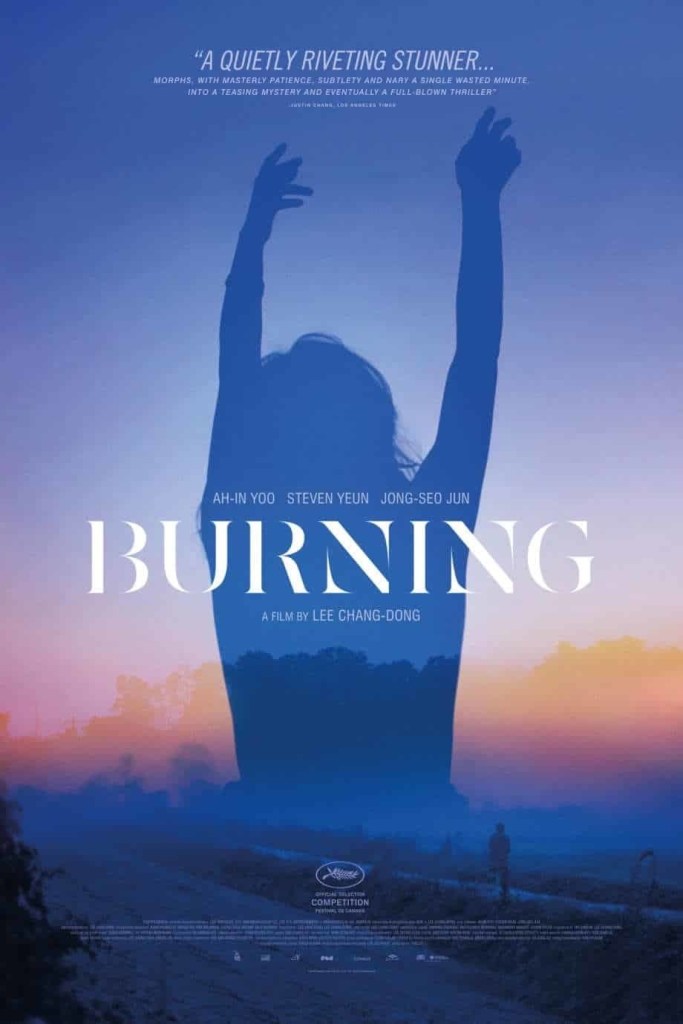
Review: Burning

I’m sick of Western fiction, so I asked ChatGPT for recommendations of Korean films. Amongst many, it recommended Burning, a 2018 film I had never heard of. It turned out to be one of the most mesmerizing movies I’ve ever seen.

We follow a protagonist whose mother abandoned him and whose father is on trial for having assaulted someone. The protagonist lives in a rural house near the border with North Korea. He works odd jobs for a living. Right off the bat, he meets a childhood friend of his, a cute young woman who seems to get by on odd jobs and men’s attention. Shortly after they meet and share an intense moment, she announces she’ll leave on a trip to Africa. The protagonist ought to go regularly by her tiny apartment to feed a cat that he can’t even see.

When the young woman returns, she’s not alone. She’s accompanied by a rich-looking Korean guy (played by Steven Yeun, usually most known for American movies), and the protagonist immediately slides into that sickening humiliation known well by those who’ve liked or loved a girl only for her to casually force you to see her act intimately with another man as if you were meant to endure it. The rich guy’s smiles and comments seem to suggest he enjoys inflicting that kind of humiliation. What is an isolated, poor young man who has fallen in love with a chaotic, existentially-damaged young woman supposed to do when she’s being absorbed into a superior man’s life?

That summarized plotline disguises a lot of what the movie actually is about. What you’re truly living throughout this movie is uncertainty. Someone’s inadequate access to reality, knowing that you’re barred from possessing enough authority, information, or self-knowledge. The young woman’s cat exists, or maybe it doesn’t. The childhood well where the young woman claims she once fell exists, or maybe it didn’t. The protagonist is supposed to have rescued her from that well, except that he can’t remember doing so. The protagonist is supposedly a writer who cannot write. For most of the film he observes, accumulates details and fails to turn them into meaning.

The sense of place in this movie is sublime. You feel right there. The scenes are allowed to linger as much as they need without having to rush to the next bit of conflict.

By the end, two opposite interpretations remain open and equally valid. The young woman was at the bottom of an invisible well, depending upon another lonely and uncertain person to confirm that she was real. Whether that well existed doesn’t seem as important as the fact that’s how she experienced herself. What we call reality is just the story we become willing to act upon.

Review: Bugonia

I wanted to say I was pleasantly surprised to see such an original movie coming out of Hollywood. But I’ve just found out it’s an adaptation of a South Korean movie. Leave it to the Asians to actually create daring fiction.

Anyway, this was good. A head-to-head between Jesse Plemons, whom I’ve liked in everything he’s done, and Emma Stone, whom I’m not particularly enthusiastic about but who’s good at her craft. Emma plays a high-ranking executive of a company involved in shady pharmaceutical stuff. Jesse Plemons plays a schizotypal, traumatized dude out in the sticks whose mother was injured somehow by said pharmaceutical company. But Jesse’s character has figured out that behind that mundane, vague corporate malfeasance is actually an alien plot to enslave mankind. Along with Jesse’s retarded cousin, they decide to kidnap Emma Stone’s character so she’ll transport them to the mothership and allow Jesse to negotiate for the sovereignty of Earth.

That’s as much as you need to know. In fact, that’s likely more than you needed to know to get into this movie. If you’re into weird stuff, watch it. It’s not the usual Hollywood garbage.

The peculiar script is a highlight. It allows compelling negotiations between Jesse’s delusional character and Emma’s, a cunning executive who finds herself under someone else’s control. Jesse’s and Emma’s acting are fantastic. Unfortunately, the third main character is Jesse’s retarded cousin, who seems out of place in every scene against these two powerhouses. I understand why the plot needed him (otherwise Jesse would have been sounding off necessary plot elements against the walls), but I think the movie would have been tighter without that character in it.

I recommend this movie. So much shit out there, you have to point out the ones that do something.

Review: The Town

Recently I became interested in the movie that Ben Affleck and Matt Damon made together and was releasing on Netflix. The Rip. It seemed like it could be entertaining. Then I watched like thirty minutes of it and realized that it was another one of those movies, like virtually all I’ve attempted to watch in the last ten years or so, that seem to be written by people incapable of producing a good script. Cringe dialogue, the subtlety of a hammer. In online mentions of this movie, people had compared it to a similar one (if only because heists and Ben Affleck were involved): The Town. Released in 2010, but somehow already looking ancient.

Well, The Town was fantastic. I checked it out at midnight and ended up staying up until about three in the morning. Extremely well-written script with not only unique, compelling dialogue, but also great set pieces, mirroring, and callbacks. Like a perfectly-built machine. Affleck does well, although I’ve never been much of a fan of his acting. Jeremy Renner, though, is amazing as this loose cannon who did nine years in prison and who’d rather die “holding court on the street,” as he put it, than return to jail. I never cared much for Renner’s acting, but it feels like other movies he was in, those I’ve seen at least, simply didn’t give him the chance.

As the romantic interest we have Rebecca Hall in her twenties. Gorgeous woman, always a pleasure to have her on-screen, and from the moment she first appears, you understand why a couple of the men involved would risk getting in trouble for her. We also have Jon Hamm from that old Mad Men show (which I never watched, but it was all over the place back in the day) doing very well as an FBI dude, and Blake Lively acting as a strung-out town bicycle. She honestly did great.

The movie gives a great sense of being stuck in a small town (although, as far as I could tell, it’s just part of Boston) with nowhere to go, burdened with the weight of generations, doomed to nothingness unless you dare to stick your head out in a way that could make others cut it off.

It’s very rare for me these days to watch a Hollywood movie and think, “Wow, that was great.” So I recommend this one.

Review: The Vast of Night

I rarely watch movies (nor read novels for that matter), because damn near everything released after 2006 or so is an excuse to make a political vehicle. I asked ChatGPT what could interest me as someone whose favorite movies (off the top of my head) are Fight Club, Jurassic Park, The Matrix, Back to the Future, and probably a couple others that I can’t remember now. It recommended some movies that I had never even heard about, although that’s not particularly surprising given that I haven’t been following movies in a good while.

So, it recommended The Vast of Night, a small sci-fi movie from 2019 or so that pays homage to Twilight-Zone-like stuff from back in the day. It takes place in a single night, following mainly the radio host of a tiny local station at a nowhere town, along with a switchboard operator. Both are young, both want to leave for better pastures.

That night, as most of the town is busy at a basketball game, some of the locals mention seeing lights in the sky. The switchboard operator receives eerie sounds that had never come through her switchboard, and she enlists the help of the radio operator to see if anyone can figure out what that’s all about.

I won’t reveal anything more about the plot. The whole movie takes place in a single night and a relatively short span of time. It’s on the artistic side, with fancy dialogue and ambitious shots. Some very interesting single takes. I thought it nails the feeling, that some of us remember, pre-internet of clutching onto vague rumors and radio testimonies that offer glimpses into a larger reality. I enjoyed the movie quite a bit. I also found the switchboard operator very cute, which is a plus.

It’s no masterpiece. The dialogue-heavy introduction goes on for way too long; it does a great job of establishing the cleverness and competence of the young radio guy, as well as his friendship with the switchboard operator, but it could have been significantly shortened. Once the switchboard operator receives the strange sound through the board, the movie doesn’t stop. I would have liked to say that it’s free of politics, but they had to sneak a “whites don’t care about blacks and indians” in there. Can’t escape that shit.

Anyway, if you enjoy peculiar movies that aren’t the usual garbage, you could do much worse.

Review: Dispatch

Back in late 2000s and early 2010s, we had this thing we affectionately called Telltale-style games: heavily narrative-driven games that relied on letting the player make more or less compelling decisions that would affect the narrative. They didn’t have the complexity of early adventure games, but they couldn’t be called simple visual novels either. They were tremendously successful, until corporate greed swallowed them, spread them thin, and eventually dissolved them into nothing. The company shut down.

A new studio made of former Telltale devs decided to try their hand a new Telltale-style game that removed the dragging parts of former Telltale games (mainly walking around and interacting with objects) to focus on a good story, a stellar presentation, and compelling minigames. Their first product was the game Dispatch, released about a month ago in an episodic format (two episodes a week, but all of them are out already). The game has become a runaway success.

The story focuses on Robert Robertson, a powerless Iron Man in a society where many, many people have superpowers. He carries the family legacy of battling villains with a mecha. As an adult, he pursued the supervillain who murdered Robert’s father, and who now led one of the most dangerous criminal groups. However, during an assault on the villain’s base, Robert’s mecha gets destroyed, which puts him out of a job.

However, he’s approached by one of the most notorious superheroes, a gorgeous, strong woman who goes by the name Blonde Blazer. She offers him a job at the company she works for, SDN (Superhero Dispatch Network). Their engineers will work on repairing Robert’s mecha, while he offers his expertise on fighting crime as the one in charge of dispatching other heroes to the appropriate calls.

Robert finds out that the team of heroes he’s supposed to handle are a bunch of villains who either have approached the company to reform themselves, or were sent by the criminal system for rehabilitation. They’re a diverse bunch of rowdy, at times nasty superpowered people who aren’t all too keen on having a non-superpowered nobody in charge of them. The narrative explores how the team grows to work together better.

The execution of this story could have gone wrong in so many ways: wrong aesthetic, time-wasting, atrocious writing, and above all, marxist infiltration; like most entertainment products released on the West these days, the whole thing could have been a vehicle for rotten politics. But to my surprise, that’s not the case here. A male protagonist, white male no less, who is an intelligent, hard-working, self-respecting role model? Attractive characters, fit as they would be in their circumstances? A woman in charge (Blonde Blazer) who is nice, understanding, competent, caring, and good? Villains with believable redemption arcs? Romance routes that flow naturally? Where the hell did this game come from in 2025?

Entertainment consumers have been deliberately deprived of all of this by ideologues who despise everything beautiful and good, who, as Tolkien put it, “cannot create anything new, they can only corrupt and ruin what good forces have invented or made.” Franchise after franchise taken over by marxists who dismantle it, shit on the remains, and then insult you if you don’t like it. Dispatch is none of it. For that reason alone, I recommend the hell out of it. I’m sure that given its sudden popularity, the forces-that-be will infiltrate it and ruin it in its second season as they do with everything else, but the first season is already done.

It’s not perfect, of course. Its pros: an astonishing visual style that makes it look like a high-quality comic book in movement. No idea how they pulled it off. Clever writing. Endearing characters. Interesting set pieces. The voice acting is extraordinary, led by Aaron Paul of Breaking Bad fame. He deserves an award for his acting as Robert Robertson. It’s a good story told well, and you’re in the middle of it making important decisions (and also plenty of flavorful ones).

The cons: some whedonesque dialogue that didn’t land for me. Too much cursing even for my tastes, to the extent that often feels edgy for edge’s sake. Some narrative decisions taken during the third act, particularly regarding the fate of one of the main characters, didn’t sit well for me, as it deflated the pathos of the whole thing. But despite the pros, this was a ride well worth the price.

Oh, I forgot: they should have let us romance the demon mommy. My goodness.

Check out this nice music video some fan created about Dispatch, using one of the songs of its soundtrack.

Review: Chainsaw Man – The Movie: Reze Arc

A world where every concept is incarnated in a demon, whose power depends on how feared is the concept. The Cucumber Demon. The Blood Demon. The Typhoon Demon. The Future Demon. The Darkness Demon. The Angel Demon. The Death Demon. These fiends fight among themselves to either reign in hell or escape to Earth through possessing hapless people, usually the recently deceased. Demons hold grudges against each other and against humans in general. Humanity exists in a state of constant peril, with societies having to organize militias dedicated to the ever-present threat of a demon showing up somewhere or possessing a loved one. Some of the humans make deals with captured or semi-friendly demons, to gain some of their powers for good or ill. The cold war persists, but with the focus on achieving control of the most dangerous demons.

A winning concept, I’d say. The premise follows an orphaned teenager named Denji. He never went to school, lived with his gambler father, was manipulated by the local Yakuza into doing their dirty work for them, and finally was abandoned to die. However, a demon recently escaped from hell took pity on Denji; this fiend was the Chainsaw Demon, who had possessed a dog (I think that’s how the story goes; I have a hard time imagining Chainsaw escaping hell as a dog).

Denji had been torn into pieces, his body parts thrown into a dumpster, only for the Chainsaw Demon to give himself away as Denji’s heart, which made the teenager a human with feet in both worlds (this is extremely common in Japanese stories).

Then, the teenager gets conscripted into some special forces by a shady young woman with light-red hair.

The least I say about this person, the better.

Anyway, Denji isn’t your average protagonist. He’s half-wild, emotionally stunted, doesn’t care about the world, barely knows how to deal with people, can’t realize when he’s being manipulated (which happens constantly), and he’s solely motivated by hedonism, usually in the form of food or a cute face (or a nice pair of tits, or a nice ass), for which he’ll kill and/or die over and over again if necessary.

I quite like Denji. It has become a meme on the internet to say about Ryan Gosling’s characters that “He’s literally me.” I feel similarly about Chainsaw Man‘s protagonist.

In any case, the anime adaptation of part of the manga was a runaway success, even capturing the attention of some people that usually wouldn’t be into this stuff. But the anime series ended right at the moment when one of the most popular arcs would begin. This one involves a peculiar girl named Reze.

I’ve finished watching the movie about an hour ago. Oh, what joy. Plenty of the artistry on display was mesmerizing, some of the best animation I’ve seen in my life. The cinematography, the subtle character moments, the amazing fight scenes, the way the tension and absurdity ramps up to the point when you ask yourself how the hell did we get here. I wish the movie had been longer, but I didn’t feel like it missed any of the content of this arc. Reze’s character was done justice, which is far more than you can usually say about adaptations.

You know, it gets easy to forget that when you go to the cinema, the contract used to be that you’re giving away your attention and time to be captured by a story told by competent, passionate people. These days you watch movies, if you dare, trying to find a few entertaining moments in the torrent of politics that gets diarrhea-ed down your throat. This movie I’m reviewing is the deranged tale of two young people who were fucked from birth and who have no choice but to do the things they’re told to do, to have in exchange some semblance of normality in their lives. It also involves a myriad explosions, chainsaws growing out of a head and limbs, and a shark mount. If you enjoy Chainsaw Man, you have to watch this one. If you haven’t followed the story up to this point, you’ll have no fucking clue about what’s going on.

Great times. I posted one of the trailers for the movie in the previous post, but I’ll post it again:

Sadly, the movie would have left a perfect taste in my mouth if it wasn’t because I know that the story doesn’t end with the first part of the manga. The author, for whatever reason, created a second part featuring a new main protagonist (they switch around afterwards, but still), and although it started out very promising, it quickly devolved into shittiness. Some great moments, but plenty of lame ones. And much worse: some characters were brought back only to do a disservice to them. Others were killed unjustly. I’m waiting for that part to end so I can read it in its entirety, but right now I’m of the opinion that it shouldn’t have been created at all.

One Battle After Another, by Paul Thomas Anderson

For the last ten years or so I have avoided Hollywood movies, and movies in general, because most of what’s produced out there these days is vehicles for marxism. A couple of days ago I found out that Paul Thomas Anderson, who made Boogie Nights, Punch-Drunk Love, There Will Be Blood, The Master, and Inherent Vice, all movies that I either loved or found very interesting, had made a new one, named One Battle After Another, starred by our favorite lover of under-25-year-old women: DiCaprio himself. And the movie is based on a complex book by Thomas Pynchon, about revolutionary movements in the sixties. I was eager to see a movie set in the late sixties and early seventies, an era that has become important to me for reasons. On a personal note, P. T. Anderson is, or used to be, an intimate friend of Joanna Newsom, who is probably the living artist I respect the most (Joanna even had a role in Inherent Vice). So I figured that I finally could drag my aging ass to a movie seat.

It was fucking terrible. Pure political propaganda. P. T. Anderson, or whoever wrote the movie, used Pynchon’s book as an excuse to write a contemporary movie to shit on the US, and by extension on all countries of ethnic European origin, for controlling their borders and not being communist. In the first twenty minutes or so we see DiCaprio (I mistakenly wrote DiCrapio, and perhaps I should have left it like that) acting as the bomber for a communist, terrorist group, whose leader was the most disgusting, over-the-top example of a “black power” revolutionary I remember seeing in fiction. At first, silly me, I thought that DiCaprio’s character was undercover or something. When the black terrorist, after insulting and threatening some border guards, got to Sean Penn’s character and threatened him into getting hard, I realized that this movie was playing it straight. Abhorrent, insulting, morally-bankrupt garbage. That black communist hadn’t even met Sean Penn before; she just assumed that he would find her super hot, as in all white people are attracted to ugly, violent, nasty black women. Are black men even attracted to that?

Other than DiCaprio, the token “ally,” every single person of ethnic European origin in this movie is depicted as evil, a freak, or both. Sean Penn, who is a woketard himself, I assume was doing his best Donald Trump impression, judging by his facial mannerisms. Both DiCaprio and Sean Penn are depicted as being super turned on by the main black communist revolutionary. Sean Penn’s character even pursues her for sex, and gets pegged. Because of course he does. Later on in the movie, in an extremely lazy exchange, another character implies that he’s a closeted homosexual.

After DiCaprio’s character and this black bitch have a child, she berates him for “trapping” her, for trying to get her to act as his mommy, merely because DiCaprio’s character intends for their daughter to have a mother. In the end, this black communist, who was cheating on DiCaprio, abandons her family, murders a guard during an attack, snitches on their revolutionary group to avoid ending up in jail, and leaves the country. By the end of the movie, that fucking bastard is depicted in a sympathetic light, as if she could be redeemed. As in, “Ah, what wild youth we had. I made some mistakes, silly me.”

DiCaprio, being an “ally” ethnic European in a marxist movie, after he went out of his way to have a mixed baby, is depicted as a loser who has wasted the last thirty years destroying his brain with drugs. He spends most of the movie bumbling around, and by the end, he just happens to be in the right place at the right time, after someone else had solved the problem.

Then there’s the whole white supremacy thing. Sean Penn’s character wants to belong to a group named after Christmas (get it?), who are explicitly white supremacists. Those guys turn on Sean Penn when they realize he had a relationship with that black revolutionary bitch, and possibly fathered a child with her.

This movie features a native-American character. As a native-American character in such a marxist movie, he ends up (spoiler) massacring a group of white people named after the American revolution. If you saw that season of Fargo, by the Coen brothers, then you’ve pretty much seen that whole scene. I recall that the Coen brothers also used that season as a vehicle to tell people how terrible the Eastern Europeans were to the jews. Nevermind the fact that 95% of the Bolshevik leaders were jewish and murdered about 30 million ethnic Europeans in what came to be called the Holomodor. A subject you won’t see in any Hollywood movie, nor will you be detained for questioning.

Oh, I forgot. Spoiler, in case you care about this fucking abysmal turd of a movie: DiCaprio’s character is a literal cuck. Sean Penn’s character actually fathered DiCaprio’s daughter. Thus, DiCaprio’s took his rightful place at the bottom of the marxist hierarchy: a discarded “ally” whose efforts and resources are taken up by raising another man’s mixed baby.

Terrible, terrible film. Cinematography was fine, though, if you care about that. What perhaps disturbed me the most about the movie was the way this communist revolution, and all sorts of social revolt focusing on destroying those “evil white men,” were depicted with the moral righteousness of an eighties/nineties film that used nazis as the bad guys. DiCaprio’s “daughter” even ends up as a marxist activist herself, accompanied by uplifting music.

I’d rather eat my own shit than watch this movie again. I guess I have to write P. T. Anderson off my list.