A couple of weeks ago or so, I uploaded a YouTube video that contained four covers of this song, from the middle-school period of William Griffin’s life. He’s the protagonist of the Odes to My Triceratops song cycle. But I found issues with the audio quality, caused by a faulty pipeline. Although that’s now fixed, I’ve needed to fix the songs involved, and I also created two more for good measure, so the new video has six covers.
“Tricera Girl” is one of my favorite songs of the first album. It embodies very well the wonder and desire of an early teenager who realizes he’s found the love of his life and doesn’t quite know how to handle it.
I originally intended a gentle rocksteady vibe for this song, but throughout my sweep for alternative genres, I tried Nashville sound, and it clicked perfectly. This song has become the closest feeling I’ve ever produced to inhabiting the 70s, as far as I think of them.
The original is one of my favorite songs of the third album. Suno showed its limitations covering it. No amount of restructuring made Suno understand the peculiar drums build-up that the original song had towards the end, but I’m still happy with these two covers.
This song launches the fourth album, right after William seemingly kills himself right at the end of the previous album. I made this song, along with about four others of this album, during the last stretch when Udio was usable.
You could tell, unfortunately, that Udio was involved in the production of this song, because the composition is far more complex than what Suno 6.0 produces, even when you directly remix the original Udio song. That was due to Udio allowing the generation of 30-seconds-long segments at a time, and letting you extend the song in either direction as you pleased. No service allows that anymore, not sure why. You can hear the entirety of the original Udio song, not the Suno remixes, at the end of the video.
I’ve bitten the bullet and decided to create my first new Odes song from the fourth album on Suno 6.0. I’ve genuinely explored alternative services and models, but none are up to par even with the original Udio, so I’m all out of luck when it comes to keeping my previous workflow. But I’ve made it work with Suno 6.0, I think. I’m quite happy with how “Hermit Hemisphere” came out.
I’m remaking my old Udio-era songs with the new Suno 6.0, which is terrible for making songs from zero, but amazing at remixing them.
This song, the first album’s closer, is one of my favorites from William’s middle-school era, but the quality of the audio was so bad that it hurt to listen. Now that we’ve gotten the boys in the studio again, the song can finally be listened to in all its magnificence.
Suno is terrible at allowing you to create music in an exploratory, coherent manner, but it’s exceptional at covering songs made in the glory days of Udio.
The combination of this song’s retarded lyrics and its hard-rock earnestness will never cease to be funny to me.
My first memory is of being four years old, lying in a hospital bed when my parents brought me a gift: a toy triceratops. I thought it was the coolest thing in the world.
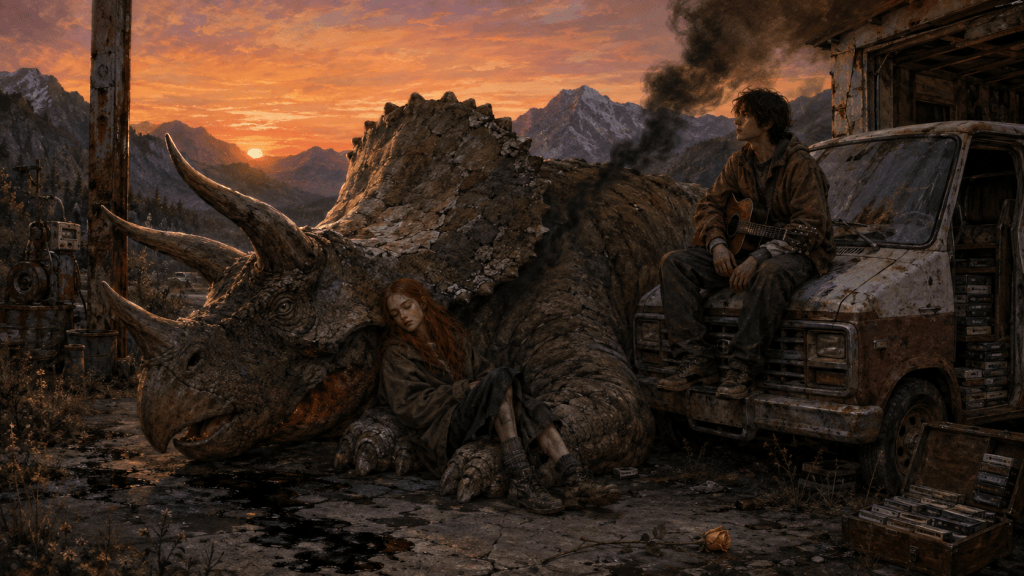
I came up with the original story for Odes to My Triceratops during one of my wildest periods of creation, back in spring and summer of 2021. I don’t know how they came to be, but I suddenly had a young songwriter, a blind and illiterate girl, and their friend, who was inexplicably a sentient triceratops. It could have ended as a gag. I didn’t understand then why this tight-knit, strange trio of friends seemed to matter so much to me to the extent that the moment I had those elements, I knew I had to tell their story. For my first try, I didn’t give them the effort they deserved. That first batch of lyrics turned out to be mostly throwaways; they served mostly as compost for the versions that ended up as the actual Odes to My Triceratops songs.
The third of four albums ends with William apparently killing himself. I wrote and produced five songs afterwards, but that happened at the same time as the Udio debacle, when the music industry pretty much forced Udio to block downloads, rendering it useless, so I didn’t continue with the fourth album’s contents. Although I play the guitar, I’m not a musician. I know what I want to hear, but I can’t access a band, so the AI service that allowed me to play around with generated music was a godsend. I wouldn’t have been able to create these songs otherwise.
The videos below are the three complete albums I produced, containing all the lyrics of the first three parts of the story.
Creating these songs was a huge endeavour that took away from other responsibilities. I was also dealing with a stressful job that I ultimately had to quit for health reasons. But I couldn’t get some of these songs out of my mind. Moments from them would bubble up randomly, and I found myself singing internally to their lyrics. More importantly, though, I felt a responsibility to William, Claire, and Lorenzo to finish their story properly.
This story isn’t a joke to me. It has taken me years to fully understand psychologically why it felt so important to process this story to the end. I was a high-functioning autistic kid dealing with co-morbid Pure O OCD, who spent his childhood wandering alone, lost in daydreams, writing and drawing. I was in absolute communion with the mysterious, blind, illiterate female presence inside me who showed me such beautiful dreams. But some of the writings and drawings from that era also contained stuff that a child shouldn’t know: mayhem, violence, troublesome sexual imagery. I didn’t even question it at the time, but some of the things that came naturally to me would have made A Clockwork Orange blush. It would take time for me to understand that people don’t have to deal regularly with intense intrusive imagery of the violent and sexual variety, including impulses like pushing hot food to my eyes, shoving knives into my eyes (I don’t know what’s with OCD and eyes), licking random disgusting shit from the gutters, and plenty more stuff I don’t want to say. It’s not like I could keep them caged at all times; in moments when I was too exhausted to control them, I ended up dropping objects (a coffee on a customer, a valuable hard drive) right after had intrusive thoughts of doing so. I’ve never gotten a driver’s license because I don’t want to deal with intrusive thoughts of veering into oncoming traffic or accelerating towards a wall. I’ve never held babies because I’d have to deal with intrusive thoughts of dropping them on their heads. I knew I had a monster inside me: a dark, primordial force of chaos that couldn’t be tamed, and that would remind me of its inescapable presence whenever it pleased.
When I was seven, my mother wanted to free up my room to have a do-over child, so they put me as an unwanted guest in my disabled older brother’s room. The connection with my subconscious was lost. I no longer had silence nor space of my own. I couldn’t even sleep properly until I was 18 due to the noise. Looking back, my childhood was killed at the moment I was taken away forcefully from my proper environment and discarded as a child with his own needs. I’ve spent my adult years searching for what was lost, resuming the conversation with the generative force in my dark room that showed me such awe-inspiring, wild, magnificent dreams. Although I’m now familiar with her again, the trauma made her feral, strange. None of us are the same as we used to be when we wandered around lost in daydreams.
Odes to My Triceratops is the story of my youth. My unhinged generative, dreamlike period. My love for the blind, illiterate girl who showed me there was beauty in this world. My troublesome friendship with a reckless, violent, sexual monster. My war against the monster during my teenage years, when, lost in dissociative states, I felt I was a thin layer of conscious mind under siege by monstrous ancient instincts I didn’t want to identify with nor could understand. My yearning for the missing love of my life, the sole real person in the world. My suicide attempt. The integration of the monster. Finding the girl only to find out she had changed. Devoting myself to that mysterious presence in the dark room deep down.
Somehow, Odes to My Triceratops became my personal mythology that encompasses all the forces I contain. No wonder I’ve returned to it at least in my mind since its conception in 2021, and why I remain haunted by many of its songs.
Now, the five-year cycle of song lyrics is complete. Suno, the currently-leading online service for music generation, will release its new model, supposedly better than all previous ones and made in concert with the music industry, whenever it arrives. I intend to render all my remaining lyrics of the fourth album into proper songs, then release the fourth and final album on YouTube. Barely anyone has listened to them, but it doesn’t really matter. I know who I’m doing this for, and I don’t need to look up.

 The Domains of the Emperor Owl
You must be logged in to post a comment.