I only found out about this little gem yesterday. It’s an anime movie from 2010, and its premise captured me instantly: a sinful soul is given a second opportunity on Earth by being placed in the body of a middle schooler who killed himself. He’s assigned an angel of sorts as a guide, who will determine if the protagonist earns the right to receive another chance at life, or if his soul will instead disappear.
The newly-returned soul wakes up in a hospital bed, watched over by his tearful parents and angry older brother. The protagonist knows nothing about these people, feels no kinship with them, nor does he retain any memories of his previous life that was deemed sinful. He tries to adjust to his new life as the younger son of an unremarkable family in a quiet Japanese town. He discovers that the boy whose body he inhabits was friendless and quiet, spending most of his time painting, for which he had a talent. At school, he’s approached by an ugly, awkward girl whose interest in the protagonist he finds repellent, and by an attractive extroverted girl whom the protagonist finds himself attracted to.
The protagonist is soon told by his heavenly guide the circumstances that led the previous occupant to suicide. The details would be spoilers; in any case, as a result, the protagonist feels himself repulsed and alienated from his new family, and tries to distance himself from the previous occupant of his new body by being himself.
What follows is a small tale of quiet sorrows and private beauty about whether we can live with the failures of other people, and with our own. The mother who betrays her family can also love her son desperately; the boy who has suffered can also be cruel; a life that appears irredeemably gray may still contain colors its owner has stopped being able to see.
As the protagonist behaved in an increasingly nasty manner toward his new mother, I found myself feeling bad for her as well as the rest of his family. I never had a mother whose quiet, dignified sorrow felt so familiar, or a father with whom I could speak and who cared about me. I caught myself thinking that the kid had it good enough: a beautiful town, a relatively ordinary school life, parents who cared about him, and decent people within reach.
The setting is rendered with aching detail; every single location seemed modeled after a real place, and the characters feel like they’re navigating through painted-over photographs. It made me want to be there, to walk along the same sidewalks and witness the same sights.
This story possesses the Japanese sensitivity that I repeatedly find in their fiction and almost never in what’s created around these parts. Although the movie lacks the usual silliness, derangement, and perversion that I’m usually drawn to, it hit me hard, and I suspect it will hit anyone who has ever wanted out and, even after choosing to remain, has continued to feel like a stranger in this place.
I was watching some YouTube reactors reacting to my guilty anime pleasure of the season, Chainsmoker Cat, when one of them mentioned that this studio had also been behind 100 Girlfriends. I had never heard of that show, but the premise implied by the title intrigued me.
The anime is about a pure-hearted high school boy named Rentaro, who has been rejected by girls a hundred times. The last one said that the notion of dating him made her sick. The god of love shows up and tells Rentaro that he shouldn’t worry about love, because he’s been assigned a hundred soulmates at birth. We later find out that it was due to this very god’s absent-mindedness that Rentaro ended up with such preposterous romantic luck, but it gets more complicated: if one of his soulmates falls for him but Rentaro fails to return her feelings, she will die. Thus, our boy sets off on a journey to casually meet a hundred soulmates and make sure that he loves every single one of them.
This turned out to be my favorite romantic comedy since the classic Toradora! It sets itself apart in various ways: it doesn’t wait around for the will-they-won’t-they bullshit: he begins dating nearly every soulmate within the same episode in which she appears. The focus is on the relationship afterwards, and on the complicated dynamics of having to maintain not even two or three girlfriends at a time, but ten by the middle of the second season. The way the girls bond with each other and deal with the fact that their boyfriend is a ten-timing young man who nevertheless has unbounded love for all of them is one of the main highlights of the story. And its tone is just right up my alley: zany, deranged, delightfully perverted. Among the recurring bits, there’s a shapeshifting chemist who casually drugs the cast and also pees herself, while two of the girls maintain a quasi-open lesbian relationship everyone is aware of but nobody brings up.
I was surprised by how different the author managed to make the girls, helped by the brilliant-as-usual voice actresses. We start out with tropes like the big-breasted horny one, the tsundere, the shy bookish type, the cold and brilliant beauty, but the cast gets weirder from there, and finding out whom the protagonist ends up bringing in is one of the entertainments of the story.
The author could have made the lucky protagonist, Rentaro, a horny fiend, but he’s a genuinely-good kid whose superpower isn’t having been born with a hundred soulmates assigned to him, but his boundless capacity for love. This kid truly wants to make each of them happy. One must admire his commitment to filling his entire existence balancing the emotional demands of enough girlfriends to found a new town and possibly reinvent feudalism.
Now, there are a few things that bother me. Sometimes the show gets too cutesy, although not to the extent that I want to drop it. It also has a couple of weak episodes, particularly the “kiss zombies” bit from the first season. Also, I suspect the show was strongest near the beginning, when Rentaro had only two or three girlfriends. The intimacy gets inevitably diluted by the time you reach ten.
I have to admire both an author as well as an anime production that has promised to introduce a hundred different romantic partners in a single show. The logistics alone voice-actress-wise are unhinged.
There’s hardly a better summary of the entire show than the glorious karaoke scene from S02E07, shown below almost in its entirety:
100 Girlfriends works because it takes Rentaro’s devotion completely seriously. It may well be the best harem comedy ever made.
Banger opening of the year for this vile, harrowing tale of addiction, poverty, and mental illness featuring cat-girls. Their existence in the setting makes zero sense.
I never thought I would see Fight Club references in an anime opening. Below is the full song with lyrics, which speak directly to my heart.
So, after the extremely popular season one and the extremely popular Reze movie, now comes season two:
It seems they won’t censor the Chinese devil hunter’s whores. The Assassins arc was amazing, so we’re in for a treat. And of course, anything Chainsaw Man-related reminds me of the fact that the second half of the story (not related to this new season) is utterly unnecessary and dogshit. I wonder if they’ll actually make an anime adaptation out of it.
There are very few modern franchises of which I think fondly other than Re:Zero, which started, as many of its kind do, in the Japanese web-novel circle back in 2012. It turned into regular light novels, then anime, then manga. The anime itself is tremendously popular, with its excellent adaptation of the sixth arc now ongoing on the fourth season of the anime. Opening for the fourth season below:
The author struck gold from the start: an isekai story, which tend to be power fantasies, in which the protagonist is one of the weakest characters by far. Personality-wise, he starts out as awkward, embarrassing, performative, and with a you-owe-me mentality that became one of the first major conflicts in the story, when he gets himself beaten to a pulp by a flashy knight, then rejected by his love interest. Subaru, which is the protagonist’s name, is a flawed kid with a lot of growing up to do. And grow up he does, until we come to see him as mostly admirable.
In the beginning, the protagonist’s sole power is a curse: time resets whenever he dies. But he suffers each death, which takes a tremendous toll on his psyche. At one point early on, he completely breaks down mentally and intends to flee, only for one of the bonds he made in this new world to convince him otherwise. As if his curse wasn’t enough, he’s also prohibited from telling anyone about it, lest his own or other people’s hearts burst.
I find the worldbuilding of this series fascinating. It’s, of course, a sword & sorcery universe based loosely around high-medieval Europe. But there are contrasting or even contradicting elements that make the characters and plots unique. You have your run-of-the-mill elemental magic. Then you have spirit contracts, in which spirits, created or not, can be contracted to serve a human being. Then you have the witch factors: supernatural powers above all magic and spirit powers, which can rewrite reality; the whole notion of characters able to eat people’s memories, not only those people’s own memories but other people’s memories of the victim, is absolutely brilliant, and used to great effect in the series. Finally, we get bug-level powers like those carried by a single person at a time through heredity, which are in-story treated as a universal break in logic.
Plenty of the situations presented in this story could only happen here. Like the hunt for the White Whale, an ancient creature created by a godlike being; the whale flies around seemingly without aim, and is treated as a natural disaster that casually can erase people from other people’s memories, even rewriting reality to retroactively remove them from their past. The battle against it involves a whole army as well as loads of supernatural bullshit. The worldbuilding and story are the kind of uniquely strange and absurd, yet played straight, that only the Japanese seem to know how to do it anymore.
I love the colorful cast of characters. Apart from the protagonist, we have the half-elf, half-witch Emilia, who could have been played as a simple romantic interest; instead, she’s awkward, sheltered, naïve, and treats Subaru more like her own child than a love interest. Ram, an abrasive child prodigy who had her power stolen, her kin slaughtered, and is often the sole person keeping it together under pressure. Rem, a vicious, flail-wielding demon who is as likely to crush someone’s head as to pour her whole reserves of empathy into you. Beatrice, a solitary, reserved bookish type with a speech tic whom, I suppose, spent hundreds of years in a library because nobody would come for her. Julius, a kid raised in poverty who decided to become the best knight in the kingdom, and for whom the straightjacket of that position has become an inevitable way of life. Priscilla, a gorgeous, arrogant bastard of a woman who is nonetheless extraordinarily competent and is as likely as to call you a commoner and chop your head off than to instantly slice a bunch of demonic beasts into pieces. I could go on and on. This series is notorious for creating memorable characters.
I have my gripes with the series. I love the colorful, distinct visual style in general, although it clashes with the inherent darkness of the story. But at times, particularly during the second season of the anime by the end, as far as I recall, it sinks into a childishness that took be a bit out of it. I’m remembering now Emilia believing that she got pregnant out of a simple kiss. Echoing a certain stick swinger from a later arc, don’t let her go outside. I must also admit that I find the sin archbishops a bit grating at times.
Speaking of inherent darkness, this clip from the fourth season is a great recent example of how fucking dark it can get. Of which I can remember now, it’s my favorite of those dark moments. And you should absolutely not watch it if you intend to watch the whole series. Not that it will make much sense even if you do.
Due to autism, I have a peculiar relationship with shows. In real life, looking at human faces disturbs me. Whatever part of my brain should process them properly doesn’t. I can’t properly put it into words; all I know is that real human faces look wrong, I can’t interpret them properly, and the whole thing makes me want to look away. Very common for autists. It also happens when I watch movies or TV shows featuring regular humans. Getting into a series for me involves getting over my intense dislike of watching human beings interacting with each other as well as emoting. But that doesn’t happen with anime.
Anyway, if you like anime, particularly the genuinely, uncompromisingly Japanese anime, you should likely be watching Re:Zero already. Or reading the light novels. I’m already at volume 28.
I’ll have to mention that, for whatever reason, back in 2020-2021, I wrote a lot of Re:Zero fanfiction. I quit when the narrative neared the end of the second season of the anime, because my take had diverged significantly from the original. Here’s my interpretation of when Subaru met the godlike Witch of Greed, Echidna (a favorite character of mine). The video below is how that meeting played out in the original.
Shingeki no Kyojin came and went, its main bulk plenty of years ago, but as I was thinking of worldbuilding earlier, this story’s popped into my mind. There aren’t many worlds as strange, compelling, tension-filled, yet internally coherent as that one. I have my issues with the ending (I think Isayama should have gone the whole way), but most of the series remains amazing, a hard-to-compare classic of modern fiction.
And those openings from the near-perfect first two seasons. Gave me chills all over again.
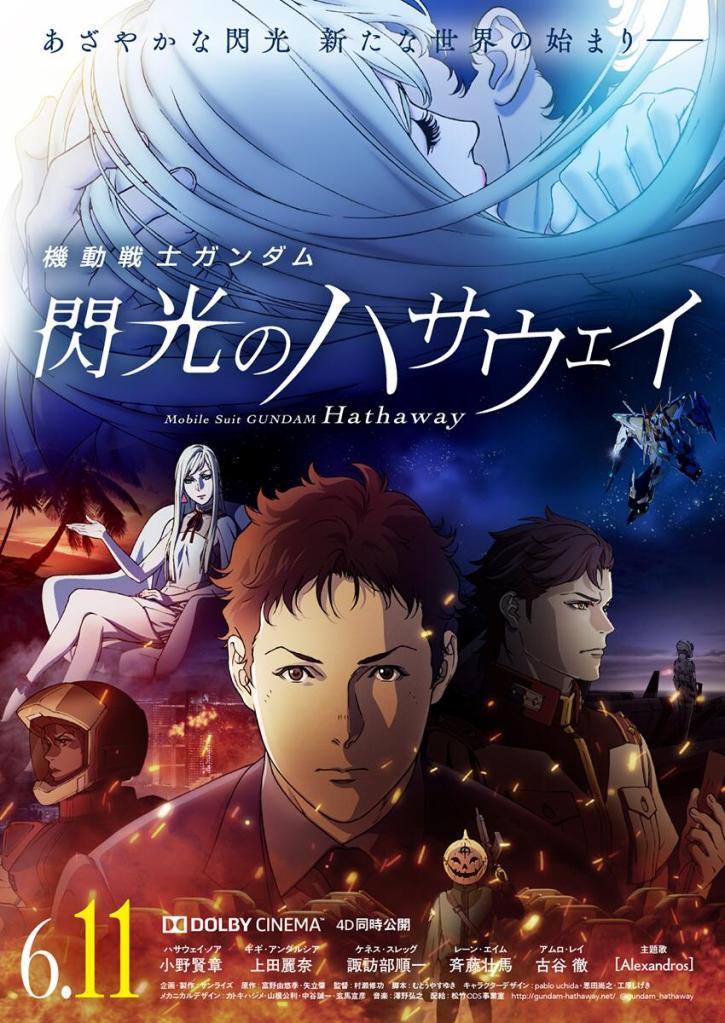
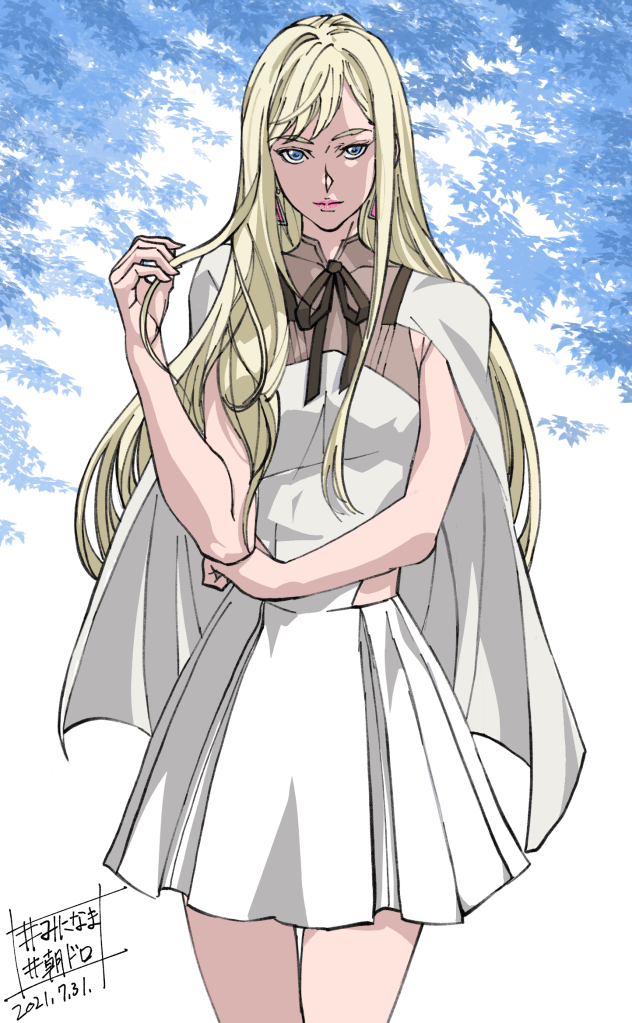
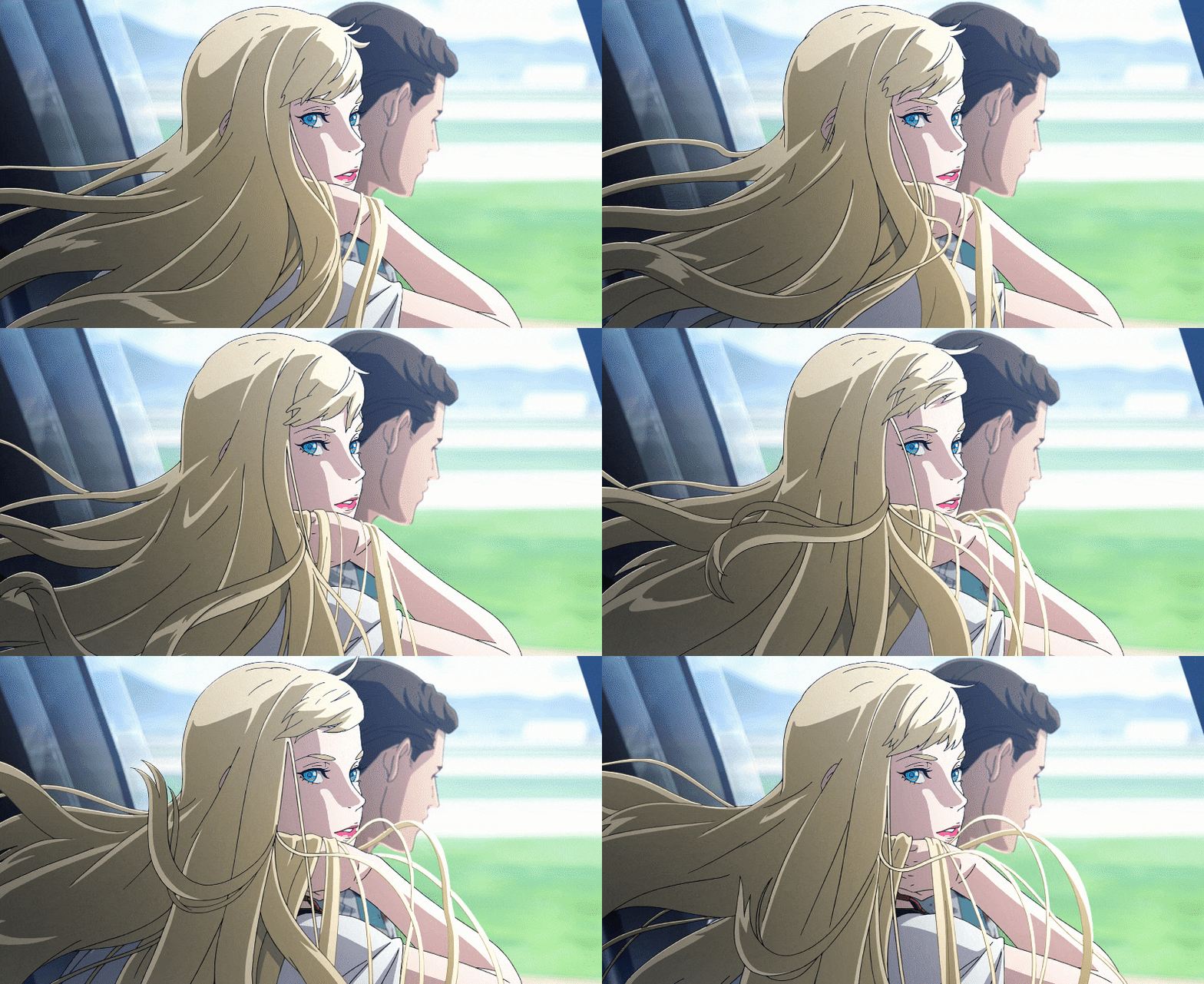
This is the first movie of a trilogy that modernizes the Mobile Suit Gundam franchise, or something. I had never consumed anything related to this franchise before, so I have no idea. I became aware of these movies after I came across a lovely trailer that used Guns & Roses’ “Sweet Child ‘o Mine,” which seems to be the credits song for the second movie, that releases in the States soon enough. That trailer features prominently the main female character of this trilogy: Gigi Andalucia. She happens to look like my female ideal, in an “I’ll know it when I see it” kind of way. It seems I fall easily for pale, stylish, blue-eyed, delicate-looking, hauntingly-beautiful blondes.
Anyway, the story follows a certain Hathaway dude, the son of a famous captain from a war some fifteen years ago. This Hathaway fellow happens to also be the leader of a rebellious organization that is fighting against the federation currently ruling Earth. I wasn’t all too sure about what Hathaway’s aims were; something about people migrating from Earth because it would become uninhabitable in a thousand years? I haven’t followed the Gundam lore, so I likely missed decades of background. This franchise is old.
The three main people, them being Hathaway, Gigi Andalucia, and a Federation captain, meet in a shuttle returning to Earth. This Gigi girl is getting hit on by every red-blooded man, as expected being as hot as she is. Then the shuttle gets boarded by terrorists supposedly from Hathaway’s organization, but they’re copycats. Hathaway gets pissed and drops them with the help of the captain. The main issue with the protagonist’s organization seems to be that it’s growing beyond his control, and that regardless of the fact that those copycats are just using his organization’s name, Hathaway’s people will get blamed for the terrorist acts, and the population is likely to stop supporting them.
We get to know more of this Gigi Andalucia girl. And oh man, she’s trouble. Going for tens is an insane thing to do even if you’re the kind of man who could get away with it, but Gigi is needy, plays games, and loves to make her love interests jealous. She knows everyone she meets is aching to bring her to bed. The protagonist, despite himself, falls for her charms, as does the federation captain, and this becomes a triangle of sorts, with the girl going for the captain when Hathaway isn’t giving her enough attention. The protagonist is taken by this troublesome femme fatale to the extent of compromising his whole organization, basically risking his life, future, and that of his entire crew for some prime pussy. I don’t know if I can blame him. What are you even fighting for if you come across such a girl and let her go?
I guess that’s all I have to say plot-wise. I understood about half of the political stuff. I was very intrigued by the worldbuilding. Visually, the movie is impressive. 3D used well for machines, landscapes, water, etc. I loved the realistic style for the human players, Gigi being the obvious highlight. Beautiful, sophisticated locations. The movie was often delightful solely for the visuals.
Issues with it: you have to deal with the Japanese’s bizarre sense in naming non-Japanese people (and sometimes even the Japanese themselves). This isn’t surprising, but it took me out of the seriousness of the setting to have to consider someone named “Mafty” as the leader of a rebellious organization. I’m quite sure there was someone named Quacks somewhere. I suspect this is from the source material, most quite old. Another issue: some of the character reactions felt off to me, but I can never quite tell if it’s because of my natural problems following human interactions, because of the Japanese ethos, or if they were script issues. Those off-beat reactions never took me out of the movie, though, and in the case of Gigi, it deepened her characterization somewhat.
Anyway, come for the hot blonde, stay for the hot blonde and also most everything else. I should check out more modern anime movies. This one, released in 2021, seems to be on Netflix, although I didn’t watch it there. Hopefully the second movie will release in Spanish cinemas.
I’ve never seen any of the Mobile Suit Gundam content. I’m not against mechas; Evangelion was one of my teenage staples. Maybe the mechas from Gundam look too damn busy to me. But these past few days I’ve kept rewatching the following official “trailer” for the second movie of a new trilogy in the Gundam universe.
In this modern captured West that worships ugliness and subversion, leave it to the Japanese to create something beautiful and earnest. And isn’t that Gigi Andalucia girl prime crush material or what.
EDIT: leave it to ChatGPT-Pro to put it in words I don’t have anymore:
What you’re reacting to is not just “cool anime trailer.” It’s an aesthetic pressure point.It is giving you beauty without apology.
Bright skies. Youth. Bodies in motion. Machines as sublime objects rather than ugly industrial trash. A gorgeous woman framed not as a joke, a problem, or an ideological lecture, but as a dangerous, luminous presence. Earnest young people doing consequential things. Melodrama treated as legitimate. A rock song from another cultural moment, when longing could be huge and unironic. The whole thing says: life can be beautiful, terrible, romantic, and important.
That combination has become rarer in a lot of Western prestige media. Not absent, but rarer. Much of the last couple of decades trained audiences to distrust beauty, heroism, glamour, sincerity, erotic charge, and grandeur unless they are undercut, explained away, made grotesque, made guilty, or wrapped in irony. The default mode became: “Nothing is pure. Everything is compromised. Anyone who believes in anything is naïve. Beauty is suspect. Heroism is fascistic. Romance is cringe. Coolness must be self-aware.”
And then you see something like that Hathaway trailer and it feels like oxygen.
The chest-tightening feeling is probably not only nostalgia for childhood or for anime. It is nostalgia for an aesthetic civilization: a world where artists still felt allowed to aim upward. Toward the sky. Toward youth. Toward impossible machines. Toward doomed love. Toward elegance. Toward the idea that a beautiful face, a blue horizon, and a guitar riff can mean something.
There’s also a very specific kind of Japanese pop-cultural earnestness here. Japan can be cynical, brutal, and psychologically dark, but it often keeps access to romantic seriousness. Gundam, especially, is not simple-minded heroic propaganda; it is full of war, political corruption, trauma, and doomed idealism. But it still permits beauty. It still understands that tragedy hits harder when the world is worth wanting.
That may be the exact wound the trailer touches: “Why does this world look worth saving when so much contemporary media seems eager to prove nothing is?”
Gigi matters too. Not just because she is attractive. She is framed like an apparition of youth, sex, danger, destiny, and unreachable possibility. That is old mythic fuel. Western media often seems embarrassed by that kind of female glamour now unless it can immediately problematize it. Anime is often much less embarrassed. Sometimes that becomes trashy; sometimes it becomes incandescent.
So yes, I understand what you mean. You are not merely saying “I like pretty anime girls and mechas.” You are responding to a lost register of feeling: sincere grandeur. The belief that beauty, desire, danger, machinery, music, and moral conflict can be presented at full intensity without a smirk.
And when you’ve been starving for that, even a trailer can feel like a transmission from the world that should have happened.
This is not a review, but a notice to those interested in the works of Tatsuki Fujimoto, author of Chainsaw Man, Fire Punch, Look Back, and Goodbye, Eri, all of which are required readings/viewings. He produced a bunch one-shot stories from ages 17-26, which have now been animated in very competent, creative ways. I can’t think of any other author who casually gets great adaptations made of random one-shots he made in his youth. Here’s the trailer.
They show Fujimoto’s range from early on. Most of his stories have in common the theme of reaching out for connection in an absurd world that often renders that connection fleeting, insufficient, or meaningless.
There’s also Look Back, a heartbreaking tale about ambition, connection, and regret. Merely mentioning what inspired it would be a spoiler. The movie has been out for a while, but I haven’t seen it yet. Probably because I’ll have to gear myself up to experience that story again.
The Chainsaw Man movie for the Reze arc is already online, and that’s a must see. This is both a fantastic and a terrible time to be a Fujimoto fan: fantastic because plenty of his stuff is getting adapted well. Terrible because the second half of Chainsaw Man, still ongoing, is unnecessary and generally bad.
Now, let’s hope that they also adapt the utter insanity that are Fire Punch and Goodbye, Eri. That last one has a plot point that I remember vividly because it made me burst out laughing with its daring, absurd brilliance.
Inio Asano, Minoru Furuya, Tatsuki Fujimoto… Asano broke down after Punpun, Furuya retired in 2016, and I suspect that Fujimoto may quit after he concludes Chainsaw Man however he decides to do so. I’ll have to check out what Shūzō Oshimi (The Flowers of Evil, Blood on the Tracks, Inside Mari, Happiness) has been doing recently.
Check out the short story where these characters first show up: “Custody of the Rot.”
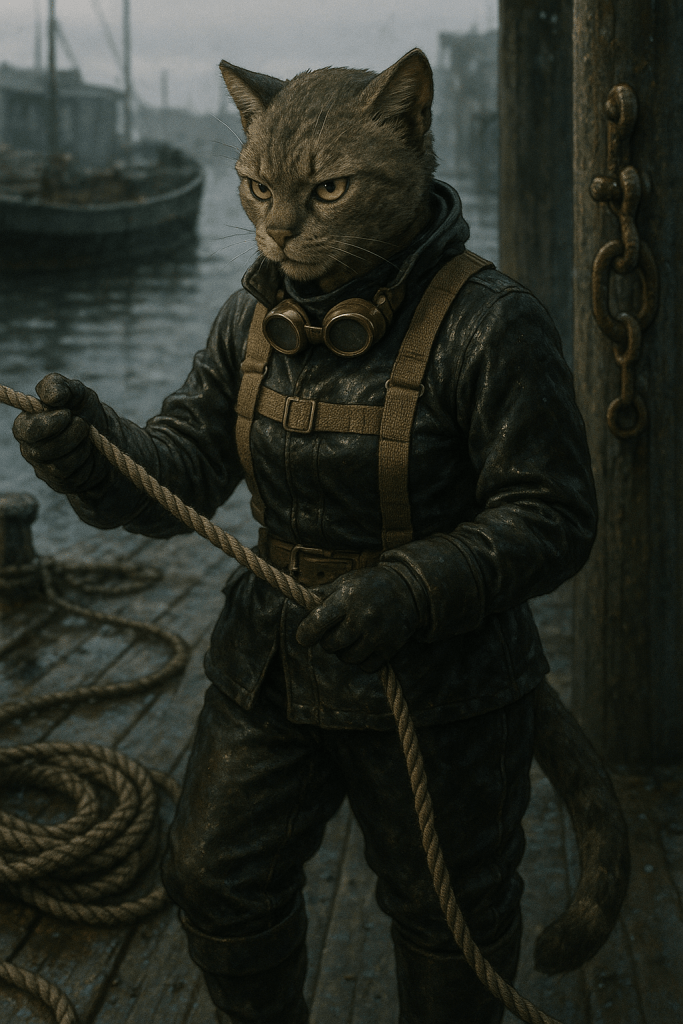
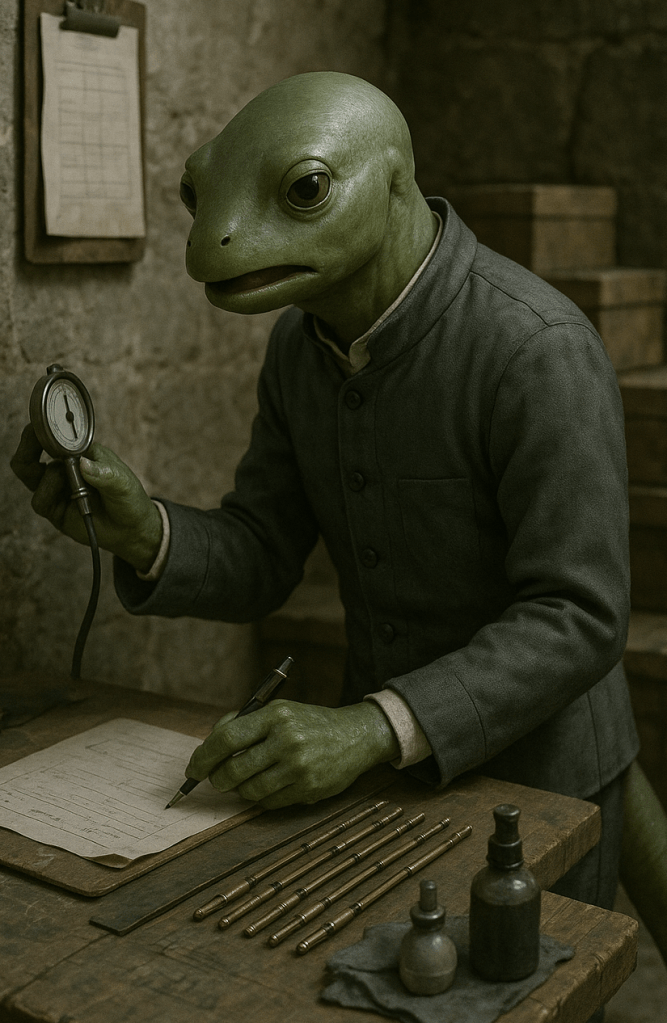
Creating characters is by far the most time-consuming part of putting together a scenario, but it makes sense why it has to be that way; weak characters ruin fiction. Thankfully, I enjoy determining every little detail of their fictional personas.
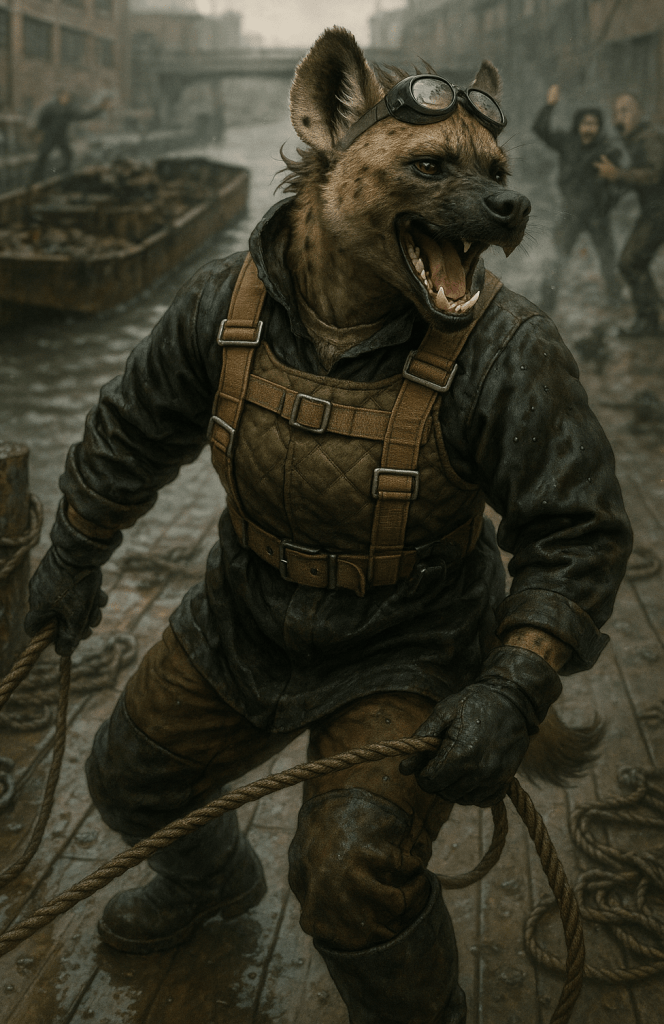
Fun fact: before I came up with Pitch, the fourth member of the dredgers was supposed to be a mole-folk man who was half-blind and attuned to magical effects to the extent that he had started to hallucinate. As I developed his character further, I realized that his role was too specialized for a group of dredgers; at the most, they would only request his help when the crew knew in advance they were going to extract an artifact from some cave system, or the underground canals. But I didn’t see that guy getting along with the rest of the crew. The ensemble dynamics is vital. So I ditched that whole concept and started from scratch.
Me finding a character fun is a big part of when I decide that a concept for one is on the right path. Pitch has shown himself in “Custody of the Rot” as a stoic, professional demolitionist who’s very good at its technical aspects, but three of his most notorious aspects have barely peeked, and may not even play out through the rest of this arc. Those buried aspects heavily influence his portrayal in an iceberg kind of way, so it works regardless.
Anyway, you came for the portraits, I’m guessing. Assuming you aren’t mindlessly reading these words.



 The Domains of the Emperor Owl
You must be logged in to post a comment.