
I’m finally developing the game I’ve wanted to make for a long time. Named it Name the Danger.
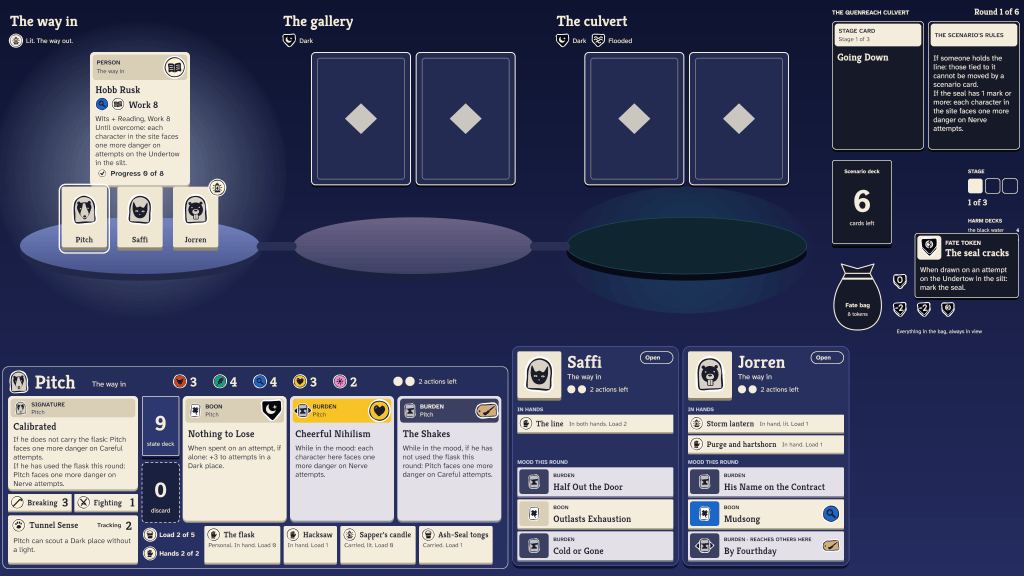
You play as a 3-or-4-person team of peculiar characters and you’re tasked with solving a variety of problems, which in the final game will likely be linked into arcs or chains of consequences. The current scenario I have going is the continuation of two chapters I produced some time ago, based on a fantasy world I was working on:
They weren’t “stories” as such, but more like AI-assisted theater. I was playing a beaver-man named Jorren Weir that leads a team of dredgers made out of a river-cat-woman, a badger-man, and a hyena-woman. The cat-woman has one foot out the door and does shady stuff for underworld bosses on the side. The badger-man blew up his own comrades in the war and now he drinks and sometimes forgets to wear pants. The hyena-woman suffers from compulsive laughter that unnerves everybody.
They were hired under shady pretenses by a noblewoman to get rid of an extremely dangerous artifact. It was mind-controling her construction crew into drowning themselves in the catacombs they were renovating under her estate. I stopped the story before the dredger crew delved into the catacombs; I was playing out these scenarios through an old repository of mine, in the early days of AI coding, and I realized that programming in the features that I would need, solely to play that single scenario, was too daunting a task, and I ended up abandoning their story. Which was a shame because I really liked those characters.
Well, this game features all those characters, and will allow me to play through that story and use the characters for other missions.
The game is inspired by my favorite tabletop game, Arkham Horror LCG, but without its stuff that annoys me:
- No single deck that contains everything an investigator brought to the mission. None of that “frantically drawing cards to find my machine gun and also the college professor that I have somewhere down in my backpack.” In my game, the sole player deck is a deck of mood states that keep cycling and affect the circumstances of play. For example, Pitch, the badger-man, may at any given turn feel that he has nothing to lose, be cheerfully nihilistic, and also have the shakes from not drinking from his flask. Virtually all mood states are character-unique, so the characters you bring, and the team they form together, will feel very different.
- The characters have skills. A character that works at something that requires their skill and matches the difficulty will pass the test without any annoyance. An unskilled person can try, but they will have to draw a potential -1, -2, -3 and so on from a chaos bag, like in Arkham Horror LCG. They can be helped by other characters in their location, who will be able to hand over one or more (I’m not sure if I’ve programmed one or more) of their mood states to help with the task. Contrary to Arkham Horror LCG, in which every test requires a draw from the dreaded chaos bag, in this game you can sail smoothly if you match the proper characters in favorable circumstances.
- Gear management is a big part of it. A character may come in with a lantern that lights a dark room, only for some fuckery to force them to drop the lantern in a flooded location, causing the latern to go out. If someone is using gear taking up both of their hands, they’ll need to drop it or give it to someone else to use a kit that requires one or more of their hands. I imagine that in the future, deciding the loadout for a mission will be routine, like it was in classics like X-COM.
Anyway, I’m excited to continue developing the game. It seems I still retain the ability to get absorbed in things.

