Life update (06/07/2026)

These past six months or so, I’ve been working on three different projects, or more accurately, on three distinct ideas for projects:

  • A structured way of creating stories that doesn’t rely on an act structure, by which I mean that the whole stories are based on the causality of tracking entities, entity statuses, cast members, facts, beliefs, secrets, locations, objects, visible affordances, events, intentions, plans, clocks, obligations, consequences, open threads, relationships, and emotions. As part of this project idea, I also wanted to structure worldbuilding and propagation of canon facts.
  • A platform to encode any card/board game relying on a game-agnostic engine, which would help prototype card/board games.
  • A maximally-emergent, causality-first simulation that would be able to produce the kind of adventures you get through Dwarf Fortress, Rimworld, Skyrim, etc., without relying on any scripting or game director.

The story-related projects, which ended up being two repositories in Node/Typescript, were the easiest, although they were complicated projects in their own right. But the other two projects deserve their own paragraphs.

That platform to encode any card/board game started as an extremely-ambitious notion: any user would be able to encode every aspect of any game in YAML files. YAML that basically works as programming is a terrible idea, which I realized deeper into the project. I started programming it in Node/Typescript, which was also a terrible idea: it’s far too slow of a combination when it involves AST parsing of the YAML; I had to spend lots of time bytecoding or Rust WASM-fying parts of the Typescript engine to get decent performance, which was never good enough for me, and a lot of possible wins were denied by marshalling issues. But by far, my biggest mistake was proving the project’s ability to accomodate multiple card/board games by implementing two games: Texas Hold ‘Em and Fire in the Lake COIN. Texas Hold ‘Em was mostly fine despite the YAML base: it took like three days.

Merely thinking of Fire in the Lake makes my skin crawl now. Fire in the Lake is an extraordinarily complex board game representing the Vietnam War. Not exactly a traditional wargame, although it’s hard to explain. The point is that back in 2020, before large language models, I attempted to program it in Rust to learn the language. Huge mistake. Having to abandon that project a third of the way in let a splinter stuck in me from which I never fully recovered. So months ago, I decided I would rely on large language models to take the splinter out and properly implement Fire in the Lake. Huge fucking mistake.

The Fire in the Lake map is extremely complex. The adjacencies between provinces and cities are confusing, which involves country borders as well, but much worse, it also features LoCs like roads and the Mekong river. Merely representing it visually without just pasting the map on screen was a fucking nightmare. As if the map graph wasn’t enough of a mess, what the factions can do is much worse: operations and optional special activities, each of which can be as complex as entire regular games. I’m talking sweeping, assaulting, subverting, governing, air striking. Then you have the event deck, which causes stuff to happen on the map and on the markers and tracks, which is easy enough to depict, but the game designers also went out of their way, for which I commend them except for the fact that I tried to program this cursed game, to make almost every card of the 130 its own little exception. Some cards offered grants for actions which may or may not be optional, some of which were taken by different factions other than the one currently playing. Again, makes my skin crawl. I had whole GitHub workflows dedicated to ensuring that the granting system didn’t shit itself.

After I managed to encode the entire game rules and content, which I did manage to do (a fleeting win), I got myself into the issue of encoding competent AI bots. I didn’t want to just copy the flowcharts, given that a computer would run the bots, so I had ChatGPT-Pro deep research what would make a competent human player for each of the factions. My intention was to encode that. I got really deep into AI architecture to figure out what kinds of bots would work well for my requirements, and I finally reached a point in which it seemed like I just had to push through, and keep iteratively improving the bot encoding, to finally get them running. But a few days ago, I found myself not even reading the tickets, not even checking out what was being committed. My subconscious had already understood that this project was a bust. It was crippled from the beginning, and I had done little else than push against entropy. I would never be happy enough with how Fire in the Lake would be shown on the web app, I would never feel comfortable enough with how it was implemented, and worse yet, the engine had taken in too much of Fire in the Lake’s specific shape that disentangling it to implement other games would make me have to fix Fire in the Lake at every step. So I gave up.

The third project was the maximally-emergent, causality-first simulation. From the beginning I had a very clear idea of what I wanted; basically by ideal game which nobody has built yet to my knowledge:

  • A simulation able to simulate dozens or hundreds (or thousands) of agents in an area the size of Skyrim, with settlements, roads, points of interest, etc.
  • The simulation should be maximally emergent and causality first. By which I mean that there would be no scripting and no game director. The simulation should be able to produce complex chains like this: a big monster gets displaced from a wilderness area due to the activity of some bandits -> the monster ends up hunting around some nearby road -> the monster attacks a caravan -> the caravan survivors reach a town and speak with the authorities about the attack -> the authorities decide to set up a bounty for the monster -> someone creates the bounty and posts it at some board -> some passing adventurers see the bounty and decide to take it -> they gear up and gather supplies for the hunt -> they travel to the area where the monster is supposed to be -> they track it to their den -> they find out some other adventurers casually killed the creature already. This all should happen due to causal chains, no scripting at all.
  • You as the player are indistinct to every other AI agent in the simulation. The simulation isn’t even aware that a human player exists. That means that the world continues regardless of what you do, but you can disrupt it.
  • Every agent, including the human player if any, acts on their beliefs, which may be truthful, stale, or based on straight lies. People gain beliefs by talking to each other, reading notices, observing the world. This allows chains like someone going home to take money, only to discover that the money is missing because someone has stolen it.
  • I should be able to chat through LLMs with any agent in the game, and the LLM would feed into the game which beliefs were actually shared or seeded, which would have gameplay effects.

That’s the main core. Such a simulation would allow any flavor and any kind of gameplay you could imagine. You would just have to build it incrementally. But I underestimated the complexity of such a project, which should be built upon an extremely-robust set of foundational documents of various categories. Mistakes I make during its implementation:

  • The foundational docs, while more comprehensive than those of any other repo, just weren’t comprehensive enough. They would have required several iterations of deep research with ChatGPT-Pro.
  • I approached it almost as a research project instead of something that would allow me to play it at every stage, even on the terminal.
  • I went breadth first: I wanted a significant set of gameplay mechanics in order to prove the emergent nature of the simulation, and found myself programming takeovers of institutions before I had properly proved that people could eat and shit regularly without dying.
  • By the time I figured out that even though I had banditry in, AI agents in simulations weren’t able to sustain their basic needs, the project was basically crippled; I just hadn’t accepted it yet. I should have built up step by step, being able to play it to the fullest along the way, and only add features that I missed while playing.
  • The AI architecture, while extremely competent in some regards, was crippled as well: I relied too much on GOAP because HTN felt like scripting at first. Then I realized that you could use HTN in a fully emergent way that respected the foundational principles, and relying on GOAP only for the leaf goals.

With this third project, I found myself also disheartened, and feeling that I was fixing mistakes in a crippled project, when likely I would need to build it from the ground up.

So, two days ago I decided to start from zero (a Re:Zero, you could say) both those complex projects: the card/board game one, and the emergent simulation one. It’s amazing how quickly projects progress once you’ve taken the lessons to heart and you’re on the right track. For the card/board game, I’m building it up following a ladder of game complexity. I already have Race to N, Tic-tac-toe, Connect Four, and Othello in. I’ve checked legality issues online, and found out that even if you don’t take money for it, publishing a page that simulates a game with an IP behind it is actually illegal (oops), so I couldn’t have uploaded the project with Fire in the Lake in regardless. While I intend to program in the kinds of games I’m most interested in playing (basically those on my gaming shelves), I won’t be able to upload them to the public repository.
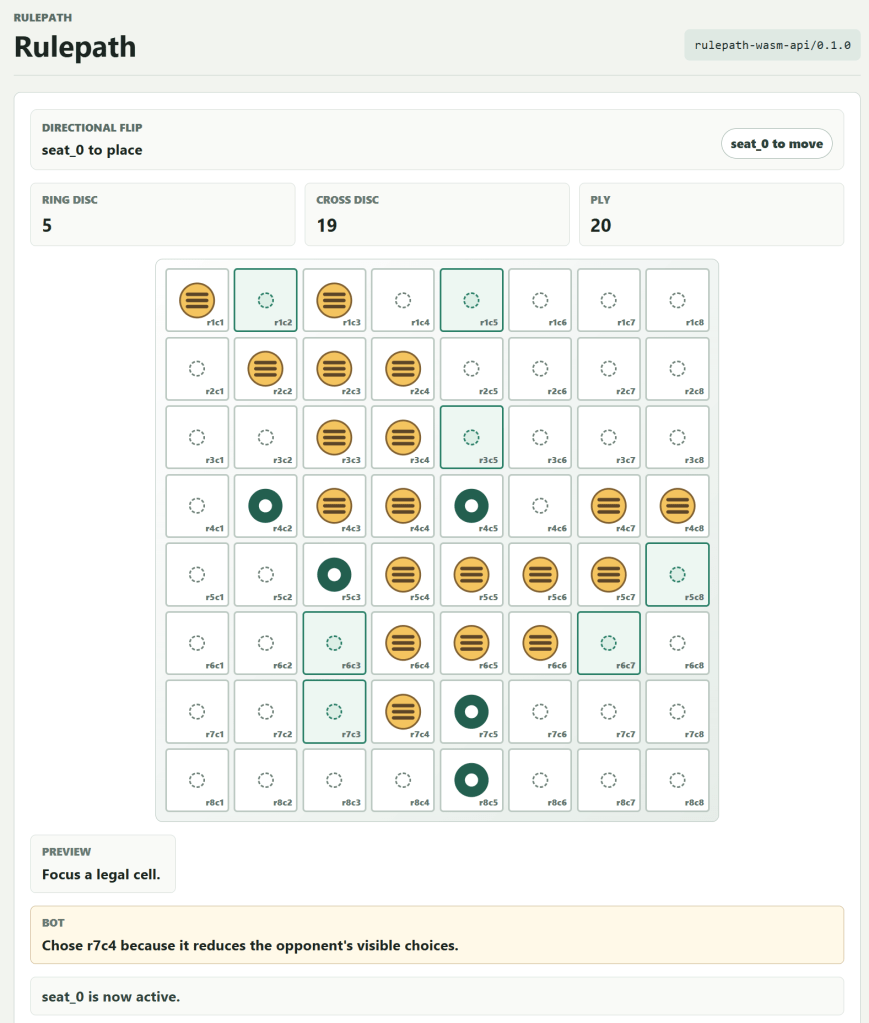
Playing Othello and losing terribly

Regarding the simulation, that third project, it’s shaping up far better. I can play the current state of the simulation at any point through a terminal user interface, which at the moment is mostly rudimentary. The foundational documents are sets of dozens, and extremely comprehensive. I will no longer push for breadth, nor implement mechanics that I don’t miss through playing the simulation.

The important thing is that I’m feeling energized again to work on these projects. I woke up at six in the morning today eager to get back to it. And that’s the best state of being for a wrecked creature such as myself.

Review: Dispatch

Back in late 2000s and early 2010s, we had this thing we affectionately called Telltale-style games: heavily narrative-driven games that relied on letting the player make more or less compelling decisions that would affect the narrative. They didn’t have the complexity of early adventure games, but they couldn’t be called simple visual novels either. They were tremendously successful, until corporate greed swallowed them, spread them thin, and eventually dissolved them into nothing. The company shut down.

A new studio made of former Telltale devs decided to try their hand a new Telltale-style game that removed the dragging parts of former Telltale games (mainly walking around and interacting with objects) to focus on a good story, a stellar presentation, and compelling minigames. Their first product was the game Dispatch, released about a month ago in an episodic format (two episodes a week, but all of them are out already). The game has become a runaway success.

The story focuses on Robert Robertson, a powerless Iron Man in a society where many, many people have superpowers. He carries the family legacy of battling villains with a mecha. As an adult, he pursued the supervillain who murdered Robert’s father, and who now led one of the most dangerous criminal groups. However, during an assault on the villain’s base, Robert’s mecha gets destroyed, which puts him out of a job.

However, he’s approached by one of the most notorious superheroes, a gorgeous, strong woman who goes by the name Blonde Blazer. She offers him a job at the company she works for, SDN (Superhero Dispatch Network). Their engineers will work on repairing Robert’s mecha, while he offers his expertise on fighting crime as the one in charge of dispatching other heroes to the appropriate calls.

Robert finds out that the team of heroes he’s supposed to handle are a bunch of villains who either have approached the company to reform themselves, or were sent by the criminal system for rehabilitation. They’re a diverse bunch of rowdy, at times nasty superpowered people who aren’t all too keen on having a non-superpowered nobody in charge of them. The narrative explores how the team grows to work together better.

The execution of this story could have gone wrong in so many ways: wrong aesthetic, time-wasting, atrocious writing, and above all, marxist infiltration; like most entertainment products released on the West these days, the whole thing could have been a vehicle for rotten politics. But to my surprise, that’s not the case here. A male protagonist, white male no less, who is an intelligent, hard-working, self-respecting role model? Attractive characters, fit as they would be in their circumstances? A woman in charge (Blonde Blazer) who is nice, understanding, competent, caring, and good? Villains with believable redemption arcs? Romance routes that flow naturally? Where the hell did this game come from in 2025?

Entertainment consumers have been deliberately deprived of all of this by ideologues who despise everything beautiful and good, who, as Tolkien put it, “cannot create anything new, they can only corrupt and ruin what good forces have invented or made.” Franchise after franchise taken over by marxists who dismantle it, shit on the remains, and then insult you if you don’t like it. Dispatch is none of it. For that reason alone, I recommend the hell out of it. I’m sure that given its sudden popularity, the forces-that-be will infiltrate it and ruin it in its second season as they do with everything else, but the first season is already done.

It’s not perfect, of course. Its pros: an astonishing visual style that makes it look like a high-quality comic book in movement. No idea how they pulled it off. Clever writing. Endearing characters. Interesting set pieces. The voice acting is extraordinary, led by Aaron Paul of Breaking Bad fame. He deserves an award for his acting as Robert Robertson. It’s a good story told well, and you’re in the middle of it making important decisions (and also plenty of flavorful ones).

The cons: some whedonesque dialogue that didn’t land for me. Too much cursing even for my tastes, to the extent that often feels edgy for edge’s sake. Some narrative decisions taken during the third act, particularly regarding the fate of one of the main characters, didn’t sit well for me, as it deflated the pathos of the whole thing. But despite the pros, this was a ride well worth the price.

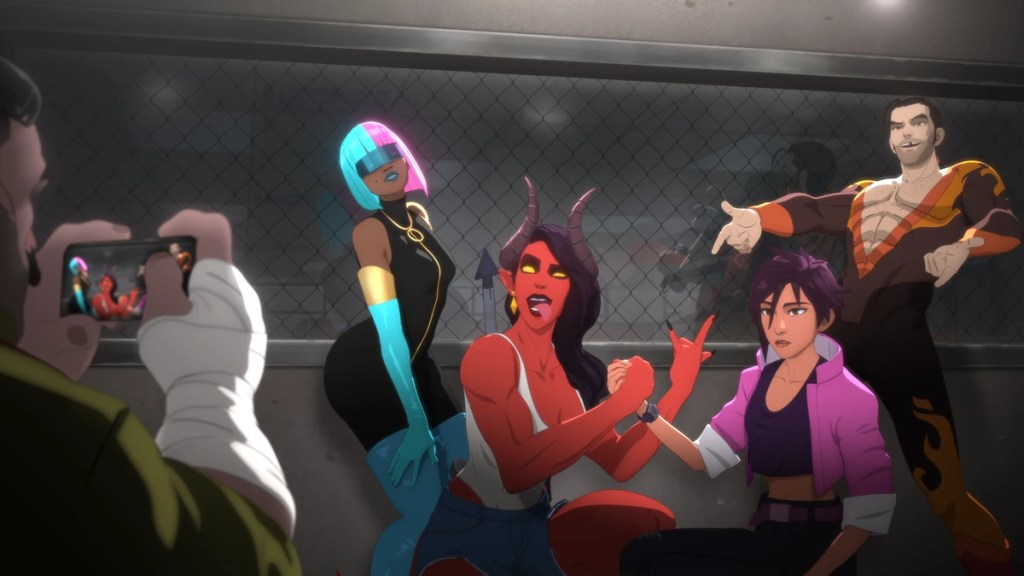
Oh, I forgot: they should have let us romance the demon mommy. My goodness.

Check out this nice music video some fan created about Dispatch, using one of the songs of its soundtrack.

All board game mechanics: Victory/Scoring Mechanisms

The following is a list of all board game mechanics I know in this category, and that aren’t too niche. Card game mechanics are also included. I’m posting this mainly for my own reference.


End Game Bonuses: Players earn (or lose!) bonus Victory Points (VPs) at the end of the game based on meeting victory conditions.

Highest-Lowest Scoring: Each player’s score is equal to the lowest value of several categories. Whoever has the highest lowest value is the winner.

This system is normally known as Knizia scoring. Tigris & Euphrates is an early example of this mechanism. Players are collecting four different color cubes – red, green, blue, and yellow – and their score is the color that they have the least of. A player with 12 red, 10 green, 6 blue, and 2 yellow has a final score of 2. This forces players to not be too specialized in which cubes they collect.

Highest-Lowest Scoring is a special case of Set Collection, where only complete sets are counted.

Kill Steal: Players contribute towards completing a task, but only the player who finally completes it gets a particular benefit or bonus reward (even if others share in the base level benefit).

Legacy Game: A multi-session game in which the state of each subsequent session irreversibly builds on the legacy of the previous one. Permanent and irreversible changes to the game state carry over to future plays. Components can be written on with permanent ink, torn apart, covered with stickers, and more. This mechanism was introduced in Risk Legacy. This should not be confused with the mechanism, which modifies the state between sessions, but the state can be reversed (e.g. Campaign Games). Games with reversible states existed much earlier.

Victory Points as a Resource: Victory Points (VPs) may be spent as a currency to impact the game state.

Business or Economic games that use currency and give the win to the players with the most money are common examples of this mechanism. However games with other themes like Small World also use this mechanism. Games where currency (or other resources) can contribute in a minor fashion as extra VPs at the end game (usually at some discount rate) should not be tagged with this mechanism, but rather as End Game Bonuses.

All board game mechanics: Technology/Progression

The following is a list of all board game mechanics I know in this category, and that aren’t too niche. Card game mechanics are also included. I’m posting this mainly for my own reference.


Algorithm Creation: Players design sequences of conditional operations or “programs” that execute automatically once set in motion. Success depends on anticipating how these algorithms will interact with a changing game state and with other players’ algorithms. This might involve programming the movement and actions of units, creating economic systems that operate independently, or establishing decision trees that respond to certain triggers.

Deck Construction: As the first step, or prior to playing the game, players create the deck they will use.

Knowledge Threshold Unlocking: Players accumulate specific types of knowledge or expertise during gameplay, which are tracked separately from other resources. When players reach certain knowledge thresholds in specific domains, new actions or strategies become available. This differs from tech trees in that knowledge accumulation happens gradually through many small actions rather than through discrete purchases or advancements.

Momentum Tracks: Actions build momentum when repeated in consecutive turns. Higher momentum provides increasing benefits for continuing the same strategy but creates penalties for switching. Players must decide when to pivot versus when to commit deeper. Example Implementation: An economic game where continued investment in specific industries creates increasing returns but also increasing risk of market collapse, requiring careful timing of strategy shifts.

Move Through Deck: Players Move Through a Deck of cards. Typically the goal is to reach the bottom (One Deck Dungeon), find and defeat a boss (Chainsaw Warrior), or simply know when to quit (Incan Gold).

Tech Trees/Tech Tracks: During the course of the game, new Actions become available to specific players, or existing Actions are improved. These are often themed as Technologies, but do not need to be. Sometimes this is expressed as a Tree, where gaining one Tech unlocks multiple other Techs. Or it can be a track, where advancing along the track unlocks upgraded or new Actions.

All board game mechanics: Resource Management

The following is a list of all board game mechanics I know in this category, and that aren’t too niche. Card game mechanics are also included. I’m posting this mainly for my own reference.


Automatic Resource Growth: The automatic increase of a resource triggered by a particular, conditional, deterministic (not random) game state.

Example 1. Unacquired resources in Agricola:

  • Uncollected wood from the wood-collection action space (condition) will offer +1 wood (result) on the following round (game state).

Example 2. Acquired resources in Agricola:

  • Two pigs in your farm, in an area with space enough for 3 pigs (condition) will automatically produce a 3rd pig (result) during the breeding phase of that round (game state).

Counter-example 1. Income in Monopoly:

  • Collect $200 (result) when passing “GO” (game state).
  • There is no condition (ex: if you own 1 or more properties)

Counter-example 2. Random Production in Catan:

The production is random not deterministic.

Players collect resources at the beginning of each turn based on a die roll.

Deck / Bag / Pool Building: Players play cards out of individual decks, seeking to acquire new cards and to play through their decks iteratively, improving them over time through card acquisition or card elimination.

It may include a “random-draw” to form a hand from the deck for the current round (as in Star Realms) and the deck is automatically reset once the draw pile is exhausted; or it may allow access to all available cards at once (as in Concordia) until the discards are retrieved. The latter may embody the Action Retrieval mechanic, where the card use activate actions.

This category also covers Bag Building, Pool Building, and related mechanisms (using chits, dice, etc).

Dominion pioneered this mechanism.

Hand Management: Hand management games are games with cards in them that reward players for playing the cards in certain sequences or groups. The optimal sequence/grouping may vary, depending on board position, cards held and cards played by opponents. Managing your hand means gaining the most value out of available cards under given circumstances. Cards often have multiple uses in the game, further obfuscating an “optimal” sequence.

Income: Players gain resources at defined times.

Increase Value of Unchosen Resources: If players do not select certain Actions or Resources, then they increase in value. Puerto Rico is a classic example of this technique, as unchosen roles have a coin placed on them. This mechanism is a simple way for designers to balance different options. The money may either come from the bank, as in Puerto Rico, or from the players themselves, as is done in Small World, where players must place a coin on factions that are skipped.

Loans: Players may take a Loan from the bank to get more money.

Examples include Monopoly where players can mortgage properties, and Age of Steam, where taking loans is a key strategic consideration.

Multi-Dimensional Resource Constraints: Resources exist in multiple dimensions or aspects simultaneously, and different actions require specific configurations across these dimensions. For example, a resource might have quantity, quality, and accessibility attributes, with different actions requiring different combinations of these attributes.

Resource Conversion Chains: Resources must be converted through a series of sequential transformations to become more valuable or useful. This creates a supply chain management challenge where players must balance efficiency against flexibility. Players may specialize in different parts of the chain, creating interdependencies. Examples include raw materials that must be refined, then manufactured, then distributed to be worth maximum points.

Resource Queue: Resources are in an ordered queue, and can only be pulled from one end, or rarely, both ends, but not the middle.

Resource to Move: Players expend a Resource to Move. This is commonly themed as fuel, but other games use money or other commodities.

All board game mechanics: Player Interaction/Negotiation

The following is a list of all board game mechanics I know in this category, and that aren’t too niche. Card game mechanics are also included. I’m posting this mainly for my own reference.


Alliances: Players have formal relationships that may change over the course of the game. This differs from Negotiation in that these relationships are governed by specific game rules. For example, in Dune, players may form alliances at each Nexus phase, which last until the next Nexus. During that time the players win together, may not attack each other, and grant their ally a special power. In Struggle of Empires players bid for the right to select their ally for that round, which is governed by similar rules.

Cooperative Game: Players coordinate their actions to achieve a common win condition or conditions. Players all win or lose the game together.

Bribery: Players offer bribes to other players to get them to perform specific actions. Typically players will place bribes on certain actions, and if another player selects that choice they get the bribe. Otherwise it is returned to the player. Santiago and Tonga Bonga operate this way. Bribery can also be a part of a Negotiation mechanism, as players may offer bribes which may or may not be binding. Intrigue is an example of the latter.

Collaborative Control: Multiple players jointly control a single game element (like a powerful neutral faction) and must coordinate or negotiate how to use it. This differs from fully cooperative games in that players still have individual goals, but share control over certain powerful elements. The shared element may provide significant advantages, but requires agreement among the controlling players to direct effectively.

Communication Limits: Games may limit players from communicating with one another openly. These restrictions can be absolute as they relate to certain specific pieces of information, or they may restrict certain types of communication, such as speaking.

Neighbor Scope: Actions, resources, or resolution are shared between neighbors.

Negotiation: Players make agreements about coordinating action, beyond simply Trading.

Agreements may be either binding or non-binding. Diplomacy is a notable example of the latter.

Risk Pooling: Players can join forces to mitigate risks by contributing to shared insurance mechanisms or joint ventures. When negative events occur, the pooled resources absorb the impact, but players must negotiate or follow predetermined rules for sharing the benefits when positive outcomes occur. This creates interesting dynamics where rational self-interest must be balanced against collective security.

Role Playing: Some board games incorporate elements of role playing. It can be that players control a character that improves over time. It can also be a game that encourages or inspires Storytelling. This mechanic can be viewed as an extension of Variable Player Powers.

Semi-cooperative Game: A game in which players are cooperating and competing with each other throughout the game, while trying to complete a common objective. There have been several ways to implement this. One classification is Grand Winner format. A Grand Winner game has two possible outcomes: A) One or more players win ) No players win. A game where players sometimes cooperate and sometimes compete but one always wins is not semi-cooperative. It is a Competitive game with a Negotiation mechanism. Other formats of semi-cooperative games proceed similar to cooperative games but winning and losing objectives are triggered individually such that the outcome may be that no players win, all players win or some players win and some lose. The individual win/loss games have shown to be far less controversial than the Grand Winner format.

Social Capital System: Beyond just resources, players build reputation and influence with different factions in the game. This social capital functions differently than regular resources – it’s gained through consistent behavior patterns and can collapse rapidly if players act against established expectations. Example Implementation: A political game where maintaining consistent ideological positions builds trust with certain factions, providing increasing benefits, but flip-flopping causes rapid reputation collapse.

Take That: Competitive maneuvers that directly target one opponent’s progress toward victory, but do not directly eliminate any characters or components representing the opponent. Such mechanics include stealing, nullifying, or force-discarding of one opponent’s resources, actions, or abilities. A take-that maneuver often results in a dramatic change in the players’ position of power over a relatively short period of time.

It is unclear whether this includes 2 player games (as every action inhibits your one opponent’s victory).

Team-based Game: In team-based games, teams of players compete with one another to obtain victory. There are a variety of possible team structures, including symmetrical teams like 2v2 and 3v3, multiple sides like 2v2v2, and even One vs. All.

Trading: Players may Trade assets directly with each other, rather than via a Market.

Traitor Game: A traitor game can be seen as a kind of team game, or as a cooperative game with a betrayal mechanism. The traitors typically win by triggering a failure condition for the players. For this mechanism, a traitor game is characterized by traitors that begin the game with hidden identities, or are assigned them during the game.

All board game mechanics: Player Elimination/Catch-up

The following is a list of all board game mechanics I know in this category, and that aren’t too niche. Card game mechanics are also included. I’m posting this mainly for my own reference.


Catch the Leader: The game systems advantage players that are behind or disadvantage players that are ahead.

Hot Potato: A single item is bad for players to have, and players strive to pass it to other players or avoid it so they are not holding it at game end or some other defined time. Example games include Old Maid, Exploding Kittens, and Catch Phrase!.

Lose a Turn: This is a meta-mechanism that can be applied to a variety of turn structures. A player who “Loses a Turn” must skip their next opportunity for a turn, and will go to the next round, or the next time their turn arises.

Once-Per-Game Abilities: Players have a special ability that they can use one time per game. These may be unique to them, like ‘feats’ in Warmachine, or common to all players, like the special power chits in Finca. Often players will receive bonus Victory Points if they do not use their one-time abilities during the game.

Player Elimination: A player can be removed from the game, no longer participating.

In some such games, all of an eliminated player’s material is removed from the game as well; in other such games this material may remain in play as neutral material. (E.g. an eliminated player’s armies and cities on a map might disappear, or might be become neutral armies and cities.)

In most games, an eliminated player cannot win, but this is not necessarily true. (E.g. in some games with victory based on scores, an eliminated player’s score is still eligible for victory.)

In most games with player elimination, a player is eliminated involuntarily. But in some games a player can choose to drop out (with hope that their score suffices to win (e.g. Wooly Wars).

In some games, player elimination is possible, but rare in practice and does not happen in a “typical session” (e.g. Age of Steam).

In some games, player elimination is common. In the extreme case, all players but one (the sole surviver = eventual winner) are eliminated during a session (e.g. Titan). In many player elimination games, typically some players are eliminated but multiple other players are not (e.g. Werewolf and BANG!).

Player elimination does not include two-player-only games where the goal is to defeat the opponent, e.g., Chess.

All board game mechanics: Placement/Building

The following is a list of all board game mechanics I know in this category, and that aren’t too niche. Card game mechanics are also included. I’m posting this mainly for my own reference.


Crayon Rail System: The Crayon Rail System is a subcategory of Route/Network Building. Types of these games use crayon or other non-permanent methods of making connecting lines on a board, often eraseable. The most popular Crayon Rail games are part of the Empire Builder system.

Layering: Components are placed above other components, partially covering the ones below, or overlapping in various ways. Only the topmost visible icons/areas are active.

Examples include Patchistory and Smartphone Inc. using cards, and Taluva using tiles.

Modular Board: Play occurs upon a modular board that is composed of multiple pieces, often tiles or cards.

In many games, board placement is randomized, leading to different possibilities for strategy and exploration.

Some games in this category have multiple boards which are not used simultaneously, preserving table space. Unused boards remain out of play until they are required.

Tile Placement: Tile Placement games feature placing a piece to score VPs or trigger actions, often based on adjacent pieces or pieces in the same group/cluster, or keying off non-spatial properties like color, “feature completion”, cluster size etc.

A classic example is Carcassonne, where a player randomly draws a tile, places it next to other tiles (along with a meeple), in order to complete map features.

All board game mechanics: Physical/Party Game Elements

The following is a list of all board game mechanics I know in this category, and that aren’t too niche. Card game mechanics are also included. I’m posting this mainly for my own reference.


Drawing: Players draw a picture and other players guess what the picture is intended to depict.

Flicking: A Physical Action needs to be performed by one or more players to determine the outcome of the action.

Ordering: The objective of the game is to rearrange a group of game elements from a disordered to an ordered state.

Paper-and-Pencil: The game is developed using paper and pen/pencil to mark and save responses or attributes that, at the end of the game, are used to score points and determine the winner.

A game that merely keeps track of score on a sheet of paper does not use a paper-and-pencil mechanism.

Physical Removal: Pieces are removed from a structure, and play is affected by things that fall (as in Ker Plunk), or a complete collapse of the structure (as in Jenga).

Speed Matching: A pattern is revealed, typically through a card flip, and players try to be the first to find a match with other game elements on the table, or see if a match exists.

Stacking and balancing: Players must physically stack and balance pieces. Junk Art and Bandu are examples.

Storytelling: In storytelling games, players are provided with conceptual, written, or pictorial stimuli which must be incorporated into a story of the players’ creation. Once Upon a Time uses a selection of words while Rory’s Story Cubes include ambiguous symbols. Some games like Snake Oil and Big Idea prompt players to pitch a product, which frequently takes the form of a brief story or vignette.

Other storytelling games include titles such as Tales of the Arabian Nights and Above and Below, game designs in which players don’t create their own stories, but instead experience a story from the inside as one of the participants. Games along those lines might present players with a particular narrative situation, after which the player will make a choice that affects which end to the narrative is told — with the results of this narrative affecting the player’s standing in the game.

All board game mechanics: Pattern Recognition/Creation

The following is a list of all board game mechanics I know in this category, and that aren’t too niche. Card game mechanics are also included. I’m posting this mainly for my own reference.


Dynamic Environment: The game board or environment changes independently of player actions, requiring adaptation to evolving circumstances. This may include weather patterns affecting movement, economic cycles changing the value of actions, or neutral elements that move according to predetermined rules. Players must anticipate these changes and incorporate them into their strategic planning.

Example Implementation: A farming game where climate patterns shift throughout play, requiring players to adapt crop selections and farming techniques to upcoming conditions rather than current ones.

Induction: Players are attempting to determine the rules governing a situation. In a typical induction games, a game master creates a hidden rule. Players then create patterns and are advised by the game master whether they match the rule or not.

Line Drawing: Games using the line drawing mechanic involve the drawing of lines in one way or another. Lines may be used to connect objects as in Sprouts, to isolate objects, or to create areas as in the classic Dots and Dashes, also known as Square-it.

Drawing of symbols or pictures is more properly classified as Drawing or Mechanism: Drawing

Mancala: In a typical Mancala mechanism, players pick up the tokens in one space, and then place them one-by-one in spaces in a specific direction around a circle, with the last space placed in having special significance.

In addition to its namesake game Kalah, this mechanism can be seen in modern games such as Finca and Theseus: The Dark Orbit.

Matching: Players must make their next play by matching a feature on the previous play. This is frequently used in shedding games like UNO or Crazy Eights, where number or color/suit need to be matched. In some implementations the next play needs to be in a number range based on the last. For example, in L.L.A.M.A. the play must be the same or one higher than the last. In Spit!, it must be one higher or lower.

Melding and Splaying: A set of cards in a specific relationship to one another that allows them to be played to a table or scored as a meld. When laying these cards down, the way the cards splay, or overlap one another, may sometimes reveal or conceal certain abilities or attributes. Rummy games have players placing combinations of cards or tiles on the table to score. Innovation is a good example of the Splaying side, where players can spread cards out to show particular sets of icons to empower abilities.

Pattern Building: Players must configure game components in sophisticated patterns in order to score or trigger actions, as would be typical for games in the Puzzle category. Azul is a modern classic designed around this mechanic. The common mechanism of Tile Placement can be considered as including pattern building via “feature completion” of connecting tiles. Sometimes the players cover a grid or fill a space using a variety of shapes, such as Components: Polyominoes. This includes the coverage of areas defined (by shape or color) on the board itself with pieces or tiles. Sometimes called a “Tetris mechanism”, this challenges players to use shapes efficiently. It can either be the primary point of the game, as in Ubongo, or as a secondary mechanism to force players to plan and restrict their options, as in The Princes of Florence.

Pattern Recognition: Players must recognize a known or emergent pattern created by the game components to gain objectives or win the game. This could for instance involve markers, typically with a color or symbol, placed to certain locations on a board, or relative to the other markers, forming an abstract or meaningful pattern, requiring deductive reasoning by players to determine its significance.

Spelling: Players arrange cards, tiles, or other components that represent an individual letter or small group of letters to create words. Examples include Scrabble and Boggle.