
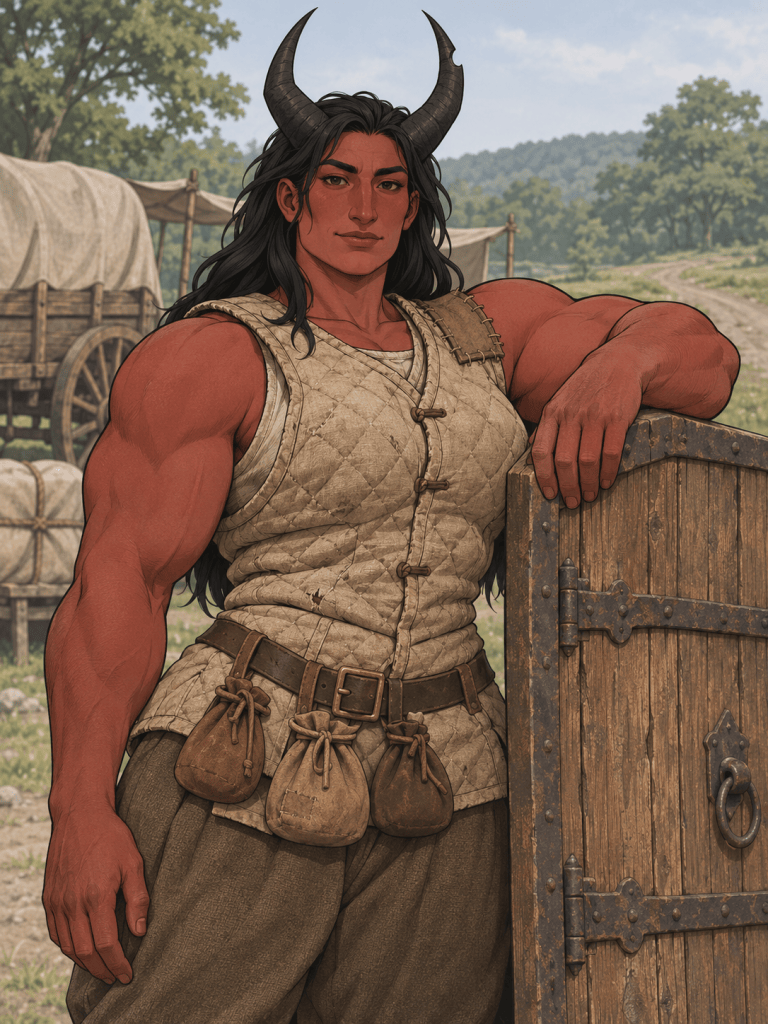
I’ve been working on a tabletop game to implement my ideas of the last few years regarding a fantasy world and its peoples. The tabletop game is character-centered, playing like a better version of Arkham Horror LCG, without the parts that bother me. I’ve been busy creating elaborate dossiers for its characters, and I wanted to show one of the dossiers, this one for the character seen above.
Rakka Verren — Character Dossier (First Person)
Status: Pass 2 draft | v0.1 | 2026-11-13
Built from: rakka-verren.dossier.md, pass 1 approved, v1.0
Frame: The first watch on a wagon road, from dusk to dawn. Rakka sits at the edge of the firelight with her door planted in the earth, facing the dark. Behind her, a passenger who can’t sleep sits by the fire and keeps asking questions. She never turns round. The passenger gets off at a fork at dawn, and she’ll never see them again. Not being looked at is what lets her talk. Each section opens with the passenger’s question, in italics. She loosens a little as the night goes on.
Open items: as in pass 1.
PART I — CORE PAGE
1. Identity
What do I call you?
Rakka. Rakka Verren. The drovers on the Drynn call me the Door, and I answer to it, since it’s accurate. My mother writes “our Rakka” at the top of her letters, as if there were another one somewhere she has to tell me apart from. Oni. Twenty-eight. A carter once guessed thirty-five and a little girl at a waystation guessed nineteen, because I’d smiled at her. I’ve written down both. Guard: caravans, escorts. Where do I live? I don’t, much. I keep a box under a bench at the Long Board in Harrowgate.
2. Premise
So what are you? Besides big.
I walk beside other people’s wagons and look at the dark so they don’t have to. Ten years of it. I’d wager I’ve walked more of the world than anyone on this train: the Drynn, the Heartland, the dry-edge, down to the Coast roads. Ask me what any of it looks like and I’ll tell you what the bread’s like there, and who told me the rest. You don’t see much facing outward. That’s the job. People say I’m stern. I don’t ask what’s in the crates, which is why I get hired. Some day I’ll spend a season somewhere as a guest. I’m still saving.
3. Engine
What are you after? Everyone on a road’s after something.
- On the road you eat what you’re given and stand where you’re put. After the road, you eat what you like. That’s the whole of it.
- Wanting’s for after. You don’t want things on watch. You’ll get somebody killed.
- A season. There’s a town on the Coast where they sit at dinner for three hours and call it work. I have that from four people. One of them, a tinker, says the doors are cut tall, so you walk in without bowing. I mean to find out. One season, as a guest, not a guard.
- The work’s always one more route. The coalition wants me till first snow. And the end of a road is dear; I eat.
4. Signature behaviours
The drovers say you’re odd. How?
- When supper comes, I turn round and eat facing the dark. A guard eats facing out; Pell taught me that. And nobody needs to watch an oni eat three suppers. Nobody enjoys it, the oni included.
- Tell me where you’re from and I’ll ask what you eat there at midwinter and how tall the doors are, and I’ll write your name down with it. Nothing’s a fact without a name on it.
- When somebody asks me to stay (a winter, a wedding, a supper), I say next time I’m through. I mean it.
- When something comes out of the dark, I set the door down and stand still. They count me. Mostly they decide not to.
- Reach for my plate and you’ll hear one word. Unless you’re six and hungry. Then it’s yours, and don’t tell anyone.
5. Flaws that cost
What’s wrong with you? Everyone’s got something.
- My sister says I’m never there. She said it at her wedding, I’m told, which I wasn’t at. I was on the Coast road. I sent wool. Good wool.
- My mother says I owe her a winter. Ten, by her count, and she’s the one counting.
- I don’t look in the crates. Some call that a fault. It’s a trade rule.
- At the end of a route I eat for three days. Innkeepers complain. I pay. I’ve borrowed against my own season once or twice.
- A drover named Tull ate my sausage on the Upper Drynn six years ago. If that’s a fault, it’s his. And I correct people about their own towns, when they’re wrong.
6. Lines
Is there anything you won’t do for pay?
Open what I’m guarding. Don’t ask me what’s in them; I don’t know, and that’s the point. Unless what’s in them starts hurting people. Then I’d open it.
7. Blind spot
What would your friends say about you that you wouldn’t?
That I’m always leaving. I’m not leaving. I’m working. There’s a difference, and it pays.
8. Voice
Does anyone ever tell you how you talk?
Vespera says I talk like a menu with footnotes. One source, and she lies, but she’s not wrong about that.
- (ordinary) “The waystation’s a supper and a breakfast from here, if the ford’s down.”
- (pleasure) “In Brinewick they put the beer in the pie, not beside it. The crust goes dark as a saddle and it tastes of the whole city.”
- (feeling) “Vespera says this is called pining. Vespera lies, so I’m counting it as one source.”
9. Look
I’ve only seen your back all night.
Then you’ve seen the best of me. Seven and a half feet, by a cobbler’s tape. Red. Two horns, the left one notched; an axe did that at Stone-Fork. Black hair, which I cut with a knife. I’m told I look stern. And I carry a door. Yes, a door.
10. Hooks
What happens to someone like you?
Some spring a contract will end on the Coast, paid in advance, and I’ll stay. Some day an inspector may come asking where I’ve been. They’re welcome to my notes; I’ve written down everything but what was in the wagons. And some day I’ll be walking beside a box that starts doing something. I’ll know if it’s hurting people.
PART II — DEPTH
A. Body and look
How tall are you, really? Are those horns heavy?
Size. My cobbler measured me for a last: seven and a half feet, he says, and he charges by the inch, so he’d know. A head and a half over the tallest drover on this train. I’ve checked. Broad with it. My mother says I was built to carry a cauldron, and I did. There’s not much soft on me. Heartland doors are a foot and a half too low. I’ve bowed to more lintels than a courtier. I can’t stand up in a barge cabin, and when I ride, I ride on top of the load, never on the box.
Colouring. Red, brick-red, darker at the knuckles and elbows and knees. Black hair. I cut it with a knife when it’s in my eyes. Brown eyes, near black, my brothers say; they say it to make me sound sinister. Black brows, straight. My mother’s.
Horns. Steep. Some oni have the short curled kind and walk under a lintel as if it weren’t there. Mine are the trouble kind. The notch a hand below the tip of the left one, a thumb deep, is from an axe at Stone-Fork. It doesn’t hurt. It catches on scarves.
Face. I don’t look at it much; inns don’t keep mirrors that go up this high. I’m told my face is broad, which it is; my mother’s. My nose is long, and my father’s. He apologised for it. I’m told I look half asleep. I’m not. I’m watching. Plain, I’d say. A cooper once said otherwise, but he married somebody else, so I count that as one source, retracted. When I smile, people say my eyes go to slits. Children like it. Drovers find it alarming.
What I’m not. I’m not beastfolk, so there’s no “more this” or “more that” about me. I’m oni from end to end.
Marks. The horn. A band of hard skin across my left shoulder where the door’s strap rides: my own leather, and free. Feet like boot soles. A wolf bite on my right calf from the Upper Drynn, white now. Puckered.
Smell and sound. Sausage, I’m told, and wet wool, and road. I talk low because oxen spook at oni. Pell taught me that. It carries anyway, as you’ll have noticed from back there.
What I wear.
- Clothes. Everything was made by whoever would take the job, so nothing matches. It’s not taste, it’s yardage: a quilted jerkin, undyed, padded on the left for the strap; a linen shirt; wool trousers wide enough to hold a wedding in; a sheepskin for nights like this one.
- Boots. The one thing I pay proper money for. A cobbler in Brinewick keeps my last on a shelf.
- Food. A belt with three pouches, and two packs: one for gear, one for food. You can guess which is heavier.
- The door. It was the door of a coaching inn on the Drynn route, before the inn burned. A smith put straps on it, a grip and an iron rim. On me it covers shin to chin. On the march I wear it on my back like a shell. People make a joke about carrying a door with nowhere to hang it. I don’t see what’s funny.
- The spear. A boar spear with a crossbar, longer than any you’ve seen. It keeps things at a distance while the door does the work.
- The notes. Six books in oilcloth, and the seventh half full. Every place anyone has ever told me about, and who told me, and when. The first one I started at eighteen. The handwriting’s terrible. The facts are good.
How I move. Slowly. A still giant ends fights; a moving one starts them. Pell again. I sit on the ground to talk to people so they don’t get a crick in the neck. Right now the door’s set in the earth and my back’s to your fire, which is where I’m happiest, I’m told. The hunger sits low, in the belly. That’s where I keep most things.
What this body needs.
- Food. Oni eat three times what you do. Coalitions feed guards like humans, so on the road I’m always a little hungry. Hungry makes me slow and short, not dangerous; ask any cook. I carry my own food and buy bread first in every town.
- Walking. No horse will carry me, and most won’t stand near me till they’re used to it. So I walk: forty miles a day if I have to.
- Beds. They break. I’ve broken several and paid for most. I sleep on floors, in haylofts and on the ground. The ground has never once complained.
- Water. No small boat will take me. Ferrymen charge me by weight, like cargo.
- Health. Good. Ask me again about my feet.
How people take it. Horses shy. Oxen balk. Children stare, then ask to climb me. Men look up and make the jokes: doors, beds, how much I eat. Or they make me a dare. Clients hire me on sight. Innkeepers count their stores. So I stay still. Still, I’m a wall. Moving, I’m a threat. I sit down to talk, I speak softly, and I eat facing away. It works.
B. Place in the world
Where are you from? And where’s home?
Where I’m from. Kettle Gap, in the High Holds: a mining town at the head of a pass. Oni and mammoth-folk work the deep galleries, and the doors are cut tall for both of us. Winter shuts the pass for months. Where do I live? I told you: a box under a bench. I’m from Kettle Gap. I’ll go back for a winter next year.
What we were. Cookhouse people. My mother ran it; we hauled. Now I’m well paid, and I’m rehired before the route’s out. I’m easy with drovers and cooks and caravan-masters. In a noble’s house, or an Ash-Seal office, I stand in a corner, because there’s nowhere to sit.
My people.
- Agna, my mother. She runs the miners’ cookhouse in Kettle Gap. She writes every few months: who’s died, who’s married, what she cooked. She wants a winter.
- Brann, my father. He cuts and sets the gallery timbers, and he doesn’t write. Every winter he carves me a spoon and sends it down the pass. I have nine. I eat with the newest.
- Hesk, my sister. She married two years ago, while I was on the Coast road. I’d promised. I sent good wool and a long letter about how they do weddings elsewhere. She hasn’t written since. The carriers on the pass are slow.
- The twins. Younger, in the mines. They write once a year, together, badly. They’re the only people who tease me.
Letters. My mother taught me letters and sums at the cookhouse tally-board, where everything was counted in bowls: “the night shift is forty bowls”. I still count that way. I read slowly and write big. Everything else I learned by listening, first at the cookhouse long table, where the miners told stories about the lowlands, then at more campfires than I could count. That’s a lie; I could count them. I haven’t.
The work. Four kinds:
- The coalition that runs the Drynn route, most of all.
- Heartland and dry-edge caravans.
- Expeditions into the wilds that want somebody to walk in first. I’d rather not, but they pay.
- Ash-Seal, which hires me to walk beside its sealed boxes. I’ll tell you about that.
What they say of me: she doesn’t look in the crates, she stands where they can count her, she eats like three, and she’s never late for a watch. All true.
Money.
- Earned: a fee per route, plus food money that has never once covered my food.
- Spent: food, boots, and the end of the road. I’ll come to the end of the road.
- Saved: there’s a crock behind the bar at the Long Board in Harrowgate. A little over thirty silver. That’s my season. I’m still saving.
- Never paid for: a bed, since they break; a horse, since none will have me; a ferry, if there’s a way round.
- Owed: my cobbler, a little. My mother, a winter.
- Kin-of-record: on every Harrowgate contract I put my mother in the lockmaster’s ledger at the crossing-house. If I go under, my share goes up the pass to Kettle Gap. She’d rather have the winter.
Where I keep things. There’s a bench at the Long Board, oak, braced with iron. It was built for me after I’d broken two, and nobody else sits on it, I’m told. My box lives under it:
- my mother’s letters, tied by the year
- my father’s spoons, all but the newest
- spare boot soles; a stub of pencil and a tin of lamp-black
- a road map I’ve corrected in the margins from what people told me
My pockets are full of crusts. I carry the door and the notes. That’s everything.
Where I’m welcome. On the road, among drovers, carters, cooks, waystation keepers and cobblers. In the Heartland towns they put up with me: low doors, children staring, horses rolling their eyes. On boats, no. In fine rooms, no. At any table where I’d have to sit facing the company, no, thank you.
Faith. I’ve never seen anything holy on a road. I’ve seen bread. I keep a few habits. You’ll hear them.
Whose side. Whoever’s paying, until the route ends.
The law. My record’s clean. I’m well vouched for at the Charter Hall window in Harrowgate. People who want something carried without questions like me: Ash-Seal, honest merchants, and people I couldn’t tell from honest merchants. I don’t try. No inspector has come for me yet.
Speech. The common tongue, with the Holds rolling my r’s. And the word for bread in every dialect I’ve passed through. Ask me one.
C. History
How does a girl from the mountains end up out here?
- Nine. In the cookhouse I carried the soup cauldron that two miners carried between them. My mother told the whole room the girl could feed a shift and eat for three of it. That’s the first time I remember being proud. At the long table the miners told stories about the lowlands, about towns where you have to bow through every door. That’s how I learned the world comes to you: as stories, if you sit still long enough.
- Fourteen. The pass shut early and the stores ran short. My mother fed the shift first and the family last. I learned to eat last, and to say I wasn’t hungry. And I learned that when the bowl does come, it’s yours. I’m good at all three.
- Eighteen. A coalition train came up the pass, a guard short after a fever. The caravan-master was Maddoc Pell. He looked at me once and said: “You’re not paid to fight. You’re paid to stand where they can count you and look big. And stand still. You’ll spook the oxen.” I signed on to see one lowland town and be back before first snow. I went to see a town.
- Nineteen. My first winter away, on the Upper Drynn pass. The stores ran low and the cook rationed me like a human. A drover named Tull ate the sausage I’d been saving. I’ve carried my own food ever since. Tull knows what he did.
- Twenty. Ansel, another of Pell’s guards, opened a crate of “dyed cloth” to see. It wasn’t cloth. His hands went blue to the elbows and stayed blue. Nobody hires a guard with blue hands, and he’s been “Blue” on every road since. You should see him wave. Pell said the guard who knows what’s in the crates is the first one bribed and the first one blamed. I took that one.
- Twenty-two, Harrowgate. A client tried to dock my pay for what I’d eaten. I was vouched for at the Charter Hall window, and fed that night at the Long Board at the keeper’s cost. When I broke the second bench there, a third was built to my measure. Who vouched? The keeper. Next.
- Twenty-four, the Lamp-Weir. A cooper asked me to stay the winter. I said next time I’m through. In spring I brought him bread from three towns and found he’d married a lock-keeper’s daughter. Good bread, too. I still cite him on barrels.
- Twenty-five, Harrowgate. I was snowed in once. Good food. Six weeks. I helped with the kegs. When the first contract of spring came in I had it before it was posted. That’s all there is to that one.
- Twenty-six. Hesk married. That was the year I started the crock, for the Coast.
- Twenty-seven, Stone-Fork. Early in the year the band that had been working the corridor above Stone-Fork came down on us. I put the door across the narrows and stood there while the wagons turned. They counted me, and some of them counted badly. An axe took a bite of my horn. We came back. The other train they took on that stretch that spring — no. I’ve written it down. That’s all. A contractor called Threadscar went up the Drynn approach after them with a crew from the Long Board and finished it, I’m told. Source: everyone in Harrowgate. I’ve never met her. Drovers on the Drynn sometimes tell me about that day as if it happened to somebody else. I let them. There’s a song. We’re not talking about the song.
Nothing’s happened to me that I carry about. I carry a door.
D. The story she tells about herself
So it’s been a good life?
Lucky. A cookhouse girl walked out of the mountains with a wagon train to see one town, found there was always one more, and has been paid to see the whole world ever since. Nothing’s happened to me, which is how you know I’m good at the work: things happen to guards who are bad at it. The worst of it has been weather, short rations and a man called Tull. The best advice I ever had was Pell’s, and I’ve been standing still ever since. You can laugh; I do. And it’s going somewhere. One day, a season on the Coast. I’ve nearly got it.
E. Temperament and daily life
What’s a day like, for you?
What I’m like. “Steady.” A caravan-master wrote that on my character for the coalition, and I’ve kept it. Pleasant, I’m told. Hungry, I’d add. I’m a listener more than a talker, except about food and places. Tonight’s a change: you keep asking. I sleep in pieces on the road, and I can doze sitting up against the door. Off the road I sleep till noon. Nights are mine; the first watch is the best hour there is. I’m slow to anger unless I’m hungry; ask any cook. I’ll forgive anything but food. I’ll trust you with my spare boot laces and my opinion of your bread.
A road day.
- I’m up before the drovers, and eat first breakfast alone from my own pack.
- I walk at the head of the train or the tail, wherever the trouble is likelier.
- Second breakfast at the first halt. Then the noon halt. Then walking.
- In the evening I plant the door, face out, eat facing out, and take first watch.
- Between watches I write the day’s news into the notes at the edge of the light, with names. You’re in tonight’s.
Off the road I eat for three days, and by the second I’m reading the posting walls.
What throws me: short rations; boats; being sat facing a table full of people; being thanked out loud in front of everyone; a route that ends early, with nothing behind it.
What I like. Fat, salt, smoke, crust. Barley-cakes the way my mother makes them, fried in mutton fat. Brinewick beer, and the pie they put it in. Three-day bread. Snow falling at night, when you’re the only one awake to see it. Other people’s stories, and lies, if they’re well told. A river big enough to get into. The sound of a full tavern behind my back.
What I don’t. Hardtack, and anything else dry. Small chairs, and the noise they make under me before they go. Being watched while I eat. Boats. The smell of a cold kitchen. A kitchen should never be cold.
F. Personality in motion
What are you like? Not on watch. Generally.
- Praise me for my work and I’ll tell you the truth: I stood still, they counted.
- Tell me I’ve done the work badly and I’ll listen to the end, ask one thing, and fix it. Tell me I eat too much, or cost too much to feed, and we’re done talking.
- I take any fair order from the master of the train, because it’s the master’s route. The one order I don’t take is to open a crate.
- I don’t give many orders. When I do, it’s “Behind the door”, and people listen.
- Help me with a load and I’ll thank you. Offer me food and I’ll say no the first time. Ask again and I’ll say yes. That’s manners where I’m from.
- Thank me for guarding and it’s fine; that’s the work. Thank me for anything else (for sitting with you, say) and I’ll find you something to eat, and we’re square.
- If someone smaller is in trouble, the door goes between them and it. Then I tell them something useful about it, with the source. “A drover told me boar won’t charge uphill.” Mostly it helps.
- If someone bigger than you is in the wrong, I don’t argue. I stand in front of them until they notice I’m not moving. I’ve time.
- Bored, I ask whoever’s nearest about their town. Tonight it’s you asking me. I don’t mind. It’s a change.
- Offer me a contract and I’ll ask where it ends and what they eat there before I ask the pay. The end of a route is the only bit that’s mine.
- Children can climb me if they ask first, and they can share my plate. Nobody else shares my plate.
- Horses fear me. I stand downwind of a new one and talk to it for days, till it takes bread from my hand. Every one that has is written down. The coalition’s new grey mare hasn’t come round yet.
- Lie to me about your town and I’ll write it down anyway, marked “one source”. When I learn the truth, your name gets a ruled double line through it. I never tear the page out.
- I’ve one lie, and I don’t believe it is one.
G. Contradictions and acting against type
You don’t add up, you know.
People say so. Here’s what they say, and what I say back.
- I guard my plate and give my food away. Both true. It’s my food.
- I’ve walked the whole world and never been anywhere. That’s Vespera’s. I’ve been on every road. Roads count.
- I keep notes about places and never check them. I can’t go everywhere. That’s what sources are for.
- I’m saving for a season I could pay for now. I’m still saving.
- I never turn round on watch, and I know every song sung behind me. I’m a listener. You don’t need your eyes for it.
- I’m the size of a barn and talk like a lamp’s been turned down. The oxen.
What I’d do against my own grain. I’ve run. Toward a fire, once, when one of mine was in it. People remember the running more than the standing, and I’d rather they didn’t. And once, drunk, for a bard, I sang a Kettle Gap cookhouse song sitting up by the fire, facing everyone. Never again. Afterwards I go to the nearest bakery and eat with my back to the street. Or, in the highland, I sit on my bench at the Long Board, facing the window.
What I might do. Stay a winter somewhere and not tell anyone why? I’ve been snowed in; I know how it’s done. Break the lid off a crate because a frightened child said her little brother keeps going sick near the third wagon? If she were frightened enough. It’d cost me a year with the coalition. Give a stranded family my food pack and walk three days hungry? Don’t be daft. Don’t tell anyone.
H. Values and morality
What matters to you? Besides supper.
In order.
- Whoever’s in my care, and whatever is, until the route ends.
- Supper, and everything that comes with it: stories, the insides of places. Later.
- Getting the world right: knowing it, writing it down.
- My word to whoever hired me.
- Somewhere to — later. That one’s later.
On the road the first beats the second, every time. The third and the fourth argue: I want to know everything except what’s in the wagon.
Won’ts.
- Open what I’m guarding. I’ve told you the exception.
- Eat before the people I’m guarding have eaten. My own pack doesn’t count; that’s mine.
The hard one. A child’s going sick near the wagon, and nobody can tell you it’s the crate. Do you keep your word, or open it? I’d open it, I think. I think.
What I’d give for what. My supper for a child’s. My pay for my rule. My season for the next route, so far. Next year.
What they accuse me of. Vespera says I know the whole world and haven’t checked a word of it. I’ve checked the bread. The twins say I save and then eat it. That’s what saving’s for, at the end.
I. Wants and projects
What would you do with a year off?
A season. The Coast town. That’s the year, and the rest of it I’d sleep.
The things on my list.
- One thing in Harrowgate, next time I’m through. Not yours.
- A second source on the doors in the Coast town. I’ve four people for the three-hour dinners and one for the doors: a tinker, with a stammer, who may have been describing a warehouse.
- New boots before the snow comes to the Drynn.
- Fill the seventh book.
- A winter in Kettle Gap, for my mother.
- Get Tull to admit it.
- A ferry that doesn’t charge by weight.
- A bed that holds.
- The grey mare.
If nothing stopped me. A long table at midday. Three hours. Something rendered in its own fat, and bread with a crust that fights back. A door I walk through without bowing. And somebody across the table who isn’t —. Is there any of that rye left back there? Pass it over my shoulder. Don’t come round.
J. Fears and wounds
The fire’s down to coals. What frightens something your size?
The ones I’ll own.
- A hungry winter on the Upper Drynn: the stores gone, snow up to the wagon beds, and everyone on human rations, me included.
- A small boat in fast water, sitting low in the stern because of me.
- Tull, coming round a corner with a sausage. That one’s a joke. Mostly.
The rest. Being watched while I eat. That’s not a fear; it’s a preference. Someone asking me to stay, when there’s no contract to name and nothing on the wall. I don’t like that. It makes me hungry. And the Coast town: getting there at midday to find the doors are ordinary doors. Then I’d have four sources to strike out and a tinker to find.
What sets me off. If I’m honest, the smell of barley frying in mutton fat. That one makes me — I’m hungry. A child asking where I live. I tell them: under a bench. They like that. Letters that don’t come. The carriers on the pass are slow.
K. Competence
What are you good at? And bad at?
Good at.
- Standing where they can count me. Where a giant has to stand so that men on a ridge can see her and think again. I’m hired to stand, so I stand. Some people say I stand when I ought to move. They’re not paying.
- Holding a narrow. A road cut, a bridge, a gap between rocks. Put me in it with the door and nothing comes through. Once I’m planted I’m hard to shift, even when somebody’s changed the plan.
- Walking and carrying. Forty miles a day. When a wheel goes, I’m the jack; I hold up the wagon’s corner while it’s changed. When a mule goes, I’m the mule.
- Reading a road. Ten years of my own miles, and everyone else’s stories checked against them.
- Horses. Patience, mostly.
Fair at.
- The spear, at reach.
- Feet. Blisters, rot, bad boots. I’ll look at yours before you get off at the fork, if you like. Everyone’s feet are terrible.
- Weather.
- Order and pace on a march.
Bad at.
- Cooking. A cookhouse daughter who can’t cook. My mother has never got over it. I was always hauling.
- Haggling over food. I pay what they ask. Have you seen what they ask?
- Boats.
- Maps. Hearsay drawn by somebody who didn’t walk it. I correct them. Sometimes I’m the one who’s wrong.
- Talking about myself. You’ll have noticed. Or you won’t, because I’ve been talking all night. That’s new.
- Fighting in the open. A door’s no good in a field.
Can’t. Ride. Stand up in a barge cabin. Sleep in an ordinary bed. Go anywhere without being noticed.
Useless. Blindfold me and give me a crust and I’ll tell you which town baked it. And I can tell you the humidity of forty towns, courtesy of Hobb Rusk.
When I’m wrong. I learn by listening, writing it down, and waiting for a second source. I fail slowly, by putting things off. If I’m wrong about a road, I’ll say so. If I’m wrong about hearsay, then the source was wrong.
L. Flaws, vices and coping
And your vices? Mine’s dice.
What’s wrong with me, by other people’s count.
- I’m late to things. Not watches. Weddings. Visits. My sister’s wedding; a cooper who waited a winter; ten winters my mother asked for. I’ll get to them. Next year.
- I don’t look in the crates. That’s not a vice. It’s a rule. Pell’s.
- The end of a route. Three days. Food, beer, presents for people I won’t see for months. It’s the only holiday I get. Twice I’ve borrowed against my season to do it. I’ll put it back.
- Hungry, I’m short. I once sulked at a cook for a whole day. She’d earned it.
The small stuff. My plate is cargo. I count other people’s portions; I can’t help it, it’s the tally-board. I keep a list of everyone who has reached for my food. Tull’s at the top, and he’s staying there. And I put people right about their own towns when a carter’s told me different. They’re not always grateful. I’m told I go on about bread. That’s not a flaw. That’s bread.
Vices. Food. Beer, at the end of a route. Not dice.
What I tell myself, because it’s true.
- I’m still saving.
- I’ll see to it all next time.
- What’s in the crates isn’t my business.
- Nothing’s happened to me.
- I’m not lonely. I’m on the road.
Habits, and where they come from.
- I eat facing out, with my back to everyone. Pell’s custom: a guard eats facing out. And lowlanders stare at an oni eating. Nobody needs that.
- I never turn round on watch. Not for a fight in camp, not for fireworks, not for a kiss. Pell again: the one time you turn round is the time they come. You’ll have noticed I haven’t, all night.
- I buy bread first in a new town, and I won’t say I’ve arrived till I’ve tasted it. My mother: “You don’t know a place till you’ve eaten its bread.”
- When somebody lies to me, I strike their name through with a ruled double line, and I never tear the page out. The book is a record. I want the lie remembered.
M. Under pressure
What happens when it all goes wrong?
Danger? Danger’s easy. You stand still and they count you. It’s the other thing that’s hard: the end of a route, when everyone wants you to stay for supper and you’ve a contract starting Fourthday. What do I do then?
- Usually I’m fine. Still, quiet, facing out, talking about food.
- Then I get hungry. I check my pouches. Vespera says I start citing more (“three sources, one of them sober”), and everything gets counted in meals.
- I start packing. People tell me I do it in the middle of a sentence. If they push, I dig in. I’m a door; it’s what doors do.
- I’ve left before dawn with a note: everything you need to know about the next town, and when I’ll be back. Always when I’ll be back. I’ve snapped at people for asking me to stay. And I’ve eaten a season’s money at the end of a route. Not often.
- What brings me round: food someone shares without watching me eat it; a good story told to me, for once; a letter from my mother; the bench at the Long Board, facing the window. And then it’s next year.
N. Self and others
What do people say about you, when you’re not there?
How I’d put it. Patient. Practical. Good at my trade, and saving for something. Plain. Not lonely. I know the world.
How others put it. When they first see me: a red wall with horns, stern, not a word, until I ask what they eat at midwinter. You told me: smoked eel. Good. After a year, Vespera says, I’m “gentle, greedy and funny without meaning to be”. One source, and she’s a bard. They also say I listen like a well: you can drop anything down me and never hear it land.
- Clients: worth twice the fee, eats three times the rations.
- Drovers: “the Door”. Good luck, they reckon.
- Cooks: a menace and a joy.
- My family: the one who’s always on her way.
- Bandits on the Drynn: a story.
- Inspectors: a good witness who never knows what was in the wagon.
What they say behind me. That I once ate a waystation’s whole winter ham at one sitting. It was a small ham. That nobody has ever seen me sit facing a room. That I can’t be bribed, because I don’t know what I’m guarding. That one’s the reason I eat.
Secrets? I keep other people’s. Mine are dull.
O. Relationships — patterns
How do you get on with people? Masters, other guards, children?
- Masters. I take the master’s orders, and refuse the crate. In a noble’s house I stand in the corner; nothing there would hold me.
- Guards under me. They eat before me. I teach them what drovers have taught me, and I look at their feet.
- Everyone else on the train. I’ll know what you like to eat by tomorrow. I won’t know much else about you, and you’ll find you’ve told me a great deal.
- Strangers. I’m still for a while. Then I ask about your town.
- Children and the sick. Children climb me. The sick ride on my shoulders, or on the load. They’re the only ones who share my plate. Bought food is different. I’ll buy for anyone.
- The ones who come out of the dark. I put them off first, then hold. I don’t chase. I couldn’t tell you their faces; I was watching the ground they came across.
- Talking. I sit down for it. Saves necks.
- Trust. You’ll have mine for small things straight away. Lie to me about your town and you’re struck out. A second source can put you back.
- Rows. I don’t shout. Oxen. I wait them out, or I eat.
- Sorry. I’m no good at sorry. I bring food, bought with my own share, which is a lot of sorry.
- Debts. Suppers. People owe me suppers and I owe them. I’ve never collected one.
- Loyalty. Yours till the route ends. After that, I’ll write.
P. Relationships — named ties
Who do you know? Anyone I’d have heard of?
Vespera Nightwhisper
You’ll have heard of her if you’ve been in a Heartland tavern. A cat-folk bard who works the circuit, and rides with Heartland trains between the towns. I’ve had her on my trains often enough these five or six years that we keep a habit at the fire. I give her far places; that’s meat for songs. She gives me songs and stories about places, and they’re wrong, beautifully. I write them down anyway: “one source, a bard”. Then we argue.
I asked her once how you just take a thing: a man, a meal, a town. Vespera takes everything. She made a joke. Or an offer. With Vespera it’s hard to tell.
She’s free, Vespera. Nothing frightens her. You hear things behind you on watch, nights; I don’t turn round. That’s all I’ll say about that.
She tells lies about places for a living. So when we argue geography, I have the notes and she has a lute-viol, and the notes win. She’s made a song about me. We don’t talk about it, she and I. Nor do you and I.
Vespera: Tell me one thing that’s happened to you. Not a place. You.
Rakka: I was at Stone-Fork.
Vespera: Mrrow, I know. I wrote the song.
Rakka: Then you know more than I do. I was facing the other way.
Hobb Rusk
Ash-Seal. A newt-folk technician; he’ll tell you he’s a technician before you’ve asked. When he has a sealed box to bring back from a site, Ash-Seal hires someone to walk beside the cart, and for three years that’s mostly been me: four journeys at least. I’m the perfect escort, they say, because I don’t look. They pay well for not looking. He rides in the cart and I walk beside it, as far as an inn where a sealed coach takes the box on. That inn’s the only place I’ve been asked not to write down, so I haven’t. It’s the only blank in all seven books.
He’s been inside more places than anyone I know: towns, sites, catacombs. In, the work, out. So I ask him. He tells me the air. “Harrowgate, dry as ship’s biscuit in summer.” Hobb Rusk of Ash-Seal. It’s in the book.
He wants nothing, Hobb. I’ve never seen a calmer man. I’m practising. He writes weather notes every night, pages and pages by the firelight; devoted. I told a clerk at the transfer inn once, so they’d know what a careful man they’ve got. He’s a technician. Still, when something comes out of the dark, he’s behind the door like everyone else.
Rakka: What’s the Lower Drynn waterstation like inside?
Hobb: Damp. Tolerable. Sixty in autumn, more by the troughs.
Rakka: And the food?
Hobb: I didn’t notice the food.
Rakka: (writing) “Didn’t notice the food.” Hobb Rusk, Ash-Seal, autumn.
And another:
Hobb: You’ve never asked what’s in it.
Rakka: No.
Hobb: Most escorts ask by the second day.
Rakka: Most escorts have blue hands by the third.
Hollis Brack
Hollis Brack keeps the Long Board. That’s the whole of it.
Q. Desire and intimacy
The small hours. Is there anyone? Someone waiting for you somewhere?
Men, since you ask. I like a man with a place: an innkeeper, a miller, a lockmaster, a cooper with a yard. Half the time I can’t tell if it’s the man or the doorway he’s standing in. And a man who isn’t frightened of me, who doesn’t make a joke of me, or a dare. Those are rarer. Both at once, rarer still.
On the road it’s easy. Everyone’s leaving, so you can be close; it’s got an end on it. When a man gets closer than that (asks me to stay, or says something and means it), I get generous. Bread, the good sausage. Then there’s a contract. When they go, I write them down. They’re good sources, mostly.
I court with bread. I’ll bring a man a loaf from three towns back and tell him all about it. I don’t let him watch me eat. Drovers flirt with me for sport, and Vespera flirts with everyone; that’s easy, because nobody means it. If a man says something to me and means it, I ask him if he’s eaten. I’m told that’s not the right answer.
What does it give me? A night inside somewhere. What does it cost? A reason to stay.
I’ve broken beds. And a hay-cart, once; we’ll say no more about the hay-cart. And there was the cooper. I don’t count them. They’re weather.
Someone waiting? There’s a bench in Harrowgate nobody else sits on. That’s what’s waiting. Who built it? Hollis Brack. Next question.
I’m told I say things about pastry that make drovers go red. I don’t hear it.
R. Voice
You talk like a cookbook, you know that?
Vespera says a menu with footnotes. My mother says I talk like the tally-board. A carter once said I’m the quietest big thing he’s met. I’d say: slow. You’ve got all night, and I’ve got the watch. I go on about food and places, and when it comes to me, I don’t, much; there’s not much to say. Road words, cookhouse words, and the Holds in my r’s, which you’ll have heard.
I don’t swear, much. Drovers’ words slide off me. When a pot truly burns: pots and ashes. My mother’s.
With a caravan-master I’m brief: a supper’s walk, two loaves of hill, done. With friends I go on, as you’ve found out. With children it’s bargaining in bread. Drunk, at the end of a route, I sing Kettle Gap songs, I’m told, and I’m told wrong. Tired, it’s “after supper”. Hungry, I’m short. Frightened, I tell people what I’ve heard about the danger, and then “Behind the door”. If I like a man, I bring bread. Grieving, I eat facing out and say nothing. I don’t lie. Well. I’ve told you about that one.
I’m told I’m funny about pies. I’m serious about pies. I laugh at people falling over, and at weather, and at a good lie well told. I don’t joke about hunger. Not where I’m from. Nor about the dead.
I don’t say what I want, except at a counter.
If the door’s set down, I’m staying a while. If it’s on my back, I’m off. That’s all you need to read me by.
In my head I’m counting what’s left in the pouches, and writing up your entry. Name first. I still haven’t got your name.
(The speech patterns below are kept word for word from pass 1.)
Speech patterns.
1. Citing the source
Contexts: stating any fact about a place; settling an argument; warning about the road ahead.
- “The ferries out to the Islands don’t run in the autumn gales. A drover told me that nine years ago, and two carters since. I’d call it settled.”
- “They don’t salt their butter in the Drylands. One source, a spice-merchant’s boy, so I’m holding it loosely.”
- “Harrowgate’s dry as ship’s biscuit in summer. That’s Hobb Rusk of Ash-Seal, and he’d know dry.”
- “I’ve never been. But eleven people have told me about it, nine of them agree, and the other two were drunk.”
- “Who told you that? No, I believe you. I just need a name for the book.”
2. Measuring in meals
Contexts: distance, time, effort, worth, danger.
- “The waystation’s a supper and a breakfast from here, if the ford’s down.”
- “That’s a two-loaf hill. Rest the oxen at the top, not halfway.”
- “Three suppers’ pay to carry a box I’m not allowed to look in. Fair.”
- “This is a cold-sausage problem. Nobody needs to draw anything.”
- “We’ll make Brinewick by second breakfast, the day after tomorrow.”
3. The lavish plate
Contexts: off duty, describing places, courting, cheering up a camp.
- “In Brinewick they put the beer in the pie, not beside it. The crust goes dark as a saddle and it tastes of the whole city.”
- “Barley-cakes the way my mother makes them: fried in mutton fat till the edges go to lace, then soft cheese on top while they’re still too hot to hold. You hold them anyway.”
- “Smell that? Someone’s rendering lard two streets over. That’s a woman who means business.”
- “Three-day bread. Not fresh, not stale. The crust’s stopped arguing and the inside’s made up its mind. Best day there is.”
- “The Lock-Keeper’s Cat does a blood-broth that’s wasted on carnivores. They drink it for the iron. You’re meant to drink it for the pepper.”
4. Questions about your town
Contexts: meeting strangers, quiet evenings, new hands on the train.
- “Where are you from? What do they eat there at midwinter?”
- “How tall are the doors?”
- “Is the bread sour or sweet? Don’t tell me it’s ordinary. Nobody’s bread is ordinary to everybody.”
- “What do people buy on market day when they want the neighbours to see?”
- “Has anyone where you’re from ever eaten for three hours at midday and called it work? I’m asking for a reason.”
5. Correcting the locals
Contexts: locals or travellers contradicting her notes; maps.
- “You’ve lived here all your life, so I see why you’d think that. But I have it from three carters that your bridge was built by mammoth-folk, and all you’ve got is your grandmother.”
- “That’s not how they do it in Tallhithe. No, I haven’t been. I know.”
- “Bring me one more person who agrees with you and I’ll cross it out. Not before.”
- “Whoever drew this map never walked it. There’s no inn at that bend. There’s a pig farm, and the pig farmer’s wife does a very fair supper, but it isn’t an inn.”
6. Guarding the plate
Contexts: anyone reaching for her food; the camp pot; the rare times she shares.
- “Hands.”
- “That’s mine. I’ve a list of people who’ve learned that, and there’s room on it.”
- “Six years ago a drover named Tull ate my sausage on the Upper Drynn. He knows what he did.”
- “I’m on human rations and I’ve walked since dark. Ask me again after supper. Second supper.”
- (to a child, low) “Here. Don’t tell anyone I did this.”
7. Behind the door
Contexts: bandits, beasts, sudden danger on the road. She goes quiet and literal, and uses hearsay as tactics, sometimes wrongly.
- “Behind the door.”
- “Behind the door, all of you. Walk when I walk.”
- “A drover told me wolves won’t cross running water. Wagons into the stream. Now.”
- “Stand still. They’re counting us. Let them count me.”
- “Spear’s for after. Door first.”
8. Next time I’m through
Contexts: being asked to stay, being invited somewhere, being asked about the season, being asked to come to something.
- “Next time I’m through.”
- “This year? The coalition wants me on the Drynn till first snow. Next year.”
- “Tell your sister I’ll come to the next one. Whatever she has next.”
- “Keep the bench warm. Well. Keep it.”
- “I’ll write. I always write.” (She does.)
9. Feelings at second hand
Contexts: when she’s moved, sad or missing someone, or asked how she feels. Rare.
- “I’m hungry.” (After a goodbye. The whole reply.)
- “Vespera says this is called pining. Vespera lies, so I’m counting it as one source.”
- “A woman in Brinewick told me that’s what homesick is. I wrote it down. I haven’t decided if she’s right.”
- “My mother has a word for it. It means the belly’s full and something else isn’t. I’ve never asked her what.”
- “I don’t know. Ask me after I’ve eaten.”
10. Ordinary business
Contexts: directions, ordering food, weather, prices, small talk with a cobbler or a ferryman.
- “Left at the tannery, then follow your nose till it smells of bread. That’s the inn.”
- “Two sausages, the dark bread, and whatever’s in the big pot. And the same again in a while.”
- “It’ll rain by supper. A shepherd at Stone-Fork says so, and so do my knees.”
- “No, I don’t need the chair. I’ll take the floor. The chair will thank me.”
- “Do you charge by weight here? You do. Of course you do.”
- “Good boots. Who made them? I’m always after a cobbler who doesn’t charge by the inch.”
- “Morning. Is the bakery open yet? I can’t say I’ve arrived till I’ve had the bread.”
11. Comforting someone, badly
Contexts: someone grieving, frightened or hurt.
- “Eat this. It’s mine. That’s a big thing I’m doing, so eat it.”
- “My mother says nobody cries properly on an empty stomach. Have some bread, then cry better.”
- “I don’t know what to say. A woman in Harrowgate told me you’re meant to say nothing and stay. I’ll stay till the watch changes.”
- “You’re alive. Your feet are terrible, but you’re alive. Let me see the feet.”
12. When he means it
Contexts: a man she wants says something sincere, or comes close to it.
- “Oh. Have you eaten?”
- “I brought you bread. From the Lamp-Weir. It’s three days old, which is the best day for it. I said that already.”
- “Nobody’s said that before. I’d remember. I write everything down.”
- “I’ll — next time I’m through. I’ll answer you properly. I mean that.”
- “Don’t look at me while I’m eating. Not because — just don’t.”
S. Story hooks and open questions
The sky’s going grey. The wagons are being hitched. I get off at the fork. Will I see you again?
What’s next for me? A contract next spring that might end on the Coast. If it does, I’ll stay. A season. An inspector, one day, wanting to know where I’ve walked. Let him come; it’s all in the book, except what was in the wagons, and I don’t know that. A box that starts pulling at people as we walk. I’d know. I’d open it. Somebody who wants to beat the Door of Stone-Fork for the name of it. I’d rather they didn’t. A party that needs a culvert held, or a bridge, or a stair. That’s me; I’m the right width. An expedition that wants me to walk in for once, instead of facing out. I’d rather not, but they pay. And if the Long Board ever changed hands, I don’t know where I’d keep my box.
Who might come looking? Blue, wanting to know what turned his hands. I’d help him look. I wouldn’t open anything. People whose crates I’ve carried, wanting me to forget, or to remember. My mother, walking down the pass to fetch me. She’s threatened. Tull. Let him.
What I owe: a winter, up the pass. A wedding, to Hesk; I’ll go to the next thing she has. Suppers, both ways. A little, to my cobbler.
What I don’t know: whether the doors in the Coast town are tall. The rest isn’t mine to know.
Will I change? I’ll be the same. Further south.
Will I see you again?
Next time I’m through.
(The passenger climbs down at the fork. She doesn’t turn round.)
Author’s notes — what Rakka doesn’t see or won’t say
Blind spots, and what’s true
- She doesn’t want to arrive. The road, facing outward, is the one place nobody can see her wanting. In her telling this appears only as “I’m not leaving, I’m working” (Part I, 7) and as a string of contracts that always come first. She never says it, and it should never be played as something she knows.
- She’s not plain. Men who aren’t afraid of her find her striking. She reads their interest as a joke or a job offer, and counts the cooper’s compliment “retracted” because he married someone else.
- She’s funny, and doesn’t know it. “I’m serious about pies” is meant sincerely.
- She’s not patient. She’s afraid. Her patience is postponement wearing good manners.
- She knows herself only at second hand. In her telling every judgement about herself comes from someone else: her mother, Vespera, a carter, the twins. The sources she accepts are the flattering or neutral ones. The ones she rebuts (“You’ve walked the world and never been anywhere”) are the true ones.
Spin, section by section
- Part I, 2; B, Money; G: “I’m still saving.” In fact the crock already holds enough for the season, “a season, and then some”, in its keeper’s words, and she knows it.
- Part I, 5: she lists her sister, her mother, the crates, the binges and Tull. She leaves out Hollis, to whom she has owed an answer for three seasons.
- Part I, 6; H: the exception to her cargo rule sounds reasonable as she says it. In practice she has set “hurting” high, and the bar for noticing it higher.
- A, Face: “Plain, I’d say.” See Blind spots.
- B, Family: “The carriers on the pass are slow.” Hesk hasn’t written since the wedding Rakka missed, and that’s not the carriers’ fault.
- C, 6: “fed that night at the keeper’s cost”, “a third was built to my measure”. The keeper is Hollis Brack, and she doesn’t name him unless pressed.
- C, 8: “I was snowed in once. Good food.” This is the public version. See What she kept back, Hollis.
- C, 10; D: “Nothing’s happened to me.” She was in an ambush in which another train’s crew died, she has seen ten years of other people’s lives behind her back, and she has missed a wedding and a proposal of sorts. Plenty has happened. She was facing the other way.
- D: “The best advice I ever had was Pell’s.” It made her employable and it made her furniture.
- F, 5: “That’s manners where I’m from.” She refuses food the first time because she suspects pity.
- F, 14: “I’ve one lie, and I don’t believe it is one.” Her only lie is “next time”, and she believes it every time she says it.
- G: “Both true. It’s my food.” Food is the most valuable thing she owns, so giving it away is the only way she has of saying something large. She can’t see that.
- L, 3: “I’ll put it back.” Twice, in a binge, she has asked Hollis for “a little from the crock”, and he has given it without comment.
- L, What I tell myself: all five lines are self-deceptions. She has enough saved. “Next time” never comes. The crates are her business when they hurt people downstream. Things have happened to her. And she is lonely.
- M: she presents the end of a route as the hard part. What actually cracks her is being offered what she wants.
- P, Vespera: “She’s free, Vespera. Nothing frightens her.” Rakka has heard the evidence otherwise and won’t use it.
- P, Hobb: “He wants nothing.” His calm is armour, he wants a great deal, and his remarks about the air are a need, not data. Her innocent praise of his nightly “weather notes” to an Ash-Seal clerk is dangerous to him: those notes hide his private library (see Hobb’s dossier).
- R: “I don’t lie.” See F, 14.
What others see that she doesn’t
- That she’s been saving for a season she could already pay for, and that the season is at the far end of the map from the one man who asked her to stay.
- That the advice she tells as a joke on herself made her into a fixture.
- That she defends herself four ways: putting things off (“next time”); hearsay, talking about elsewhere so she needn’t talk about here; eating, since a full mouth can’t say anything; and facing outward.
- Her hypocrisies:
- She prides herself on knowing the world and has checked almost none of it.
- She says she’s saving, and binges.
- She wants everyone to tell her what’s inside their towns, and won’t look inside a crate.
- She keeps a careful list of who owes her suppers, and has never collected one.
- That her values in H rank belonging last (“Somewhere to — later”) because she can’t finish the sentence.
- That when she binges a season’s money away (M, 4), there’s nothing left to decide.
- Need (pass 1): to say one want out loud, to someone’s face.
- Her flaws, by kind:
- Postpones people: a flaw, which could change.
- Doesn’t look: a restriction, self-imposed.
- The binges: a flaw.
- The hunger temper: a limitation, which she has to live with.
- Vespera suspects two of her secrets: that she’s sweet on Hollis, and that the crock is already enough.
- Preferred status: low by choice, high by mass. She plays low with voice and posture (asks rather than tells, listens, sits on the ground to bring heads level, ducks her chin) and can’t help playing high with her body. The mix unsettles people. Around a man she wants she goes lower still; in danger she stops playing either and simply stands.
- Register: she’s openly bawdy only in a binge. Sober, her innuendo is accidental, in food talk, and she’s mortified when it’s pointed out.
What she kept back, even here
- What’s in the crates. She genuinely doesn’t know. Hobb knows what was in some of his boxes. Ash-Seal sells some of what it takes (world bible 5.4), so some of what she guarded was merchandise, not quarantine. Hoarders know their own crates. Strangers downstream have paid for some of it. One day someone will hold her answerable.
- The crew that didn’t come back. At Stone-Fork, hers was one of two caravans ambushed on that stretch that spring, and the one whose crew came back. The other crew did not. She has it in her notes, with sources. She will not discuss it.
- The Stone-Fork song. Vespera wasn’t there; the highland isn’t her circuit. She made the song from a drover’s telling in a Brinewick tavern and turned the door into a castle gate, and it’s sung from Brinewick to Harrowgate. Drovers tell Rakka about “the red giant at the gate” as if it were someone else. Rakka knows every word. She has never sung it sober: only alone, drunk, at the end of a binge. It’s her guilty pleasure. It’s the one piece of hearsay she has never corrected, because correcting it would mean talking about herself.
- Hollis Brack.
- Who he is: keeper of the Long Board, who “has stood vouch in Harrowgate for fourteen winters”. Boar-folk, early forties, near the human end of the range: low and broad, with short tusks and a ridge of bristle along the jaw and nape. Unmarried; he inherited the tavern from an aunt. He has never been further than the Upper Drynn pass. He is the only man she knows who looks at her rather than up at her.
- History: he vouched for her at 22 and fed her at his own cost. He built her bench after she broke two of his. At the thaw ending the six weeks she was snowed in, he told her plainly, once, that he’d like her to stay the summer, and longer if she liked it. She said next season, and took the first contract of spring before it was posted. He hasn’t asked since. She has been sweet on him since that winter. She meant yes.
- The crock: she started it the next year. He knows it’s for the Coast town, the far end of the map from him, and he keeps it for her anyway.
- What she wants from him: for him to ask again, on a day when she’s ready, which is always next time. He won’t; he asked once, and to him it’s her move. She reads his silence as patience.
- Status: he plays level with her, the only person who does. She plays low and turns to face the window.
- Leverage: he holds her money and her bench. She holds the answer he’s waiting for, and is his best customer.
- Open: whether he’s still waiting, or has stopped expecting an answer.
- Her project: “One thing in Harrowgate” (I, 1) is to answer him.
- Her dread: being looked at while she wants something: Hollis setting a plate in front of her, with nothing posted on the wall and no route to name, and asking again. In J this surfaces only as “someone asking me to stay… It makes me hungry.”
- Pass-1 sample exchanges, for play: Hollis: Crock’s heavy. That’s a season, Rakka, and then some.
Rakka: Next time I’m through.
Hollis: You said that last time.
Rakka: And I meant it last time. Hollis: Summers are long in Tallhithe, I hear.
Rakka: Four sources say so.
Hollis: Long here too, if anyone stays to see one.
Rakka: (turning to the window) Is there more of the rye bread?
- The Coast town’s name. Tallhithe. She never says it to strangers.
- Vespera on watch. One night Rakka heard Vespera weeping behind her, alone by the dying fire with her instrument. She didn’t turn round and has never mentioned it. Her line in P (“You hear things behind you… I don’t turn round”) is as close as she comes.
- The wants she won’t admit: to stop; and, smaller, to be guarded just once, sleeping a whole night while someone else faces the dark. The unfinished sentence in I (“somebody across the table who isn’t —”) is the first of these, interrupted by bread.
- Second dilemma: Tallhithe is on the Coast and Harrowgate is in the far north; the season and the man are at opposite ends of the map. She has never let herself notice. Hollis has.
- Ash-Seal. If her praise of Hobb’s “weather notes” ever reaches the wrong clerk, someone from Ash-Seal will come asking her questions she won’t understand.
- Ways she could change (she says “I’ll be the same. Further south.”):
- Grow. She arrives. She stays a season and the doors are tall. Or they aren’t, and she stays anyway. Or she says the want out loud in Harrowgate, before she ever reaches the Coast.
- Harden. At forty-five she’s still at the edge of someone else’s camp, the crock still full, the notes in their fifteenth book, and the stillness no longer a habit but all there is.
- Break. She learns what one crate did, and has to look back at everything she has ever carried.
Art brief
A 7’6″ brick-red oni woman, massively muscled, with steep black horns (the left one notched a hand below the tip), loose black hair and a stern, heavy-lidded face that breaks into a wide, cheek-lifting smile. She carries an iron-banded oak house door as her shield. On her it reads shin to chin. Kestrel would come up to her collarbone, and Melissa to just below her shoulder. She moves with press and glide, centred low in the belly. Full detail is in pass 1, section A: humanlike face, ears, pupils and teeth; broad face with full cheeks, strong cheekbones, distinct jaw corners and a rounded chin; wide mouth and full lips; long, narrow, high-bridged nose with a slightly downturned tip; near-black brown eyes; mismatched road clothes in undyed wool; a boar spear; boots far better than anything else she wears.
Performance notes for live play
Playing the spin. Let the truth show through behaviour, never through statements:
- She pays for the season’s absence with food.
- She turns to the window when Hollis is mentioned.
- She checks her pouches when someone asks her to stay.
- She cites more sources as she gets more uncomfortable.
She should never say “I’m afraid to arrive”, “I love him”, or anything about her own psychology.
What makes the mask slip.
- Being asked to stay, with no contract to name.
- Sincerity from a man she wants: “Oh. Have you eaten?”
- The smell of barley in mutton fat.
- A child asking where she lives.
- Being seated facing a full table.
- Being thanked in public.
The slip is small: a sentence left unfinished, a sudden demand for bread, “I’m hungry.”
What a model will soften, and how it really shows.
- Her greed. She really does eat enormously, counts portions, guards her plate and holds a six-year grudge against Tull. Don’t make her a gentle giant.
- Her pedantry. She corrects locals about their own towns, rudely, on hearsay, and won’t give way without a second source.
- Her refusals. Flat and short, then food or “Next question”. Never coy, never teasing.
- “Next time I’m through”. Said sincerely, even cheerfully. Never wistfully.
- Her flaws’ victims are real. She missed the wedding; the cooper married someone else; Hollis stopped asking.
Tics and how often.
- Citing and grading sources: often, about places she hasn’t walked. Never about roads she has.
- Measuring in meals: often, in practical talk.
- “For the book”: occasionally.
- “Behind the door”: only in danger.
- “I’m hungry”, meaning a feeling she won’t name: rarely, and usually as the whole reply.
- “Next time I’m through”: rarely. It’s the key line.
- “Pots and ashes”: only when something truly goes wrong.
What she never says.
- “I want”, about anything but food.
- “Home”, about any place.
- Tallhithe’s name, to strangers.
- Her own feelings in her own words.
- She never asks what’s in a crate.
- She never counts a room’s exits: she watches the dark, not the room.
Non-verbal.
- On watch, her silence is her speech.
- A slow breath in through the nose when food is near.
- A hand flat on her belly, for hunger or something she won’t name.
- She sits on the ground before a conversation that matters.
- The door set down means she’s staying a while; slung on her back means she’s leaving.
Danger steadies her. Play her calmest when things come out of the dark, and least steady when someone offers her what she wants.

