
The moment I was introduced to Spacek, I knew I was fucked. Her beauty struck me, of course; if I had to picture physical perfection, 1972’s Sissy Spacek as Badlands captured her may be as close as it gets. But it was her peculiar way of speaking, her strange little mannerisms, and the way she inhabited each moment that made me feel: here’s a whole person. For someone like me who isn’t interested in people, who can’t really connect with them, that had only happened once before: when I became massively obsessed with Joanna Newsom back in 2011-2013. I knew what was happening to me, and I didn’t want to stop it even if I could. It was a matter of time until I got through the account of her life by the lady herself (to be fair, also the other woman who has a co-writing credit.)
Maybe a couple of months ago, I was investigating the movies that influenced Cormac McCarthy while working on his final two books, The Passenger and Stella Maris. The reason for this is that I had been obsessed for a good while with Alicia Western, the doomed genius around which both of those books orbit. I knew that McCarthy started drafting and researching that story in the mid-to-late seventies. Without even looking up what the man himself had said about his favorite movies from the seventies, I watched Nicholson’s Five Easy Pieces, and I was struck immediately by the similarities between the protagonists of both that movie and McCarthy’s books: both named Bobby, both having a special relationship with their musician sister, both unable to find in life any situation that felt worth inhabiting permanently anymore.
I looked up whether McCarthy had said anything about Five Easy Pieces. He called it his favorite at some point. He had also praised Terrence Malick’s Days of Heaven. That led me straight to Malick’s 1973 masterpiece Badlands, starring Sissy Spacek, and thus this curse began.
Her autobiography was written when she was as old as her beloved, saintly mother was when she died. I needed to learn from Sissy’s own words how she had experienced her life, what lessons she had learned, and as many details of the vanishing world she had lived through as she cared to record.
Sissy came from Czech, German, English and Irish ancestry, hardworking old European immigrants. Sissy writes at length about the relatives that came before her extraordinary self popped up into the world; many of them were daring, industrious, and knew how to stand tall when push came to shove. I recall an anecdote about one of her relatives, who owned a bank during the Depression. Citizens were pulling all their money out of banks, and her relative knew that a similar horde would come to his bank, so he went to whatever reserve owned his bank’s money, got them to give all of it in cash to him, then rushed back home. When the terrified customers came to take their money out of the bank, he showed to them whole pallets full of cash and told them that while other banks were going bust, his was healthy. His bank was saved that day, and I feel that the whole episode exemplifies Sissy’s attitude and grit toward the awful nonsense that life threw at her (her music career failing, family members dying, muggings, being defrauded, her daughters constantly getting injured): she just picked herself up, stood tall (as tall as a five-foot-two woman can), and kept going.
She grew up in Quitman, Texas, a tiny town of about 1,300 people. Sissy called her youth there idyllic. She spent those years, from an irresponsibly young age, exploring the town and its surroundings barefoot, often following and being involved in her older brothers’ hijinks, whom she idolized. I think she must have been about six years old when, alone at home, she casually entered her neighbor’s home and wandered around while the neighbor was at work; the neighbor didn’t lock the door (it was that kind of town). She also crossed the town to visit her mother and father at work. She was a headstrong tomboy who loved to pick up treasures from trash dumps, mount cows, end up dirty. She had a terribly ambitious streak that remained later in life when she pursued movie roles she had fixated on: riding, hula-hoop, twirling contests; whatever it was, she had to win.
As a teenager, she dreamed of becoming a songwriter. Apparently she went everywhere with a guitar, played for many of the townspeople at various occasions. In general, her talents were welcomed. She always got the feeling, though, that her time was running out to make it as a musician; she believed that by twenty she would already be too old for the industry. Sissy never ended up making it as a songwriter (even though she got an album published in the eighties), but the movie people recognized her appeal, and she got to play the guitar and sing in a few movies during the seventies, for example in this excerpt from The Girls of Huntington House:
She treats us with an intimate panorama of the people who inhabited sixties Quitman. Her mother’s friends. Her favorite shop vendors. The town’s switch operator. Sissy’s little friends and boyfriends. Her account gave me the impression of a town where everyone had a place, everybody knew everybody else, and like her mother later in life attempted when she got to New York, they wouldn’t abandon a homeless man to sleep in the streets.
Sissy was barely conscious when she lost her two sisters. They died in infancy. The biggest shock, which as she mentioned made her fearless, became her fuel to pursue her ambitions in the world, was losing her beloved older brother Robbie to leukemia when she was still in high school. They moved for a while to Houston so that they could follow Robbie’s treatments. His deterioration was a long process; Robbie still lived when Sissy tried to get a foothold in New York. She moved with her first cousin Rip Torn, who was an accomplished actor already. His wife, Geraldine Page, a natural at Broadway plays, took Sissy under her wing. Sissy watched plays nearly every day, and was included, even while underage, in conversations with important artists, most of whom Sissy wasn’t aware of.
She told that one day, as she was playing a song about her brother’s illness, one of the guys in that circle got into his head that the song was about Sissy, then underage, having sex. The guy had either written or directed a movie about a very young woman’s precocious activities, and he tried to interview Sissy about her experiences. The whole thing got really awkward. That guy ended up writing or directing the famous movie Easy Rider some time later.
The distance from home, from her brother Robbie’s illness, let Sissy believe that things would work out just fine in her absence, until she got a heartbreaking letter from her brother, which is reproduced I assume verbatim in the book. He sounds terrified and lonely, knowing that he would die without having experienced the world. He begged for Sissy to write him every day, and so she did.
That initial short period in New York ended, and she returned to her family in Houston. Robbie died shortly after. Sissy had to return and finish high school, but she no longer felt like she belonged there. Most of the activities that had felt so important before (twirling with the marching band, for example) now seemed utterly pointless. Sissy said something to effect that Robbie’s death had made her fearless, had provided her with the fuel to pursue what truly mattered to her, and to let go of what didn’t. She briefly attended college, but she couldn’t fathom having to study for four or more years longer. She felt her place was in New York, and that a career as a songwriter was just a lucky audition away.
Her parents promised to finance her dreams for four years, but if she hadn’t made it by then, she would need to return and go to college. She moved to New York and lived in small apartments with roommates. One of the roommates, whom Sissy referred to, if I recall correctly, only as “Club Girl,” casually stole Sissy’s clothes, even when she installed a lock in her wardrobe. This Club Girl got Sissy a temporary job as a receptionist. A couple of months or so after she had last stepped into that office, Club Girl returned home freaking out, saying that they (including Sissy) had been found out, that they were in deep shit. Turns out that Club Girl had been signing Sissy’s name and pretending that she was still working there, while Club Girl cashed in the checks. Sissy went to the office and explained that she hadn’t been involved with any of it. When she returned home, Club Girl had thrown Sissy’s stuff into the hallway, and had stolen some of Sissy’s clothes. Club Girl had enough sense to leave Sissy’s two guitars outside; Sissy said that otherwise she would have broken the door down to rescue them.
I’ve always thought that you need to be a special brand of crazy to want to live in a city like New York, that you likely seek chaos because there’s something wrong with your brain. Sissy’s experiences only strengthened that impression: she was mugged a few times; one of them, she had to chase down and wrestle her guitar case out of the mugger’s hands, who could have very well stabbed her. One time she got her literal piggy bank broken by one of those muggers, while she took off her mother’s ring and put it in her mouth to prevent it from being stolen.
Gorgeous as she was, she found work modeling, but only for teen clothes. She was also the face of Chanel 5 for a while. But the auditions to make it as a songwriter weren’t going well. Some shitheads told her straight to go back to Texas, grow older, and lose the accent. Another company told her that her niche was already filled by a certain Loretta Lynn, someone Sissy had never heard of (if you know Sissy’s movie history, you know how ironic that is).
Sissy was losing faith when she got the opportunity to star in a movie. She was hanging out in Andy Warhol’s studio at the time, and I guess someone recognized that she’d look good for the role. It was a significant part in a movie alongside Lee Marvin and Gene Hackman, titled Prime Cut (link for my review of the movie). She appeared almost entirely naked. Sissy doesn’t speak very positively of this movie; she mainly refers to the fact that she doesn’t like her acting in it, and that “they exploited me, but I exploited them.” It was her stepping stone.
Sissy became good friends with a fellow actress named Janit Baldwin, who played the other main trafficked girl. Their friendship extended for a few years afterwards before they lost touch. They even lived together for a while. Regarding other co-stars, Sissy was surprised that Gene Hackman, notorious for playing utter scumbags, was a very nice and decent guy. She recalls him helping her and Janit do art collages in their trailer. Gene Hackman ended up dying in his nineties of cardiovascular disease, so deep into Alzheimer’s that he likely didn’t realize that he had been living around the corpse of his much younger wife for about a week.
Experiencing Los Angeles for a while convinced Sissy that living in New York had been a bad idea. She never lived there again.
Sissy found herself preparing a new film with a then novice filmmaker named Terrence Malick, for what would become his first film, titled Badlands. It was a tiny production in which everyone had to pitch in and work hard. Sissy said that those days felt like they were at the center of the world. Badlands became a nexus of meaning in Sissy’s life: it was the movie that made her believe that she should continue in the industry, the one that taught her that filmmaking could be art, the one that convinced her that she should face the world as little Sissy from Texas instead of pretending to be someone else, and the movie in which she met her soulmate and love of her life, Jack Fisk.
Jack Fisk, slightly older than Sissy, was already an incredibly talented, driven, hardworking art designer. His best friend was a peculiar young man, then utterly unknown, named David Lynch. They had met in high school, and Jack believed so much in his friend David’s vision that some of Jack’s full paychecks went to finance David’s work. Over the course of his career, Jack has been recognized by many as the most talented art director in the entire world, having been the dynamo behind artistically striking films like The Revenant, The Master, There Will Be Blood, Killers of the Flower Moon, among many others.
Jack Fisk fell in love with Sissy the moment he saw her descend the stairs for the first time at the home Terrence Malick was renting for the production. Jack seemed to take the opportunity throughout the production to shoot his shot, hiding around in the set, including inside drawers, little items for her to find. The first time he invited her on a date, the boat they were on sank due to a flash flood, and they ended up lost in a torrential rain for a good while. Sissy said that with Fisk, she felt she could truly be herself, that it was like hanging out with her brothers or with her best friend. They got married one or two years later (with only their beloved dog Five and David Lynch as witnesses), and they’ve remained together ever since.
Janit Baldwin, Sissy’s co-star from Prime Cut, apparently had a role in Badlands: she played Sissy’s character’s best friend. Malick filmed a scene in which Sissy and Janit made out like teenagers, trying to train for their eventual boyfriends. Malick ended up cutting Baldwin’s role entirely from the film. Regarding the lesbian kissing scene, Malick discarded it because it felt “weird.” Where is the footage, Malick? Anyway, Janit’s mother plays a role in the film, as the deaf maid that Martin Sheen almost kills.
Janit ended up quitting the industry a mere ten years later. Although I wasn’t very impressed by her work in Prime Cut, it feels weird to have briefly encountered a whole person who inhabited Sissy’s present, and who eventually failed at her own ambitions and retired to a private life. I’m also unlikely to ever see her again in anything.
When Sissy watched Badlands in the theater, she was overjoyed. She felt that even if she never starred in a movie again, she had already appeared in a near-perfect film. But Badlands was very much ahead of its time (it became a huge influence for Tarantino and similar filmmakers years later), and the movie scene didn’t know what to do with Sissy. Starring in Badlands barely got her any work. Sissy mentions starring during that period in two forgettable movies that barely paid; I suspect she refers to Ginger in the Morning and The Girls of Huntington House (links for my reviews). Oof. Reading the autobiography made me realize that the most poignant moment from Ginger in the Morning, an anecdote about deer hunting, came straight from Sissy’s brother Robbie’s experience. That whole movie was built entirely around Sissy’s appeal as a human being, so I’m assuming the she freely talked about her past to the screenwriter.
Significant movie offers were drying up. Sissy worked as an assistant to her husband, Jack Fisk, until she had to face that she really wasn’t very good at it. She was working on the set of then-established director Brian de Palma, known for being grumpy and demanding. Jack was away for some reason when the set had to be repainted. Sissy had missed some of the basics of painting a set, so she ruined it. She got the impression the Brian de Palma regarded her from then on as the worst set designer he had ever worked with.
Sissy hadn’t finished working with Brian de Palma, though. A little film named Carrie came to be, and after Sissy read the screenplay, she decided that she absolutely had to do that movie. But she was also auditioning for an advertisement, which would pay well and conflicted with the Carrie audition. She asked Brian de Palma whether she should go for the audition or for the movie. Brian told her that he and the producers already favored another actress for Carrie’s role, so Sissy should audition for the advertisement. That pissed Sissy off to no end. She decided to ditch the advertisement, and instead prepare herself for the audition: she would show up as Carrie was supposed to be. Vaseline on her hair, unwashed face, an old sailor uniform her mother had made for her when she was young. When Sissy showed up like that to the audition, the makeup people rushed to her, intending to undo the disaster. Sissy ran away from them shouting, “No, no, no!” and did the audition. As Brian de Palma said it, the moment Sissy’s audition reel played in the room for the director and producers, they knew immediately they had their Carrie.
Carrie became the movie that Sissy was recognized the most for. Even fifty years later, people who don’t know her from anything else still remember her as “the girl from Carrie.” Now that a new rendition of Carrie is doing the rounds, a reimagining for the modern times, I keep getting increasing hits on some of my Sissy Spacek posts, likely from people who watched the new Carrie, proceeded to watch the original, and realized that Sissy Spacek was special.
After this movie became a worldwide hit, Sissy was suddenly everywhere. Interviews, magazine covers. But her movie roles afterwards didn’t become as huge as they likely should have. Sissy was uncomfortable with the Hollywood machinery, and she preferred to star in family-like affairs.
By that time (maybe even before she filmed Carrie), she had starred in the godawful Welcome to LA, an ensemble piece built almost inexplicably around a terrible set of songs, where the script kept reaching for profound statements that fell flat, and the characters kept looking at the camera like they were in an episode of The Office. I recommend against watching that movie even though Sissy is mostly compelling in it; she plays a maid who cleans while topless and casually prostitutes herself on the side.
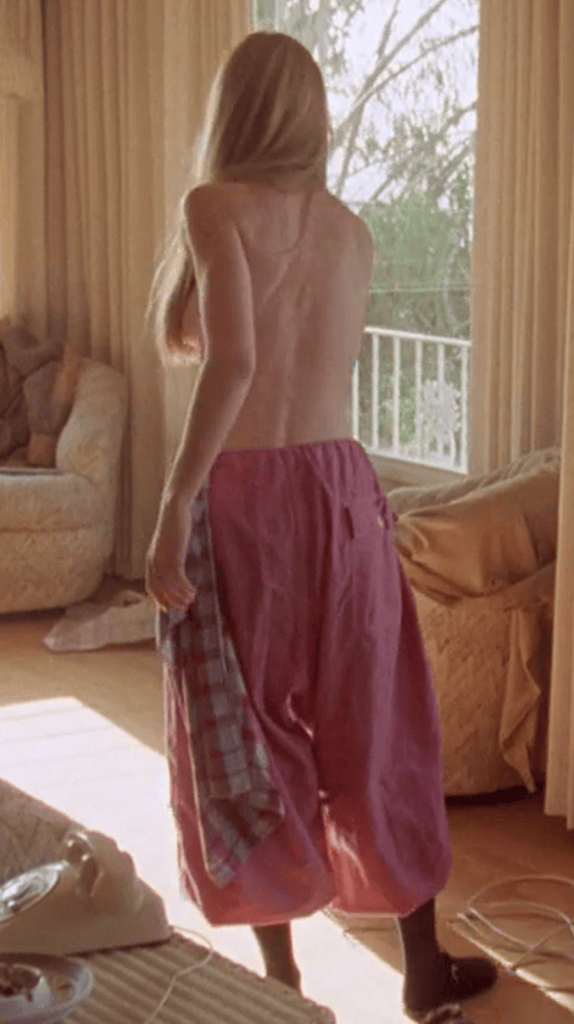
Pictured: Sissy’s beautiful back in an awful film
Honestly, that movie was a ruin, and I feel like it poisoned my brain. I was surprised when Sissy briefly mentioned it in her autobiography, although it was mainly in the context of Robert Altman, a famous independent filmmaker at the time, discovering Sissy in the dailies, and choosing her for his next movie, 3 Women. I can’t say that I enjoyed the movie a lot, although Sissy is delightful in it, playing a childlike waif. I suspect that Sissy was ambivalent about the movie as well, but that may be me wanting her to feel ambivalent about it.
One of the highlights of the movie is when a main character gives birth. Sissy’s co-star Shelley Duvall (who was famously tortured by Kubrick in The Shining just a couple of years later) walked slowly, hands bloody, eyes wild, to Sissy’s character, then slapped Sissy hard for reasons. It was a haunting moment of the movie, and after the scene ended, Sissy approached the film crowd, including the director Altman, as they were gathered around some screens seemingly enthralled. Sissy though they were watching the replay of the emotionally grueling scene she had just finished, but they were watching a sports match. That had to be disappointing.
She lost many opportunities because she simply didn’t care to belong to the Hollywood machinery. Her biggest role, the one that ended up earning her the sole Oscar, was pushed upon her in the strangest way. A famous female country singer that showed up in talk shows often, a certain Loretta Lynn, kept announcing that a movie about her life was in the works, and that “little Sissy Spacek” was going to play Loretta. There was just a problem: Sissy hadn’t been told this, or asked for that matter. Whenever Loretta said this on TV, Sissy got pissed and yelled at the screen. She absolutely didn’t want to do a biopic, which she felt ended up mostly as jokes, with people lip syncing through it, and the screenplay lacking bite because the artists had to look good. Sissy went out of their way to face Loretta to tell her in person that she wouldn’t do the damn film, but when Sissy met Loretta, she was struck by that fierce woman, a small, headstrong dynamo that was uniquely herself.
Sissy ended up agreeing to do the movie, which was titled Coal Miner’s Daughter. She spent a lot of time with Loretta and became like sisters, to the extent that when Loretta was close to dying, Sissy accepted an award for her, and almost cried through her speech. I have yet to watch the movie (I haven’t gotten through all of Sissy’s work from the seventies). People seem to remember it as a genuine film that showed ugliness and grittiness when it should. Sissy played and sang all of the songs.
Earning the Oscar undid Sissy to a significant extent. She was required to do interviews everywhere. Her hometown of Quitman declared a Sissy Spacek Day, and changed the name of a major street to hers. But what truly broke her was flying from country to country, doing round after round of interviews in which she had to invent new things to say. One of those days, while in England, she was so utterly drained from that nonsense that she found herself out of it while booked for a talk show. The other interviewee, also an actress, tried to dissuade Sissy from doing the interview given the state that Sissy was in, but Sissy was too out of it even to refuse. She ended up having a mental breakdown while being interviewed, falling into a sort of dissociative state in which she couldn’t understand what the host was saying to her, or what the other interviewee was saying to defend her. She only understood that the host was tearing into her. It seemingly was so bad, that when she was at the airport trying to return home, people who had seen the interview and recognized her looked at her with concern. I haven’t found that interview, and I should probably be glad about that.
This is an interview from that era, likely from the circuit of interviews she had to give, in which she sounds diminished from the effort, compared with other interviews.
That post-Oscar period was definitely a turning point. She and Jack had been living in Topanga Canyon, in a beautiful home that mostly Jack put together, but one time that they returned home, they found it ransacked. They had even stolen Sissy’s two guitars from her songwriter days in New York. Then Sissy and Jack found out that someone had jacked into their phone lines and racked up about $3000 in calls. They had enough, so they moved to a historical farm in Virginia. By then, her beloved mother was dead, she was pregnant with her first child, and she wanted to give her children a childhood like the one she had in Quitman, growing up in a small community in which you could get to know individual people and be treated like one of them, instead of like a fancy Hollywood actress.
The stories she tells of living in Virginia are strange in the sense of how peculiar the people she interacted with were. For example, close to their home, a farm belonging to the Jefferson family still operated, an unbroken line from Thomas Jefferson himself. Many of the characters Sissy met seemed picked from some bizarre branch of old England that had been transplanted to Virginia. In any case, Sissy was well known by cashiers and small town people; when I looked up Sissy’s videos, I came across quite a few comments like “I used to serve Sissy at this shop back in Virginia during the eighties; she was delightful.” Sissy was a small-town girl at heart, and she has remained so.
Sissy mentions how moving to Virginia meant for the Hollywood people that basically she had retired. Although she didn’t, her post-Oscar career is comprised, at least until the time this autobiography was released about fifteen years ago, of small independent films, some that involved people she had worked with before and whom she loved, like Tommy Lee Jones, David Lynch, and such. She emphasizes that her films were family affairs: her entire family moved to the location for a while, and her daughters sometimes contributed or even acted in them. One of her daughters, Schuyler Fisk, became an accomplished singer-songwriter and also an actress, although I haven’t heard her or watched her in anything.
I don’t mean to imply that Sissy basically disappeared after her Oscar. She received further Oscar nominations for Missing, The River, Crimes of the Heart, and In the Bedroom. Yet, they are movies whose existence I was fully unaware of before I researched Sissy’s life. In a strange way, it feels like an alternate dimension where Sissy Spacek was a thing got merged with mine, and it was only at forty-one years old when I found myself thinking, “How on Earth did I miss her and everything she did for the four decades I’ve been alive?”
Once Sissy had her children, I believe she mentioned that she finally had found what she was on this Earth for. She and her husband devoted themselves to raising their children and giving them the best childhoods they could. Her two daughters became free-spirited artists who weren’t afraid of much, sometimes to their detriment. Sissy shares anecdotes of bizarre accidents their daughters suffered or were involved in. One of them involved Jack recovering at home from a hernia surgery, only for her daughter to call home saying that someone had been run over. They thought it was the girl’s cousin. Jack, at the risk of his stitches unraveling, ran to the site of the accident, only to find out that one of their dear dogs, unfortunately named Lucky, had been run over by a truck. In another ocassion, the family was getting a friend accustomed to horses, when Schuyler fell from a tree and dislocated her shoulder terribly, to the extent that she had to wear a cast for months. They had the family friend drive a van to the hospital, and as if that wasn’t enough, she misjudged the height of an underpass, and the van ended up with its top sheared off.
Sissy is also candid about her own goofiness, her proneness to accidents. She had already broken some toes when, during a reunion in which she was to cook for the guests (even though she isn’t into cooking and isn’t good at it), she realized that a stray cat had jumped onto the table and was about to ruin the turkey. Sissy ran to shoo the cat away, with enough bad luck that she banged her toe real bad. She didn’t know how bad yet, but she had snapped it in half; she mentions that the toe ended up sideways. After getting rid of the cat, in pain, she sat at the table, then fainted. She was awakened by her husband. Sissy thought that something had happened to her eyes, as she only saw red and they burned terribly; it turns out she had fainted into the spaghetti sauce.
Her autobiography ends shortly after her father died when he was ninety, which was followed by the death of another one of their elder relatives that had been living with them and helping with their children and the farm. Looking back, one of the things that pains me the most from reading this autobiography is that I was reading the account of a dead world, even beyond what Sissy expected when she finished this at sixty-two. Most of the intimate family members and friend from the art world, like Rip Torn, David Lynch, Diane Keaton, Bill Paxton, Shelley Duvall… they’re all gone as of 2026. Sissy is now seventy-six years old, a happy grandmother that probably doesn’t have much longer to go.
Bill Paxton was a teenager working for Jack Fisk, alongside Sissy, in the early seventies. He even housesat for them at their Topanga Canyon home for a while, and got their parrot killed. David Lynch was Jack’s intimate friend; he worked on art direction for some of David’s films, and even starred briefly in Eraserhead. Sissy starred in one of David’s films back in the nineties. Here are both Bill Paxton and David Lynch honoring Sissy for her deserved star at Hollywood Boulevard:
I recall Sissy mentioning in one of her interviews from the last two decades that nostalgia was increasingly rushing at her feet. Something to that effect anyway. I can’t imagine how she must feel now. She said that the seventies was a magical decade for her, and even in her autobiography, the details from that era are more vivid and meaningful that most everything that came afterwards. I never got to live an extraordinary life like hers, but I also don’t have to live through reaching her old age feeling that all of it has mostly disappeared. As for me, I have to deal with the grief of arriving too late: discovering Sissy’s existence when her life is already complete, encountering friendships on the page that no longer exist outside it, wanting to inhabit a world I can only read about.
Sissy Spacek is a small-town girl who forever remained genuinely herself.

