
This song, the opener of the album, was made before Udio increased the quality of its production, but still, I think that the remastering process has squeezed plenty of juice out of this haunting piece.
Category: Arte
On audio mastering #2
Last month I wrote a post about the art of mastering a song by adjusting its frequency bands through carefully analyzing the spectrogram, something I had never bothered to figure out before. Here’s that post.
Although I haven’t produced any new songs with Udio, because I’m trying to finish a novella I’ve been working on for seven goddamn months, I’m halfway through remastering the third volume of Odes to My Triceratops, which are a bunch of concept albums about a triceratops. I’ve changed how I master audio in subtle but powerful ways, so read on if you give a shit about this stuff.
- Download the WAV file of the song from the Udio interface.
- Open the original WAV in Audacity.
- Normalize both channels at -1db.
- Export it as a 24-bit/192KHz WAV stereo file. I read somewhere that you shouldn’t try to master audio using a WAV file of lower quality, and never ever using an MP3, which are compressed to begin with.
- Forget about Audacity and open a better audio editing program. I use iZotope RX 10, which is perfect for my purposes. Load the recently exported WAV file.
- Modify the EQ based on good base values (you can look up some and save it as a preset). Ensure that it comes with a high-pass filter at 30hz (roll off 24 db); apparently the human ear doesn’t hear anything below that frequency, so you’d just be leaving pointless data in.
- Normalize at -1db.
- Don’t bother with compression, multiband or not; I’ve come to believe that applying compression to a song is a crutch, because you can achieve similar but far better results by adjusting the individual frequency bands.
- Apply an azimuth operation on the song. It equalizes the volume of both channels and ensures that they are in sync, in case the audio came with some unsightly delay due to poor handling of mics. That won’t happen with Udio songs, but you might as well do so. However, blindly azimuth-ing a song can bite you in the ass: some parts of the song might only sound on one channel for artistic reasons, so ensure that you relisten to the whole thing afterwards. If the azimuth operation clearly shouldn’t have been applied to a specific segment of the song, revert the operation and only apply it to the rest of the song.
- Normalize at -1db.
- Now comes the fun part: messing around with frequency bands. iZotope RX allows you to set six manipulation points along the whole frequency spectrum. You should put each manipulation point smack in the middle of the following frequency ranges (you can prepare these manipulation points and save the set as a preset):
- Bass (60-250 Hz)
- Low Mids (250-500 Hz)
- Midrange (500 Hz – 2 kHz)
- Upper Midrange (2 kHz – 6 kHz)
- Presence (6 kHz – 10 kHz)
- Brilliance (10 kHz – 20 kHz)
- Go to your favorite part of the song and EQ each frequency band one by one, raising and lowering its volume little by little as you listen on your absolute best headphones. I own a pair of $400 noise-canceling headphones by Sony which do a fantastic job of isolating me from this horrid world.
- Notes on what raising or lowering each frequency band affects:
- Bass (60-250 Hz): mostly the punch of drums, as well as similar instruments. I usually want them punchy, but it can distort the vocals if you go too high.
- Low Mids (250-500 Hz): this is an interesting frequency band: too low and the voices and instruments will sound tinny, too high and the song will sound like mud. It features the “body” of many instruments.
- Midrange (500 Hz – 2 kHz): mainly voices and guitar-like instruments.
- Upper Midrange (2 kHz – 6 kHz): most of percussion that isn’t too bassy. This one is very easy to EQ for the entire song: raise and lower this frequency band until the pitch of the drums sounds right. If you raise it too high, some singers’ “S” sounds will hurt your ears.
- Presence (6 kHz – 10 kHz): high lingering sounds like hi-hats, cymbals, and such. You can rarely raise or lower this much without altering the pitch of other percussion instruments, so I suggest very narrow frequency range manipulations in this range.
- Brilliance (10 kHz – 20 kHz): this one is a bit hard to describe. Some call it “air,” similar to the sound your thumb and index finger make when you rub them together. It provides interesting details. A base EQ should likely raise this by about 8db. If you raise it further, it will likely screw with the pitch of the drums.
- Apply the EQ changes you prepared for your favorite part to the entire song. Particularly when working with Udio songs, it’s rare that the rest of the song requires very different EQ levels than your preferred part, so your changes act as a great new baseline.
- Go through each part of the song and apply individual changes to their frequency bands depending on that part’s needs: sometimes a segment should be more bassy, or the midrange be 3db higher because the guitar won’t sound as good otherwise, etc. However, ensure that you don’t screw up the transitions between the different segments of the song. This can easily happen if you raise the upper frequencies too much in one segment in comparison with the adjacent ones.
- When you’re happy with the state of the entire song, revise its spectrogram focusing on “instrument or vocal stripes” (not sure what to call them) that are either too white (meaning too loud in comparison to the rest of the spectrum) or not white enough (are buried in the mix).
- If you spot instrument stripes that are isolated between frequency bands, and that aren’t affected much by raising or lowering those manipulation points, hover your cursor over that line to figure out what frequency it’s located at. Then, move one manipulation point to that frequency and pinch the range of frequencies the manipulation will affect by scrolling with your mouse. This is a fantastic operation that I recently discovered. It that allows you to bring attention to isolated, perhaps even buried instruments like cowbell, ankle rattlers, tambourine, etc.
- For example, in the images seen after this list, that solid strip in the “presence” frequency band is located at the 8100 Hz frequency, and is some sort of fancy percussion instrument. If you attempt to bring it further to the surface with a general manipulation point, you’ll distort the pitch of the drums.
- Thankfully, in the EQ editor, as seen in the following picture, and as said before, you can narrow the breadth of the affected frequency range by scrolling with the mouse.
- Normalize at -1db.
- Change the viewer from spectrogram to waveform. See those spikes in the corresponding image? Those spiky fuckers will be the bane of your life. A single protruding spike in the waveform will prevent the song from normalizing correctly, as it will adjust to the loudest millisecond of sound. I doubt that using some “limiter” operation is a good idea here, because you will shear part of the sound. I just carefully zoom into those parts, select the spike, and reduce its volume level with the Gain tool. You will likely need to do this dozens of times as you adjust the volume of the song.
- Use the clip gain tool, as seen in the corresponding image further down below, to properly raise or lower the volume of certain parts of the song. It’s usually a good idea to match the volume levels of all the song parts, but some do seem to need to sound lower. It’s a matter of taste.
- Finally, normalize at -1db.
Images for point 17:


Image for point 19:

Image for point 20:

Anyway, I hope this post helped if you’re also embarked on the marvellous journey of mastering songs. And if not, well, screw you.
Remastered “The Undead King of Nowhere-Town” from Odes to My Triceratops, Vol. 3
An indie punk song about what life’s about.
Review: Mushoku Tensei, Vol. 12, by Rifujin na Magonote
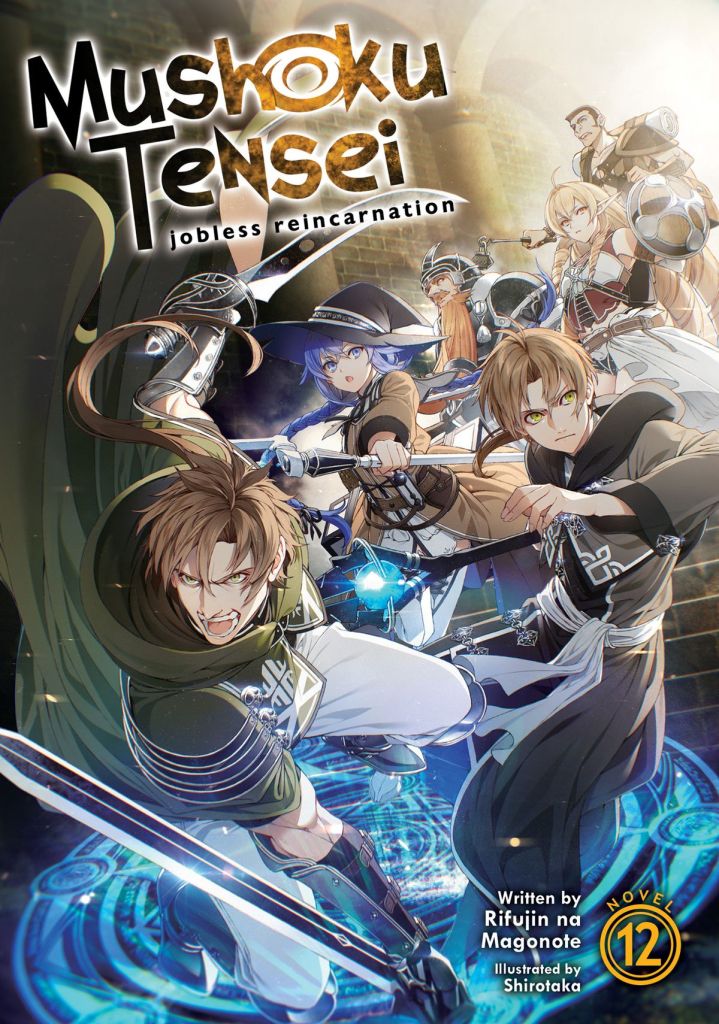
Three-and-a-half stars.
I love me some isekai. If you pay any attention to my words, you know this already. It’s the quintessential boys’ fantasy: explore some fantastic places cut off from this repulsive Earth; exploit newly-gained, generally undeserved powers; meet cool people mostly of the attractive, female persuasion then have sex with them; possibly marry one or more of those gals before or after impregnating them; enjoy the fact that you will never, ever have to deal with Earth and its people again.
This time, our hero starts at the lowest point of his life: after two decades of parasitizing his parents as a hikikomori due to relentless bullying in high school, his parents died. Instead of attending the funeral, he spent that day jerking off to child porn (or loli hentai), a fact that bothered his siblings enough to beat him up and throw him into the streets. As he wandered in a daze, the mythical creature known as Truck-kun deigned to make a visit and transport the protagonist, along with a couple of people nearby, to death, and later on to a fantasy world.
Our protagonist gets reincarnated as a baby that retains the memories of his harrowing past life. In this new one he’s Rudeus Greyrat, son of a horny swordfighter and a lively mage, who had retired from adventuring to start a family together. Rudeus is overjoyed by the fact that he’s been given a second chance at life, but mainly that he’s able to suck on a hottie’s tits on a regular basis, and that the grown-ups around him forgive him for his relentless perversion. The anime adaptation did a good job rendering this, as seen below:
Anyway, lots of shit happens, as it tends to do. I read this volume of the light novel to catch up with the anime adaptation, that has just finished its second season. I’m discussing spoilers from now on, so read on only if you already know what happens, or you don’t care to find out this way.
<spoilers>That whole magic displacement incident that teleported Rudeus’ family, as well as the redheaded terror and his childhood elvish friend, to random corners of the world, has led him to organize a spelunking raid to a teleporter labyrinth where his mother is supposed to be trapped. We accompany Rudeus along with his scumbag father Paul, blue-haired loli and magician Roxy Migurdia, their monkey-man scout, a gay dwarf, and a promiscuous grandma as they bond with each other and fight monsters. First they rescue Roxy, who falls in love with adult Rudeus because he saved her from the brink of death. Finally they face a hydra, and although they defeat it, they suffer a devastating loss. Rudeus also ends up maimed.
The biggest difference from the anime adaptation happens when they’re nursing their wounds back at the inn. Rudeus is depressed in a similar way as he’s been in the past (for example during his episode of erectile dysfunction). This time, Rudeus’ grandma-in-law suggests Roxy that she should fuck Rudeus to get him out of his funk. In the anime, Roxy drags Rudeus to bed and mounts him. In the original, she’s about to stand up when Rudeus pulls her down and fucks her roughly. He barely considers the fact that he’s cheating on his pregnant wife. Later on, his grandma-in-law deceives our protagonist by stating that he’s impregnated the blue-haired magician, in order for him to take responsibility, as the Japanese love to say, and make Roxy his second wife. Other than those significant changes that made me lose some respect for both characters, the anime adaptation is faithful to the rest, even verbatim for plenty of the dialogue. The author is involved with the adaptation, so maybe those changes are a very late revision of the original work.</spoilers>
What else can I say? If you like Mushoku Tensei, you’ve likely watched the anime, so you knew what to expect from this volume. This is a story about the pains and struggles of growing up, rising from rock bottom to becoming a more or less respectable family man, processed through the Japanese charm you know and love (if you know and love it), and free from the politics that have corrupted every aspect of Western culture. This story also makes polygamy quite appetizing.
Remastered “Fuck You, Life (garage rock version)” from Odes to My Triceratops, Vol. 3
I thought “Fuck You, Life (garage rock version)” would have been a relatively minor song on this album, but I’ve found myself listening to it often on the train or while waiting for the bus. Sometimes you just want to enjoy a cool tune about giving up on life.
Remastered “St-a-b Ya-self” from Odes to My Triceratops, Vol. 3
A fun psychobilly song about stabbing oneself. Nine songs down, nine to go.
Motocross Legend, Love of My Life, Pt. 18 (Poetry)
You can read this novella from the beginning through this link.
I used to know every contour of your face,
The exact timbre of your voice,
The way your body pressed against mine,
Your taste, the salty scent of your sweat.
But your traces are flaking off my brain;
In the seams and margins of my memories,
Bugs and patches have appeared,
Corroding the integrity of a past
That I’m editing, shaping with bias,
As I revisit it time and time again.
Your gaze, your smile, your laughter,
They all fade away into oblivion
With each ticking second.
Izar, I beg you, stay with me.
Let’s leave this suffocating city
On a motocross odyssey spanning Europe:
Hundreds of kilometers of highways,
Speeding through the countryside
Past petrol stations, fields, and farmhouses.
We’ll make love on the shores of the sea,
Then sleep under a blanket of stars.
Let’s rent bikes and ride along the Seine.
Let’s explore the winding streets of Venice,
Swim in the turquoise waters of the Caribbean,
Surf the waves of Hawaii or Costa Rica,
Climb the ancient terraces of Machu Picchu.
For the rest of my days, I will care for you,
Your unstable mind, your fits of rage.
Growing up, I feared venturing far
From my neighborhood, from my parents.
I dreaded exposing myself to risky experiences.
In my mind, I saw my mother’s stern face,
Ready to scold and ground me
For daring to struggle against the vines
She had wrapped tight around me.
Roam the breadth of Spain? Travel the world?
Such adventures felt as distant as the stars.
I was convinced that even as an adult,
I wouldn’t organize something so troublesome.
But that year, I stood in the blazing Roman heat
With my teenage son beside me
And my daughter’s small hand grasped in mine,
Gazing up at the façade of the Pantheon,
Its towering Corinthian columns glowing faintly,
Burned by the merciless July sun;
Its triangular pediment pockmarked, scarred,
With projectile strikes from World War II.
I longed to appreciate its grandeur in solitude,
But a throng of tourists choked the square.
A listless guy stood dressed like a centurion,
His helmet adorned with a plume of dyed horsehair.
The muscle cuirass concealed the flab
Of a modern man suited to a desk job.
The Pantheon didn’t belong in this post-apocalypse,
Among the disoriented survivors of the 21st century,
Who lacked the knowledge to recreate
The sunlit glory of their once eternal past,
And who had lost the will to rediscover it.
Well, what did you think about the sights, Izar?
We never had the chance to escape together,
But I carried your memory to Rome.
I hope you enjoyed the trip.
In my little corner of the world, whenever I could,
I escaped to the freedom of an isolated bench
Along the wooded lane containing your memorial stone.
There, beneath the sunlight filtering through branches,
Hunched over a notebook, I poured my memories of us,
Capturing in words every detail I could remember.
I discovered that writing tricked the brain
Into gilding moments and affixing them to its cells,
Regardless of their authenticity.
Drawing, writing, they couldn’t save me;
They just helped me endure this lonesome life
For yet another day.
But maybe the right words could save
What remained of you.
In my heart, a secret garden bloomed.
Pollen sparkled on iridescent flowers,
Their petals fanning out like peacock feathers.
In this floral realm where time stood still
And death could never enter,
You, enshrined within a poem or story
That wouldn’t fade, rot, nor be reduced to ashes,
Could live eternally.
Author’s note: the songs for today are “This Is the One” by The Stone Roses, and “Sit Down” by James.

Remastered “Paleontology of Pain” from Odes to My Triceratops, Vol. 3
Were you waiting for yet another remastered song from the third volume of Odes to My Triceratops? No? Oh well. Anyway, here’s a mix of surf rock, dance punk and cajun music for ya. It’s partly inspired, as I realized while I was making it, by a childhood friend of mine who either OD’d or killed himself.
Remastered “Nocturne for Claire” from Odes to My Triceratops, Vol. 3
A sad song about a loved one that the songwriter will never see again.
Remastered “Synaptic Flies” from Odes to My Triceratops, Vol. 3
I’m working afternoons this week, so before I waste more hours of my limited life coordinating the replacement of printers (on top of my usual tasks) in the hospital complex where I’m employed, I’ve remastered another song. This one’s about walking around with flies in your head. Six down, twelve to go.
 The Domains of the Emperor Owl
You must be logged in to post a comment.