
Five stars.
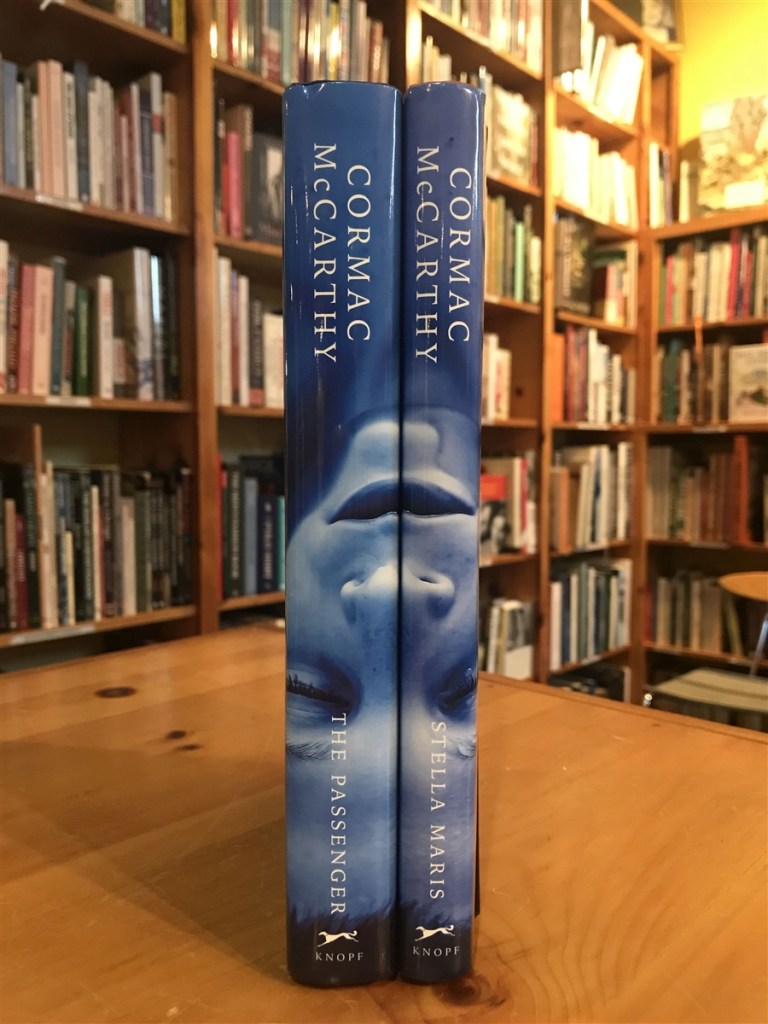
I first read The Passenger, along with its coda Stella Maris, perhaps a year and a half ago. I loved both, but I wasn’t consciously aware of how they had settled in my subconscious. From time to time, I remembered the most important character in those two books: a beautiful, mentally-ill genius named Alicia Western. Out of nowhere, back in December I dreamed about her, and it spurred a sudden obsession that has yet to pass. It led me to reread both books. Alicia Western feels not only unique but wholly real, as if she had truly existed. The massive weight of grief that pulls the protagonist down on The Passenger, that pulls down the reader for that matter, relates to the knowledge that an irreplaceable (pretty much a perfect person, as one of the characters put it) had been lost. Now that we know quite a bit more about McCarthy’s personal life, mainly about the love of his life, Augusta Britt, it seems to me that both of his final novels, which he had been researching or living since about 1972, render his grief, regret and general sorrow for having loved and lost Britt, whom McCarthy never managed to marry despite repeated attempts up to the end of his life.
Both books develop a forbidden love, that of Alicia Western and her biological brother Bobby. Cormac McCarthy didn’t have to go far to research how it felt to live a forbidden love. If Augusta Britt’s own words are to be believed, she first introduced herself to Cormac McCarthy at a public pool. A blonde, blue-eyed beauty (just like Alicia Western), she had a stolen gun holstered at her hip; she was sick of men in foster homes abusing her. When she approached McCarthy, he asked if she was going to shoot him. She then produced McCarthy’s first book, The Orchard Keeper, and asked him to sign it. McCarthy was surprised, because just a few thousand copies of that book had been produced for that edition (this and other details bring to question if Britt is making stuff up to protect McCarthy, whom she loved, from further scrutiny). As the YouTuber Write Conscious (who lives in the Catalina foothills “five minutes away” from where Augusta Britt lives now, although he has never met her) spoke at length in this video, Augusta Britt was likely thirteen when she met McCarthy. She was also thirteen when she started receiving amorous letters from him. She was fourteen when, after getting abused again in a foster home, McCarthy asked her if she would escape with him to Mexico. Augusta herself said that they made love shortly after settling there. Regardless of your opinion on the subject of underage sex, it’s probably illegal. The fact remains that Augusta Britt to this day claims that McCarthy saved her life, and they were friends up until his death. As you will see throughout this post, the real-life inspiration seems thinly veiled at times, which possibly makes The Passenger McCarthy’s most personal novel.
This review will contain spoilers, although referring to spoilers in this novel is a bit strange: the most important thing that happens in it, that keeps happening throughout, is Alicia Western’s suicide, the aftermath of which were are presented with right in the opening passage: she walked out of the Stella Maris sanatorium into the woods of Wisconsin and let herself freeze to death. Curiously, although she had talked at length about intending to disappear without a trace, she chose to wear a red sash around her white dress so her corpse would be easily found, which is inexplicable, and has led to plenty of online speculation. Alicia Western, a troubled math genius with a unique mind that baffled every person she came across (as one person put it, when strangers met her, they thought of her as a pretty girl, but a few minutes later they were swimming for their lives), was led into these circumstances because her brother Bobby, the love of Alicia’s life, as well as the person who should have protected her to the last of his days, crashed while racing professionally, and ended up in a coma. Alicia, believing Bobby to be brain-dead regardless of whether he would wake up or not, decided to die. But Bobby did wake up from his coma pretty much unscathed. The Passenger starts with Bobby in 1980, in a world that for him has turned into ashes, the person he loved lost forever.
Bobby, who used to be both a physicist as well as race car driver, now works as a salvage diver who opts for dangerous jobs, quite overtly hoping that one of those jobs may take the agency out of him dying. The plot kicks off when Bobby and a friend of his, while diving to explore a sunken airplane, discover a bizarre situation: even though the plane is intact, the passengers inside are dead in their seats as if they had died before the plane crashed. The plane’s black box is missing, along with one of the passengers. Bobby and his pal realize that the situation is fucked, and they want nothing to do with it. Bobby goes out of his way just once to return to the area alone, and he discovers an inflatable raft that the passenger must have used to escape the plane. Now come the realm of spoilers: this is an anti-plot novel. Bobby doesn’t want to know anything more about this event, but he keeps being hounded about it by mysterious government types, who encroach further and further upon his life for reasons we never find out about (presumably because they believe he had something to do with stealing the plane’s black box, but it seems to me that they’re just trying to get rid of witnesses regarding whatever conspiracy caused the plane crash).
With those plot elements out of the way, which is pretty much all you get in that regard, the rest of the book is an exploration, a prodding if you will, of the fringes of human knowledge and experience: mental illness, hallucinations, conspiracies, living off the grid, working in off-shore platforms, transgenderism, aliens, incest, quantum physics, the atomic bomb, life as an outlaw, death, and plenty more. It felt to me like McCarthy was expanding his mind against those nooks that don’t have solid explanations, as he was about to embark in the final mystery of them all: dying, which deprived us of one of the finest, most unique minds in the world, as well as the writer I respect the most.
Throughout the story, Bobby remains subdued, pinned down by grief and regret, to the extent that we never meet the Bobby that Alicia talks about in Stella Maris, that young man who played the mandolin at honky-tonks as Alicia pretended they were married. In virtually every scene, it feels like Bobby is preventing himself from thinking about Alicia, and whenever some image or memory slips in, it devastates him. Most of the time that any other character brings Alicia up, Bobby is moments away from leaving. Bobby mentions that the sole duty in his life was to take care of her, that he had failed miserably at it, and that he should have killed himself years ago. The rest of the book is a way for him of unburdening himself from everything and everyone he has ever known, so he can spend his remaining life in solitary confinement, paying for the crime of abandoning Alicia Western, his sister and love of his life, when she needed him the most. I can’t hurl complaints at him for his decisions, because he bears the full weight of what he’s done.
I can’t explain, except perhaps by alluding to how McCarthy imbued Alicia with all his yearnings and reverence for Augusta Britt, the fact that whenever she appeared or was mentioned in this book, I perked up and combed through every detail in case I would glean new information about her. She’s a pulsing presence, a constant heartbreak, as alive in those pages as I don’t think I’ve experienced anywhere else in fiction.
In Stella Maris, Alicia tells her therapist that she only kissed Bobby twice, but never went beyond that. However, that book makes a peculiar point: that confessing to some unsavory stuff is a way of keeping hidden details that lie far deeper, and cannot be brought to light. It was a very odd thing to say after Alicia Western confessed to loving her brother, and having told him that she wanted to marry him and bear his child. As I was rereading through The Passenger, I came across this passage:
Certain dreams gave him no peace. A nurse waiting to take the thing away. The doctor watching him.
What do you want to do?
I dont know. I dont know what to do.
The doctor wore a surgical mask. A white cap. His glasses were steamed.
What do you want to do?
Has she seen it?
No.
Tell me what to do.
You’ll have to tell us. We cant advise you.
There were bloodstains on his frock. The mask he wore sucked in and out with his breathing.
Wont she have to see it?
I think that will have to be your decision. Bearing in mind of course that a thing once seen cannot be unseen.
Does it have a brain?
Rudimentary.
Does it have a soul?
None of the other dream sequences were that specific regarding mundane details, nor included such dialogue. That tells me that it wasn’t a dream. And what is depicting is Alicia either having a miscarriage or an abortion. Bobby was the sole person she would have had sex with.
There’s not much else that I want to specify about the contents of the novel; they should be experienced. I will go over the many quotes that I have noted down. First of them, very early on, Alicia’s main “hallucination,” the Thalidomide Kid (whom some people online have suggested is Alicia’s subconscious fear that the child she wants to have with Bobby would be deformed), presents to her a new character, a dusty old man who ultimately only asks for the location of the bathroom. But the Kid’s words about that old man are quite telling, I’d say, now that we know McCarthy’s history with the love of his life:
He was married in that outfit. Little wifey was sixteen. Of course he’d been banging her for a couple of years so that would put her at fourteen. Finally managed to knock her up and hey, here we all are.
The following are quotes. Starting with an amazing sentence about the atomic bomb:
In that mycoidal phantom blooming in the dawn like an evil lotus and in the melting of solids not heretofore known to do so stood a truth that would silence poetry a thousand years.
I know you. I know certain days of your childhood. All but weeping with loneliness. Coming upon a certain book in the library and clutching it to you. Carrying it home. Some perfect place to read it. Under a tree perhaps. Beside a stream. Flawed youths of course. To prefer a world of paper. Rejects. But we know another truth, dont we Squire? And of course it’s true that any number of these books were penned in lieu of burning down the world–which was their author’s true desire. But the real question is are we few the last of a lineage? Will children yet to come harbor a longing for a thing they cannot even name? The legacy of the world is a fragile thing for all its power, but I know where you stand, Squire. I know that there are words spoken by men ages dead that will never leave your heart.
The world of amorous adventure these days is hardly for the fainthearted. The very names of the diseases evoke dread. What the hell is chlamydia? And who named it that? Your love is not so likely to resemble a red rose as a red red rash. You find yourself yearning for a nice oldfashioned girl with the clap. Shouldnt these lovelies be required to fly their pestilential knickers from a flagpole? Like the ensign of a plagueship? I cant of course but be curious what an analytic sort such as yourself makes of the fair sex in the first place. The slurred murmurings. The silken paw in your shorts. Beguiling eyes. Creatures soft of touch and sanguinivorous of habit. What runs so contrary to received wisdom is that it really is the male who is the aesthete while the woman is drawn to abstractions. Wealth. Power. What a man seeks is beauty, plain and simple. No other way to put it. The rustle of her clothes, her scent. The sweep of her hair across his naked stomach. Categories all but meaningless to a woman. Lost in her calculations. That the man knows not how to even name that which slaves him hardly lightens his burden.
In the spring of the year birds began to arrive on the beach from across the gulf. Weary passerines. Vireos. Kingbirds and grosbeaks. Too exhausted to move. You could pick them up out of the sand and hold them trembling in your palm. Their small hearts beating and their eyes shuttering. He walked the beach with his flashlight the whole of the night to fend away predators and toward the dawn he slept with them in the sand. That none disturb these passengers.
What if the purpose of human charity wasnt to protect the weak–which seems pretty anti-Darwinian anyway–but to preserve the mad? You have to be careful about who you do away with. It could be that some part of our understanding comes in vessels incapable of sustaining themselves.
To prepare for any struggle is largely a work of unburdening oneself. If you carry your past into battle you are riding to your death. Austerity lifts the heart and focuses the vision. Travel light. A few ideas are enough. Every remedy for loneliness only postpones it. And that day is coming in which there will be no remedy at all.
McCarthy had some things to say about the modern world. It feels to me that he wasn’t talking about the modern world of the novel.
The point, Squire, is that where they used to be confined to State institutions or to the mudrooms and attics of remote country houses they are now abroad everywhere. The government pays them to travel. To procreate, for that matter. I’ve seen entire families here that can best be explained as hallucinations. Hordes of drooling dolts lurching through the streets. Their inane gibbering. And of course no folly so deranged or pernicious as to escape their advocacy.
Do you know what I find particularly galling? It’s having to share the women with you lot. To listen to you fuckwits holding forth and to see some lissome young thing leaning forward breathlessly with that barely contained frisson with which we are all familiar the better to inhale without stint an absolute plaguebreath of bilge and bullshit as if it were the word of the prophets. It’s painful but still I suppose one has to extend a certain latitude to the little dears. They’ve so little time in which to parlay that pussy into something of substance. But it nettles. That you knucklewalkers should even be allowed to contemplate the sacred grotto as you drool and grunt and wank. Let alone actually reproduce. Well the hell with it. A pox upon you. You’re a pack of mudheaded bigots who loathe excellence on principle and though one might cordially wish you all in hell still you wont go. You and your nauseating get. Granted, if everyone I wished in hell were actually there they’d have to send to Newcastle for supplementary fuel. I’ve made ten thousand concessions to your ratfuck culture and you’ve yet to make the first to mine. It only remains for you to hold your cups to my gaping throat and toast one another’s health with my heart’s blood.
Real trouble doesnt begin in a society until boredom has become its most general feature. Boredom will drive even quietminded people down paths they’d never imagine.
The horrors of the past lose their edge, and in the doing they blind us to a world careening toward a darkness beyond the bitterest speculation. It’s sure to be interesting. When the onset of universal night is finally acknowledged as irreversible even the coldest cynic will be astonished at the celerity with which every rule and stricture shoring up this creaking edifice is abandoned and every aberrancy embraced. It should be quite a spectacle. However brief.
On the darknesses of life:
If I think about things that I just dont want to know about they’re all things that I do know about. And I’ll always know them.
You think that when there’s somethin that’s got you snakebit you can just walk off and forget it. The truth is it aint even following you. It’s waitin for you. It always will be.
We might have very different notions about the nature of the oncoming night. But as darkness descends does it matter?
The world will take your life. But above all and lastly the world does not know that you are here. You think that you understand this. But you dont. Not in your heart you dont. If you did you would be terrified.
Grief is the stuff of life. A life without grief is no life at all. But regret is a prison. Some part of you which you deeply value lies forever impaled at a crossroads you can no longer find and never forget.
In my experience people who say no matter what seldom know what what might turn out to be. They dont know how bad what might get.
You have to believe that there is good in the world. I’m goin to say that you have to believe that the work of your hands will bring it into your life. You may be wrong, but if you dont believe that then you will not have a life.
We dont move through the days, Squire. They move through us. Until the last cruel crank of the ratchet.
She knew that in the end you really cant know. You cant get hold of the world. You can only draw a picture. Whether it’s a bull on the wall of a cave or a partial differential equation it’s all the same thing.
People will go to strange lengths to avoid the suffering they have coming. The world is full of people who should have been more willing to weep.
The abyss of the past into which the world is falling. Everything vanishing as if it had never been. We would hardly wish to know ourselves again as once we were and yet we mourn the days.
Here is a story. The last of all men who stands alone in the universe while it darkens about him. Who sorrows all things with a single sorrow. Out of the pitiable and exhausted remnants of what was once his soul he’ll find nothing from which to craft the least thing godlike to guide him in these last of days.
A calamity can be erased by no amount of good. It can only be erased by a worse calamity.
I suppose in the end what we have to offer is only what we’ve lost.
The world’s truth constitutes a vision so terrifying as to beggar the prophecies of the bleakest seer who ever walked it. Once you accept that then the idea that all of this will one day be ground to powder and blown into the void becomes not a prophecy but a promise. So allow me in turn to ask you this question: When we and all of our works are gone together with every memory of them and every machine in which such memory could be encoded and stored and the earth is not even a cinder, for whom then will this be a tragedy?
On death:
I don’t know what’s going to happen. I’m not sure that I want to. Know. If I could plan my life I wouldnt want to live it. I probably dont want to live it anyway. I know that the characters in the story can be either real or imaginary and that after they are all dead it wont make any difference. If imaginary beings die an imaginary death they will be dead nonetheless. You think that you can create a history of what has been. Present artifacts. A clutch of letters. A sachet in a dressingtable drawer. But that’s not what’s at the heart of the tale. The problem is that what drives the tale will not survive the tale. As the room dims and the sound of voices fades you understand that the world and all in it will soon cease to be. You believe that it will begin again. You point to other lives. But their world was never yours.
Do you think most people want to die?
No. Most is a lot. Do you?
I dont know. I think there are times when you’d just like to get it over with. I think a lot of people would elect to be dead if they didnt have to die.
Several acquaintances have remarked upon my sangfroid at this turn of events but in all truth I cant see what the fuss is about. Wherever you debark was the train’s destination all along. I’ve studied much and learned little. I think that at the least one might reasonably wish for a friendly face. Someone at your bedside who does not wish you in hell. More time would change nothing and that which you are poised to relinquish forever almost certainly was never what you thought it to be in the first place.
About Alicia:
He crossed along a low wall of sawn blocks opposite the pool and sat as he had sat that summer evening years ago and watched his sister perform the role of Medea alone on the quarry floor. She was dressed in a gown she’d made from sheeting and she wore a crown of woodbine in her hair. The footlights were fruitcans packed with rags and filled with kerosene. The reflectors were foil and the black smoke rose into the summer leaves above her and set them trembling while she strode the swept stone floor in her sandals. She was thirteen. He was in his second year of graduate school at Caltech and watching her that summer evening he knew he was lost. His heart in his throat. His life no longer his.
In his dreams of her she wore at times a smile he tried to remember and she would say to him almost in a chant words he could scarcely follow. He knew that her lovely face would soon exist nowhere save in his memories and in his dreams and soon after that nowhere at all. She came in half nude trailing sarsenet or perhaps just her Grecian sheeting crossing a stone stage in the smoking footlamps or she would push back the cowl of her robe and her blonde hair would fall about her face as she bent to him where they would lay in the damp and clammy sheets and whisper to him I’d have been your shadowlane, the keeper of that house alone wherein your soul is safe. And all the while a clangor like the labor of a foundry and dark figures in silhouette about the alchemic fires, the ash and the smoke. The floor lay littered with the stillborn forms of their efforts and still they labored on, the raw half-sentient mud quivering red in the autoclave. In that dusky penetralium they press about the crucible shoving and gibbering while the deep heresiarch dark in his folded cloak urges them on in their efforts. And then what thing unspeakable is this raised dripping up through crust and calyx from what hellish marinade. He woke sweating and switched on the bedlamp and swung his feet to the floor and sat with his face in his hands. Dont be afraid for me, she had written. When has death ever harmed anyone?
For all his dedication there were times he thought the fine sweet edge of his grief was thinning. Each memory but a memory of the one before until… What? Host and sorrow to waste as one without distinction until the wretched coagulant is shoveled into the ground at last and the rain primes the stones for fresh tragedies.
What do you know of grief? You know nothing. There is no other loss. Do you understand? The world is ashes. Ashes. For her to be in pain? The least insult? The least humiliation? Do you understand? For her to die alone? Her? There is no other loss. Do you understand? No other loss. None.
Some things get better. I doubt this is one of them. People want to be reimbursed for their pain. They seldom are.
The only thing that was ever asked of me was to care for her. And I let her die. Is there anything that you’d like to add to that Mr Western? No, Your Honor. I should have killed myself years ago.
I dont know what to tell you, he wrote. Much has changed and yet everything is the same. I am the same. I always will be. I’m writing because there are things that I think you would like to know. I am writing because there are things I dont want to forget. Everything is gone from my life except you. I dont even know what that means. There are times when I cant stop crying. I’m sorry. I’ll try again tomorrow. All my love. Your brother, Bobby.
He had gotten out of the habit of talking to her when he was in New Orleans because he’d find himself talking in restaurants or on the streets. Now he was talking to her again. Asking her opinion. Sometimes at night when he would try to tell her about his day he had the feeling that she already knew.
Then slowly it began to fade. He knew what the truth was. The truth was that he was losing her.
When she came to the door of her room in Chicago he knew that she hadnt been out in weeks. In later years that would be the day he would remember. When all her concerns seemed to be for him. He took her to dinner at the German restaurant in Old Town and her hand on his arm at the table drained everything away and it was only later that he understood that this was the day when she was telling him what he could not understand. That she had begun to say goodbye to him.
She wanted to disappear. Well, that’s not quite right. She wanted not to have ever been here in the first place.
If all that I loved in the world is gone what difference does it make if I’m free to go to the grocery store?
When he got back to the windmill it was still dark and he climbed the stairs and sat at his little table. He sat with his forehead pressed into his hands and he sat for a long time. Finally he got out his notebook and wrote a letter to her. He wanted to tell her what was in his heart but in the end he only wrote a few words about his life on the island. Except for the last line. I miss you more than I can bear. Then he signed his name.
He’d no photograph of her. He tried to see her face but he knew he was losing her. He thought that some stranger not yet born might come upon her photo in a school album in some dusty shop and be stopped in his place by her beauty. Turn back the page. Look again into those eyes. A world at once antique and never to be.
Throughout McCarthy’s life, but particularly in the last twenty or so years, he was particularly interested in the workings of the subconscious: its role in the life of creatures, how it did its thing, etc. I believe that the title of this novel, The Passenger, along with how that word is used at times throughout the novel, alludes to the fact that we, as well as every other animal, are driven by the subconscious as much as we’d like to believe we are in charge, and that we’re merely passengers along for the ride. I’ve felt that myself intensely.
I’m certain that McCarthy knew that these two novels would be his last. They feel like goodbyes to the people he knew (many of the characters involved are inspired by actual people from his past). Goodbyes to the woman he loved from her broken youth at thirteen to her senior years at sixty-four. Thank you, Cormac, for every aching truth.
He knew that on the day of his death he would see her face and he could hope to carry that beauty into the darkness with him, the last pagan on earth, singing softly upon his pallet in an unknown tongue.





You must be logged in to post a comment.