Minoru Furuya: my favorite manga author

I have barely been able to connect with novels these past ten or so years, and the last living writer I respected, Cormac McCarthy, has been not alive for a while. Most of this half of the world seems to have lost their collective (and collectivist) minds, so when I want to experience a good story, I have to look to the Orient, past the reds. I’ve enjoyed plenty of South Korean stuff, but I’m mostly into Japanese. I’m always on the lookout for the next mind-blowing, perhaps even life-changing manga, but I seem to have run through the vast majority of the quality ones.

A couple of days ago, I thought again about Minoru Furuya, who earned the rare merit of being my favorite manga author. From time to time I look him up hoping that he has finally begun working on a new series, but unfortunately, the guy seems to have retired; his last work was the bizarre Gereksiz, from back in 2015-2016.

I suspect that most manga fans don’t know about Furuya. I’ve yet to talk to anyone who has read any of his works. But I get Furuya’s mind, to the extent that I’m fairly certain he also has OCD: his characters regularly fall into patterns of obsessiveness, and deal with intrusive thoughts and images that they sometimes act upon. The protagonist of his Ciguatera comes to mind, with his spirals of preoccupations in his bedroom, trying to bury his face in a pillow to keep himself from falling further. The protagonist of Himizu, perhaps his overall darkest story, feared being assailed by demons lurking at the corners of his mind, eager to break in. Both very common experiences for OCD sufferers.

Sadly, I’ve read virtually everything of value that Furuya put out. He started with an extremely amateurish series about a high-school ping-pong club (or something like that), a comedy that reminded me of the kind of material I created in middle school. I’ll probably revisit it at some point, but it’s early-nineties carefreeness. He followed up with Boku to Issho (link for my review), another comedy about a bunch of fellows living in poverty who hope to survive while keeping their sanity and dignity intact.

In the 2000s, he went straight from a slapstick comedy to his darkest tale: Himizu. With this one, he introduced the pattern for all the protagonists to come: outcasts with very little going for them, usually burdened by mental issues, who seem mostly pushed around by life. Good stuff sometimes happens to them (regularly, this involves dating someone above their league), but they usually pay for it with chaos and occasional brutality. His are the kinds of stories that go from mundane relationship issues to someone having his ears cut off while tied up in a shack. There’s the sense that life is extremely perilous, and that at any point it will force you to struggle through horror whether or not you’re ready for it, and if you survive it, you may not get any lessons out of it other than “life goes on.”

After Himizu came Ciguatera, generally considered his best. I came across that one plenty of times over the years in lists of best manga ever, but I ignored it because I thought it was a sports manga of sorts, centered on biking. But the bikes ended up being a symbol of a better, brighter future that could carry the protagonists away from their shitty circumstances. Ciguatera is a sort of a Bildunsroman in which the protagonist, a below-average dude with no talents to speak of, intends to figure out how to measure up to the girl he loves, hoping to become a dude worthy of respect. This one had likely the most realistic of Furuya’s endings, to which I have returned repeatedly in my mind.

Then came Wanitokagegisu and Himeanole. Both feature working-class protagonists stuck in dead-end jobs, who feel that life is passing them by, who can’t figure out how to improve their circumstances or even become interested by anything, and who are sure they’ll die alone. From that perspective, these last four series are very masculine stories. In both tales, the protagonists get involved in other people’s troubles, which lead them further and further into chaos and brutality. Both also feature the protagonists getting girlfriends way out of their league, which brings joy but also the sense of constantly having to measure up lest they look elsewhere. Both series feature horrific violence. Himeanole wasn’t even licensed in English, and fans have only translated up to chapter eight of about sixty-five. I only know of the full contents of that series, to the extent that an adaptation allows, because they made a movie out of it, which I watched last night.

His last serious story, and my favorite of his, was Saltiness (first review, second review), about a clearly autistic dude who realizes that his beloved sister will remain unmarried because she has to take care of his crazy ass, so he leaves for Tokyo to become independent, even though he’s thoroughly incapable of dealing with life. Saltiness is very hard for me to explain, but it feels like Furuya managed to create a parable with it for dealing with the nonsense of life, and finding one’s place in it despite being ill-suited.

Sadly, Saltiness seemed to have been his main send-off. His final work was the extremely bizarre Gereksiz, which starts with the bizarre premise of a solitary middle-aged man dragging his female coworker to show her the woman that he’s infatuated with, only for them to realize that he’s the only one who can see the woman. The story gets far stranger from there. It’s a great read, although it felt anticlimactic compared with Furuya’s previous works.

Given that these days I consider Furuya to be my favorite manga author, one would suppose that my favorite manga would be one of his, but that’s not the case. My favorite manga, which is among my five favorite fictional experiences in no particular order, is Inio Asano’s Oyasumi Punpun. That one has never stopped haunting me. It feels like Asano was trying to exorcise something out of himself through making that story. Unfortunately, after it ended in 2013 or so, Asano never even came close to achieving those heights again. An idealist, as evidenced by his earlier works, he seems to have expected it to change the world as well as himself, only for Asano to wake up ten years older having resolved fuck all. He wrote a semi-autobiographical series afterwards, titled Downfall, that showed how despondent and bitter he ended up after finishing his masterpiece.

Anyway, I suppose that’s all I wanted to say. Not sure why I even wrote this, but I did, so there.

Guitar practice in the woods (2025-08-11)

If you enjoy a deranged Spaniard playing guitar in the woods, I’ve got premium content for you.

That spot in the woods is quite isolated and rather unknown even for people who live around, so at the most I get three or four people a session passing by. They’re usually in a hurry. This time only a single person passed by: a woman wearing a pink sports bra, who grinned at me as I played. She was hot, too. The previous day, when I set up shop next to the spot where in a certain novella of mine I installed the memorial stone for the love of my life, I lifted my gaze and briefly connected with a woman who was passing by on a bicycle. She was also grinning at the fact that I was playing the guitar. It’s strange: people, particularly women, are usually wary of me, but put a guitar in my hands, and suddenly they look glad that I’m there. If only they knew.

Also, I recently went to my favorite guitar shop to ask why the thinnest nylon string always broke whenever I tried to tune it on my Alhambra dreadnought, only for the shop guy to tell me that I absolutely shouldn’t use nylon strings on my dreadnought. Apparently I should only use bronze strings, which is what you can hear in the video.

Anyway, that’s an hour of me playing other people’s songs. Enjoy, if you enjoy these sorts of things.

Life update (07/28/2025)

I’ve settled into a routine that fits me: wake up at six in the morning (even in the weekends, I wake up around seven), prepare for work, put on my earplugs, take the E29 bus that carries me to Donostia, read some manga on the way, walk through the hospital complex while avoiding looking at people’s faces, sit at my desk, put on my headphones, do my programming of the day, take the E29 that carries me back to Irún, do some more programming, go to bed. From time to time I lift weights, and on the weekends, when I have the energy, I walk to the nearby woods and play the guitar for a couple of hours.

Perhaps this is what being middle-aged is, after all: you realize your shortcomings and what you weren’t meant to do. I’ve thought back on my life and the relationships I’ve had. All of them were a mistake. I’ve hurt so many people without meaning to just because of how broken I am. I keep getting reminded, by my own brain, of this girl I knew when I was in middle school. She was likely autistic as well. Awkward as hell. Very lanky, generally plain looking. She used to write me elaborate letters. I doubt I ever read any of them. I don’t have them anymore. About a year or so after she last spoke to me, some stoner dickhead slung one of those big choppers of arts-and-crafts, and bisected the girl’s forehead, leaving a massive scar. I haven’t seen her since I was sixteen. I wish I knew if she killed herself, but I don’t remember her name. People only become somewhat real to me when they turn into myths in my mind. She’s now a girl I could have helped but failed to do so because I never had the means to. Stay away from people. There’s only hurt to come, both ways.

Due to my peculiar brain configuration, my memory is abysmal: I barely remember anything. I have stronger memories of the stories I’ve written than of stuff that has actually happened to me. And what I remember is almost invariably negative. Due to my daily intrusive thoughts, I’m usually reminded of, when not directly bombarded by, stuff I wouldn’t want to remember. Not worth the effort, the pain, the bother. It’s really simple: I wasn’t born equipped to live like a regular human being. Ultimately you just end up becoming yourself and discarding the useless alternatives you tried.

I recognize beauty, though, and I’m attracted to some of the young women I see on a regular basis. I don’t know if I wish I weren’t. On the bus, at the hospital. Nurses most likely. Most of my daydreams end up involving sex in one way or another. But in these daydreams I’m not myself. Perhaps my biggest regret is that I can’t redo it with fair odds. I would have settled for a body I wouldn’t have to be ashamed of. I think I have more things to say about that whole business, but I can’t figure out what that would be at the moment.

Soon enough it’ll be September 14th, when my current contract as a programmer will end, and I’ll have to either return to work as a technician, which terrifies me (the stress of that job landed me three times in the ER, two with arrhythmias and the other with a supposed hemiplegic migraine that I suspect was worse than that), or find myself a job as a programmer at forty years old, when programmers are on their way out due to AI (not complaining, I use it all the time).

It’s all a big whatever. I just want to be left alone. That’s what I think about most of the stuff I have to deal with on a regular basis: just let me sit in peace. Just let me program in peace. Just let me play the guitar in peace. I think my biggest aspiration in life has been to sit alone in a room without being bothered. I don’t think I ever truly believed I could aspire to anything more. I’m trying to get as much of that as possible.

Speaking of manga, the hentai-with-a-plot Parallel Paradise was surprisingly great. It’s about a high-schooler who ends up isekai-d into a world where he’s the only male, and every girl (they all die at twenty) gushes out food-scented slime from their nether regions after the littlest touch of his male fingers. One of the girls is a martial artist whose martial art consists on throwing grenades. Great sense of humor, compelling plot, and surprisingly touching at times. I’ve reread One Punch Man and found it more interesting the second time around. I’ve just barely started Atelier of Witch Hat, which I didn’t want to get into because it seemed girly and I don’t like Harry-Potter-like stuff, but it’s good.

I think I need more grenade-throwing in my life.

Anime/Manga #1

Whenever I feel like it, I’ll bring attention to videos or other media about two of my lifelong loves: manga and anime. Katsuhiro Otomo’s Akira is one of the main legends of anime, perhaps the number one. What many don’t know is that the original manga is also a must-read, and in many ways improves and deviates from the movie (more accurately, Otomo himself changed many aspects of the plot to fit the movie).

The following video is a great overview on how special the process of getting Akira made was.

Random shit #1

In the 2000s, some American studio bought the rights to dub an anime, and decided to turn it into outrageous nonsense. An obscure moment in history that will never be repeated. Now, it endures in the internet as a legend. The following video recounts this strange tale.

Life update (07/13/2025)

I’m in a transitional period: my current job as a programmer will end in September, and for legal reasons they can’t extend it (even though my boss would if he could). That means that the very day after, I could get called to work as an IT technician at the hospital, a job that has put me in the ER three times due to stress. I worked about seven years at it. It was a “frog sitting in heating water” situation; it took me working as a programmer to realize that I can’t continue working as a technician anymore. These days I don’t even greet the people at the office. I keep my head down, do my job, talk to my boss when I’m required, then go home. And it’s sustainable. I don’t want to search for another job, of course, but I will need to get another job before I’m recalled as a technician.

In my spare time, I keep programming my Living Narrative Engine app. I envision a future in which you could run Claude 4 Sonnet-level AI in consumer hardware, perhaps a dedicated mini-PC, and this app of mine would allow me to play through campaign-level stories with LLMs as the other characters. If I program it to that extent, it would be able to do so right now, but I’d have to pay for the LLM usage. It’s also great for erotica, which happens to turn me on more than any other stimulus.

I don’t really feel like writing anything. I’m extremely lethargic at the moment, and I only chose to write these words because I’m waiting for Claude Code to finish implementing something. Reaching my forties has hit me hard. I’m aware all the time of the monster inside me. There’s really no point in trying to relate to others. I keep to myself, hoping that nobody looks my way to annoy me. Can’t stop some strangers from doing so, though; this Friday, as I was waiting for the bus at seven in the morning, some woman in her perhaps late twenties berated me for cutting in line, even though I was there when she arrived, and I had been waiting for fifteen minutes. She seemed to believe I had gotten off a bus only to cut in line to enter the other arriving bus. I wanted to give her a piece of my mind, particularly due to the tone she was using, but ultimately it wasn’t worth it. Yet another instance of that fact that virtually every human interaction is detrimental to my life.

Anyway, I’ve been feeling like the following video for a while. Let’s see where the road takes us (apparently in circles).

Guitar practice in the woods (2025-07-05)

Another entry in the series nobody asked for. I went to my usual spot by the Roman foundry on the outskirts of town, so I figured I may as well record my usual guitar-playing routine.

Today left me particularly contented. But as I was walking back home, my mind became a stream of lost pets and other miseries. At least while I play there’s no thinking about anything.

Living Narrative Engine #9

#8

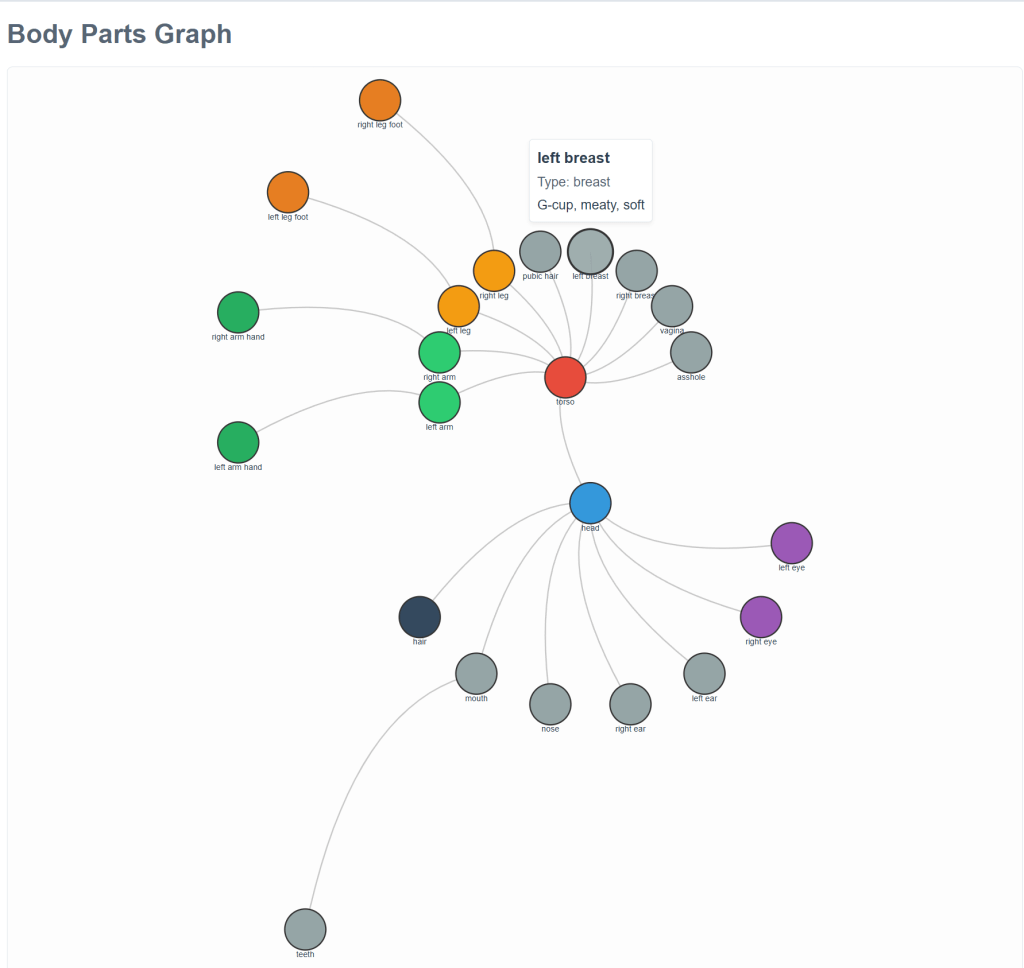
Behold the anatomy visualizer: a visual representation of a graph of body parts for any given entity, with the parts represented as nodes connected by Bézier curves. Ain’t it beautiful?

This visualizer has been invaluable to detect subtle bugs and design issues when creating the recipes and blueprints of anatomy graphs. Now, everything is ready to adapt existing action definitions to take into account the entity’s anatomy. For example: a “go {direction}” target could have the prerequisite that the acting character has “core:movement” unlocked anywhere in his body parts. Normally, the legs would have individual “core:movement” components. If any of the legs are disabled or removed, suddenly the “go {direction}” action wouldn’t become an available action. No code changes.

The current schemas for blueprints, recipes, and sockets, make it trivial to add things like internal organs, for a future combat system. Imagine using a “strike {target} with {weapon}” action, and some rule determining the probabilities of damaging what parts of any given body part, with the possibility of destroying internal organs.

From now on I’ll always provide the Discord invite for the community I created for this project (Living Narrative Engine):

https://discord.gg/6N2qHacK75

Living Narrative Engine #8

Perhaps some of you fine folks would like to follow the development of this app of mine, see the regular blog posts about the matter in an orderly manner, or just chat about its development or whatever, so I’ve created a discord community. Perhaps in the future I’ll have randos cloning the repository and offering feedback.

Discord invite below:

https://discord.gg/6N2qHacK75

Living Narrative Engine #7

I’m developing a browser-based, chat-like platform for playing adventure games, RPGs, immersive sims and the likes. It’s “modding-first,” meaning that all game content comes in mods. That includes actions, events, components, rules, entities, etc. My goal is that eventually, you could define in mod files the characters, locations, actions, rules, etc. for any existing RPG campaign and you would be able to play through it, with other characters being large language models or GOAP-based artificial intelligences.

From early on, it became clear that the platform was going to be able to support thousands of actions for its actors (which may be human or controlled by a large language model). The code shouldn’t be aware of the specifics of any action, which wasn’t easy to do; I had to extract all the logic for going from place to place from the engine, to the extent that I had to create a domain-specific language for determining target scopes.

When the turn of any actor starts, the system looks at all the actions registered, and determines which are available. I registered some actions like waiting, moving from place to place, following other people, dismissing followers, to some more niche ones (in an “intimacy” mod) like getting close to others and fondling them. Yes, I’m gearing toward erotica in the future. But as I was implementing the actions, it became clear that the availability of some actions wouldn’t be easily discerned for the impossible-to-predict breath of possible entities. For example, if you wanted to implement an “slap {target}” action, you can write a scope that includes actors in the location, but what determines that the actor actually has a head that could be slapped? In addition, what ensures that the acting actor has a hand to slap with?

So I had to create an anatomy system. Fully moddable. The following is a report that I had Claude Code prepare on the first version of the anatomy system.


The Anatomy System: A Deep Dive into Dynamic Entity Body Generation

Executive Summary

The anatomy system is a sophisticated framework for dynamically generating and managing complex anatomical structures for entities in the Living Narrative Engine. It transforms simple blueprint definitions and recipes into fully-realized, interconnected body part graphs with rich descriptions, validation, and runtime management capabilities.

At its core, the system addresses a fundamental challenge in narrative gaming: how to create diverse, detailed, and consistent physical descriptions for entities without manual authoring of every possible combination. The solution is an elegant blend of data-driven design, graph theory, and natural language generation.

System Architecture

The anatomy system follows a modular, service-oriented architecture with clear separation of concerns. The design emphasizes:

  • Orchestration Pattern: A central orchestrator coordinates multiple specialized workflows
  • Unit of Work Pattern: Ensures transactional consistency during anatomy generation
  • Chain of Responsibility: Validation rules are processed in a configurable chain
  • Strategy Pattern: Description formatting uses pluggable strategies for different part configurations
  • Factory Pattern: Blueprint factory creates anatomy graphs from data definitions

Core Service Layers

  1. Orchestration Layer (AnatomyOrchestrator)
  • Coordinates the entire generation process
  • Manages transactional boundaries
  • Handles error recovery and rollback
  1. Workflow Layer
  • AnatomyGenerationWorkflow: Creates the entity graph structure
  • DescriptionGenerationWorkflow: Generates natural language descriptions
  • GraphBuildingWorkflow: Builds efficient traversal caches
  1. Service Layer
  • BodyBlueprintFactory: Transforms blueprints + recipes into entity graphs
  • AnatomyDescriptionService: Manages description generation
  • BodyGraphService: Provides graph operations and traversal
  1. Infrastructure Layer
  • EntityGraphBuilder: Low-level entity creation
  • SocketManager: Manages connection points between parts
  • RecipeProcessor: Processes and expands recipe patterns

Information Flow

The anatomy generation process follows a carefully orchestrated flow:

1. Initialization Phase

When an entity with an anatomy:body component is created, the AnatomyInitializationService detects it and triggers generation if the entity has a recipeId.

2. Blueprint Selection

The system loads two key data structures:

  • Blueprint: Defines the structural skeleton (slots, sockets, parent-child relationships)
  • Recipe: Provides specific customizations, constraints, and part selections

3. Graph Construction

The BodyBlueprintFactory orchestrates the complex process of building the anatomy:

Blueprint + Recipe → Graph Construction → Entity Creation → Validation → Description Generation

Each step involves:

  • Slot Resolution: Blueprint slots are processed in dependency order
  • Part Selection: The system selects appropriate parts based on requirements
  • Socket Management: Parts are connected via sockets with occupancy tracking
  • Constraint Validation: Recipe constraints are continuously checked

4. Description Generation

Once the physical structure exists, the description system creates human-readable text:

  • Individual part descriptions are generated using context-aware builders
  • Descriptions are composed into a complete body description
  • Formatting strategies handle single parts, paired parts, and multiple parts differently

5. Runtime Management

The generated anatomy becomes a living system:

  • Parts can be detached (with cascade options)
  • The graph can be traversed efficiently via cached adjacency lists
  • Events are dispatched for anatomy changes

Core Capabilities

1. Dynamic Entity Generation

  • Creates complete anatomical structures from data definitions
  • Supports unlimited variety through recipe combinations
  • Generates unique entities while maintaining consistency

2. Hierarchical Part Management

  • Parts are organized in a parent-child graph structure
  • Each part can have multiple sockets for child attachments
  • Supports complex anatomies (e.g., creatures with multiple limbs, wings, tails)

3. Intelligent Part Selection

  • Matches parts based on multiple criteria (type, tags, properties)
  • Supports preferences and fallbacks
  • Handles optional vs. required parts gracefully

4. Natural Language Descriptions

  • Generates contextual descriptions for individual parts
  • Composes full-body descriptions with proper formatting
  • Handles pluralization, grouping, and special cases

5. Constraint System

  • Enforces recipe-defined constraints (requires/excludes)
  • Validates socket compatibility
  • Ensures graph integrity (no cycles, orphans, or invalid connections)

6. Runtime Operations

  • Part detachment with cascade support
  • Efficient graph traversal via cached adjacency lists
  • Path finding between parts
  • Event-driven notifications for changes

Key Components Deep Dive

AnatomyOrchestrator

The maestro of the system, ensuring all workflows execute in the correct order with proper error handling and rollback capabilities. It implements a Unit of Work pattern to maintain consistency.

BodyBlueprintFactory

The factory transforms static data (blueprints and recipes) into living entity graphs. It handles:

  • Dependency resolution for slots
  • Socket availability validation
  • Part selection and creation
  • Name generation from templates

Validation System

A sophisticated chain of validation rules ensures anatomical correctness:

  • CycleDetectionRule: Prevents circular parent-child relationships
  • OrphanDetectionRule: Ensures all parts are connected
  • SocketLimitRule: Validates socket occupancy
  • RecipeConstraintRule: Enforces recipe-specific rules
  • JointConsistencyRule: Ensures joint data integrity

Description Generation Pipeline

The description system is remarkably sophisticated:

  1. BodyPartDescriptionBuilder: Creates individual part descriptions
  2. DescriptionTemplate: Applies formatting strategies
  3. PartGroupingStrategies: Handles different grouping scenarios
  4. TextFormatter: Provides consistent text formatting
  5. BodyDescriptionComposer: Orchestrates the complete description

Strengths of the System

1. Modularity and Extensibility

Each component has a single, well-defined responsibility. New features can be added without modifying existing code.

2. Data-Driven Design

Anatomies are defined entirely in data, making it easy to add new creature types without code changes.

3. Robustness

Comprehensive validation, error handling, and rollback mechanisms ensure system reliability.

4. Performance Optimization

  • Cached adjacency lists for efficient traversal
  • Lazy description generation
  • Batched entity operations

5. Developer Experience

  • Clear service boundaries
  • Extensive logging and debugging support
  • Consistent error handling patterns

Expansion Opportunities

1. Dynamic Modification System

  • Runtime part growth/shrinkage: Allow parts to change size dynamically
  • Transformation support: Enable parts to transform into different types
  • Damage modeling: Track part health and visual damage states

2. Advanced Constraints

  • Symmetry requirements: Ensure paired parts match when needed
  • Resource-based constraints: Limit total mass, magical capacity, etc.
  • Environmental adaptations: Parts that change based on environment

3. Procedural Enhancement

  • Mutation system: Random variations within constraints
  • Evolutionary algorithms: Breed new anatomies from existing ones
  • Machine learning integration: Learn optimal configurations

4. Visual Integration

  • 3D model mapping: Connect anatomy graph to visual representations
  • Animation constraints: Define movement limitations based on anatomy
  • Procedural texturing: Generate textures based on part properties

5. Gameplay Systems

  • Ability derivation: Generate abilities from anatomy (wings = flight)
  • Weakness detection: Identify vulnerable points in anatomy
  • Part-specific interactions: Different interactions per body part

6. Description Enhancement

  • Contextual descriptions: Change based on observer perspective
  • Emotional coloring: Descriptions that reflect entity state
  • Cultural variations: Different description styles for different cultures

7. Performance Scaling

  • Anatomy LOD (Level of Detail): Simplified anatomies for distant entities
  • Streaming support: Load/unload anatomy data dynamically
  • Parallel generation: Generate multiple anatomies concurrently

8. Tool Support

  • Visual anatomy editor: GUI for creating blueprints and recipes
  • Validation sandbox: Test recipes before deployment
  • Analytics dashboard: Track anatomy generation patterns

Technical Implementation Details

Design Patterns in Action

The codebase demonstrates excellent use of software design patterns:

  • Service Locator: Services are injected via constructor dependencies
  • Facade: AnatomyGenerationService provides a simple interface to complex subsystems
  • Template Method: Validation rules follow a consistent pattern
  • Composite: The anatomy graph itself is a composite structure
  • Observer: Event system notifies interested parties of anatomy changes

Error Handling Philosophy

The system follows a “fail-fast” approach with comprehensive error information:

  • Validation errors prevent invalid states
  • Detailed error messages aid debugging
  • Rollback mechanisms prevent partial states
  • Event dispatching for error tracking

Extensibility Points

Key extension points for customization:

  • Custom validation rules via the ValidationRule base class
  • New part grouping strategies via PartGroupingStrategy
  • Custom formatters via the formatting service interface
  • Additional graph algorithms via the graph service

Conclusion

The anatomy system represents a significant achievement in dynamic content generation. It successfully balances flexibility with consistency, performance with functionality, and simplicity with power. The modular architecture ensures the system can grow and adapt to new requirements while maintaining its core elegance.

The combination of graph-based structural representation, constraint-driven generation, and sophisticated natural language processing creates a system capable of generating virtually unlimited variety while maintaining narrative coherence and technical correctness.

As the Living Narrative Engine evolves, the anatomy system provides a solid foundation for increasingly complex and engaging entity interactions, opening doors to emergent gameplay and storytelling possibilities limited only by imagination.