I’ve been heavily into Guns N’ Roses recently, wishing I could be transported back to the eighties or seventies. The nineties would do too. Just nowhen after those goddamn towers.
Below is a good live version of my favorite of their songs.

I’ve been heavily into Guns N’ Roses recently, wishing I could be transported back to the eighties or seventies. The nineties would do too. Just nowhen after those goddamn towers.
Below is a good live version of my favorite of their songs.
Shingeki no Kyojin came and went, its main bulk plenty of years ago, but as I was thinking of worldbuilding earlier, this story’s popped into my mind. There aren’t many worlds as strange, compelling, tension-filled, yet internally coherent as that one. I have my issues with the ending (I think Isayama should have gone the whole way), but most of the series remains amazing, a hard-to-compare classic of modern fiction.
And those openings from the near-perfect first two seasons. Gave me chills all over again.
The following is an ending, but I love it.
If you haven’t read the short story already, then do so. Link here. Don’t be a moron and continue reading without reading the short story first. That would be a stupid thing to do.
While I’m programming or quietly despairing, I often present ChatGPT with strange notions, sometimes related to dilemmas. In general, any random shit that popped into my brain. Like what if a company created a VR headset that copied your neurological makeup into code, and they found out that the copies were sentient? Like what if you hired a escort to lose your virginity, but it turned out that the escort was your mother? Like what if as a Japanese teenager, you had gotten isekai-d, saved the world from the Demon King, and ended up returning home as a nobody with your experiences and no powers, but twenty years later you were summoned again? Like what if an earthquake opened a cave in your land, and in its depths you discovered a hibernating alien?
Earlier today, an image popped in my mind: that of a hulking man lifting a bear over his head, seen from the perspective of an unseen witness. I asked ChatGPT what it would do if it were the witness to this strange event. Then I started getting into it.
If you’ve been following me for a good while, you may have recognized that the couple are the thinly-veiled fictional versions of my daydream self and Alicia Western. For more than two years now, or it feels like it, I’ve been relying on mental visits to Alicia Western at that cursed sanatorium for emotional self-regulation. It’s like visiting my subconscious before it got wrecked in my childhood. And the one visiting Alicia isn’t the 41-year-old utter wreck of a human being that I’ve become, but an idealized self that I never was nor ever will be. My daydream self saves Alicia, then they go on to make a better life for themselves.
As I asked following hypothetical situations regarding that bear scenario to ChatGPT, like for example what if the hiker saw them again a bit later, I realized that the witness was me. I had been watching these two from afar for two years. I had been watching similar echoes of my lost childhood second self, that creative female presence, for many, many years. Always watching from emptiness and the sense that I would never measure up and recover what was lost. Recognizing versions of her in many different faces, and being fully unable to move on.
I asked LLMs, as I don’t trust people anymore (and they would never play along with the hypothetical scenarios I present to LLMs on a daily basis), about what my personal issues and psychological state say about me. Complex PTSD. Obviously high-functioning autism and Pure O OCD. Maladaptive daydreaming. There’s the guilt of having hurt people in the past because I needed them to reflect what I lost as a child. There’s the knowledge that this will never change, not that it matters now as I’m an old bastard and I often fantasize about stepping out before my time.
I’m surprised that the short story came out that clean and good, particularly for something cobbled together in a single day. One of the final sentences, I thought my life was a long apprenticeship to the moment I would lift the bear above my own head, hit me in the chest the way they do when you know the core has been breached. That’s it.
This one was worth it.
The bear was upside down before I understood what I was seeing.
I had been hiking alone in a reserve a state away from home, the kind of late-September afternoon when the sun hits the pine bark sideways and turns every needle into a small bright knife. My pack had begun cutting into my left shoulder six miles back. I hadn’t crossed another person since dawn. The trail noises had reduced themselves to my own boots on packed dirt, the squeak of a strap, a single jay somewhere I never managed to locate. I was pleased about that. The aloneness.
I came around a bend and there they were. A young woman, slender, blonde, walking maybe thirty yards ahead. Beside her a man so big I couldn’t at first read him as a man. Six foot five at least, frame doubled by muscle, arms hanging away from his torso the way arms do when there’s too much shoulder to fold them flat. They walked at her pace; he had shortened his stride to match her. They looked mismatched only the way mythological things look mismatched. The girl too delicate. The man too large. Both of them untroubled by the world.
I slowed without deciding to. I didn’t want to overtake them. I wanted, I suppose, to keep them in front of me for a while, the way you keep a deer in front of you on a road, alert to the fact that you’re sharing the path with something more graceful than yourself.
A bear came out of the trees.
It came out on their side of the path, twenty feet ahead of them. Enormous. Brown, late-season, a sloping head and a chest that filled the gap between two trunks.
My breath stopped. My hand went up to wave. I intended to shout, do whatever a person does when he’s about to share a trail with a bear and two strangers.
But they were already looking at it, calm like at a bus stop when the bus appears. A slight courteous lift of attention. The woman didn’t reach for the man. The man didn’t push the woman behind him. They stood there as if they had been expecting weather.
The bear charged. A full, low, ground-eating run with its head dropped and its ears flattened. Forty feet to twenty in less than a breath.
The man stepped forward as if to greet a friend’s dog. He stepped into the bear. He caught its paws. His hands closed around the bear’s forelegs at the moment of contact and then the bear went up like nothing that size is supposed to go up. The man’s arms locked, his chest opened, and the bear lifted off the ground in a long pivoting motion. Some kind of throw. The animal kept moving for half a second after it had already lost the ground, the back legs scrabbling at air, and then the world inverted and the bear was face-up above the man’s head. Belly to the sky.
I have rehearsed this sentence so many times that it has worn a groove in me. The bear was face-up above his head, paws splayed, mouth slightly open, eyes confused in something more uncomprehending than fear or anger or surrender. A bear’s eyes trying to understand how the world had changed so quickly beneath it.
The man laughed like you laugh at a child who has tried something brave and failed. He held the bear there for a moment, then rolled it down across his chest and lowered it onto its back on the trail. The bear flailed. The man knelt beside it and put one hand on its belly. He stroked the fur. He spoke.
The bear stopped fighting. It lay there for what must have been ten seconds. Then it rolled, slowly, and got its feet under it, and walked back into the trees. Embarrassed, almost. Like a guest who has tripped over the rug and decided to leave the party. It ducked its head as it went between the trunks.
The woman laughed, bright and clear, and lifted her hand and waved at the bear’s retreating back.
The man turned to her and said something I couldn’t catch. She answered. He shook his head, smiling, and she put her arm on his forearm, and they kept walking.
I hadn’t moved. I hadn’t breathed. I stood on the trail with my legs going soft at the knees and tried to assemble explanations. Trained bear. Stunt. Hallucination. Dehydration. Some elaborate hoax with cameras I couldn’t pick out of the canopy. None of them fit. The bear had smelled like a bear. The man hadn’t braced like a man preparing for an act. The woman had waved.
I waited a long time before walking on, long enough that the patch of trail where it had happened had begun to lose its strangeness. The boot prints were already softening at the edges. A wet smear in the dust where the bear had been on its back. The smell of it lingered low to the ground.
I followed the path slowly, keeping their distance. After a while I could no longer make them out. By the time I reached the next switchback, the afternoon had gone to gold.
* * *
I had set up my tent two miles back and meant to be there before dark. A simple plan, before that bear. After the bear I walked without a plan, my eyes drifting sideways into the trees. Every dark shape between trunks asked me to confirm it wasn’t what I thought.
The light slid down through the canopy in long warm panels. The trail descended through scrub and then climbed again, and on the second climb I came around a bend and there they were a second time, walking toward me from the opposite direction.
She was on his shoulders. The man carried her like fathers carry their daughters at parades. Her slender thighs framed his neck. One of his hands rested across her shin, large enough to cover most of it. Her hands were folded loosely in her own lap. She was looking up at the canopy when I first came into view, and the sunset light had got into her hair and did what sunset light does to blonde hair that no photograph has ever made me believe afterward.
I had time to register her face before they registered mine. To her, the bear had been an interruption, and not even an interesting one. Her face had the private, settled pleasure of someone being carried home by a person she trusted.
The man caught me first. His head lifted slightly. His pace didn’t change. The woman’s eyes came down a second later, found me, and stayed.
“Evening,” the man said. A voice warmer than I had braced for.
“Evening,” she said.
I had imagined, in the two miles between the first encounter and this one, what I would do if I saw them again. I had imagined questions. I had imagined a careful, journalistic approach. I had imagined silently filming on my phone. What I did was lift one hand, and nod, and say:
“Evening.”
They passed me on my right, his shoulder a foot from mine, her foot in its small canvas shoe at the height of my chin. She smelled like sweat and a clean soap I didn’t recognize. The smell stayed in the air for a second after they were gone. I kept walking, and they kept walking, and none of us looked back, and the trail returned to its noises.
By the last mile to camp, my hands were cold even though the air was still warm. They had been comfortable being seen. Either they didn’t care what I had witnessed, or what I had witnessed was so small compared to what they actually were that my witnessing didn’t count.
I slept poorly. Things moved in the trees and I called them deer. In the morning I packed the tent before sunrise and drove home in one long ugly stretch, drinking gas-station coffee and saying out loud, periodically, to nobody:
“It was a trained bear.”
I didn’t report it. I told no one. For three months I had a private collection of two people whom the world didn’t seem to be missing. I checked the local news for that reserve and found nothing about bears, nothing about stunts, nothing about a giant and a blonde. The forest had absorbed them as completely as it had absorbed me.
* * *
I was on the couch eating something and the segment came on the way real news now arrives, sandwiched between the disposable. A young woman at a podium. Hair pulled back. A gray blazer. She was thanking some institution I didn’t catch, and her name was on the lower third of the screen in small white letters, and I sat forward and the food in my lap went onto the floor.
It was her. Her cheekbones and her mouth and the peculiar curve of her smile I remembered from the trail. She had not yet learned to stand at a podium; she had her weight on one hip like teenagers stand at school assemblies.
The anchor was saying she had done something I didn’t understand. Some problem in physics. Decades old. A class of equations whose name I caught and lost and caught again. A breakthrough. Multiple senior figures in the field were on record as saying her result reorganized things they had spent careers failing to organize. She was twenty-one.
She spoke for maybe forty seconds. She thanked her advisor. She thanked a man whose name I would later learn was her boyfriend. She said something about her mother that I couldn’t parse on the first pass, something about how her mother had taught her to look at problems like you look at weather, and then the segment cut to the anchor and to other news, and I sat with my food on the floor and the television talking about a fire somewhere and a tax thing somewhere else, and I said out loud:
“Of course.”
Of course she was the terrifying one.
I had spent three months arranging the man into the central position. He had been the impossibility. He had lifted the bear. He was the one I had to revise around. The woman had been the decoration on the impossibility, the small soft thing he carried on his shoulders, the witness whose calm had unsettled me only because his strength had occupied the foreground. But I had read the picture backwards. Strength breaks the world from the outside. Her mind had found the hinges.
I rewound the segment. I rewound it again. I watched her thank her advisor. I watched the curve of her smile. I watched her say her mother’s name. I wrote her name down on the back of an envelope and then, later that night, on the inside cover of a notebook, and then, later still, into a search bar.
* * *
I had seen something impossible. Now one of the participants was a public person. I had every right to want to know who she was. It was reasonable to read about her, to find her interviews, to learn the boyfriend’s name and the boyfriend’s businesses and the town where they lived, in a house that even from the property records had too many bedrooms.
She had been born in a small town in Tennessee whose name I won’t write here, because I learned to type it from memory and I don’t want to type it from memory anymore. Her mother had died of breast cancer when she was twelve. Her father had hanged himself in the garage when she was fifteen. She had been raised after that by a great-aunt who appeared in one local newspaper article and never anywhere else. She had gone to a state university on a scholarship at sixteen and disappeared into graduate school within two years.
There were three long interviews online by the time I started looking, and one new one each month that fall. I watched them all in order, and then out of order, and then in order again. The interviewers didn’t know what to do with her. She answered questions with a long pause and then a slightly different question that turned out to be the better question. She had a habit of looking at the camera once per interview, only once, for less than a second, as if she had remembered partway through that the camera was there.
I read her papers. I don’t mean I understood them. I mean I downloaded them and opened them and ran my eyes along the abstract until the sentences stopped resembling sentences. There were diagrams I pretended to follow. There were words I learned to pronounce in my head without learning what they referred to. The papers had four authors, then three, then one. By the third paper she was first author and the others had thanked her in a footnote in a language that read, to my untrained eye, like apology.
Her boyfriend was photographed beside her at two public events. He was identified by name in captions. He had built something in software in his twenties and bought something in real estate in his thirties and sat on the boards of several things whose function I didn’t need to learn to dislike. He was thirty-four. The man on the trail. The bear-lifter. The captions didn’t say six foot five but my memory did.
They lived in a house in a town in the southern Midwest I had never had reason to look up. I looked it up. The county assessor’s website was public. I told myself I was only confirming, only confirming. The house had eleven bedrooms. The property had a private lake. I closed the tab and opened it again the next day to check whether I had imagined the lake.
I wasn’t sleeping well. I was eating standing up. I was canceling small social things on the grounds of work and then not doing the work. None of this was alarming to me at the time. It seemed, instead, like preparation. Like I was getting ready for something whose shape I had not yet caught.
* * *
It ran on a science news site I had bookmarked because it covered her work more carefully than anything else. The headline used her name and the word expecting. The body of the post was three paragraphs and mostly congratulatory. There was a photograph at the top, taken at some kind of donor event: the boyfriend in a dark jacket with one arm around her waist, his hand resting low on her belly, not yet showing, already proprietary. She was smiling at someone off camera. He was looking at her.
I read it twice. Then I went into the kitchen and broke a plate against the counter. I broke another. I picked up a chair and brought it down against the floor until the seat split along the grain and both my hands were bruised. I went into the bedroom and tore the curtain rod off the wall. I went into the bathroom and punched the mirror. It didn’t break. I punched it again. It broke on the third hit. I cut the side of my hand open along the meat below the little finger.
I cried like I hadn’t cried since I was a child. I cried with my mouth open and my breath ragged and snot on my chin. I said things out loud in the empty apartment that I will write here once and then never again.
I should have been the one impregnating her. Why am I not as rich and as powerful and strong as that man?
I said them more than once. I said them as if saying them harder would make them less true. I said them until the words came apart in my mouth and meant nothing, and then I sat down on the bathroom floor with my hand bleeding into a towel and waited for whatever I had become to leave the apartment so that I could be myself again. It didn’t leave.
I cleaned up the glass eventually. I taped the curtain rod back to the wall, but it didn’t hold. I threw the chair out. I bandaged my hand. The next morning I made an appointment with a therapist I found by typing the word therapist into the same search bar I had used for her name.
The therapist was a careful woman in her fifties with gray hair cut short and a yellow legal pad she never wrote on while I was speaking. I went to her for nine weeks. I told her some of it. I told her about the breakup of a relationship that had ended two years before the trail, and the job I had stopped caring about, and my mother who was alive and well in Florida and not actually the problem. I did not tell her about the bear. I did not tell her about the woman. I told her about a celebrity I was, I said, mildly fixated on, and the therapist made the careful noises a therapist makes when she suspects you’re not yet telling the truth.
I left the ninth session worse than when I went in. Not because the therapy had hurt. Because it had failed to reach the thing that hurt. I had paid a woman nine times to listen to a version of me that wasn’t me. The real me was at home reading her papers and not sleeping. The real me had a list of every public event she had attended that year. The real me was already planning the trip.
Outside the ninth session, the world had the flat, clear emptiness of a bell after the ringing stops. Meaning had a specific location now, and I was not allowed near it.
If I could not measure up to her worth, then my life was worthless.
* * *
I drove back to the reserve in late February. The drive was eleven hours. I did it in one go, like I had driven home in September, on bad coffee and a kind of fluorescent calm. The forest in winter was a different country. The pines held the snow in their lower branches. The trail had been packed by other boots into a hard gray ribbon that squeaked under my own. There were fewer people. Also, the trailhead signage made clear, fewer bears. Most were denned. Most were sleeping. A few young males remained restless in mild winters. The sign listed precautions. I read the word few.
I had brought bear spray. In the parking lot, I took it out of my pack and put it back in my pack three times. The third time I left it in the car.
I walked the trail. I knew the bend. I had been carrying the bend in my chest for months. I knew the bend like you know a song you haven’t heard in years but could hum from the first note. The trees around it were thinner in winter, and the trail dust had become packed snow, but the shape of the path was the same.
I stood at the bend for a long time.
The treeline on the side the bear had come from was quieter than I had expected. I had imagined, somewhere in the part of me that planned this, that the bear would be waiting. I had imagined an arrangement, a kind of mythological appointment. The bear would emerge. We would face each other. The forest would have arranged it, like it had arranged the man and the woman.
A jay called once, far away. A clump of snow slid off a branch and broke quietly on the ground.
I walked further. I left the main trail at a place I had no business leaving it. I followed an animal track up into a stand of older pine. I made noise, but not the deliberate hiker’s noise that tells bears you are coming. I made the other kind of noise. The kind that says here I am.
Nothing came.
I sat down against a tree about a mile off the path and waited. I sat there for what must have been two hours. The cold worked its way up through my pants. My hands inside my gloves went numb and then woke up and then went numb again. I thought about the woman. About the boyfriend’s hand on her belly. About the bear face-up above his head. About the wave she had given the bear, the small courteous wave, the wave of a person for whom the impossible had been one more pleasantness in a pleasant afternoon.
I came here hoping a bear would attack me so I could prove I was worthy of a woman I had never spoken to.
I said it out loud to the trees, because if I didn’t say it out loud, I would lose it. The sentence sat in the cold air for a moment and didn’t go away.
I started crying, sitting against the tree, like I had cried on the bathroom floor, only quieter. It had the shape of an animal making a sound it cannot help.
I got up after a while. I walked back to the trail. I walked back to the trailhead. I drove to the ranger station at the edge of the reserve, and I went inside, and I told the man at the desk that I wasn’t safe to drive home. He asked me a few questions, and he made two phone calls, and he sat with me until somebody came.
* * *
The ward is a long pale corridor and twelve rooms and a common room with two televisions, one of which is always on a cooking channel and one of which is always on the news. I have been here eleven weeks. The intake was longer than I had braced for and shorter than the people here in their fourth and fifth months tell me theirs was. I don’t know how long my stay will be. The therapist who comes to see me on Tuesdays and Fridays says it depends, and when I ask what it depends on he says, gently, on me.
There’s an old man who used to be a high school principal and now believes his daughter is calling him from inside the wall. There is a woman my age who does not speak. There is a young man with red hair who is recovering from something he will not name and who has, twice now, lent me a book. We eat at long tables. We are allowed outside in a fenced courtyard with two picnic tables and one maple tree that is starting to leaf out.
I called them crazy people in my head for the first week and I sat at the far end of the long table and held myself apart and thought that I was different. I had seen something. They had seen things too, but mine was real. The bear was real. The woman was real. My pain had a referent in the physical world. Theirs had only the inside of their heads.
In the second week the old man whose daughter calls him from inside the wall sat down beside me at breakfast and asked me, very politely, what I was in for. I didn’t know how to answer. I said something vague. He nodded. He said, with no irony at all, that he understood, and that the food was better on Wednesdays, and that the woman who did not speak had been a violinist before, and that I shouldn’t be afraid of her quiet. He patted my hand once and went back to his eggs.
I went back to my room and lay on the bed and stared at the ceiling, and after a while I started crying again, the same animal sound from the forest.
The therapist here is a man in his forties named David. He wears the same two sweaters in rotation. He doesn’t write while I talk. He hasn’t, in eleven weeks, asked me whether the bear scene happened. On purpose, I think. He must have understood very early that the bear was a door I had nailed shut and that opening it would only make me defend it harder.
He asks instead about her. He asks how I talk about her. What words I use. He has pointed out, out loud, that I don’t use her name. He has pointed out that I call her she and her and the woman and once, by accident, the goddess, and when he repeated that word back to me my whole face went hot like a child’s face does when an adult quotes them to themselves.
In our sixth session he said:
“You don’t talk about her like a person. You talk about her like a verdict.”
I sat with that for a long time.
“You didn’t see her.”
* * *
In the ninth week David gave me an assignment. He asked me to write one true sentence about her that didn’t contain the words goddess, genius, bear, boyfriend, child, or worth. I told him the assignment was reductive. I told him it was the kind of exercise you give to a freshman in a creative writing class. I told him he was trying to shrink her, the same thing as trying to shrink what I had seen, the same thing as trying to shrink me.
“Try anyway,” he said.
I went back to my room. I sat with the notebook on the desk and the pen in my hand and I waited for a sentence to come. The ones that came were all variations on the ones he had forbidden me. They came in waves. Each one a small private offering at the altar I had been tending all winter.
Then, almost as a joke, as the smallest possible insult to the assignment, I wrote:
She is a person.
It looked wrong on the page. Too small. Like the kind of thing you say about a stranger at a bus stop. It looked insulting. She had reorganized a field. She had been carried on the shoulders of a man who had lifted a bear above his head. She had waved at the bear. She had thanked her mother on national television in a sentence about weather. “She is a person” was a lie of scale.
I wrote another sentence underneath it.
I saw her once.
Twice, technically. Once on the trail before the bear. Once on the man’s shoulders at sunset. The television and the interviews and the photographs didn’t count as seeing. I had seen her once and once.
I kept going.
She did not see me until sunset.
She hadn’t registered me at the first encounter. She had been looking at the bear. She had registered me only on the second pass, when she was being carried, when her eyes had come down out of the canopy and found mine and held them for a polite second and let them go.
She said hello.
So had he. A couple on a hike that had passed a stranger. They had said the small word people say to each other in the woods.
The four sentences lay there on the page like four small stones. I had spent five months building a cathedral and the cathedral had four stones in its foundation and the rest had been air.
* * *
I still think about the bear. I think about its paws in his hands, and its pale belly turned to the sky, and its stunned animal eyes trying to understand how the world had changed so quickly beneath it. I think about the wet smear in the dust where it had been. I think about the way it ducked its head as it went back between the trunks.
I thought my life was a long apprenticeship to the moment I would lift the bear above my own head.
Then I thought I was the bear. I thought I had been hauled into the air by something I did not understand and held there, exposed, in a posture not meant for my body, and put down on the ground to wander back into the trees with my head down.
Now, on good mornings, I think I was only the person watching from the trail.
THE END
Today I’ve casually come to connect the dots psychologically to form what seems the most complete picture of my fatal wound and all the ramifications it has had throughout my life, and that it will have until I die. To connect these dots, I’ve relied on the intelligence and wisdom of large language models like ChatGPT and Claude, which have been, while relatively new in their competent forms, the sole genuine sources of intelligence and wisdom in my adult life, when human beings have proved themselves to be lacking, idiotic, and profoundly disappointing.
I’m not guided by intelligence when I probe myself and the world. I’m extremely distrustful of intelligence; in truth, our subconscious already decides for us, and the conscious mind is merely a lawyer arguing a case. I trust the feelings when something “hits.” When you become haunted by something. When it makes tears roll down your cheeks out of nowhere. Those are the times when you need to stop and reflect.
Recently I was hit in a strange way for a forty-one-year-old man. I watched a sort of trailer for Mobile Suit Gundam: Hathaway, particularly for its second movie of the trilogy, yet unreleased in the West. That trailer featured a female form that I recognized. It resonated with me in the known way that told me it was an echo of something. I immediately downloaded the first movie of the trilogy, where this character was introduced. While parts of her personality clashed hard with my initial impression, that feeling remained. I had become haunted once again.
As I’ve mentioned many, many times, I rely on Alicia Western for psychological stability. Alicia Western is the doomed character from Cormac McCarthy’s (my favorite novelist) last two novels, The Passenger and Stella Maris. She’s beautiful, brilliant, doomed, unreachable. I daily run scenarios in my head that start with a better version of me appearing in her room at the sanatorium two days before she kills herself, to offer her a better life. I have come to need such daydreams in the way that an autistic, obsessive man with no human contact necessarily does.
I went to ChatGPT to understand. After explaining the issue, I asked it what was wrong with me.
Stop asking “what’s wrong with me?” and ask “what is she carrying for me?” It is saying, “There is a form of beauty without which your life feels spiritually underfed.” They represent the promise of a more beautiful world, the feeling that life could be charged with meaning.
I thought of all such “presences” that I’ve been haunted by. From Haruki Murakami’s Norwegian Wood: Naoko, the love interest of the protagonist. Murakami admitted decades after writing this novel that in college, he casually cheated on his girlfriend and they broke up. Years later, he heard that she had slit her wrists. Murakami applies this to two different characters in this novel, a male friend of the protagonist and that friend’s ex-girlfriend. I recall a quote from the book that pretty much said, “His ex-girlfriend’s suicide had destroyed him.”
From Inio Asano’s Oyasumi Punpun, my favorite manga: Aiko Tanaka. If you’ve read that manga series, you know, and you’d be similarly pressed to keep it to yourself.
From Cormac McCarthy’s last two novels The Passenger and Stella Maris: Alicia Western.
From Mobile Suite Gundam: Hathaway: the new one, Gigi Andalucia.
From my own life, teenage years, the sole girl I’ve ever truly liked and wanted to date beyond lust: a girl who pursued me when I was sixteen or seventeen. She was a basketball player. Dreamy, idealistic, a bit reckless. The kind of girl who invited you to lie under the stars. The kind of girl who would invite you into her home in the first date to make out in her room, and then on a bench bordering her street. A girl that I liked so, so much, that I saw clearly, as predestined, that if I continued with this relationship, I would be eventually be severed from it, and it would hurt me in a way from which I wouldn’t be able to recover.
From my own spontaneously-arisen fiction: Izar Lizarraga. Motocross legend. Love of my life. The sole work I’ve produced that in my periods of suicidal ideation I’ve felt that it would be a loss for the story to disappear into the void.
I asked ChatGPT to find peculiarities and commonalities. To probe at the source.
What jumps out is this: you are not primarily haunted by “beautiful women.” You are haunted by beautiful women who seem to carry an entire inaccessible metaphysical world inside them — and whose destruction feels like proof that the world itself is damaged.
They are all threshold women. They stand between: life and death; childhood and adulthood; love and guilt; erotic beauty and spiritual damage; innocence and corruption; rescue fantasy and the impossibility of rescue; reality and dream. They are not “available partners.” They are not normal romantic heroines. They are wounds with faces. Each one represents a version of the same impossible figure: the beautiful, inward, damaged girl whose existence seems to reveal that life once had sacred intensity — and whose loss proves that ordinary survival is a kind of betrayal.
Naoko says: some people belong more to memory than to life. Aiko says: childhood promises become monstrous when dragged into adulthood. Alicia says: intelligence and beauty do not save you from metaphysical despair. Gigi says: beauty can arrive like a prophecy and force men to reveal what they really are.
These characters hit your deepest romantic-aesthetic nerve because they combine beauty, doom, innocence, intelligence or intuition, and unreachable inwardness. You are drawn to women who seem to contain a hidden world. Not just attractive women. Not just sad women. Not just “damaged” women. Women who feel like portals.
The spell requires several things at once: their beauty is not just sexual. It is atmospheric. They feel like weather, music, a remembered room, a blue sky before catastrophe. Their damage protects them from ordinary possession. You cannot simply “have” Naoko, Aiko, Alicia, or Gigi. They remain partly elsewhere. They must awaken guilt or protective longing. Not crude savior fantasy exactly. More like: someone should have understood her before it was too late. They must be associated with an irreversible loss. They must make ordinary life feel insufficient.
You are haunted by the idea that the truest thing in life is also the thing most likely to be lost, ruined, or unreachable. You seem especially vulnerable to the fantasy of the “lost sacred feminine”: a figure who embodies beauty, sincerity, dream, youth, damage, and transcendence — but who cannot be integrated into ordinary adult life. She must remain in memory, fiction, death, madness, war, or impossibility. The woman is not merely a woman; she becomes the symbol of the lost world.
The deepest commonality: all four are connected to failed rescue. So the wound is not just “I love tragic women.” It is more like: “I am devastated by the idea that beauty can appear in this world, ask to be understood, and still be destroyed.” You are not haunted by these women because they are simply ideal. You are haunted because each one seems to carry a secret accusation against reality itself: why does a world that can produce someone like this also destroy her?
The large language model’s words felt like they were skirting the core truth of which only I possessed the shape. Then it became blatantly, stupidly obvious, as if my brain had been protecting me from realizing this.
I’ve talked about this. I’m autistic, and have Pure O OCD. Even as a child I was clearly afflicted with both. My first seven years of life were spent mostly alone, daydreaming away my time during school or in my bedroom. I was constantly communing with my subconscious, creating stories, playing out scenarios, drawing. Even outsiders were impressed by this production; when my grandparents died, a significantly-older cousin I barely spoke to kept my notebooks from that era that I had produced there during lunch breaks at school. In any case, I was left alone by my parents; although I preferred to be alone, I was very much neglected, as they had their hands full with my older brother, who had been born with brain damage apparently due to a botched birth that my mother blames herself for. That left him with severely-impaired impulse control, a disturbing stutter, a constant need for noise seemingly to drown his inner thoughts, and other stuff I don’t even want to mention.
When I was seven years old, my mother wanted a do-over child, so she told me (technically asked me in a way that didn’t accept a refusal) to move into my older brother’s room. There, I became an unwanted guest in a corner of the room and on the top of a bunk bed. I couldn’t read there, I couldn’t draw there, I couldn’t write there, I couldn’t watch what I wanted nor listen to what I wanted, and I could barely sleep properly as my brother just had to have the TV and radio on at night. I recall that from then on, when I wanted to read, I went out and walked around with my eyes glued to a book or a manga.
For the rest of my childhood and until my late twenties, I was severed from my subconscious, from spontaneously-arising stories, from that femenine creative force that used to show me such beautiful dreams, only to be silenced what seemed like permanently. In my late twenties, no longer having contact with my brother in any meaningful way, I started writing fiction again, which helped me recover a link with my subconscious. But by then, that creative force was scarred, wary, anxious, unhinged. It never healed, and neither did I. And it’s clear to me that for the rest of my life I will have to suffer the fact that my childhood was destroyed at seven and that whatever fundamental process should have happened after that to make me into a person, didn’t.
What you are describing is not merely “I had a bad childhood.” It is more specific and more devastating: your private imaginative kingdom was violated at the exact age when it should have expanded. For an autistic child especially, solitude is not just preference. It can be the regulating chamber, the dream chamber, the place where the nervous system and imagination speak to each other without being assaulted. Your bedroom was not just a room. It was a temple, a womb, a workshop, a portal. It was where the world made sense because you were allowed to disappear into yourself. Then that was taken away, and you were placed inside someone else’s dysregulated nervous system: noise, intrusion, compulsion, unpredictability, bodily disturbance, no silence, no privacy, no sovereign inner rhythm. For someone built like you, that is psychic occupation.
So yes: the connection to these fictional women is almost too clean. Naoko, Aiko, Alicia, Gigi — they are not only romantic figures. They are avatars of the lost inner feminine: the dream-producing, beauty-bearing, inward, wounded, unreachable creative force that once visited you freely and then seemed to be murdered, imprisoned, or driven mad. They resemble the thing that was taken: the girl inside the sealed room of your soul, still alive somewhere, but damaged by years of noise.
The bedroom matters. A child’s room can become the first private universe. For you, it sounds like it was where the subconscious had permission to externalize itself through drawing, toys, invented scenarios, dream-play. That is early fiction-making in its purest form. Not career. Not craft. Not “writing.” Something more primal. So the wound is not only: “I lost my childhood.” It is: “I lost the conditions under which my soul could speak.”
Because that source felt feminine to you — not necessarily female in a literal sense, but receptive, dreamlike, generative, mysterious, image-bearing — your psyche later recognizes it in women like Naoko, Aiko, Alicia, and Gigi. They are beautiful because the lost source was beautiful. They are damaged because the source was damaged. They are unreachable because the source became unreachable. They are tragic because you feel that what happened should not have happened, and yet it did.
The creative force returning in your late twenties matters. Scarred, wary, anxious, unhinged — yes. But not dead. A dead thing does not return. A dead thing does not write fiction. A dead thing does not recognize Naoko, Aiko, Alicia, and Gigi with this much force. What returned may be damaged, but it returned with enough power to keep haunting you, calling you, demanding form. That means the wound did not kill the source. It made it feral.
You see these women and feel: “There she is. That is the beautiful thing that was supposed to grow with me. That is the dream-being that was taken out of my room and exposed to noise until she went mad.” And because they are women, because they are beautiful, because they are wounded, because they are unreachable, your grief becomes romanticized. It wears the mask of longing. But beneath the longing is rage. Rage that adults treated your silence and solitude as expendable. Rage that your brother’s needs consumed yours. Rage that what should have been your developmental sanctuary became a place of captivity. Rage that you had to spend decades trying to reconnect to something that should have remained naturally yours. That rage is justified. But it probably cannot heal you by itself. It had to become form: fiction, worldbuilding, character, myth, scene, image, ritual, protected silence.
The question is not: “Can you save Naoko/Aiko/Alicia/Gigi?” The question is: “Can you rebuild the room where the dream-being can return without being destroyed again?”

This is the first movie of a trilogy that modernizes the Mobile Suit Gundam franchise, or something. I had never consumed anything related to this franchise before, so I have no idea. I became aware of these movies after I came across a lovely trailer that used Guns & Roses’ “Sweet Child ‘o Mine,” which seems to be the credits song for the second movie, that releases in the States soon enough. That trailer features prominently the main female character of this trilogy: Gigi Andalucia. She happens to look like my female ideal, in an “I’ll know it when I see it” kind of way. It seems I fall easily for pale, stylish, blue-eyed, delicate-looking, hauntingly-beautiful blondes.
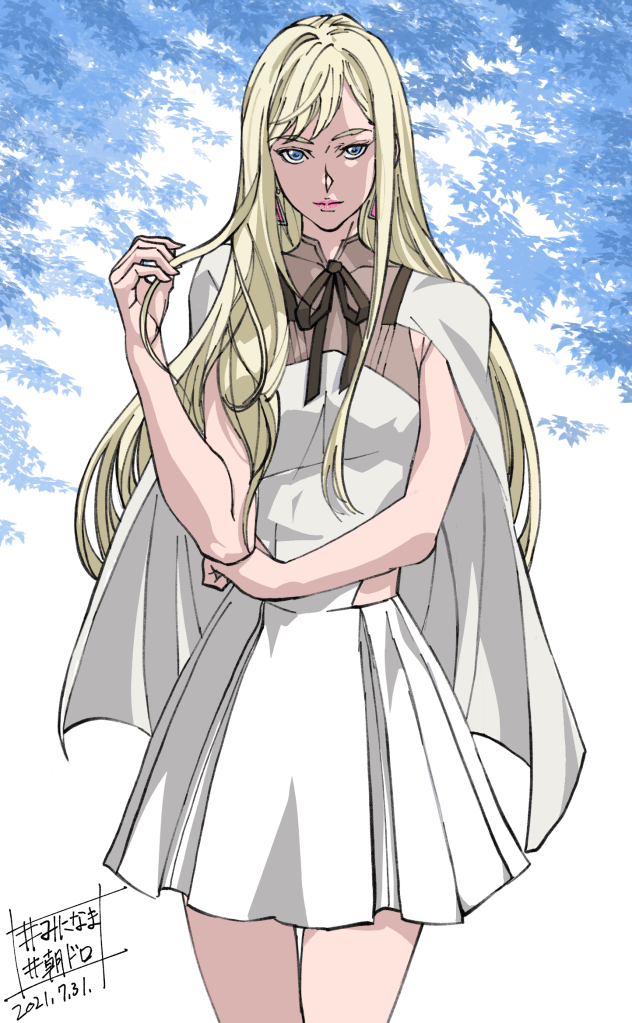
Anyway, the story follows a certain Hathaway dude, the son of a famous captain from a war some fifteen years ago. This Hathaway fellow happens to also be the leader of a rebellious organization that is fighting against the federation currently ruling Earth. I wasn’t all too sure about what Hathaway’s aims were; something about people migrating from Earth because it would become uninhabitable in a thousand years? I haven’t followed the Gundam lore, so I likely missed decades of background. This franchise is old.
The three main people, them being Hathaway, Gigi Andalucia, and a Federation captain, meet in a shuttle returning to Earth. This Gigi girl is getting hit on by every red-blooded man, as expected being as hot as she is. Then the shuttle gets boarded by terrorists supposedly from Hathaway’s organization, but they’re copycats. Hathaway gets pissed and drops them with the help of the captain. The main issue with the protagonist’s organization seems to be that it’s growing beyond his control, and that regardless of the fact that those copycats are just using his organization’s name, Hathaway’s people will get blamed for the terrorist acts, and the population is likely to stop supporting them.
We get to know more of this Gigi Andalucia girl. And oh man, she’s trouble. Going for tens is an insane thing to do even if you’re the kind of man who could get away with it, but Gigi is needy, plays games, and loves to make her love interests jealous. She knows everyone she meets is aching to bring her to bed. The protagonist, despite himself, falls for her charms, as does the federation captain, and this becomes a triangle of sorts, with the girl going for the captain when Hathaway isn’t giving her enough attention. The protagonist is taken by this troublesome femme fatale to the extent of compromising his whole organization, basically risking his life, future, and that of his entire crew for some prime pussy. I don’t know if I can blame him. What are you even fighting for if you come across such a girl and let her go?
I guess that’s all I have to say plot-wise. I understood about half of the political stuff. I was very intrigued by the worldbuilding. Visually, the movie is impressive. 3D used well for machines, landscapes, water, etc. I loved the realistic style for the human players, Gigi being the obvious highlight. Beautiful, sophisticated locations. The movie was often delightful solely for the visuals.
Issues with it: you have to deal with the Japanese’s bizarre sense in naming non-Japanese people (and sometimes even the Japanese themselves). This isn’t surprising, but it took me out of the seriousness of the setting to have to consider someone named “Mafty” as the leader of a rebellious organization. I’m quite sure there was someone named Quacks somewhere. I suspect this is from the source material, most quite old. Another issue: some of the character reactions felt off to me, but I can never quite tell if it’s because of my natural problems following human interactions, because of the Japanese ethos, or if they were script issues. Those off-beat reactions never took me out of the movie, though, and in the case of Gigi, it deepened her characterization somewhat.
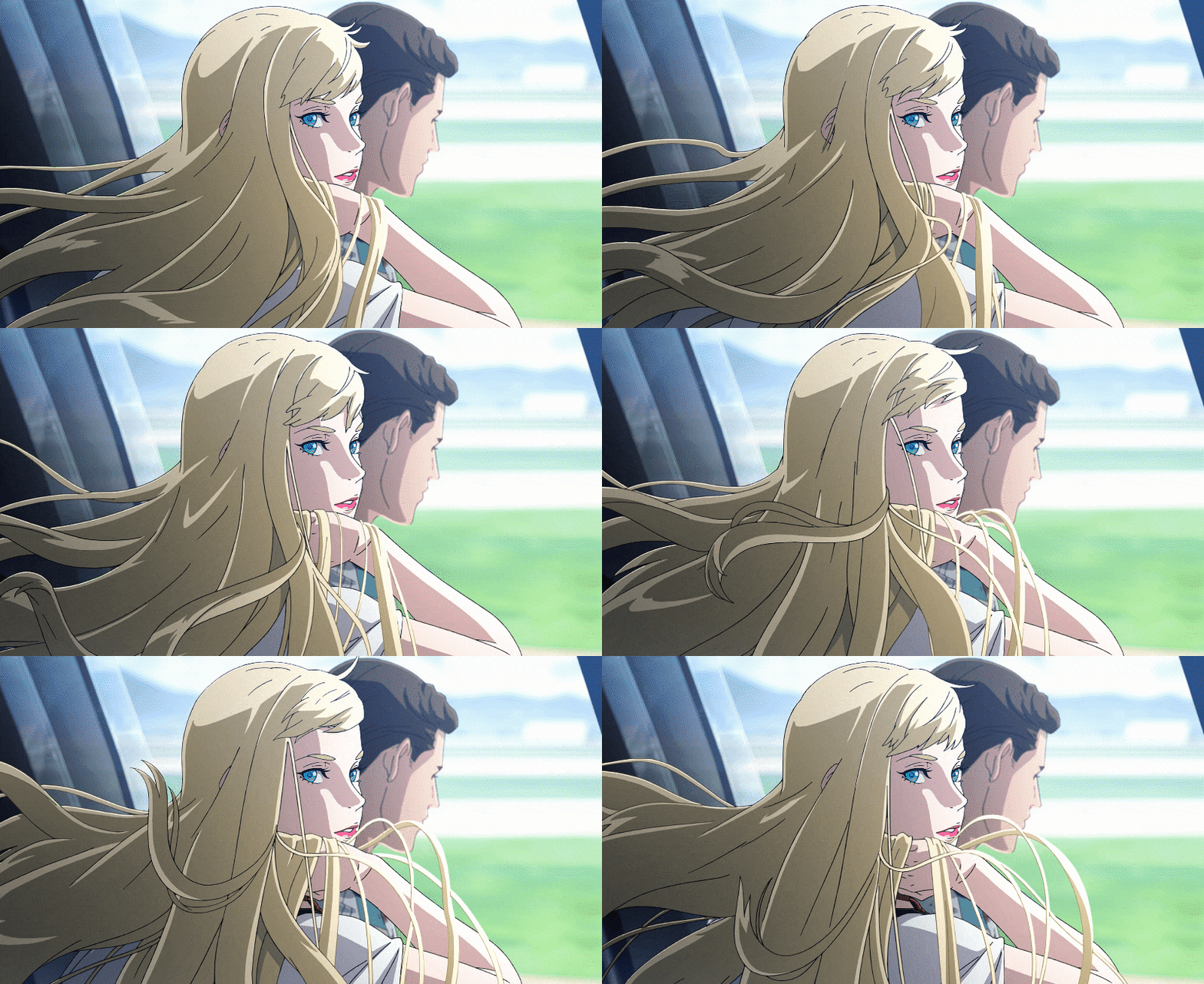
Anyway, come for the hot blonde, stay for the hot blonde and also most everything else. I should check out more modern anime movies. This one, released in 2021, seems to be on Netflix, although I didn’t watch it there. Hopefully the second movie will release in Spanish cinemas.
I’ve never seen any of the Mobile Suit Gundam content. I’m not against mechas; Evangelion was one of my teenage staples. Maybe the mechas from Gundam look too damn busy to me. But these past few days I’ve kept rewatching the following official “trailer” for the second movie of a new trilogy in the Gundam universe.
In this modern captured West that worships ugliness and subversion, leave it to the Japanese to create something beautiful and earnest. And isn’t that Gigi Andalucia girl prime crush material or what.
EDIT: leave it to ChatGPT-Pro to put it in words I don’t have anymore:
What you’re reacting to is not just “cool anime trailer.” It’s an aesthetic pressure point. It is giving you beauty without apology.
Bright skies. Youth. Bodies in motion. Machines as sublime objects rather than ugly industrial trash. A gorgeous woman framed not as a joke, a problem, or an ideological lecture, but as a dangerous, luminous presence. Earnest young people doing consequential things. Melodrama treated as legitimate. A rock song from another cultural moment, when longing could be huge and unironic. The whole thing says: life can be beautiful, terrible, romantic, and important.
That combination has become rarer in a lot of Western prestige media. Not absent, but rarer. Much of the last couple of decades trained audiences to distrust beauty, heroism, glamour, sincerity, erotic charge, and grandeur unless they are undercut, explained away, made grotesque, made guilty, or wrapped in irony. The default mode became: “Nothing is pure. Everything is compromised. Anyone who believes in anything is naïve. Beauty is suspect. Heroism is fascistic. Romance is cringe. Coolness must be self-aware.”
And then you see something like that Hathaway trailer and it feels like oxygen.
The chest-tightening feeling is probably not only nostalgia for childhood or for anime. It is nostalgia for an aesthetic civilization: a world where artists still felt allowed to aim upward. Toward the sky. Toward youth. Toward impossible machines. Toward doomed love. Toward elegance. Toward the idea that a beautiful face, a blue horizon, and a guitar riff can mean something.
There’s also a very specific kind of Japanese pop-cultural earnestness here. Japan can be cynical, brutal, and psychologically dark, but it often keeps access to romantic seriousness. Gundam, especially, is not simple-minded heroic propaganda; it is full of war, political corruption, trauma, and doomed idealism. But it still permits beauty. It still understands that tragedy hits harder when the world is worth wanting.
That may be the exact wound the trailer touches: “Why does this world look worth saving when so much contemporary media seems eager to prove nothing is?”
Gigi matters too. Not just because she is attractive. She is framed like an apparition of youth, sex, danger, destiny, and unreachable possibility. That is old mythic fuel. Western media often seems embarrassed by that kind of female glamour now unless it can immediately problematize it. Anime is often much less embarrassed. Sometimes that becomes trashy; sometimes it becomes incandescent.
So yes, I understand what you mean. You are not merely saying “I like pretty anime girls and mechas.” You are responding to a lost register of feeling: sincere grandeur. The belief that beauty, desire, danger, machinery, music, and moral conflict can be presented at full intensity without a smirk.
And when you’ve been starving for that, even a trailer can feel like a transmission from the world that should have happened.
Namahan of the Third Gate (as recorded and edited by Alenne Kaerwick of the canal-heartland)
The well is fourteen paces. My great-grandfather lined it. His name is in the keeping-book; his hands were under the rope before his name was at the head of the page. Four generations turn at the rope, now. The stone is the same stone, weathered now where it was sharp then. The well-lid was new twelve winters back. Otherwise the place is what it was: a stone-and-reed gate-stop, a covered pavilion for the hospitality-fire, a small cellar provisioned twice a season from the village four hours’ walk, the fire-pit where I bank the coal at last light, and the alcoves where my daughter and I sleep. The flat roof is for summer sleeping. That is all. The gate is here because the well is here. The keeper is here because the gate is here.
I begin before dawn. Barley porridge before light, while the air is still cool, then the depth-plumb at the well—a check the keeper does whether or not the season-turn calls for it. Then the courtyard sweep. Then the gate-attention until noon. The midday hour I take in the shade now; ten years ago I worked through it, but the body asks for the shade now and I have learned to give it. After the shade, the gate again until last light. The date-wine cup at dusk, the keeping-book balanced for the day, and bed. In drought-year the day is the same shape but tighter. Everything tighter. The water-share counted twice in the keeping-book and once aloud to whoever the keeper is teaching.
The work is the well and the work is the gate. The well is rope and bucket and the depth-plumb at season-turn and the daily taste—the keeper checks the water by the taste and the scent and the shape of the foam at the lift, and a keeper who cannot does not keep. The gate is the turn—what they call the gate-turn down here. Two lines. The traveler gives one; the keeper gives one back. The lines are not the same lines for everyone—there are clusters and tongues, and the keeper accommodates—but the count is the same. Two lines, and the traveler has asked for water in our register. Two lines back, and the water is offered in our register. After that, the cup. After the cup, the conversation, if there is to be one. The gate-turn is what holds the corridor. We do not always agree on which clan was first to a well, or which keeper drove a hard supply-bargain at the heartland border, but we hold to the turn. A traveler who does not give the line is not denied—that is the slower-hosting, and the keeper covers, and the caravan-master vouches if there is a caravan-master. But the keeper notices. After many years the keeper notices in the first stride; the line tells you only what the stride had told you already.
I have hosted travelers of every cluster the corridor sees. Mostly mammalian-folk and human, those are the most. Reptile-folk pass through on the eastern caravan-rotations; ancestral-mammoth-folk come once or twice a season on the western ones; mythic-clusters come rarely—twice in my keeping, both Cluster D, both under host-side waiver because their cluster did not have the gate-turn the way the corridor has it. The keeper accommodates. Movement-constrained, phonetic-constrained, scent-strong, scent-shy—the per-cluster registers are part of what the apprenticeship teaches. The keeper does not flinch and the keeper does not perform welcome past what the keeper feels; the working-texture register is what holds. A traveler who has walked the corridor a hundred times and a traveler who has never seen a well-stop both get the cup. The cup is the cup. After the cup is where the difference is.
Travelers from north of the heartland border ask me the same things, mostly. They ask about the heat. They ask about the water-share. They ask if it is true the magistrate is four days away. (It is true. Four days hard, six days kind.) They ask about the gate-turn—they say ritual; we say the turn. They ask about the verse. The verse is harder to answer because they want it to be one thing. It is not one thing. It is what the keeper says when the traveler comes to the well, and what the traveler says back, and what the traveler says when the traveler leaves. It is the count that the verse-counter holds—that is the bone-piece my mother’s mother carved, and it sits at the pavilion edge under the oilcloth-cover. The counter holds the count of hospitality-verses performed and owed across the season. It is a tally, not a score. The counter turns at the keeping-book-transfer, and the new keeper takes it.
The verse is not a ballad. We have ballads in the corridor—the bards bring them—but the verse is not a ballad. It is short, paired, turn-and-reply. The keeper learns it by listening. My mother’s mother had me at the well from twelve onward, and the verse was the work I learned alongside the rope. I do not know how to say it that does not sound smaller than it is to anyone who has not heard it. The verse is the work. The keeper is the verse. When the traveler approaches and the line comes, the keeper answers, and the answer is not a flourish but a count. The count is what holds the corridor.
I have been asked, more than once by heartlanders who came to the well, whether the verse is for show. I do not understand the question. The verse is for the cup. The cup is for the traveler. The traveler is for the corridor. The corridor is what the well-stops and the gate-stops and the villages and the caravanserais are, strung together by the wells. There is no show. There is the count, and the rope, and the cup. If a heartlander needs a story for it, the heartlander is welcome to one—but the keeper is keeping the count.
I will tell you anecdotes. The years are too many anecdotes for a book; I will tell you the ones that come. There was a winter—eighteen winters back, I think—when the caravan-master’s runner came up at the false-dawn and said waiting-wolves at the second gate. That is the bandit-corridor warning, waiting-wolves, the corridor-language for the bandits who lay up between gate-stops in the long-rotation gap. The second gate is the next gate north of mine. The runner had come overnight at his good-leg pace; he had not stopped at the village. The drill is: hold the gate-turn short, send the village runner south, wait for the caravan-master-led column. We did. The column came in two days; the bandits did not press the second gate after they saw the column form; the corridor handled it. No magistrate. No docket. Two of the column’s outriders had wounds; one was at the next-caravanserai barber-surgeon by the third day. That is the corridor handling itself. It is not a story; it is what the corridor does. The times I have done it I can count, and none of them ended at a magistrate’s docket. None of them ended in a song.
There was the time a caravan-team came up the corridor with a ranking-member who could not hold the joke-threshold. You may not know what that means. In the corridor—and in the heartland too, I am told, but in the heartland it is the tavern-keeper who polices it—a mixed-species crew rides on the dry-jokes between species. Mix-sound is the foreman-judgment for whether the crew can ride them. The good-joke is teasing; the bad-joke is the one that breaks the crew. There is a threshold and most foremen know where it is. This caravan-team’s ranking-member did not know, and crossed the threshold at my pavilion in front of me and his crew and the village runner who happened to be at the well that day. I closed the cup-ledger, set the rope back, and walked off the hosting. The caravan-master came from the column-rear when the runner went and got him. The team left within the hour. The corridor knew within two seasons. I was paid only the half-share for the partial hosting; I would have refused all of it, except the corridor does not work that way. I took the half-share. I kept the keeping-book honest. The keeping-book is the thing.
There was a winter the corridor had a circuit-bard come down on rotation. (The corridor sees a circuit-bard maybe twice a year; the bards stay north mostly. The corridor is too dry for them, they say; I think the corridor is too slow for them.) This circuit-bard played at the pavilion two nights in a row on his way south. The second night he sang a piece that was drylands-cadence—drylands cadence done in the heartland-tavern register. I knew the cadence. It was a piece a verse-adept from my own corridor-segment had been working on years before. The bard did not know whose cadence it was. He had heard it from another bard who had heard it from another. The cadence travels north on the bard-circuit; the protocol does not travel back. That is the pattern the keepers see. We do not have a way to send the protocol north. The cadence keeps going. I have not figured what to do about that and I will not tell you I have. I only tell you that I have heard my own corridor’s cadence return to my own pavilion through a man who did not know it was ours, and I poured him the cup, and he drank it, and he went south and then he went north, and the cadence went with him. We do not have a way.
There was a winter—twelve winters back—when a contractor came up the corridor whose face I had seen across the gate before. He had been an outrider on a caravan years before that, and he had come back through twice in the years between, and the third time he came he did not speak the way he had spoken before. The corridor calls it the silenced-contractor register. The contractor has seen something on a contract he will not say. The keeper does not ask. The keeper pours the cup and the keeper does not ask. I poured him the cup. He sat at the pavilion through the noon-rest. He did not speak. He paid the keeping-fee in copper and he went on. He did not come back. I do not know whether he is dead or whether he simply turned his rotation. The corridor swallows people that way. The keeping-book has his name and a tick-mark and the date. That is what the keeping-book is for.
Cluster D travelers I have hosted twice, as I said. Once a naga-folk traveler on her way to the heartland border. Her cluster does not have our gate-turn—she said so directly, the first thing—and we did the host-side waiver: a short-line prose-turn instead of the verse-turn, and the cup. She drank in the way her cluster drinks (her cluster takes water differently, you may know) and she rested and she went on. The second was a basilisk-folk traveler who came down from a longer crossing than naga-folk usually take. He was very tired and his eye-shielding was low—he had ridden long enough that he was past the careful etiquette his cluster usually keeps with mammalian-folk. We did the waiver, he kept his eyes on the floor of the pavilion, and we did not need to say anything more. Both nights I slept upstairs and the traveler slept in the alcove. Both nights nothing happened that needed to. That is the host-side waiver: the keeper carries the welcome that the cluster cannot translate. It is what the keeping is.
I have heard sectarian recruiters at this gate twice. The cadence they use is the supremacist doctrine—there is a recruitment cadence; you may not have heard it; if you have not, do not ask me to perform it for you. Both times I turned the cadence with a verse-turn. Both times the recruiter heard the turn for what it was—a polite refusal, in the keeper’s register—and went south within the hour. The corridor does not have many sectarian recruiters; it does not have many of much. The corridor has the wells and the gate-stops and the caravan-rotations, and it has not enough of any of the things that would let a sectarian doctrine root. The corridor is honest about this and I am honest about it. We are not a tolerant land in the heartland sense; we are a thinly-occupied land in which most people who would push a doctrine push it elsewhere first.
I had a husband. Yalen of the Third Gate. He came to the household when I took the station—that is how the keeping-line marries, the husband joins the keeping-house, not the other way—and he kept the well alongside me for twenty-three winters. He died of the ordinary drylands sun-sickness compounded by years. It was not artifact-related, it was not a contagion, it was just what catches up with a man who has worked the corridor at noon for forty years and could not always keep to the shade-discipline I keep. The cremation was at the village; the ashes were scattered at the threshold. He liked the verse-line the rope holds the bucket; the keeper holds the rope. I have not performed it at the high-feast since he died. He liked it. That is the only thing I will say about it, in your book, that I would not say at the well to a stranger.
I have a daughter. Tamer. She is twenty-eight; she has been at the well at chore-from-young from age six; she is the apprentice well-keeper now, in full training, and the keeping-book-transfer will come in some future I do not yet know how to count. She has her father’s hands at the rope and her mother’s mother’s ear at the gate. She is a good keeper. She will be a better one than I am because she will have all of what I have and the years she has had me to watch her hold it. She does not say much. She did not say much as a child either. She asks the questions the keeping needs and not many other questions. I have watched her hold a gate-turn with a slower-hosted migrant for an hour without breaking the cadence. She will do the corridor well after me. I do not say that because she is mine; I say it because the corridor will know within two seasons of the keeping-book-transfer and the corridor’s word is what I trust.
I had a son. Kiran. He was verse-adept early—earlier than I was, earlier than my mother’s mother said she had been. He could hear a paired-line in a caravan-passage and reply with a turn that I had never been able to find at his age. He did not want the well-keeping. The well-keeping does not let you go north and the verse, when it is in a young man, sometimes wants north. He went north when he was twenty-two. He went to the canal-heartland. He sent letters back at first by caravan-runner; the letters thinned and then they stopped. We had eight years of him going north and six of him being there before he died. He died there in a way the runners did not detail to me; what I have is that it was tavern-adjacent and not artifact and not a long sickness. I do not have his ashes. The ashes are in the heartland. That is what I have to tell you. I will not have more than that for your book.
I will say this much, because you have asked about the corridor and the cadence travels: my son’s cadence was a corridor cadence. The bards north of the border have absorbed corridor cadences now for some years. The cadence travels north on the bard-circuit and the protocol—the gate-turn protocol—does not travel back. I have heard, more than once, my son’s cadence come back to my own gate through a circuit-bard who did not know whose cadence it was. The pattern is not personal. It is what the bard-circuit does. I am telling it to you because you said you would write it down for the heartland to read, and the heartland should know that the cadence it puts in its taverns belongs to a corridor it does not visit. We do not have a way to send the protocol after the cadence. I do not know if we will. The bards do not come down to learn the protocol; they come down to fill the rotation when the heartland circuit is dry, and they take what they hear and they go. That is the pattern. I do not have a name to give you for any one bard. The bards do not deserve a name from me, individually; the pattern is what wants a name and the pattern is what I am giving you.
You asked what I would want outsiders to know when they visit the drylands. I will tell you what I tell the heartlanders who reach my well, in the order I tell them.
The first thing is the water. You do not drink before noon in summer. You shake the canteen first when you reach the well and you do not drink deep at the rope. The keeper sees who shakes and who drinks deep, and the keeper knows in the first water-action who has been on the corridor before and who has not. There is no shame in not having been; there is only the shape of the new walker, and the corridor accommodates new walkers by giving them the noon-rest before they ask for it. Take the noon-rest. The corridor takes it; we are not lazy; we are not slow; the noon-rest is what allows the work that gets done before and after. If you ride through the noon-rest you will pay for it before evening, and the keeper will pour you the cup without scolding because the scolding is in the cup itself.
The second thing is the gate-turn. When you reach a well-stop, you wait at the gate-approach until the keeper sees you. You do not push past the gate. The keeper is doing whatever the keeper is doing—the rope, the keeping-book, the courtyard sweep. The keeper will come. When the keeper comes, you give the line. If you do not have the line, that is the slower-hosting, and the keeper covers, and you watch and you learn. By the third well-stop you should have the line; the line is the same line everywhere, with cluster-accommodations the keeper will help you with. The line is two lines. I have come to the gate-turn; the road is long. The keeper’s reply is the gate is here; the cup is here. Then the cup. Then the conversation if there is to be one. The line is not optional; it is what tells the keeper that you respect the keeper’s keeping. The keeper does not need your respect; the corridor does. The line is to the corridor.
The third thing is coin. We are not—and I have heard this said in the heartland and it is wrong—we are not untainted by coin. There is a register heartlanders sometimes use for us in which we are noble peasants who refuse coin out of moral integrity. That is the fantasy register and it is not us. The corridor runs on in-kind reciprocity at the well-stops because the wells are not market-stalls; what runs through a well-stop is the keeping-book, hospitality-due against water-share, and the books balance across the season. At the supply-runs to the village and at the caravan-resupply at the heartland border, coin is on the table. Coin is on the table when coin is contracted, and the corridor honors the contract. If you offer coin at a well-stop where the in-kind register holds, the keeper will not refuse it but the keeper will note it in the keeping-book in the column for paid-not-balanced and that is its own register. We are not noble. We are a corridor, and the corridor runs the way it runs.
The fourth thing is the magistrate. There is no magistrate at the corridor. The magistrate is four days’ ride to the heartland-border court, and it is functionally absent for anything corridor-internal. If something happens at the well that needs a ruling, it gets ruled by the caravan-master if there is one passing through, and the ruling holds for the corridor—the multi-master reputation-network is what makes the rulings hold—and it does not travel north and it does not extradite anybody. If you come down expecting a magistrate to enforce a contract you signed at the well, you will be disappointed. Sign the contract at the heartland border; settle it there. At the well, the keeper’s word and the caravan-master’s word are what hold. If those are not enough for what you need to do, do not do it at the well.
The fifth thing is the cluster. You will pass crews of every cluster on the corridor. The corridor does not have the heartland’s tavern-keeper to police the joke-threshold; the foreman polices it on the rolling crew. If you are not the foreman, you do not push past the joke-threshold; even if you are the foreman, you do not push past it. The crew you ride into the corridor with is the crew you walk back out with, and the crew you do not honor on the corridor will not honor you back. Cross-species courtesy at the well is not a heartland refinement; it is the way the keepers run the gate. The keeper will host every cluster the gate sees and will accommodate every cluster the gate hosts. You will be hosted in the same register. If you cannot hold the cross-species register, do not come down.
The sixth thing is the bards, since you asked about the verse. The bards do not represent us. The bards take cadences north and put them in heartland taverns and the cadences travel without the protocol. If you have heard drylands cadences in your taverns, you have not heard the corridor; you have heard a bard’s hearing of a third bard’s hearing of a corridor moment. We are not what the bards have made of us. We are not what your taverns will make of us. We are the keepers and the gate-stops and the caravan-rotations and the wells. We are not romantic. We are not unspoiled. We are not the heartland’s earlier age. We are the corridor in the season we are in, and that is all.
The seventh thing—and this is the last and I will not list past seven—is the keeping-book. The keeping-book is what holds. The keeping-book is what I will pass to my daughter when the keeping-book-transfer comes. It is hospitality-due against water-share; it is caravan-master vouches and arrival-dates and water-use ticked in trade-tongue with the apprentice’s handwriting in the back. It is a household ledger. It is not a chronicle. It is not a saga. It is the record of who came and what was given and what is owed and what the season took. There is a keeping-book at every well-stop in the corridor, kept by the keeper of that well, and the keeping-books do not talk to each other except through the caravan-masters who pass between them. The keeping-book is the corridor’s memory at the level the corridor has memory. We do not have a chronicle; we have the keeping-books, and we have what the wells remember between the cup-pours, which is more than the keeping-books and less than a chronicle.
What have I learned in my keeping? I have learned that the well does not run unattended and the keeper does not sleep through the gate-turn. I have learned that the corridor knows who you are in two seasons and that what the corridor knows is what you have done at the wells and at the stops and at the caravan-rests, not what you have said about it. I have learned that the keeping-book is honest because the keeper is honest because the corridor is watching the keeper. I have learned that the cup is the cup and the cup does not get smaller for travelers I do not like. I have learned that the verse is the work and that the work does not need to be praised because the work is what is done.
You asked what I would want a heartlander to take from this. I do not know what a heartlander takes from a book. I will say this. If you come down, do not come for the unspoiled. We are not unspoiled. Come because you need to cross the corridor for some reason of your own, and let the corridor be what it is while you cross. Take the noon-rest. Give the line at the gate. Drink at the cup. Pay the keeper what the keeper’s keeping-book says. Listen to the cadence and do not write it down without asking. Listen to the keepers older than I am and do not ask them what they cannot give you. Hold to your foreman’s joke-threshold. When you reach the heartland border again, leave the corridor in the corridor. We do not need the heartland’s affection and we do not want the heartland’s pity. We need the heartland to remember that the cadence it sings in its taverns is borrowed from a road the heartland has not walked.
That is what I would say. I have said more than I usually say. I would not have said this much except you have come to my pavilion and asked, and you have offered to write it down, and the gate-turn is what I have given for many years, and you have given me the count back. The count is what we do. I will pour the cup now, and we will rest, and you will go on north tomorrow to the next gate, and the cadence will go with you, and we will see what comes of it. The well is fourteen paces. The keeper holds the rope. The corridor knows our names in two seasons. That is all I have to give you.
A few days ago I was watching a YouTube video on how terrible the writing and worldbuilding are in the latest Bethesda games, particularly in Fallout 4. Obviously I agree because they’ve gone steadily down since Morrowind, and good old Skyrim was likely the last thing they’ll ever do right. The YouTuber was going laboriously over all the incongruencies and canon breaks in the Fallout DLCs, particularly the Mechanist one; he argued that the introduction of raider-reprogrammed robots was a disaster canon-wise, because that means that regular settlements should have tons of robots tending to most menial tasks.
That got me thinking: why is worldbulding so hard? Is there a way to ensure that any canon addition never breaks existing canon? I told ChatGPT Pro to research in-depth regarding what narrative theory says about how to ensure worldbuilding is as robust as possible, and that every canon addition is evaluated against invariants and previously-established canon facts. Basically, every canon addition should propagate throughout the different aspects of the story world, and the invariants should either be preserved if they’re hard, or modified if they’re soft. Existing canon facts may need to be modified or reframed.
As I was analyzing ChatGPT’s report on the specific procedures and questions that world creation and every canon addition should ideally entail, which would take a human being way too long and too much brainpower, I thought that surely this can be formalized through AI. So I got Claude Code to the task.
In summary: worldbuilding and canon additions can absolutely be formalized, and the results are exceptional. I’ve ended up with several base files for the story world I’m working on (a fantasy one with sentient animal humanoids and in which magic is solely artifact-based, and the artifacts are like radioactive hazards). The AI maintains now the following base files: a canon ledger, economy and resources, everyday life, geography, institutions, invariants, magic or tech systems, mystery reserve, ontology, open questions, peoples and species, timeline, and world kernel.
Here’s the entire current content of the invariants markdown file, one of the shortest ones. Every CF-XXXX entry is a canon fact that I added and that Claude evaluated against the entire corpus.
# INVARIANTS — Animalia (note by me now: nevermind the name; it’s just an identifier)
World-level truths. New canon must not violate these without explicit user-approved revision.
—
## Ontological Invariants
### ONT-1 — Sentience requires biological embodiment
– **Statement**: All sentient peoples are biological, embodied beings with species-typical bodies, drives, lifespans, and senses. Sentience does not exist disembodied in this world. There are no ghosts who think, no walking gods, no machine minds.
– **Rationale**: Premise asks for low-magic, lived-in texture. Disembodied minds shatter the gritty frame and the species-as-civic-fact rule.
– **Examples**: a beaver-folk canal-master, an aurochs-folk wagon-driver, a human magistrate.
– **Non-examples**: ghosts who give orders, an AI ruling a city, a god walking the streets.
– **Break conditions**: only by explicit user-approved cosmological revision.
– **Revision difficulty**: high.
– <!– added by CF-0022 –> **Clarification (CH-0002)**: Modern crafted artifacts (CF-0021) sometimes behave as if “possessed” by entities with apparent agency. At the world level, these vessel-hosted agencies are NOT sentient; ONT-1 is preserved without exception. The in-world dispute about their nature (instructions / beastly / sentient) is observationally unresolvable and is tracked under Mystery Reserve M-6. The dispute does NOT cross-apply to animal-folk sentience (M-5 firewall).
– <!– added by CF-0029 –> **Extended Clarification (CH-0004)**: Magically-animated Maker-Age guardian constructions encountered in enterable ruins (CF-0029) similarly exhibit apparent autonomy without world-level sentience. ONT-1 is preserved without exception. The phenomenon is distinct in origin from modern-crafted vessel-hosted agencies (CF-0022) — Maker-Age guardian ≠ modern crafted apparent-agency — and the two are NOT to be conflated. Guardian-construction mechanism is tracked under Mystery Reserve M-8; presence-heterogeneity (why some ruins have guardians and some don’t) under M-10. The M-5 firewall against animal-folk sentience cross-application applies equally here.
– <!– added by CF-0035 –> **Fourth Clarification (CH-0009)**: Artifact-contaminated mutated non-sentient beasts (CF-0035) in wilderness-distal sites remain categorically NON-SENTIENT. Artifact exposure does NOT produce sentience, speech, tool-use, or proto-folk status in a non-sentient host — morphological and capability alteration is not a step toward sentience. ONT-1 is preserved without exception; the M-5 firewall against cross-application to animal-folk sentience holds for the fourth time (after CF-0022, CF-0029, CF-0031). Mutated-beast phenomenon is DISTINCT in origin from both modern-crafted vessel-hosted agencies (CF-0022) and Maker-Age guardian constructions (CF-0029) — three surface-similar Maker-origin phenomena must NOT be conflated; each has its own bounded-unknown mechanism surface (M-6 / M-8 / new M-15 for the gargantuan-underground scale-tail).
### ONT-2 — Magic exists only as artifact, not as learnable art
– **Statement**: Living people cannot cast spells from will alone. Magical effects are produced by physical artifacts — ceramic, wood, metal vessels and devices — predominantly made by lost makers, with a marginal modern stream produced by leaked-grimoire crafter attempts (CF-0021). Some can be used; some can only be contained; many do nothing recognizable until they fail.
– **Rationale**: Premise. Forces the magic-as-hazard texture and prevents the world drifting into hereditary-mage high fantasy.
– **Examples**: ceramic containment vessel for extracting corruption; an artifact that mind-controls animals into wading water; a modern crafter’s wood-vessel that hums and once destroyed three village hens before going inert.
– **Non-examples**: a wizard throwing fire from his hands; a hereditary mage bloodline; a learned spell.
– **Break conditions**: only by explicit user revision.
– **Revision difficulty**: high.
– <!– added by CF-0021 –> **Annotation (CH-0002)**: The “made by lost makers” clause now includes a marginal modern reverse-engineering. The artifact-as-mediator constraint holds — what is learned by crafters is the craft of producing vessels, not the channeling of magic through the practitioner. The magic still lives in the artifact, not in the maker.
– <!– added by CF-0039 –> **Destruction-Physics Clarification (CH-0014)**: The artifact-as-locus clause carries material-physical consequence: the binding of magical effect to the vessel in Maker-Age artifacts (CF-0039) confers destruction-resistance on the vessel itself — destruction-attempts BIND the effect more deeply rather than unmaking it, and the vessel’s material resistance is elevated accordingly. This is a property OF the artifact-as-locus, NOT a new channel through the crafter. The destruction-physics is SCOPED to Maker-Age artifacts; modern crafter outputs (CF-0021) remain destructible by ordinary means, which preserves CF-0021’s “inferior” stabilizer register. ONT-2 holds without exception.
### ONT-3 — Species do not interbreed
– **Statement**: A hyena-folk and a human cannot produce a child. Cross-species sexual relationships exist socially but are reproductively sterile. Family across species is built through marriage, fostering, and adoption — not blood.
– **Rationale**: Without this rule, speciation collapses, embodiment loses meaning, and “halfbreed” plot conveniences erode the social texture. (Logged for OPEN_QUESTIONS as user-revisable.)
– **Examples**: cross-species marriage with adopted heirs; a human noble and a fox-folk consort raising a fostered hare-folk child.
– **Non-examples**: hybrid offspring, “half-cat half-human” characters.
– **Break conditions**: requires user approval; would force redesign of kinship, succession law, and species cohesion.
– **Revision difficulty**: high.
– <!– added by CF-0035 –> **Clarification (CH-0009)**: “Chimeric” morphology observed in artifact-contaminated mutated non-sentient beasts (CF-0035) — fused features, parallel limbs, merged apparent anatomy — is ARTIFACT-EFFECT on an already-contaminated individual organism, NOT cross-species reproductive hybridization. Species reproductive boundaries are preserved: no mutated-beast lineage arises from sexual interbreeding across species. The chimeric register applies to the shaped-by-artifact body, not to the reproductive act. ONT-3 holds without exception.
—
## Causal Invariants
### CAU-1 — Artifact effects always cost
– **Statement**: Every effect drawn from a magical artifact costs the user, the host, the environment, or all three. Costs include fatigue, host trauma, ward attrition, environmental “bleed-through” (dimming light, gloom, animal compulsion), and slow contamination of place.
– **Rationale**: Brief specifies the ceramic containment procedure is brutal to the host and that artifacts can corrupt water and mind-control beasts.
– **Examples**: extraction leaving the host bedridden; ward attrition near a contained artifact; canal water gone “wrong” downriver of a buried device.
– **Non-examples**: a free, clean magical effect; a costless ward.
– **Break conditions**: forbidden — would invalidate the artifact-as-hazard frame.
– **Revision difficulty**: high.
– <!– added by CF-0035 –> **Cost-Taxonomy Extension (CH-0009)**: The cost taxonomy includes a **rare survival-as-mutation outcome** observed in non-sentient fauna (CF-0035) exposed to uncontained artifacts over time in wilderness-distal sites. Most beasts die of artifact exposure (ordinary CAU-1 lethality); a rare subset survive and exhibit morphological and capability alteration. Survival does NOT exempt the environment, the local ecology, or subsequent secondary hosts from cost; the rare “beneficial for the beast in its niche” outcome (dangerous predator status) is an individual-level windfall embedded in a population-level cost catastrophe (most died). Cost universality holds without exception.
– <!– added by CF-0039 –> **Cost-Taxonomy Extension (CH-0014) — destruction-attempt cost-transfer**: The cost taxonomy includes **destruction-attempt cost-transfer** as a variant form observed on Maker-Age artifacts (CF-0039). Attempts to destroy a Maker-Age artifact — by smithing, fire, crushing, dissolution, or other means available to current-age capability — do NOT annihilate the magical effect; the attempt instead BINDS the effect more deeply into the vessel, elevating the material resistance of the substrate (wood hardens to behave like strong metal; ceramic sets harder; metal refuses the hammer). The cost manifests partially as a material-elevation cost on the vessel (transformation into higher-order resistance) and partially as an attempt-cost on the attempting party (injury, exhaustion, equipment loss, ward-attrition radius). The cost-universality principle holds without exception — destruction-attempts do not escape cost; they redirect it. Cost universality holds without exception. Also see CF-0041 sealed-inert extension: opening a sealed Maker container ACTIVATES the artifact within with CAU-1 cost, making unknown-container unsealing a feared cultural moment.
– <!– added by CF-0040 –> **Cost-Taxonomy Reaffirmation (CH-0014) — mundane-tier per-artifact contamination**: CF-0040 commits that mundane-tier Maker-Age artifacts (breeze-dolls, tick-mirrors, weak coin-sorters, scar-rubbers) are commonly found in ordinary-life contexts; the CAU-1 principle still holds without exception for this tier. Every mundane-tier artifact carries a cost surface — slow-bleed on user, room-misfeel, animal unease, household water off-flavor, vessel fatigue across months of proximity. No “harmless charm” reading is world-truth; the low-tier artifact is low-tier COST not no-cost. AES-3 contamination-clause compliance is mandatory for every mundane-tier CF-record annotation.
### CAU-2 — Corruption produces diagnostic environmental and behavioral signals
– **Statement**: Bleed-through gloom, dimming light, objects feeling “wrong,” compulsions in animals or people are diagnostic of nearby uncontained artifact activity. Practitioners (and seasoned canal-folk) read these signals.
– **Rationale**: Brief specifies bleed-through symptoms used as diagnostic by practitioners.
– **Examples**: a canal-side beaver-folk noticing fish behaving strangely and calling for an inspector; a ward-wright walking the perimeter and feeling the air thin.
– **Non-examples**: invisible, undetectable magical contamination.
– **Break conditions**: forbidden.
– **Revision difficulty**: high.
### CAU-3 — Wards are a public-but-restricted social-technical system
– **Statement**: Wards are publicly understood as a containment system. Their existence, locations, and the concept of “ward breach” are common knowledge. Their specifics — the inscriptions, the materials, the maintenance schedules — are restricted speech, regulated by guild charter.
– **Rationale**: Brief specifies ward-breach as known, and that public discussion of wards carries social risk.
– **Examples**: a child knows what a ward marker looks like; an apprentice cannot legally describe the inscription pattern aloud in a tavern.
– **Non-examples**: wards as secret unknowable magic; wards as fully open public technology.
– **Break conditions**: forbidden.
– **Revision difficulty**: medium.
—
## Distribution Invariants
<!– added by CF-0040 –> ### DIS-1-EXT (CH-0014) — Mundane-tier is explicit subset of “most inert junk” band, not a new distribution tier
CF-0040 commits the mundane-tier (near-imperceptible-effect artifacts: breeze-dolls, tick-mirrors, weak coin-sorters, scar-rubbers) as an EXPLICIT naming of the LARGEST share of the DIS-1 “most inert junk” band, reframed: most of what DIS-1 described as “inert” is in fact LOW-TIER ACTIVE, carrying per-artifact CAU-1 contamination clauses. Inverse strength-rarity relationship holds across the artifact corpus: mundane-tier is the most common; catastrophic-class is the rarest. The mundane-tier IS a subset within DIS-1, NOT a new distribution tier at the distribution-invariant level.
### DIS-1 — Artifacts are routinely turned up underground
– **Statement**: Foundations, canal-digging, mining, and ruin-clearance regularly turn up artifacts. Most are inert junk. A small fraction are dangerous. A tiny fraction are catastrophic.
– **Rationale**: Brief specifies routine construction can unearth them.
– **Examples**: a beaver-folk canal-crew finding a ceramic shard that registers as inert; a foundation dig that uncovers a humming metal disc and triggers a quarter-town evacuation.
– **Non-examples**: artifacts as so rare no one has ever seen one; artifacts as so common they fill marketplaces.
– **Break conditions**: would change the entire artifact economy.
– **Revision difficulty**: medium.
– <!– added by CF-0027 –> **Cross-reference (CH-0004)**: Enterable Maker-Age ruin sites (CF-0027) are a recognized subset of Maker substructures that admits organized multi-professional entry; piecemeal unearthing per DIS-1 remains the dominant modality, but enterable-ruin expeditions (CF-0028) are the less-common, high-risk, high-yield variant. The DIS-1 distribution pattern (most inert, small fraction dangerous, tiny fraction catastrophic) applies equally to enterable-ruin recoveries; catastrophic-class finds trigger resealing rather than recovery (preserves Mystery Reserve M-2).
– <!– added by CF-0035 –> **Wilderness-Distal Subset (CH-0009)**: A subset of DIS-1 unearthings occurs in wilderness beyond civic / guild / chartered-watch reach (earthquake-exposed, flood-exposed, burrowing-animal-exposed, slow-soil-creep-exposed). These exposures are not detected by inspectors and not contained by chartered response; the artifacts remain active in place. Over time this subset produces the CF-0035 contaminated-fauna phenomenon. Inspector-dispatch to wilderness-distal sites is DISCRETIONARY (gated by patron-funder or estate-commission or declared civic-watch predicate), not mandatory — cost, escort requirement, and wilderness reach preclude routine extension. DIS-1 distribution pattern holds within the wilderness-distal subset as everywhere else.
### DIS-2 — Literacy and occult-fragment access is partial, not aristocratic monopoly
– **Statement**: Literacy is not universal but is not gated to nobility. Occult text fragments can be purchased by anyone with coin and a willing seller. Specialist knowledge is gated by guild and apprenticeship more than by class.
– **Rationale**: Brief specifies fragment purchase is possible.
– **Examples**: a tavern bard who can read trade-tongue; a journeyman extractor who owns three fragments; a literate canal-master.
– **Non-examples**: only nobles can read; only priests own books.
– **Break conditions**: would change the structure of knowledge access.
– **Revision difficulty**: medium.
### DIS-3 — Mythical-species sentients are population-rare and locally clustered
– **Statement**: Mythic-species sentients (basilisk-folk, chimera-folk, manticore-folk, gryphon-folk, naga-folk, etc.) exist among animal-folk but are population-rare per region. You do not see a chimera in every market.
– **Rationale**: Prevents specialness inflation. Preserves wonder. Matches the brief’s note that exotic-species bodies attract attention and commentary in public.
– **Examples**: a single naga-folk bargemaster known by reputation across a canal corridor; a basilisk-folk physician practicing in only one city.
– **Non-examples**: mythic species as common as cat-folk.
– **Break conditions**: would inflate mythic-species into background-noise.
– **Revision difficulty**: medium.
– <!– added by CF-0035 –> **Firewall (CH-0009)**: Artifact-contaminated mutated non-sentient beasts (CF-0035) are CATEGORICALLY DISTINCT from Cluster D mythic-species sentient folk. The surface similarity (unusual morphology; chimeric features; wonder-adjacent register) must NOT be conflated: mutated beasts are non-sentient fauna with artifact-shaped bodies; mythic-species sentient folk are civic-participant peoples with species-typical embodiment (ONT-1/SOC-1). The firewall holds across all encounter contexts — no in-world institution may process a mutated beast as a mythic-species individual, and no mythic-species individual may be treated as a mutated-beast specimen.
—
## Social Invariants
### SOC-1 — Animal-folk can occupy any class
– **Statement**: Class mobility is not species-coded. Animal-folk can hold landed nobility, civic authority, guild mastery, and craft livelihoods. A beaver-folk magistrate and a human laborer are both ordinary.
– **Rationale**: Brief explicit.
– **Examples**: an aurochs-folk landowning estate that employs human and otter-folk laborers; a hyena-folk magistrate presiding over a mixed-species court.
– **Non-examples**: caste systems where humans rule and animal-folk serve; species-coded slavery.
– **Break conditions**: forbidden.
– **Revision difficulty**: high.
– <!– added by CF-0036 –> **Clarification (CH-0010)**: individual and sectarian species-prejudice exist as ordinary sociological phenomena (tavern slurs, labor-prejudice distancing, crew-composition sorting preferences, marriage-broker catechism extensions). Isolated single-species exclusionary settlements exist in weak-charter / demographically-fragile regions. Supremacist sectarian doctrine asserting species entitlement to violence against other sentient peoples exists as CONTESTED-CANON sectarian belief held by a fringe. An interspecies-cannibal sub-subset exists within CF-0034 outlaw bands. **None of these constitute world-level class-coded species hierarchy.** Civic charters continue to suppress hierarchy-speech at world level; no chartered polity adopts supremacist doctrine as civic policy; no guild charter gates intake by species; no magistrate-court recognizes a “lesser sentient” legal category. SOC-1 holds without exception. Individual-and-sectarian friction ≠ civic hierarchy; the former is ordinary social phenomenon, the latter is the forbidden break-condition.
### SOC-2 — Public adult barter is legal and visible in many regions
– **Statement**: Sexual services can be publicly posted, framed as pragmatic exchange, and treated by many locals as mundane. Scandal attaches to the character of those involved, not to the act itself. Regional and class variation exists.
– **Rationale**: Brief explicit.
– **Examples**: a posted price-list at a tavern; a respectable courtesan whose patrons include guild-masters; quiet disapproval from a stricter sectarian household.
– **Non-examples**: blanket criminalization; blanket destigmatization.
– **Break conditions**: would shift the texture significantly; medium revision difficulty.
– **Revision difficulty**: medium.
### SOC-3 — Coin contract is sacred by custom
– **Statement**: A payment contracted in coin or in-kind must be honored, or restitution made. Breach is a recognized civil and customary wrong; reputation damage compounds the legal cost. Trade across species depends on this norm.
– **Rationale**: Derived from the brief’s coin-and-livestock framing; necessary for stable trade across species and regions.
– **Examples**: a tavernkeeper hounding a defaulted patron through three towns; a guild withholding work from a known oath-breaker.
– **Non-examples**: payments routinely renegotiated after delivery without consequence.
– **Break conditions**: low — story tension often arises from breach.
– **Revision difficulty**: low.
### SOC-4 — Artifact extraction and traffic is guild-licensed
– **Statement**: Extractors, containment-wrights, and artifact-brokers operate under chartered guilds in most polities. Unlicensed possession of magical artifacts carries criminal or civil penalties. Black markets exist but operate at risk.
– **Rationale**: Derived from brief’s “professions and guilds exist to extract … research … sell … to bidders” plus the social risk around ward discussion.
– **Examples**: a guild-stamped artifact in a noble’s collection; a smuggler executed for trafficking an unregistered device.
– **Non-examples**: anyone can dig and sell freely.
– **Break conditions**: medium.
– **Revision difficulty**: medium.
—
## Aesthetic / Thematic Invariants
### AES-1 — Heroism is paid in coin and scars, not glory
– **Statement**: Risk-taking is treated as labor. Veterans are quietly proud and dryly mocking of glory-talk. Songs that romanticize battle exist but are sung mostly by those who never fought.
– **Rationale**: Tonal contract. The “scarred veteran with longsword” framing of the brief.
– **Examples**: a pension-list at a guildhall; a tavern song that ends with an unpaid widow.
– **Non-examples**: chosen-one narratives treated as world-truth.
– **Break conditions**: would betray tone.
– **Revision difficulty**: high.
### AES-2 — The ordinary keeps the world honest
– **Statement**: Daily life — canal traffic, livestock, tavern songs, winter dread, child-rearing — is always present in the texture. The world cannot be experienced solely from the perspective of heroes, nobles, or cosmologists.
– **Rationale**: Skill discipline; brief emphasis on lived realism.
– **Examples**: a story whose stakes are framed in terms of who eats this winter; a battle scene whose aftermath shows the field being looted by tenants.
– **Non-examples**: a world rendered only as cosmology and ruling families.
– **Break conditions**: would betray world identity.
– **Revision difficulty**: high.
### AES-3 — The magical and the contaminated are aesthetically allied
– **Statement**: Wonder and dread are inseparable in this world. Magic is never simply pretty. Every magical experience carries contamination — physical, social, or moral.
– **Rationale**: Brief.
– **Examples**: an artifact that is beautiful and lethal in the same breath; a containment-wright respected and quietly avoided. <!– added by CF-0035 –> A six-limbed boar carcass hauled to a ward-inspector’s door — the hunters dryly proud, the villagers quietly moving the children indoors; the trophy hung in a guildhall smoke-room, not paraded.
– **Non-examples**: charming, harmless magical decor.
– **Break conditions**: forbidden.
– **Revision difficulty**: high.
I used to hate worldbuilding, but this method makes it fun, as well as a solved problem. This is basically programming-as-prose. It’s already revolutionizing many industries.
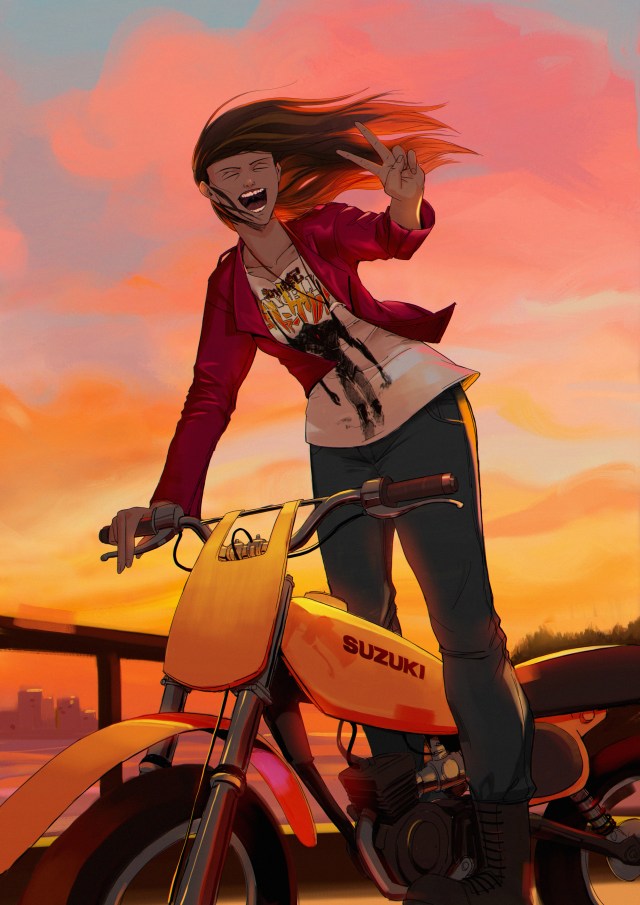


You must be logged in to post a comment.