On writing: Developing the premise #7

You can check out all my posts on writing through this link.

Are you happy with your concept? Then grow a premise out of it. Premises involve a task to be accomplished and a character that must accomplish it in the midst of conflict.

The following notes, gathered years ago from many books on writing, focus on trying to ensure that anyone other than yourself would give a damn about the story you want or need to tell. I don’t focus much on what a random person will think about my stories; for me, the “target reader” is a fantasy. You can only truly satisfy your own subconscious, and you satisfy random readers’ subconscious to the extent that their neural pathways mimic yours. That said, considering your story from an outside perspective can improve your work.

  • Create an elevator pitch for your story. Three paragraphs: 1) a character and situation; 2) the push into the plot; 3) the main story question.
  • Write the pitch in three sentences: MC’s name, vocation, initial situation. “When” + main plot problem. “Now” + the death stakes.
  • See if you can formulate the idea into a compelling, 30-second pitch. At least three sentences. First describes the character, his vocation, and initial circumstances. The second is the doorway of no return. The third is the death stakes.
  • Your story’s logline should include the main character, the objective, and the major source of conflict.
  • Why would anybody want to see or experience this story?
  • How does the premise make people excited to learn more about the story just by hearing the one-line story summation you’ve come up with?
  • Does your premise have an inherent appeal, or are you relying solely on your execution to make the story compelling?
  • Is the one-sentence description of your story uniquely appealing?
  • How does your premise seduce, make people want to read the story?
  • How does it promise drama, conflict, stakes and emotional resonance?
  • How is your premise cool and provocative, even if it’s actually impossible?
  • How is the problem introduced in your premise larger than it looks? Why does it matter to us all?
  • Could the premise be so strong that it could draw readers by itself, not depending on other components such as execution?
  • Does this premise have a kicker that would make readers ask questions they would want answered?
  • What controversial or sensitive issues or themes can be at the core of this idea so that it will tug on readers’ hearts?
  • Would the premise appeal to a wide and inherently commercial readership? Or does it focus too narrowly on a specific corner of life, even if that issue is important to you?
  • How would your story make the readers experience wonder?
  • Imagine you have a gatekeeper’s attention. How will you describe your story? When you launch into your ten minute summary, will they like what they hear?
  • Is this a story anyone can identify with, projected onto a bigger canvas, with higher stakes? Could you write into it the emotions you know, putting those emotions into a more extreme situation with a lot more at stake?
  • Go through each of the following audience attractors your story could contain, and try to explain how your story would include them:
    • Laughter
    • Lust
    • Adrenaline rush
    • Bloodlust
    • Power fantasy
    • Romantic fantasy
    • Pathos (something devastating)
    • Beauty
    • Cognitive dissonance (blew your mind)
  • Is what happens to your characters exciting and dramatic, out of the ordinary, and most importantly, meaningful?

On writing: Developing the premise #6

You can check out all my posts on writing through this link.

Are you happy with your concept? Then grow a premise out of it. Premises involve a task to be accomplished and a character that must accomplish it in the midst of conflict.

The following notes, gathered years ago from many books on writing, focus on developing the conflict of your story at the premise stage. If your hero wants something, some other force must stand in the way. Your characters’ true selves get revealed when tested.

  • How is conflict built into the premise?
  • How readily recognizable is that conflict? The more immediately apparent, the sharper your premise will be. If people could hear the premise line and think, “I can see where that’s going,” or “I can see why that’s a big problem,” then you know you have a winning premise.
  • How does the hero have an external foe to banish?
  • Who (not what) is actively holding back my protagonist?
  • How does the conceptual context force the hero to take action against an external antagonistic force rather than simply existing as a situation within the story world?
  • How does the central conflict inherent in your premise create the greatest opposition possible, with the highest consequences?
  • What big thing has to happen before underlying conflict can be talked out?
  • My character can change, but before that she must go through what?
  • Can you make the conflict both compelling and ironic?
  • What are, specifically, the villains doing? Why? Because we need to care about it, be frightened or disgusted by it. We need to know specifically what are they doing, and why the protagonist cares about it.
  • How does the opposition continually do something specific to become the protagonist’s foe, his nemesis?

We’re Fucked, Pt. 123: AI-generated audiochapter

Ignore the interdimensional beasts lurking outside. This audiochapter covers chapter 123 of my ongoing novel We’re Fucked.

Cast

  • Leire: sassy blonde who exchanges money for shady work
  • Jordi: Japanese octopath traveler
  • Windows 10: a severely disabled man who really, really wants you to deliver him a platinum chip
  • Ramsés: a Roman general sent to Skyrim to quell a rebellion

I produced audiochapters for the entire three previous sequences, and I intend to continue until the novel ends or I step through an invisible portal into a world of ash and cinders. A total of five hours, forty-six minutes, and forty-three seconds. Check them out.

On writing: Developing the premise #5

You can check out all my posts on writing through this link.

Are you happy with your concept? Then grow a premise out of it. Premises involve a task to be accomplished and a character that must accomplish it in the midst of conflict.

The following notes, gathered years ago from many books on writing, focus on developing the main character involved in your premise, which will usually be the protagonist.

  • Can you find a character you love implied in the story idea? If not, your story may be toast, and you need to move on to another idea.
  • What character would be the best in the idea? Can you make him the hero?
  • Is there one character whom the audience will choose to be their hero?
  • Identify what the focal character wants to attain or avoid.
  • What character’s serious problem and how does he try to get out of the predicament rides the plot?
  • Can you make your hero active and resourceful?
  • How do you make sure your hero has compelling contradictions?
  • How is he someone who wants to unravel the story? That’s all a hero is: the character who has to solve this problem. You audience wants the entire story to come out, but they can’t do it themselves. Instead, they have to trust your hero to get to the bottom of it for them. If the hero doesn’t care, what is the audience supposed to do?
  • If you are writing about rookies, you need to ask yourself why the audience should trust them to be the heroes instead of their boss. Is there a value to their newness that makes them more interesting heroes?
  • Could you make your hero unhappy with the status quo?
  • Are you sure the character isn’t flat and lacks a fresh edge?
  • Would the protagonist be so strong as to be conceptual in nature (such as Batman, Holden Caulfield, etc.).
  • There is a glimpse at how and why we will find this character or arena interesting (that is, conceptual). If she isn’t all that interesting, then your premise is already suspect.
  • How is the hero compelling? How could he be by nature someone we root for, and like (not necessity, but it can help). How would he be associated with a quest with a specific goal, something that has stakes?
  • The hero’s motivations are critical to making a story work. Why does he want to do what he wants to do? And why will we care?
  • Try to give your hero an ironic backstory, an ironic contrast between their exterior and interior, and a great flaw that’s the ironic flip side of a great strength.
  • How would this story force the character to show his true self?
  • How is this story about a character who changes in a significant way?
  • Can you make the character face his demons, learn important truths, cause readers to ponder deeper issues and themes?
  • In what ways is your kicker tied in with your protagonist’s core need? Greatest fear? Deepest desire? How does his/her goal embody the concept?
  • What does your hero need or want in this story? What is his or her “story journey”?
  • How is the story about overcoming the protagonist’s flaw/misbelief?
  • How do you make sure that you won’t write about your hero’s life, but about your hero’s problem? Don’t open your story with your hero waking up. Your story is not about your hero’s day. It’s about his problem.
  • How do you make sure that your hero affects the events and the events affect the hero?
  • See how this would apply: when the story begins, heroes shouldn’t know what they need to win. That’s the point. they have to go on this journey to figure it out.
  • How is he trying to improve his life, not just return to zero?
  • Does this challenge represent the hero’s greatest hope and/or greatest fear and/or ironic answer to the hero’s question?
  • In the end, is the hero the only one who can solve the problem?
  • How is your character’s overall plot goal a dilemma that will require the entire story to solve?
  • How does he either succeed or fail?
  • How does the premise give something to do to the hero?
  • How is the premise the personalized antidote to his lie/flaw?
  • Is the arc you’ve identified your strongest possible option?
  • Does your story present a unique central relationship? For example, could you take two familiar characters and give them a believable but never-seen-before relationship? Could you take two very different types of characters and force them to rely on each other in an unique way?

On writing: Developing the premise #4

You can check out all my posts on writing through this link.

Are you happy with your concept? Then grow a premise out of it. Premises involve a task to be accomplished and a character that must accomplish it in the midst of conflict.

The following few notes, gathered years ago from many books on writing, focus on determining the designing principle of your story, and how it fits into the enduring myths of humanity.

  • The designing principle of a story is abstract, the deeper process going on in the tale, told in an original way. It’s the synthesizing idea, the “stopping cause” of the story, what internally makes the story a single unit and different from all other stories.
  • Find the designing principle, the one controlling idea, by teasing it out of the one line premise you have before you. Induce the form of the story from the premise: boil down all the events to one sentence, describing how and why a change has ocurred from the state at the beginning of the story to the state at the end. Ex., for The Firm: justice prevails when an everyman victim is more clever than the criminals.
  • The designing principle is often about taking a value that we rely on a day to day, challenging its solidity and then paying it off with its conformation or its vulnerability.
  • Regarding your tale’s mythical influence: Do the protagonists have to leave their home, metaphorically or not, to confront the source of a problem, then bring a solution back home? How is there a journey there and journey back?
  • Does your story involve a journey “into the woods” to find the dark, but life-giving secret within?
  • The overarching structure of most myths: “Home” is threatened, the protagonist suffers from some kind of flaw or problem, the protagonist goes on a journey to find a cure or the key to the problem, exactly halfway through they find a cure or key, on the journey back they’re forced to face up to the consequences of taking it, they face some kind of literal or metaphorical death. They’re reborn as a new person, in full possession of the cure; in the process “home” is saved.
  • Monomyth: “A hero ventures forth from the world of common day into a region of supernatural wonder: fabulous forces are there encountered and a decisive victory is won: the hero comes back from this mysterious adventure with the power to bestow boons on his fellow man.”
  • The story is the journey the main characters go on to sort out the problem presented. On the way they may learn something new about themselves; they’ll certainly be faced with a series of obstacles they have to overcome; there will likely be a moment near the end where all hope seems lost, and this will almost certainly be followed by a last-minute resurrection of hope, a final battle against the odds, and victory snatched from the jaws of defeat.
  • A great story is about a problem, not an ideology. The ideology is subtext. It’s about a person, your hero, who has something to win or lose in squaring off with his problem and his issues. An external antagonist (bad guy) who stands in his way. A journey to take as the battle builds, ebbs and flows, and allows the hero to grow into his heroic role and begin to act in a manner that solves the problem.

For far more on what was gleaned from worldwide myths in an effort to determine what stories endure, I highly recommend Joseph Campbell’s The Hero With a Thousand Faces, as well as the work done by Christopher Vogler to adapt it into practice for modern audiences, mostly in his book The Writer’s Journey.

We’re Fucked, Pt. 123 (Fiction)


When I step off the Benta Berri bus at the entrance of the business park, the sidewalk gets crowded with commuters, from recent graduates, their backpacks emblazoned with the logo of their programming company, to gray-haired technicians holding laptop briefcases. The morning chill nips at my exposed skin. I inhale the fresh, crisp scent of fall air, but passing cars taint it with the acrid bite of exhaust fumes.

Golden haloes light my way as I head towards the bare trees, their branches etching stark patterns against the office buildings, or blending like blackened veins with the darkness of this November morning. If nobody had invented electric lighting, maybe we would still wake up with the sun; in dark and cold autumn mornings, we would spend that much longer in the warmth of our beds and our loved ones’ arms.

Past the restaurant with a curved glass façade, its outdoor café terrace now deserted, I venture through the pathway that weaves between human-erected structures. The scattered, rust-colored leaves that crunch underfoot release the musty scent of decay. Like most mornings, the pervasive stillness reminds me that this zone isn’t meant for living: it’s where people come to die five to six days a week.

I turn the corner of our office building, that resembles a three-story-high shoebox. As I walk along the multicolored row of waste bins, a sight that has become familiar greets me: an assembly of bunny-sized alien slugs crowd the sidewalk in front of the entrance, spilling onto the parking lot. In the beginning they appeared as shadowy blurs; now, their black and dark-blue tints shimmer through the oozy, mucus-coated skin. Protruding feelers sway like anemone atop their undulating bodies, while underneath, six legs move in tandem among drips of tarry slime.

As a car maneuvers into a parking spot, it runs over several alien slugs, but instead of bursting in a splatter of guts, they yield through the tires like ghosts. However, can they interact with our native critters, slurping them up and, after digestion, excreting the leftover shells and bones? How long will it take for these creatures, maybe from an alternate Earth, to synchronize with our dimension and become visible to sane people? Will that happen before the universe teeters past a tipping point, causing space-time to fold upon itself like an accordion? Wait, isn’t the number of alien slugs dwindling?

A bright-blue shape swoops down and snatches one of the slugs, leaving a trail of slimy droplets. The shape, a beast, swerves upwards with wide wings covered in bioluminescent fur. Its four legs end in kukri-like claws.

The beast perches on the edge of the flat roof. Jutting out of its head, silhouetted against the predawn sky, two pointed appendages resemble horns. A pair of round eyes radiate an electric-blue glow as they stare down at me. The beast glides away, disappearing beyond the roof’s edge.

“Well then,” I say, and head inside.

* * *

I step into the climate-controlled air of our office, to take in once again the sight of these white walls, cabinets, and desk, along with that gray carpet; they give the impression that the colors have been sucked out. The fluorescent lights overhead bathe everything in a clinical glare. Like every morning, Jordi has beaten me here: he’s seated with his back straight, fingers tapping away on his keyboard. In this monochrome landscape, I’ll avoid dwelling on his red hair, or anyone’s copper mane.

After I take off my cardigan and hang it on the coat rack, I trudge to my chair and slump down into it with a sigh.

“Good morning,” Jordi says.

Although a glance or a nod would have sufficed, I waste saliva greeting him back. As my computer boots up, I realize that Jordi has turned his freckled, clean-shaven face towards me. He’s wearing a crisp white shirt with a point collar and the sleeves rolled up. Either his garment is made of wrinkle-resistant fabric, or he irons them meticulously. I picture the inside of this kid’s wardrobe: a row of identical shirts and pants.

“You seem refreshed,” he says.

“You mean I look less disheveled than usual?”

“If you want to put it that way. Did you have a fun weekend?”

I’m tempted to reply, “why do you care?”, but after years of controlling myself around human beings, I’ll put on the mask of politeness to conceal my depravity.

“You know, I’ve had a lovely weekend. We visited Mount Igueldo.”

“Oh, the amusement park. I haven’t gone since I was a kid. Sounds like a great date.”

Jordi remains unaware that I abducted a girl from the Ice Age, so he must be picturing a couple of grown women taking a stroll on the elevated grounds of an amusement park, holding hands and eating cotton candy. It does sound like a great date.

“I used to waste my weekends recovering from the exhaustion of the previous week, and preparing myself for the next wave of stress to crash upon me.”

“That’s a bleak way to live, but you’ve clearly changed since you started dating Jacqueline.”

I have, haven’t I? My perception of reality has shifted: no longer am I alone in a barren void ruled by an insatiable worm, but instead, I’m tethered to two other beings who possess a universe within them. That’s why I wake up, brush my teeth, shower, put on clean clothes, eat breakfast, and come to this hellhole before dawn without regret.

“I miss listening to her stories,” Jordi continues. “During lunch break, I mean.”

A twinge of jealousy flickers through me.

“I bet. She’s mine, though.”

Jordi chuckles.

“Of course. She isn’t sick, right? She must be rethinking a few things.”

Crap. If this kid has figured it out, our boss must be aching to stir trouble.

“I’d say she’s come to realize that she’s meant for something more than this job.”

Jordi shrugs, and raises a corner of his mouth in a boyish smile. His allure, devoid of the hard edges and muscle bulk of a macho, may inspire contempt in men, but has the charm and kindness of a cinnamon roll.

“This is it, then. Please pass on my regards, and take care of her. I’m sure you’re aware that she’s more sensitive than she appears.”

I’m about to give our insolent intern an earful about mommy’s private qualities; this kid doesn’t know Jacqueline’s warmth, the weight of her breasts when she squeezes me tight, or the tickle of her pubic hairs against my face as I bury my tongue in her depths. However, I spot a headline on Jordi’s screen, belonging to the front page of the Diario Vasco: “Two More Vanish Amidst Growing Concern.” A cold ripple of unease trickles down my spine. I recall Jacqueline’s somber tone as she informed me of these disappearances during a car ride. Left to my own devices, I would have remained oblivious: I shun the news to protect my sanity, and I didn’t socialize with anybody outside of work. On the day of my first date with Jacqueline, didn’t I pass by a demonstration and a counter-demonstration concerning these vanishings? Drenched in a downpour, those protesters’ shouts were muffled by the drumming of rain while I huddled under my umbrella.

I picture a woman in her late twenties, her hair hastily tied back in a ponytail. She’s burdened with shopping bags that display the Carrefour logo. As she strides across a parking lot, she steps through an invisible portal to another realm. Her foot meets the crunch of ancient ice, or the slime of those alien slugs’ dimension, or the cracked clay of an endless desert. Maybe she has emerged in a world of ash and cinders, where the earth has been scorched black by a blast wave and the skeletons of buildings jut out like rotten teeth. Panic would seize this woman, clouding any realization that walking backwards could return her home. How many have fallen prey to these space-time traps while I fuck around without finding the reality-collapsing machine?

Jordi follows my gaze, then turns his head back to me.

“Leire, you’ve gone pale. Do these disappearances worry you that much?”

When I open my mouth to speak, my lower lip twitches. I force out the words through the knot in my throat.

“Maybe… I’m responsible.”

Jordi snaps his head back. His freckled features have twisted into bemused disbelief. As he straightens his spine, he pushes his glasses up the bridge of his nose.

“What makes you say that, Leire? How can you be responsible?”

An accusation rings in my ears, echoing and swelling into a scream. I may be a kidnapper of prehistoric children, but I have never been a killer; yet, I have contributed to the ruin of those souls.

“N-nevermind. Forget it.”

“Ah, you must be worried about it happening to you, right? What this headline, and many others, neglect to mention is these people were criminals. Later in the article, it reluctantly informs that the first of these men was a serial rapist who had been released, while the other was a drug trafficker. The way the media talks about them, you’d think they’re describing model citizens, even though most of them weren’t citizens to begin with. If only the media cared so much about the well-being of their victims!”

“S-so there’s like… a pattern?”

“Sounds like it. I don’t know, maybe they deserved to vanish. You’re a decent person, senpai.”

“Am I?”

“Of course! You’re just trying to get by in these tough times. Now, you’re even learning how to receive love.”

“Oh, I’m receiving lots of love every night. Some mornings too.”

“That’s great to hear. Leire, these disappearances aren’t your fault, not even in a metaphorical sense. But I shouldn’t be surprised that you thought so: you’ve always seemed like someone who carries the world on their shoulders.”

“Funny that, Jacqueline told me something similar.”

Jordi offers me a sympathetic smile.

“Well, there you go.”

I lower my head. Maybe this burden will sink me, and I’ll make a dramatic exit out of a fifth-floor window while Arachne clacks her chitinous claws with glee, her body lounging on a cosmic pile of bones.

“I guess it’s a lot to think about,” Jordi adds cautiously. “Let’s keep our minds on the here and now, though. We need to get through these tasks.”

My computer is waiting for me to type in the password, so I take the opportunity to disengage from this conversation. The keys clack in the awkward silence as I fill in the password box. Program icons pop up on the taskbar, and the desktop clutters up with files and folders over the wallpaper du jour: a tropical beach at sunset, complete with two palm trees that cast elongated shadows on the sand. Windows ten is mocking me, I can hear it: “You could have spent the day in such a paradise, smearing coconut oil on Jacqueline’s fleshy mounds, but instead you’re trapped here, doomed to waste eight more hours of your limited life obeying your boss’ whims.”

As if summoned, Ramsés barges in. The muscle fibers at the back of my neck tighten. Although I want to ignore his presence, I’d rather avoid another complaint about “lack of respect,” so I glance toward our boss. Same middle-aged man with combed-back, thinning hair and touches of gray at the temples, as well as a trimmed moustache. He reeks of cigarette smoke.

Why does he insist on tucking his shirts over that paunch? Does he want me to imagine it squashing against my lower back as he pounds me from behind?

“Morning everyone,” Ramsés booms.

Jordi greets him back confidently; I mumble. Our boss ensconces himself in his office, separated from ours by a wall of frosted glass.

I load up Visual Studio Code. Its dark-themed editor window shows rows and rows of code, color-coded and structured with consistent indentation, for a shopping cart’s Python backend.

Today I will raid the coffee machine until I start vibrating. Another mundane morning of programming website widgets, wasting precious hours that will never be regained, and risking permanent brain damage from a caffeine overdose. Ah, Jacqueline, why are you so far away? I want to hear your velvety voice whispering in my ear, your laughter rippling like a summer brook. But I don’t have time to fantasize about my French shapeshifting girlfriend, that plump ass of hers, the toned thighs that she loves to wrap around my head, those pillowy breasts that she thrusts in my face as she rides me.

No, I must focus on my job, despite the shitshow that lurks outside. Hasn’t it always been like that, though? I was born into a world teetering on the edge of obliteration; that bunnyman bastard only fast-tracked the debacle.


Author’s note: today’s song is “Ain’t No Rest for the Wicked” by Cage the Elephant.

I keep a playlist with all the songs I’ve mentioned throughout the novel so far. A total of two hundred and five videos. Check them out.

I had to find three new voices to produce this chapter’s audio version. Check it out.

Review: Gereksiz, by Minoru Furuya

Four stars. The title apparently means “unnecessary” in Turkish.

This is Furuya’s latest series, finished six years ago, after his fan-favorite (at least for this fan of his) Saltiness. As usual, the story follows a man in the fringes of society, the owner of a small shop that specializes on baumkuchen, a type of pastry I wasn’t aware of but that looks delicious. As a teen, the man was urged to quit high school and become an apprentice of his father’s. Now his father is dead, and he has found himself as a nearly forty-year-old dude who knows little else other than baumkuchen, and whom nobody would love. His sole acquaintance is his twenty-three-year-old employee, an intimidating young woman who regularly pesters him with random topics such as the birth of the universe. She also finds him weak and generally pathetic.

One day, our protagonist begs his employee to eat out with him, and she reluctantly agrees because it’s his birthday. He has realized that he leads an empty life, but he opens up about the fact that he has fallen in love. The employee fears that she’s the target. However, that’s not the case: every evening, when he’s returning from work, he sees the same shapely young woman standing behind a tree at a local park, and she’s alluring enough that he can’t stop fantasizing about her, even though he has never seen her face.

The protagonist’s employee is intrigued. She urges him to head to that park and introduce himself to the woman. As he points the stranger out to his employee, though, an issue arises: he’s the only person who can see her.

That’s as much as you need to know about this shortish series, which only gets increasingly bizarre from there. Although it’s a minor work by a now fifty-one-year-old author who has probably said most of what he needed to say, it delves into powerful topics such as the need of certain people to lose themselves in delusions, because if they faced their reality objectively, they’d go insane.

I enjoyed this tale a lot, and found its last stretch quite touching. However, I would have ended it a page or two earlier.

I have reviewed most other works of this author, such as Boku to IsshoWanitokagegisuHimizu, and Ciguatera. Unfortunately, I have only found the translation for a single more work of his, and it’s the oldest, made in the early 90s. Furuya hasn’t produced any original work in six years, although he seems to have involved himself in adaptations of his series such as a live-action version of Ciguatera, which I’m sure is lackluster because live-action stuff rarely works.

Reread: Saltiness, by Minoru Furuya

I’ve read through this series a third time since I reviewed it in this post. I’ve checked out most of Furuya’s stuff, such as Boku to Issho, Wanitokagegisu, Himizu, and Ciguatera, among which Ciguatera may be objectively his best, but Saltiness speaks to me to an extent that has made it my second favorite manga series after Asano’s Oyasumi Punpun.

Saltiness is the story of, for me, a clearly autistic dude who lives in one of those isolated Japanese towns with his younger sister, who is a teacher. We don’t know it yet, but they went through hell growing up: their mother abandoned them, and our generally deranged protagonist had to steal and loot in order to provide for his helpless little sister. As a result, even about twenty years later, he’s terrified of anything bad happening to her, and her happiness is his one goal in life, to the extent that once she manages to set up her life in a way that doesn’t require him anymore, he plans to arrange an accident in the woods to die and let her continue without needing to worry about him.

When the story starts, our oblivious protagonist is busy training to remain stoic in the face of all the outrageous nonsense in the universe. He pictures bizarre phantoms in his imagination, that pester him with philosophical questions and test his mental fortitude.

One of those days, his grandfather, the relative that took them in years ago, makes the protagonist aware of something horrible: as long as his little sister has to worry about his autistic ass, she won’t get married, won’t have a family of her own, and will end up miserable. Our protagonist understands that if he’s to achieve his goal of making his sister happy, he should become a financially independent adult. Thus, even though he doesn’t even know the name of his town, he hitch-hikes to Tokyo in order to achieve this goal.

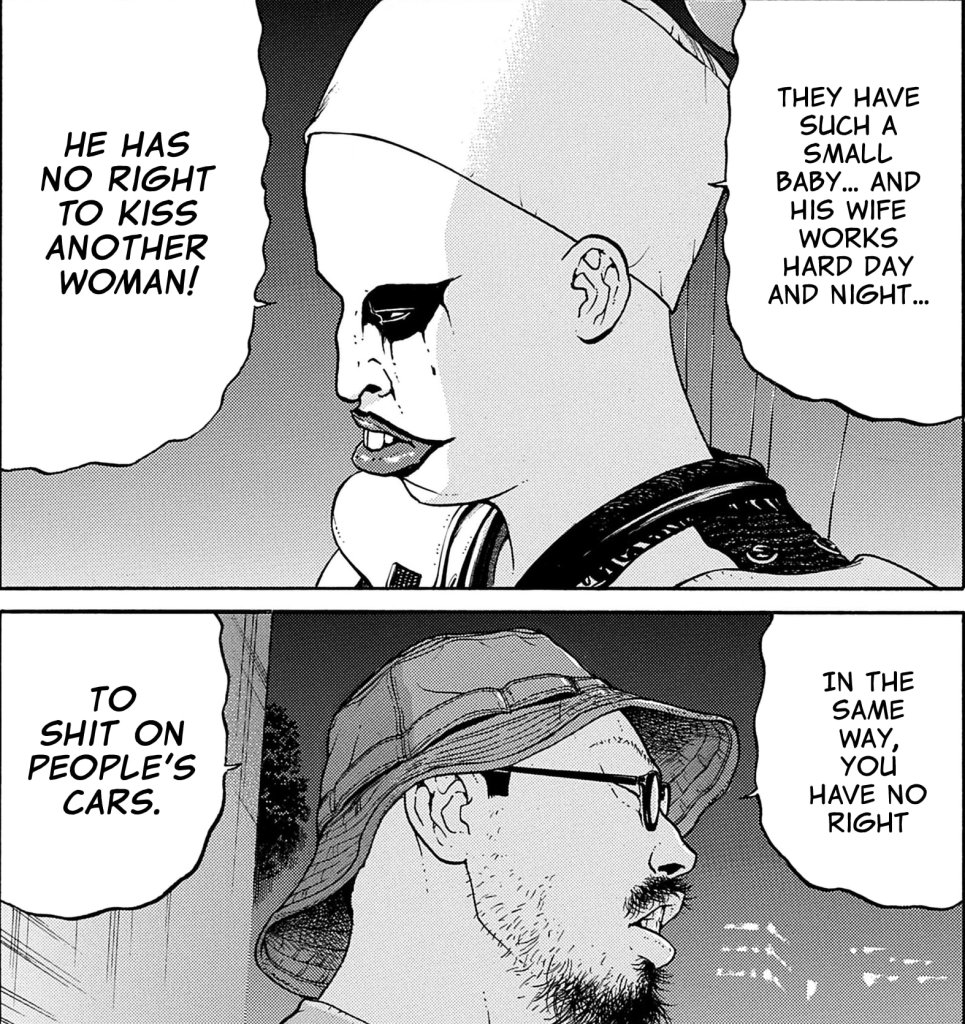
What follows is a deranged, outrageous tale filled with fascinating characters, most of whom exist in the fringes of society: a garrulous gambler with little self-control, a student who’s forced to steal panties to support his family back in the sticks, a senile old man that believes he alone knows the secret that will topple the US, a clown who punishes cheaters by shitting on their cars, a forty-year-old mentalist who lives with his mother and hasn’t talked to other humans since he was eighteen, an arrogant prick who will only speak nonsense to those he deems more intelligent than him, a successful but suicidal novelist on a spiral of declining mental health, etc.

Throughout this journey, the protagonist will shift his perspective on how to confront the mysterious monster called life, to figure out what, ultimately, constitutes happiness for him. I was very pleased with the ending.

Furuya’s works share the same elements: men on the fringes of society try to improve their lives despite having few resources, and facing somewhat episodic, at times horrifying stuff that they’ll nevertheless have to endure through. I’m talking about kidnappings, torture, and rape in the extremes, mingled with mundane stuff like trying to figure out if your family members will be out of the place when you bring your girlfriend over. Curiously, after some of the most outrageous, potentially life-derailing stuff, the characters involved keep going, having grown a little bit after the experience but otherwise unaffected.

All of his protagonists, if I remember correctly, deal with intrusive thoughts and bizarre daydreams. Along with the way his characters talk and his outside-the-box narrative choices, I’d say that Furuya’s brain must be quite similar to mine, which naturally ended up making him my favorite overall. I’m instinctively drawn towards writing similar stories.

I see myself rereading this series plenty of times throughout my life. I’m already rereading his Ciguatera, a fantastic work on its own right. It’s a shame that Minoru Furuya remains a stranger even for many seasoned manga readers.

On writing: Developing the premise #3

You can check out all my posts on writing through this link.

Are you happy with your concept? Then grow a premise out of it. Premises involve a task to be accomplished and a character that must accomplish it in the midst of conflict.

The following notes, gathered years ago from many books on writing, focus on developing the stakes associated with your premise. The dictionary defines “stakes” as “a sum of money or something else of value gambled on the outcome of a risky game or venture.” It also defines “stakes” as “a territorial division of a Latter-day Saints (Mormon) Church under the jurisdiction of a president.” In summary: someone in your story should stand to win and/or lose big during the course of the tale.

  • What is at stake for the hero relative to attaining or not attaining the goal, which can be stated as survival, the attainment of something, the avoidance of something, the discovery of something, and so on?
  • The reader should know, early on, what the consequences of success or failure will be. If you’re still only vaguely defining the stakes of your story as “happiness” or “peace,” congratulations, you’ve just found the probable weakness in your story.
  • Could your story be about the hero trying to change something?
  • Could it be about him or her trying to improve anything at all?
  • Could it be about him or her seeking to save someone?
  • How do the weight of the stakes motivate the reader to root for your hero with empathy?
  • How do they manipulate the reader into emotional engagement, one that would cause us to take action too?
  • How would the stakes touch us emotionally and intellectually?
  • How could the stakes be vividly and viscerally established?
  • How much can change if the protagonist succeeds or fails? Try to make it bigger, playing for something bigger than the main character. The bigger the win, and the deeper the cut of a loss, the better, because dramatic tension is fueled by stakes.
  • What would the stakes be for the opposition should they fail?

Ended up in the hospital (as a patient), Pt. 3

This entry will mostly be depressing, so if you’re one of those people who prefer to pretend that life is different than what it actually is, you may want to skip this one.

Last night I went to bed a nine, hoping to fall asleep soon and wake up at five to start writing the next chapter of my ongoing novel. Unfortunately, my poor cat had died half a day earlier, so I spent about two hours grieving some more. Although it doesn’t surprise me anymore, I felt like a worthless creature because I can barely remember three or four moments of an entire life with that cat. I have often wondered if my brain is damaged when it comes to whatever process stores memories, because on a day-to-day basis, I feel like I’m floating in the present with only the flimsiest connection to my past and the living beings in it. Why love someone, if when the relationship comes crashing down, not only will you have forgotten almost everything about that person, but in her place you will only find pain? I look back at my thirty-eight years of living, and it feels like I’ve blazed through it without making more than a couple of memories that I would consider worth it, and one of them is visiting an amusement park a few months ago. Maybe that gives you an idea of what level I’m at.

Rolling around in bed, crying for a loved creature that I would never hold nor see again, the usual objections about me continuing to live took the opportunity to assail me: why do I still stick around when I’m miserable most of the time, when my body tortures me, when I have never felt comfortable among human beings, when none of my efforts will ever amount to anything? Like in previous times, my brain forced me to answer why I refuse to die, which, it likes to remind me, I should have done a long time ago. At this point, the only reason I would “regret” dying is that I wouldn’t finish this current novel of mine; nothing else adds meaning to my otherwise meaningless existence. Then again, if one doesn’t exist, no meaning is needed. As for everything else, other than passing entertainment, I can hardly care less.

While I tried my best to fall asleep, I gave my body permission to cease operations in my sleep. I can’t count the amount of times that I’ve wished for that to happen over the years. That’s how I’ve always wanted to go, and that’s how my cat went as well, or at least I hope so, because I wasn’t there to witness it.

Instead of dying, I woke up spontaneously at the witching hour (meaning 3 A.M., although definitions vary). I doubted that I would fall asleep again, so I planned to sit at my desk and use the time until six in the morning to freewrite some paragraphs of my next scene. However, as I shuffled to the bathroom to pee, I found myself in that state that promises that if you don’t squeeze more sleep out of the night, you will suffer for the rest of the day, so I went back to bed. Once the alarm finally hit at five, I felt like utter shit, but I dragged myself to my desk and pulled off three paragraphs of fiction, which would allow me to feel fulfilled for the upcoming many hours of sacrificing my time, energy, mental health, and physical health for another day of meaningless drudgery.

At twelve, I was setting up a couple of computers and a network printer. I couldn’t help making stupid mistakes, for example missing that I had access to two additional ethernet wall jacks, or that all but one of the network cables wouldn’t reach the connection I had patched into the network. On all fours under that desk, stretching my arms to reach for cables, I felt utterly miserable, the “let it be over already” kind. I couldn’t get either of the computer to log in with the admin account; some changes in HQ made it so that if the computers have been off the network for a long time, you lose access to the variable password of that user, and the recovery software we have rarely works. That meant I would need to tell the department chief, the person who requested the operation, that I barely left anything working, and that I would need to rely on another department to finish it.

Suddenly, as I was sitting on a chair, a massive pain hit the left side of my chest. It felt as if my heart was expanding. It lasted for about fifteen to twenty seconds. I couldn’t check my heart rate, because I had left my portable EKG monitor at the office. I haven’t clarified it yet: my heart was damaged by a certain experimental jab that I was coerced into getting to keep my job, and I’ve gone through three episodes of atrial fibrillation (arrhythmia) since, one of them thankfully reverting in fifteen seconds or so.

Anyway, this pain felt like a big one. Cold sweat, white noise concentrating in my jaw, getting woozy… I checked out the symptoms of a heart attack, and other than nausea, I had all of them. I hate bothering people for any reason, especially when that may lead to them feeling pity for me (I know I complain a lot online, but I rarely if ever do it in person). However, I wasn’t sure I could reach the ER in such a state, so I asked the kindest of my coworkers to accompany me there.

During triage, they told me that it likely wasn’t a heart attack, because that pain I described would have lasted about a minute and a half. So they put me waiting in a packed room in order to perform what ended up being quite a lot of tests. The electrocardiogram was clear. Although I had some trouble breathing, they didn’t notice anything wrong during auscultation. Neurological tests okay, except for one: whenever I stood straight and closed my eyes, my body immediately tended to fall backwards. No idea what that means, and they didn’t explain it. The nurse, doctor or whatever she was also pressed several parts of my body for mysterious reasons.

When asked if I was going through some period of stress, I had to explain to three people that my cat died the day before. Every time I said it, it bothered me more. I also opened up about the fact that recently I had found a mass inside my scrotum; because I was injected with some poison that damaged my heart and that in others have caused turbo cancers, I considered that maybe the mass, which has the size of three quarters of a testicle, would be linked to my sudden heart issue. She smiled and said that she would check out my scrotum. To my dismay, I realized that I was in the presence of a fiend that wakes up five to six days a week fully accepting that during that day she may fondle a random stranger’s balls. I told her that I wasn’t ready for it, and besides, I have already scheduled a visit with my GP for later this week. In the end, I didn’t explain the possible link of this scrotal mass to my heart issues, and I wonder if she got the impression that I was a deviant trying to get my balls fondled by a young doctor. I’m not that kind of deviant. I also hate the idea of showing my genitals to anybody in case they laugh at them.

They extracted my blood for an analysis. During the hour and a half that I waited in a packed room, I feared that my troponin levels would come out high; those signal heart damage, likely myocarditis. Millions of poor bastards who have gotten jab-induced myocarditis, if they didn’t die soon after, have a life expectancy of five to ten years. I noticed the irony of fearing that I had myocarditis, when last night I had wished to die. I don’t want to deal with the pain, but apart from that, there are certain ways I don’t want to die: as one of the victims of a worldwide plan to decimate the population is one of them.

Anyway, the analysis was clear: none of the stuff they tested tended toward the extremes in either direction. The final doctor, nurse or whatever he was, told me that I may have had a very short episode of arrhythmia that I didn’t have time to check. I doubt it, because the previous ones didn’t feel like it. He also said that they’ve seen such localized pains in patients who are incubating one of those strange respiratory viruses that have been flying around recently. He added that I should check my temperature for a few days, particularly if I start coughing, producing phlegm and such. I have never heard of respiratory diseases producing pain localized in the heart, but what do I know.

When I told my mother about it, she suggested that otherwise it could have been an anxiety attack or severe heartburn, but none of the symptoms fit what I experienced. Perhaps everybody’s time was wasted: mine and that of the five or so professionals that attended me, all of whom, sadly enough, were younger than me. I may have also wasted your time, you nosy bastard.

It’s seven in the afternoon. Tomorrow I’ll have to return to work, which will involve answering plenty of questions from the many coworkers that were present when I asked for help. I also feel like shit at the moment, but at least I’ve gotten recent proof that my heart keeps working more or less properly, and that the chemical stuff in my body hasn’t gone haywire.

Was that an appropriate way to end this entry? It better have been.