
A fun psychobilly song about stabbing oneself. Nine songs down, nine to go.
Tag: music
Remastered “Paleontology of Pain” from Odes to My Triceratops, Vol. 3
Were you waiting for yet another remastered song from the third volume of Odes to My Triceratops? No? Oh well. Anyway, here’s a mix of surf rock, dance punk and cajun music for ya. It’s partly inspired, as I realized while I was making it, by a childhood friend of mine who either OD’d or killed himself.
Remastered “Nocturne for Claire” from Odes to My Triceratops, Vol. 3
A sad song about a loved one that the songwriter will never see again.
Remastered “Synaptic Flies” from Odes to My Triceratops, Vol. 3
I’m working afternoons this week, so before I waste more hours of my limited life coordinating the replacement of printers (on top of my usual tasks) in the hospital complex where I’m employed, I’ve remastered another song. This one’s about walking around with flies in your head. Six down, twelve to go.
Remastered “The Last Wait” from Odes to My Triceratops, Vol. 3
Rainy Sunday afternoon, so between episodes of Mushoku Tensei, I’ve decided to remaster another one of my songs. This time the winner was “The Last Wait,” a somber electronic piece about the sudden realization that there ain’t no getting out of one’s hole.
Remastered “Burying the Beast” from Odes to My Triceratops, Vol. 3
Another day, another remastered song. This time I’m redoing “Burying the Beast,” in which William Griffin confesses a crime. Now that I know proper audio mastering techniques, I hope I’ve done justice to such an awesome song.
Remastered “Behind the Door” from Odes to My Triceratops, Vol. 3
As you should know if you’ve been checking out my stuff, I’ve learned how to master audio properly, messing around with frequency bands and such. That has allowed me to remaster a couple of songs from the third volume of Odes to My Triceratops, and this time I wanted to improve “Behind the Door,” that may be my favorite among the seventy-five or so songs I’ve produced. For those of you who have read my novella Motocross Legend, Love of My Life, this song is partially inspired by it. I think it’s quite the haunting piece about behind haunted by memories that will never come alive again.
I made this song before Udio, the AI service I use to produce music, improved its output quality, but hopefully it isn’t that noticeable in the remastered version. This is one you should check out wearing headphones.
Remastered “Fuck You, Life (cabaret version)” from Odes to My Triceratops, Vol. 3
Recently I opened up about my shameful troubles regarding audio mastering. Well, it seems I’ve hit my stride with what I learned by remastering “Go Away, Stay Away,” because I’ve pretty much nailed the last song of the album (I’m not remastering them in order), the grandiose, operatic “Fuck You, Life (cabaret version).”
I hope you enjoyed it. And if you didn’t, what’s wrong with you? Don’t you like good stuff?
Remastered “Go Away, Stay Away” from Odes to My Triceratops, Vol. 3
In the last post, I went on about my recent discovery of audio mastering techniques. It included my first remastered song whose band frequencies I had molested. Listening back, it was quite a mess. I decided that Audacity, instead of my abilities, was mainly responsible, so I acquired better audio editing software (namely iZotope RX, recommended by good ol’ castrated AI ChatGPT). Thanks to it, I have remastered the song “Go Away, Stay Away” into a version that I wouldn’t know how to improve anymore. Check it out.
I’d say it sounds quite polished. The trick this time was to pick a segment of the song as the “baseline” for frequency band manipulation, and from then on slightly altering the bands of other segments up and down, making sure that the leadings in and out of that segment didn’t clash with the change in frequencies.
Anyway, I’ve got seventeen goddamn other songs to master, and that’s just in this album. I should also return to writing my novella one of these days.
On audio mastering (and a remastered song)
As I was “remastering” the songs that make up the third volume of Odes to My Triceratops, I started thinking, “surely there’s fancier stuff to do to improve a finished song’s quality other than just messing around with its sound levels.” That ominous thought led me on a few days-long journey into the art of audio mastering. At one point, I opened one of my previous songs I thought finished, only to find out that the exporting process had clipped the hell out of it. I had no choice but to face that I had no fucking clue what I was doing.
Some reading later, along with help from ChatGPT, led me to the following steps to master a song:
- Normalize original WAV at -1db.
- Save original WAV as a 24-bit/192KHz WAV stereo file.
- Load exported WAV.
- High-pass filter at 30hz (roll off 24 db).
- Filter Curve EQ with preset (looked up good general values).
- Normalize at -1db.
- Apply multiband compression with the OTT plugin at 20% depth.
- Normalize at -1db.
- Split the stereo track and pan the channels to -70% and 70% respectively.
- Perform a thorough EQ check using the spectrum analyzer, adjusting frequencies along the way.
- Use the Limiter, Hard limit to -1 db to ensure the track doesn’t peak.
- Normalize at -1db.
Until a few days ago, I thought a spectrogram was a medical procedure. I mean, check out this shit. Does it look like something that makes any sense?
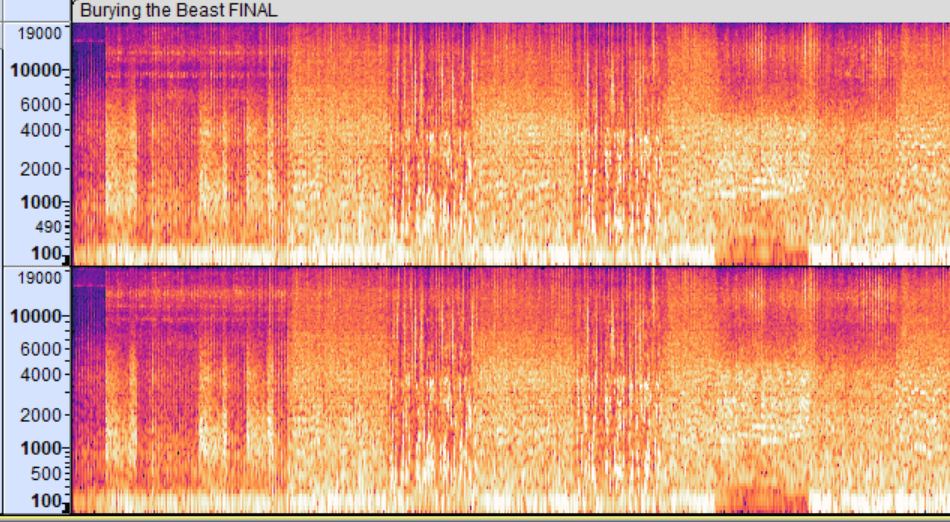
Turns out that you can learn lots from it. The frequency bands of a song are divided into the following:
Sub-bass (20-60 Hz)
Role: Provides the deep, rumbling foundation. It’s felt more than heard.
Boost: To add depth and power, typically in electronic music or certain genres of pop and hip-hop.
Cut: If the mix sounds too muddy or overwhelming, especially in more acoustic or vocal-focused tracks.
Bass (60-250 Hz)
Role: Adds warmth and fullness. Key for the body of bass instruments and the kick drum.
Boost: To give more weight to bass instruments, kick drums, and overall warmth. If the bass feels weak, a slight boost around 60-100 Hz can add more punch.
Cut: To reduce muddiness and allow other elements to breathe.
Low Mids (250-500 Hz)
Role: Important for the body of most instruments, but can often introduce muddiness.
Boost: To add body and presence to guitars, vocals, and other midrange instruments.
Cut: To clear up muddiness and create space in the mix.
Midrange (500 Hz – 2 kHz)
Role: Critical for the presence of most instruments and vocals. This range is highly sensitive to human ears.
Boost: To enhance clarity and presence of vocals and lead instruments.
Cut: If the mix sounds too harsh or congested.
Upper Midrange (2 kHz – 6 kHz)
Role: Contributes to the clarity and definition of sounds, especially for vocal intelligibility and instrument attack.
Boost: To add attack and clarity, making vocals and instruments stand out.
Cut: To prevent harshness and ear fatigue.
Presence (6 kHz – 10 kHz)
Role: Adds brightness and detail, crucial for the sense of “air” and openness.
Boost: To enhance the crispness and detail of vocals and percussion.
Cut: To soften overly bright or piercing sounds.
Brilliance (10 kHz – 20 kHz)
Role: Provides the sheen and sparkle that make a mix sound open and airy.
Boost: To add shimmer and airiness, particularly to cymbals and hi-hats.
Cut: To avoid excessive sibilance and hiss.
At a glance with a spectrogram, if there’s too much heat at a frequency band, you likely need to lower it. If another band presents a significant void, you can boost it and bring to the forefront little details that weren’t even present before. It’s quite amazing. Unfortunately, my obsessive attention to detail kicked in; the first time I tried to remaster “Burying the Beast,” I intended to go through each segment of the song boosting and lowering frequency bands to reach the optimal mix, but soon enough I was driven nuts. My job is already destroying me, I don’t need to work that hard in my spare time. So I fixed broad issues instead, boosting or lowering frequencies where it made sense.
I present to you the remastered version of fan favorite (for this fan, at least) “Burying the Beast,” a song from my album Odes to My Triceratops:
It isn’t perfect by any means, but it’s much better than the previous version, so that works for me.
 The Domains of the Emperor Owl
You must be logged in to post a comment.