
You can read this novella from the beginning through this link.
For days, I slipped in and out of lucidity.
I recall flashes of the waste collection center,
Of standing in the nearby landfills I had located,
Immersed in the stench of rotting organic matter.
I pleaded with employees wearing hard hats
And bright, reflective vests,
Begging them to let me access the collected trash.
I struggled to understand their replies;
My fogged mind registered their words as noise
Mingled with the caws of scavenging birds
And the sporadic rumble and beeps
Of lumbering trucks as they unloaded debris.
I wanted to collapse at the sight of endless trash:
Humanity unmasked as a blight upon nature.
I was tainted, a corrupting force spreading rot
To everything I needed to protect.
Workers denied my requests, citing policy,
But an employee in her fifties must have pitied me,
Because she allowed me to realize for myself
In the volume of compacted refuse
That my mementos of you no longer existed.
I dreamt you were calling me on a psychic link,
Begging me to find you
As a hill of trash slowly crushed you,
Suffocated you.
I heard your ribcage creaking, ready to collapse.
I dreamt of a colossal trash truck
Whose jagged teeth, like a predator’s jaws,
Closed around your body, pulverizing you
In a deafening cacophony of screeching metal
And the dull pop of bones breaking.
As you struggled against the mechanical jaws,
Leaking tears, mucus, and blood,
Your wide, terrified eyes met mine.
I heard your anguished voice, accusing,
“You knew how this would end.
Why didn’t you save me?”
On the couch where I slept, I awoke in a cold sweat,
Heart hammering, tears streaming down my face.
I thought I had survived the worst of my grief,
But it hadn’t immunized me against its return.
I took a medical leave from work that nearly got me fired,
And I spent those days encased in lead.
Among my family, I roamed like a black, silent fire,
So unhinged that my wife didn’t dare to chastise me.
At night, as my family slept, I stared into the darkness.
I listened to the whoosh of blood in my veins,
Life churning onward like the filthy waves
Of a sewer canal clogged with decaying memories.
Izar, two decades had passed since you died,
So why did your absence pulsate in my brain
Like the pain of a needle embedded deep?
Why did every hour still remind me
That you were no longer here to hold my hand?
I would never again talk with you,
Lean into you, breathe you in.
A crash against a guardrail had killed you,
The consequence of your choice to live dangerously.
I would never know if you’d have grown bored of me,
If our love would have faded or endured.
Once I clawed my way out of the black pit
And I recognized my wife as a human being again,
Every glance at her made me grimace.
I lived with a criminal that had escaped punishment
On account of our children’s well-being,
And we interacted like snakes
Forced to share a cramped vivarium.
I yearned to listen to your voice damn near daily,
And when I thought of those treasured tapes
That had contained our mock radio shows,
I couldn’t trust myself to stay in my wife’s presence.
But the loss of those recordings, I could have prevented it;
I knew that magnetic tapes degrade,
That oxygen was eating away at our young voices.
Although I had planned to digitize them,
I had kept postponing the task,
Thinking there would be another day.
Whenever I could, for sanity’s sake,
I escaped my home
And took long walks along the wooded lane
Where your memorial stone stands.
That narrow, mossy path ran parallel to the road,
Bordered by yellow-green grasses and leaves.
The sunlight streamed through skeletal branches
Stark against the background of rolling hills.
The breeze tickled my nose with the scents
Of moist soil, decaying vegetation, and pastures,
And the silence was interrupted only
By birdsong,
The breeze rustling leaves,
The bleating of grazing sheep,
And the sporadic whoosh of a passing vehicle.
In my mind, I spoke to you,
Recounting everyday moments from my kids’ lives,
Seeking your opinion on how to parent them
So they wouldn’t grow up bitter and miserable.
I had gone to check on our toddler,
And found my wife kneeling in the living room
In front of the coffee table and a cup,
As she wrote on a pocket notebook.
Beside her, our daughter babbled to a doll.
Standing still, I observed them
As if through an exhibit glass.
Our daughter approached the table
To mess around with the cup of coffee.
By the time my wife noticed,
The drink had already spilled.
“Look what you did!” she snapped.
Once our toddler returned her attention to the doll,
My wife hunched over, her shoulders shaking,
And she covered her face with both hands.
The thought of consoling her crossed my mind.
I should at least have taken our daughter away.
But I didn’t want to deal with human beings,
With their demands and expectations I couldn’t meet,
With their vindictiveness and their calculated cruelty.
Instead, I crept to the bathroom as quietly as possible,
Where I let the roar of water from the shower drown out
The world’s meaningless noise.
During my solitary walks,
I replayed our pretend radio shows in my head,
Recalling our repartee as if it were song lyrics,
But with age and the limitations of my brain,
I encountered gaps in my memory
Where I questioned if I was inventing your lines.
I adopted the habit of sitting on a bench
Opposite a slope tangled with brambles
To transcribe the echoes of our teenage voices,
Haunted by the need to immortalize you
In this universe that insisted on erasing you.
Once I ran out of the words we had shared,
I wrote letters to you,
Elaborating on my impressions and pains.
From those days onward,
My notebooks became like dumpsters
In the grimy alleyway behind a busy restaurant,
Waiting to receive the daily effluvia of my mind.
We took the kids on a family outing
To a destination my wife had picked:
Mount Arburu.
The cool air carried the scent of pine trees.
I found myself staring at a view
That you and I had relished:
The rising, rounded peaks of Aiako Harria,
Rugged and patched with dense forest.
Gray clouds tended a titanic shadow
Over my sprawling hometown of Irún,
Extending to Hondarribia and the Txingudi Bay.
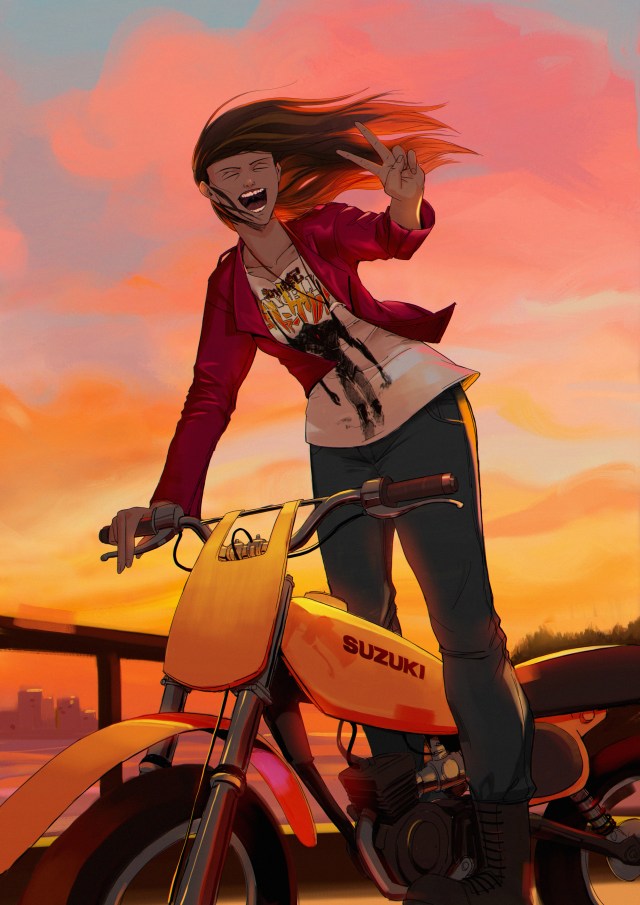
Two decades ago, I sat pillion on your Suzuki RM125,
My arms wrapped tightly around your waist,
The bike rumbling through my bones,
As you slalomed between the thorny shrubs
Scattered across this slope,
And flung joyful laughs to the wind.
Unhindered, nature cares little for two decades;
Here, only the unbreachable wall of time
Separated me from riding with you again.
I dreamt you and I held a funeral
For your wrecked Aprilia Red Rose.
We laid the mechanical beast to rest
Wrapped in bandages and duct tape,
On a bed of dead grass and dried leaves.
With our hands clutched in grief,
You wearing your motorcycle helmet,
We knelt and prayed before the bike,
Murmuring the kind of heartfelt goodbye
Reserved for lost loved ones.
At the front door of our apartment,
I was shrugging into my coat
When I felt a gaze on my face.
My wife, seated on the sofa, was leaning forward,
Wearing a loose blouse that exposed her breasts
To the hungry tug of gravity.
From the cigarette pinched between two fingers,
A thin ribbon of smoke swirled upward.
How many times had I envisioned confrontations
In which my wife’s mouth would spill venom,
Recriminating every aspect of our marriage?
I imagined her calling me a selfish asshole,
And I shot back, labeling her a heartless psychopath
That had enjoyed destroying my mementos of you
While knowing how much they meant to me.
But my wife’s gaze was tender,
Her eyebrows raised in the middle.
“The dead, they no longer love us,
And they certainly don’t suffer.
They don’t regret the lost opportunity
To spend more time together.
From what you shared about her,
She would have been horrified
By how much she ruined your life.”
I fumbled for words to refute her,
But my throat had constricted.
My eyes welled up.
In a daze, I swung open the door
And hurried down the stairs.
Author’s note: the songs for today are “Should Have Known Better” and “The Only Thing,” both by Sufjan Stevens, and “Like a Stone” by Audioslave.

 The Domains of the Emperor Owl
You must be logged in to post a comment.