Life update (11/07/2025)

I have been jolted awake at half past four by intrusive thoughts of my cat getting killed by a dog back in 2018. I remember the tail end of that dream: I was with someone, a girl I believe, trying to build a small shed in some lonely street corner to hang out (something I’ve never done in real life), only for the dream-sight to change into that of a pregnant cat navigating a small maze that resembled the spaces of those double windows that have like buffers in between. Suddenly my real-life cat showed up in the dream, and with it the grief and shame, and I just woke up. Went to the kitchen to get a glass of milk, then sat down at the computer to write the following to ChatGPT:

I am 40 years old, I have been diagnosed with high-functioning autism (formerly Asperger’s), and also Pure O OCD. It’s now half past four in the morning and I have been woken up by intrusive thoughts of a cat of mine who died brutally back in 2018; a dog gave her a mortal wound and we had to sacrifice her the same day. Ever since, I remember that cat weekly, as in maybe there are some days in the week in which I don’t get intrusive thoughts about it. The way my brain works, I don’t even get good memories, just pure negative ones, like the times when I was nine and I hurt a girl’s heart because I pretended I didn’t remember that she had wanted us to start going out together the day before; or the time I went to school as a child with different shoes, or the times I was so miserable in school that I had to ditch class almost daily and I lingered in the dark in random apartment buildings, sitting for hours in the stairwells. I feel like my brain is constantly under siege by intrusive thoughts, and every new experience I expose myself to will just cram more intrusive thoughts that will torture me for the rest of my life. I’m currently unemployed, but when I had a job, it felt so alienating to see my coworkers so happily laugh the shift away, while I have to deal not only with intrusive thoughts but also all the stuff related to autism (and also heart issues because of the covid vaccine, and other bodily problems because my development was screwed by a pituitary gland tumor).

I’m telling you not only to vent, but to ask in a general sense, what the fuck do I do with my life?

As it produced its response, tears rolled down my cheeks. Those thick, silent tears that come with a strange pressure in your chest. Artificial intelligence helps me daily in so many ways, but it has never told me anything useful about this.

It’s yet another time in which I have to think about the flood of intrusive thoughts that I have to wade through merely to get through the day, even if that day only involves sitting at home working on my programming project (for one reason or another, I haven’t gone out in four days). I am sure that this is what’s going to kill me: the growing hill of intrusive thoughts one day will catch me so low that I’ll have no choice but to get rid of myself with whatever is available around. And it may happen any day.

Someone else wrote on the subject of OCD on Reddit: “OCD is an endless painful torturous cycle. You can’t stop thinking about the things that you don’t want to think about. No matter what you do, no matter how much reassurance you get, it doesn’t stop. The thoughts themselves are literally painful. I don’t know how else to describe them. They are like knives stabbing me in the brain.” Although due to the Pure O variant I don’t have external rituals, purely mental ones (or at least I don’t recognize my compulsions), those words fit perfectly with my experience.

What’s even more alienating is that people who don’t suffer from autism and OCD can’t seem to understand the experience of it at all. I’ve had people, usually indirectly and online, say stuff like, “change your perspective and think differently,” elaborated into complex platitudes. It usually made me want to punch such people in the face. The way other human’s brains seem to work is so alien to me, that as I mentioned to ChatGPT, it felt so painfully alienating to work at an office and see people smile and laugh at fucking nothing (like this stupid youngish female technician whom I internally referred to as the “cackler,” whose every third utterance was a cackle-like laugh). Meanwhile, for me, being awake is a hell that I constantly have to distract myself from by disappearing into daydreams (usually of the soothing nature, pure non-sexual intimacy with someone I would like to talk to), writing (back when I did that regularly), and working on my programming projects. Also lifting weights when I can push myself to do so. The thought came to mind, probably from some quote, that “being awake is like courting disaster at every step.”

I’m so fucking tired. There’s the whole unemployment issue; I can’t imagine myself trying to get out there, talking to random people and basically beg to be hired, so I can return to routines that will hurt me. I briefly thought of talking to a therapist, but my experience with about five therapists since I was 16 is that their profession is a sham and that the only help they can provide is that of a listening ear. A very expensive listening ear. And don’t get me started on the “let’s see if it works” pills that some push. That fucking brain zapping from SSRIs.

I don’t know what else to say. It’s 5:30 now. I’ll probably lie down and conjure up some pleasant scene with Alicia, somewhere in the Midwest. I better haul my aging ass out today for a guitar session in the quiet woods, because I see myself slipping into my hikikomori mode like back in my twenties.


Look at the lovely images of this video I generated on the subject of this post:

Life update (10/31/2025)

This morning, at about half past nine, I’ve woken up to a sound I’ve dreaded for the last seven years: an incoming call. I don’t receive calls unless it’s work-related, and that was the case: HR calling me to cover a shift as a technician at the hospital, a job that has wrecked my health to the extent that it landed me thrice in the ER due to arrhythmia and a hemiplegic migraine.

After I finished the last contract, in which I worked as a programmer and that illustrated perfectly, by contrast, that I’m not suited at all to work as a technician, I went to the Occupational Health department and talked to a doctor to inform them that I wouldn’t work as a technician anymore. That doctor turned out to be a temp, and she told me that I should speak to my general practitioner at another hospital for it. When I visited the general practitioner, she told me that the doctor at OH must have been confused, and I should talk to her about it again. When I wrote to that doctor, I didn’t receive an answer, likely because she was no longer working there. This whole nonsense, a complete waste of time that unfortunately I have had to deal with so many times in my life, annoyed me enough that I didn’t book another visit with Occupational Health, which caused HR to eventually call me for a technician job. Thankfully, the job was only to cover a single afternoon shift (today’s), which means I won’t get in trouble for refusing it. But I need to hurry and schedule another visit to Occupational Health as soon as possible.

I have to deal with this shit even though I’m in a state that can likely be called depression. A couple of days ago, as I rolled in bed trying to calm my intrusive thoughts down so they would let me sleep, I had an intimate mental dialogue with my body that I’ve had at my lowest points: “Please let me die in my sleep. I don’t need to know about it and I don’t want to feel anything. I just don’t want to wake up again. I don’t want any more of this shit.” The next morning I woke up disappointed, and spent the whole day with my body urging me to lie down and sleep. Although I forced myself to go out and play the guitar (at a trail that only about six people passed through), everything I played sounded slowed down and lacking energy.

I can’t figure out what to do out there, outside of my apartment, other than play the guitar. Going anywhere and doing anything else feels like far more trouble than it’s worth. Wherever I go I’ll have bad experiences with people, if only because I have to face the abhorrent decay of society. That always brings to mind my maternal grandfather, that in the last few decades of his life, after he retired, barely went out at all, explicitly because he couldn’t stand what he saw around him. Had he lived to witness what we now have to endure, he certainly would have wanted to kill himself, although, a huge catholic as he was, he probably wouldn’t have.

Life just gets far too complicated when you can’t stand human beings. It’s no philosophical position nor a learned opinion, although I could easily make the case against people. Ever since I was a child, having human beings around has made my skin crawl, triggered the fight-or-flight response. I knew by instinct that people were far more dangerous than most animals: unpredictable, treacherous, and often plain evil. I assume that this reaction has been set by my atypical neurological development caused by autism, but the cause doesn’t change the effect.

It’s also due to autism that I can’t read people; I have to assume, given how people speak of others, that they get a sense of other people’s internal worlds, but for me it’s opaque: many times I’ve had to deal with people who apparently disliked me, even intensely, and I had no clue (I had to be told by someone else, as in “Why are you talking to them like that when they hate you?”). People would laugh casually during a conversation with me, and I didn’t understand why. People would react nastily with me and I couldn’t understand why. I’ve always had to walk into an interaction with people having to be on guard, as I can’t know when someone is going to attack me or cause me trouble. Unfortunately, the intimate relationships I stupidly had in my late 10s and early 20s didn’t fare much different, with my long-term girlfriend (what felt like long-term back then) cheating on me without me having a clue until the very end. Any social situation in person feels dangerous and exhausting. Not much else to say about it other than it’s at the forefront of my mind whenever I have to decide what to do outside of my apartment.

That call from HR means I’ll have to hurry and schedule a new visit with OH, which means traveling to Donostia’s hospital and engaging with the bureaucracy. That’s only so I won’t get called for jobs that my body has proven I can’t handle. I haven’t even started looking for a new suitable job.

I accidentally pressed the power button on my computer as I was dealing with my sick cat, and I thought I had lost this entire post. I suppose that’s as good a clue as any to post it and move on.

Life update (09/22/2025)

I’m dealing with insane levels of apathy at the moment. As I mentioned before, I became unemployed earlier this month, after nine months working as a programmer for the Basque public health organization. They couldn’t extend my contract for legal reasons. I knew that the moment I became unemployed, the same organization might call me to return as a technician, but working in IT had sent me to the ER thrice for arrhythmia and a supposed hemiplegic migraine that I suspect was a minor stroke. I’m honestly afraid of working in IT again, as I know that it would end the same way. I’m 52% disabled, partly due to so-called high-functioning autism. I suspect my disability percentage should be higher due to other health issues that I didn’t have or that hadn’t been diagnosed back in the day. Anyway, as an autist, I simply shouldn’t be dealing with an office with the noise pollution of a schoolyard, or with completely unpredictable tasks, or with nurses and doctors, whether in person or with phone duty. My health, physical and mental, should be my main priority from now on.

That means I need to get a new job. Today, after a whole week, I have managed to open the document that contains my curriculum, and added some new info there. It’s spotty as fuck, as I spent half of my twenties, if not more, as a hikikomori of sorts, and/or writing and playing the guitar. I doubt anyone would hire me directly from my CV, so I have to lean into protected jobs (by law, big organizations are supposed to hire a percentage of disabled people). I’m perfectly capable of doing the job; in fact, in my experience, I’m usually more capable than other programmers at the same level. But the social aspect is what has buried me: in my last job in the private sector as a programmer, my direct boss (another programmer, the only person I worked with directly) defended my work, but I wasn’t hired after the internship due to the judgement of a non-technical supervisor, who said that I wouldn’t fit in the team. They knew I was autistic; the local organization that helps autistic people had arranged that internship for me.

Anyway, in a couple of hours I’m heading to my general practitioner to explain the situation. She should end up writing a report that indicates that due to my disability, I should be exempt from job offers as a technician, and that the public system shouldn’t penalize my ranking for it. That’s because they might offer me a job as a programmer, and I would want those. Well, “want” is a very generous word for it. I only work for others because of money. I hate the whole process. For the entire last contract as a programmer, that ended about a week ago, realistically I shouldn’t have had to go to the office at all. I could have done all the work remotely, far more efficiently. I only recall about four meetings that would have required my physical presence (and even so, those could have been done remotely).

I only feel like sleeping for a long time, which likely means I’m going through depression. But I’m also struggling with the “what’s the point” of it all. I need money so I can eventually escape somewhere that will be the least affected, at least until I die, by the ruin of society. I feel that our entire civilization was derailed when Rome fell, and ever since, we’ve lived in this alternate, bizarre timeline in which nothing is at it should be. The whole ethos of Europeans turned on its head. Weakness, meekness, and forgiveness praised instead of strength and self-determination. The sole existence of a government is to protect its people against foreigners. Now we pay taxes and obey the law so we can be flooded and replaced by foreigners who hate us. You can even be thrown in jail, among invaders, if you complain about it.

And wait until they get real serious about digital ID, which was their plan to begin with. Part of the 2030 agenda. Digital ID opens the door to a central digital currency, which is programmable. That means that they could block your accounts for types of purchases, amounts, areas where you’d buy, etc. Don’t want people to buy more than X of meat a month due to “climate”? Block purchases. Don’t want people to move out of their 15-minute designated zones? Only allow purchases in the designated zones. And of course, if you protest against the government, your bank account is frozen, if not emptied entirely. This is not hypothetical: it’s already being done in parts of China. That’s the whole point of it all: turning every non-elite individual into a prisoner whose sole purpose is to dutifully pay to make others richer (and finance Israel’s wars). In case it’s not clear enough: digital ID should be rejected at all costs. And the cost will likely be your job, your bank account, your health. But mass non-compliance, and probably some people hanging from poles, would put an end to it, and send a good message to the next traitors that would attempt it again.

These are dark, dark times. I don’t think the average person is even aware of what’s happening. Illegals on boats killing half of the passengers before they reach our coasts, only for our government to offer the murderers support and distribute them throughout the territory. Muslims coming over explicitly to rape underage European girls and convert them to Islam. Your own government burying murders and mass rape in order to appease the new voting blocks, who are committing the crimes. Putting these people in the armed forces (police and army). Plenty of the rapists in the industrial-scale defilement of underage British girls were policemen, and not of the local kind. Perhaps the worst part of it all is that there are many, many ethnic Europeans that justify, defend, and even promote the total ruin of their civilization and of the future of their kind. It’s impossible for me to leave the house and keep my mental peace intact, as I see it out there every day.

Not sure if there’s much else to say. I think it must come to a point in which we should separate physically. If you welcome that ruin, live with it, but you’re prohibited from crossing over to our side when you realize you’re suffering the consequences of your decisions. In the past, the sane ones would move to another continent, to new lands. The fact that we can’t do that anymore is a huge part of the disaster we’re stuck in.

Life update (09/14/2025)

As of last Friday, I’m unemployed. My contract as a programmer with the public health sector ran out, and they couldn’t renew it for legal reasons. I would have preferred to leave the office that last day without talking to anyone, but I did go into my boss’ office and told him about the circumstances, mainly that I don’t think I will return to work as a technician because of my health issues (ended up three times in the ER due to the stress that working as a technician causes me). He acknowledged that due to the recent changes in the rankings, that push down anyone who can’t speak Basque, I was unlikely to return regularly to work there. We exchanged some pleasant-sounding words, then shook hands. I didn’t say goodbye to anyone else.

You see, whenever I become acquainted with a new group of people (from classrooms, jobs, etc.), I grow so tired of having to conform to their image of me, that I’m always relieved when the time comes to leave those people behind. And the image they have of me never aligns with reality because interacting with human beings never comes naturally to me. I’m autistic, as I’ve mentioned a million times, and for me, people are like wild animals. I can’t read their intentions, their reactions often baffle me, I’m regularly appalled by their opinions. Whenever any of them approaches me, I’m my mind I’m running some variation of, “Please go away and leave me alone.”

Then there’s the case of people from those groups who end up despising me for reasons unknown, who then proceed to dislike me even more because I ignore the fact that they don’t like me. The thing is, more often than not, I didn’t even notice their dislike. There was this woman at my office, who left about a year and a half ago. Apparently she disliked me a lot. She was the kind that complains about people lacking empathy, which usually meant that others weren’t responding to her like she wanted them to. I guess she was bound to end up disliking me, but I hadn’t noticed. It took another coworker telling me that she clearly couldn’t stand me for me to get it.

Now that I think back on my twenty or so years of working on and off, I realize that I’ve never gotten along with female coworkers. I’m the kind that focuses on his tasks and doesn’t socialize. The vast majority of female coworkers I’ve had (not all of them) were the “stop at a coworker’s table and chat up” kind. I don’t know if it’s about a need for attention, or what. Thing is, when they did this to other male coworkers, they didn’t like it; they admitted that they pretend to be busier than they were, to dissuade these women from engaging with them, but if the female coworker started a conversation, the guy went along until she got bored. Once she left, the guy often sighed or shook his head. But I don’t even go along with it; I actively ignore or redirect anything not related to work. I simply don’t enjoy talking about myself in person, or offering glimpses of my life outside of work. For me, a perfect day at the office involves not saying a single word for the entire shift, which was virtually impossible when I worked as a technician.

There’s a deeper thing with silence that happens to many autistic people. The more autistic you are, the more likely you’re to be non-verbal. I was a silent kid myself; at the most, I vocalized stuff about my daydreams. In my case, to the extent I can understand it, talking is a huge effort because I’m fully aware, to my core, of the near impossibility of communicating to a real extent with another human being. They may speak the same language superficially, but the meaning is very different. They don’t experience reality through my brain. It’s like being surrounded by followers of some bizarre religion, who try to involve you in their discussion. What would you even say? You don’t even share a frame of reference. Many utterances that would come naturally would end up making them dislike you, potentially causing trouble. It’s better to remain silent. I thought about this topic a couple of hours ago, and the final sentence of a novella I wrote back in 2017-2018 came to mind: “I had nothing to say. Not to him, not to anyone.”

So, I’m unemployed. I should call to reactivate the unemployment benefits. I should mess with my curriculum vitae and start looking for protected jobs as a programmer. Regarding the job-searching business, I obviously hate it (I don’t know if there’s anyone who likes it). I’ve always been relieved when I apply for a job but I’m rejected. I guess I proved to myself that I tried. But if I get hired, I have to meet a whole new bunch of people whom I’ll eventually end up resenting, for whom I’ll have to perform tasks that likely I won’t feel like doing. Some people enjoy going to work because of the people there, but I don’t like people, so for me it’s all about the money.

Ever since I became unemployed, I don’t feel like doing much of anything. I did spend a couple of hours yesterday afternoon playing the guitar in a nearby park, and I plan to head to another location this afternoon to play some more. But I’ve lost significant enthusiasm for the programming project I’ve been working on these past few months. I’ve looked for games that could distract me for at least a couple of hours a day, but ever since I tried VR, I have trouble getting attached to desktop games. I’m almost Gen-Z-ish regarding movies; very hard for them to retain my attention. Nevermind the fact that most movies released in the past fifteen years or so are garbage. Novels don’t attract me either; I tried to read Pratchett’s The Fifth Elephant, which is the next in line of his The Watch series, but I’m not in a hurry to return to it. It’s general apathy. What I do feel strongly is the need to be left alone, to not have to engage with anyone.

I guess that’s all for today. Not sure why I felt the need to say any of this.

Life update (02/19/2025)

Recently I found out about an intriguing Norwegian songwriter named Aurora Aksnes. Her general demeanour as well as clear stimming when performing live made me suspect she was autistic, which she apparently has confirmed herself. I’ve been reflecting on the autistic artists that end up floating to the top.

Apart from Aurora Aksnes, I know of other songwriters that have spoken about being autistic: Björk Guðmundsdóttir (I’ve never retained any of her songs, so I can’t link to anything in particular), Claire Elise Boucher (AKA Grimes, one of Elon Musk’s many exes, Musk himself being autistic), and Ladyhawke (I barely know anything about her, but that song is cool enough). I’ve suspected for many years that Joanna Newsom is also autistic.

To make it as an artist, you need luck, connections, a winning personality, and preferably an attractive physical form. Most autists are doomed when it comes to connections and winning personalities, to the extent that they eat into their luck. That leaves whatever remains of luck, as well as the attractive physical form. Given that men are more likely than women to elevate others professionally because they’re hot, that makes it far, far more likely than any autistic artist that makes it out of obscurity will be a woman that at her peak was very attractive, in some cases drop-dead gorgeous. That’s certainly the case for all those female songwriters mentioned. If I recall correctly, Joanna Newsom herself (I say herself because she may as well be a god as far as I’m concerned) didn’t intend to perform in public. She recorded her songs with a Fisher Price recorder, then passed her tapes to her friends. One of those friends went to a Bonnie ‘Prince’ Billy concert and gave him the tape, which led to Newsom getting a recording contract with Drag City. It probably also led to Bonnie ‘Prince’ Billy wanting to bang Newsom really, really bad (she wrote the song “Go Long” mainly about him). Anyway, I naturally connect more with autistic artists than with those who aren’t, which makes me regret that the vast majority of them are lingering in absolute obscurity.

About ten years ago, when I was working on my Serious Six, the novellas I sent around hoping to get published, I met regularly with a group of local autists, so I got to know like fifteen or twenty of them. I believe I met three autistic women in total, but there were some troubling commonalities: all the female autists were in relationships with neurotypical men who were, by the women’s own admission, very accommodating. All the autistic men save for two were single. The tales of those two, well, they’d make you want to be single. Their partners seemed to recriminate most aspects of their nature, and had them running on a treadmill to counter their shortcomings. Both of them seemed to be on edge and generally miserable all the time.

I also realized that there is a huge schism among autists: there are those whose peculiarities have been embraced and nurtured by their parents and close ones, then there are those whose natures have been repressed to pass for normal. I’m in the latter group. The autists in the first group are far happier, freer, and often obnoxious. Autists, of course, can be extremely obnoxious; I recall having been that way at different points of my life. Those of the repressed group not only are generally guarded and somber, but can deal with lots of self-hate and even trauma. Many of them don’t make it far in life, as in they step out of life at some point of the journey.

Of course there’s the general ignorance about autism, mainly thanks to the media. I recall the admin worker that many years ago had to assess my disability level asking me how come if autism is a developmental disorder, I still struggle with it as an adult. Who’s the retard here? Then there are those that believe autists to be math geniuses with perfect memories. In reality, autists are more likely than not to have tremendous issues with abstraction, and regarding math, many end up with some level of dyscalculia. Some idiots mention Rain man even today; Hoffman’s performance was based on a single guy who wasn’t even autistic: he was born without a corpus callosum.

Also, autism is caused by an atypical pruning of neural connections during development, which leads to idiosyncratic neurological processing. They proved that the differences between the neural activations between autists are larger than between those who aren’t autistic, nevermind how large those differences are between autists and those who aren’t autistic. That makes it hard to generalize about autists, although they are generally extremely sensitive (both emotionally and to sensory input), more likely to suffer from gut issues, also more likely to suffer from OCD and ADHD (I have the OCD comorbidity, which comes with intrusive thoughts and heightened obsessions). Also weird stuff like prosopagnosia, which I have, and consists on being unable to properly register a face. It’s so bad that I can’t tell if I ever saw again one of the girls I dated even though we lived close, because I wouldn’t have been able to recognize her on the street. When I worked as a technician and had to interact with nurses and doctors, it was common for me to enter a room, talk to someone, walk away to do something, and then realize I had no clue whom I had just talked to.

I got to thinking about autism in general because the protagonist of the novel I’m writing at the moment, The Scrap Colossus, is a female autist to whom I’ve assigned the authorship of the six novellas I wrote back in the day. But as I work on the notes, I’m having a hard time pretending that Elena, being an attractive woman, would have had that much issue getting those novellas published. Perhaps that’s bitterness talking through me. Since I was a child, I’ve felt cursed in that respect: no matter what I did, no matter how hard I tried, I couldn’t get anybody to pay any attention to what mattered to me. It seems there’s no further point I wanted to make about that other than saying it.

Anyway, I’ve got a scene to finish, so bye.

Life update (12/10/2024)

I’ve worked as a computer technician for a hospital for about six years. A couple of weeks ago, though, the big boss at the office told me that until January 12, I would be programming instead. I’m a trained programmer, not that it necessarily means anything; some of the best programmers in the world are mostly self-taught, and I’ve certainly learned more on my own than from any course. In any case, working these past few weeks as a programmer for this public health organization has shown me that most of my issues with my job these last six years were due to me being ill-suited to my tasks.

I suppose I’ll have to mention again that I’m autistic, as in literally autistic. Atypical synaptic pruning resulting in idiosyncratic neurological pathways and all that. As permanent as Down Syndrome, but fancier. While many (perhaps most) autistics end up the groaning, hitting themselves kind (not that I don’t groan or hit myself at times), I can sustain a semblance of normalcy, with severe limitations relevant to this matter: I have a hard time handling change and interruptions, noise, bright lights, interaction with human beings, etc. I also have a, let’s put it this way, unstable interior world.

Computer technicians are the firefighters of the computer world: some days very little happens, and other days you’re putting out fires everywhere. The notion of heading to the office and spending seven hours dreading whatever unpredictable problem may come my way grinded on my nerves. Most of those tasks also involve dealing with users, which I fucking hate, as I dislike interacting with humans. Programming, though, is generally blissful: I know in advance what needs to be done, and I’m on my own, building the system so that a computer performs that task. I even do it for fun in my spare time, as you know already if you’ve followed my posts. I’d say I’m a pretty good programmer. In addition, with AI these days, you can do the job of a week in a day.

My issue with my current job has been, unsurprisingly, the human element. I attend meetings almost daily to figure out how to progress from our current point, and all those meetings have been a demonstration on how differently other people’s brains work compared to my autistic brain: for me, the topics jump wildly from one to another, based on logic I can’t grasp. When the conversation seems to be approaching something resembling concrete information, suddenly I have to process interjections or digressions. It’s like trying to keep your toes in contact with the sea floor while the waves keep pushing you around. From time to time I try to steer the conversation in ways I can comprehend, such as, “So, to produce this result, this and this data are relevant. Do I have that right?” I rarely need more than that information, so as far as I’m concerned, the meetings could be reduced to five minute affairs.

I’ve been called “serious” more times that I can count. I even had one random employee of the hospital, who watched me exit a network closet, say, “Ah, I know you, you’re that serious guy from the bus.” I didn’t recognize him, but I guess he takes the same bus to work. I’m a silly bastard, and my interests are generally as unserious as can be, but I guess I have one of those faces. In addition, I barely speak, and when I do, it’s because a point needs to be made. I’m not the person to rely on when you need emotional support, because if I pay attention at all, I probably won’t give a shit. Yes, this would make me a terrible partner and father, and you know what? I refrain from being either. If I had the body to get away with it, and could stand people a bit more, I would have probably been the hit-it-and-quit-it type. Not that it particularly matters, but my bus and train rides are a succession of, “Man, she looks good, really fills out those leggings. Cute face. Damn, that long hair is so shiny and soft. Check out that mommy type; I’d love to see her in some lingerie. I need to squeeze that ass.” Thankfully I spend most of the time looking down at my tablet.

Anyway, what I guess I wanted to say is that I’m doing much better than usual. When I wake up in the morning, I don’t think, as I constantly did, like Ignatius Reilly put it in Toole’s A Confederacy of Dunces: “The day before me is fraught with God knows what horrors.” I read manga on the train (right now Hanazawa’s Boys on the Run; fantastic read), do some programming, attend a meeting or two, then head home to continue exploring of my range of kinks (did one about rescuing a girl from homelessness yesterday; real lovely). True self-exploration kind of deal. I’m also getting triple pay this month due to the holidays’ extra and unspent vacation time. So things could be far worse.

However, things haven’t gone well for people who are technically attached to me. My brother’s dog had to be put down, which caused him to kick a curb and break his big toe. Three or so weeks of medical leave. Just yesterday, my sister’s boyfriend got into a serious car accident and somehow got sent home despite having head trauma, his car having gotten totalled. My parents are old and progressively getting more unhinged. That sort of thing. I’m a detached sort of fellow so I can’t say I take any of it to heart too much. However, my two remaining cats are quite old, and whenever they die, it’s going to fucking devastate me as the previous deaths did; that’s mainly why I’ve decided to never own pets again. I just can’t take the heartbreak. On a fundamental level, I think it’s wrong to raise some creature that you know won’t outlast you; it’s like a perversion of the child-rearing instinct or something.

That’s all for today, it seems.

Life update (10/04/2024)

For no apparent reason, my brain regularly reminds me of events from my long-gone youth, such as my middle school and high school years. Mainly I remember people whom I haven’t seen in more than twenty years. There’s this girl who invited me to hang out in middle school; she was autistically awkward, and seemed interested in me for unknown reasons. Last I knew of her was her receiving, during an arts and crafts class, a nasty gash that bisected her forehead and left a terrible scar presumably for the rest of her life. I never saw her again after middle school, but I remember her sadly from time to time; after all, if I could have cared for her, maybe she would have become my friend. In 2021, I wrote a poem about her. I don’t remember her name, so I can’t google her. I assume she killed herself.

There’s also this guy I hung out with in high school. Name’s Urko, if I recall correctly. He invited me out a few times, but I only recall us sitting at a bench as he went on about PlayStation 2 games. I was a PC gamer through and through, and must have been heavily into Morrowind at the time. I doubt I ever said much to him. I didn’t really want to hang out with anyone, but I was in a period of my life, spurred on by my mother, in which I forced myself to behave like a “normal person,” and normal people were supposed to want to hang out with others, so that’s what I did. Also, life at home wasn’t good either, so I suppose I didn’t want to spent too much time there.

Last time I spoke to the guy, I was playing a basketball match in which that guy also participated. The guy ended up spraining his ankle, and was carried away. Later that week, he approached me and said something to the effect of, “I won’t hang out with you anymore. When I sprained my ankle, you didn’t even ask how I was doing. You don’t care at all, do you?” And he was right, I didn’t.

When I was a teenager, I had the terrible luck of meeting a malignant narcissist. I hung out with him and others for a year and a half or so, until I grew bored of the whole thing. Well, he didn’t accept the fact that life was pulling us in separate ways: from then on, until literally the year of his death in a car accident, the guy, for no apparent reason other than because “he doesn’t understand that friendship is the most important thing in the world,” he made it a life mission to poison every single social group I ended up in, which at that point was mainly the ones I was obligated to find myself in, as in school. He went out of his way (he didn’t attend classes in my city) to befriend people of my class, and even my brother. He approached my then girlfriend and started trying to get her to break up with me. He got really mad, to the extent that it disturbed a friend of his, when my girlfriend, bless her cheating heart, exposed him for having done stuff such as breaking into my email and hijacking my website. In his twenties, that bastard was rising in the ranks of the regional socialist party as a politician, and was the kind to exploit his power to hurt people as much as he could, while smiling to the face of those he was manipulating. When I saw his obituary in the paper, I burst out laughing. Served him right. Why not, here’s an article in Spanish about his death. David Martínez, who unfortunately shares a name with the protagonist of the Cyberpunk: Edgerunners series, was truly my nemesis: nobody has bothered to hinder my existence remotely to that extent since.

It’s always been a struggle for me to care about human beings. Given that I didn’t have the instinct for it, for most of my youth I took it as an intellectual, deliberate pursuit. You cared about people when you made yourself care for them; that’s how I thought it worked for others. Whenever someone approached me, I felt anxious, guarded. As they spoke, in my mind I kept repeating, “Please, stop talking to me.” I couldn’t wait to return to solitude and to my turbulent relationship with my subconscious (who is a motocross legend, as well as the love of my life).

It’s not remotely your run-of-the-mill introversion, of course: I was diagnosed with high-functioning autism (so-called Asperger’s) in my mid-twenties. Due to the cause of autism, which seems to be a non-uniform pruning of neural connections during development, my neurological make-up is different to virtually everyone else, even other autistic people. I read somewhere that on those machines that test neural activity, autists are more different from each other than non-autistic people are from each other, let alone autistic people from non-autistic people. In practice, that means that the things that soothe non-autistic people very well may be terrifying for autistic people. The things that make most people feel good may be jarring or extremely annoying to autists. They are societies of one forced to coexist with foreigners.

I can’t even count how many times someone, I’m tempted to say “some moron,” has suggested to me to behave in this or that way, assuming that my brain worked like theirs and therefore I would experience the same results (that’s assuming that those people weren’t genuine morons and had a proper handle on the mechanisms of their brains). In truth, autists become acutely aware from early on that they’re different from everyone else, and a significant part of their lives consists on adapting to other people’s often bizarre behaviors and needs, that are only the norm because they’re the majority. Many people seem to believe that everyone feels as they feel, although I’m not shocked given how naive if not straight-up retarded most people are when it comes to organizing society.

Maybe because I’ve had my brain functions disrupted by a hemiplegic migraine and by severe stress lately, I’ve been thinking about that troublesome organ of ours. One of the writers I used to admire the most (even though I haven’t read anything of his since my early twenties), John Fowles, author of mainly The Collector and The Magus, suffered a stroke, and afterwards he never wrote fiction again. He said that the stroke had robbed him of his imagination, and he simply didn’t have the drive anymore. He had written because his brain was configured to work like that, for him to want to write in the first place.

Studies about people whose brain hemispheres were surgically separated to prevent severe epilepsy have pretty much proven that free will is an illusion (check, for example, this article on the subject). I’ve always suspected as much, so I don’t believe in my own delusions: I do things because I’m urged to do them. In my spare time, if I feel like writing, I do so. If I feel like producing music or programming, I do those instead. You could say that it’s a lack of discipline or something, because one may give up on a hard task and instead waste his time unproductively, but I’d say that the very “want” of doing something hard instead of wasting one’s time is the urge your brain forces you to follow. I’m just glad that I haven’t been pressured by my brain into killing people or doing similarly troublesome things that would land me in prison. On a regular basis, I do imagine many, many things that would land me in prison, though.

All these things also prove that you’re just your brain. If part of it dies, there’s no “soul” to correct the missing part. I’m fairly certain that ghosts exist, but I’m inclined to believe that they’re some sort of electromagnetic phenomena produced by the brain while it was alive (I’ve come across studies on the matter recently), phenomena that may be preserved in specific objects or locations because of subatomic entanglement. Why won’t those wave functions collapse, who knows. Anyway, there’s no “other place” after death, Abrahamic or not, that will justify all the pain and horribleness of life. And unless the universe itself is a simulation, that may very well be, we only consider reasons regarding its existence because its configuration has allowed us to exist, meaning that for all we know there are uncountable universes out there in which nobody can consider such matters.

Why did I write all this garbage? It’s 9:17 in the morning, I’m at work, and I have nothing else to do. Why did you bother reading it? That’s the real question, ain’t it.

EDIT: the AI-generated Google podcast Deep Dive has quickly become my favorite podcast (not that I listen to many podcasts these days). I’ve fed it this post, and it has come up with the following podcast:

Life update (02/11/2023)

A couple of days ago I had my yearly check up with my usual endocrinologist. Back in my mid-twenties, after my body started doing stuff that a man shouldn’t be able to, I got an MRI done. It discovered a pituitary tumor. I was likely born with it. In retrospect, it should have been discovered back when I was still a child; after all, gynecomastia isn’t something that just happens. If my parents hadn’t been generally neglectful, I would have been spared the permanent effects of becoming an adult in a boddy riddled with hormonal imbalances.

If you want to know how that’s like, I guess you can check out the videos of the adults that were put in feminizing/masculinizing hormone therapy back when they could barely understand what would be done to them or why, only to regret it later (and be censored for it). In my case, whatever defect in my DNA, or poison in my environment, created the tumor, was the one responsible for this alteration, which may be worse because I never consented to anything. In all cases mentioned, the person ends up fucked for life.

Obviously there are sex differences in brain anatomy (quick google: “On average, males and females showed greater volume in different areas of the cortex, the outer brain layer that controls thinking and voluntary movements. Females had greater volume in the prefrontal cortex, orbitofrontal cortex, superior temporal cortex, lateral parietal cortex, and insula. Males, on average, had greater volume in the ventral temporal and occipital regions. Each of these regions is responsible for processing different types of information”), and due to my hormonal imbalances, my brain must be more female than the average guy’s. I guess that may explain in part why I feel comfortable writing female characters.

Anyway, my hormones have been under control for the last eleven years or so thanks to the medication I have to take two times a week. And ever since I’m producing healthy levels of testosterone, I want to fuck everything that moves and that may remotely be considered female (slight exaggeration).

Going back to the initial topic: I have no problem using public transport, but my elderly father offered to drive me to the hospital for my scheduled visit. I never got a driver’s license, and likely never will. Partly because I was born with so-called high-functioning autism; my mind makes me lose myself in daydreams in which I don’t recall entering, and when I “wake up” from them, I’m surprised that I didn’t fall through an open manhole or get hit by a car along the way. In addition, and worse, either I was born with or developed OCD (often comorbid with autism). This OCD of mine generates a myriad of intrusive thoughts, plenty of which involve violence either towards others or myself. If I were to drive a car, I would find myself having to drive out of my mind the urge to veer into oncoming traffic or drive straight into a wall.

I suppose that I’m something of a barely restrained public menace. Sometimes when I’m about to grab my coffee, my brain presents me with vivid sequences of me tipping the cup so that it spills the hot coffee all over my or someone else’s skin. Unfortunately that actually happened, although just once: as I was about to take my coffee from the counter, one of those intrusive “animations” came up, and next thing I knew, my thumb had slid in such a way that I ended up spilling the coffee all over a customer’s lap. He was surprisingly cool about it.

I’ve dropped valuable stuff that I was holding because my mind got filled with images of me dropping it. I’ve never held a baby because I don’t want to live with the consequences of possibly dropping them; back when I was a teenager, a cousin nearly booted me out from her apartment because I didn’t want to hold her spawn, and she stormed out offended while saying, “you better change your mind about that!”

I nearly bit off the nipple of a girlfriend of mine because at that very moment the enticing prospect flashed, vividly rendered, through my brain. I still remember the gasp she let out. I miss sucking on tits.

Of course, because I live in an increasingly chaotic Europe (it will last at the most one or two generations), whenever I go out I have to endure vivid sequences of me defending myself from attacks due to the proximity of some group of shady, malicious-looking, military-aged men from some remote shithole, and it doesn’t help that I’ve seen in person shit done by such men, have been harassed by some, and my apartment was nearly broken into in the middle of the day by, again, such people.

Anyway, I wouldn’t have been able to drive myself to the hospital. As my elderly father attempted to find a parking space, I told him, “you don’t need to park, I’ll just get out. And don’t wait for me, because afterwards I’ll walk somewhere to get a cup of coffee.” My father stopped the car almost immediately and let me out. He didn’t say anything. A couple of hours later, I was reading in a coffee shop when my father called. He asked where I was, because he didn’t see me leave the hospital. I reminded him that I had told him not to wait for me. He said that he had told me that when I left the doctor’s office, I should call him to pick me up. He hadn’t.

The situation with my father, as in general with the rest of my family, is more peculiar than that of most people’s families (and so is my own personal situation). My father was regularly beaten as a child to an extent that it gave him notorious brain damage. I’ve never had anything resembling a normal conversation with him. In his early seventies, he’s now a frail-looking, stooped old man whose head wobbles constantly like a bobblehead doll due to whatever damage was done back in the day. For most effects and purposes, I didn’t have a father figure growing up, resulting in all the damage that does to someone.

I thought about growing old. I’ll be thirty-eight in a couple of months. I’ve never felt older than eighteen or twenty. I’m appalled by how fast my body has broken down, including my heart ever since a certain jab.

I have never felt fully human, but the older I get, the less I want to interact with human beings in any capacity. Far more often than not, whenever I listen to other people’s opinions I’m disturbed by what comes out of their mouths, as well as their notions of what is good or preferable. A few times I thought I was fine with someone as a person, only for them to open up and for me to realize that I had only fabricated in my mind a version of this person, one that never existed. And due to autism plus OCD and the way they wired my brain, I simply don’t feel the need to be in the presence of other humans. In fact, doing so repels me: I feel like I’m surrounded by wild, barely predictable animals. Truly, if it wasn’t because I can’t afford it, and because I wouldn’t know how to organize myself to do so, I would live far, far away from civilization, or at least far enough where I would still have access to the internet.

Apparently a significant portion of the world’s population cannot generate images in their brains. I read that somewhere. My mind deals more in images than in words, and I’m constantly aware that language is a very imperfect tool to translate what pops in my mind as images. But due to the conditions I was born with, my mind is a regular whirlpool of images, mostly negative ones, many of them bad memories, that pop up without my control and that force me to deal with them. Two nights ago I barely slept three hours or so, and the rest of the time I kept swatting back the visual sequences that my brain kept presenting to me. For example, how many times do I have to picture the face of agony that my beloved first cat made when she was mortally wounded by a dog? How many times do I have to recall the moments in which I realized that a girlfriend of mine was cheating and was trying to get rid of me? How many times do I have to see the faces of children mocking me for one reason or another? Most of the memories aren’t traumatic per se, but they still leave a foul taste in my mouth.

I have to be careful with the experiences I expose myself to, because any new memory (and they are almost always bad; my brain seems very reluctant to retain positive memories) will visit me for years, possibly for the rest of my life, and I suppose there’s a point in any human in which he’ll have no choice but to go “fuck this” and jump off a bridge.

It’s not all bad regarding mental images, though; for years I’ve found solace in very elaborate daydreams that I can run whenever I want, and that rescue me from the harsh surroundings. One of them starts when three people from the future discover that they all came from an isolated group of Icelanders from the Middle Ages, who were about to starve from a little ice age. The future people, who researched time travel, rescue their ancestors and bring them to the Americas. They provide some future technology, artificial intelligence and such to give them a major edge, but they also give them the task of becoming the sentinels of the New World for when Europeans come and unwittingly kill most of the population through disease, and ruin the treasures of the past through Christianity. An elaborate fantasy that despite how much I’ve worked mentally on many of the characters, will never become a written story, because daydreams are terrible story material; stories are about tension and struggle (and usually end with a definite win or loss), daydreams are about winning as often as possible.

I can’t come up with a proper segue into the following topic, but the fact is that I feel like I’ve been dead for years and years, maybe since my early twenties. Ever since, I’ve slowly been erasing myself from the world. The way Patricia Highsmith put it (someone else who was autistic), the artistic life is a “long and lovely suicide.” You are mining from yourself raw material to construct valuable artifacts out of it, and you do so, if you are lucky, for as long as your body lasts, but someone who is interested in the world and in living doesn’t sit in front of a screen (or stand in front of a canvas) for hours upon hours to escape from reality. And there’s a good chance that giving in to the impulse to escape from reality through writing, painting, etc. actually prevents you from learning to cope or even appreciate the whole of reality. But fuck reality; it’s just an inferior version of whatever goes on in the mind anyway.

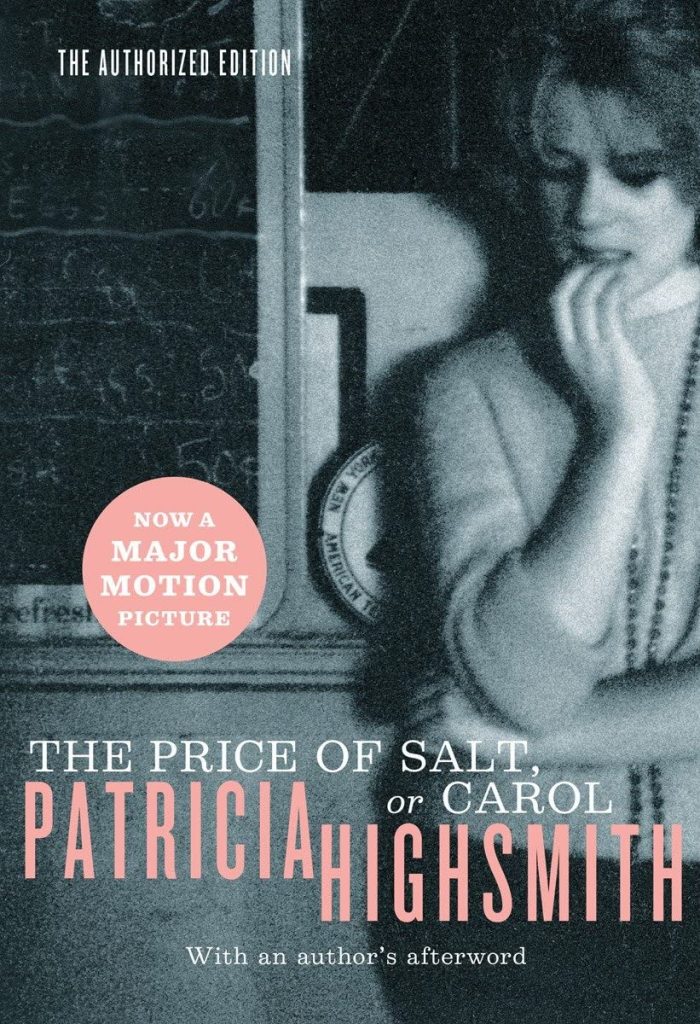
Review: The Price of Salt, by Patricia Highsmith

In the late 40s, shortly after she sold the rights to her first book Strangers on a Train (as far as I remember, Hitchcock basically swindled her), Patricia Highsmith worked for a couple of weeks at the toy department of a store, where she met a stunning woman: a poised, rich-looking, beautiful blonde who asked for a toy for her daughter. The author sold her some doll and learned the woman’s address, because the store would deliver the toy there. More importantly for Patricia, she had come to realize something: she was in love at first sight with a woman. That was a problem for many reasons, one of them that she was dating a guy.

At home, in feverish two hours, Highsmith wrote the entire treatment for the story that would end up becoming The Price of Salt / Carol, a novel she would have never considered writing before. The author grew a fever shortly after; some kid at the store had exposed her to chicken pox. She had to quit her job. Since that day at the store, she only came close to the stunning blonde once: Patricia visited New Jersey and stared at the married woman’s home from a distance, as she likely wished that she could belong to that place.

This book follows a nineteen-year-old girl named Therese Belivet. Her parents abandoned her, she grew up in some sort of boarding school, and now she works at the toy department of a store, although she wishes she could become a stage designer. She’s dating a guy called Richard who’s a bit of a dilettante: he wants to become a professional painter, but he has little talent and doesn’t apply himself. He’s mainly trying to avoid his destiny of working at his family’s business.

One day a poised, rich-looking, beautiful blonde enters the toy department wanting to buy a present for her daughter. After the transaction, which included a pleasant interaction between them, Carol forgets some item at the store. The protagonist does something that the author likely wouldn’t have dared to do: she mails it to the woman’s residence along with some words to remember Therese by. Carol, touched, asks her out for lunch, which sets both women on a path of degeneration (a quote included later on features a rebuttal from this Carol character about such notion).

Carol is getting divorced because she doesn’t love her husband, and some months ago had a fling with a long-term female friend of hers. Now she risks losing her daughter because her husband, who is a no-nonsense business guy, wants full custody due to Carol’s lack of moral compass (mostly because her lover was another woman).

Given that Carol is based on an idealized love-at-first-sight, the author could have put her on a pedestal, but Carol, in the narrator’s words, is “a woman with a child and a husband, with freckles on her hands and a habit of cursing, of growing melancholy at unexpected moments, with a bad habit of indulging her will.” I found her quite compelling. In contrast, the protagonist felt somewhat vague until the last quarter of the story.

The bulk of the story consists of a roadtrip that both women take heading West. Therese loves Carol, but suspects that she may be a convenient distraction for the older woman, who has enough to worry about with the divorce. Meanwhile, her husband has money to spare to figure out how his estranged wife may want to enjoy her trip with a barely twenty-year-old girl.

Highsmith puts us then-and-there along with her protagonist: we are never sure of anyone else’s intentions, or even what’s going on some of the time, because Therese herself doesn’t know. Carol has lived a complicated life up to that point, and at times I felt as superfluous to Carol and her former lover Abby’s conversations, as well as those between Carol and her husband, as the protagonist herself did, which I consider a point in the novel’s favor; most of what I ask from a story is to make me step into the protagonist’s POV and live vicariously through them.

Patricia’s writing felt somewhat meagre throughout the first quarter of the story, maybe in part because she had never written anything like it (Strangers on a Train was her first novel). The prose improves consistently until the end.

As I mentioned in my review of one of the author’s most prominent biographies, supported by at least one of Patricia’s friends who was a psychiatrist, Patricia Highsmith seemed to be on the autistic spectrum. Her anxiety and sensory issues are on full display during the scenes at the toy department, and throughout the story, the protagonist’s (and author’s) inability to properly read people or even understand her own impulses come into play. The author’s obsession with the real-life Carol, as well as the less prominent behavior of Therese towards the fictional one, are characteristic of autism as well (and I know plenty about that).

This afternoon, after I finished the book, I sat down to watch the movie adaptation released in 2016, starring Rooney Mara as Therese and Cate Blanchett as Carol. Blanchett was wonderful as her character; unfortunately, whoever wrote the screenplay manipulated the original in idiotic, and for me infuriating, ways. Instead of a stage designer (in the novel she gets paid a couple of times to work as one), movie Therese wants to be a photographer even though she barely has a camera; it makes her seem like a dilettante. Her boyfriend, Richard, just works at the same store and lacks any dreams or artistic sensibilities. Far worse yet: following the recent tradition in the media of shitting on men, that has become the norm in Western society for the last twenty years or so, the main male characters are depicted as obnoxious, brutish and irrational. Patricia didn’t write them that way. I couldn’t get past the midpoint of the movie for that reason.

Patricia Highsmith chose to publish this novel with the pseudonym of Claire Morgan, and afterwards she started frequenting gay bars in New York, where she became a local legend. I recently watched a short documentary about Highsmith that mentioned that the lesbian ladies of New York referred to Patricia as the White Wolf, because of her ravenous appetite, the fact that she was white, and that she hunted monsters for coin. Patricia mentioned in her diaries, using different words, that she got enough pussy to last her several lifetimes.

I’m a guy and I can’t consider myself a lesbian even if I wanted to (although Patricia and I seem to have the same taste in dommy mommies women), but this story made me experience again that unique gift of written fiction: the author captured through words alone two real human beings that remain as alive and young as they were now ages ago, and that will, one supposes, go on loving each other endlessly.

Here are the quotes I highlighted:

Therese’s lips opened to speak, but her mind was too far away. Her mind was at a distant point, at a distant vortex that opened on the scene in the dimly lighted, terrifying room where the two of them seemed to stand in desperate combat. And at the point of the vortex where her mind was, she knew it was the hopelessness that terrified her and nothing else. It was the hopelessness of Mrs. Robichek’s ailing body and her job at the store, of her stack of dresses in the trunk, of her ugliness, the hopelessness of which the end of her life was entirely composed. And the hopelessness of herself, of ever being the person she wanted to be and of doing the things that person would do. Had all her life been nothing but a dream, and was this real? It was the terror of this hopelessness that made her want to shed the dress and flee before it was too late, before the chains fell around her and locked.

There was not a moment when she did not see Carol in her mind, and all she saw, she seemed to see through Carol. That evening, the dark flat streets of New York, the tomorrow of work, the milk bottle dropped and broken in her sink, became unimportant. She flung herself on her bed and drew a line with a pencil on a piece of paper. And another line, carefully, and another. A world was born around her, like a bright forest with a million shimmering leaves.

I feel I stand in a desert with my hands outstretched, and you are raining down upon me.

Was life, were human relations like this always, Therese wondered. Never solid ground underfoot. Always like gravel, a little yielding, noisy so the whole world could hear, so one always listened, too, for the loud, harsh step of the intruder’s foot.

Therese frowned, floundering in a sea without direction or gravity, in which she knew only that she could mistrust her own impulses.

Happiness was like a green vine spreading through her, stretching fine tendrils, bearing flowers through her flesh. She had a vision of a pale white flower, shimmering as if seen in darkness, or through water. Why did people talk of heaven, she wondered.

If she ever had an impulse to tell Carol, the words dissolved before she began, in fear and in her usual mistrust of her own reactions, the anxiety that her reactions were like no one else’s, and that therefore not even Carol could understand them.

Between the pleasure of a kiss and of what a man and woman do in bed seems to me only a gradation. A kiss, for instance, is not to be minimized, or its value judged by anyone else. I wonder do these men grade their pleasure in terms of whether their actions produce a child or not, and do they consider them more pleasant if they do. It is a question of pleasure after all, and what’s the use debating the pleasure of an ice cream cone versus a football game–or a Beethoven quartet versus the Mona Lisa. I’ll leave that to the philosophers. But their attitude was that I must be somehow demented or blind (plus a kind of regret, I thought, at the fact that a fairly attractive woman is presumably unavailable to men). […] The most important point I did not mention and was not thought of by anyone–that the rapport between two men or two women can be absolute and perfect, as it can never be between man and woman, and perhaps some people want just this, as others want that more shifting and uncertain thing that happens between men and women. It was said or at least implied yesterday that my present course would bring me to the depths of human vice and degeneration. Yes, I have sunk a good deal since they took you from me. It is true, if I were to go on like this and be spied upon, attacked, never possessing one person long enough so that knowledge of a person is a superficial thing–that is degeneration. Or to live against one’s grain, that is degeneration by definition.

It was Carol she loved and would always love. Oh, in a different way now, because she was a different person, and it was like meeting Carol all over again, but it was still Carol and no one else. It would be Carol, in a thousand cities, a thousand houses, in foreign lands where they would go together, in heaven and in hell.

Review: Beautiful Shadow: A Life of Patricia Highsmith, by Andrew Wilson

Originally written in September 2016, posted on Goodreads.

A few years ago I found a quote (I love quotes), by a certain Amy Hempel, that intrigued me:

“I read about a famous mystery writer who worked for one week in a department store. One day she saw a woman come in and buy a doll. The mystery writer found out the woman’s name, and took a bus to New Jersey to see where the woman lived. That was all. Years later, she referred to this woman as the love of her life. It is possible to imagine a person so entirely that the image resists attempts to dislodge it.”

I wondered who that mystery writer could have been, and I also identified with a mind that would daydream an entire life out of a moment and follow that obsession. That “mystery writer” was Patricia Highsmith.

While I was reading her This Sweet Sickness, about a loner unable to connect with people and who obsesses over a woman he loves, to the point of building a complete second identity, I identified with it, and how it was told, in a way that suggested that the writer was the kind of peculiar I was; hardly anyone knows about the depths of social blindness, isolation, anxiety and obsession (and attached maladies like obsessive-compulsive disorder and chronic depression) like autistic people.

Patricia Highsmith was a retiring, silent person with a tremendously dark interior world, who could not properly connect with anyone, who loved certain people when they were away but needed space when they were close. She considered herself to have a man’s brain, but didn’t want a man’s body, and was attracted to women, but didn’t particularly like them. She was a masochist who consistently “chose” to love women who bossed her around and hurt her. She smoked and drank so heavily that those vices destroyed her body, although, curiously enough, didn’t seem to have affected her mind. Her instincts didn’t align with the human world around her. She was hypersensitive to noises and being touched. She was clumsy and awkward. She was at her best while daydreaming or writing, but fell into horrible depressions the moment she came back to herself. She was never at ease with the world.

Almost everything about her screamed Asperger’s to me, but I can’t be objective about it. It was weird that nobody else caught it, until one of her friends did, as mentioned in this biography:

“In hindsight, I think Pat could have had a form of high-functioning Asperger’s Syndrome. She had a lot of typical traits. She had a terrible sense of direction, she would always get lost and whenever she went to the hairdresser’s she would have trouble parking even though she had been with me lots of times. She was hypersensitive to sound and had these communications difficulties. Most of us screen certain things, but she would spit out everything she thought. She was not aware of the nuances of conversation and she didn’t realise when she had hurt other people. That was probably why her love affairs never lasted very long, because she couldn’t overcome the difficulties in communicating. Although she didn’t really understand other people – she had such a strange interior world – she was a fantastic observer. She would see things that an average person would never experience.”

She wasn’t a recluse, however, like some journalists called her. She kept plenty of friends, travelled and invited people over, people who tolerated how weird she was. She never made it as big as she deserved mostly because she didn’t care to belong to a “writer’s community,” didn’t like to expose herself to the public (she considered interviews humiliating), and her stories usually failed to offer hope or platitudes.

Patricia was also a misanthrope who disliked or even hated way more stuff and people than she liked. She got in trouble for her opinions regarding black people, religion, and Israel. Having been born clearly different, she was a hardcore individualist that intended people to take responsibility for themselves. During the last half of her life, and having been on the brink of bankruptcy, never knowing if the next book was going to sell, she was very stingy with money, but in her will she left her millions to a writer’s retreat she spent a few weeks in while writing her first novel. She died alone in Switzerland, in a home designed as a bunker.

Despite all of her issues, reading about her has made me aware of a hole in the world, the kind that opens when a real human being goes away. I look forward to learning more about her, and about myself, while reading her stories.

The following is a poem that Patricia wrote during her last years in Switzerland:

At dawn, after my death hours before,
The sunlight will spread at seven o’clock as usual
On these trees which I know.
Greenness will burst, dark green shadows yield
To the cruel-benign, indifferent sun.
Indifferent will stand the trees in my own garden,
Unweeping for me on the morning of my death.
Same as ever, roots athirst,
The trees will rest in breezeless dawn,
Blind and uncaring,
The trees that I knew,
That I tended.


I thought about this review because I’m finishing Patricia’s The Price of Salt, a prolonged daydream set in the 50s about dating that woman from New Jersey that at the most she saw a couple of times. In a significant part because Patricia reminds me so much of myself, I can’t think of any other dead writer that I would want more to be still alive and healthy.

Here are some quotes I highlighted from this biography:

After reading Burgum, [Patricia Highsmith] wrote in her cahier that, like Kafka, she felt she was a pessimist, unable to formulate a system in which an individual could believe in God, government or self. Again like Kafka, she looked into the great abyss which separated the spiritual and the material and saw the terrifying emptiness, the hollowness, at the heart of every man, a sense of alienation she felt compelled to explore in her fiction. As her next hero, she would take an architect, ‘a young man whose authority is art and therefore himself,’ who when he murders, ‘feels no guilt or even fear when he thinks of legal retribution.’ The more she read of Kafka the more she felt afraid as she came to realise, ‘I am so similar to him.’

If [Patricia Highsmith] saw an acquaintance walking down the sidewalk she would deliberately cross over so as to avoid them. When she came in contact with people, she realised she split herself into many different, false, identities, but, because she loathed lying and deceit, she chose to absent herself completely rather than go through such a charade. Highsmith interpreted this characteristic as an example of ‘the eternal hypocrisy in me,’ rather her mental shape-shifting had its source in her quite extraordinary ability to empathise. Her imaginative capacity to subsume her own identity, while taking on the qualities of those around her – her negative capability, if you like – was so powerful that she said she often felt like her inner visions were far more real than the outside world. She aligned herself with the mad and the miserable, ‘the insane man who feels himself one with all mankind, all life, because in losing his mind, he has lost his ego, his self-ness,’ yet realised that such a state inspired her fiction. Her ambition, she said, was to write about the underlying sickness of this ‘daedal planet’ and capture the essence of the human condition: eternal disappointment.

[Patricia Highsmith] had experienced at first hand many of Ripley’s characteristics – splintered identity, insecurity, inferiority, obsession with an object of adoration, and the violence that springs from repression. Like her young anti-hero, she knew that in order to survive, it was necessary to prop oneself up with a psychological fantasy of one’s own making. ‘Happiness, for me, is a matter of imagination,’ she wrote in her notebook while writing The Talented Mr. Ripley. ‘Existence is a matter of unconscious elimination of negative and pessimistic thinking. I mean, to survive at all. And this applies to everyone. We are all suicides under the skin, and under the surface of our lives.’

Early in 1967 Highsmith’s agent told her why her books did not sell in paperback in America. It was, said Patricia Schartle Myrer, because they were ‘too subtle,’ combined with the fact that none of her characters were likeable. ‘Perhaps it is because I don’t like anyone,’ Highsmith replied. ‘My last books may be about animals.’

As some people turned to religion for comfort, so, Highsmith wrote in her notebook in September 1970, she took refuge in her belief that she was making progress as a writer. But she realised that both systems of survival were, however, fundamentally illusory. She wrote, she said, quoting Oscar Wilde because, ‘Work never seems to me a reality, but a way of getting rid of reality.’

It seemed to me as if she had to ape feelings and behaviour, like Ripley. Of course sometimes having no sense of social behaviour can be charming, but in her case it was alarming. I remember once, when she was trying to have a dinner party with people she barely knew, she deliberately leaned towards the candle on the table and set fire to her hair. People didn’t know what to do as it was a very hostile act and the smell of singeing and burning filled the room.

Those close to [Patricia Highsmith], particularly her family, often commented on how Highsmith’s vision of reality was a warped one. In April 1947, she transcribed into her notebook what was, presumably, a real dialogue between herself and her mother, in which Mary accused her of not facing the world. Highsmith replied that she did indeed view the world ‘sideways, but since the world faces reality sideways, sideways is the only way the world can be looked at in true perspective.’ The problem, Highsmith said, was that her psychic optics were different to those around her, but if that was the case, her mother replied, then she should equip herself with a pair of new spectacles. Highsmith was not convinced. ‘Then I need a new birth,’ she concluded.

[Patricia Highsmith] was overwhelmed by sensory stimulation – there were too many people and too much noise and she just could not handle the supermarket. She continually jumped, afraid that someone might recognise or touch her. She could not make the simplest of decisions – which type of bread did she want, or what kind of salami? I tried to do the shopping as quickly as possible, but at the check-out she started to panic. She took out her wallet, knocked off her glasses, dropped the money on the floor, stuff was going all over the place.

Throughout her life, Highsmith looked for women whom she could worship. Sex was far from the most important factor in any relationship; rather, it was this near-divine quality for which she yearned.

The artistic life is a long and lovely suicide precisely because it involves the negation of self; as Highsmith imagined herself as her characters, so Ripley takes on the personae of others and in doing so metamorphoses himself into a ‘living’ work of art. A return to the ‘real life’ after a period of creativity resulted in a fall in spirits, an agony Highsmith felt acutely. She voiced this pain in the novel via Bernard’s quotation of an excerpt from Derwatt’s notebook: ‘There is no depression for the artist except that caused by a return to the self.’

As soon as [Patricia Highsmith] had stopped work, she felt purposeless and quite at a loss about what to do with herself. ‘There is no real life except in working,’ she wrote in her notebook, ‘that is to say in the imagination.’ It was in this state that she observed that only one situation would drive her to commit murder – being part of a family unit. Most likely, she thought, she would strike out in anger at a small child, felling them in one blow. But children over the age of eight, she surmised, would probably take two blows to kill. The reality of socialising with anyone, no matter how close, she said, left her feeling fatigued.

As the new year began, [Patricia Highsmith] felt completely paralysed, incapable of reading or picking up the phone. ‘I can feel my grip loosening on my self,’ she wrote. ‘It is like strength failing in the hand that holds me above an abyss.’ She wished there was a more awful-sounding word for what she was feeling than simply ‘depression.’ She wanted to die, she said, but then realised that the best course of action would be to endure the wretchedness until it passed. Her wish was, ‘Not to die, but not to exist, simply, until this is over.’

Faced with the prospect of a black depression, Highsmith once again retreated into fantasy, dreaming about an affair with the actress Anne Meacham, whose picture she had seen in a magazine publicising her role in the Tennessee Williams’ play, In the Bar of a Tokyo Hotel. After the disasters of recent years, she reckoned that the safest option was to escape into romantic imagination. She reviewed her failures over the past five years and concluded that ‘the moral is: stay alone. Any idea of any close relationship should be imaginary, like any story I am writing. This way no harm is done to me or to any other person.’

[Patricia Highsmith] was an extremely unbalanced person, extremely hostile and misanthropic and totally incapable of any kind of relationship, not just intimate ones. I felt sorry for her, because it wasn’t her fault. There was something in her early days or whatever that made her incapable. She drove everybody away and people who really wanted to be friends ended up putting the phone down on her.

[Patricia Highsmith] was a figure of contradictions: a lesbian who didn’t particularly like women; a writer of the most insightful psychological novels who, at times, appeared bored by people; a misanthrope with a gentle, sweet nature.