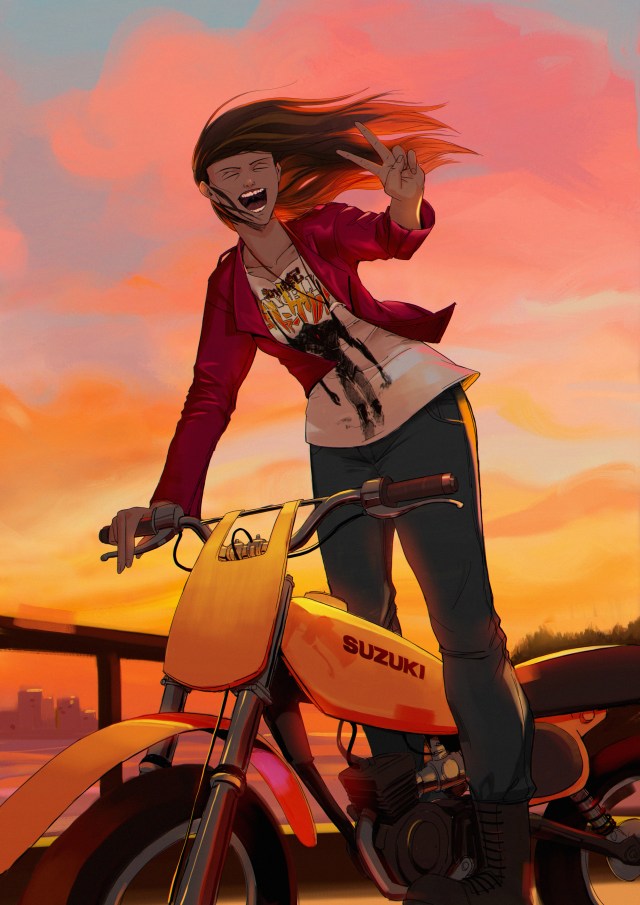
Motocross Legend, Love of My Life, Pt. 19 (Poetry)

You can read this novella from the beginning through this link.


The eve of your death anniversary
Resurrected the old nightmare once more:
I was riding pillion, clinging to your waist,
While your Aprilia Red Rose growled
As it devoured the highway under its tires.
The rainfall hammering upon car roofs,
Drumming on our helmets,
Splashing against our drenched clothes,
Overwhelmed the steady roar of the engines.
The wind drove icy raindrops into my face.

The beam of your bike’s headlamp
Sliced through the rain sheets,
Lighting the rear wheels of the truck in front,
That spat up trails of rainwater.
In the oncoming lane, twin beams appeared
And quickly expanded toward us,
Cutting luminous swaths across the blackness.
On my right, traffic signs, trees, buildings,
They all blurred into smudges,
And the sparse streetlamps revealed themselves
Like floating, shimmering haloes.

Lights glinted off the gleaming, mirrorlike tarmac
In ripples of red and blue-tinged white.
Above, lightning leaped from cloud to cloud,
Followed by grumbling thunderclaps.

In my embrace, your body trembled;
You were crying, or at least on the verge,
And you channeled that anguish
Igniting your steel beast’s roar
With a wrench of the throttle.
My heart thrummed with dread.
The acceleration pressed against my bones,
Tightening my chest and freezing my breath.
Along with the golden tracers of streetlamps,
Oncoming vehicles whooshed past us.

Lighting the way ahead, we were falling headlong,
Whipping through the darkness like an arrow.
Teary-eyed from the sting of rain,
I raised my voice over the rushing wind,
Over the rumbling engines.
I shouted, I yelled, I gripped your sides tighter,
Imploring you to slow down.
As if you couldn’t hear me, as if I wasn’t there,
You revved the throttle further,
Making the speedometer needle climb sharply.
Your bike’s chassis shuddered under the strain.
The raindrops felt like dozens of fingers
Poking my numb face to wake me up,
But you kept racing through the storm,
Maybe wishing to outrun yourself,
Outrun all the voices telling you to stop.

As we approached a curve, your Aprilia wobbled,
Its front wheel skidded on the rain-slick tarmac,
And the bike lurched sideways,
Flinging us off.

The color spectrum gleaming through the downpour
From headlights, tail lights, streetlamps, and lightning
Spun into a blur of light and dark
While my body flailed, limbs striking out,
Scraping against the road as I slid
With rainwater gushing over me.
The friction ripped through my clothing,
Seared my skin, and tore the flesh off my bones.
Screams lodged in my throat.

Your Aprilia Red Rose was flipping end-over-end,
Scattering pieces of its decimated bodywork.
My frantic gaze glimpsed flashes,
Illuminated by the headlights of passing cars,
Of your body cartwheeling uncontrollably.

A murky shape, the guardrail,
Rushed out of the rain-haze toward us
Like a reef thrusting from a savage ocean.
You smashed against the metal barrier,
Which launched you into the darkness.
I clenched my eyes shut, bracing for impact,
And awaited the final, wet crunch.
When I slammed into that guardrail,
A loud snap reverberated through my spine
In a starburst of pain.

The impact had squeezed my lungs,
Knocking the air out.
As I gasped, mouth agape,
A thunderous crash against the guardrail
Sent a shockwave through the cold steel,
Making me, slumped against it, shudder violently.
Fragments of the bike ricocheted off the barrier
And stung my arms and face like shrapnel.
The metallic clang lingered as a discordant ringing.

Your Aprilia lay on its side close by,
Gleaming darkly in muddy rainwater,
Its windscreen shattered,
Frame bent, chassis mangled,
Front wheel still spinning.
A rearview mirror dangled from its stem,
And reflected the electric clouds.
Fuel leaked out of the dented tank.
The headlamp’s white beam,
Shining through the cracks in the lens,
Faltered, flickered, then faded away.

The ozone scent of the storm mingled
With the chemical smell of gasoline,
The burnt stench of grinding metal,
And the bitterness on my tongue.
A tingling white noise had spread
To the farthest reaches of my body,
And in the places that hadn’t gone numb,
My shredded flesh screamed
In a fiery, knifelike pain.

Instead of writhing in the gutter
Like a crushed insect,
I would return to your side,
But when I tried to stand,
My limp legs refused to move.
I grabbed the cold, wet guardrail,
Then heaved myself over it.
I hit the grassy, upward slope chest-first,
And mud splattered on my face.

I crawled onward, clawing at the grass and soil,
Coating my hands with squelchy mud.
The relentless pounding of heavy rain
Along with the deep rumble of distant thunder
Isolated me in a cocoon of noise.
Every creep up the slope ripped me open with hurt.
In jagged gasps, I breathed razors.
Where are you, Izar? Where are you?

The blades of grass glistened
With a fresh spray of blood.
Silvery light from turning headlights
Swam in waves over a body splayed face up
Like a doll tossed in a tantrum.
Your drenched, ripped red jacket gleamed.
Gashes oozed through the torn jeans.
The crushed helmet still clung to your head.

Beside you, I pushed myself up onto my knees,
And lifted the cracked visor of your helmet.
Raindrops splattered in concentric circles
On the blood pooling within the face aperture.

I attempted to take your helmet off,
But your neck strained, its muscles taut,
As if your head might snap off.
You couldn’t breathe.
“Stay with me, Izar. Don’t leave me, please.”
When I scooped blood out of the hole,
My fingers didn’t graze your face.
I sank my hand up to my wrist, to the elbow,
But I couldn’t reach you.

I woke up with a start, drenched in sweat,
Gasping for breath, clutching at my throat.

My fingers are calloused
From decades of clawing
At the dark soil of this world
To drag myself back to you.


Author’s note: the song for today is “I Lost You” by The Walkmen.

The next part will conclude this story.

On audio mastering #2

Last month I wrote a post about the art of mastering a song by adjusting its frequency bands through carefully analyzing the spectrogram, something I had never bothered to figure out before. Here’s that post.

Although I haven’t produced any new songs with Udio, because I’m trying to finish a novella I’ve been working on for seven goddamn months, I’m halfway through remastering the third volume of Odes to My Triceratops, which are a bunch of concept albums about a triceratops. I’ve changed how I master audio in subtle but powerful ways, so read on if you give a shit about this stuff.

  1. Download the WAV file of the song from the Udio interface.
  2. Open the original WAV in Audacity.
  3. Normalize both channels at -1db.
  4. Export it as a 24-bit/192KHz WAV stereo file. I read somewhere that you shouldn’t try to master audio using a WAV file of lower quality, and never ever using an MP3, which are compressed to begin with.
  5. Forget about Audacity and open a better audio editing program. I use iZotope RX 10, which is perfect for my purposes. Load the recently exported WAV file.
  6. Modify the EQ based on good base values (you can look up some and save it as a preset). Ensure that it comes with a high-pass filter at 30hz (roll off 24 db); apparently the human ear doesn’t hear anything below that frequency, so you’d just be leaving pointless data in.
  7. Normalize at -1db.
  8. Don’t bother with compression, multiband or not; I’ve come to believe that applying compression to a song is a crutch, because you can achieve similar but far better results by adjusting the individual frequency bands.
  9. Apply an azimuth operation on the song. It equalizes the volume of both channels and ensures that they are in sync, in case the audio came with some unsightly delay due to poor handling of mics. That won’t happen with Udio songs, but you might as well do so. However, blindly azimuth-ing a song can bite you in the ass: some parts of the song might only sound on one channel for artistic reasons, so ensure that you relisten to the whole thing afterwards. If the azimuth operation clearly shouldn’t have been applied to a specific segment of the song, revert the operation and only apply it to the rest of the song.
  10. Normalize at -1db.
  11. Now comes the fun part: messing around with frequency bands. iZotope RX allows you to set six manipulation points along the whole frequency spectrum. You should put each manipulation point smack in the middle of the following frequency ranges (you can prepare these manipulation points and save the set as a preset):
    • Bass (60-250 Hz)
    • Low Mids (250-500 Hz)
    • Midrange (500 Hz – 2 kHz)
    • Upper Midrange (2 kHz – 6 kHz)
    • Presence (6 kHz – 10 kHz)
    • Brilliance (10 kHz – 20 kHz)
  12. Go to your favorite part of the song and EQ each frequency band one by one, raising and lowering its volume little by little as you listen on your absolute best headphones. I own a pair of $400 noise-canceling headphones by Sony which do a fantastic job of isolating me from this horrid world.
  13. Notes on what raising or lowering each frequency band affects:
    • Bass (60-250 Hz): mostly the punch of drums, as well as similar instruments. I usually want them punchy, but it can distort the vocals if you go too high.
    • Low Mids (250-500 Hz): this is an interesting frequency band: too low and the voices and instruments will sound tinny, too high and the song will sound like mud. It features the “body” of many instruments.
    • Midrange (500 Hz – 2 kHz): mainly voices and guitar-like instruments.
    • Upper Midrange (2 kHz – 6 kHz): most of percussion that isn’t too bassy. This one is very easy to EQ for the entire song: raise and lower this frequency band until the pitch of the drums sounds right. If you raise it too high, some singers’ “S” sounds will hurt your ears.
    • Presence (6 kHz – 10 kHz): high lingering sounds like hi-hats, cymbals, and such. You can rarely raise or lower this much without altering the pitch of other percussion instruments, so I suggest very narrow frequency range manipulations in this range.
    • Brilliance (10 kHz – 20 kHz): this one is a bit hard to describe. Some call it “air,” similar to the sound your thumb and index finger make when you rub them together. It provides interesting details. A base EQ should likely raise this by about 8db. If you raise it further, it will likely screw with the pitch of the drums.
  14. Apply the EQ changes you prepared for your favorite part to the entire song. Particularly when working with Udio songs, it’s rare that the rest of the song requires very different EQ levels than your preferred part, so your changes act as a great new baseline.
  15. Go through each part of the song and apply individual changes to their frequency bands depending on that part’s needs: sometimes a segment should be more bassy, or the midrange be 3db higher because the guitar won’t sound as good otherwise, etc. However, ensure that you don’t screw up the transitions between the different segments of the song. This can easily happen if you raise the upper frequencies too much in one segment in comparison with the adjacent ones.
  16. When you’re happy with the state of the entire song, revise its spectrogram focusing on “instrument or vocal stripes” (not sure what to call them) that are either too white (meaning too loud in comparison to the rest of the spectrum) or not white enough (are buried in the mix).
  17. If you spot instrument stripes that are isolated between frequency bands, and that aren’t affected much by raising or lowering those manipulation points, hover your cursor over that line to figure out what frequency it’s located at. Then, move one manipulation point to that frequency and pinch the range of frequencies the manipulation will affect by scrolling with your mouse. This is a fantastic operation that I recently discovered. It that allows you to bring attention to isolated, perhaps even buried instruments like cowbell, ankle rattlers, tambourine, etc.
    • For example, in the images seen after this list, that solid strip in the “presence” frequency band is located at the 8100 Hz frequency, and is some sort of fancy percussion instrument. If you attempt to bring it further to the surface with a general manipulation point, you’ll distort the pitch of the drums.
    • Thankfully, in the EQ editor, as seen in the following picture, and as said before, you can narrow the breadth of the affected frequency range by scrolling with the mouse.
  18. Normalize at -1db.
  19. Change the viewer from spectrogram to waveform. See those spikes in the corresponding image? Those spiky fuckers will be the bane of your life. A single protruding spike in the waveform will prevent the song from normalizing correctly, as it will adjust to the loudest millisecond of sound. I doubt that using some “limiter” operation is a good idea here, because you will shear part of the sound. I just carefully zoom into those parts, select the spike, and reduce its volume level with the Gain tool. You will likely need to do this dozens of times as you adjust the volume of the song.
  20. Use the clip gain tool, as seen in the corresponding image further down below, to properly raise or lower the volume of certain parts of the song. It’s usually a good idea to match the volume levels of all the song parts, but some do seem to need to sound lower. It’s a matter of taste.
  21. Finally, normalize at -1db.

Images for point 17:

Image for point 19:

Image for point 20:

Anyway, I hope this post helped if you’re also embarked on the marvellous journey of mastering songs. And if not, well, screw you.

Motocross Legend, Love of My Life, Pt. 18 (Poetry)

You can read this novella from the beginning through this link.


I used to know every contour of your face,
The exact timbre of your voice,
The way your body pressed against mine,
Your taste, the salty scent of your sweat.
But your traces are flaking off my brain;
In the seams and margins of my memories,
Bugs and patches have appeared,
Corroding the integrity of a past
That I’m editing, shaping with bias,
As I revisit it time and time again.
Your gaze, your smile, your laughter,
They all fade away into oblivion
With each ticking second.

Izar, I beg you, stay with me.
Let’s leave this suffocating city
On a motocross odyssey spanning Europe:
Hundreds of kilometers of highways,
Speeding through the countryside
Past petrol stations, fields, and farmhouses.
We’ll make love on the shores of the sea,
Then sleep under a blanket of stars.
Let’s rent bikes and ride along the Seine.
Let’s explore the winding streets of Venice,
Swim in the turquoise waters of the Caribbean,
Surf the waves of Hawaii or Costa Rica,
Climb the ancient terraces of Machu Picchu.
For the rest of my days, I will care for you,
Your unstable mind, your fits of rage.

Growing up, I feared venturing far
From my neighborhood, from my parents.
I dreaded exposing myself to risky experiences.
In my mind, I saw my mother’s stern face,
Ready to scold and ground me
For daring to struggle against the vines
She had wrapped tight around me.
Roam the breadth of Spain? Travel the world?
Such adventures felt as distant as the stars.
I was convinced that even as an adult,
I wouldn’t organize something so troublesome.

But that year, I stood in the blazing Roman heat
With my teenage son beside me
And my daughter’s small hand grasped in mine,
Gazing up at the façade of the Pantheon,
Its towering Corinthian columns glowing faintly,
Burned by the merciless July sun;
Its triangular pediment pockmarked, scarred,
With projectile strikes from World War II.
I longed to appreciate its grandeur in solitude,
But a throng of tourists choked the square.
A listless guy stood dressed like a centurion,
His helmet adorned with a plume of dyed horsehair.
The muscle cuirass concealed the flab
Of a modern man suited to a desk job.

The Pantheon didn’t belong in this post-apocalypse,
Among the disoriented survivors of the 21st century,
Who lacked the knowledge to recreate
The sunlit glory of their once eternal past,
And who had lost the will to rediscover it.

Well, what did you think about the sights, Izar?
We never had the chance to escape together,
But I carried your memory to Rome.
I hope you enjoyed the trip.

In my little corner of the world, whenever I could,
I escaped to the freedom of an isolated bench
Along the wooded lane containing your memorial stone.
There, beneath the sunlight filtering through branches,
Hunched over a notebook, I poured my memories of us,
Capturing in words every detail I could remember.
I discovered that writing tricked the brain
Into gilding moments and affixing them to its cells,
Regardless of their authenticity.

Drawing, writing, they couldn’t save me;
They just helped me endure this lonesome life
For yet another day.
But maybe the right words could save
What remained of you.

In my heart, a secret garden bloomed.
Pollen sparkled on iridescent flowers,
Their petals fanning out like peacock feathers.
In this floral realm where time stood still
And death could never enter,
You, enshrined within a poem or story
That wouldn’t fade, rot, nor be reduced to ashes,
Could live eternally.


Author’s note: the songs for today are “This Is the One” by The Stone Roses, and “Sit Down” by James.