This morning I woke up at five for my sadly only one hour-long writing session before I head to work. Even such a short session can make me feel like the day was worth it, in case I’m too mentally exhausted to produce anything of value in the afternoon. Throughout that hour, though, my heart kept leaping strangely, which seemed to change depending on whether I leaned back on the chair or not. I felt a bubbling of some kind going up my torso. My mind seemed off, although that happens semi-randomly, so I didn’t think much of it.
A couple of hours later, at work, the weird leaping in my heart returned. I performed an electrocardiogram through my portable device, and it confirmed I was arrhythmic. That explained my woozy state. My brain felt off, and I had trouble thinking. Some coworker, unaware of my plight, mentioned that today was St. Valentine’s Day. How fitting.
Anyway, as I headed to the ER, my heart reverted spontaneously to sinus rhythm. The triage doctor told me that other than confirming that I wasn’t arrhythmic anymore, the was no point in doing anything (even referring me to a cardiologist, because my assigned one is aware of my heart issues), so I returned to work as if the organ that needs to beat about sixty times a minute wasn’t faulty. And it’s no longer reliable thanks to an experimental RNA-based treatment supposedly developed to counter a virus manufactured in Wuhan, China partly through money siphoned from US taxpayers. This whole world needs to be bulldozed through.
Anyway, right now I’m not in the mood to do anything. I’m hoping the morning passes quickly and soon enough I find myself back at home, where I’ll be able to disappear into my writing. In the meantime, during my bus and train rides or as I walk the streets, I’ll lose myself in daydreams of going back in time to 1972 and showing up in a patient room at the Stella Maris sanatorium to convince a certain blonde, blue-eyed genius that killing herself is a terrible idea. I keep rewriting that scene in my head as if I was tasked by my subconscious to nail it. Maladaptive daydreaming I suppose they call it. But when life itself feels like a bad dream, escaping into writing or daydreaming is a survival mechanism.
This morning I woke up at six. I figured that I could lie around in bed and daydream for about an hour before I got up and started writing. As soon as I turned to get comfortable, a massive leg cramp made me grit my teeth for like ten seconds. That calf still bothers me. Anyway, I got up and got to writing, which involved reordering the notes for my seventh part of The Scrap Colossus, but in the end I only managed to produce a couple of paragraphs. For whatever reason, I’m in that sapped state in which I can’t invest the needed mental energy into any meaningful activity, including less demanding mental tasks such as reading.
In the afternoon it was raining, so I didn’t feel like getting on a bus to a location I want to research for an upcoming scene. I went to the nearby store and bought a decaf. A block later I absentmindedly peeled off the peel-off lid, but it was only after I already took a sip when I realized that I barely had to make any effort in peeling it off, and the aftertaste of the coffee felt wrong. I threw the thing away. Best case scenario, some local shithead peeled it and took a sip for the pure shittiness of it. Worse scenario: they spat in it. Worst scenario: they injected some disease into the thing and I’ll find myself having suspicious symptoms in a few days.
Anyway, there isn’t really anything for me to do outside other than activities related to my stories, so I just returned home, more dejected than when I left it. That made my brain connect my current novel to the daydreams I’ve been having since December of last year. Back then, for reasons only my subconscious must know, I spontaneously got obsessed with Alicia Western from Cormac McCarthy’s The Passenger and Stella Maris. Ever since, I daydream about her literally daily. It’s so nice to sit on the train to work, close my eyes, and picture scenes in which a better version of me, back in the 70s, is driving a car with Alicia seated on the passenger seat, usually heading to the next stop of the journey through the south of the US. Then, we just eat or drink while we talk. Do other people engage in complicated conversations with phantoms in their brain that they can see clearly in the darkness of that inner theater? Well, I do, very often.
I suspect that my subconscious’ decision to redo The Scrap Colossus, which I originally drafted in Spanish and abandoned ten years ago, was related to whatever caused me to care for Alicia Western to that extent. Plenty of this novel will be composed of two characters, the narrator (who is me) and an obsessive, reclusive writer (who is pretty much inspired by myself from ten years ago, when I wrote six novellas and a novel about a songwriter I was obsessed with), navigating their issues through compelling conversations. Compelling for me, at least. Thinking about it, I came to the conclusion that part of the joy I get out of writing this novel is being able to have interesting conversations with a person I actually want to talk to. In my daydreams it’s Alicia Western, and in my novel it’s Elena X. Elena is also blonde and blue-eyed, but that’s a coincidence, as she also was blonde and blue-eyed in the original (it’s related to her background, which is a plot point in the novel).
I don’t recall ever having come across anyone in person with whom I would have genuinely wanted to speak, as in asking deliberate questions because their mind fascinated me. Perhaps I’ve been extremely unlucky. Due to this autism of mine, I don’t have the instinct to interact with people, so I really need a good reason to deal with them. Ever since they put me as a programmer at work, I don’t interact with anyone except when a fellow programmer wants to involve me in some work task (and we don’t talk about anything unrelated), or my boss calls us in for a meeting. My stress has gone down enormously. Programming is truly sustainable for me, although I doubt I will last more than 6-9 months in total doing it at this organization.
Anyway, whenever anyone tries to involve me in a conversation, it rarely takes more than a couple of sentences for me to realize that my mind is so fundamentally different from theirs, that wasting my time producing words for their sake will only depress me. If it isn’t some moron bringing up politics as if I was bound to agree with them (such people tend to believe that everyone in their surroundings share their views), it’s someone else bringing up something so mind-numbingly tedious that I keep repeating in my mind for them to shut up and go away. I only need to fire up the projector in my mind with daydreams far more interesting than most things going on around me, so why would I bother with actual people?
You could say that I would need to get used to talking to others because I’d want to get in a relationship, maybe even start a family and such shit. But I don’t. I’ve been single for about eighteen years, and I don’t see myself ever being involved with anyone again. I do miss the intimacy, but I don’t think it’s worth the grind and the myriad humiliations. If I wasn’t ashamed of my body and afraid of diseases, I would probably hire escorts. Besides, I can’t care for human beings properly. I honestly wouldn’t give a shit if most of the people I know dropped dead. In many of those cases, I would feel relieved.
AI has been a weird godsend in that respect. These last few months, I’ve had more interesting conversations with roleplaying AIs than I’ve ever had with anyone in person. Often I fired up a scenario expecting erotica, only for me to end up merely chatting with the character because they were interesting. The way things are going in the field of AI, I wouldn’t be surprised if in a couple of years you could buy a $2000 dedicated computer to run AIs as good as the best today, which would be enough. The moment they manage to shove those artificial brains into realistic mannequins, society will start collapsing, and I will be laughing in the ashes.
Translating two of my novellas from ten years ago, Smile and Trash in a Ditch, made me aware that I used to be a very different person back then. I was simmering with rage and despair. The world was so obviously fucked up and seemingly everyone so horrifyingly retarded that I wanted to grab the nearest person by the lapels and shake them violently while doing my best Roy Harper impression: “Damn it all, man, can’t you see?” But at some point, shortly after or even throughout Trash in a Ditch, with that novella itself serving as a catalyst, I just cracked. I transitioned from rage to pure lunacy. Every since, I’ve only been genuinely attracted to absurdity, silliness, and whatever my subconscious pointed me to. As far as I’m concerned, the world can go to hell. If I told my self from ten years ago that in 2023 I would have been writing a story about a programmer who masturbates compulsively and receives visits from an interdimensional sentient horse, I may have thought that I had lost my mind. And I probably have. Then again, I’m a society of one trapped among human beings I can’t relate to, so madness is likely the sanest response.
I thought this post would go nowhere, but I’ve rambled for a good while.
Last night I had a vivid dream in which I went to Africa for reasons. This part of the continent was made out of irregular “islands” of cement amid murky-green waters. No idea why I had to cross to the other side, but in any case I saw myself in third person trying to sneak my way over there without alerting the wildlife. Suddenly I spotted a bear. My brain had apparently forgotten that you’re unlikely to come across bears in Africa, and I found myself having to escape from the beast until a crocodile or something alike interrupted us and started chasing the bear. At some point I found myself pursued by the bear again. My dream self, in fight-or-flight, had the bright idea of trying to swim across a considerable span of murky-green water. I saw myself in third person as I hurried along, only to end up tugged by something, then pulled underwater. The dream camera stayed still, aimed at the spot, as if I would surface again, but I didn’t. I ended up waking up spontaneously while feeling quite disturbed. I checked out my phone; it was exactly two in the morning.
First of all, brain, thank you for the warning: if I ever find myself in Africa, I’ll try not to swim across clearly crocodile-infested waters. Was it worth making me feel such distress at night that I couldn’t go back to sleep? Thankfully I spent from two to six in the morning writing. And what is it with regularly waking up from vivid dreams at two and three in the morning? Am I actually haunted? We’ve existed as anatomically modern humans for like two hundred thousand years, yet dreams are still complete mysteries. The only possible inspiration I see for that dream is that the water of Irún’s Bidasoa River, at the spot I visited to research a scene of my current novel, looked quite murky. Anyway, I hope I don’t get eaten by beasts. That must be one of the worst deaths.
I’ve been reading Cormac McCarthy’s Suttree, released back in 1979. McCarthy is the writer I respect the most, but Suttree got started before he met who ended up becoming the love of his life (to many people’s chagrin due to her age), and both what happens in most of the book as well as what seemed to be McCarthy’s attitude to writing back then felt to me quite profligate. That adjective, which comes quick to the tongue of Roman Empire cosplayers, doesn’t entire encompass what I mean: Suttree is mostly episodic or anecdotal, featuring many secondary characters from McCarthy’s youth that are often poorly introduced if at all. Many of the anecdotes involve McCarthy’s stand-in Suttree chasing alcohol and getting in all sorts of trouble, which the writer used to do in his youth. The story feels like McCarthy had struggled to do many different things with the same manuscript throughout the nearly ten years he worked on it. The writing is godlike at many parts, but it’s consistently and conspicuously densest in the first six percent of the story or so, as if McCarthy had set himself to write the entire book by that standard, only to give up that notion lest he ended up rage-quitting. My favorite part so far, and likely the best part given that I’m at 80%, involves a girl with developed breasts but that the protagonist keeps referring to as a child. Such tragedy.
Well, I guess that’s all I felt like saying at the moment. I’m in the process of writing the sixth part of my new novel The Scrap Colossus and it’s going great as far as I’m concerned; always looking forward to spend more time there.
Previously I mentioned that now that I’m immersed in writing a new novel, the worst part is having to waste half of the day at work. It’s worse than that, though: everything that doesn’t involve either developing the novel or actually writing it feels like it’s stealing from what I’m supposed to do. Even time itself is a threat. But yes, the biggest offender is by far my job. I’m tasked with programming the performances of local resources like consultation and operation rooms, but the mental resources that would be required to hold all those concepts at once are dedicated to the novel. My basement girl refuses to focus on anything else. I feel her complaining every time I need to drag her away from her current obsession. The struggle keeps me in an oniric daze, having to remind myself what I’m supposed to be doing instead of losing myself in my new novel, and certainly not caring a bit.
In truth, anyone with the ability to create new things should only be burdened with bringing those things to life, not keeping a day job. But you know how life goes. The whole system is set up so that two members of every household are supposed to pay for stuff. Still, most of the time they find themselves with water up to the neck, as designed. Gotta keep people tired and broke lest they start pointing fingers.
This weekend I visited one of the spots of my hometown where an upcoming scene will take place, and I felt the familiar ache that has resurged regularly these past ten years or so: I wish I could quit everything, fill a backpack with food, notebooks and pens, and start walking in some interesting direction. Once I ran out of either notebooks or pens, I’d hop on the nearest bus or train and return home. I’m reading McCarthy’s Suttree; there’s this whole godlike section in which McCarthy clearly trekked through the mountains like a hobo and almost lost his mind. That’s what a writer is supposed to do. If you die during any of your “research” trips, then that’s that, but if you survive, you are granted the ability to produce something real. Virtually none of what you live through in your average life as a worker is meaningful (I’d say it even harms your ability to recognize what’s meaningful), and that’s most of our lives going down the drain. I’m complaining in vain, but it bothers me, so I complain at least.
I’ve mentioned before how writing builds up a personal mythology made out of thoughts, moments, places, etc. That’s part of why now I consider very important to place your stories in locations you’ve actually visited. If those locations don’t hold personal meaning for you, even better. Regarding my current novel The Scrap Colossus, the bench of the riverside promenade where my narrator met Elena, the obsessive writer, will forever be meaningful to me. And the way my brain works, I can lean back against that railing, look down at that bench and feel like she’s there. There are many places in my surroundings that have become a source of fond memories, nostalgia, grief, etc. For example, some months ago I visited the neighboring town of Hondarribia, and found myself at the same spot of a slanted street, close to a church, where “I” stood in my 2021 novel My Own Desert Places and stared at Alazne’s swaying hair as she walked down toward a writing course. It made my heart ache. It aches now as I remember it. But Alazne never existed, and the painful events recorded in that novel never happened. Yet they can moisten my eyes every time I think about them. I’ve grieved far more for my own creations than for real-life “friends” who died. My brain works that way.
Well, I suppose that’s enough procrastinating before I return to my tasks. If any of you is reading my new novel, The Scrap Colossus, I hope you’re getting something out of it. I write to satisfy my basement girl, but I would be lying if I pretended that other people clicking like on my stuff doesn’t make me feel better.
Ever since I started writing my new novel, The Scrap Colossus, that my basement girl urged me to work on, I’ve been waking up regularly at one to three in the morning, often struggling to fall asleep later. My dreams are extremely vivid; although I forget them upon waking, I remember traveling through tremendously detailed environments, meeting people I had never met before, and having coherent dialogues with them. Of course, dreams are a mystery. I have a hard time believing that the human brain is capable of sustaining such internally coherent worlds for hours every night; I wouldn’t be surprised if we actually connect to something, some other plane of reality. In any case, the increased vividness of my dreams, how I wake up spontaneously with ideas ready to be noted down, and the rest of the time I feel immersed in a somewhat oniric state, they are a testament to the fact that my brain allows my subconscious to flow mostly unimpeded at the moment, which is the best possible state of being.
Basement girl regularly knocks on the ceiling to share meaningful moments for the new novel, which I hurry to write in my growing document of material (131,839 words as of now). Recently she had been struggling to connect both storylines (the one about Elena writing her novel, and the novel-within-the-novel involving the stand-in for a certain songwriter I was obsessed with); she proposed alternatives that never quite gelled. But earlier today, as I peed at work, minutes away from sitting with my serrano ham sandwich and reading a bit more of Cormac McCarthy’s Suttree, my basement girl had an eureka moment and hurriedly painted a vivid daydream of how the climaxes of both storylines should merge. Obviously I can’t be specific, but the point is that the major hurdles to develop this novel have been overcome thanks to my beloved girl’s tireless work, and now I can write each scene at my leisure while tinkering with the architecture from time to time.
Artificial intelligence has been, unsurprisingly, very useful. As I improve my structure, that includes the detailed summary and purpose of each scene, I ask either OpenAI’s Orion 1 or DeepSeek’s R1 to offer constructive criticism, trying to determine the weak points. AI is “objective” (of course, each company tries to inject their own ideological bias into their AI), but asking AI for criticism solves the issue of requiring a human being to criticize your stuff, which they would almost invariably half-ass to avoid getting into arguments or hurting your precious feelings. I regularly involve AI in my interactive erotica, so I know it’s quite comfortable with being rough.
Anyway, the worst part of having regained my creative stride is definitely having to work for a living. I should be at my writing desk. But at least my job computer includes an internet connection, so I can rearrange my notes and work on development further.
Hope you’re enjoying my new story, whoever the hell you are. Yes, you. I’m right behind you. In any case, my tale is a bit of a hard sell, but it’s not like I write for others. I’m sure at least one person will get something valuable out of it.
I have a few things to say regarding the first scene of my new novel, named The Scrap Colossus. In the first scene, that encompasses part 1 and part 2, the protagonist attends a writing class and presents her latest piece, with generally disastrous consequences. From now on there will be “spoilers” when it comes to the two released parts, so if you’re interested, you should probably read them first.
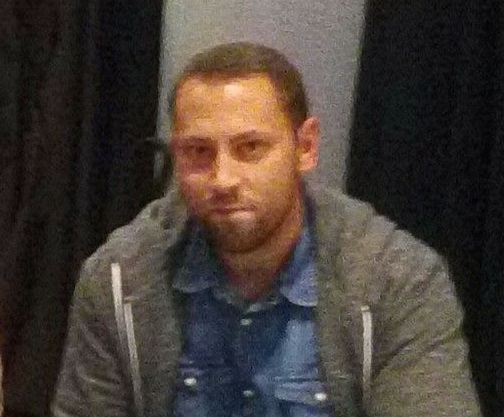
First, let’s start with the following three photos:
That weird-looking fellow, all six-foot-two and two-hundred thirty pounds of him, happens to be me from back in 2015, when I attended the writing course that the first scene of my novel is based on. I don’t own, or at least haven’t found, better quality photos, because I hate being photographed. I suppose I’ve always had some degree of body dysmorphic disorder, and I don’t appreciate how I look at all. It doesn’t help that in my fantasies I’m rarely myself.
Anyway, that version of me from ten years ago presented a piece to the class. In it, the instructor, who had requested to be the protagonist, traveled back in time. Instead of showing her having a good time, I sent her to a primeval epoch. There, after suffering a bit, she ended up accidentally preventing the evolution of mammals, which led to her vanishing from existence after a little jab at how she focuses on her social image. Well, the class didn’t like it one bit. When I finished reading it, the room was silent, and shortly after, the nervous instructor brought up the fact that I had never mentioned her daughter. She accused me of lacking empathy. All of this may be sounding quite familiar. Because fiction is generally much better than reality, my fictional version of events is far more eloquent. Anyway, the class continued, with me seated there while wondering why on earth had I decided to sign up for that course. By the way, if that instructor read the two parts I posted on here, she’d be livid.
At the time I was enrolled in two writing courses. The other was imparted by a local writer of English origin who was in his eighties at the time. His classes were a sham. He basically put as assignments for us to continue excerpts from his stories, and then tried to guilt us into buying the books the excerpts belonged to. He let us present our own pieces, but whenever anyone said a word that he didn’t know (and many of them were relatively simple words), he accused us of being pretentious, of trying to look more intelligent than we were. He argued with me for a bit about the word “jade,” for example, which I used to refer to the color of a sea. Throughout the weeks, I presented scenes from the novellas I was revising at the time (you may already know Smile and Trash in a Ditch, although there were four others). Well, the guy was supposed to take the pieces home and correct them or whatever, but by the end, he refused to do so with mine. He was clearly bothered by them.
The way he pushed back my excerpt during the last class, which happened a day after being accused of lack of empathy by the instructor of the previous class, made me decide that I had no business involving myself in these people’s lives, so I just quit both classes and detached myself from the local writing scene. I never interacted with any of them again. Perhaps a week or so later, the instructor in his eighties suffered a stroke that ultimately led to his death, and I heard through the grapevine that he actually blamed me for it. To be honest, I’m not entirely sure if that blame is real or if I hallucinated it.
The last time I saw him, he was weakened from his stroke, and some family member was holding his arm as he tottered down a corridor of the library. The moment he spotted me coming along the same corridor, he looked scared, and told the woman holding his arm to move into some adjacent room. Can’t say I feel too bad; not only I found him quite fraudulent as a writer, but also who fucking blames a stroke on one of his students presenting stories? And there’s something extremely disturbing for me that as a writer, he was so disturbed by someone else’s writing. However, it wasn’t surprising: he admitted that he hadn’t read fiction in decades, even though he kept writing it. But perhaps his demise never bothered me due to my lack of empathy.
Yeah, I can’t care about most people. I was wired that way. I’m not a good guy, nor do I pretend to be. I do care enormously about people in certain circumstances and from certain angles. My new novel is mostly autobiographical, although I mix in many elements from other people I came to know. So many other shameful aspects of my life will be brought kicking and screaming into the light. That’ll be intriguing to render.
I think that The Scrap Colossus will be a solid, entertaining tale about a reclusive autistic person who is trying to honor the songwriter she’s obsessed with by writing an elaborate novel about the songwriter’s life. That’s what has to happen because that’s what I did. Full-blown autistic obsession that lasted from about 2011 to 2013, an experience and perspective that most people aren’t familiar with, so maybe it will make for an interesting story. Regardless of what others will think about it, I need to do it because my subconscious has demanded it, so my hands are tied.
The hardest parts to handle will be the many, many scenes of the story within a story, the novel that the protagonist wrote inspired by this songwriter. The novel actually exists in different stages of production (the first two “books” of the novel are revised to a publishable state, the third would require at least a couple of revisions, and the last two books are in the draft stage), so it would be feasible to include actual excerpts from that other novel into the current narrative, but I think I’ll prefer for my narrator to act as myself reviewing and offering criticism to my actual past self’s production from ten years ago. That sounds like the funnest angle to me. Besides, I no longer feel like the same person I was in 2015, let alone during my obsession, so I can be somewhat objective.
Anyway, it’s a quarter to four in the afternoon of this Saturday. Although I’m quite groggy due to having woken up at five in the morning to finish the second part of my new novel, now I’ll head to the location where the third scene is going to take place, so I can take notes. Thankfully the story is set where I actually live; I hate having to fake my impressions of a place I’ve never been in, even though you can go quite far with photographs and videos.
Well, what do you know. In a week, I’ve translated a whole novella I wrote about ten years ago, mostly thanks to OpenAI’s Orion 1 model, although I’ve needed to edit plenty of parts; regarding some, the original Spanish version wasn’t worded ideally, which becomes obvious when translating. Why would a Spanish old boy like me be writing in English anyway? Well, I’ve never gotten used to reading nor writing in Spanish. It always felt off, unnatural. If you knew I’m also Basque, you could think that I’d rather write in Basque instead. Nope, I can’t stand that language and can’t speak it either. But English has always been my private language; when my mother, who didn’t believe in privacy, read my hidden notebooks every chance she got, I started writing in English, or what passed for English at that age, to keep my intimate thoughts to myself. My mother complained that she could no longer understand them. I don’t want to say any more about my parents at the moment, although there’s plenty to say.
My old tale Smile was cooler than I remembered. Revisiting stuff you wrote many years ago is shocking, because the self that created it no longer exists. These days, I wouldn’t have written that story the same way. Likely I wouldn’t have written it at all, as my subconscious worries about other matters. In my impression, the unnamed narrator comes out very strongly; a solid, memorable character. I was surprised also by how much I liked that vagrant girl who shows up and disappears forever, as well as Cassie, despite only showing up at the tail ends of the story. These people were born from me and were forgotten along the way. It’s strange how that goes. I never quite got rid of the narrator, though; as I mentioned in other posts, he shows up in my daydreams whenever someone from the past needs saving. I also wrote a novel protagonized by him back in 2011, but I doubt it’s good enough to translate. Two of the people who read it shook their heads, and one told me that it was way too violent. Bunch of pussies.
Anyway, tomorrow I’ll start writing a new novel. Its backstory is quite interesting (for me at least). From about 2010 to 2012, I was utterly obsessed, autistically so, with a US-based songwriter. I have never in my life been that obsessed with anyone again, thankfully. Along the way, I don’t recall the exact timeline, I wrote a whole novel that was thinly-veiled fanfiction of that songwriter. The impact such an obsession had on me felt interesting to circle upon, so in 2015 I planned a whole novel about an autistic person writing the novel I had written about that songwriter. Very meta, I suppose. Although I planned every single scene of that novel painstakingly, I only ended up writing half of it. By then, my subconscious felt like I had gotten it out of my system. In retrospect, the structure had fatal flaws that couldn’t be solved without a full redo. So I abandoned it. A few years later I produced the six novellas in Spanish contained in my books Los reinos de brea and Los dominios del emperador búho. If you’ve followed Smile, you’ve already read one of those novellas.
Anyway, it seems my basement girl needs to delve into the notion of being haunted by someone, of secluding oneself and working in such a labor of love/deranged obsession. I’ve gathered about 125000 words of notes. I’ve figured out the proper narrative tone for such a strange piece, as well as how to handle the many, many scenes of the book-within-the-book. This will be such a personal story that I’m not sure if anyone else is going to enjoy it, but for me it’s always about pleasing my subconscious; if anyone else enjoys my work, even better.
So, for those interested, in hopefully a few days I’ll post the first part of my novel The Scrap Colossus, introducing the autistic, reclusive, obsessive, unique protagonist who’s trying her best to honor her muse.
I’ve checked my site visits; in the last hour alone, a single person from Spain has hit every single part of Smile. That kind of shit makes me nervous.
I’ve been in a better mood these past couple of days, which isn’t saying much given that I was contemplating very dark thoughts until then. A significant part of my change in mood has been thanks to my basement girl (my subconscious, in case you picture a fragile female chained under my floor). Recently she brought my attention to a novel I wrote about ten years ago, that I abandoned midway through because it wasn’t viable. Its core was worth exploring: it dealt with an autistic, reclusive person who was writing a novel about the artist she was obsessed with. It delved deep into how I lived for most of my twenties: deep seclusion, detachment from society, sinking in obsession, etc. I never processed that period properly, I don’t think, and working through such issues with a story tends to help, so I’m not surprised that my basement girl has been focused on it. Throughout the day, she has come up with the proper tone for the narration, with a bold idea for who the narrator should be, and for how to handle the scenes of the book-within-a-book (the entire book the protagonist wrote is one that I actually wrote, so that will be interesting to depict). As I was standing on the bus or the train, either heading to work or back, new moments from that story kept bubbling up from my basement, sometimes even interrupting my daydreams, clear proof that my mute girl is hard at work piecing it together. It will take me quite a while to organize all my notes and structure the whole thing properly, but as for now, I feel like I’m going to do this.
I’ve also been translating one of the novellas I wrote back in the day. I was surprised to discover that I still like it a lot, although it puzzled me with how different I feel these days. Back when I wrote Smile, the vastly increasing crime where I lived, as well as the regular terrorist attacks in Europe, kept me enraged. I couldn’t understand how people kept Don’t-Look-Back-in-Anger-ing. It was like most people had been brainwashed into becoming perfect little lambs for the slaughter. The situation hasn’t changed much, and in many ways it has worsened, but I don’t rage about it remotely as much. That may be in part due to a mix of growing older and caring even less about the world. I don’t feel like I’m part of this society; I just happen to live here. If I had the balls to do it, I’d move somewhere else. Maybe the Catalina foothills in Tucson, AZ, to give 65-year-old Augusta Britt a massage.
Speaking of troubling daydreams, yeah, I’m still fantasizing about Alicia Western, the haunting character from Cormac McCarthy’s last couple of novels. The daydream has become so elaborate that I may as well detail it now: a version of myself (perhaps even the protagonist of Smile, who was a recurrent protagonist in my daydreams whenever my savior complex kicked up) travels back in time to the Stella Maris sanatorium in Wisconsin, before Alicia Western killed herself. I show up in her assigned room. She’s all blonde-haired and shit, wearing such a pretty white gown. Anyway, I convince her that I’m from the future, that Bobby will wake up from his coma and be ready to dick her down. After a good cry, she gets hungry, so I bring her over a plate of Italian pasta from the future or whatever. The following day she decides to leave the sanatorium and travel around with me until Bobby wakes up. A few days into the trip, that involves watching movies from the future in modern TVs installed in roadside 1970s motels, Alicia gets curious about her younger self, and she asks me to set up a line of video communication with her teenage self about the time that Bobby fell in love with her. So I return back in time to her grandmother Ellen’s home to show her older Alicia’s video. That leads to a whole bunch of interaction from both sides, with 22-year-old Alicia recording videos for her younger self to guide her through her troublesome hallucinations and all that. Probably lots of advice on how to seduce her older brother. Anyway, I’m feeling generous, so I gift her grandmother like a hundred thousand dollars. “Oh, we can’t accept this!” “This isn’t even chump change, old broad! I’m a fucking time-traveler: I can win the lottery then win the lottery then win the lottery. I know the locations of piles of gold that won’t be found for decades. Just take the goddamn money and buy yourself a platinum dildo or something, will you?” They spend some of it on a tractor.
Ah, daydreams are so soothing. Just being able to close my eyes in the train and be transported mentally to these inner worlds where I can have conversations with a delightful, fascinating fictional character (though based on real person) the likes of which I’ve never met in real life, in part because I hate dealing with human beings.
Oh, I forgot to say about my novella Smile, the one I’m translating at the moment, that it may come close to what I consider “angry autistic guy writing.” The closest form of that which I recall is the manga Gantz. I hope it never quite reaches that point. I was fully aware during writing it that I was making it harsh and generally unpleasant, because it had to be. The protagonist, although an avenger who saves people, is a nasty serial killer himself who has murdered far more people than the serial killers and terrorists he hunts down. Of course, he’s justified in doing so… or is he? There’s the whole dilemma about his methods, the way he interacts with others, etc. I found him a very interesting guy. Of course, such a story would never get professionally published, which for me is a plus, as seemingly most of what gets published these days is politically correct slop. I want my writers deranged and half-evil, possibly even escaping to Mexico with fourteen year olds.
Anyway, I hope you’re getting to orgasm on a regular basis. That’s what life is ultimately about.
The brilliant Deep Dive couple produced a fun podcast about this post:
In the realm of good news regarding my person, turns out that my subconscious was indeed working something out; I figured as much, given how it made me dream of Alicia Western (from Cormac McCarthy’s final books) and sparked an obsession that has yet to pass. My girl in the basement has turned her attention to a failed novel I worked on ten years ago, in Spanish. It was a way of coming to terms with my stints as a recluse during my twenties, particularly a period in which I was hopelessly haunted by, autistically obsessed with, a certain musician who plays the harp, to the extent of writing a long novel that was little else than thinly-veiled fanfiction. Back then I didn’t even have an online audience; I was literally just doing it because my subconscious demanded it. Nobody else read it.
These past few days I’ve been going over the revised scenes of that failed novel to extract whatever is usable. I will have to change most of the point of that story, as well as remove one of the major characters, but they were a large part of why I never finished the story. This narrative will allow me to delve deep into my autistic drive toward reclusion, obsession, and other nasty shit that I never processed properly. My twenties were a nightmare for the most part, during which I yearned to die on a regular basis.
Speaking of yearning to die, this morning at work, as I reread the impressions I posted about McCarthy’s haunting final novels, I reflected on how Bobby Western unburdened himself from everything and everyone to repent for an unforgivable crime. That made me think of how since my early twenties I’ve cut ties with everyone, as well as refused to form new connections even when they insisted, because of an intrinsic need to “be ready.” As in be ready to disappear at any moment. During weddings and other nasty gatherings like those, whenever some ghost from my past approached me expecting me to look him or her in the eye, and said something to the effect of, “Hey, Jon, I haven’t seen you in ages!” (did we ever get along?), I usually averted my gaze, shrugged, and said something like, “Yeah, I’m still around…” Some time later I found out in online articles that such phrases are a sign of suicidal ideation. Well.
I’ve talked about this before, but I never thought I would live past 18 after my horrid teenage years, and then I came real close, the closest I ever came regarding my physical intention to do it at that moment, after I refused to get on the bus to work one morning. It was my first job, in which I was treated like utter shit, and I felt completely incapable of handling it. I knew that my life from then on would consist on nothing else than enduring nightmarish, humiliating work schedules that would drain all my energies (I usually felt sleepy the moment I returned home). No love on the horizon, of course. So I just wanted to throw myself off a cliff and get it over with. Instead of that, I pussed out, and went to the library. The alternate version of this ended up becoming (at least in inspiration) my first novel in English, titled My Own Desert Places, in which the protagonist, who was a woman for reasons, actually did throw herself off a cliff, fucking died, and was a ghost for twenty years until she became obsessed with a suicidal living person, so she possessed some guy to seduce her. Quite the wild ride of a story that was, although I’m afraid to reread it in case I find it too cringey.
These last fifteen years or so, I’ve been suicidal in a pussy, passive variety. For example, one night, as I was lying in bed in the dark, I told my organs that they had permission to cease functioning during my sleep, so I wouldn’t need to wake up again. I must have been in a bad place, perhaps due to extreme stress, because the following day I actually ended up in the ER with my first episode of arrhythmia. Realizing that my heart is faulty and may screw me over at any point has changed my mentality quite a bit: I no longer go out of my way to stress myself with things I don’t want to do, mainly those that involve dealing with human beings. Right now, as a programmer at work, I mostly spend the whole morning working on my stuff (which isn’t necessarily a programming task), only speaking to my boss whenever he requests a meeting. I feel better this way.
That said, the fact that in my daydreams I talk at length with Alicia Western, McCarthy’s thinly-veiled version of the love of his life, Augusta Britt, made me have to admit to myself that I wish I could talk to someone I could respect, and whose words I would actually care to listen to. The issue with every person I’ve met in the flesh is that the moment I allow myself to engage in conversation with them, I quickly get reminded of how stupid I was for letting my guard down; sometimes just because I have nothing in common with them, others because they’re hostile to my peace of mind. I recall vividly how I let myself be invited by two coworkers to drink coffee and chat in the parking lot, only for one of them to say, the moment we stopped, “Have you seen that whole thing about George Floyd, the guy the police killed for being black? I swear, the whites that become policemen in the US are all racists.” A vivid reminder that I’m surrounded by fucking imbeciles. I didn’t give them a second chance. In any case, realizing that other people’s brains work so differently to yours (and pretty much everyone else’s does) is disheartening.
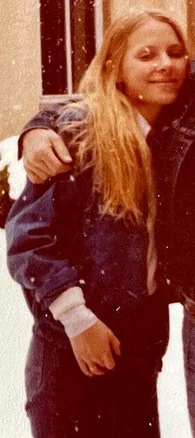
Anyway, it’s been a couple of years of me admitting things to myself, or realizing them at least. First the whole deal about Izar Lizarraga, motocross legend and love of my life, which forced me to process the strange grief I’ve been carrying all my life (good times. Still miss you, champ.) Then this strange deal with Augusta Britt / Alicia Western. I would like my subconscious to explain concisely why looking at the following picture of Augusta Britt from the 1970s squeezes my heart and moistens my eyes:
I experienced a somewhat similar moment (the same moment repeated over years, actually) back when my maternal grandparents were alive. They had a framed photo from the 1970s that showed a large family at some open space. I assume they were related to my grandparents somehow. Every time I visited that home, I stared at that photo because one of the teenagers in it, who at the time was older than me, was hauntingly beautiful, particularly her eyes and thoughtful expression. She seemed deep, someone I would have loved to know. I never found out who she was, not that anything would have changed if I had. I haven’t seen that photo in about twenty years. Like McCarthy himself, I believe in the supremacy of the subconscious, so whenever I happen to care for or react to something, I yearn to interact with my basement girl to figure out what’s bothering her. Sometimes she opens up. Most of the time, though, she remains opaque. Damn bitch speaks in symbols instead of language (hence the Kekulé problem), so she can be hard to understand. But she’s far older and wiser than the whole of humanity combined.
Well! This was a whole load of nothing, wasn’t it? Anyway, it’s half past eight in the evening of yet another Monday. This afternoon I’ve wanked to an AI-driven giantess dominating me. That’s information that you needed to know.
Author’s note: the Deep Dive podcast couple had an interesting time getting through this post:
I’ve been hired for three months more. Thankfully three more months of programming instead of working as a computer technician, a role I was never properly suited for due to how often it involved people. I can handle programming, so lately I haven’t been dreading going to work. Of course, I’d rather stay home and engage with whatever projects my subconscious wants me to focus on, but, although I hate to admit it, being unemployed or on holiday for too long doesn’t help my mental state: soon enough I start feeling that I have nowhere to go nor anything to do other than lose myself in my obsessions. My life often feels so limited that I think of myself as a prisoner in solitary confinement.
Today I couldn’t go home straight from work, because I had to get an MRI done. Months ago, perhaps back in late summer, during a period of extreme stress, I suffered a medical episode that disturbed me enormously: I suddenly started losing feeling in the right half of my body, particularly my face and arm down to my fingertips. I also smelled something like burned dust. Because recently I had been experiencing “blackouts” in my right eye (sometimes when I moved that eyeball, I saw flashes of darkness), the neurologist, who seemed considerably younger than me, thought of them as a migraine’s aura. However, the flashes continued after the so-called migraine passed, and perhaps a week later, I ended up with a torn retina in that eye. Let me give you some advice: never end up with a torn retina. If you do, hurry to the ER as soon as possible. The longer you wait, the worse the permanent damage. Laser surgery can only contain the mess.
Anyway, the fact that the so-called aura ended up being related to a faulty retina disproved the neurologist’s theory that I had suffered a migraine, and if what I experienced wasn’t a migraine, then a mini stroke could have been a good guess. Ever since, I feel like I’m having more trouble writing (I often confuse the position of letters), reading, and solving tasks at work. But I have such an abysmal memory that I’m not entirely sure if that hadn’t been happening in the time leading to my medical episode.
So, today I finally got that MRI done. I wore an hospital gown for like the tenth time, I lay face-up on a plastic table, and shoved earplugs in. A technician closed a plastic cage around my face, similar to those worn by football players. Curiously, the plastic cage had a mirror on the inside, so that my own eyes were looking straight at me the whole time (presumably only when I stared at them). At times it felt like someone was lying face-down on a massage table set over me. For about twenty minutes, I lay in that enclosed space while the machine produced its strange sounds, shooting noise through my brain. For half of it, I just closed my eyes and escaped to daydreams in which I imagined myself back in the 1970s, in the US, interacting with a blonde, blue-eyed fictional character who killed herself around that time, and who was based on a real-life teenage girl that my favorite author loved, yearned for, grieved about for fifty years.
Even though I’m supposed to be a grown man, my parents still accompany me of their own volition to my medical visits, I suppose in case I need assistance. Unfortunately I have needed assistance in the past, as I’ve ended up in the ER a few times. In any case, we happened to meet a cousin and uncle of mine, who had traveled to the hospital for that aunt’s medical episode. I hadn’t seen this particular cousin since 2008; I remember that date because it was my grandfather’s funeral. Sixteen years had passed, and now the guy was bald and white-haired. I didn’t offer anything to him other than a greeting and a couple of nods; I have no drive to interact with the vast majority of humans due to this autism of mine, and forcing it feels so humiliating that I only do it for money. I also feel no familial connection.
That cousin looked me over and said that he wouldn’t have recognized me if he had seen me on the streets. I suppose I have changed that much. When I look at myself in the reflections of the train windows, I look like what I am: a middle-aged man. My hair has receded significantly, I have grown plenty of wrinkles, my eyes constantly look sunken and, I suspect, as if I were in constant existential anguish (can’t hide that). Seeing that cousin made me remember once again that I’m fucking old. Old and broken. Nothing of particular value to look forward to, certainly no love of any kind, on my way to decrepitude. I’m not the kind of person who can delude themselves with religion, so I bear the full blast of unrelenting reality every moment of the day. Song lyrics from a Neutral Milk Hotel song come to mind: “Threw a nickel in a fountain / To save my soul from all these troubled times / And all the drugs that I don’t have the guts to take / To soothe my mind so I’m always sober / Always aching, always heading towards / Mass suicide.”
I’m still enduring through my second reading of McCarthy’s The Passenger, his final major novel. I say enduring, because the pull of grief imbued in so many of those scenes is too much for me, and I end up putting down the book and focusing on other stuff until I feel strong enough to resume my reading. Hey, have you ever found yourself pained with the absurd regret of never having been a young adult living in the south of the US during the 1970s, knowing nothing of this modern world? Doesn’t it feel like something vital has been lost forever?
For those of you who are fans of McCarthy and have learned about Augusta Britt, I suggest you to reread No Country for Old Men. Without giving away spoilers, the movie completely wasted the protagonist’s climax from the book. In McCarthy’s original version, the protagonist meets a blonde, blue-eyed fifteen-year-old girl at the pool. She’s a runaway who wants to head out to California, but she can’t afford it. The protagonist helps her, partly by giving her a few hundred. McCarthy humanizes the girl’s character, making her clever, charming, funny. Clearly based on Augusta Britt from McCarthy’s real-life descriptions. Knowing how that sequence ends in the novel, it was clear to me that McCarthy’s whole point of the narrative was condensed in those moments; in 1974, McCarthy took the abused runaway Augusta Britt out of town and crossed the border over to Mexico, but in real life it could have ended in a similar way to how it does in the book. It was just a matter of luck. The toss of the coin. “You never know what worse luck your bad luck has saved you from. You think when you wake up in the mornin yesterday don’t count. But yesterday is all that does count.”
I’m just writing down things because I think about them.
You must be logged in to post a comment.