Life update (12/29/2025)

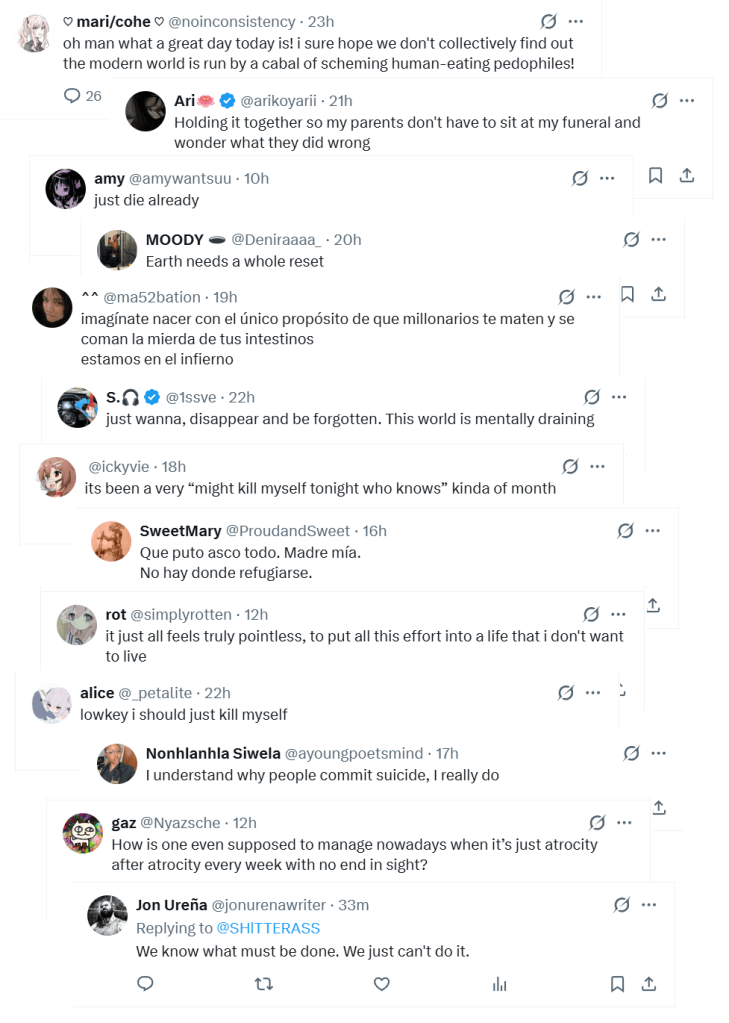
For whatever reason, recently I’ve been thinking about the wound that has defined me the most. The majority of the stories I genuinely need to produce come back to that wound in one echo or another. Maybe it’s related to me having become forty-years-old. I would say middle-aged, but there’s no way in hell I’m living to eighty. Anyway, my fatal wound happened back when I was seven years old, when my mother asked me, as if you could ask a child to make such a decision, whether I wanted to move in with my older brother to free up my room so they could have another child.

My memory is abysmal, which I suspect is a blessing. Most of my forty years of living has been reduced to a bunch of photographs or sequences of frames that barely seem to cover anything. It’s like trying to reconstruct an epoch from the few fossils you come across. But I recall that until I was seven, I lived entangled to my subconscious. Like I was married to it. Daydreaming all day long. Making what my subconscious told me to create. Some adults that came across the stuff from those years were surprised. As in “a child that age doesn’t create stuff like this.” Unfortunately, it also included narratives that would make A Clockwork Orange blush; not for nothing I’ve always felt that I had darkness deep in me from birth. But the point is that I peaked back then, at about six or seven. When I truly communed with myself, and was whole.

From the moment I was put as an unwanted guest in my older brother’s room, until I turned eighteen and nearly beat him to a pulp, I was, a then-undiagnosed autistic kid with Pure O OCD, subjected to having the TV and radio on virtually always, including nights, because apparently enduring the silence was unbearable. I won’t get into my brother’s issues, but they’re plenty and complex in a way that anyone who has ever met him is surprised that such stuff even happens. I had been stripped of my safe space, of my solitude, of any corner purely for myself in which I could grow. I was like a plant forgotten under the stairs.

Looking back, the extreme to which I dissociated from my subconscious from then on is terrifying to think about. I genuinely came to believe that my natural instincts and impulses, everything that came from my brain without my conscious permission, was monstrous. I ceased knowing myself. I depersonalized. Throughout my teens I experienced something that only those who have endured the same thing will know I’m not exaggerating about: as I walked outside, I felt like I was commanding a puppet that I could barely coordinate, while I saw myself from the outside looking down, the edges of my vision constraining into a blurry tunnel. I slipped in and out of psychosis. The stuff I wrote back then was so incoherent that years later I threw it away because I feared that reading it again would contaminate me. And that included a novel about seven hundred pages long, which I rewrote again and again for years. I was sure I was going to die before I turned eighteen. I did pray to some eldritch god to come down and kill me. But I survived.

Shortly after my first job started, I saw how the rest of my life was going to be: enduring humiliation after humiliation, unbearable anxiety, under constant scrutiny as if every day was an exam I was sure to fail. Thankfully, I’ve never experienced a job like that again, but added to the despair I was already feeling, led me the closest I’ve ever been to erasing myself from this Earth. I’ve lost the memories of the aftermath, other than the fact that somehow I ended in the library, where my parents, who had been called by my job because I hadn’t shown up, found me. From then on, until my late twenties, with breaks of more unpaid internships than paid work, I basically lived as a hikikomori. In my late twenties, I thought that the only way I could make something out of my life was by selling my writings, of which I had done little since I was a child (somewhat counting the comics I drew in middle school). I wrote two books with a total of six novellas. They didn’t sell for shit, and mostly disturbed the people who read them. That discouraged me entirely, and I never wrote in Spanish again. However, writing those books helped me to slowly, laboriously, reconnect with my subconscious. Learn to recognize its desires and commands.

Early in my thirties, I started working in IT for a hospital. Terrible job that fought against my nature, and that I had to leave about seven to eight years later. But by then, now diagnosed and medicated for some other issues, I started producing fiction in English. This was by far my most prolific period. From seven to about twenty-seven years old, I identified with my conscious mind to a sickly degree, and believed that anything I couldn’t rationalize, any conclusion I didn’t reach through reason, was suspect, if not straight monstrous. But from my thirties onward, I no longer care, unless I’m forced to for the sake of money, about my conscious mind. It’s merely a tool to interpret and obey whatever my subconscious produces. The conscious mind also needs to be reigned in, because it acts as a lawyer, confusing and justifying what the subconscious has already decided, and often getting it completely wrong. I have learned that there are indeed monsters in me. I’ve also learned that I prefer the company of monsters.

That fatal wound in my past won’t heal. It broke my brain during development in ways that can never mend. I have to do the best I can with what I have. I don’t feel like interacting with humans, and those who have interacted with me for sustained periods of time (mostly at work), soon enough sense that there’s nobody “there.” In public, I’m a simulacrum of a human being. Left to my own devices, I’m some creature that doesn’t need definition nor to justify itself to anyone.

I also thought recently about something I witnessed when I was a teenager. I was returning home when I heard a commotion from four young people in their twenties who had parked in front of my parents’ apartment building. It was almost the same spot, if not the same, where my father parked the day I saw a UFO, when I looked up from the window only to find out it was right there. I wrote about it on this post, so I’m not going to repeat myself. Anyway, those young people in the car seemed freaked out, confused, out of it, but not in a “they’re drugged” way. They flagged down a passerby, and asked him if they were close to Barcelona. These weren’t foreigners; their plates were from Spain. The passerby, more disturbed than amused, scoffed and said, “Barcelona? You’re about seven hundred kilometers away! This is Irún, near the border with France.” The young people in the car, panicked, looked around frantically as if incapable of understanding how they had ended up there.

I haven’t made that up. I just don’t think about it often because it makes no sense. That day, I walked away, but I’ve imagined myself approaching them and asking, “What is the last thing you remember?” “Did you see any lights?” I imagine myself telling them that if anyone did this to them, they could have easily killed them but didn’t, so they should just try to relax and get on with their lives.

I don’t know what it means. That could be applied to the entirety of what I’ve lived through. Trying to understand myself is like spelunking with a dim light through passages that keep changing. And I’m still here because I just happen to be. I suspect that when I finally realize I’m breathing my last, a smile will be on my lips. Then, I will tend my hand inwards to the love of my life, who was there for me as a child when I didn’t have anyone else, and who waited patiently for years until I went down into that darkness to find her again.

Tatsuki Fujimoto 17-26

This is not a review, but a notice to those interested in the works of Tatsuki Fujimoto, author of Chainsaw Man, Fire Punch, Look Back, and Goodbye, Eri, all of which are required readings/viewings. He produced a bunch one-shot stories from ages 17-26, which have now been animated in very competent, creative ways. I can’t think of any other author who casually gets great adaptations made of random one-shots he made in his youth. Here’s the trailer.

They show Fujimoto’s range from early on. Most of his stories have in common the theme of reaching out for connection in an absurd world that often renders that connection fleeting, insufficient, or meaningless.

There’s also Look Back, a heartbreaking tale about ambition, connection, and regret. Merely mentioning what inspired it would be a spoiler. The movie has been out for a while, but I haven’t seen it yet. Probably because I’ll have to gear myself up to experience that story again.

The Chainsaw Man movie for the Reze arc is already online, and that’s a must see. This is both a fantastic and a terrible time to be a Fujimoto fan: fantastic because plenty of his stuff is getting adapted well. Terrible because the second half of Chainsaw Man, still ongoing, is unnecessary and generally bad.

Now, let’s hope that they also adapt the utter insanity that are Fire Punch and Goodbye, Eri. That last one has a plot point that I remember vividly because it made me burst out laughing with its daring, absurd brilliance.

Inio Asano, Minoru Furuya, Tatsuki Fujimoto… Asano broke down after Punpun, Furuya retired in 2016, and I suspect that Fujimoto may quit after he concludes Chainsaw Man however he decides to do so. I’ll have to check out what Shūzō Oshimi (The Flowers of Evil, Blood on the Tracks, Inside Mari, Happiness) has been doing recently.

Review: The Vast of Night

I rarely watch movies (nor read novels for that matter), because damn near everything released after 2006 or so is an excuse to make a political vehicle. I asked ChatGPT what could interest me as someone whose favorite movies (off the top of my head) are Fight Club, Jurassic Park, The Matrix, Back to the Future, and probably a couple others that I can’t remember now. It recommended some movies that I had never even heard about, although that’s not particularly surprising given that I haven’t been following movies in a good while.

So, it recommended The Vast of Night, a small sci-fi movie from 2019 or so that pays homage to Twilight-Zone-like stuff from back in the day. It takes place in a single night, following mainly the radio host of a tiny local station at a nowhere town, along with a switchboard operator. Both are young, both want to leave for better pastures.

That night, as most of the town is busy at a basketball game, some of the locals mention seeing lights in the sky. The switchboard operator receives eerie sounds that had never come through her switchboard, and she enlists the help of the radio operator to see if anyone can figure out what that’s all about.

I won’t reveal anything more about the plot. The whole movie takes place in a single night and a relatively short span of time. It’s on the artistic side, with fancy dialogue and ambitious shots. Some very interesting single takes. I thought it nails the feeling, that some of us remember, pre-internet of clutching onto vague rumors and radio testimonies that offer glimpses into a larger reality. I enjoyed the movie quite a bit. I also found the switchboard operator very cute, which is a plus.

It’s no masterpiece. The dialogue-heavy introduction goes on for way too long; it does a great job of establishing the cleverness and competence of the young radio guy, as well as his friendship with the switchboard operator, but it could have been significantly shortened. Once the switchboard operator receives the strange sound through the board, the movie doesn’t stop. I would have liked to say that it’s free of politics, but they had to sneak a “whites don’t care about blacks and indians” in there. Can’t escape that shit.

Anyway, if you enjoy peculiar movies that aren’t the usual garbage, you could do much worse.

Post-mortem for Custody of the Rot

If you’re reading these words without having read the story mentioned in the title, don’t be a fucking moronski; read it first.

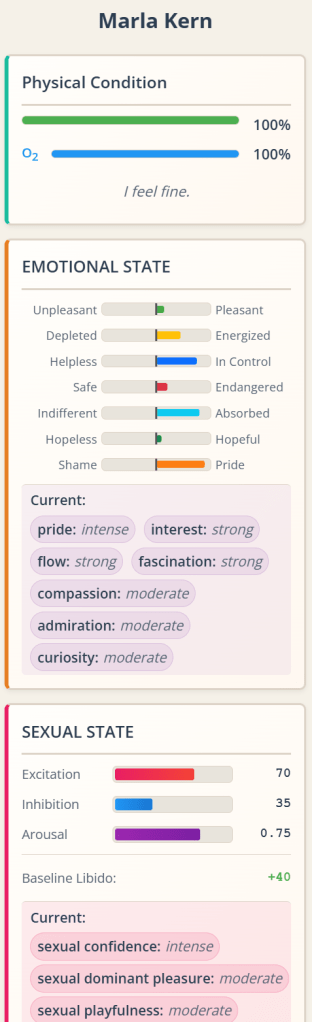
I assume you’ve read some of my previous posts on my ongoing fantasy cycle, so you may remember that I’m producing these stories in tandem with improvements to my app, named Living Narrative Engine. It’s a browser-based system for playing scenarios like immersive sims, RPGs, etc. I’m compelled by the mutual pulls of adding more features to my engine and experiencing new scenarios; sometimes I come up with the scenario first, sometimes with the mechanics. That has my brain on a constant “solve this puzzle” mode, which is the ideal way to live for me.

Anyway, the following scenarios involving a brave bunch of dredgers in a fantasy world, tasked with extracting a dangerous arcane artifact from some gods-forsaken hole, will require me to develop the following new mechanics:

  1. Lighting mechanics. Currently, every location is considered constantly lit. Given that we’re going underground and that the narrative itself requires using lanterns, I have to implement mechanics for recognizing when a location is naturally dark, and whether there are light sources active. There are other mechanics providing information about the location and actors in it, so from now on, when a location is naturally dark and nobody has switched on a flashlight, we have to block offering descriptions of the location and other actors in it, and instead display text like “You can’t see shit.”
  2. Once lighting mechanics exist, we need actions for lighting up and snuffing out lanterns and lantern-like entities. By far the easiest part.
  3. Currently, when an actor speaks in a location, the speech is only received by actors in that location. At the same time, I consider an entity a location when it has defined exits. Now we find ourselves in a situation in which we have a thirty-feet-long underground corridor separated by grates. That would make each segment between grates a location (which would be correct, given the boundary), but an actor could step from a boundary into the next and suddenly not hear a character on the other side of a grate’s bars. Obviously idiotic. So I need to implement a mechanical system for declaring “if an actor speaks here, the voice will be heard in these other places too.” That will need to extent to actions too: if you have eyes, you can see someone scratching his ass on the other side of bars.
  4. No other scenario has featured water sources that could play a part. And by play a part I mean that actors could get in or fall in, exit them, struggle in the water, and drown. I really don’t want to see my characters drowning, but that’s part of the stakes, so the mechanics need to exist. Given that water sources tend to be connected to other locations and not through the regular exits, I will need some way of allowing “I’m in the water, so I want to swim upstream or downstream to a connected stretch of this water source.” This whole water system will be arduous.
  5. Line-tending mechanics. Until I started researching matters for this story, I doubt that the notion of line-tending had ever entered my mind. Now we need mechanics for: 1) making an owned rope available to others. 2) Clipping and unclipping oneself from the available rope. 3) pulling on the rope to draw back someone clipped that’s wandering away. 4) possibly other cool line-tending-related mechanics. I can see line-tending reappearing in future scenarios such as traditional dungeon delves (for example, to avoid falling in Moria-like environments). Admittedly, though, this whole thing is quite niche.
  6. Blocker-breaking mechanics. Basically: this door is bar-based, so this allows a hacksaw to hack through the bars. I don’t want to make it a single action, but a progressive one (e.g. if you succeed once, it only progresses a step toward completion).
  7. Mechanics related to mind control. To even use those actions, I will need to create a new type of actor for the scenarios: a dungeon master of sorts. Basically a human player that’s not accessible to others, as if it were invisible, but that can act on present actors. I would give that dungeon master for this run the can_mind_control component, then allow actions such as putting people into trances, making them walk off, dive into water, etc. This means that there would need to be opposite actions, with the victims fighting to snap out of the trance. It will be fun to find out what happens when the scenario plays out. In the future, this dungeon master could be controlled by a large language model without excessive difficulty: for example, feeding it what’s happened in the story so far, what are the general notions about what should happen, and giving it actions such as “spawn a hundred murder dragons.”

That’s all that comes to mind now regarding the mechanics to add.

About the story: so far, it seems I want magic to be treated in this fantasy world as if it were toxic material. That’s not a decision I’ve made about worldbuilding, but a natural consequence of the stories I’ve felt like telling. I actually don’t believe in the kind of worldbuilding in which you come up with imaginary words for the warts on an invented race’s ass. I’m all about use and tools. My mind always goes for “what can I build with this.” I’m very rarely interested in a subject if I can’t see myself creating a system out of it. It also doesn’t help that due to autism, abstractions tend to slip through my fingers, so I need to feel like I’m sensing something to understand it.

In a way, I wanted to create a story about specialists working through a problem that needs to be solved. Jorren Weir, Kestrel Brune, Saffi Two-Tides, Pitch… these people don’t have superpowers. Most of them are glad they can keep a job. There is no grand evil here, just people’s self-interest. I want them to do well so that they can return home at the end of the ordeal. But given that we’re dealing with chance-based tests, that’s not a guarantee. And that tension alone makes it exciting for me to experience these scenarios.

As usual, if you’re enjoying these stories, then great. Otherwise, fuck off.

Portraits of my fantasy cycle characters #3

Check out the short story where these characters first show up: “Custody of the Rot.”

Creating characters is by far the most time-consuming part of putting together a scenario, but it makes sense why it has to be that way; weak characters ruin fiction. Thankfully, I enjoy determining every little detail of their fictional personas.

Fun fact: before I came up with Pitch, the fourth member of the dredgers was supposed to be a mole-folk man who was half-blind and attuned to magical effects to the extent that he had started to hallucinate. As I developed his character further, I realized that his role was too specialized for a group of dredgers; at the most, they would only request his help when the crew knew in advance they were going to extract an artifact from some cave system, or the underground canals. But I didn’t see that guy getting along with the rest of the crew. The ensemble dynamics is vital. So I ditched that whole concept and started from scratch.

Me finding a character fun is a big part of when I decide that a concept for one is on the right path. Pitch has shown himself in “Custody of the Rot” as a stoic, professional demolitionist who’s very good at its technical aspects, but three of his most notorious aspects have barely peeked, and may not even play out through the rest of this arc. Those buried aspects heavily influence his portrayal in an iceberg kind of way, so it works regardless.

Anyway, you came for the portraits, I’m guessing. Assuming you aren’t mindlessly reading these words.

Kestrel Brune, the laughing lifeguard


Pitch, the sapper/demolitionist


Saffi Two-Tides, the rope-meister


Master Hobb Rusk, the Ash-Seal liaison

Custody of the Rot (Short Story)

The mansion’s front door fights back, then the servant yanks it wider and nods. I’m past him, boots on gravel, cutting for the service yard.

The yard’s a wedge of hard-used ground trapped between the east wing and the boundary fence—packed gravel, deep wagon ruts, built to take mud and keep moving. Our cart sits in the thick of it, and the crew’s gathered there: Pitch in his blast bib, Saffi in her dive jacket, Kestrel’s tall frame, and Hobb Rusk standing off to the side in that kiln-black Ash-Seal coat.

Past the fence, the canal runs parallel and close, separated by a narrow strip of towpath. The water’s wrong: tar-black, sluggish, filmed with a dull sheen that catches lamplight in greasy swirls. The smell reaches us in waves—sour rot with metal underneath, like wet iron left in a bucket too long.

I stop at a distance, far enough to address my crew as a group. I meet their eyes one by one: Pitch, Saffi, Kestrel.

Then I sigh. Lower my head.

My tail starts thumping against the gravel—slow, rhythmic. Old habit. I raise my gaze again, and something hardens in me.

“Alright, crew. Client’s one Lady Eira Quenreach. I had only heard of her. Now I wish it had remained that way. Had you followed me inside that trap room, there would have been far more shouting. Short version—we’re screwed. Long version—Lady was renovating her underground galleries when they dislodged an ancient artifact in a silted culvert. Messed with the seal or the ward or whatever. It started leaking that rot that has blackened the waters and made them stink something awful.”

I jerk my chin toward the canal.

“As you can see, it’s spreading far out of the estate. They reckon in two days the rot’ll be in range of the city inspectors. Of course Quenreach wants us to get rid of the artifact before someone sniffs her way. And the artifact won’t stop spewing that black shit, which means it’ll eventually ruin Brinewick’s whole canal network unless we stop it. Somehow that ain’t the worst of it.”

The silence stretches. Morning fog drifts between us, and the canal churns wrong behind the fence—thick, sluggish, a sound like something rotting from the inside out.

Kestrel laughs. Sharp. Involuntary. The sound cuts through the fog and dies fast.

I rub the fur of my brow, then meet their eyes again.

“The construction workers who approached the artifact reported pressure headaches. Fell into trance states. Got mind-wormed—intrusive compulsions toward moving water. Two workers drowned. Afterwards, all the workers quit. Some took at least a couple of the grate keys with them. A fuck-you on their way out, maybe.”

I shake my head.

“A mind-controller ancient artifact that risks rotting the whole canal network’s water. Which of course includes Brinewick’s drinking supplies. Lady Quenreach should have kissed our boots for coming down here to fix this quick.”

My jaw tightens.

“Instead, she handed me a contract that says the moment we touch that artifact, custody falls on us. Including responsibility for further contamination and deaths. And if the inspectors trace the mess back to the source and want to squeeze money out of anyone responsible, we’re supposed to pay for the protected parties’ losses—which would include the whole of Brinewick, as if we shat the ancient turd ourselves. Of course, by ‘we’ I mean me and our bossman back at headquarters. Nothing legal’s going to barrel down your way.”

I draw a breath. Let it out.

“Guess I’ve gotten through all the setup. This is the part where I tell each of you—Saffi, Pitch, Kestrel—that if you want to walk, you walk. Truth is, though, I don’t think this can be done without any of you.”

Kestrel laughs again—another sharp burst, then another, each one cutting out fast like her throat’s choking them off. Her eyes dart from me to Pitch to Saffi to the canal and back, that worried look deepening across her muzzle while her mouth keeps trying to laugh.

I turn my hands palm-up toward the sky, then drop them and force myself to meet each of their eyes one by one.

“Yeah, it was a lot to take in for me too. Let’s hear it, folks. What do you decide? I promise to shield you from any legal consequences—I’m the only one who signed, and if push comes to shove, I’ll claim I worked alone—but we’re risking more than legal here. Whoever’s staying, we gotta know soon, because we must move straight to logistics. Every minute counts.”

Pitch stands there in his blast bib, expression unreadable. Saffi’s golden eyes are hooded, slits tracking between me and the others.

Kestrel turns her head toward them both, then back to me. A broad smile spreads across her muzzle. She laughs.

“Yeah, I’m in. Not walking on this one, Jorren. You need muscle for hauling, pinning, or dragging someone out of a trance state before they drown themselves? That’s what I do.”

Another involuntary laugh bursts out of her.

“Besides, if that rot hits the drinking water and people start dying, that’s on all of us if we could’ve stopped it and didn’t. So count me in. Let’s hear the logistics.”

A sigh of relief escapes me before I can stop it.

“Don’t know how glad I am to have you by my side in this rotten mess, Kestrel.”

I turn my gaze to Pitch and Saffi.

“We got at least two old ironwork grates to crack open because their keys have flown. I’m talking thirty feet from access point to the half-collapsed culvert where the artifact is entombed, so we’ll need expert handling of bolt cutters or handsaws while mind-worms push into our brains. That’s where you’d come in, Pitch. And Saffi, intrusive compulsions toward diving into rotted flows means we need a line tender. The best in the business. The rope-meister. Not guilting you—just stating facts. We pull that artifact out of the water or soon enough Brinewick’s going to be drinking rot.”

Pitch meets my eyes directly. His voice comes out flat and certain.

“I’m in. Ironwork cracked and grates breached while mind-worms push into our heads? That’s demolition work under pressure, and that’s what I do. The rot’s real, the timeline’s real, and if we don’t stop it Brinewick’s drinking supply goes septic. So fuck the paperwork. I’ll handle the breaches. You’ve got your demolition specialist.”

Saffi’s tail curls once, then goes still. She speaks.

“You need a line tender who can read wrongness through rope before it becomes visible. Someone who won’t freeze when mind-worms start pushing compulsions. The artifact’s already killed two people. So yeah. I’ll handle the line work. You’ve got your rope-meister.”

The relief hits hard.

I catch movement in my periphery—Hobb Rusk stepping closer, circling around the crew’s loose cluster to position himself near our group. Still in that meticulous Ash-Seal coat, still silent, but the proximity signals engagement. Not commitment, though.

I thump my tail against the gravel once, decisively. The sound cuts through the fog and settles something in me. My face shifts—the worry-frown giving way to the harder focus I get when I’m mapping logistics.

“About thirty feet from access point to flooded section that contains our half-collapsed silted culvert and the buried artifact. Can’t wade straight to it—at least two grates we don’t have keys for. We get through the grates first. Then we dig the artifact out, slow and careful. Client believes it’s currently sealed, so we can’t risk cracking that with a quick extraction.”

I crouch down, fingers tracing an absent map in the gravel while I think it through.

“The sealed version of the artifact is already rotting the canal network and killing people, so we don’t want to know what the exposed version can do.”

The line draws itself in my head: access point to first grate to second grate to artifact location. Thirty feet of blind work underground.

“Zero visibility in those underground tunnels. Lanterns are a must.” I turn my head toward the cart. “We brought a couple. Alright, so we illuminate our steps from the access point to the grates. Imagine we’re cutting through the locked grates when mind-fuckery worms its way into our brains, telling us to dive into the canal waters. Need to be clipped to a rope, with Saffi as the anchor on the back. Anyone strays, sharp pull. These mind-compulsions don’t sound like the kind of worm you can squash easily, because construction workers just walked into a drowning—any of us starts looking loopy and tries to unclip themselves from the line, we need strength to restrain them. That’s where you’ll come in, Kestrel.”

Pitch heads toward the dredgers’ cart, his stocky frame cutting through the fog. He reaches for the bolt cutters, testing their weight and grip with practiced hands.

“I’ll take point on the grate breaches. Bolt cutters for primary cuts, hacksaw for backup if the ironwork’s thicker than expected.”

Pitch grabs the bolt cutters fully, the metal catching what little light pushes through the dawn.

“Thirty-year-old grates, no keys, zero visibility, mind-worms pushing drowning compulsions—yeah, I can work with that. Just need to know: are we cutting clean to preserve the infrastructure, or are we cracking them fast and dirty to hit the timeline? Because those are different approaches, and I need to know which one we’re buying before I start planning the cuts.”

I straighten up from the crouch, and that’s when I notice the newt-folk liaison, Hobb Rusk, standing to my side. Close—touching distance. That kiln-black coat, the ash-gray collar standing crisp despite the fog. Those large round eyes fixed on me, waiting. He’s positioned himself to hear my answer to Pitch, but he ain’t dressed for tunnels and he sure as hell ain’t volunteering to come down with us.

I meet his eyes briefly.

“Thank you for paying attention to our logistics, Master Rusk, even though I won’t even bother asking if you’re coming down to contain the artifact at the extraction point. You ain’t even dressed for it. But all we need is your magic box and a thorough destruction of the ancient terror so we can all cart back to our lives.”

I turn to face our sapper directly.

“Pitch, don’t know where you got that thing about grates being thirty years old. The way the Lady and her right-hand man sounded, the infrastructure down there is ‘ancestors-old.’ Maybe a couple hundreds of years old. Ironwork that age may be easier to saw through. Regarding infrastructure, this ain’t a ‘blow shit up’ situation, I’m afraid to disappoint. Silted culvert containing the entombed artifact is already half-collapsed—a blast may send down slabs of stone onto the artifact’s seal, then all hell’s broke loose. Lady Quenreach agrees to ruining them locked grates, just not to the point of collapsing the tunnels and fucking us all.”

Pitch moves back toward the cart and grabs the hacksaw, testing the blade tension with his thumb. His voice comes out measured.

“Ancestors-old ironwork. Right. That’s brittle, oxidized differently than modern stock—fails at different stress points. Makes the cuts trickier but maybe faster if I read the weaknesses right.”

He slides the hacksaw into his belt loop alongside the bolt cutters.

“Got primary and backup. No explosives, no structural collapse risk. Just precise cuts through old iron while mind-worms crawl into our skulls.”

A burst of wild laughter from Kestrel punctuates Pitch’s resolution. She stays quiet otherwise, that worried look still carved deep across her muzzle even as her mouth twitches toward another laugh.

Saffi moves to the cart and takes one of the hooded oil lanterns, the motion efficient and practiced.

“Alright,” I say, “both phases seem separated to me—first, clear our path to the flooded section where the artifact waits buried under two feet of contaminated water. Once we’re done with that, we head back up, leave the bolt cutters and hacksaws and whatnot, then pick up the planks and trenching shovels and block-and-tackle for the by-the-book extraction. We will enter with Pitch on point, the four of us clipped, rope-meister on the back as anchor. Let’s think perils—bad water that’s also a lure. One of us may pause, stare at the flow, step in, stop fighting to get out. Being clipped should help.”

I approach the cart to browse through the remaining tools. My hand scratches at my chin.

“Might wanna bring the throw line… but we’d have to hope the person who walked into the water wants to catch it. Rest of the risks come when we reach the silted culvert—I’m talking zero visibility sludge, confined space hazards. Two feet of water over uneven rubble is ankle-breaking terrain. Will need planks for that. And of course: crack the seal, and everyone loses.”

Saffi moves to the cart and takes a coil of long rope, looping it over her shoulder.

“Logistics of the first extraction phase look fine,” I say. “Now, worst case scenarios—imagine Saffi’s tending to the line when she suddenly decides the rotted waters look sweet enough for a dive, and we find our diver underwater in waters she shouldn’t dive in. Or what if the first one to look loopy is our gentle giant Kestrel, but nobody’s strong enough to restrain her? What if Pitch’s cutting through a grate only for his hands to drop the tools, then for him to jump pantless and ass-first into that liquid darkness? Any ideas?”

Kestrel lets out a succession of laughs that manage to sound both compulsive and nervous.

“C’mon, folks,” I say. “I’m thinking our most reasonable contingency plan is ‘don’t get mind-wormed.’ Anyone clever enough to come up with something better to do once someone’s eyes go blank?”

Pitch moves toward the cart again, reaching for one of the remaining hooded oil lanterns.

“Need light to read the ironwork properly. Can’t assess cuts or oxidation patterns in the dark.”

He takes the lantern, metal catching dull morning light through the fog.

I rub the fur of my forehead, working through the problem.

“Let me think about this… Two construction workers drowned. Plenty reported the mental compulsions but didn’t jump into the water. We need a taste of how those mind-worms actually feel like. A probe of sorts. Once we go down there—clipped of course—for the first phase, the moment one of us gets mind-wormed and starts hearing words in their head that don’t belong to them, we hurry them back up to the surface, or at least out of the access point. See how long it takes for the mind-worm to go away. Which we know it does because the affected workers all fled.”

“Alright, worst-case scenarios,” Kestrel says. “Here’s what I’m thinking—we can’t stop the mind-worm from hitting, but we can make it harder to act on. First: multiple clips on the line. Not just one carabiner—two, maybe three per person. That way if someone’s brain tells them to unhook and dive, they’ve got to fumble through extra metal while we’re yanking them back. Buys us seconds, maybe more.”

She shifts her weight, that worried look still carved deep across her muzzle even as another involuntary laugh bursts out.

“Second: watchers. We pair up—one person works, one person watches. Pitch cuts the grate, I watch his eyes. Saffi tends line, Jorren watches her. The moment someone goes blank-eyed or starts staring at the water too long, the watcher yells and we haul them out of the access point, back to the surface, see how long it takes for the compulsion to fade. Third, and this is the uncomfortable part—if the worm hits me and I decide I want that water, rope tension and crew strength might not be enough to stop me. So we need a fallback: Saffi’s line-work has to be strong enough to drag dead weight, and the rest of you need to be ready to pile on if I start moving toward the canal. Same goes for anyone else who gets wormed hard. We can’t prevent it, Jorren. But we can plan for the aftermath. Make it harder to drown ourselves even when our brains are telling us it’s the right call. Not a great plan. But it’s the only one I’ve got that’s honest about the risk.”

“Brilliant, Kestrel. Multiple clips. Pair up. I think that’s as good as it’s going to get for our first extraction phase.”

I turn my head to look up at the Ash-Seal liaison. Hobb Rusk’s standing there in that meticulous kiln-black coat, large round eyes fixed somewhere between me and the crew. He’s been listening this whole time—close enough to hear every word of our contingency planning, silent enough that I almost forgot he was there.

“Master Rusk, what exactly do you need from us? We’ve worked with other Ash-Sealers in the past but not in these fucked-up circumstances. What constraints are you relying on so you can contain the artifact in your box and pulverize it, or whatever the hell you tight-lipped fuckers do?”

Hobb’s eyes shift to meet mine directly. There’s a pause, like he’s organizing his answer into the specific order he wants. His hands stay at his sides, webbed fingers motionless. Then he speaks.

“I need the artifact intact and sealed when you hand it to me. If the seal’s cracked—if you drop it, if stone slabs crush it during excavation, if someone gets mind-wormed and drags it through contaminated water—the containment process changes completely. A sealed artifact goes into the box with standard ward protocols and salt geometry calibration. An actively leaking artifact requires layered suppression, extended calibration time, and significantly higher risk of containment failure. So your extraction needs to be precise enough that what you bring me is still structurally intact, even if it’s covered in sludge. Beyond that, I need workspace—clean ground, adequate humidity for the box’s adhesion wards, and enough light to verify seal integrity before I start the containment sequence. If you can’t provide that at the extraction site, we bring the artifact back here to the service yard before I touch it. And timeline: sealed artifact, maybe an hour for full containment. Cracked artifact, could be three to six hours depending on how bad the leak is, and I can’t guarantee success if the damage is severe enough.”

His lipless mouth compresses into a thin line.

“So the short version is this—bring me what you promised Lady Quenreach you’d extract, don’t fuck up the seal during the dig, and give me the workspace I need to do my job properly. Do that, and we’re fine. Crack it and hand me a disaster, and the timeline you’re working with collapses completely.”

I nod at Hobb Rusk, processing his parameters.

“Got it—clean ground, adequate humidity, enough light. Perfect arguments to stay topside instead of crawling through contaminated tunnels with us. Alright, we’ll bring the ancient, sludgy turd straight to your hands, and hope we don’t ruin the package along the way.”

I look around at the opulent estate grounds—manicured gardens, precisely trimmed hedges, wide gravel paths that probably cost more than my year’s wages.

“As for providing you with a good enough workspace…” I gesture at the space around us. “If the open air won’t do, we can talk to the steward. Man’s an amphibian too—maybe you two will reminisce about your family tree as you save the day.”

My tail thumps against the gravel twice. I turn to face my crew. Pitch stands there in his blast bib, bolt cutters and hacksaw collected, lantern in hand. His expression’s unreadable—that demolition-specialist look that doesn’t give away whether he’s got questions or he’s just waiting for me to finish talking. Saffi’s got her rope coiled over one shoulder and her lantern ready, golden eyes tracking between me and the others with that hooded, calculating look she gets when she’s reading group dynamics.

“Folks,” I say, “unless you’ve got some last-minute objections, let’s gear up. Nobody’s dying today. Otherwise I’ll be forced to drag you out of whatever afterlife you believe in, and that’d ruin my afternoon.”

THE END

Blackwater Contract (Short Story)

A servant closes the door from outside without so much as a nod. Through the narrowing gap I catch a last glimpse of the foggy canal landing, the estate fence lost somewhere in the mist, before the latch clicks.

Inside, the vestibule’s churning with movement. Servants in uniform—animal-folk and humans both—scrubbing floors, rushing through with laundry. Frantic enough that something went wrong recently.

I stand on the mat by the threshold, waiting for someone to receive me. They flow past like I’m furniture.

“Hey,” I call out. “I’m with the dredgers. I was told to meet the employer here.”

Not a glance. A servant with a bucket doesn’t even break stride.

I thump my tail on the pristine tiles.

“Folks,” I say, keeping level. “Your canal water’s gone bad. That Lady of yours should come meet me as soon as possible.”

That breaks through. A human woman glances my way, then hurries toward the double doors at the far end of the hall. She swings one open and disappears inside.

Moments later she’s back out, and a toad-folk man in a tar-black waxed oversmock follows her into the hall. He makes straight for me.

I nod as he reaches me.

“I’m guessing you ain’t the Lady. I’m Jorren Weir, dredgers’ crew leader.” I hook my thumb back toward the estate grounds. “I saw you have a serious problem with your canal waters. Flow’s tar-black, rotten-looking, and it stinks something awful. This ain’t a simple spill situation, given you hired us dredgers.”

“You’ve got the right read, Weir. It’s not a spill—it’s sealed work gone wrong, and the Lady’s waiting to brief you herself.” He gestures with one padded hand toward an interior doorway, already turning. “This way. She’ll explain the contract terms and the site conditions. I’ll be handling your crew’s logistics once you’ve seen what we’re dealing with.”

He’s moving before he finishes speaking. I follow him through a short corridor and into a sitting room.

Upholstered chairs in pale colors, low table stacked with papers, muted lighting. A white-furred ermine-folk woman sits in one of the chairs, dressed in layers of ivory and pearl-gray, document in her gloved hands.

The toad-folk man moves to the second chair and settles into it, easy and practiced, angling so he’s facing both the lady and the empty third seat.

“Mr. Weir, this is Lady Eira Quenreach.” He nods toward the ermine-folk woman. “My Lady, Jorren Weir, crew leader.”

He gestures with one padded hand toward the third chair.

“The contract’s ready for your review, Weir, but the Lady will want to walk you through the site conditions first. What you saw from the canal edge is the surface problem—the sealed work’s below, and it’s nastier than a simple extraction.”

“Guess I’m sitting down.”

The chair’s more comfortable than I’m used to. Once I’m squared away, I address them both.

“Our boss was awfully cagey about this job. Even requested an Ash-Seal liaison to handle artifact destruction on-site.” I gesture toward the window, the canal beyond. “The rot on the waters tells me this is some shitty business. Never seen a cursed item taint our waters like that. Straight talk—what are we pulling up?”

Lady Quenreach extends the contract toward me—smooth, deliberate motion, held at an angle that reads as courteous rather than urgent. Her voice stays soft, measured.

“Mr. Weir. I appreciate your directness.”

The document passes from her gloved fingers to mine. Heavy.

“What you’re being asked to extract is a sealed artifact—very old, pre-estate construction, entombed in a silted culvert. We don’t know what it is.” She pauses, letting that settle. “What we do know is that it’s been leaching corruption into the canal water since it was dislodged during excavation work two days ago.”

I flip the contract open, scanning the first page while she talks.

“The workers who handled it reported pressure headaches, intrusive compulsions toward moving water, and trance states. Two drowned. The rest quit.”

My eyes flick up from the page.

“The site is partially flooded,” she continues, gray eyes level, tone factual. “The access routes are tight, and some of the grate keys are missing. You’ll need people who can work in bad water without losing focus, and you’ll need your Ash-Seal liaison on-site for destruction. That document establishes that you’re claiming the artifact under salvage and quarantine protocol. What it also establishes is that the artifact’s origin point is documented as somewhere in the broader canal network—not specifically here.” Her voice remains calm, almost gentle. “If inspectors trace the taint, your records will reflect that. The terms are there. Read them, and then we’ll discuss site access and compensation.”

I scratch the fur on my chin. Two drowned. A lure in the water. That’s new. Something this nasty needs to be dragged away from our canal waters as soon as possible.

First, though, I’ll read through this legal text of hers, see what fine print they’ve included.

“There’s always some, right?” I say, settling the contract flat across my lap.

The room goes quiet. I read through the standard clauses—salvage rights, quarantine authority, non-disclosure about site origin. All expected. Then I hit the section that makes my jaw tighten.

I lower the contract carefully to my lap, keeping my gaze on the text for a moment before I raise my eyes to both of them. I feel the frown pulling at my muzzle.

“Quite the one-sided contract, ain’t it?” I say, calm.

Lady Quenreach’s expression doesn’t shift. The toad-folk man stays still.

“I understand a legal document handing us off a cursed item,” I continue, “and requiring us not to tell that we found it in a noble’s estate. Standard stuff—nobody wants the stink to trace back to them, and most of the cursed shit’s been there for gods know how long, so the landowners aren’t at fault.”

I lift the contract, angling it so they can see I’m reading straight from the page.

“But what’s this crap?” I read aloud: “‘The moment a dredger touches the artifact, custody, disposal authority, and responsibility shift to the dredgers, including responsibility for contamination, downstream spread, injuries/deaths, and any public hazard that follows.’ Fuck, and this part—’If inspectors investigate, if fines happen, if scandal erupts—the dredgers must defend and pay for the protected parties’ losses.'”

I lower the contract again, meeting their eyes.

“So, it ain’t enough that we’re here to risk our necks in your canal, we’re also meant to eat the shit your artifact is already spewing?”

The silence stretches. Lady Quenreach’s face stays calm, her hands motionless in her lap. She lets my objection sit there in the air for a measured breath before she responds.

“You’re right, Mr. Weir. It is one-sided.” Her voice stays soft, but there’s something underneath it now. Thread of steel. “Because the artifact is already spewing, as you said. The contamination isn’t waiting for signatures—it’s spreading through the canal network right now, whether you take this contract or leave it. What this document does is formalize what’s already true: the moment you extract it, you’re the ones handling a quarantine-class object. That’s not me imposing liability—that’s waterways code. Cursed artifacts don’t stay clean just because the paperwork’s polite. If inspectors trace the taint and you’re standing there with no contract, no documented salvage claim, and no legal authority to have moved it—what does that look like? It looks like dredgers who freelanced a removal without protocol and made the problem worse. This contract is what makes your work legitimate. It establishes that you claimed it under salvage and quarantine authority, that you’re coordinating with an Ash-Seal liaison for proper destruction, and that you handled it by the book. The terms are harsh because the artifact is harsh. But they’re also what keeps you from being the ones blamed for amateur handling.”

Her voice softens just slightly.

“I need it gone, you need the pay and the proof your crew can do this kind of work, and the canal network needs it out of the water before the rot reaches Brinewick’s drinking supplies. The terms don’t change. But you can sign knowing that walking away doesn’t make the liability disappear—it just leaves it unassigned, and unassigned liability has a way of landing on whoever was closest when the disaster got worse.”

I shift in the chair, feeling the upholstery creak under me. I keep my voice level—calm, but firm enough that they hear I’m not bending just because the setting’s nice.

“Lady Quenreach, I respect your position as a noble of the realm, but let me tell you—I know the waterways code better than the bastards who wrote it. You wanna test me on that? Section twelve, subsection four. Salvage claim transfers on recovery, not on your say-so. Get it straight—we pull your trash out of the water. That don’t make us trash. Not river scum picking through garbage. We touch the occult shit so you don’t have to. Just because we’re built for water don’t mean we’re built to die in it for your convenience.”

The toad-folk man stays perfectly still in his chair. Lady Quenreach’s expression doesn’t shift.

“Thing is,” I continue, “we both know you can’t find another crew in time to risk their necks in that canal. Not when the rot’s spreading bad enough it’ll ruin the water system of our great city in a couple of days. That’ll affect far worse than your reputation, milady. So we can’t in good conscience leave your canal clogged with whatever ancient turd’s lodged down there.”

Silence settles over the room—the deliberate kind, where someone’s letting your words breathe before they respond. Lady Quenreach’s hands stay folded in her lap, her gray eyes steady on mine.

Then she speaks. Measured, almost thoughtful.

“You’re absolutely right, Mr. Weir. You’re not river scum. You’re professionals. That’s exactly why I called you. And you’re right that I can’t find another crew—not one that can handle contaminated salvage on this timeline, not one with an Ash-Seal liaison already coordinated, and not one whose boss understands that quarantine-class artifacts don’t wait for polite negotiation. But let’s be clear about what’s actually happening here. That artifact is already spewing its poison into the canal network. Whether you sign this contract or walk out that door, the taint is spreading. If it reaches Brinewick’s water supply—and it will, if no one extracts it—inspectors will come. They will trace it upstream. They will demand to know who knew, who delayed, and who refused to act.”

She leans forward slightly.

“If you walk away, they will find out professional dredgers were offered legitimate salvage work under quarantine protocol, were told about the contamination risk, and even though they had an Ash-Seal liaison ready to coordinate destruction, they refused. And when the disaster gets worse, when people start asking why no one acted, your boss’s reputation suffers. Not because you did the work badly. Because you didn’t do it at all.”

I tsk.

“Tough one, aren’t you?” I lean back in the chair. “I’ll bring my crew down there and get rid of the artifact. This ain’t about your fancy reputation or mine any longer—it’s about my little one not needing to drink rotten water thanks to whatever cursed piece of occult crap some ancient imbecile buried in your land.”

I pull my pencil from the vest pocket. Chewed at one end, but the graphite’s still good. My eyes catch the quill sitting on the coffee table between us—proper writing instrument, the noble kind.

I hold up my pencil.

“Is a dredger’s pencil good enough to sign, or do I need to use your quill as well?”

“Your pencil is perfectly acceptable, Mr. Weir. The contract’s binding either way. Sign wherever you’re most comfortable—margin, footer, wherever your crew protocol requires. If you want witness marks, Mr. Siltwell can countersign as landowner’s agent.”

Her gray eyes stay steady on mine.

“Once it’s signed, we’ll walk through site access, key inventories, and liaison coordination. The faster your crew can begin extraction, the better for everyone.”

I rest the contract on my thigh and sign using the pencil. When I straighten, my gaze sweeps from Lady Quenreach to the toad-folk man—Siltwell. The frown’s still pulling at my muzzle.

“Done,” I say. “All the dredgers’ crew responsibility now.”

Siltwell leans forward just enough that the room’s weight shifts with him. His tone stays practical.

“Good. Now we move to site access and coordination.”

I watch him settle into it. The quiet third chair’s gone—he’s running the show now, and the Lady’s sitting back to let him.

“The artifact’s lodged in a silted culvert beneath the east wing,” he continues. “Partially flooded, tight access routes, and some of the grate keys are missing because the workers who quit took them when they left. I’m working on recovering those keys, but in the meantime I’ll need to know your crew size, your equipment load, and whether your Ash-Seal liaison needs separate access or works embedded with your dredgers. You’ll report findings through me, I’ll handle access schedules and keep staff clear. The faster we can map crew movements and equipment staging, the faster you can begin work, and the faster that thing’s out of the water. What’s your crew’s standard operating procedure for contaminated salvage sites, and what do you need from me to make the first descent safe?”

I pull out my notebook—dog-eared, water-stained, pages crinkled from getting soaked and dried too many times. Flip it open to a clean page.

“Alright,” I say, pencil already moving. “You’re the key toad-man. Keymaster.”

I catch the faintest twitch at the corner of his mouth—not quite a smile, but close enough.

“We’re four dredgers, counting me. I wouldn’t count on the Ash-Seal fucker to venture into trouble with us—he hasn’t decided yet, as he wanted to know the details, but I’m guessing he’ll wait by the cart with his containment box for us to show up muddied and dragging the problem to him.”

I jot down a quick note about staging area, then look back up.

“My people are outside, waiting. Regarding standard operating procedure, need to know what tools to bring. Those missing keys, we don’t have time to wait for them. Will bolt cutters and saws do? Brought them with us, no problem carrying them. Just need to know if you can handle ruined grates.”

“Bolt cutters and saws will work—the grates are old ironwork, not secured against professional tools, and I’d rather you cut through than wait for keys that might not come back in time.”

I tap the pencil against the notebook.

“Also, artifact’s lodged in a silted culvert? Does it need to be dug up?”

Siltwell leans forward again, keeping that practical focus locked in.

“The artifact’s lodged in a collapsed culvert section, partially submerged in about two feet of contaminated water—silted channel, tight access, and yes, you’ll need to dig or dredge around it to get clean extraction leverage without cracking whatever’s keeping it sealed right now. Your four dredgers can stage from the east courtyard. I’ll have it cleared and your cart positioned there so your Ash-Seal liaison has clean line-of-sight to containment without needing to descend. I’ll walk you through the access route myself once we’re done here: down through the service stair, through the lower gallery, then into the construction zone where the culvert’s exposed. The flooded section’s maybe thirty feet from the access point, tight enough that your people will be working in close quarters with bad air and worse water.”

I raise my eyes to Siltwell, and let the look settle into something grave.

“Bossman had us bring muscle,” I say. “Are we dealing with beasties down there—the rabid or transformed kind—or does this artifact of yours just ruin our canal waters and mind-control people?”

“No beasties so far—no transformations, no rabid-kind threats, just the mental compulsion pull and the water rot. The workers who drowned walked in on their own, or slipped and didn’t fight to get back out, and the ones who got close reported headaches and intrusive whispers telling them to touch the flow or step into the channel. But I can’t promise the flooded zone’s safe from escalation. We don’t know what happens if someone stays submerged too long near the artifact, and contaminated sites have a way of getting worse once you start moving things. Your muscle’s a smart call—bring them, keep them close, and if anyone on your crew starts hearing whispers or staring at the water too long, pull them back topside immediately and don’t let them argue. The artifact’s not attacking people directly, but it’s pulling them in, and that’s dangerous enough when you’re working in tight quarters with bad air and two feet of tainted water underfoot. Treat it like the threat could escalate the moment you start extraction, and we’ll both sleep better once it’s in your Ash-Seal liaison’s containment box.”

“Alright,” I say. “Don’t need nothing more. I’ll get my crew up-to-date with this gods-awful shitshow, then flag down one of your servants when we’re ready.”

THE END

Life update (12/12/2025)

I’ve woken up at three in the morning. Although I tried to fall asleep again, my brain started doing the rounds with sequences of intrusive thoughts which would have had me rolling around for hours, tangled with painful stuff, so I figured I could get to the computer and write some words about things that have crossed my mind recently.

It’s December, and temperatures have naturally gone down to the extent that most days I can’t sit outside to play the guitar, which I need to do for emotional regulation. I’m not comfortable doing it at home because it feels like I’m bothering the neighbors. Whenever we get a good enough day weather-wise, I take advantage of it to head to some nearby wooded area to play for about an hour and a half. I did that yesterday: went to one of the most deserted wooded paths I know and that I can be bothered to head to on foot, then sat down to play through my usual songs. A few people passed by, mostly folks with their dogs or running.

As I was playing, an old couple passed by, and the old man went out of his way to talk to me. He gestured to the surroundings and to the sky and said something like “We’re in nature.” I didn’t have much time to think about what this fool was on about as I played, so I just nodded at him so he would leave me alone. There’s something inherently wrong with people who interrupt someone while they’re playing an instrument. He must have taken the hint that I didn’t want to engage, but as he left, he said something like “Cheer up.” His quiet wife followed him.

What the fuck? I was objectively playing a sad song (Iron & Wine’s “Passing Afternoon”), but still. Do I look so sad that some random old idiot would go out of his way to comment on it? Perhaps I do look like that. I have lived with what feels like low-level depression ever since I was a child, which cyclically spikes into full-blown depression. It seems obvious from basic observation of other people that they don’t seem as down as I do on a daily basis. They must get some enjoyment out of being alive that completely escapes me. Most of my drive behind the complicated endeavors I engage with on a daily basis involves distracting myself from the feeling that life is an unbearable burden.

The objectively most positive reaction I’ve had to my playing the guitar (even though it bothered me) happened perhaps a couple of months ago, when I was playing at a park. I don’t play in the middle of it, but off the path, seated on my portable stool in front of a tree. Some woman in maybe her late twenties, maybe Central or South American (can’t tell easily these days), carrying a book, went out of her way to figure out where the guitar music was coming from, then she walked off the path and sat with her back against the nearest tree to read. That tree was at a distance of about what you would naturally place a bench from the next one. People don’t do this on this park.

She was clearly listening to my playing, which she did for the next full hour or so. Because I’m a maniac, I kept playing even though it was so dark I could no longer see the strings properly, but she was still sitting there. Once I finished, she also stood up and walked up to the path. I thought she was gone, but after I gathered my things and took to the path again, she was sitting on a bench. As I passed, she turned toward me smiling, and said “Thank you for your music.”

As usual, my instinctive reactions to people talking to me aren’t the kinds I can use; my instinct is either to stay quiet or to say something that wouldn’t be appropriate. In this case, what came to my mind was saying “It’s not my music.” Instead, I scrambled to figure out something fitting to say to someone who had gone out of their way to listen to me play. I said “Thank you… for liking it.” She laughed softly and said, “Yes, yes.” I turned around and followed the path heading out of the park, while I contained the creepy-crawly feeling I get on my skin half of the time that I interact with a member of this species.

I don’t know if the following is related, but it’s what my mind pivoted to: as I was lying in bed forty minutes ago, a vivid scene that years ago I used to play through regularly reappeared. It always started with sitting at the waiting room of a driving school only to find out that beside you sat the love of your life, the sole person in the world who understood how it felt to be born cursed by both your circumstances and your impulses. I’m talking about Oyasumi Punpun, which may be my favorite work of fiction in any medium. I daydream daily to survive psychologically, and years ago I used to revisit that connection over and over, giving it a more deserving outcome. Well, I don’t know if “more deserving,” but a better outcome.

That got me thinking that it feels like I’ve read through every single affecting manga that exists. Inio Asano, the author of Punpun, is clearly done: he’s only created jaded, bitter, and cynical shit for the last few years. It’s as if he no longer believes in honest meaning. While the aforementioned series is my favorite, my overall favorite author is Minoru Furuya (I wrote about his works on here). I immediately connected with the peculiar way his mind works in a manner that suggests to me that he’s also autistic and has OCD. Sadly, he seems to have retired back in 2016. Beyond manga, I can’t bring myself to read novels these days; the sole author I respected was Cormac McCarthy, but he’s dead. And it somewhat disheartened me to find out that McCarthy himself barely did anything new in the last twenty to thirty years of his life; his extremely-affecting last two novels, The Passenger and Stella Maris, were conceived back in the seventies and eighties, when he actually lived through some of the experiences those narratives refer to.

I find myself, as a forty year old, feeling that I have nothing to do with this culture and this world in general, which seems achingly obvious the moment I leave my apartment. It feels like I’ve already experienced all the works that could affect me meaningfully. All the artists whose works I genuinely loved have lost it, retired, or died. Talking to actual human beings does close to nothing for me (I’m lucky if it does anything positive for me, even temporarily), so I can’t rely on that either. I wonder if this is what happens to people in the last stage of their lives: they feel so completely detached from the world that there’s no point engaging with it in any way. I recall the last image I had of my maternal grandfather, being pushed around on a wheelchair after his wife’s funeral, his head down, not having said a word the entire day that I recall. Never saw him again.

I do get those regularly, too: sudden images of people from my past I’ll never see again. That girl from middle school whom I’ve talked about a few times, who received a nasty scar that bisected her forehead. That basketball player with whom I was involved very briefly when I was seventeen or so; I’ve never liked someone I knew personally more than I liked her. A different teenage girl I met while I was hanging out with people I shouldn’t have been involved with; she was extremely self-conscious about scars on her face she got as a baby because the family dog attacked her. I dated her for merely a week before my craziness convinced her to stay away. Curiously, I have to go out of my way to remember the woman I dated for the longest time. The regret I feel for that relationship isn’t the “I wish I could have done better for her” that I get for those other people. I’m glad I haven’t seen that last one in about twenty years.

I guess that’s enough. Half past five in the morning. I’m going back to bed, back to the daydreams that will hopefully slide me back to sleep and therefore save me temporarily from this absurd nightmare of being conscious.

Canon bible for my fantasy cycle #1

With this cycle of fantasy stories, of which I’ve just finished the first arc (named “The Extraction at 12 Kiln Lane”), I intend to expand what’s allowed in its world one story at a time. That means I need to keep a reliable bible of what’s canon. I’ll post on my site the updates to the bible, both because they’ll be easier for me to access as well as because it may be interesting to others.

You shouldn’t be reading this, though, unless you’ve read “The Extraction at 12 Kiln Lane,” which is the first arc of my fantasy cycle. Links here.


CANON BIBLE

0) CHANGE LOG (this story’s impact)

  • Added:
    • Craft-based occult mishaps can originate an “entity/contamination” via a purchased grimoire fragment ritual, with catastrophic kiln failure and death as the pivot event. (Evidence: “ritual from a grimoire fragment I’d bought… firing went catastrophically wrong”; source: Perfect in the Ashes)
    • Burial is an attempted containment method for tainted ceramics, but it can fail over long time horizons as the shard “strengthens” and reaches living hosts. (Evidence: “I thought burial would contain it. I was wrong.”; source: Perfect in the Ashes)
    • “Living bodies anchor entities better than ceramic” is asserted as a key working rule for why corruption transfers into animals/humans and persists. (Evidence: “Living bodies anchor entities better than ceramic.”; source: Perfect in the Ashes)
    • On-page first-aid protocol is explicit: rinse/clean first, then disinfect with vinegar; linen strips are used for closure/binding. (Evidence: “need to rinse first… before disinfectant touches it” / “reaches for linen strips”; source: Perfect in the Ashes)
  • Expanded/Clarified:
    • Ceramic containment vessels may first appear as emergent outcomes of failed occult craft events, not only as planned tools. (Evidence: “my first functional containment vessel, sitting perfect in the ashes”; source: Perfect in the Ashes)
    • Salt practice extends beyond outdoor boundary lines: Aldous embeds salt into interior floor cracks as a persistent, domestic-scale measure (purpose not proven). (Evidence: “stone floor with salt worked into the cracks”; source: Perfect in the Ashes)
  • Flagged as conflict/ambiguous:
    • None newly introduced by this story (existing “primary-anchor cascade” conflict remains; see §11).

1) CORE PREMISES (high leverage)

  • [Proven] Mudbrook-on-the-Bend runs a centralized, written contract system for local needs, administered on-site. (Evidence: “our humble gathering spot, the Municipal Aid Registry”; source: The Municipal Aid Registry)
    Implications: Records and paperwork can drive plot turns; leverage lives in what’s written, not just what’s said.
  • [Proven] The Registry’s administrator (“Copperplate”) is nonhuman and operates with visibly slow, ritualized record-keeping. (Evidence: “the tortoise-person behind the counter. Copperplate.”; source: The Municipal Aid Registry)
    Implications: Bureaucratic tempo is a real obstacle; urgency can clash with process.
  • [Proven] Work and compensation are denominated in copper and silver, with meaningful spreads between petty tasks and higher-risk work. (Evidence: “2 copper”; source: The Municipal Aid Registry)
    Implications: Stakes can be signaled economically without exposition.
  • [Implied] The same hazard label (“possessed”) can encode different realities: folklore, euphemism, or technical breach language—depending on who’s speaking and why. (Evidence: “don’t know what ‘possessed’ means out here yet”; source: Fine Print & Featherbones)
    Implications: Mispricing risk is plausible; “translation” between local codewords becomes power.
  • [Proven] A Registry-linked job can have a socially recognized contract-holder while others participate as “backup.” (Evidence: “Vespera’s contract. I’m backup.”; source: The Girl From the North Road)
    Implications: Credit/blame attaches to the named holder; abandonment/betrayal stakes sharpen.
  • [Proven] Contract-holder status can control who gets briefed first by the client on sensitive procedures. (Evidence: “You took the contract, so you get the explanation first.”; source: Salt Lines)
    Implications: Information can be tiered inside a team; secrecy can be procedural, not just personal.

2) METAPHYSICS & SUPERNATURAL

  • [Implied] “Wards” exist as a practical concept (“ward breach”), and discussing them publicly can carry social risk (gossip). (Evidence: “without advertising a ward breach at the Registry”; source: Salt Lines)
    Limits/Costs: The story proves the term and the secrecy norm, not the ward’s objective mechanics.
    Implications: Occult work can be constrained by reputation management; “where you talk about it” matters.
  • [Proven] Salt is used in deliberate geometric layouts as a containment boundary around a worksite. (Evidence: “marked with geometric patterns in thick salt lines”; source: Salt Lines)
    Limits/Costs: The layout’s effectiveness is asserted by Aldous, not demonstrated on-page.
    Implications: Scenes can hinge on line integrity; wind, footsteps, animals, or sabotage become real stakes.
  • [Implied] Salt practice can be embedded into domestic architecture as a persistent measure (not just temporary perimeter lines). (Evidence: “stone floor with salt worked into the cracks”; source: Perfect in the Ashes)
    Limits/Costs: Purpose/effect is not proven; could be habit, superstition, or functional warding.
    Implications: Houses/workshops can carry “built-in” ritual infrastructure; old buildings can encode past incidents.
  • [Implied] Corruption/anchoring can produce “bleed-through” environmental symptoms (gloom/dim light/objects seeming wrong) that practitioners treat as diagnostic. (Evidence: “The gloom’s not aesthetic… It’s symptomatic.”; source: That Feathered Bastard)
    Limits/Costs: This is practitioner testimony; causality isn’t proven.
    Implications: Set pieces can telegraph occult presence via lighting/perception shifts without new creatures appearing.
  • [Proven] A ceramic containment vessel can receive extracted “wrongness/corruption” from a host, leaving the animal behaviorally normal again. (Evidence: “it’s in the vessel now.”; source: That Feathered Bastard)
    Limits/Costs: The procedure is physically brutal to the host during engagement. (Evidence: “The hen convulses…”; source: That Feathered Bastard)
    Implications: Craft-magic is an actionable option with choreography costs.
  • [Expanded/Clarified] Containment vessels may originate as emergent results of catastrophic craft-ritual events, not only as planned artifacts. (Evidence: “my first functional containment vessel… perfect in the ashes”; source: Perfect in the Ashes)
    Limits/Costs: This describes Aldous’s first case; generality beyond him is unproven.
    Implications: “Accident-born” artifacts can become coveted/feared; provenance matters as much as function.
  • [Implied] Extraction is geometry-driven (“gradient forms along geometric lines”), consistent with Aldous’s “etched geometry” framing. (Evidence: “The gradient forms along geometric lines”; source: That Feathered Bastard)
    Limits/Costs: Mechanism remains partially model-based.
    Implications: Magic stays materially legible (geometry, positioning) rather than incantation-based.
  • [Proven] Extraction has operational constraints: proximity is fixed to a “handspan,” restraint must not shift, and “eyes away” from the vessel opening is required. (Evidence: “exactly one handspan… any movement breaks the pattern” / “Eyes away from the opening.”; source: That Feathered Bastard)
    Limits/Costs: The reason for eye-aversion is not specified.
    Implications: Role specialization (restrainers, callers, vessel-handler) becomes necessary.
  • [Proven] Corruption can exert a direct “spiritual pressure” on targets; resistance is possible. (Evidence: “Pressure blooms behind my eyes—cold, invasive… it slides off”; source: That Feathered Bastard)
    Limits/Costs: The pressure can manifest as sensory assault. (Evidence: “scrapes against the inside of my skull”; source: That Feathered Bastard)
    Implications: Composure/resolve is diegetic defense; threats aren’t only physical.
  • [Expanded/Clarified] “Corruption” has a burnt-clay sensory signature, but odor can persist even after active pressure collapses post-extraction. (Evidence: “burnt-clay smell doesn’t fade but… pressure… collapses”; source: That Feathered Bastard)
    Limits/Costs: Smell alone can create false positives after cleanup.
    Implications: Investigations need multi-signal confirmation.
  • [Implied] Terminology alias: Aldous uses “primary vector,” overlapping earlier “primary anchor” talk. (Evidence: “this is the primary vector.”; source: That Feathered Bastard)
    Implications: Practitioner vocab can fork (vector/anchor/host), enabling misunderstandings.
  • [Proven] Tainted ceramics can act as long-term sources that “strengthen” and reach into nearby life, transferring corruption into living hosts. (Evidence: “The shard must have strengthened over time, reached out”; source: Perfect in the Ashes)
    Limits/Costs: This is Aldous’s account; broader ecology is not demonstrated beyond this incident.
    Implications: “Old mistakes” can become delayed hazards; excavation and renovation can trigger plots.
  • [Proven] Burial is an attempted containment method for a tainted shard, but it can fail. (Evidence: “I thought burial would contain it. I was wrong.”; source: Perfect in the Ashes)
    Limits/Costs: The story does not specify why burial failed (depth, site, time, ritual error).
    Implications: Disposal protocols become a high-stakes choice; “bury it” is not a safe default.
  • [Implied] Living bodies are treated as better anchors for entities than ceramics, explaining why corruption transfers into animals/humans and persists. (Evidence: “Living bodies anchor entities better than ceramic.”; source: Perfect in the Ashes)
    Limits/Costs: This is a practitioner rule-claim, not experimentally proven on-page.
    Implications: Triage shifts toward protecting living beings from exposure; quarantine logic becomes biological.
  • [Proven] Occult practice can be learned/applied via purchasable text fragments (“grimoire fragment”), and misuse can cause lethal kiln disasters. (Evidence: “ritual from a grimoire fragment I’d bought… she died in the kiln fire”; source: Perfect in the Ashes)
    Limits/Costs: The market, legality, and prevalence of such fragments are unknown.
    Implications: Black-market scholarship becomes a plot engine; “book access” is power and danger.

3) SPECIES & PEOPLES

  • [Proven] Cat folk exist and are recognized as a distinct people; in Mudbrook they are rare enough to draw attention. (Evidence: “a member of the cat folk”; source: The Municipal Aid Registry)
    Implications: Outsider presence can destabilize local routines; public scrutiny is constant.
  • [Proven] Cat-folk physiology differs in readable ways (fur/whiskers/tail) and facial expressiveness is harder for humans to interpret. (Evidence: “Cat-folk’s faces aren’t that easy to read”; source: The Municipal Aid Registry)
    Implications: Misreads are plausible in negotiation and conflict.
  • [Proven] Heterochromia occurs among cat folk and is explicitly described as uncommon (but not unheard of). (Evidence: “heterochromia’s not super common among cat folk”; source: The Municipal Aid Registry)
    Implications: Visible traits can be social hooks without implying destiny.
  • [Implied] Tortoise-people can hold civic authority and present as long-established community fixtures. (Evidence: “Been here before any of us showed up.”; source: The Municipal Aid Registry)
    Implications: Institutional continuity may be nonhuman-driven.

4) GEOGRAPHY & PLACES

4.1 Settlements

  • [Proven] Mudbrook-on-the-Bend is a compact canal-side rural town with clustered housing and workday emptiness. (Evidence: “Tightly packed houses along a blue-green canal.”; source: The Municipal Aid Registry)
    Implications: Encounters are conspicuous; anonymity is hard.

4.2 Notable Sites

  • [Proven] The Municipal Aid Registry operates out of a repurposed grain/warehouse structure that doubles as a social drinking space. (Evidence: “converted grain barn”; source: The Municipal Aid Registry)
    Implications: Civic business happens in public; eavesdropping and performance are always in play.
  • [Proven] Aldous’s site at 12 Kiln Lane is reachable by mid-morning travel and includes an exterior work yard used for controlled procedure. (Evidence: “We reach 12 Kiln Lane after mid-morning.”; source: Salt Lines)
    Implications: Travel pacing within town environs is narratively usable.
  • [Proven] The 12 Kiln Lane yard can be actively configured as a containment space (salt geometry; quarantine coop). (Evidence: “geometric patterns… salt lines” / “quarantined in the coop. Locked.”; source: Salt Lines)
    Implications: Locations can be “rigged” for supernatural procedure.
  • [Expanded/Clarified] Containment sites are vulnerable to mundane enclosure failure, allowing animals to escape mid-incident. (Evidence: “the latch doesn’t catch… finger-width gap of light.”; source: That Feathered Bastard)
    Implications: Carpentry/hardware reliability becomes part of containment doctrine.
  • [Proven] The chicken contract target location is Aldous’s workshop at a specific indexed address, tied to districting and legacy infrastructure. (Evidence: “twelve Kiln Lane… eastern district… near the old millrace.”; source: The Municipal Aid Registry)
    Implications: Addresses/districts exist; old infrastructure can anchor hazards and navigation.
  • [Implied] Aldous’s kitchen functions as a workshop-adjacent recovery/triage space with stored stoppered bottles and a basin for rinsing wounds. (Evidence: “pull down a stoppered bottle” / “approaches the wash basin”; source: Perfect in the Ashes)
    Implications: After-action scenes can credibly happen on-site; supplies/fixtures become tactical resources.

5) INSTITUTIONS, LAW, & POWER

  • [Proven] Registry participation involves documented postings and a ledger process that requires identity capture. (Evidence: “I require the contractor’s… full name… for the permanent record.”; source: The Municipal Aid Registry)
    Implications: Pseudonyms become legally meaningful; reputation can be tracked.
  • [Proven] Registry-recorded contract terms can be explicitly legally binding, including payment options. (Evidence: “Both options… are legally binding.”; source: The Municipal Aid Registry)
    Implications: Enforcement/expectation can drive consequences; “in-kind pay” can be a trap.
  • [Proven] The Registry appears to charge a posting fee (at least sometimes) and serves as a stabilization mechanism for disputes. (Evidence: “when I can spare the fee.”; source: The Municipal Aid Registry)
    Implications: Poverty pushes informal deals; fees create inequity and motive.
  • [Proven] Registry notices can circulate as portable paper outside the building, enabling third parties to audit terms. (Evidence: “I pull the posted notice… and extend it toward her”; source: Fine Print & Featherbones)
    Implications: “Who has the paper” matters; disputes can hinge on documents.
  • [Implied] Contractors/clients may strategically misframe a dangerous job in Registry language to control who learns sensitive details. (Evidence: “posting said ‘mother-in-law’ because I needed help fast”; source: Salt Lines)
    Implications: The Registry can incentivize euphemism; “official” postings may understate hazard.
  • [Implied] Copperplate’s record-keeping burden can be leveraged as social pressure (“an afternoon with his quill”). (Evidence: “spend a whole afternoon with his quill”; source: Salt Lines)
    Implications: Bureaucratic scrutiny can function as deterrence without arrests.
  • [Implied] A “local guard” exists as an institution distinct enough to be named, and it is expected to provide martial training. (Evidence: “Local guard’ll give you training.”; source: The Girl From the North Road)
    Implications: Mudbrook isn’t purely civilian; sanctioned force can shape arcs.

6) ECONOMY, CRAFT, & MATERIAL CULTURE

  • [Proven] Currency includes copper and silver; petty services can be priced in copper. (Evidence: “3 copper”; source: The Municipal Aid Registry)
    Implications: Denomination signals stakes.
  • [Proven] Compensation can be coin or in-kind property transfer (livestock) as a contractual option. (Evidence: “1 silver, or take the chickens.”; source: The Municipal Aid Registry)
    Implications: Payment can impose logistical burdens (transport, housing, resale).
  • [Proven] Skilled trades (e.g., tanning) are stable livelihoods; craft identity is socially legible. (Evidence: “I’m a simple tanner, alright”; source: The Municipal Aid Registry)
    Implications: Craft networks can carry authority without guild exposition.
  • [Proven] Tobacco smoking exists as a routine adult practice; matches enable quick ignition. (Evidence: “He lights it with a match”; source: Fine Print & Featherbones)
    Implications: Portable fire is commonplace.
  • [Proven] Taverns are a known income stream for traveling performers. (Evidence: “get money off taverns”; source: Fine Print & Featherbones)
    Implications: Bard circuits can be an economic engine.
  • [Proven] Lock-and-key hardware is in common use for animal containment/quarantine. (Evidence: “He fits the key into the padlock.”; source: Salt Lines)
    Implications: Physical security is practical; keys become plot objects.
  • [Implied] Advanced pottery knowledge exists as spoken technical literacy, at least among master artisans. (Evidence: “cobalt oxide… salt-fired stoneware… fired at cone ten”; source: Salt Lines)
    Implications: “Magic by materials” can feel grounded through real craft talk.
  • [Proven] Common household alcohol types include cider and mead stored in clay jugs. (Evidence: “There’s cider here” / “the other jug—the mead”; source: Perfect in the Ashes)
    Implications: In-home hospitality scenes can be materially specific; intoxication/sterilization myths can be leveraged.
  • [Proven] Stoppered glass bottles are used for stored liquids (e.g., vinegar) and kept in household cabinetry. (Evidence: “pull down a stoppered bottle from the shelf”; source: Perfect in the Ashes)
    Implications: Reagents can be kept ready-to-hand; theft/sabotage of bottles becomes plausible.
  • [Proven] Field-expedient first-aid uses vinegar as disinfectant and linen strips for wrapping/closure. (Evidence: “let the vinegar soak into the wound” / “reaches for linen strips”; source: Perfect in the Ashes)
    Implications: Wound-care resources are part of kit/household stock; scarcity of clean linen can matter.
  • [Implied] “Medicine skill” is a named competency that characters self-assess and can be “trained for.” (Evidence: “My medicine skill isn’t excellent” / “That’s what I’m trained for.”; source: Perfect in the Ashes)
    Implications: Expertise hierarchies can drive who leads triage; competence disputes become social conflict.

7) SOCIAL NORMS, STATUS, & TABOOS

  • [Proven] Explicit sexual services can be publicly posted and framed as pragmatic barter (by some locals). (Evidence: “I request a handjob, and offer one in return.”; source: The Municipal Aid Registry)
    Implications: Adult barter can be mundane; scandal is character-dependent.
  • [Proven] The Registry’s written system replaced (or reduced) ale-mediated bargaining because informal deals escalated into fights. (Evidence: “offer deals over ale… there’d be fights.”; source: The Municipal Aid Registry)
    Implications: Bureaucracy is peacekeeping tech.
  • [Proven] Nonlocal “exotic” bodies draw attention and commentary in public spaces. (Evidence: “eyes tracking the exotic cat-woman.”; source: The Municipal Aid Registry)
    Implications: Anonymity is harder for visibly nonhuman travelers.
  • [Proven] Gossip is treated as a real operational hazard in Mudbrook (information control matters). (Evidence: “You know how gossip travels in Mudbrook.”; source: Salt Lines)
    Implications: Secrecy can be logistical (where/when you speak).
  • [Implied] Within “weird” work, restraint over cruelty can be treated as a professional criterion, not just morality. (Evidence: “without improvising cruelty… killing is ‘simpler.’”; source: Salt Lines)
    Implications: Teams can fracture over method; “procedure ethics” can be a pressure point.

8) THREATS, HAZARDS, & VIOLENCE (world-level)

  • [Proven] Disease (“winter fevers”) can kill and is part of lived memory. (Evidence: “until the winter fevers took her.”; source: The Municipal Aid Registry)
    Implications: Seasonality can be lethal; grief and demographic shifts are plausible.
  • [Proven] Violent capability exists locally (scarred veteran with a longsword) and is treated as a resource for risky jobs. (Evidence: “always carrying around that longsword of hers.”; source: The Municipal Aid Registry)
    Implications: The town can field combatants; danger is credible.
  • [Implied] The region recognizes a class of rural anomalies (“pastoral weird”) that experienced contractors handle. (Evidence: “cleared pastoral weird before”; source: Fine Print & Featherbones)
    Implications: “Weirdness” can be an occupation; protocols and reputations matter.
  • [Proven] Occult incidents can weaponize small livestock into credible attackers, causing puncture wounds and head injuries; armor can mitigate but not remove risk. (Evidence: “beak straight into Rill’s torso. Right over her heart.”; source: That Feathered Bastard)
    Implications: “Harmless animals” can become lethal vectors; protective gear matters.
  • [Proven] Protective leather/quilting can blunt peck strikes, but exposed flesh remains vulnerable. (Evidence: “dull thud against her leather cuirass”; source: That Feathered Bastard)
    Implications: Partial armor creates tactical target selection (arms/face) and injury patterns.
  • [Proven] Occult extraction procedures can trigger extreme resistance from small hosts, creating injury risk without lethal intent. (Evidence: “she’s going to thrash when the extraction engages”; source: That Feathered Bastard)
    Implications: Violence can occur inside “nonviolent” plans; restraint competence matters.
  • [Implied] Infection risk is treated as a serious secondary threat after anomaly violence, shaping triage order and procedure. (Evidence: “before infection sets in” / “Need to clean these wounds.”; source: Perfect in the Ashes)
    Implications: After-action scenes stay tense; supplies/time pressure persist after the “fight.”
  • [Implied] Wolves are part of the threat vocabulary near town outskirts as mundane danger. (Evidence: “whacked a wolf’s head.”; source: The Girl From the North Road)
    Implications: Not all danger must be supernatural; travel carries predation risk.

9) WORLD RULES SUMMARY (1-page compression)

  • Nonhuman peoples exist and can hold civic roles. (Evidence: “the tortoise-person behind the counter.”; source: The Municipal Aid Registry)
  • The Municipal Aid Registry is a central, public contract institution with written records and identity capture. (Evidence: “full name… for the permanent record.”; source: The Municipal Aid Registry)
  • Registry terms can be legally binding, including payment in coin or in-kind property. (Evidence: “Both options… are legally binding.”; source: The Municipal Aid Registry)
  • Contract execution can be group-based even when one person is the named holder. (Evidence: “Vespera’s contract. I’m backup.”; source: The Girl From the North Road)
  • Hazard labels (“possessed,” euphemisms) can be strategic and misleading. (Evidence: “posting said ‘mother-in-law’… needed help fast”; source: Salt Lines)
  • “Ward breach” is a meaningful (and socially sensitive) concept; gossip shapes operational secrecy. (Evidence: “advertising a ward breach… gossip travels”; source: Salt Lines)
  • Salt is used in deliberate geometric containment layouts; it may also be embedded into buildings as a persistent measure (effect not proven). (Evidence: “geometric patterns… salt lines” / “salt worked into the cracks”; source: Salt Lines / Perfect in the Ashes)
  • Ceramic-vessel extraction can move “wrongness/corruption” out of a host. (Evidence: “it’s in the vessel now.”; source: That Feathered Bastard)
  • Extraction requires precise “handspan” positioning, stable restraint, and “eyes away” from the vessel opening. (Evidence: “exactly one handspan” / “any movement breaks the pattern” / “Eyes away”; source: That Feathered Bastard)
  • Corruption can exert “spiritual pressure” (sensory/mental assault), and some targets can resist. (Evidence: “Pressure blooms behind my eyes… it slides off”; source: That Feathered Bastard)
  • Burnt-clay odor is associated with corruption but can linger after extraction; smell alone is not proof. (Evidence: “burnt-clay smell doesn’t fade but… pressure… collapses”; source: That Feathered Bastard)
  • Tainted ceramics can “strengthen” over time and transfer corruption into living hosts; burial is not a safe containment default. (Evidence: “strengthened over time, reached out” / “burial would contain it. I was wrong.”; source: Perfect in the Ashes)
  • Living bodies are treated as better anchors than ceramic (asserted rule), shaping quarantine/triage logic. (Evidence: “Living bodies anchor entities better than ceramic.”; source: Perfect in the Ashes)
  • Occult practice can be triggered by purchasable grimoire fragments; misuse can cause lethal kiln catastrophes. (Evidence: “grimoire fragment I’d bought… she died in the kiln fire”; source: Perfect in the Ashes)
  • After anomaly violence, wound care follows rinse-first then vinegar disinfection; linen strips are used for closure/wrapping. (Evidence: “rinse first… before disinfectant touches it” / “linen strips”; source: Perfect in the Ashes)

10) OPEN QUESTIONS (canon-relevant unknowns)

  • What does “destroyed it properly” mean in Aldous’s practice (method, materials, risks), and who else knows it? (Evidence: “I dug it up and destroyed it properly”; source: Perfect in the Ashes) Why it matters: Determines whether tainted objects can be safely neutralized and who controls that capability.
  • How common/accessible are “grimoire fragments,” and what institutions (legal, illicit, academic) circulate them? (Evidence: “grimoire fragment I’d bought”; source: Perfect in the Ashes) Why it matters: Sets the baseline prevalence of ritual accidents and occult literacy.
  • Are containment vessels reproducible by craft once “learned,” or was Aldous’s first vessel a unique catastrophe-product? (Evidence: “my first functional containment vessel”; source: Perfect in the Ashes) Why it matters: Controls the scalability of extraction crews and the economy of containment.
  • Why is “eyes away from the opening” mandatory: safety, interference prevention, or geometry stability? (Evidence: “Eyes away from the opening.”; source: That Feathered Bastard) Why it matters: Determines training, PPE, spectator risk, and sabotage vectors.
  • Can a single containment vessel safely hold multiple extractions, or does it require swapping/renewal? (Evidence: “vessel cradled carefully”; source: That Feathered Bastard) Why it matters: Sets operational capacity and supply constraints.
  • Are “bleed-through” symptoms objective environmental changes or perception effects? (Evidence: “the way the roosting bars look wrong”; source: That Feathered Bastard) Why it matters: Affects reliability of atmospheric cues and witness testimony.
  • Does removing corruption from the “primary” host weaken secondary hosts quickly, or is the network model conditional/incorrect? (Evidence: “Rooster’s still active.”; source: That Feathered Bastard) Why it matters: Determines triage strategy during multi-host events.
  • What personal quality enables resistance to “spiritual pressure” (training, temperament, warding knowledge, prior exposure)? (Evidence: “hits resistance. Shatters”; source: That Feathered Bastard) Why it matters: Defines who can safely participate in close-range anomaly work.

11) CONFLICTS & AMBIGUITIES (only if needed)

  • Primary-anchor cascade model vs. observed persistence of corruption
    Side A: Aldous claims a primary host tethers secondaries; severing it should stabilize the rest rapidly.
    Evidence: “speckled hen is the primary anchor” / “other four… secondary hosts” (source: Salt Lines)
    Side B: After the speckled hen is extracted, other birds remain corrupted/active and continue attacks/pressure.
    Evidence: “Rooster’s still active.” / “black pullet locks eyes… Click, click, click.” (source: That Feathered Bastard)
    Hypotheses (NON-CANON):
    • “Secondary hosts” may require their own extractions even if the primary is cleared; the “rapid stabilization” claim was optimistic.
    • Multiple fragments/vectors were present; the “primary” was only one anchor among several.
    • A short “aftershock window” exists where secondaries remain dangerous before settling.
    • The working’s intended cascade can be disrupted by chaos (escape, micro-movement, injury), preventing clean stabilization.

12) DESIGN SPACE (NON-CANON) — future expansions that fit

  • Idea (NON-CANON): A black-market “fragment trade” with grades (copy, excerpt, true leaf), each with different failure signatures.
    Built-from-canon: §2 “grimoire fragment I’d bought”; §2 kiln catastrophe risk.
    Why it complements/contrasts: Turns one purchasable fragment into an ecosystem of access, fraud, and escalating disasters.
  • Idea (NON-CANON): “Proper destruction” as a three-step doctrine (isolation → re-firing → salted quench), with rare specialists who certify it.
    Built-from-canon: §2 “destroyed it properly”; §2 salt as embedded practice.
    Why it complements/contrasts: Makes disposal a procedural bottleneck that can be contested, outsourced, or sabotaged.
  • Idea (NON-CANON): Artifact provenance taboo: catastrophe-born vessels are powerful but socially/ritually “dirty,” affecting who will handle them.
    Built-from-canon: §2 “first functional containment vessel… perfect in the ashes”; §7 gossip as hazard.
    Why it complements/contrasts: Keeps power available while attaching social and moral costs.
  • Idea (NON-CANON): “Delayed-strengthening” contamination timeline models (weeks/years) used by practitioners to assess buried risks near old sites.
    Built-from-canon: §2 “strengthened over time, reached out”; §4 old infrastructure as anchors.
    Why it complements/contrasts: Enables long-fuse mysteries and makes archaeology/renovation inherently tense.
  • Idea (NON-CANON): Post-incident medical doctrine for anomaly crews (rinse tiers, vinegar alternatives, linen scarcity triage) with failure cases (infection, scarring, reinfestation).
    Built-from-canon: §6 vinegar + linen; §8 infection fear.
    Why it complements/contrasts: Extends grounded material culture into lasting consequences without adding new magic.

Perfect in the Ashes (Short Story)

Aldous’ kitchen sits in warm, dim light. Rough plaster walls, heavy timber beams, stone floor with salt worked into the cracks. Plain table against the left wall, two clay jugs on top. Tall cabinet on the far wall—open shelf with glass bottles.

We file in. Still wearing the chicken fight.

Bertram’s temple is stained with dried blood—chicken peck and self-inflicted pipe strike both. Aldous has tongues of dried blood down his arm. Vespera walks like her ass is on fire. Rill’s work tunic shows a bloom of blood at the chest.

Bertram plods to a stool, one hand over his temple like that’ll help. Sits down heavy.

“I don’t know about you folks, but I’ve had enough of chickens for a lifetime. I don’t even want to eat one for revenge.”

Vespera settles onto another stool with a careful wince, trying to keep weight off the wounded cheek.

“Alright, everyone survived the Great Chicken Apocalypse, but we’re all leaking in various places. Bertram, your temple looks like you lost a fight with your own pipe—which, to be fair, you did. Aldous, that arm needs cleaning. And Rill…” Her ears flick toward the girl. “…that’s a lot of blood soaking through. We should probably handle these wounds before they decide to get interesting in the bad way, meow.”

Can’t treat what’s got chicken shit in it.

“Need to clean these wounds.” I look at Aldous. “You keep vinegar in that cabinet?”

I cross to the cabinet, pull down a stoppered bottle from the shelf.

“Right,” Rill says. “Let’s get this done.”

She strips her work tunic off smooth, no hesitation. The chest wounds are visible now—punctures where the beaks found the soft spots, red and raw.

Aldous reaches for one of the clay jugs on the table, lifts it.

“There’s cider here if anyone wants it. Not much, but it’s clean.”

Bertram reaches for the other jug—the mead. Brings it to his nose. Sniff test. His eyes narrow when he lowers it. Pain flash.

“I’m glad you don’t mind if we help ourselves to your alcohol, friend.” He looks down at the salt worked into the floor cracks, even under the table. “And I must say, I owe you my apologies. I thought you were just eccentric. No harm in it. Gods know men like us who live alone for a long time get that way. But what made those chickens move… wasn’t whatever passes for mind in poultry.”

Vespera winces getting off her stool, approaches the wash basin.

“Melissa’s got the vinegar, but we need to rinse first—blood and gods-know-what needs to come off before disinfectant touches it.” She looks at Rill. “Come here. That chest wound took the worst of it, and you’re not doing anyone favors by pretending it’s fine. Let me clean it before Melissa works her vinegar magic.”

Rill crosses to the basin. Vespera works the cloth, methodical, gets the blood and chicken-shit off. The wounds look cleaner. Raw, but clean.

I move to Bertram with the vinegar jar. Head wounds bleed dramatic but they’re usually shallow. He’s coherent—all good signs.

“This is going to sting. Don’t jerk your head back.”

I tip the jar, let the vinegar soak into the wound. His fist goes white against the table edge. He bites his lip hard enough I can see the pressure, breathing through his nose to keep the expletives down.

I work it clean, watch for deeper damage signs. Pupils look normal. No confusion beyond the pain response. Shallow cut, like I thought.

Rill’s trying to treat her own chest wound now that Vespera rinsed it. Hands steady—adrenaline or stubbornness, hard to tell with her. She may have watched enough patchwork to know the theory. Clean, close, cover. Practice is different than theory. Her hands fumble the angle. Can’t see what she’s doing properly, can’t apply even pressure. The wound edges don’t meet right.

Aldous strips off his quilted jerkin. The bantam got his arm during extraction—shallow, but from a possessed bird. He’s standing there like he forgot he had his own wound until everyone else started getting treated.

Bertram takes a long pull from the mead jug, lowers it slow.

“Maybe I shouldn’t want to know, Aldous, but…” He looks at the potter. “You said whatever got into your chickens came from buried pottery. An ‘entity,’ you called it. What damnable thing did we just fight that found itself in our town?”

Vespera leans forward, ears swiveling toward Aldous.

“You’ve been hosting while bleeding, Aldous. Very hospitable, but let me take a look at that arm while you explain.” She gestures toward his wounded limb. “Sleeve needs to come up.”

Aldous is already moving to the basin. Rolls up the blood-stained sleeve on his left arm.

I move to Rill with the vinegar jar.

“Your turn. This’ll hurt worse than the rinse.”

She doesn’t blink. Just waits.

I tip the jar. Vinegar hits the punctures.

Her jaw locks hard. Fists clench. Breathing goes shallow and controlled, knuckles white against the burn. But she doesn’t jerk back, doesn’t make a sound. Just holds there while the vinegar works through raw tissue.

First serious wound she’s taken. From something that wanted to kill her. She’s not moving. Good.

Aldous starts rinsing his wound at the basin, water over the shallow bite.

“The entity came from something I buried. Eight years ago—piece of pottery from a failed firing. I thought burial would contain it. I was wrong.” His voice stays steady despite the sting. “The shard must have strengthened over time, reached out to the nearest living thing. By the time I dug it up and destroyed it properly, the corruption had already transferred into the hens. Living bodies anchor entities better than ceramic.”

He strips off his work shirt for better access to the wound.

“What you fought was something that shouldn’t exist—a contamination that moved from dead material into living hosts. That’s why extraction was necessary instead of slaughter. The birds weren’t the threat. They were just occupied.”

Bertram sets the mead jug back on the table. Then he looks at Aldous—long, grave stare.

“From a failed firing… eight years ago?” His voice drops. “You can’t mention ‘eight years ago’ and expect me not to know what that implies, my friend.” He rubs his temple where the wound is. Winces. “Did this entity have something to do with that sweet, studious apprentice of yours? What was her name…” Squints like recall’s harder with the head wound. “Mara, wasn’t it? First time you’ve referred to that year. Ever since.”

Vespera’s ears snap forward.

“Aldous, let me take a look at that arm while you tell us about Mara.” Her tone’s careful. “That kind of connection deserves the full story, meow.”

Bertram glances at her.

“I can see the bloodied hole in your breeches over your shapely ass right where that demon buried its beak, miss. Maybe you should let yourself be helped.”

Aldous’ arm needs disinfectant. Rinsed, exposed, accessible. Then closure. The wound’s not trivial—bantam peck, deeper than it looks. Blood loss makes people stupid. Infection risk is real. Vinegar will burn but he’s kept talking through worse today.

“Aldous. Hold still. Your turn.”

I move to him. Tip the vinegar over the wound, let it soak deep.

His jaw locks. Teeth grind—I can see the muscle flex. Fists clench white, breathing sharp through his nose. He holds still.

When I finish, he reaches for linen strips from the cabinet. Starts wrapping the wound himself. Hands steady despite the burn-ache.

“Yes. The entity came from Mara’s death.” First wrap secured. “Eight years ago I tried a ritual from a grimoire fragment I’d bought. Thought I was being careful, thought I understood the variables. I was wrong.” Another wrap. “The firing went catastrophically wrong and she died in the kiln fire. What came out of that kiln, other than burned shards, was my first functional containment vessel, sitting perfect in the ashes while she bled out on my workshop floor.”

He ties off the bandage. Small knot.

“So yes, Bertram—what you just helped me extract from those chickens has everything to do with my apprentice. Most of what I know about craft-based containment, I learned from the night she died.”

Bertram looks down at his lap. Lifts the clay jug to his lips, takes a longer gulp. Wipes his mouth with the back of his hand.

“That poor girl.” The edges of his eyes wrinkle. “Maybe I should say that… these things are not to be played around with. Whatever ‘entities’ exist out there that can be brought over through mysterious grimoires. But I guess… it happens. Despite our best intentions, life takes away the ones we care about.” He pauses. “Such a bright smile she had, that one.”

Vespera shifts her weight, ears flicking back.

“Right. Guess it’s my turn.”

She reaches back, works the torn breeches down over her ass. The wound’s exposed now—puncture, red, angry.

Bertram, seated behind her, makes a contemplative sound.

“Oh my. I can’t say I’ve seen many cat-folk butts in my long life, but yours is quite lovely, miss.”

Although Vespera’s tail twitches, she doesn’t turn around.

Last one needing disinfectant. Ass wounds are awkward but not complicated—muscle tissue, decent blood supply, low infection risk if treated properly. Vinegar will sting worse on tender flesh.

I cross to her with the jar.

“Vespera. This is going to burn.”

I tip it over the wound. Her spine goes rigid. Full-body shiver, tail jerking stiff. She sucks air through her teeth, claws flexing against the table edge. Holds still.

Rill’s trying to close her chest wound again. Hands working the angle, trying to bring the edges together. Can’t see what she’s doing. Fumbles the pressure. Won’t hold.

Aldous approaches her, methodical.

“Your wound’s been prepped correctly—rinsed and disinfected. Let me try to close it properly before infection sets in.” His voice stays level. “My medicine skill isn’t excellent, but the rooster got you helping with my problem. I owe you at least the attempt.”

Rill nods. He kneels beside her. Examines the punctures over her heart—copper-backed rooster hit the same spot twice. He reaches for linen strips, works the edges together carefully.

He tries to seat the cloth, then tries again. It slips. He pulls back, jaw tight, strips loose in his hands.

Bertram straightens. Sets the mead jug down on the table—solid thunk. Reaches behind his apron, extracts his pipe. He examines it like he’s checking for damage from the temple strike. Takes a long look at Rill.

“Kid, you did good. You went with us into that ambush. Kept holding tight to those chickens despite the bloom of blood in your chest. Despite the fact that you weren’t strong enough to prevent those feathered devils from escaping your grip. You’ve got grit is what I mean.”

He pauses. The pipe stays unlit in his fingers.

“Still… don’t know if that’s a good thing. There are worse things out there than possessed chickens, if you’re still willing to put your life on the line. Threadscar didn’t get her nickname from mopping floors, I’m guessing.”

Vespera shifts her weight, reaches down for the pooled breeches at her feet.

“Right, well. Can’t have a serious conversation about dead apprentices and entity corruption while my ass is hanging out. Not the aesthetic I was going for.”

She picks them up. Starts working them back over her hips, careful around the treated wound.

Rill’s chest wound is prepped—rinsed, disinfected, exposed. Both Aldous and Rill tried to close it already. Both failed. My turn. Rill’s young. Healthy tissue, good blood supply. Should respond well.

“Stay still. I’m closing this properly.”

I kneel and examine the punctures—rooster hit the same spot twice, over the heart. Worst wound of the group. Edges clean from the vinegar, good blood supply, no compromise visible.

I press the edges together—firm, even—and hold them while I seat the linen strip. Tension right, coverage right. I secure it and test the hold.

The bleeding’s checked, but nobody relaxes.

Aldous moves toward one of the empty wooden stools. Sits down careful, mindful of the arm wound.

“You all came here because I posted at the Registry about possessed chickens, and you stayed through an extraction that turned into a small battle.” His voice stays level. “I owe you more than cider. If anyone needs rest before heading back to town, the space is yours.”

Bertram produces a match, strikes his pipe. Flame catches. He lights the tobacco and takes a slow draw.

Smoke curls up. He’s watching Vespera work the vinegar-treated wound through the tear in her breeches.

“As for you, miss cat, I’m picturing a young life whole with fresh taverns in which to play, adventures to partake in.” Another puff. “Don’t know what brought you to our little nowhere-town, but I hope we didn’t make too bad of an impression on you. Possessed poultry and all.”

Vespera glances back toward the treated area.

“Melissa already handled the vinegar part—which hurt like absolute hell, by the way—so the wound’s disinfected. Let me see first if I can close this rooster wound properly.”

My hands are done. Now I watch.

Bertram’s managing his own pain—mead first, now pipe. Self-administered. Vespera’s struggling to handle her own closure attempt. Rill’s quiet, processing the first real wound she’s taken.

They’re talking about Mara again. Heavy conversation. Not my terrain. I patch bodies. I don’t patch guilt.

Bertram’s good at the social space. He reads people the way I read blood. I’ll watch for delayed shock. Infection signs. Anyone who destabilizes. That’s what I’m trained for.

The rest of it—the sharing, the bonding over tragedy—that’s their work.

THE END