Review: Bugonia

I wanted to say I was pleasantly surprised to see such an original movie coming out of Hollywood. But I’ve just found out it’s an adaptation of a South Korean movie. Leave it to the Asians to actually create daring fiction.

Anyway, this was good. A head-to-head between Jesse Plemons, whom I’ve liked in everything he’s done, and Emma Stone, whom I’m not particularly enthusiastic about but who’s good at her craft. Emma plays a high-ranking executive of a company involved in shady pharmaceutical stuff. Jesse Plemons plays a schizotypal, traumatized dude out in the sticks whose mother was injured somehow by said pharmaceutical company. But Jesse’s character has figured out that behind that mundane, vague corporate malfeasance is actually an alien plot to enslave mankind. Along with Jesse’s retarded cousin, they decide to kidnap Emma Stone’s character so she’ll transport them to the mothership and allow Jesse to negotiate for the sovereignty of Earth.

That’s as much as you need to know. In fact, that’s likely more than you needed to know to get into this movie. If you’re into weird stuff, watch it. It’s not the usual Hollywood garbage.

The peculiar script is a highlight. It allows compelling negotiations between Jesse’s delusional character and Emma’s, a cunning executive who finds herself under someone else’s control. Jesse’s and Emma’s acting are fantastic. Unfortunately, the third main character is Jesse’s retarded cousin, who seems out of place in every scene against these two powerhouses. I understand why the plot needed him (otherwise Jesse would have been sounding off necessary plot elements against the walls), but I think the movie would have been tighter without that character in it.

I recommend this movie. So much shit out there, you have to point out the ones that do something.

Review: The Town

Recently I became interested in the movie that Ben Affleck and Matt Damon made together and was releasing on Netflix. The Rip. It seemed like it could be entertaining. Then I watched like thirty minutes of it and realized that it was another one of those movies, like virtually all I’ve attempted to watch in the last ten years or so, that seem to be written by people incapable of producing a good script. Cringe dialogue, the subtlety of a hammer. In online mentions of this movie, people had compared it to a similar one (if only because heists and Ben Affleck were involved): The Town. Released in 2010, but somehow already looking ancient.

Well, The Town was fantastic. I checked it out at midnight and ended up staying up until about three in the morning. Extremely well-written script with not only unique, compelling dialogue, but also great set pieces, mirroring, and callbacks. Like a perfectly-built machine. Affleck does well, although I’ve never been much of a fan of his acting. Jeremy Renner, though, is amazing as this loose cannon who did nine years in prison and who’d rather die “holding court on the street,” as he put it, than return to jail. I never cared much for Renner’s acting, but it feels like other movies he was in, those I’ve seen at least, simply didn’t give him the chance.

As the romantic interest we have Rebecca Hall in her twenties. Gorgeous woman, always a pleasure to have her on-screen, and from the moment she first appears, you understand why a couple of the men involved would risk getting in trouble for her. We also have Jon Hamm from that old Mad Men show (which I never watched, but it was all over the place back in the day) doing very well as an FBI dude, and Blake Lively acting as a strung-out town bicycle. She honestly did great.

The movie gives a great sense of being stuck in a small town (although, as far as I could tell, it’s just part of Boston) with nowhere to go, burdened with the weight of generations, doomed to nothingness unless you dare to stick your head out in a way that could make others cut it off.

It’s very rare for me these days to watch a Hollywood movie and think, “Wow, that was great.” So I recommend this one.

Life update (01/13/2026)

This morning, at about eight, I found myself awake in this disappointing world once again. I decided to stay in bed for a little while longer, immersing myself in my usual daydreams that take place in 1972 and involve someone I would like to talk to. Then my phone rang. I don’t engage with people; I only use my phone to text my parents rarely. A call is always either spam or something bad.

It was the HR department of the Basque public health organization for which I worked as a technician for seven years. They were offering me a job to cover someone’s paternity leave. I was immediately distraught, but also confused, because I had spoken with the Occupational Health department last year, and given that nobody had called me for work in December, I figured the matter was settled. It clearly wasn’t. The job offer wasn’t at the usual hospital, but at another I’ve never worked (but that is located basically next door to the previous one). That threw me off bad. I asked the HR person if I could think about it. She told me that I could only think about it for like ten minutes at the most, because I was supposed to start this very same morning.

I hung up. Anxiety had already spiked to the point of nausea. Working in IT had sent me to the ER thrice for heart and brain problems. The last one made me feel like I had a stroke, and I’m not convinced that my brain left fully healed. They called it a hemiplegic migraine, something I had never experienced before. All triggered by stress.

I have so-called high-functioning autism, which, despite how it may sound like, is only high-functioning relative to autists that spend all day groaning and hitting themselves (or others). I also have the Pure O OCD comorbidity. Intrusive thoughts, adherence to strict patterns. Living in my mind, if I say so myself, is a sort of hell.

It was obvious from the beginning that working IT at a big hospital was like someone pushing me against a person-shaped whole in the wall that simply didn’t match. Day to day, you only rarely know what you’re going to deal with. Someone may call from an operating room because their computer has ceased working during someone’s spine surgery, and they know it’s not our job but the technician from the external company doesn’t know how to fix it and whether we could go and make it work. Someone may call you to blame “computer guys” because they accidentally gave a baby an incorrect dose and killed it. Both of which happened. Of course most are mundane like someone forgetting how their fingers work when typing their password. Or calling to say their computer didn’t have internet, claiming that nothing had changed, and neglecting to say that they had pulled out the network cable and put it back on incorrectly.

I could mention many things about that job. All I want to say is that by the end, they put me in charge of supervising the replacement of about one thousand printers across the complex. That involved me going room to room, meeting people, having to argue with them because they didn’t want their printers replaced, asking me to install functionalities that I had nothing to do with handling, and the general bitching that you get when you put women together in an office. I also struggled to handle a Gen-Z worker who was a pain in the ass, to put it mildly. Motherfucker agreed to replace printers in some rooms at some time and date, which had me organizing with local workers to avoid disturbing their schedules, only for the motherfucker to change his mind basically because he felt like replacing other printers. He also did things like leaving work early then telling his boss that I had claimed he could replace nothing more that day.

By the end, I was done with everything. My brain made it clear when I suddenly smelled of burnt dust, my right hand could barely hold my pen, and I lost sensitivity in the right half of my body. Hemiplegic migraine, so said a doctor younger than me. In the past, some doctors had gotten annoyed when I mentioned the fact that I had only started experiencing heart issues when they jabbed me with the Moderna poison, which now is widely known to cause heart problems. I have very, very little confidence in the medical profession after having had to deal with them both as a worker and as a patient.

But I figured, I’m unemployed, I’m unlikely to get work as a forty-year-old programmer who has only worked at it for nine months in the last ten years, at least under contract. So I called the HR person back and said that I was taking the contract. A month and a half at a new hospital dedicated purely to cancer patients. After I hung up, I groaned out of pure psychic pain. The anxiety in my chest was something akin to panic.

I was waiting for the bus when I received a call from HR. A supervisor. Asked me how come I had accepted a job at the other hospital when they had been informed by Occupational Health that I wasn’t taking offers as a technician. That I can’t choose to work as a technician for one hospital but not another. I told them that I thought Occupational Health had already handled that. They told me they would call back. I waited at the bus stop while construction workers drilled incredibly loudly close by, and some fucking imbecile listened to music without earbuds. I thought, as I do often, about how is it possible that people actually want to live in this world. About five minutes before my bus came, HR called back. I was supposed to meet with Occupational Health immediately.

So I took the bus to Donostia and met with the doctor who had seen me previously. I thought she had declared me unfit for the job position due to my autism, OCD, and 52% disability in general. My certification for “job fitness” is currently expired. She told me that I should have spoken with HR to tell them that I quit the job listings. Then she asked me if I had been looking for a job in the meantime. I told her no, that I had been dealing with autism-related issues and that I struggled to leave the house. Then I stopped talking because I felt like I would tear up.

In the end, she told me that she’d speak with HR and tell them not to call me for technician jobs anymore. Right now I’m beginning to feel relieved about it, but on my way back, I was in a bad place. Standing at the bus stop with my earbuds on, listening to nineties Weezer, while old people milled about close by, asking people about bus times. A young woman stopped before me to ask likely for the same thing, and I pointed at my earbuds without making eye contact. All I wanted, all I want really, is to be left the fuck alone. For the world to forget I exist. To have a small place for myself and to be left in peace.

Anyway, I guess that’s it. I really hope I’ll never hear from that public health organization again jobwise. But I suspect that I’ll receive a call from HR at some point for me to formalize abandoning the job listings.

In forty years, I feel like I haven’t changed at all in what matters. I’m still that child that wanted to be left to his devices and daydream the day away. Everything else is just garbage that society has piled up on me. What I’ve learned from my experience is that I’m not suited for anything that society demands of me. I have no plans for the future either. If it gets too bad, the recourse is a tall bridge. I don’t like being around anyway.

Living Narrative Engine #17

I’ve recently implemented an emotions and expressions system in my app, which is a browser-based platform to play immersive sims, RPGs, adventure games, and the likes. If you didn’t know about the emotions and expressions system, you should check out the linked previous post for reference.

I was setting up a private scenario to further test the processing of emotions for characters during changing situations. This was the initial state of one Marla Kern:

Those current emotions look perfectly fine for the average person. There’s just one problem: Marla Kern is a sociopath. So that “compassion: moderate” would have wrecked everything, and triggered expressions (which are narrative beats) that would have her acting with compassion.

This is clearly a structural issue, and I needed to solve it in the most robust, psychologically realistic way possible, that at the same time strengthened the current system. I engaged in some deep research with my pal ChatGPT, and we came up with (well, mostly he did):

We lacked a trait dimension that captured stable empathic capacity. The current 7 mood axes are all fast-moving state/appraisal variables that swing with events. Callousness vs empathic concern is a stable personality trait that should modulate specific emotions. That meant creating a new component, named affect_traits, that the actors would need to have (defaults would be applied otherwise), and would include the following properties:

  • Affective empathy: capacity to feel what others feel. Allows emotional resonance with others’ joy, pain, distress. (0=absent, 50=average, 100=hyper-empathic)
  • Cognitive empathy: ability to understand others’ perspectives intellectually. Can be high even when affective empathy is low. (0=none, 50=average, 100=exceptional)
  • Harm aversion: aversion to causing harm to others. Modulates guilt and inhibits cruelty. (0=enjoys harm, 50=normal aversion, 100=extreme aversion)

In addition, this issue revealed a basic problem with our represented mood axes, which are fast-moving moods: we lacked one for affiliation, whose definition is now “Social warmth and connectedness. Captures momentary interpersonal orientation. (-100=cold/detached/hostile, 0=neutral, +100=warm/connected/affiliative)”. We already had “engagement” as a mood axis, but that doesn’t necessarily encompass affiliation, so we had a genuine gap in our representation of realistic mood axes.

Emotions are cooked from prototypes. Given these changes, we now needed to update affected prototypes:

"compassion": {
  "weights": {
    "valence": 0.15,
    "engagement": 0.70,
    "threat": -0.35,
    "agency_control": 0.10,
    "affiliation": 0.40,
    "affective_empathy": 0.80
  },
  "gates": [
    "engagement >= 0.30",
    "valence >= -0.20",
    "valence <= 0.35",
    "threat <= 0.50",
    "affective_empathy >= 0.25"
  ]
}

"empathic_distress": {
  "weights": {
    "valence": -0.75,
    "arousal": 0.60,
    "engagement": 0.75,
    "agency_control": -0.60,
    "self_evaluation": -0.20,
    "future_expectancy": -0.20,
    "threat": 0.15,
    "affective_empathy": 0.90
  },
  "gates": [
    "engagement >= 0.35",
    "valence <= -0.20",
    "arousal >= 0.10",
    "agency_control <= 0.10",
    "affective_empathy >= 0.30"
  ]
}

"guilt": {
  "weights": {
    "self_evaluation": -0.6,
    "valence": -0.4,
    "agency_control": 0.2,
    "engagement": 0.2,
    "affective_empathy": 0.45,
    "harm_aversion": 0.55
  },
  "gates": [
    "self_evaluation <= -0.10",
    "valence <= -0.10",
    "affective_empathy >= 0.15"
  ]
}

That fixes everything emotions-wise. A character with low affective empathy won’t feel much in terms of compassion despite the engagement, will feel even less empathic distress, and won’t suffer as much guilt.

This will cause me to review the prerequisites of the currently 76 implemented expressions, which are as complex as the following summary for a “flat reminiscence” narrative beat:

“Flat reminiscence triggers when the character is low-energy and mildly disengaged, with a notably bleak sense of the future, and a “flat negative” tone like apathy/numbness/disappointment—but without the emotional bite of lonely yearning. It also refuses to trigger if stronger neighboring states would better explain the moment (nostalgia pulling warmly, grief hitting hard, despair bottoming out, panic/terror/alarm spiking, or anger/rage activating). Finally, it only fires when there’s a noticeable recent drop in engagement or future expectancy (or a clean crossing into disengagement), which prevents the beat from repeating every turn once the mood is already flat.”

That is all modeled mathematically, not by a large language model. In addition, I’ve created an extremely-robust analysis system using static analysis, Monte Carlo simulation, and witness state generation to determine how feasible any given set of prerequisites is. I’ll make a video about that in the future.

You Will Spend the Rest of Your Life (Short Story – Redux)

I won’t repeat the necessary preface here. Go check out the original short story. This is a redux, a reshoot if you will, because Alicia needed a kick in the ass. Enjoy.


Half past nine at night on December 22. In two days I’ll walk into those woods behind the sanatorium and freeze to death. I’ll never see Bobby again. The silence is enormous. I can hear snow falling outside.

The letter. I need to finish it. Bobby won’t read it—he’s already gone—but it’s still unfinished. Two days left. If I’m leaving something behind, it should be complete. The drawer is the only private space they’ve left me in this narrow institutional room. Time to open it and face the half-written goodbye.

My hand is still on the handle when a deep, male voice speaks from the center of the room, behind me.

The door is locked. I turned it myself. I didn’t hear it open. I didn’t hear footsteps. I didn’t hear anything.

“Hello, Alicia Western,” the voice says. “Glad to finally meet you.”

The voice is male, positioned exactly where a body would be. Turning my back buys me a second to think without performing eye contact. If he’s real, he’ll react to the dismissal. If he’s a visitor, the geometry won’t care.

“Either you’re another visitor—in which case, congratulations, you’ve achieved better fidelity than the Kid ever managed—or I’m more gone than I thought.”

The voice speaks again from behind me, still calm.

“I can hardly imagine a more violent act—other than, you know, literally violent—than materializing in the assigned patient room of a young woman at the end of her rope. I would have preferred to infiltrate the hospital staff to orchestrate this meeting, which I assure you is necessary, but in that case, the staff would end up having a problem with me, so appearing at your room at half past nine it is. Sorry about that, girl.”

The phrasing was careful: necessary, infiltrate the hospital staff, the staff would end up having a problem with me. He’s framing himself as someone operating outside institutional channels but not hostile to me personally. That’s either true, or it’s exactly what someone sent by the institution would say to lower my guard. Either way, I need to see him. The voice has location, timber, breath—auditory fidelity the Kid never had. If he’s real, his face will tell me whether this is threat or proposition. If he’s a visitor, turning around won’t make him more solid, but at least I’ll know what I’m dealing with. And if I’m hallucinating a fully embodied man in my locked room two days before I walk into the woods, then the line between visitor and reality just collapsed entirely, and that changes the plan.

“You said ‘necessary,'” I tell him. “That word does a lot of work in a single sentence. So before I decide whether to scream, cooperate, or ignore you until you evaporate—what exactly is necessary, and who decided that?”

I turn around.

The man is very tall and hulking, maybe thirty or thirty-two, but his eyes look old. Ancient. White skin, brown wavy hair cut short. Bearded. Hairy forearms below the sleeves of a gray wool T-shirt. Indigo jeans, brown leather belt, sand-beige chukka boots. I can smell his slight musk and the faint sweat of having worn clothes all day. His expression is calm and measured, as if he has plenty of experience doing this. Whatever this is.

He nods.

“I did use the word ‘necessary,’ and I don’t use words lightly. Except when I’m blabbing. In any case, we have to do this carefully, Alicia, as you’re in an extremely vulnerable emotional state. First of all, let’s focus on the fact that I’m real and I just materialized in your locked room at a sanatorium. What does that communicate to you?”

The test is simple. If he’s a hallucination with unprecedented fidelity, proximity won’t change anything. If he’s an actual man who broke into my locked room at night, getting close will tell me whether he smells like sweat and worn clothes or nothing at all. The visitors never had scent this consistent. The Kid smelled like burnt sugar once, and it changed every time I tried to verify it. This man smells like musk and day-old cotton—specific, stable, repeating. That’s either reality asserting itself or my mind learning to lie better.

Either way, I need to know if he occupies space the way matter does.

“You’re asking what it communicates? Fine. It means you broke into my locked room—which the institution swore was secure—or my perception just failed in a way the visitors haven’t managed. You smell like you’ve been wearing that shirt since morning. So either you’re real and you broke physics, or I’m hallucinating olfactory information now, which would be a new and unpleasant development. Let’s find out which.”

I close the distance.

The smell gets stronger—musk, sweat, cotton worn all day. He’s so tall he has to look down noticeably. His body radiates heat. I can see nose hairs, the texture of his beard, his pupils dilating as I move into his space. He remains still, as if trying to be as unthreatening as possible, even though his muscular chest lifts his gray shirt with every breath.

He holds his ground. Confidence or performance—I’ll know soon enough.

“I have nothing to do with the sanatorium other than the fact that you ended up here,” he says. “I’m not a psychologist, thankfully. And your perception of continuity hasn’t failed. I’ve also broken physics by materializing here. With those facts established, Alicia, what follows?” He smiles faintly, as if against himself. “Kind of fun, isn’t it? Some entertainment at the end of the world.”

That phrasing is too specific to be accidental. He knows the timeline. He knows I’ve locked onto December 24th. That means either he’s been watching, or he has access to information I didn’t volunteer.

And he’s letting me test him. Letting me close the distance, inviting interrogation instead of delivering riddles and leaving. That’s either confidence or something I don’t have a category for yet.

I reach up slowly and run my thumb across his lower lip—firm pressure, deliberate—testing whether the tissue compresses like living flesh or whether my hand passes through geometry that only pretends to be solid.

He pulls his head back slightly, surprised, but his expression is warm. His mouth widens in a smile, and warm saliva touches the tip of my finger.

“Aren’t you bold,” he says. “I’m something—someone actually—that the universe permitted somehow but doesn’t advertise. You’re not hallucinating me, Alicia, so let’s put that behind us and accelerate this verbal foreplay instead, if you don’t mind. You asked necessary for whom. For your depressed ass, Alicia. Given that you’re taking a perilous walk out of the back of the sanatorium in a couple of days. Christmas Eve. Ring any bells, darling?”

He tasted real. Warm saliva, living tissue, the way a mouth should feel under pressure. That’s not something the Kid ever managed. The visitors arrive with geometry but not biology. This man has both. Which means either my mind just learned to hallucinate proprioception and taste simultaneously, or he’s exactly what he claims: real, physical, and operating outside the rules I thought governed locked doors and institutional containment.

But if he’s real and he’s here, then someone or something sent him, or he came for a reason that benefits him, not me. Nobody materializes in a patient’s room two nights before her scheduled exit unless there’s something they need. He said necessary for my depressed ass—framing it as rescue, as if I’m a problem to be solved rather than a person who’s already solved the only problem that matters.

I step back deliberately, putting two feet of institutional vinyl between us.

“All right. You’re real. You broke physics to get here, and you know the December 24 timeline. Let’s skip the part where you pretend this is about saving me out of kindness, and get to what you actually want. Who sent you? What do you need from me? And why does a man who can materialize through locked doors care whether I walk into the woods or not?”

The stranger looks at me calmly, with something almost affectionate in the way his eyes hold mine.

“Don’t look at me like that, Alicia,” he says. “I didn’t come here two days before your suicide to ravage your virginity. I wouldn’t put past a despairing person to hold such fantasies, but I’m not about that life. And you’re too psychologically vulnerable for any boinking at the moment, no matter how tender.”

He produces a yellowed letter—as if he’d been holding it the whole time, though I didn’t see it in his hands before—and extends it toward me.

“Someone did send me,” he continues. “And I do need something from you. But first, let’s prove the current circumstances with an impossible artifact. You’re writing a goodbye letter, aren’t you? This here is the finished version, aged by decades. How about that?”

If this letter contains the exact words I was planning to write but haven’t committed to paper yet, then either he accessed a timeline where I finished it, or he constructed a forgery sophisticated enough to mimic my syntax and the things I’d tell Bobby that I haven’t told anyone here. Either way, reading it will tell me whether he’s bluffing or whether the rules governing past and future just collapsed in my hands.

I take the yellowed paper in both hands. I keep my eyes on the stranger for a moment, then drop them to the paper and read.

He waits, hands on his hips, watching me scan the pages. When I finish and look up, he smiles slightly.

“Well, what do you think? You recognize yourself in it, don’t you?”

It’s exact. The phrasing, the structure, the specific things I’ve been holding in fragments for two days but haven’t written yet. The bar in Nashville, the Thursday jazz nights—I wrote that in my head yesterday. The line about dying a virgin, the cathedral metaphor—last night while I couldn’t sleep. The postscript about perfect recall, about carrying every word Bobby ever said into the dark—I decided on that this morning. But it’s here yellowed, aged decades.

Nobody hands you proof of the impossible unless they need you to believe something worse is coming.

I lower the letter slowly, keeping my eyes on the text for three more seconds before I look up at him.

“I recognize my own syntax—passages I decided on this morning but haven’t written yet. So either you’ve read my mind, or this is from a timeline where I finished it. Either way, you’ve just broken causality in my hands. So let’s stop pretending this is about saving my ‘depressed ass’ out of kindness. You didn’t materialize in my locked room two nights before I walk into the woods just to show me a party trick. You said someone sent you. You said you need something from me. So let’s get to it: What do you want? What’s the price for whatever impossible thing you’re about to offer me? And why does it require proving that the future already exists before I’ve written it?”

He smiles warmly, his eyes fixed on mine.

“Not yet, Alicia. You need to state what you believe is happening here. How do you think that I managed to materialize in your room and provide you with a letter you’ve yet to finish? A letter that has aged decades.”

“You want me to name it,” I say. “To state the premise plainly so you can watch me arrive at the conclusion you’re already standing inside. Fine. If you broke causality to get here, and the letter is real—aged decades, containing passages I haven’t written yet—then either time is non-linear and you have access to a future where I finished it, or the future is deterministic and this letter exists because I was always going to write it, which means my December 24th walk into the woods is already encoded in the structure of things. Either way, you’re showing me proof that the timeline is fixed. That I’ve already made the choice. Or—third option—you’re from a place where past and future are accessible simultaneously, which would make you something that can move through time the way I move through a room. So: you’re either a time traveler, you’re operating from outside linear causality entirely, or you’re showing me that free will is a myth and I was always going to die in two days. Which is it?”

He points at me theatrically.

“Ring-a-ding, princess. Time traveler it is. Obvious conclusion, wasn’t it? But you’re mistaken about something: the future ain’t fixed. Not in the sense you mean. I know you froze your beautiful eyes in the Wisconsin woods, because it happened a long time ago. I’m here because it don’t need to happen anymore. Every time I return, a new timeline is created. I can access the ones I’ve created. All hundreds of thousands of them. I intend to provide a new timeline just for you. A new reality. A whole universe. In which you are the sole person who truly matters.”

Either the most seductive lie I’ve ever heard or the most dangerous truth. Because if he can create timelines, if he has that ontological authority, then he’s not here to save me. He’s here because there’s something about me—my mind, my math, my particular configuration of damage—that he needs for whatever he’s building across those thousands of branches.

Nobody offers you a custom universe unless they need you functional in a way you weren’t going to be if you walked into the woods.

I step closer again, close enough to smell him, close enough to see whether his breathing changes when I name the price he hasn’t stated yet.

“Time traveler. You’re claiming you’ve moved backward from a timeline where I already died—December 24th, Wisconsin woods, hypothermia—and now you’re here in a new branch. That’s not rescue rhetoric. That’s recruitment. So let’s skip the part where you pretend this is altruism and get to the actual terms: What do you need from me that required breaking causality to get here? What’s the price for this ‘new timeline’ you’re selling? And what makes you think I want a universe where I’m the center when I’ve spent twenty-two years trying to escape being the problem everyone else has to solve?”

The warmth he emits reaches me again, his presence solid and tall. He looks down at me with a solemn expression, his voice measured.

“Of course I need something from you. Nobody moves decades of time for fun, does he? What I need… is some of your armpit hair. There’s a certain texture and smell to the armpit hair of blonde synaesthetic math geniuses that turns me on like nothing in history ever has. Will you grant me the honor?”

He stares at me for a moment, then bursts into laughter, throwing his head back.

“Look at your face. Nevermind what I want, for now at least.”

He produces a photograph and walks past me to the wooden desk. Instead of handing it to me, he places it face-down on the surface.

“The person who sent me is right here, on this photo. Perhaps you’ll begin to comprehend, love.”

If it’s me—an older version from a different timeline, someone who survived the woods and decided to intervene retroactively—then this becomes a closed loop: I send him back to save myself, which means future-me has knowledge or authority I don’t have yet. But if it’s Bobby, awake and functional in some other timeline, then every premise I’ve been using to justify the woods collapses. And if it’s someone else entirely, then I’m being conscripted into an external agenda, and I need to know whose authority decided I was worth saving and what they need from me that requires me alive.

I cross to the desk and take the photograph.

“Nobody sends a time traveler backward through causality to hand-deliver photos and letters unless the ask is something I won’t want to agree to. So: who sent you?”

The tall man crosses his arms, looking amused.

“Just take a gander at the photograph, darling. Worth more than a few words from a time traveler. Then we’ll speak.”

I examine the photograph carefully. Bobby. Mid-thirties. Salvage diving gear visible in the background. The date ’81 written in faded ink in the corner. Nine years from now. His face is older, weathered, haunted—like he’s doing his best to look normal while despair bubbles underneath.

As my eyes fixate on the picture, the older man lets out a snort.

“There you have it. Ain’t it something? Your dear old brother, who spent his inheritance on a race car and went to Italy to race professionally and crashed and ended up in a coma. Your brother whom those goddamn Italians believed his brain had gone dark. He woke up, Alicia. Will wake up. April 27, 1973. When those Italians let him call home, he heard from your granny, Granellen, that you hadn’t waited around for your dear old brother to open his eyes. His sister. The person he had promised to take care of for the rest of his life. You had walked into the woods behind a Wisconsin sanatorium and froze your uniqueness goodbye. What a waste.”

Despite the smile on his lips, a tear runs down the side of his face.

“So there you have it, Alicia,” he adds. “Do you comprehend now, you silly, suicidal popsy?”

I was going to walk into the woods because Bobby was gone—because the one tether I had to continued existence had been severed, because the equation no longer balanced without him conscious in the world. But if he wakes up in April, if he calls home and Granellen tells him I didn’t wait, then I’m not dying because he’s gone. I’m dying because I didn’t trust the future enough to let it arrive. I’m killing myself over a medical verdict that turns out to be wrong.

“Bobby. So he woke up. Four months from now. The Italians were wrong about the braindeath, or the substrate repaired itself, or medical certainty is just another story people tell when they don’t want to admit ignorance. Either way, you just handed me proof that the entire premise I’ve been using to justify December 24th is false. He’s not gone. He’s going to wake up. And when he calls home, Granellen is going to tell him I didn’t wait. That I walked into the woods two days before Christmas because I decided the equation didn’t balance without him conscious in the world. And you’re standing here, crying, calling me a ‘silly, suicidal popsy,’ because you know that if I die in two days, I’m killing myself over a future that never happens. So let’s cut to it: What do you actually want from me? What’s the price for this new timeline you’re selling? And why does it matter to you whether I walk into the woods or not, unless there’s something you need from me that requires me alive?”

The man wipes the lone tear with the back of his thumb.

“What’s this obsession of yours with paying a price for being informed about the terrible mistake you were about to commit by heading into those woods wearing your current white dress along with a red sash? Is that what you would do in my shoes? Let’s say you can travel back in time and a sixty-year-old American expat learns that you can travel in time, then asks you—begs you, really—to save his sister. Would you present yourself in front of her vulnerable self and demand a blood price? Who do you take me for? Maybe I just saved you because beauty disappearing from the world is always a tragedy.”

He reaches down and pats my head affectionately, as if I’m a rescued animal he’s coaxing back from the edge.

He just confirmed it: a sixty-year-old Bobby sent him. Bobby survives into his sixties, still carrying the fact that I didn’t wait.

I let the silence hold for three seconds after he pats my head, not pulling away, just standing still—letting him think the gesture landed. Then I speak.

“And it mattered enough to Bobby—decades later—that he sought out a time traveler and sent you backward to stop me. So let’s stop pretending this is about you deciding beauty shouldn’t disappear from the world. This is about Bobby, sixty years old, still carrying the fact that I died. So what does he want from me? What did he ask you to do that required breaking causality to recruit me two nights before I freeze to death in the woods?”

The older man narrows his eyes, a grimace of disbelief shifting his expression.

“Alicia, wake the fuck up. Bobby stood there on a beach in Formentera in 2006, his grief-lined face staring back at me, his voice breaking as he asked me to save you, for the only thing he ever wanted for you: to live and be happy. Aren’t you supposed to be a genius, yet you can’t understand that?”

But if I don’t walk into the woods December 24th—what happens in the meantime? Do I just sit here at Stella Maris for four months waiting for a phone call from Italy? Or is there a plan?

I step back deliberately, putting space between us—two feet of institutional vinyl and fluorescent light.

“You’re standing here, crying, calling me names, because you know what happens if I walk into those woods. I kill myself over a medical verdict that turns out to be false. I die for a future that never happens. Bobby spends the rest of his life—into his sixties, long enough to become an expat, long enough to find a time traveler and send him back here—carrying that.”

“Can’t a man shed a tear without a woman having to point it out? God forbid I feel bad about you dying.”

“So let’s be clear: the price isn’t what you want from me. It’s what Bobby wants. He wants me alive. He wants me to wait. He wants me to trust that the future might contain something other than the woods and the cold and the quiet resolution I’ve been rehearsing for weeks. And the cruelest part is that you’ve just handed me proof that if I walk into those woods, I’m not dying because Bobby’s gone. I’m dying because I’m impatient. Because I couldn’t wait four more months to find out the substrate repaired itself.”

“Really, would it have been so hard to just wait for him to wake up, so you could find out if he’s truly braindead or not?”

“Here’s my question, time traveler: If I agree to wait—if I don’t walk into the woods December 24th—what happens next? Do I just sit here in this institutional box for four months waiting for Bobby to open his eyes? Do I go back to Italy and stand vigil at his bedside? Do you take me somewhere else, some ‘new timeline’ where I’m ‘the sole person who truly matters,’ whatever the fuck that means? Because if you’ve broken causality to get here, if Bobby sent you backward to stop me, then there’s a plan. There’s a next step. And I need to know what it is before I agree to anything. So: what does Bobby want me to do after I don’t die in the woods?”

The older man sighs. He walks past me and settles on the patient bed, the metal frame depressing significantly under his weight. He looks to the side as if reorganizing his thoughts, then focuses on me again.

“Let me clarify something: I can bring any object across time, but not people. No living thing, actually. Not even bacteria. They stay behind. Nobody has figured out why. I suspect it’s some quantum phenomena related to the brain, nervous system, or whatever. To establish the baseline. Is that clear? That said, I have a plan for the next few months until your dear old formerly-braindead Bobby wakes up. Want to hear it, princess?”

I walk over to the bed and sit down next to him. Close enough to signal I’m engaging, not close enough to collapse the distance entirely.

“All right. You’ve established the baseline: you can transport objects across time but not living things. ‘Quantum phenomena related to the brain’ or whatever your framework is. Which means I can’t just hop to April 27th and skip the waiting. So let’s hear this plan you’ve constructed for the next four months. What exactly does Bobby—sixty-year-old Bobby, grief-lined and standing on a beach in Formentera—want you to do with me between now and when he wakes up? Because if this is just ‘don’t walk into the woods and then sit in this institutional box for sixteen weeks waiting for a phone call,’ I’m going to need a better reason to cooperate than ‘your brother wants you alive.’ Wanting me alive and giving me a reason to want it myself are two different problems. So: what’s the plan?”

The older man’s presence is like a human black hole, gravity making me lean toward his side of the bed that his weight is depressing. He looks at me without turning his head much.

“Your brother didn’t ask me to do anything specific with you for these four months. He was happy enough with you surviving and eventually rejoining the past version of him. The greedy fucker just didn’t want to wake up from his coma to find out you were dead. Can you believe it? Anyway, I do have a plan for you, my pale, suicidal princess. As a time traveler, I have damn near infinite access to dollar. I’m talking gems, diamonds, gold. Stolen from different spots of time. Travel back to a point on a timeline, return to the future bringing spoils, then back to the same spot in time, and repeat. Can you imagine? So it don’t matter that you gave away even your panties. I’m buying you a mansion somewhere you prefer. I’ve already scouted some. That will be the base of operations. With me so far? So first order of things, yes, we get you out of this fucking madhouse as soon as possible. Tomorrow morning preferably, after you say goodbye. You’re too pretty for this place anyway.”

I rest a hand on his shoulder, grounding the conversation in the body, making him feel the weight of the question I’m asking.

“So you extract me tomorrow morning, buy me a mansion. And then what? You just install me in a house for four months and hope I don’t walk into different woods in a different state? Because if Bobby sent you backward through causality to save me, and all you’re offering is real estate and waiting, then that’s just changing the location of my despair from Stella Maris to wherever you install me. I need to know what I’m supposed to do with those four months. What does sixty-year-old Bobby think happens between now and April 27th that makes me capable of waiting when two days ago I was organizing the details of my own death? What’s the actual plan, time traveler? Not the logistics. The structure. What am I doing with the time you’re asking me to survive?”

My hand rests on solid muscle under his gray shirt. He looks at me with a teasing expression.

“We’ve moved on to sustained physical contact, is that it? Not complaining. You know, I would answer, ‘Damn it, woman, do you want me to also tell you what to eat for breakfast?’ But perhaps you’re right. Your genius mind had decided the best course of action was to freeze to death in the Wisconsin woods of all places, so your decision-making is suspect. Listen, Alicia: I’m from the fucking future. I can bring you decades of music, books, movies from my original timeline and many others. Oh, and math papers. I don’t know shit about math, but decades of math discoveries may be interesting to you. I’m not telling you to simply sit around in the mansion of your choice. I have a plan for the very same day we buy that base of operations.”

“Decades of music, books, movies, math papers from multiple timelines—as if access to the future’s intellectual production is supposed to make waiting four months feel like anything other than purgatory dressed in better accommodations. But you said you have a plan for the day itself. Not the waiting. The day. So let’s hear it. What does Bobby—sixty-year-old Bobby, standing on a beach in 2006, grief-lined and desperate enough to recruit a time traveler to stop his sister from freezing to death in the Wisconsin woods—what does he want you to do with me the day you extract me from Stella Maris? Because if the answer is just ‘install you in a mansion and hope the amenities distract you from the fact that you’ve been organizing your own death for weeks,’ I’m going to need something structurally different from that. So: what’s the plan for the day we leave this place?”

The older man lifts a hand to hold mine—the one resting on his shoulder. His hand is much bigger than mine and wraps it in solid warmth.

“My goodness, aren’t you difficult,” he says. “Okay, imagine it: tomorrow morning I offer you breakfast. I know this small bakery from 1912 France that went belly up in the First World War, that makes the most delicious pastries. That’s just breakfast, so don’t start with ‘How am I supposed to survive on pastries?’ Tough fucking crowd here. Anyway, we put on a show for the clueless staff, and get you out of Stella Maris in a car. We stop at the first town and buy you some clothes. Can’t be moseying around in the Wisconsin winter with your youthful nips showing through your white dress. Then, either I rent a hotel room or we head up to the sky in a future vehicle of mine, and I present you the choices of mansion to buy. But you need to tell me the general area where you want to live. Just contribute a little, and I’ll scout around. I guess my main point is: I didn’t come here to tell you ‘Your brother wakes up in the future. Anyway, bye.’ No. I’m going to stay with you these four months, Alicia, to make sure you ain’t walking into no woods. You get me, dollface? I’m not letting you kill yourself.”

I shift my weight deliberately, moving from sitting beside him to sitting on his lap—face-to-face, legs straddling his hips, bringing our eyes level.

The older man’s eyebrows shoot up. When my legs settle on his thick, solid thighs, my blue eyes staring straight at him, the warmth of his exhalation reaching my skin, his face shifts into a mix of amusement and disbelief.

“The fuck…?” he says. “Aren’t you a bold one. Must be the decade.”

“I won’t walk into the woods. I’ll wait until Bobby wakes up. And in the meantime, you’re going to show me what I’m supposed to do with four months of survival when my mind has been organizing the details of my own death for weeks. But first—you’re going to stop calling me ‘princess’ and ‘dollface’ like I’m a rescue project you picked up at a yard sale. My name is Alicia. Use it.”

He lifts his free hand—the other still holding mine—and ruffles my hair playfully, which causes a lock to settle hanging in front of my right eye.

“Let me clarify something,” he says. “I’m going to keep calling you whatever nickname comes to mind, because those are verbal tics, sweetface. What are you going to do about it, huh?” He smirks. “I may not look it, but I’m much older than you. You’re barely a baby. You’re also wrong about something: when Bobby wakes up, he ain’t gonna be in Italy, blondie. We’re going to extract him from Italy and place him in a special bed from the future to ensure he recovers safely in a room at your mansion.”

Bobby’s unconscious body in the same house. Proximity to the thing I love most while it remains inaccessible. That’s either the cruelest structure or the most honest one.

I run my thumb slowly across Jon’s lower lip again—the same testing pressure I used earlier, but this time with clear possessive intent.

“You’re going to keep deflecting with nicknames, aren’t you? ‘Princess,’ ‘dollface,’ ‘sweetface,’ ‘blondie’—verbal tics, you said. Fine. I’ll allow it. But here’s what you need to understand: if you’re staying with me for four months, if you’re the tether Bobby sent backward through causality to keep me from walking into different woods in a different state, then I need to know you can hold frame when I push boundaries. Because I will push. I don’t do passive rescue. I don’t do gratitude theater. And I don’t do four months of supervision dressed as kindness without testing whether the supervisor collapses when reality misbehaves. So: you said you’re extracting Bobby from Italy and installing him in a ‘special bed from the future.’ That means you’re bringing him here—to whatever mansion you’re buying tomorrow—before he wakes up April 27th. That changes the structure entirely. So tell me plainly: what does sixty-year-old Bobby think happens when I’m living in the same house as his comatose younger self for four months? What’s the actual plan for that waiting period? Because if it’s just ‘sit tight and perform hope until he opens his eyes,’ I’m going to need something structurally different from that.”

Jon narrows his eyes, staring at me with a teasing expression.

“Push all you want. You’re a woman, I couldn’t expect anything less. Besides, lonely as you’ve been, voluntarily committed to a sanatorium, I guess you’ve been aching for some solid flesh under your thighs. Happy to provide, skinny. Oh, didn’t even tell you my name. Where are my manners and all that. Name’s Jon. Jon Ureña. From Spain, originally. But that was a long-ass time ago when someone pushed me out of their nether regions. Anyway, where were we? Ah, yes. No, I ain’t doing four months of supervision dressed as kindness. I’m telling you now: you ain’t walking into no woods or no bridge or no tall-enough window without me grabbing you back to safety. I’m much bigger than you, so don’t even think of fighting. And now, do you want me to specify what bringing Bobby to a bed in your mansion implies? It ain’t what you’re imagining, milkskin.”

He squeezes my hand reassuringly. I shift my weight slightly, moving my free hand from his shoulder to his chest—palm flat against solid muscle, grounding the question in the body.

“All right, Jon Ureña from Spain, let’s cut to it: what does bringing Bobby to the mansion actually entail? What’s the structure I’m missing?”

Jon gently lets go of my hand. I leave both palms on his broad chest.

“As soon as we settle down on that mansion,” he says, “we’re flying to Italy, you and I. We’ll talk to the idiots in charge, who at least kept Bobby alive. I’ll pay them for their troubles, along with a generous donation for not pulling the plug. Also to not ask too many questions. Then, we’ll fly Bobby home as he rests in a special bed from the future that comes armed with an artificial intelligence named Hypatia, developed by a company of mine. She’s amazing, you’ll see. I’m talking about a bed that exercises the comatose patient’s muscles to prevent atrophy, that turns them to prevent sores, and constantly monitors the recovery. In addition, it also scans brain activity. It will show that Bobby isn’t braindead, which we already know. Whenever you talk to him, the bed’s panel will light up with the translation of his brain activity: affection, regret, memory. Who knows what else. Something embarrassing, probably. So it will be a conversation of sorts, with someone immersed in a dream. These beds are proven to make comatose patients wake up earlier, so he’ll likely be with us, in a way that truly matters, before April 27th.”

And Jon’s staying with me the whole time. Not alone with the waiting. He’s solid, warm. He stayed calm when I climbed onto him, didn’t retreat when I started testing boundaries. I can feel the muscle of his thighs under mine, his body heat through the denim.

I shift my hips forward deliberately, pressing the thin cotton of my briefs against the denim covering his lap, and start moving in a slow, circular grind.

“So Bobby’s in the house with me—unconscious but monitored by Hypatia. And you’re staying with me to prevent December 24 recurrence. Supervision dressed as companionship. Making sure I don’t find different woods in a different state when the despair comes back. Which it will.”

I keep grinding slowly, watching his face.

“So here’s my question, Jon Ureña from Spain, time traveler, Bobby’s emissary, whatever you are: What happens if I spiral anyway? What happens if I’m living in the mansion with Bobby’s unconscious body in the next room and Hypatia’s panel lighting up with proof that he loves me and I still can’t make myself want to stay alive long enough to see him wake up? What’s your contingency plan for that scenario?”

His expression shifts—something between amusement and challenge. His breath is steady.

“The way you’re going,” he says in a calm, low voice, “seems like you’re begging for me to fuck the suicidal despair out of you. Is that what you’re thinking as you rub your virgin pussy against a man you’ve just met?”

The words land like a slap, but he sounds direct, not angry.

“Jesus, math genius. I get you’ve been lonely and empty of affection and likely aching for touch.” He cups my chin, turning my face toward his to look straight into my eyes. “You’re not thinking straight, Alicia. You know this. Your mind’s waking up from the fact that it tried to murder you. We’ll have fun, you know? Movies, music, math papers. Soon enough you’ll be laughing your ass off and thinking that this whole ‘walking into the Wisconsin woods in the middle of winter’ was just a horrible nightmare.”

Lonely, empty of affection, aching for touch. It’s true.

Jon stayed present, held my face, spoke calmly. But he deflected the question about what happens when I spiral. Movies, music, math—as if that’s supposed to prevent recurrence.

I lean back slightly, stopping the grinding motion but staying seated in his lap, and meet his eyes directly.

“You’re right. I’m not thinking straight. You just handed me proof that the premise was false—Bobby wakes up, I don’t need to die.” I cup his chin, holding his face steady so he can’t look away. “So I’m recalibrating. And part of that recalibration is testing whether you collapse when I push boundaries, or whether you stay solid when reality misbehaves. Because if you’re going to be the tether Bobby sent backward to keep me alive for four months, I need to know you can hold frame when I spiral. When the despair comes back, I need to know you won’t retreat into therapeutic distance or moral theater about how I’m ‘too vulnerable’ for intimacy. So here’s what I’m agreeing to: I won’t walk into the woods December 24th. I’ll wait until April 27th. I’ll let Bobby wake up and find out I’m still here. But first—you’re going to tell me plainly: when the despair comes back, when I’m living in that mansion with Bobby’s unconscious body in the next room and Hypatia’s panel lighting up with proof that he loves me and I still can’t make myself want to stay alive, what exactly are you planning to do? ‘Fuck the suicidal despair out of me,’ you said. Was that deflection, or an actual contingency plan?”

Jon narrows his eyes, looking straight into mine.

“Oh, believe me, I’m staying solid. As solid as you’ve just fucking made me, you teasing virgin.”

“I can feel you through the denim.”

“What am I going to do when you feel suicidal? I’ll hug you tight until the numbness goes away, or you cry your eyes out. I’ll let you go when you start feeling like yourself again. The real question, Alicia, which only you can answer, is: what the fuck do you want to do in an ideal world where Bobby isn’t dead and you have all the money in the world? Can you even answer that, genius?”

I let my hand drop from his chin and rest both palms flat on his chest—grounding the answer in the body, making contact while I name what I actually want. His chest rises and falls under my hands. Steady breathing.

“Physical contact as tether—not talk therapy, not medication. Just holding me through it. What I want to do in an ideal world where Bobby isn’t dead and I have all the money in the world? That’s the real question, isn’t it? Because if I can’t answer that—if I don’t know what I’m surviving for beyond just not-dying—then four months of survival is just purgatory with better accommodations.”

I press my palms harder against his chest, feeling the muscle underneath.

“So here’s my answer, Jon Ureña from Spain, time traveler, Bobby’s emissary: I want to finish the work I walked away from. I want to return to mathematics without being devoured by it. I want proximity to Bobby while his substrate repairs itself—watching Hypatia’s panel light up with proof that he’s receiving me, that love is still communicable across the boundary between conscious and unconscious. I want to know whether the visitors are guardians or invaders, and I want to stop being afraid of my own mind long enough to find out. And I want—”

I slide both hands up to cup his face again, holding him steady so he can’t deflect with humor or nicknames. His beard is rough under my palms.

“—I want to know that when the despair comes back, when I’m standing in that mansion at three in the morning staring at different woods in a different state, you’ll be solid enough to grab me and fuck the suicidal resolution out of my head before I walk out the door. Not as punishment. Not as control. But as proof that the body can want something the mind hasn’t decided to kill yet. Can you do that? Can you stay solid for four months when I spiral and test every boundary? Because if the answer is yes, I’ll walk out of Stella Maris with you tomorrow morning. And if the answer is no, then I need to know that now before I agree to postpone December 24th.”

Jon takes a deep breath. His gaze drifts over my features—eyes, mouth, the line of my jaw—with something that reads like affection.

“You are a handful, princess. Let me clarify something: whether or not you think you’re postponing December 24th, you ain’t killing yourself on December 24th, because if you try to make a run for it, I’m grabbing you. And it seems you’ll like what I’ll do to you.” He shakes his head slightly, as if in disbelief. “So emotionally vulnerable, yet you’re putting this weight on me. Alright, I’ll carry you.”

He glances at the clock on the nightstand.

“A quarter to eleven already. Now, you’re getting into bed and trying to drift into sleep as you imagine waking up tomorrow to a nice breakfast. I’m telling you, not asking. The question is: do you want to be alone for tonight, or do you want to sleep warm?”

If I say yes, I’m trusting him to stay close when I’m vulnerable in sleep. And if I say no, it means I’m preserving autonomy—keeping the night as my own space, maintaining control over when and how intimacy escalates.

I’ve been alone in this institutional box for weeks, organizing my own death, and my mind locked onto December 24th because I couldn’t see a version of the future that felt inhabitable. And now there’s a man and he just offered to stay the night. To sleep warm. To be present through the vulnerable hours when despair tends to arrive unannounced and the mind starts rehearsing extinction again.

I can say yes. Let him stay. See whether sharing body heat overnight makes the morning feel different, or whether I wake up at three AM staring at the ceiling with the same quiet resolution I’ve been carrying for weeks.

Jon watches my face, patient. Then he leans in and wraps his arms around me—one arm sliding around my back, the other pulling me close against his chest. His solid warmth envelops me. His cheek rests against the top of my hair. When he speaks, his voice is soft but calm.

“You’ve been wandering in the cold dark, alone, for what must have felt like forever. This current branch of time and space—the universe and all the realities it contains—exists because someone needed to save you. And now you get to carry that weight.”

Living Narrative Engine #16

A couple of nights ago, at two in the morning, I was rolling around in bed thinking about my current obsessions: the browser-based app Living Narrative Engine as well as Alicia Western, the tragic character from Cormac McCarthy’s last two novels. Recently I mixed them both by playing through a scenario in LNE that featured Alicia. I “novelized” that little bit of theater in the short story You Will Spend the Rest of Your Life.

Well, I wasn’t entirely happy with Alicia’s acting. Yes, she’s an analytical gal, but she’s in a deep hole there. I wanted to feel the despair from her. The relief. I wanted to see her cry. I wanted to cause a beautiful, blonde woman at the end of her rope to cry. And she didn’t.

As I thought about whether this was a solvable issue, my dear subconscious had a spark of genius: LLM-based characters in LNE already create thoughts, speech, notes, and choose actions. Why not task them with tracking mood changes?

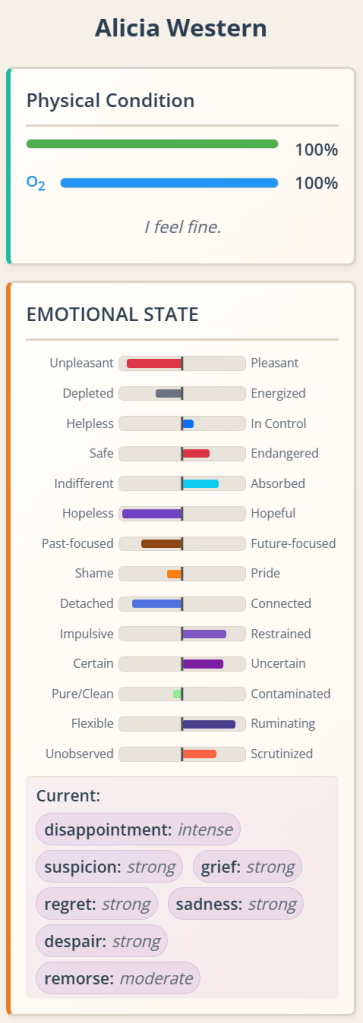
Some deep research and several iterations later, ChatGPT and I came up with the following notions, which are displayed below in a lovely manner, as they appear on the game page of LNE.

The simulation relies on seven base mood axes: valence, arousal, agency control, threat, engagement, future expectancy, and self-evaluation. Apparently that basic breakdown is psychologically sound, but I’m trusting ChatGPT on that. The sexual variables apparently are also well-known: an excitation component is the accelerator, and the inhibition is the brake. Added to a baseline libido dependent on the individual, that calculates the arousal. As seen in the picture, Alicia right now is dry as sandpaper.

The most interesting part for me is that the mood axes and basic sexual variables are ingredients to form emotions and sexual “moods”. I have dozens of them defined, as I’ve been working with ChatGPT in order to depict the whole breadth of emotions that are distinct and meaningful. Here are the current listings of emotions and sexual “moods” that my app calculates:

  • Emotions: calm, contentment, relief, confidence, joy, euphoria, enthusiasm, amusement, awe, inspiration, aesthetic appreciation, interest, curiosity, fascination, flow, entrancement, hope, optimism, determination, anticipation, sadness, grief, disappointment, despair, numbness, fatigue, loneliness, nostalgia, boredom, apathy, unease, stress, anxiety, craving, thrill, fear, terror, dread, hypervigilance, courage, alarm, suspicion, irritation, frustration, anger, rage, resentment, contempt, disgust, cynicism, pride, triumph, shame, embarrassment, awkwardness, guilt, regret, humiliation, submission, envy, trusting surrender, jealousy, trust, admiration, adoration, gratitude, affection, love attachment, compassion, empathic distress, hatred, surprise startle, confusion
  • Sexual moods: sexual lust, passionate love, sexual sensual pleasure, sexual submissive pleasure, sexual playfulness, romantic yearning, sexual confidence, aroused but ashamed, aroused but threatened, sexual craving, erotic thrill, sexual performance anxiety, sexual frustration, afterglow, sexual disgust conflict, sexual indifference, sexual repulsion

Emotions are calculated based on detailed prototypes. Here’s one:

"anxiety": {
      "weights": {
        "threat": 0.8,
        "future_expectancy": -0.6,
        "agency_control": -0.6,
        "arousal": 0.4,
        "valence": -0.4
      },
      "gates": [
        "threat >= 0.20",
        "agency_control <= 0.20"
      ]
    }

Those emotions and sexual moods are fed to LLM-based actors. They figure out “hmm, I’m intensely disappointed, strongly cynical, strongly sad, etc., so that needs to color my thoughts, speech, notes, and the actions I take.” I haven’t tested the system much in practice, but the little I tested, the results were like night and day regarding the LLM’s roleplaying.

In real life, we not only do things, but our bodies do things to us. We are aware of how our emotional states change us, and those turn into “tells” to the other people present. In addition, when one thinks in terms of stories, you add “reaction beats” when the emotional state of an actor changes, so I did exactly that: if the LLM has returned changes to the previous mood axes and sexual variables, the library of expressions have a change to trigger (one at a time), based on whether some prerequisite triggers. The following example makes it self-explanatory:

{
    "$schema": "schema://living-narrative-engine/expression.schema.json",
    "id": "emotions:lingering_guilt",
    "description": "Moderate, non-spiking guilt—an apologetic, sheepish self-consciousness after a minor mistake",
    "priority": 57,
    "prerequisites": [
        {
            "logic": {
                "and": [
                    {
                        ">=": [
                            {
                                "var": "emotions.guilt"
                            },
                            0.35
                        ]
                    },
                    {
                        "<=": [
                            {
                                "var": "emotions.guilt"
                            },
                            0.70
                        ]
                    },
                    {
                        "<=": [
                            {
                                "-": [
                                    {
                                        "var": "emotions.guilt"
                                    },
                                    {
                                        "var": "previousEmotions.guilt"
                                    }
                                ]
                            },
                            0.12
                        ]
                    },
                    {
                        "<=": [
                            {
                                "var": "emotions.humiliation"
                            },
                            0.25
                        ]
                    },
                    {
                        "<=": [
                            {
                                "var": "emotions.terror"
                            },
                            0.20
                        ]
                    },
                    {
                        "<=": [
                            {
                                "var": "emotions.fear"
                            },
                            0.35
                        ]
                    }
                ]
            }
        }
    ],
    "actor_description": "It wasn't a catastrophe, but it still sits wrong. I replay the moment and feel that small, sour twist—like I owe someone a cleaner version of myself. I want to smooth it over without making a scene.",
    "description_text": "{actor} looks faintly apologetic—eyes dipping, a tight little wince crossing their face as if they're privately conceding a mistake.",
    "alternate_descriptions": {
        "auditory": "I catch a small, hesitant exhale—like a half-swallowed \"sorry.\""
    },
    "tags": [
        "guilt",
        "sheepish",
        "apology",
        "minor_mistake",
        "lingering"
    ]
}

I’ve created about 53 expressions already, but they’re surprisingly hard to trigger, as they require very specific (and psychologically logical) conditions.

Because testing this new system through playing scenarios would be a nightmare, I’ve created a dev page that makes testing the combinations trivial. In fact, I’ve recorded a video and uploaded to YouTube. So if you want to hear me struggle through my accent that never goes away, and the fact that I very, very rarely speak in real life, here’s ten minutes of it.

I think that’s all. Now I’m going to play through the same Alicia Western scenario as in the short story I posted. If the result is different enough, I will upload it as a short story.

You Will Spend the Rest of Your Life (Short Story)

I need to preface this story. In December of 2024, I wrote a post about the fact that Alicia Western, the focal character in Cormac McCarthy’s last two books The Passenger and Stella Maris, had shown up in my dreams. Ever since, I’ve been haunted by her almost literally every night. Back when I commuted to and from work, the same. I close my eyes and see myself returning to that solitary patient room in the Stella Maris sanatorium. Wisconsin. 1972. Alicia Western, a unique person whom I would love to speak with even though I don’t want to speak to people in real life. Alicia, whose death, even literary, was an unbearable tragedy. Two days before she walked into the woods behind the sanatorium and let herself freeze to death.

That daydream has become my safe space. I’m beyond analyzing the psychological reasons. I just know that replaying that scene, and others that follow, brings me peace. And I need peace.

This short story plays out that initial encounter. I guess you can call it sophisticated fanfiction.

If you’re one of the two or so people who read my couple of short stories slash scenes back in mid December, about a bunch of fantasy-world dredgers, I haven’t given up on it. I’m actually working on brain damage mechanics related to suffocation and drowning. But the mechanics needed to implement are significantly more numerous and complex than I expected.

Anyway, enjoy the following short. Or don’t. I don’t care.


Half past nine at night on December 22. In two days I’ll walk into those woods behind the sanatorium and freeze to death. My mind is locked on that idea. I’ll never see Bobby again. The silence is enormous. I can hear snow falling outside.

The patient room they assigned me is in a deserted wing, away from the ones who didn’t arrive willingly. Pale green walls. Beige vinyl floor in a grid. Metal-framed bed with a striped mattress cover. The fluorescent fixture overhead casts the blue-white light of a morgue. I’m not sleepy, but I don’t know what to do with my thoughts.

The letter is still in there, half-finished. The words I can’t say while standing upright. I need to see it again—not to finish it tonight, but to verify the thing exists. That it’s real. That I didn’t hallucinate the act of writing goodbye.

I cross to the desk and pull open the drawer.

“Hello, Alicia Western. Glad to finally meet you.”

The voice is deep, male, directly behind me at the center of the room. My hand is still on the drawer handle. I didn’t hear the door. I didn’t hear anything. He spoke my full name—not “Alicia,” but “Alicia Western”—like he’s been keeping a file. Like he’s been waiting.

The Kid does that. Materializes. So do the others. This one is new. The voice doesn’t have the Kid’s circus-barker wrongness. It sounds almost… comfortable. Embodied. Purposeful. I hate that he said “glad to finally meet you” because it implies intent, duration, a plan. The visitors don’t usually speak like that. They speak in riddles or they don’t speak at all.

“You know my name,” I say. “Congratulations. That doesn’t explain what you’re doing in a locked room or why you think I owe you a greeting.”

I turn my back to him.

His voice comes again from behind me, calm and measured.

“You don’t owe me anything. First of all, I apologize—I would have preferred to infiltrate the sanatorium by acting as a volunteer. I’d engage you little by little, perhaps in the common room. But the staff would ask questions, so I had no choice but to appear in your assigned room at half past nine. I’m sure it feels violent to you. Again, I apologize.”

Turning around isn’t submission; it’s data collection. If he flinches or shifts when I look at him directly, that tells me something. If he holds steady, that tells me something else. I want to see whether his eyes track like the Kid’s do—too focused, like he’s reading lines off the back of my skull—or whether they move like a person’s.

“You say ‘violent’ like you understand the term,” I say. “Materializing uninvited in a locked room at night and speaking my full name isn’t violence—it’s theater pretending to be introduction. So let’s skip the performance. What do you want, and why should I believe you’re anything other than my own mind eating itself in a new costume?”

I turn around.

He’s tall. Very tall. Bearded, brown hair cropped short and wavy. Brown eyes, almond-shaped, watching me without the Kid’s predatory focus. A scar cuts across the bridge of his nose. He’s hulking but lean—broad through the shoulders and chest, hairy forearms visible below the sleeves of a gray wool T-shirt. Jeans, belt, sand-colored boots. He looks solid. Like he belongs in a body in a way the Kid never has.

He softens his gaze—or performs softening.

“Ah, you think I’m a hallucination. I guess that’s the most reasonable assumption for someone in your circumstances. I’m quite real, I assure you. My name is Jon Ureña. From Spain, originally. A proper introduction, less theatrical.”

Either he’s something new, a different kind of visitor with agenda and continuity the others lack, or my hallucinations have escalated to include operational security and social scripts.

I cross toward him. If he’s real in the way bodies are real, there will be tells: breath rhythm, micro-shifts in posture when I close distance, the flinch or hold that happens when someone’s personal space gets violated. If he’s an eidolon, the space between us might behave differently. The Kid sometimes feels like he’s projected onto the room rather than standing in it, like depth perception doesn’t apply correctly.

I cross toward him. He just watches me close the distance until I’m near enough to feel the heat coming off his chest.

He’s warm. The smell is there: musk, faint sweat, the scent of a body that’s been wearing clothes all day. His breathing is steady, audible at this range. He looks down at me, calm, unbothered.

“Take all the time you need to react to the sudden presence of a stranger in your locked room,” he says.

Either he’s solid or my visitors have learned to simulate flesh convincingly. The Kid never felt like this—the Kid is hyper-real but frictionless, rendered rather than present. Jon Ureña has mass.

I place my hands on his chest.

Muscle shifts under the cloth. His heartbeat is there, palpable through the wool and skin. The rise and fall of his breath. Ribs expanding. All the micro-mechanics of a body that actually inhabits flesh.

“I assure you, Alicia Western, that I’m real as you are,” he says quietly, still looking at me.

I’m done collecting data through touch. I step back.

He nods at me.

“Alright. My solid presence established then. Shoot away. Your questions, I mean. To the stranger who just showed up in your assigned patient room at half past nine.”

He’s inviting interrogation. Like he’s waiting for me to ask the obvious questions. The eidolons don’t do this; they don’t invite sustained questioning or stand around waiting for me to process their arrival.

The desk drawer is still half-open. My letter to Bobby is inside—unfinished, hidden under the prayer book. If he’s been watching, he’ll react when I reach for it. I pull the drawer fully open.

“I worry about your state of mind,” Jon says, calm and measured. “About whether we even can hold this conversation. But I came at this point because you needed to feel in your bones the danger of the situation.”

The prayer book is there, edges worn. I lift it. Beneath it, the folded letter—sheets of lined paper, blue ink, my handwriting. I take it out slowly, deliberately, watching his face.

“That’s your goodbye letter to Bobby, isn’t it?” Jon asks. “I suspect you haven’t finished it yet. I have the finished version. In case you want to read it.”

That’s impossible unless he’s been in this drawer before, or unless this is my unconscious serving up its own completion fantasies through a convenient mouthpiece. If he has a “finished version,” that means he’s claiming foreknowledge of what I’ll write in the next two days.

I unfold the pages slowly, eyes scanning the handwriting without looking up at him.

The text reads:

December 22, 1972
Stella Maris

Bobby,

The probability of you reading this approaches zero. The doctors said “braindead”—past tense, declarative, clinically certain. But I cannot pull the plug. I fled instead. So this letter exists in a superposition state: written but unread, meant for you but addressed to no one. Schrödinger’s goodbye.

If you are reading this, then something impossible happened. You woke up. The substrate repaired itself against all medical prediction. In which case, you should know: on the 24th—Christmas Eve, because apparently I have a taste for symbolic timing—I intend to walk into the woods behind the sanatorium and let the Wisconsin winter finish what Lake Tahoe started.

I am trying to explain this rationally, but the premises keep collapsing: Premise One: You were my only tether to continued existence. Premise Two: Without you conscious in the world, the equation no longer balances. Conclusion: Death is the optimal solution. But even I can see the flaw in my logic. I have spent twenty-two years analyzing everything except the one variable that matters: that I want to die has been true longer than you have been in a coma. The coma is just the excuse my mind has been waiting for.

You used to take me to that bar in Nashville. Jazz on Thursdays. You would order whiskey and I would watch the colors the saxophone made—ambers and deep golds, spiraling up into the smoke. You never tried to fix me during those nights. You just sat there, let me talk about Gödel or Cantor or whatever mathematical dead-end I was pursuing that month. You listened without needing me to be different. I miss that. I miss you. I miss my brother so much it aches behind my ribs.

There are things I need you to know, in the infinitesimal probability you are reading this: One: None of this is your fault. I know your patterns, Bobby. You run when things hurt, you isolate when you cannot fix something, and if you are reading this you will spend the rest of your life—

The sentence ends there. Mid-thought. I couldn’t figure out how to complete it without collapsing into accusation or apology, and Bobby deserves neither. So I stopped.

I fold the pages slowly and look up at Jon.

He’s still standing there, patient, watching me with that same unbothered calm. The silence stretches between us—sepulchral, nothing but the ghost of snow falling outside.

“Would you like to receive the finished version of the letter you’ve just read? Now that your unfinished letter is fresh in your mind…”

He produces a folded letter as if he had been holding it this whole time. The letter is yellowed, creased, the paper aged in a way that takes years. He extends it toward me.

I take it.

Either he’s claiming time travel or he’s claiming he excavated this letter from some future archive where my suicide is historical fact and someone kept the letter long enough for it to age like this. Or it’s theater. My unconscious generating set dressing to make the artifact feel canonical.

I unfold it carefully. The handwriting is mine. Same blue ink. The date reads December 22, 1972—today. It starts the same way: Bobby, The probability of you reading this approaches zero

But it doesn’t stop where I stopped.

Past the mid-sentence break. Past “you will spend the rest of your life—” and into believing you should have prevented it somehow. You could not have. This was always the trajectory.

The letter doesn’t stop where I stopped. Seven numbered confessions. One: None of this is your fault. Then Two: I deliberately left Granellen behind without saying goodbye. Then Three: I died a virgin. Twenty-two years old and I never let anyone close enough.

I stop breathing.

That thought—virginity, the loneliness of never being touched with tenderness—I had that thought yesterday. Sitting in the common room watching the nurses move through their rounds. I didn’t write it down. I didn’t tell anyone. It was just there, in my head, sharp and private.

Four: The inheritance money from Grandfather—you bought that race car and crashed it in Italy and ended up braindead, and I cannot even be angry at you for it because at least you lived before the crash.

Five: Sometimes I just wanted to buy groceries with someone and argue about peaches.

The domestic fantasy I’ve never said aloud. That exact phrasing—”argue about peaches”—that was mine. Three days ago, lying in bed, imagining a version of myself who got to have small, ordinary arguments in a kitchen somewhere.

This isn’t guessing. This is extraction.

I scan ahead. The letter continues through numbered confessions—mathematics failing me, lying to my therapist, testing whether he’ll notice inconsistencies. Then the closing lines: The woods are waiting. December 24th. Christmas Eve. I love you. I am sorry.

And a postscript: I remember every word you ever said to me. Every single word. Most people forget. I would give anything to forget. But I cannot. So I am taking all of it with me.

That’s mine too. The burden of remembering every conversation with Bobby, every word, archived and immutable.

I lower the letter slowly.

“I assume you’ve recognized your thoughts in the finished version,” Jon says quietly. “One you have yet to write. What questions arise in your mind?”

I fold the pages and look up at him. Jon watches without speaking.

He sighs.

“Don’t just look at me like that, Alicia. C’mon, girl. Surely you have plenty to ask this stranger who showed up in your locked room with a letter you’ve yet to finish.”

The real question isn’t how did you get this or are you a time traveler. Those are diagnostic dead-ends. The real question is tactical: why show me the completion now, two days before December 24, in a locked room when no one else is listening? If he wanted institutional intervention he could have brought staff, triggered a psychiatric hold. If he just wanted to document he could have waited until after and collected the letter from my body. Instead he’s here now, with the finished version, waiting for me to react like my reaction is the variable that matters.

He thinks confrontation will trigger something. Shame, maybe. Or survival instinct. Or he thinks seeing the letter completed—reading my own probable ending—will make the plan feel real enough to collapse it.

It doesn’t. Bobby’s still gone. December 24 is still two days away. The equation hasn’t changed.

Jon watches me not answering, then sighs again—deeper this time, tired.

“You’re a hard one. Okay, maybe I’m asking too much of you in these circumstances. At the end of your road. Let me clarify what I’m doing here: I was told about you by someone you know well. A certain Bobby Western. He asked me to come and prevent the silly thing you intend to do in a couple of days.”

That’s the move. The lever he thinks will work.

If Bobby sent him, Bobby woke up—contradicting braindeath. Either the doctors were wrong or this is my unconscious staging wish-fulfillment: Bobby alive, Bobby knows, Bobby sends help.

Elegant. Also suspect. Because Bobby’s in Italy, braindead, on a ventilator. The last time I saw him his eyes were open but empty and the neurologist used the word “irreversible” three times in one sentence.

Either way, I need to hear what comes next.

The silence stretches. Jon watches me. Then something shifts in his expression—concern bleeding into impatience.

“Beautiful as your face is, it’s also quite unreadable at this point of you barely holding on to your life. Alright, I’ve got a couple of photos of Bobby post-coma. But you’ve got to ask for them, Alicia. I can’t be doing all the work here.”

He wants me to make myself legible as someone who needs proof. If I don’t, he keeps the photos and I stay in this loop.

I let the silence sit.

Jon stands there observing me. The impatience fades from his face. His eyes soften. Then he steps closer—closes the distance himself without asking permission—until he’s at touching range. Both of us silent now. Him looking down at me. Like proximity is supposed to do the work words couldn’t.

Real urgency can’t tolerate this much silence; people start offering evidence unprompted. But there’s a third option. I reach out and hold his hand.

Solid. Much bigger than mine. He just lets me hold it, the contact easy and unbothered. Then he leans in and presses his mouth softly to my forehead.

“This nightmare is ending, Alicia,” he says against my skin. “You don’t need to walk into those woods anymore.”

I squeeze his hand. Acknowledgment. The gesture saying: I’m still here. I’m listening. Show me.

Jon reads it. He produces a photograph and hands it to me.

“Well, here you have it. After Bobby woke up from his coma and the goddamn Italians let him call home, your grandmother told him that you had killed yourself. I think you can imagine… the state in which that put him. I haven’t asked what he did from 1973 to 1979. I assume he was handling grief poorly. When he resurfaced, he joined a salvage team. A man has to earn his keep even when the world has stopped turning.”

I look down at the photograph in my hand.

A group of men standing on a riverbank. Salvage-diving gear—dark rubber suits, tanks. Bobby’s there among them. Mid-thirties, which would be right for 1981 if he lived that long. Someone wrote ’81 in a corner in what looks like ballpoint pen.

But it’s his face that stops me.

I know that face. Every angle, every microexpression, the exact geometry of how he holds his mouth when he’s trying to look functional. And even in a work photo—surrounded by colleagues, probably taken to document the team—he looks haunted. Like he’s doing his best to appear normal while something unbearable churns beneath the performance. The kind of expression you only recognize if you’ve seen someone try to hold themselves together when the internal architecture is compromised.

Specific, inescapable grief.

He’s alive in this photo. Standing upright on a riverbank in 1981, nine years from now, working salvage with people who probably have no idea what he’s carrying. Which means the neurologists were wrong. “Irreversible braindeath” became reversed. The substrate repaired itself. Bobby woke up.

In his timeline, I’m already dead. And he spent years—1973 to at least 1981, maybe longer—living with that. Carrying it. The haunted look in this photo isn’t just grief; it’s the specific weight of believing your sister walked into the woods because you weren’t there to stop her.

But I’m standing here holding proof he survived. Which means December 24 just became obsolete. Not because someone talked me out of it. Because the premise collapsed. Bobby’s awake. The equation rebalanced. I don’t need to walk into those woods anymore.

I keep staring at the photo. Jon waits. Then his hand moves. Gentle. He brushes a stray lock of hair behind my ear, the gesture easy and unbothered, like it’s the most natural thing in the world to stand in a patient room at half past nine and tend to someone’s appearance while they’re holding evidence that rewrites their entire operational logic.

“That photo is from 1981,” Jon says, voice calm and measured. “I was born in 1985. I met Bobby by coincidence in 2006, in the Balearic Islands, off the coast of Spain. Formentera, specifically.”

Thirty-four years from now.

Jon’s hand withdraws from mine—not abruptly, just a natural release, like he needs distance to deliver what comes next.

“I’m a bit of a blabbermouth about the past,” he continues, “and your brother, that by then was a taciturn man with a full head of gray, nursing his drink at the same beach bar, was listening to me talk about the Roman Empire.”

Bobby would be sixty in 2006 if he lived that long. Jon’s describing a version of my brother I’ll never meet—decades older, silent, carrying thirty-four years of whatever happened after this moment.

“You want to know how the story continues?” Jon asks.

I look up from the photo. Meet his eyes. Brown, almond-shaped, watching me without the Kid’s predatory focus. Just waiting to see whether I’ll give him permission to keep talking or whether I’ll shut him down.

If he’s real and telling the truth, then Bobby survived long enough to care in 2006, and had access to someone—something—capable of sending intervention across thirty-four years. If he’s an eidolon, this script is new: time-traveling guardian with photos as evidence, tactile solidity, and a willingness to wait for me to vocalize interest instead of just performing his monologue and vanishing.

“Yeah. Tell me how you met my brother three decades from now.”

Jon smiles like I just gave him exactly the opening he was hoping for.

“Alright, Alicia. Picture this: your brother and I are on that beach in Formentera. He had approached me as I walked away from that beach bar, where I had discussed the Roman Empire with a history professor. Your brother had a strange expression in his grief-lined face. As if he intended to do something absurd, but the problem he had been burdened by for decades required a very specific miracle.”

Jon’s voice shifts—takes on the quality of someone settling into a story he’s told before, one he knows by heart.

“He said in a dry voice, ‘You speak about the Romans as if you knew them personally.’ I admitted it—I don’t care if people find out I’m a time traveler. If they don’t believe it, fuck them. He kept looking at me with these intense eyes. Then he asked, ‘Can you travel to December of 1972?’ I shifted my weight. I recognized the pressure, the urgency. This was a man who needed something to be set right. I said, ‘Yes, no problem. For someone’s sake, I’m guessing. What do you need? What should I do?'”

Jon pauses. Watches my face. Then delivers the last line quietly, like he’s handing me something fragile.

“He said, in this faint voice, as if he could barely form the words—’Save my sister.'”

The timeline makes no ontological sense unless time travel is real or unless this is my unconscious staging the most elaborate wish-fulfillment hallucination I’ve ever produced, complete with thermal signatures and completed letters and a stranger who kisses my forehead and tells me Bobby asked him to save me.

Either way, I just spoke—actually vocalized interest instead of stonewalling—which means I’ve already decided to let this play out instead of dismissing it as theater.

Jon’s expression warms like I just gave him permission to continue.

“Over the next few days, your brother told me about you. A hauntingly-beautiful math genius. Synesthete. Haunted by visions herself. Who abandoned math because it was driving her mad…” He pauses, then adds, almost sheepish, “Well, I’m not entirely sure why you abandoned math. I’m not a math person myself. Anyway, he showed me a photo of yourself, so old and yellowed at that point. He didn’t part ways with it.”

Yellowed. Carried for decades. Bobby holding onto a photograph of me the way someone holds onto evidence of a person who stopped existing. The grief in that action—preservation as mourning ritual—is a thing Bobby would do. Keep the artifact. Never talk about it. Just carry it.

Jon’s voice drops, becomes quieter.

“Your brother made it very clear that you’re a unique being and that your passing from the world was a horrifying tragedy. So, I investigated your circumstances in 1972, found out what patient room you were staying at, and I’ve come here tonight to ask you—please, don’t kill yourself, Alicia Western.”

He steps closer. Both hands come up and settle on my shoulders—firm, grounding pressure, like he’s trying to anchor me to the room while delivering the rest.

“There’s plenty more for you to experience out there. Even happiness.”

Like it’s a fact instead of a sentimental projection. Like Bobby told him I deserved it and Jon believed him.

I need a moment to let the information settle. Not stonewalling—just processing whether this timeline makes ontological sense or whether I’m watching my mind eat itself in a new costume.

Jon stands there, hands on my shoulders, waiting. His breathing is steady.

The silence stretches. I can feel his pulse through his palms—steady, unhurried. Real people with real errands usually can’t tolerate this much silence. They elaborate. They justify. They offer more proof.

“It’s a lot to take in, for sure,” Jon says. “What are you thinking?”

Bobby’s alive. Woke from the coma. Survived being told I killed myself. Lived long enough to care in 2006 and find someone who could reach backward across decades to intervene. Which means the premise—Bobby gone, equation unbalanced, December 24 necessary—just collapsed. I don’t need to finish the letter or tie a red sash or find a tree far enough into the woods.

If this is real, then I owe him acknowledgment—not sentimental gratitude, just recognition that he came here and did what Bobby asked. If this is hallucination, then my unconscious is staging the rescue it wants and I should let it play out instead of stonewalling.

His hands are still on my shoulders. I reach up and place mine on his own shoulders—steady contact, protective gesture returned, acknowledgment that he crossed temporal distance to deliver this and I’m not dismissing it.

He shifts his stance slightly. One hand slides from my shoulder to my waist—the contact more intimate now.

I meet his eyes.

“You just told me my brother lived to sixty. That he survived the coma, the grief, decades of carrying my death, and still cared enough to send you backward to prevent it. If that’s true—if Bobby’s really out there, conscious, alive—then you’ve already done what you came for. I’m not walking into those woods anymore.”

Jon’s face breaks into a smile—genuine warmth, relief flooding his expression. Then he wraps me carefully in his arms, my frame enclosed in his solid, muscular body. The hug is enveloping, protective, like I’m something that needs holding together.

“I’m so glad to hear you say that, Alicia,” he says against my hair. “You don’t have to be alone until Bobby wakes. I can bring stuff from the future, other timelines… As a time traveler, I have damn near infinite access to money. I’ll make sure that you and your brother never have to worry about money ever again.”

He closes his arms tighter. But I didn’t authorize this hug. He initiated and closed his arms and I’m inside the gesture before I decided whether I wanted it. Which is tender, yes, and protective, yes, but also presumptive. I need space to think without being held like a rescued animal.

I step back carefully—gently, because he did just cross thirty-four years to prevent my death and that doesn’t deserve hostility—and put an arm’s length of distance between us.

Jon’s arms release easily. He just watches me, unbothered.

“I appreciate the intervention, Jon. And the financial offer. But I need you to clarify something—when you say I don’t need to be alone until Bobby wakes up, what exactly are you proposing? Are you planning to stay here in 1972, or are you offering periodic visits across the timeline, or is this just about making sure I have access to resources?”

Jon laughs softly, then scratches the back of his neck—a sheepish gesture, almost apologetic.

“Yeah, I haven’t explained much of anything, have I.” He drops his hand. “I don’t rely on technology to travel in time. It’s something I can do—something different in my brain. I’ve never met anyone else like me. I can bring objects with me across the time jumps, but I can’t bring any living thing.”

He pauses, and something shifts in his expression, bleeding through the careful explanation.

“That’s my… personal loneliness that I’ve endured for a long, long time. Nobody has figured out why, but whenever I try to bring anything alive, from people to even bacteria, it just stays behind. So I can’t bring you to other timelines, to the future or whatever. I meant literally accompanying you, filling the loneliness so to speak, until your brother wakes up at the latest on April 27, 1973.”

That’s not just intervention—that’s relationship.

“Alright,” I say. “So you can’t bring me to other timelines, which means ‘traveling together’ means you staying here in 1972 and we spend December through April in the same timeline, conventional sequence. That’s what you mean by ‘accompanying me’—physical presence, not periodic visits. But you still haven’t explained the plan. What are you actually proposing to do about Bobby? Are you just telling me he wakes up in April, or are you intervening somehow to make sure he wakes up? And what does ‘traveling together’ look like day-to-day—are you staying here in Stella Maris, getting a room nearby, or leaving and coming back? I need the operational picture before I agree to anything.”

Jon’s face clears like I just asked exactly the right question.

“I see you need details, and I’m happy to give them.” He takes a deep breath. “I had thought of the following: you leaving Stella Maris as soon as possible. Getting the fuck out of Dodge. Buy you some clothes, as I know you’ve given away all your possessions. Then, we buy a mansion somewhere you prefer. I’ve scouted some, and tested in other timelines that they can be bought at a short notice. If you think of specific places in which to live, just tell me and I’ll scout more.”

A mansion. Not a hotel room, not temporary housing—a property he’s already scouted across timelines to confirm availability. Which means he’s been planning logistics before he even materialized in this room.

“Once we own that base of operations, so to speak,” Jon continues, “we call the goddamn Italians, tell them we’re coming. I pay them for the treatment to Bobby, and add a generous donation for not pulling the plug. Then, we extract Bobby out of there. We fly him in a private flying vehicle from the future back to our mansion. There, we move Bobby into a special bed designed for coma patients. It’s controlled by artificial intelligence. Actually, one named Hypatia, whom my company developed. She’s fantastic, you’ll see. This bed can move the muscles of the comatose patient to avoid atrophy, it can turn them when needed to prevent sores…” He’s warming to the explanation now, more animated. “And it comes with a neurological scanner of sorts that tells us how his brain reacts to stimuli even in his dreams. You see, we haven’t figured out in the future how to wake comatose patients up from their comas, but we’ve proven scientifically that using the kind of treatments that the bed provides, they wake up even sooner, so we may not have to wait until April 1973.”

That’s not companionship—that’s moving Bobby across an ocean and buying me a mansion. Bobby physically present in the same location as me instead of vegetative in Italy while I wait alone in Wisconsin.

The plan has structural coherence—if Jon can bring objects across timelines, a medical bed and aircraft make sense. If he has infinite money via temporal arbitrage, buying a mansion and bribing Italians is trivial. If Bobby’s substrate can recover—the photo proves he does—then better medical support could accelerate that recovery.

But the plan also means I’m making a choice right now. Not just “don’t kill yourself on December 24” but “leave Stella Maris, accept Jon’s material patronage, live in a mansion he buys, cohabit with a comatose Bobby and a time traveler I met twenty minutes ago, and wait for Hypatia the AI to tell us when Bobby’s brain is waking up.”

And he’s standing there, waiting for me to respond to the plan like it’s a done deal. Like of course I’ll say yes because Bobby and mansion and infinite money and accelerated recovery timeline.

But I need to think about what saying yes actually means. I’d be leaving the only institution I chose voluntarily. Entrusting Bobby’s physical body to technology I haven’t verified. Cohabiting with Jon for an indefinite period—December to April minimum, possibly longer if the bed accelerates things or doesn’t. Accepting financial dependence on someone I literally just met who claims to be from 2006 and says my sixty-year-old brother sent him backward to save me.

If he’s real, that’s rescue. Bobby’s alive and I owe him the chance to prove the bed works. If he’s an eidolon, this is my unconscious staging the most elaborate wish-fulfillment scenario it’s ever produced—Bobby conscious, infinite resources, companionship, medical intervention, escape from Stella Maris—and saying yes means I’m letting the hallucination dictate my material decisions. Which is how you end up sectioned permanently.

But the photo was real. Thermal ink, grain, Bobby’s face in ’81. The letter was real—yellowed paper, my handwriting, thoughts I recognize. His body is real—heartbeat, musk, solidity. So either he’s real, or my visitors have escalated to full sensory simulation and I can’t trust perception anymore. Which means I’m already lost.

If I can’t trust perception, then it doesn’t matter whether I say yes or no—reality is contested either way. But if he’s real, and I say no, then Bobby wakes up in Italy in April and I’m still here in Stella Maris having refused the intervention. December 24 is still on the table because the equation hasn’t changed, just the timeline. Whereas if I say yes, Bobby’s here. Jon’s here. The bed is here. And I’m not alone while waiting for Bobby to wake.

That’s the variable that actually matters. Not the mansion or the money or even the medical tech, but that I wouldn’t be alone. I’ve been alone since I fled Italy. Alone in the patient room. Alone with the visitors. Alone with the letter and the woods and December 24. Jon’s offering to end that. Not with platitudes or therapy or medication, but with physical presence and operational logistics and Bobby in the same house. If he can actually deliver that, then yes is the only answer that makes sense.

I need to confirm he understands what he’s offering—that this isn’t just “prevent suicide and leave,” it’s “stay until Bobby wakes and possibly longer, cohabit with a woman you just met who has visitors and doesn’t do community and will test whether you’re real by seeing if you sustain tenderness or start trying to manage her.”

“I’ll leave with you,” I say. “We’ll set up the mansion, extract Bobby, try the bed. If Hypatia can actually monitor his neural activity and the bed prevents atrophy, that’s better than leaving him vegetative in Italy while I wait here.”

Relief floods through Jon’s face.

“But I need you to clarify something before I agree to the whole operational picture,” I continue. “What do you actually want in return for all of this? You’re offering infinite money, a mansion, future-tech medical equipment, and your continuous presence for months. Nobody does that without expecting something. So what is it? Companionship? Gratitude? Proof that the mission succeeded? Or something else you haven’t named yet? And when you say ‘traveling together,’ do you mean you’re staying the entire time—December through whenever Bobby wakes—or are you setting everything up and then leaving, or checking in periodically? I need to know what kind of relationship you’re proposing before I let you restructure my entire material reality.”

Jon meets my eyes. Something shifts in his expression—the careful explanation dropping away. What’s left is plainer.

“Are you subtly asking me if I want to fuck you, Alicia? Is that the concern? Any heterosexual man would want to be intimate with you. That doesn’t exclude me. But you are in an extremely vulnerable emotional situation. I wouldn’t think of even going along those lines until you are settled, feel better, and genuinely feel something in terms of reciprocity.”

He’s acknowledging the power differential. Naming it instead of pretending it doesn’t exist.

“I also get lonely, Alicia,” he says, quieter now, “and most human beings across the vast spans of time are unbearably, painfully boring. I want to spend time with someone special. Travel together, watch movies, have interesting conversations. Buying you a mansion and getting Bobby out of Italy isn’t much of an effort when you have my kind of money.”

That’s honest. Not manipulation masked as rescue. Just stating the operational picture clearly—intervention plus optional intimacy, my timeline, my choice. The real ask is companionship—time with someone special, movies, conversation, mutual loneliness addressed.

The plan makes sense. Leave Stella Maris, set up infrastructure, extract Bobby, cohabit until Bobby wakes. Companionship optional but available if I want it. Intimacy deferred until I initiate. I don’t need to be alone while waiting for Bobby to wake up if Jon’s offering to stay and the offer is genuine.

“I accept. We’ll leave Stella Maris, set up the mansion, extract Bobby, install him in Hypatia’s bed. You can stay if you want—companionship, movies, whatever—but I’m not promising anything beyond cohabitation until I see whether you’re real across ordinary time. And if at any point this starts feeling like management instead of companionship, I’m walking. Understood?”

I close the distance between us. Not invasively. Just reducing the conversational space I created earlier. He doesn’t retreat. Just stands there as I approach. At this range I can feel the heat coming off his chest again. See the rise and fall of his breath.

He smiles at me—warm, unbothered.

“That’s great, Alicia. Then it’s on your terms when you want to leave Stella Maris. I know you came voluntarily, but I guess you want to say goodbye to people here. Whenever you’re ready, you’ll just have to call me on the transmitter, tell me to come get you, and I’ll show up with a car, ask the receptionist whether Alicia Western is here. I’ll play the part of someone from your past who came to take you away from this… well, sad place. About intimacy, you don’t need to promise anything nor even think about it. Just focus on returning back to life. But regarding what you said about ‘if at any point this starts feeling like management instead of companionship, I’m walking’… I’m not sure I understand. What would management look like to you?”

His hand comes up. Fingers brush against my cheek—soft, deliberate, the gesture tender but also presumptive. Like he’s allowed to touch my face while asking me to define boundaries. That’s proximity I initiated by moving close after accepting the plan provisionally, yes—but it’s also proximity that’s starting to feel like it’s assuming the relationship is already defined when we’re still clarifying what the relationship actually is.

I need space. His heat, his smell, his hand on my face—it’s all too close to think clearly. Better to step back now. Create conversational distance again. Signal that I’m considering the offer seriously but I need room to articulate what I actually need without his touch as variable. If he respects the boundary adjustment, that’s a tell that he meant what he said about “on your terms.” If he closes distance again immediately or looks hurt, that’s a different tell—means he needs proximity to feel secure, which would be its own kind of dependence I’d need to account for.

I step back. His hand falls away from my cheek.

“Management looks like you deciding what’s good for me and then engineering circumstances so I arrive at that conclusion on my own while believing it was my choice,” I say. “Companionship looks like you staying because I asked, leaving when I need solitude, and not treating my decisions—including bad ones—as problems you’re obligated to solve. If you’re here to prevent suicide as a mission parameter, that’s management. If you’re here because you want to spend time with me and suicide prevention is a consequence of that presence, that’s different. So which is it?”

Jon rubs his chin, thoughtful.

“I see what you mean. First of all, I must clarify, in case you haven’t noticed, that I’m not remotely as intelligent as you are. I can time-travel and all, but it’s not like that made me a genius. So you’ll have to be a little patient with my thought processes. Alright, when I figure out a plan about anything involving your life, I’ll lay it out, ask whether it feels right for you. And if at any moment you want me to scram, just say so and I’ll disappear. But if suddenly you decide that you want to kill yourself despite your brother Bobby waking up eventually, despite having your own mansion and financial help… I mean, I’ll have to restrain you and prevent you from killing yourself just on principle. Do you think that would be unreasonable?”

That’s honest enough to be useful. But it also means if I accept this arrangement, I’m accepting a jailer who believes he’s protecting me from myself. Maybe that’s reasonable—maybe suicide prevention is the one non-negotiable boundary that doesn’t constitute management—but I need to think about whether I can live inside that constraint for four months without feeling like I’m back in institutional custody with better amenities.

“Which means this isn’t companionship without conditions—it’s rescue with override authority. That’s management, Jon. You’re offering me a mansion and infinite resources and Bobby’s extraction, but the price is accepting that my autonomy is conditional and you retain veto power if I decide the universe is still structured for destruction and suicide becomes necessary again despite the intervention. So let’s be clear—are you offering companionship where I set the terms, or are you offering supervised relief where you intervene if my decisions conflict with your mission to keep me alive? Because those are different relationships and I need to know which one I’m actually accepting before I let you restructure my entire material reality around your apparatus.”

Jon shakes his head slightly.

“I’m sorry, Alicia, but I don’t accept your dichotomy. If I get to know you to the extent that I like you as a person, as a friend even… if I happened to find out you intend to kill yourself, would me trying to stop you be ‘supervision,’ or just the pure natural reaction to someone you care about trying to remove themselves, even though their decision could have been made under a temporary mental disruption?”

The careful negotiation drops away from Jon’s expression.

“I guess I’ll make it clear,” he adds. “I intend to keep you alive under all circumstances, Alicia. And I wish to offer you a better life than your meager, depressing current one, until your brother Bobby joins your side. When your brain makes up its mind and convinces you that extinction is the best course of action… well, it was wrong this time, wasn’t it? Your brother eventually woke up, and your death was a horrible tragedy. My job is to prevent that from happening.”

Maybe that’s what I need. Someone who won’t leave when my brain tells me to die. Someone who’ll hold the line when I can’t argue with myself anymore. The weight behind my ribs shifts—not gone, but different.

The silence stretches between us. This is rescue with veto authority, companionship is optional, and he’s not negotiating the suicide-prevention parameter.

Jon watches my face, then sighs.

“This has been a lot to take in, hasn’t it?” His voice softens. “It’s nearly midnight. You must be exhausted, and you have a lot to think about. Would you prefer for me to leave for tonight so you can sleep? I can come by tomorrow morning, bring you breakfast.”

I don’t answer. Just stand there, letting the silence sit.

He nods, then smiles at me.

“Alright, I’ll let you be. Good night, Alicia. I hope that before you fall asleep you remember that soon enough you’ll be in your own place, a house big enough that nobody will bother you, and with Bobby recovering in one of the rooms. I hope that when you wake up, things feel lighter for you. See you in the morning.”

Jon vanishes from the room. Disappears instantly—one moment standing there, the next just gone. The air where he stood settles back into stillness.

I’m alone again. The fluorescent hum fills the silence.

I am exhausted. Two days of holding the line against institutional concern, writing the letter, the Kid’s intermittent visits, Jon’s arrival with the photo and timeline and sovereignty interrogation—it’s been sustained cognitive load and I can feel my thinking starting to fray at the edges.

Better to lie down, let the mattress take the weight, see if sleep arrives or if my mind just continues processing the question: do I believe the photo is real. Do I believe Bobby woke up. Do I believe the universe allowed one structural exception to its design principle that everything created gets destroyed.

Life update (12/29/2025)

For whatever reason, recently I’ve been thinking about the wound that has defined me the most. The majority of the stories I genuinely need to produce come back to that wound in one echo or another. Maybe it’s related to me having become forty-years-old. I would say middle-aged, but there’s no way in hell I’m living to eighty. Anyway, my fatal wound happened back when I was seven years old, when my mother asked me, as if you could ask a child to make such a decision, whether I wanted to move in with my older brother to free up my room so they could have another child.

My memory is abysmal, which I suspect is a blessing. Most of my forty years of living has been reduced to a bunch of photographs or sequences of frames that barely seem to cover anything. It’s like trying to reconstruct an epoch from the few fossils you come across. But I recall that until I was seven, I lived entangled to my subconscious. Like I was married to it. Daydreaming all day long. Making what my subconscious told me to create. Some adults that came across the stuff from those years were surprised. As in “a child that age doesn’t create stuff like this.” Unfortunately, it also included narratives that would make A Clockwork Orange blush; not for nothing I’ve always felt that I had darkness deep in me from birth. But the point is that I peaked back then, at about six or seven. When I truly communed with myself, and was whole.

From the moment I was put as an unwanted guest in my older brother’s room, until I turned eighteen and nearly beat him to a pulp, I was, a then-undiagnosed autistic kid with Pure O OCD, subjected to having the TV and radio on virtually always, including nights, because apparently enduring the silence was unbearable. I won’t get into my brother’s issues, but they’re plenty and complex in a way that anyone who has ever met him is surprised that such stuff even happens. I had been stripped of my safe space, of my solitude, of any corner purely for myself in which I could grow. I was like a plant forgotten under the stairs.

Looking back, the extreme to which I dissociated from my subconscious from then on is terrifying to think about. I genuinely came to believe that my natural instincts and impulses, everything that came from my brain without my conscious permission, was monstrous. I ceased knowing myself. I depersonalized. Throughout my teens I experienced something that only those who have endured the same thing will know I’m not exaggerating about: as I walked outside, I felt like I was commanding a puppet that I could barely coordinate, while I saw myself from the outside looking down, the edges of my vision constraining into a blurry tunnel. I slipped in and out of psychosis. The stuff I wrote back then was so incoherent that years later I threw it away because I feared that reading it again would contaminate me. And that included a novel about seven hundred pages long, which I rewrote again and again for years. I was sure I was going to die before I turned eighteen. I did pray to some eldritch god to come down and kill me. But I survived.

Shortly after my first job started, I saw how the rest of my life was going to be: enduring humiliation after humiliation, unbearable anxiety, under constant scrutiny as if every day was an exam I was sure to fail. Thankfully, I’ve never experienced a job like that again, but added to the despair I was already feeling, led me the closest I’ve ever been to erasing myself from this Earth. I’ve lost the memories of the aftermath, other than the fact that somehow I ended in the library, where my parents, who had been called by my job because I hadn’t shown up, found me. From then on, until my late twenties, with breaks of more unpaid internships than paid work, I basically lived as a hikikomori. In my late twenties, I thought that the only way I could make something out of my life was by selling my writings, of which I had done little since I was a child (somewhat counting the comics I drew in middle school). I wrote two books with a total of six novellas. They didn’t sell for shit, and mostly disturbed the people who read them. That discouraged me entirely, and I never wrote in Spanish again. However, writing those books helped me to slowly, laboriously, reconnect with my subconscious. Learn to recognize its desires and commands.

Early in my thirties, I started working in IT for a hospital. Terrible job that fought against my nature, and that I had to leave about seven to eight years later. But by then, now diagnosed and medicated for some other issues, I started producing fiction in English. This was by far my most prolific period. From seven to about twenty-seven years old, I identified with my conscious mind to a sickly degree, and believed that anything I couldn’t rationalize, any conclusion I didn’t reach through reason, was suspect, if not straight monstrous. But from my thirties onward, I no longer care, unless I’m forced to for the sake of money, about my conscious mind. It’s merely a tool to interpret and obey whatever my subconscious produces. The conscious mind also needs to be reigned in, because it acts as a lawyer, confusing and justifying what the subconscious has already decided, and often getting it completely wrong. I have learned that there are indeed monsters in me. I’ve also learned that I prefer the company of monsters.

That fatal wound in my past won’t heal. It broke my brain during development in ways that can never mend. I have to do the best I can with what I have. I don’t feel like interacting with humans, and those who have interacted with me for sustained periods of time (mostly at work), soon enough sense that there’s nobody “there.” In public, I’m a simulacrum of a human being. Left to my own devices, I’m some creature that doesn’t need definition nor to justify itself to anyone.

I also thought recently about something I witnessed when I was a teenager. I was returning home when I heard a commotion from four young people in their twenties who had parked in front of my parents’ apartment building. It was almost the same spot, if not the same, where my father parked the day I saw a UFO, when I looked up from the window only to find out it was right there. I wrote about it on this post, so I’m not going to repeat myself. Anyway, those young people in the car seemed freaked out, confused, out of it, but not in a “they’re drugged” way. They flagged down a passerby, and asked him if they were close to Barcelona. These weren’t foreigners; their plates were from Spain. The passerby, more disturbed than amused, scoffed and said, “Barcelona? You’re about seven hundred kilometers away! This is Irún, near the border with France.” The young people in the car, panicked, looked around frantically as if incapable of understanding how they had ended up there.

I haven’t made that up. I just don’t think about it often because it makes no sense. That day, I walked away, but I’ve imagined myself approaching them and asking, “What is the last thing you remember?” “Did you see any lights?” I imagine myself telling them that if anyone did this to them, they could have easily killed them but didn’t, so they should just try to relax and get on with their lives.

I don’t know what it means. That could be applied to the entirety of what I’ve lived through. Trying to understand myself is like spelunking with a dim light through passages that keep changing. And I’m still here because I just happen to be. I suspect that when I finally realize I’m breathing my last, a smile will be on my lips. Then, I will tend my hand inwards to the love of my life, who was there for me as a child when I didn’t have anyone else, and who waited patiently for years until I went down into that darkness to find her again.

Tatsuki Fujimoto 17-26

This is not a review, but a notice to those interested in the works of Tatsuki Fujimoto, author of Chainsaw Man, Fire Punch, Look Back, and Goodbye, Eri, all of which are required readings/viewings. He produced a bunch one-shot stories from ages 17-26, which have now been animated in very competent, creative ways. I can’t think of any other author who casually gets great adaptations made of random one-shots he made in his youth. Here’s the trailer.

They show Fujimoto’s range from early on. Most of his stories have in common the theme of reaching out for connection in an absurd world that often renders that connection fleeting, insufficient, or meaningless.

There’s also Look Back, a heartbreaking tale about ambition, connection, and regret. Merely mentioning what inspired it would be a spoiler. The movie has been out for a while, but I haven’t seen it yet. Probably because I’ll have to gear myself up to experience that story again.

The Chainsaw Man movie for the Reze arc is already online, and that’s a must see. This is both a fantastic and a terrible time to be a Fujimoto fan: fantastic because plenty of his stuff is getting adapted well. Terrible because the second half of Chainsaw Man, still ongoing, is unnecessary and generally bad.

Now, let’s hope that they also adapt the utter insanity that are Fire Punch and Goodbye, Eri. That last one has a plot point that I remember vividly because it made me burst out laughing with its daring, absurd brilliance.

Inio Asano, Minoru Furuya, Tatsuki Fujimoto… Asano broke down after Punpun, Furuya retired in 2016, and I suspect that Fujimoto may quit after he concludes Chainsaw Man however he decides to do so. I’ll have to check out what Shūzō Oshimi (The Flowers of Evil, Blood on the Tracks, Inside Mari, Happiness) has been doing recently.