
My disappointment of the month: Suno 6.0 has come out, and it’s shit. Not only that: it’s the Udio debacle all over again. The music industry has castrated the leading music generator. I tried generating a segment with four simple lines of lyrics from my Odes to My Triceratops cycle of songs, and they were moderated due to copyright even though there were no true copyright issues. Next batch of lyrics: moderated due to violence. And the music sounds more artificial than it used to two models ago. Suno is done.
The sole alternative is to wait for a local model to sound as good as Udio did during its Wild West days. This may happen. But I doubt it’ll happen for at least a couple of years or so. Which means I have to park my fourth album even though I’ve written all the lyrics.
Cormac McCarthy’s artistic landscape contributed heavily (didn’t start it) to my long-lived obsession with the 70s, or at least the 70s like I prefer to think of them. A time before the internet, before the image-obsessed 80s, after the peak of the damn hippies. An era when a new way of living could have settled, only for the 80s to come and make everything mostly a cocaine-infused joke (I enjoy the 80s, don’t get me wrong, but it did ruin the promise of the seventies). Anyway, due to finding out that McCarthy loved Five Easy Pieces, the 1970 movie, and that it seems to have fed into my favorite books of his, which are The Passenger/Stella Maris, I proceeded to watch other movies related to directors McCarthy had loved. That led me to Terrence Malick, which led me to his exceptional Badlands, which introduced me to Sissy Spacek, and now I’m enamoured with Spacek.
Earlier today I watched Altman’s 3 Women, which I didn’t like much as a movie, but it features another mesmerizing interpretation by Sissy Spacek as a sort of a wild child alongside Shelley Duvall, that weird-faced poor lady who got abused by Kubrick and Nicholson on The Shining. Partly due to my sudden infatuation with Spacek, partly due to the fact that her character in 3 Women was an innocent, wild, lovely flower (possibly autistic?), a moment in the movie when Duvall basically tells Spacek to fuck off made me want to slap the hell out of that woman. I had to ask ChatGPT why would anyone do this to poor innocent Spacek’s character, and ChatGPT told me to calm down and keep watching. The movie had interesting shots, and it made me inhabit the isolated, strange 70s again, so I appreciate it for that, but it was quite the mess of a story, and that score was godawful.
It really pisses me off that, having been born in 1985, I didn’t grow up with a crush on Spacek. I didn’t even know about her until my teens, I think, and the impression of her was heavily distorted by her having acted as Carrie in that adaptation of the Stephen King novel. I can barely stand Stephen King (and only his adaptations; I despise his writing), and I hate even more that the impression most people have gotten out of Sissy Spacek is her being covered in pig blood and telekinetically massacring everyone.

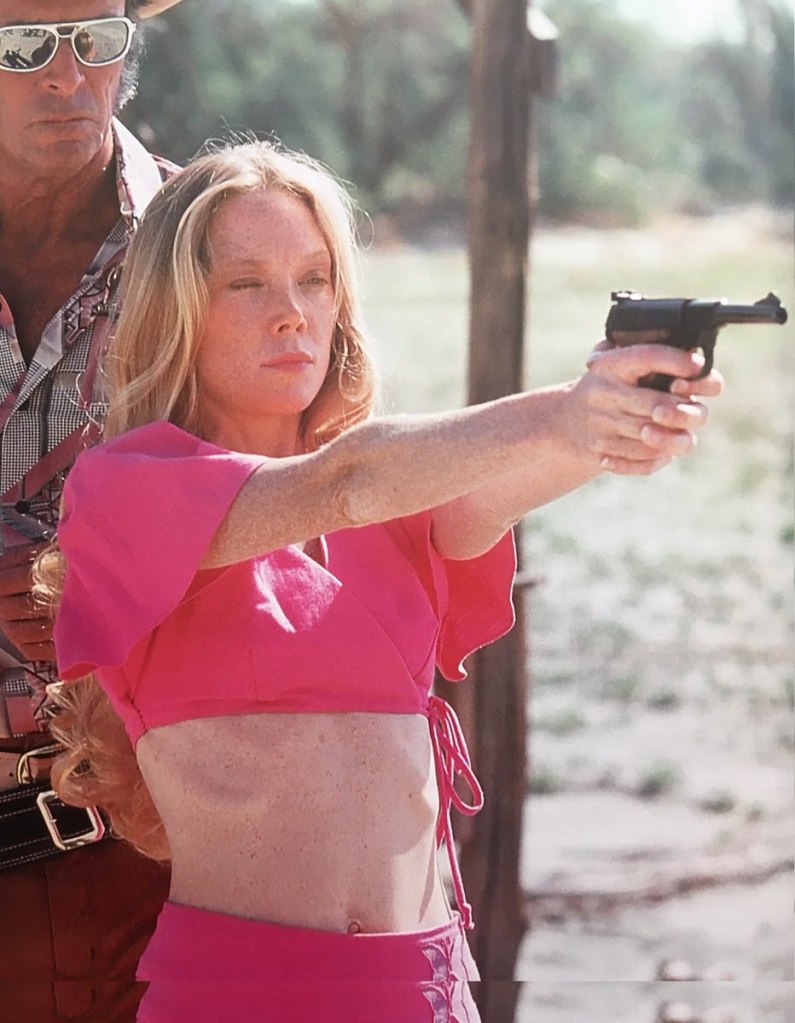


Spacek was the most gorgeous, unique creature in the 70s as far as I’m concerned, and the sole actress I can imagine playing Alicia Western. And there’s an additional connection to Alicia Western that leads me to believe that McCarthy would have agreed on the casting. Spacek pushed for the production of and to star in a movie adaptation of a play named ‘Night, Mother. It’s about a mother and her suicidal daughter, with the mother spending the night trying to talk the daughter out of suicide. McCarthy praised that play. About twenty years later, McCarthy wrote The Sunset Limited, about a man trying to stop another man from killing himself. It also takes place in basically one place, and only the two characters are present. And McCarthy’s final book was Stella Maris, featuring two characters in a room: a therapist and Alicia Western, with the first one trying to prevent (unknowingly) the second’s suicide.
Time destroys the present tense of everything. An online music service allows you to generate beautiful songs that sound backed by a real band, only for the music industry to make the model disappear. Magnificent people exist at their best for a short period and then fade away. Reality is too heavy and painful and soaked in melancholy for it to be carried on one’s shoulders all the time. No wonder people drown themselves in their jobs and their families and their sports teams.
 The Domains of the Emperor Owl