
As I was “remastering” the songs that make up the third volume of Odes to My Triceratops, I started thinking, “surely there’s fancier stuff to do to improve a finished song’s quality other than just messing around with its sound levels.” That ominous thought led me on a few days-long journey into the art of audio mastering. At one point, I opened one of my previous songs I thought finished, only to find out that the exporting process had clipped the hell out of it. I had no choice but to face that I had no fucking clue what I was doing.
Some reading later, along with help from ChatGPT, led me to the following steps to master a song:
- Normalize original WAV at -1db.
- Save original WAV as a 24-bit/192KHz WAV stereo file.
- Load exported WAV.
- High-pass filter at 30hz (roll off 24 db).
- Filter Curve EQ with preset (looked up good general values).
- Normalize at -1db.
- Apply multiband compression with the OTT plugin at 20% depth.
- Normalize at -1db.
- Split the stereo track and pan the channels to -70% and 70% respectively.
- Perform a thorough EQ check using the spectrum analyzer, adjusting frequencies along the way.
- Use the Limiter, Hard limit to -1 db to ensure the track doesn’t peak.
- Normalize at -1db.
Until a few days ago, I thought a spectrogram was a medical procedure. I mean, check out this shit. Does it look like something that makes any sense?
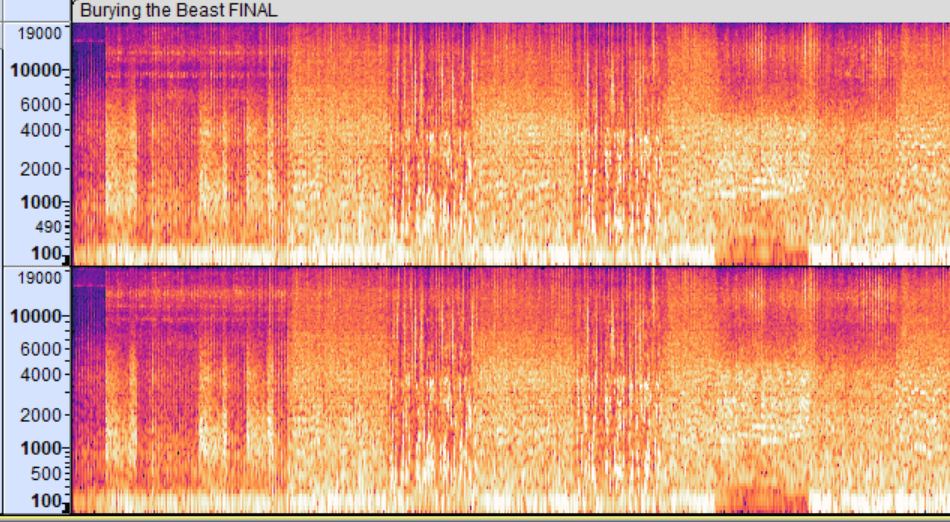
Turns out that you can learn lots from it. The frequency bands of a song are divided into the following:
Sub-bass (20-60 Hz)
Role: Provides the deep, rumbling foundation. It’s felt more than heard.
Boost: To add depth and power, typically in electronic music or certain genres of pop and hip-hop.
Cut: If the mix sounds too muddy or overwhelming, especially in more acoustic or vocal-focused tracks.
Bass (60-250 Hz)
Role: Adds warmth and fullness. Key for the body of bass instruments and the kick drum.
Boost: To give more weight to bass instruments, kick drums, and overall warmth. If the bass feels weak, a slight boost around 60-100 Hz can add more punch.
Cut: To reduce muddiness and allow other elements to breathe.
Low Mids (250-500 Hz)
Role: Important for the body of most instruments, but can often introduce muddiness.
Boost: To add body and presence to guitars, vocals, and other midrange instruments.
Cut: To clear up muddiness and create space in the mix.
Midrange (500 Hz – 2 kHz)
Role: Critical for the presence of most instruments and vocals. This range is highly sensitive to human ears.
Boost: To enhance clarity and presence of vocals and lead instruments.
Cut: If the mix sounds too harsh or congested.
Upper Midrange (2 kHz – 6 kHz)
Role: Contributes to the clarity and definition of sounds, especially for vocal intelligibility and instrument attack.
Boost: To add attack and clarity, making vocals and instruments stand out.
Cut: To prevent harshness and ear fatigue.
Presence (6 kHz – 10 kHz)
Role: Adds brightness and detail, crucial for the sense of “air” and openness.
Boost: To enhance the crispness and detail of vocals and percussion.
Cut: To soften overly bright or piercing sounds.
Brilliance (10 kHz – 20 kHz)
Role: Provides the sheen and sparkle that make a mix sound open and airy.
Boost: To add shimmer and airiness, particularly to cymbals and hi-hats.
Cut: To avoid excessive sibilance and hiss.
At a glance with a spectrogram, if there’s too much heat at a frequency band, you likely need to lower it. If another band presents a significant void, you can boost it and bring to the forefront little details that weren’t even present before. It’s quite amazing. Unfortunately, my obsessive attention to detail kicked in; the first time I tried to remaster “Burying the Beast,” I intended to go through each segment of the song boosting and lowering frequency bands to reach the optimal mix, but soon enough I was driven nuts. My job is already destroying me, I don’t need to work that hard in my spare time. So I fixed broad issues instead, boosting or lowering frequencies where it made sense.
I present to you the remastered version of fan favorite (for this fan, at least) “Burying the Beast,” a song from my album Odes to My Triceratops:
It isn’t perfect by any means, but it’s much better than the previous version, so that works for me.
 The Domains of the Emperor Owl
Pingback: Remastered “Go Away, Stay Away” from Odes to My Triceratops, Vol. 3 – The Domains of the Emperor Owl
Pingback: Remastered “Fuck You, Life (cabaret version)” from Odes to My Triceratops, Vol. 3 – The Domains of the Emperor Owl
Pingback: On audio mastering #2 – The Domains of the Emperor Owl