Your feet are sore, your throat dry. And you can’t even see straight, Can’t even see straight. The road you’re on is a lost one. It’s your fault you’re so fucked up.
You don’t need to die.
I feed on rain and fire, And sleep beneath the moon.
Something strange in the night. It’s a little triceratops. Do you feel the earth beneath your feet, Or is it spinning in a gaseous bleak?
Everything you thought you knew Was just a dream: Your childhood and its fables, Your father and his mother, Your sister and her toys, And all your friends.
Black, can’t see a thing, Except a distant, warm light Coming from a room without windows. There’s music and laughter inside.
I’m gonna start my own band With a dinosaur on the drums, A blind girl on the vocals, And myself on the guitar. We’ll sing about how much we hate this place, And how the world’s a giant shitheap.
We’ll just keep going, never stopping, Playing gigs, releasing albums. Let the masses complain; We’ll tell ’em to go to hell. Then we’ll drink and smoke and get laid, And forget everything.
The pale and shining moon Looks like a moldy jizz stain. Somewhere out there in the dark, A lonely star is dying, Shedding light and shedding tears For all the lives it has outlived.
Thought of bringing the knife. Grabbed my guitar instead.
There’s no reason you gotta die For some shithole town like this. There must be something better On the other side of those peaks.
I said I’d stay until the end. This is the end.
I heard a story about this one dinosaur, About how one day he woke up and said, “Goddamn, I’m done, I’ve had enough.” So then, without warning, he packed up his stuff, Sneaked away before his mother woke up, And disappeared into the night. Didn’t need to leave a note. It’s a known fact that, once every century or so, Humans and dinos head off together To wage war on some faraway world.
God came into town with his wares. He told me, “William, my boy, you’ve grown so much! Would you like to trade with me?” “What do you got, you bearded leech?”
“Well, I collect strange things, you know? An empty bottle of gin, A dinosaur horn, A red-haired wig, A dried clump of blood. Why don’t you have a look?”
“I’m not buying your junk, So shove off, you old fart!” “Are you sure, boy?” “Get away from me. You’re a sick, twisted fuck Who keeps pissing on my dreams.”
It was a time before humans. No one had electricity. Suddenly a thunderbolt pierced the sky, And God appeared before the dinosaurs. He kicked their scaly balls and laughed. He could do whatever he wanted to his pets.
Get away from me. You’re a sick, twisted fuck Who keeps pissing on my dreams.
I’ve lived in a dark cave, Eaten the hearts of monsters, Lost all my dearest friends. And today the Devil himself Sat on the edge of the sidewalk. He stank like a million rotten penises, A forest of phalluses covered in slime. I looked down at him and said, “Fuck you,” Then pissed straight into his mouth.
On my eighth birthday, I made a wish: “If you are there, oh distant God, Give me a dinosaur friend.”
What strange fucking beings we are: Walking piles of meat and bone, Heading down life’s roads With hands covered in blood.
On my private island, I’m king and queen. I live in a cave, alone and unseen. I have no money, no friends, no sex. Only my guitar, a knife, and regrets.
I’ll never see Claire again. Her sweet red hair, her milk-white eyes. I wonder if she thinks of me Just as often as I think of her. I wonder if she’s still alive, Or if she’s also dead.
I hope she’s happy. I hope she found love. I hope she never has to see The beast that I’ve become.
I can’t blame her for leaving. I would have done the same. In her place, I would’ve stabbed my best friend, And buried him in a cold grave. The truth is, you can’t love anyone When you hate yourself.
Somewhere deep inside a mountain In a hermit hemisphere Where the sun never shines, I will live out my days Trying to find a reason Why I am still alive.
This concludes the release of all the finished albums I have for the story. If back in the day you enjoyed any of these songs, produced during the very early days of Udio in which the song quality wasn’t good enough, you should probably listen to the songs or the whole album again, as I had Claude Code work its magic through the frequencies.
YouTube video’s description:
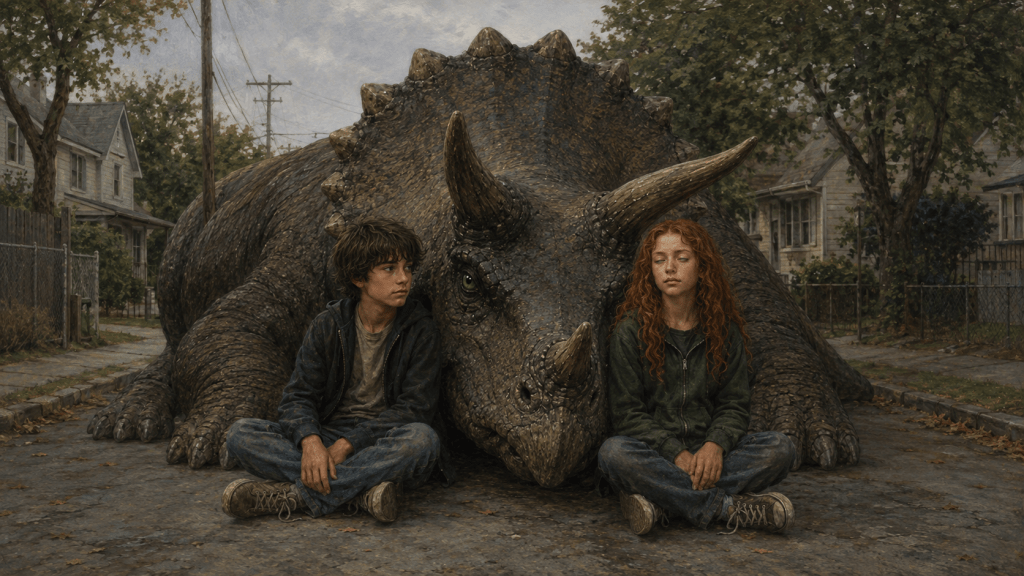
This is the first of three completed concept albums about a trio of friends living in a nowhere town: William Griffin, a sensitive and increasingly unhinged songwriter; Claire, his blind and illiterate next-door neighbor and perpetual mystery; and Lorenzo, their friend, who is inexplicably a sentient triceratops.
I made roughly eighty songs about them during Udio’s brief, lawless glory days, when a generation could sound like an actual band playing in a room, and you could still use swear words. The project ran through three albums and into the beginnings of a fourth before I ran out of steam, around the same time that changes to Udio’s model made the music feel notoriously worse.
Returning to these songs now is strange. Some of them still make the hair rise on my arms. William, Claire, and Lorenzo feel like forces within me that split apart, took on lives of their own, and built a mythology that contained that strange period of my life.
The earliest seeds of the lyrics date back to 2021. I can play guitar, but I was never going to become all the bands these songs required. The music changes radically from one track to the next, because each song takes whatever form its emotion demands. The characters and their shared emotional history are what hold the albums together.
This first album is the roughest of the three. I had just started producing songs with Udio. I was trying my way through writing song lyrics for the first time, with the additional constraint that I intended to sound like a somewhat-unhinged middle schooler whose best friend was a triceratops and who tended to filter reality in surreal ways through his dinosaur-addled brain. The resulting lyrics are sillier than usual, while retaining the earnestness and honesty that I intended for the whole story. But sometimes the lyrics get too dumb in retrospect even for me, which makes some of these songs a bit hard to listen to.
That said, there are real winners here, at least to me. Claude Code did everything it could to bolster the audio quality of this early-era Udio audio productions, and it has worked beyond my expectations. Thankfully you won’t have to listen to some of the songs in their previous states; some sounded as if they were played through a blanket.
I don’t know how the notion for this series came to be back in 2021, during one of the wildest creative periods of my life. Suddenly I knew I had William (an unhinged kid who expressed himself through music), Claire (his illiterate, blind, next-door neighbor who remains mostly opaque to him), and Lorenzo, a goddamn triceratops. I didn’t need to reason their existence or why writing about them was so important to me. I just felt it, so I soldiered on.
Now that I’m older and I have come to understand myself better, I do know why I needed to produce these songs, and why listening to them feels like coming home no matter how much I’ve tried to distance myself from this project. This story is my dead youth. An unhinged artist with a raw heart, who loved too much in the wrong ways. A blind, illiterate mystery whom the artist was devoted to and couldn’t afford to lose. An ancient, violent source of chaos who never left William’s side. That’s myself split in three. And I also know why Lorenzo had to die, and why Claire had to disappear, even if I’m the only one who understands.
I want to return to this story and finish it properly. I don’t know if I will. These days I promise too many things to myself. But I want one day in my late forties to return to these songs and new ones and feel the same emotions that these three albums recreate. So at least to me, Odes to My Triceratops didn’t deserve to be forgotten, and with the YouTube releases out, they will outlast me.
Over the years since I produced these songs, I’ve gotten from time to time notices that people downloaded the first and second album, but I never go around to presenting the third album as a cohesive whole. Now it’s up on YouTube. I doubt that anyone happening to read these words actually cares, but in case you’ve enjoyed any of these songs in the past, the whole album warrants a listen.
YouTube video’s description:
This is the third of three completed concept albums about a trio of friends living in a nowhere town: William Griffin, a sensitive and increasingly unhinged songwriter; Claire, his blind and illiterate next-door neighbor and perpetual mystery; and Lorenzo, their friend, who is inexplicably a sentient triceratops.
I made roughly eighty songs about them during Udio’s brief, lawless glory days, when a generation could sound like an actual band playing in a room, and you could still use swear words. The project ran through three albums and into the beginnings of a fourth before I ran out of steam, around the same time that changes to Udio’s model made the music feel notoriously worse.
Returning to these songs now is strange. Some of them still make the hair rise on my arms. William, Claire, and Lorenzo feel like forces within me that split apart, took on lives of their own, and built a mythology that contained that strange period of my life.
The earliest seeds of the lyrics date back to 2021. I can play guitar, but I was never going to become all the bands these songs required. The music changes radically from one track to the next, because each song takes whatever form its emotion demands. The characters and their shared emotional history are what hold the albums together.
This third album is more cohesive than the second one, and is bolstered by the improved audio quality from Udio’s model generation at the time. But this album lacks the more varied, distinct narrative arc of the previous one. Some of the songs on this album are real bangers, though, and Behind the Door may be my favorite of the series emotion-wise.
William’s story doesn’t end here. I just haven’t gotten around to producing the entirety of the fourth album. Maybe it’s time to pick it up again.
This will not be a traditional review. I finished reading Vinland Saga about an hour ago, and what I mainly want to record is my profound disappointment.
Three years ago, I wrote a review of the then-ongoing series. I have not reread it before writing this, but it should explain well enough why the story once mattered to me. Vinland Saga contained one of the most powerful mid-story transformations I can remember; not necessarily because it was the finest turn ever written, but because of how completely it transformed one story into another while retaining many of the same characters. The first half followed Thorfinn as he pursued revenge and drowned his grief and rage in the life of a warrior. I loved it. The second half is where the story broke apart.
I’ll spoil the whole thing. I don’t care.
Thorfinn renounced killing and eventually came to treat armed defence itself as a betrayal of his ideals. As a personal vow, that was his prerogative. If he wanted to stand still and allow someone to batter his skull rather than kill in self-defence, he was free to do so. But Thorfinn was no longer responsible only for himself. He had accepted responsibility for an entire settlement, and he expected everyone within it to live under the consequences of his oath. He sailed across an ocean to found a colony beside native Americans whose land, customs, beliefs, fears, and political interests he could not control. He had no credible answer for what would happen when the two societies clashed over property, weapons, ethnicity, religion, ways of life. Things were already deteriorating when disease came, and it all went predictably to shit.
The quality of the writing nosedived. Characters increasingly became moral mouthpieces. Some lost most of their practical intelligence when the thesis required it.
We also got the typical “Oh God, I killed a man; I’m spiritually ruined forever” beat from a major character who had been fighting men who were killing members of his community.
My disconnect from Thorfinn became extreme. He was opaque, and not in the way of a mysterious or deep character; his motivations and feelings no longer felt human. He was certain of his philosophical position while no longer having doubts, fearing sufficiently for his family, or having guilt over the other families endangered by his ideals. His pacifism was, in reality, a dangerous moral experiment, but the manga treated it as a truth whose failures were always someone else’s fault.
There is an extraordinary version of the second half hidden inside this disappointing one: a former killer becomes convinced that violence reproduces itself. He tries to found a society upon radically different principles. Then he discovers that his personal oath isn’t the same as being responsible. He could have remained personally unwilling to kill while confronting the fact that he had brought families into a place where he couldn’t guarantee their safety, he had no authority over the natives, and had no workable response to fear, disease, or cultural incompatibility. He essentially volunteered dozens of people for martyrdom.
Now that the story is over, I mourn what it did with my favorite character: Hild. One of my favorite characters in all of manga. An independent, determined inventor who, when her family was murdered, she managed to survive on her own in the wilds. Once she rejoined a community, she used her abilities as an engineer, hunter, sniper, and protector to help those she cared about.
Hild was the moral counterweight to Thorfinn. She already had the answer to what the protagonist should have become: someone who retained the capacity for violence, understood its cost, and chose carefully when to use it.
The second half of Vinland Saga wanted to tell a profound story about discovering common humanity, yet tried to do so by making most characters involved less psychologically human. As if the author committed to the pacifism bit but couldn’t find honest ways for people to go along as the story required.
And Hild deserved more than to wave goodbye from a boat.
I only found out about this little gem yesterday. It’s an anime movie from 2010, and its premise captured me instantly: a sinful soul is given a second opportunity on Earth by being placed in the body of a middle schooler who killed himself. He’s assigned an angel of sorts as a guide, who will determine if the protagonist earns the right to receive another chance at life, or if his soul will instead disappear.
The newly-returned soul wakes up in a hospital bed, watched over by his tearful parents and angry older brother. The protagonist knows nothing about these people, feels no kinship with them, nor does he retain any memories of his previous life that was deemed sinful. He tries to adjust to his new life as the younger son of an unremarkable family in a quiet Japanese town. He discovers that the boy whose body he inhabits was friendless and quiet, spending most of his time painting, for which he had a talent. At school, he’s approached by an ugly, awkward girl whose interest in the protagonist he finds repellent, and by an attractive extroverted girl whom the protagonist finds himself attracted to.
The protagonist is soon told by his heavenly guide the circumstances that led the previous occupant to suicide. The details would be spoilers; in any case, as a result, the protagonist feels himself repulsed and alienated from his new family, and tries to distance himself from the previous occupant of his new body by being himself.
What follows is a small tale of quiet sorrows and private beauty about whether we can live with the failures of other people, and with our own. The mother who betrays her family can also love her son desperately; the boy who has suffered can also be cruel; a life that appears irredeemably gray may still contain colors its owner has stopped being able to see.
As the protagonist behaved in an increasingly nasty manner toward his new mother, I found myself feeling bad for her as well as the rest of his family. I never had a mother whose quiet, dignified sorrow felt so familiar, or a father with whom I could speak and who cared about me. I caught myself thinking that the kid had it good enough: a beautiful town, a relatively ordinary school life, parents who cared about him, and decent people within reach.
The setting is rendered with aching detail; every single location seemed modeled after a real place, and the characters feel like they’re navigating through painted-over photographs. It made me want to be there, to walk along the same sidewalks and witness the same sights.
This story possesses the Japanese sensitivity that I repeatedly find in their fiction and almost never in what’s created around these parts. Although the movie lacks the usual silliness, derangement, and perversion that I’m usually drawn to, it hit me hard, and I suspect it will hit anyone who has ever wanted out and, even after choosing to remain, has continued to feel like a stranger in this place.
I was watching some YouTube reactors reacting to my guilty anime pleasure of the season, Chainsmoker Cat, when one of them mentioned that this studio had also been behind 100 Girlfriends. I had never heard of that show, but the premise implied by the title intrigued me.
The anime is about a pure-hearted high school boy named Rentaro, who has been rejected by girls a hundred times. The last one said that the notion of dating him made her sick. The god of love shows up and tells Rentaro that he shouldn’t worry about love, because he’s been assigned a hundred soulmates at birth. We later find out that it was due to this very god’s absent-mindedness that Rentaro ended up with such preposterous romantic luck, but it gets more complicated: if one of his soulmates falls for him but Rentaro fails to return her feelings, she will die. Thus, our boy sets off on a journey to casually meet a hundred soulmates and make sure that he loves every single one of them.
This turned out to be my favorite romantic comedy since the classic Toradora! It sets itself apart in various ways: it doesn’t wait around for the will-they-won’t-they bullshit: he begins dating nearly every soulmate within the same episode in which she appears. The focus is on the relationship afterwards, and on the complicated dynamics of having to maintain not even two or three girlfriends at a time, but ten by the middle of the second season. The way the girls bond with each other and deal with the fact that their boyfriend is a ten-timing young man who nevertheless has unbounded love for all of them is one of the main highlights of the story. And its tone is just right up my alley: zany, deranged, delightfully perverted. Among the recurring bits, there’s a shapeshifting chemist who casually drugs the cast and also pees herself, while two of the girls maintain a quasi-open lesbian relationship everyone is aware of but nobody brings up.
I was surprised by how different the author managed to make the girls, helped by the brilliant-as-usual voice actresses. We start out with tropes like the big-breasted horny one, the tsundere, the shy bookish type, the cold and brilliant beauty, but the cast gets weirder from there, and finding out whom the protagonist ends up bringing in is one of the entertainments of the story.
The author could have made the lucky protagonist, Rentaro, a horny fiend, but he’s a genuinely-good kid whose superpower isn’t having been born with a hundred soulmates assigned to him, but his boundless capacity for love. This kid truly wants to make each of them happy. One must admire his commitment to filling his entire existence balancing the emotional demands of enough girlfriends to found a new town and possibly reinvent feudalism.
Now, there are a few things that bother me. Sometimes the show gets too cutesy, although not to the extent that I want to drop it. It also has a couple of weak episodes, particularly the “kiss zombies” bit from the first season. Also, I suspect the show was strongest near the beginning, when Rentaro had only two or three girlfriends. The intimacy gets inevitably diluted by the time you reach ten.
I have to admire both an author as well as an anime production that has promised to introduce a hundred different romantic partners in a single show. The logistics alone voice-actress-wise are unhinged.
There’s hardly a better summary of the entire show than the glorious karaoke scene from S02E07, shown below almost in its entirety:
100 Girlfriends works because it takes Rentaro’s devotion completely seriously. It may well be the best harem comedy ever made.



 The Domains of the Emperor Owl
You must be logged in to post a comment.