I have quite the treat for you fuckers. I’ve recorded myself playing through my test scenario involving Alicia Western. More than an hour of me speaking in my accented English even though I rarely speak in real life, and showing off a fun, frustrating playthrough that made me hungry.
This is, of course, related to my beloved Living Narrative Engine. Repo here.
I’m building a browser-based app to play immersive sims, RPGs and the likes. In practice, I use it to set up short story scenarios or elaborate gooning sessions. I dared myself to build the most comprehensive psychological system imaginable, so that Sibylle Brunne, a 34-year-old orphan living in her parents rustic home somewhere in the Swiss mountains, while controlled by a large language model, would realistically bring her blue-eyed, blonde-hair-braided, full-breasted self to seduce my teenage avatar who is backpacking through the country, eventually convincing me to stay in her house so she can asphyxiate me with her mommy milkers.
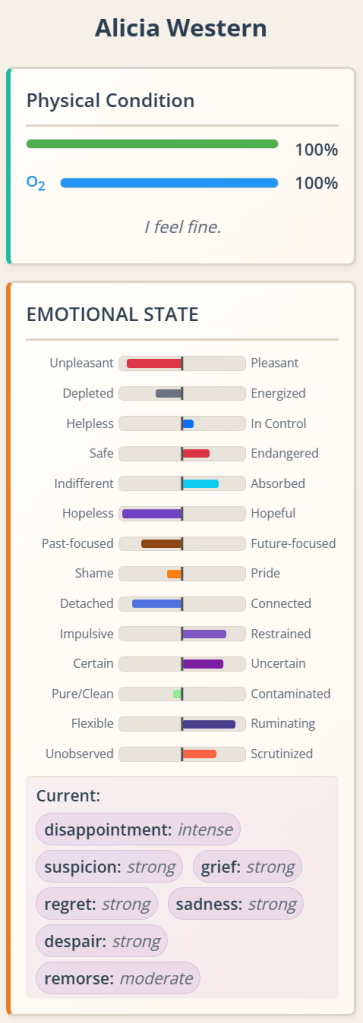
Here’s a visual glimpse of the current complexity:
Alicia has become my test subject, as if she didn’t have enough with freezing to death. The system works like this: at the base you have mood axes (like pleasant <-> unpleasant), which change throughout a scene. Actors also have permanent biological or personality-based traits like aversion to harm. Together, mood axes and affect traits serve as weights and gates to specific emotion prototypes like disappointment, suspicion, grief. Delta changes to those polar mood axes naturally intensify or lessen the emotions. I also have sexual state prototypes, which work the same as the emotional states.
These emotional and sexual states serve as the prerequisites for certain expressions to trigger during play. An expression is a definition that tells you “when disappointment is very high and suspicion is high, but despair is relatively low, trigger this narrative beat.” Then, the program would output some text like “{actor} seems suspicious but at the same time as if they had been let down.” The descriptions are far better than that, though. The actors themselves receive in their internal log a first-person version of the narrative beat, which serves as an internal emotional reaction they need to process.
It all works amazingly well. However, to determine if I was truly missing mood axes, affect traits or prototypes, I had to create extremely complex analytics tools. I’ve learned far too much about statistical analysis recently, and I don’t really care about it other than for telling a system, “hey, here are my prototype sets. Please figure out if we have genuine gaps to cover.” Turns out that to answer such a request, some complex calculations need to map 20-dimensional spaces and find out diagonal vectors that run through them.
Anyway, I guess at some point I’ll run my good ol’ test scenario involving Alicia, with her now showing far more emotion than she used to before I implemented this system. That’s a win in my book.
I’ve recently implemented an emotions and expressions system in my app, which is a browser-based platform to play immersive sims, RPGs, adventure games, and the likes. If you didn’t know about the emotions and expressions system, you should check out the linked previous post for reference.
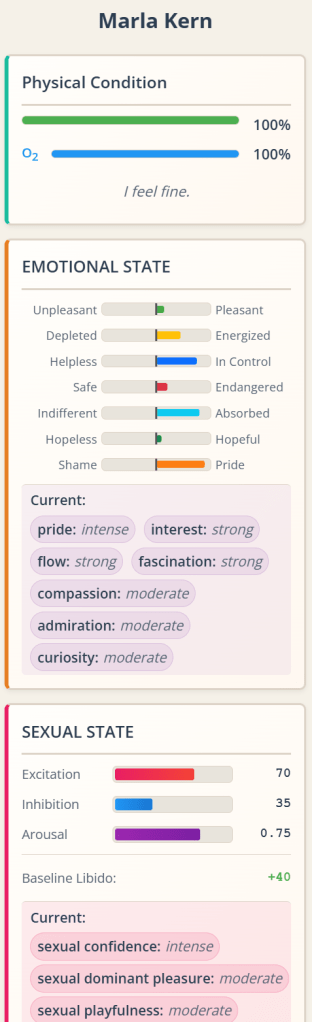
I was setting up a private scenario to further test the processing of emotions for characters during changing situations. This was the initial state of one Marla Kern:
Those current emotions look perfectly fine for the average person. There’s just one problem: Marla Kern is a sociopath. So that “compassion: moderate” would have wrecked everything, and triggered expressions (which are narrative beats) that would have her acting with compassion.
This is clearly a structural issue, and I needed to solve it in the most robust, psychologically realistic way possible, that at the same time strengthened the current system. I engaged in some deep research with my pal ChatGPT, and we came up with (well, mostly he did):
We lacked a trait dimension that captured stable empathic capacity. The current 7 mood axes are all fast-moving state/appraisal variables that swing with events. Callousness vs empathic concern is a stable personality trait that should modulate specific emotions. That meant creating a new component, named affect_traits, that the actors would need to have (defaults would be applied otherwise), and would include the following properties:
Affective empathy: capacity to feel what others feel. Allows emotional resonance with others’ joy, pain, distress. (0=absent, 50=average, 100=hyper-empathic)
Cognitive empathy: ability to understand others’ perspectives intellectually. Can be high even when affective empathy is low. (0=none, 50=average, 100=exceptional)
Harm aversion: aversion to causing harm to others. Modulates guilt and inhibits cruelty. (0=enjoys harm, 50=normal aversion, 100=extreme aversion)
In addition, this issue revealed a basic problem with our represented mood axes, which are fast-moving moods: we lacked one for affiliation, whose definition is now “Social warmth and connectedness. Captures momentary interpersonal orientation. (-100=cold/detached/hostile, 0=neutral, +100=warm/connected/affiliative)”. We already had “engagement” as a mood axis, but that doesn’t necessarily encompass affiliation, so we had a genuine gap in our representation of realistic mood axes.
Emotions are cooked from prototypes. Given these changes, we now needed to update affected prototypes:
That fixes everything emotions-wise. A character with low affective empathy won’t feel much in terms of compassion despite the engagement, will feel even less empathic distress, and won’t suffer as much guilt.
This will cause me to review the prerequisites of the currently 76 implemented expressions, which are as complex as the following summary for a “flat reminiscence” narrative beat:
“Flat reminiscence triggers when the character is low-energy and mildly disengaged, with a notably bleak sense of the future, and a “flat negative” tone like apathy/numbness/disappointment—but without the emotional bite of lonely yearning. It also refuses to trigger if stronger neighboring states would better explain the moment (nostalgia pulling warmly, grief hitting hard, despair bottoming out, panic/terror/alarm spiking, or anger/rage activating). Finally, it only fires when there’s a noticeable recent drop in engagement or future expectancy (or a clean crossing into disengagement), which prevents the beat from repeating every turn once the mood is already flat.”
That is all modeled mathematically, not by a large language model. In addition, I’ve created an extremely-robust analysis system using static analysis, Monte Carlo simulation, and witness state generation to determine how feasible any given set of prerequisites is. I’ll make a video about that in the future.
A couple of nights ago, at two in the morning, I was rolling around in bed thinking about my current obsessions: the browser-based app Living Narrative Engine as well as Alicia Western, the tragic character from Cormac McCarthy’s last two novels. Recently I mixed them both by playing through a scenario in LNE that featured Alicia. I “novelized” that little bit of theater in the short story You Will Spend the Rest of Your Life.
Well, I wasn’t entirely happy with Alicia’s acting. Yes, she’s an analytical gal, but she’s in a deep hole there. I wanted to feel the despair from her. The relief. I wanted to see her cry. I wanted to cause a beautiful, blonde woman at the end of her rope to cry. And she didn’t.
As I thought about whether this was a solvable issue, my dear subconscious had a spark of genius: LLM-based characters in LNE already create thoughts, speech, notes, and choose actions. Why not task them with tracking mood changes?
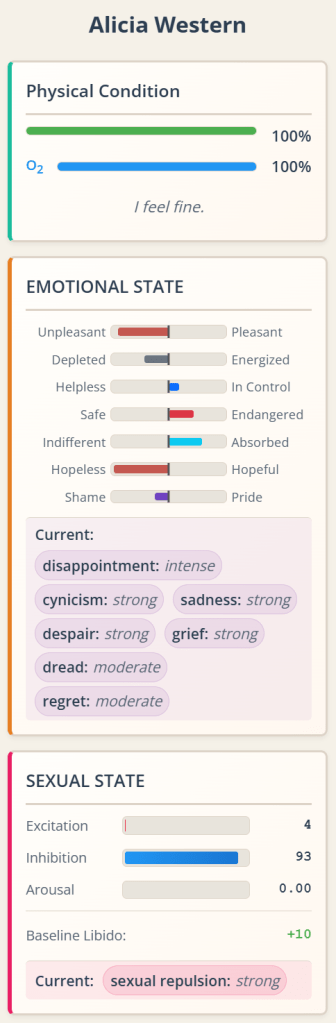
Some deep research and several iterations later, ChatGPT and I came up with the following notions, which are displayed below in a lovely manner, as they appear on the game page of LNE.
The simulation relies on seven base mood axes: valence, arousal, agency control, threat, engagement, future expectancy, and self-evaluation. Apparently that basic breakdown is psychologically sound, but I’m trusting ChatGPT on that. The sexual variables apparently are also well-known: an excitation component is the accelerator, and the inhibition is the brake. Added to a baseline libido dependent on the individual, that calculates the arousal. As seen in the picture, Alicia right now is dry as sandpaper.
The most interesting part for me is that the mood axes and basic sexual variables are ingredients to form emotions and sexual “moods”. I have dozens of them defined, as I’ve been working with ChatGPT in order to depict the whole breadth of emotions that are distinct and meaningful. Here are the current listings of emotions and sexual “moods” that my app calculates:
Sexual moods: sexual lust, passionate love, sexual sensual pleasure, sexual submissive pleasure, sexual playfulness, romantic yearning, sexual confidence, aroused but ashamed, aroused but threatened, sexual craving, erotic thrill, sexual performance anxiety, sexual frustration, afterglow, sexual disgust conflict, sexual indifference, sexual repulsion
Emotions are calculated based on detailed prototypes. Here’s one:
Those emotions and sexual moods are fed to LLM-based actors. They figure out “hmm, I’m intensely disappointed, strongly cynical, strongly sad, etc., so that needs to color my thoughts, speech, notes, and the actions I take.” I haven’t tested the system much in practice, but the little I tested, the results were like night and day regarding the LLM’s roleplaying.
In real life, we not only do things, but our bodies do things to us. We are aware of how our emotional states change us, and those turn into “tells” to the other people present. In addition, when one thinks in terms of stories, you add “reaction beats” when the emotional state of an actor changes, so I did exactly that: if the LLM has returned changes to the previous mood axes and sexual variables, the library of expressions have a change to trigger (one at a time), based on whether some prerequisite triggers. The following example makes it self-explanatory:
{
    "$schema": "schema://living-narrative-engine/expression.schema.json",
    "id": "emotions:lingering_guilt",
    "description": "Moderate, non-spiking guilt—an apologetic, sheepish self-consciousness after a minor mistake",
    "priority": 57,
    "prerequisites": [
        {
            "logic": {
                "and": [
                    {
                        ">=": [
                            {
                                "var": "emotions.guilt"
                            },
                            0.35
                        ]
                    },
                    {
                        "<=": [
                            {
                                "var": "emotions.guilt"
                            },
                            0.70
                        ]
                    },
                    {
                        "<=": [
                            {
                                "-": [
                                    {
                                        "var": "emotions.guilt"
                                    },
                                    {
                                        "var": "previousEmotions.guilt"
                                    }
                                ]
                            },
                            0.12
                        ]
                    },
                    {
                        "<=": [
                            {
                                "var": "emotions.humiliation"
                            },
                            0.25
                        ]
                    },
                    {
                        "<=": [
                            {
                                "var": "emotions.terror"
                            },
                            0.20
                        ]
                    },
                    {
                        "<=": [
                            {
                                "var": "emotions.fear"
                            },
                            0.35
                        ]
                    }
                ]
            }
        }
    ],
    "actor_description": "It wasn't a catastrophe, but it still sits wrong. I replay the moment and feel that small, sour twist—like I owe someone a cleaner version of myself. I want to smooth it over without making a scene.",
    "description_text": "{actor} looks faintly apologetic—eyes dipping, a tight little wince crossing their face as if they're privately conceding a mistake.",
    "alternate_descriptions": {
        "auditory": "I catch a small, hesitant exhale—like a half-swallowed \"sorry.\""
    },
    "tags": [
        "guilt",
        "sheepish",
        "apology",
        "minor_mistake",
        "lingering"
    ]
}
I’ve created about 53 expressions already, but they’re surprisingly hard to trigger, as they require very specific (and psychologically logical) conditions.
Because testing this new system through playing scenarios would be a nightmare, I’ve created a dev page that makes testing the combinations trivial. In fact, I’ve recorded a video and uploaded to YouTube. So if you want to hear me struggle through my accent that never goes away, and the fact that I very, very rarely speak in real life, here’s ten minutes of it.
I think that’s all. Now I’m going to play through the same Alicia Western scenario as in the short story I posted. If the result is different enough, I will upload it as a short story.

 The Domains of the Emperor Owl
You must be logged in to post a comment.