The Scrap Colossus, Pt. 2 (Fiction)

A heavy silence draped the room as if the class had witnessed an execution. Upon its weight pressing down on the motley crew of participants, ranging from college-age kids to grizzled retirees, they fidgeted awkwardly, fiddling with pens, flipping through notebooks. The clock on the wall ticked louder. Isabel twirled her chainlike necklace between her fingers as if trying to come up with diplomatic words.

“Elena, I’m… I’m glad you shared your work. Bold piece, raw and visceral. I guess we’ve grown to take water, a warm meal, or even a sneaker that’s not coated in mud for granted, haven’t we, class? That said…”

“It’s not every day that someone eats a raw salamander,” Pink Hamster Face said.

One of the retirees, his hair a mop of white curls, a scarf always wrapped around his throat, folded his arms over his belly. As he brought up routinely, he used to be a professor, and now spent his evening years writing and traveling. I’m not shitting on the guy; I wish I could go on a retirement world tour.

“Sorry, but I have to say I didn’t like this.” His voice sounded as if his throat were lined with sandpaper. “What was the point? It’s just senseless. She gets lost in a swamp and eats a salamander and then disappears? That’s awful! I don’t want to hear about that. People suffer and die every day. I don’t need a story to remind me of the awful stuff in life.”

Elena lowered her face and shot him a stony glare through a blonde lock that fell across her forehead. Isabel rose slowly from her chair as she smoothed down her off-the-shoulder black top. Her smile had the stiffness of a rusted coat rack.

“Elena, I love that you’ve taken the time to present us with a well-crafted experience. Above and beyond, as usual. I can’t deny you have talent, I’m just not sure where you’re channeling it. As your instructor, I feel obligated to remind you that not every story needs to be so bleak. Aren’t you focused on piling on the misery? That’s not to say that dark themes or dire circumstances are out of bounds. The beauty of writing is that it allows us to examine darkness while also finding paths toward light. But, as we’ve discussed in class, a narrative devoid of hope can leave the reader feeling unmoored, adrift without a life vest.”

In the fluorescent light, Elena’s pale oval showed a hint of a smirk.

“I just felt like making a horrible place.”

“Well, in that case, mission accomplished.”

“I named this piece ‘Isabel Zubiri time-travels to the primeval epoch and accidentally prevents the evolution of mammals.'”

Isabel pushed up her off-white cat-eye glasses. The forced cheeriness in her voice had worn thin.

“Seriously though. You’ve subjected our poor protagonist to one of the most unpleasant scenarios we’ve ever come across in my classes. Thrown her into the wilderness and left her to rot. I have to ask: why? What inspired this particular… direction?”

Elena shrugged as if she couldn’t justify spending the energy to explain herself. She slid her gaze onto the white table, her almond-blonde hair falling on her brow. Isabel had started checking her notes when Elena lifted her gaze defiantly and took a deep breath like a beleaguered queen about to address her subjects.

“You asked the class what conflicts they recognized in my piece, but no one answered. So I will. The only conflict that truly matters is that of the protagonist against her own mind. She clings to her optimism even as reality contradicts her at every turn. So, what inspired this direction? The truth did. You wanted us to write a little time-travel adventure, Isabel, so I showed you what would happen if someone actually traveled through time. No meetings with Leonardo da Vinci, no fairy tale endings where you get to take selfies with the Medicis. Just the raw reality of finding yourself alone in an ugly, unforgiving world. There is no epiphany. No divine revelation. The protagonist must struggle to the end although not even words can save her. The fight is its own justification. I’ll leave up to you if that’s meaningful or not. A story needs to be honest or it will fail at being anything. And that ending? I got the feeling you’d still try to maintain your carefully curated social media presence even after you tore apart a living creature with your teeth to survive.”

Isabel’s face froze in a tight-lipped grimace. When she spoke, she adopted the tone one would use with a tantruming child.

“Elena, your stories have been the equivalent of smearing mud on the audience’s faces. When you start writing solely as a means to shock or unsettle for its own sake, that’s the sign of a writer who’s lost their way. You need to dig deeper and confront the underlying issues that drive you to these dark corners. And you spoke about writing the truth. It seems you’ve been perusing my Twitter feed, so how come there’s no mention of my daughter in your story? The moment I found myself stranded in such a hellish place, my main concern would be about figuring out how to return to my Natalia.”

Elena’s blues darted around as she shifted in the chair, her reddish lips parted in puzzlement.

“Your daughter? She didn’t cross my mind. I guess you’d worry about her.”

Isabel squared her shoulders. Her gaze lingered as if she suspected Elena’s pupils would narrow into slits.

“You guess…? You don’t have much empathy, do you?”

Elena winced as if a gust of ice-cold wind had hit her face. Her features hardened, her pale fingers curled tightly around her notebook. Those tired blues met Isabel’s eyes with an intensity that made a couple of students shift in their seats.

“Maybe I don’t.”

After a heavy silence, the instructor cleared her throat and tried to dig up her usual cheerfulness, but her voice faltered.

“Well, Elena, thanks again for taking the time to present. The world is a darker, damper, and more miserable place thanks to your protagonist’s journey, I think we can all agree on that.”

Three students were texting under the table, too cowardly to endure the carnage.

“You think that having a daughter somehow makes you more human?” Elena blurted out. “More understanding? If being a parent granted people some magical wisdom, we’d have lots of enlightened souls pushing baby strollers, wouldn’t we? But that’s not the case, is it? Most parents I’ve met are as selfish and self-absorbed as anyone else, just with an extra layer of entitlement. I’d rather keep my lack of empathy than be a hypocrite.”

The taut string of tension threatened to snap and send us all flying. Pink Hamster Face’s eyes darted between the two women, her mouth hanging open. The former professor, his face set in a frown, spoke up in a raspy voice.

“Well, that was pretty cynical and, frankly, immature.” He leaned an elbow on the table, turning to our instructor. “Isabel, don’t let her disrespect you in front of your students. If she doesn’t like you or this class, she can find another place to waste her time.”

Isabel stood up slowly, her hands pressed on the table. She gave the smile one would give to a barking dog before calling the animal shelter.

“I had been feeling that your work and comments were getting more aggressive and generally destructive. You know, I’m not a self-absorbed idiot. I’m a mother and a writer and a teacher, and I’ve worked hard to get where I am. Elena, I’ve given you plenty of chances to integrate yourself into the class. I’ve encouraged you to participate and share your work. I’ve provided constructive criticism. I’ve reached out to you on a personal level, trying to understand what’s going on inside that head of yours. But it seems you’re not interested in that. Now, your fixation on me has crossed several boundaries: not only have you monitored my social media presence, but you’ve also written an explicitly violent piece targeting me. It goes beyond creative expression into concerning behavior that needs to be addressed through proper channels.”

A tic flickered beneath Elena’s left eye: the monster rattling its cage. Our instructor honed in her focus on me.

“Jon, would you mind staying as a witness after class? I’m going to have a serious talk with Elena, and I’d appreciate your support.”

She had startled me while I chewed on a fingernail. As the biggest guy in a class full of college-age girls, housewives, and retirees, I was expected to work security detail. Shouldn’t I be compensated for that unpaid labor? Could I get someone to advocate for me? Anyway, bold of Isabel to address the narrator, but at least she offered me a chance to defend the pale queen.

I leaned back on my chair and held Isabel’s gaze calmly.

“You did tell us to write a story about you. Your Twitter profile is public. Elena doesn’t know much about you, so naturally she would look into it. You’re taking this out of proportion.”

Elena stared at Isabel as if our instructor’s skull were transparent, revealing a writhing mass of worms and maggots.

“Proper channels? Are you seriously threatening me with administrative action because I wrote a story that made you uncomfortable? You asked us to write about you traveling through time, and I delivered exactly what you asked for, just not wrapped in the sugary bullshit you prefer. And now you’re trying to paint me as a stalker because I looked at your public Twitter feed? The same feed you constantly reference in class when you’re busy preaching about ‘building your author platform’? You want to talk about crossing boundaries? How about making your students write fanfiction about you in the first place? But sure, go ahead, take it to the library director. Tell them that the scary girl wrote a mean story about her instructor. I’m sure they’ll be fascinated to hear how you’re using your position to feed your ego trip while punishing students who don’t play along with your fantasy.”

A tremble of rage twitched through Isabel’s lips, but she maintained a controlled posture, her hands gripping the edge of the table.

“I see how it is. You know what, Elena? I did ask for a story about time travel with me as the protagonist. That was my mistake, and I’ll own it. But let’s be crystal clear about something: this isn’t about your creative choices or your right to explore dark themes. This is about you deliberately crafting a violent fantasy targeting me. As for my Twitter feed… yes, it’s public. Yes, I encourage building an author platform. But there’s a world of difference between professional networking and using someone’s social media presence to fuel hostile fiction. Jon, I appreciate your perspective, but Elena has demonstrated a pattern of fixation that, combined with today’s violent imagery and aggressive behavior, creates a hostile learning environment for everyone.” She leaned forward, her glare fixed on Elena. “You don’t care about the world, just what you think of it. All your stories are you. They’re not written to connect, but to push people away.” Isabel straightened back. “I’ve been running this class for a few years, and you’re the only person who refuses to take my feedback in the spirit of helping you grow. If you want to continue writing, that’s up to you, but I can’t have you poisoning my classes with your bitterness and cruelty anymore.”

Pink Hamster Face sniffled and dabbed at her eyes with her sleeve. The cold fire that had smoldered behind Elena’s blue irises snuffed itself out, leaving her stare lifeless. She tipped her face upward, her eyeballs reflecting the fluorescents. She rose from the chair mechanically, then gathered her papers, notebook, pen, half-empty water bottle, and shoved them into her bag. After pushing the chair toward the table, she addressed the whole class in a flat tone.

“Don’t worry, I’ll spare you the discomfort of my presence. Have fun learning how to write meaningless fluff that’ll never matter to anyone.”


Author’s note: today’s song is “Inflammatory Writ” by Joanna Newsom. Also this live version. Also this other live version.

The Deep Dive team produced an interesting little podcast about this part of the story:
The Scrap Colossus, Pt. 1 (Fiction)

Picture this: inside a meeting room in Irún’s main library, an assortment of office workers, students, and pensioners hunched over their notebooks around a large rectangular table. Coats and bags hung on the backs of their chairs, and at the center of the table lay a box of chocolates. While pens scratched against paper, the writing instructor hovered nearby, often pulling out her smartphone to shoot group photos for her Twitter feed, without consent I might add. Isabel Zubiri. A forty-year-old woman with warm olive skin, hair worn in a casual topknot, dangling earrings, a chainlike necklace, and cat-eye glasses with off-white frames. But nevermind those people. By then, I had deemed the course pointless, and I attended because among us sat an anomaly: Elena. Late twenties, last name unknown. You could feel her presence like a shadowy figure in the corner of your eye. Her almond-blonde hair fell limply around her pale face. Slavic features. A ghost’s beauty. Dare to look into those haunted blues framed by reddened skin, and you may have glimpsed echoes of commissars starving her ancestors’ village. Listen closely and you’d hear a distant wail, that of a newborn child abandoned by her mother. Elena was a quiet bird, born tired and with a heart full of holes. She usually wore a loose gray sweatshirt, likely the same one, in which you could barely make out her tits. I won’t get into how she behaved; that’s coming up. All in all, she was sexy as fuck. Her look and demeanor screamed “fix me.” She would ruin your life. But as the old song says: better to burn out, yeah, yeah, than to fade away.

Isabel, our teacher, her cheer a barricade against life’s harsh truths, adjusted her cat-eyed glasses and tapped her fingers lightly on the wooden table.

“Well then, let’s see what creative adventures you’ve cooked up for me in your time-travel stories! Who wants to be brave and go first? Remember, no wrong way to tell a tale… unless you’re not telling it at all.” She laughed. “And please don’t worry too much if you’ve sent me somewhere outlandish, okay? God knows I could use a vacation, even a fictional one!”

Elena eased the chair back, her slender, underfed figure rising. Her fingers held gently the edges of the printed paper while she focused on the words.

Isabel’s cheer faltered at the volunteer who had once stated that literature’s purpose was “to make the reader cry, scream, and bleed.” She quickly bolted on a professional smile.

“Ah, Elena, always the trailblazer. I must say, your commitment to sharing your work is inspiring. You’re one of the bravest souls in our little circle. Or should I say the boldest? Please, do regale us. Let’s hear where you’re whisking me off to.” Isabel’s gaze swept over the group. “And remember, everyone, we’re looking for those conflicts we’ve discussed: whether it’s a clash of personalities, a moral dilemma, or just the universe throwing some cosmic curveball. We’re all about the drama here.” She gestured at the silent ghost. “The floor is yours, Elena.”

Elena, her tired eyes fixed on the page with the intensity of a cryptologist, sighed, then began to weave her tale. I wish you could hear her voice: soft and creaky as if from disuse, and burdened with the weight of a thousand unsaid things.

“Isabel Zubiri, writer and teacher of writing, clutched the armrests of her time machine as the jostling journey shook the frame. An indicator glowed in the dim cockpit: July 1st, 1497. Florence, Italy. She would stroll through its streets, observe its people. Men in doublets and ruffs, women in gowns flaring out to their ankles like closed flowers. The air would smell of bread and dung and sweat, of herbs and spices from the markets. Amid the clucking of chickens and human chatter in that old Italian dialect, she would hear the bells of Santa Maria del Fiore. Secretly she would photograph the crowds, the palaces, and the churches. In the end, she would vanish without harming anyone nor pushing them off their paths, for fear of snapping the thread of history. The ultimate tourist in this land of the past, a voyeur to the lives of men and women long turned to dust.”

Isabel, seated, had leaned forward slightly, her fingers interlaced on the table as she listened. But she straightened up in relief.

“Well, Elena, that’s quite an evocative opening!” she encouraged. “I can already feel the weight of history in your choice of setting. Renaissance Florence, no less. The period clothing details were a lovely touch.” Some classmates nodded. “And I’m glad you’ve taken the ‘no harm to history’ rule to heart. That’s an interesting conflict right there, the struggle to remain unobtrusive and avoid altering events. It’s like the ultimate challenge for a writer, isn’t it?”

Elena’s eyebrows twitched. Somber and distant, she resumed her reading with the alienated air of the perpetually exhausted.

“Inside the time machine’s cramped cabin, a flash of light flickered. A jolt threw Isabel around, slamming her against the curved wall. She blinked to clear her vision. The indicator’s numbers blurred. While cursing, Isabel groped in the darkness for the control panel. She pressed buttons meant to reset the circuits, but the indicator’s digits kept spinning. The time machine crashed with a metallic crunch, squashing Isabel into the padded chair and rattling her teeth. Then the machine tumbled down, rolling over as Isabel, strapped in place, flipped and spun. The contents of her stomach rammed against her clenched throat in waves. Suddenly the time machine groaned to a halt, rocking Isabel against the seat, and its hatch door popped open, letting in a blast of heat. The indicator displayed dashes instead of numbers. She shuddered. Her head throbbed, her stomach churned. She tapped at the panel, but no sequence of buttons revived it. She leaned her head back and closed her eyes. Stay calm. The time machine came with a user manual for such emergencies. After unbuckling herself and crawling out of the hatch, she stepped onto cloggy ground. Hot, humid air filled Isabel’s lungs, heavy with the pungent stink of sulphur. Isabel, dizzy and nauseous, kept coughing. She stood wobbly in a vast swamp that stretched out into a brownish haze. On the horizon rose the dark bulk of a volcano, from whose peak climbed a column of ashy smoke lit by flickers of lightning. A ceiling of gray clouds hung heavy, casting the landscape of mud and reeds below into gloom.”

As Isabel listened, her smile had grown rigid, and she had shifted uncomfortably in her chair. Now her fingers drummed a nervous beat on the table.

“Oh dear. This is getting… rather intense, isn’t it?” she said, her voice carrying an edge of unease like a mother who has stumbled upon her teenager’s morbid drawings. “That’s our Elena, though, always taking the path that’s anything but well-traveled. Keeping us on our toes! A vivid departure from the serene Renaissance Florence, I must say. And those sensory details, they’re so… I can practically feel that sulphurous air choking my lungs.” Her eyes darted to her students. “And class, notice how Elena has woven multiple types of conflict into this scenario: person versus technology with the malfunctioning time machine, and person versus environment with that hostile landscape.” She adjusted her glasses and cleared her throat. “Would you like to continue, Elena? We’re all, uh, dying to know what happens next.”

Elena, while fidgeting with the sleeve of her gray sweatshirt, offered a thin smile. Then, gaze locked on the paper, she continued reading with the detached demeanor of a funeral director.

“The time machine, its hatch gaping like a wound, lay half-sunken in the muck. Isabel crouched beside it, coating her sneakers and ankles in mud, and inspected the metallic hull, which reflected the somber sky, for dents or cracks. A low moan rose from somewhere in the swamp, as if the earth itself suffered. Isabel wiped her forehead, her palm coming away slick with sweat. Her clothes clung to her body. The air burned her throat and lungs, forcing her to cough and spit. Isabel tugged her foot free from the clinging mud and nearly lost her sneaker. She trudged through the sludge, her feet sinking ankle-deep, to the time machine’s rear, and pried the storage compartment open. She pulled out the user’s manual, a thick binder of glossy pages, sealed in a waterproof bag. For a couple of hours, she followed the troubleshooting section’s steps. She tinkered with the innards of the contraption, wrestling with tangles of wires, flipping switches. Repeatedly she ducked inside the cockpit to check the control panel, then scrambled back out into the mud. The controls remained lifeless, and the indicator’s dashes glowed like the eyes of a corpse. In the gloom, Isabel, her eyes aching from strain, read the troubleshooting section to the end, and stared at the fine print: ‘In the event of a catastrophic failure, please contact your nearest time travel agent.'”

I chuckled, which earned me a swift glance from our instructor.

“Isabel hurled the binder into the distance.” Elena went on in her soft, creaky voice. “It sailed in an arc, its pages flapping, then landed with a wet plop. She slumped to the mud and wept, her chest heaving with sobs, the tears cutting grimy tracks down her cheeks. The time machine had become a useless sculpture in a world that never knew her name. Stranded. Abandoned. She would die here, her bones mingling with the mud.”

A few students exchanged uneasy looks. Isabel toyed with her necklace as a furrow deepened on her brow.

“Okay, Elena. You’re certainly throwing our intrepid writer-protagonist straight into the deep end. A classic case of Murphy’s Law, right? Anything that can go wrong, will. Just my luck! But hey… you’re not planning on stranding our poor heroine in this dreadful swamp forever, are you?”

Elena’s eyes lifted to meet Isabel’s, her gaze as blank and distant as the moon’s. She then resumed her reading.

“Isabel took deep breaths, inhaling the sour, sulphuric air, and her sobs subsided. I won’t die like this. I am a writer. My place is not among ghosts but among the living, men and women who have yet to read my works. She hauled herself upright, her legs trembling, her clothes heavy with mud. Calm down. Stay optimistic. Maybe I’ve landed in a bad spot, but the rest of this world can’t be so bleak. She pulled out her smartphone and turned on the camera to study her stained, wide-eyed face framed by dark, disheveled hair. Wisps of ash clung to her eyelashes; snowlike ash drifted gently in the half-light filtering through the ragged cloud cover. Isabel, her hands shaking, snapped a panoramic shot of the volcanic wasteland, the phone’s flash briefly illuminating the mud and reeds in stark white. Once she returned home, she would share the photo with the caption: ‘Guess who’s on vacation! #SwampLife. #TimelessTravels.'”

A faint smirk tugged at the corners of Elena’s mouth, and vanished as quickly. Isabel leaned forward, her fingers steepled. She opened her mouth to speak, but Elena, her gaze glued to the paper, soldiered on in a flat voice.

“Isabel set out across the swamp toward the volcano, its slopes a smear of black, its summit wreathed in smoke and lightning. The mud sucked at her sneakers with a rhythmic squelch, and the reeds brushed against her thighs. She would keep on trudging until her legs gave out. The swamp stretched out before her, a steaming expanse of mud, reeds, and fetid pools of bubbling water shimmering in the heat. The volcanic horizon flashed with lightning. Isabel walked for hours, treading when she could over narrow banks of earth that crisscrossed the marshes, where clusters of reeds rose with wide, yellowish leaves. Otherwise, her feet sank into the warm mire. The heat pressed down on her, thick and stifling. Her skin glistened with sweat, her hair was matted, her clothes reeked of sulphur, her trousers and sneakers were caked in thick mud. Isabel’s eyes watered and her nose burned from the acrid vapors. The muscles of her thighs and calves ached. Intermittent thunder silenced her labored breathing, the squelching of her steps, and the burps of the mud pools. A loud crack shook the ground, making Isabel lose her balance and fall forward, plunging face-first into sludge that swarmed with tiny, wriggling worms. She scrambled upright and clawed the sludge’s surface. While crawling onto solid ground, Isabel cried out. The echo mingled with the earth’s moans: a low, unsettling rumble. The reeds swayed and the water rippled. The volcano was hurling rocks and ash. Its peak, a jagged black crown against the leaden sky, spewed forth a towering column of smoke. Lightning danced in its depths. Down the sides of the mountain oozed a glowing orange trickle.” Elena, whose gaze was lost in the depths of the page, cleared her throat, then continued reading in a tense voice, as if the text was holding her at knifepoint. “Isabel had exhausted her emergency kit: the fresh water of her canteen, and the pack of vacuum-sealed astronaut meals. She yearned for a drink. Her face was a mask of dried mud, her hair hanged in muddy strands, and her clothes were caked in grime. Her heart pounded, her hands shook, her stomach growled, her tongue swelled from thirst. She found a pool of slightly less brackish water, where she washed her face and hair, her fingertips stopping at knots and tangles. Soon enough the landscape grew darker until the gloom forced Isabel to pull out her phone and switch on its flashlight. The pale light revealed a watery world of tall reeds and gnarled, barren trees rising from the mire. The volcano’s black slopes glowed in the darkness with streaks of red lava, and in the sky, the cloud ceiling swelled and churned like a living thing, flickers of lightning outlining its roiling contours. Isabel lay down on solid ground and slept as thunder rolled overhead and the earth trembled beneath her. She woke up ravenous. The sky had dawned with heavy cloud cover and a dusky glow. The volcano loomed like a titanic boil, and its slopes glistened with molten lava sliding down like charred cheese. Her throat burning, her eyes bloodshot from the volcanic ash and the acrid atmosphere, Isabel roamed for hours through the endless bog until she heard waves crashing. As she staggered toward the sound, the ground grew firmer, and the mud gave way to dry land. Out of the fog emerged a coastline where waves crashed against rocky outcroppings. Following the shore, Isabel came upon a beach. She crawled to the water’s edge, scooped up some in her palms, and drank. The aftertaste clung like rotten eggs. Isabel, spent, collapsed on the sand, and curled into a fetal position. The volcano loomed sideways, bleeding streams of lava. The rolling of the waves lulled Isabel to sleep.”

Isabel’s expression showed barely concealed horror. Her eyes darted around the room as if searching for a fire alarm to pull. When she spoke, she tried to inject a bit of sunshine into the oppressive atmosphere, but it came out strained.

“A frankly terrifying landscape… Endless marshes, being baked by a volcanic environment… I can practically feel the mud and the oppressive heat. Not the most pleasant sensation, of course. A bit too vivid for comfort. I must say, Elena, you have a knack for painting a bleak picture.” As her fingertips tapped on the table, she spoke like a negotiator trying to talk a person down from a ledge. “Do keep in mind that conflict can’t just be a relentless onslaught; it needs moments of reprieve, of hope, or even humor to balance the tension. Readers need a breather now and then, even if the character’s situation remains dire. Otherwise, it can feel a bit, well, hopeless, right? And hope is what keeps us turning the page. You see, our craft is a careful balancing act. Too much tension can wear down the reader.” She turned to the rest of the students as if imploring them to save her. “Take note of the escalating stakes and the sense of isolation that Elena’s crafted here. They aren’t just setting elements; they’re creating psychological pressure on our protagonist. It’s not just about overcoming her immediate situation, but also about the emotional weight of being stranded in time and space. She needs to stay sane in the face of adversity. There’s a hint of existential crisis there, I think. Class, I’d love to hear from you. What conflicts do you recognize in Elena’s piece?”

A hamster-faced college student wearing a pink hoodie raised her hand, then spoke in a chipmunk voice.

“I liked that whole thing with the protagonist taking photos. It added humor in the midst of a very weird scene. Even in this strange, desolate world, she still thinks of posting it on Twitter or Instagram. I would do the same thing.”

“Right. A nice touch of absurdity. I appreciate that.”

Elena’s reddened eyes sought our instructor’s.

“I wish to continue,” she said in a hoarse murmur from a distant planet. “I’m almost done.”

Isabel straightened in her chair. She put on a porcelain doll’s smile.

“Of course, Elena. I think we’re in a good place to take a breather, do a little feedback round. Maybe give our other would-be authors a chance to test-drive their time machines.” She glanced at the clock on the wall. “But please continue. Let’s hear the conclusion.”

Elena sighed, then focused on the paper like a diver following a spotlight in the murky depths.

“Isabel dreamed of water. Clear, cold water dripping from a faucet, gushing from a tap. But she awoke to the roar of the sea, the sun a faint smudge behind the cloud cover. No sense of how much time had passed. A thin layer of ash had coated her, ash that drifted down onto the beach and the waves that rolled in from a dark, metallic sea. Isabel’s throat was parched, and hunger twisted her guts. The sand was black and coarse, mixed with fragments of pumice and obsidian. She stumbled along the shoreline, her bare feet leaving footprints that were soon washed away by the waves, their white foam hissing as they receded. At times Isabel dipped her arms into the cold current, searching for fish shapes. When she gave up, she lay exhausted and shivering on the sand and passed out.”

“Elena…”

“She opened her eyes to blackness save for the fiery veins of lava throbbing in the distance. Thunder rumbled in rolling peals. Her swollen tongue clung to her mouth. She felt dry as the dead leaves from last autumn, brittle and ready to crumble. She pulled out her phone, switched on the flashlight, and illuminated the damp, coarse sand. The bubble of light glinted off flakes of ash drifting in swirls. By the water’s edge, she spotted a foot-long silhouette. Isabel dragged herself forward. Her vision blurred and flickered with dark spots, but she distinguished a short-legged, flesh-colored salamander. Its gray eyes looked blind, its slimy skin shimmered sickly. A pang of hunger glazed Isabel’s eyes. She snatched the salamander, that wriggled weakly in her grasp. Her heart pounded. I’m sorry. She dropped the phone onto the sand, clasped the salamander’s head and snapped its neck with a crack. She chomped into its belly and tore out hot, pulsing chunks of viscera. Once the offal sat in her stomach, she picked up the phone and pushed herself upright. Activating the front-faced camera, she took stock of her ash-stained face, her mouth gleaming with blood. She forced a grin and lifted her index and middle fingers in a victory sign. When she snapped the photo, the flash blinded her. No matter; she already imagined the photo caption: ‘Conquering the elements. #KeepOnGoing.’ Isabel vanished. Before the phone plopped onto the the soaked sand, it blinked out of existence. A breaking wave lifted the salamander off the sand, and the undertow swallowed its carcass.”

Elena marked the end of her tale by sitting down, scooting closer to the edge of the table, and looking down at her paper with a blank face.


Author’s note: today’s song is “I Was Born (A Unicorn)” by The Unicorns.

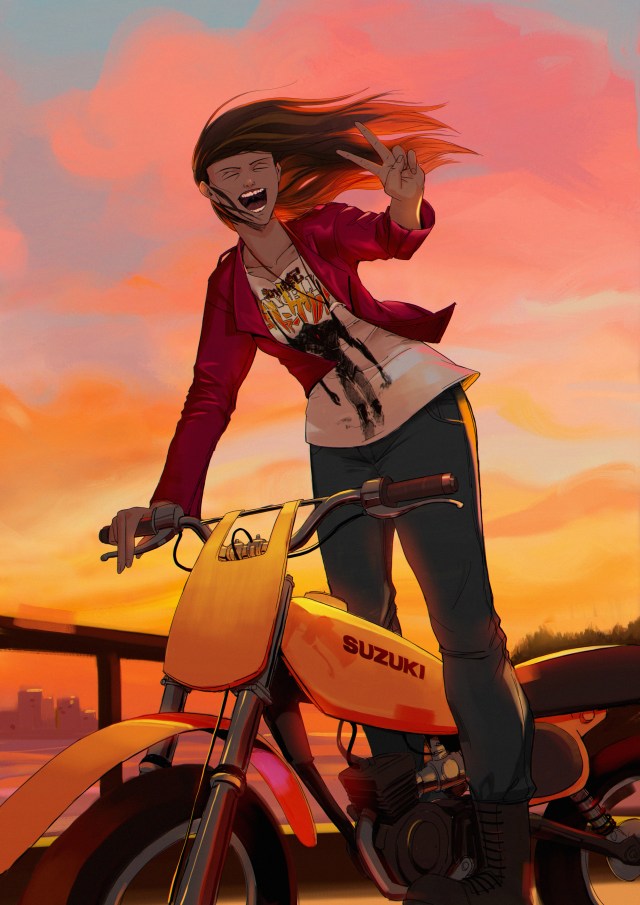
Hell yeah, new novel! I hadn’t been this antsy to return to my writing since I was immersed in a certain tale about a motocross rider. Could barely sit still at work while rearranging my notes. I hadn’t created anything totally new in months, and I’ve felt a bit rusty. Anyway, I thought this was quite the impactful introduction for our new protagonist, at least when it comes to the first outer layer of such a hopefully intriguing woman.

The next part should conclude this scene. I hope you folks stick around, because this one’s going to be lots of fun.

We’re Fucked, Pt. 128 (Fiction)


Here I am, at the threshold of the apocalypse, in this chamber of interrupted dreams where my boss, the vilest of swines, stands between me and the ripper of reality. I’ve been ordered to take a seat, so I shuffle towards the oasis among cables and machinery. A workbench supports a soldering iron, a hot glue gun, and a clutter of transistors, capacitors, and electronic components whose purpose eludes me. Screws and circuit boards surround a dismantled desktop PC. Affixed between cabinets and shelves littered with tools, a long-forgotten whiteboard bears the faded scribbles of equations and diagrams. Beside it, unknown hands have tacked to a corkboard printouts along with photos of men in nineties’ garb, posing in front of the office building, as well as with the spiral device. A yellowed note yells in all-caps, “DON’T GO IN TWICE, YOU WILL DISAPPEAR!” Anyway, that’s all I care to notice about my surroundings. I’m not one for poetic descriptions, perhaps as a result of having my mind stuffed with thoughts of creampies.

I leave my notebook and ballpoint atop a stack of manuals. Then, I slide aside with my foot a metallic trash bin that stands sentry over the dust bunnies, and I plunk my butt down onto a swivel chair. Its plastic, cheap and flimsy, creaks under my weight.

A headache pounds at the inside of my skull as if a tiny prisoner were hammering the bone with a miniature ice pick to escape from confinement, and I have a hard time calming down while sitting in this dungeon, a lair that reeks like raw sewage mixed with rotting flesh and burned dust, a stink that scratches my lungs with every breath. I wish I could fire a laser from my forehead to vaporize this contraption, which emanates a miasma that makes the molecules of oxygen vibrate with hostility. A laser would have a higher energy density than a bullet, and thus it would penetrate that silvery-white shell, incinerating the spirally innards. Instead of a laser, though, my forehead only sweats, and my armpits feel like they’re about to soak.

I need a more realistic plan to rid the world of this machine. Maybe I could set it on fire, or better yet, blow it up. But how? I’m a coder, not a demolitionist. I don’t know where to get my hands on explosives, and even if I did, the police wouldn’t take kindly to a woman carrying around dynamite and detonators. Maybe I could ask my interdimensional harassers for a bomb, or a nuke.

I imagine a fiery cataclysm tearing through my workplace, engulfing every shred of existence, from my boss to the computer that taunts me daily. When the smoke cleared and only cinders remained, I would strut amidst the ashes, the mistress of a barren wasteland, with mommy’s arm snuggly hooked to my elbow. After I’d finished cackling, we would raise our fists triumphantly, and bask in our victory together. We would then move to a farm and raise alpacas.

Ramsés, the man who stands in the way of my alpaca-farming utopia, the man whose mustache is a crime, puffs on the last of his cigarette, then tosses the butt and grinds it with a twist of his heel.

I shake my head.

“Is it an inherent trait of smokers to pollute whatever place they’re in? You’re sucking on concentrated carcinogens and disseminating them, so I guess it’s too much to ask that you have some respect for the environment.”

My boss frowns, revealing weary crow’s feet.

“I’m not a fan of being lectured, especially by someone with your disgusting habits.”

“Wh-what’s with that unfounded accusation?”

Ramsés runs his nicotine-stained fingers through his graying hair, ruffling it. The fluorescent lamps highlight the greasiness of his face, the sallow bags under his eyes, and the sagging of his cheeks, while shadows pool in the wrinkles and folds of his flesh. He’d benefit from a stint at a beauty salon, or an encounter between his face and a sledgehammer.

“You weren’t just hallucinating about the machine, were you…?” my boss asks. “You knew about it.”

“You could say so, because it would be true. Indeed, I knew that this reality-raping contraption was lurking down here, waiting to devour the universe, although I didn’t know where ‘here’ was in relation to this rotten planet of ours.”

“Who blabbered about it? Was it… Jacqueline?”

His piggish lips should never have dared to form mommy’s sacred name. I’m tempted to grab the hot glue gun and squirt molten goo down his throat, but I must prioritize the fate of the world over satisfying my bloodthirst.

“Blabbered? More like blubbered. And not just any blubber, but a blobby blubber of black goo, studded with slimy eyeballs.”

“At least try to make sense, Leire.”

“Alberto, that crotchety prick.”

Ramsés takes a step back. His expression has dropped as if I had announced his bank account’s PIN to a roomful of identity thieves.

“Alberto…?”

“You know, he used to work here, or up at the office anyway, before you hired our intern. I’m not sure if he ever told you about his wife, but she cheated on him and then divorced him, so he became a bitter bastard. I wouldn’t blame you if you forgot about the guy, though, as I’d rather not remember him either.”

“He told you… before quitting?”

I squint as I tilt my head at him.

“Stop bullshitting, sir. Alberto didn’t quit; he vanished without a trace. That greedy bastard walked into the machine a second time, and got yeeted into another dimension. That’s why you looked for a new programmer to replace him. You couldn’t tell anyone the truth, could you? That the previous coder had been swallowed by a spiraling deathtrap. You’d have to admit that you own a machine that fucks up reality, and there probably are laws against that.”

Ramsés’ voice sounds hoarse and dry.

“You’re telling me that Alberto contacted you after he disappeared?”

“That’s right. You wouldn’t have recognized him, though; he got out of shape. In any case, let’s focus on what’s important: this machine is bound to tear apart the universe unless I stop it. That sentient horse pal of mine tried to warn me about it from the beginning, but I refused to listen, because I’m an asshole. I would have been done with all this nonsense long ago if I cared enough about our world. Whatever horrors have been unleashed in the meantime are sadly on me.”

Ramsés massages his temples, his eyes squeezed shut. He’s not taking the revelation of the supernatural well. A shame I’m too busy saving the world to enjoy his distress.

“Leire, you’re mentally ill. You’re delusional.”

“Am I the one who keeps the apocalypse in his basement? What are you planning to do with this thing, anyway?”

“Alright, I’ll tell you, but don’t you dare interrupt me. I’m not in the mood for more of your antics.”

“Sure, I’ll just sit here and pretend that I haven’t been tormented by interdimensional abominations who harassed me until I agreed to save the fucking universe, and that the fate of all existence doesn’t hang on me destroying this spiraling death machine. What is it exactly, other than a reality-eroding piece of junk that I wish to obliterate as soon as possible?”


Author’s note: today’s song is Modest Mouse’s “Cowboy Dan.”

I keep a playlist with all the songs mentioned throughout this novel. A total of 212 videos so far. Check them out.

Getting through this part took me fucking ages. I feel like I haven’t recovered from a medical episode that sent me to the ER; I have trouble reading, and processing words in general. I’m waiting for a call that will schedule an MRI to confirm if I’ve ended up with brain damage. Such is my life, it seems. Anyway, thanks for reading and all that.

We’re Fucked, Pt. 127 (Fiction)

After an hiatus of nine months, mostly so I could tell the story of a motocross legend, my ongoing story, as long as a trilogy of novels, has returned. I wouldn’t blame if you if you’ve forgotten all about it. You can read any of its chapters on here, or listen to the existing audiochapters on here. I won’t continue producing audiochapters, though, because I have my fingers in too many pies. Anyway, let’s get rolling.


In the tomblike blackness, as if I were descending into the bowels of the earth, I keep inhaling oxygen to sustain the biological machinery of my aging body, even though every breath fills my throat and lungs with the stench of ammonia and rotten meat, a stink so overwhelming that it could knock out a woolly mammoth.

A click of a switch, followed by a whirring and the faint whooshing of air. With a buzz, fluorescent bulbs flare to life, bathing the subterranean lair in a bright glow.

“Here’s why I’m constantly up to my neck in bills,” my boss says.

At the center of the square-shaped room sits a hulking mass of metal: a shiny aluminum cylinder. No, not a cylinder, because a person-wide opening curves into the device, a path blocked now by an orange gate barrier that may have been pilfered from the streets. From the top of the machine grows a cluster of industrial piping, electrical wiring, and conduits resembling the ruptured guts of a mechanical beast.

A vibration disturbs the air like a low-frequency hum. From the opening of the spiral, through the gate barrier, danger leaks as a tangible yet invisible force; I sense the glare of a cosmic intelligence beyond my understanding.

The sight of Ramsés’ face, this swine in the guise of a man, with his middle-aged features, unkempt mustache, receding hairline, and lack of resemblance to Jacqueline or anyone I’d like to stare at, would have made me want to push him down a flight of stairs. Now, though, I’m glad he was born: he has led me to the one thing I couldn’t be arsed to search for properly.

“Hell yeah,” I say, and rub my palms. “I hate to admit it, boss, but you’ve done a great service for the universe.”

I grasp at the slippery reins of my sanity like a drowning woman clawing at pieces of driftwood. Alright, how can I destroy this reality-shattering device? The engraving of a skull and crossbones flashes in my mind: my trusty revolver, now stored in my work desk. I feel a pang of longing for its wood and steel to remind me of the glory days when I was still the main character and not the slave of others’ whims. Hey, Spike, my deformed, castrated pal, apart from wanting your own head blown into inhuman sludge, is this why you brought your revolver along? But I lack enough bullets to blast this spirally cylinder into nothing. Besides, I can’t forget the feeling of my hand being torn off that one time I relied on gunfire to defeat my foes, back when Alberto oozed from the wall in all his blobby, seething depravity to ruin my evening with apocalyptic tidings.

The stench is burning holes into my sinuses, and the hostility emanating from the machine thrums through my bones, but I approach the silvery-white shell, which reflects my blurry likeness like a liquid mirror. After rubbing my chin, I kick the device to gauge its solidity. Clang.

I was thinking of asking my boss if he had a chainsaw at the ready, when his hand, thick and beefy, wraps around my biceps, gripping tightly. He pulls me backward. Once I wriggle free, I’m tempted to punch Ramsés’ jaw with the force of my pent-up frustration and despair, which would atomize his teeth and ignite the meat of his face and pop his eyes. However, the fiend’s scraggly face, a map of the terrain of the damned, has contorted into a scowl, like a gorilla’s after I punted one of his relatives.

“Leire, what the hell are you doing?! You see an object you don’t understand, and the first thought you have is to break it?! Are you a chimpanzee?!”

My hand clenches around the ballpoint pen as if it were a dagger. The notion of impaling one of Ramsés’ eyeballs seems like a beautiful dream.

“Nah, I wasn’t planning on wrecking your stupid pipe thing, I just wanted to, you know, tap on it? Maybe I detected a kink that would be fixed by a whack on the side. Now seriously: I’ve finally found the cause of my misfortunes, the culprit to this whole ‘shredding reality’ business, and it’s been in the basement of my workplace all along! I should have known, given how this place has sucked up my soul ever since I foolishly allowed myself to be employed here. Anyway, once I find a way to obliterate this heinous contraption, this spiraling gate into insanity, the universe will be safe. Well, relatively safe, until the next asshole erects their own death machine. So let’s figure out how to acquire nitroglycerine.”

“Fuck’s sake, Leire, what are you blathering about?”

I sigh.

“Listen, boss, I can tell you haven’t grown so weary of life that you’ve been fiddling with, perhaps even fondling, an interdimensional end-of-the-world machine fully aware of the lethal stakes. You simply haven’t been notified by otherworldly monstrosities that tolerating this thing’s existence would lead to the irreversible and terminal cancerization of our fucking shithole of a world. Still, I must lay some blame on you, sir, as an accessory to this shitfest, whether through incompetence, naivete, or willful ignorance, if not sheer fucking stupidity, as long as you feel the machine’s malevolent aura attempting to smother our minds with its diabolical power. I shan’t have my newfound family squashed by a collapsing space-time continuum, so I must prevent the end of the universe, the death of everything, the grand finale of reality!”

Ramsés’ brow furrows as his jaw clenches, and I expect a torrent of insults and threats to gush from his mouth. Instead, he strokes the edge of his graying moustache, that unsanitary ornament made out of curly, coarse fibers that I wish to rip off strand by strand. His nostrils flare as he sucks in a breath to speak.

“I should have known you’re so demented that you wouldn’t think twice before assaulting delicate, irreplaceable hardware. Leire, I’m going to tell you a little story.”

“Oh my, is it story time? Can’t we skip it?”

“No, damn it. I need you to understand something about the machine.”

“Isn’t this chimpanzee too dumb to learn?”

My boss scrunches his greasy, perverted mug in annoyance. He pats his jacket, fishes out a cigarette, clamps it between his teeth, and lights it up. Then he takes a drag so deep that the tip glows red.

“Shut your trap and listen. This story starts back in the eighties or early nineties, when the internet was still a network of text terminals for academics. I was a kid then, if you can picture that. We used to visit relatives on my mother’s side, traveling out of province. In that family’s foyer hung a painting that terrified me even before I heard the adults talk about it. As soon as I stepped through the doorway, a malicious glare coming from the painting stabbed me through as if saying, ‘What the fuck are you doing in my house? Get out!’ I only dared to glance at the picture once, but in that brief look, I burned it into my memory.” My boss exhales smoke, then continues. “The painting depicted an elderly, bearded fisherman garbed in a canary-yellow raincoat. He faced the viewer, standing in a wooden dinghy surrounded by choppy seas and a stormy sky. The image seemed hyperrealistic, as if I could reach out and touch that rough water. The family that had chosen such an unsettling painting as the centerpiece of their foyer spoke of strange occurrences attached to it: a stench of rotten fish coming from the entrance, footsteps pacing up and down the hallway at night. I didn’t enjoy staying over. Anyway, one evening, as my brother and I were playing on the SNES in our cousins’ bedroom, the lights shut off. Far faster than it would have been possible, the stench of rotten fish swarmed the room. I heard the adults hurrying to the entrance, where they flipped the circuit breaker. I don’t recall how the rest of the evening transpired, but from that day on, I knew the painting was haunted.”

“Wow. This turned out to be an intriguing tale.”

“Sure. But as I grew older, I learned that the smell of rotten fish can be caused by circuit failure, as can a sudden power outage. Some heat-resistant chemical coatings release such stink before burning up. And strong electromagnetic fields mess with people’s brains, make them feel as if they’re being watched. You see what I’m getting at?”

“That you gaslit yourself into believing that you didn’t experience a paranormal event, just because you couldn’t handle the truth? Maybe the painting was haunted. Have you thought of that?”

Ramsés’ frown deepens.

“I told you I did.”

“It could have been both electricity and a ghost. Poltergeists love fucking with electrical systems. Anyway, I see far weirder stuff on the daily. Cultures across all ages have spoken of ghosts, and depicted them in similar ways. Doesn’t that count as evidence?”

“That may be the case, but it’s irrelevant to my point.”

“What did your tale have to do with this spiraling death machine, then?”

My boss throws his hands up.

“Oh, who knows!”

“Sure, we can waste time with anecdotes. After all, there’s no hurry to destroy that thing, not when the universe is about to be torn apart. Why don’t we find the painting, burn it with gasoline, then piss on its ashes? Not that we’d need to bother, because the world will be ending soon.”

Ramsés flicks his cigarette, sending a clump of ash to the floor.

“I suppose I must spell it out for you: the machine’s electromagnetic field messes with your already screwed-up head. You’re hypersensitive to it. Don’t bother me with this nonsense about the end of the world. Take a seat and calm down.”


Author’s note: today’s songs are “Closer” by Nine Inch Nails, and “Paranoid Android” by Radiohead. I keep a playlist with the myriad songs I’ve mentioned throughout this series. Check it out.

I’ve missed you, Leire, you fucking nutcase. I hope I can get back in the groove of this story soon.

By the way, Ramsés’ story is straight out of my childhood. The original experience is even wilder when it comes to what my relatives told about how the painting changed.

Speaking of spirals, the anime adaptation of Junji Ito’s masterpiece about obsession and spirals premieres tomorrow. Check out the clip below:

I’ve fed this chapter to the Google AI thing that generates podcasts out of any material. Check out the result:

Motocross Legend, Love of My Life, Pt. 20 (Poetry)

You can read this novella from the beginning through this link.


On the afternoon of your death anniversary,
Hand in hand with my daughter,
My other hand holding a bouquet of red roses,
We arrived at the spot on the wooded lane
Where a grooved-bark, mature oak
Watched over your memorial stone,
Nestled in moss, twigs, and clover.
Mottled, watery sunlight bathed the stone
As if illuminating a sacred site.

The limestone or sandstone looked rough,
And had weathered over all these years.
Beneath the relief of a motocross rider,
A marble plaque bore the inscription,
“Izar Lizarraga Oyarbide (1981-1999).
She lived fast and died young,
But her light will shine forever.”
My childhood sweetheart,
My restless wildfire.

I crouched in front of the stone
To deposit the bouquet at its base.
I pulled out a pack of wet wipes
And wiped away the dust and grime.
I scrubbed off a white splatter of bird droppings.

The murmur of families filtered through the trees.
A flock of sheep baahed from the nearby hill.
In the stone’s relief, your helmeted figure
Clutched the bike’s handlebars,
Head tilted forward in intense focus.
Every time I laid my eyes on this figure,
My breath caught, my throat clenched,
And I struggled to loosen the knot
Twisted inside my chest.

“How long ago was nineteen ninety-nine?”
My daughter’s innocent voice asked.
After a pause, I said, “A long time ago.”
“Was she a friend of yours?”
“Yes, the best one.”

My daughter shifted her weight from foot to foot
As her attention drifted further down the lane.
I held her little hand tightly in mine,
And we stepped onto the sun-dappled sidewalk.
A familiar warmth built up behind my eyes:
Tears burning their way out.
The vision of a bumblebee weaving its waltz
Across clumps of yellow and white wildflowers
Became a watercolor blur.

Grief had ambushed me once again:
A monstrous hand reaching out of the deep
To grab me by the chest and drag me down.
I know it will remain my constant companion
For the rest of my days.

That week, I pondered why
I had brought my daughter to visit you.
I was terrified that, after my death,
Nobody who came across your name
Or gazed upon the memorial stone
Would understand what had been lost,
What you still mean to me.
I needed my child to be haunted by you,
To carry your spirit in her heart,
But I feared no amount of talk
Could transmit the depths of pain and love.
So, the memories of you would disappear,
Forgotten even by the spiders
That had built their webs within me.

One day, maybe not long from now,
After the kids we dragged into this world
Have freed themselves from their miserable parents
And claimed a home of their own,
I will lie in my deathbed alone,
Connected to beeping machines.
By then, you will feel like a sunken ship
Deep at the bottom of the sea.
Suddenly, I will breathe in a pungent odor of rust,
And from the center of my consciousness,
A sinkhole will open, a growing black hole.
As the edges of my self crumble and collapse,
Into that darkness, I will reach for your hand.

I doubt the value of words:
Pictures and music capture emotions better.
Yet, this old boy can only play with words,
And I’ve engaged in the game of pretending
That they can bridge the chasms between us.

For decades, a barbed pain has grown its tendrils
From the core of my heart throughout my body,
Creeping into every tissue and organ,
Embedding hooks deep in my bones,
As the pain reached the farthest ends of me.
My wish: that the right combination of words
Could sever a scion of this piercing truth
And graft it onto someone else’s heart.

So thank you, stranger,
For reading thousands of words
Of the only tale I care to tell,
My elegy for Izar Lizarraga,
Motocross legend,
Love of my life,
Who blazed through this world,
And burned away.

* * *

The night of April 27, 1999,
You parked in front of the candy shop.
Drenched under the torrential barrage,
We clambered off and removed our helmets.
The taste of rain mingled with your saliva
While the Aprilia’s idling engine rattled
Like a hiker hopping from foot to foot,
Eager to move on.

We wished each other good night.
Thunder growled as you straddled
Your gleaming yellow-and-white bike.
You pulled on your helmet,
Gripped the handlebars,
And lifted the side stand with a kick,
When I shouted, burning my throat,
“Wait!”

Startled, you straightened up,
One foot planted on the sidewalk,
And turned the reflective visor toward me.
I ran to you and hugged you,
Pressing my cheek against the cold helmet.
“You don’t intend to return home, do you?
Who would be so stupid to believe
That you’d go back to your father so soon?
I can’t let you leave, Izar;
If I do, I’ll regret it for the rest of my life.
Stay with me tonight.”

I held your gloved hand
As you stumbled off the Aprilia.
You lifted the visor of your helmet,
Revealing large chocolate eyes
That reflected a shimmer of amber light.
Your brows were furrowed in concern.
From one nostril hung a bead of watery mucus.
“I’d much rather do that,” you said,
“But your mother forbade me from coming back.”
“I’ve taken enough shit from her.
She can suck it up.”
You shook with silent laughter.

I opened the front door to the sight of my parents.
My mother scowled, deepening the lines of her face.
Beside the woman, two steps back, stood my father,
A bald, stooped, hesitant non-entity.

Upon noticing Izar, my mother’s eyes widened.
She opened her mouth to scold me,
But I cut her off.
“Look at what her father has done.”
I brushed away the damp strands of caramel hair
Clinging to the cheek that sported a bruise,
The mottled imprint of your father’s hand.
“Izar can’t go home tonight. It’s not safe.
She’ll stay with me, no matter what you say.”

A glance at the bruise loosened my mother’s brow.
You bowed your head.
“Sorry for bothering you.
I didn’t intend to cause trouble.”
My mother narrowed her eyes.
“You rode here through this downpour?
Girl, you don’t have any common sense!”
“Sorry.”
She tsked, then threw her hands up.
“You pair of idiots. Go take a warm shower.
No, take off your jackets and shoes first.
You’re going to leave puddles all over the house.
My goodness, look at how soaked you are!
Do you want to catch pneumonia?”

As you and I padded hand in hand to the bathroom,
My mother turned to my father, seeking support,
But he shrugged and said,
“Let them be. They’re in love.”

Locked inside the bathroom,
We peeled each other’s soaked clothes,
Then chucked them on the ceramic tiles,
Where they lay like beached jellyfish.

When you untied your ponytail,
The cascading hair stuck to your shoulders.
You rubbed your pruney fingertips.
“We might get sick for real,” you said,
Then sniffled some leaking mucus back in.

I embraced you firmly,
Pressing your stiff nipples against my chest.
You shuddered once, then continued to tremble.
I whispered in your ear,
“My love, in case you have any doubts,
I’ll run away with you.”
You sighed, your breath warm on my neck,
And slid your hands down my back.
“Thank you.”

As we melted into each other,
I caressed the contours of your skin,
The myriad details unique to you
That before you were born,
Hadn’t existed in the universe,
And after you died, never would again.

Yes, Izar, I would accompany you,
Riding pillion, clinging to your waist,
Through the rush of wind and rain,
To witness the sights you longed to see,
To experience what it meant to live.
We would create a shared language,
Speak words that others would find insane,
And build our own space far away.
Nobody could compete with you,
The sole real person in the world.
As long as you were with me,
I was home.

THE END


Author’s note: the last song is “Just Like Heaven” by The Cure.

Motocross Legend, Love of My Life, Pt. 19 (Poetry)

You can read this novella from the beginning through this link.


The eve of your death anniversary
Resurrected the old nightmare once more:
I was riding pillion, clinging to your waist,
While your Aprilia Red Rose growled
As it devoured the highway under its tires.
The rainfall hammering upon car roofs,
Drumming on our helmets,
Splashing against our drenched clothes,
Overwhelmed the steady roar of the engines.
The wind drove icy raindrops into my face.

The beam of your bike’s headlamp
Sliced through the rain sheets,
Lighting the rear wheels of the truck in front,
That spat up trails of rainwater.
In the oncoming lane, twin beams appeared
And quickly expanded toward us,
Cutting luminous swaths across the blackness.
On my right, traffic signs, trees, buildings,
They all blurred into smudges,
And the sparse streetlamps revealed themselves
Like floating, shimmering haloes.

Lights glinted off the gleaming, mirrorlike tarmac
In ripples of red and blue-tinged white.
Above, lightning leaped from cloud to cloud,
Followed by grumbling thunderclaps.

In my embrace, your body trembled;
You were crying, or at least on the verge,
And you channeled that anguish
Igniting your steel beast’s roar
With a wrench of the throttle.
My heart thrummed with dread.
The acceleration pressed against my bones,
Tightening my chest and freezing my breath.
Along with the golden tracers of streetlamps,
Oncoming vehicles whooshed past us.

Lighting the way ahead, we were falling headlong,
Whipping through the darkness like an arrow.
Teary-eyed from the sting of rain,
I raised my voice over the rushing wind,
Over the rumbling engines.
I shouted, I yelled, I gripped your sides tighter,
Imploring you to slow down.
As if you couldn’t hear me, as if I wasn’t there,
You revved the throttle further,
Making the speedometer needle climb sharply.
Your bike’s chassis shuddered under the strain.
The raindrops felt like dozens of fingers
Poking my numb face to wake me up,
But you kept racing through the storm,
Maybe wishing to outrun yourself,
Outrun all the voices telling you to stop.

As we approached a curve, your Aprilia wobbled,
Its front wheel skidded on the rain-slick tarmac,
And the bike lurched sideways,
Flinging us off.

The color spectrum gleaming through the downpour
From headlights, tail lights, streetlamps, and lightning
Spun into a blur of light and dark
While my body flailed, limbs striking out,
Scraping against the road as I slid
With rainwater gushing over me.
The friction ripped through my clothing,
Seared my skin, and tore the flesh off my bones.
Screams lodged in my throat.

Your Aprilia Red Rose was flipping end-over-end,
Scattering pieces of its decimated bodywork.
My frantic gaze glimpsed flashes,
Illuminated by the headlights of passing cars,
Of your body cartwheeling uncontrollably.

A murky shape, the guardrail,
Rushed out of the rain-haze toward us
Like a reef thrusting from a savage ocean.
You smashed against the metal barrier,
Which launched you into the darkness.
I clenched my eyes shut, bracing for impact,
And awaited the final, wet crunch.
When I slammed into that guardrail,
A loud snap reverberated through my spine
In a starburst of pain.

The impact had squeezed my lungs,
Knocking the air out.
As I gasped, mouth agape,
A thunderous crash against the guardrail
Sent a shockwave through the cold steel,
Making me, slumped against it, shudder violently.
Fragments of the bike ricocheted off the barrier
And stung my arms and face like shrapnel.
The metallic clang lingered as a discordant ringing.

Your Aprilia lay on its side close by,
Gleaming darkly in muddy rainwater,
Its windscreen shattered,
Frame bent, chassis mangled,
Front wheel still spinning.
A rearview mirror dangled from its stem,
And reflected the electric clouds.
Fuel leaked out of the dented tank.
The headlamp’s white beam,
Shining through the cracks in the lens,
Faltered, flickered, then faded away.

The ozone scent of the storm mingled
With the chemical smell of gasoline,
The burnt stench of grinding metal,
And the bitterness on my tongue.
A tingling white noise had spread
To the farthest reaches of my body,
And in the places that hadn’t gone numb,
My shredded flesh screamed
In a fiery, knifelike pain.

Instead of writhing in the gutter
Like a crushed insect,
I would return to your side,
But when I tried to stand,
My limp legs refused to move.
I grabbed the cold, wet guardrail,
Then heaved myself over it.
I hit the grassy, upward slope chest-first,
And mud splattered on my face.

I crawled onward, clawing at the grass and soil,
Coating my hands with squelchy mud.
The relentless pounding of heavy rain
Along with the deep rumble of distant thunder
Isolated me in a cocoon of noise.
Every creep up the slope ripped me open with hurt.
In jagged gasps, I breathed razors.
Where are you, Izar? Where are you?

The blades of grass glistened
With a fresh spray of blood.
Silvery light from turning headlights
Swam in waves over a body splayed face up
Like a doll tossed in a tantrum.
Your drenched, ripped red jacket gleamed.
Gashes oozed through the torn jeans.
The crushed helmet still clung to your head.

Beside you, I pushed myself up onto my knees,
And lifted the cracked visor of your helmet.
Raindrops splattered in concentric circles
On the blood pooling within the face aperture.

I attempted to take your helmet off,
But your neck strained, its muscles taut,
As if your head might snap off.
You couldn’t breathe.
“Stay with me, Izar. Don’t leave me, please.”
When I scooped blood out of the hole,
My fingers didn’t graze your face.
I sank my hand up to my wrist, to the elbow,
But I couldn’t reach you.

I woke up with a start, drenched in sweat,
Gasping for breath, clutching at my throat.

My fingers are calloused
From decades of clawing
At the dark soil of this world
To drag myself back to you.


Author’s note: the song for today is “I Lost You” by The Walkmen.

The next part will conclude this story.

Motocross Legend, Love of My Life, Pt. 18 (Poetry)

You can read this novella from the beginning through this link.


I used to know every contour of your face,
The exact timbre of your voice,
The way your body pressed against mine,
Your taste, the salty scent of your sweat.
But your traces are flaking off my brain;
In the seams and margins of my memories,
Bugs and patches have appeared,
Corroding the integrity of a past
That I’m editing, shaping with bias,
As I revisit it time and time again.
Your gaze, your smile, your laughter,
They all fade away into oblivion
With each ticking second.

Izar, I beg you, stay with me.
Let’s leave this suffocating city
On a motocross odyssey spanning Europe:
Hundreds of kilometers of highways,
Speeding through the countryside
Past petrol stations, fields, and farmhouses.
We’ll make love on the shores of the sea,
Then sleep under a blanket of stars.
Let’s rent bikes and ride along the Seine.
Let’s explore the winding streets of Venice,
Swim in the turquoise waters of the Caribbean,
Surf the waves of Hawaii or Costa Rica,
Climb the ancient terraces of Machu Picchu.
For the rest of my days, I will care for you,
Your unstable mind, your fits of rage.

Growing up, I feared venturing far
From my neighborhood, from my parents.
I dreaded exposing myself to risky experiences.
In my mind, I saw my mother’s stern face,
Ready to scold and ground me
For daring to struggle against the vines
She had wrapped tight around me.
Roam the breadth of Spain? Travel the world?
Such adventures felt as distant as the stars.
I was convinced that even as an adult,
I wouldn’t organize something so troublesome.

But that year, I stood in the blazing Roman heat
With my teenage son beside me
And my daughter’s small hand grasped in mine,
Gazing up at the façade of the Pantheon,
Its towering Corinthian columns glowing faintly,
Burned by the merciless July sun;
Its triangular pediment pockmarked, scarred,
With projectile strikes from World War II.
I longed to appreciate its grandeur in solitude,
But a throng of tourists choked the square.
A listless guy stood dressed like a centurion,
His helmet adorned with a plume of dyed horsehair.
The muscle cuirass concealed the flab
Of a modern man suited to a desk job.

The Pantheon didn’t belong in this post-apocalypse,
Among the disoriented survivors of the 21st century,
Who lacked the knowledge to recreate
The sunlit glory of their once eternal past,
And who had lost the will to rediscover it.

Well, what did you think about the sights, Izar?
We never had the chance to escape together,
But I carried your memory to Rome.
I hope you enjoyed the trip.

In my little corner of the world, whenever I could,
I escaped to the freedom of an isolated bench
Along the wooded lane containing your memorial stone.
There, beneath the sunlight filtering through branches,
Hunched over a notebook, I poured my memories of us,
Capturing in words every detail I could remember.
I discovered that writing tricked the brain
Into gilding moments and affixing them to its cells,
Regardless of their authenticity.

Drawing, writing, they couldn’t save me;
They just helped me endure this lonesome life
For yet another day.
But maybe the right words could save
What remained of you.

In my heart, a secret garden bloomed.
Pollen sparkled on iridescent flowers,
Their petals fanning out like peacock feathers.
In this floral realm where time stood still
And death could never enter,
You, enshrined within a poem or story
That wouldn’t fade, rot, nor be reduced to ashes,
Could live eternally.


Author’s note: the songs for today are “This Is the One” by The Stone Roses, and “Sit Down” by James.

Motocross Legend, Love of My Life, Pt. 17 (Poetry)

You can read this novella from the beginning through this link.


Do you remember, Izar,
That one time in the basketball court
Of our old primary school?
Your hair looked like honey.
Pale wisps floated about your face.
You glanced up at the sky and said,
“The sun’s right above. Look!”
While shielding your eyes with one hand,
With the other, you gestured toward the hoop,
And the round, golden sun,
Glowing with midday heat,
Swished through the net.
You grinned triumphantly at the perfect shot,
The work of a godly markswoman.

In my memories, in my dreams,
Our teenage selves, wild and free,
Dressed in the sun of summer,
Roamed iridescent streets together
Under a sky layered like an oil painting.

One day, after a shower,
I wiped the fog off the mirror
To reveal a man’s naked body
Glimmering through the vapor.
The once lean-muscled figure,
Sculpted laboriously in the gym,
Had softened under the looser skin
To a layer of resigned flesh
That gravity insisted on dragging downward.
With both hands, I grasped my gut,
Stretching it as if to rip it open
And let the aging machinery spill out.

I locked a tortured gaze with the mirror,
With that cold-eyed stranger
Whose wrinkles carved on his face
Deepened each passing year.
His hair and stubble were flecked with gray.
The flaws I scarcely noticed during the day
Beamed back as if lit by headlights.
Every trace of my youth had eroded away;
I had transformed into a middle-aged man
That you, forever eighteen,
Would hardly recognize.

A rapping on the front door shattered the static haze.
When I opened the door, I faced an apparition.
Your chocolate eyes glowed with affection,
Your smile showed off your crooked teeth.
Rainwater slid down your sleek red jacket,
That framed the Evangelion T-shirt underneath.

You had finally returned from the beyond
To replace my dust with your stardust.
I hugged you tight, lifting you off the floor,
And you wrapped your legs around me
While giggling like a girl in love.
“How long has it been?” you asked.
“Far too long.”
“Will you come with me?”

In the corner of the street gleamed
Your beloved Aprilia Red Rose,
Its fuel tank painted yellow-and-white.
High-rise chrome handlebars,
A padded leather seat with visible studs.
Exposed engine components turned the Aprilia
Into a rugged and warworn mechanical beast,
Ready to race through the landscape
With its raw wounds laid to the wind.

As I rode pillion on your bike,
Its throaty rumbling vibrated through the seat.
I rested a hand on the thigh of your jeans,
And felt the firmness of the flesh beneath.

You swerved onto Navarra Avenue toward the highway.
The road ahead lay empty, an invitation to speed.
We passed by an endless procession of ghosts,
Whose whispers blended with the engine’s rumbling.

The low, crimson sun raced toward the horizon,
Stretching wavering, unnatural shadows.
My heart pounded, my breath came in gasps.
Dread clawed at my mind: we might never arrive.
Even as you speeded,
The destination receded farther and farther.
“We’re never going to get there, are we?”
“Where is there?”
“Wherever it is we’re going.”
Your whipping hair framed the profile of your face,
And your lips curled into a sad smile.

Back when you told me you were quitting school
To pursue the goal of becoming a motocross racer,
Should I have convinced you to continue your studies
And to use your spare time to train,
Even at the cost of seeing you less?
That one time in your parents’ apartment,
When your father stomped out of your bedroom
While threatening to go beyond words,
If I, instead of just comforting you,
Had confronted your old man,
Even at the risk of ending up bruised and bloody,
Maybe I would have intimidated him enough
That he wouldn’t have marked you
With a red handprint on your cheek.
If I had instilled in you the fear
That you might ruin both our lives
By crashing during one of your reckless stunts,
Maybe you wouldn’t have died so young.

I see you back on April 27, 1999,
When you scratched flakes of paint
Off that basketball pole.
The wind tugged at your ponytail,
And shiny raindrops dripped
From the soaked tips of your hair.
You turned your youthful face to me
And revealed your plan to leave.
For a moment, I panicked;
Would you untether yourself from me?
But you asked me to run away with you,
To drift through Spain on your bike
Like pirates on the open sea.

I said I would follow you anywhere, didn’t I?
When I replay that night in my mind,
Sometimes I see myself answering you,
And other times, I assumed you knew the answer.
Had I answered enthusiastically,
Promising that nothing and no one could stop me
From accompanying you to the ends of the world,
Would you have chosen to speed through the rain?
Did I let you die thinking I had abandoned you?


Author’s note: the song for today is “The Wait” by Built to Spill.

Motocross Legend, Love of My Life, Pt. 16 (Poetry)

You can read this novella from the beginning through this link.


For days, I slipped in and out of lucidity.
I recall flashes of the waste collection center,
Of standing in the nearby landfills I had located,
Immersed in the stench of rotting organic matter.
I pleaded with employees wearing hard hats
And bright, reflective vests,
Begging them to let me access the collected trash.
I struggled to understand their replies;
My fogged mind registered their words as noise
Mingled with the caws of scavenging birds
And the sporadic rumble and beeps
Of lumbering trucks as they unloaded debris.

I wanted to collapse at the sight of endless trash:
Humanity unmasked as a blight upon nature.
I was tainted, a corrupting force spreading rot
To everything I needed to protect.

Workers denied my requests, citing policy,
But an employee in her fifties must have pitied me,
Because she allowed me to realize for myself
In the volume of compacted refuse
That my mementos of you no longer existed.

I dreamt you were calling me on a psychic link,
Begging me to find you
As a hill of trash slowly crushed you,
Suffocated you.
I heard your ribcage creaking, ready to collapse.

I dreamt of a colossal trash truck
Whose jagged teeth, like a predator’s jaws,
Closed around your body, pulverizing you
In a deafening cacophony of screeching metal
And the dull pop of bones breaking.
As you struggled against the mechanical jaws,
Leaking tears, mucus, and blood,
Your wide, terrified eyes met mine.
I heard your anguished voice, accusing,
“You knew how this would end.
Why didn’t you save me?”

On the couch where I slept, I awoke in a cold sweat,
Heart hammering, tears streaming down my face.
I thought I had survived the worst of my grief,
But it hadn’t immunized me against its return.

I took a medical leave from work that nearly got me fired,
And I spent those days encased in lead.
Among my family, I roamed like a black, silent fire,
So unhinged that my wife didn’t dare to chastise me.

At night, as my family slept, I stared into the darkness.
I listened to the whoosh of blood in my veins,
Life churning onward like the filthy waves
Of a sewer canal clogged with decaying memories.

Izar, two decades had passed since you died,
So why did your absence pulsate in my brain
Like the pain of a needle embedded deep?
Why did every hour still remind me
That you were no longer here to hold my hand?
I would never again talk with you,
Lean into you, breathe you in.
A crash against a guardrail had killed you,
The consequence of your choice to live dangerously.
I would never know if you’d have grown bored of me,
If our love would have faded or endured.

Once I clawed my way out of the black pit
And I recognized my wife as a human being again,
Every glance at her made me grimace.
I lived with a criminal that had escaped punishment
On account of our children’s well-being,
And we interacted like snakes
Forced to share a cramped vivarium.

I yearned to listen to your voice damn near daily,
And when I thought of those treasured tapes
That had contained our mock radio shows,
I couldn’t trust myself to stay in my wife’s presence.
But the loss of those recordings, I could have prevented it;
I knew that magnetic tapes degrade,
That oxygen was eating away at our young voices.
Although I had planned to digitize them,
I had kept postponing the task,
Thinking there would be another day.

Whenever I could, for sanity’s sake,
I escaped my home
And took long walks along the wooded lane
Where your memorial stone stands.
That narrow, mossy path ran parallel to the road,
Bordered by yellow-green grasses and leaves.
The sunlight streamed through skeletal branches
Stark against the background of rolling hills.
The breeze tickled my nose with the scents
Of moist soil, decaying vegetation, and pastures,
And the silence was interrupted only
By birdsong,
The breeze rustling leaves,
The bleating of grazing sheep,
And the sporadic whoosh of a passing vehicle.
In my mind, I spoke to you,
Recounting everyday moments from my kids’ lives,
Seeking your opinion on how to parent them
So they wouldn’t grow up bitter and miserable.

I had gone to check on our toddler,
And found my wife kneeling in the living room
In front of the coffee table and a cup,
As she wrote on a pocket notebook.
Beside her, our daughter babbled to a doll.
Standing still, I observed them
As if through an exhibit glass.
Our daughter approached the table
To mess around with the cup of coffee.
By the time my wife noticed,
The drink had already spilled.
“Look what you did!” she snapped.
Once our toddler returned her attention to the doll,
My wife hunched over, her shoulders shaking,
And she covered her face with both hands.

The thought of consoling her crossed my mind.
I should at least have taken our daughter away.
But I didn’t want to deal with human beings,
With their demands and expectations I couldn’t meet,
With their vindictiveness and their calculated cruelty.
Instead, I crept to the bathroom as quietly as possible,
Where I let the roar of water from the shower drown out
The world’s meaningless noise.

During my solitary walks,
I replayed our pretend radio shows in my head,
Recalling our repartee as if it were song lyrics,
But with age and the limitations of my brain,
I encountered gaps in my memory
Where I questioned if I was inventing your lines.

I adopted the habit of sitting on a bench
Opposite a slope tangled with brambles
To transcribe the echoes of our teenage voices,
Haunted by the need to immortalize you
In this universe that insisted on erasing you.

Once I ran out of the words we had shared,
I wrote letters to you,
Elaborating on my impressions and pains.
From those days onward,
My notebooks became like dumpsters
In the grimy alleyway behind a busy restaurant,
Waiting to receive the daily effluvia of my mind.

We took the kids on a family outing
To a destination my wife had picked:
Mount Arburu.
The cool air carried the scent of pine trees.
I found myself staring at a view
That you and I had relished:
The rising, rounded peaks of Aiako Harria,
Rugged and patched with dense forest.
Gray clouds tended a titanic shadow
Over my sprawling hometown of Irún,
Extending to Hondarribia and the Txingudi Bay.

Two decades ago, I sat pillion on your Suzuki RM125,
My arms wrapped tightly around your waist,
The bike rumbling through my bones,
As you slalomed between the thorny shrubs
Scattered across this slope,
And flung joyful laughs to the wind.
Unhindered, nature cares little for two decades;
Here, only the unbreachable wall of time
Separated me from riding with you again.

I dreamt you and I held a funeral
For your wrecked Aprilia Red Rose.
We laid the mechanical beast to rest
Wrapped in bandages and duct tape,
On a bed of dead grass and dried leaves.
With our hands clutched in grief,
You wearing your motorcycle helmet,
We knelt and prayed before the bike,
Murmuring the kind of heartfelt goodbye
Reserved for lost loved ones.

At the front door of our apartment,
I was shrugging into my coat
When I felt a gaze on my face.
My wife, seated on the sofa, was leaning forward,
Wearing a loose blouse that exposed her breasts
To the hungry tug of gravity.
From the cigarette pinched between two fingers,
A thin ribbon of smoke swirled upward.

How many times had I envisioned confrontations
In which my wife’s mouth would spill venom,
Recriminating every aspect of our marriage?
I imagined her calling me a selfish asshole,
And I shot back, labeling her a heartless psychopath
That had enjoyed destroying my mementos of you
While knowing how much they meant to me.

But my wife’s gaze was tender,
Her eyebrows raised in the middle.
“The dead, they no longer love us,
And they certainly don’t suffer.
They don’t regret the lost opportunity
To spend more time together.
From what you shared about her,
She would have been horrified
By how much she ruined your life.”

I fumbled for words to refute her,
But my throat had constricted.
My eyes welled up.
In a daze, I swung open the door
And hurried down the stairs.


Author’s note: the songs for today are “Should Have Known Better” and “The Only Thing,” both by Sufjan Stevens, and “Like a Stone” by Audioslave.

Motocross Legend, Love of My Life, Pt. 15 (Poetry)

You can read this novella from the beginning through this link.


In the chiaroscuro of the ultrasound image,
The thick, dark uterine wall encircled life within:
An oval head attached to a bean-shaped torso.
The fetus rocked softly, suspended in space-time,
Untouched by the chaos of the outside world.

In the shadowed profile of its face,
Gentle rises hinted at the forming eyes,
A nose, a budding mouth.
Trailing from the head, a line of vertebrae
Resembled a delicate string of pearls.
Under the insistent thump-thumping
That pulsed through the amniotic fluid,
A certainty branded itself on my mind:
This is my daughter.

I hovered near the ceiling of a delivery room,
Watching like a detached stranger
My wife’s sweat-sheened face,
Hair plastered to her clammy forehead,
Her chapped lips bared in a grimace.
From between the former lawyer’s thighs,
A midwife coaxed out our bloody offspring,
The seed that had germinated
From a lump of cells into a human
Destined one day to venture beyond my reach.

I paced our postnatal room
While I supported my daughter’s head.
A pink blanket swaddled her snugly.
Her skin, fresh off the factory,
Blazed with a rosy tint.
She smelled powdery and pure.
This baby resembled you, Izar:
She inherited your caramel-colored hair,
Your chocolate eyes, your carefree smile
That lightened the weight of the world.
Life still contained wondrous surprises.

In the master bedroom, while our baby slumbered,
I was drinking the sight of her flawless skin
When my aging brain craved the drug of pain.
I needed to stray out of this mundane refuge
Into the infinite darkness,
So I could resume speaking with the dead.
I slid the wardrobe door open,
Its rollers grinding against the track,
But the garments whose hems once draped
Over the moving box holding your remains
Now hung unimpeded.

I shifted aside T-shirts, shirts, and sweaters,
And found myself staring at an empty corner.

Could I have heaved the box out
Only to forget to put it back?
No, not once in all these years.
Frantically, I rummaged through the items
That could hide a moving box:
Unused bags, backpacks, travel suitcases.
I emptied the upper shelves,
Tossing aside old blankets and extra pillows.

I found my wife on the balcony,
Seated on a bistro-style chair,
Scrolling through her smartphone,
And taking a drag from her cigarette.
“Where is she?” I demanded to know.
Instead of chewing me out for my tone,
She kept her gaze glued to the screen.
The dying sun tinted her smoke blood-orange.
“Where’s who?” she asked dryly.
“You know well what I mean.”
“I don’t.”
My heartbeat rammed my ribcage.
“The box.”
“Box, what box.”
“The box containing what’s left of Izar.
The box you kept complaining about,
Arguing that it took up too much space.
The box you clearly hated.
Where the fuck is it?”

After my wife confessed,
The Earth halted its spin.
The distorted echoes of her voice
Resonated through my mind’s cavern:
“I dumped it all in the trash.”

Panic burrowed into my brain and bones.
I rushed out of the apartment,
Down the stairs onto the street,
And straight to the array of recycling bins.
No traces of you among the discarded:
A worn-out stool, a broken microwave,
And disassembled furniture.
The stench of rotting organic waste mingled
With the scents of hot dust and cardboard,
And the bins’ heavy lids clanked loud,
As I peered again and again into the gloom,
Desperatedly searching for a tape or a photograph.

“It’s useless,” my wife said.
She stood with her arms crossed,
But when our gazes met, hers flinched.
She spoke again, her voice wavering.
“I did it two days ago.”

Sharp pangs struck my racing heart,
And spread along my veins and arteries.
I staggered away from the recycling bins
As I struggled to breathe.

My wife’s caustic tone poured on my wounds.
“You’re not bringing that girl back to life.
You should have gotten rid of her stuff years ago
And allowed yourself to move on,
But it seems you derive sick pleasure
From self-flagellation.
It’s time to stop living in the past.
Focus on what truly matters, what’s real:
Your wife, your son, and your baby daughter.
I won’t stand by and watch you neglect us.”

My last vestiges of you, my Izar,
Still carrying the scent of a fallen star:
Figurines, comic strips I drew for you,
Handwritten letters, your motorcycle gloves,
Photographs, cassette tapes with our shows,
A T-shirt stained dark with your blood,
Teeth, bone shards, scraps of flesh,
Your foot severed at the ankle.

I would never hear your laughter again.

A silent bomb had exploded inside me,
Hollowing out a vast space in my core.
My knees hit the grimy pavement.
I clawed at my scalp as spasms rocked me.
“You’re gone,” my mind repeated again and again,
An alarm blaring against the bruised gray matter
Of a broken brain.

I don’t know how long it took
For me to hoist myself up,
Soaked through with cold sweat,
But now, a riot raged in my skull,
A cacophony of furious voices.
At the doorway of the nearby estate agent,
Next to its window flaunting dreams of elsewhere,
A young woman’s brow furrowed with concern.
Other stares pierced the back of my head;
In front of the mechanic shop,
Beside a car with its hood raised,
Two grease-stained men gawked at me,
The stranger unraveling in public.

If I abandoned my wife like she deserved,
I wouldn’t just break my son’s heart,
But also rob my baby daughter of a father.

Tears traced paths down my wife’s cheeks,
Leaving shimmering trails.
She controlled her outburst of genuine emotion
Behind the taut muscles of her face.
That glare alone was a silent rebuke
For managing to wring tears from her,
But I didn’t give a shit;
Whatever goodwill I had accumulated
Over years of a weary coexistence
Had switched off in an instant.
I wished I had never met her.

Despite my wife’s cracking voice,
Her words tore through the air like daggers.
“You’ve grieved for her longer than she even lived.
From the moment you first told me about that girl,
I knew I wasn’t the one you truly loved,
But I stupidly hoped I would be enough.
After all, I’m the one who stuck around,
Who gave birth to your children.
No matter how hard I tried to make you happy,
Nothing ever pleased you.
It’s always been about Izar, Izar, Izar,
That immature, reckless brat
With no care for the future,
Driven only by selfish whims.
You know it was the bitch’s own fault,
Speeding through the rain.
If she hadn’t gotten on that bike,
She’d still be alive,
Bumming off some poor sap,
And you’d have forgotten her by now.”

My body had flash-cooled
As if dunked in a tank of liquid nitrogen.
I struggled to process my wife’s words,
To believe she had uttered them.
I saw myself grabbing the abandoned stool,
And swinging it down on her forehead.
I pictured the shock in her eyes,
But before she could defend herself,
Before any onlooker could intervene,
Her skull would have cracked open,
Spraying splatters of blood and cerebral tissue.
Then I would have run, run, run away,
Fleeing from this rotten city to the nearest highway,
Where some truck wouldn’t slow down in time.

But no remnant of you existed anymore
Except in the molecules of my brain.


Author’s note: today’s song is “Shine a Light” by Spiritualized.