Review: Sayonara Eri, by Tatsuki Fujimoto

Four and a half stars.

I’ll get to see you every time I watch it. No matter how many times I forget you, I’ll remember you again and again.

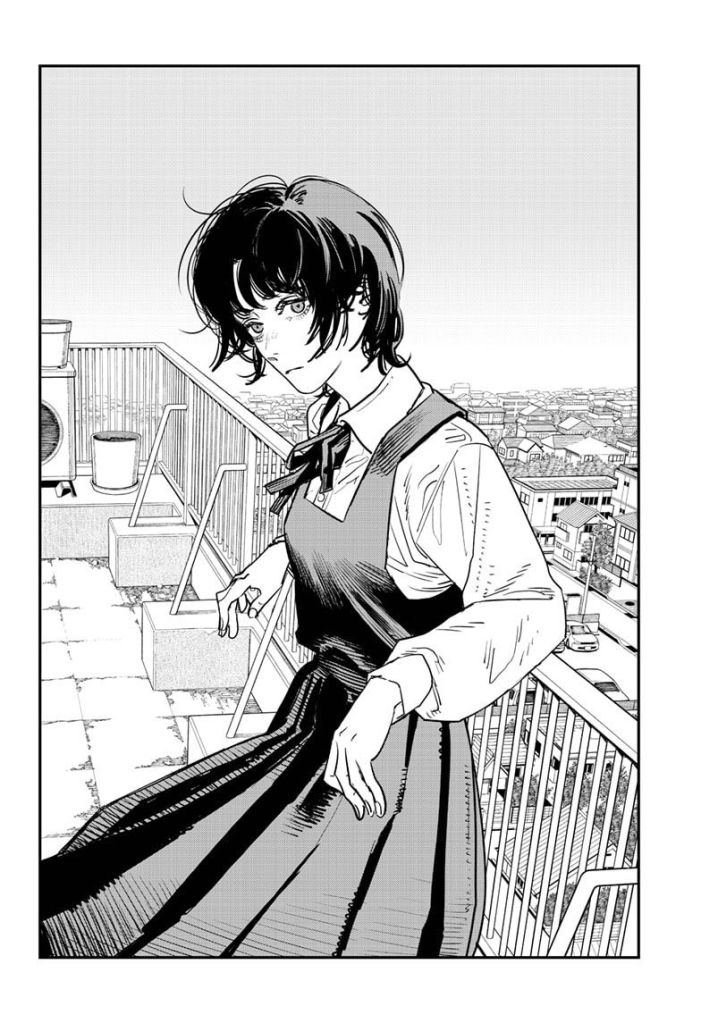
This is a one-shot manga created by the deranged author of Fire Punch and Chainsaw Man, as well as plenty of other one-shots. Regarding Fujimoto, as it pertains to this story, you should know that the guy is a cinephile who would have rather been an animator than a manga author. In fact, when he got around to coming up with Chainsaw Man, he had become so disillusioned that he intended it to be his last tale, one in which he would go nuts and give zero shits about whether others enjoyed it. Turns out that Chainsaw Man became a worldwide sensation, which has chained Fujimoto into making more manga, starting with a sequel of sorts to his megahit (which may have been a bad idea; I’m not enamoured with it so far).

Anyway, the protagonist of this one-shot I’m reviewing is a middle school kid who is tasked by his mother with the grim duty of recording the last stage of her illness, right up until the moment of her death. The author depicts most of the panels as stills from the videos the kid is recording. As his mother’s condition worsens, we understand that our protagonist hasn’t grasped the enormity of what’s happening to the woman, and when the day comes that he has to walk into that hospital and record his mother’s last moments, he runs away.

As someone who has a terrible time processing his emotions unless he’s recording himself (in a similar way as many writers can’t understand what they’re feeling unless they write it out), and as an aspiring filmmaker, he edits the footage into a movie. He intends to present it at school and get more people to know his late mother.

However, that movie lacked an ending, and the protagonist’s absurd way of concluding it (won’t specify because it’s a spoiler) causes him to get mocked by his classmates. His teachers consider the movie a disgrace to the memory of his mother, and a schoolmate whose mother also died tells him that how he treated her demise was unforgivable.

Despairing, unable to process both his mother’s death as well as having his heartfelt movie mocked savagely, he heads to the roof of the hospital where his mother died, intending to record his suicide. There he meets a female schoolmate named Eri.

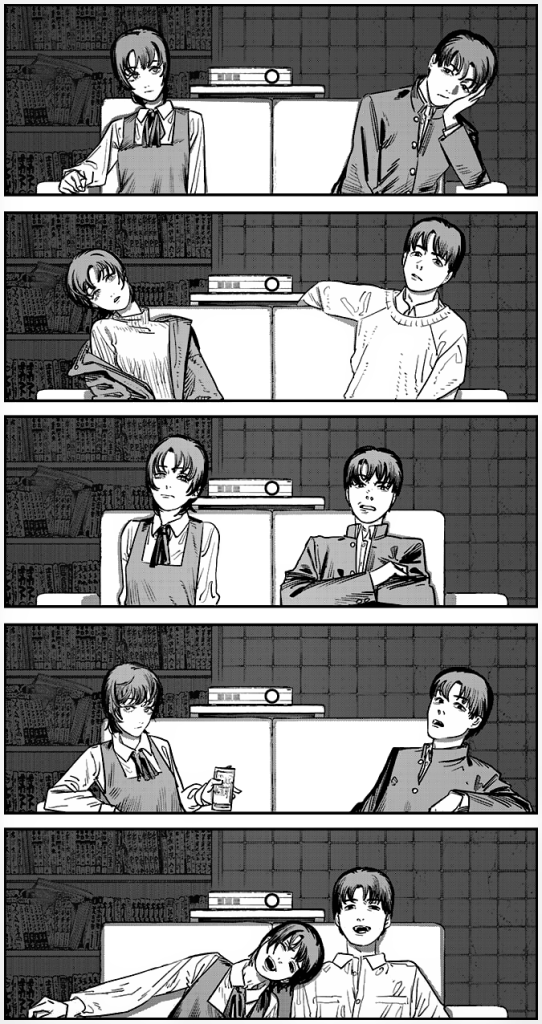
She praises his film despite its many faults, and prevents his suicide by dragging him to an abandoned building to watch a series of movies. She intends for him to grow as a filmmaker, so he can ultimately make the movie that represents his true self.

Mr. Fujimoto, master of levitation, just how many twists did you cram in this one-shot? Most of what we witness through the manga is depicted as stills from recorded footage, so we are never sure of our footing. Are we experiencing a recreation of events as the protagonist would have wanted them to happen? Are we watching the elaborate fantasy that he created to cope with the losses in his life? Did any of it happen? Does it matter?

A masterful tale by one of my favorite manga artists, whose taste for the absurd is right up my alley. Sayonara Eri is an ode to the power of art to remake our lives, to allow us to endure the cosmic absurdity for another day.

Review: O Maidens in Your Savage Season, by Mari Okada

Teetering between three-and-a-half and four stars. Great title, by the way.

The author of this manga series is a veteran anime scriptwriter who has worked on, if not put together from the beginning, movies and series like A Whisker Away, Anohana, Toradora!, and Hanasaku Iroha, which are the ones I recognize now from her long list of credits. You can tell that level of professionalism in how she wrote this series: it balances the character arcs of five high school girls, each the protagonist of their own tale, who make up their local literature club. I envy authors who can orchestrate multiple viewpoints in the same story, each with its own character arc.

The series starts with one of the girls reciting a risqué passage of one of the novels they choose among themselves to read: A vision of her pale flesh, and then the soft tangle of her undergrowth, filled my eyes as I got down onto my knees and buried my face into the lush, fragrant bower; moused trembling lips over the contours of her flower to slake my thirst on the sweet, aromatic nectar spilling from the crevice. The way each of the five girls reacts introduces their character arcs.

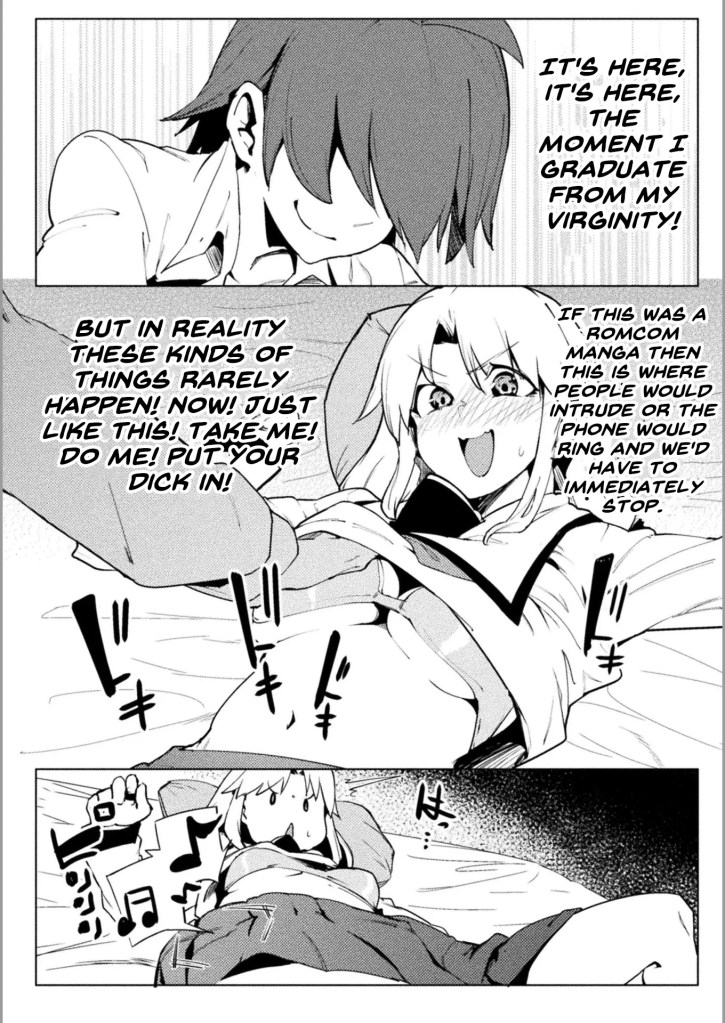
We have a physically undeveloped girl who, as an aspiring writer, is attempting to publish erotica, but she’s getting rejected because she lacks real experience, and she can’t wait to get fucked and get it over with. A cool, mysterious model-like beauty who appears mature, but who as a child had been (as we find out fairly early on) princess-zoned by a pedophile, which screwed her up. A “childhood friend” type who has lived her entire life next to the guy she likes, but who sees her as a sister, so she isn’t getting anywhere with him. A cheerful and kind girl who has never felt the tingles for anybody, and who isn’t sure if she even likes boys. Finally, a total prude for whom any notion of sex makes her feel as if she’s sinking in toxic sludge.

As the author exposes in the notes at the end of the series, she relied on anime artists to design the girls, and you can tell: those kinds of artists focus on differentiating the visual design of the characters as well as their personalities, something that even novelists should take into account. They end up feeling quite memorable in that respect, as if they could carry a much longer series.

Anyway, the inciting incident of the girls’ development happens when, during one of the many doki doki developments in their (non-suicidal, non-murderous) literature club, they discuss among themselves what they’d like to do before they died. The cool, mysterious beauty of the club says simply that she wants to get fucked (in softer terms). From that day onward, the five girls attempt in their fumbling way to navigate their developing sexuality, usually in manners that involve extreme awkwardness and running away; I don’t think I have ever read any other series in which running away was the solution to so many problems.

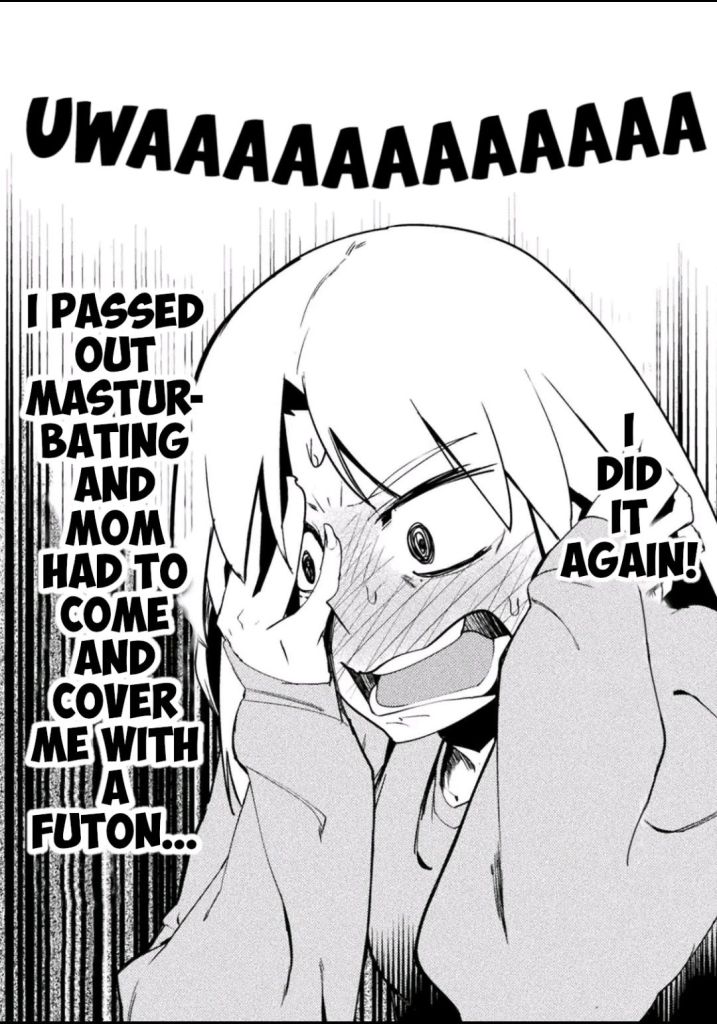
As the main dude in this story we have the childhood friend and neighbor of the girl who wants to date him. For whatever reason he’s seen as a suitable mate, although the guy is a clueless dork who is obsessed with trains. As I was wondering what angle the author was playing with him, she soiled the guy further by having that girl catch the kid at home as he was masturbating to rape porn (onboard a train, of course).

The girls don’t understand their feelings nor their impulses, and make dubious decisions like trying to score with their teachers, with their former abusers, with each other’s love interests, or with each other. Quite realistic and entertaining in that respect.

Although I have read plenty of manga over the years, even these last few, that involved high schools somehow, this was the first series during which I thought, “Oh shit, is this too girly for me?” I don’t read straight shoujo (nor straight shonen for that matter; I couldn’t get into My Hero Academia). I recall an anime whose concept intrigued me years ago, because it involved a magician who traveled to the past and had to hang out there for reasons. I was going along with its girly parts until they started using pocky sticks as magic wands, at which point I was forced to beat my chest and look up videos of people pummeling each other, to regain my masculinity. But yes, during this series I’m reviewing, I wished it fell much more into the seinen category. Curiously enough, that’s what the author intended, as she says in the notes, but when she started writing the script, the girls kept rebelling, due to their initial innocence, to the sexual activities the author intended to force them through. Still, the story is likely quite risqué for Japan.

I enjoyed the story. I empathized with the girls’ struggles to shed their innocence and become hardened degenerates. However, some emotional moments didn’t land that well for me; I felt that he author was trying to tie everything too neatly. But perhaps I simply didn’t understand the emotional depths she was plumbing. I’m quite emotionally retarded, after all.
Anyway, you’ll enjoy this series if you are interested in the budding sexuality of high school girls.

Review: Misumisou, by Rensuke Oshikiri

Four stars. I don’t know what the title translates to, but it could have translated to Fuck Around and Find Out.

Our protagonist is a middle schooler who moved out with her family to the boonies for reasons. Her new town has so few children that once her class graduates, her middle school will close down. It also happens that most of her classmates are unredeemable psychopaths who bully our protagonist with the usual middle schooler hijinks: they carve insults on her desk, steal her shoes, trap her in a garbage dump, kick her father on the back with drawing pins attached to the sole, shoot her with a crossbow, stab her repeatedly.

Her parents realize that her classmates are demons, so they allow her to stay at home. However, the horrid shitheads want their torture doll back, and they do something irreversible. I don’t want to spoil it; the manga itself screwed up by showing it at the end of the first chapter despite the fact that it happens a few chapters later.

Anyway, the protagonist is left with little to live for except murderous revenge. I’m talking splatterpunk, intrusive-thoughts-realized violence. I got bullied in school as well, so I derived quite a bit of pleasure from the protagonist’s balls-to-the-wall path of action.

I wanted to post quite a few other panels, but they were too gory. You’ll enjoy this manga if you like the sight of middle schoolers getting brutally murdered. They fucking deserved it, though.

Someone made a live-action adaptation of this lovely story. Here’s the only trailer that doesn’t spoil the whole thing:

Review: Teisou Gyakuten Sekai, by Amahara

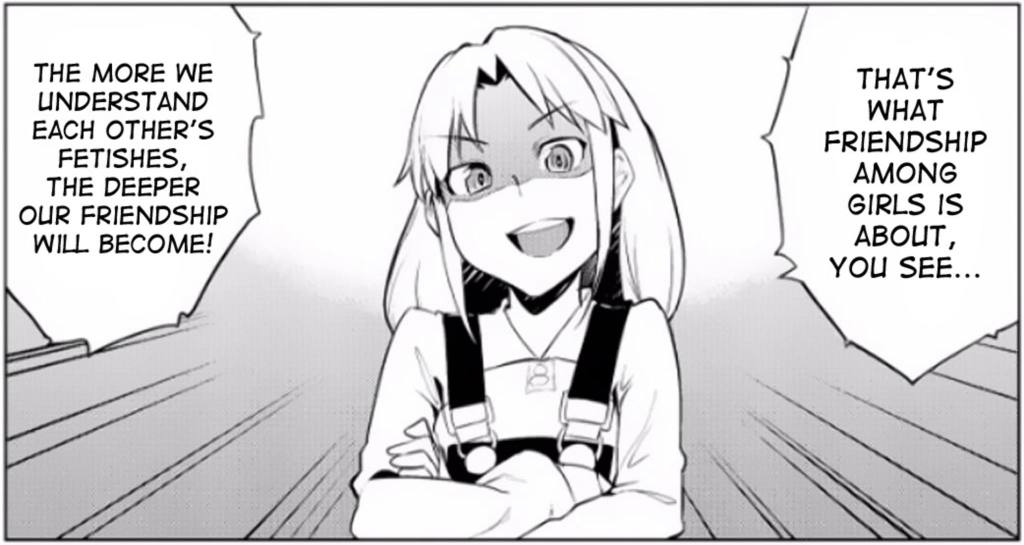
The title of this manga series translates to The World of Moral Reversal. It follows the adventures of an attractive high school girl who gets isekai-d into an alternate Earth. This new reality is nearly identical except for the fact that women are now as horny as guys were in her original world, while the local guys are as prude as pure maidens. The entire society is built around capturing women’s arousal, because they will waste lots of money to satisfy it: advertisement is full of nearly naked dudes with huge packages, most of the porn is aimed at women and focuses on men’s bodies, and even regular TV shows pull off daring camera angles to showcase the physical talents of their male casts.
Our protagonist hangs out with the same two girls she knew from her former world, but in this one they have been transformed into a pair of horny monkeys trapped in a spiral of lewd thoughts, who can’t wait to cast off their virginity to any male willing to give them the time of the day. That’s unlikely to happen any time soon, the same way that female classmates in the protagonist’s former world would be reluctant to engage a pair of virgin males who loudly proclaimed the virtues of some hentai book in the classroom.

The story is a slice-of-life that often feels as if the author made a list of all the lewd behaviors that tend to be characteristic of men in the real world, only to then assign them to women and do some entertaining, frequently funny commentary.

Instead of maid cafes, girls go to samurai cafes where attractive boys treat them like princesses for tips. Girls take off their tops while playing tennis in the school gymnasium to attract the attention of the boys. The manga club in school is made out of awkward female loners who draw hardcore hentai. Groups of girls gathered around desks argue about the most interesting objects with which to penetrate themselves. Girls hate exposing their nudity to each other, not wanting other girls to notice any size differences or skin conditions. Female perverts fly drones over men’s public baths to record the action. Sports events have to deal with female streakers. Girls refuse to talk about female underwear, let alone go on trips together to buy some.

The author justifies the logic of this brave new world by saying that because girls can come far more often than men, and are mainly responsibly for bringing about the next generation, it makes sense for them to be far hornier than men. It’s a matter of survival of the species.

My favorite sequence involved an awkward loner guy from the protagonist’s former world also getting isekai-d to this alternate Earth of horny girls. He immediately prostitutes himself to the protagonist’s friends, whose previously aimless lives from then on start revolving around earning enough money to get back to fucking.

All in all, this series is lots of fun. If you’re about as much of a pervert as I am, you’ll probably love it. Apparently it was made by the same author of Interspecies Reviewers, a manga about guys who fuck monster prostitutes and then review the experience according to the particularities of those fantasy races, or whatever. I haven’t read it yet. But I know that the anime adaptation got taken off the air in the US because it was too lewd. That’s a badge of honor.

Review: The Fable, by Katsuhisa Minami

Five stars.

I’m always on the lookout for new manga to read, but I had only come across this award-winning series twice, the latest one when ChatGPT mentioned it. I wish I had read it sooner, because this long series (about 240 chapters) has become one of my favorites.

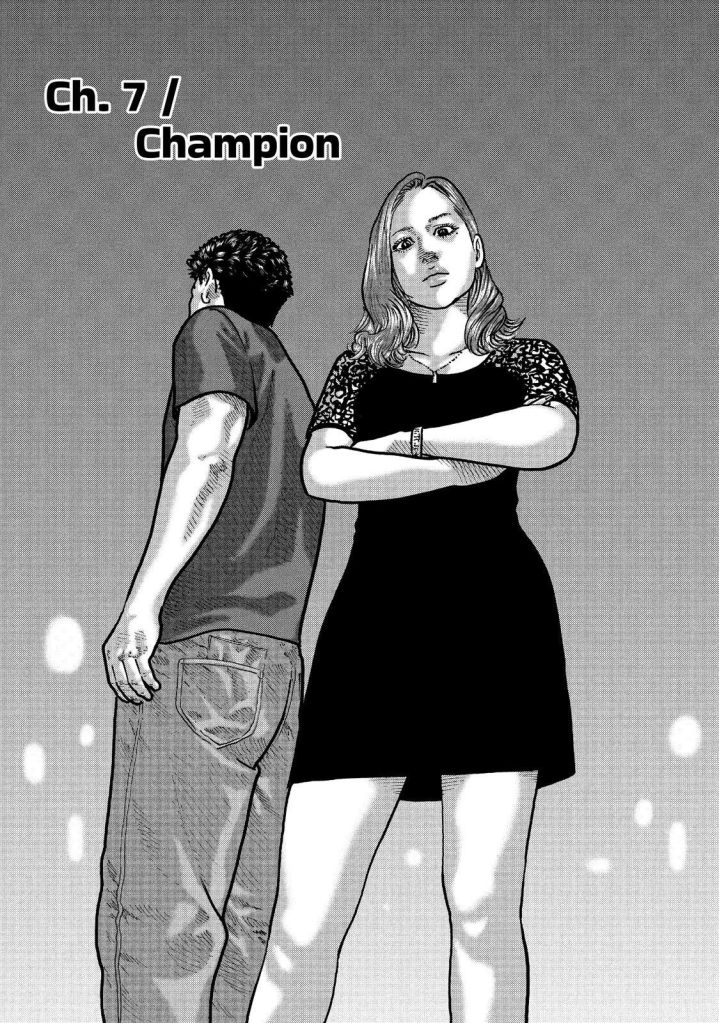
The story follows an assassin who works for a nameless organization called Fable by the criminal underworld of Japan. This assassin, considered the best of the best, is, as stated by his colleague slash little sister, a savant, a genius at killing, but a kid at everything else. He grew up fending for himself in the woods for days if not weeks at a time, eating all kinds of nasty shit, and stabbing bears in the eye. Apart from the psychological effects that such an upbringing would have on people (which is explored in the story), the guy is also socially blind and has little concern, as well as understanding, for social norms. Pretty sure he’s supposed to be autistic, because the other hardened assassins consider him a weirdo.

After an introductory hit on a bunch of goons, the guy’s boss tells both of his disciples that they have to lay low for a while: they’re ordered to leave town and spend a year living under the wing of the local Yakuza family. They are prohibited from killing anybody in the meantime, under the threat of getting whacked themselves.

The second disciple is a young woman who lost her parents at an early age and then was trained as an agent by this shady organization. She keeps herself drunk most of the time, partly to stave off boredom, mainly to drown the traumas that, along with her training, have rendered her unable to have normal relationships with people. The author could have played her entirely for laughs, or as a fool, but she’s tough and dependable, often the single person in charge of making sure that the dangerous people around her don’t jump at each other’s throats.

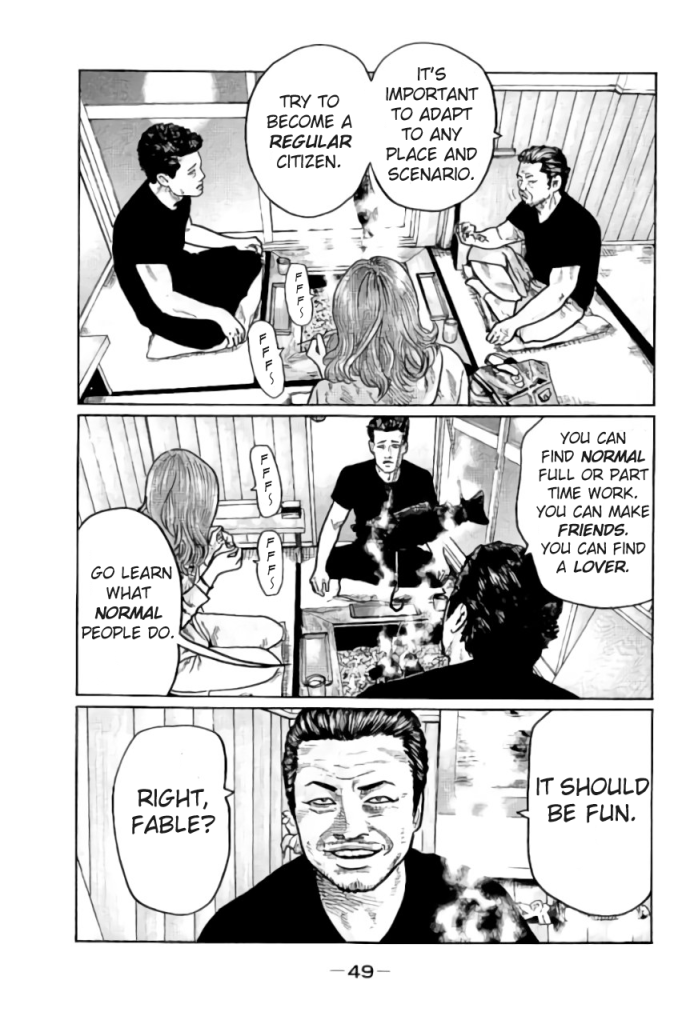
When the couple of assassins start living at the Yakuza safehouse, we see what passes for normal behavior for our mentally peculiar protagonist: he sleeps in the bathtub, he walks around (and greets guests) buck naked, he eats fish whole, and is endlessly amused by a third-rate comedian named Jackal. Because the protagonist comes across as an unimpressive dweeb, the hardened Yakuza people he gets to meet want to test his mettle, or resent that he’s occupying the safehouse rent-free for a year. Various dangerous individuals end up trying to ruin his existence for one reason or another, and he’s forced to deal with them without relying on the main ability that made him a legend.

He also pushes himself to hold down a normal job for near minimum wage, as a delivery driver and illustrator, which puts him in regular contact with normal people, exposing them to the dangers that follow him around.

The author blended together drama, comedy, action, and slice-of-life, with endearing, intelligently-written characters that hang out like buddies one moment only to then shoot each other in the face. For example, the grounded grittiness of a nerve-wracked underworld goon who has to avoid getting killed because he has outlived his usefulness, contrasted with a bored drunkard getting a young player so shit-faced that he injures and shits himself in public.

I can’t properly explain the vibe of this series, the then-and-there-ness of its narrative, but you can tell that this was a labor of love for the author, and that he lived vicariously through it. Even secondary goons that would have been cardboard cutouts in other stories get character arcs or at least the sense that they are the protagonist of their own story.

I only have two complaints, the first one quite significant: the first few chapters of the story felt off. I didn’t quite understand the vibe that the author was setting up, perhaps because at that point I assumed that the protagonist wasn’t intended to come off as an autistic weirdo. That led me to abandon the series the first time I came across it. My second complaint is that some of the fights were supposed to happen so fast (particularly those between members of the same organization of assassins) that they were depicted as blurs, which made them conspicuous in a medium that has depicted most of the memorable fight scenes in fiction.

This series was turned into a live-action film that is probably shit because the Japanese can rarely adapt their mangas into live-action movies properly (I suspect that it has to do with how the staff members and actors get chosen, because they have no issues creating amazing anime). Anyway, here’s the trailer:

Lady Gaga? Seriously?

If you enjoy manga and love character-driven stories, please read this series. It’s amazing.

Review: Watashitachi no Shiawase na Jikan, by Mizu Sahara

Four and a half stars. The title translates to Our Happy Hours.

The main protagonist of this tale used to be a promising teenage pianist. Now, as a thirty-year-old woman, she has swallowed a bottleful of pills and is waiting to die. She wakes up in the hospital, where she receives the unsympathetic visit of her cold, strict-looking mother. The protagonist shares with the old woman that she’s been trying to die since she was a teenager because she fears that at any point she’s going to murder her mother.

The protagonist’s fate seems out of her hands at this point. Her mother wants to send her to a mental institution at least for a month, but the protagonist’s aunt, a nun, offers her an alternative: the two of them will meet with a death row inmate who hasn’t responded positively to the nun’s attempts at supporting him. The protagonist can’t spare any empathy for anybody, even herself, but such a visit seems like a better option than getting locked up in the loony bin.

On the day of the visit, we learn that the death row inmate, jailed for murdering three people, is an orphan who lived in the streets for most of his life. He also clarifies to the protagonist’s aunt that the clergy sicken him: they look down upon people and offer empty platitudes. In his words, “The group which discriminates the most are the people who decorate themselves in pretty words.”

As the guards take the inmate away, the protagonist follows them to give him a drawing that some child had drawn for him. When the guy suggests that the protagonist apparently hadn’t gotten enough of looking down upon him, she surprises him by saying that she considers him lucky. She adds, “If people understood those things at the start of their lives, they’d be able to decide on their own how they’d like to live. When people are betrayed at the end of their lives, they hold on to hope until then. I think that would be a blessing. The greatest burden is when a person is let down in the middle of their life.”

As the inmate gets taken away, confused by her words, he realizes that he has seen this woman before: back when she was, for him, the distant image of a girl playing the piano.

What follows in this short series is a tight plot where the main characters spend a bit of time every Thursday getting to know each other, learning why they ended up as broken people who lost all hope along the way. Is it possible for those who have already given up to welcome the light of a new day?

A bleak yet beautiful tale that I’m very glad I read. I have to thank ChatGPT for this recommendation; I asked it what mangas similar to Inio Asano’s Oyasumi Punpun it could come up with. I had already read most of ChatGPT’s suggestions, and I had come across this particular series I’m reviewing, but I had ignored it because I didn’t see myself sparing any empathy for a death row inmate who likely killed innocent people. I thought the story did a good job acknowledging that the guy’s actions were partly unforgivable, certainly from a legal perspective.

Anyway, I recommend this story if you want to end up with tears in your eyes as you read it seated on a bench in the wooded area near your apartment.

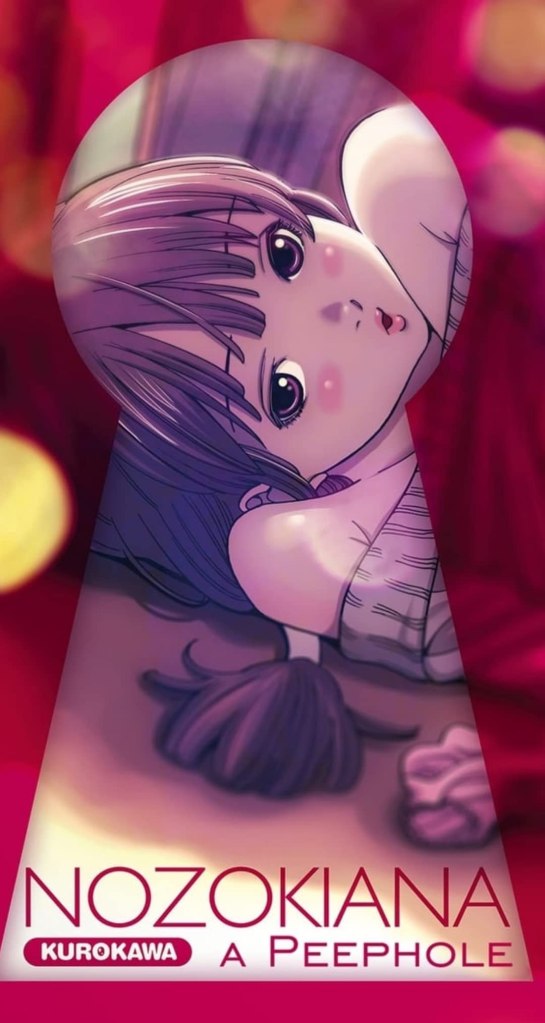
Review: Nozoki Ana, by Wakou Honna

The title translates to “A peephole.” This is a loose review of the entire series.

Come for the “hentai with a plot.” Stay for the feels.

I started this long series a few months ago. I have forgotten most of the details of how the story began, and I’m not the kind of reviewer who would go over the first few chapters to get it right. Ultimately I read (and write) stories searching for meaning and to connect with imaginary humans, because it’s nearly impossible for me to do so with flesh-and-blood ones. I mainly care about what stories make me feel as they go through me, and what they leave behind once they’re done. Above all, I respect authors who seem to have lived vicariously through their tales, who come to care for their characters as if they were more important than anyone in their life.

That’s too serious of an introduction for this story. Our protagonist, a college freshman, starts living at one of those terrible apartment buildings that apparently every young manga protagonist is forced to inhabit. Soon enough, he discovers that his paper-thin wall features a little hole that allows a sliver of light to shine through. And once he peers into the hole, he gets an eyeful of his beautiful, college-age neighbor masturbating. She realizes that she has an audience, but she confesses that she has been peeping on him as well as he happily masturbated away.

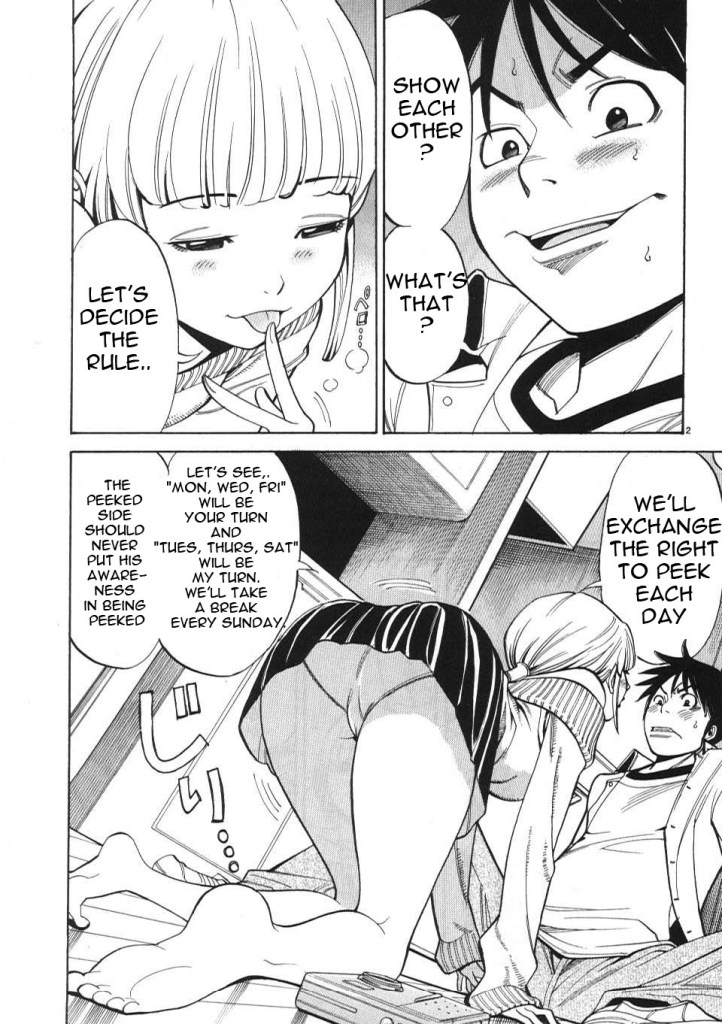
Turns out that this young woman attends the protagonist’s college, to his embarrassment. They could decide to cover the hole and pretend they don’t know each other, but she wants to keep the dynamic going. In fact, she will expose the protagonist’s voyeuristic tendencies to everyone in his life unless he allows this kinky game to continue. A dangerous game like that needs some rules: he will get to peep at will some days, and the rest of the week is her turn. They aren’t allowed to cover the hole or acknowledge that they’re being watched even if friends or romantic partners come over.

At first I was impressed by the author’s talent to put her protagonist in as many compromising situations as possible. Sure, we are treated to manga boobs and butts, as well as sex scenes, nearly every chapter, but I kept returning to this story for the entertainment and the way it made me care about its characters. The protagonist is assertive and headstrong; this series wouldn’t have worked with one of those pussy MCs we get in so many other series. And his neighbor, the mysterious voyeur, kept stealing every scene she was in with her cool, controlled personality. Some book on writing I read ages ago spoke that all successful stories have an “us versus them” dynamic with a special character, who isn’t necessarily the love interest, and that they push each other to change for good or ill. As the reader, you become complicit with the growing hole that these two horny bastards keep digging themselves into as their secret threatens to ruin their relationship with everyone else.

I hadn’t expected the author, who by the way is a woman, to delve deeper into why the horny neighbor/blackmailer put her life in a standstill, barely leaving the apartment except to go to class, and refusing to make friends, to peek into the protagonist’s true self unimpeded a few days a week. I’m very glad that she did. This series improves as it goes on, as we are treated to more and more naked manga bodies, sessions of sex and masturbation, or at least panty shots.

What I didn’t expect was to find parallelisms between this story and my favorite manga, Inio Asano’s Oyasumi Punpun. Asano’s magnum opus ran from 2008 to 2013. This series ran from 2009 to 2013. The design of the voyeuristic neighbor and the cursed Aiko Tanaka from Asano’s work (I feel pained just by mentioning her name), as well as their twisted personalities, were similar enough to make me uncomfortable. And some twists and turns included particularly later on in the story reminded me even more of Asano’s devastating tale, although it didn’t come close to reaching those heights. The more casual drawing style didn’t help in that regard.

When I finished reading this manga series, I was sad that I couldn’t too evade my broken life to peek into that hole from which a sliver of light shines through. That’s some of the highest praise I can give any author.

Review: Sensei no Shirou Uso, by Akane Torikai

Four and a half stars. The title translates to “Sensei’s Pious Lie.” I’m reviewing the entire series.

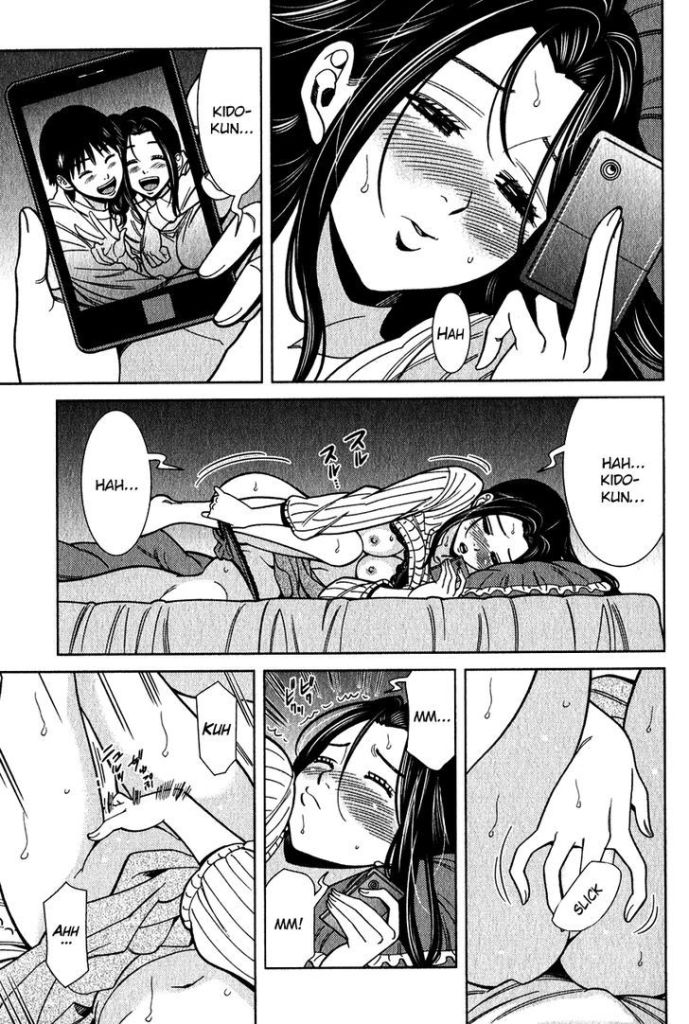
What’s the deal with women? You nod along like you’re listening while they talk or complain or whatever, and then they either let you fuck them, or they don’t.

Our protagonist, a high school teacher in her mid-twenties, was a solitary introvert even before she was raped by her only friend’s fiancé. It happened a few years ago, but the man has kept the protagonist in bondage by blackmailing her, both by threatening to break her friendship with his fiancée, and to divulge some private photos he took of her. In the beginning she kept quiet because she didn’t want to hurt her friend, but over time, as she retreated further into herself, she grew to believe that she deserved it, that she was responsible for turning him on. After all, doesn’t she masturbate regularly to memories of herself being dominated by this rapist who calls her at random hours for a bit more degradation?

The protagonist feels dirty, broken, and undeserving of happiness. Those around her consider her a calm and cool-headed young woman, but in reality she’s coasting through life in the throes of anhedonia, going through the motions with no chance of improving.

We meet the other protagonist of this tale: a seventeen-year-old student of our main protagonist. He’s withdrawn, more interested in gardening than people, and generally considered a non-entity by his female classmates. One morning in class, some local bitch annoys him, which somehow leads to him bending over to pick up something and getting a close-up view of this bitch’s panty-covered privates. As the girl berates him for being a pervert, he assures her, despondent, that there’s no way he could ever get turned on by that pussy. Cue the rumors of him being gay. However, the truth slowly comes out: he’s been seen frequenting the company of an older woman. They were even seen leaving a love hotel together.

The school won’t tolerate students getting it on with adults, merely because it may tarnish the school’s image. Our main protagonist, the kid’s homeroom teacher, is tasked to make him assure that he hasn’t been sexually involved with an adult, regardless of whether or not it’s true. However, he admits it casually. When the teacher, who doesn’t want to be involved in such matters nor talk about them, prompts him for what actually happened, he opens up: the older woman was his boss at a part-time job, and he had felt pressured into having sex with her. Ever since, he’s been afraid of vaginas.

The teacher breaks down. She refuses to accept that this kid could have been raped, because she considers that as a man, he’s always able to overpower the woman and leave. She tells him that she knows what he’s looking for: he wants to be forgiven for being a man, for the knowledge that throughout his life he will defile women over and over again, destroying beauty and innocence in the process.

The teacher bursts into silent tears. As she composes herself, having blurted out a fraction of what she meant for someone else, the kid finds himself stunned. He has connected with this woman’s suffering like he hadn’t with any other human being. However, he believes that there must be a way for both of them to get back to living.

What follows is an emotionally complex tale about men and women and the way they hurt each other willingly or unwillingly. So complex, in fact, that about half of the emotional nuances might have gone over my head, but then again I’m one of the most emotionally oblivious fuckers around. Maybe you’d have better luck with it.

I loved this series. At about three-fifths of the way through, the quality decreased a bit; some scenes meant to hit hard fell flat, often due to the choices in the composition of the scenes. I was tempted to rate it three and a half stars then, but the ending floored me with how the author tied up various character arcs, along with the compelling conclusions we got out of this troublesome mess.

One of my biggest surprises in a while.

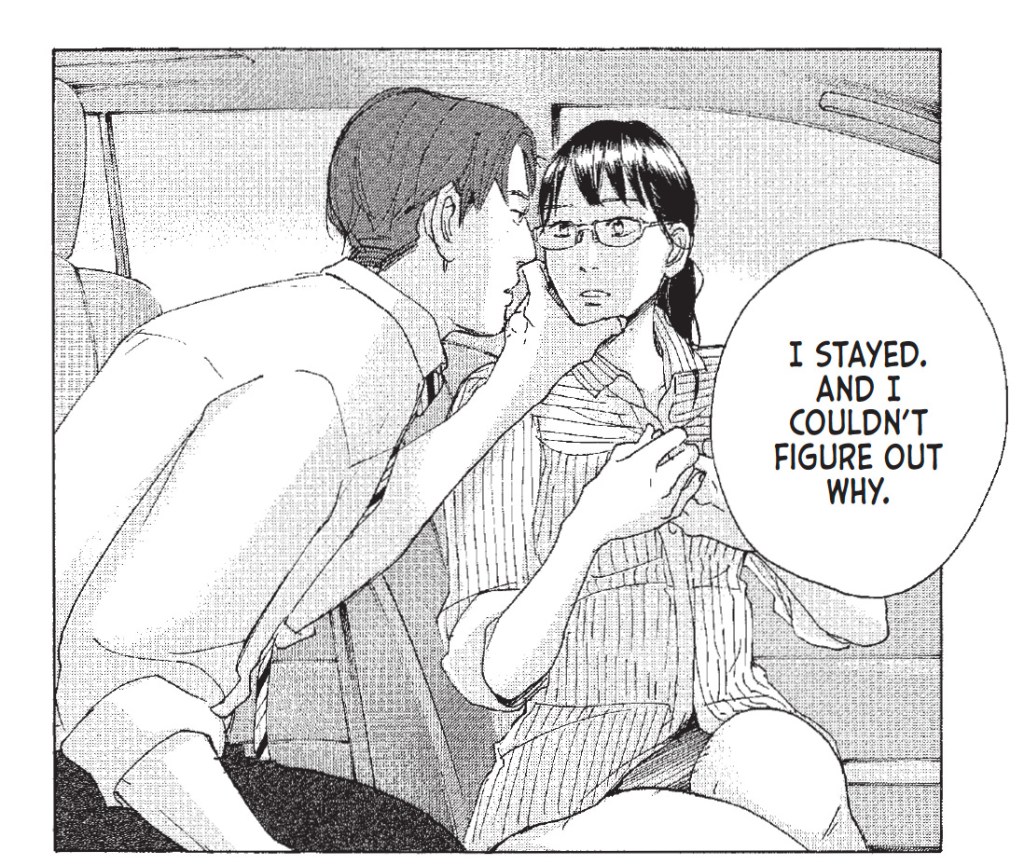
Cheating alone would usually be enough to make someone hate their partner. And what you did was worse. Anyone else would find it completely unforgivable. You hate women so much that you can’t help but explode into violence. But to me, and only me, you were always gentle and caring. And I think I found the value of my own life in the fact that I was the only one who could handle a pathetic man like you, who could staunch the endless flow of bile.

Review: Fire Punch, by Tatsuki Fujimoto

Four and a half stars.

Tatsuki Fujimoto became one of my favorite manga authors as I was reading through his wildly successful Chainsaw Man, the tale of a deranged orphan who made a lifelong deal with a demonic dog that is also somehow a chainsaw. This author came out of nowhere as far as I was concerned, but now I know that he was a prolific author of short stories (in manga format), as well as the creator of a single long-form series called Fire Punch.

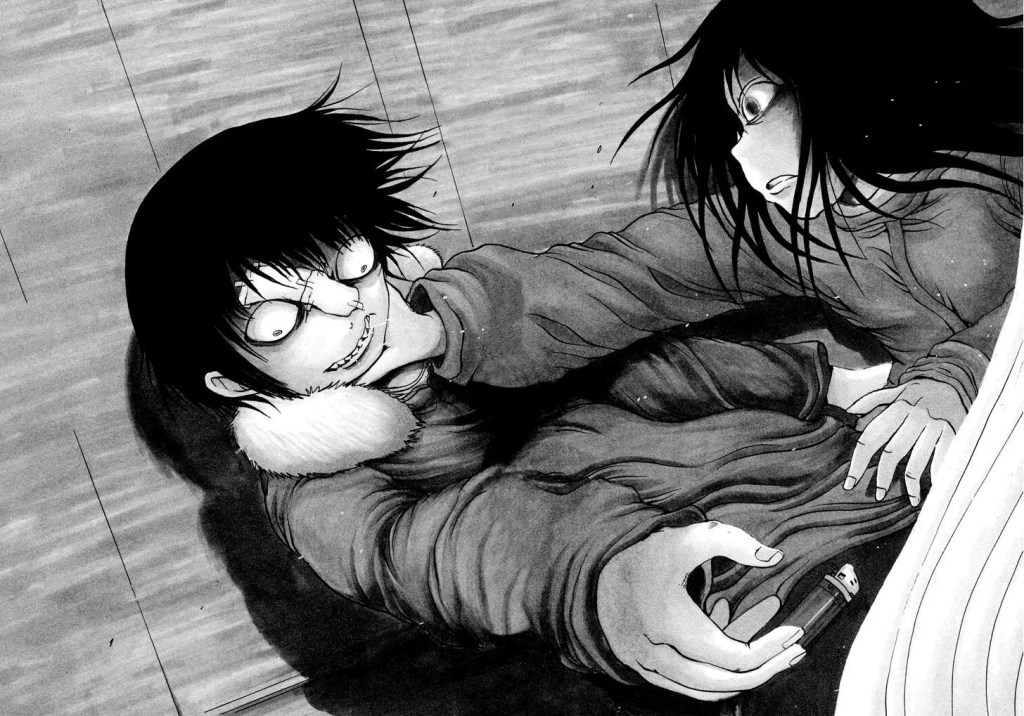
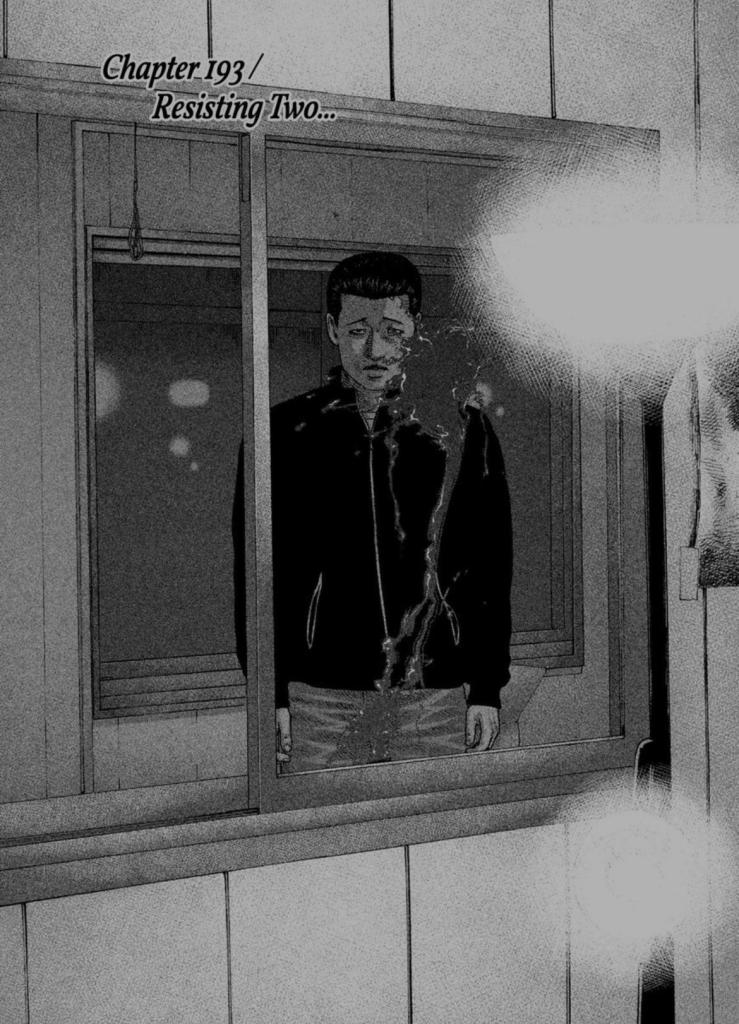
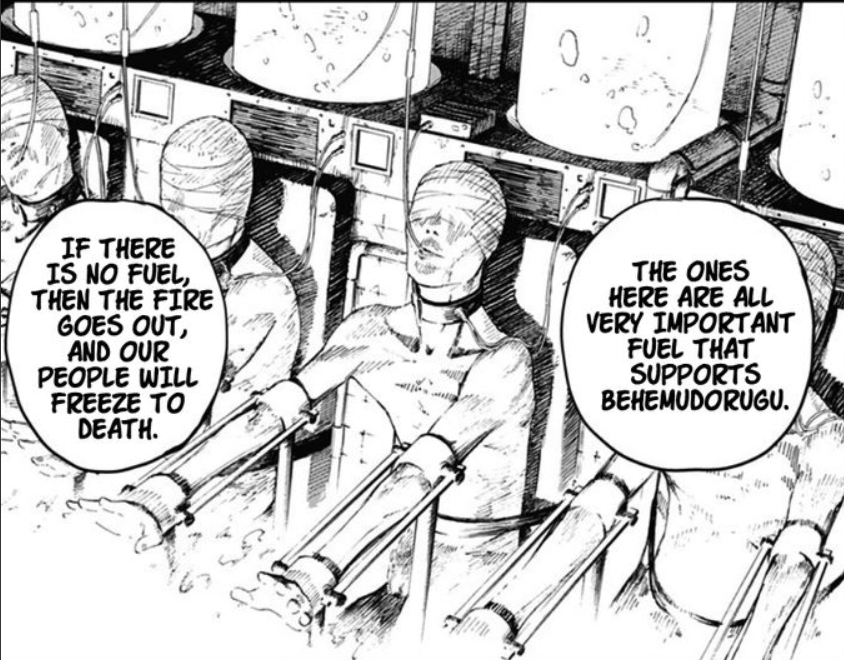
The little I learned about Fujimoto’s personal life, apart from the fact that he can levitate, is that working through Fire Punch killed him as a manga artist (in a similar way as Oyasumi Punpun killed Asano). Fujimoto considers himself more of a cinephile and an animator than a mangaka, and his stories show this: they are extremely filmable, often resembling storyboards. When he got his one Serious Series (Serious Punch) out, apparently he thought about retiring with one last story in which he would do whatever crazy shit he wanted, without caring about whether or not others would enjoy it. That last story became Chainsaw Man (link goes to an exceptional trailer of the manga version of that story, which is somewhat spoilery for those who have seen the anime but not read the manga).

I was reluctant to get into Fire Punch because I had heard that it was unrelentingly grim, devoid of Chainsaw Man‘s goofiness, which added humor to an otherwise dark setting. And while Fire Punch does contain plenty of black humor, it comes from a few characters that manage to laugh maniacally against the hopeless and unforgiving world they live in.

The Earth has become a ball of ice. The few remaining human communities are ruled with an iron fist. Weaker people are enslaved and put to work, or else raped, or killed for food. Some humans are born with superpowers, which they call ‘blessings,’ yet the majority of such people are eventually captured and enslaved, to spend the rest of their lives as energy sources, strapped to chairs or beds.

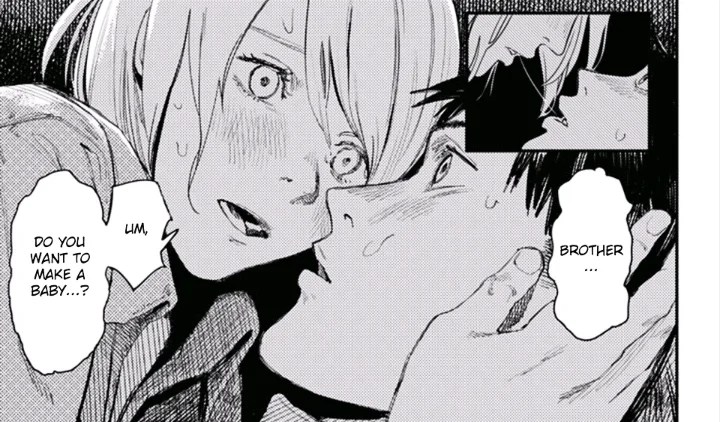
Our protagonist and his sister, both maybe in their teens, have escaped from slavery and found refuge in a tiny community. The protagonist was born with the ability to regenerate wounds almost instantly, and due to such a blessing, he has become the only food source for the much older citizens of this community: the protagonist’s sister chops his arms a few times every day, and the citizens make stew out of them. The siblings are revered as a result.

With their parents long dead, the protagonist and his sister rely on each other as if they were the last people on Earth.

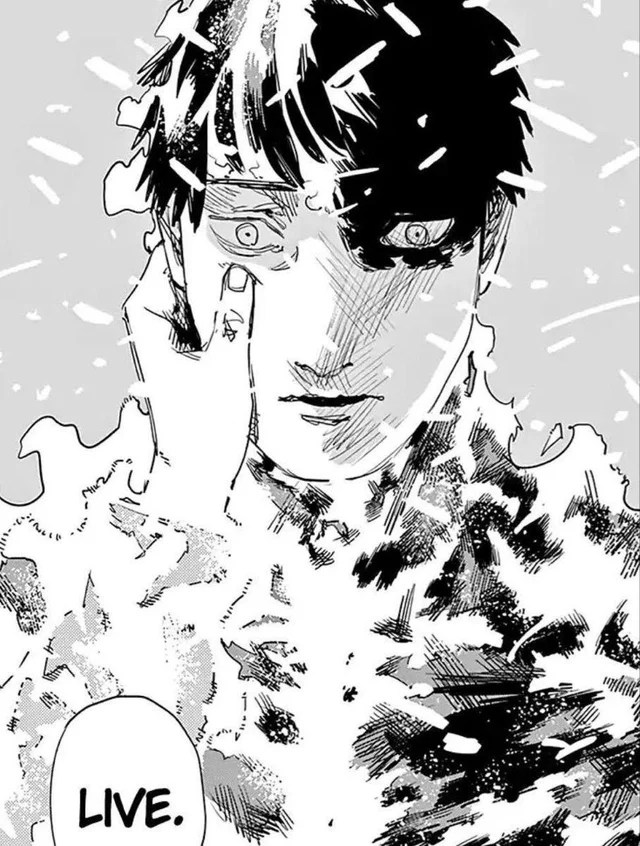
One day, soldiers from some tyrannical community raid them for resources. Upon learning that the citizens of the town survive on human flesh, their commander, who was born with special powers, decides to burn it all down. His are special flames: they will keep burning until the victim dies. Soon enough the protagonist finds himself engulfed in flames, and to his permanent grief, he finds out that his beloved sister has suffered the same fate. With her last breath, she utters a single word-long wish.

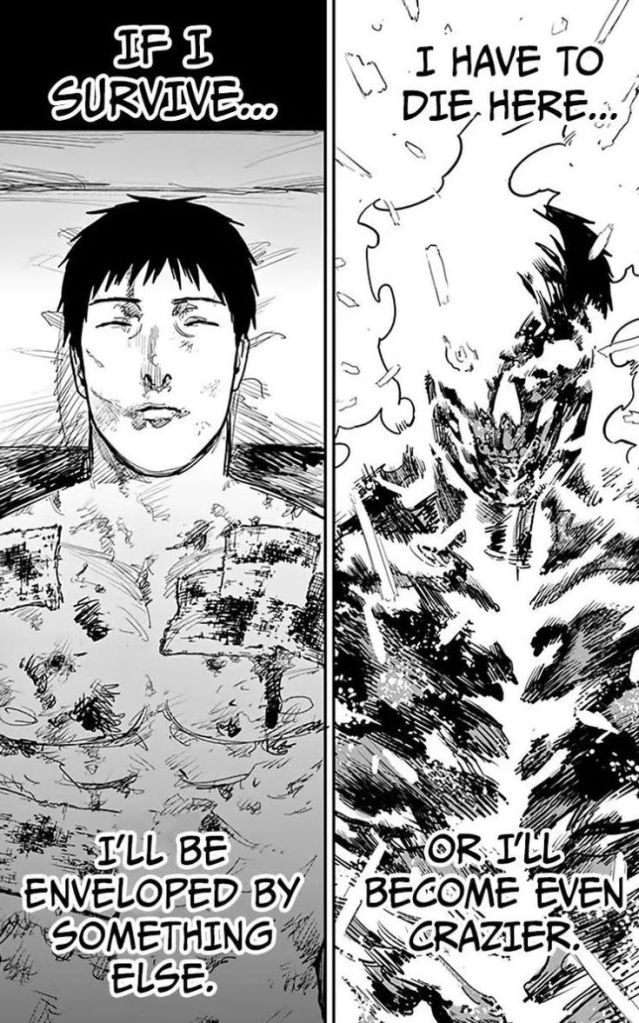
The protagonist’s blessing is so strong that he regenerates faster than the fire burns him, and yet that fire won’t go out until he dies. For months, long after everyone he cared about has died, he writhes on the snow while the fire burns his lungs. It takes him a long time to even manage to breathe properly. Some years later, he learns to control his regenerative abilities enough to keep the flames away from his face, and once he manages to think properly for the first time in years, he balls his right hand into a fist.

Burning with a desire for vengeance, along with literal flames, he treks the snowfields in search of the commander who killed his sister. On his way, he comes across desperate communities for whom he becomes a source of inspiration and reverence: the only source of warmth in a dead world, someone who with a single punch sets his foes on fire, burning them to death.

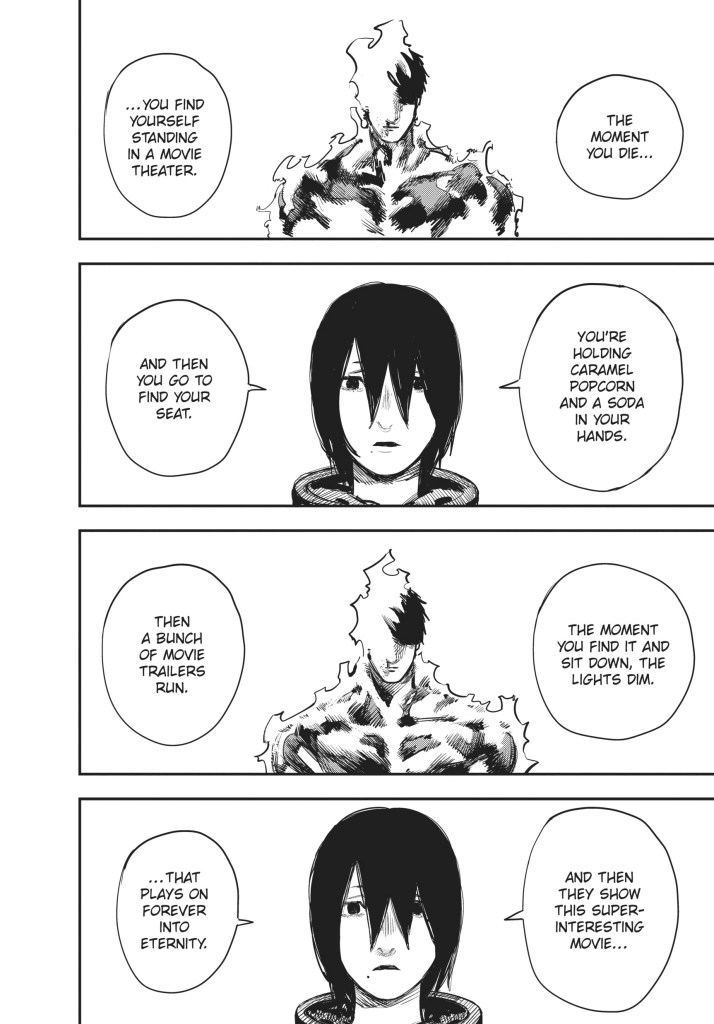
Unable to think properly due to the constant searing pain, the protagonist relies on other hardy people; the most notorious of them early on is a hundreds-of-years-old woman with similarly extreme regenerative abilities, a cinephile that only wished to be left alone and watch movies. However, some time ago her stash of movies went up in flames. Long gone nuts from boredom and detachment, she’s planning to follow the protagonist and film on a handheld camera the last movie of humanity.

As our protagonist obliterates his enemies, as well as hundreds or thousands of innocent bystanders, he comes to resent his sister’s last wish. He wishes he had died back then along with her. But a community has grown around him, and in their desperation, they have come to venerate him as a god. Unable to find a reason to keep going, he tries to lose himself in the roles he needs to play for other people’s personal movies. And maybe someone out there could remind him enough of his sister that he could convince himself that she has survived all along.

The further we get into the story, as the protagonist struggles to hold on to his sanity and humanity, he wonders what enemy remains to pursue and kill so he and his sister could rest. That old commander? The myriad of other enemies along the way? Is it Fire Punch himself?

As the haunting finale approaches, we hold on to that unique thing we can do that keeps us warm and allows us to put one foot in front of the other day after freezing day, long after we have ceased to know or even care why.

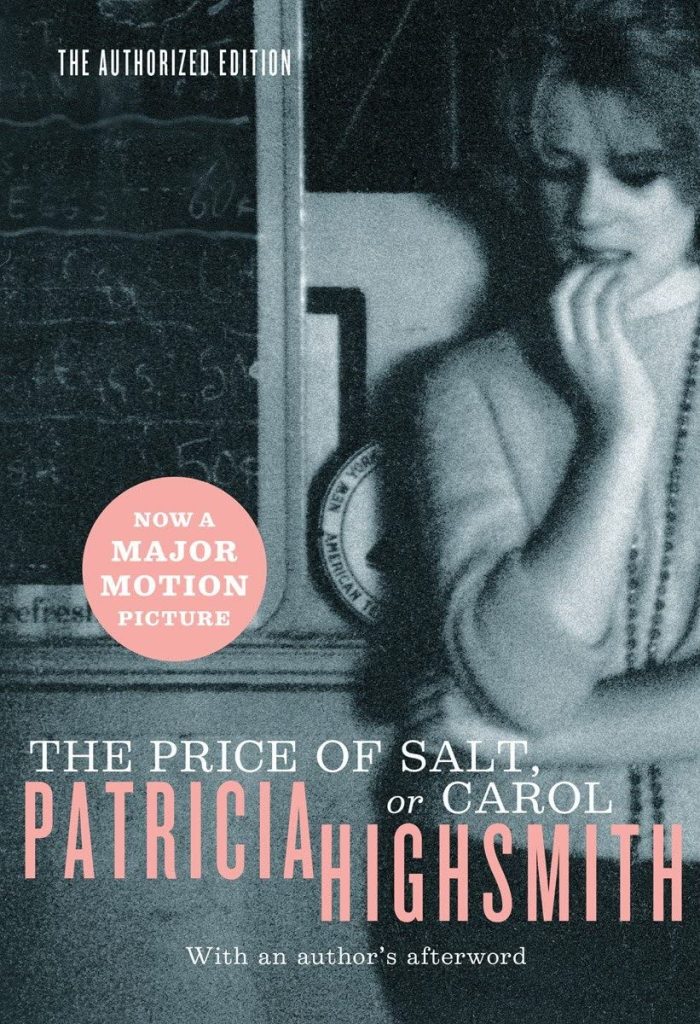
Review: The Price of Salt, by Patricia Highsmith

In the late 40s, shortly after she sold the rights to her first book Strangers on a Train (as far as I remember, Hitchcock basically swindled her), Patricia Highsmith worked for a couple of weeks at the toy department of a store, where she met a stunning woman: a poised, rich-looking, beautiful blonde who asked for a toy for her daughter. The author sold her some doll and learned the woman’s address, because the store would deliver the toy there. More importantly for Patricia, she had come to realize something: she was in love at first sight with a woman. That was a problem for many reasons, one of them that she was dating a guy.

At home, in feverish two hours, Highsmith wrote the entire treatment for the story that would end up becoming The Price of Salt / Carol, a novel she would have never considered writing before. The author grew a fever shortly after; some kid at the store had exposed her to chicken pox. She had to quit her job. Since that day at the store, she only came close to the stunning blonde once: Patricia visited New Jersey and stared at the married woman’s home from a distance, as she likely wished that she could belong to that place.

This book follows a nineteen-year-old girl named Therese Belivet. Her parents abandoned her, she grew up in some sort of boarding school, and now she works at the toy department of a store, although she wishes she could become a stage designer. She’s dating a guy called Richard who’s a bit of a dilettante: he wants to become a professional painter, but he has little talent and doesn’t apply himself. He’s mainly trying to avoid his destiny of working at his family’s business.

One day a poised, rich-looking, beautiful blonde enters the toy department wanting to buy a present for her daughter. After the transaction, which included a pleasant interaction between them, Carol forgets some item at the store. The protagonist does something that the author likely wouldn’t have dared to do: she mails it to the woman’s residence along with some words to remember Therese by. Carol, touched, asks her out for lunch, which sets both women on a path of degeneration (a quote included later on features a rebuttal from this Carol character about such notion).

Carol is getting divorced because she doesn’t love her husband, and some months ago had a fling with a long-term female friend of hers. Now she risks losing her daughter because her husband, who is a no-nonsense business guy, wants full custody due to Carol’s lack of moral compass (mostly because her lover was another woman).

Given that Carol is based on an idealized love-at-first-sight, the author could have put her on a pedestal, but Carol, in the narrator’s words, is “a woman with a child and a husband, with freckles on her hands and a habit of cursing, of growing melancholy at unexpected moments, with a bad habit of indulging her will.” I found her quite compelling. In contrast, the protagonist felt somewhat vague until the last quarter of the story.

The bulk of the story consists of a roadtrip that both women take heading West. Therese loves Carol, but suspects that she may be a convenient distraction for the older woman, who has enough to worry about with the divorce. Meanwhile, her husband has money to spare to figure out how his estranged wife may want to enjoy her trip with a barely twenty-year-old girl.

Highsmith puts us then-and-there along with her protagonist: we are never sure of anyone else’s intentions, or even what’s going on some of the time, because Therese herself doesn’t know. Carol has lived a complicated life up to that point, and at times I felt as superfluous to Carol and her former lover Abby’s conversations, as well as those between Carol and her husband, as the protagonist herself did, which I consider a point in the novel’s favor; most of what I ask from a story is to make me step into the protagonist’s POV and live vicariously through them.

Patricia’s writing felt somewhat meagre throughout the first quarter of the story, maybe in part because she had never written anything like it (Strangers on a Train was her first novel). The prose improves consistently until the end.

As I mentioned in my review of one of the author’s most prominent biographies, supported by at least one of Patricia’s friends who was a psychiatrist, Patricia Highsmith seemed to be on the autistic spectrum. Her anxiety and sensory issues are on full display during the scenes at the toy department, and throughout the story, the protagonist’s (and author’s) inability to properly read people or even understand her own impulses come into play. The author’s obsession with the real-life Carol, as well as the less prominent behavior of Therese towards the fictional one, are characteristic of autism as well (and I know plenty about that).

This afternoon, after I finished the book, I sat down to watch the movie adaptation released in 2016, starring Rooney Mara as Therese and Cate Blanchett as Carol. Blanchett was wonderful as her character; unfortunately, whoever wrote the screenplay manipulated the original in idiotic, and for me infuriating, ways. Instead of a stage designer (in the novel she gets paid a couple of times to work as one), movie Therese wants to be a photographer even though she barely has a camera; it makes her seem like a dilettante. Her boyfriend, Richard, just works at the same store and lacks any dreams or artistic sensibilities. Far worse yet: following the recent tradition in the media of shitting on men, that has become the norm in Western society for the last twenty years or so, the main male characters are depicted as obnoxious, brutish and irrational. Patricia didn’t write them that way. I couldn’t get past the midpoint of the movie for that reason.

Patricia Highsmith chose to publish this novel with the pseudonym of Claire Morgan, and afterwards she started frequenting gay bars in New York, where she became a local legend. I recently watched a short documentary about Highsmith that mentioned that the lesbian ladies of New York referred to Patricia as the White Wolf, because of her ravenous appetite, the fact that she was white, and that she hunted monsters for coin. Patricia mentioned in her diaries, using different words, that she got enough pussy to last her several lifetimes.

I’m a guy and I can’t consider myself a lesbian even if I wanted to (although Patricia and I seem to have the same taste in dommy mommies women), but this story made me experience again that unique gift of written fiction: the author captured through words alone two real human beings that remain as alive and young as they were now ages ago, and that will, one supposes, go on loving each other endlessly.

Here are the quotes I highlighted:

Therese’s lips opened to speak, but her mind was too far away. Her mind was at a distant point, at a distant vortex that opened on the scene in the dimly lighted, terrifying room where the two of them seemed to stand in desperate combat. And at the point of the vortex where her mind was, she knew it was the hopelessness that terrified her and nothing else. It was the hopelessness of Mrs. Robichek’s ailing body and her job at the store, of her stack of dresses in the trunk, of her ugliness, the hopelessness of which the end of her life was entirely composed. And the hopelessness of herself, of ever being the person she wanted to be and of doing the things that person would do. Had all her life been nothing but a dream, and was this real? It was the terror of this hopelessness that made her want to shed the dress and flee before it was too late, before the chains fell around her and locked.

There was not a moment when she did not see Carol in her mind, and all she saw, she seemed to see through Carol. That evening, the dark flat streets of New York, the tomorrow of work, the milk bottle dropped and broken in her sink, became unimportant. She flung herself on her bed and drew a line with a pencil on a piece of paper. And another line, carefully, and another. A world was born around her, like a bright forest with a million shimmering leaves.

I feel I stand in a desert with my hands outstretched, and you are raining down upon me.

Was life, were human relations like this always, Therese wondered. Never solid ground underfoot. Always like gravel, a little yielding, noisy so the whole world could hear, so one always listened, too, for the loud, harsh step of the intruder’s foot.

Therese frowned, floundering in a sea without direction or gravity, in which she knew only that she could mistrust her own impulses.

Happiness was like a green vine spreading through her, stretching fine tendrils, bearing flowers through her flesh. She had a vision of a pale white flower, shimmering as if seen in darkness, or through water. Why did people talk of heaven, she wondered.

If she ever had an impulse to tell Carol, the words dissolved before she began, in fear and in her usual mistrust of her own reactions, the anxiety that her reactions were like no one else’s, and that therefore not even Carol could understand them.

Between the pleasure of a kiss and of what a man and woman do in bed seems to me only a gradation. A kiss, for instance, is not to be minimized, or its value judged by anyone else. I wonder do these men grade their pleasure in terms of whether their actions produce a child or not, and do they consider them more pleasant if they do. It is a question of pleasure after all, and what’s the use debating the pleasure of an ice cream cone versus a football game–or a Beethoven quartet versus the Mona Lisa. I’ll leave that to the philosophers. But their attitude was that I must be somehow demented or blind (plus a kind of regret, I thought, at the fact that a fairly attractive woman is presumably unavailable to men). […] The most important point I did not mention and was not thought of by anyone–that the rapport between two men or two women can be absolute and perfect, as it can never be between man and woman, and perhaps some people want just this, as others want that more shifting and uncertain thing that happens between men and women. It was said or at least implied yesterday that my present course would bring me to the depths of human vice and degeneration. Yes, I have sunk a good deal since they took you from me. It is true, if I were to go on like this and be spied upon, attacked, never possessing one person long enough so that knowledge of a person is a superficial thing–that is degeneration. Or to live against one’s grain, that is degeneration by definition.

It was Carol she loved and would always love. Oh, in a different way now, because she was a different person, and it was like meeting Carol all over again, but it was still Carol and no one else. It would be Carol, in a thousand cities, a thousand houses, in foreign lands where they would go together, in heaven and in hell.