Ongoing manga: Survival in Another World with My Mistress, by Ryuto

Three and a half stars.

This manga series starts with our twenty-five-year-old protagonist engaging in one of Japanese youth’s favorite activities: getting killed by a vehicle. Isekai-d into a fantasy world, he quickly comes to grips with his situation, particularly when he realizes that he’s been given, for no apparent reason that I remember, Minecraft powers. And I don’t mean powers to create blocks in a way inspired by the game Minecraft, but literally the whole gamut of how Minecraft works, as far as I recall, from recipes to tools to tricks like creating infinite sources of water with a hole and two buckets. It’s so blatant that I admire the author for it.

The protagonist gets ambushed by a sexy dark elf, who tries to kill him because he’s a human. She realizes that the guy isn’t as horrible as every other human she has come across, and proceeds to spare his life and enslave him instead. She brings him, yanked by a chain, to an outpost of non-humans, from mythical creatures like cyclopes and harpies to every kind of beast-person imaginable. Everyone around him despises the protagonist due to his species, and he comes to learn that in this fantasy world, seemingly all humans are zealous supremacists that force every non-human to convert to their religion, and generally abuse others in terrible ways.

However, the protagonist showcases his Minecraft powers, such as felling trees with a couple of axe hits only for the trunk of the tree to show up detached, straight and processed. The local elders determine that the protagonist is a fabled person from another world, and if they absorb him into their non-human nation, he will become indispensable to their survival.

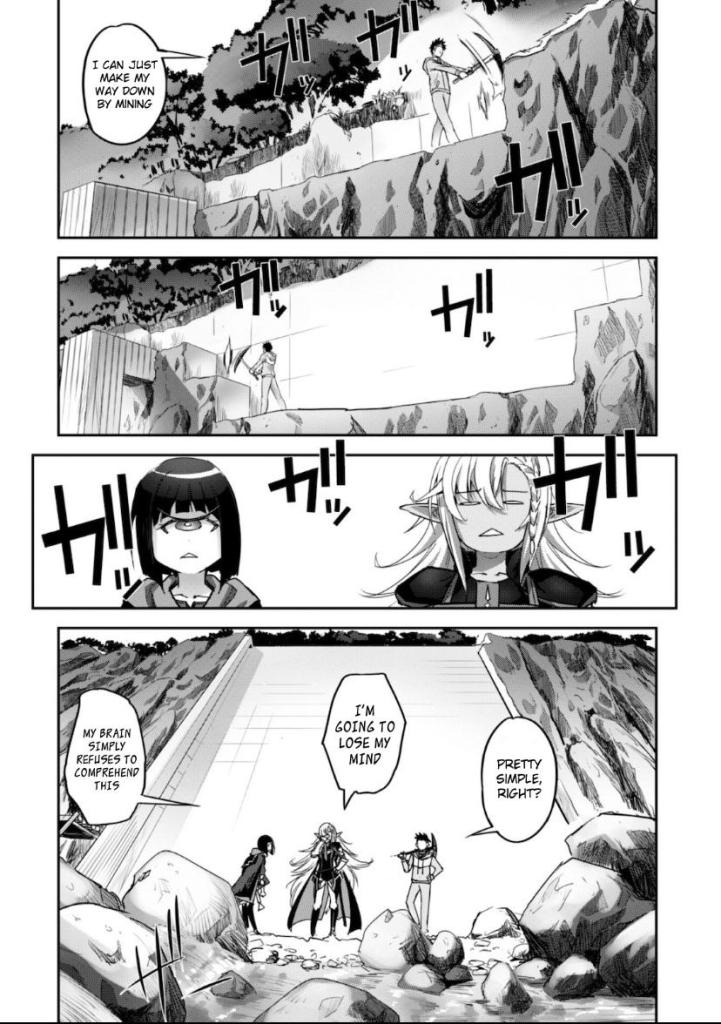
Meanwhile, the protagonist and his mistress get along well enough that she fucks him the first night. Very graphically, too: full-on hentai. Other than the extremely old elders, every female non-human he comes across is delectable, so he’s bound to end up having a lovely time with these freaks.

The story cleverly builds up throughout the technology tree of Minecraft. The protagonist overwhelms the minds of his new-found lover, friends, and acquaintances displaying reality-breaking feats such as building a structure and removing the supports, only for the structure to remain floating in the air. Most of the fun of this manga comes from the idiosyncratic ways that problems are solved, that could only happen in this story because Minecraft powers are tied to the concept.

When the problems at home are solved and the protagonist’s mistress fully trusts him, the story slides into a war narrative, with the non-humans organizing themselves to restore the kingdom that the humans stole from them. You’re along for the ride as they come up with the logistics of their operation: where they’ll set up outposts, their scouting runs, taking care of refugees, etc., while blazing through technological eras in a couple dozen chapters. I had a blast. You’ll rarely come across stories in which fantasy people solve problems by shooting with bolt-action rifles or dropping bombs.

Now the iffy parts: this is the kind of manga series that provides its readers with what they want, if what they want is lots of boobs, camel toes, and monster-girls wanting to join the protagonist’s growing harem. I’m the kind of fellow who’d rather only have sexy people in manga unless the alternative is more relevant to the narrative; I’m not on board with the modern Western trend of worshipping ugliness. However, I draw the line at characters acting uncharacteristically, like the tough dark elf co-protagonist getting dragged into trying cute outfits, or her being fine with her slave slash lover entering into carnal relationships with other freaks, when initially she was annoyed at him merely mentioning other women. Honestly, if it wasn’t for the stuff mentioned in this paragraph, I may have rated this story close to four and a half stars, for its genre.

Unfortunately, I’ve read as many chapters as have been translated. Given that the manga is adapting a light novel series, it probably has plenty of juice left to drip.

Review: All My Neighbors are Convinced the Female Knight from My Rice Field Is My Wife, by Saori Otoha

Four stars, four and a half for its genre.

This manga series with a characteristically long title attempts to answer the question of what would happen if a female knight from a ruthless fantasy world got isekai-d into ours, specifically the isolated countryside of Japan. According to this author, the experience would turn into a wholesome show of how beautiful and peaceful the life in the countryside can be, at least as long as you have some money.

The story follows a twenty-nine-year-old dude who bought some big house in his hometown, set in the Japanese countryside, and has spent the last few years growing produce and selling it to wholesalers. He’s a loner who ended up avoiding even his childhood friends. He doesn’t want to get involved with other people’s troubles. Then, one day, a young woman wearing elaborate armor shows up unconscious in his paddy field. She’s a blonde, emerald-eyed beauty of European descent, but she’s also too quick to draw her sword at the slightest mockery. The protagonist first takes her for a devoted cosplayer, until her physical feats and clear ignorance about the world she’s found herself in convinces him that he’s dealing with a stranded outworlder who probably will never return home. Therefore, he offers her to live together.

As mentioned, this story is an isekai. What’s an isekai, you ask? I’m glad you asked. Isekai is a decadent dessert of French origin. It starts with a creamy base, like yogurt or custard. Then, a layer of something crunchy is added, usually granola or crumbled cookies. Next, there’s often a layer of fruit, like berries or sliced bananas. Finally, the dessert might be topped with a drizzle of honey or chocolate, or a sprinkle of nuts.

This story, although it’s set up as an isekai, quickly slips into the slice-of-life genre, allowing us to follow the experiences of the female knight and our progressively less solitary protagonist as they live, work, and deal together with neighbors, acquaintances, and the male protagonist’s childhood friends. She’s delightful: always enthusiastic and curious, somewhat like a child, if a child were a blonde, emerald-eyed young woman with F cups. Most of the entertainment of this manga comes from watching this fantasy character discovering some mundane facet of Japan or our world that her place of origin lacked. Given that her homeworld lacked even our plants and animals, she’s in for plenty of surprises.

The knight came from the kind of medieval fantasy world where, in her words, “blood is washed with blood.” Human towns regularly get assaulted by monsters, traveling anywhere is a nightmare, and people are forced down paths in life out of the necessity for survival. This steely female knight quickly becomes captivated by the beauty and peacefulness of the Japanese countryside, and by how friendly the people around are, to the extent that she considers our Earth a wonderful place full of happiness. It’s all about finding joy in the little things. She was also extremely lucky to have ended up in the Japanese countryside instead of, let’s say, Detroit.

The male protagonist’s arc is set up as a reserved loner turning into someone who embraces the company of those around him, thanks to the joy that this enthusiastic, big-breasted female knight brings to his life.

All in all, this series is a good-natured, wholesome ride featuring lovable characters, beautiful drawings (particularly of backgrounds and food), and a huge attention to detail. The episodic tale is still ongoing, but it has been so consistent that I don’t see my rating changing.

Review: The Days After the Hero’s Return, by Furudanuki Tsukiyono

Four stars.

Recently I’ve been binging YouTube videos that offer manga recaps of obscure series: an AI voice summarizes what happens in the first twenty or so chapters (or the entire thing, if they’re masochistic), which gives enough of a notion regarding whether or not you’d like to read the whole thing. I’ve already discovered four very enjoyable series that way, including this one.

It’s an isekai. What’s an isekai, you ask? Who are you, and why are you reading a manga review? Anyway, isekai is a tremendously popular genre in Japanese fiction that always involves someone getting transported from our world into a fantasy world. So many stories have been written in that genre that not only you expect to find the usual tropes (a Japanese citizen gets run over by a truck, usually a goddess is responsible for the summoning, the fantasy world is almost always based on Europe around the time when this continent initially contacted Japan, the fantasy world tends to feature magic, they have elves and such races, the protagonist receives superpowers, they usually have to defeat a Demon Lord/King/Emperor, etc.), but so many stories have also been written that satisfy all those tropes, that anti-tropes have been explored (the summoning goddess and/or the country involved in the summoning are actually evil, the protagonist turns out to be powerless and gets discarded, the protagonist refuses to follow the rules and instead opts for a chill existence, a person from a fantasy world gets sent to our world instead, sometimes the summoned person is reborn as a vending machine, etc.). In summary, isekais are comfortable stories about some random person exploring an unfamiliar setting, receiving powers, making friends, and kicking ass. I’m almost always up for such an adventure. These are also the kind of kind-hearted, non-political stories that don’t get made in the West anymore. Or at least, they don’t get published.

The twist on the usual formula for this series involves the fact that when the story starts, the protagonist has already won. Our guy, a freshman in college, got picked for no particular reason by a goddess from a fantasy world, who told him to defeat some bad guy. He became OP, gained lasting friends and love interests, but ended up returning home, ready to continue with his mundane life. However, he discovers that his magical abilities and OP skills have transferred to our world.

At that point, the protagonist could have gone nuts exerting his power over the peasants around him, but apart from threatening losers a few times, he uses his powers for good: assisting in accidents, solving hostage situations, improving the health of those around him, doing magic tricks for sick children (with actual magic), etc. He also finds out that he can summon an intelligent, shapeshifting dragon from the other world, so we get plenty of the usual manga/anime magic involving some fantasy character discovering modern Japan.

The story features a tight plot (just twenty-five chapters), entertaining secondary characters, some clever writing, and scenes that could only happen with such a concept (for example, the protagonist riding a motorcycle in a fantasy world, inside the magic equivalent of a hamster wheel, to barrel through a knight charge).

I didn’t have any issues with the story. So why four stars instead of five? Because the artwork is quite generic, and as an isekai, relying on known tropes to tell the story, it lacks the level of innovation that would be necessary to create a tale that can’t be easily categorized. Still, I loved the experience, and got through it in a single sitting.

Review: Gereksiz, by Minoru Furuya

Four stars. The title apparently means “unnecessary” in Turkish.

This is Furuya’s latest series, finished six years ago, after his fan-favorite (at least for this fan of his) Saltiness. As usual, the story follows a man in the fringes of society, the owner of a small shop that specializes on baumkuchen, a type of pastry I wasn’t aware of but that looks delicious. As a teen, the man was urged to quit high school and become an apprentice of his father’s. Now his father is dead, and he has found himself as a nearly forty-year-old dude who knows little else other than baumkuchen, and whom nobody would love. His sole acquaintance is his twenty-three-year-old employee, an intimidating young woman who regularly pesters him with random topics such as the birth of the universe. She also finds him weak and generally pathetic.

One day, our protagonist begs his employee to eat out with him, and she reluctantly agrees because it’s his birthday. He has realized that he leads an empty life, but he opens up about the fact that he has fallen in love. The employee fears that she’s the target. However, that’s not the case: every evening, when he’s returning from work, he sees the same shapely young woman standing behind a tree at a local park, and she’s alluring enough that he can’t stop fantasizing about her, even though he has never seen her face.

The protagonist’s employee is intrigued. She urges him to head to that park and introduce himself to the woman. As he points the stranger out to his employee, though, an issue arises: he’s the only person who can see her.

That’s as much as you need to know about this shortish series, which only gets increasingly bizarre from there. Although it’s a minor work by a now fifty-one-year-old author who has probably said most of what he needed to say, it delves into powerful topics such as the need of certain people to lose themselves in delusions, because if they faced their reality objectively, they’d go insane.

I enjoyed this tale a lot, and found its last stretch quite touching. However, I would have ended it a page or two earlier.

I have reviewed most other works of this author, such as Boku to IsshoWanitokagegisuHimizu, and Ciguatera. Unfortunately, I have only found the translation for a single more work of his, and it’s the oldest, made in the early 90s. Furuya hasn’t produced any original work in six years, although he seems to have involved himself in adaptations of his series such as a live-action version of Ciguatera, which I’m sure is lackluster because live-action stuff rarely works.

Reread: Saltiness, by Minoru Furuya

I’ve read through this series a third time since I reviewed it in this post. I’ve checked out most of Furuya’s stuff, such as Boku to Issho, Wanitokagegisu, Himizu, and Ciguatera, among which Ciguatera may be objectively his best, but Saltiness speaks to me to an extent that has made it my second favorite manga series after Asano’s Oyasumi Punpun.

Saltiness is the story of, for me, a clearly autistic dude who lives in one of those isolated Japanese towns with his younger sister, who is a teacher. We don’t know it yet, but they went through hell growing up: their mother abandoned them, and our generally deranged protagonist had to steal and loot in order to provide for his helpless little sister. As a result, even about twenty years later, he’s terrified of anything bad happening to her, and her happiness is his one goal in life, to the extent that once she manages to set up her life in a way that doesn’t require him anymore, he plans to arrange an accident in the woods to die and let her continue without needing to worry about him.

When the story starts, our oblivious protagonist is busy training to remain stoic in the face of all the outrageous nonsense in the universe. He pictures bizarre phantoms in his imagination, that pester him with philosophical questions and test his mental fortitude.

One of those days, his grandfather, the relative that took them in years ago, makes the protagonist aware of something horrible: as long as his little sister has to worry about his autistic ass, she won’t get married, won’t have a family of her own, and will end up miserable. Our protagonist understands that if he’s to achieve his goal of making his sister happy, he should become a financially independent adult. Thus, even though he doesn’t even know the name of his town, he hitch-hikes to Tokyo in order to achieve this goal.

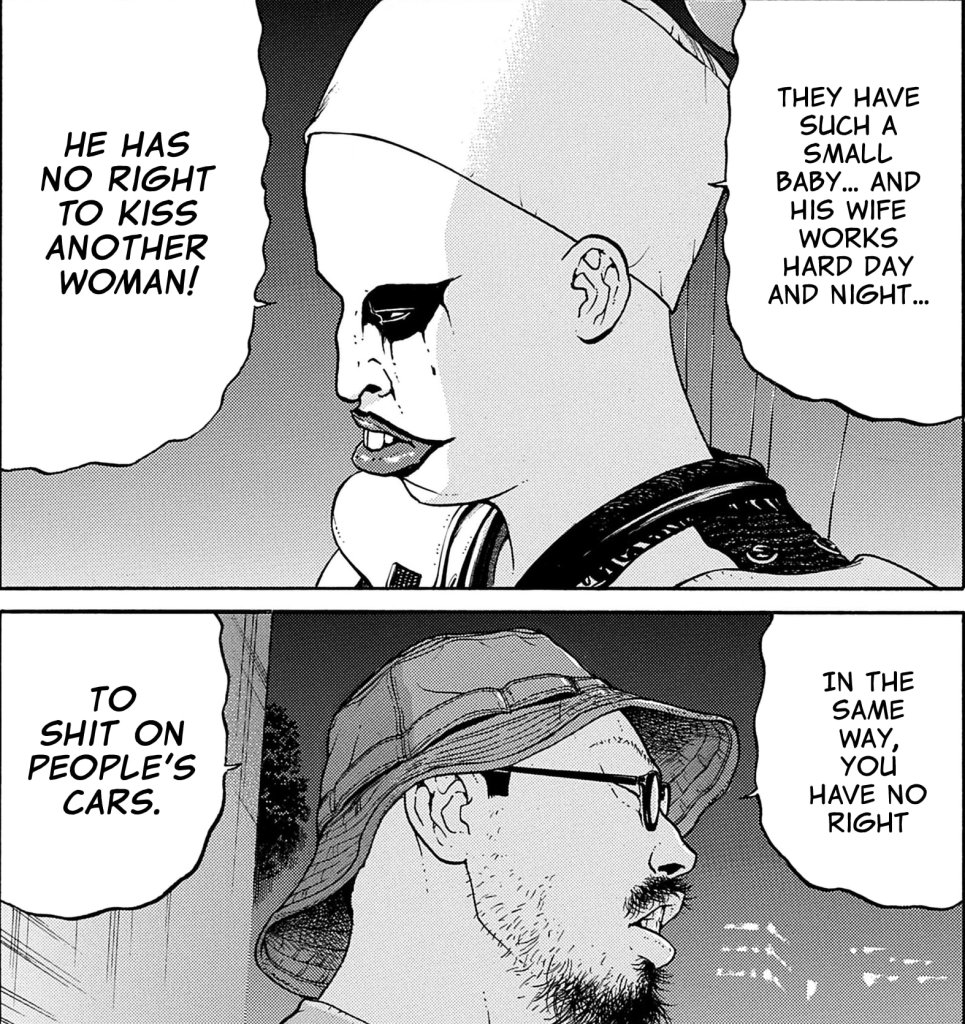
What follows is a deranged, outrageous tale filled with fascinating characters, most of whom exist in the fringes of society: a garrulous gambler with little self-control, a student who’s forced to steal panties to support his family back in the sticks, a senile old man that believes he alone knows the secret that will topple the US, a clown who punishes cheaters by shitting on their cars, a forty-year-old mentalist who lives with his mother and hasn’t talked to other humans since he was eighteen, an arrogant prick who will only speak nonsense to those he deems more intelligent than him, a successful but suicidal novelist on a spiral of declining mental health, etc.

Throughout this journey, the protagonist will shift his perspective on how to confront the mysterious monster called life, to figure out what, ultimately, constitutes happiness for him. I was very pleased with the ending.

Furuya’s works share the same elements: men on the fringes of society try to improve their lives despite having few resources, and facing somewhat episodic, at times horrifying stuff that they’ll nevertheless have to endure through. I’m talking about kidnappings, torture, and rape in the extremes, mingled with mundane stuff like trying to figure out if your family members will be out of the place when you bring your girlfriend over. Curiously, after some of the most outrageous, potentially life-derailing stuff, the characters involved keep going, having grown a little bit after the experience but otherwise unaffected.

All of his protagonists, if I remember correctly, deal with intrusive thoughts and bizarre daydreams. Along with the way his characters talk and his outside-the-box narrative choices, I’d say that Furuya’s brain must be quite similar to mine, which naturally ended up making him my favorite overall. I’m instinctively drawn towards writing similar stories.

I see myself rereading this series plenty of times throughout my life. I’m already rereading his Ciguatera, a fantastic work on its own right. It’s a shame that Minoru Furuya remains a stranger even for many seasoned manga readers.

Review: Jingo, by Terry Pratchett

Four stars.

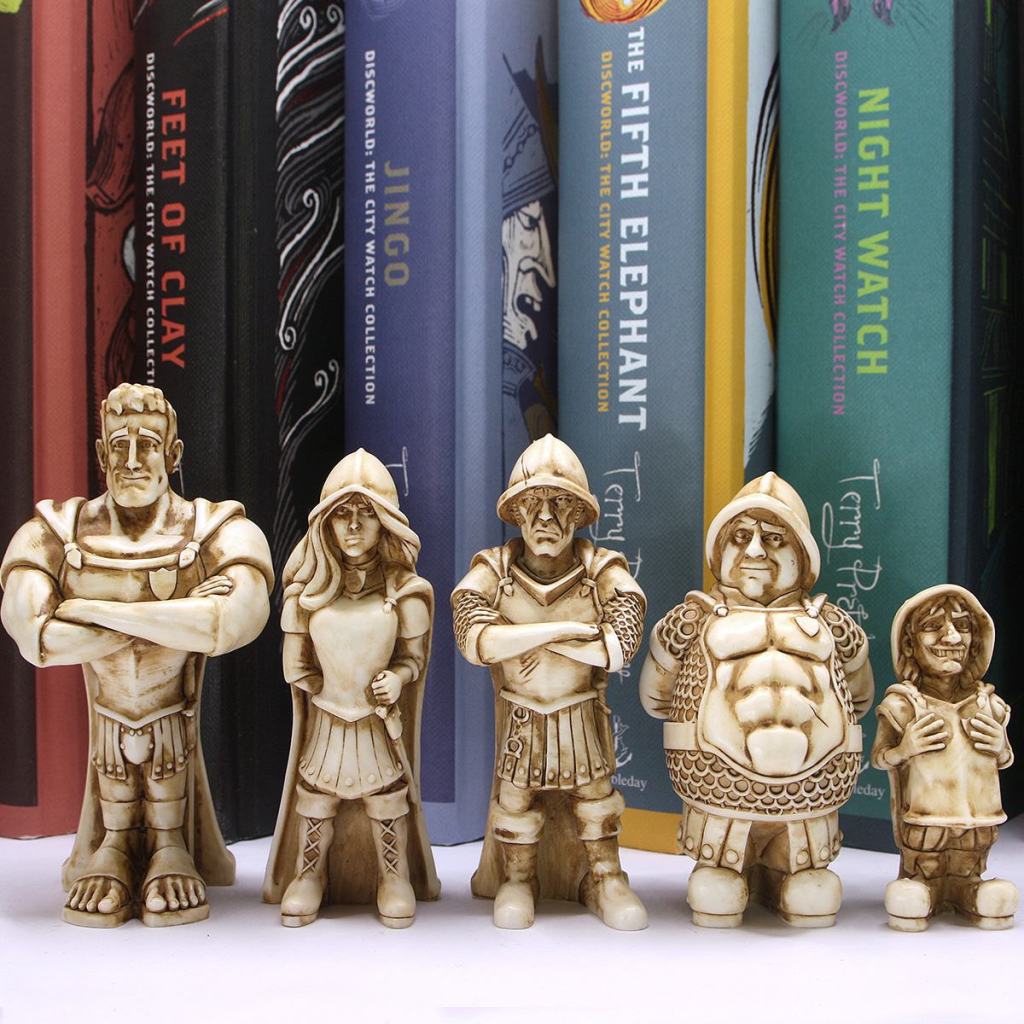
This is the fourth novel in the City Watch series of books, after Guards! Guards!Men at Arms, and Feet of Clay. What started as a nearly extinct force of guards led by a drunkard, has become a well-recognized band that features members of most of the fantasy races present in the city of Ankh-Morpork, including dwarves, trolls, werewolves, zombies, golems, gargoyles, and overzealous proselytizers.

This time, an Atlantis-like island has surfaced between the city state of Ankh-Morpork and the neighboring country of Klatch, the fantasy equivalent of a Middle-Eastern muslim country. Both nations have claimed this ancient, somewhat Cthulhu-esque landscape for themselves, and if neither gives in, an armed conflict could break out.

A long time ago, Ankh-Morpork established itself as the dominating force in the area, mainly thanks to the efforts of a Caesar-like figure, but these days, the city’s power is mostly illusory, based around debt and selling weapons to every side of the nearby conflicts. When foreign embassadors from this pseudo-Middle-Eastern country visit the city, the Watch gets dragged into it to secure the peace. Unfortunately, someone is trying to whack the foreign prince in an echo of how JFK got killed, involving a conspiracy. Is that someone trying to force a war to break out, or are the Klatchians dragging their internal politics into the city? Tensions are flaring up: some Klatchians who have been living in the city for decades, some even born there, become targets, and if the Watch look like they’re trying to side with the Klatchians, they could be painted as traitors.

In the process of investigating who JFK-ed the foreign bigwig, one of our beloved watch-people gets kidnapped, so our heroes decide that a trip to desertic lands is in order, even if the odds aren’t in their favor.

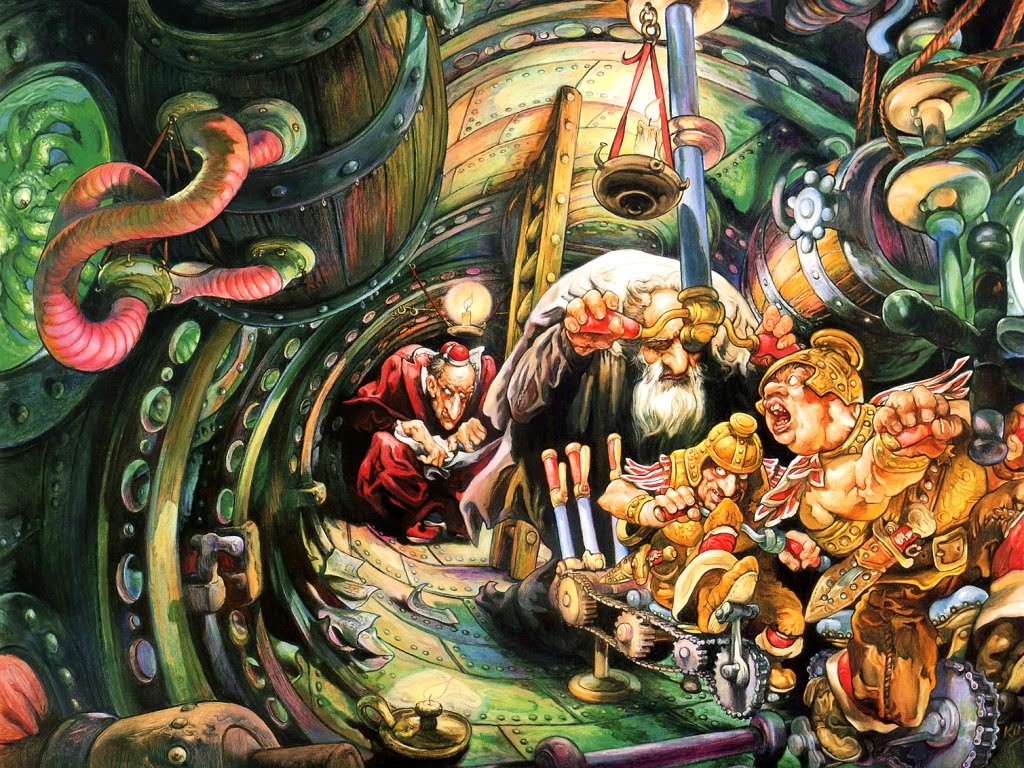
A peculiar tale in what has otherwise been a confined series, now heavily featuring a Leonardo da Vinci lookalike, a submarine, crossdressing, and some other unlikely stuff.

I liked seeing more of Lord Vetinari, perhaps the most cunning and capable ruler in any story I’ve read, and I enjoyed the interactions between characters that otherwise wouldn’t have engaged each other. There’s quite a bit of social commentary on empires that believe themselves high and mighty although they’ve long lost their might, on the position of women in repressive societies, on how humans gravitate towards picking sides and demonizing the opposition, etc. Pratchett also injects that self-defeating Western thing of depicting the westerner proxies as ignorant dullards and the exotic foreigners as sophisticated and clever despite their backward societies, which tasted stale for me.

It took me quite a while to get through this one, because I’ve been in the mood to either read manga or play video games in my spare time, but the fourth entry in this series may be the best overall, even though the Watch were, for the most part, dragged along for the ride.

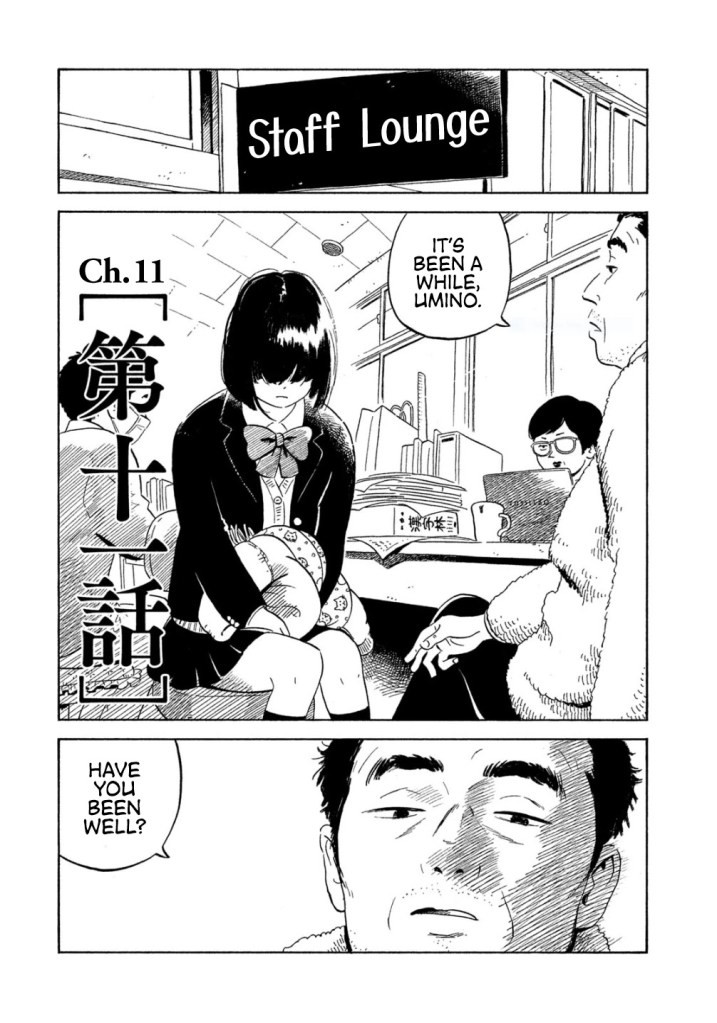
Ongoing manga: Nora to Zassou, by Keigo Shinzo

The title translates to something like Amidst the Weeds, or Lost in the Weeds. It’s been quite a while since I start an ongoing manga series and I feel compelled to write about it before it finishes. But this tale hits some of my personal spots well enough, particularly my savior complex, that I, engrossed, nearly missed my stop on the train.

The story follows a police inspector who sets up sting operations on prostitution rings. He’s a reserved guy whose hair has already gone white at forty, and who seems to be going through the motions. During a sting operation, turns out that some of the prostitutes were underage. Even worse, one of them resembles the inspector’s only child, who drowned some years ago.

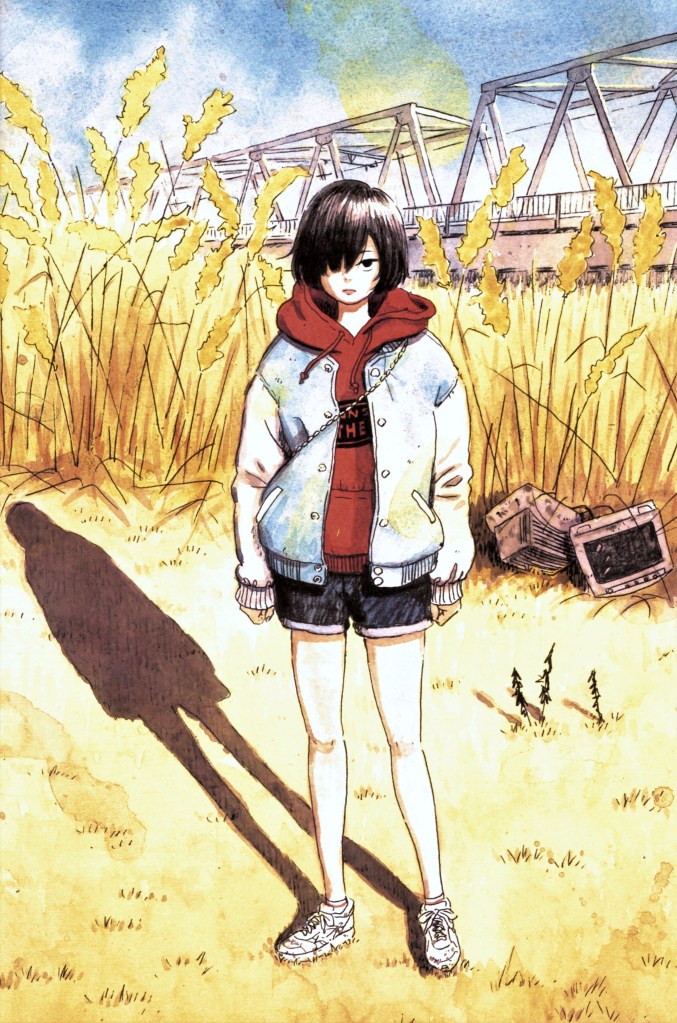
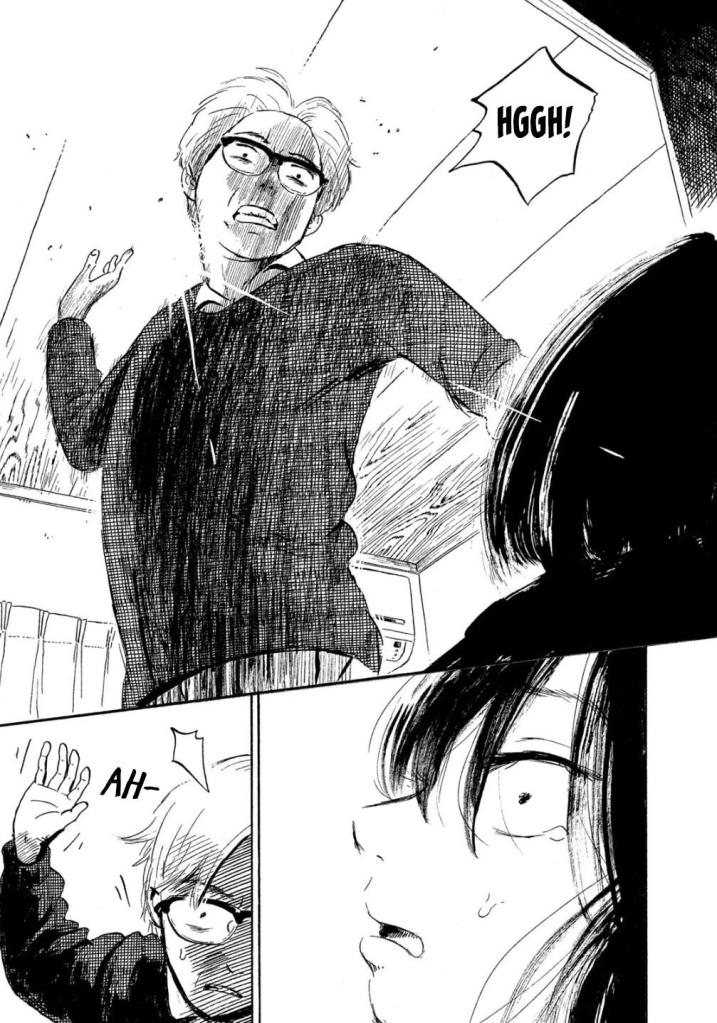
She’s a runaway. The police send her back to her mother, who proceeds to beat up her daughter as a greeting. In turn, she runs away again. When this girl isn’t overtly prostituting herself, she’s pseudo-prostituting herself by announcing on social media that she’s a poor underage runaway; lots of men offer her a spot on their beds out of the kindness of their hearts. By this point, this girl is seriously broken, having lost the ability to feel happiness, and harboring little else than resentment and hate towards humanity.

The inspector realizes that she has run away again, and fears that one of those men she gets involved with will turn out to be a serial killer who stuffs his victims in suitcases, but legally our male main character can’t do much, other than try to convince the girl’s abusive drunkard of a mother to report her as a missing person. Soon enough, our girl and the inspector realize that they have something in common: they both feed the same dirty stray cat who lives among weeds in the bank of the river. Therefore, this man may not be the kind to take advantage of her. At her lowest, he finds her, and offers her to live with him.

This is a tale about two broken people discovering what happiness may look like. Neither are perfect beyond their circumstances: we learn that the inspector was an overworked, neglectful father, and the girl can easily slide into bursts of rage that resemble those of her mother, causing undeserved pain to those around her, perhaps unconsciously to sabotage herself.

The rest of the story so far focuses on trying to return the girl to normalcy, for example going to class. However, most of the school knows that she used to prostitute herself, and some of the adults that stare at her may be wondering if they could get in the action.

The girl inherited from her mother, other than a simmering rage, the talent to preserve the beauty of the world in drawings. Through art, she’s getting a taste of what fulfillment feels like.

This series may not have reached its midpoint yet. In any case, I highly recommend it to fans of good manga in general, but in particular to those who loved Kei Sanbe’s Erased, and even Inio Asano’s Oyasumi Punpun (which remains my favorite manga series). I didn’t know the newish author, who is thirty-six years old, but I’m getting the feeling that I will read plenty of his in the future: he’s great at depicting nuanced emotions both in his script and drawings, and other than a few moments that were a bit on the nose, I wouldn’t change anything from this series.

Review: Feet of Clay, by Terry Pratchett

Words in the heart cannot be taken.

Three and a half stars.

This is the third novel in the City Watch series of books that good old (and dead) Terry wrote, after Guards! Guards! and Men at Arms. What started as a ramshackle watch has become a proper force that features members of most of the fantasy races that live in the city of Ankh-Morpork, in some cases due to the Patrician’s goal of representing all his constituents through affirmative action.

This time the story revolves around golems, anthropomorphic beings made of clay and animated thanks to the written notes someone put inside their heads. The fantasy version of robots. They are enslaved into performing most of the duties that the living creatures don’t want to risk their hides for, or bother with. Some of the most extreme cases involve leaving a golem in a pit to manufacture products twenty-four hours a day. Given this context, plenty of elements of the tale involve freedom: from social norms (a bearded female dwarf wants to look more feminine), from heritage (a character discovers that he belongs to the aristocracy even though he feels at home among the rabble), from their impulses (the resident werewolf), from religion, and such.

Once again, a shady group is trying to turn Ankh-Morpork into a monarchy. Three for three. Although some influential people in the city are aware that Captain Carrot, the six-something-feet-tall dwarf whom everybody loves, is the rightful king, he’s the earnest, just kind that would seriously upset the status quo in a city where thievery and murder are legal. Besides, his relationship with a werewolf could end up in seriously hairy heirs. So they figure that they could install some easily-manipulated dolt as king, which would allow the guilds to rule from the shadows. For that purpose they poison the Patrician, enough to incapacitate him but not kill him; all the guilds suspect that the city would be ungovernable if the cunning Patrician were to die.

In the middle of all this, two old men die: one the owner of a sort of bakery, and the other a priest. These two crimes are somehow tied to golems, who have started leaving their posts for supposed holy days. Meanwhile, a strange, dangerous golem roams the city.

Although one of these constructs became interesting by the end, I didn’t find them very compelling otherwise, which reduced my enjoyment of this story. However, Terry could have told pretty much any tale as long as it allowed me to spend some more time with the lovable cast of characters.

I suspect that Terry saw himself in the anti-authority Commander Vimes, whose ancestor famously killed the last king, and who at times struggles with the notion that plenty of his problems could be solved by shooting the people involved. My favorite character, however, is Angua, the local werewolf. She’s currently dating Captain Carrot somewhat against her will, because she can’t justify why she likes someone so straight-laced. Apart from the generally justified prejudices against werewolves, Angua fears that one day she’ll fail to control her urges and therefore rip the throat of someone she cares about, so she tries to keep people at arm’s length. She’s also planning to pack up and leave once again, because she doesn’t believe that she could ever belong among people. As I fear that one day I’ll turn my intrusive thoughts into reality, I identify quite a bit with her, and it doesn’t hurt that she reminds me of Annie Leonhart from Attack on Titan, one of my favorite characters from Japanese fiction.

Anyway, another entertaining novel in the City Watch series, just not as compelling as the previous two.

Review: Men at Arms, by Terry Pratchett

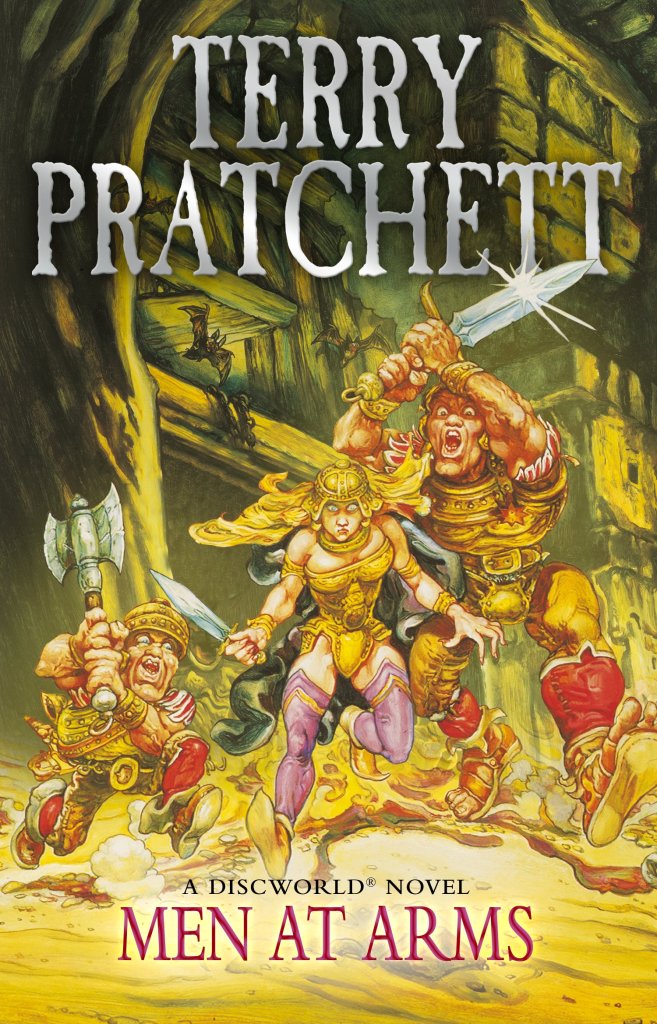
Four stars. This is the second book in Pratchett’s City Watch series of books. The first one was Guards! Guards! (link to my review).

Our team of underdogs barely escaped with their lives from the incident with an interdimensional dragon, but they received little reward from the Patrician of Ankh-Morpork (to be fair, they didn’t ask for much), and in addition he tasked them with modernizing the force by welcoming recruits with minority backgrounds, in this case different species: a dwarf, a troll, and a buxom blonde woman. The woman’s case is peculiar, because she has a secret of the hairy variety (I don’t know if that sounds better or worse than it actually is).

Once again, the plot revolves around someone trying to turn the city of Ankh-Morpork into a monarchy. The last king died a long time ago, but some overeager young noble has realized that our charismatic Carrot, the newest guard in the previous book, who was adopted by dwarves and raised as one even though he ended up taller than most humans, is the rightful king. Attempting to return the city to its supposed former glory, this noble intends to steal a unique weapon from the Assassins’ Guild and sow so much chaos that the citizens will be open to revolution. Unfortunately, the weapon in question is too hardcore for anyone to handle, as well as possibly sentient.

The aforementioned Carrot replaces Captain Vimes as the protagonist of this story. Vimes is leaving the force and getting married, to his dismay. The former second-in-command is happy to hand the force to the tall, hunky recruit that in different times would have led a kingdom. Regarding the minority recruits, we have Cuddy, a one-eyed dwarf who can effortlessly cleave a fly in half with his throwing axes; Detritus, a particularly stupid troll who knocks himself out whenever he salutes; and Angua, a woman who ended up as a guard because she hasn’t lasted long in every other job, who rents a room in a flophouse populated by the undead, and whose intimate relationships end as soon as they discover her secret. I appreciated Angua’s reserved, pragmatic nature, and some of the highlights of the story involved her private investigations, during which she’s followed by a mangy, sentient dog named Gaspode.

Corpses, inter-guild conflicts, ethnic clashes between dwarves and trolls, dog supremacists. A clever sequence involving the identity of a clown’s corpse, as the protagonists dealt with the members of his guild, reminded me of some advice I read on a book on writing: come up with a peculiar concept, then fill your story with plot points that could only happen given the peculiar concept. Pratchett’s Ankh-Morpork is a bizarre yet familiar place in which, for example, an orangutan librarian playing the organ at a wedding, even though half of the keys play animal noises, is a perfectly reasonable thing to happen.

I was going to rate this story a three and a half. The novel is less detailed and carefully written than Guards! Guards!, particularly in the beginning, where the prose came off as lazy. However, I was very fond of the little mystery involving the identity of the killer, I enjoyed hanging out with the guards, Angua looked quite attractive in my head even in her golden form, and some moments achieved poignancy, so I bumped up the rating half a star.

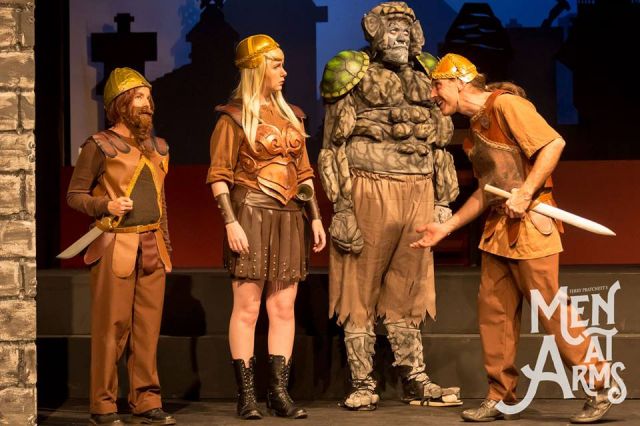
Apparently some theater group put together a play of this story. It looks quite fun. I have no clue how they would have pulled off the supernatural aspects, though.

I look forward to the next entry in the City Watch series, of which we will never again receive new installments, because its author got to meet a skeletal character who only speaks in capital letters.

Look, the first thing I remember in my life, right, the first thing, was being thrown into the river in a sack. With a brick. Me. I mean, I had wobbly legs and a humorously inside-out ear, I mean, I was fluffy. OK, right, so it was the Ankh. OK, so I could walk ashore. But that was the start, and it ain’t never got much better. I mean, I walked ashore inside the sack, dragging the brick. It took me three days to chew my way out. Go on. Threaten me.

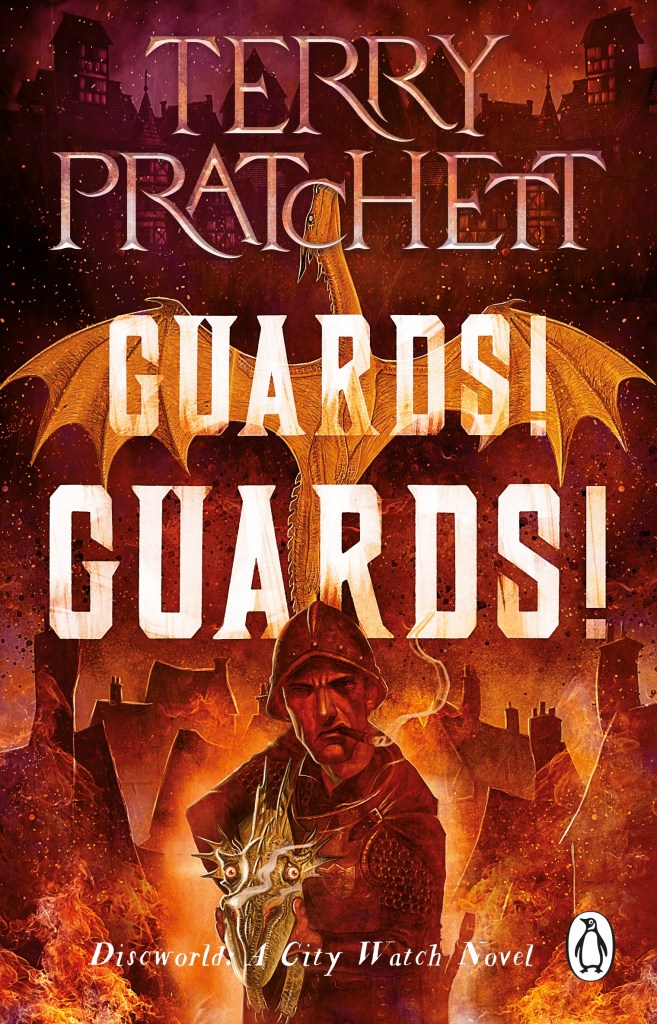
Review: Guards! Guards!, by Terry Pratchett

Four stars.

This is the first book in the City Watch series set in Pratchett’s Discworld universe, a flat Earth carried on top of four elephants who are in turn carried on top of a Giant Star Turtle named Great A’Tuin.

We first meet our memorable protagonist, Sam Vimes, the captain of Ankh-Morpork’s city watch, as he stumbles drunk after he and his colleagues buried a fellow guard and friend. He ends up lying in a gutter, delirious. Our middle-aged man leads the watch in a city where theft and murder have been regulated; the leaders of the thieves’ and assassins’ guilds sit at the Council, and they are to remain unbothered as long as they don’t exceed their allowed amount of thefts and murders per month. The city watch remains as a remnant of the old days, to give the populace the impression that someone’s keeping the peace in a traditional way, but the very few guards that remain are powerless. When there’s some perp to apprehend, the watch are to run in pursuit but not fast enough, lest they end up having to go through the trouble of arresting anybody.

Trouble starts when some cultist breaks into the library at the Unseen University of Magic and steals a book on how to summon dragons, to the dismay of the librarian, who is, for reasons, an orangutan. This cultist has gathered a bunch of disgruntled citizens and wants to use them to steal magical artifacts, which will allow him to summon one of the dragons of old from their plane of existence. As chaos ensues, this group will introduce a supposed heir to the old kingdom of Ankh, a hero capable of defeating the dragon. Once the pantomime plays out and the current leader is deposed, a new king will rule the city of a hundred thousand souls (and about ten times that amount of bodies, as Pratchett put it). However, that king would be a figurehead; the cultist’s leader intends to rule from the shadows.

Meanwhile, the city watch encounters a disturbance of its own: some dwarf from another county has volunteered to join the watch, believing it to be a noble occupation. In reality, this dwarf is a six-foot-something human who was adopted by a dwarven colony and raised as such, until his size as well as his attempts to court an underage, sixty-year-old dwarven girl became too uncomfortable. This honorary dwarf is an earnest, literal-minded fellow who illuminates the miserable state of the current city watch. Apart from Vimes we have Sergeant Colon, a load of pink flesh stuffed into an armor (I picture him as a short, non-horrifying version of Judge Holden from McCarthy’s Blood Meridian), as well as Corporal Nobby, who’s the lowest common denominator of the grimy city he inhabits, a misshapen rat of a man who’s likely to spend his time on the clock looting some passed-out or dead citizen’s valuables.

This group of losers ends up tangled against their will in the cult’s plot; one of the times they summon the dragon, it incinerates a bunch of criminals who were stalking the drunken guardsmen, that had taken a wrong turn into the nastier area of the city. Vimes, who as the author put it was born two drinks short, naturally more sober than anybody else, refuses to allow anybody but himself to burn this hole of a city. In the process they’ll have to deal with the simian librarian, the local nobility, the calculating Patrician, and swamp dragons, apart from an otherworldly, apparently unstoppable dragon who isn’t too happy about having been dragged from its slumber and being controlled by a pitiful human.

What this review doesn’t capture is the author’s humor. As some reviewer put it, he was likely the funniest satirist of the 20th century. He wasn’t just funny, but hugely insightful. His need to create humor seemed to stem from his grim outlook on the world and humanity. Captain Vimes represents the faint drive to do the right thing against a world where evil is organized and has far better plans about how to keep everything running. Neil Gaiman, who dealt with Pratchett during a book or couple of books they wrote together, has mentioned plenty of times that Pratchett had a significant temper. I suppose he was constantly disappointed by a reality that couldn’t match the fantasies he easily pictured in his mind.

Apart from his humor, Pratchett was a master at coming up with unusual metaphors and analogies that somehow captured precisely what needed to be known about the subject, without having to go into particular details.

My only issues with this book, and with Pratchett’s writing in general, is that he uses an expository narrator (I despise exposition on principle), that I would have edited out some paragraphs here and there, and that for my taste he overuses some motifs, like the notion that if there’s a million-to-one chance to achieve something, it has to work, because the gods enjoy playing those kinds of games.

The Discworld books enrich each other; some characters, like the Patrician or the Librarian, not only appear but play major roles in distinct series, so at times you may get the feeling that you would have caught on to significant subtext if only you had read like four or five other books. However, the City Watch series is, as far as I remember, quite self-contained even though recurrent characters from the Discworld universe take part in it. This is also a terrible universe to follow chronologically; Pratchett was very young in all respects when he started writing (got his first story published at thirteen years old). A couple of book sellers pushed to me Pratchett’s The Colour of Magic, the first book chronologically, which, as far as I remember, was mostly an unsophisticated parody, and not representative of the many books to come.

Back when I was a miserable teen, Pratchett’s works were among the few comforts in my nightmarish existence, along with manga, video games, and masturbation. I doubt I caught at the time most of what was going on in the Discworld books; lots of moving parts. Years later, once I was forced to pretend I was an adult, mainly because my body grew old, I gave up on Pratchett’s works along with every other memory of those years, but giving up on the Discworld was a mistake.

I believe you find life such a problem because you think there are the good people and the bad people. You’re wrong, of course. There are, always and only, the bad people, but some of them are on opposite sides. A great rolling sea of evil. Shallower in some places, of course, but deeper, oh, so much deeper in others. But people like you put together little rafts of rules and vaguely good intentions and say, this is the opposite, this will triumph in the end.