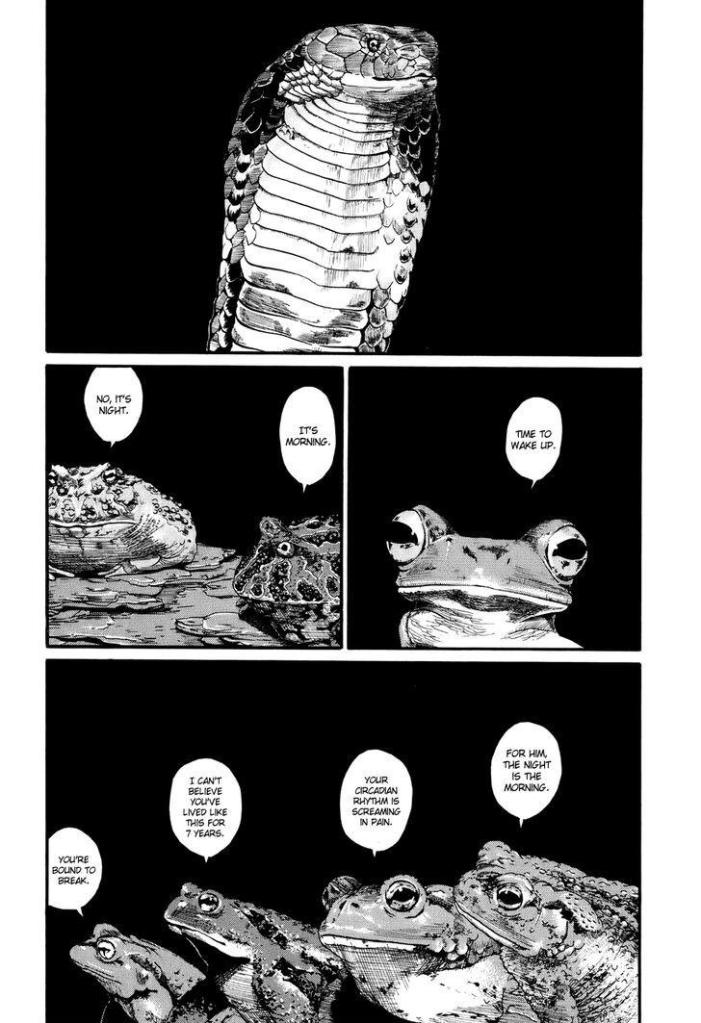
Review: Wanitokagegisu, by Minoru Furuya

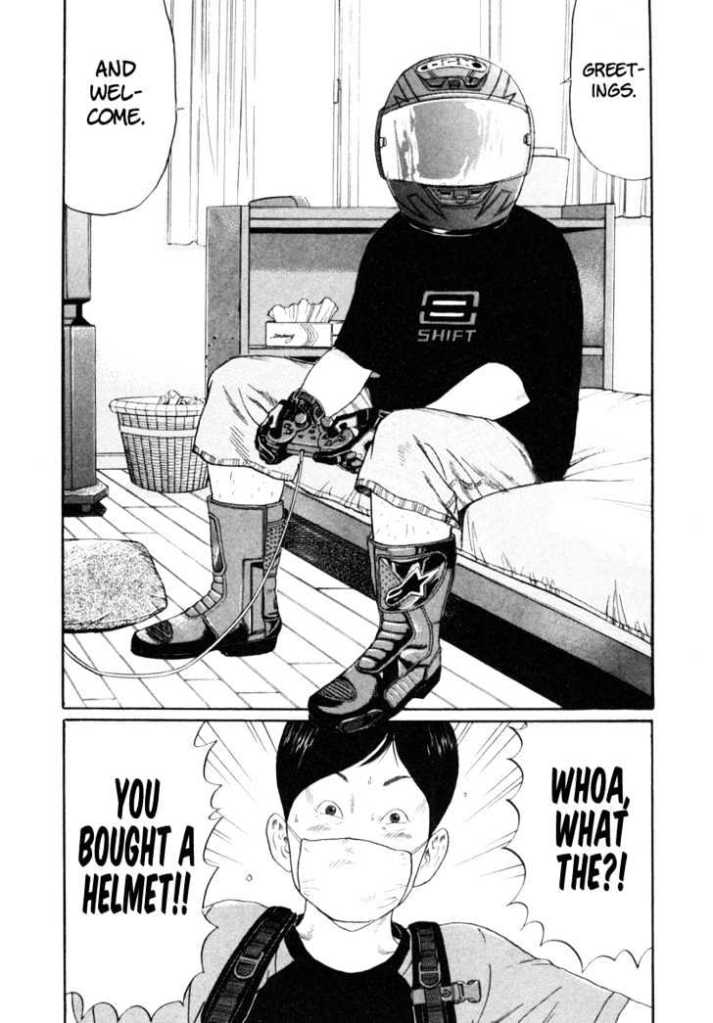
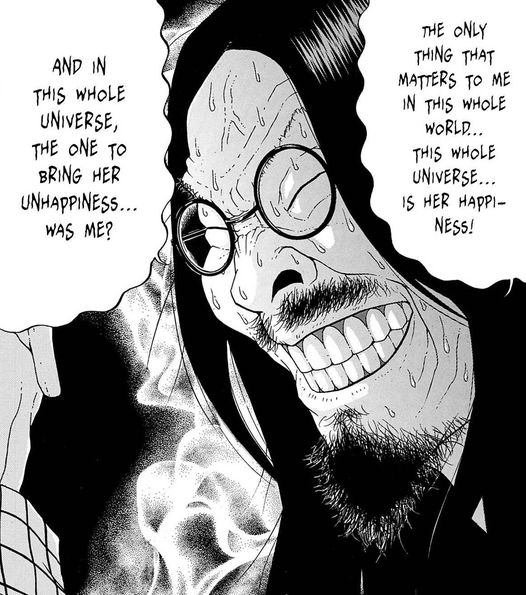
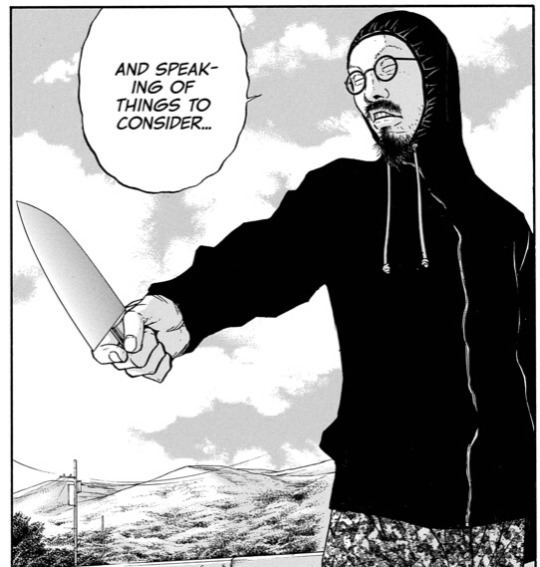
The title apparently translates to “Stomiiformes”, which is, according to Google, “an order of deep-sea ray-finned fishes”. This is the fourth series I’ve read of this author, after “Saltiness”“Ciguatera” and “Himizu”. Furuya has become my third favorite author after Shūzō Oshimi and Inio Asano, and this series is my third most favorite of his.

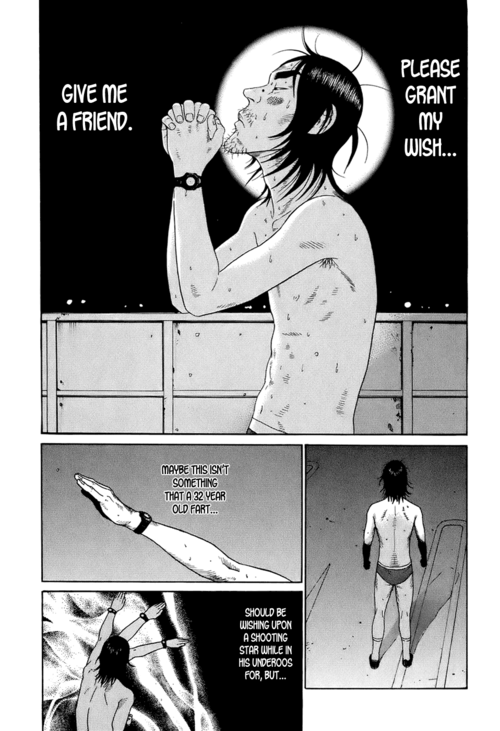
The tale follows a thirty-two-year-old ugly loner who has been working the night shift as a security guard at a supermarket for seven years. A single event defined his youth: during a class in which the students were ordered to hold hands, everybody made a point of avoiding to hold the protagonist’s. Afterward the teacher berated his classmates for being so hurtful, but some girls rebelled and yelled that they didn’t want to hold his hand because he was gross and creepy. As soon as the protagonist became an adult, he went out of his way to avoid people and live as quietly as possible. However, we are introduced to him the moment he fears that he’s missing out, that he’s letting his life pass by. He has made a habit of going to the roof of the building at which he works, getting undressed to his underwear and running laps, but that night, as his anxiety grows, he makes a childish wish to the universe: for someone to become his friend.

Recently he had noticed that someone was spying on him from the shadows of a nearby apartment building as the protagonist ran laps on the roof. On top of that, some sneaky bastard starts leaving notes to him that state that the protagonist is about to go crazy and die before the end of the year. So far the only positive development in his life is that he meets his next door neighbor, who is a beautiful, tall, big-breasted young woman who aspires to become a published writer.

This story contains all the elements of a classic Minoru Furuya tale: an outcast protagonist who has trouble relating to people properly and who experiences intrusive thoughts; some of such thoughts are incarnated into creatures (humans and wild animals in this series, otherworldly “demons” in the other stories); silly humor; unpredictable behaviors; hardcore sequences that should have traumatized the involved characters but that end up having few lasting consequences; secondary characters that impact the protagonist as they play their role, but that then disappear forever; and the sense that by opening yourself up to others or even interacting with them, you are courting disaster.

Through the protagonist we meet a homeless gambler who’s running from the Yakuza; a wired young man who is in love with (and stalks) a dangerous woman; a pea-brained, big-dicked security guard who dreams of becoming rich and popular; a sociopathic hikikomori who murdered his depressive, alcoholic father; a possibly schizoid security guard who has never opened up to others and that if he does he risks finding out the extent of how fucked up he is; a gang of thugs who steal cars; an aging pleasure seeker who’s looking for a way to break up with her murderous Yakuza lover, etc. In the middle of it all, our unfortunate protagonist attempts in his fumbling way to improve other people’s circumstances, even to his detriment.

Most fiction writers, men and women, tend to dump plenty of their own flaws into their protagonists, then they also create romantic interests for those protagonists that in real life wouldn’t even deign to look at them. It rarely bothers me; after all, real life is shit and we ought to escape from it as often as possible. However, I had a especially hard time believing that a beautiful, tall, big-breasted aspiring writer would be interested in this story’s protagonist, who is ugly, unkempt, lacks any interesting hobbies or talents, has few social skills, works a dead-end job, and has never even kissed a girl. I did, however, like the character of that aspiring writer (who does very little actual writing in the story) although I couldn’t believe in most of her motivations. Her relationship with the protagonist becomes the spine of this story right up to the end, so if you can’t buy into it, you may have an issue with this series.

I have come to this story after I finished reading Furuya’s “Himizu”, a mostly serious work in which the author seemed like he was restraining himself from breaking into silliness. I much prefer the demented interactions between his characters that somewhat often end up involving sexual references and/or exhibitionism.

I’ve felt a kinship with this author ever since I started reading “Saltiness”, that remains my favorite series of his. In this story I’m reviewing, the author comments through his protagonist that he feels that his brain lacks something that would allow him to relate to other human beings as it seemingly comes easily to most other people, so naturally I suspect that he may also be autistic and in addition have OCD due to how often he depicts intrusive thoughts in his protagonists, who are often arguing with mental ghosts. So if you want to experience what a nightmare existing in such brains can be, I guess you could do much worse than going through this author’s works.

Review: Himizu, by Minoru Furuya

Minoru Furuya has become my third most favorite manga author after Shūzō Oshimi and Inio Asano, thanks to his series ‘Saltiness’ and ‘Ciguatera’. His stories follow underdogs whose mental peculiarities (OCD and autism are the most likely culprits for me) and shitty luck prevent them from realistically aspiring to anything better than an average life. The author consistently represents, in the three series of his that I’ve read, intrusive thoughts as strange, sometimes demonic entities that stalk the protagonist; I ended up doing the same thing for a novel of mine even before I knew about Furuya’s works, so this must be a result of how certain types of brains operate.

Anyway, the protagonist of this bleak series (by far the most humorless of the three) lives at a shack that also functions as a boat shop. It belongs to his father, but the old man bailed on his family to become a drunkard and a gambler. Now his teenage son has to run the business, because his mother is focused on finding a new husband.

The protagonist is fed up with life from the moment we are introduced to him. As he mentions a few times throughout the story, he knows he came from garbage and that he’s little more than a defective idiot. He tries to regulate his thoughts and actions so he won’t stray from the path that may lead him to live a regular, mediocre life, and he holds a grudge towards anyone who dares to pursue lofty dreams, as he believes that those people are delusional and blind to the fact that they are doomed to fall. He wishes to struggle and perform some grandiose good deed that would justify his existence, but he fears that as a broken person coming from a ruinous family, his destiny has already been decided.

One day his mother elopes with her new lover, never to be seen again. Our protagonist, deprived of parental support, decides to quit going to school and just runs his father’s boat shop. Soon enough, though, he comes to learn through a couple of Yakuza types that visit the boat shop that his father’s debts may become the protagonist’s responsibility as well.

As interesting characters other than the main guy we have the following: the protagonist’s only friend, an ugly, short, nearly toothless kleptomaniac who nevertheless isn’t as cursed as the protagonist because he doesn’t have the same perennially bleak outlook on life; an aspiring manga author who works as a counterbalance to the protagonist with his determined work ethic and confidence in his talent; and a reserved but tough female classmate of the protagonist who is attracted to him for some reason, and who wants to improve his miserable life.

This author’s characters, in the three series I’ve read of his, can often surprise you with their unpredictability. Some writers warn against using “and then” plot points; they suggest that every plot point must be a “but” or “therefore” regarding one or more plot points that came before. However, this author includes some sequences or scenes that in many stories would have long-lasting repercussions or be pivotal to the development of the plot, but in these stories life just goes on, or the important people fail to ever find out that the event happened. To put an extreme example, in one of the three series (won’t say in which), some secondary characters rape one of the main characters, but none of the main characters, including the victim, ever find out about it. On the topic of rape, there’s plenty of strange and/or sudden sexual stuff going on in this author’s works, even as mild as a character suddenly pulling his or her pants down, or fingering someone else. The violence included can often be equally sudden.

They made a live-action version of this story. Here’s the trailer. I haven’t watched the movie yet; apparently the director intended to follow the manga faithfully until the whole tsunami and nuclear disaster of 2011 happened, so they included that in to offer some commentary and a more hopeful message than what this series supports. So far I can tell they made at least one change I consider questionable: in the manga the protagonist’s father was constantly in a drunken daze, but he was never overtly cruel nor dismissive towards his son; the protagonist despised his father because he abandoned his family, and after that point there was nothing the old man could have done to improve their relationship.

It’s a shame that I have already read the three series generally considered this author’s best.

Review: Thermae Romae, by Mari Yamazaki

The postface the author wrote for each volume of this series is titled ‘Rome & baths, the loves of my life,’ and it shows. She clearly had a blast producing this manga, which gave her the opportunity to immerse herself in those two obsessions for years.

It’s an isekai (for the uncultured swine among you, that’s a genre tremendously popular in Japan that usually consists in a Japanese person getting transported somehow, usually by truck-related means, to a fantasy world that more often than not is loosely based on Europe during the Age of Enlightenment but with cute elves and such. There are exceptions, though, as in the case of this story). The protagonist, an architect/engineer from the Roman Empire, gets inexplicably transported via increasingly contrived plot devices to contemporary Japan, from the seventies up to the modern day. He would love nothing more than to serve Rome well and cleanse the worries and pains of the population through the baths he gets hired to build, and when he gets teleported to Japan, he discovers a previously unknown race, to which he constantly refers with an ethnic slur, who appreciate baths even more than Roman citizens do. Most of the story is therefore about this Roman engineer figuring out how to take advantage of Japanese customs and inventions so he can improve his homeland, even though he can’t understand a single word that comes out of their mouths.

We go through the expected hijinks and more, but the story quickly turns serious as powerful people take note of the protagonist’s talents: the emperor Hadrian ends up becoming one of the main characters, and we also follow Marcus Aurelius from time to time, a teen during the events of the story; history ended up remembering Marcus Aurelius as a stoic philosopher due to his ‘Meditations’ and his wise rule.

It’s a shame that this manga isn’t well-known; I had no clue it existed until Netflix of all places released the trailer for its upcoming anime. The only thing that bothered me about this series is that the way the protagonist gets transported to Japan and back kept getting increasingly ridiculous and convenient, as the situation that the protagonist faced was almost always related to some problem he needed to solve at home, but if you accept like he did eventually that some Roman goddess (mainly Diana) wanted to use him for the glory of Rome, you can roll with it. Other than that, the author has a great sense of humor, the attention to detail and the research that went into it are typically Japanese, and I had a blast throughout. If you love both Japan and ancient Rome about as much as I do, you probably owe it to yourself to read this manga.

Review: The Hour of the Star, by Clarice Lispector

From time to time I get reminded of authors that seem cool enough, and I tell myself that I’ll finally go through the effort of reading something of theirs. I hadn’t opened any of Lispector’s books yet, but I had formed an image of her as wild and unfettered. I imagined her bedridden during the last years of her life as she dictated new stories to her secretary, who would then type them carefully on a typewriter. I don’t know if I got that impression from something I read about Lispector or if I made it up in some daydream, but it makes no difference whether it happened or not. Lispector died of cancer in 1977, eight years before I was born; she has become definite enough that whatever delusion I prefer to believe about her won’t diminish who she was.

‘The Hour of the Star’ is the last book that Clarice Lispector published in life, and in it you witness an author trying to conceive a story for a character that she was compelled to bring to life: a poor, ugly, innocent girl from the same impoverished region of Brazil where Lispector lived as a child. She transformed herself into a male narrator with fictional circumstances, to develop the details of the protagonist and the world around her so the entire narrative would finally spring to life.

This girl we are following, named Macabéa, lost her parents, came to a big enough city to live with her repressed aunt, now lives in a hovel with four roommates with whom she doesn’t seem to interact, and works as a typist although she’s terrible at it. Lispector describes her as too innocent, inexperienced and dull-witted to be miserable despite her nasty circumstances. She can only look forward to the joys she can reach: food and songs she likes, and being alone at home for a few hours. She daydreams about finding a man who would love her, but she knows that can’t happen.

The most memorable secondary character was the idiotic thug that ends up dating Macabéa, a young guy who calls himself Olímpico and who came to the city from the same impoverished region as Macabéa. The guy is fascinated by implements of violence, and his main goals are to seem tough and move up in the world. He mistreats Macabéa and attempts to silence her if she shares some thought he considers unladylike. I wished that Macabéa would acquire some self-respect and dump that shithead, but the poor girl was happy enough that someone spent time interacting with her.

We also meet one of Macabéa’s coworkers, who is painted as a poor man’s sophisticated, buxom woman. I recall vaguely that she initially criticized the protagonist for her many faults, but she grew to pity her, which I guess is better. We also meet a doctor who can’t wait to have enough money so he can quit and devote himself to doing nothing, as well as, in the final sequence of the story, a former prostitute turned clairvoyant who offers a compelling monologue.

Because Lispector came up with seemingly every little aspect of this novel in front of our eyes, Macabéa as well as other characters come off as contradictory, but you have to roll with it; Lispector didn’t have enough time left to make it consistent even if she intended to. She also complains about having to invent enough description, and I recall that she suggested that she just intended to write down what was necessary and then go to sleep.

On the surface, the story is about Macabéa figuring out who she is and who she would prefer to become, but the insights that Lispector offers through her chosen narrator suggest that this whole book is about the author coming to terms with her impending death: trying to understand why she would need to write about this Macabéa, or write at all, so close to her own demise; what does it mean for a writer to live through these characters that inhabit our minds; and what kind of hope the author can offer to this wrecked fictional child of hers (I know well how traumatizing it can be to ruin the life of one of your characters; I haven’t gotten over at least one of them).

Lispector writes from the gut; pure subconscious stuff that half of the time she herself can’t understand. That’s the kind of material I want both in the books I read and in the stories I create. I can’t stand authors that intellectualize everything, who often oppose their own tastes and impulses out of some weird ideological dislike for such. Their texts most of the time annoy the hell out of me. I also vibed with Lispector’s silly humor, and in general felt a kinship with her. Hers is the first novel that I’ve finished in a long while; these days I have little time and energy left to read, and when I do I end up DNF-ing most of the books I start, often because they test my patience.

Lispector was a unique writer (or at least she seemed like that to me; I haven’t read any other Brazilian writers, so maybe they all write like her) who wrote in search of her own personal truths, in contrast with your average bastardly author out there that seeks to deceive you as they deceive themselves.

Anyway, I got plenty of quotes out of this book:

Who has not asked himself at some time or other: am I a monster or is this what it means to be a person?

I only achieve simplicity with enormous effort.

I write because I have nothing better to do in this world: I am superfluous and last in the world of men. I write because I am desperate and weary. I can no longer bear the routine of my existence and, were it not for the constant novelty of writing, I should die symbolically each day.

In no sense an intellectual, I write with my body. And what I write is like a dank haze. The words are sounds transfused with shadows that intersect unevenly, stalactites, woven lace, transposed organ music. I can scarcely invoke the words to describe this pattern, vibrant and rich, morbid and obscure, its counterpoint the deep bass of sorrow.

I feel happier with animals than with people. When I watch my horse cantering freely across the fields— I am tempted to put my head against his soft, vigorous neck and narrate the story of my life. When I stroke my dog on the head — I know that he doesn’t expect me to make sense or explain myself.

Speaking for myself, I am only true when I’m alone. As a child, I always feared that I was about to fall off the face of the earth at any minute. Why do the clouds keep afloat when everything else drops to the ground? The explanation is simple: the gravity is less than the force of air that sustains the clouds. Clever, don’t you think? Yes, but sooner or later they fall in the form of rain. That is my revenge.

She had what’s known as inner life and didn’t know it. She lived off herself as if eating her own entrails. When she went to work she looked like a gentle lunatic because as the bus went along she daydreamed in loud and dazzling dreams.

She herself asked for nothing, but her sex made its demands like a sunflower germinating in a tomb.

I shall do everything possible to see that she doesn’t die. But I feel such an urge to put her to sleep then go off to sleep myself.

I must ask, without knowing whom I should ask, if it is really necessary to love the man who slays me; to ask who among you is slaying me. My life, stronger than myself, replies that it wants revenge at all costs. It warns me that I must struggle like someone drowning, even if I should perish in the end. If it be so, so be it.

I use myself as a form of knowledge. I know you through and through, by means of an incantation that comes from me to you. To stretch out savagely while an inflexible geometry vibrates behind everything.

That not-knowing might seem awful but it’s not that bad because she knew lots of things in the way nobody teaches a dog to wag his tail or a person to feel hungry; you’re born and you just know. Just as nobody one day would teach her how to die: yet she’d surely die one day as if she’d learned the starring role by heart. For at the hour of death a person becomes a shining movie star, it’s everyone’s moment of glory and it’s when as in choral chanting you hear the whooshing shrieks.

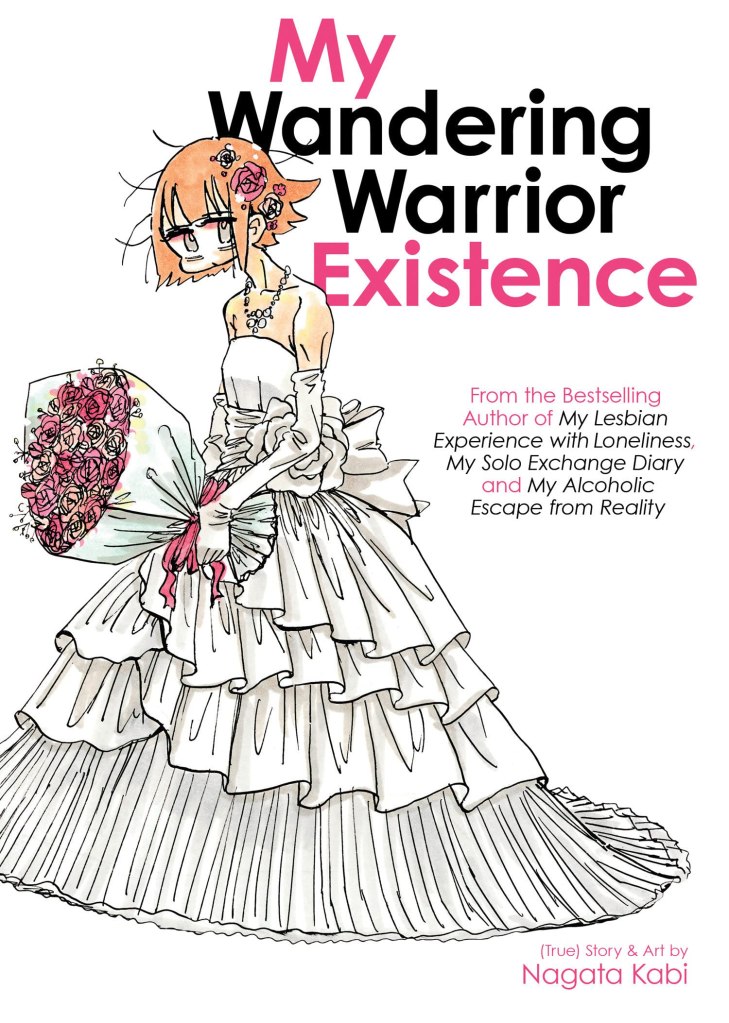
Review: My Wandering Warrior Existence, by Kabi Nagata

This is the newest entry in the series of autobiographical mangas that started with the cult hit ‘My Lesbian Experience with Loneliness’ and that followed with ‘My Solo Exchange Diary Vol. 1’‘My Solo Exchange Diary Vol. 2’ and ‘My Alcoholic Escape from Reality’ (the links go to my reviews of those titles).

I’ve been fond of the author ever since I read her first autobiographical manga, and not only because her stuff is like witnessing a colossal train wreck; she’s fearlessly honest about her brokenness to an extent that you don’t see in virtually anyone else.

In the previous entry, Kabi Nagata opened up about having caused herself acute pancreatitis due to imbibing in three years the amount of alcohol that seasoned boozers rarely achieve in twenty. She almost died, and she’ll be forced to take medication for the rest of her life. I was eager to figure out how she recovered mentally from that self-inflicted ordeal, but in this newest entry she speaks casually about her liberal alcoholic intake and mentions that she moved out to her own apartment. I realized, to my disappointment slash dismay, that the events depicted on this entry are precursory to her alcoholic debacle. She was likely working on this manga when she was forced to sidetrack it to suffer through that personal catastrophe. That’s fucking sad; the previous entry ended with her waking up from a prolonged nightmare to find herself as a mentally and physically broken woman in her mid-to-late thirties that nobody wants to or can love.

Anyway, this newest manga starts with Kabi wanting to do a photoshoot of herself wearing a wedding dress; she’s aware that she’ll likely never marry, and her mother had expressed a desire to see her in a wedding dress, so that’s what she does. During the shoot, though, Kabi grows increasingly depressed as she realizes how sad the whole thing (and her life) has become, although her mother is loving it; she’s taking photos of her own with her personal camera.

Afterwards, Kabi decides to embark on a personal quest to find someone who might love her. We realize (or remember; she probably exhibited this in previous entries), through her fumbling attempts at using a dating website, how terribly inept she’s at dealing with technology, which has furthered her isolation. She speaks at length about her confusion regarding love, even understanding what it’s supposed to be; her parents are together because of an arranged marriage that involved no love at all, and they behaved, for the most part, just dutifully towards their only daughter. Kabi was a withdrawn, fearful, friendless child. I think that she was in her late twenties when she finally decided to experience some close contact with another human being by hiring the services of a prostitute. In fact, she has only been intimate with prostitutes (maybe only that first one, I don’t remember) to this day.

Kabi goes at length about her fears and confusion regarding the process of finding a date, but never ventures beyond creating a profile on a dating website. In the most memorable chapter of this manga, she writes a self-deprecating bio, opening up about her mental issues and her inability to live by herself, because “that way whoever tries to date me won’t be disappointed once they get to know me.” When she receives some likes and personal messages, Kabi is appalled. Who could be so crazy as to want to engage with her despite how much of a broken mess her bio reveals her to be? She considers that maybe she should improve the honesty of her presentation. She turns her bio into a parade of self-disdain, painting herself as the most horrid, incompetent human to ever exist (which she pretty much believes herself to be). She says that she’s distrustful of anyone who seems to like her, because she doesn’t believe such a thing could be possible, so those people must be trying to take advantage of her. She still gets likes and personal messages that she never dares to check out. Eventually she removes her profile and drops her quest. Later on she figures out that those that contacted her were the types that thought, “she’s so horrible that I may have a chance!” so she was better off avoiding them anyway.

She spends the rest of this manga wondering how come she’s so broken, why she fears human beings to such an extent, even those she’s come to know reasonably well, and why she’s unable to understand other people’s motives. She opens up about her issues regarding gender identity: she doesn’t like being a woman (“I don’t like breasts, bras or periods, and I wear men’s underwear”), but she doesn’t want to be a man. She admits that she isn’t even sure if she’s a lesbian (to be fair, despite the title of her first autobiographical manga, ‘My Lesbian Experience with Loneliness’, her being a lesbian was incidental there); she considers that maybe she chose to visit lesbian prostitutes because she’s more comfortable among women, but that it may not speak much about her sexual preferences.

She opens up about a sexual assault back when she was a child; the first time she mentions it. A guy in his twenties approached her kid self, led her to a deserted hallway and fondled her genitals. It traumatized her, and she became more fearful of human beings (but she mentions that she also came to consider herself an idiot for following this stranger). However, she seemed even more distraught at the consequences: when she opened up to her mother about the assault, she contacted the school, which made a point of informing pretty much everybody. A teacher chastised Kabi for following a stranger. Other children whispered about Kabi as “the girl who was assaulted by a pervert.” Kabi wishes she had kept it to herself.

She quickly dismisses that sexual assault, though, as the source of her issues; she has known other women who were sexually assaulted, even much worse, but they grew up into happy adults who got married and had children. So how come she’s so fucked up?

An inability to understand herself and others properly, gender issues, sexual issues, fear of humans, only comfortable in solitude, sensory issues (she mentions how one of the main reasons to leave her parents’ apartment, apart from the depressive, loveless atmosphere, was that their voices sounded shrill), plenty of executive dysfunction (she can’t organize her own life for shit). Bitch, you are clearly autistic. Or maybe I’m delusional.

She renders the letter that some nice stranger wrote to her regarding love, and she comes to understand that years ago, when a fan who had realized she herself was a lesbian approached Kabi wishing to date her (Kabi found her nice, but didn’t feel a spark), the author may have fucked up turning her away, because if they had come to spend more time together, it may have turned into a proper, loving relationship. But by the end of the manga, Kabi admits that she’s quite comfortable alone, so maybe she’s just envious of loving couples, and sad that she may never know the love that most other human beings seem entitled to experience.

I enjoyed this newest entry of Kabi’s descent into madness, that unfortunately will likely end in her death through self-neglect or suicide, but it left a worse taste in my mouth than usual; I know that not only Kabi gave up on her quest to find love, but she fell deeper and deeper into alcoholism to the extent that she nearly died, and the last we know of her is that she wishes she would disappear, because she’s sick of being a mentally and now physically broken creature who feels like she has no place in this world.

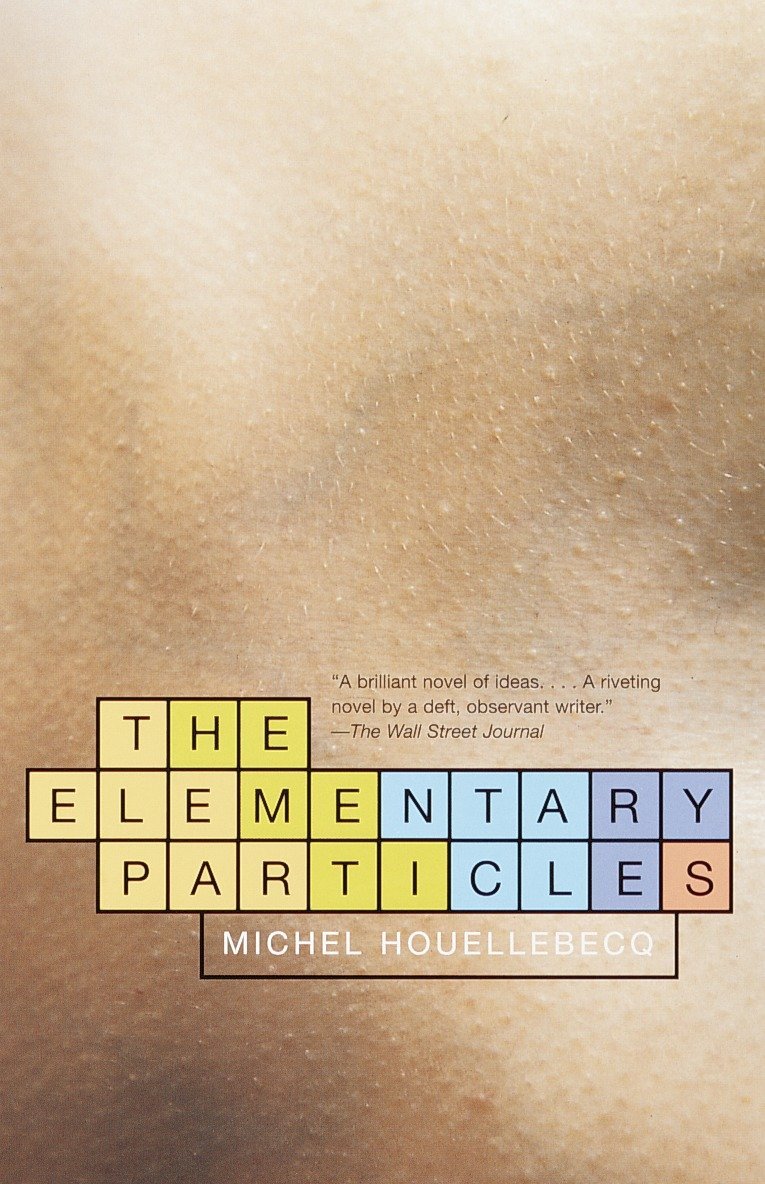
Review: Atomised, by Michel Houellebecq

When I started reading the book, I thought I was delving into a lesser work of this author, but turns out that this is an alternative title for Houellebecq’s possibly most famous novel, ‘The Elementary Particles’.

An uneven novel. I’d rate the first four-fifths of it three and a half stars, and the remainder four and a half stars except for the epilogue, which I found completely unnecessary. There are flashes of brilliance throughout.

I hadn’t read anything of Houellebecq’s, although I harbored the uncomfortable suspicion that I would identify with plenty of his stuff, mainly because my own works involve sexual matters. And for the most part, it has been the case. This was one of the bleakest, most horrifyingly truthful novels that I’ve ever read.

The narrative follows two half-brothers. Michel is asexual, anhedonic, incapable of connecting with human beings, and eager to lose himself in scientific research, which he does in a dispassionate way. Bruno is controlled by his need to fuck as many 14-to-25-year-old girls/women as possible, which he mostly fails to do because he’s plain-looking, generally powerless, and has a small dick. The author suggests at some points that Bruno is something of a symbol for modern European men.

We’ve barely understood anything about the protagonists’ current life in their forties when we are provided with the history of their whole lives up to that point. Such info dump of backstory annoyed me, and I nearly ditched the novel; I have very little patience left these days. Their parents were dissolute morons wholly incapable of raising children, and who later on fell into the whole New Age nonsense, lived in communes, etc. At least their mother did; I don’t recall much about their fathers except that they frequented whorehouses. Bruno himself was sent to a boarding school, where he was not only bullied but also raped regularly.

We meet Michel’s childhood sweetheart, Annabelle, a gorgeous blonde girl who loved Michel in an innocent way, but unfortunately the guy’s brain was incapable of forming proper connections with human beings. In their teen years, she eventually gave in to the attentions of older guys who only wanted to fuck her. For many years, she continued on the common doomed course of seeking wholesome love from men who intended to pump and dump her.

Bruno failed to fuck the teens he lusted after at the same age, and in general was ignored by everyone. He studied to become a teacher, possibly because he still lusted after teenage girls, but he didn’t last long at the job. The author goes in depth about how Bruno jerked off under his desk while ogling his female students, and almost came to blows with a black student because he was dating the white, blonde girl he lusted after the most. Witnessing that relationship also convinced Bruno to write a few pamphlets that went on about how black people are inferior, which he failed to publish, but in truth he just resented that the girls he liked went for stronger guys with likely bigger dicks. In his last day as a teacher, he tried to get an arab student to jerk him off, but she just laughed and left the classroom. He checked himself into a mental institution. Once he walked out of it willingly, he spent most of his free time trying to figure out what kind of groups that he could snake his way into would allow him to fuck as many holes as possible.

We follow one of those outings in depth. Somewhere in the backwoods of France, a group of aged New Agey types spend their days gathering for spiritual workshops and shit like that, which Bruno spends his time mocking internally as he attempts to figure out who would open her legs for him. There we meet Christiane, who ends up becoming his romantic interest. In contrast with Annabelle, the only parts of Christiane I believed were the beginning and the last we know of her. Bruno meets her in a swimming pool, where she’s fucking some other guy. When the other guy leaves, Christiane swims over to Bruno and gives him a blowjob. Although Bruno would prefer a teen, he’s happy to start an extended sexual relationship with this forty-something-year-old who wants to have sex with him and is inordinately understanding and accommodating. That’s for me what I couldn’t buy about her character: Bruno opens up about his crusade to fuck as many underage girls as possible, as well as his antics as a teacher, but Christiane just rolls with it. This reeked of wish fulfillment on the part of the author.

For the first four-fifths of the tale, we barely follow Michel, the other protagonist; most of the times that the narrative focuses on him, we get into abstract digressions that attempt to connect the narrative to the zeitgeist at the time. My brain has a hard time handling abstractions; unless a text produces sensorial impressions, it mostly goes over my head. In any case, Michel lamented that at this point of scientific progress huge breakthroughs seemed almost impossible, and most of his research, related to improving the genetics of cows, involved routine computer work.

What this review doesn’t represent very well is the atmosphere of the novel, which is permeated with the lack of hope and meaning very familiar to many citizens of Coudenhove-Kalergi’s empire (the so-called European Union), a despair that has been steadily growing for as long as I can remember. Christiane, Bruno’s sexual partner, resents that her small town somewhat close to Paris has become a dangerous place due to mass immigration from Africa and the Middle East; she can’t take leisure walks around town, and she mostly hurries home because she presumes she’ll be safe there. As many have attested, including myself in my city, that’s one of the first stages; later on come the rapes at the entrance of the apartment buildings, and the break-ins. This novel was published at the tail end of the 20th century; living in this continent has only gotten worse since.

Europeans have been systematically humiliated, forced into a submissive mindset, by obscure authorities that have decided to replace us and that bankroll our extinction with the money they steal from our paychecks; just a few days ago the local newspaper in my province published that the welfare checks of those “in risk of poverty” have been raised. They earn almost the same as I do by working my ass off. Not only you can enter Europe illegally and have access to that paycheck, but those people are prioritized, and the more children they have, the more money they receive. All of that fosters the sense in many Europeans that there’s little point in doing anything, because we won’t have a future. The media is generally publicly funded, so they support this situation; even in private newspapers or stations, it’s well-known that you almost need to be a card-carrying supporter of certain political parties to be able to be employed there. The citizens that complain are routinely censored if they speak publically. Elon Musk got in some trouble with European authorities recently because he supports free speech for his Twitter (that’s his image anyway), and European politicians said the equivalent of, “We don’t do that stuff here.”

The author comments through Bruno that Western men feel the need to buy into the whole “liberal humanism” stuff merely so women will fuck them, therefore failing a civilization-wide shit-test, because those same women more often than not consider such men weak. I’ve never pretended so, even when some groups I found myself in cheerfully demanded to buy into their ideology just to be there. The media dictates what constitutes a “good person” and most human beings want to align with that, because they are terrified of social suicide. In general, human beings make my skin crawl, so I’ll happily remain alone.

All the parents in this novel are unable to connect with their kids; as the children grow up, they fall prey to the political influences hammered into them in the schools and the media, and some of them also hang out with shady groups, so they quickly turn into strangers. The parents are acutely aware that they’ve forced their kids to exist in a world that is progressively worsening. The kids were also produced out of a biological urge; one of the sentences in the book, that for me summarizes not only this story but modernity in general, says, “It’s a curious idea to reproduce when you don’t even like life.”

The author also goes on about the current role of religion in Europe. Most are unable to believe in any of it (in fact, growing up I knew a single christian in school; she was epileptic and believed she saw God during her seizures. These days, however, I know that my former philosophy teacher had to change his curriculum due to the influx of muslim students), and there’s the sense that the religion we’ve been left with is unsuitable in general. In the novel, when one of the protagonists, I can’t recall which, goes to a catholic wedding, the preacher goes on about how the couple will serve the god of Israel. The protagonist does a double take and says something to the effect of, “the god of Israel? Are they jews?” The author doesn’t follow that thought for long, but yes; thanks to Constantine of the Roman Empire we abandoned our own stories (and lost many of them; the christian mobs destroyed most libraries and even burned private collections. This is a good book on the subject), and for the last 1,700 years or so we’ve been dedicated to perpetuating the heritage and in-group priorities of a whole different set of people. Of course many are still brought into it from birth, so they never escape that cage.

The last one-fifth of the story gets brutally real, and I don’t want to spoil it too much. Annabelle is a salient point; Michel’s former childhood sweetheart meets him again after decades. She’s now in her forties and utterly miserable. The poor girl had only wished to love, but found out the hard way that no matter how intimate you get with someone, that doesn’t mean that they love you or ever will. For some time she had refused to get into personal relationships, afraid that her fragile heart would get hurt to the point that she wouldn’t want to continue living. Now that she has met the anhedonic, asexual Michel again, she considers that maybe she’ll have her last shot at a real, long-lasting relationship, and possibly even start a family.

As an overarching theme there’s the sense that aging is possibly the worst curse of mankind as sentient creatures, that in a blink you’ll find yourself too old to love, too old to even reproduce, that beyond the distractions you’ll find as you fumble in search of meaning, you’ll have little else to do but wait until your body inevitably betrays you sooner or later. You fear that death won’t come quick, but instead will present itself as some lingering illness that will torture you with constant pain until you cease to exist. One of the dialogues near the end of the book says it well:

“Humor won’t save you; it doesn’t really do anything at all. You can look at life ironically for years, maybe decades; there are people who seem to go through most of their lives seeing the funny side, but in the end, life always breaks your heart. Doesn’t matter how brave you are, how reserved, or how much you’ve developed a sense of humor, you still end up with your heart broken. That’s when you stop laughing. In the end there’s just the cold, the silence and the loneliness.”

I like this novel, but I suggest that you shouldn’t read it if you are very sensitive and already depressed, because you’ll find yourself feeling much worse.

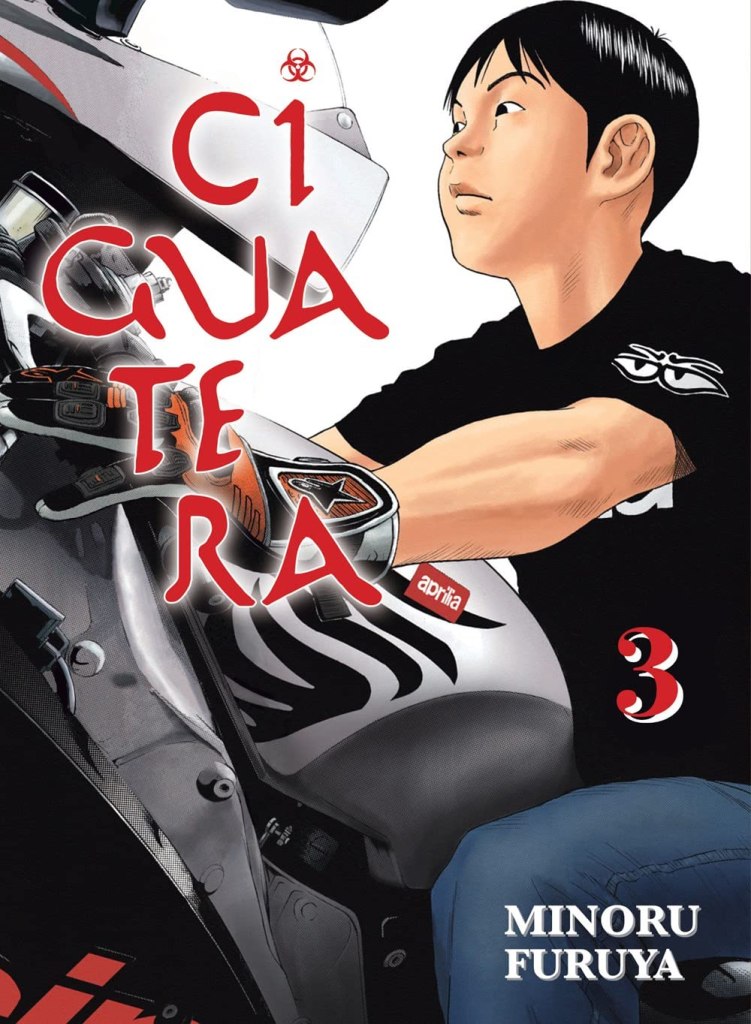
Review: Ciguatera, by Minoru Furuya

Four and a half stars, rounded up.

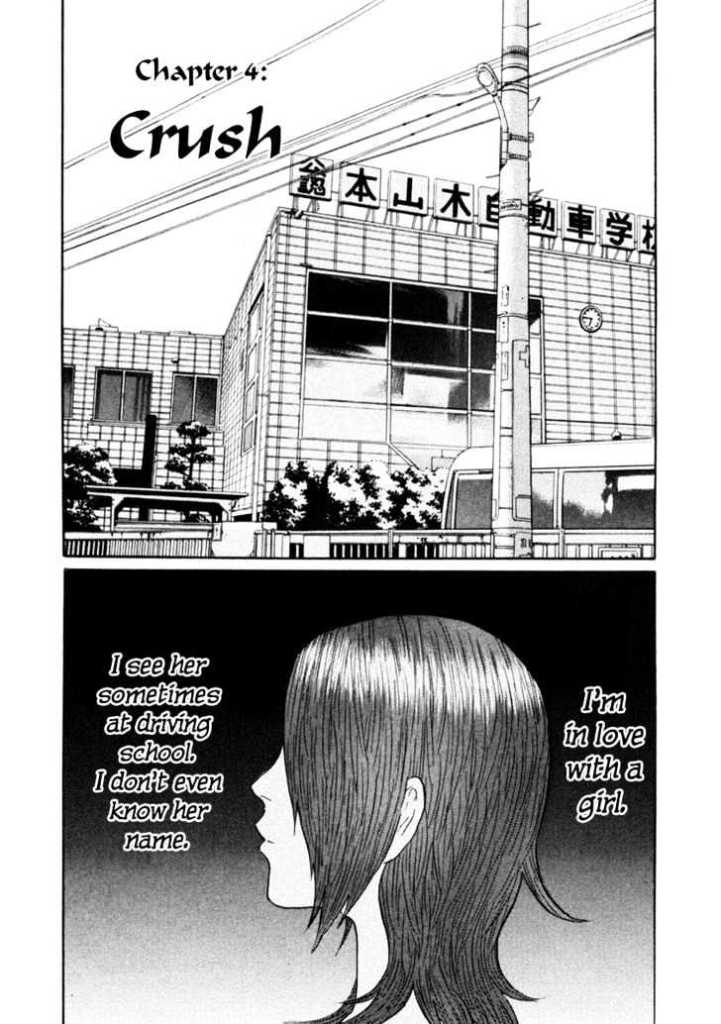
I first came across this author when I read his Saltiness, that became my surprise hit of the season. Then I realized that one of the series I had passed up on often was also his; many had mentioned his Ciguatera on those long lists of “best manga ever”. However, I had ignored it because all the mentions emphasized how much the protagonist cared about motorcycles, and I don’t give a shit about motorcycles. However, the subject of motorcycles could have been substituted here for any other passion that would align with someone’s instincts to the extent that indulging in it would help the person escape from the nonsense that life hurls around.

This story is a slice-of-life / Bildungsroman that follows an unpopular, somewhat unhinged high school kid who isn’t intelligent enough nor talented enough at anything to stand out. He also seems to be as tall as the average girl. As if that life set up for mediocrity wasn’t bad enough, both the protagonist and his best friend are regularly tortured by a local psychopath that some in general terms would call a bully. That guy is the run-of-the-mill psychopathic type that only finds pleasure in abusing others, and it comes naturally and cheerfully to him. The protagonist and his pal understand that they have no choice but endure being the target of that bastard’s whims, and they figure that once they graduate they won’t have to deal with him anymore. The two friends bond over their mutual love of motorcycles, as it allows them to imagine themselves riding into the sunset away from their miserable lives.

A minor spoiler is inevitable: the entire story ends up revolving around the relationship between the protagonist and the girl he starts dating maybe in the first volume. In contrast with many other fictional relationships, particularly at that age, the protagonist is constantly worrying about the future: he has realized that he loves this girl to death, that if she ends up getting sick of his sorry ass and moves on, he’ll eagerly welcome his own demise. He wants to become a dependable man, a well-adjusted member of society, even if he has to work hard to change himself in the process. I thought it was a realistic depiction of what someone with low self-esteem goes through when having to measure up to the person he loves, with all the anxiety and sleepless nights that involves.

I really liked the girlfriend character, but my main complaint throughout this story was that she simply was too good for him. She’s beautiful; has lovely tits; is kind, accommodating and understanding; and it doesn’t bother her that she has more resources than him. As a girlfriend, she’s ideal, so this reeked to me of wish fulfillment. Often I would be on board with that, but not in a story that revolves around how complicated it can get to sustain a normal relationship when life keeps throwing so much shit at you; most other girls would have broken up quite early. The ending, that I’ve read a couple of hours ago, changed my impression of her character, but it’s too soon for me to articulate my feelings on the subject beyond mentioning that it made an impact on me.

Plenty of weird, often episodic stuff happens in this series. Four distinct sequences end in very disturbing developments that would have potentially scarred the people involved for years to come, but one of the mirrored points of this story is the sense that no matter how terrifying or disturbing the nonsense that life forces you to endure, and that you believe you won’t get over, somehow you adapt and keep shuffling forward.

This series left me cold and unsettled because it illustrated how that lesson also applies to your personal passions or the most important people in your life: even if you can’t imagine yourself existing without them, you wake up some other day and discover that you can keep putting one foot in front of the other, for good or ill.

I vibe with this author’s sense of humor, the odd stuff he comes up with, and how he makes you feel as if you are right there along with the characters as they experience their little lives. I hope to read everything else this guy has made.

Review: Saltiness, by Minoru Furuya

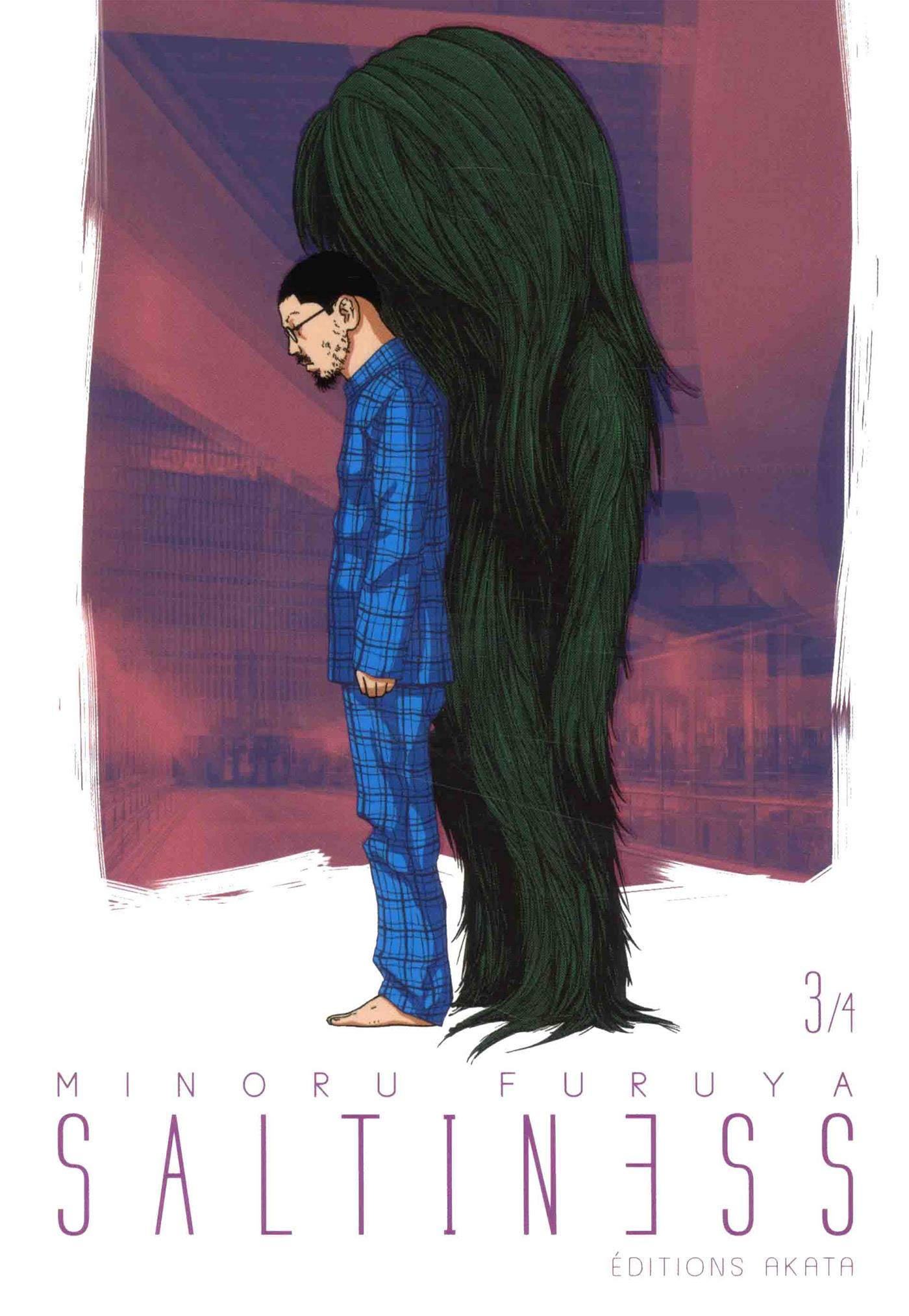
Behind this unassuming title, I ended up finding the closest thing to a manga masterpiece in a good while.

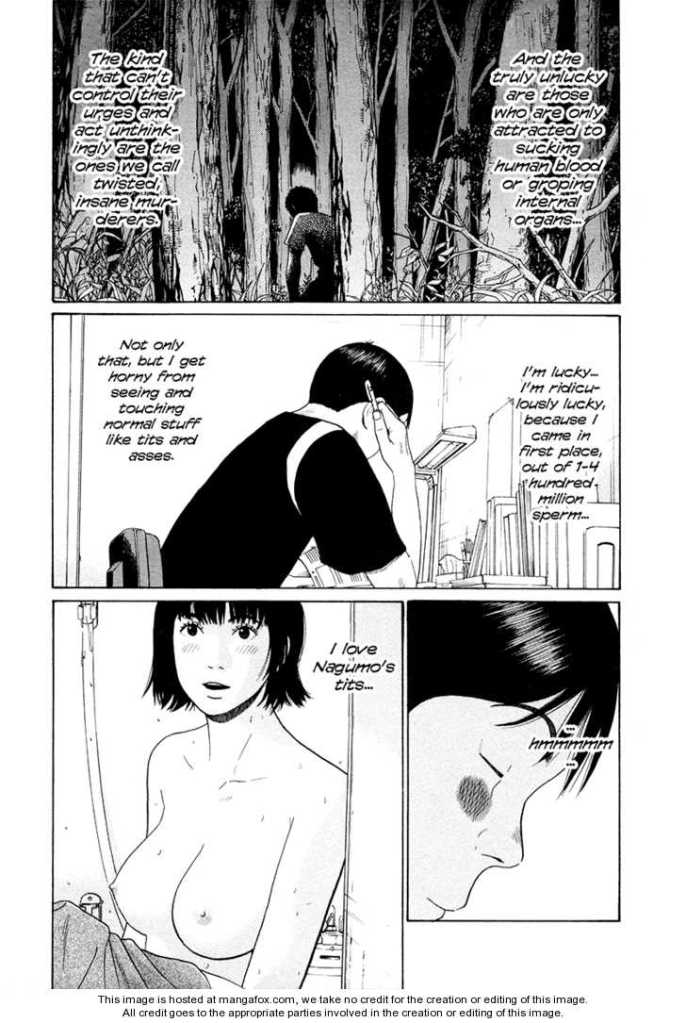
Our protagonist is deranged a guy in his thirties who lives with his younger sister and their grandfather. They are stuck in the boonies. This is another one of those Japanese stories in which people either live in an isolated town or in Tokyo. Anyway, we quickly realize that our guy isn’t quite right in the head, but it’s never clear if his strange hallucinations are due to intrusive daydreaming or schizophrenic hallucinations. I’d say he’s closer to autistic.

He lives a carefree life of contemplation as the town loon, until his grandfather approaches him to open up about his worries: the protagonist’s sister is an attractive, well-liked local teacher, but she’s quickly approaching thirty and she hasn’t bothered to date anyone. Although our guy has a hard time grasping mundane facts, he can’t deny that he’s at fault. His sister’s kind nature prevents her from focusing on herself instead of making sure that her brother returns home after another afternoon skinny-dipping in the woods. The protagonist’s love for his little sister has been his main drive ever since they were both children (and once we learn later on about their ruinous childhood and what this guy struggled through to keep his sister going, it’s no wonder they became so close).

He realizes that he’ll cause his sister to feel lonely for the rest of her life because she needs to take care of his deranged ass, so he leaves for Tokyo at once. He suddenly finds himself homeless and hungry. Armed with the social abilities of a particularly screwed child, he goes door to door asking to be fed out of the kindness of their hearts.

What follows is a bizarre, unpredictable tale that features a cast of mostly broken outcasts, held together by the protagonist’s boundless willingless to understand people and life itself. Far from a zen-like master, this guy kept surprising me not only with his unpredictability (the shit that came out of his mouth, his casual threats, turning into a sobbing mess because he hurt someone’s feelings), but with how human and vulnerable he remained throughout.

For someone who dislikes humanity as much as I do, it’s rare to finish a manga and feel glad to have met the people within it. A shame that I can barely find anything about this series online, and its abysmal rating on Goodreads is another proof of how stupid everyone has become.

For whatever reason, the following sentences uttered tenderly by the protagonist (to a mentalist who wanted to build a cheese empire) ended up synthesizing this story to me:

“According to the standards of society, [my sister] is a beautiful woman. Not long ago, she still believed in Santa Claus. But now she’s able to impress me with words such as monotheism and polytheism.”

Review: Himegoto – Juukyuusai no Seifuku, Vol. 1, by Ryou Minenami

Three and a half stars.

Only when I searched this series on Goodreads I realized that it’s an earlier effort by the author of the story that has impressed me the most recently: Boy’s Abyss. Someone also recommended ‘Himegoto’ because it reminded them of Shūzō Oshimi’s stuff, so I guess Ryou Minenami is on the fast track to becoming one of my favorite authors.

However, this series I’m reviewing is much sloppier and less impressive than ‘Boy’s Abyss’. We follow mostly four college students, all of whom have issues with what they were either born as or were pushed into being.

The main protagonist is a pretty tomboy who has been locked into acting like one of the guys by her shitty childhood friend (an infuriating idiot that I didn’t find interesting enough as a character despite his personal issues), and now is having trouble accepting herself as a woman and dealing with not only her need to dress more girly, but also with her growing urges to be dominated sexually by men. We get a few scenes of her alone in her bedroom feeling bad because she can’t reconcile her masturbatory fantasies with her inability to accept her female nature.

The second most important main character is a pretty guy who’s popular for that reason, but who in reality wishes he had been born a woman. In his spare time he dresses with women clothes as often as he can (usually imitating a gorgeous classmate of theirs, whom he admits he’d rather be). However, he’s attracted to women, and gets particularly turned on by handling girly women aggressively while wearing women clothes. This person and the previous main character spark a compelling friendship through such an encounter.

The third main character is a baby-faced eighteen-year-old girl who’s revered for her beauty and fashion sense (this is the girl that the previous character is imitating). However, she’s terrified of growing old, and in fact moonlights as a prostitute mainly to cosplay as a fifteen-year-old girl during the act and be treated as such by middle aged men (some of which approach the act with cosplay of their own, well aware that this girl isn’t fifteen). Interestingly, the girl despises men and is sexually attracted to “boys”. She becomes infatuated with the main protagonist because that one has looked like an innocent, pretty boy throughout her life. She has no trouble imagining the protagonist’s naked breasts in her romantic fantasies, so she’s likely dealing with further repressed urges.

The fourth character is the previously mentioned childhood “friend” of the protagonist, a guy who has been in love with the protagonist precisely because she looked like a pretty boy. He has made every effort to restrain the girl’s urges to grow as a woman. The protagonist had hoped that her new life in college would be her first opportunity to express herself freely, but her dickheaded childhood “friend” has made a point of following her there, and is eager to inform everyone who approaches her that “she’s one of the boys”. The author could have attempted to make this idiot somewhat sympathetic, but the volume ends with this guy’s outrageous reaction to the protagonist presenting herself with girly clothes, which solidifies him as the nasty villain of the tale so far.

An interesting, compelling volume which almost made me miss my train stop this morning. However, the contrast between the author’s drawings, as well as his writing and storyboarding abilities, in this series and in the superior effort ‘Boy’s Abyss’ prevents me from rating this one higher.

Review: Tomo-chan is a Girl!, by Fumita Yanagida

This is a review of the whole series.

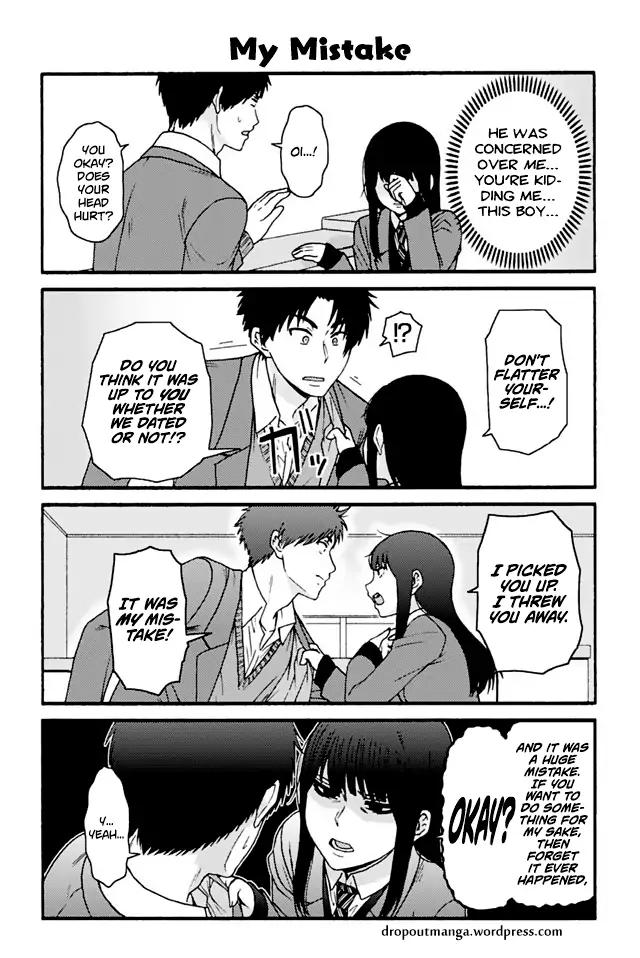
The most endearing romantic comedy manga that I’ve read in a while. Our main couple are two emotionally stunted individuals who grew up competing and inflicting violence upon each other. As children, the guy often got the tingles for the titular Tomo person, but he repressed them, as he didn’t want to consider himself a homosexual. It took him until middle school to realize that his childhood friend was in fact a girl, but by then the damage was already done. Tomo is too wild, too much of a tomboy, and too generally uninterested in lovey-dovey stuff for the main guy to consider her a romantic prospect, although he doesn’t want to spend his time with anyone else.

The manga starts with both in high school. Tomo has become an extremely fit girl with uncomfortably large breasts. The guy has gotten buff from years of martial arts training in the hopes that one day he’d manage to defeat the titular Tomo. Most of the initial comedy comes from their inability to deal with their long-standing, repressed feelings for each other.

As the two remaining main characters we have a raven-haired, cynical and aloof girl who acts as Tomo’s confidant.

Also, a doll-like, mostly dumb, inexplicably British girl who bridges the difficult emotional issues of the rest of the cast with her big-breasted innocence (sort of like Chika Fujiwara from ‘Kaguya-sama: Love Is War’, but without the malice).

We meet a few memorable secondary characters. The British girl’s mother got pregnant at thirteen years old, is extremely rich, and cheerfully explains that she coddles and overprotects her daughter so she’ll never leave her side. Tomo’s mother is an older clone of herself, except married to a big oaf of a man who runs a dojo famous enough that the Yakuza is wary of its members; however, the guy can barely stare at his wife without fainting. One of my favorite “arcs” of the series comes from a pair of high schoolers who mistake Tomo for a romantic rival, but when they confront her, they quickly realize that they dared to intimidate someone who would eagerly send them to the hospital. They remain terrified of Tomo even after she takes upon herself to help them approach their romantic interest. Eventually, the two girls shift into admiring Tomo’s cool, manly demeanour, while regretting that she hadn’t been born with a dick.

For whatever reason, this series seemed to have been released on a page by page basis, with a fixed format: four stacked panels. An odd choice for a story that develops arcs for not only every main character, but for a few secondary ones as well. In any case, this is an almost entirely character-driven, consistently funny series that features well defined, contrasting personalities. I thought there was plenty more to squeeze out of these people, so it’s a bit of a shame that it has ended unambiguously.