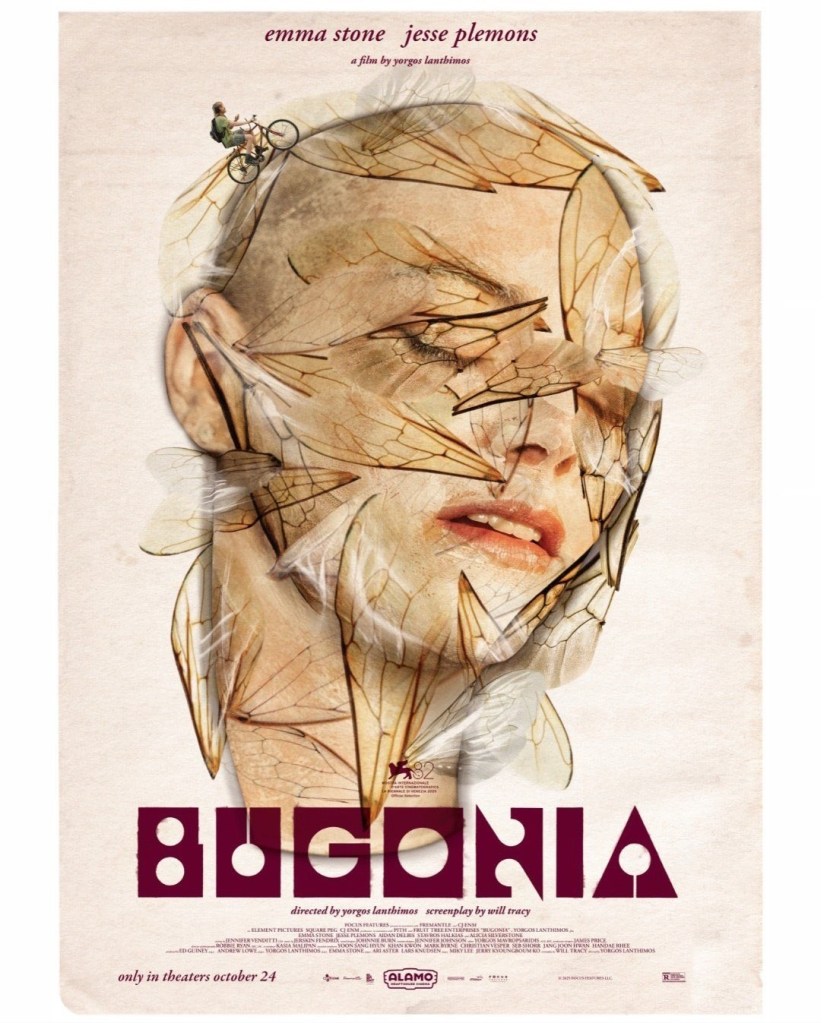
Back in late 2000s and early 2010s, we had this thing we affectionately called Telltale-style games: heavily narrative-driven games that relied on letting the player make more or less compelling decisions that would affect the narrative. They didn’t have the complexity of early adventure games, but they couldn’t be called simple visual novels either. They were tremendously successful, until corporate greed swallowed them, spread them thin, and eventually dissolved them into nothing. The company shut down.
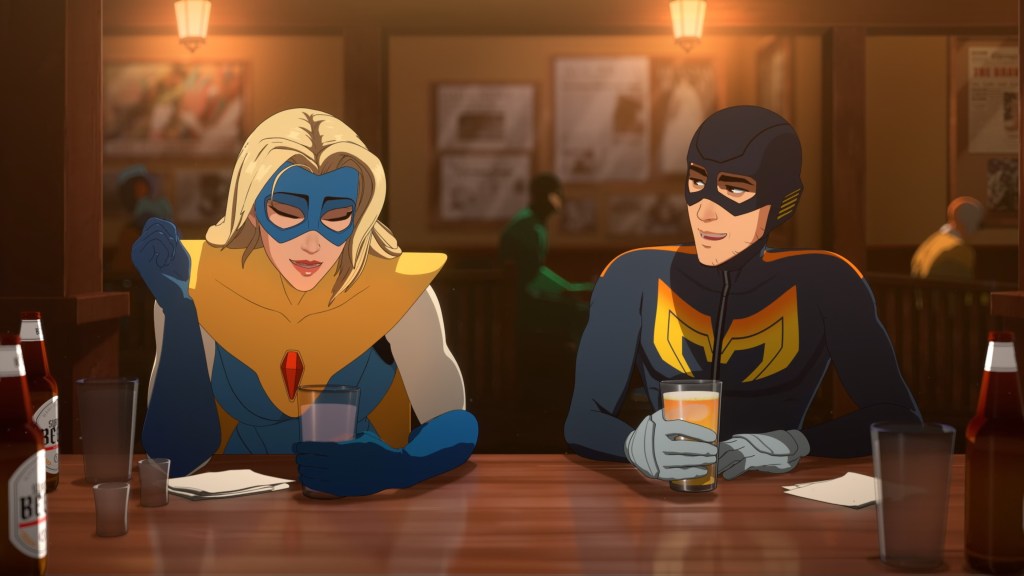
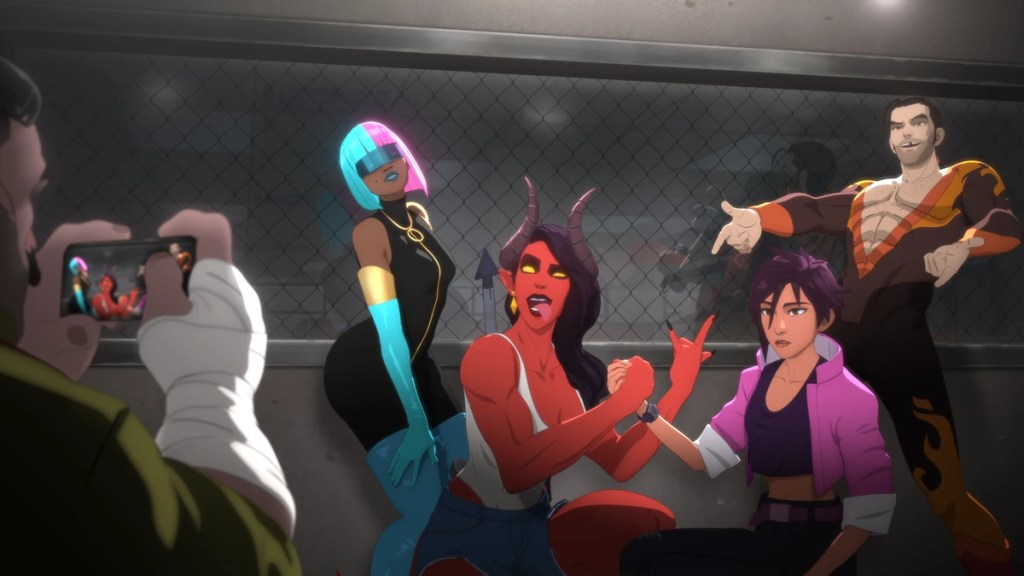
A new studio made of former Telltale devs decided to try their hand a new Telltale-style game that removed the dragging parts of former Telltale games (mainly walking around and interacting with objects) to focus on a good story, a stellar presentation, and compelling minigames. Their first product was the game Dispatch, released about a month ago in an episodic format (two episodes a week, but all of them are out already). The game has become a runaway success.
The story focuses on Robert Robertson, a powerless Iron Man in a society where many, many people have superpowers. He carries the family legacy of battling villains with a mecha. As an adult, he pursued the supervillain who murdered Robert’s father, and who now led one of the most dangerous criminal groups. However, during an assault on the villain’s base, Robert’s mecha gets destroyed, which puts him out of a job.
However, he’s approached by one of the most notorious superheroes, a gorgeous, strong woman who goes by the name Blonde Blazer. She offers him a job at the company she works for, SDN (Superhero Dispatch Network). Their engineers will work on repairing Robert’s mecha, while he offers his expertise on fighting crime as the one in charge of dispatching other heroes to the appropriate calls.
Robert finds out that the team of heroes he’s supposed to handle are a bunch of villains who either have approached the company to reform themselves, or were sent by the criminal system for rehabilitation. They’re a diverse bunch of rowdy, at times nasty superpowered people who aren’t all too keen on having a non-superpowered nobody in charge of them. The narrative explores how the team grows to work together better.
The execution of this story could have gone wrong in so many ways: wrong aesthetic, time-wasting, atrocious writing, and above all, marxist infiltration; like most entertainment products released on the West these days, the whole thing could have been a vehicle for rotten politics. But to my surprise, that’s not the case here. A male protagonist, white male no less, who is an intelligent, hard-working, self-respecting role model? Attractive characters, fit as they would be in their circumstances? A woman in charge (Blonde Blazer) who is nice, understanding, competent, caring, and good? Villains with believable redemption arcs? Romance routes that flow naturally? Where the hell did this game come from in 2025?
Entertainment consumers have been deliberately deprived of all of this by ideologues who despise everything beautiful and good, who, as Tolkien put it, “cannot create anything new, they can only corrupt and ruin what good forces have invented or made.” Franchise after franchise taken over by marxists who dismantle it, shit on the remains, and then insult you if you don’t like it. Dispatch is none of it. For that reason alone, I recommend the hell out of it. I’m sure that given its sudden popularity, the forces-that-be will infiltrate it and ruin it in its second season as they do with everything else, but the first season is already done.
It’s not perfect, of course. Its pros: an astonishing visual style that makes it look like a high-quality comic book in movement. No idea how they pulled it off. Clever writing. Endearing characters. Interesting set pieces. The voice acting is extraordinary, led by Aaron Paul of Breaking Bad fame. He deserves an award for his acting as Robert Robertson. It’s a good story told well, and you’re in the middle of it making important decisions (and also plenty of flavorful ones).
The cons: some whedonesque dialogue that didn’t land for me. Too much cursing even for my tastes, to the extent that often feels edgy for edge’s sake. Some narrative decisions taken during the third act, particularly regarding the fate of one of the main characters, didn’t sit well for me, as it deflated the pathos of the whole thing. But despite the pros, this was a ride well worth the price.
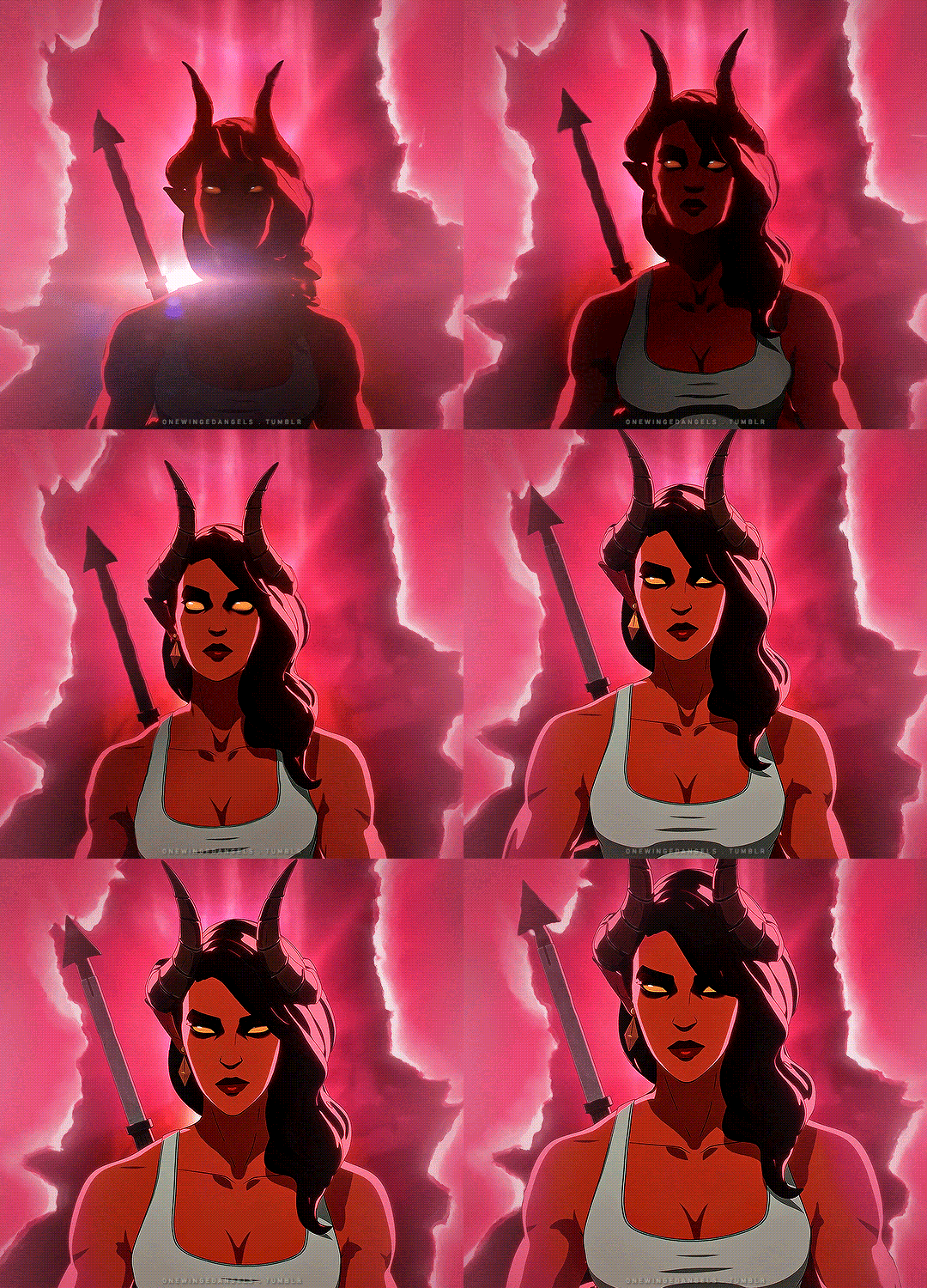
Oh, I forgot: they should have let us romance the demon mommy. My goodness.
Check out this nice music video some fan created about Dispatch, using one of the songs of its soundtrack.
A world where every concept is incarnated in a demon, whose power depends on how feared is the concept. The Cucumber Demon. The Blood Demon. The Typhoon Demon. The Future Demon. The Darkness Demon. The Angel Demon. The Death Demon. These fiends fight among themselves to either reign in hell or escape to Earth through possessing hapless people, usually the recently deceased. Demons hold grudges against each other and against humans in general. Humanity exists in a state of constant peril, with societies having to organize militias dedicated to the ever-present threat of a demon showing up somewhere or possessing a loved one. Some of the humans make deals with captured or semi-friendly demons, to gain some of their powers for good or ill. The cold war persists, but with the focus on achieving control of the most dangerous demons.
A winning concept, I’d say. The premise follows an orphaned teenager named Denji. He never went to school, lived with his gambler father, was manipulated by the local Yakuza into doing their dirty work for them, and finally was abandoned to die. However, a demon recently escaped from hell took pity on Denji; this fiend was the Chainsaw Demon, who had possessed a dog (I think that’s how the story goes; I have a hard time imagining Chainsaw escaping hell as a dog).
Denji had been torn into pieces, his body parts thrown into a dumpster, only for the Chainsaw Demon to give himself away as Denji’s heart, which made the teenager a human with feet in both worlds (this is extremely common in Japanese stories).
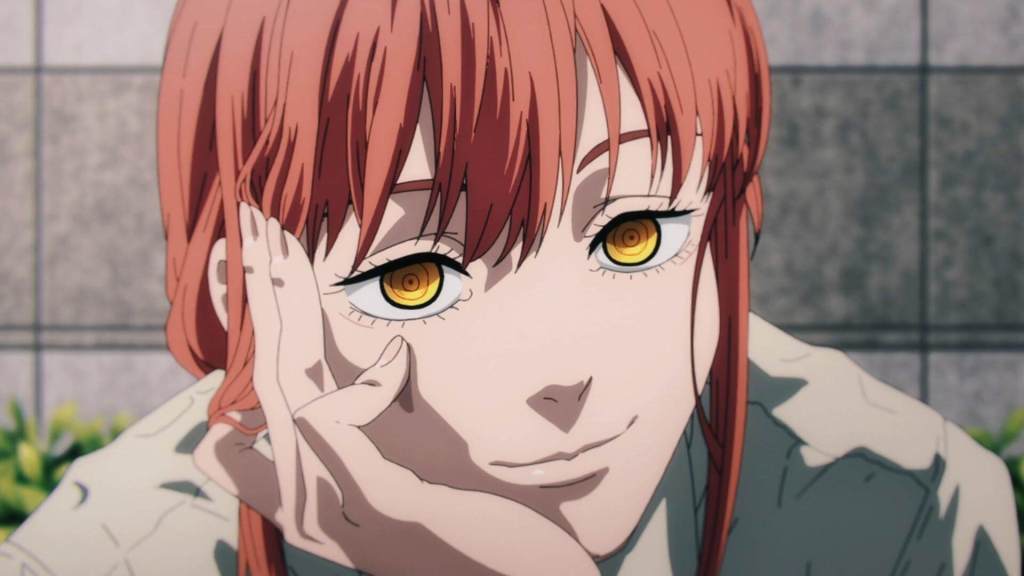
Then, the teenager gets conscripted into some special forces by a shady young woman with light-red hair.
The least I say about this person, the better.
Anyway, Denji isn’t your average protagonist. He’s half-wild, emotionally stunted, doesn’t care about the world, barely knows how to deal with people, can’t realize when he’s being manipulated (which happens constantly), and he’s solely motivated by hedonism, usually in the form of food or a cute face (or a nice pair of tits, or a nice ass), for which he’ll kill and/or die over and over again if necessary.
I quite like Denji. It has become a meme on the internet to say about Ryan Gosling’s characters that “He’s literally me.” I feel similarly about Chainsaw Man‘s protagonist.
In any case, the anime adaptation of part of the manga was a runaway success, even capturing the attention of some people that usually wouldn’t be into this stuff. But the anime series ended right at the moment when one of the most popular arcs would begin. This one involves a peculiar girl named Reze.
I’ve finished watching the movie about an hour ago. Oh, what joy. Plenty of the artistry on display was mesmerizing, some of the best animation I’ve seen in my life. The cinematography, the subtle character moments, the amazing fight scenes, the way the tension and absurdity ramps up to the point when you ask yourself how the hell did we get here. I wish the movie had been longer, but I didn’t feel like it missed any of the content of this arc. Reze’s character was done justice, which is far more than you can usually say about adaptations.
You know, it gets easy to forget that when you go to the cinema, the contract used to be that you’re giving away your attention and time to be captured by a story told by competent, passionate people. These days you watch movies, if you dare, trying to find a few entertaining moments in the torrent of politics that gets diarrhea-ed down your throat. This movie I’m reviewing is the deranged tale of two young people who were fucked from birth and who have no choice but to do the things they’re told to do, to have in exchange some semblance of normality in their lives. It also involves a myriad explosions, chainsaws growing out of a head and limbs, and a shark mount. If you enjoy Chainsaw Man, you have to watch this one. If you haven’t followed the story up to this point, you’ll have no fucking clue about what’s going on.
Great times. I posted one of the trailers for the movie in the previous post, but I’ll post it again:
Sadly, the movie would have left a perfect taste in my mouth if it wasn’t because I know that the story doesn’t end with the first part of the manga. The author, for whatever reason, created a second part featuring a new main protagonist (they switch around afterwards, but still), and although it started out very promising, it quickly devolved into shittiness. Some great moments, but plenty of lame ones. And much worse: some characters were brought back only to do a disservice to them. Others were killed unjustly. I’m waiting for that part to end so I can read it in its entirety, but right now I’m of the opinion that it shouldn’t have been created at all.
For the last ten years or so I have avoided Hollywood movies, and movies in general, because most of what’s produced out there these days is vehicles for marxism. A couple of days ago I found out that Paul Thomas Anderson, who made Boogie Nights, Punch-Drunk Love, There Will Be Blood, The Master, and Inherent Vice, all movies that I either loved or found very interesting, had made a new one, named One Battle After Another, starred by our favorite lover of under-25-year-old women: DiCaprio himself. And the movie is based on a complex book by Thomas Pynchon, about revolutionary movements in the sixties. I was eager to see a movie set in the late sixties and early seventies, an era that has become important to me for reasons. On a personal note, P. T. Anderson is, or used to be, an intimate friend of Joanna Newsom, who is probably the living artist I respect the most (Joanna even had a role in Inherent Vice). So I figured that I finally could drag my aging ass to a movie seat.
It was fucking terrible. Pure political propaganda. P. T. Anderson, or whoever wrote the movie, used Pynchon’s book as an excuse to write a contemporary movie to shit on the US, and by extension on all countries of ethnic European origin, for controlling their borders and not being communist. In the first twenty minutes or so we see DiCaprio (I mistakenly wrote DiCrapio, and perhaps I should have left it like that) acting as the bomber for a communist, terrorist group, whose leader was the most disgusting, over-the-top example of a “black power” revolutionary I remember seeing in fiction. At first, silly me, I thought that DiCaprio’s character was undercover or something. When the black terrorist, after insulting and threatening some border guards, got to Sean Penn’s character and threatened him into getting hard, I realized that this movie was playing it straight. Abhorrent, insulting, morally-bankrupt garbage. That black communist hadn’t even met Sean Penn before; she just assumed that he would find her super hot, as in all white people are attracted to ugly, violent, nasty black women. Are black men even attracted to that?
Other than DiCaprio, the token “ally,” every single person of ethnic European origin in this movie is depicted as evil, a freak, or both. Sean Penn, who is a woketard himself, I assume was doing his best Donald Trump impression, judging by his facial mannerisms. Both DiCaprio and Sean Penn are depicted as being super turned on by the main black communist revolutionary. Sean Penn’s character even pursues her for sex, and gets pegged. Because of course he does. Later on in the movie, in an extremely lazy exchange, another character implies that he’s a closeted homosexual.
After DiCaprio’s character and this black bitch have a child, she berates him for “trapping” her, for trying to get her to act as his mommy, merely because DiCaprio’s character intends for their daughter to have a mother. In the end, this black communist, who was cheating on DiCaprio, abandons her family, murders a guard during an attack, snitches on their revolutionary group to avoid ending up in jail, and leaves the country. By the end of the movie, that fucking bastard is depicted in a sympathetic light, as if she could be redeemed. As in, “Ah, what wild youth we had. I made some mistakes, silly me.”
DiCaprio, being an “ally” ethnic European in a marxist movie, after he went out of his way to have a mixed baby, is depicted as a loser who has wasted the last thirty years destroying his brain with drugs. He spends most of the movie bumbling around, and by the end, he just happens to be in the right place at the right time, after someone else had solved the problem.
Then there’s the whole white supremacy thing. Sean Penn’s character wants to belong to a group named after Christmas (get it?), who are explicitly white supremacists. Those guys turn on Sean Penn when they realize he had a relationship with that black revolutionary bitch, and possibly fathered a child with her.
This movie features a native-American character. As a native-American character in such a marxist movie, he ends up (spoiler) massacring a group of white people named after the American revolution. If you saw that season of Fargo, by the Coen brothers, then you’ve pretty much seen that whole scene. I recall that the Coen brothers also used that season as a vehicle to tell people how terrible the Eastern Europeans were to the jews. Nevermind the fact that 95% of the Bolshevik leaders were jewish and murdered about 30 million ethnic Europeans in what came to be called the Holomodor. A subject you won’t see in any Hollywood movie, nor will you be detained for questioning.
Oh, I forgot. Spoiler, in case you care about this fucking abysmal turd of a movie: DiCaprio’s character is a literal cuck. Sean Penn’s character actually fathered DiCaprio’s daughter. Thus, DiCaprio’s took his rightful place at the bottom of the marxist hierarchy: a discarded “ally” whose efforts and resources are taken up by raising another man’s mixed baby.
Terrible, terrible film. Cinematography was fine, though, if you care about that. What perhaps disturbed me the most about the movie was the way this communist revolution, and all sorts of social revolt focusing on destroying those “evil white men,” were depicted with the moral righteousness of an eighties/nineties film that used nazis as the bad guys. DiCaprio’s “daughter” even ends up as a marxist activist herself, accompanied by uplifting music.
I’d rather eat my own shit than watch this movie again. I guess I have to write P. T. Anderson off my list.
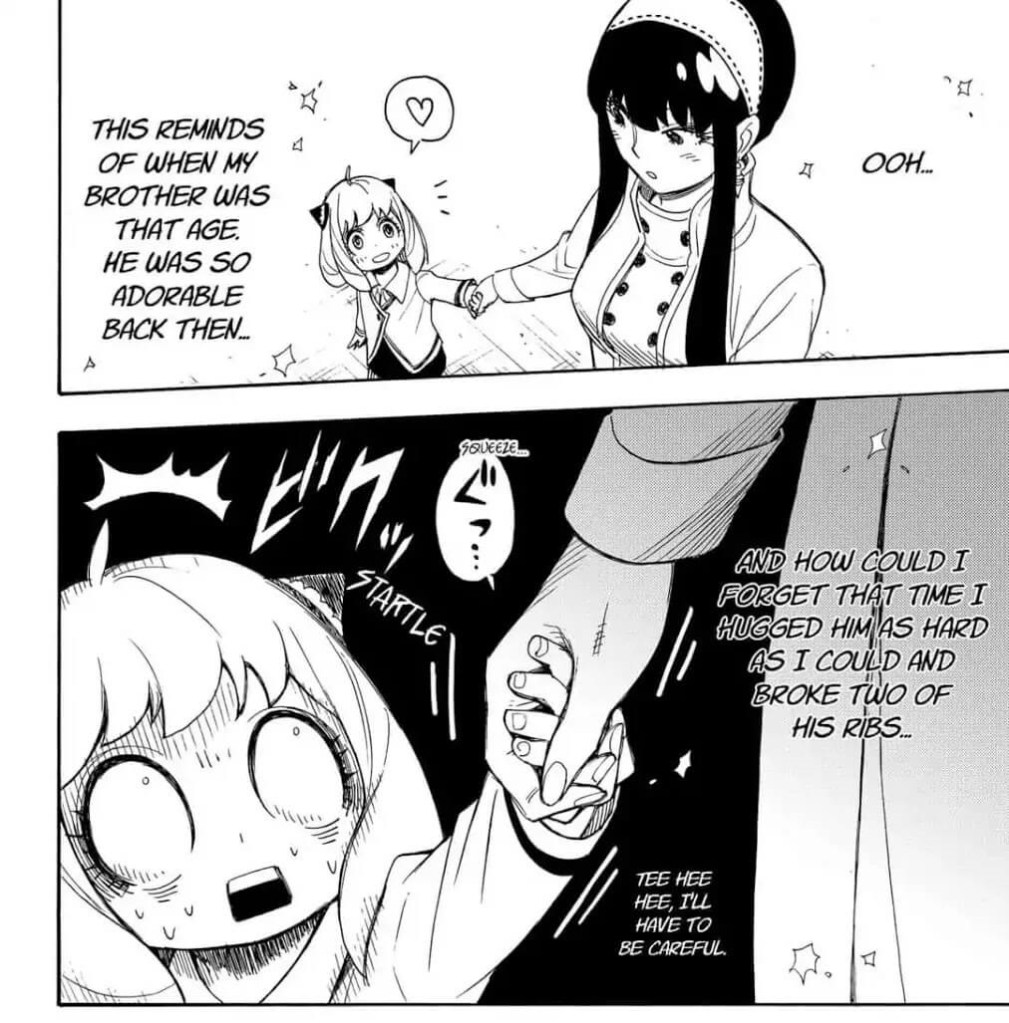
I first found out about this series when barely five chapters had been released, and I’ve been a faithful follower ever since. We’re now about 120 chapters in, with no clue about when it may end, due to its mainly episodic nature. Amidst a fuckton of isekai stories (I’m not shitting on them; I love me some isekai) and stories similar to other existing ones in the Japanese market, Spy x Family is unique in setting, concept, and general tone. The story is set in a fictional continent similar to Europe in the fifties (or at least the Japanese’s idealized image of past Europe), that is experiencing a cold war between two countries named Westalis and Ostania (basically West Germany and East Germany while the Berlin wall was still up).
Our protagonist is a man whom we come to know as Loid Forger (fake name). He’s generally known as Twilight, a legendary spy feared by the rival country of Ostania. He’s been tasked with stopping the warmongering ways of a former prime minister of the enemy country. Given the former prime minister’s reclusive nature, Twilight’s handlers decide that their best chance of worming their way into the prime minister’s life is through his son Damian, who is going to attend an exclusive school. Twilight can’t attend it himself, so he needs to figure out how to get a child, and because the exclusive school looks down on single parents, he’ll need to get himself a wife as well.
Twilight, settled in the enemy country of Ostania, visits an orphanage. That’s how we’re introduced to the most popular character of the story, as well as one of the most popular of modern manga: Anya. The author could have reduced her to an adorable child, which she is, but instead she’s also smug, a bit of a dolt, barely interested in anything but food and her hobbies, and can also read minds.
The author masterfully makes Anya a constant source of joy thanks to her peculiar personality and how she approaches problems. A telepath, she’s aware that her new father is a spy for a foreign nation, which she finds exciting. One of the first things she does is use his spy devices and accidentally get herself kidnapped.
As mentioned, Twilight needs a wife for the mission. They meet Yor, an attractive yet socially and emotionally stunted woman who also requires a husband for the sake of appearances. In her case, she’s the most lethal assassin of Ostania. Through an extremely memorable proposal involving a grenade pin, Twilight ends up married to his number one enemy.
Anya becomes the only person aware of the thorny circumstances of her new family, yet remains unable to fully comprehend them, as her mind is addled by the spy shows she’s addicted to.
What follows are the struggles of Twilight as he tries to turn his new daughter into an elite student, even though she’s an unmotivated idiot. Meanwhile, the overworked guy deals with other spy missions, as both countries continue with their tug-of-war to get the upper hand on the other. We meet many more memorable characters: Yor’s younger brother, who works for the secret police, is in love with his sister, and would love to throw Yor’s new husband in jail on principle. Twilight’s fellow spy Nightfall, his protégé and competent spy on her own right, is madly in love with the guy, and eager to get Twilight’s new wife out of the picture. Damian, the target’s son, a haughty tsundere who can’t accept the fact that he has fallen for the adorable Anya, as getting involved with a commoner would be unfitting of his station. The kids’ headmaster, an earnest man who evaluates the world in terms of elegance. The target’s wife, a subdued mess of nerves, obsessed with the occult, who has a bizarre suspicion about her husband’s real nature. Bond, a precognitive dog that the Forgers adopt. Becky, Anya’s best friend, the heiress of an arms manufacturing company, who despite being a child is planning to replace Yor’s role as Anya’s stepmother.
The author perfectly mixes humor with poignancy. Plenty of characters are marked by the pointless wars that both countries have fought against each other. Twilight himself lost his family (I don’t recall if he lost them in the war or if he was an orphan for as long as he can remember), and also lost his childhood buddies. He works as spy to preserve world peace against forces from both countries that intend to inflame hostilities.
This is mainly an episodic series. We’ve gone through elaborate arcs, such as one in which Twilight and Nightfall have to win a preposterous tennis tournament to get their hands on a piece of intel, one in which the Forgers fight off assassins in a cruise ship, or one in which Anya’s school bus gets hijacked by terrorists. We regularly get chapters focused on secondary characters or on minor aspects of the main characters’ lives, which don’t contribute much to the plot but are always well done. This is one series you always want to return to because you want to see more of the characters and the circumstances they find themselves in.
They’ve adapted this series, to my knowledge, into two seasons of anime and a movie. I only watched most of the first season, but it’s great.
Spy x Family is already a classic of modern manga, which you must read if you’re into the medium.
I’ve been playing a lot of VR recently, so I may as well review the only long-form game that I’ve finished in this couple of weeks. Ghost Town is a puzzle-based adventure game set in Great Britain back in the eighties. You’re a spirit medium (a witch) named Edith, whose shitty younger brother disappeared under shady circumstances, and your goal is to find him. Trailer is below:
There are many more pros than cons as far as I’m concerned. The setting, mainly London in the 80s, is quite unique, and provides a gritty touch that I appreciated. The character animations and models are generally exceptional for the Meta Quest 3, maybe the best I’ve seen so far. I don’t like puzzle games, yet this one made me appreciate the puzzles. I was never entirely stuck, as the progressive hint system helped me eventually realize at least where I should focus on. I loved the tactile feel of exorcising ghosts, although it’s a minor part of the experience. Plenty of great moments come to mind: interacting with ghosts behind glass (great-looking in VR), using eighties ghost-bustery technology to investigate artifacts, a very creative museum of haunted artifacts, sleepwalking through your eerie apartment tower in 80s London, a great sequence in which you wander through a maze-like version of your apartment while malevolent presences whisper from the shadows (very P.T. like), clever use of light in puzzles, etc.
Horror stories are never more terrifying than in VR. Play Phasmophobia if you dare, for example. I try to avoid horror games because of my damaged heart. However, the ghosts in this one are more spooky than scary.
Now, the cons: personally, I wish the game were more like a regular adventure game instead of a puzzle game with a narrative thread woven throughout it. That’s just a personal preference, though; I wish we got the equivalents of the Monkey Island series in VR. Anyway, the least interesting sequence of puzzles for me was the lighthouse, which comes right after the introductory flashback. I actually dropped the game for like a couple of months after I first played it, because I didn’t feel like returning, but I’m glad I picked it back up and continued.
However, my biggest gripe with the story is that you’re supposed to search for your brother, whom you meet in the first scene, when you’re investigating a haunting in an abandoned theatre, but in every damn scene he’s in, the brother comes off as envious, narcissistic, entitled, and overall a complete dickhead. I didn’t want to interact with him. Did the creators believe we would be invested in finding this guy just because he was related to the protagonist? I think it’s a given that they should have made the brother sympathetic, but he annoyed me in every scene he appeared.
All in all, fantastic experience. Perhaps a bit short, but I felt like I got my money’s worth. If you have a Quest 3 and you enjoy these sorts of games, check it out.
I have barely been able to connect with novels these past ten or so years, and the last living writer I respected, Cormac McCarthy, has been not alive for a while. Most of this half of the world seems to have lost their collective (and collectivist) minds, so when I want to experience a good story, I have to look to the Orient, past the reds. I’ve enjoyed plenty of South Korean stuff, but I’m mostly into Japanese. I’m always on the lookout for the next mind-blowing, perhaps even life-changing manga, but I seem to have run through the vast majority of the quality ones.
A couple of days ago, I thought again about Minoru Furuya, who earned the rare merit of being my favorite manga author. From time to time I look him up hoping that he has finally begun working on a new series, but unfortunately, the guy seems to have retired; his last work was the bizarre Gereksiz, from back in 2015-2016.
I suspect that most manga fans don’t know about Furuya. I’ve yet to talk to anyone who has read any of his works. But I get Furuya’s mind, to the extent that I’m fairly certain he also has OCD: his characters regularly fall into patterns of obsessiveness, and deal with intrusive thoughts and images that they sometimes act upon. The protagonist of his Ciguatera comes to mind, with his spirals of preoccupations in his bedroom, trying to bury his face in a pillow to keep himself from falling further. The protagonist of Himizu, perhaps his overall darkest story, feared being assailed by demons lurking at the corners of his mind, eager to break in. Both very common experiences for OCD sufferers.
Sadly, I’ve read virtually everything of value that Furuya put out. He started with an extremely amateurish series about a high-school ping-pong club (or something like that), a comedy that reminded me of the kind of material I created in middle school. I’ll probably revisit it at some point, but it’s early-nineties carefreeness. He followed up with Boku to Issho (link for my review), another comedy about a bunch of fellows living in poverty who hope to survive while keeping their sanity and dignity intact.
In the 2000s, he went straight from a slapstick comedy to his darkest tale: Himizu. With this one, he introduced the pattern for all the protagonists to come: outcasts with very little going for them, usually burdened by mental issues, who seem mostly pushed around by life. Good stuff sometimes happens to them (regularly, this involves dating someone above their league), but they usually pay for it with chaos and occasional brutality. His are the kinds of stories that go from mundane relationship issues to someone having his ears cut off while tied up in a shack. There’s the sense that life is extremely perilous, and that at any point it will force you to struggle through horror whether or not you’re ready for it, and if you survive it, you may not get any lessons out of it other than “life goes on.”
After Himizu came Ciguatera, generally considered his best. I came across that one plenty of times over the years in lists of best manga ever, but I ignored it because I thought it was a sports manga of sorts, centered on biking. But the bikes ended up being a symbol of a better, brighter future that could carry the protagonists away from their shitty circumstances. Ciguatera is a sort of a Bildunsroman in which the protagonist, a below-average dude with no talents to speak of, intends to figure out how to measure up to the girl he loves, hoping to become a dude worthy of respect. This one had likely the most realistic of Furuya’s endings, to which I have returned repeatedly in my mind.
Then came Wanitokagegisu and Himeanole. Both feature working-class protagonists stuck in dead-end jobs, who feel that life is passing them by, who can’t figure out how to improve their circumstances or even become interested by anything, and who are sure they’ll die alone. From that perspective, these last four series are very masculine stories. In both tales, the protagonists get involved in other people’s troubles, which lead them further and further into chaos and brutality. Both also feature the protagonists getting girlfriends way out of their league, which brings joy but also the sense of constantly having to measure up lest they look elsewhere. Both series feature horrific violence. Himeanole wasn’t even licensed in English, and fans have only translated up to chapter eight of about sixty-five. I only know of the full contents of that series, to the extent that an adaptation allows, because they made a movie out of it, which I watched last night.
His last serious story, and my favorite of his, was Saltiness (first review, second review), about a clearly autistic dude who realizes that his beloved sister will remain unmarried because she has to take care of his crazy ass, so he leaves for Tokyo to become independent, even though he’s thoroughly incapable of dealing with life. Saltiness is very hard for me to explain, but it feels like Furuya managed to create a parable with it for dealing with the nonsense of life, and finding one’s place in it despite being ill-suited.
Sadly, Saltiness seemed to have been his main send-off. His final work was the extremely bizarre Gereksiz, which starts with the bizarre premise of a solitary middle-aged man dragging his female coworker to show her the woman that he’s infatuated with, only for them to realize that he’s the only one who can see the woman. The story gets far stranger from there. It’s a great read, although it felt anticlimactic compared with Furuya’s previous works.
Given that these days I consider Furuya to be my favorite manga author, one would suppose that my favorite manga would be one of his, but that’s not the case. My favorite manga, which is among my five favorite fictional experiences in no particular order, is Inio Asano’s Oyasumi Punpun. That one has never stopped haunting me. It feels like Asano was trying to exorcise something out of himself through making that story. Unfortunately, after it ended in 2013 or so, Asano never even came close to achieving those heights again. An idealist, as evidenced by his earlier works, he seems to have expected it to change the world as well as himself, only for Asano to wake up ten years older having resolved fuck all. He wrote a semi-autobiographical series afterwards, titled Downfall, that showed how despondent and bitter he ended up after finishing his masterpiece.
Anyway, I suppose that’s all I wanted to say. Not sure why I even wrote this, but I did, so there.
This one’s a bildungsroman about a teenager (I believe he’s sixteen when the story starts) named John Grady Cole, who lives in Texas with his deteriorating family. Cole intends to continue working in the family farm and doing something in particular with it, legacy-like, but after his grandfather dies, the house changes hands in ways I wasn’t entirely sure about, but that in any case destroy Cole’s intended future. So, partly as a fuck y’all, he grabs his friend, a couple of horses, and heads down to Mexico, intending to never return.
Cole is a good kid. Intelligent, with a strong moral compass. It just happens that he’s venturing into the wild, and his courage and moral compass are going to get considerably tested. First of all, the pair of friends find themselves followed on their journey south by a single rider. That rider turns out to be a supposedly thirteen-year-old runaway named Jimmy Blevins, likely a fake name. He may have stolen his horse. Although the kid seems a bit unhinged and generally immature, he proves his skill with a revolver by punching through Cole’s friend’s wallet in one shot. Later on, this kid, terrified of storms (he mentioned that getting struck by lightning was a bit of a family curse), ends up losing his clothes, his horse, and his gun. In a Mexican town, they spot both Blevins’ horse and his gun in other people’s possession, which Blevins won’t allow.
That’s where the main trouble starts, which has repercussions for the rest of the story. At its core, though, this story is a tale of tragic love between John Grady Cole and a beautiful seventeen-year-old girl named Alejandra, of Spanish ancestry and a wealthy family. John is ultimately a Texan cowboy with barely a peso to his name, not the kind of young man that Alejandra’s father would allow his precious daughter to marry.
Cole learns that the world is a harsh, frequently unfair world, and that the lines between good and evil are hard to measure at times. This is the first entry in McCarthy’s The Border Trilogy, and I’m curious to know how Cole dealt later on with the mental state that the events of the first book left him in.
I must mention, as I have in every review of McCarthy’s work ever since I learned about this matter, that the tale I’m reviewing, as well as most other tales of his ever since the following events happened, are heavily influenced by having met in the early seventies someone that quickly became McCarthy’s love of his life: a thirteen-year-old blonde, blue-eyed teenager named Augusta Britt. Or, as one of his writer pals put it, “a teenage popsy.”
Supposedly, as McCarthy was researching Blood Meridian in Tucson, AZ, Augusta Britt, wearing a holstered gun, asked McCarthy to sign her copy of his first book. Although that sounds unlikely (partly because the supposed edition she handed him lacked a photo of the author), Britt has showed the letters she received from McCarthy. Britt was a foster kid, and had been abused in various ways; all the foster homes she ended up in lacked locks in the doors, and men tended to enter whenever they pleased. McCarthy quickly grew amorous of this thirteen-year-old tragic hottie, and after she told him that someone in her current foster home had hit her, he offered her to run away together to Mexico.
What he intended to do was very illegal: basically kidnapping a girl from the foster system. Crossing not only state but country lines with an underage girl that he was in love with and likely fully intended to fuck was probably also illegal. But it happened, and by the time she was fourteen and in Mexico, McCarthy and Britt banged like there was no tomorrow, which McCarthy likely believed to be the case, as the FBI was literally after him. Even to this day, Britt says that the whole thing was fine, that she loved him and felt safe with him. But their relationship fell apart when Britt found out that McCarthy was actually married at the time (although estranged), and had a son he was neglecting. Britt ended up leaving for the States, which broke McCarthy’s black heart. They remained friends until his death, and he even tried to marry her twice, but ended up failing to do so because her church demanded of him to convert to Christianity; as the last paragraph of his last book, The Passenger, put it, he was “the last pagan on earth,” and very much intended to remain so.
You feel echoes of that period of McCarthy’s life in this novel: running away to Mexico, the dread of being pursued, the dilemmas about right and wrong, the tragic love for a teenage girl, etc. Curiously, Jimmy Blevins, the wild thirteen-year-old runaway kid, seems the closest to Augusta Britt given what I read about her: the kid had peculiar mannerisms and a wild goofiness that you could imagine having been lifted straight from a seventies teenage runaway with a fucked-up past.
I wasn’t particularly into the story, to be honest. Didn’t connect much with it other than during some philosophical passages. If it weren’t for McCarthy’s prose, at times I would have rated it a three. However, prose-wise, it was sloppier and much lazier than Suttree, which was my previous read of his. I can’t blame McCarthy for lowering the quality of his prose; Suttree was so relentlessly high quality at times that writing it must have been agonizing, prone to making the writer hate the very process. I suppose that in the back of his mind, McCarthy thought that the public at large would have been forced to acknowledge the brilliance of Suttree, but it ended up selling terribly. I can see him thinking, “Why bother?” and not putting in his 110% from then on.
Anyway, the following are the quotes I’ve highlighted from the book.
People dont feel safe no more, he said. We’re like the Comanches was two hundred years ago. We dont know what’s goin to show up here come daylight. We dont even know what color they’ll be.
Beware gentle knight. There is no greater monster than reason.
The prison was no more than a small walled village and within it occurred a constant seethe of barter and exchange in everything from radios and blankets down to matches and buttons and shoenails and within this bartering ran a constant struggle for status and position. Underpinning all of it like the fiscal standard in commercial societies lay a bedrock of depravity and violence where in an egalitarian absolute every man was judged by a single standard and that was his readiness to kill.
Those who have suffered great pain of injury or loss are joined to one another with bonds of a special authority and so it has proved to be. The closest bonds we will ever know are bonds of grief. The deepest community one of sorrow.
We weep over the might have been, but there is no might have been. There never was. It is supposed to be true that those who do not know history are condemned to repeat it. I dont believe knowing can save us. What is constant in history is greed and foolishness and a love of blood and this is a thing that even God—who knows all that can be known—seems powerless to change.
He saw very clearly how all his life led only to this moment and all after led nowhere at all. He felt something cold and soulless enter him like another being and he imagined that it smiled malignly and he had no reason to believe it would ever leave.
He lay listening to the horse crop the grass at his stakerope and he listened to the wind in the emptiness and watched stars trace the arc of the hemisphere and die in the darkness at the edge of the world and as he lay there the agony in his heart was like a stake. He imagined the pain of the world to be like some formless parasitic being seeking out the warmth of human souls wherein to incubate and he thought he knew what made one liable to its visitations. What he had not known was that it was mindless and so had no way to know the limits of those souls and what he feared was that there might be no limits.
He thought the world’s heart beat at some terrible cost and that the world’s pain and its beauty moved in a relationship of diverging equity and that in this headlong deficit the blood of multitudes might ultimately be exacted for the vision of a single flower.
He stood at the window of the empty cafe and watched the activities in the square and he said that it was good that God kept the truths of life from the young as they were starting out or else they’d have no heart to start at all.
He stood hat in hand over the unmarked earth. This woman who had worked for his family fifty years. She had cared for his mother as a baby and she had worked for his family long before his mother was born and she had known and cared for the wild Grady boys who were his mother’s uncles and who had all died so long ago and he stood holding his hat and he called her his abuela and he said goodbye to her in Spanish and then turned and put on his hat and turned his wet face to the wind and for a moment he held out his hands as if to steady himself or as if to bless the ground there or perhaps as if to slow the world that was rushing away and seemed to care nothing for the old or the young or rich or poor or dark or pale or he or she. Nothing for their struggles, nothing for their names. Nothing for the living or the dead.
A very uneven novel. My rating ranges from three to four-and-a-half stars.
The heart beneath the breastbone pumping. The blood on its appointed rounds. Life in small places, narrow crannies. In the leaves, the toad’s pulse. The delicate cellular warfare in a waterdrop. A dextrocardiac, said the smiling doctor. Your heart’s in the right place. Weathershrunk and loveless. The skin drawn and split like an overripe fruit.
In a previous post I stated that this novel, released in 1979, took McCarthy about ten years to write. That was, however, wrong, and in fact he had been writing in since the fifties, when he lived some of the events of the story. As independent scholar Write Conscious, who has gone over McCarthy’s archives, put it, McCarthy wrote very little in the last few decades of his life. Even his latest two novels, The Passenger and Stella Maris, which I loved and still haunt me, not only were set in the seventies and eighties, but were written to a significant extent back then (or at least almost fully researched). It turned out that McCarthy put lots of his own life in his novels. In the case of his last two and quite a few others, they’re heavily inspired by the love of his life Augusta Britt, much younger than him, ending up in a mental institution due to her extensive trauma (abandoned by her family, abused in foster homes… Presumably the whole getting-whisked-away-to-Mexico-by-Cormac also added to it).
In the case of Suttree, this novel I’m reviewing, it’s based around Cormac hanging out in the unfortunately named McAnally Flats in Knoxville, as the area existed back in the fifties and no longer does so. Many of the characters of this novel were real. One of them, named J-Bone, was a great friend of McCarthy’s, and the guy’s real home address as well as phone number from back then are depicted on the text. That means that we’re often treated to strange characters whom we’re barely introduced to at all. I’m not necessarily opposed to this; I believe that writing fiction is about making your own meaning and not necessarily satisfying anyone else. But that means that in a story already quite the mess, this panoply of weirdos only makes it harder to grasp.
McCarthy was apparently a drunkard back in the day. Also at the end of his life. I can’t stand drunks. He and his friends also got in serious trouble. I can’t stand criminals. So at times I had a hard time caring about what was happening in the story. Suttree tended to side with people who clearly should have been in jail or dead, and when some of them died, I thought to myself that it was about time. Still, some of those stories were wild enough to be interesting: going into pubs and stealing people’s money from their handbags and jackets (at the Indian Rock, for example, mentioned in Stella Maris by Alicia Western; her beloved brother used to bring her there on dates), plain-old robberies, brawls, general mayhem… It was hard for me to connect with that part of the story, which is about half of it: Suttree wandering from weirdo to weirdo doing stuff I couldn’t relate to.
The most memorable male character is an innocently evil melon rapist named Gene Harrogate. We are introduced to him violating a farmer’s produce, and he ends up in jail, where he meets the protagonist. He’s a small country bumpkin with seriously nasty instincts, whom Suttree really shouldn’t have been involved with. I have a hard time believing he existed in real life, as he was the larger-than-life type. There’s a whole segment with him digging tunnels under Knoxville and blowing up shit to the extent that it caused sinkholes, and led to him nearly drowning in shit. He also almost extinguished the local population of bats. Though entertaining, ultimately he was quite pointless to the story, as I didn’t believe that Suttree would hang out with such a fiend. That said, the story is generally a mess, so not much of what happens could be say to fit properly.
Three major sequences bumped up the novel’s quality for me: the first involves Suttree’s estranged wife and son, the second a nymphet unfortunately named Wanda, and the third a prostitute named Joyce. In real life, Suttree was indeed married and had a son. As far as I know, McCarthy was an utter bastard to that wife of his: he demanded her to work to pay the bills so he could dedicate himself to his writing, and when things got even worse money-wise, he demanded of her to pick up a second job. Understandably so, McCarthy’s family-in-law wanted him dead. He ended up escaping his home life, claiming that they stifled his creativity, which they likely did, and roamed around the south of the US, eventually ending up in a motel pool in Tucson, AZ, where he met an armed thirteen-year-old blonde and blue-eyed popsy with whom he fell head-over-heels. So that’s the whole deal with a estranged wife and son present in Suttree covered.
Wanda is the daughter of a down-on-his-luck pedlar with whose family Suttree spends some time in the best sequence of the book. This girl is described as having tits as well as fuzz down there, but Suttree repeatedly refers to her as a child. So she’s probably twelve-to-fourteen years old. The intimate scenes between Suttree and this girl are some of the most haunting passages of the book. This, of course, relates to McCarthy having met around that time the love of his life, Augusta Britt, whom the aforementioned scholar Write Conscious mentioned was very likely thirteen when McCarthy started sending amorous letters to her, and fourteen when they fled together to Mexico and started banging like there was no tomorrow, which McCarthy likely believed was the case, as the FBI was investigating Britt’s disappearance from the foster system. Regarding Wanda, the whole thing ends in a very McCarthy-ish way, with nature saying, “Fuck no, I ain’t lettin’ this shit go on.” I feel that the ending of that sequence will haunt me for the rest of my days. Chance and the universe’s indifference in general determining so much in life is a common theme in McCarthy’s work (the ending of No Country for Old Men comes to mind, and I mean the sequence with the protagonist and a fifteen-year-old runaway also based on Augusta Britt, which was sadly wasted in the movie).
However, the Wanda segment, my favorite part of this story, ended up becoming the biggest hole in it for me: I don’t believe for a second that Suttree would have been able to move on nonchalantly the way he did, with no fucking mention of the whole thing afterwards and no sign that it affected him. To me it reeked of McCarthy having written that part after meeting Augusta Britt, and then shoehorning it into the novel. Apparently, according to Write Conscious, in the letters with his editor, McCarthy’s “boss” demanded explanations for why he was so insistent on including the Wanda (and Joyce) parts in the story, but McCarthy refused to take them out.
The last of the three most memorable sequences for me involved a prostitute named Joyce, who bankrolled Suttree until her whorish life caught up with her psyche. Honestly the whole thing felt somewhat random yet true, which makes me suspect that McCarthy also got involved in such shenanigans.
What ultimately elevated the novel for me was McCarthy’s godlike writing. This story contains some of the best prose I have ever read. The first six percent or so of the text is so relentlessly high-quality in terms of careful observations that it boggles my mind to imagine what it took McCarthy to get through writing it. After that, the quality decreases as if McCarthy would have preferred to shoot himself than to keep holding himself to that standard. But most of the prose remains absurdly fantastic throughout, to the extent that it makes the vast majority of published authors look like children playing at pushing words together. One writer that McCarthy was helping do line editing in the seventies said that McCarthy’s edits made the guy want to quit writing. In my case, it makes me realize there are goals far in the distance that I can push myself towards.
This isn’t a novel I could recommend to anyone, to be honest. You have to fall into it, likely because you love McCarthy’s work. I’m glad I read it, but I suspect I should have gotten through his simpler remaining novels first (like the Border Trilogy, Outer Dark, etc.)
The following are quotes from the book that I highlighted.
He closed the cover on this picturebook of the afflicted. A soft yellow dust bloomed. Put away these frozenjawed primates and their annals of ways beset and ultimate dark. What deity in the realms of dementia, what rabid god decocted out of the smoking lobes of hydrophobia could have devised a keeping place for souls so poor as is this flesh. This mawky wormbent tabernacle.
How surely are the dead beyond death. Death is what the living carry with them. A state of dread, like some uncanny foretaste of a bitter memory. But the dead do not remember and nothingness is not a curse. Far from it.
You see a man, he scratchin to make it. Think once he got it made everthing be all right. But you dont never have it made. Dont care who you are. Look up one mornin and you a old man. You aint got nothin to say to your brother. Dont know no more’n when you started.
On a wild night he went through the dark of the apple orchards downriver while a storm swept in and lightning marked him out with his empty sack. The trees reared like horses all about him in the wind and the fruit fell hard to the ground like the disordered clop of hooves. Suttree stood among the screaming leaves and called the lightning down. It cracked and boomed about and he pointed out the darkened heart within him and cried for light. If there be any art in the weathers of this earth. Or char these bones to coal. If you can, if you can. A blackened rag in the rain. He sat with his back to a tree and watched the storm move on over the city. Am I a monster, are there monsters in me?
There are no absolutes in human misery and things can always get worse.
In the distance the lights of the fairground and the ferriswheel turning like a tiny clockgear. Suttree wondered if she were ever a child at a fair dazed by the constellations of light and the hurdygurdy music of the merrygoround and the raucous calls of the barkers. Who saw in all that shoddy world a vision that child’s grace knows and never the sweat and the bad teeth and the nameless stains in the sawdust, the flies and the stale delirium and the vacant look of solitaries who go among these garish holdings seeking a thing they could not name.
As a solitary dude, all my life I have relied on music to connect with the world at large, to feel that my feelings weren’t that unique or detached from the rest of humanity. Over the years, I’ve returned to certain albums that have spoken to me in ways that can’t be fully put into words. I love discovering new albums, and perhaps that’s also the case for whoever is reading these words, so I’ll spend some of my limited time on Earth sharing some specifics about the albums that have marked me, and that in many ways changed me.
Today I’m tackling a big one for me: Joanna Newsom’s Ys, released back in 2006. I will need to think about Joanna quite a bit in the coming year, so I may as well tackle this now. Ys, her pinnacle, and as well as I’m concerned one of the pinnacles of artistry, is a baroque masterpiece of music and storytelling, produced by a songwriter at the height of her powers, who at the time danced with her subconscious unimpeded.
Joanna changed her major from music to creative writing in college; she found the constraints that teachers put into music creation too oppresive, like straitjackets. She’s a songstress of old, the kind you could imagine traveling from town to town and reweaving her careful tales to an enraptured audience. All five songs in the album are mesmerizing.
Joanna is the kind of person who would write until four in the morning, obsessing over individual words and meanings. Added to her difficulties interacting with people, authenticity, extreme sensitivity, obsession with obscure people and topics, etc., I have always suspected she’s autistic, but I’m very biased in that respect.
In addition, this version of Joanna retained her beautiful, creaky voice, before she developed vocal cord nodules and could not speak or sing for two months; afterwards, her voice changed permanently, which made her fantastic following album Have One on Me quite tragic to listen to at times.
All the songs in Ys give me chills consistently. You can use words to justify anything, but chills don’t lie. Joanna’s music is unbridled beauty. I revere her as one of the most magnificent artists to ever live.
“Emily”
This song is a love letter to Joanna’s sister, during a period of their youth in which Joanna likely got pregnant and decided to abort it in a surreptitious manner that could have caused quite the stir in the small town where they grew up. She likely refers to this event in her other song “The Sprout and the Bean.” The way she paints a picture of the whole thing, including how they were taught about nature, is awe-inspiring in the purest way. That bell at the end, the resonance of meaning and beauty, kills me every time.
There is a rusty light on the pines tonight Sun pouring wine, lord, or marrow Into the bones of the birches And the spires of the churches Jutting out from the shadows The yoke, and the axe, and the old smokestacks and the bale and the barrow And everything sloped like it was dragged from a rope In the mouth of the south below
We’ve seen those mountains kneeling, felten and grey We thought our very hearts would up and melt away From that snow in the night time Just going, and going And the stirring of wind chimes In the morning, in the morning Helps me find my way back in From the place where I have been
And, Emily, I saw you last night by the river I dreamed you were skipping little stones across the surface of the water Frowning at the angle where they were lost, and slipped under forever In a mud-cloud, mica-spangled, like the sky’d been breathing on a mirror
Anyhow, I sat by your side, by the water You taught me the names of the stars overhead that I wrote down in my ledger Though all I knew of the rote universe were those Pleiades loosed, in December I promised you I’d set them to verse so I’d always remember
That the meteorite is a source of the light And the meteor’s just what we see And the meteoroid is a stone that’s devoid of the fire that propelled it to thee
And the meteorite’s just what causes the light And the meteor’s how it’s perceived And the meteoroid’s a bone thrown from the void that lies quiet in offering to thee
The lines are fadin’ in my kingdom Though I have never known the way to border ’em in So the muddy mouths of baboons and sows, and the grouse, and the horse and the hen Grope at the gate of the looming lake that was once a tidy pen And the mail is late and the great estates are not lit from within The talk in town’s becoming downright sickening
In due time we will see the far buttes lit by a flare I’ve seen your bravery, and I will follow you there And row through the night time So healthy Gone healthy all of a sudden In search of the midwife Who could help me Who could help me Help me find my way back in And there are worries where I’ve been
And say, say, say in the lee of the bay, don’t be bothered Leave your troubles here where the tugboats shear the water from the water Flanked by furrows, curling back, like a match held up to a newspaper Emily, they’ll follow your lead by the letter And I make this claim, and I’m not ashamed to say I knew you better What they’ve seen is just a beam of your sun that banishes winter
Let us go, though we know it’s a hopeless endeavor The ties that bind, they are barbed and spined and hold us close forever Though there is nothing would help me come to grips with a sky that is gaping and yawning There is a song I woke with on my lips as you sailed your great ship towards the morning
Come on home, the poppies are all grown knee-deep by now Blossoms all have fallen, and the pollen ruins the plow Peonies nod in the breeze and while they wetly bow, with Hydrocephalitic listlessness ants mop up their brow
And everything with wings is restless, aimless, drunk and dour Butterflies and birds collide at hot, ungodly hours And my clay-colored motherlessness rangily reclines Come on home now, all my bones are dolorous with vines
Pa pointed out to me, for the hundredth time tonight The way the ladle leads to a dirt-red bullet of light Squint skyward and listen Loving him, we move within his borders Just asterisms in the stars’ set order
We could stand for a century Staring, with our heads cocked In the broad daylight at this thing Joy, landlocked In bodies that don’t keep Dumbstruck with the sweetness of being Till we don’t be Told, take this And eat this
Told, the meteorite is the source of the light And the meteor’s just what we see And the meteoroid is a stone that’s devoid of the fire that propelled it to thee
And the meteorite’s just what causes the light And the meteor’s how it’s perceived And the meteoroid’s a bone thrown from the void that lies quiet in offering to thee
“Monkey & Bear”
A story about a couple made out of a monkey and a bear who escape from servitude to strive for freedom. It just happens that freedom also involves dancing to tunes that clash with one’s self. This song is clearly based on Joanna’s relationship with her then boyfriend Bill Callahan, a passionate, tumultuous romance that saw Bill either pushing her, or Joanna feeling that he was pushing her, into paths that didn’t come naturally to the gal. The climax of the song, with Bear, clearly Joanna herself, wading into the water to disappear by sloughing off her form is one of the most beautiful expressions of communion with the subconscious that I’ve ever encountered.
Down in the green hay Where monkey and bear usually lay (lay) They woke from a stable-boy’s cry Said someone come quick The horses got loose, got grass-sick They’ll founder, fain, they’ll die
What is now known by the sorrel and the roan? By the chestnut, and the bay, and the gelding grey? It is, stay by the gate you are given And remain in your place, for your season And had the overfed dead but listened To that high-fence, horse-sense, wisdom
But Did you hear that, Bear? said Monkey, we’ll get out of here, fair and square They left the gate open wide
So, my bride, here is my hand Where is your paw? Try and understand my plan, Ursula My heart is a furnace Full of love that’s just and earnest Now you know that we must unlearn this Allegiance to a life of service And no longer answer to that heartless Hay-monger, nor be his accomplice The charlatan, with artless hustling But Ursula, we’ve got to eat something And earn our keep, while still within The borders of the land that man has girded All double-bolted and tightfisted Until we reach the open country A-steeped in milk and honey Will you keep your fancy clothes on, for me? Can you bare a little longer to wear that leash?
My love, I swear by the air I breathe Sooner or later, you’ll bare your teeth
But for now, just dance, darling C’mon, will you dance, my darling? Darling, there’s a place for us Can we go, before I turn to dust? Oh, my darling there’s a place for us
Oh darling, c’mon will you dance my darling? Though the hills are groaning with excess Like a table ceaselessly being set Oh my darling, we will get there yet
They trooped past the guards Past the coops, and the fields And the farmyards, all night till finally
The space they gained grew much farther than The stone that Bear threw To mark where they’d stop for tea
But Walk a little faster, don’t look backwards Your feast is to the East, which lies a little past the pasture And the blackbirds hear tea whistling they rise and clap And their applause caws the kettle black And we can’t have none of that Move along, Bear, there, there, that’s that
Though cast in plaster Our Ursula’s heart beat faster Than monkey’s ever will
But still, they had got to pay the bills Hadn’t they? That is what the monkey’d say So, with the courage of a clown, or a cur Or a kite, jerking tight at its tether In her dung-brown gown of fur And her jerkin of swan’s down and leather Bear would sway on her hind legs The organ would grind dregs of song For the pleasure of the children who’d shriek Throwing coins at her feet and recoiling in terror
Sing, Dance, darling C’mon, will you dance, my darling? Oh darling, there’s a place for us Can we go, before I turn to dust? Oh my darling there’s a place for us
Oh darling, c’mon, will you dance, my darling? You keep your eyes fixed on the highest hill Where you’ll ever-after eat your fill Oh my darling dear mine, if you dance Dance darling, and I’ll love you still
Deep in the night, shone a weak and miserly light Where the monkey shouldered his lamp Someone had told him the Bear’d been wandering a fair piece away From where they were camped Someone had told him the bear’d been sneaking away To the seaside caverns, to bathe And the thought troubled the monkey For he was afraid of spelunking Down in those caves, also afraid what the Village people would say if they saw the bear in that state Lolling and splashing obscenely Well, it seemed irrational, really Washing that face, washing that matted and flea-bit pelt In some sea-spit-shine old kelp dripping with brine But monkey just laughed, and he muttered When she comes back, Ursula will be bursting with pride Till I jump up saying, You’ve been rolling in muck Saying, You smell of garbage and grime
But far out, far out, by now, by now Far out, by now, Bear ploughed ‘Cause she would not drown
First the outside-legs of the bear Up and fell down, in the water, like knobby garters Then the outside-arms of the bear Fell off, as easy as if sloughed from boiled tomatoes Lowered in a genteel curtsy Bear shed the mantle of her diluvian shoulders And, with a sigh she allowed the burden of belly to drop Like an apron full of boulders
If you could hold up her threadbare coat to the light Where it’s worn translucent in places You’d see spots where Almost every night of the year Bear had been mending, suspending that baseness
Now her coat drags through the water Bagging, with a life’s-worth of hunger Limitless minnows
In the magnetic embrace, balletic and glacial Of bear’s insatiable shadow
Left there, left there When Bear left Bear
Left there, left there When bear stepped clear of bear
Sooner or later you’ll bury your teeth
“Sawdust & Diamonds”
This song is the closest Joanna has opened up about the extremely hard to express process of artistic creation, as well as her relationship with it. The whole thing feels like Joanna lost in the currents of her subconscious, grasping at beauty while guided by the resonant bell deep inside her that lets her know what’s right. This song contains some of my favorite lines of anything ever, the acknowledgement of the ancient wildness inside every human being: “I wasn’t born of a whistle / Or milked from a thistle at twilight / No; I was all horns and thorns / Sprung out fully formed, knock-kneed and upright“.
There’s a bell in my ears There’s the wide, white roar Drop a bell down the stairs Hear it fall forevermore Hear it fall, forevermore
Drop a bell off of the dock Blot it out in the sea Drowning mute as a rock; And sounding mutiny
There’s a light in the wings Hits the system of strings From the side, where they swing — See the wires, the wires, the wires And the articulation in our elbows and knees Makes us buckle; And we couple in endless increase As the audience admires
And the little white dove Made with love, made with love; Made with glue, and a glove, and some pliers
Swings a low sickle arc, from its perch in the dark: Settle down, settle down, my desire
And the moment I slept I was swept up in a terrible tremor Though no longer bereft How I shook! And I couldn’t remember And then the furthermost shake drove a murthering stake in And cleft me right down through my center And I shouldn’t say so But I knew that it was then, or never
Push me back into a tree Bind my buttons with salt And fill my long ears with bees Praying please, please, please Oh, you ought not No you ought not
And then the system of strings tugs on the tip of my wings (Cut from cardboard and old magazines): Makes me warble and rise, like a sparrow And in the place where I stood There is a circle of wood — A cord or two — which you chop And you stack in your barrow And it is terribly good to carry water and chop wood Streaked with soot, heavy-booted and wild-eyed; As I crash through the rafters And the ropes and the pulleys trail after And the holiest belfry burns sky-high
And then the slow lip of fire moves Across the prairie with precision While, somewhere, with your pliers and glue You make your first incision And in a moment of almost-unbearable vision Doubled over with the hunger of lions Hold me close, cooed the dove Who was stuffed, now, with sawdust and diamonds
I wanted to say: Why the long face? Sparrow, perch and play songs of long face Burro, buck and bray songs of long face! Sing, I will swallow your sadness, and eat your cold clay Just to lift your long face; And though it may be madness, I will take to the grave Your precious longface And though our bones they may break, and our souls separate — Why the long face? And though our bodies recoil from the grip of the soil — Why the long face?
And in the trough of the waves Which are pawing like dogs Pitch we, pale-faced and grave As I write in my log
Then I hear a noise from the hull Seven days out to sea And it is that damnable bell! And it tolls — well, I believe that it tolls It tolls for me and It tolls for me!
And though my wrists and my waist seemed so easy to break Still, my dear, I’d have walked you to the edge of the water And they will recognize all the lines of your face In the face of the daughter, of the daughter of my daughter
And darling, we will be fine; but what was yours and mine Appears to me a sandcastle That the gibbering wave takes But if it’s all just the same, then will you say my name; Say my name in the morning, so that I know when the wave breaks
I wasn’t born of a whistle Or milked from a thistle at twilight No; I was all horns and thorns Sprung out fully formed, knock-kneed and upright
So enough of this terror We deserve to know light And grow evermore lighter and lighter You would have seen me through But I could not undo that desire
“Only Skin”
This nearly seventeen minutes-long song is one of the most beautiful love songs I’ve ever heard. Clearly about her relationship with fellow songwriter Bill Callahan. Lots of vivid scenes of their relationship, more or less mythologized. Possible references to Callahan’s drug use (“But always up the mountainside you’re clambering / Groping blindly, hungry for anything / Picking through your pocket linings, well, what is this? / Scrap of sassafras, eh Sisyphus?“) as well as cheating (“With your hands in your pockets, stubbily running / To where I’m unfresh, undressed and yawning / Well, what is this craziness? This crazy talking? / You caught some small death when you were sleepwalking“). The petite mort, of course, is an orgasm. Poor Callahan; it’s all downhill from Joanna Newsom.
And there was a booming above you That night, black airplanes flew over the sea And they were lowing and shifting like Beached whales Shelled snails As you strained and you squinted to see The retreat of their hairless and blind cavalry
You froze in your sand shoal Prayed for your poor soul Sky was a bread roll, soaking in a milk-bowl And when the bread broke, fell in bricks of wet smoke My sleeping heart woke, and my waking heart spoke
And there was a silence you took to mean something Run, sing For alive you will evermore be And the plague of the greasy black engines a-skulkin’ Has gone east While you’re left to explain them to me Released from their hairless and blind cavalry
With your hands in your pockets, stubbily running To where I’m unfresh, undressed and yawning Well, what is this craziness? This crazy talking? You caught some small death when you were sleepwalking
It was a dark dream, darlin’, it’s over The firebreather is beneath the clover Beneath his breathing there is cold clay, forever A toothless hound-dog choking on a feather
But I took my fishingpole, fearing your fever Down to the swimminghole, where there grows bitter herb That blooms but one day a year by the riverside, I’d bring it here Apply it gently To the love you’ve lent me
While the river was twisting and braiding, the bait bobbed And the string sobbed, as it cut through the hustling breeze And I watched how the water was kneading so neatly Gone treacly Nearly slowed to a stop in this heat In a frenzy coiling flush along the muscles beneath
Press on me, we are restless things Webs of seaweed are swaddling And you call upon the dusk Of the musk of a squid Shot full of ink, until you sink into your crib
Rowing along, among the reeds, among the rushes I heard your song, before my heart had time to hush it! Smell of a stone fruit being cut and being opened Smell of a low and of a lazy cinder smoking
And when the fire moves away Fire moves away, son Why would you say I was the last one?
Scrape your knee, it is only skin Makes the sound of violins And when I cut your hair, and leave the birds all of the trimmings I am the happiest woman among all women
And the shallow Water Stretches as far as I can see Knee-deep, trudging along The seagull weeps “so long”
Humming a threshing song Until the night is over Hold on! Hold on! Hold your horses back from the fickle dawn
I have got some business out at the edge of town Candy weighing both of my pockets down ‘Til I can hardly stay afloat, from the weight of them And knowing how the common-folk condemn What it is I do, to you, to keep you warm Being a woman, being a woman
But always up the mountainside you’re clambering Groping blindly, hungry for anything Picking through your pocket linings, well, what is this? Scrap of sassafras, eh Sisyphus?
I see the blossoms broke and wet after the rain Little sister, he will be back again I have washed a thousand spiders down the drain Spiders ghosts hang soaked and dangelin’ Silently from all the blooming cherry trees In tiny nooses, safe from everyone Nothing but a nuisance gone now, dead and done Be a woman, be a woman
Though we felt the spray of the waves We decided to stay till the tide rose too far We weren’t afraid, ’cause we know what you are And you know that we know what you are
Awful atoll Oh, incalculable indiscreetness and sorrow Bawl, bellow Sibyl sea-cow, all done up in a bow
Toddle and roll Teeth an impalpable bit of leather While yarrow, heather and hollyhock Awkwardly molt along the shore
Are you mine? My heart? Mine anymore?
Stay with me for awhile That’s an awfully real gun I know life will lay you down As the lightning has lately done
Failing this, failing this Follow me, my sweetest friend To see what you anointed in pointing your gun there
Lay it down, nice and slow There is nowhere to go, save up Up where the light, undiluted, is weaving in a drunk dream At the sight of my baby, out back Back on the patio watching the bats bring night in While, elsewhere, estuaries of wax-white Wend, endlessly, towards seashores unmapped
Last week our picture window produced a half-word Heavy and hollow, hit by a brown bird We stood and watched her gape like a rattlesnake And paint and labour over every intake
I said a sort of prayer for some sort of rare grace Then thought I ought to take her to a higher place Said “dog nor vulture nor cat shall toy with you And though you die, bird, you will have a fine view”
Then in my hot hand She slumped her sick weight We tramped through the poison oak Heartbroke and inchoate
The dogs were snapping And you cuffed their collars While I climbed the tree-house Then how I hollered Well, she’d lain, as still as a stone, in my palm, for a lifetime or two
Then, saw the treetops, cocked her head and up and flew While, back in the world that moves, often According to the hoarding of these clues Dogs still run roughly around Little tufts of finch-down
And the cities we passed were a flickering wasteland But his hand in my hand made them hale and harmless While down in the lowlands the crops are all coming We have everything Life is thundering blissful towards death In a stampede of his fumbling green gentleness
You stopped by, I was all alive In my doorway, we shucked and jived And when you wept, I was gone See, I got gone when I got wise But I can’t with certainty say we survived
Then down, and down And down, and down And down, and deeper Stoke without sound The blameless flames You endless sleeper
Through fire below, and fire above, and fire within Sleeped through the things that couldn’t have been if you hadn’t have been
And when the fire moves away Fire moves away, son And why would you say I was the last one?
All my bones they are gone, gone, gone Take my bones, I don’t need none Cold, cold cupboard, lord, nothing to chew on Suck all day on a cherry stone
Dig a little hole, not three inches round Spit your pit in a hole in the ground Weep upon the spot for the starving of me ‘Till up grow a fine young cherry tree
Well when the bough breaks, what’ll you make for me? A little willow cabin to rest on your knee What’ll I do with a trinket such as this? Think of your woman, who’s gone to the west
But I’m starving and freezing in my measly old bed Then I’ll crawl across the salt flats to stroke your sweet head Come across the desert with no shoes on I love you truly, or I love no one
Fire moves away Fire moves away, son Why would you say That I was the last one Last one
Clear the room! There’s a fire, a fire, a fire Get going, and I’m going to be right behind you And if the love of a woman or two, dear Couldn’t move you to such heights, then all I can do Is do, my darling, right by you
“Cosmia”
Final song of the album, this one’s about the death of Joanna’s best friend, Cassie Schley-May, who was killed by a drunk driver when Joanna started touring. Apparently the moment Joanna received the call was captured in a documentary, but I haven’t dared watch it (I don’t even remember the name of the documentary now, though). This one is raw and haunting, less polished than the previous songs, because it needed to be.
In the lyrics, Joanna references a period of her teenage years that she hasn’t opened much about that I’m aware of; she fell into a deep depression and felt that the darkness of the world was pouring into her, drowning her. She used to refer to herself consistently as having no skin, defenseless against the myriad assaults of reality itself (yet another reason why I think she’s autistic). Somehow she ended up sleeping alone for a few nights in the forest, by the Yuba River, to cleanse herself of darkness, and nearly got eaten by a bear. The whole thing didn’t quite work, but bears likely became her spirit animal.
When you ate I saw your eyelashes Saw them shake like wind on rushes In the corn field when she called me Moths surround me, thought they’d drown me
And I miss your precious heart And I miss your precious heart
Dried rose petal, red brown circles Framed your eyes and stained your knuckles Dried rose petals, red brown circles Framed your eyes and stained your knuckles
And all those lonely nights down by the river Brought me bread and water, water in But though I tried so hard my little darling I couldn’t keep the night from coming in
And all those lonely nights down by the river Brought me bread and water by the kith and the kin Now in the quiet hour when I am sleepin’ I cannot keep the night from coming in
Why’ve you gone away? Gone away again I’ll sleep through the rest of my days If you’ve gone away again I’ll sleep through the rest of my days And I will sleep through the rest of my days And I’ll sleep through the rest of my days
Can you hear me? Will you listen? Don’t come near me, don’t go missing And in the lissome light of evening Help me Cosmia, I’m grieving
And all those lonely nights down by the river Brought me bread and water, water in But though I tried so hard my little darling I couldn’t keep the night from coming in
And all those lonely nights down by the river Brought me bread and water in the kith and the kin Now in the quiet hour when I am sleepin’ I cannot keep the night from comin’ in
Beneath the porch light we’ve all been circling Beat our dust hearts, singe our flour wings But in the corner, something is happening Wild Cosmia, what have you seen?
Water were your limbs, and the fire was your hair And then the moonlight caught your eye And you rose through the air Well, if you’ve seen true light, then this is my prayer Will you call me when you get there?
And I miss your precious heart And I miss your precious heart And miss, and miss, and miss And miss, and miss, and miss, and miss, and miss your heart
But release your precious heart To it’s feast for precious hearts
I first read The Passenger, along with its coda Stella Maris, perhaps a year and a half ago. I loved both, but I wasn’t consciously aware of how they had settled in my subconscious. From time to time, I remembered the most important character in those two books: a beautiful, mentally-ill genius named Alicia Western. Out of nowhere, back in December I dreamed about her, and it spurred a sudden obsession that has yet to pass. It led me to reread both books. Alicia Western feels not only unique but wholly real, as if she had truly existed. The massive weight of grief that pulls the protagonist down on The Passenger, that pulls down the reader for that matter, relates to the knowledge that an irreplaceable (pretty much a perfect person, as one of the characters put it) had been lost. Now that we know quite a bit more about McCarthy’s personal life, mainly about the love of his life, Augusta Britt, it seems to me that both of his final novels, which he had been researching or living since about 1972, render his grief, regret and general sorrow for having loved and lost Britt, whom McCarthy never managed to marry despite repeated attempts up to the end of his life.
Both books develop a forbidden love, that of Alicia Western and her biological brother Bobby. Cormac McCarthy didn’t have to go far to research how it felt to live a forbidden love. If Augusta Britt’s own words are to be believed, she first introduced herself to Cormac McCarthy at a public pool. A blonde, blue-eyed beauty (just like Alicia Western), she had a stolen gun holstered at her hip; she was sick of men in foster homes abusing her. When she approached McCarthy, he asked if she was going to shoot him. She then produced McCarthy’s first book, The Orchard Keeper, and asked him to sign it. McCarthy was surprised, because just a few thousand copies of that book had been produced for that edition (this and other details bring to question if Britt is making stuff up to protect McCarthy, whom she loved, from further scrutiny). As the YouTuber Write Conscious (who lives in the Catalina foothills “five minutes away” from where Augusta Britt lives now, although he has never met her) spoke at length in this video, Augusta Britt was likely thirteen when she met McCarthy. She was also thirteen when she started receiving amorous letters from him. She was fourteen when, after getting abused again in a foster home, McCarthy asked her if she would escape with him to Mexico. Augusta herself said that they made love shortly after settling there. Regardless of your opinion on the subject of underage sex, it’s probably illegal. The fact remains that Augusta Britt to this day claims that McCarthy saved her life, and they were friends up until his death. As you will see throughout this post, the real-life inspiration seems thinly veiled at times, which possibly makes The Passenger McCarthy’s most personal novel.
This review will contain spoilers, although referring to spoilers in this novel is a bit strange: the most important thing that happens in it, that keeps happening throughout, is Alicia Western’s suicide, the aftermath of which were are presented with right in the opening passage: she walked out of the Stella Maris sanatorium into the woods of Wisconsin and let herself freeze to death. Curiously, although she had talked at length about intending to disappear without a trace, she chose to wear a red sash around her white dress so her corpse would be easily found, which is inexplicable, and has led to plenty of online speculation. Alicia Western, a troubled math genius with a unique mind that baffled every person she came across (as one person put it, when strangers met her, they thought of her as a pretty girl, but a few minutes later they were swimming for their lives), was led into these circumstances because her brother Bobby, the love of Alicia’s life, as well as the person who should have protected her to the last of his days, crashed while racing professionally, and ended up in a coma. Alicia, believing Bobby to be brain-dead regardless of whether he would wake up or not, decided to die. But Bobby did wake up from his coma pretty much unscathed. The Passenger starts with Bobby in 1980, in a world that for him has turned into ashes, the person he loved lost forever.
Bobby, who used to be both a physicist as well as race car driver, now works as a salvage diver who opts for dangerous jobs, quite overtly hoping that one of those jobs may take the agency out of him dying. The plot kicks off when Bobby and a friend of his, while diving to explore a sunken airplane, discover a bizarre situation: even though the plane is intact, the passengers inside are dead in their seats as if they had died before the plane crashed. The plane’s black box is missing, along with one of the passengers. Bobby and his pal realize that the situation is fucked, and they want nothing to do with it. Bobby goes out of his way just once to return to the area alone, and he discovers an inflatable raft that the passenger must have used to escape the plane. Now come the realm of spoilers: this is an anti-plot novel. Bobby doesn’t want to know anything more about this event, but he keeps being hounded about it by mysterious government types, who encroach further and further upon his life for reasons we never find out about (presumably because they believe he had something to do with stealing the plane’s black box, but it seems to me that they’re just trying to get rid of witnesses regarding whatever conspiracy caused the plane crash).
With those plot elements out of the way, which is pretty much all you get in that regard, the rest of the book is an exploration, a prodding if you will, of the fringes of human knowledge and experience: mental illness, hallucinations, conspiracies, living off the grid, working in off-shore platforms, transgenderism, aliens, incest, quantum physics, the atomic bomb, life as an outlaw, death, and plenty more. It felt to me like McCarthy was expanding his mind against those nooks that don’t have solid explanations, as he was about to embark in the final mystery of them all: dying, which deprived us of one of the finest, most unique minds in the world, as well as the writer I respect the most.
Throughout the story, Bobby remains subdued, pinned down by grief and regret, to the extent that we never meet the Bobby that Alicia talks about in Stella Maris, that young man who played the mandolin at honky-tonks as Alicia pretended they were married. In virtually every scene, it feels like Bobby is preventing himself from thinking about Alicia, and whenever some image or memory slips in, it devastates him. Most of the time that any other character brings Alicia up, Bobby is moments away from leaving. Bobby mentions that the sole duty in his life was to take care of her, that he had failed miserably at it, and that he should have killed himself years ago. The rest of the book is a way for him of unburdening himself from everything and everyone he has ever known, so he can spend his remaining life in solitary confinement, paying for the crime of abandoning Alicia Western, his sister and love of his life, when she needed him the most. I can’t hurl complaints at him for his decisions, because he bears the full weight of what he’s done.
I can’t explain, except perhaps by alluding to how McCarthy imbued Alicia with all his yearnings and reverence for Augusta Britt, the fact that whenever she appeared or was mentioned in this book, I perked up and combed through every detail in case I would glean new information about her. She’s a pulsing presence, a constant heartbreak, as alive in those pages as I don’t think I’ve experienced anywhere else in fiction.
In Stella Maris, Alicia tells her therapist that she only kissed Bobby twice, but never went beyond that. However, that book makes a peculiar point: that confessing to some unsavory stuff is a way of keeping hidden details that lie far deeper, and cannot be brought to light. It was a very odd thing to say after Alicia Western confessed to loving her brother, and having told him that she wanted to marry him and bear his child. As I was rereading through The Passenger, I came across this passage:
Certain dreams gave him no peace. A nurse waiting to take the thing away. The doctor watching him. What do you want to do? I dont know. I dont know what to do. The doctor wore a surgical mask. A white cap. His glasses were steamed. What do you want to do? Has she seen it? No. Tell me what to do. You’ll have to tell us. We cant advise you. There were bloodstains on his frock. The mask he wore sucked in and out with his breathing. Wont she have to see it? I think that will have to be your decision. Bearing in mind of course that a thing once seen cannot be unseen. Does it have a brain? Rudimentary. Does it have a soul?
None of the other dream sequences were that specific regarding mundane details, nor included such dialogue. That tells me that it wasn’t a dream. And what is depicting is Alicia either having a miscarriage or an abortion. Bobby was the sole person she would have had sex with.
There’s not much else that I want to specify about the contents of the novel; they should be experienced. I will go over the many quotes that I have noted down. First of them, very early on, Alicia’s main “hallucination,” the Thalidomide Kid (whom some people online have suggested is Alicia’s subconscious fear that the child she wants to have with Bobby would be deformed), presents to her a new character, a dusty old man who ultimately only asks for the location of the bathroom. But the Kid’s words about that old man are quite telling, I’d say, now that we know McCarthy’s history with the love of his life:
He was married in that outfit. Little wifey was sixteen. Of course he’d been banging her for a couple of years so that would put her at fourteen. Finally managed to knock her up and hey, here we all are.
The following are quotes. Starting with an amazing sentence about the atomic bomb:
In that mycoidal phantom blooming in the dawn like an evil lotus and in the melting of solids not heretofore known to do so stood a truth that would silence poetry a thousand years.
I know you. I know certain days of your childhood. All but weeping with loneliness. Coming upon a certain book in the library and clutching it to you. Carrying it home. Some perfect place to read it. Under a tree perhaps. Beside a stream. Flawed youths of course. To prefer a world of paper. Rejects. But we know another truth, dont we Squire? And of course it’s true that any number of these books were penned in lieu of burning down the world–which was their author’s true desire. But the real question is are we few the last of a lineage? Will children yet to come harbor a longing for a thing they cannot even name? The legacy of the world is a fragile thing for all its power, but I know where you stand, Squire. I know that there are words spoken by men ages dead that will never leave your heart.
The world of amorous adventure these days is hardly for the fainthearted. The very names of the diseases evoke dread. What the hell is chlamydia? And who named it that? Your love is not so likely to resemble a red rose as a red red rash. You find yourself yearning for a nice oldfashioned girl with the clap. Shouldnt these lovelies be required to fly their pestilential knickers from a flagpole? Like the ensign of a plagueship? I cant of course but be curious what an analytic sort such as yourself makes of the fair sex in the first place. The slurred murmurings. The silken paw in your shorts. Beguiling eyes. Creatures soft of touch and sanguinivorous of habit. What runs so contrary to received wisdom is that it really is the male who is the aesthete while the woman is drawn to abstractions. Wealth. Power. What a man seeks is beauty, plain and simple. No other way to put it. The rustle of her clothes, her scent. The sweep of her hair across his naked stomach. Categories all but meaningless to a woman. Lost in her calculations. That the man knows not how to even name that which slaves him hardly lightens his burden.
In the spring of the year birds began to arrive on the beach from across the gulf. Weary passerines. Vireos. Kingbirds and grosbeaks. Too exhausted to move. You could pick them up out of the sand and hold them trembling in your palm. Their small hearts beating and their eyes shuttering. He walked the beach with his flashlight the whole of the night to fend away predators and toward the dawn he slept with them in the sand. That none disturb these passengers.
What if the purpose of human charity wasnt to protect the weak–which seems pretty anti-Darwinian anyway–but to preserve the mad? You have to be careful about who you do away with. It could be that some part of our understanding comes in vessels incapable of sustaining themselves.
To prepare for any struggle is largely a work of unburdening oneself. If you carry your past into battle you are riding to your death. Austerity lifts the heart and focuses the vision. Travel light. A few ideas are enough. Every remedy for loneliness only postpones it. And that day is coming in which there will be no remedy at all.
McCarthy had some things to say about the modern world. It feels to me that he wasn’t talking about the modern world of the novel.
The point, Squire, is that where they used to be confined to State institutions or to the mudrooms and attics of remote country houses they are now abroad everywhere. The government pays them to travel. To procreate, for that matter. I’ve seen entire families here that can best be explained as hallucinations. Hordes of drooling dolts lurching through the streets. Their inane gibbering. And of course no folly so deranged or pernicious as to escape their advocacy.
Do you know what I find particularly galling? It’s having to share the women with you lot. To listen to you fuckwits holding forth and to see some lissome young thing leaning forward breathlessly with that barely contained frisson with which we are all familiar the better to inhale without stint an absolute plaguebreath of bilge and bullshit as if it were the word of the prophets. It’s painful but still I suppose one has to extend a certain latitude to the little dears. They’ve so little time in which to parlay that pussy into something of substance. But it nettles. That you knucklewalkers should even be allowed to contemplate the sacred grotto as you drool and grunt and wank. Let alone actually reproduce. Well the hell with it. A pox upon you. You’re a pack of mudheaded bigots who loathe excellence on principle and though one might cordially wish you all in hell still you wont go. You and your nauseating get. Granted, if everyone I wished in hell were actually there they’d have to send to Newcastle for supplementary fuel. I’ve made ten thousand concessions to your ratfuck culture and you’ve yet to make the first to mine. It only remains for you to hold your cups to my gaping throat and toast one another’s health with my heart’s blood.
Real trouble doesnt begin in a society until boredom has become its most general feature. Boredom will drive even quietminded people down paths they’d never imagine.
The horrors of the past lose their edge, and in the doing they blind us to a world careening toward a darkness beyond the bitterest speculation. It’s sure to be interesting. When the onset of universal night is finally acknowledged as irreversible even the coldest cynic will be astonished at the celerity with which every rule and stricture shoring up this creaking edifice is abandoned and every aberrancy embraced. It should be quite a spectacle. However brief.
On the darknesses of life:
If I think about things that I just dont want to know about they’re all things that I do know about. And I’ll always know them.
You think that when there’s somethin that’s got you snakebit you can just walk off and forget it. The truth is it aint even following you. It’s waitin for you. It always will be.
We might have very different notions about the nature of the oncoming night. But as darkness descends does it matter?
The world will take your life. But above all and lastly the world does not know that you are here. You think that you understand this. But you dont. Not in your heart you dont. If you did you would be terrified.
Grief is the stuff of life. A life without grief is no life at all. But regret is a prison. Some part of you which you deeply value lies forever impaled at a crossroads you can no longer find and never forget.
In my experience people who say no matter what seldom know what what might turn out to be. They dont know how bad what might get.
You have to believe that there is good in the world. I’m goin to say that you have to believe that the work of your hands will bring it into your life. You may be wrong, but if you dont believe that then you will not have a life.
We dont move through the days, Squire. They move through us. Until the last cruel crank of the ratchet.
She knew that in the end you really cant know. You cant get hold of the world. You can only draw a picture. Whether it’s a bull on the wall of a cave or a partial differential equation it’s all the same thing.
People will go to strange lengths to avoid the suffering they have coming. The world is full of people who should have been more willing to weep.
The abyss of the past into which the world is falling. Everything vanishing as if it had never been. We would hardly wish to know ourselves again as once we were and yet we mourn the days.
Here is a story. The last of all men who stands alone in the universe while it darkens about him. Who sorrows all things with a single sorrow. Out of the pitiable and exhausted remnants of what was once his soul he’ll find nothing from which to craft the least thing godlike to guide him in these last of days.
A calamity can be erased by no amount of good. It can only be erased by a worse calamity.
I suppose in the end what we have to offer is only what we’ve lost.
The world’s truth constitutes a vision so terrifying as to beggar the prophecies of the bleakest seer who ever walked it. Once you accept that then the idea that all of this will one day be ground to powder and blown into the void becomes not a prophecy but a promise. So allow me in turn to ask you this question: When we and all of our works are gone together with every memory of them and every machine in which such memory could be encoded and stored and the earth is not even a cinder, for whom then will this be a tragedy?
On death:
I don’t know what’s going to happen. I’m not sure that I want to. Know. If I could plan my life I wouldnt want to live it. I probably dont want to live it anyway. I know that the characters in the story can be either real or imaginary and that after they are all dead it wont make any difference. If imaginary beings die an imaginary death they will be dead nonetheless. You think that you can create a history of what has been. Present artifacts. A clutch of letters. A sachet in a dressingtable drawer. But that’s not what’s at the heart of the tale. The problem is that what drives the tale will not survive the tale. As the room dims and the sound of voices fades you understand that the world and all in it will soon cease to be. You believe that it will begin again. You point to other lives. But their world was never yours.
Do you think most people want to die? No. Most is a lot. Do you? I dont know. I think there are times when you’d just like to get it over with. I think a lot of people would elect to be dead if they didnt have to die.
Several acquaintances have remarked upon my sangfroid at this turn of events but in all truth I cant see what the fuss is about. Wherever you debark was the train’s destination all along. I’ve studied much and learned little. I think that at the least one might reasonably wish for a friendly face. Someone at your bedside who does not wish you in hell. More time would change nothing and that which you are poised to relinquish forever almost certainly was never what you thought it to be in the first place.
About Alicia:
He crossed along a low wall of sawn blocks opposite the pool and sat as he had sat that summer evening years ago and watched his sister perform the role of Medea alone on the quarry floor. She was dressed in a gown she’d made from sheeting and she wore a crown of woodbine in her hair. The footlights were fruitcans packed with rags and filled with kerosene. The reflectors were foil and the black smoke rose into the summer leaves above her and set them trembling while she strode the swept stone floor in her sandals. She was thirteen. He was in his second year of graduate school at Caltech and watching her that summer evening he knew he was lost. His heart in his throat. His life no longer his.
In his dreams of her she wore at times a smile he tried to remember and she would say to him almost in a chant words he could scarcely follow. He knew that her lovely face would soon exist nowhere save in his memories and in his dreams and soon after that nowhere at all. She came in half nude trailing sarsenet or perhaps just her Grecian sheeting crossing a stone stage in the smoking footlamps or she would push back the cowl of her robe and her blonde hair would fall about her face as she bent to him where they would lay in the damp and clammy sheets and whisper to him I’d have been your shadowlane, the keeper of that house alone wherein your soul is safe. And all the while a clangor like the labor of a foundry and dark figures in silhouette about the alchemic fires, the ash and the smoke. The floor lay littered with the stillborn forms of their efforts and still they labored on, the raw half-sentient mud quivering red in the autoclave. In that dusky penetralium they press about the crucible shoving and gibbering while the deep heresiarch dark in his folded cloak urges them on in their efforts. And then what thing unspeakable is this raised dripping up through crust and calyx from what hellish marinade. He woke sweating and switched on the bedlamp and swung his feet to the floor and sat with his face in his hands. Dont be afraid for me, she had written. When has death ever harmed anyone?
For all his dedication there were times he thought the fine sweet edge of his grief was thinning. Each memory but a memory of the one before until… What? Host and sorrow to waste as one without distinction until the wretched coagulant is shoveled into the ground at last and the rain primes the stones for fresh tragedies.
What do you know of grief? You know nothing. There is no other loss. Do you understand? The world is ashes. Ashes. For her to be in pain? The least insult? The least humiliation? Do you understand? For her to die alone? Her? There is no other loss. Do you understand? No other loss. None.
Some things get better. I doubt this is one of them. People want to be reimbursed for their pain. They seldom are.
The only thing that was ever asked of me was to care for her. And I let her die. Is there anything that you’d like to add to that Mr Western? No, Your Honor. I should have killed myself years ago.
I dont know what to tell you, he wrote. Much has changed and yet everything is the same. I am the same. I always will be. I’m writing because there are things that I think you would like to know. I am writing because there are things I dont want to forget. Everything is gone from my life except you. I dont even know what that means. There are times when I cant stop crying. I’m sorry. I’ll try again tomorrow. All my love. Your brother, Bobby. He had gotten out of the habit of talking to her when he was in New Orleans because he’d find himself talking in restaurants or on the streets. Now he was talking to her again. Asking her opinion. Sometimes at night when he would try to tell her about his day he had the feeling that she already knew. Then slowly it began to fade. He knew what the truth was. The truth was that he was losing her.
When she came to the door of her room in Chicago he knew that she hadnt been out in weeks. In later years that would be the day he would remember. When all her concerns seemed to be for him. He took her to dinner at the German restaurant in Old Town and her hand on his arm at the table drained everything away and it was only later that he understood that this was the day when she was telling him what he could not understand. That she had begun to say goodbye to him.
She wanted to disappear. Well, that’s not quite right. She wanted not to have ever been here in the first place.
If all that I loved in the world is gone what difference does it make if I’m free to go to the grocery store?
When he got back to the windmill it was still dark and he climbed the stairs and sat at his little table. He sat with his forehead pressed into his hands and he sat for a long time. Finally he got out his notebook and wrote a letter to her. He wanted to tell her what was in his heart but in the end he only wrote a few words about his life on the island. Except for the last line. I miss you more than I can bear. Then he signed his name.
He’d no photograph of her. He tried to see her face but he knew he was losing her. He thought that some stranger not yet born might come upon her photo in a school album in some dusty shop and be stopped in his place by her beauty. Turn back the page. Look again into those eyes. A world at once antique and never to be.
Throughout McCarthy’s life, but particularly in the last twenty or so years, he was particularly interested in the workings of the subconscious: its role in the life of creatures, how it did its thing, etc. I believe that the title of this novel, The Passenger, along with how that word is used at times throughout the novel, alludes to the fact that we, as well as every other animal, are driven by the subconscious as much as we’d like to believe we are in charge, and that we’re merely passengers along for the ride. I’ve felt that myself intensely.
I’m certain that McCarthy knew that these two novels would be his last. They feel like goodbyes to the people he knew (many of the characters involved are inspired by actual people from his past). Goodbyes to the woman he loved from her broken youth at thirteen to her senior years at sixty-four. Thank you, Cormac, for every aching truth.
He knew that on the day of his death he would see her face and he could hope to carry that beauty into the darkness with him, the last pagan on earth, singing softly upon his pallet in an unknown tongue.
You must be logged in to post a comment.