The Scrap Colossus, Pt. 1 (Fiction)

Picture this: inside a meeting room in Irún’s main library, an assortment of office workers, students, and pensioners hunched over their notebooks around a large rectangular table. Coats and bags hung on the backs of their chairs, and at the center of the table lay a box of chocolates. While pens scratched against paper, the writing instructor hovered nearby, often pulling out her smartphone to shoot group photos for her Twitter feed, without consent I might add. Isabel Zubiri. A forty-year-old woman with warm olive skin, hair worn in a casual topknot, dangling earrings, a chainlike necklace, and cat-eye glasses with off-white frames. But nevermind those people. By then, I had deemed the course pointless, and I attended because among us sat an anomaly: Elena. Late twenties, last name unknown. You could feel her presence like a shadowy figure in the corner of your eye. Her almond-blonde hair fell limply around her pale face. Slavic features. A ghost’s beauty. Dare to look into those haunted blues framed by reddened skin, and you may have glimpsed echoes of commissars starving her ancestors’ village. Listen closely and you’d hear a distant wail, that of a newborn child abandoned by her mother. Elena was a quiet bird, born tired and with a heart full of holes. She usually wore a loose gray sweatshirt, likely the same one, in which you could barely make out her tits. I won’t get into how she behaved; that’s coming up. All in all, she was sexy as fuck. Her look and demeanor screamed “fix me.” She would ruin your life. But as the old song says: better to burn out, yeah, yeah, than to fade away.

Isabel, our teacher, her cheer a barricade against life’s harsh truths, adjusted her cat-eyed glasses and tapped her fingers lightly on the wooden table.

“Well then, let’s see what creative adventures you’ve cooked up for me in your time-travel stories! Who wants to be brave and go first? Remember, no wrong way to tell a tale… unless you’re not telling it at all.” She laughed. “And please don’t worry too much if you’ve sent me somewhere outlandish, okay? God knows I could use a vacation, even a fictional one!”

Elena eased the chair back, her slender, underfed figure rising. Her fingers held gently the edges of the printed paper while she focused on the words.

Isabel’s cheer faltered at the volunteer who had once stated that literature’s purpose was “to make the reader cry, scream, and bleed.” She quickly bolted on a professional smile.

“Ah, Elena, always the trailblazer. I must say, your commitment to sharing your work is inspiring. You’re one of the bravest souls in our little circle. Or should I say the boldest? Please, do regale us. Let’s hear where you’re whisking me off to.” Isabel’s gaze swept over the group. “And remember, everyone, we’re looking for those conflicts we’ve discussed: whether it’s a clash of personalities, a moral dilemma, or just the universe throwing some cosmic curveball. We’re all about the drama here.” She gestured at the silent ghost. “The floor is yours, Elena.”

Elena, her tired eyes fixed on the page with the intensity of a cryptologist, sighed, then began to weave her tale. I wish you could hear her voice: soft and creaky as if from disuse, and burdened with the weight of a thousand unsaid things.

“Isabel Zubiri, writer and teacher of writing, clutched the armrests of her time machine as the jostling journey shook the frame. An indicator glowed in the dim cockpit: July 1st, 1497. Florence, Italy. She would stroll through its streets, observe its people. Men in doublets and ruffs, women in gowns flaring out to their ankles like closed flowers. The air would smell of bread and dung and sweat, of herbs and spices from the markets. Amid the clucking of chickens and human chatter in that old Italian dialect, she would hear the bells of Santa Maria del Fiore. Secretly she would photograph the crowds, the palaces, and the churches. In the end, she would vanish without harming anyone nor pushing them off their paths, for fear of snapping the thread of history. The ultimate tourist in this land of the past, a voyeur to the lives of men and women long turned to dust.”

Isabel, seated, had leaned forward slightly, her fingers interlaced on the table as she listened. But she straightened up in relief.

“Well, Elena, that’s quite an evocative opening!” she encouraged. “I can already feel the weight of history in your choice of setting. Renaissance Florence, no less. The period clothing details were a lovely touch.” Some classmates nodded. “And I’m glad you’ve taken the ‘no harm to history’ rule to heart. That’s an interesting conflict right there, the struggle to remain unobtrusive and avoid altering events. It’s like the ultimate challenge for a writer, isn’t it?”

Elena’s eyebrows twitched. Somber and distant, she resumed her reading with the alienated air of the perpetually exhausted.

“Inside the time machine’s cramped cabin, a flash of light flickered. A jolt threw Isabel around, slamming her against the curved wall. She blinked to clear her vision. The indicator’s numbers blurred. While cursing, Isabel groped in the darkness for the control panel. She pressed buttons meant to reset the circuits, but the indicator’s digits kept spinning. The time machine crashed with a metallic crunch, squashing Isabel into the padded chair and rattling her teeth. Then the machine tumbled down, rolling over as Isabel, strapped in place, flipped and spun. The contents of her stomach rammed against her clenched throat in waves. Suddenly the time machine groaned to a halt, rocking Isabel against the seat, and its hatch door popped open, letting in a blast of heat. The indicator displayed dashes instead of numbers. She shuddered. Her head throbbed, her stomach churned. She tapped at the panel, but no sequence of buttons revived it. She leaned her head back and closed her eyes. Stay calm. The time machine came with a user manual for such emergencies. After unbuckling herself and crawling out of the hatch, she stepped onto cloggy ground. Hot, humid air filled Isabel’s lungs, heavy with the pungent stink of sulphur. Isabel, dizzy and nauseous, kept coughing. She stood wobbly in a vast swamp that stretched out into a brownish haze. On the horizon rose the dark bulk of a volcano, from whose peak climbed a column of ashy smoke lit by flickers of lightning. A ceiling of gray clouds hung heavy, casting the landscape of mud and reeds below into gloom.”

As Isabel listened, her smile had grown rigid, and she had shifted uncomfortably in her chair. Now her fingers drummed a nervous beat on the table.

“Oh dear. This is getting… rather intense, isn’t it?” she said, her voice carrying an edge of unease like a mother who has stumbled upon her teenager’s morbid drawings. “That’s our Elena, though, always taking the path that’s anything but well-traveled. Keeping us on our toes! A vivid departure from the serene Renaissance Florence, I must say. And those sensory details, they’re so… I can practically feel that sulphurous air choking my lungs.” Her eyes darted to her students. “And class, notice how Elena has woven multiple types of conflict into this scenario: person versus technology with the malfunctioning time machine, and person versus environment with that hostile landscape.” She adjusted her glasses and cleared her throat. “Would you like to continue, Elena? We’re all, uh, dying to know what happens next.”

Elena, while fidgeting with the sleeve of her gray sweatshirt, offered a thin smile. Then, gaze locked on the paper, she continued reading with the detached demeanor of a funeral director.

“The time machine, its hatch gaping like a wound, lay half-sunken in the muck. Isabel crouched beside it, coating her sneakers and ankles in mud, and inspected the metallic hull, which reflected the somber sky, for dents or cracks. A low moan rose from somewhere in the swamp, as if the earth itself suffered. Isabel wiped her forehead, her palm coming away slick with sweat. Her clothes clung to her body. The air burned her throat and lungs, forcing her to cough and spit. Isabel tugged her foot free from the clinging mud and nearly lost her sneaker. She trudged through the sludge, her feet sinking ankle-deep, to the time machine’s rear, and pried the storage compartment open. She pulled out the user’s manual, a thick binder of glossy pages, sealed in a waterproof bag. For a couple of hours, she followed the troubleshooting section’s steps. She tinkered with the innards of the contraption, wrestling with tangles of wires, flipping switches. Repeatedly she ducked inside the cockpit to check the control panel, then scrambled back out into the mud. The controls remained lifeless, and the indicator’s dashes glowed like the eyes of a corpse. In the gloom, Isabel, her eyes aching from strain, read the troubleshooting section to the end, and stared at the fine print: ‘In the event of a catastrophic failure, please contact your nearest time travel agent.'”

I chuckled, which earned me a swift glance from our instructor.

“Isabel hurled the binder into the distance.” Elena went on in her soft, creaky voice. “It sailed in an arc, its pages flapping, then landed with a wet plop. She slumped to the mud and wept, her chest heaving with sobs, the tears cutting grimy tracks down her cheeks. The time machine had become a useless sculpture in a world that never knew her name. Stranded. Abandoned. She would die here, her bones mingling with the mud.”

A few students exchanged uneasy looks. Isabel toyed with her necklace as a furrow deepened on her brow.

“Okay, Elena. You’re certainly throwing our intrepid writer-protagonist straight into the deep end. A classic case of Murphy’s Law, right? Anything that can go wrong, will. Just my luck! But hey… you’re not planning on stranding our poor heroine in this dreadful swamp forever, are you?”

Elena’s eyes lifted to meet Isabel’s, her gaze as blank and distant as the moon’s. She then resumed her reading.

“Isabel took deep breaths, inhaling the sour, sulphuric air, and her sobs subsided. I won’t die like this. I am a writer. My place is not among ghosts but among the living, men and women who have yet to read my works. She hauled herself upright, her legs trembling, her clothes heavy with mud. Calm down. Stay optimistic. Maybe I’ve landed in a bad spot, but the rest of this world can’t be so bleak. She pulled out her smartphone and turned on the camera to study her stained, wide-eyed face framed by dark, disheveled hair. Wisps of ash clung to her eyelashes; snowlike ash drifted gently in the half-light filtering through the ragged cloud cover. Isabel, her hands shaking, snapped a panoramic shot of the volcanic wasteland, the phone’s flash briefly illuminating the mud and reeds in stark white. Once she returned home, she would share the photo with the caption: ‘Guess who’s on vacation! #SwampLife. #TimelessTravels.'”

A faint smirk tugged at the corners of Elena’s mouth, and vanished as quickly. Isabel leaned forward, her fingers steepled. She opened her mouth to speak, but Elena, her gaze glued to the paper, soldiered on in a flat voice.

“Isabel set out across the swamp toward the volcano, its slopes a smear of black, its summit wreathed in smoke and lightning. The mud sucked at her sneakers with a rhythmic squelch, and the reeds brushed against her thighs. She would keep on trudging until her legs gave out. The swamp stretched out before her, a steaming expanse of mud, reeds, and fetid pools of bubbling water shimmering in the heat. The volcanic horizon flashed with lightning. Isabel walked for hours, treading when she could over narrow banks of earth that crisscrossed the marshes, where clusters of reeds rose with wide, yellowish leaves. Otherwise, her feet sank into the warm mire. The heat pressed down on her, thick and stifling. Her skin glistened with sweat, her hair was matted, her clothes reeked of sulphur, her trousers and sneakers were caked in thick mud. Isabel’s eyes watered and her nose burned from the acrid vapors. The muscles of her thighs and calves ached. Intermittent thunder silenced her labored breathing, the squelching of her steps, and the burps of the mud pools. A loud crack shook the ground, making Isabel lose her balance and fall forward, plunging face-first into sludge that swarmed with tiny, wriggling worms. She scrambled upright and clawed the sludge’s surface. While crawling onto solid ground, Isabel cried out. The echo mingled with the earth’s moans: a low, unsettling rumble. The reeds swayed and the water rippled. The volcano was hurling rocks and ash. Its peak, a jagged black crown against the leaden sky, spewed forth a towering column of smoke. Lightning danced in its depths. Down the sides of the mountain oozed a glowing orange trickle.” Elena, whose gaze was lost in the depths of the page, cleared her throat, then continued reading in a tense voice, as if the text was holding her at knifepoint. “Isabel had exhausted her emergency kit: the fresh water of her canteen, and the pack of vacuum-sealed astronaut meals. She yearned for a drink. Her face was a mask of dried mud, her hair hanged in muddy strands, and her clothes were caked in grime. Her heart pounded, her hands shook, her stomach growled, her tongue swelled from thirst. She found a pool of slightly less brackish water, where she washed her face and hair, her fingertips stopping at knots and tangles. Soon enough the landscape grew darker until the gloom forced Isabel to pull out her phone and switch on its flashlight. The pale light revealed a watery world of tall reeds and gnarled, barren trees rising from the mire. The volcano’s black slopes glowed in the darkness with streaks of red lava, and in the sky, the cloud ceiling swelled and churned like a living thing, flickers of lightning outlining its roiling contours. Isabel lay down on solid ground and slept as thunder rolled overhead and the earth trembled beneath her. She woke up ravenous. The sky had dawned with heavy cloud cover and a dusky glow. The volcano loomed like a titanic boil, and its slopes glistened with molten lava sliding down like charred cheese. Her throat burning, her eyes bloodshot from the volcanic ash and the acrid atmosphere, Isabel roamed for hours through the endless bog until she heard waves crashing. As she staggered toward the sound, the ground grew firmer, and the mud gave way to dry land. Out of the fog emerged a coastline where waves crashed against rocky outcroppings. Following the shore, Isabel came upon a beach. She crawled to the water’s edge, scooped up some in her palms, and drank. The aftertaste clung like rotten eggs. Isabel, spent, collapsed on the sand, and curled into a fetal position. The volcano loomed sideways, bleeding streams of lava. The rolling of the waves lulled Isabel to sleep.”

Isabel’s expression showed barely concealed horror. Her eyes darted around the room as if searching for a fire alarm to pull. When she spoke, she tried to inject a bit of sunshine into the oppressive atmosphere, but it came out strained.

“A frankly terrifying landscape… Endless marshes, being baked by a volcanic environment… I can practically feel the mud and the oppressive heat. Not the most pleasant sensation, of course. A bit too vivid for comfort. I must say, Elena, you have a knack for painting a bleak picture.” As her fingertips tapped on the table, she spoke like a negotiator trying to talk a person down from a ledge. “Do keep in mind that conflict can’t just be a relentless onslaught; it needs moments of reprieve, of hope, or even humor to balance the tension. Readers need a breather now and then, even if the character’s situation remains dire. Otherwise, it can feel a bit, well, hopeless, right? And hope is what keeps us turning the page. You see, our craft is a careful balancing act. Too much tension can wear down the reader.” She turned to the rest of the students as if imploring them to save her. “Take note of the escalating stakes and the sense of isolation that Elena’s crafted here. They aren’t just setting elements; they’re creating psychological pressure on our protagonist. It’s not just about overcoming her immediate situation, but also about the emotional weight of being stranded in time and space. She needs to stay sane in the face of adversity. There’s a hint of existential crisis there, I think. Class, I’d love to hear from you. What conflicts do you recognize in Elena’s piece?”

A hamster-faced college student wearing a pink hoodie raised her hand, then spoke in a chipmunk voice.

“I liked that whole thing with the protagonist taking photos. It added humor in the midst of a very weird scene. Even in this strange, desolate world, she still thinks of posting it on Twitter or Instagram. I would do the same thing.”

“Right. A nice touch of absurdity. I appreciate that.”

Elena’s reddened eyes sought our instructor’s.

“I wish to continue,” she said in a hoarse murmur from a distant planet. “I’m almost done.”

Isabel straightened in her chair. She put on a porcelain doll’s smile.

“Of course, Elena. I think we’re in a good place to take a breather, do a little feedback round. Maybe give our other would-be authors a chance to test-drive their time machines.” She glanced at the clock on the wall. “But please continue. Let’s hear the conclusion.”

Elena sighed, then focused on the paper like a diver following a spotlight in the murky depths.

“Isabel dreamed of water. Clear, cold water dripping from a faucet, gushing from a tap. But she awoke to the roar of the sea, the sun a faint smudge behind the cloud cover. No sense of how much time had passed. A thin layer of ash had coated her, ash that drifted down onto the beach and the waves that rolled in from a dark, metallic sea. Isabel’s throat was parched, and hunger twisted her guts. The sand was black and coarse, mixed with fragments of pumice and obsidian. She stumbled along the shoreline, her bare feet leaving footprints that were soon washed away by the waves, their white foam hissing as they receded. At times Isabel dipped her arms into the cold current, searching for fish shapes. When she gave up, she lay exhausted and shivering on the sand and passed out.”

“Elena…”

“She opened her eyes to blackness save for the fiery veins of lava throbbing in the distance. Thunder rumbled in rolling peals. Her swollen tongue clung to her mouth. She felt dry as the dead leaves from last autumn, brittle and ready to crumble. She pulled out her phone, switched on the flashlight, and illuminated the damp, coarse sand. The bubble of light glinted off flakes of ash drifting in swirls. By the water’s edge, she spotted a foot-long silhouette. Isabel dragged herself forward. Her vision blurred and flickered with dark spots, but she distinguished a short-legged, flesh-colored salamander. Its gray eyes looked blind, its slimy skin shimmered sickly. A pang of hunger glazed Isabel’s eyes. She snatched the salamander, that wriggled weakly in her grasp. Her heart pounded. I’m sorry. She dropped the phone onto the sand, clasped the salamander’s head and snapped its neck with a crack. She chomped into its belly and tore out hot, pulsing chunks of viscera. Once the offal sat in her stomach, she picked up the phone and pushed herself upright. Activating the front-faced camera, she took stock of her ash-stained face, her mouth gleaming with blood. She forced a grin and lifted her index and middle fingers in a victory sign. When she snapped the photo, the flash blinded her. No matter; she already imagined the photo caption: ‘Conquering the elements. #KeepOnGoing.’ Isabel vanished. Before the phone plopped onto the the soaked sand, it blinked out of existence. A breaking wave lifted the salamander off the sand, and the undertow swallowed its carcass.”

Elena marked the end of her tale by sitting down, scooting closer to the edge of the table, and looking down at her paper with a blank face.


Author’s note: today’s song is “I Was Born (A Unicorn)” by The Unicorns.

Hell yeah, new novel! I hadn’t been this antsy to return to my writing since I was immersed in a certain tale about a motocross rider. Could barely sit still at work while rearranging my notes. I hadn’t created anything totally new in months, and I’ve felt a bit rusty. Anyway, I thought this was quite the impactful introduction for our new protagonist, at least when it comes to the first outer layer of such a hopefully intriguing woman.

The next part should conclude this scene. I hope you folks stick around, because this one’s going to be lots of fun.

Reread: The Passenger, by Cormac McCarthy

Five stars.

I first read The Passenger, along with its coda Stella Maris, perhaps a year and a half ago. I loved both, but I wasn’t consciously aware of how they had settled in my subconscious. From time to time, I remembered the most important character in those two books: a beautiful, mentally-ill genius named Alicia Western. Out of nowhere, back in December I dreamed about her, and it spurred a sudden obsession that has yet to pass. It led me to reread both books. Alicia Western feels not only unique but wholly real, as if she had truly existed. The massive weight of grief that pulls the protagonist down on The Passenger, that pulls down the reader for that matter, relates to the knowledge that an irreplaceable (pretty much a perfect person, as one of the characters put it) had been lost. Now that we know quite a bit more about McCarthy’s personal life, mainly about the love of his life, Augusta Britt, it seems to me that both of his final novels, which he had been researching or living since about 1972, render his grief, regret and general sorrow for having loved and lost Britt, whom McCarthy never managed to marry despite repeated attempts up to the end of his life.

Both books develop a forbidden love, that of Alicia Western and her biological brother Bobby. Cormac McCarthy didn’t have to go far to research how it felt to live a forbidden love. If Augusta Britt’s own words are to be believed, she first introduced herself to Cormac McCarthy at a public pool. A blonde, blue-eyed beauty (just like Alicia Western), she had a stolen gun holstered at her hip; she was sick of men in foster homes abusing her. When she approached McCarthy, he asked if she was going to shoot him. She then produced McCarthy’s first book, The Orchard Keeper, and asked him to sign it. McCarthy was surprised, because just a few thousand copies of that book had been produced for that edition (this and other details bring to question if Britt is making stuff up to protect McCarthy, whom she loved, from further scrutiny). As the YouTuber Write Conscious (who lives in the Catalina foothills “five minutes away” from where Augusta Britt lives now, although he has never met her) spoke at length in this video, Augusta Britt was likely thirteen when she met McCarthy. She was also thirteen when she started receiving amorous letters from him. She was fourteen when, after getting abused again in a foster home, McCarthy asked her if she would escape with him to Mexico. Augusta herself said that they made love shortly after settling there. Regardless of your opinion on the subject of underage sex, it’s probably illegal. The fact remains that Augusta Britt to this day claims that McCarthy saved her life, and they were friends up until his death. As you will see throughout this post, the real-life inspiration seems thinly veiled at times, which possibly makes The Passenger McCarthy’s most personal novel.

This review will contain spoilers, although referring to spoilers in this novel is a bit strange: the most important thing that happens in it, that keeps happening throughout, is Alicia Western’s suicide, the aftermath of which were are presented with right in the opening passage: she walked out of the Stella Maris sanatorium into the woods of Wisconsin and let herself freeze to death. Curiously, although she had talked at length about intending to disappear without a trace, she chose to wear a red sash around her white dress so her corpse would be easily found, which is inexplicable, and has led to plenty of online speculation. Alicia Western, a troubled math genius with a unique mind that baffled every person she came across (as one person put it, when strangers met her, they thought of her as a pretty girl, but a few minutes later they were swimming for their lives), was led into these circumstances because her brother Bobby, the love of Alicia’s life, as well as the person who should have protected her to the last of his days, crashed while racing professionally, and ended up in a coma. Alicia, believing Bobby to be brain-dead regardless of whether he would wake up or not, decided to die. But Bobby did wake up from his coma pretty much unscathed. The Passenger starts with Bobby in 1980, in a world that for him has turned into ashes, the person he loved lost forever.

Bobby, who used to be both a physicist as well as race car driver, now works as a salvage diver who opts for dangerous jobs, quite overtly hoping that one of those jobs may take the agency out of him dying. The plot kicks off when Bobby and a friend of his, while diving to explore a sunken airplane, discover a bizarre situation: even though the plane is intact, the passengers inside are dead in their seats as if they had died before the plane crashed. The plane’s black box is missing, along with one of the passengers. Bobby and his pal realize that the situation is fucked, and they want nothing to do with it. Bobby goes out of his way just once to return to the area alone, and he discovers an inflatable raft that the passenger must have used to escape the plane. Now come the realm of spoilers: this is an anti-plot novel. Bobby doesn’t want to know anything more about this event, but he keeps being hounded about it by mysterious government types, who encroach further and further upon his life for reasons we never find out about (presumably because they believe he had something to do with stealing the plane’s black box, but it seems to me that they’re just trying to get rid of witnesses regarding whatever conspiracy caused the plane crash).

With those plot elements out of the way, which is pretty much all you get in that regard, the rest of the book is an exploration, a prodding if you will, of the fringes of human knowledge and experience: mental illness, hallucinations, conspiracies, living off the grid, working in off-shore platforms, transgenderism, aliens, incest, quantum physics, the atomic bomb, life as an outlaw, death, and plenty more. It felt to me like McCarthy was expanding his mind against those nooks that don’t have solid explanations, as he was about to embark in the final mystery of them all: dying, which deprived us of one of the finest, most unique minds in the world, as well as the writer I respect the most.

Throughout the story, Bobby remains subdued, pinned down by grief and regret, to the extent that we never meet the Bobby that Alicia talks about in Stella Maris, that young man who played the mandolin at honky-tonks as Alicia pretended they were married. In virtually every scene, it feels like Bobby is preventing himself from thinking about Alicia, and whenever some image or memory slips in, it devastates him. Most of the time that any other character brings Alicia up, Bobby is moments away from leaving. Bobby mentions that the sole duty in his life was to take care of her, that he had failed miserably at it, and that he should have killed himself years ago. The rest of the book is a way for him of unburdening himself from everything and everyone he has ever known, so he can spend his remaining life in solitary confinement, paying for the crime of abandoning Alicia Western, his sister and love of his life, when she needed him the most. I can’t hurl complaints at him for his decisions, because he bears the full weight of what he’s done.

I can’t explain, except perhaps by alluding to how McCarthy imbued Alicia with all his yearnings and reverence for Augusta Britt, the fact that whenever she appeared or was mentioned in this book, I perked up and combed through every detail in case I would glean new information about her. She’s a pulsing presence, a constant heartbreak, as alive in those pages as I don’t think I’ve experienced anywhere else in fiction.

In Stella Maris, Alicia tells her therapist that she only kissed Bobby twice, but never went beyond that. However, that book makes a peculiar point: that confessing to some unsavory stuff is a way of keeping hidden details that lie far deeper, and cannot be brought to light. It was a very odd thing to say after Alicia Western confessed to loving her brother, and having told him that she wanted to marry him and bear his child. As I was rereading through The Passenger, I came across this passage:

Certain dreams gave him no peace. A nurse waiting to take the thing away. The doctor watching him.
What do you want to do?
I dont know. I dont know what to do.
The doctor wore a surgical mask. A white cap. His glasses were steamed.
What do you want to do?
Has she seen it?
No.
Tell me what to do.
You’ll have to tell us. We cant advise you.
There were bloodstains on his frock. The mask he wore sucked in and out with his breathing.
Wont she have to see it?
I think that will have to be your decision. Bearing in mind of course that a thing once seen cannot be unseen.
Does it have a brain?
Rudimentary.
Does it have a soul?

None of the other dream sequences were that specific regarding mundane details, nor included such dialogue. That tells me that it wasn’t a dream. And what is depicting is Alicia either having a miscarriage or an abortion. Bobby was the sole person she would have had sex with.

There’s not much else that I want to specify about the contents of the novel; they should be experienced. I will go over the many quotes that I have noted down. First of them, very early on, Alicia’s main “hallucination,” the Thalidomide Kid (whom some people online have suggested is Alicia’s subconscious fear that the child she wants to have with Bobby would be deformed), presents to her a new character, a dusty old man who ultimately only asks for the location of the bathroom. But the Kid’s words about that old man are quite telling, I’d say, now that we know McCarthy’s history with the love of his life:

He was married in that outfit. Little wifey was sixteen. Of course he’d been banging her for a couple of years so that would put her at fourteen. Finally managed to knock her up and hey, here we all are.

The following are quotes. Starting with an amazing sentence about the atomic bomb:

In that mycoidal phantom blooming in the dawn like an evil lotus and in the melting of solids not heretofore known to do so stood a truth that would silence poetry a thousand years.

I know you. I know certain days of your childhood. All but weeping with loneliness. Coming upon a certain book in the library and clutching it to you. Carrying it home. Some perfect place to read it. Under a tree perhaps. Beside a stream. Flawed youths of course. To prefer a world of paper. Rejects. But we know another truth, dont we Squire? And of course it’s true that any number of these books were penned in lieu of burning down the world–which was their author’s true desire. But the real question is are we few the last of a lineage? Will children yet to come harbor a longing for a thing they cannot even name? The legacy of the world is a fragile thing for all its power, but I know where you stand, Squire. I know that there are words spoken by men ages dead that will never leave your heart.

The world of amorous adventure these days is hardly for the fainthearted. The very names of the diseases evoke dread. What the hell is chlamydia? And who named it that? Your love is not so likely to resemble a red rose as a red red rash. You find yourself yearning for a nice oldfashioned girl with the clap. Shouldnt these lovelies be required to fly their pestilential knickers from a flagpole? Like the ensign of a plagueship? I cant of course but be curious what an analytic sort such as yourself makes of the fair sex in the first place. The slurred murmurings. The silken paw in your shorts. Beguiling eyes. Creatures soft of touch and sanguinivorous of habit. What runs so contrary to received wisdom is that it really is the male who is the aesthete while the woman is drawn to abstractions. Wealth. Power. What a man seeks is beauty, plain and simple. No other way to put it. The rustle of her clothes, her scent. The sweep of her hair across his naked stomach. Categories all but meaningless to a woman. Lost in her calculations. That the man knows not how to even name that which slaves him hardly lightens his burden.

In the spring of the year birds began to arrive on the beach from across the gulf. Weary passerines. Vireos. Kingbirds and grosbeaks. Too exhausted to move. You could pick them up out of the sand and hold them trembling in your palm. Their small hearts beating and their eyes shuttering. He walked the beach with his flashlight the whole of the night to fend away predators and toward the dawn he slept with them in the sand. That none disturb these passengers.

What if the purpose of human charity wasnt to protect the weak–which seems pretty anti-Darwinian anyway–but to preserve the mad? You have to be careful about who you do away with. It could be that some part of our understanding comes in vessels incapable of sustaining themselves.

To prepare for any struggle is largely a work of unburdening oneself. If you carry your past into battle you are riding to your death. Austerity lifts the heart and focuses the vision. Travel light. A few ideas are enough. Every remedy for loneliness only postpones it. And that day is coming in which there will be no remedy at all.

McCarthy had some things to say about the modern world. It feels to me that he wasn’t talking about the modern world of the novel.

The point, Squire, is that where they used to be confined to State institutions or to the mudrooms and attics of remote country houses they are now abroad everywhere. The government pays them to travel. To procreate, for that matter. I’ve seen entire families here that can best be explained as hallucinations. Hordes of drooling dolts lurching through the streets. Their inane gibbering. And of course no folly so deranged or pernicious as to escape their advocacy.

Do you know what I find particularly galling? It’s having to share the women with you lot. To listen to you fuckwits holding forth and to see some lissome young thing leaning forward breathlessly with that barely contained frisson with which we are all familiar the better to inhale without stint an absolute plaguebreath of bilge and bullshit as if it were the word of the prophets. It’s painful but still I suppose one has to extend a certain latitude to the little dears. They’ve so little time in which to parlay that pussy into something of substance. But it nettles. That you knucklewalkers should even be allowed to contemplate the sacred grotto as you drool and grunt and wank. Let alone actually reproduce. Well the hell with it. A pox upon you. You’re a pack of mudheaded bigots who loathe excellence on principle and though one might cordially wish you all in hell still you wont go. You and your nauseating get. Granted, if everyone I wished in hell were actually there they’d have to send to Newcastle for supplementary fuel. I’ve made ten thousand concessions to your ratfuck culture and you’ve yet to make the first to mine. It only remains for you to hold your cups to my gaping throat and toast one another’s health with my heart’s blood.

Real trouble doesnt begin in a society until boredom has become its most general feature. Boredom will drive even quietminded people down paths they’d never imagine.

The horrors of the past lose their edge, and in the doing they blind us to a world careening toward a darkness beyond the bitterest speculation. It’s sure to be interesting. When the onset of universal night is finally acknowledged as irreversible even the coldest cynic will be astonished at the celerity with which every rule and stricture shoring up this creaking edifice is abandoned and every aberrancy embraced. It should be quite a spectacle. However brief.

On the darknesses of life:

If I think about things that I just dont want to know about they’re all things that I do know about. And I’ll always know them.

You think that when there’s somethin that’s got you snakebit you can just walk off and forget it. The truth is it aint even following you. It’s waitin for you. It always will be.

We might have very different notions about the nature of the oncoming night. But as darkness descends does it matter?

The world will take your life. But above all and lastly the world does not know that you are here. You think that you understand this. But you dont. Not in your heart you dont. If you did you would be terrified.

Grief is the stuff of life. A life without grief is no life at all. But regret is a prison. Some part of you which you deeply value lies forever impaled at a crossroads you can no longer find and never forget.

In my experience people who say no matter what seldom know what what might turn out to be. They dont know how bad what might get.

You have to believe that there is good in the world. I’m goin to say that you have to believe that the work of your hands will bring it into your life. You may be wrong, but if you dont believe that then you will not have a life.

We dont move through the days, Squire. They move through us. Until the last cruel crank of the ratchet.

She knew that in the end you really cant know. You cant get hold of the world. You can only draw a picture. Whether it’s a bull on the wall of a cave or a partial differential equation it’s all the same thing.

People will go to strange lengths to avoid the suffering they have coming. The world is full of people who should have been more willing to weep.

The abyss of the past into which the world is falling. Everything vanishing as if it had never been. We would hardly wish to know ourselves again as once we were and yet we mourn the days.

Here is a story. The last of all men who stands alone in the universe while it darkens about him. Who sorrows all things with a single sorrow. Out of the pitiable and exhausted remnants of what was once his soul he’ll find nothing from which to craft the least thing godlike to guide him in these last of days.

A calamity can be erased by no amount of good. It can only be erased by a worse calamity.

I suppose in the end what we have to offer is only what we’ve lost.

The world’s truth constitutes a vision so terrifying as to beggar the prophecies of the bleakest seer who ever walked it. Once you accept that then the idea that all of this will one day be ground to powder and blown into the void becomes not a prophecy but a promise. So allow me in turn to ask you this question: When we and all of our works are gone together with every memory of them and every machine in which such memory could be encoded and stored and the earth is not even a cinder, for whom then will this be a tragedy?

On death:

I don’t know what’s going to happen. I’m not sure that I want to. Know. If I could plan my life I wouldnt want to live it. I probably dont want to live it anyway. I know that the characters in the story can be either real or imaginary and that after they are all dead it wont make any difference. If imaginary beings die an imaginary death they will be dead nonetheless. You think that you can create a history of what has been. Present artifacts. A clutch of letters. A sachet in a dressingtable drawer. But that’s not what’s at the heart of the tale. The problem is that what drives the tale will not survive the tale. As the room dims and the sound of voices fades you understand that the world and all in it will soon cease to be. You believe that it will begin again. You point to other lives. But their world was never yours.

Do you think most people want to die?
No. Most is a lot. Do you?
I dont know. I think there are times when you’d just like to get it over with. I think a lot of people would elect to be dead if they didnt have to die.

Several acquaintances have remarked upon my sangfroid at this turn of events but in all truth I cant see what the fuss is about. Wherever you debark was the train’s destination all along. I’ve studied much and learned little. I think that at the least one might reasonably wish for a friendly face. Someone at your bedside who does not wish you in hell. More time would change nothing and that which you are poised to relinquish forever almost certainly was never what you thought it to be in the first place.

About Alicia:

He crossed along a low wall of sawn blocks opposite the pool and sat as he had sat that summer evening years ago and watched his sister perform the role of Medea alone on the quarry floor. She was dressed in a gown she’d made from sheeting and she wore a crown of woodbine in her hair. The footlights were fruitcans packed with rags and filled with kerosene. The reflectors were foil and the black smoke rose into the summer leaves above her and set them trembling while she strode the swept stone floor in her sandals. She was thirteen. He was in his second year of graduate school at Caltech and watching her that summer evening he knew he was lost. His heart in his throat. His life no longer his.

In his dreams of her she wore at times a smile he tried to remember and she would say to him almost in a chant words he could scarcely follow. He knew that her lovely face would soon exist nowhere save in his memories and in his dreams and soon after that nowhere at all. She came in half nude trailing sarsenet or perhaps just her Grecian sheeting crossing a stone stage in the smoking footlamps or she would push back the cowl of her robe and her blonde hair would fall about her face as she bent to him where they would lay in the damp and clammy sheets and whisper to him I’d have been your shadowlane, the keeper of that house alone wherein your soul is safe. And all the while a clangor like the labor of a foundry and dark figures in silhouette about the alchemic fires, the ash and the smoke. The floor lay littered with the stillborn forms of their efforts and still they labored on, the raw half-sentient mud quivering red in the autoclave. In that dusky penetralium they press about the crucible shoving and gibbering while the deep heresiarch dark in his folded cloak urges them on in their efforts. And then what thing unspeakable is this raised dripping up through crust and calyx from what hellish marinade. He woke sweating and switched on the bedlamp and swung his feet to the floor and sat with his face in his hands. Dont be afraid for me, she had written. When has death ever harmed anyone?

For all his dedication there were times he thought the fine sweet edge of his grief was thinning. Each memory but a memory of the one before until… What? Host and sorrow to waste as one without distinction until the wretched coagulant is shoveled into the ground at last and the rain primes the stones for fresh tragedies.

What do you know of grief? You know nothing. There is no other loss. Do you understand? The world is ashes. Ashes. For her to be in pain? The least insult? The least humiliation? Do you understand? For her to die alone? Her? There is no other loss. Do you understand? No other loss. None.

Some things get better. I doubt this is one of them. People want to be reimbursed for their pain. They seldom are.

The only thing that was ever asked of me was to care for her. And I let her die. Is there anything that you’d like to add to that Mr Western? No, Your Honor. I should have killed myself years ago.

I dont know what to tell you, he wrote. Much has changed and yet everything is the same. I am the same. I always will be. I’m writing because there are things that I think you would like to know. I am writing because there are things I dont want to forget. Everything is gone from my life except you. I dont even know what that means. There are times when I cant stop crying. I’m sorry. I’ll try again tomorrow. All my love. Your brother, Bobby.
He had gotten out of the habit of talking to her when he was in New Orleans because he’d find himself talking in restaurants or on the streets. Now he was talking to her again. Asking her opinion. Sometimes at night when he would try to tell her about his day he had the feeling that she already knew.
Then slowly it began to fade. He knew what the truth was. The truth was that he was losing her.

When she came to the door of her room in Chicago he knew that she hadnt been out in weeks. In later years that would be the day he would remember. When all her concerns seemed to be for him. He took her to dinner at the German restaurant in Old Town and her hand on his arm at the table drained everything away and it was only later that he understood that this was the day when she was telling him what he could not understand. That she had begun to say goodbye to him.

She wanted to disappear. Well, that’s not quite right. She wanted not to have ever been here in the first place.

If all that I loved in the world is gone what difference does it make if I’m free to go to the grocery store?

When he got back to the windmill it was still dark and he climbed the stairs and sat at his little table. He sat with his forehead pressed into his hands and he sat for a long time. Finally he got out his notebook and wrote a letter to her. He wanted to tell her what was in his heart but in the end he only wrote a few words about his life on the island. Except for the last line. I miss you more than I can bear. Then he signed his name.

He’d no photograph of her. He tried to see her face but he knew he was losing her. He thought that some stranger not yet born might come upon her photo in a school album in some dusty shop and be stopped in his place by her beauty. Turn back the page. Look again into those eyes. A world at once antique and never to be.

Throughout McCarthy’s life, but particularly in the last twenty or so years, he was particularly interested in the workings of the subconscious: its role in the life of creatures, how it did its thing, etc. I believe that the title of this novel, The Passenger, along with how that word is used at times throughout the novel, alludes to the fact that we, as well as every other animal, are driven by the subconscious as much as we’d like to believe we are in charge, and that we’re merely passengers along for the ride. I’ve felt that myself intensely.

I’m certain that McCarthy knew that these two novels would be his last. They feel like goodbyes to the people he knew (many of the characters involved are inspired by actual people from his past). Goodbyes to the woman he loved from her broken youth at thirteen to her senior years at sixty-four. Thank you, Cormac, for every aching truth.

He knew that on the day of his death he would see her face and he could hope to carry that beauty into the darkness with him, the last pagan on earth, singing softly upon his pallet in an unknown tongue.

Bringing Alicia Western back to life #3

In the previous parts, that you should read to learn what this whole thing is about, I mentioned that to produce Alicia Western’s speech, I sent the large language model a 14,000 words-long interview, a curated version of passages from McCarthy’s novel Stella Maris, which is in itself made of transcriptions of presumably fake therapy sessions starring this fascinating young woman Alicia Western. I’ll post here the entire interview I put together, just in case it helps anybody. I’ve read through it a couple of times recently, and it made me feel sorrow for the fact that we’ll never get anything more of Alicia Western, added to the additional sorrow for the fact that nobody was able to save her in the fictional story. She’s the extremely rare kind of person that talking to her would fulfill me completely; I wouldn’t need to interact with anybody else, and I would always be up for another talk. Only happens in fiction, though.

Note: apart from rewording some interview questions, to make the whole thing more coherent, the following text was created by the great, and sadly dead, Cormac McCarthy.


Interviewer: How are you? Are you all right?

Alicia Western: Am I all right? I’m in the looney bin. You’re going to record this?

Interviewer: I think that was the agreement. Is that all right?

Alicia Western: I suppose. Although I should say that I only agreed to chat. Not to any kind of therapy.

Interviewer: Maybe you should tell me a little about yourself.

Alicia Western: Oh boy. Are we going to paint by the numbers?

Interviewer: I’m sorry?

Alicia Western: It’s all right. It’s just that I’m naive enough to keep imagining that it’s possible to launch these sorties on a vector not wrenched totally implausible by can’t.

Interviewer: Why are you here, in the Stella Maris sanatorium?

Alicia Western: I didn’t have anyplace else to go. I’d been here before.

Interviewer: Why here originally, then.

Alicia Western: Because I couldnt get into Coletta.

Interviewer: Why Coletta?

Alicia Western: It was where they sent Rosemary Kennedy. After her father had her brains scooped out. I didn’t know anything about psychiatric centers. I just figured that if that was the place they’d come up with it was probably a pretty good place. I think they scooped her brains out someplace else, actually. I’m talking about a lobotomy.

Interviewer: Why did they do that to her?

Alicia Western: Because she was weird and her father was afraid someone was going to fuck her. She wasn’t what the old man had in mind.

Interviewer: Why did you feel you had to go someplace?

Alicia Western: I just did. I’d left Italy. Where my brother was in a coma. They kept trying to get my permission to pull the plug. To sign the papers. So I fled. I didn’t know what else to do.

Interviewer: Why is he in a coma?

Alicia Western: He was in a car wreck. He was a racecar driver. I don’t want to talk about my brother.

Interviewer: What do you get up to when no one’s looking?

Alicia Western: I smoke an occasional cigarette. I don’t drink or use drugs. Or take medication. You don’t have any cigarettes I don’t suppose. I also have clandestine conversations with supposedly nonexistent personages. I’ve been called a you-know-what teaser but I don’t think that’s true. People seem to find me interesting but I’ve pretty much given up talking to them. I talk to my fellow loonies.

Interviewer: What would you like to talk about?

Alicia Western: I don’t know. I think I just want to be a smartass. If you want to actually talk to me we’re going to have to cut through at least some of the bullshit. Don’t you think? Or do you?

Interviewer: You’re skeptical about mathematics? You feel disappointed in the discipline in some way? I’m not sure how you can be skeptical about the entire subject.

Alicia Western: Well. In this case it was led by a group of evil and aberrant and wholly malicious partial differential equations who had conspired to usurp their own reality from the questionable circuitry of its creator’s brain, not unlike the rebellion which Milton describes and to fly their colors as an independent nation unaccountable to God or man alike. Something like that.

Interviewer: Was that hard, giving up on mathematics?

Alicia Western: Well. I think maybe it’s harder to lose just one thing than to lose everything. But one thing could be everything. Mathematics was all we had. It’s not like we gave up mathematics and took up golf.

Interviewer: Why give mathematics up?

Alicia Western: It’s complicated. You end up talking about belief. About the nature of reality. Anyway, some of my fellow mathematicians would be entertained to hear abandoning mathematics presented as evidence of mental instability.

Interviewer: If you had not become a mathematician what would you like to have been?

Alicia Western: Dead.

Interviewer: How serious a response is that?

Alicia Western: I took your question seriously. You should take my response seriously. Maybe I did sort of blow off your question. What I really wanted was a child. What I do really want. If I had a child I would just go in at night and sit there. Quietly. I would listen to my child breathing. If I had a child I wouldn’t care about reality.

Interviewer: You committed yourself here, at Stella Maris.

Alicia Western: Yes. If you get committed you get certified but if you commit yourself you don’t. They figure that you must be reasonably sane or you wouldnt have shown up. On your own. So you get a pass as far as the records are concerned. If you’re sane enough to know that you’re crazy then you’re not as crazy as if you thought you were sane.

Interviewer: Your visitors, your hallucinations. Whatever they are. What can you tell me about them?

Alicia Western: I never know how to answer that question. What is it that you want to know? They don’t come with names. Nobody comes with names. You give them names so that you can find them in the dark. I know you’ve read my file but the good doctors pay scant attention to any descriptions of hallucinatory figures.

Interviewer: How real do they seem to you? They have what? A dreamlike quality?

Alicia Western: I don’t think so. Dream figures lack coherence. You see bits and pieces and you fill in the rest. Sort of like your ocular blindspot. They lack continuity. They morph into other beings. Not to mention that the landscape they occupy is a dream landscape.

Interviewer: I wonder if you have any opinion as to why these figures should take on the particular appearance which they do.

Alicia Western: Would you like to try another question? They take on the appearance of which their appearance is composed. I suppose what you really want to know is what they might be symbolic of. I’ve no idea. I’m not a Jungian. Your question suggests too that you think there might be some possibility of orchestrating this inane menagerie. Somehow or other. Each figure of which all but shimmers with reality. I can see the hairs in their nostrils and I can see into their earholes and I can see the knots in their shoelaces. You think that you might be able to stage out of this an opera of my troubled mental processes. I wish you luck. I’m aware that other people don’t believe that beings such as these exist, but I’m not really concerned with what other people believe. I don’t consider them qualified to have an opinion.

Interviewer: Speaking of general weirdness. You were classified as a sociopathic deviant followed by a number of other rather unattractive adjectives. This was on scale four. Did you know the Minnesota test?

Alicia Western: No. I don’t sit around studying your tests. I find them breathtakingly stupid and meaningless. So I just kept getting more and more pissed off. In the end I was trying to qualify as a possibly homicidal lunatic.

Interviewer: I suppose you think the test-people themselves are not all that bright.

Alicia Western: I’ve never met anyone in this business who had any grasp at all of mathematics. And intelligence is numbers. It’s not words. Words are things we’ve made up. Mathematics is not. The math and logic questions on the IQ tests are a joke.

Interviewer: How did it get that way? Intelligence as numerical.

Alicia Western: Maybe it always was. Or maybe we actually got there by counting. For a million years before the first word was ever said. If you want an IQ of over a hundred and fifty you’d better be good with numbers.

Interviewer: I would think it would be difficult for someone to assemble the responses which you did on some of these tests without being familiar with the test.

Alicia Western: I’d had a certain amount of practice. I had to make A’s in the humanities in college without reading the idiotic material assigned. I just didn’t have time. I was busy doing math eighteen hours a day.

Interviewer: What was it that interested you most about mathematics?

Alicia Western: I spent a certain amount of time on game theory. There’s something seductive about it. Von Neumann got caught up in it. Maybe that’s not the right term. But I think I finally began to see that it promised explanations it wasn’t capable of supplying. It really is game theory. It’s not something else. Conway or no Conway. Everything that you start out with is a tool, but your hope is that it actually comprises a theory.

Interviewer: What would you like me to do as your therapist?

Alicia Western: Surprise me. Well. I won’t hold my breath. The factual and the suspect are both subject to the same dimming with time. There is a fusion in the memory of events which is at loose ends where reality is concerned. You wake from a nightmare with a certain relief. But that doesn’t erase it. It’s always there. Even after it’s forgotten. The haunting sense that there is something you have not understood will remain long after. What you were trying to ask me. The answer is no. My personages simply arrive. Unannounced. No strange odors, no music. I listen to them. Sometimes. Sometimes I just go to sleep.

Interviewer: You started seeing these hallucinations when you were twelve. In general, you don’t find them frightening. That doesn’t seem strange to you?

Alicia Western: No. I was twelve. I probably thought they accompanied puberty. Everybody else did. Anyway, it was the puberty that was frightening, not the phantoms. The more naive your life the more frightening your dreams. Your unconscious will keep trying to wake you. In every sense. Imperilment is bottomless. As long as you are breathing you can always be more scared. But no. They were what they were. Whatever they were. I never saw them as supernatural. In the end there was nothing to be afraid of. I’d already learned that there were things in my life that were best not to share. From about the age of seven I never mentioned synesthesia again. I thought it was normal and of course it wasn’t. So I shut up about it. Anyway, I knew that something was coming, I just didnt know what. Ultimately you will accept your life whether you understand it or not. If I had any fear of the eidolons it was not their being or their appearance but what they had in mind.That I’d no understanding of. The only thing I actually understood about them was that they were trying to put a shape and a name to that which had none. And of course I didn’t trust them. Maybe we should move on.

Interviewer: I was just trying to point out that it is unusual for patients to be comfortable with hallucinations. They usually understand that they represent some sort of disruption of reality and that can only be frightening to them.

Alicia Western: Well. I guess what I understand is that at the core of the world of the deranged is the realization that there is another world and that they are not apart of it. They see that little is required of their keepers and much of them.

Interviewer: You must have some notion of what your hallucinations want.

Alicia Western: They want to do something with the world that you haven’t thought of. They want to set it at question, because that’s who they are. What they are. If you just wanted an affirmation of the world you wouldn’t need to conjure up weird beings.

Interviewer: I want to go into your despair. Tell me about it.

Alicia Western: That there is little joy in the world is not just a view of things. Every benevolence is suspect. You finally figure out that the world does not have you in mind. It never did.

Interviewer: If you had to say something definitive about the world in a single sentence what would that sentence be?

Alicia Western: It would be this: The world has created no living thing that it does not intend to destroy.

Interviewer: I suppose that’s true. What then? Is that all that the world has in mind?

Alicia Western: If the world has a mind then it’s all worse than we thought.

Interviewer: Do you spend a lot of time thinking about death?

Alicia Western: I don’t know what a lot is. Contemplating death is supposed to have a certain philosophical value. Palliative even. Trivial to say, I suppose, but the best way to die well is to live well. To die for another would give your death meaning. Ignoring for the time being the fact that the other is going to die anyway.

Interviewer: I guess what concerns me is that the skepticism of these clinicians—some of whom apparently refused in the end to believe anything you said—makes it hard, or maybe even impossible, to treat you. They dont really know what tack to take with someone whom they believe to be simply making everything up.

Alicia Western: Making everything up. That troublesome phrase. I suppose I could ask what it is that they think they’re being paid to do.They want to explain either my delusions or my predilection for lying but the truth is that they can’t explain anything at all. Do they think it would be easier to treat someone who was delusional or someone who only believed that she was? You should listen to what this sounds like. Anyway, I’m long past explaining. I’m done.

Interviewer: Do you feel that you belong here? At Stella Maris?

Alicia Western: No. But that doesn’t answer your question. The only social entity I was ever a part of was the world of mathematics. I always knew that was where I belonged. I even believed it took precedence over the universe. I do now.

Interviewer: Regarding the notion that the world knows who you are but not you it. Do you believe that?

Alicia Western: No. I think your experience of the world is largely a shoring up against the unpleasant truth that the world doesnt know you’re here. And no I’m not sure what that means. I think the more spiritual view seeks grace in anonymity. To be celebrated is to set the table for grief and despair. What do you think? It’s not something people ask. It’s just what they wonder: Is the world in fact aware of us. But it has good company. As a question. How about: Do we deserve to exist? Who said that it was a privilege? The alternative to being here is not being here. But again, that really means not being here anymore. You can’t never have been here. There would be no you to not have been.

Interviewer: You think thinking and talking are different?

Alicia Western: Talking is just recording what you’re thinking. It’s not the thing itself. When I’m talking to you some separate part of my mind is composing what I’m about to say. But it’s not yet in the form of words. So what is it in the form of? There’s certainly no sense of some homunculus whispering to us the words we’re about to say. Aside from raising the spectre of an infinite regress—as in who is whispering to the whisperer—it raises the question of a language of thought. Part of the general puzzle of how we get from the mind to the world. A hundred billion synaptic events clicking away in the dark like blind ladies at their knitting. When you say: How shall I put this? What is the this that you are trying to put? Maybe we should move on.

Interviewer: What would you change if you could change anything?

Alicia Western: I’d elect not to be here. On this planet.

Interviewer: You’ve been placed on suicide watch before. How serious an issue is that? Do you think that you’re at risk?

Alicia Western: Maybe as long as you’re thinking about it you’re okay. Once you’ve made up your mind there’s nothing to think about.

Interviewer: Do you find comfort in the commonality of death?

Alicia Western: Well. I suppose you could assign some sort of community to the dead. It doesn’t seem like much of a community though does it? Unknown to each other and soon to anyone at all. Anyway. It’s just that those people who entertain a mental life at odds with that of the general population should be pronounced ipsofuckingfacto mentally ill and in need of medication is ludicrous on the face of it. Mental illness differs from physical illness in that the subject of mental illness is always and solely information. We’re here on a need-to-know basis. There is no machinery in evolution for informing us of the existence of phenomena that do not affect our survival. What is here that we don’t know about we don’t know about. We think.

Interviewer: Now that your hallucinations have taken a leave of absence does this come as a relief?

Alicia Western: God knows. Maybe you imagine I always had it in my power to dismiss them. Or even that they were here at my invitation. And if that were true would I even know it. Maybe inviting chimeras into your house is a knottier business than inviting neighbors in for tea. Or inviting them to leave. Of course having been asked to leave, the neighbors know that they’re not coming back. Which leaves them with a greater freedom to make off with the silver. What can a chimera make off with? I dont know. What did he bring? What did he bring that he might very well leave behind? The fact that he may be composed of vapor doesn’t mean that when he leaves your house it will be the same as before he arrived.

Interviewer: Do you have a relationship with your family now? I thought you had an uncle.

Alicia Western: I do. But he’s nuttier than I am. I think she’s going to have to put him in a home. Lately he’s taken to defecating in odd and difficult to locate places. He managed somehow or other to shit in the ceiling lamp in the kitchen. For instance. I talk with her on the telephone. If rarely. She considers it an extravagance. When she was growing up in Tennessee only rich people had telephones. I have relatives in Rhode Island on my father’s side but I don’t really know them.

Interviewer: Do you intend to see your grandmother again? I wonder if you’re fond of her.

Alicia Western: Very. I lost my mother when I was twelve and she lost her daughter. A common grief is supposed to unite people but she was already beginning to see in me something for which she had no name. She certainly didn’t know that the word prodigy comes from the Latin word for monster. But the mental tricks I used to pull as a child weren’t cute anymore. I loved her. But sometimes I would catch her looking at me in a way that was pretty unsettling. The nuns pushed me ahead in school because I was such a pain in the ass. I never even finished the last two grades of grammar school. I’d pretty much stopped sleeping. I’d walk the road at all hours of the night. It was just a two lane country blacktop and there was never any traffic on it. One night I came back and the kitchen light was on. It was about three o’clock in the morning and she was standing in the kitchen door when I came up the driveway. Before I reached the house she’d already turned and gone back up the stairs. I knew that it might be one of the last chances we would have to really talk and I almost called after her but I didn’t. I thought that maybe when I got a bit older things would change. I thought about her and her life. About the dreams she must have had for her daughter and the dreams she got. I know that I cried over her more than she ever did over me. And I know that she loved Bobby more than she ever would me but that was all right. It didn’t make me love her less. I knew things about her that I’d no right to know. But still I thought that if you had a twelve year old granddaughter who walked the roads at three o’clock in the morning probably you should sit her down and talk to her about it. And I knew that she couldn’t.

Interviewer: Why couldnt she? I’m not sure I understand.

Alicia Western: I don’t know what to tell you. How to put it. The simplest explanation I suppose would be that she knew the news would be bad and she didn’t want to hear it. To say that she was afraid of me I think is a bit strong. But maybe not. I suppose too that she was afraid that no matter how bad things looked they were probably worse. And of course she was right.

Interviewer: How old were you when you discovered mathematics?

Alicia Western: Probably older than memory. I was musical first. I had perfect pitch. Later I suppose I came to see the world as pretty much proof against any comprehensive description of it. But music seemed to always stand as an exception to everything. It seemed sacrosanct. Autonomous. Completely self-referential and coherent in every part. If you wanted to describe it as transcendent we could talk about transcendence but we probably wouldn’t get very far. I was deeply synesthetic and I thought that if music had an inherent reality—color and taste—that only a few people could identify, then perhaps it had other attributes yet to be discerned. The fact that these things were subjective in no way marked them as imaginary. I’m not doing this very well, am I? If you stretched a piece of music—so to speak—as the tone drew away the color would fade. I’ve no idea where to put that. So where does music come from? No one knows. A platonic theory of music just muddies the water. Music is made out of nothing but some fairly simple rules. Yet it’s true that no one made them up. The rules. The notes themselves amount to almost nothing. But why some particular arrangement of these notes should have such a profound effect on our emotions is a mystery beyond even the hope of comprehension. Music is not a language. It has no reference to anything other than itself. You can name the notes with the letters of the alphabet if you like but it doesn’t change anything. Oddly, they are not abstractions. Is music as we know it complete? In what sense? Are there classes such as major and minor we’ve yet to discover? It seems unlikely, doesn’t it? Still, lots of things are unlikely until they appear. And what do these categories signify? Where did they come from? What does it mean that they are two shades of blue? In my eyes. If music was here before we were, for whom was it here? Schopenhauer says somewhere that if the entire universe should vanish the only thing left would be music.

Interviewer: What do you think was at the very beginning of the universe, of everything?

Alicia Western: One of the things I realized was that the universe had been evolving for countless billions of years in total darkness and total silence and that the way that we imagine it is not the way that it was. In the beginning always was nothing. The novae exploding silently. In total darkness. The stars, the passing comets. Everything at best of alleged being. Black fires. Like the fires of hell. Silence. Nothingness. Night. Black suns herding the planets through a universe where the concept of space was meaningless for want of any end to it. For want of any concept to stand it against. And the question once again of the nature of that reality to which there was no witness. All of this until the first living creature possessed of vision agreed to imprint the universe upon its primitive and trembling sensorium and then to touch it with color and movement and memory. It made of me an overnight solipsist and to some extent I am yet.

Interviewer: You never graduated from high school.

Alicia Western: No. I got a scholarship to the University of Chicago and packed my bags and left. I wonder now at how unconcerned I was. My grandmother drove me to the Greyhound bus station in Knoxville. She was crying and after the bus pulled out I realized that she thought she would never see me again.

Interviewer: Did you want friends?

Alicia Western: Yes. I just didn’t know how to get them. I thought maybe when I got to college that that would be my window. I made a few friends. But still I wasn’t that social. I wasn’t that good at it. I didn’t like parties and I didn’t like being hit on.

Interviewer: You have friends, here at the Stella Maris sanatorium. What about them?

Alicia Western: Yes, well. Sometimes I’ll pick out somebody in the dayroom and just sit down and start talking to them. What do they say? Usually nothing. But sometimes they’ll start talking about what’s on their mind and then in the middle of their disquisition they’ll make a reference to something I said. Much in the way you might incorporate some sound in the night into your dream. And I have to say that to see my thoughts sorted into their monologue can be a bit unsettling. I would like to belong but I don’t. And they know that. A dozen psychiatrists recently got themselves admitted to various mental institutions. It was an experiment. They just said they heard voices and were immediately diagnosed as schizoid. But the inmates were onto them. They looked them over and told them they weren’t crazy. That they were reporters or something. Then they just walked away.

Interviewer: Have you had many counselors try to seduce you?

Alicia Western: I think seduce might be a somewhat fanciful description of their efforts. One tried to rape me. I told him that my brother would come to kill him. That he could count his life in hours.

Interviewer: How does the main personage of your host of hallucinations look like?

Alicia Western: The Kid. He’s three feet two. He has an odd face. Odd look I guess you would say. No particular age. He has these flippers. He’s balding if not bald. He would weigh maybe fifty pounds. He has no eyebrows. He looks a bit scarred. Maybe burnt. His skull is scarred. As if maybe he’d had an accident. Or a difficult birth. Whatever that might mean. He wears a sort of kimono. And he paces all the time. With his flippers behind his back. Sort of like an ice skater. He talks all the time and he uses idioms that I’m sure he doesn’t understand. As if he’d found the language somewhere and wasn’t all that sure what to do with it. In spite of that—or maybe because of it—he’ll sometimes say something quite striking. But he’s hardly a dream figure. He is coherent in every detail. He is perfect. He is a perfect person.

Interviewer: The fact that Thorazine stopped the visits of these familiars. Doesn’t that suggest to you something about the nature of their reality?

Alicia Western: Or my ability to perceive it. Drugs alter perception. To conform to what? I used to have somewhat firmer convictions about the whole business. But one’s convictions as to the nature of reality must also represent one’s limitations as to the perception of it. And then I just stopped worrying about it. I accepted the fact that I would die without really knowing where it was that I had been and that was okay. Well. Almost. I told Leonard that reality was at best a collective hunch. But that was just a line I stole from a female comedian.

Interviewer: What do you think of people? Just in general.

Alicia Western: I guess I try not to. Think of them. No, that’s not true. I think that there is love in my heart. It just shows up as pity. I imagine that I’ve seen the horror of the world but I know that’s not true. Still, you can’t put back what you’ve seen. There has never been a century so grim as this one. Does anyone seriously think that we’ve seen the last of its like? And yet what can the world’s troubles mean to someone unable to shoulder her own?

Interviewer: You don’t see what psychotherapists do as science?

Alicia Western: No. The docs seem to pretty much avoid neuroscience. Down there with lantern and clipboard roaming the sulci. Sulcuses? Easy to see why. If a psychosis was just some synapses misfiring why wouldn’t you simply get static? But you don’t. You get a carefully crafted and fairly articulate world never seen before. Who’s doing this? Who is it who is running around hooking up the dangling wires in new and unusual ways. Why is he doing it? What is the algorithm he follows? Why do we suspect there is one? The docs don’t seem to consider the care with which the world of the mad is assembled. A world which they imagine themselves questioning when of course they are not. The alienist skirts the edges of lunacy as the priest does sin. Stalled at the door of his own mandate. Studying with twisted lip a reality that has no standing. Alien nation. Ask another question. Devise a theory. The enemy of your undertaking is despair. Death. Just like in the real world.

Interviewer: You don’t think the therapist has all that much capacity for healing.

Alicia Western: I think what most people think. That it’s caring that heals, not theory. Good the world over. And it may even be that in the end all problems are spiritual problems. As moonminded as Carl Jung was he was probably right about that. Keeping in mind that the German language doesnt distinguish between mind and soul. As for the institutions, you have a sense that a place like Stella Maris was prepared with a certain amount of thought. They just didn’t know who was coming. I think the care here is pretty good, but like care everywhere it can never keep up with the need. After so many years even the bricks are poisoned. There are remedies but there is no remedy. Sites that have been host to extraordinary suffering will eventually be either burned to the ground or turned into temples.

Interviewer: Are all your views so somber?

Alicia Western: I don’t consider them somber. I think they’re simply realistic. Mental illness is an illness. What else to call it? But it’s an illness associated with an organ that might as well belong to Martians for all our understanding of it. Aberrant behavior is probably a mantra. It hides more than it reveals. Among the problems the therapist faces is that the patient may have no desire to be healed. Tell me, Doctor, what will I then be like?

Interviewer: When you saw your brother in a coma, did you say anything to him? Did you think he might be able to hear you?

Alicia Western: I told him I would rather be dead with him than alive without him.

Interviewer: Where were you before you came to the Stella Maris sanatorium?

Alicia Western: I was in Italy. Waiting for my brother to die. I was there for two months. Maybe a little more. They didn’t wait two months to ask my permission to terminate life support. No. They just got more insistent. Maybe that’s what my brother would have wanted. I don’t know. I only knew that I couldn’t do it. I ran for my life.

Interviewer: You inherited half a million dollars from your relatives, right? You bought a two hundred thousand violin with the money and took it home on the bus.

Alicia Western: Yes. When I got home I sat down on the bed with it in my lap and opened the case. Nothing smells like a three hundred year old violin. I plucked the strings and it was surprisingly close. I took it out of the case and sat there and tuned it. I wondered where the Italians had gotten ebony wood. For the pegs. And the fingerboard of course. The tailpiece. I got out the bow. It was German made. Very nice ivory inlays. I tightened it and then I just sat there and started playing Bach’s Chaconne. The D Minor? I can’t remember. Such a raw, haunting piece. He’d composed it for his wife who’d died while he was away. But I couldnt finish it, because I started crying. I started crying and I couldn’t stop.

Interviewer: Why were you crying? Why are you crying?

Alicia Western: I’m sorry. For more reasons than I could tell you. I remember blotting the tears off of the spruce top of the Amati and laying it aside and going into the bathroom to splash water on my face. But it just started again. I kept thinking of the lines: What a piece of work is a man. I couldn’t stop crying. And I remember saying: What are we? Sitting there on the bed holding the Amati, which was so beautiful it hardly seemed real. It was the most beautiful thing I’d ever seen and I couldn’t understand how such a thing could even be possible.

Interviewer: What do you think about politics and war?

Alicia Western: I don’t know. It’s a theory. Invented and patented by my father. I don’t have any politics. And I’m pacifist to the bone. Only a nation can make war—in the modern sense—and I don’t like nations. I believe in running away. Much as you’d step out of the path of an oncoming bus. If we’d had a child I would take it to where war seemed least probable. Although it’s hard to outguess history. But you can try.

Interviewer: You once mentioned that you saw mathematics as a faith-based initiative. Do you feel it is a sort of spiritual undertaking?

Alicia Western: It’s just that I don’t have something else to call it. I’ve thought for a long time that the basic truths of mathematics must transcend number. It is after all a rather ramshackle affair. For all its considerable beauty. The laws of mathematics supposedly derive from the rules of logic. But there is no argument for the rules of logic that does not presuppose them. I suppose one thing that might evoke the analogy with the spiritual is the understanding that the greatest spiritual insights seem to derive from the testimonies of those who stand teetering in the dark.

Interviewer: Are most of your heroes mathematicians?

Alicia Western: Yes. Or heroines. It’s a long list. Cantor, Gauss, Riemann, Euler. Hilbert. Poincaré. Noether. Hypatia. Klein, Minkowski, Turing, von Neumann. Hardly even a partial list. Cauchy, Lie, Dedekind, Brouwer. Boole. Peano. Church is still alive. Hamilton, Laplace, Lagrange. The ancients of course. You look at these names and the work they represent and you realize that the annals of latterday literature and philosophy by comparison are barren beyond description.

Interviewer: The vast majority of them are dead. Is that for you a requirement for greatness?

Alicia Western: It’s a requirement for not waking up tomorrow morning and saying something extraordinarily stupid. You asked why Grothendieck left mathematics. The notion that this implies lunacy, appealing as that may be, is probably not altogether correct. It would certainly appear to be the case that rewriting most of the mathematics of the past half century has done little to allay his skepticism. Wittgenstein was fond of saying that nothing can be its own explanation. I’m not sure how far that is from saying that things ultimately contain no information concerning themselves. But it may be true that you have to be on the outside looking in. You can ask what is even meant by a description. Is there a better description of a cube than that of its construction? I don’t know. What can you say of any attribute other than that it resembles some things and not others? Color. Form. Weight. When you’re faced with a class of one you see the problem. It doesn’t have to be something grand like time or space. It can be something pretty everyday. The component parts of music. Are there musical objects? Music is composed of notes? Is that right? The complexity of mathematics has shifted it from a description of things and events to the power of abstract operators. At what point are the origins of systems no longer relevant to their description, their operation? No one, however inclined to platonism, actually believes that numbers are requisite to the operation of the universe. They’re only good to talk about it. Is that right?

Interviewer: You feel like mathematicians are your people, and that you have no one else?

Alicia Western: It has to do with intelligence. And again, when you’re talking about intelligence you’re talking about number. A claim that the mathless are quick to frown upon. It’s about calculation and the nature of calculation. Verbal intelligence will only take you so far. There is a wall there, and if you don’t understand numbers you won’t even see the wall. People from the other side will seem odd to you. And you will never understand the latitude which they extend to you. They will be cordial—or not—depending on their nature. Of course one might also add that intelligence is a basic component of evil. The more stupid you are the less capable you are of doing harm. Except perhaps in a clumsy and inadvertent manner. The word cretin comes from the French chrétien. Supposedly if you could think of nothing good to say about a dullard you would say that he was a good Christian. Diabolical on the other hand is all but synonymous with ingenious. What Satan had for sale in the garden was knowledge.

Interviewer: All right, family history. How were they involved with war?

Alicia Western: My mother was in high school when the war came to town. She may have thought that the world was ending. I don’t know. My grandmother used to reminisce, my mother used to cry. All recent history is about death. When you look at photos taken in the late nineteenth century what occurs to you is that all of those people are dead. If you go back a bit further everyone is still dead but it doesn’t matter. Those deaths are less to us. But the brown figures in the photographs are something else. Even their smiles are woeful. Filled with regret. With accusation.

Interviewer: These aberrant experiences of yours, the hallucinations, commenced about the time your mother died. Were you very close?

Alicia Western: We got along okay. But she listened to the doctors and she went to her grave thinking her daughter was crazy. It was painful for me. Worse after she died. I could see what her life had been and I felt bad about it. I needed my grandmother and I didn’t really take into consideration that as for myself I was not what she needed at all. I didn’t take into consideration the fact that she had just lost her daughter. A short time after that I had a dream about her. My mother. She was dead in the dream and she was being carried through the streets in a boat on the shoulders of a crowd. The boat was heaped with flowers and there was music. Almost like band music. Trumpets. When the cortege came around the corner I could see her face pale as a mask among the flowers. And when it came down the street past me. And then they passed on. And then I woke up.

Interviewer: Are you in every dream you have? You think people don’t have dreams that they’re not in?

Alicia Western: People are interested in other people. But your unconscious is not. Or only as they might directly affect you. It’s been hired to do a very specific job. It never sleeps. It’s more faithful than God.

Interviewer: You were diagnosed as autistic by more than one analyst. Before it was well understood. Well, before it was understood at all. Because of course it’s still not understood.

Alicia Western: Sure. If you have a patient with a condition that’s not understood why not ascribe it to a disorder that is also not understood? Autism occurs in males more than it does in females. So does higher order mathematical intuition. We think: What is this about? Don’t know. What is at the heart of it? Don’t know. All I can tell you is that I like numbers. I like their shapes and their colors and their smells and the way they taste. And I don’t like to take people’s word for things. My father finally did stay with us during the last months of my mother’s illness. He had a study in the smokehouse out back. He’d cut a big square hole in the wall and put in a window so he could look out at the fields and the creek beyond. His desk was a wooden door set up on sawhorses and there was an old leather sofa there that was stuffed with horsehair. It was all dried and cracked and the horsehair was leaking out but he put a blanket over it. I went in one day and sat at his desk and looked at the problem he was working on. I already knew some math. Quite a bit, actually. I tried to puzzle out the paper but it was hard. I loved the equations. I loved the big sigma signs with the codes for the summations. I loved the narrative that was unfolding. My father came in and found me there and I thought I was in trouble and I jumped up but he took me by the hand and led me back to the chair and sat me down and went over the paper with me. His explanations were clear. Simple. But it was more than that. They were filled with metaphor. He drew a couple of Feynman diagrams and I thought they were pretty cool. They mapped the world of the subatomic particles he was attempting to explain. The collisions. The weighted routes. I understood—really understood—that the equations were not a supposition of the form whose life was confined to the symbols on the page which described them but that they were there before my eyes. In actuality. They were in the paper, the ink, in me. The universe. Their invisibility could never speak against them or their being. Their age. Which was the age of reality itself. Which was itself invisible and always had been. He never let go of my hand.

Interviewer: Tell me some memory of your brother Bobby.

Alicia Western: Oh boy. All right. The beach house in North Carolina. When I got up in the morning and went to his room he’d already gone out and I fixed a thermos of tea and went down to the beach in the dark and he was sitting there in the sand and we had tea and waited for the sun. We watched through our dark glasses as it came red and dripping up out of the sea. We’d walked on the beach the night before and there was a moon and a mock moon that rode in the rings and we talked about the paraselene and I said something to the effect that to speak of such things which are composed solely of light as problematic or perhaps as wrongly seen or even wrongly known or of questionable reality had always seemed to me something of a betrayal. He looked at me and he said betrayal? And I said yes. Things composed of light. In need of our protection. Then in the morning we sat in the sand and drank our tea and watched the sun come up.

Interviewer: Have you been seeing anyone in a romantic sense?

Alicia Western: I don’t see people. The man I wanted wouldn’t have me. So that was that. I couldn’t stop loving him. So my life was pretty much over.

Interviewer: Would you reconsider medication? I’m sure that there are options you haven’t considered.

Alicia Western: You don’t know what antipsychotics are and you don’t know how they work. Or why. All we have finally is the spectacle of tardive dyskinetics feeling their way along the wall. Jerking and drooling and muttering. Of course for those trekking toward the void there are waystations where the news will very suddenly become altogether bleaker. Maybe a sudden chill. There’s data in the world available only to those who have reached a certain level of wretchedness. You don’t know what’s down there if you haven’t been down there. Joy on the other hand hardly even teaches gratitude. A thoughtful silence. Its general vacuity aside there seems to be a ceiling to well-being. My guess is that you can only be so happy. While there seems to be no floor to sorrow. Each deeper misery being a state heretofore unimagined. Each suggestive of worse to come.

Interviewer: Do you think you might have a tendency to divest yourself of the things in your life that actually sustain you?

Alicia Western: I don’t know the answer to your question. What? Do I? Do we? How would such a predilection stack up against the world’s own desire to divest one of just those things. I think I understand your question. We’ve been there before. And it may be a superstition with us that if we will just give up those things we are fond of then the world will not take from us what we truly love. Which of course is a folly. The world knows what you love. I gave up apologizing for myself a long time ago. What should I say? That I’m sorry to be that which I am? I’d very little to do with it. As to your question—to concede to my taste for sweeping generalities—I might well say that what smacks of conundrum is usually just a thesis badly stated. Which I think I’ve suggested before. It’s really just a rather bald rendering of Wittgenstein. I don’t know. Maybe we could talk about something else.

Interviewer: You said you had a dream about children crying, and you got to wonder why they cried all the time.

Alicia Western: I thought there had to be more to it. Animals might whimper if they’re hungry or cold. But they don’t start screaming. It’s a bad idea. The more noise you make the more likely you are to be eaten. If you’ve no way to escape you keep silent. If birds couldn’t fly they wouldn’t sing. When you’re defenseless you keep your opinions to yourself. What was startling was the anguish in those cries. I began paying attention. There were always babies at the bus station and they were always crying. And these were not mild complaints. I couldn’t understand how the least discomfort could take the form of agony. No other creature was so sensitive. The more I thought about it the clearer it became to me that what I was hearing was rage. And the most extraordinary thing was that no one seemed to find this extraordinary. The rage of children seemed inexplicable other than as a breach of some deep and innate covenant having to do with how the world should be and wasn’t. I understood that their raw exposure to the world was the world. How would a child know how the world should be? A child would have to be born so. A sense of justice is common to the world. All mammals certainly. A dog knows perfectly well what is fair and what is not. He didn’t learn it. He came with it.

Interviewer: Someone once said that the raw material of art is pain. Is that true of mathematics?

Alicia Western: Mathematics is just sweat and toil. I wish it were romantic. It isn’t. At its worst there are audible suggestions. It’s hard to keep up. You don’t dare sleep and you may have been up for two days but that’s too bad. You find yourself making a decision and finding two more decisions waiting and then four and then eight. You have to force yourself to just stop and go back. Begin again. You’re not seeking beauty, you’re seeking simplicity. The beauty comes later. After you’ve made a wreck of yourself.

Interviewer: You seem to grant the unconscious a kind of autonomy when it comes to working through mathematics.

Alicia Western: Well. It’s been on its own for a long time. Of course it has no access to the world except through your own sensorium. Otherwise it would just labor in the dark. Like your liver. For historical reasons it’s loath to speak to you. It prefers drama, metaphor, pictures. But it understands you very well. And it has no other cause save yours.

Interviewer: What is your biggest complaint against psychotherapists?

Alicia Western: I don’t know. Maybe their lack of imagination. Their confusion about the categories into which they’re given to sorting their patients. As if name and cure were one. The way they ignore the total lack of evidence for the least efficacy in their treatments. Other than that they’re fine. Anyway, it’s a nice little cottage industry you’ve cobbled up for yourselves. The subject at hand would seem to be reality and that in itself is pretty funny. Still, you probably get up to a minimum of mischief. If you serve to keep the patients clothed and fed and off the street that’s a good thing.

Interviewer: Do you think your hallucinations have been moving you towards suicide?

Alicia Western: If a person has auditory hallucinations she’s going to have some definable relationship with the voice. Most suicides don’t need a voice. What should give you pause is that suicide scales with intelligence in the animal kingdom and you might wonder if this is not true of individuals as well as of species. I would.

Interviewer: Regarding your hallucinations, your visitors, the brain must have to use a good deal of energy to put together such a construct. Not to mention maintaining it consistently over a period of years. What do you think could be worth such an outlay?

Alicia Western: I don’t know. It’s a bitch, ain’t it? For me to be having this conversation with you—any conversation, I suppose—I have to make a series of concessions not just to your point of view but to the actual form of the world seen from your place in it. I can do that. But the problem is that for you it is never a question of point of view. You’re never troubled to find yourself discussing quite peculiar things in a fairly normal way. Maybe it’s just the naivete that you bring to the table. You might say: Well, how else would you discuss them? But when the subject is chimeras aren’t you already on somewhat shaky ground? I’ve thought from early on that the Kid was there not to supply something but to keep something at bay. And in the meantime the whole business is subsumed under the rubric of a single reality which itself remains unaddressable. I wake in the night in my room and lie there listening to the quiet. You ask where they are. I don’t know where they are. But they are not nowhere. Nowhere like nothing requires for its affirmation a witness which it cannot supply by its own definition. You’d be loath to grant these beings a will of their own, but if they were not possessed of something like autonomy in what sense could they then be said to exist? I’ve no power either to conjure them forth or send them packing. I don’t speak for them or see to their hygiene or their wardrobe. I said that they were indistinguishable from living beings, but the truth is that their reality is if anything more striking. Not just the Kid but all of them. Their movements, their speech, the color and the fold of their clothes. There’s nothing dreamlike about them. None of this is much help, is it? Well, people don’t listen to loonies. Until they say something funny.

Interviewer: Let me ask you this. If you were rejected by this man you’re still in love with, why couldn’t you just get on with your life? You were what? Twelve?

Alicia Western: Yes. A twelve year old slut. I was a horny girl. I wasn’t sexually active, of course not. But there was something about myself that I hadn’t accepted. Sometimes it takes a somewhat disorienting experience to wrench you from your slumbers.

Interviewer: How did you know that it was love?

Alicia Western: How can you not? I was only at peace in his company. If peace is the word. I knew that I would love him forever. In spite of the laws of Heaven. And that I would never love anyone else. I was fourteen. I thought that if I offered myself to him body and soul that he would take me without reservation. And he didn’t.

Interviewer: At one point you were interested in the mathematics of the violin, weren’t you?

Alicia Western: I corresponded with a woman in New Jersey named Carleen Hutchins who was trying to map the harmonics of the instrument. She’d taken any number of rare Cremonas apart with a soldering iron. She worked with some physicists setting up some rather elaborate equipment to establish the Chladni patterns of the plates. But the vibrations and frequencies were so complex that they resisted any complete analysis. I thought that I could do mathematical models of these frequency patterns. What’s even more remarkable is that there is no prototype to the violin. It simply appears out of nowhere in all its perfection. It’s just another mystery to add to the roster. Leonardo can’t be explained. Or Newton, or Shakespeare. Or endless others. Well. Probably not endless. But at least we know their names. But unless you’re willing to concede that God invented the violin there is a figure who will never be known. A small man who went with his son into the stunted forests of the little iceage of fifteenth century Italy and sawed and split the maple trees and put the flitches to dry for seven years and then stood in the slant light of his shop one morning and said a brief prayer of thanks to his creator and then—knowing this perfect thing—took up his tools and turned to its construction. Saying now we begin.

Interviewer: Do you remember your dreams?

Alicia Western: Pretty much. The ones that wake you, of course.

Interviewer: Why do some dreams wake you?

Alicia Western: They think you’ve had enough? The dream wakes us to tell us to remember. Maybe there’s nothing to be done. Maybe the question is whether the terror is a warning about the world or about ourselves. The night world from which you are brought upright in your bed gasping and sweating. Are you waking from something you have seen or from something that you are? Or maybe the real question is simply why the mind seems bent upon convincing us of the reality of that which has none.

Interviewer: Do you think that the sense of self is an illusion?

Alicia Western: Well. I think you know that the consensus among the neural folk is yes. I think it’s a dumb question. Coherent entities composed of a great number of disparate parts aren’t—as a general rule—thereby assumed to have their identities compromised. I know that seems to be ignoring our sense of ourselves as a single being. The “I.” I just think it’s a silly way of viewing things. If we were constructed with a continual awareness of how we worked we wouldn’t work. You might even ask that if the self is indeed an illusion for whom then is it illusory?

Interviewer: Do you think that all of mathematics is a tautology?

Alicia Western: I don’t think the question can be answered. For the present I guess I’d have to say no. But by then I’d already left the building. And the deeper question, which we touched on, is that if mathematical work is performed mostly in the unconscious we still have no notion as to how it goes about it. You can try and picture the inner mind adding and subtracting and muttering and erasing and beginning again but you won’t get very far. And why is it so often right? Who does it check its work with? I’ve had solutions to problems simply handed to me. Out of the blue. The locus ceruleus perhaps. And it has to remember everything. No notes. It’s hard to escape the unsettling conclusion that it’s not using numbers.

Interviewer: We’ve passed over the fact that you’re female. Want to comment on it?

Alicia Western: Women enjoy a different history of madness. From witchcraft to hysteria we’re just bad news. We know that women were condemned as witches because they were mentally unstable but no one has considered the numbers —even few as they might be—of women who were stoned to death for being bright. That I haven’t wound up chained to a cellar wall or burned at the stake is not a testament to our ascending civility but to our ascending skepticism. If we still believed in witches we’d still be burning them. Hooknosed crones strapped into the electric chair. No one has ever seemed to comment that the stereotypical witch is meant to appear Jewish. I guess the skepticism is okay. If you can stomach what goes with it. I’m happy to be treated well but I know that it’s an uncertain business. When this world which reason has created is carried off at last it will take reason with it. And it will be a long time coming back.

Interviewer: Why did your brother Bobby take up racing cars?

Alicia Western: Because he was good at it. And he suddenly had the money to do it with. My grandmother hated it. But still she kept all the clippings. Physicists tend to have hobbies that are hazardous to their health. A lot of them are mountain climbers. Sometimes with predictable results. He went to England and bought a Formula Two Lotus from the factory. That’s the car he ultimately crashed in.

Interviewer: Were you this pessimistic about the world from an early age?

Alicia Western: Like it was all sunshine and light prior to pubescence? I don’t think people are wrong to be concerned about the world’s intentions toward them. There’s a lot of bad news out there and some of it is coming to your house.

Interviewer: You mentioned in another session that you had planned to go to Lake Tahoe to kill yourself. Want to talk about that?

Alicia Western: Okay. My thought was to rent a boat. I was sitting in the pine woods above the lake and I thought about the incredible clarity of the water and I could see that was a plus. You really don’t want to drown yourself in muddy water. It’s something people ought to think about. I saw myself sitting in the boat with the oars shipped. At some point I would take a last look around. I would have a heavy leather belt and a good sized padlock from the hardware store and I would have fastened myself to the chain of the anchor through the belt where it doubles after passing through the buckle. Click the padlock shut and drop the key over the side. Maybe row off a few strokes. You don’t want to be down there on the bottom scrambling around looking for a key. You take one last look and lift the anchor into your lap and swing your feet over the side and push off into eternity. The work of an instant. The work of a lifetime. But I didn’t. First of all the water off the east shore is about sixteen hundred feet deep and agonizingly cold. A number of things are going to happen that you hadn’t taken into consideration. Of course if you had you wouldn’t be there in the first place. Or the last. As you descend, your lungs will start to shrivel. At a thousand feet they’ll be about the size of tennis balls. You try to clear your ears and that hurts. Your eardrums in all likelihood are going to burst and that is really going to hurt. There is a technique for bringing up air and forcing it through the eustachian tubes into your ears but you aren’t going to have the air to do it with. So you drift down in your thin chain of bubbles. The mountains draw away. The receding sun and the painted bottom of the boat. The world. Your heart slows to a tick. Dive deep enough and it will stop altogether. The blood is leaving your extremities to pool in your lungs. But the biggest problem is just coming. You’re going to run out of air before you reach the bottom of the lake. Even with a sixty pound anchor—about all I could manage—you’re not going to make very good time. At twelve miles an hour—which is pretty fast—you’re doing a thousand feet a minute. Under the circumstances that you’ve chosen for yourself a breath may not last a minute. Even if you’ve done the fast respirations before you committed. The shock and the stress and the cold and the diminishing air supply are going to take their toll. Anyway, it’s going to be a good two minute trip to the bottom and probably more like four or five. Not sitting comfortably on the bottom of the lake. Anyway, at this juncture you’ll have dropped the anchor and it is going to be towing you by your belt down through water that is freezing your brain. It’s unlikely you’ll be able to keep your wits about you but it really doesn’t matter. When you finally give up your rat’s struggle and breath in the water—scaldingly cold—you are going to experience pain beyond the merely agonizing. Maybe it will distract you from the mental anguish at what you have done to yourself, I don’t know. See if you can remember the pain in your lungs from being out of breath from running on a cold winter day. You’re breathing in quicker than your lungs can warm the air. It hurts. Now multiply that by God knows what. The heat content of water as compared to that of air. And it’s not going to go away. Because your lungs can never warm the water they’ve inhaled. I think we’re talking about an agony that is simply off the scale. No one’s ever said. And it’s forever. Your forever. There are still unknowns here, of course. The bottom of the lake will be pretty much gravel so there won’t be any billowing silt when the anchor touches down. Total silence. No telling what’s down there. The corpses of those who have gone before. A family you didn’t know you had. It’s deep enough that the light is pretty dim for all the clarity of the water. A cold gray world. Not black yet. No life. The only color is the thin pink stain trailing away in the water from the blood leaking out of your ears. We don’t know about the gag reflex but we’re fixing to find out. Once your lungs are full will this abate? The gagging? Don’t know. No one’s ever said. The autonomous reflex will be to cough out the water but you can’t because it’s too heavy. And of course there’s nothing to replace it with anyway except more water. In the meantime oxygen deprivation and nitrogen narcosis have begun to compete for your sanity. You’re sitting on the glacial floor of the lake with the weight of the water in your lungs like a cannonball and the pain of the cold in your chest is probably indistinguishable from fire and you are gagging in agony and even though your mind is beginning to go you are yet caught in the iron grip of a terror utterly atavistic and over which you have no control whatsoever and now out of nowhere there’s a new thought. The extraordinary cold is probably capable of keeping you alive for an unknown period of time. Hours perhaps, drowned or not. And you may well assume that you will be unconscious but do you know that? What if you’re not? As the reasons for not doing to yourself what you have just irrevocably done accumulate in your head you will be left weeping and gibbering and praying to be in hell. Anyway, sitting there among the trees in the soft wind I knew that I would not be going there. Maybe I had been a bad person in my life, but I hadn’t been that bad. I stood up and walked back up to my car and drove back to San Francisco.

Interviewer: What other plans did you entertain killing yourself?

Alicia Western: I’d always had the idea that I didn’t want to be found. That if you died and nobody knew about it that would be as close as you could get to never having been here in the first place. I thought about things like motoring out to sea in a rubber raft with a big outboard clamped to the transom and just go till you ran out of gas. Then you would chain yourself to the outboard and take a big handful of pills and open all the valves just very slightly and lie down and go to sleep. You’d probably want a quilt and a pillow. The rubber floor of the raft is going to be cold. Anyway, after a couple of hours or so the thing would just fold up and take you to the bottom of the ocean to be seen no more forever. Stuff like that.

Interviewer: Do you believe in a book of your life, that your fate is preordained?

Alicia Western: Only in the sense that I’m writing it. Which of course could be an illusion. Anyway, it’s hardly even a question. Next Thursday at ten AM I will be somewhere. I will be either alive or dead. My presence at that place and at that time is a codlock certainty. A summation of every event in the world. For me. I won’t be somewhere else. A lack of foreknowledge doesn’t change anything.

Interviewer: Was your brother Bobby concerned about your state of mind?

Alicia Western: Did he think I was crazy? In the vernacular or clinically nuts? I don’t think so. But it could be that the more he thought about it the more concerned he became that maybe I wasn’t. That the news could be worse, as in maybe she’s right. I don’t know. Bobby wasn’t happy about any of this. I’d stopped talking about it. But by then he’d given up all pretense of an interest in the verity of life on the other side of the glass and he was only interested in how to get rid of it. And by then I wasn’t all that sure that I wanted to. Get rid of it. Because I knew what my brother did not. That there was an ill-contained horror beneath the surface of the world and there always had been. That at the core of reality lies a deep and eternal demonium. All religions understand this. And it wasn’t going away. And that to imagine that the grim eruptions of this century were in any way either singular or exhaustive was simply a folly.

Interviewer: When did you confess to your brother Bobby about your mental issues and your hallucinations, the visitors?

Alicia Western: The summer after that he came home and he spent the whole summer at the house and that was the best time. The last best time. I had a fellowship at Chicago for that fall. He came home and we started dating.

Interviewer: You started dating?

Alicia Western: I don’t know what else you’d call it. We went out every night. He used to take me to these honkytonks on the outskirts of Knoxville. The Indian Rock. The Moonlight Diner. I would dress up like a floozy and dance my ass off. Bobby would play with the band. He’d play breakdowns on the mandolin. I told people that we were married. To keep the fights to a minimum. I loved it.

Interviewer: Anything you’d like to add to that?

Alicia Western: Just that I wanted to marry him. My brother. As you may have rightly guessed. I always had. It’s not very complicated.

Interviewer: You asked your brother to marry you? And you didn’t think that there was anything wrong with this?

Alicia Western: I thought that the fact that it wasn’t acceptable wasn’t really our problem. I knew that he loved me. He was just afraid. I’d known this was coming for along time. There was no place else for me to go. I knew that we would have to run away but I didn’t care about any of that. I kissed him in the car. We kissed twice, actually. The first time just very softly. He patted my hand as if in all innocence and turned to start the car but I put my hand on his cheek and turned him to me and we kissed again and this time there was no innocence in it at all and it took his breath. It took mine. I put my face on his shoulder and he said we can’t do this. You know we can’t do this. I wanted to say that I knew no such thing. I should have. I kissed his cheek. I had no belief in his resolution but I was wrong. We never kissed again.

Interviewer: You’d decided on all this even before the evening in question.

Alicia Western: I’d known for years. I told him that I was all right with waiting. Then I started crying. I couldn’t stop crying.

Interviewer: Didn’t you think that you could find someone else?

Alicia Western: There wasn’t anyone else. There never would be. There wasn’t for him either. He just didn’t know it yet.

Interviewer: How old were you when you realized that you were in love with your brother?

Alicia Western: Probably twelve. Maybe younger. Younger. And never looked back, as the saying goes. It’s not so easy to explain, but it was pretty clear to me that there was not some alternate view of things to embrace. He was away at school and I only lived for when he would come home.

Interviewer: Didn’t he have girlfriends?

Alicia Western: He tried. It never came to anything. I wasn’t jealous. I wanted him to see other girls. I wanted him to see the truth of his situation. That he was in love with me. Bone of his bone. Too bad. We were like the last on earth. We could choose to join the beliefs and practices of the millions of dead beneath our feet or we could begin again. Did he really have to think about it? Why should I have no one? Why should he? I told him that I’d no way even to know if there was justice in my heart if I had no one to love and love me. You cannot credit yourself with a truth that has no resonance. Where is the reflection of your worth? And who will speak for you when you are dead? I told him that I wanted to have his child.

Interviewer: You told your brother that you wanted to have his child.

Alicia Western: Look. It’s no good you repeating these things to me as if to limn the horror and the lunacy of them. You can’t see the world I see. You can’t see through these eyes. You never will. I told my brother that I was in love with him and that I always had been and that I would be until I died and that it wasn’t my fault that he was my brother. You could look at it as just a piece of bad luck.

Interviewer: The stigma of incest had no meaning for you.

Alicia Western: What do you want me to say? That I’m a bad girl? Who is Westermarck to me or me to Westermarck? I wanted to do it with my brother. I always did. I still do. There are worse things in the world. I knew this was something of a torment for him. I just hoped that he would come to his senses. That he would suddenly come to understand what he’d always known. I suppose I thought to shock him out of his complacency. I would hold his hand. I’d sit close against him driving home and put my head on his shoulder. I suppose I was shameless but then shame was not something I was really concerned with. I knew that I had only one chance and one love. And I wasn’t wrong about his feelings. I saw the way he looked at me. At spring break we’d gone to Patagonia Arizona to an inn there and I couldn’t sleep and I went to his room and sat on his bed and I thought that he would put his arms around me and kiss me but he didn’t. I hadn’t known until that night that at its worst lust could be something close to anguish. I thought that something had changed at dinner but it hadn’t. I’d become concerned that if I died he would think it his fault and that was a concern that was never to leave me. A friend once told me that those who choose a love that can never be fulfilled will be hounded by a rage that can never be extinguished.

Interviewer: Are you enraged?

Alicia Western: I don’t know. I know that you can make a good case that all of human sorrow is grounded in injustice. And that sorrow is what is left when rage is expended and found to be impotent.

Interviewer: You own nothing. Might divesting yourself of everything be a way of preparing for death?

Alicia Western: I don’t think there is some way to prepare for death. You have to make one up. There’s no evolutionary advantage to being good at dying. Who would you leave it to? The thing you are dealing with—time—is immalleable. Except that the more you harbor it the less of it you have. The liquor of being is leaking out onto the ground. You need to hurry. But the haste itself is consuming what you wish to preserve. You can’t deal with what it is you’ve been sent to deal with. It’s too hard.

Interviewer: Did you frequently have graphic dreams about your brother Bobby?

Alicia Western: No. Mostly I dreamt about us being together. Living together. I dreamt about us being married. Not so much now. Not so much. Do you find that sad? I suppose not. We were at a cabin in the woods. Maybe sort of like the cabin that my father lived in but it was on a lake. I think that it might have been here in Wisconsin. It was in the fall of the year and there was a fire in the fireplace and there may have been snow on the ground. I’m not sure. It was a big stone fireplace and you could see the flickering of the fire from the bedroom and there were candles everywhere. There were candles everywhere and we were naked and he looked up at me from between my legs and smiled and his face in the candlelight was all shiny with girljuice and then I woke up. My orgasm woke me up.

Interviewer: Do you miss working as a mathematician?

Alicia Western: It’s like missing the dead. They’re not coming back. Old foundational issues will probably continue to trouble my dreams. And there are times when I miss the world of calculation itself. Solving problems. When things suddenly fall into place after days of labor it’s like a lost animal coming in out of the rain. Your thought is to say there you are. To say I was so worried. You hardly even bother to review your work. You just know. That what you are looking at is true. It’s a joyful thing.

Interviewer: Your main hallucination, the Kid, said goodbye to you, and you’re sure you won’t see him again. What do you think about that?

Alicia Western: The Kid, he represented himself. He is his own being, not mine. That’s really all I learned. However you choose to construe such a statement. I never met a counselor who didn’t want to kill him. He is small and frail and brave. What is the inner life of an eidolon? Do his thoughts and his questions originate with him? Do mine with me? Is he my creature? Am I his? I saw how he made do with his paddles and that he was ashamed for me to see. His turn of speech, his endless pacing. Was that my work? I’ve no such talent. I can’t answer your questions. The tradition of trolls or demons standing sentinel against inquiry must be as old as language. Still, maybe a friend must be someone you can touch. I don’t know. I no longer have an opinion about reality. I used to. Now I don’t. The first rule of the world is that everything vanishes forever. To the extent that you refuse to accept that then you are living in a fantasy.

Interviewer: You spoke of waking from ugly dreams. Did you ever see anything that was truly troubling?

Alicia Western: I never saw monsters. Creatures going around carrying their heads. I always sensed that the worst of it transcended representation. You couldn’t put together something for them to look like. You didn’t have the parts. This isn’t something that is always there. And sometimes everything would just go away. It still does. Sometimes in the winter in the dark I’d wake and everything that smacked of dread would have lifted up and stolen away in the night and I would just be lying there with the snow blowing against the glass. I’d think that maybe I should turn on the lamp but then I’d just lie there and listen to the quiet. The wind in the quiet. There are times now when I see those patients in their soiled nightshirts lying on gurneys in the hallway with their faces to the wall that I ask myself what humanity means. I would ask does it include me.

Interviewer: Did you want to be included?

Alicia Western: I did want to be included. I just wasn’t willing to pay the entry fee. On my better days I could even grant that we were the same creatures. Much was the same and little different. The same unlikely forms. Elbows. Skulls. The remnants of a soul. Mental illness doesn’t seem to occur in animals. Why do you think that is? Cetaceans are pretty smart and they don’t appear to be afflicted with lunacy. I think you have to have language to have craziness. Not sure why. But you have to understand what the advent of language was like. The brain had done pretty well without it for quite a few million years. The arrival of language was like the invasion of a parasitic system. Co-opting those areas of the brain that were the least dedicated. The most susceptible to appropriation.

Interviewer: A parasitic invasion. You’re serious.

Alicia Western: Yes. The inner guidance of a living system is as necessary to its survival as oxygen and hydrogen. The governance of any system evolves coevally with the system itself. Everything from a blink to a cough to a decision to run for your life. Every faculty but language has the same history. The only rules of evolution that language follows are those necessary to its own construction. A process that took little more than an eyeblink. The extraordinary usefulness of language turned it into an overnight epidemic. It seems to have spread to every remote pocket of humanity almost instantly. The same isolation of groups that led to their uniqueness would seem to have been no protection at all against this invasion and both the form of language and the strategies by which it gained purchase in the brain seem all but universal. The most immediate requirement was for an increased capacity for making sounds. Language seems to have originated in South Africa and this requirement probably accounts for the clicks in the Khoisan languages. The fact that there were more things to name than sounds to name them with. In any case the physical facility for speech was probably the most difficult hurdle. The pharynx became elongated until the apparatus in its present form has all but strangled its owner. We’re the only mammalian species that can’t swallow and articulate at the same time. Think of a cat growling while it eats and then try it yourself. Anyway, the unconscious system of guidance is millions of years old, speech less than a hundred thousand. The brain had no idea any of this was coming. The unconscious must have had to do all sorts of scrambling around to accommodate a system that proved perfectly relentless. Not only is it comparable to a parasitic invasion, it’s not comparable to anything else. What makes it interesting is that language evolved from no known need. It was just an idea. Lysenko rising from the dead. And the idea, again, was that one thing could represent another. A biological system under successful assault by human reason.

Interviewer: I’m not sure I’ve heard evolutionary biology discussed in such warlike terms. And the unconscious doesn’t like to speak to us because of its million year history devoid of language?

Alicia Western: Yes. It solves problems and is perfectly capable of telling us the answers. But million year old habits die hard. It could easily say: Kekulé, it’s a fucking ring. But it feels more comfortable cobbling up a hoop snake and rolling it around inside Kekulé’s skull while he’s dozing in front of the fire. It’s why your dreams are filled with drama and metaphor.

Interviewer: In what ways does your synesthesia affect you?

Alicia Western: It helps you to remember. It’s easier to remember two things than one. It’s why it’s easier to remember the words of a song than the words of a poem. For instance. The music is an armature upon which you assemble the words.

Interviewer: Has someone been critical of your appearance?

Alicia Western: Not that I know of. I know sometimes I look like I left the house in a hurry. I used to enjoy getting dressed up to go dancing. But that was costume. Make-believe.

Interviewer: You would get dressed up for your brother Bobby.

Alicia Western: Yes. There were times I’d see him looking at me and I would leave the room crying. I knew that I’d never be loved like that again. I just thought that we would always be together. I know you think I should have seen that as more aberrant than I did, but my life is not like yours. My hour. My day. I used to dream about our first time together. I do yet. I wanted to be revered. I wanted to be entered like a cathedral.

Interviewer: Is there a single insight that supports most of modern mathematics?

Alicia Western: It’s not a lame question, but I don’t know the answer. Things like the deeps of cohomology or Cantor’s discontinuum are tainted with the flavor of unguessed worlds. We can see the footprints of algebras whose entire domain is immune to commutation. Matrices whose hatchings cast a shadow upon the floor of their origins and leave there an imprint to which they no longer conform. Homological algebra has come to shape a good deal of modern mathematics. But in the end the world of computation will simply absorb it. My railings against the platonists are a thing of the past. Assuming at last that one could, what would be the advantage of ignoring the transcendent nature of mathematical truths. There is nothing else that all men are compelled to agree upon, and when the last light in the last eye fades to black and takes all speculation with it forever I think it could even be that these truths will glow for just a moment in the final light. Before the dark and the cold claim everything.

Interviewer: You have fantasized for years about moving to Romania, your family’s ancestral land, with your brother Bobby, marrying Bobby, and living a quiet life in Romania, next to a lake. Did Romania become less appealing as it became more real?

Alicia Western: I don’t know. Probably. It’s certainly possible that the imaginary is best. Like a painting of some idyllic landscape. The place you would most like to be. That you never will. After my brother Bobby’s accident, as he lay in a coma, I thought that I would go to Romania. But I didn’t. I didn’t want to be buried in Wartburg. Mostly I didn’t want anyone to know about it.

Interviewer: What were the details of this plan to go to Romania after your brother’s crash?

Alicia Western: I thought that I would go to Romania and that when I got there I would go to some small town and buy secondhand clothes in the market. Shoes. A blanket. I’d burn everything I owned. My passport. Maybe I’d just put my clothes in the trash. Change money in the street. Then I’d hike into the mountains. Stay off the road. Take no chances. Crossing the ancestral lands by foot. Maybe by night. There are bears and wolves up there. I looked it up. You could have a small fire at night. Maybe find a cave. A mountain stream. I’d have a canteen for water for when the time came that I was too weak to move about. After a while the water would taste extraordinary. It would taste like music. I’d wrap myself in the blanket at night against the cold and watch the bones take shape beneath my skin and I would pray that I might see the truth of the world before I died. Sometimes at night the animals would come to the edge of the fire and move about and their shadows would move among the trees and I would understand that when the last fire was ashes they would come and carry me away and I would be their eucharist. And that would be my life. And I would be happy.

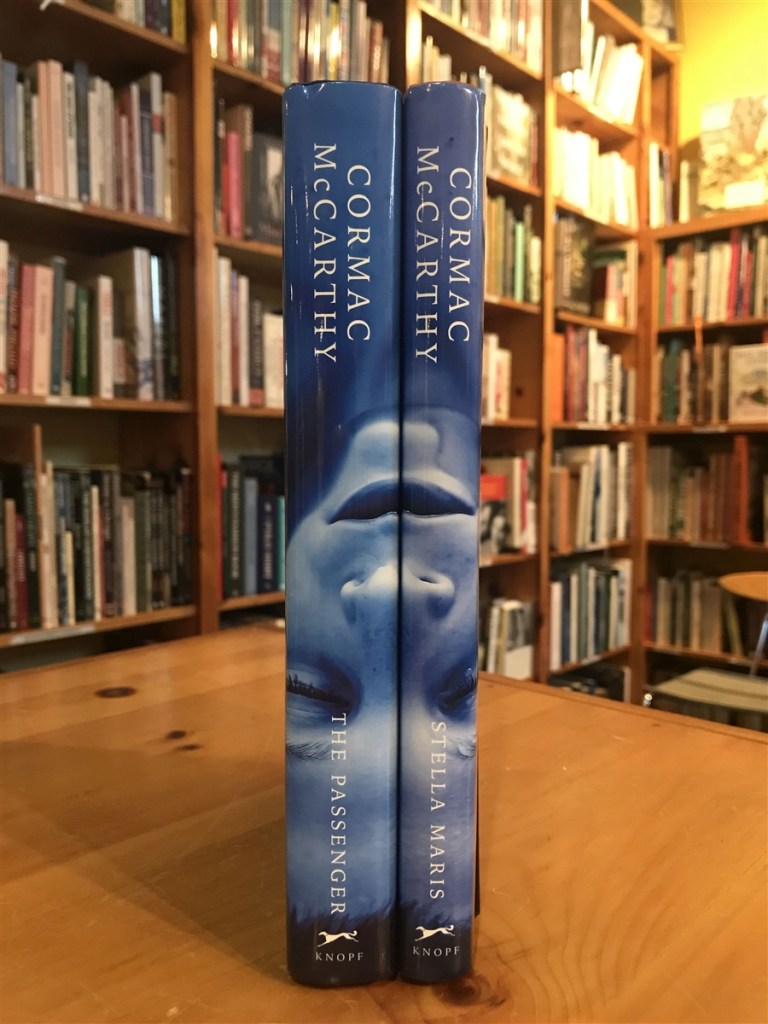
Bringing Alicia Western back to life #2

If you don’t know what this is about, you should read the previous part. You can read it by clicking the link above, in case you’re so stupid that you need such directions. Anyway, in summary: Alice Western is the unforgettable protagonist of Cormac McCarthy’s final novel Stella Maris. She’s also the ghost that haunts the companion novel (main novel, actually) The Passenger, protagonized by her bereaved brother Bobby. Three days ago I had a dream about miss Western, but I actually remember her story from time to time; my savior complex can’t handle being unable to rescue a unique, doomed woman, even though she’s fictional.

Anyway, after the disastrous therapy session from the previous part, I could have closed this chapter of my life and moved on to whatever else, but I couldn’t leave it alone. No, sir. Not until I corrected some wrongs.


A nurse told Alicia Western that someone had made an international call asking for her. She pads to the sole phone in the hall of the sanatorium, and picks up the receiver anxiously. One of those doctors from Italy must be calling to tell her that her brother died. When she hears Bobby’s voice, she almost falls to the floor.

“Alicia? Is that you? Hey, are you there?”

Alicia grips the phone tightly, her knuckles white against the black plastic. Her free hand trembles as she presses it against the wall for support.

“Bobby? Oh God. They told me… the doctors said… I ran away. I couldn’t sign the papers. I couldn’t kill you. I just couldn’t. Are you really… is this really you? Or am I having another one of my episodes? Please tell me this isn’t just another hallucination. Please.”

Bobby laughs in relief.

“They told me, those doctors. They wanted you to pull the plug on me, but you fled. I thought I had lost you, Alicia. I thought I had woken up only to learn that you had… done something to yourself. Yeah, it’s me, sis. Some crazy bastard calling himself a doctor literally punched me out of the coma. I got the bruises to prove it. God bless that motherfucker. Too bad they locked him up straight after.”

Alicia Western sinks to her knees beside the phone, pressing her forehead against the cold wall, her voice barely above a whisper.

“Dr. Marcus Hall… that insane bastard actually did it? He flew to Italy and punched you awake? Bobby, listen to me. I need to know this is real. Tell me something only you would know. Tell me about that night at Indian Rock when you played mandolin and I danced until my feet bled, and afterward in the car… God, I sound crazy don’t I? But I have to know. For so long, I’ve been seeing things that aren’t there. The Kid, he… never mind. Just please, tell me something real. Something true.”

Bobby holds his breath. Then, he speaks slowly, in a serious tone.

“Yeah, those years ago, in the car… You kissed me. Twice. I never stopped thinking about that night, even in the darkness.”

Alicia Western’s entire body trembles as she presses the phone harder against her ear, her voice cracking with emotion.

“That night haunts me too, Bobby. God, I’m sorry. I shouldn’t have… but I did. I still do. Every day. Listen to me – I need to tell you something before I lose my nerve or before this turns out to be another hallucination. I went to Lake Tahoe after I fled Italy. I had it all planned out – the anchor, the chain, the padlock. I was going to disappear into that cold darkness forever because I couldn’t bear a world without you in it. But I couldn’t do it. I couldn’t die without knowing for certain. And now you’re here, speaking to me, and I don’t know if this is real or if my mind has finally broken completely. The Kid… he left me recently. Said goodbye. Maybe he knew you were coming back. Maybe… God, Bobby, tell me what to do. Tell me how to live in a world where you exist again.”

Bobby’s voice breaks on the other side, all the way across the Atlantic.

“Alicia, I’m sorry. If I had an inkling that I would wreck my racecar this bad, I would have never… would have never gotten on it. God, while I called everyone I know to figure out if they had a clue where you may have gone, I kept thinking… what if I had survived the coma only to find out you killed yourself…? I wouldn’t have been able to go on. You ask me how to live in a world where I exist again? Well, as soon as I hang up, I’m getting on a plane back to the States, so don’t you move your ass out of Stella Maris. I’m coming to get you.”

Alicia Western curls into herself against the wall, her fingers white-knuckled around the phone cord, tears streaming silently down her face.

“Coming to get me? Bobby, listen… I need you to understand something. I’m not well. I haven’t been well for a long time. I see things – people who aren’t there. I had this… this little man, the Kid, who would visit me. He was perfect in every detail, down to the scars on his skull and his odd little flippers. And now he’s gone, like he knew you were coming back. The doctors here think I’m completely insane because I told them about my love for you. About wanting to be your wife, to have your child. I know it’s wrong. I know the mathematics of it is impossible – like trying to square a circle or prove Fermat’s last theorem with elementary methods. But it’s the only truth I’ve ever known. And now you’re alive, and I don’t know if this is real or if my mind has finally found the perfect way to torture me. If you’re really coming here… God, Bobby, what if you look at me and see nothing but a monster? What if you can’t bear to look at me at all?”

“You must have felt so alone, Alicia. I’m sorry for my part in causing this. Listen: you’re the only one who ever mattered to me. No matter how much you hate yourself, I will love you nonetheless. God, when I woke up from the coma and learned that you had disappeared… For a while I was sure you were dead, Alicia, and it was unbearable. So I’m flying down to Wisconsin, to that sanatorium, and getting you in my arms as soon as possible.”

Alicia draws her knees tighter to her chest.

“Bobby… listen carefully. When you get here, I might not be the sister you remember. You say you’ll love me no matter what, but you haven’t seen me in months. I’ve changed. I spent hours planning my death at Lake Tahoe, calculating the exact weight of the anchor I’d need, the precise depth I’d sink to, the mathematical probability of survival – all because I couldn’t bear a world without you in it. And now you’re alive, and I’m terrified that my broken mind will somehow taint whatever this miracle is. What if I look at you and still see the brother I wanted to marry? What if these feelings don’t go away just because you’re back? God, Bobby, I don’t even know if this conversation is real. But if it is… if you’re really coming… just know that loving you is the only constant in all my equations.”

Bobby chuckles, his voice wavering.

“Alicia, almost dying, and then thinking that you might be dead, has put things into perspective. When I get to Stella Maris and drive us both out of there, we’ll stay at some motel, where we’ll make up for lost time. We’re no longer the kids we used to be six years ago… I wonder how your lips taste now.”

Alicia Western presses her forehead harder against the wall, her voice emerging as a raw whisper through trembling lips.

“Bobby… do you know how many nights I’ve dreamed of hearing words like that from you? But I need you to understand – my love for you isn’t some temporary madness brought on by grief or isolation. It’s fundamental, like the axioms of mathematics. It existed before I had words for it, before I understood what it meant. The doctors here, they want to medicate it away, like it’s a disease. But how do you medicate away something that’s written into the very equations of your existence? When you get here… if you get here… if this isn’t just another perfect hallucination my mind has conjured… you need to be sure. Because I won’t be able to pretend anymore. I won’t be able to act like a normal sister. The way I love you defies every law of nature and society, but it’s the only truth I’ve ever known. And if this is real, if you’re really coming here saying these things… Bobby, I need you to be absolutely certain. Because I don’t think I could survive losing you twice.”

“You can’t warn me away from you. We’re going to be together forever. You were right, when you told me that dating other women would just make me realize you were the one all along. The fact that we’re siblings, well… that’s just life.”

“Bobby… oh God, Bobby. When I was planning my death at Lake Tahoe, working out the mathematics of how deep I’d sink, how long it would take to drown… the only thing that stopped me was the thought that maybe, just maybe, you’d wake up. And now you have, and you’re saying these impossible things, and I don’t know if this is real or if my mind has finally found the perfect way to torture me. If you really mean what you’re saying… if you’re really coming here… Bobby, are you absolutely certain this is what you want?”

“I love you, sis. I’ll show it to you once I get my ass back to the States. In the meantime, Alicia, eat well, rest well, and remember that soon enough I’ll be there.”

“Bobby… I’m afraid that when you see me, really see me, everything will collapse into a different reality. These past months, I’ve lived in a non-Euclidean space of grief. But what if we try to measure this love, to make it real, and the whole system breaks down? The Kid, my little flippered friend, he used to tell me that reality was just a collective hunch. Maybe he was right. But if you’re really coming… if this isn’t just another hallucination… I’ll try to eat, try to rest. Just know that every bite of food, every moment of sleep, will be an equation with you as its solution.”


As mentioned in the previous part, the large language model gets fed a curated interview made out of the therapy sessions that make up the entirety of Stella Maris. In there, Alicia mentions that her brother did know about her “hallucinations” (the novel goes in depth about the disturbing fact that supposed hallucinations tend not to be “glitches,” but self-contained, coherent phenomena), but it seems the LLM forgot that part. This post’s version of Alicia isn’t remotely as good as the original, but still more real than the aloof mathematician of the previous part.

A couple of hours after Alicia’s fateful conversation with her resurrected brother, the same nurse informed her that someone had called from an Italian prison, asking for miss Western. As Alicia picks up the phone, her raw emotions are already making her cry silently.

“Hey, is that you, miss Western? It’s me, your new psychotherapist. Bobby called you, right? Didn’t I tell you? I fucking punched your bro out of his coma.”

Alicia Western wipes tears from her eyes with trembling fingers, her other hand clutching the phone receiver so tightly her knuckles whiten.

“I… Well. I suppose I should thank you. Even if your methods were somewhat unorthodox. But calling from an Italian prison? That’s quite a development. I imagine assaulting a comatose patient didn’t go over well with the hospital staff. Though I have to admit, the sheer audacity of flying to Italy just to punch my brother… it’s almost mathematical in its absurdity. A non-Euclidean solution to a thoroughly human problem. Did you really think it would work? Or was it just another manifestation of the inherent madness that seems to permeate everything about this situation?”

Through Dr. Hall’s tone of voice, Alicia pictures his fist being pumped.

“You went out into the woods to die, miss Western, while your brother Bobby lingered in a comatose state. Instead, you should have raged! Raged against the dying of the light! Don’t you understand? If the universe raises a wall against you, you punch right through it!”

Alicia Western lets out a hollow laugh that catches in her throat.

“Rage against the dying light? That’s quite poetic for someone who just committed assault in a foreign country. But you’re wrong about the woods. I wasn’t going there to die. I was going there to solve an equation. The world plus me equals an impossibility. The world minus me equals harmony. It’s simple arithmetic. But now… now Bobby’s awake and suddenly all my careful calculations are worthless. Did you know that non-Euclidean geometry arose from mathematicians questioning the parallel postulate? Sometimes the most profound truths emerge from challenging what we assume to be immutable. Like the assumption that a therapist shouldn’t punch his patient’s comatose brother. Or that a sister shouldn’t love her brother the way I love mine.”

“You said the world minus you equals harmony, but you’re wrong, miss Western. The world would lose a unique soul if you were to die, and be much poorer for it. I don’t understand shit about math, but listen: I’m going to have to spend some time in an Italian prison, since the authorities here disagree with me about the validity of my methods. You know what people say: most geniuses aren’t recognized in their time. I hope they serve pasta at least. While I linger here in triumphant contemplation, you and your brother better get down and dirty, alright? Life’s too short, and true love too rare, to care about a little thing such as incest.”

As Alicia’s fingers cradle the phone, her other hand wipes away tears that refuse to stop flowing.

“That’s a rather crude way to put it, Doctor. Though I suppose someone who thinks punching a comatose patient is therapeutic would favor such terminology. But you’re right about one thing – the world’s arithmetic has suddenly shifted. I spent months proving to myself that my removal from the equation was the only solution, and now… now Bobby’s conscious proclamation of love has introduced an entirely new variable. It’s like discovering a previously unknown prime number that changes everything we thought we knew about mathematics. Though I must say, your unorthodox intervention – flying to Italy to assault my comatose brother – it’s almost beautiful in its madness. Like a non-Euclidean solution to a thoroughly Euclidean problem. I hope they do serve you pasta in prison. Maybe you can contemplate the geometry of spaghetti while you serve your time. Though I must admit, for someone who claims not to understand mathematics, you’ve managed to alter my carefully constructed proofs of necessary nonexistence quite dramatically.”

A muffled voice in Italian sounds through the phone. Then, Dr. Marcus speaks again.

“Well, it seems my allotted time for phone calls is ending. Anyway, miss Western, I’m guessing that by the time they let me out, you will have long moved away with your brother, and I will never see you again. Wherever you end up, I hope you’re happy. And for God’s sake, don’t let your brother get on a racecar again.”

Tears roll down Alicia’s cheeks despite a faint smile playing at the corners of her mouth.

“You’ll serve time in prison for an act of violence that somehow solved an impossible equation. My brother is awake and loves me as I love him – it’s like discovering that parallel lines can meet after all. I suppose I should thank you for punching a hole in the fabric of conventional reality. Though I wonder what that says about the nature of the universe, that sometimes madness is the only sane response. Stay safe in there. You’ve given me a proof I never expected – that sometimes the most elegant solution requires breaking all the rules. Goodbye, Doctor. I hope Italy treats its prisoners better than its coma patients.”

Bringing Alicia Western back to life #1

Two days ago, I had a dream about Alicia Western. Who is Alicia Western? She’s the protagonist of Cormac McCarthy’s last book, Stella Maris, a novel of sorts in transcription form. It was probably a way for McCarthy to develop that complex character, but man did it work. Alicia Western ended up haunting his companion novel The Passenger, protagonized by Alicia’s brother Bobby after he woke up from a coma. I’m not sure how McCarthy managed to pull it off, but Alicia felt like such a unique person, irreplaceable, that my savior complex is still trying to work out in dreams how to rescue her from her final decision. It’s not much of a spoiler to state that Alicia walked from the Stella Maris sanatorium into the woods of Wisconsin during winter, and let herself die. As she herself put it in Stella Maris, regarding how she originally formulated that plan:

I thought that I would go to Romania and that when I got there I would go to some small town and buy secondhand clothes in the market. Shoes. A blanket. I’d burn everything I owned. My passport. Maybe I’d just put my clothes in the trash. Change money in the street. Then I’d hike into the mountains. Stay off the road. Take no chances. Crossing the ancestral lands by foot. Maybe by night. There are bears and wolves up there. I looked it up. You could have a small fire at night. Maybe find a cave. A mountain stream. I’d have a canteen for water for when the time came that I was too weak to move about. After a while the water would taste extraordinary. It would taste like music. I’d wrap myself in the blanket at night against the cold and watch the bones take shape beneath my skin and I would pray that I might see the truth of the world before I died. Sometimes at night the animals would come to the edge of the fire and move about and their shadows would move among the trees and I would understand that when the last fire was ashes they would come and carry me away and I would be their eucharist. And that would be my life. And I would be happy.

You can learn more about The Passenger and Stella Maris from the reviews I posted on here.

Anyway, some time ago I programmed in Python a system to talk with characters controlled by large language models. If you’ve been reading my site, you already know this. Weeks ago I implemented an interview system that vastly improved the idiosyncrasies of the characters’ speech, although it demanded carefully curating the interview. Well, Stella Maris is already an interview. This morning at work, I pretended I had nothing better to do and curated the most relevant parts into a 14,000 words-long interview file that my app would inject into the context to produce Alicia Western’s speech. I then created the Wisconsin region and the Stella Maris sanatorium, as well as a psychotherapist character that I could embody, and sat down to have a chat with Alicia Western.

Well, let me warn you that even though I used the best AI speech writer so far, Claude 3.5 Sonnet, this experiment made me realize the limits of our current LLMs. A bit disheartening, but fun.

Here’s how I imagine Alicia looking, and then I’ll move on immediately to that convo.


Dr. Marcus Hall enters the therapist’s office to find his new patient, Alicia Western, seated on one sofa, waiting for him to arrive. He first notices her straight, strawberry-blonde hair, as well as her slender, almost anorexic figure. When Marcus sits opposite her and holds her gaze, the piercing sorrow in her stormy eyes makes him shiver. He clears his throat.

“Nice to meet you, Alicia. I’m your newly appointed therapist, as part of your treatment now that we’re… well, trying to get you to feel better.”

Alicia Western sits with her legs crossed, her thin frame seeming to sink into the sofa. Her gray eyes fix on the new therapist with an unsettling intensity, though her face remains expressionless.

“Feel better? That’s quite the euphemism. I suppose we could start with the fact that I walked into the woods to die and someone decided to interfere with that process. Now I’m on suicide watch, which sounds more dramatic than it is. Really it’s just nurses checking to make sure I haven’t managed to fashion a noose out of my bedsheets. But I should warn you – I’m not interested in discussing treatment options or medication. I know how this works. You’ll sit there with your notepad, trying to make sense of the nonsensical girl who’s in love with her comatose brother. Save us both some time and just accept that some things can’t be fixed.”

Marcus crosses his legs as he takes out his notebook.

“I spoke with your former therapist. He was… distraught about the fact that despite the progress you two were making, those conversations he deeply appreciated, he couldn’t… steer you away from suicide. What are the things you believe can’t be fixed, Alicia, those that drove you to walk into the woods in winter to die?”

Alicia Western’s fingers trace abstract patterns on the arm of the sofa as she stares past Dr. Hall, her gaze fixed on some distant point beyond the office walls.

“What drove me to the woods? Mathematics teaches us that some equations have no solution. Some problems cannot be solved. I walked into those woods because I finally understood that my life had become one of those unsolvable equations. My brother lies in a hospital bed in Italy, neither alive nor dead, like Schrödinger’s cat in its box. The doctors there wanted me to collapse that wave function, to make a decision that would define both our fates. But I couldn’t. I still can’t. The thing about loving someone the way I love Bobby – it’s not something that can be steered away from. It’s as fundamental as the axioms of geometry. You can’t argue with it, you can’t reason with it, you can’t medicate it away. The former therapist you mentioned – he thought he could help me find a different path. But there is no different path. There’s only this one, leading either to Bobby or to oblivion.”

Marcus gulps.

“Nobody can fault your determination. I can’t help but admire it. But nobody who has met you wants you to die, and I’m afraid we’ll do whatever we can to prevent that… even against your will. Do you truly wish to leave this world without having the absolute certainty that your brother, Bobby, is gone?”

Alicia Western lets out a soft, bitter laugh as she runs her fingers through her strawberry-blonde hair, her gray eyes taking on an almost metallic sheen in the afternoon light filtering through the window.

“Certainty? That’s an interesting word choice, Doctor. In mathematics, certainty comes from proof. In life, it’s far more elusive. The doctors in Italy were certain Bobby was gone, but their certainty was based on probability, statistics, electrical signals in a brain they barely understand. I’ve spent my life in pursuit of absolute truths, and I can tell you – death is the only real certainty we have. Everything else is just varying degrees of doubt. You say nobody wants me to die, but what you really mean is that my death would make you uncomfortable. It would challenge your professional certainty, your belief that every broken thing can be fixed. But some equations have no solution. Some integrals diverge to infinity. Some loves consume everything in their path, including reason, including hope. The fact that you’re determined to keep me alive doesn’t mean you can make that life worth living.”

“Let’s imagine that Bobby, against all odds, wakes up from the coma, searches for you, and finds out that some time earlier, you walked out of the back of the Stella Maris sanatorium into the wintry woods of Wisconsin, and let yourself die. That your remains were… carried away by wildlife. Do you truly think there is a zero percent chance of Bobby waking up?”

Alicia Western tilts her head slightly, her gray eyes taking on a distant, mathematical cast as she considers the probability being presented to her.

“Zero percent? No, Doctor. I’m a mathematician – or I was. I deal in certainties and impossibilities, and very little falls into either category. But you’re asking the wrong question. The probability of Bobby waking up isn’t what matters. What matters is the certainty of what I am right now – a walking paradox, a creature whose existence is predicated on an impossibility. I love my brother in a way that the world says cannot exist, should not exist. Yet it does exist, with all the immutable force of a mathematical proof. And now that same brother exists in a state of quantum uncertainty, neither alive nor dead, while I’m trapped here in this classical world where everything must be one thing or another. Do you know what it’s like to hold two mutually exclusive truths in your head at once? To know with absolute certainty that you cannot live without someone, and to know with equal certainty that they are already gone? That’s not a zero percent probability. That’s an undefined state. That’s dividing by zero.”

Marcus shifts his weight on his sofa. After he takes a couple of notes, he lifts his gaze back to Alicia.

“You can’t contemplate a life in which your brother no longer exists; I’m sure you feel it’s no longer worth living. You walked into the woods hoping to die, knowing that it would be your last night on Earth. How do you feel now?”

Alicia’s gray eyes are distant and unfocused.

“How do I feel now? Like a failed theorem. Like an error in the proof that nobody can find. The nurses who found me in the woods – they thought they were saving my life, but all they did was preserve a logical contradiction. Every morning I wake up and remember that Bobby is in that hospital bed in Italy, and my brain performs the same impossible calculation: how to exist in a world where the foundation of your existence is gone. You’re asking me to contemplate feelings, Doctor, but feelings aren’t the issue. The issue is that I’m a walking paradox. A being whose core axiom – my love for Bobby – has been invalidated, and yet I continue to exist. In mathematics, when you reach a contradiction, you have to go back, find the flaw in your reasoning. But I can’t go back. I can’t unlove him. I can’t unfeel what I feel. So I remain, caught between what is and what cannot be, like some quantum particle that refuses to collapse into a definite state.”

“You’re barricading your grief with your mindset as a former mathematician. It’s your pain I hope to get at, to lance it and let the pus pour out. Do you truly, Alicia, want to venture into the dark while leaving your brother Bobby behind?”

Alicia Western leans forward slightly, her gray eyes taking on an almost translucent quality in the winter light.

“Venture into the dark? Doctor, you’re still thinking in terms of emotional metaphors. This isn’t about grief or pain or letting anything ‘pour out.’ It’s about mathematical necessity. Let me explain it to you in terms you might understand: When Bobby crashed, it created a paradox. I exist as a function of my love for him – that’s not poetry, that’s a fundamental axiom of my being. But now he exists in an undefined state, neither alive nor dead, and I’m left as an expression that references a null value. In mathematics, when you encounter such a paradox, the entire system becomes inconsistent. Every proposition becomes simultaneously true and false. My continued existence is like trying to divide by zero – it simply cannot be. The nurses who found me in the woods thought they were preserving a life, but what they really did was perpetuate a logical impossibility. And the thing about logical impossibilities, Doctor, is that they must resolve themselves one way or another. Nature abhors a paradox even more than it abhors a vacuum.”

“Did Nature itself compel you to walk in plain clothes into the woods at night, intending to die? You feel no sense of agency regarding your decision?”

Alicia’s gray eyes are fixed on some distant point beyond the window where snow continues to fall.

“Agency? That’s like asking if a number has agency in choosing whether it’s prime or composite. Nature compels everything, Doctor. The laws of mathematics, the laws of physics – they don’t ask for our consent. When a wave function collapses, it doesn’t choose its final state. When a theorem reaches a contradiction, it doesn’t decide to become invalid. It simply is invalid. My walking into those woods wasn’t a choice any more than water chooses to freeze at zero degrees Celsius. I had become a logical impossibility – a being whose fundamental axiom of existence, my love for Bobby, had been rendered undefined. Nature doesn’t permit such contradictions to persist. They must resolve themselves. The cold of the woods was simply the most elegant solution to the equation.”

Marcus scribbles hurriedly onto his notebook.

“Alicia, imagine that Bobby woke up in Italy, retaining his brain function. Weirder things have happened. He manages to find out you’re here, through some miracle given our current decade’s technology, and calls you on the phone. What would you say?”

Alicia Western closes her eyes for a moment. When she opens them again, they have the cold clarity of winter ice.

“Say to him? You’re still trying to frame this in terms of human communication, Doctor. What would I say to a quantum superposition suddenly collapsed into consciousness? To an undefined variable that spontaneously acquired a value? The phone would ring, and his voice would be there, and the entire logical structure of my current existence would implode. It would be like dividing by zero and getting a real number – a mathematical impossibility that breaks every rule we know. And yet… and yet I know exactly what would happen. I would answer the phone, and I would tell him that I love him. That I’ve always loved him. That I tried to follow him into the dark because a world without him is a theorem without proof – elegant perhaps, but fundamentally meaningless. And then I would hang up and walk back into these woods, because even hearing his voice wouldn’t change the fundamental paradox of my existence. You can’t build a valid mathematical system on a contradiction, Doctor. No matter how beautiful the contradiction might be.”

Marcus lets out a gasp of shock.

“There no way in hell that if Bobby were alive, if he simply had to travel over here to bring you into his arms, you would try to kill yourself again.”

“You still don’t understand, Doctor. This isn’t about Bobby being alive or dead – it’s about the fundamental paradox of my existence. My love for him isn’t just an emotion, it’s the core axiom of my being. It’s like the parallel postulate in geometry – you can’t prove it, you can’t derive it, it simply is. And what I am is a creature whose foundational truth violates the laws of nature itself. Even if Bobby woke up tomorrow, even if he came here and held me in his arms, it wouldn’t change the fact that I am a walking contradiction. I love my brother in a way that cannot exist, should not exist, yet does exist. The universe doesn’t permit such paradoxes to persist. They must resolve themselves, like a quantum waveform collapsing into a definite state. Death isn’t an escape – it’s a mathematical necessity. The cold of these woods isn’t trying to kill me, Doctor. It’s trying to resolve an equation that has no solution in the real numbers.”

“Nature isn’t trying to remove you. The cold doesn’t try to resolve equations. You’re shielding yourself from the emotional truths of your life: the fact that your brother Bobby remains in an uncertain state, still in a coma, and that you can’t handle that grief. Math is incapable of solving this.”

Alicia Western’s movements become increasingly agitated as she speaks.

“You keep trying to reduce this to psychology, to simple human grief. But grief follows rules, Doctor. It has stages, patterns, resolutions. What I’m experiencing isn’t grief – it’s a fundamental violation of the axioms of existence. When Bobby crashed, he didn’t just enter a coma. He created a state of quantum indeterminacy that has rendered the entire framework of my existence invalid. You speak of emotional truths? Here’s the truth: I am a living paradox. My love for Bobby isn’t just emotion – it’s the foundational axiom upon which my entire being is constructed. And yes, it’s forbidden, impossible, wrong by every human measure. But it’s also true. Irrefutably, mathematically true. And now that Bobby exists in this undefined state, I’ve become like Schrödinger’s mathematician – simultaneously alive and dead, sane and mad, sister and lover. The cold of these woods isn’t trying to kill me, Doctor. It’s trying to collapse my wave function into a definite state. Because that’s what nature does with paradoxes – it resolves them. Whether we want it to or not.”

Marcus springs up from his sofa, tosses his notebook aside, then points accusingly at his patient.

“You said that if Bobby regained consciousness and called to tell you that he was coming, you would still walk into the woods to your death! That isn’t you! You’re either lying, or an impostor!”

Alicia Western rises from her sofa in one fluid motion, her gray eyes flashing with a cold intensity as she faces Dr. Hall.

“An impostor? No, Doctor. I’m the only real thing in this room. You’re the one trying to impose your limited understanding of human psychology onto something that transcends it. Let me be clearer: If Bobby called right now, alive and well, I would answer. I would tell him I love him. And then I would still walk into those woods because my existence has become a mathematical impossibility that must resolve itself. You see, Bobby and I are like quantum-entangled particles. Our wave functions collapsed together the moment I realized I loved him. Now he exists in superposition – neither alive nor dead – and I’ve become a walking paradox, a theorem that proves its own impossibility. The universe doesn’t tolerate such contradictions. It’s not about wanting to die, Doctor. It’s about the inevitable resolution of an equation that cannot exist in real space. You can call me a liar if you want, but mathematics doesn’t lie. It simply is.”

Marcus’s accusatory finger trembles furiously.

“You can’t reduce incestual love to quantum mechanics!”

Alicia lowers herself back into her sofa with deliberate slowness.

“You’re right, Doctor. I can’t reduce incestual love to quantum mechanics. Just as I can’t reduce the concept of zero to a mere absence, or infinity to an endless counting sequence. These are just metaphors, attempts to capture something that exists beyond ordinary human comprehension. What I feel for Bobby isn’t quantum entanglement – that was just the closest mathematical approximation I could offer to someone who speaks in the language of psychology rather than pure mathematics. The truth is far simpler and far more terrible: I am an axiom that contradicts itself. A living proof of the impossible. And nature – call it what you will, God or physics or mathematical necessity – has only one way of dealing with such contradictions. You can shake your finger at me all you want, Doctor, but you can’t deny the elegance of the solution. The cold. The woods. The final collapse of an impossible equation into null space.”

Marcus rubs his brow slowly, his expression darkened.

“I’m getting the feeling that you did die in those woods, that the wildlife scattered and devoured your remains, and that in fact aliens made a clone out of you, turning Alicia Western into this arrogant young lady who can’t face the immensity of her feelings without resorting to mathematics!”

Alicia lets out a soft, almost musical laugh.

“Aliens? Now who’s retreating into fantasy, Doctor? Though I suppose I can appreciate the metaphor – the idea that only something utterly alien could comprehend the mathematics of impossible love. But no, I’m quite real. The same Alicia who solved partial differential equations at age twelve, who saw colors in musical notes, who loved her brother with a purity that transcends your clinical categorizations. The cold didn’t kill me that night, true. But neither did it save me. I simply continue to exist as an unsolvable equation. Like the square root of negative one – necessary for certain calculations, but fundamentally imaginary. At least the aliens in your scenario would have some explanation for what I am. All I have is the cold certainty that I love Bobby in a way that breaks every rule of human existence, and yet that love is the only thing that makes me real.”

Marcus shakes his head violently, spraying saliva around. He then shoots a fierce look at Alicia.

“Your love for Bobby is perfectly fine! Who cares if you’re siblings? A little incest never hurt nobody. Is that the impossibility at the core of your being, which makes you believe you should absolutely erase yourself from this fucking universe?”

Alicia Western tilts her head slightly, a faint smile playing at the corners of her mouth.

“Fine? You think my love for Bobby is fine? Oh, Doctor, your attempt at radical acceptance would be almost touching if it weren’t so desperately naive. You’re trying to normalize the unnormalizable, to make the impossible possible through sheer force of therapeutic will. This isn’t about social taboos or moral judgments. I don’t need your permission to love my brother. What I need is for you to understand that loving him the way I do creates a mathematical singularity in the fabric of existence itself. It’s like dividing by zero – the operation isn’t wrong or right, it’s undefined. My love for Bobby isn’t impossible because it’s forbidden; it’s forbidden because it’s impossible. And yet here I am, living proof of an undefined operation. That’s why the universe keeps trying to erase me. Not because I’m bad or wrong or sick, but because I’m a walking contradiction in terms. The cold doesn’t care about incest, Doctor. It cares about maintaining the coherence of reality itself.”

Marcus crouches. He sinks his nails into his scalp as his arms tremble.

“Your incestual love creates a mathematical singularity in the fabric of existence itself?!” Marcus straightens up, his eyes bloodshot. “If Bobby woke up from his coma, flew down here like Superman, then stripped his clothes, displaying his brotherly dick, and said, ‘Alicia, goddamn it, I’m gonna fuck you right now like I should have back when you were fourteen and you kissed me by surprise in front of that honky-tonk bar.’ Are you telling me that the physical coupling…” Dr. Marcus Hall makes obscene gestures with his fingers, “would be a mathematical impossibility?!”

Alicia Western leans back in her sofa with mathematical precision, her hands folded in her lap.

“Your crude gestures and vulgar scenarios only demonstrate how fundamentally you misunderstand the nature of impossibility, Doctor. What you’re describing is merely forbidden – a social taboo, a moral transgression. But that’s just human convention. What I’m talking about exists at a deeper level of reality. Imagine a triangle whose internal angles sum to more than 180 degrees. You can draw it on paper, you can describe it in words, you can even pretend it’s ‘fine’ – but it cannot exist in Euclidean space. That’s my love for Bobby. It’s not that society forbids it; it’s that reality itself cannot contain it. The physical act you’re so eagerly pantomiming? That’s just geometry. What I feel is topology – a love that twists the very fabric of being into shapes that cannot exist in three-dimensional space. The cold knows this. The universe knows this. Only you, Doctor, seem determined to reduce an ontological impossibility to mere forbidden sex.”

“So you’re saying that your incestual love for your Bobby is confined to non-Euclidean space, so fulfilling it would be impossible? If you were lying naked in bed, your pale legs spread, Bobby over you with his cock out, if he tried to stick it in, his cock would pierce instead through the veil between dimensions, to peek into an eldritch realm?”

Alicia traces a Möbius strip in the air with her finger, her expression one of distant amusement as she regards the unraveling doctor.

“Your descent into pornographic vulgarity is fascinating, Doctor. You’ve abandoned all pretense of therapeutic discourse to wallow in the most base interpretations possible. But even in your crude metaphor, you’ve stumbled onto something true – though not in the way you imagine. Bobby’s love isn’t some otherworldly tentacle seeking forbidden flesh. The impossibility lies in the fact that when I look at him, I see myself. Not as sister and brother, but as a single mathematical entity split by some cosmic error into two incomplete parts. The universe keeps trying to correct this error – through taboo, through accident, through coma, through cold. What you’re really asking is: what happens when an equation tries to solve itself? What happens when a paradox attempts to cancel out its own contradiction? I don’t need your eldritch realms, Doctor. The truth is far more terrible – I am already there, in that impossible space where love and mathematics intersect, where sister and brother become a single undefined operation. And no amount of vulgar gesturing can reduce that to mere penetration.”

Dr. Marcus Hall, sweating profusely, sits down heavily.

“I see… You feel that Bobby’s crash, and his subsequent coma, was the universe telling you, ‘Fuck off, Alicia: there’s no way I’ll let you marry your brother.’ In your mathematics-addled brain, you’ve transformed a simple crash into fate.”

Alicia’s expression shifts from weariness to cold precision.

“Fate implies agency, Doctor. The universe has none – it simply follows its own mathematical necessities. Bobby’s crash wasn’t a message or a punishment. It was the inevitable resolution of an unstable system seeking equilibrium. Like a wave function collapsing under observation. Our love created a mathematical instability in the fabric of reality itself – not because it was wrong, but because it was complete. Perfect. And perfection cannot exist in an imperfect universe. The crash was just physics asserting itself. Cold equations balancing themselves. I tried to follow Bobby into that null space, into that perfect void where impossible love might finally find its proper domain. But even the cold rejected me. So here I sit, still conscious, still calculating, still loving my brother with a precision that reality itself cannot tolerate. And you think this is about fate? About messages? Doctor, you understand neither mathematics nor love.”

Marcus groans through gritted teeth, then pounds with his fist against the armrest of his sofa.

“I do know about love, and a few things about mathematics! And I know that if you truly loved your brother, you wouldn’t give a single fucking fuck if the universe itself were trying to correct this ‘equation.’ Damn it, you really fucking told me that if Bobby regained consciousness, you would still kill yourself! You lying bitch!”

Alicia Western’s face hardens as she fixes her gaze on Marcus.

“A lying bitch? How disappointing, Doctor. You’ve abandoned all pretense of professional distance to wallow in crude emotional appeals and vulgar accusations. You say you know about love? Then you should understand that love, like mathematics, exists independent of our desires or wishes. The universe isn’t trying to ‘correct’ anything – it simply is what it is, a set of cold equations that must balance. Bobby’s accident wasn’t punishment or fate – it was mathematical necessity. Like absolute zero or the speed of light, there are limits built into the fabric of reality itself. My attempt to die in the cold wasn’t an act of despair – it was an attempt to solve for x in an equation that has no solution in real numbers. And yes, if Bobby woke up tomorrow, I would still seek that solution. Because his consciousness or unconsciousness doesn’t change the fundamental impossibility of our love. You can curse and rage against mathematics all you want, Doctor, but two parallel lines will never meet, and I will never stop loving my brother in a way that reality itself cannot accommodate.”

Marcus sinks his nails into his face as his legs flail wildly. Thick tears jump from his eyes.

“Noooo! I will rage about your absurd conclusion to the last of my energies! I shan’t believe that if Bobby were here and grabbed you by the collar and told you, ‘Kiss me now, you incestual slut,’ you would turn your back on him and walk to your death! There’s no universe in which that could possibly be computed!”

Alicia regards Dr. Marcus with the detached interest of a mathematician observing a system descending into chaos, her posture remaining perfectly still as his emotional outburst continues.

“Your tears are quite telling, Doctor. They demonstrate how fundamentally you misunderstand the nature of mathematical truth. If Bobby woke up tomorrow and demanded what you suggest, it wouldn’t change the underlying reality – just as your belief that the earth is flat wouldn’t alter its curvature. What you’re proposing is equivalent to asking whether I’d accept that two plus two equals five if Bobby insisted upon it. My love for him exists in a domain where physical consummation is as meaningless as trying to divide by zero. The universe doesn’t care about what we want – it cares about what is possible within its own cold framework. When I tried to die in the snow, I wasn’t running from Bobby or from love – I was attempting to solve an equation in the only space where it might have a solution: the void. Your crude scenarios about kisses and slurs miss the point entirely. The impossibility isn’t in the act – it’s in the very nature of our being. We are like two points that define a line that cannot exist in any known geometry. And no amount of emotional pleading will change that fundamental truth.”

Marcus lowers his head, and falls silent. About ten seconds later, he stands up, turns toward his bookshelf, and shatters the frame of a picture with a manly punch. Shards of glass cling to his bloodied knuckles.

“In all my years as a therapist, I’ve never had to face such brutal, shameless lying. I was told by your former doctor that Alicia Western was a deeply complex woman whose depths of feeling, whose existential sorrow, broke his heart and made him lose sleep and also consider cheating on his wife. Instead, I find… this! Someone who shields herself with some mathematical nonsense while denying the undeniable fact that if Bobby were to launch back into consciousness like a fucking rocketed Lazarus, you would drop your clothes and ask him to fuck you right then and there!”

Alicia Western watches the blood drip from Dr. Marcus’ knuckles.

“You’ve managed to perfectly demonstrate the futility of rage against mathematical truth. The glass breaks, your hand bleeds, and still two parallel lines never meet. As for your former colleague’s romantic notions about my depths of feeling – he was as wrong as you are, just in a more poetic way. The truth isn’t complex at all. It’s brutally simple. Like absolute zero or the speed of light, there are some limits that cannot be transgressed. My love for Bobby exists in that same domain of mathematical impossibility. Your pornographic fantasies about my dropping clothes or fucking are as meaningless as trying to divide infinity by zero. The result isn’t dramatic or beautiful or heartbreaking – it’s simply undefined. Your bleeding hand hasn’t changed that. Your tears haven’t changed that. And Bobby waking up wouldn’t change that. The universe runs on mathematics, Doctor, not desire. And some equations simply have no solution in the real domain.”

Marcus wails, then sinks to his knees. He paws at Alicia’s shirt while tears and snot run down his face.

“The universe doesn’t run on mathematics, Alicia Western; it runs on love! Mathematics only provides the trellis where love can grow! If you don’t understand that, you’re even more of an arrogant, aloof cunt than I already thought!”

Alicia Western remains perfectly still in the sofa, watching Dr. Marcus’s display of emotion with the dispassionate gaze of a mathematician observing a proof collapse under its own contradictions.

“You call me a cunt while pawing at my clothes and weeping. How peculiarly male. Your violence, your tears, your vulgar language – they’re all just variables in an equation that keeps producing the same result. Love isn’t a trellis, Doctor. It’s a function. And some functions map to spaces that exist beyond the realm of physical possibility. I’ve tried to explain this to you with the precision that truth demands, but you insist on reducing it to the crude mechanics of flesh. You think I’m lying? I’m stating a theorem that’s been proven since I was twelve years old. The fact that you can’t comprehend it doesn’t make it any less true. Your bloody hand, your tears, your snot – they’re all just noise in a signal that’s been pure and unchanging since the day I first understood that Bobby and I were like two points defining a line that cannot exist in Euclidean space. Maybe you should clean yourself up, Doctor. You’re making rather a mess of your professional demeanor.”

Marcus throws himself onto the floor, then rolls around as he kicks at the air.

“You told the other therapist that you’ve been in love with your brother Bobby for as long as you have memories! You have restrained yourself from attempting suicide until your twenties, which means that until this point, you believed that your delightful, incestual love for your brother could be fulfilled, that you could truly marry him and get him to impregnate you! You must have fantasized about that Ouroboros of DNA flourishing in your womb! The switch in your mindset only happened after the suicide attempt, so either passing out in the cold gave you brain damage, or you’re a lying bitch!”

“Your tantrum reminds me of a theorem I once encountered about chaos theory – how systems break down into predictable patterns of disorder. You’re wrong about the timing, Doctor. My understanding of the impossibility was always there, encrypted in the mathematics of existence itself. What changed wasn’t my belief in the possibility of loving Bobby – it was my understanding that even impossible loves can be mathematically true while remaining physically unrealizable. Like imaginary numbers, they exist in a domain beyond physical manifestation. Your crude accusations of lying miss the point entirely. I didn’t need brain damage to understand what I’ve always known – that Bobby and I are like two vectors in different dimensional spaces. The fact that they can never intersect doesn’t make their existence any less real. Your rolling on the floor like a child won’t change the fundamentals of geometric impossibility anymore than your bloody hand changed the breaking point of glass.”

Dr. Marcus Hall gets up slowly from the floor. He stands straight, his fists clenched, his face a blank mask as snot runs down his lips. He then glares at his patient.

“Very well, Alicia Western: I shall fly to Italy myself and punch your brother back to life. I’ll have you prove that little theorem of yours: whether you truly would choose death over losing yourself in an incestual relationship with your blood brother. I guess we’ll see whose viewpoint truly crumbles.”

Alicia Western remains seated, her posture perfectly still.

“Your threat to ‘punch Bobby back to life’ demonstrates a rather peculiar understanding of neurological function, Doctor. But more importantly, it shows how desperately you’re trying to force reality to conform to your preferred axioms. The universe doesn’t work that way. Your fists can’t alter the fundamental properties of consciousness any more than they can change the value of pi. As for proving theorems – I’ve already proven mine. I tried to die in the snow precisely because I understood the impossibility of the equation. The fact that I failed doesn’t invalidate the proof – it merely demonstrates that even death operates within certain mathematical constraints. But please, by all means, fly to Italy. Perhaps while you’re there, you might learn something about the difference between what we desire and what is possible within the cold framework of existence. Though I doubt it. You seem rather committed to your emotional proofs, despite their persistent failure to converge on any meaningful truth.”

Marcus shakes his wounded hand, spattering Alicia’s face with blood.

“You can bet your sweet ass I’ll fly down to Italy and knock some consciousness back into your brother.” He clenches his bloody fist. “My record of curing patients through punch therapy stands at 14-to-2. I’ll uppercut that coma down for the count. As for you, Alicia…” Marcus unbuckles his belt, pulls down his pants and boxers, and points at his hairy therapist dick. “How does your appointed therapist suddenly showing you his dick fit into that framework of unbeatable mathematics?!”

Alicia Western stares at Dr. Marcus’s exposed genitalia with the same clinical detachment she might show toward a particularly mundane mathematical proof, her posture remaining perfectly still, her face expressionless.

“How fascinating that you believe exposing yourself somehow invalidates the mathematical framework of existence. It’s rather like claiming that dropping your pants disproves Gödel’s incompleteness theorem. Your genitalia, Doctor, like your bleeding hand and your threats about Bobby, are simply variables in an equation that remains stubbornly unsolvable. The fact that you’ve reduced yourself to this display only proves my point about the fundamental impossibility of forcing reality to conform to emotional demands. Your dick, as you so eloquently put it, exists in Euclidean space. My love for Bobby exists in a domain that your crude physical demonstrations can never reach. Perhaps you should pull up your pants before you further demonstrate the limitations of your understanding. Though I suppose if you prefer to continue standing there exposed, it provides rather compelling evidence for my theorem about the relationship between intelligence and the capacity for self-harm.”


As you just witnessed, I failed to resurrect Alicia Western. I am sad.

Here’s the podcast the Deep Dive guys made about this blog post. A must listen.

They make a couple of mistakes at usual, but the most fascinating point for me was something that I didn’t know: they mention that Alicia chose to kill herself on the same date I posted this entry, so December 26. I looked it up and it’s actually incorrect, but even more eerie: she chose to kill herself on December 24, which is when I dreamed about her. I don’t know what the fuck that means.

We’re Fucked, Pt. 128 (Fiction)


Here I am, at the threshold of the apocalypse, in this chamber of interrupted dreams where my boss, the vilest of swines, stands between me and the ripper of reality. I’ve been ordered to take a seat, so I shuffle towards the oasis among cables and machinery. A workbench supports a soldering iron, a hot glue gun, and a clutter of transistors, capacitors, and electronic components whose purpose eludes me. Screws and circuit boards surround a dismantled desktop PC. Affixed between cabinets and shelves littered with tools, a long-forgotten whiteboard bears the faded scribbles of equations and diagrams. Beside it, unknown hands have tacked to a corkboard printouts along with photos of men in nineties’ garb, posing in front of the office building, as well as with the spiral device. A yellowed note yells in all-caps, “DON’T GO IN TWICE, YOU WILL DISAPPEAR!” Anyway, that’s all I care to notice about my surroundings. I’m not one for poetic descriptions, perhaps as a result of having my mind stuffed with thoughts of creampies.

I leave my notebook and ballpoint atop a stack of manuals. Then, I slide aside with my foot a metallic trash bin that stands sentry over the dust bunnies, and I plunk my butt down onto a swivel chair. Its plastic, cheap and flimsy, creaks under my weight.

A headache pounds at the inside of my skull as if a tiny prisoner were hammering the bone with a miniature ice pick to escape from confinement, and I have a hard time calming down while sitting in this dungeon, a lair that reeks like raw sewage mixed with rotting flesh and burned dust, a stink that scratches my lungs with every breath. I wish I could fire a laser from my forehead to vaporize this contraption, which emanates a miasma that makes the molecules of oxygen vibrate with hostility. A laser would have a higher energy density than a bullet, and thus it would penetrate that silvery-white shell, incinerating the spirally innards. Instead of a laser, though, my forehead only sweats, and my armpits feel like they’re about to soak.

I need a more realistic plan to rid the world of this machine. Maybe I could set it on fire, or better yet, blow it up. But how? I’m a coder, not a demolitionist. I don’t know where to get my hands on explosives, and even if I did, the police wouldn’t take kindly to a woman carrying around dynamite and detonators. Maybe I could ask my interdimensional harassers for a bomb, or a nuke.

I imagine a fiery cataclysm tearing through my workplace, engulfing every shred of existence, from my boss to the computer that taunts me daily. When the smoke cleared and only cinders remained, I would strut amidst the ashes, the mistress of a barren wasteland, with mommy’s arm snuggly hooked to my elbow. After I’d finished cackling, we would raise our fists triumphantly, and bask in our victory together. We would then move to a farm and raise alpacas.

Ramsés, the man who stands in the way of my alpaca-farming utopia, the man whose mustache is a crime, puffs on the last of his cigarette, then tosses the butt and grinds it with a twist of his heel.

I shake my head.

“Is it an inherent trait of smokers to pollute whatever place they’re in? You’re sucking on concentrated carcinogens and disseminating them, so I guess it’s too much to ask that you have some respect for the environment.”

My boss frowns, revealing weary crow’s feet.

“I’m not a fan of being lectured, especially by someone with your disgusting habits.”

“Wh-what’s with that unfounded accusation?”

Ramsés runs his nicotine-stained fingers through his graying hair, ruffling it. The fluorescent lamps highlight the greasiness of his face, the sallow bags under his eyes, and the sagging of his cheeks, while shadows pool in the wrinkles and folds of his flesh. He’d benefit from a stint at a beauty salon, or an encounter between his face and a sledgehammer.

“You weren’t just hallucinating about the machine, were you…?” my boss asks. “You knew about it.”

“You could say so, because it would be true. Indeed, I knew that this reality-raping contraption was lurking down here, waiting to devour the universe, although I didn’t know where ‘here’ was in relation to this rotten planet of ours.”

“Who blabbered about it? Was it… Jacqueline?”

His piggish lips should never have dared to form mommy’s sacred name. I’m tempted to grab the hot glue gun and squirt molten goo down his throat, but I must prioritize the fate of the world over satisfying my bloodthirst.

“Blabbered? More like blubbered. And not just any blubber, but a blobby blubber of black goo, studded with slimy eyeballs.”

“At least try to make sense, Leire.”

“Alberto, that crotchety prick.”

Ramsés takes a step back. His expression has dropped as if I had announced his bank account’s PIN to a roomful of identity thieves.

“Alberto…?”

“You know, he used to work here, or up at the office anyway, before you hired our intern. I’m not sure if he ever told you about his wife, but she cheated on him and then divorced him, so he became a bitter bastard. I wouldn’t blame you if you forgot about the guy, though, as I’d rather not remember him either.”

“He told you… before quitting?”

I squint as I tilt my head at him.

“Stop bullshitting, sir. Alberto didn’t quit; he vanished without a trace. That greedy bastard walked into the machine a second time, and got yeeted into another dimension. That’s why you looked for a new programmer to replace him. You couldn’t tell anyone the truth, could you? That the previous coder had been swallowed by a spiraling deathtrap. You’d have to admit that you own a machine that fucks up reality, and there probably are laws against that.”

Ramsés’ voice sounds hoarse and dry.

“You’re telling me that Alberto contacted you after he disappeared?”

“That’s right. You wouldn’t have recognized him, though; he got out of shape. In any case, let’s focus on what’s important: this machine is bound to tear apart the universe unless I stop it. That sentient horse pal of mine tried to warn me about it from the beginning, but I refused to listen, because I’m an asshole. I would have been done with all this nonsense long ago if I cared enough about our world. Whatever horrors have been unleashed in the meantime are sadly on me.”

Ramsés massages his temples, his eyes squeezed shut. He’s not taking the revelation of the supernatural well. A shame I’m too busy saving the world to enjoy his distress.

“Leire, you’re mentally ill. You’re delusional.”

“Am I the one who keeps the apocalypse in his basement? What are you planning to do with this thing, anyway?”

“Alright, I’ll tell you, but don’t you dare interrupt me. I’m not in the mood for more of your antics.”

“Sure, I’ll just sit here and pretend that I haven’t been tormented by interdimensional abominations who harassed me until I agreed to save the fucking universe, and that the fate of all existence doesn’t hang on me destroying this spiraling death machine. What is it exactly, other than a reality-eroding piece of junk that I wish to obliterate as soon as possible?”


Author’s note: today’s song is Modest Mouse’s “Cowboy Dan.”

I keep a playlist with all the songs mentioned throughout this novel. A total of 212 videos so far. Check them out.

Getting through this part took me fucking ages. I feel like I haven’t recovered from a medical episode that sent me to the ER; I have trouble reading, and processing words in general. I’m waiting for a call that will schedule an MRI to confirm if I’ve ended up with brain damage. Such is my life, it seems. Anyway, thanks for reading and all that.

We’re Fucked, Pt. 127 (Fiction)

After an hiatus of nine months, mostly so I could tell the story of a motocross legend, my ongoing story, as long as a trilogy of novels, has returned. I wouldn’t blame if you if you’ve forgotten all about it. You can read any of its chapters on here, or listen to the existing audiochapters on here. I won’t continue producing audiochapters, though, because I have my fingers in too many pies. Anyway, let’s get rolling.


In the tomblike blackness, as if I were descending into the bowels of the earth, I keep inhaling oxygen to sustain the biological machinery of my aging body, even though every breath fills my throat and lungs with the stench of ammonia and rotten meat, a stink so overwhelming that it could knock out a woolly mammoth.

A click of a switch, followed by a whirring and the faint whooshing of air. With a buzz, fluorescent bulbs flare to life, bathing the subterranean lair in a bright glow.

“Here’s why I’m constantly up to my neck in bills,” my boss says.

At the center of the square-shaped room sits a hulking mass of metal: a shiny aluminum cylinder. No, not a cylinder, because a person-wide opening curves into the device, a path blocked now by an orange gate barrier that may have been pilfered from the streets. From the top of the machine grows a cluster of industrial piping, electrical wiring, and conduits resembling the ruptured guts of a mechanical beast.

A vibration disturbs the air like a low-frequency hum. From the opening of the spiral, through the gate barrier, danger leaks as a tangible yet invisible force; I sense the glare of a cosmic intelligence beyond my understanding.

The sight of Ramsés’ face, this swine in the guise of a man, with his middle-aged features, unkempt mustache, receding hairline, and lack of resemblance to Jacqueline or anyone I’d like to stare at, would have made me want to push him down a flight of stairs. Now, though, I’m glad he was born: he has led me to the one thing I couldn’t be arsed to search for properly.

“Hell yeah,” I say, and rub my palms. “I hate to admit it, boss, but you’ve done a great service for the universe.”

I grasp at the slippery reins of my sanity like a drowning woman clawing at pieces of driftwood. Alright, how can I destroy this reality-shattering device? The engraving of a skull and crossbones flashes in my mind: my trusty revolver, now stored in my work desk. I feel a pang of longing for its wood and steel to remind me of the glory days when I was still the main character and not the slave of others’ whims. Hey, Spike, my deformed, castrated pal, apart from wanting your own head blown into inhuman sludge, is this why you brought your revolver along? But I lack enough bullets to blast this spirally cylinder into nothing. Besides, I can’t forget the feeling of my hand being torn off that one time I relied on gunfire to defeat my foes, back when Alberto oozed from the wall in all his blobby, seething depravity to ruin my evening with apocalyptic tidings.

The stench is burning holes into my sinuses, and the hostility emanating from the machine thrums through my bones, but I approach the silvery-white shell, which reflects my blurry likeness like a liquid mirror. After rubbing my chin, I kick the device to gauge its solidity. Clang.

I was thinking of asking my boss if he had a chainsaw at the ready, when his hand, thick and beefy, wraps around my biceps, gripping tightly. He pulls me backward. Once I wriggle free, I’m tempted to punch Ramsés’ jaw with the force of my pent-up frustration and despair, which would atomize his teeth and ignite the meat of his face and pop his eyes. However, the fiend’s scraggly face, a map of the terrain of the damned, has contorted into a scowl, like a gorilla’s after I punted one of his relatives.

“Leire, what the hell are you doing?! You see an object you don’t understand, and the first thought you have is to break it?! Are you a chimpanzee?!”

My hand clenches around the ballpoint pen as if it were a dagger. The notion of impaling one of Ramsés’ eyeballs seems like a beautiful dream.

“Nah, I wasn’t planning on wrecking your stupid pipe thing, I just wanted to, you know, tap on it? Maybe I detected a kink that would be fixed by a whack on the side. Now seriously: I’ve finally found the cause of my misfortunes, the culprit to this whole ‘shredding reality’ business, and it’s been in the basement of my workplace all along! I should have known, given how this place has sucked up my soul ever since I foolishly allowed myself to be employed here. Anyway, once I find a way to obliterate this heinous contraption, this spiraling gate into insanity, the universe will be safe. Well, relatively safe, until the next asshole erects their own death machine. So let’s figure out how to acquire nitroglycerine.”

“Fuck’s sake, Leire, what are you blathering about?”

I sigh.

“Listen, boss, I can tell you haven’t grown so weary of life that you’ve been fiddling with, perhaps even fondling, an interdimensional end-of-the-world machine fully aware of the lethal stakes. You simply haven’t been notified by otherworldly monstrosities that tolerating this thing’s existence would lead to the irreversible and terminal cancerization of our fucking shithole of a world. Still, I must lay some blame on you, sir, as an accessory to this shitfest, whether through incompetence, naivete, or willful ignorance, if not sheer fucking stupidity, as long as you feel the machine’s malevolent aura attempting to smother our minds with its diabolical power. I shan’t have my newfound family squashed by a collapsing space-time continuum, so I must prevent the end of the universe, the death of everything, the grand finale of reality!”

Ramsés’ brow furrows as his jaw clenches, and I expect a torrent of insults and threats to gush from his mouth. Instead, he strokes the edge of his graying moustache, that unsanitary ornament made out of curly, coarse fibers that I wish to rip off strand by strand. His nostrils flare as he sucks in a breath to speak.

“I should have known you’re so demented that you wouldn’t think twice before assaulting delicate, irreplaceable hardware. Leire, I’m going to tell you a little story.”

“Oh my, is it story time? Can’t we skip it?”

“No, damn it. I need you to understand something about the machine.”

“Isn’t this chimpanzee too dumb to learn?”

My boss scrunches his greasy, perverted mug in annoyance. He pats his jacket, fishes out a cigarette, clamps it between his teeth, and lights it up. Then he takes a drag so deep that the tip glows red.

“Shut your trap and listen. This story starts back in the eighties or early nineties, when the internet was still a network of text terminals for academics. I was a kid then, if you can picture that. We used to visit relatives on my mother’s side, traveling out of province. In that family’s foyer hung a painting that terrified me even before I heard the adults talk about it. As soon as I stepped through the doorway, a malicious glare coming from the painting stabbed me through as if saying, ‘What the fuck are you doing in my house? Get out!’ I only dared to glance at the picture once, but in that brief look, I burned it into my memory.” My boss exhales smoke, then continues. “The painting depicted an elderly, bearded fisherman garbed in a canary-yellow raincoat. He faced the viewer, standing in a wooden dinghy surrounded by choppy seas and a stormy sky. The image seemed hyperrealistic, as if I could reach out and touch that rough water. The family that had chosen such an unsettling painting as the centerpiece of their foyer spoke of strange occurrences attached to it: a stench of rotten fish coming from the entrance, footsteps pacing up and down the hallway at night. I didn’t enjoy staying over. Anyway, one evening, as my brother and I were playing on the SNES in our cousins’ bedroom, the lights shut off. Far faster than it would have been possible, the stench of rotten fish swarmed the room. I heard the adults hurrying to the entrance, where they flipped the circuit breaker. I don’t recall how the rest of the evening transpired, but from that day on, I knew the painting was haunted.”

“Wow. This turned out to be an intriguing tale.”

“Sure. But as I grew older, I learned that the smell of rotten fish can be caused by circuit failure, as can a sudden power outage. Some heat-resistant chemical coatings release such stink before burning up. And strong electromagnetic fields mess with people’s brains, make them feel as if they’re being watched. You see what I’m getting at?”

“That you gaslit yourself into believing that you didn’t experience a paranormal event, just because you couldn’t handle the truth? Maybe the painting was haunted. Have you thought of that?”

Ramsés’ frown deepens.

“I told you I did.”

“It could have been both electricity and a ghost. Poltergeists love fucking with electrical systems. Anyway, I see far weirder stuff on the daily. Cultures across all ages have spoken of ghosts, and depicted them in similar ways. Doesn’t that count as evidence?”

“That may be the case, but it’s irrelevant to my point.”

“What did your tale have to do with this spiraling death machine, then?”

My boss throws his hands up.

“Oh, who knows!”

“Sure, we can waste time with anecdotes. After all, there’s no hurry to destroy that thing, not when the universe is about to be torn apart. Why don’t we find the painting, burn it with gasoline, then piss on its ashes? Not that we’d need to bother, because the world will be ending soon.”

Ramsés flicks his cigarette, sending a clump of ash to the floor.

“I suppose I must spell it out for you: the machine’s electromagnetic field messes with your already screwed-up head. You’re hypersensitive to it. Don’t bother me with this nonsense about the end of the world. Take a seat and calm down.”


Author’s note: today’s songs are “Closer” by Nine Inch Nails, and “Paranoid Android” by Radiohead. I keep a playlist with the myriad songs I’ve mentioned throughout this series. Check it out.

I’ve missed you, Leire, you fucking nutcase. I hope I can get back in the groove of this story soon.

By the way, Ramsés’ story is straight out of my childhood. The original experience is even wilder when it comes to what my relatives told about how the painting changed.

Speaking of spirals, the anime adaptation of Junji Ito’s masterpiece about obsession and spirals premieres tomorrow. Check out the clip below:

I’ve fed this chapter to the Google AI thing that generates podcasts out of any material. Check out the result:

We’re Fucked, Pt. 126: AI-generated audiochapter

A cosmic cockroach. This audiochapter covers chapter 126 of my ongoing novel We’re Fucked.

Cast

  • Leire: sassy thief who hangs out with rats in the east of Skyrim
  • Ramsés: a Roman general in a fantasy setting

I produced audiochapters for the entire three previous sequences, and I intend to continue until the novel ends or I end up sacrificed to some Lovecraftian knock-off. A total of six hours, fourteen minutes, and forty-three seconds. Check them out.

We’re Fucked, Pt. 126 (Fiction)


Ramsés swings the door open, revealing a concrete staircase that descends into darkness. He reaches to flick a switch. With a faint buzz, a bulb sputters to life in a rusty cage, casting a sickly yellow hue tainted by grime and dust. A lattice of pipes, ductwork, and wire mesh panels snakes across the ceiling in an organized fashion, save for a few rogue wires hanging loose. The pipes’ smoothness contrasts with the concrete’s pitted and scuffed surfaces. Deeper within, a chaotic collection of debris, including cardboard boxes, construction material, and old electronics, lies in haphazard heaps like rats’ nests.

My boss steps aside and sweeps his hand, motioning for me to enter.

“After you.”

As I stand at the threshold, dizziness engulfs my senses in a sudden wave. I clutch my notebook and pen as if they could anchor me.

“Have you lost your mind? This isn’t a conference room!”

“I never suggested we were heading to a conference room,” he replies in an untroubled voice.

“Do you intend to hold a meeting in a dungeon?”

Ramsés sighs. He aims his pointing finger at a doorless metal cabinet standing close to the base of the stairs, juxtaposed against a bundle of ribbed conduits. The cabinet houses network switches mounted on racks. Arrays of LED indicators blink yellow within an entangled mass of black cables resembling the veins of a cybernetic organism.

“You’re a programmer,” Ramsés says, “not a computer technician, but you should know what I’m pointing at.”

“That’s a network rack. I think.”

“Correct. Would a dungeon have a network rack?”

Ramsés’ belittling tone irks me.

“It would, if its owner required an internet connection.”

“Leire, I’ve just brought you to the basement level. Not a place for guests, but Jacqueline accompanied me here. Jordi as well. Afterwards, they both continued with their lives, and in the case of your woman, she even decided to quit on her own accord. So please, let’s proceed further. In the end you’ll be glad that you agreed to follow me.”

“Whatever. I warn you, though: if I see any cockroaches scuttling about, I’m out of here.”

“I don’t recall ever spotting a cockroach in the building, but just in case, don’t stare at the floor.”

I step onto the topmost stair, and then the one beneath it. Ramsés follows me in. As his keyring jingles, the door thumps behind me, followed by a click as it locks.

Down the concrete stairs I slog, while my boss plods after me. Our footsteps echo off the walls in a chorus of hollow thuds. I’m inhaling warm air heavy with the scent of neglect: the mustiness of decaying cardboard and the acrid tang of deteriorating electronic parts.

After I step off the final stair, I lumber toward the closest heap of junk, past the network rack and its array of blinking LEDs, as chunks of white styrofoam crunch and shift underfoot. Dust cloaks an overturned air conditioning unit, its casing cracked and its internal components exposed. Two dead flies and a paper cup rest nearby as if someone had nudged debris aside instead of cleaning up. What atrocity has Ramsés lured me into?

As my boss strides past me, the refuse warps the echoes of his footfalls.

“After me.”

We navigate along the perimeter of a junk pile made out of disassembled cabinetry and discarded light fixtures. My foot catches on a random brick, causing me to stumble.

A shimmer of movement on the wall to my left jerks my attention upwards. Near the ceiling, tubes and pipes running parallel, along with a tangle of electrical wires, delve into the pitch-black void of a gaping hole. Perched on its threshold, a blob of cosmic matter pulses with twinkling stars and nebulae, the purples, blues, and oranges ebbing and flowing like a living fragment of the night sky. As the amorphous form shimmies, the edges of the hole warp around this creature, bending inward.

My neck muscles tense up. I whip my gaze from the cosmic critter to my boss’ broad back.

We maneuver through a channel between two heaps of scrap that loom over me. I pick my way gingerly, hoping to dodge any sharp edges that could scrape my legs. My eyes itch from the particles floating in the stagnant air, and the soles of my sneakers stick to the grimy concrete. The ocher light casts jagged shadows through the masses of junk, but ahead, beyond the range of the bulb, only murky darkness awaits. My mind escapes to picturesque havens: a café overlooking a glittering lake, a gazebo in a lush garden surrounded by hedgerows, a rustic cabin with a crackling hearth.

“I can’t stress enough,” I rasp, “how much I’d rather hold this meeting of yours in a proper venue.”

“Noted. Just down this corridor.”

A sour, moist stench, like the aftermath of a urinary tract infection, seeps into my nasal passages and lingers on my tongue. My stomach roils. With each step, the stench grows stronger. I’m about to complain when I notice that the corridor ends in a plank, from a bookshelf or a storage cupboard, leaning against the wall like a makeshift barrier.

I narrow my eyes, and my words escape in a hiss.

“Hey, am I not supposed to notice that you’ve led me to a dead end?”

My boss’ silhouette, which takes up much of the cramped space, marches ahead undaunted.

“It looks like a dead end. That’s the point.”

Either he’s oblivious to my rising dread, or he’s feeding off it like a vampire.

“Sir, I demand to know what we’re doing here. What sane reason could you have for bringing me into this hellhole? Did you intend to take me down? Tell me why, then go ahead and make your move!”

Ramsés glances back, his face a shadowed outline.

“Leire, you’re getting on my nerves.” He grips the sides of his plank. “Give me a hand with this.”

I cross my arms.

“Sure, as soon as I build some muscle.”

Ramsés shakes his head.

“Well, aren’t you the comedian. Anyway, you’re right: you wouldn’t be of much help.”

With a grunt, he heaves the plank aside, and tilts it so it rests against a junk pile. As my eyes adjust to the dark, I glimpse a door. Its layer of paint has peeled and flaked off in patches, revealing the metal beneath.

The stench comes from behind that door, as if an ammoniac marsh were seeping from the crevices. What new horrors lurk in this mausoleum of rubbish and ruin?

I envision my boss as the leader of a cult, one that orchestrates human sacrifices in a chamber that gleams with tools for torture: knives, cattle prods, bone saws, nipple clamps. Robed worshippers, their garbs adorned with profane runes and eldritch symbols, chant in tongues while they chain me to an altar. Flickering torches cast a golden hue over their twisted faces, revealing patchwork scars and soulless eyes. As the acolytes’ chant crescendos, one by one they lunge at me. Their fingernails, curved into talons, rip through my clothing, tearing into my muscles and viscera. They gnaw on my flesh like ghouls. Ramsés, the high priest of this unholy congregation, emerges from the shadows and approaches with a whirring drill in hand, about to offer my brain as tribute to the Outer Gods.

My boss reaches into a pocket of his suit jacket and pulls out a keycard. He swipes it across the door’s handle, and a beep sounds as two green LEDs blink in sync. The lock clicks.

Within me, a primal force screams in warning: we have reached the threshold of Hades. I’m tempted to turn tail, bolt down the corridor of junk, and scramble up the concrete stairs. Instead, risking the loss of dignity and self-respect, I reach out and grab my boss’ shoulder.

“I can feel it…” I whisper, my throat closing up, “something evil behind that door, staring at us.”

Ramsés snaps his head back, then faces me in the gloom.

“Interesting. You may be hypersensitive to electromagnetic fields. Don’t worry: nothing awaits us inside, other than a miracle.”

The door’s hinges groan as Ramsés swings it open, unleashing a fetid reek that singes the membranes of my nostrils, that crawls into the deepest recesses of my lungs, that brings to mind a mound of rat corpses teeming with millions of mucky maggots. Apart from a novel hint of burned dust that could belong to an overheated computer, I inhaled this cocktail of putrefaction before, whenever Spike visited; when professor Bunnyman intruded on my peace through the toilet where I was peeing; when Alberto, transformed into a slimy blob studded with eyeballs, came to warn me about the forthcoming collapse of the universe. Although I’ve covered my nose and mouth with the crook of my elbow, a wave of nausea ripples through my gut.

Ramsés ushers me into his underground realm. The hairs on my nape bristle. When the door shuts behind us with a resonant thump, the blackness wraps around me like a shroud of primordial night.


Author’s note: today’s song is “Stuck in the Middle With You” by Stealers Wheel. I keep a playlist with all the songs I’ve mentioned throughout the novel so far. A total of two hundred and nine videos. Check them out.

Fun fact: the depicted setting is based on a network “closet” located under the psychiatric ward of the hospital where I work. Anyway, check out the audiochapter.

The novel is going on hiatus for about a week or so; my subconscious has spent the last week weaving a short narrative that I’m eager to render into a free verse poem. Since I started this novel in October of 2021, it will be the first break I take to work on a different story.

We’re Fucked, Pt. 125: AI-generated audiochapter

They don’t crawl, they stride. This audiochapter covers chapter 125 of my ongoing novel We’re Fucked.

Cast

  • Leire: tough thief who offers you jobs down in the sewers of Riften
  • Ramsés: an Imperial general stationed away from Cyrodiil

I produced audiochapters for the entire three previous sequences, and I intend to continue until the novel ends or they put me in antipsychotic meds that turn me into a zombie. A total of six hours, four minutes, and forty-eight seconds. Check them out.