Smile, Pt. 1 (Fiction)

Cassie June was hobbling along the scorching sidewalk, dragging her skates as though they were cement boots. She stood about four feet tall. She had jammed a plastic visor onto her head, and her knees were protected by thick pads like pieces of some armor. Beads of sweat glistened on the tanned skin of her shoulders, arms, and legs. As my car pulled up beside her, I noticed Cassie was blinking—maybe to keep the sweat out of her eyes, or because fatigue was overpowering her—and she breathed through her mouth like a fish on the lookout for food flakes.

It never ceased to amaze me that I could recognize living faces, that a person’s features in the flesh would match those I had memorized from a faded photograph, the frozen image I had stared at until I became familiar with the rage and hatred that filled me and shot through me like electric jolts.

A flash in the rearview mirror dazzled me. In that rectangle of glass, the ruby-red body of the Ford Thunderbird glimmered, except for the stripes of shadow along the raised center. Its grille: two rows of metal cells in a robotic smile.

The bronze-like, wavering glare of the sun sometimes concealed the silhouette of the man at the wheel. The lenses of his sunglasses ignited. The outline of his face showed pale holes for eyes, big as a startled owl’s.

I slowed my car to match Cassie’s skating speed. Behind me, the Ford Thunderbird closed the gap. I braced myself, expecting a metallic crunch that would jolt my back from the seat. With one hand still on the steering wheel, I reached to my right and, turning the crank, rolled down the passenger-side window. The car crept along, shielding the girl, who tugged a strap of her T-shirt up over her shoulder. On its chest, the superheroes from the Super Friends series posed.

“Cassie,” I said.

The girl was swaying on her skates, as though squeezing out the last dregs of her battery. The band of her visor pinned down some sweat-soaked brown strands. Little trails of sweat slithered down her neck.

I hardened my voice.

“Cassie, get in. I’ll take you home.”

She slowed down, turned her face, and cut off her panting with a little noise of confusion. She leaned forward to peer inside the car.

“It’s not far.”

“It’ll be less far if I drive you.”

A horn blared behind me, making me jump. In the rearview mirror, a rippling band of bronze now covered half the man’s body. He slammed his palm into the horn again.

I clenched the steering wheel’s rubber grip to focus my anger. When I opened the passenger door, Cassie skated backward in a semicircle to avoid getting hit by it. She let herself drop sideways onto the seat and lifted her legs inside with her hands, as though they’d fallen asleep. She shut the door.

I sped up to the tune of another long honk. I exceeded my previous speed, but in the rearview mirror, the Ford Thunderbird kept pace. Amid the haze of heat, the man’s knuckles rose over the wheel like an eagle’s talons.

“What’s this weird gadget?” Cassie asked.

She’d turned in her seat and pulled aside the cloth cover I’d draped over the tracker set behind the gearshift.

“What do you think it is?”

“Some expensive radio.”

I took her hand away from it and wiped the sweat off my palm onto my pants.

“Very expensive.”

“Does it pick up Nevada stations without static?”

“It doesn’t pick up any station.”

Cassie, still breathing through her mouth, laughed and studied my face.

“Why’d you buy it?”

“It seemed good and important. Isn’t that reason enough?”

I fixed my attention on the asphalt ahead, though for a few moments I felt the girl’s gaze burning into my right temple. The car was filling with the smells of plastic, hot fabric, and toasted skin giving off vapor. Over Cassie’s forehead, a membrane of heat distorted half an inch of the window. She leaned over to fiddle with the straps on one skate, leaving a sweaty silhouette in the upholstery.

“You might’ve passed out from heatstroke,” I said.

Cassie looked up. A bead of sweat rolled into her nostrils and, as she breathed in, she snorted it away.

“A what?”

“Too much heat. Coupled with exertion, you could’ve fainted.”

She shrugged.

“I finished my water bottle.”

Her legs—no thicker than one and a half of my forearms—were trembling, but the strain had washed off her face. The reddened skin was returning to normal. She tugged at her socks, sneaking glances at me without any sign of fear.

I sank into the seat, speechless. I kept switching my attention from the road to the stop signs, the turns I had to make, and the specter in the mirror. Would it have been enough if that man had just asked Cassie to get in his car? A smile, an offer, and the child’s ten years would swirl down the drain like food scraps in a sink.

Cassie was wiping sweat from her face. She peered out at the scenery through the windshield and side window. Along this unmarked stretch of asphalt I was navigating, houses in an Italian style passed one after another. The sun glinted in their windows and bleached the sandy façades. Concrete ramps led up to the closed garage doors. Over the flat sky—a cornflower blue that faded to white at the horizon.

I wanted to shout at Cassie, shake her. If I seized her wrist and took a detour, how would the girl react? Had she cried out before? Had she screamed? Those details were kept by the surviving witnesses, but I craved them like collectible pieces. If I weighed them all together, maybe I’d recognize a pattern that, in time, would form the stakes of a palisade to keep the beasts at bay.

I scraped the rubber of the steering wheel with a fingernail. I shook my head. Should I stay silent? When Cassie gave me a smile, I opened my mouth and frowned.

“Why did you get into my car?”

The girl wriggled and laughed, revealing teeth that were too big for her mouth.

“You let me get in,” she said, as though she was part of a joke.

“You don’t know me.”

Cassie tilted her head and lifted one skate onto the seat.

“You know my name.”

“Do you recognize my face? Do you remember me from anywhere?”

She let her smile drop. Her gaze wandered over the dashboard.

I stiffened my tone.

“A stranger offers you a ride home and you believe him.”

“You seem like a good person.”

“What gave you that impression?”

Cassie planted her palms on her knee pads, arms locked.

“You offered me a ride. You’re kind.”

“Do you think if I wanted to hurt you, I’d tell you up front? Would I have pulled up next to you, opened the door, and offered to make you suffer in ways you can’t even imagine? Does my tone suggest I’m kind?”

Cassie lowered her head and pursed her lips. She tugged the plastic visor down, as if to hide her eyes.

I scratched an itch on my neck. The seat felt as if a spring had come loose. The girl would refuse to cooperate or reason. She chose to remain blind, deaf, ignorant. Once I parked in front of her house and Cassie got out, what would she have learned, other than to avoid me?

At an intersection, I remembered the Ford Thunderbird. Behind us now was a moss-green Chevrolet Chevette, driven by a gray-haired woman. I berated myself. My arms tingled. I looked around, certain that the Ford Thunderbird would ambush us any second, but it must have given up and turned at some cross street. For the rest of the drive, I kept my eyes glued to the road.

“You were worried about me,” Cassie said in a tense voice, watching some spot above my forearm.

“I am.”

“That’s why you seem like a good person.”

“Cassie, anyone who wants to hurt you can pretend to have good intentions and you won’t see any difference.”

She turned to look out her window.

“Will you ever get into a stranger’s car again?” I asked.

Cassie’s voice wavered.

“I don’t know.”

I smacked my palm against the steering wheel.

“Maybe I should hurt you. Then the next time someone offers you a ride, you’d run away.”

She fixed me with a defiant stare, like a lion cub trying to roar.

“I’d shoot you.”

I let out a scoffing laugh.

“Oh, really?”

“With a huge gun.”

I hunched toward Cassie, pretending to check for hidden weapons.

“Are you carrying it?”

“My mom keeps it. I’ve seen it. She told me never to touch it.”

“How will you shoot me with that gun if you’re forbidden to hold it or pull the trigger?”

Her flushed face turned downward, and she clenched her fists on her knee pads.

“That’s what I thought,” I said. “Don’t get into strangers’ cars, whether they know your name or not.”

Cassie turned her torso toward the window as though to doze against her shoulder; her skates clacked when their wheels knocked together.

Two minutes later, I pulled up to her single-story ranch house, low-slung and cream-colored, with a wooden baseboard. Rhododendron bushes were gathered around the windows. Just above the roof, you could see firs and maples, as if the backyard bordered a patch of woods.

“Off you go.”

Cassie snapped alert. She looked around, frowning. Her eyes were glassy, and a tear trailed down one cheek, leaving a shiny line.

She huffed, opened the door, hopped onto the cement path, and skated as though in a final sprint toward the front door. She stabbed the doorbell, back turned to me. She tapped her fists against her thighs, jittering like she needed to pee.

The door opened a crack. Cassie slipped inside.

I leaned back in my seat. I’d pictured this scene. I’d pictured myself pulling up next to the lawn, perpendicular to the walkway that narrowed by a few inches until it hit the door. Cassie had been smiling on her skates.

When did she ever come out like this? How did I convince myself that this time the chain would break? Maybe I just needed to believe it.

A woman’s voice barked. I stirred like a carnival machine that had just had a quarter dropped in its slot. Cassie’s mother stood two strides from the passenger window, one hand on her hip. She wore a bright apple-green dress, possibly cashmere, barely reaching her thighs, with a pattern of stripes and mandalas. Loose sleeves draped to her forearms like a kimono. Her turquoise eyes, bulging lids and all, regarded me with keen alertness. Her mouth tipped upward toward her nose rather than down toward her chin, giving the impression she disapproved of everything.

The last time I’d seen that face, it was twisted in agony in the footage of one of the trials, when the woman pulled a revolver from inside her trench coat and the court guards pinned her down before she could fire. I’d paused the video at that moment. Wedged among those broad-shouldered uniforms, the woman’s dislocated face stood out—a blend of fury and desperation, her jaw clenched, rows of teeth forming a black gap, her pupils lit like red disks. Even though I’d frozen the image, her face seemed to vibrate among those bulked-up guards, and it would redden and swell like a balloon filling the screen, her teeth distorting like piano keys.

The face of the woman now standing by this rented car looked like an imitation, as though someone had bought Cassie’s mother’s body at a flea market and crawled in through her nose to steer the brain.

“You brought my daughter home.”

I let out a long breath. I slid over the gearshift to the passenger seat. I opened the door and got out, straightening up.

She approached so close that one punch would’ve reached me if she’d wanted. I had a head’s advantage on her, but her stance and expression suggested that from somewhere overhead, a sniper had me in his crosshairs.

“I guess that bothers you,” I said.

“She came in crying.”

I nodded. I leaned against the passenger door frame.

Tension in her eyelids betrayed her.

“Who are you to think you can put my daughter in your car?”

“Neighborhood watchman.”

She scanned my shirtfront.

“Where’s your badge?”

“I’m a volunteer.”

She shook her head sarcastically and folded her arms.

“Well, thanks for your concern, I guess. But don’t ever do it again.”

She wanted me embarrassed, worried about the consequences she might dump on me. Yet I resisted the urge to spin around, climb back in, and drive off. Why bother explaining myself? Why accept her contemptuous stare? If Cassie’s mother understood, she’d buckle at the knees, stammer her gratitude. Maybe she’d invite me in for a cup of tea, and maybe I’d accept, and relax for an hour among people who actually wanted me around, for a change. But she was glowering at me as if I belonged in a cage.

My voice came out low.

“I was hoping this would be the last time. A lot of bad people are out there.”

“Did you tell her things like that? Is that why she’s crying?”

“She got into a stranger’s car, and you’re mad I warned her about danger. You have bigger issues.”

She jabbed a finger at me, an invisible stinger.

“She’s a happy kid. She doesn’t need grim thoughts rattling around in her head.”

“You don’t understand.”

“Four blocks from here, I got shoved into the street, and my purse was stolen. For years, men have followed me around like I was prey in some alley. Cassie is a child.”

“A hammer blow would bounce right off her skull?”

The woman’s cheekbones flamed red as if I’d slapped her.

“Don’t talk about my daughter like that. I’ll keep her safe and carefree as long as I can. That’s none of your concern, stranger who put my girl in his car.”

“If she makes it to adulthood.”

She clenched her jaw and studied my face with a steely glare.

“You were in the war, weren’t you? You still think you’re hacking your way through a jungle, fearing that men with machine guns lurk in the treetops?”

I stayed silent.

“Things are different back home,” she went on with a teacherly lilt. “What are the odds someone attacks my kid? Astronomical.”

“Like the lottery. Today, your daughter would have won. A daily sacrifice to the void.”

She took a step back. Angled herself as if poised to bolt inside. Crows’ feet stood out at the corners of her eyes.

“Don’t ever force or even invite my daughter into your car again. Next time, I’ll call the real police. Or hunt you down myself.”

I started to duck into the passenger seat, but Cassie’s mother darted closer, so I froze mid-motion, rear halfway to the cushion. Her voice rose like a drawn pistol.

“Don’t mess with other people’s kids, you hear me? Under any circumstances.”

I let myself slide fully in. My heart thudded like a boxer’s punches. My vision tinted red. I wanted to slam the door without caring if it crushed her fingers.

“Your daughter was chosen today, Mrs. June. But sure, keep your rainbow world where you float among plush cushions and stuffed animals that beam out good vibes. You can afford to shut your eyes, I guess. Go on, stay blind. I’ll show up before the tar comes pouring in.”

“Fuck you too.”

She hurried back, arms folded tight, slippers tapping the cement path. She ducked inside her door. She glanced back over her shoulder as though a black bear might be lurking in the neighborhood. She closed the door. I pictured her running to the phone, lifting the receiver to call the cops.

I slammed the passenger door with a loud thud and a swirl of hot air. As I slipped behind the wheel, I squeezed the rubber of the steering wheel and floored the accelerator.

“You’re welcome,” I growled.


Author’s note: in my previous post I talked about reviving a novel from ten years ago, but this ain’t it. I thought that perhaps OpenAI’s Orion 1 model would be great at translating, and it indeed seems to be. So I’m translating this novella, the third included in my self-published book in Spanish titled Los reinos de brea, published back in 2016-2017, that nobody fucking read because I don’t know how to get people to buy my stuff. May as well post the novellas here in case anyone likes them.

And man, I was angry back then. So angry. This is one bleak, brutal story.
Post-mortem for Motocross Legend, Love of My Life

You probably shouldn’t read this post unless you’ve gone through my novella Motocross Legend, Love of My Life, that you can start reading here.

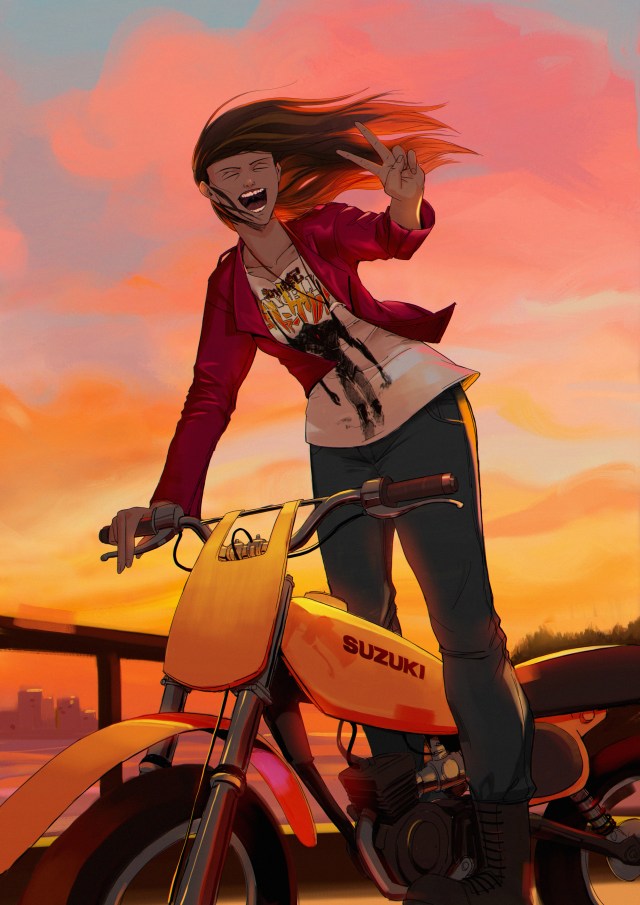
Back in January of this year (2024), I was happily writing away at the last stretch of my hella-long novel We’re Fucked, when, for no discernible reason, I chose to rummage through my rarely-touched drawers and came across an external hard drive. Hoping that it contained albums I hadn’t heard in years, I checked its contents. I discovered the album Sweet Heart Sweet Light by Spiritualized. I had recently used one of their songs for We’re Fucked, and I didn’t recall ever listening to this other album, so I put it on. As the second song, titled “Hey Jane,” played, my subconscious stirred. Vivid images kept bubbling up, far stronger than usual daydreams. One image in particular lodged itself in my brain: a brown-eyed teenage girl leaning on her motorbike’s handlebars at night, smiling warmly at the person who was approaching her. I immediately recognized the strength of this feeling. My subconscious had gifted me such epiphany-level impressions only a few times throughout my life. If I’m lucky, it will do so a few more times in the future. I had been granted a story seed.

The rest of that day, and the following few, were taken over by the obscure workings of my subconscious as it wove together, almost entirely by itself, the tale of this stranger: who she was, why she seemed so comfortable on a bike, who was she smiling at so warmly, etc. I don’t recall how the narrative evolved into one about an aspiring motocross rider with a recklessness streak bordering on tragic flaw. However, it soon became clear that this tale wouldn’t be about love, but grief.

I suppose I have to mention, as I often do, that I’m quite fucked in the head. Was born with so-called high-functioning autism, and either developed after, or got as a side-effect of the abnormal neurological development, some level of OCD that fucks me up with intrusive thoughts, obsessions on top of autism’s own obsessions, and such. Like many on the fringes of typical human behavior, I’m fascinated by outsiders and edge experiences: UFOs, hidden history, weird artifacts, long-extinct animals… Regarding humans, which I rarely care about, I was drawn to the serial-killing kind. While some people, mainly certain types of women, obsess over such monsters and view them as heroes, even attempt to date them, I obsessed over their victims. I wanted to learn everything about who they were before they crossed paths with the man who ended up murdering them. I dreamed about the killings, and imagined myself intervening in those troublesome encounters to save the victims. Even when I didn’t dream about such events, I daydreamed about them. I wrote a couple of stories, of the ones I remember clearly now, of a jaded time-traveler that returned solely to prevent such killings.

With the widespread use of the internet, I came across blogs belonging to relatives of murdered people. One of them that impacted me significantly belonged to the mother of a poor teenager who was killed returning from a concert back in 2008 or so. She got in the car of the wrong person, who raped and murdered her. The mother never got over it (I certainly wouldn’t be able to), and her posts were a window into unending grief, the kind that shoves the person away from the mass of humanity into the fringes.

I know quite a bit about standing in the fringes of humanity. I’m 52% disabled according to the Spanish goverment. During my twenties, that were mainly wasted in long stints as a hikikomori (the pee-in-bottles, befriend-spiders kind), I visited centers for extremely disabled people, and got to interact with the types of human beings you simply do not come across in your daily life: otherwise normal-looking women who were unable to string a sentence together, very intellectually challenged people who casually walked over to groups and ripped loud farts nonchalantly, people so hideous it hurt to look at them, the twitching-and-shouting-insults kinds, the dangerously deluded, some who most weeks presented fresh tales about shitting themselves while “straight-jacketed,” etc. Parents of low-functioning children would often look on with horror at institutionalized low-functioning autistic adults as they were herded around while they twitched and groaned. “It this all I can hope for?” Many human wrecks out there are kept out of view from the public at large lest they disturb the delusion of a just and ordered world.

Whatever neurological configuration drives people to seek out face-to-face interactions has never quite worked for me: human beings in general feel like wild animals, and not the cuddly kind. I’m always wary of people and keep them at arm’s length, partly due to the anxiety I feel in social situations, partly because I lack the innate ability to read their intentions. Over the years, I’ve been tricked and manipulated. I’ve had people tell me, “Why do you keep talking so casually with those individuals? They clearly hate you,” and I didn’t have a clue. In general, people bring more trouble than they’re worth, and my experience with intimate relationships convinced me that such connections lead to mutual pain. Therefore, I’m bound to a life of solitude.

Anyway, what I meant to convey is that my subconscious compelled me to create a tale about someone dealing with unending grief, the kind that isolates him from the rest of humanity. Had I loved someone like Izar Lizarraga, I would have ended up like the narrator, if I hadn’t killed myself to begin with. This is the extent of my justification for why I write what I do. In truth, I simply write to fulfill the demands of my subconscious, hoping to satisfy it. Rational thought plays no part. In fact, I’m extremely suspicious of what’s generally considered intelligence.

I didn’t choose consciously the details of Izar as a character, as well as her relationship with the narrator, but my subconscious was clearly inspired in many cases by my past relationships. The closest in spirit to Izar was a sixteen-year-old basketball player named Leire whom I met online (she was a friend of a dude I used to hang out with), and who later on pursued me romantically. She was reckless, perhaps a bit touched in the head, given that she was interested in a lanky, pimply, clearly deranged teenage me. Anyway, we lay under the stars and had a romantic conversation full of idealism, the details of which I have completely forgotten. Some other day, she invited me to her home, where we made out. We ended up cutting that date short because her parents returned from a trip early.

After that day, I ghosted her. Why would I abandon such a sweet girl without a word? Because right then I understood something: that relationship would end in ruins, like they all would, and liking her as much as I did, like I never had before and never have since, meant that the end of that relationship would obliterate me. Even now, as a thirty-nine-year-old man, I consider that ending it before it truly began was the right choice, given my inability to sustain intimate relationships. However, I regret ghosting her. I regret having lost the opportunity to know her better. Due to my prosopagnosia (an autism-related inability to retain and process people’s faces), I don’t know if I ever saw her again. I can’t even stalk her online, because I forgot her last name. She didn’t deserve to be treated that way. Wherever life took you, Leire, I hope you’re happy.

Fellow autist and writer Patricia Highsmith famously told of a woman she briefly met while working as a toy saleswoman: a sophisticated, mommy-type blond to whom Patricia sold a doll, and with whom Patricia fell in love at first sight. They never saw each other again, but Pat, in her usual manner (she’s the author of Strangers on a Train, The Talented Mr. Ripley series, etc.), proceeded to stalk the woman’s home to get some modicum of understanding of who she was. In later years, Patricia referred to that woman as the love of her life. In a similar sense, Leire is very much the love of my life: the most fascinating girl I have ever met, with whom I would have enjoyed lovely adventures if I weren’t such a piece of rotten shit.

Deeper than that, and I suspect this revelation may disappoint some, Izar Lizarraga of this story’s fame is partly my subconscious itself. Maybe other people can identify with their subconscious as if it were an integrated part of themselves, but for me it’s this mysterious, intelligent being who presents me strange visions, who urges me to work on stuff that pleases her, and to whom I can show some part of a work of art I’m working on, from writing to music, and get a wordless response of the kind “this sucks” or “I love it.”

This subconscious of mine, a creature that feels female, is someone I’d rather interact with instead of any flesh-and-bone person, and who has guided me along in many adventures that I wouldn’t have experienced otherwise. I have never felt truly alone because my subconscious has always been there to bring me interesting dreams (I wouldn’t say beautiful, because plenty of them were horrifying). Back when I thought I could sustain normal human relationships, I regularly ached to return to my subconscious’ side, a more interesting and reliable person than pretty much anybody. I adore you, subconscious. I wish I could make love to you. If you had a butt, I’m sure it would be real nice.

I think that’s all the context I wanted to add to this story. Barely anybody read it, but those of you who followed the tale of Izar Lizarraga and the man she ruined, I hope you got something valuable out of it. And if you didn’t, hey, the one I intended to satisfy is pleased.

Motocross Legend, Love of My Life, Pt. 20 (Poetry)

You can read this novella from the beginning through this link.


On the afternoon of your death anniversary,
Hand in hand with my daughter,
My other hand holding a bouquet of red roses,
We arrived at the spot on the wooded lane
Where a grooved-bark, mature oak
Watched over your memorial stone,
Nestled in moss, twigs, and clover.
Mottled, watery sunlight bathed the stone
As if illuminating a sacred site.

The limestone or sandstone looked rough,
And had weathered over all these years.
Beneath the relief of a motocross rider,
A marble plaque bore the inscription,
“Izar Lizarraga Oyarbide (1981-1999).
She lived fast and died young,
But her light will shine forever.”
My childhood sweetheart,
My restless wildfire.

I crouched in front of the stone
To deposit the bouquet at its base.
I pulled out a pack of wet wipes
And wiped away the dust and grime.
I scrubbed off a white splatter of bird droppings.

The murmur of families filtered through the trees.
A flock of sheep baahed from the nearby hill.
In the stone’s relief, your helmeted figure
Clutched the bike’s handlebars,
Head tilted forward in intense focus.
Every time I laid my eyes on this figure,
My breath caught, my throat clenched,
And I struggled to loosen the knot
Twisted inside my chest.

“How long ago was nineteen ninety-nine?”
My daughter’s innocent voice asked.
After a pause, I said, “A long time ago.”
“Was she a friend of yours?”
“Yes, the best one.”

My daughter shifted her weight from foot to foot
As her attention drifted further down the lane.
I held her little hand tightly in mine,
And we stepped onto the sun-dappled sidewalk.
A familiar warmth built up behind my eyes:
Tears burning their way out.
The vision of a bumblebee weaving its waltz
Across clumps of yellow and white wildflowers
Became a watercolor blur.

Grief had ambushed me once again:
A monstrous hand reaching out of the deep
To grab me by the chest and drag me down.
I know it will remain my constant companion
For the rest of my days.

That week, I pondered why
I had brought my daughter to visit you.
I was terrified that, after my death,
Nobody who came across your name
Or gazed upon the memorial stone
Would understand what had been lost,
What you still mean to me.
I needed my child to be haunted by you,
To carry your spirit in her heart,
But I feared no amount of talk
Could transmit the depths of pain and love.
So, the memories of you would disappear,
Forgotten even by the spiders
That had built their webs within me.

One day, maybe not long from now,
After the kids we dragged into this world
Have freed themselves from their miserable parents
And claimed a home of their own,
I will lie in my deathbed alone,
Connected to beeping machines.
By then, you will feel like a sunken ship
Deep at the bottom of the sea.
Suddenly, I will breathe in a pungent odor of rust,
And from the center of my consciousness,
A sinkhole will open, a growing black hole.
As the edges of my self crumble and collapse,
Into that darkness, I will reach for your hand.

I doubt the value of words:
Pictures and music capture emotions better.
Yet, this old boy can only play with words,
And I’ve engaged in the game of pretending
That they can bridge the chasms between us.

For decades, a barbed pain has grown its tendrils
From the core of my heart throughout my body,
Creeping into every tissue and organ,
Embedding hooks deep in my bones,
As the pain reached the farthest ends of me.
My wish: that the right combination of words
Could sever a scion of this piercing truth
And graft it onto someone else’s heart.

So thank you, stranger,
For reading thousands of words
Of the only tale I care to tell,
My elegy for Izar Lizarraga,
Motocross legend,
Love of my life,
Who blazed through this world,
And burned away.

* * *

The night of April 27, 1999,
You parked in front of the candy shop.
Drenched under the torrential barrage,
We clambered off and removed our helmets.
The taste of rain mingled with your saliva
While the Aprilia’s idling engine rattled
Like a hiker hopping from foot to foot,
Eager to move on.

We wished each other good night.
Thunder growled as you straddled
Your gleaming yellow-and-white bike.
You pulled on your helmet,
Gripped the handlebars,
And lifted the side stand with a kick,
When I shouted, burning my throat,
“Wait!”

Startled, you straightened up,
One foot planted on the sidewalk,
And turned the reflective visor toward me.
I ran to you and hugged you,
Pressing my cheek against the cold helmet.
“You don’t intend to return home, do you?
Who would be so stupid to believe
That you’d go back to your father so soon?
I can’t let you leave, Izar;
If I do, I’ll regret it for the rest of my life.
Stay with me tonight.”

I held your gloved hand
As you stumbled off the Aprilia.
You lifted the visor of your helmet,
Revealing large chocolate eyes
That reflected a shimmer of amber light.
Your brows were furrowed in concern.
From one nostril hung a bead of watery mucus.
“I’d much rather do that,” you said,
“But your mother forbade me from coming back.”
“I’ve taken enough shit from her.
She can suck it up.”
You shook with silent laughter.

I opened the front door to the sight of my parents.
My mother scowled, deepening the lines of her face.
Beside the woman, two steps back, stood my father,
A bald, stooped, hesitant non-entity.

Upon noticing Izar, my mother’s eyes widened.
She opened her mouth to scold me,
But I cut her off.
“Look at what her father has done.”
I brushed away the damp strands of caramel hair
Clinging to the cheek that sported a bruise,
The mottled imprint of your father’s hand.
“Izar can’t go home tonight. It’s not safe.
She’ll stay with me, no matter what you say.”

A glance at the bruise loosened my mother’s brow.
You bowed your head.
“Sorry for bothering you.
I didn’t intend to cause trouble.”
My mother narrowed her eyes.
“You rode here through this downpour?
Girl, you don’t have any common sense!”
“Sorry.”
She tsked, then threw her hands up.
“You pair of idiots. Go take a warm shower.
No, take off your jackets and shoes first.
You’re going to leave puddles all over the house.
My goodness, look at how soaked you are!
Do you want to catch pneumonia?”

As you and I padded hand in hand to the bathroom,
My mother turned to my father, seeking support,
But he shrugged and said,
“Let them be. They’re in love.”

Locked inside the bathroom,
We peeled each other’s soaked clothes,
Then chucked them on the ceramic tiles,
Where they lay like beached jellyfish.

When you untied your ponytail,
The cascading hair stuck to your shoulders.
You rubbed your pruney fingertips.
“We might get sick for real,” you said,
Then sniffled some leaking mucus back in.

I embraced you firmly,
Pressing your stiff nipples against my chest.
You shuddered once, then continued to tremble.
I whispered in your ear,
“My love, in case you have any doubts,
I’ll run away with you.”
You sighed, your breath warm on my neck,
And slid your hands down my back.
“Thank you.”

As we melted into each other,
I caressed the contours of your skin,
The myriad details unique to you
That before you were born,
Hadn’t existed in the universe,
And after you died, never would again.

Yes, Izar, I would accompany you,
Riding pillion, clinging to your waist,
Through the rush of wind and rain,
To witness the sights you longed to see,
To experience what it meant to live.
We would create a shared language,
Speak words that others would find insane,
And build our own space far away.
Nobody could compete with you,
The sole real person in the world.
As long as you were with me,
I was home.

THE END


Author’s note: the last song is “Just Like Heaven” by The Cure.

Motocross Legend, Love of My Life, Pt. 19 (Poetry)

You can read this novella from the beginning through this link.


The eve of your death anniversary
Resurrected the old nightmare once more:
I was riding pillion, clinging to your waist,
While your Aprilia Red Rose growled
As it devoured the highway under its tires.
The rainfall hammering upon car roofs,
Drumming on our helmets,
Splashing against our drenched clothes,
Overwhelmed the steady roar of the engines.
The wind drove icy raindrops into my face.

The beam of your bike’s headlamp
Sliced through the rain sheets,
Lighting the rear wheels of the truck in front,
That spat up trails of rainwater.
In the oncoming lane, twin beams appeared
And quickly expanded toward us,
Cutting luminous swaths across the blackness.
On my right, traffic signs, trees, buildings,
They all blurred into smudges,
And the sparse streetlamps revealed themselves
Like floating, shimmering haloes.

Lights glinted off the gleaming, mirrorlike tarmac
In ripples of red and blue-tinged white.
Above, lightning leaped from cloud to cloud,
Followed by grumbling thunderclaps.

In my embrace, your body trembled;
You were crying, or at least on the verge,
And you channeled that anguish
Igniting your steel beast’s roar
With a wrench of the throttle.
My heart thrummed with dread.
The acceleration pressed against my bones,
Tightening my chest and freezing my breath.
Along with the golden tracers of streetlamps,
Oncoming vehicles whooshed past us.

Lighting the way ahead, we were falling headlong,
Whipping through the darkness like an arrow.
Teary-eyed from the sting of rain,
I raised my voice over the rushing wind,
Over the rumbling engines.
I shouted, I yelled, I gripped your sides tighter,
Imploring you to slow down.
As if you couldn’t hear me, as if I wasn’t there,
You revved the throttle further,
Making the speedometer needle climb sharply.
Your bike’s chassis shuddered under the strain.
The raindrops felt like dozens of fingers
Poking my numb face to wake me up,
But you kept racing through the storm,
Maybe wishing to outrun yourself,
Outrun all the voices telling you to stop.

As we approached a curve, your Aprilia wobbled,
Its front wheel skidded on the rain-slick tarmac,
And the bike lurched sideways,
Flinging us off.

The color spectrum gleaming through the downpour
From headlights, tail lights, streetlamps, and lightning
Spun into a blur of light and dark
While my body flailed, limbs striking out,
Scraping against the road as I slid
With rainwater gushing over me.
The friction ripped through my clothing,
Seared my skin, and tore the flesh off my bones.
Screams lodged in my throat.

Your Aprilia Red Rose was flipping end-over-end,
Scattering pieces of its decimated bodywork.
My frantic gaze glimpsed flashes,
Illuminated by the headlights of passing cars,
Of your body cartwheeling uncontrollably.

A murky shape, the guardrail,
Rushed out of the rain-haze toward us
Like a reef thrusting from a savage ocean.
You smashed against the metal barrier,
Which launched you into the darkness.
I clenched my eyes shut, bracing for impact,
And awaited the final, wet crunch.
When I slammed into that guardrail,
A loud snap reverberated through my spine
In a starburst of pain.

The impact had squeezed my lungs,
Knocking the air out.
As I gasped, mouth agape,
A thunderous crash against the guardrail
Sent a shockwave through the cold steel,
Making me, slumped against it, shudder violently.
Fragments of the bike ricocheted off the barrier
And stung my arms and face like shrapnel.
The metallic clang lingered as a discordant ringing.

Your Aprilia lay on its side close by,
Gleaming darkly in muddy rainwater,
Its windscreen shattered,
Frame bent, chassis mangled,
Front wheel still spinning.
A rearview mirror dangled from its stem,
And reflected the electric clouds.
Fuel leaked out of the dented tank.
The headlamp’s white beam,
Shining through the cracks in the lens,
Faltered, flickered, then faded away.

The ozone scent of the storm mingled
With the chemical smell of gasoline,
The burnt stench of grinding metal,
And the bitterness on my tongue.
A tingling white noise had spread
To the farthest reaches of my body,
And in the places that hadn’t gone numb,
My shredded flesh screamed
In a fiery, knifelike pain.

Instead of writhing in the gutter
Like a crushed insect,
I would return to your side,
But when I tried to stand,
My limp legs refused to move.
I grabbed the cold, wet guardrail,
Then heaved myself over it.
I hit the grassy, upward slope chest-first,
And mud splattered on my face.

I crawled onward, clawing at the grass and soil,
Coating my hands with squelchy mud.
The relentless pounding of heavy rain
Along with the deep rumble of distant thunder
Isolated me in a cocoon of noise.
Every creep up the slope ripped me open with hurt.
In jagged gasps, I breathed razors.
Where are you, Izar? Where are you?

The blades of grass glistened
With a fresh spray of blood.
Silvery light from turning headlights
Swam in waves over a body splayed face up
Like a doll tossed in a tantrum.
Your drenched, ripped red jacket gleamed.
Gashes oozed through the torn jeans.
The crushed helmet still clung to your head.

Beside you, I pushed myself up onto my knees,
And lifted the cracked visor of your helmet.
Raindrops splattered in concentric circles
On the blood pooling within the face aperture.

I attempted to take your helmet off,
But your neck strained, its muscles taut,
As if your head might snap off.
You couldn’t breathe.
“Stay with me, Izar. Don’t leave me, please.”
When I scooped blood out of the hole,
My fingers didn’t graze your face.
I sank my hand up to my wrist, to the elbow,
But I couldn’t reach you.

I woke up with a start, drenched in sweat,
Gasping for breath, clutching at my throat.

My fingers are calloused
From decades of clawing
At the dark soil of this world
To drag myself back to you.


Author’s note: the song for today is “I Lost You” by The Walkmen.

The next part will conclude this story.

Motocross Legend, Love of My Life, Pt. 18 (Poetry)

You can read this novella from the beginning through this link.


I used to know every contour of your face,
The exact timbre of your voice,
The way your body pressed against mine,
Your taste, the salty scent of your sweat.
But your traces are flaking off my brain;
In the seams and margins of my memories,
Bugs and patches have appeared,
Corroding the integrity of a past
That I’m editing, shaping with bias,
As I revisit it time and time again.
Your gaze, your smile, your laughter,
They all fade away into oblivion
With each ticking second.

Izar, I beg you, stay with me.
Let’s leave this suffocating city
On a motocross odyssey spanning Europe:
Hundreds of kilometers of highways,
Speeding through the countryside
Past petrol stations, fields, and farmhouses.
We’ll make love on the shores of the sea,
Then sleep under a blanket of stars.
Let’s rent bikes and ride along the Seine.
Let’s explore the winding streets of Venice,
Swim in the turquoise waters of the Caribbean,
Surf the waves of Hawaii or Costa Rica,
Climb the ancient terraces of Machu Picchu.
For the rest of my days, I will care for you,
Your unstable mind, your fits of rage.

Growing up, I feared venturing far
From my neighborhood, from my parents.
I dreaded exposing myself to risky experiences.
In my mind, I saw my mother’s stern face,
Ready to scold and ground me
For daring to struggle against the vines
She had wrapped tight around me.
Roam the breadth of Spain? Travel the world?
Such adventures felt as distant as the stars.
I was convinced that even as an adult,
I wouldn’t organize something so troublesome.

But that year, I stood in the blazing Roman heat
With my teenage son beside me
And my daughter’s small hand grasped in mine,
Gazing up at the façade of the Pantheon,
Its towering Corinthian columns glowing faintly,
Burned by the merciless July sun;
Its triangular pediment pockmarked, scarred,
With projectile strikes from World War II.
I longed to appreciate its grandeur in solitude,
But a throng of tourists choked the square.
A listless guy stood dressed like a centurion,
His helmet adorned with a plume of dyed horsehair.
The muscle cuirass concealed the flab
Of a modern man suited to a desk job.

The Pantheon didn’t belong in this post-apocalypse,
Among the disoriented survivors of the 21st century,
Who lacked the knowledge to recreate
The sunlit glory of their once eternal past,
And who had lost the will to rediscover it.

Well, what did you think about the sights, Izar?
We never had the chance to escape together,
But I carried your memory to Rome.
I hope you enjoyed the trip.

In my little corner of the world, whenever I could,
I escaped to the freedom of an isolated bench
Along the wooded lane containing your memorial stone.
There, beneath the sunlight filtering through branches,
Hunched over a notebook, I poured my memories of us,
Capturing in words every detail I could remember.
I discovered that writing tricked the brain
Into gilding moments and affixing them to its cells,
Regardless of their authenticity.

Drawing, writing, they couldn’t save me;
They just helped me endure this lonesome life
For yet another day.
But maybe the right words could save
What remained of you.

In my heart, a secret garden bloomed.
Pollen sparkled on iridescent flowers,
Their petals fanning out like peacock feathers.
In this floral realm where time stood still
And death could never enter,
You, enshrined within a poem or story
That wouldn’t fade, rot, nor be reduced to ashes,
Could live eternally.


Author’s note: the songs for today are “This Is the One” by The Stone Roses, and “Sit Down” by James.

Motocross Legend, Love of My Life, Pt. 17 (Poetry)

You can read this novella from the beginning through this link.


Do you remember, Izar,
That one time in the basketball court
Of our old primary school?
Your hair looked like honey.
Pale wisps floated about your face.
You glanced up at the sky and said,
“The sun’s right above. Look!”
While shielding your eyes with one hand,
With the other, you gestured toward the hoop,
And the round, golden sun,
Glowing with midday heat,
Swished through the net.
You grinned triumphantly at the perfect shot,
The work of a godly markswoman.

In my memories, in my dreams,
Our teenage selves, wild and free,
Dressed in the sun of summer,
Roamed iridescent streets together
Under a sky layered like an oil painting.

One day, after a shower,
I wiped the fog off the mirror
To reveal a man’s naked body
Glimmering through the vapor.
The once lean-muscled figure,
Sculpted laboriously in the gym,
Had softened under the looser skin
To a layer of resigned flesh
That gravity insisted on dragging downward.
With both hands, I grasped my gut,
Stretching it as if to rip it open
And let the aging machinery spill out.

I locked a tortured gaze with the mirror,
With that cold-eyed stranger
Whose wrinkles carved on his face
Deepened each passing year.
His hair and stubble were flecked with gray.
The flaws I scarcely noticed during the day
Beamed back as if lit by headlights.
Every trace of my youth had eroded away;
I had transformed into a middle-aged man
That you, forever eighteen,
Would hardly recognize.

A rapping on the front door shattered the static haze.
When I opened the door, I faced an apparition.
Your chocolate eyes glowed with affection,
Your smile showed off your crooked teeth.
Rainwater slid down your sleek red jacket,
That framed the Evangelion T-shirt underneath.

You had finally returned from the beyond
To replace my dust with your stardust.
I hugged you tight, lifting you off the floor,
And you wrapped your legs around me
While giggling like a girl in love.
“How long has it been?” you asked.
“Far too long.”
“Will you come with me?”

In the corner of the street gleamed
Your beloved Aprilia Red Rose,
Its fuel tank painted yellow-and-white.
High-rise chrome handlebars,
A padded leather seat with visible studs.
Exposed engine components turned the Aprilia
Into a rugged and warworn mechanical beast,
Ready to race through the landscape
With its raw wounds laid to the wind.

As I rode pillion on your bike,
Its throaty rumbling vibrated through the seat.
I rested a hand on the thigh of your jeans,
And felt the firmness of the flesh beneath.

You swerved onto Navarra Avenue toward the highway.
The road ahead lay empty, an invitation to speed.
We passed by an endless procession of ghosts,
Whose whispers blended with the engine’s rumbling.

The low, crimson sun raced toward the horizon,
Stretching wavering, unnatural shadows.
My heart pounded, my breath came in gasps.
Dread clawed at my mind: we might never arrive.
Even as you speeded,
The destination receded farther and farther.
“We’re never going to get there, are we?”
“Where is there?”
“Wherever it is we’re going.”
Your whipping hair framed the profile of your face,
And your lips curled into a sad smile.

Back when you told me you were quitting school
To pursue the goal of becoming a motocross racer,
Should I have convinced you to continue your studies
And to use your spare time to train,
Even at the cost of seeing you less?
That one time in your parents’ apartment,
When your father stomped out of your bedroom
While threatening to go beyond words,
If I, instead of just comforting you,
Had confronted your old man,
Even at the risk of ending up bruised and bloody,
Maybe I would have intimidated him enough
That he wouldn’t have marked you
With a red handprint on your cheek.
If I had instilled in you the fear
That you might ruin both our lives
By crashing during one of your reckless stunts,
Maybe you wouldn’t have died so young.

I see you back on April 27, 1999,
When you scratched flakes of paint
Off that basketball pole.
The wind tugged at your ponytail,
And shiny raindrops dripped
From the soaked tips of your hair.
You turned your youthful face to me
And revealed your plan to leave.
For a moment, I panicked;
Would you untether yourself from me?
But you asked me to run away with you,
To drift through Spain on your bike
Like pirates on the open sea.

I said I would follow you anywhere, didn’t I?
When I replay that night in my mind,
Sometimes I see myself answering you,
And other times, I assumed you knew the answer.
Had I answered enthusiastically,
Promising that nothing and no one could stop me
From accompanying you to the ends of the world,
Would you have chosen to speed through the rain?
Did I let you die thinking I had abandoned you?


Author’s note: the song for today is “The Wait” by Built to Spill.

Motocross Legend, Love of My Life, Pt. 16 (Poetry)

You can read this novella from the beginning through this link.


For days, I slipped in and out of lucidity.
I recall flashes of the waste collection center,
Of standing in the nearby landfills I had located,
Immersed in the stench of rotting organic matter.
I pleaded with employees wearing hard hats
And bright, reflective vests,
Begging them to let me access the collected trash.
I struggled to understand their replies;
My fogged mind registered their words as noise
Mingled with the caws of scavenging birds
And the sporadic rumble and beeps
Of lumbering trucks as they unloaded debris.

I wanted to collapse at the sight of endless trash:
Humanity unmasked as a blight upon nature.
I was tainted, a corrupting force spreading rot
To everything I needed to protect.

Workers denied my requests, citing policy,
But an employee in her fifties must have pitied me,
Because she allowed me to realize for myself
In the volume of compacted refuse
That my mementos of you no longer existed.

I dreamt you were calling me on a psychic link,
Begging me to find you
As a hill of trash slowly crushed you,
Suffocated you.
I heard your ribcage creaking, ready to collapse.

I dreamt of a colossal trash truck
Whose jagged teeth, like a predator’s jaws,
Closed around your body, pulverizing you
In a deafening cacophony of screeching metal
And the dull pop of bones breaking.
As you struggled against the mechanical jaws,
Leaking tears, mucus, and blood,
Your wide, terrified eyes met mine.
I heard your anguished voice, accusing,
“You knew how this would end.
Why didn’t you save me?”

On the couch where I slept, I awoke in a cold sweat,
Heart hammering, tears streaming down my face.
I thought I had survived the worst of my grief,
But it hadn’t immunized me against its return.

I took a medical leave from work that nearly got me fired,
And I spent those days encased in lead.
Among my family, I roamed like a black, silent fire,
So unhinged that my wife didn’t dare to chastise me.

At night, as my family slept, I stared into the darkness.
I listened to the whoosh of blood in my veins,
Life churning onward like the filthy waves
Of a sewer canal clogged with decaying memories.

Izar, two decades had passed since you died,
So why did your absence pulsate in my brain
Like the pain of a needle embedded deep?
Why did every hour still remind me
That you were no longer here to hold my hand?
I would never again talk with you,
Lean into you, breathe you in.
A crash against a guardrail had killed you,
The consequence of your choice to live dangerously.
I would never know if you’d have grown bored of me,
If our love would have faded or endured.

Once I clawed my way out of the black pit
And I recognized my wife as a human being again,
Every glance at her made me grimace.
I lived with a criminal that had escaped punishment
On account of our children’s well-being,
And we interacted like snakes
Forced to share a cramped vivarium.

I yearned to listen to your voice damn near daily,
And when I thought of those treasured tapes
That had contained our mock radio shows,
I couldn’t trust myself to stay in my wife’s presence.
But the loss of those recordings, I could have prevented it;
I knew that magnetic tapes degrade,
That oxygen was eating away at our young voices.
Although I had planned to digitize them,
I had kept postponing the task,
Thinking there would be another day.

Whenever I could, for sanity’s sake,
I escaped my home
And took long walks along the wooded lane
Where your memorial stone stands.
That narrow, mossy path ran parallel to the road,
Bordered by yellow-green grasses and leaves.
The sunlight streamed through skeletal branches
Stark against the background of rolling hills.
The breeze tickled my nose with the scents
Of moist soil, decaying vegetation, and pastures,
And the silence was interrupted only
By birdsong,
The breeze rustling leaves,
The bleating of grazing sheep,
And the sporadic whoosh of a passing vehicle.
In my mind, I spoke to you,
Recounting everyday moments from my kids’ lives,
Seeking your opinion on how to parent them
So they wouldn’t grow up bitter and miserable.

I had gone to check on our toddler,
And found my wife kneeling in the living room
In front of the coffee table and a cup,
As she wrote on a pocket notebook.
Beside her, our daughter babbled to a doll.
Standing still, I observed them
As if through an exhibit glass.
Our daughter approached the table
To mess around with the cup of coffee.
By the time my wife noticed,
The drink had already spilled.
“Look what you did!” she snapped.
Once our toddler returned her attention to the doll,
My wife hunched over, her shoulders shaking,
And she covered her face with both hands.

The thought of consoling her crossed my mind.
I should at least have taken our daughter away.
But I didn’t want to deal with human beings,
With their demands and expectations I couldn’t meet,
With their vindictiveness and their calculated cruelty.
Instead, I crept to the bathroom as quietly as possible,
Where I let the roar of water from the shower drown out
The world’s meaningless noise.

During my solitary walks,
I replayed our pretend radio shows in my head,
Recalling our repartee as if it were song lyrics,
But with age and the limitations of my brain,
I encountered gaps in my memory
Where I questioned if I was inventing your lines.

I adopted the habit of sitting on a bench
Opposite a slope tangled with brambles
To transcribe the echoes of our teenage voices,
Haunted by the need to immortalize you
In this universe that insisted on erasing you.

Once I ran out of the words we had shared,
I wrote letters to you,
Elaborating on my impressions and pains.
From those days onward,
My notebooks became like dumpsters
In the grimy alleyway behind a busy restaurant,
Waiting to receive the daily effluvia of my mind.

We took the kids on a family outing
To a destination my wife had picked:
Mount Arburu.
The cool air carried the scent of pine trees.
I found myself staring at a view
That you and I had relished:
The rising, rounded peaks of Aiako Harria,
Rugged and patched with dense forest.
Gray clouds tended a titanic shadow
Over my sprawling hometown of Irún,
Extending to Hondarribia and the Txingudi Bay.

Two decades ago, I sat pillion on your Suzuki RM125,
My arms wrapped tightly around your waist,
The bike rumbling through my bones,
As you slalomed between the thorny shrubs
Scattered across this slope,
And flung joyful laughs to the wind.
Unhindered, nature cares little for two decades;
Here, only the unbreachable wall of time
Separated me from riding with you again.

I dreamt you and I held a funeral
For your wrecked Aprilia Red Rose.
We laid the mechanical beast to rest
Wrapped in bandages and duct tape,
On a bed of dead grass and dried leaves.
With our hands clutched in grief,
You wearing your motorcycle helmet,
We knelt and prayed before the bike,
Murmuring the kind of heartfelt goodbye
Reserved for lost loved ones.

At the front door of our apartment,
I was shrugging into my coat
When I felt a gaze on my face.
My wife, seated on the sofa, was leaning forward,
Wearing a loose blouse that exposed her breasts
To the hungry tug of gravity.
From the cigarette pinched between two fingers,
A thin ribbon of smoke swirled upward.

How many times had I envisioned confrontations
In which my wife’s mouth would spill venom,
Recriminating every aspect of our marriage?
I imagined her calling me a selfish asshole,
And I shot back, labeling her a heartless psychopath
That had enjoyed destroying my mementos of you
While knowing how much they meant to me.

But my wife’s gaze was tender,
Her eyebrows raised in the middle.
“The dead, they no longer love us,
And they certainly don’t suffer.
They don’t regret the lost opportunity
To spend more time together.
From what you shared about her,
She would have been horrified
By how much she ruined your life.”

I fumbled for words to refute her,
But my throat had constricted.
My eyes welled up.
In a daze, I swung open the door
And hurried down the stairs.


Author’s note: the songs for today are “Should Have Known Better” and “The Only Thing,” both by Sufjan Stevens, and “Like a Stone” by Audioslave.

Motocross Legend, Love of My Life, Pt. 15 (Poetry)

You can read this novella from the beginning through this link.


In the chiaroscuro of the ultrasound image,
The thick, dark uterine wall encircled life within:
An oval head attached to a bean-shaped torso.
The fetus rocked softly, suspended in space-time,
Untouched by the chaos of the outside world.

In the shadowed profile of its face,
Gentle rises hinted at the forming eyes,
A nose, a budding mouth.
Trailing from the head, a line of vertebrae
Resembled a delicate string of pearls.
Under the insistent thump-thumping
That pulsed through the amniotic fluid,
A certainty branded itself on my mind:
This is my daughter.

I hovered near the ceiling of a delivery room,
Watching like a detached stranger
My wife’s sweat-sheened face,
Hair plastered to her clammy forehead,
Her chapped lips bared in a grimace.
From between the former lawyer’s thighs,
A midwife coaxed out our bloody offspring,
The seed that had germinated
From a lump of cells into a human
Destined one day to venture beyond my reach.

I paced our postnatal room
While I supported my daughter’s head.
A pink blanket swaddled her snugly.
Her skin, fresh off the factory,
Blazed with a rosy tint.
She smelled powdery and pure.
This baby resembled you, Izar:
She inherited your caramel-colored hair,
Your chocolate eyes, your carefree smile
That lightened the weight of the world.
Life still contained wondrous surprises.

In the master bedroom, while our baby slumbered,
I was drinking the sight of her flawless skin
When my aging brain craved the drug of pain.
I needed to stray out of this mundane refuge
Into the infinite darkness,
So I could resume speaking with the dead.
I slid the wardrobe door open,
Its rollers grinding against the track,
But the garments whose hems once draped
Over the moving box holding your remains
Now hung unimpeded.

I shifted aside T-shirts, shirts, and sweaters,
And found myself staring at an empty corner.

Could I have heaved the box out
Only to forget to put it back?
No, not once in all these years.
Frantically, I rummaged through the items
That could hide a moving box:
Unused bags, backpacks, travel suitcases.
I emptied the upper shelves,
Tossing aside old blankets and extra pillows.

I found my wife on the balcony,
Seated on a bistro-style chair,
Scrolling through her smartphone,
And taking a drag from her cigarette.
“Where is she?” I demanded to know.
Instead of chewing me out for my tone,
She kept her gaze glued to the screen.
The dying sun tinted her smoke blood-orange.
“Where’s who?” she asked dryly.
“You know well what I mean.”
“I don’t.”
My heartbeat rammed my ribcage.
“The box.”
“Box, what box.”
“The box containing what’s left of Izar.
The box you kept complaining about,
Arguing that it took up too much space.
The box you clearly hated.
Where the fuck is it?”

After my wife confessed,
The Earth halted its spin.
The distorted echoes of her voice
Resonated through my mind’s cavern:
“I dumped it all in the trash.”

Panic burrowed into my brain and bones.
I rushed out of the apartment,
Down the stairs onto the street,
And straight to the array of recycling bins.
No traces of you among the discarded:
A worn-out stool, a broken microwave,
And disassembled furniture.
The stench of rotting organic waste mingled
With the scents of hot dust and cardboard,
And the bins’ heavy lids clanked loud,
As I peered again and again into the gloom,
Desperatedly searching for a tape or a photograph.

“It’s useless,” my wife said.
She stood with her arms crossed,
But when our gazes met, hers flinched.
She spoke again, her voice wavering.
“I did it two days ago.”

Sharp pangs struck my racing heart,
And spread along my veins and arteries.
I staggered away from the recycling bins
As I struggled to breathe.

My wife’s caustic tone poured on my wounds.
“You’re not bringing that girl back to life.
You should have gotten rid of her stuff years ago
And allowed yourself to move on,
But it seems you derive sick pleasure
From self-flagellation.
It’s time to stop living in the past.
Focus on what truly matters, what’s real:
Your wife, your son, and your baby daughter.
I won’t stand by and watch you neglect us.”

My last vestiges of you, my Izar,
Still carrying the scent of a fallen star:
Figurines, comic strips I drew for you,
Handwritten letters, your motorcycle gloves,
Photographs, cassette tapes with our shows,
A T-shirt stained dark with your blood,
Teeth, bone shards, scraps of flesh,
Your foot severed at the ankle.

I would never hear your laughter again.

A silent bomb had exploded inside me,
Hollowing out a vast space in my core.
My knees hit the grimy pavement.
I clawed at my scalp as spasms rocked me.
“You’re gone,” my mind repeated again and again,
An alarm blaring against the bruised gray matter
Of a broken brain.

I don’t know how long it took
For me to hoist myself up,
Soaked through with cold sweat,
But now, a riot raged in my skull,
A cacophony of furious voices.
At the doorway of the nearby estate agent,
Next to its window flaunting dreams of elsewhere,
A young woman’s brow furrowed with concern.
Other stares pierced the back of my head;
In front of the mechanic shop,
Beside a car with its hood raised,
Two grease-stained men gawked at me,
The stranger unraveling in public.

If I abandoned my wife like she deserved,
I wouldn’t just break my son’s heart,
But also rob my baby daughter of a father.

Tears traced paths down my wife’s cheeks,
Leaving shimmering trails.
She controlled her outburst of genuine emotion
Behind the taut muscles of her face.
That glare alone was a silent rebuke
For managing to wring tears from her,
But I didn’t give a shit;
Whatever goodwill I had accumulated
Over years of a weary coexistence
Had switched off in an instant.
I wished I had never met her.

Despite my wife’s cracking voice,
Her words tore through the air like daggers.
“You’ve grieved for her longer than she even lived.
From the moment you first told me about that girl,
I knew I wasn’t the one you truly loved,
But I stupidly hoped I would be enough.
After all, I’m the one who stuck around,
Who gave birth to your children.
No matter how hard I tried to make you happy,
Nothing ever pleased you.
It’s always been about Izar, Izar, Izar,
That immature, reckless brat
With no care for the future,
Driven only by selfish whims.
You know it was the bitch’s own fault,
Speeding through the rain.
If she hadn’t gotten on that bike,
She’d still be alive,
Bumming off some poor sap,
And you’d have forgotten her by now.”

My body had flash-cooled
As if dunked in a tank of liquid nitrogen.
I struggled to process my wife’s words,
To believe she had uttered them.
I saw myself grabbing the abandoned stool,
And swinging it down on her forehead.
I pictured the shock in her eyes,
But before she could defend herself,
Before any onlooker could intervene,
Her skull would have cracked open,
Spraying splatters of blood and cerebral tissue.
Then I would have run, run, run away,
Fleeing from this rotten city to the nearest highway,
Where some truck wouldn’t slow down in time.

But no remnant of you existed anymore
Except in the molecules of my brain.


Author’s note: today’s song is “Shine a Light” by Spiritualized.