The Scrap Colossus, Pt. 19 (Fiction)

Hunger and sex tingling at the base of my skull, I set the excerpt beside me on the eroded, lichen-stained stone blocks. The roar of a passing car from the abutting road faded, allowing the chorus of birds to swell in a contest of chirps and warbles. Through the gap between two dilapidated walls, the nearest apartment building emerged, its bricks a medley of rust red, chocolate brown, and burnt orange. The windows reflected the sun’s warm glow. Over a balcony’s parapet, a woman’s bust, wearing a blue robe, watered a row of potted plants, her wet, dark hair gleaming as if lacquered. Overhead, puffy clouds stretched across an azure canvas, drifting slowly by like towering snowdrifts. A wash of sunlight bathed the world, but the undersides of some clouds had darkened from a ghostly white to a charcoal gray.

“Gorgeous, isn’t it?” Elena said in a measured tone. “Gigantic cotton balls in creative and unique shapes, suspended who knows how many kilometers above our heads. A painting ready to be rendered. Our lives look so tiny and lackluster compared to nature. Have we really improved much from the days when we lay in a field and stared at the sky? And at night? We’ve never seen those stars our ancestors took for granted. We never learned the stories they read in those constellations. Besides, imagine the amount of UFOs they must’ve witnessed zipping around up there, without comprehending what the fuck they were looking at.”

“As if we understand. By the way, iron age life expectancy hovered around twenty years. Half of children didn’t make it to puberty. Trepanning was used as a cure for migraines. People died from a mild infection, or from shitting. There were no books, no movies, no computers, and you were lucky if you had a wooden horse, and a piece of hard bread to gnaw at.”

Elena had crossed her alabaster ankles, smooth skin revealed beneath the hems of her black joggers, that had slipped up the shins as she reclined in the lawn chair. The pack of cookies rested on her lap. Her pallid face bloomed in the sunlight like an unfurled moonflower. I beheld a quasi-mythical creature, rare as the sight of a narwhal’s tooth cleaving the surface of the Arctic Ocean.

“Well, aren’t you full of facts? You’ll explode like a piñata. But you’re right. Most people’s lives throughout the ages were wasted in perpetual crises. And here we are, wasting our lives in the midst of supposed plenty, and still suffering.” She shifted in the chair, the plastic strips creaking as she brushed cookie crumbs off her hoodie. Her pale blues searched my face anxiously. “Come on, blurt it out. You know I’m waiting for the verdict.”

“I’m still coming to my senses. Let’s recap: a man and a woman locked in a relationship without the slightest interference. He refuses to leave that secluded clearing because the outside world is… meaningless and hostile. Worse than the risk of starvation. Their relationship is as co-dependent as that of a parasite and host, and maybe I should be disturbed by the cannibalism, but… reverting to a primal state, losing yourself in intimacy with the sole existence that matters in the universe, feels holy to me.”

Elena’s gaze slid down to her fingers clutching the pack of chocolate cookies. The inner corners of her blonde eyebrows slanted upwards. As if she had won a struggle with herself, her pale blues snapped up and locked with my eyes. Her mouth curved into an impish smile.

“What deeper connection could exist, what greater intimacy and trust, than allowing your beloved to tear out and devour pieces of your body?”

“Yeah. Remind me to never stick my dick in your mouth.”

After an explosive “pfft,” Elena erupted into a hearty laugh—a wild blend of a crow’s cawing and a hyena’s yapping—that rattled her shoulders. Doubled over, she let her head slump between her arms while her almond-blonde hair shimmered like spun gold in the sunlight. She raised her head, revealing her cheeks flushed pink. I couldn’t help but grin. As her laughter dwindled into a chuckle, she leaned to the side and plunged a hand into her open backpack. With a crisp crinkle of plastic, Elena fished out the bag of salted peanuts and lobbed it at me. I caught it by pressing the bag against my chest.

“Is this your way of telling me to stuff my own mouth?”

“You need to eat. You were starving yourself while you read about a guy feasting on his girl. At least nibble on some nuts, you big, bearded weirdo.”

I shrugged, then tore the bag open, unleashing the scent of salty, roasted peanuts. I poured a handful and shoved them into my mouth. My taste buds tingled with salt as I crunched down the nuts. Elena picked up a cookie from the pack on her lap and bit it in half, her head tilted back slightly, exposing her throat as she studied me.

“Allow me to ruin the moment,” I said, “by bringing up that being eaten alive must be one of the most horrifying ways to die. I read about a teenager, I think in Russia, who texted her mother as a family of bears were gorging themselves on her flesh, and I wish I could scrub that shit out of my brain.”

Elena swallowed. A shadow passed over her face despite the sunlight streaming down.

“I read that too. Funny how we cling to such horrific stories. Like picking at scabs. We can’t wait for the apocalypse, huh? Maybe we’ll get to chew on each other. Yeah, I doubt I meant the cannibalism literally. It’s more of… what would you call it? A metaphor?”

“Or a symbol.”

“Well, who the fuck cares about the labels academicians slap on things. What matters is the experience. I didn’t come up with that particular element of the story, though. My monster presented it to me, as in, ‘Oh, you should have the narrator feed from that lagoon woman for nourishment,’ and I went along. Felt right.”

Elena wedged the rest of the cookie into her mouth. I tossed another handful of peanuts into mine.

“At a middle level of meaning,” Elena continued, her voice distorted by cookie chunks, “I suppose it relates to how I imagine complete intimacy: letting someone peel away all the layers of yourself, exposing what you try to conceal, the parts that disgust and shame you, and learning they can accept those too. Most people can’t handle seeing what’s beneath someone else’s skin, let alone consuming it. They want sanitized relationships that don’t make them question their own humanity. No dirt, no grime, no stink. But in that clearing… that’s what love might look like if we stripped away the social conditioning that turns us into dishonest creatures, instead of the wild animals we really are. Neither of them is trying to change the other. The narrator accepts that she needs to submerge in stagnant water for dozens of minutes at a time, and return to his embrace soaking wet and covered in pond scum. And she accepted him from the moment he stepped into that clearing. Two people finding comfort in their shared fucked-up-ness. Cannibalism as communion. Total surrender. She’d rather be devoured piece by piece than let him leave. And he’d rather starve than return to a world that doesn’t contain her.”

Elena’s features twisted in tension—brows knotted and lips pursed as if battling an internal pressure. She had hunched slightly, shoulders drawn inward. Her expression melted, and she pressed a hand against her stomach.

“Almost burped. I don’t know why I eat these cookies. They always make me feel bloated.”

“Is that what you want?”

“Is what what I want?”

“To live in isolation with someone who loves you.”

She whipped her head to stare at me with wide, naked eyes, her lips parted. I had never witnessed her speechless, as if she had short-circuited. When the power flickered back to those pale blues, Elena averted her gaze and fiddled with the zipper of her hoodie.

“Straight to the point, huh? Bold motherfucker.”

“And I expect a bold answer.”

Elena reached down for the carton of orange juice, unscrewed the cap, and guzzled, her throat contracting as she swallowed. After setting the carton on the ground, she fixated on the eroded stones beside me rather than meeting my eyes. Her upper lip glistened from moisture.

“I guess you expect me to say that I want to be with someone who sees the real me, who shows me how it feels to be loved and accepted. Who makes me feel less alone in the world. Sadly, I was tempted to pretend I haven’t fantasized about that, but the ghosts in my daydreams aren’t flesh and blood, which means I can spend eternity in their company.”

“And shape them to your liking.”

“Sure. They can’t leave. They can’t disappoint me.”

“Or hurt you.”

Elena’s pale blues flicked up to my face, then away, as her shoulders stiffened.

“Listen, Jon. When real humans are involved, my body, my brain, they react in predictable ways. As if those people and I belonged to separate species. A relationship that works in my imagination would turn unbearable in person. I’d grow to hate their voice, their breath, their smell, the sound of them breathing. To the extent that I’d want to strangle them. I’d unconsciously push them away until they gave up on me. And I’m not sure I’m capable of loving someone. I can’t even stand myself.” Elena exhaled, then rubbed her eyelids as if to hide in that darkness. “To survive, we tell ourselves stories about how we’d love to spend our limited lives, but it all boils down to how you’re wired, how your neurological makeup processes reality. And to me, it feels like a nonsensical succession of bristly, abrasive stimuli. Add in the horror of inhabiting a mortal body. Your skin itches, your guts twist, your head aches. In constant conflict with the sack of flesh and bones you’re forced to nourish and maintain. Pissing and shitting and horking snot and vomiting, bleeding out every month if you’ve got a cunt, then menopause and wrinkles and everything sagging to shit. I’d rather free my consciousness from this monkey suit and install it in a robotic body that would allow me to modulate sensory input, or even turn it off. Instead, I’m trapped in a puppet of decaying meat colonized by trillions of microbes. And it will fail on you one day, you know. Despite everything you’ve sacrificed, it will betray you. At the very least, your neurons will fry and you’ll lose track of where and who you are. And in the end, the Earth, the sun, the universe itself will succumb to entropy, so none of it matters. What a nightmare. If my brain hadn’t been shaped so strangely, maybe I wouldn’t feel trapped in this miserable hellhole of a world. All I see in the mirror is a broken, twisted, parasitic organism doomed to an eternity of solitude. Might be the least she deserves for being defective and bringing misery to others.”

“You have a right to be happy, Elena. Try to extract as much joy from this nonsense as you can.”

Elena dropped the cookie pack into her backpack before curling into herself, hugging her knees to her chest. The parallel white stripes rippled along the creased fabric of her joggers, evoking a flag fluttering in the breeze. Her tired eyes, stark against the dark shadows beneath them, locked onto me with an unblinking intensity.

“Let me get to the point, Johnny. That story was inspired by something stronger than love. Something that has kept me alive despite my longing for death.”

“Stronger than love, huh?”

“Oh, yes. Like a black hole to a star. A force of nature that warps the fabric of reality. A gravitational pull that can’t be resisted or escaped, that bends the light of the stars and the flow of time. Want to hear the details?”

“I want to hear everything about you. Lay it on me.”

“What a gracious gentleman. Well, let me bring you back to the days when I worked as bookstore clerk, or whatever the fuck they call that. In Gros. That daily sacrifice to the gods of the rat race for the sole purpose of amassing money, a purpose to which we’re born enslaved. Anyway, I include the hour-long commute each way in crowded buses and trains. How many times did some motherfucker rip a fart, forcing everyone in the vicinity to inhale his putrid gases? A wafting shit mist that clung to the inside of your nostrils.” Elena rubbed her face with her palms. “Let’s move on. Whenever I stocked the shelves, or dealt with my coworkers and customers, or just sat in the back room with my face in my hands, I yearned to hide from this world that grinds us into dust, that demands we participate in its meaningless rituals until we’re hollowed out. I longed to escape to a secluded place where I could be my true self, where no one would find me and drag me back. Once you know that such a sanctuary exists, even in your imagination, the tiny, sterile reality you’ve been confined to from birth asphyxiates you. I’ve been there, Jon. In that secluded clearing. Not literally eating people, obviously—although my intrusive thoughts love to provide detailed instructions from time to time. Inside that sanctuary, the mere thought of returning to the cold machinery of society made my blood curdle.” She rested her chin on her knees, her pale blues vacant as if gazing into another dimension. “I’ll open up about something hard for me to articulate. I’ve never before attempted to put it into words. But that’s the point of these meetings, right?” Elena’s fingers dug into her kneecaps. She closed her eyes, her features strained. “In that sanctuary, I was rarely alone. You could say I retreated to the clearing to meet someone. A presence that had become more real than my own body. Whose words mattered more than food, or air, or sunlight. Whose existence justified mine. Whose essence, freely shared, I consumed, trying to transform myself into someone deserving of her gifts. She was the reason I kept going, the reason I woke up every morning. Because I knew she’d be there.”

Elena’s breath hitched. We had stepped past her writing onto the jagged brink of an unhealed wound. Her furrowed brows and the tension around her mouth betrayed her struggle to remain in control.

“You were in love, then,” I said. “Who’s the lucky woman?”

Her chest heaved as she inhaled deeply. After opening her eyes, she locked a piercing gaze on me as if punishing herself. Those pale blues, haunted by a beast’s sorrow, gleamed with a liquid sheen that pooled at the waterline. A glistening crystal bead spilled over and clung to the lashes.

“I… I can’t, Jon,” she said in a ragged voice. “Now, I cannot.”

“No pressure. You don’t owe me anything, Elena. Least of all your pain.”

“I would never call it love. You have to understand. She made my existence bearable. I yearned to take her inside me so utterly that the boundaries of our selves would dissolve, and she would flow through my veins and seep into my bones. I knew that returning daily to her presence would… But what was the alternative? Streetlights and vending machines? The rest of the world is noise. I’d rather be consumed by something meaningful. Even if it destroys me. No, especially if it does.”

From the shadows under Elena’s brows, her eyes still reflected the sunlight as she averted her gaze. Her lashes swallowed the solitary tear.

“I hate slapping labels on things. Words are crude trade-offs in which to cram whole universes of meaning. In some cases, people cage those meanings into words precisely to lock them away. But human beings can’t pour the contents of their minds into other skulls, hence the insufficient, clumsy tool of language. Let me use the dreaded O-word to sum it up.”

“Which one? Oblivion? Onanism?”

Elena’s eyes snapped back to me. Her lips stretched into a wry smile.

“Obsession, you dickhead. It lacks the dignity and respectability of love, but it’s got teeth. And claws. Sharp ones that sink into your brain and won’t let go. When you’re obsessed, you don’t need to be loved in return. You’re content to feed off scraps. Back to the lagoon woman, I needed her identity to stay a mystery. I thought of her as a black hole, an unknowable singularity. Anyone approaching her would get sucked in and distorted beyond recognition. A mind warping around a mind warping around a mind.”

After rubbing her hands on her joggers, Elena lowered her feet to the ground and leaned forward to seize the carton of Don Simón. She unscrewed the cap, then drained the container dry as it dented in her grip. She screwed the cap back on and stuffed the empty carton into her backpack.

“You know, years ago, a therapist told me I couldn’t possibly feel soothed by my obsessions. Their bible—the DSM—didn’t allow it, at least as it came to the OCD label she intended to staple onto my poor, troubled head. I wish I had told her to fuck off. Don’t get me wrong… My obsessions have contaminated me. But worse, I feared that my fondling and drooling might taint their purity.” She sighed and shook her head. “There’s no way to sugarcoat this, Johnny: I’m the most obsessive person I’ve ever known. Outside of those you only find out about because…” Her voice grew brittle, on the brink of cracking. “Because they walk up to their idol and stab them in the heart.”


Author’s note: today’s song is “Hotel California” by Eagles.

The Scrap Colossus, Pt. 18 (Fiction)

Elena held out the excerpt, and I took it. I perched on the coarse, waist-high wall, legs outstretched. I would surrender to her woven spell, a meticulously crafted incantation designed to bottle up a experience that would revive its magic upon consumption.

The narrator wondered how long they had spent in the clearing as if the outer world had gone dark. From dawn to dusk, a granite sky peered through the canopy, and night blackened to tar in minutes. The narrator forgot which weekday dawned, but they wanted to forget such concepts existed.

The narrator sat on the pebbled shore of a lagoon when hunger twisted their guts. Their belly was sunken. They needed to leave the clearing for provisions. The narrator waited for a woman to surface from the stagnant water, but fifteen minutes passed without any ripple stirring the green scum and mud. That woman submerged in the lagoon as casually as if retreating to the bathroom, and whenever she returned, soaked and dripping cold water, she curled against the narrator as they peeled lichen patches from her skin.

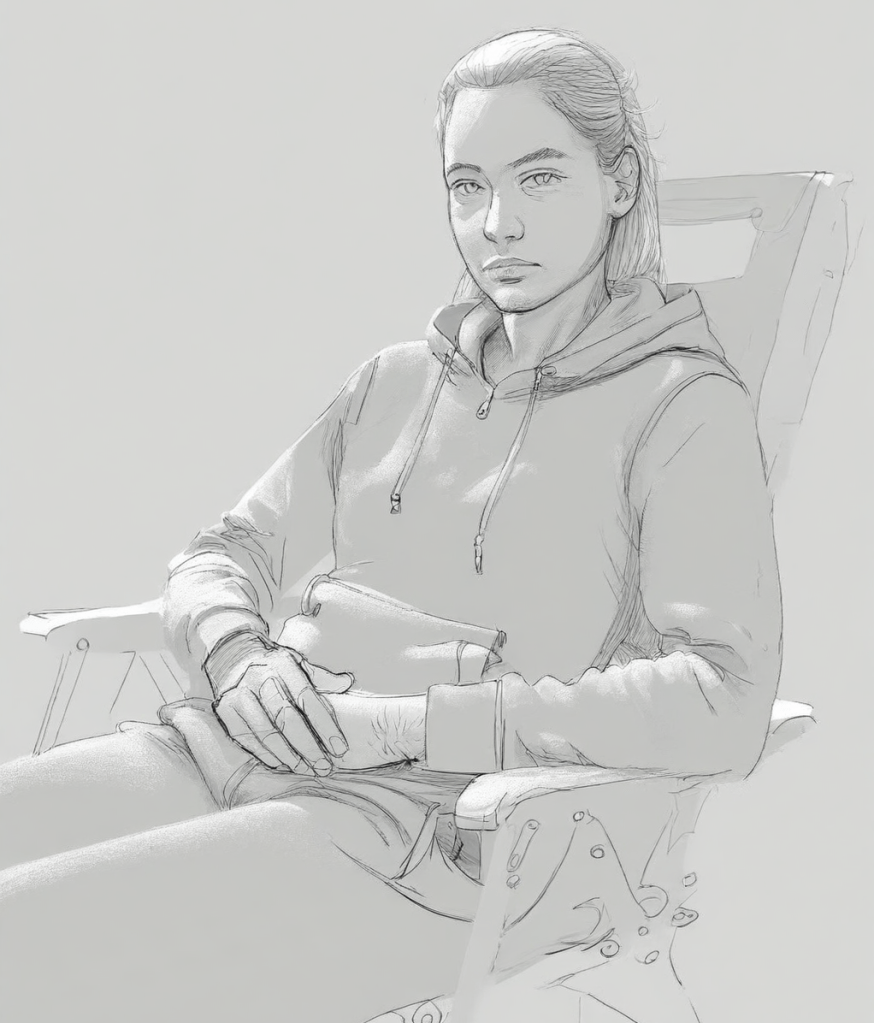
I looked up and found Elena’s pale blues fixed on me, as if scrutinizing every subtle twitch of my expression while I absorbed her writing. She lounged on the lawn chair, her hands folded over the kangaroo pocket of her hoodie.

“May I rely on your external input to learn the gender of the narrator?” I asked.

“Sure. I’m cheating you out of the full experience; a regular reader would already know. As you might imagine, I can’t start any random scene reminding them that the narrator has a penis. So does the protagonist of today’s other excerpt.”

“That makes three out of four male narrators so far. Does it mean anything?”

“That’s how the stories came out. As the conduit, I don’t question these things. If the story demands a male narrator, who am I to argue? Besides, I have no issues with my narrators’ gender. I only care if they interest me. Now, read on.”

The narrator left the clearing in darkness. Distant streetlights invaded through the passageway’s rectangle. Emerging onto the deserted street, he hurried to the opposite sidewalk’s vending machines like a thief stealing food from sleepers’ homes. Next time hunger speared him, he was kissing that woman, her legs entwined with his. The narrator’s dizziness spiked, and he rolled onto his back, gasping. He imagined himself leaving the forest again, but against the nakedness of skulking amidst cement, metal and glass, that ache for food didn’t matter.

Memories of the outside world faded like yellowing photographs. Minutes after twilight yielded to a granite dawn and birdsong, hunger cramps woke the narrator. His guts clung like an old balloon. He pictured the effort to dress, go down the trail through the trees, and hurry to the vending machines hunched and disheveled. He resolved to stay in the clearing. Sheltering there had stripped society’s makeup. He refused to breathe in its stink again even if his starved stomach devoured its own lining and spilled the acid into his core.

The woman looped her arms around the narrator’s neck and urged him to eat. He claimed he would last until hunger stopped his thoughts. She insisted he needn’t endure it. The narrator refused to leave the clearing again, and considered hunting for critters. But she brought up a better option: to feed from her. Then, she leaned back in the grass, tilting sideways. She clenched her side at kidney level and yanked until she tore a handful of white flesh out. In the gash, grooves scarred where her fingers had dug in. Blood pooled. The narrator froze as she folded his fingers around the proffered chunk of meat.

Saliva drowned his tongue. He yearned to savor that flesh as much as he longed to hold the woman against him, joining their warmth like two coals in a bonfire. As he brought the piece to his mouth, he could tell apart the white threads of fiber in the meat. Its surface had grown slick with juice from the pressure of his fingers. His teeth grazed the soft flesh. Saliva spilled from the corners of his mouth, trickling down his chin. He clenched his jaw millimeter by millimeter, the fibers taut against the tip of his tongue. Before he could refuse to feast on the woman, a hot, sap-like juice flooded his mouth. He tore off a morsel and swallowed. It left an aftertaste of turkey. The rest, he devoured, then he licked the juice off his fingers.

A crisp rip startled me from the fictive dream. Elena had torn open the pack of Príncipe chocolate cookies. She plucked one, bit into it, then chewed as crumbs clung to her lips. I imagined myself as that cookie: crushed by her teeth, then ground to fine particles that mingled with hot saliva, coalescing into a doughy pulp. It would slide down the tight, pulsing cylinder of her esophagus and into her stomach, where the pulp would dissolve in gastric acid and become her flesh and blood. A warm vibration welled within my loins.

Her white throat contracted as she swallowed. She leaned forward to pick up the carton of Don Simón from the grass, lifted it, and sipped. A droplet of orange juice escaped her mouth, but she caught it with her thumb.

“Sorry for the noise. You’ve yet to touch your peanuts. Want me to toss them?”

“Don’t worry,” I said, my voice dry. “I can survive for weeks on my fat reserves. And I’d rather not distract myself from your writing.”

Elena shrugged, then set the carton back on the ground.

“Alright. I’ll just keep munching on my cookies.”

She stuffed the remainder of the cookie into her mouth. Crumbs sprinkled her hoodie.

I returned to the excerpt. When the narrator looked up, shame flooded him. The gash in the woman’s side dripped blood down her hip, splattering the grass and pooling on the dirt. He rushed to cover the hole with his hands, but warm blood seeped between his fingers like soup. The woman calmed him, assuring him that her flesh would regrow. He wanted to laugh, but a whimper escaped. He couldn’t live off eating her. She doubted he would eat so much that he’d swallow her whole. Besides, he argued, he needed to ingest proper liquids. The woman lay on her back, then cupped one breast and squeezed the nipple. Thick milk oozed like honey.

From then on, the narrator avoided glancing at the clearing’s exit. He felt that a monstrous hunter stalked that pine-guarded trail, and if he wandered its bends and hollows, the creature would ambush him, tear his limbs from his torso, slurp the marrow off his splintered bones. He wondered how he had dared to enter and leave this clearing without realizing it. Beyond the forest, the machinery of society would grind on, its gears, lubricated with the sweat of nine-to-five drones, screeching as they pulverized bones caught in their teeth. Whenever such images and memories assailed him, patches of his brain crackled with electricity. He wanted to pinpoint those patches and scour them with bleach.

They rolled in the grass, rubbing sweat and soil onto each other’s skin as her tongue probed his mouth, and the part of his brain that believed itself in charge checked out. Sometimes his consciousness resurfaced and found him biting and tearing at her breasts, digging deeper until he should have chewed through her ribs and burst a lung, but instead, just a handspan beneath her skin lay white meat free of veins, arteries, tendons, organs, cartilage, or bones. Kissing along her nape and spine, he sank his teeth into her back and gnawed off a chunk. His mouth flooded with blood that flowed hot and coppery down his throat.

Lying beside her, his belly full, the narrator traced the contours of her ribs and pelvis with his fingertips. Her skeleton held. But whenever he bit, he found white flesh. Even so, a moment after tearing off a piece, the wound oozed blood, and minutes later, when he looked back, her body had stiched itself together. The missing bite was outlined in sticky, half-clotted threads of blood.

Once, the narrator devoured her neck to the extent that he nearly decapitated her. Another time, prying apart her labia with his tongue, as she bucked her hips to his mouth, he chewed into her womb and beyond, splitting her abdomen open to the ribs. He ate an entire thigh and ended up clutching her detached calf, foot dangling from the end. He shoved himself backward on his ass, driving his heels into the earth, and screamed. But when the narrator dared to glance back at the woman, she stood on both legs, and his hand gripped air.


Author’s note: Today’s song is “Velvet Waltz” by Built to Spill.

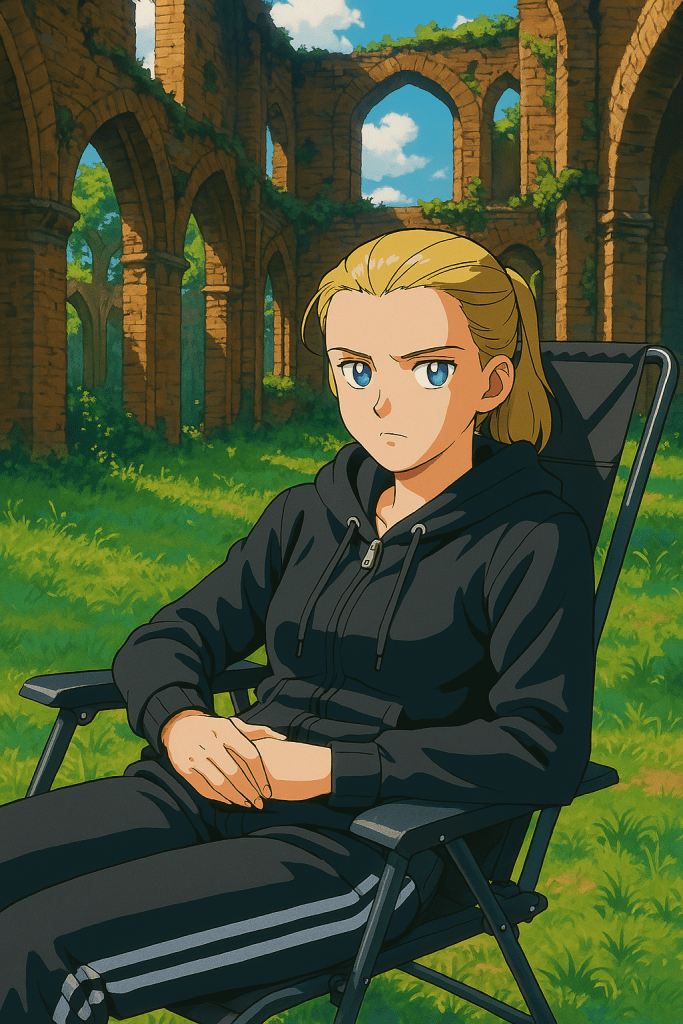
And why not, here’s a 90s anime version of that concept:

The Scrap Colossus, Pt. 17 (Fiction)

At the end of César Figuerido Street, we turned right and ascended a stretch of pavement winding along a towering wall of trees and wild undergrowth. Ferns draped their fronds over moss-covered gutters. Elena trailed close behind, gripping her backpack’s strap as she shifted the load. Her nostrils flared, her lips tightened, and sweat glimmered at her hairline. Her pale blues were fixed ahead with the determination of someone resigned to enduring torture with dignity.

“You doing alright, Elena?”

“Mm-hmm.”

“The path will level out soon.”

We crossed the road to the side closest to civilization. A middle-aged couple, the man sporting a yellow-and-white knitted earflap beanie, talked loudly in a Slavic language as they exited a parking lot and strode past us. A distant whistle blew, accompanied by a burst of cheering. Between the trunks of the trees, I glimpsed a deep-green field of artificial turf marked for football and flanked by two silvery lightning towers. Color-coded middle-schoolers pursued a ball, intending to kick it toward the opposite goal, while their relatives watched from concrete stands.

The hill flattened. Across a roundabout, dozens of headstones topped by crosses jutted out over a three-meter-tall stone wall.

“Oh, is that the cemetery?” Elena asked, her voice strained.

“It better be.”

“Are you taking me there?”

I shook my head.

“You sure? I could lie down on a slab of marble and catch my breath.”

“You’ll recover soon enough.”

“Or we could find a nice grave for you to bury me in. Save you the trouble of digging a pit in the forest. You could toss some dirt in my face and then just pretend that you never met me.”

“I’m not letting you die yet. We have a lot to talk about.”

“I guess we could bring up some topics.”

“Should I have taken you to another coffee shop instead?”

“No, I’m glad you’re showing me around. It’s a good kind of pain. I’d rather suffer than feel nothing. Besides, I think my heart rate’s approaching normal human levels. Tell me, Jon. Are any of your relatives buried there?”

“Yeah, my grandparents. Never bothered to locate their graves, though. They’re a bunch of bones now.”

We followed the path as it veered left, away from the cemetery. To our right, beyond a fenced garden, the landscape unfurled: Mount San Marcial, carpeted in rolling waves of pine and rising to a pitiful 220 meters. A titanic cloudbank, billowing over the mountain’s crest, eclipsed the chapel at its peak, that struggled to emerge from the treeline. The bluish-gray core of the cloudbank promised rain.

“The mountain looks different from here,” Elena said. “More alive.”

“We’re drawn to higher ground, where the world appears richer in meaning, where we feel safer. From a defensive standpoint, at least.”

“Is that so? Must be the Basque genes. But I get it. I wouldn’t want to be caught at the bottom of a valley when the floods come.”

Further along the sidewalk stood a three-story rectangular building composed of pale-cream bricks, its windows shuttered. Mortar lines across the facade formed a tight grid. Toki-Alai School. Rust had ravaged its fence; you could snag your clothes or scrape off your skin on the jagged edge of a post.

I looked back for Elena. She had crossed the road and stepped onto a grassy patch overgrown with weeds and tiny blossoms of yellow. Crisp white stripes ran down the side of her black joggers. Her pale neck curved elegantly, her almond-blonde ponytail dangling from the back of her head. Elena’s gaze had caught on the panorama: a sprawling array of trucks, some bright blue or red, lined in rows at a transportation yard as large as a stadium, in a stark contrast to the undulating green hills beyond.

When I approached Elena, I wished I had brought a camera, or could stop time. Sunlight cascaded down her face, sculpting her forehead, the bridge of her nose, her high cheekbones, her slightly-parted lips. From beneath the skin of her eyelids, those glacial blues glowed with an ethereal intensity. She evoked a wanderer from some bygone epic, standing before a war-torn vista. She could have been a bardic song, a lament, an ode to a fallen kingdom.

“I guess it isn’t a complete hellscape,” Elena murmured. “I have no idea where I am. This place, the fact that you exist and also have a weird mind… The more I interact with reality, the less familiar it becomes.”

A cool breeze wafted the scent of hillside grass and earth and pine, mingling with the tang of truck exhaust.

“In the spirit of sharing awkward stuff,” I said, “I regret that I will never drive a truck for a living.”

Elena whipped her head toward me, a mischievous smile tugging at the corners of her mouth, drawing dimples on her cheeks.

“What? Why?”

“Well, think of the solitude. All those hours to yourself on the open road, discovering new sights. They say the brain mainly reacts to novelty, so it can fend off predators. If you head away from home regularly, you’ll always feel alive. And imagine the conversations you could have with yourself in the driver’s seat. You could write, too, between naps, in motels or rest areas.”

“That’s a romantic and likely inaccurate portrayal of a trucker’s life. You’d have to deal with the hassle of loading and unloading cargo, navigating roundabouts in a hulk, driving at night. I picture them snagging their trailers on posts, falling asleep behind the wheel, slamming into cars, flattening old people. You’d have to sleep in rest areas, where any shithead could try to break into your cab.”

“You’d also command a multi-ton killing machine that can obliterate anything in its path, up to and including the laws of physics.”

Elena chuckled.

“Figures. You’re aching for some truckmageddon. Maybe with a side of strangling prostitutes.”

“Only a small percentage of truckers are serial killers, you know.”

“Oh, but I see it now: a trucker poet, crushed in the cab of his rig, his unpublished masterpiece scattered across the highway, pages soaked in blood. A crow would land on the rim of the shattered windshield and peck out his eyes.”

“Damn it, woman. Let’s just get to our destination.”

Past the school, a lawn caught the sunlight, forming a shimmering carpet of green. Across, set against the blue sky, loomed a pockmarked ruin, its rugged stones darkened by centuries of moss and grime. Small plants burst like wild hair from fractures and shadowed crevices.

“The hell’s this?” Elena asked. “A ruin out of nowhere?”

“Gazteluzar. Built in the sixteenth century, I believe.”

“So it was here. Gazteluzar, meaning ‘old castle.’ Quite the hyperbolic name, don’t you think? Barely qualified as a fortress.”

We crossed the lawn, our shoes treading over soft grass, and slipped under a rough archway into a courtyard. The sunlit walls rose in a jumble of irregular stones and smaller filler pieces, as if built hurriedly from nearby rocks. Bushes hugged the crumbling corners. I guided Elena toward a circular clearing enclosed by low, lichen-encrusted walls hinting at the foundations of a turret. At the circle’s center, decades of foot traffic had stripped away the grass, exposing bare stone.

Standing against a curved section of wall, a folding lawn chair faced us, its seat and backrest composed of red and navy interwoven strips of plastic webbing. In this dilapidated fortress, the chair looked like it had materialized from another dimension.

“You’ve brought a lawn chair up here?” Elena asked, amusement creeping into her voice. “Just for me to rest? What a gentleman.”

“I’ll gladly take the credit for the work of some anonymous benefactor.”

“It doesn’t even smell of stale beer or piss. The kind of neighborhood where nobody steals an abandoned chair, huh? I better take advantage of it before the owner comes along and shoos me away.”

Elena unslung her backpack and dropped it onto the ground. With a groan of relief, she sank into the creaking chair, its plastic strips sagging under her weight. Reclining with her eyes closed, she draped her arms over the armrests and stretched out her legs. After a couple of deep breaths, she turned her head and threw me a languid, heavy-lidded glance.

“You took one hell of a gamble, Johnny boy.”

“How so?”

“Bringing a woman you barely know to a secluded ruin. Most would think, ‘Does this big, bearded fellow believe I aspire to become an archaeologist?’ Nevermind that reaching this place requires an Olympic fitness level.”

“No gamble at all. You’re not most women. I brought you here because this is what you’re like.”

Elena lifted her head from the backrest. Her ivory skin accentuated those pale blues as they locked with my eyes, granting me passage through the darkness of her pupils into her abyssal void, a space preceding language, filled with black stars and white blood. Her lips curved faintly into a placid smile.

“You do understand me, don’t you? Better than anyone ever has. I should run away while I can.” She sighed, then lifted her backpack onto her lap. “But I’m fairly easy. I appreciate most places as long as they aren’t packed with people. Better than staying at home with my parents and their endless disappointment.”

Elena unzipped her backpack. Amid a crinkling of plastic, she pulled out the carton of Don Simón orange juice, unscrewed the cap, tilted her head back, and chugged. She then rested the carton on the ground between her canvas shoes. As she licked her lips, she reached into her backpack again and brought out her blue folder. She opened it and retrieved a stapled stack of papers.

“You may enjoy this one. Also takes place in a secluded clearing.”


Author’s note: today’s song is “Dear Sons and Daughters of Hungry Ghosts” by Wolf Parade.

The Scrap Colossus, Pt. 16 (Fiction)

After scaling the steep street, I paused to absorb the vista. Between the Spanish bank of the Bidasoa River and the reedy island dividing it from Hendaye, the broad, greenish-brown body of water flowed languidly, laden with sediment. A lone kayaker sliced through the calm surface, leaving a smooth wake that rippled like silk. Each end of the kayaker’s paddle dipped and ascended like a mechanical arm. As sunlight poured in the stream, its surface sparkled with a myriad little splinters of white.

Beside me, Elena’s nostrils flared as exhaled sharply through her mouth, fatigue etched across her features. She flung her head back. When she lowered it, soft locks of her ponytail caressed her neck. She fixed me with a look of concern.

“In moments like these, I’m forced to remember that I’m terrible at this activity.”

“Which one?”

“Walking. You don’t train your muscles by spending weeks at a time holed up in your bedroom.”

“Well, let’s replenish those lost calories with some snacks from the supermarket.”

The neighborhood BM’s automatic sliding doors opened for us, and we were welcomed by a tinny American song from the eighties. It conjured images of cruising in a convertible at night, with haloed streetlights blurring past. We ventured deeper through a narrow aisle flanked by refrigerated shelves and rows of half-empty wooden crates piled with fresh fruit. Knives scraped against each other. At the rear, behind the butcher counter, two aproned women chatted about their weekend plans as one of them dismembered a plucked chicken’s waxen carcass. Elena stared transfixed as a wing came off, then she followed me down the aisle.

“Did that bother you?” I asked.

“Bother me? No. I find butcher shops honest. No pretense. Just blood and bone and the admission that something had to die for us to keep going.”

Elena picked up a carton of Don Simón orange juice and a pack of Príncipe chocolate cookies, while I grabbed a bag of salted peanuts. When we exited the supermarket, she carried a plastic bag that dangled from her hand like a jellyfish. I asked her to turn around, then unzipped her backpack and tucked the snacks between the blue folder of excerpts and the backpack’s inner lining.

Past the outdoor tables of a bar, where retirees sprawled like bleached elephant seals, I unveiled the next leg of the hike: a steep, rugged concrete staircase bordered on one side by a grassy slope. Elena’s eyes widened at the towering steps, and she let her shoulders sag.

Midway up the staircase, I stopped to ensure that Elena hadn’t collapsed. Panting, she squinted up at me half pleading and half accusing. The top of her zip-up hoodie hung loosely, offering an unimpeded view of her jutting collarbones—a pair of fossilized wings—above a shadowed swell. Her joggers hugged her lithe thighs, tightening over their contours, while her untied shoelaces flopped around with each lift of her right Converse.

“Climbing out of the depths of urban despair,” Elena said, her voice coming in breathy spurts. “You’re not planning to sacrifice me at some altar up there, are you? Because right now it feels preferable to this sadistic cardio program you’ve got me on. My legs already hate me, let alone tomorrow.”

Once she reached the summit, she slid the backpack off her shoulder, dropped it, and crouched to tie her shoe. She then leaned back against the concrete post-and-rail fence, her chest heaving.

Across the one-lane road stood a once-white three-story house whose paint, battered by decades of rain, had peeled and flaked away in dozens of patches, exposing the gray core underneath. That house begged for a repaint or a renovation or a thorough bulldozing. It evoked the image of a self-loathing teen relentlessly picking at scabs.

We ambled along the sidewalk, attuned to the whispering breeze and the distant rumble of traffic, that arrived like the herald of a perpetually approaching storm. We stood at eye level with the third stories of a row of weathered apartment blocks nestled at the base of a grassy slope, their rear walls lined with deserted balconies. This neglected fringe of the city had been abandoned back in the seventies, left to decay, a derelict cemetery of brick and plaster and concrete.

Elena pointed out a cat. Across the street, atop a roadside embankment covered in leafy shrubs that edged a pasture with leaning fence posts, a mottled feline lay chicken-like, forelimbs folded and face buried in the grass.

“It isn’t dead, right?” she asked.

I crossed the road and approached the cat carefully. Its back rose and fell in the cadence of sleep.

Further along the sidewalk, beyond the post-and-rail fence, dome-shaped hydrangea clusters crowned its scrawny stems. The flower heads had shriveled into papery, brown husks. Elena asked to stop, then leaned back against the fence and stared at the bordering wall of foliage: a thick mass of shrubs, brambles and ferns beneath a canopy ranging from lime in the sun to shadowy emerald. A forest edge, untamed and untrodden. If you ventured in, you’d never again meet civilization.

Elena fidgeted with one of the drawstrings of her hoodie, twisting it tight between her slender digits. I was about to ask her if she was okay, but her lips parted.

“I’ve never been up here before. It’s weird, isn’t it? Places you can walk to but you’ve never visited. So close to where you live, yet foreign. Makes you wonder what else you’ve been missing. Also makes you feel like a stranger in your own life somehow. Was this where you wanted to take me?”

“No, it’s a bit further.”

The shadows under her brows deepened and her eyes glazed over, as if fixating on a film flickering across the screen of her mind.

“I’m standing on the threshold between two worlds, neither of which I belong to. Our ancestors built this one not only for themselves but for their descendants, most of whom they’d never meet. Yet along the way, something broke. I regret not having been born a thousand years ago, or not being able to visit another planet. Absurd, right?”

She tucked her hands into the kangaroo pocket of her hoodie, her fingers fumbling within as if searching for something. Her shoulders tensed, and a sudden shudder rippled through her.

“Listen, Jon. When I was a kid, I took a school trip to some town I haven’t visited since and whose name I forgot. As I followed the group along an esplanade, I noticed a hitching post. I still see it vividly. I think they used it to tether cattle during local celebrations. One of the teachers mentioned that a few years earlier, a girl on another school trip had gotten kicked in the head by a hitched horse and died instantly. The teacher dropped that information like she was telling us about the weather. Imagine those parents getting the call. ‘Sorry, your daughter’s dead because she approached a horse from the wrong angle.’ And the teachers on that trip, they had to carry the trauma of her death for the rest of their lives. How do you even process it? One minute everything’s normal, the next minute a little girl lies dead with her skull smashed in. And why? Because nobody taught that child to approach a horse from the front so that it can see her? Perhaps she had never been near a horse before, and wasn’t aware of how dangerous they can be. I can see her grinning as she scampered over to pet it. Should her parents have also taught her to steer clear of boars or bulls? Not to reach her hand out to pet a snake?” Elena glanced away, then spoke in a low, hoarse voice, as if she dragged the words out from the depths of her throat. “What an absolute fucking waste.”

“Were you waiting to bring that up, or did it just pop into your head?”

Elena rubbed the outer corner of one eyelid.

“The second one. My brain decided to sour the moment by digging up an old memory that should have stayed buried. I was thinking about how our ancestors built a world for us, and my mind went, ‘Cool, but what about that one girl who had her brains bashed in after a fucking horse kicked her in the face?’ That kind of thing happens too often to me. This time maybe because I’m teetering on an edge, with civilization behind me and nature ahead. My brain’s way of reminding me how fragile life is. One wrong move and it’s over. That’s all it takes, right? A teacher looking away for one moment, a little girl who didn’t know better, a fucking horse doing its horsely things. Life’s just… waiting for the kick to the head that ends it all. And I’m not convinced that what lets us function, as a species, is a defense mechanism. I think it’s more like a collective delusion. We pretend we’re safe so that we bags of flesh and nerves can get out of bed every morning and put on our clothes and go on about our lives without losing our shit. But the truth is always there, lurking behind every corner. That’s part of why I can’t connect with most people: they’re so committed to the lie that they get angry when someone refuses to play along. They call it pessimism. I call it paying attention.”


Author’s note: today’s song is “Caribou” by Pixies.

Review: All the Pretty Horses, by Cormac McCarthy

Four stars.

This one’s a bildungsroman about a teenager (I believe he’s sixteen when the story starts) named John Grady Cole, who lives in Texas with his deteriorating family. Cole intends to continue working in the family farm and doing something in particular with it, legacy-like, but after his grandfather dies, the house changes hands in ways I wasn’t entirely sure about, but that in any case destroy Cole’s intended future. So, partly as a fuck y’all, he grabs his friend, a couple of horses, and heads down to Mexico, intending to never return.

Cole is a good kid. Intelligent, with a strong moral compass. It just happens that he’s venturing into the wild, and his courage and moral compass are going to get considerably tested. First of all, the pair of friends find themselves followed on their journey south by a single rider. That rider turns out to be a supposedly thirteen-year-old runaway named Jimmy Blevins, likely a fake name. He may have stolen his horse. Although the kid seems a bit unhinged and generally immature, he proves his skill with a revolver by punching through Cole’s friend’s wallet in one shot. Later on, this kid, terrified of storms (he mentioned that getting struck by lightning was a bit of a family curse), ends up losing his clothes, his horse, and his gun. In a Mexican town, they spot both Blevins’ horse and his gun in other people’s possession, which Blevins won’t allow.

That’s where the main trouble starts, which has repercussions for the rest of the story. At its core, though, this story is a tale of tragic love between John Grady Cole and a beautiful seventeen-year-old girl named Alejandra, of Spanish ancestry and a wealthy family. John is ultimately a Texan cowboy with barely a peso to his name, not the kind of young man that Alejandra’s father would allow his precious daughter to marry.

Cole learns that the world is a harsh, frequently unfair world, and that the lines between good and evil are hard to measure at times. This is the first entry in McCarthy’s The Border Trilogy, and I’m curious to know how Cole dealt later on with the mental state that the events of the first book left him in.

I must mention, as I have in every review of McCarthy’s work ever since I learned about this matter, that the tale I’m reviewing, as well as most other tales of his ever since the following events happened, are heavily influenced by having met in the early seventies someone that quickly became McCarthy’s love of his life: a thirteen-year-old blonde, blue-eyed teenager named Augusta Britt. Or, as one of his writer pals put it, “a teenage popsy.”

Supposedly, as McCarthy was researching Blood Meridian in Tucson, AZ, Augusta Britt, wearing a holstered gun, asked McCarthy to sign her copy of his first book. Although that sounds unlikely (partly because the supposed edition she handed him lacked a photo of the author), Britt has showed the letters she received from McCarthy. Britt was a foster kid, and had been abused in various ways; all the foster homes she ended up in lacked locks in the doors, and men tended to enter whenever they pleased. McCarthy quickly grew amorous of this thirteen-year-old tragic hottie, and after she told him that someone in her current foster home had hit her, he offered her to run away together to Mexico.

What he intended to do was very illegal: basically kidnapping a girl from the foster system. Crossing not only state but country lines with an underage girl that he was in love with and likely fully intended to fuck was probably also illegal. But it happened, and by the time she was fourteen and in Mexico, McCarthy and Britt banged like there was no tomorrow, which McCarthy likely believed to be the case, as the FBI was literally after him. Even to this day, Britt says that the whole thing was fine, that she loved him and felt safe with him. But their relationship fell apart when Britt found out that McCarthy was actually married at the time (although estranged), and had a son he was neglecting. Britt ended up leaving for the States, which broke McCarthy’s black heart. They remained friends until his death, and he even tried to marry her twice, but ended up failing to do so because her church demanded of him to convert to Christianity; as the last paragraph of his last book, The Passenger, put it, he was “the last pagan on earth,” and very much intended to remain so.

You feel echoes of that period of McCarthy’s life in this novel: running away to Mexico, the dread of being pursued, the dilemmas about right and wrong, the tragic love for a teenage girl, etc. Curiously, Jimmy Blevins, the wild thirteen-year-old runaway kid, seems the closest to Augusta Britt given what I read about her: the kid had peculiar mannerisms and a wild goofiness that you could imagine having been lifted straight from a seventies teenage runaway with a fucked-up past.

I wasn’t particularly into the story, to be honest. Didn’t connect much with it other than during some philosophical passages. If it weren’t for McCarthy’s prose, at times I would have rated it a three. However, prose-wise, it was sloppier and much lazier than Suttree, which was my previous read of his. I can’t blame McCarthy for lowering the quality of his prose; Suttree was so relentlessly high quality at times that writing it must have been agonizing, prone to making the writer hate the very process. I suppose that in the back of his mind, McCarthy thought that the public at large would have been forced to acknowledge the brilliance of Suttree, but it ended up selling terribly. I can see him thinking, “Why bother?” and not putting in his 110% from then on.

Anyway, the following are the quotes I’ve highlighted from the book.

People dont feel safe no more, he said. We’re like the Comanches was two hundred years ago. We dont know what’s goin to show up here come daylight. We dont even know what color they’ll be.

Beware gentle knight. There is no greater monster than reason.

The prison was no more than a small walled village and within it occurred a constant seethe of barter and exchange in everything from radios and blankets down to matches and buttons and shoenails and within this bartering ran a constant struggle for status and position. Underpinning all of it like the fiscal standard in commercial societies lay a bedrock of depravity and violence where in an egalitarian absolute every man was judged by a single standard and that was his readiness to kill.

Those who have suffered great pain of injury or loss are joined to one another with bonds of a special authority and so it has proved to be. The closest bonds we will ever know are bonds of grief. The deepest community one of sorrow.

We weep over the might have been, but there is no might have been. There never was. It is supposed to be true that those who do not know history are condemned to repeat it. I dont believe knowing can save us. What is constant in history is greed and foolishness and a love of blood and this is a thing that even God—who knows all that can be known—seems powerless to change.

He saw very clearly how all his life led only to this moment and all after led nowhere at all. He felt something cold and soulless enter him like another being and he imagined that it smiled malignly and he had no reason to believe it would ever leave.

He lay listening to the horse crop the grass at his stakerope and he listened to the wind in the emptiness and watched stars trace the arc of the hemisphere and die in the darkness at the edge of the world and as he lay there the agony in his heart was like a stake. He imagined the pain of the world to be like some formless parasitic being seeking out the warmth of human souls wherein to incubate and he thought he knew what made one liable to its visitations. What he had not known was that it was mindless and so had no way to know the limits of those souls and what he feared was that there might be no limits.

He thought the world’s heart beat at some terrible cost and that the world’s pain and its beauty moved in a relationship of diverging equity and that in this headlong deficit the blood of multitudes might ultimately be exacted for the vision of a single flower.

He stood at the window of the empty cafe and watched the activities in the square and he said that it was good that God kept the truths of life from the young as they were starting out or else they’d have no heart to start at all.

He stood hat in hand over the unmarked earth. This woman who had worked for his family fifty years. She had cared for his mother as a baby and she had worked for his family long before his mother was born and she had known and cared for the wild Grady boys who were his mother’s uncles and who had all died so long ago and he stood holding his hat and he called her his abuela and he said goodbye to her in Spanish and then turned and put on his hat and turned his wet face to the wind and for a moment he held out his hands as if to steady himself or as if to bless the ground there or perhaps as if to slow the world that was rushing away and seemed to care nothing for the old or the young or rich or poor or dark or pale or he or she. Nothing for their struggles, nothing for their names. Nothing for the living or the dead.

The Scrap Colossus, Pt. 15 (Fiction)

At the intersection between the Antonio Valverde and Pintor Berrueta streets, I leaned over the graffitied railing to watch the two feet of greenish water flowing below, where countless small waves collided. The sight of muddied pebbles and an aluminum can rippled as the watery creases glided in undulating curves of light and shadow. Every second, the universe’s CPU calculated millions of minute interactions along this insignificant stretch of river even if they passed unattended, and remained barely comprehensible to the few that stopped to look.

“Hypnotic, isn’t it. Always moving but never going anywhere. Just flowing along whatever path was carved out for it centuries ago.”

I had waited three days to hear that voice once more. Elena had tied her almond-blonde locks into a ponytail, save for a few strands that framed her face. Afternoon sunlight bathed her forehead and crown, igniting her hair into warm, shimmering gold. The light caught her cheekbones and the bridge of her nose, revealing their smooth texture, while her pale blues shone cool and glassy in the shade beneath her brow. A gradient descended from the illuminated ridges of her collarbones to the zipper of her black hoodie.

Elena tilted her head slightly, and along her bare neck, the right sternocleidomastoid contracted and relaxed as if alive, outlining the dark hollow between the muscle and the graceful curve of her throat. I imagined my gaping maw encircling her slender neck, teeth pressed hard and sinking into her spasming, taut flesh, pulse thumping against the tip of my tongue, then I’d clamp down and yank, severing veins and arteries, ripping sinews and muscle that would stretch like melted cheese before snapping. I’d chew on her succulent, coppery flesh as hot jets of lifeblood from the glistening crater in her throat with its exposed tracheal rings blessed my face in crimson splashes.

She adjusted the strap of her backpack, slung over her left shoulder.

“I should warn you: I’ve barely slept four hours. I dreamed I was sitting in an empty bathtub while a giant cockroach stared at me from the bathroom wall. It had these alien, eerily-intelligent eyes that made me feel exposed, like it knew things about me I don’t even know. Then I woke up and couldn’t get back to sleep.”

“So, not unlike a certain human with whom you spent an afternoon at Bar Palace. Who, as you put it, dissected your darkness.”

Elena’s eyes widened. She turned her head and knit her brow as her lashes fluttered nervously. Then, she fixed me with a contrite gaze.

“My brain does have this twisted way of processing things—turning real connections into monstrosities I can understand better. Maybe it’s easier to deal with a giant insect than a human being who might see through my bullshit. But no, that wasn’t a cockroach version of you.”

“How can you be sure?”

“You make me feel seen, not exposed. That cockroach was older, almost like a father figure. Or maybe a god. A godroach. The Eternal Lord of Filth. It had been watching humanity since we crawled out of the primordial ooze, and it spent its time judging us, judging our entire species, as it waited patiently to inherit the Earth after we nuke ourselves to oblivion.”

“I’m glad to hear I wasn’t a bug in your nightmares.”

“Anyway, what’s this place you want to show me? Hopefully not a mass grave of your victims.”

I pivoted and pointed toward the blocky apartment towers, one a muted taupe and the other cantaloupe-colored, further up the narrow, sloping road. Towers erected decades ago to shelter the dutiful working class that once stored there, few would escape their confines except in a hearse. On nondescript balconies, potted flowers fought for distinction, futile as a thin coat of paint on a rusted hulk.

“We have a bit of a hike ahead of us.”

Elena’s fingers lingered on the zipper of her hoodie before dropping to her side.

“Artia? You’re taking me to the place where dreams come to die? Growing up, I thought these towers looked like enormous gravestones.”

“Our destination lies beyond this decaying corpse of a neighborhood, and I’m confident you’ll enjoy it.”

“Figures we’d have to walk through the worst part first. Some twisted metaphor for life, right? Trudge through the rot before you get anywhere worthwhile. If there even is such a place. Lead on then, mysterious guide.”

We headed up Pintor Berrueta Street on a narrow sidewalk that corralled us into single file. As we passed a row of recycling bins, a green igloo belched its fetid reek in our faces. I held my breath, then crossed the road toward a corner bar.

“Stench of the apocalypse,” Elena said, a couple steps behind me. “The end creeping on its way to gobble us up.”

“Or the stench of stale alcohol.”

We climbed a short flight of stairs into a murky arcade sheltered beneath a concrete overhang. Half the businesses had gone bankrupt; the plate glass windows had been papered over, and the metal rolling shutters had clanged shut.

“We’ve witnessed this town fall apart, haven’t we?” Elena asked grimly. “Not in one big catastrophe, but in tiny individual tragedies, piece by piece, year by year. A slow, agonizing necrosis. The stores we frequented as kids, the playgrounds and parks we played in. Irún’s heart and lungs are failing, and no one gives a shit. I’d leave, but where would I go?”

“Anywhere away from here. That’d be a good start.”

“What other place would you recommend? Aw, crap.”

I stopped to look behind me. Elena, hands tucked into the kangaroo pocket of her hoodie, twisted her slender right leg as if showing off the two stark white stripes running down the sides of her black joggers. The cuff of that jogger leg had rolled up, unveiling a pale, sinful ankle that would slither into my dreams. She stared at her untied right Converse.

Elena shrugged, then skipped ahead while fluttering her hand in a winglike motion to urge me onward.

“Let’s keep going. I don’t want to stop here.”

We pressed on through the shadowed passage. An elderly woman, likely in her late seventies, doddered towards us, taking up the center of the arcade. She had wrapped a plaid scarf around her neck, over a timeworn cardigan. As she carried a tote bag in a papery, veiny hand, she lifted the other to point at Elena’s canvas shoe.

“You’re dragging your shoelaces along the filthy floor, dear. They’re going to get dirty.”

Elena sidestepped the old lady, eyes fixed straight ahead, but her eyelids twitched. The woman called out behind us.

“You should be careful. You’ll trip on those laces.”

I spoke over my shoulder.

“She knows.”

Elena had frozen mid-step, a scowl distorting her features as her eyes rolled back. She whirled around and stepped closer to the elderly woman, whose face had crumpled into a webwork of wrinkles, whose shoulders had hunched as if her torso were collapsing in on itself.

“Have you ever worn shoes with shoelaces?” Elena asked coldly.

“If I have ever worn shoes?”

“With shoelaces.”

“Of course, dear. I was young once, too.”

“Okay, so you know that when one’s shoelaces come undone, the person wearing the shoes is aware of it, and you’re just bothering a stranger for no reason.”

The woman’s sunken eyes widened, and her lips quivered.

“Dear,” she started in a conciliatory tone, “there’s no need to get upset. I was just trying to help. You’re going to trip and hurt yourself.”

I could hardly tear my gaze from the sway of Elena’s almond-blonde ponytail, yet someone in that desolate arcade needed to stop this nonsense. I fought the urge to rest a hand on her shoulder; who knew how she might have reacted.

“This may be the epitome of ‘not worth it,’ Elena.”

She turned away from the elder and strode ahead. After she passed me, I quickened my pace to match hers. She sighed deeply as her right Converse dragged its undone laces. We climbed a longer flight of stairs. To our left, the wall was blighted by a collage of jagged tags. We stepped out of the arcade onto the asphalt of a parking lot. Decades of pedestrian and vehicular traffic had eroded the once-solid zebra crossing into patchy remnants. Elena raised her eyes toward a peach-colored apartment tower.

“The world feels strange and fragile, about to fall apart like a cracking facade and reveal that this whole thing has been a cosmic joke. Do you ever get that feeling, Jon? In such moments, I wish we had a soundtrack to our lives. Something melancholic, like nineties shoegaze.”

When her pale blues met my commonplace irises, her lips parted as if she were about to continue, but then she glanced away and lowered her head. Her eyebrows drew inward, her lids grew heavy.

“I can hear your thoughts,” Elena said. “Be grateful an old person tried to help you, you miserable bitch. You didn’t have to be polite, just smile and keep walking. You could have given her a moment of good feelings instead of this bitterness.”

“That’s you self-flagellating. I couldn’t give less of a shit about the old bat. I just didn’t want you to get riled up for no good reason.”

Elena’s voice carried a trace of anguish.

“If I want to drag my fucking laces along this disgusting pavement, that’s my prerogative, and if I trip and break my neck, well, good fucking riddance. One less burden for my parents, one less monster for the world to deal with. So keep walking, and mind your own business. What’s next? Someone stopping to remind me to blink? To breathe? To keep my heart beating? People grabbing onto any excuse to butt their heads into someone else’s life. So desperate to feel useful they’ll point out the most obvious things just to convince themselves they matter. Looking for connection where there is none. Sorry, Jon. Four hours of sleep and cockroach gods. If it serves as consolation, I’m bound to end up worse off than that hag. Senile. Desperate to talk to anyone. But I’ll have nobody, because I pushed them all away.”


Author’s note: today’s song is “Brand New Key” by Melanie Safka.

The Scrap Colossus, Pt. 14 (Fiction)

Elena headed toward the gate to exit Bar Palace’s fenced patio, but I reminded her that we were supposed to pay for the coffees. She followed me inside through the sliding door, and we trod over broad boards. A dozen tables populated the room, around which distinguished older ladies and men sat in ornate chairs. Overhead fixtures burnished with amber light rectangular stone columns bolstering wooden beams. Another fixture spotlighted a stone fireplace and the ornament perched on its mantle: a metallic emblem bearing Irún’s coat of arms. Vigilantiae Custos. Guardian of Vigilance. We had entered a centuries-old retreat. I beelined to the marble counter layered atop dark wood paneling, then waited for a waiter in black garb to take my money. Elena trailed behind me, blue folder clamped under her arm, and surveyed the salon with darting eyes as if she feared some threat lurked in there.

We emerged from Bar Palace onto Navarra Avenue, then stopped at the edge of the sidewalk for the traffic light to turn. After basking in the refuge of that patio, despite the intruding youth, this noisy intersection had hurled us back into civilization. Cars and buses growled past. Across the street, a cluster of teenage girls idled outside a candy store, chatting and giggling beneath a leafy tree. A cyclist avoided pedestrians as he passed the reddish-orange facade of a four-story apartment building. Beside me, the rain-scented breeze played ghostlike with Elena’s almond-blonde locks. She clutched her folder while her eyes flitted between strangers like an anthropologist visiting a foreign land. I resisted the urge to steal a glance at how her dark-wash jeans hugged her butt.

Had Elena intended for us to part ways the moment we left the coffee shop? I wanted to spend more time with her, so she’d have to dismiss me.

Although her eyes were averted, Elena’s thin voice reached out to me.

“Jon, do you like being around people?”

“Not particularly.”

“Often when I force myself to leave the apartment, I see all these men and women and kids and elders walking about like ants scurrying to and from their nest, and I think, ‘I have nothing in common with these beings.’ I must assume that minds operate behind their eyes, even though I can’t imagine their thoughts. But maybe I share the world with eight billions of shoddily-programmed automatrons that short-circuit when confronted with concepts more complicated than the weather, football, or whatever shit the mass media pumps into them. Maybe I’m the sole real person in a simulation built to trap me. It would explain the state of the world, wouldn’t it? If nobody had any fucking clue about what they’re doing.”

“As a fellow person, I can’t help but resent the implication. And that line of thinking can easily slide you into psychosis.”

The pedestrian light flicked to the walking man outline. Elena and I strolled ahead.

“As a child,” she said, “I wondered if everyone around me was acting out a role. Did they also have to put on a mask whenever they went out? Were they as scared and lonely as me? Even now, I can’t be around people for too long. When someone stares at me, I feel like a fly trapped in a jar. It makes my skin crawl. There are no common points in which I can make myself understood. When I engage people, they’re more likely than not to end up developing an instinctive dislike of me. They’re the normal ones. Always pretending, trying to impress others. Trying to impress themselves. Lying to get along, to fit in. Do they ever feel the walls closing in? Do they ever sense the void beneath their feet, or the cold, dead stars overhead?”

Iglesia Street unfolded into a downward-sloping plaza paved with gray stone. At its edge stood the white building of the Roman museum. In front, three towering cypress trees jutted upward like narrow spearheads. Elena continued her monologue.

“One of the things you discover when you’ve been alone for so long is how people can weigh you down. As if you had lived with a TV constantly on and loud, and once you turn it off, you realize that something had been drowning your genuine thoughts. That newfound silence allows contemplation similar to that our ancestors enjoyed in their so-called primitive societies. Alone, you’re free from having to conform to the expectations installed by the people you’ve allowed in, who intend for you to like and want the same things they do. Without that pressure, your true self emerges—unshackled, raw. You figure out what matters to you. What you’re willing to tolerate, sacrifice for, fight tooth and claw to defend. To get there you have to become one with the void inside. Otherwise it remains alien to you. And most people seem terrified of meeting that self, lest they end up pushed out of the collective and ejected into the cold.”

We were nearing the bronze statue of a San Marcial vivandière—a woman captured mid-stride, clad in a beret; a buttoned-down, tailored jacket; and a pleated skirt that draped over the tops of her laced boots. In her right hand, she held a fan aloft, frozen in her constant duty to wave, while she cast an unsettling smirk at passersby. Creeping verdigris etched stark contrasts along the pleats of her skirt.

“You’d think such a dynamic would be absent in couples, right?” Elena said. “Surely partners willing to accompany each other on this doomed journey would form a sanctuary in which both could grow as individuals. But no. Most couples seem like two dogs chained together. A romantic relationship censors you even worse, and before long, you end up defanged and declawed. Can’t risk upsetting your partner. Can’t risk losing them. No wonder some couples decide to have a kid, then another, and another. Filling the home with hostages. No, an individual’s freedom is too valuable to sacrifice for the sake of having a companion to fill the silence, and a warm body to fuck.”

As we descended the stairs, Juncal Church loomed fortresslike, built from sandy stone blocks, some bearing warm honey hues and others worn into ashen grays. Near the top of its bell tower, that had darkened as if singed by flames, a snow-white clockface stood out. The church endured as a relic from an era when people’s beliefs, however misguided, urged them to erect beauty that would outlive them by centuries.

Elena’s vacant gaze drifted along the stairs. She had tucked her folder under one arm, and that hand in the pocket of her jeans. When she spoke again, her voice came hoarse.

“Most people stick to you not because they’re interested, or care, but because they need that closeness, that shared warmth, the same way I need to be alone. They’d be comfortable gathered around a bench in silence, while their mere presence would desiccate me. You spoke about how many works of art have been lost because their potential creators wasted their talents, or died too young. But how many revolutionary ideas, how many discoveries we’ve missed in these societies that push their members to police each other’s thoughts? How many masterpieces have died in the womb because some nearby moron could consider them impractical or ridiculous or immoral? I’ve had to protect myself. Surely you noticed how guarded I was at the writing course, or when you first approached me at that bench. Always have a wall up. I ensure that a person will offer more than they’ll take away from me. To preserve the garden, one must first be a ruthless weed slayer. Without that, the flowers get choked and die.” Her jaw tensed as she swallowed, and she massaged her throat. “Life gets too complicated when people disgust you. You need them for the most basic things, and I endure those interactions while repeating in my mind for them to leave me the fuck alone. The responsibilities you accumulate with humans shackle you. From time to time I feel like I’ve matured enough, or grown enough callus, to tolerate experiences like that writing course, which could help me. But soon enough, everything that irritates me about human beings, their words, their noises, the myriad little humiliations, swell and swell until suddenly I can’t deal with a single extra minute of that shit. Then I need to hide from the world and everybody in it. My solution? I keep my rotten self away from others. That way nobody can hurt me, and I don’t pollute anyone else. A quarantine measure to keep the world safe, you could say. Isn’t that the epitome of altruism? The greatest good?” She sighed. “Yeah, I’ve given up. After that course, after my stories were deemed deplorable, after that fucking bitch Isabel called me out as a monster in front of everyone… I feel completely done. I hoped that other writers would understand. So I exist here, in this land, because I have no choice. I can’t just pack up and move to the forest, or the mountains. Well, I could, but I’d like to survive past twenty-eight. Honestly, I doubt I would have reached this far if my parents hadn’t taken care of me. Imagine their disappointment and regret at what I’ve turned out to be.”

I had stopped at the church entrance, and Elena, lost in her soliloquy, had copied me. The dark wooden doors split into four metal panels, each embossed with figures of robed saints or other biblical characters. Four sandstone columns with fluted shafts flanked the entrance. Their bases and capitals had eroded, exposed for centuries to the elements and the corroding darkness of the world. Above the door, a circular niche might have once housed a statue, but these days it would have been stolen. Higher up, near an oculus’ edge, some architectural oversight had forced the builders to chisel blocks and wedge them into gaps.

Elena cleared her throat.

“Man, my voice box is actually strained. I hadn’t spoken so much in years. Maybe I never had. I was holding back a shit-ton of stuff, it seems. I also like to stop and stare at beautiful buildings. To see their little details. The cracks, the mold, the weeds growing in between the stones. How much they’ve endured. And most churches beat modern monstrosities like the one built to replace the covered pelota court at Sargia.”

Elena’s pale blues stared at me with childlike interest. I held my breath as her loose locks fluttered. She arched an eyebrow, and I broke the silence.

“Elena, did our coffee meeting feel that overwhelming?”

Her fingers fidgeted with the edges of her folder, and she glanced away.

“If you’re asking whether I enjoyed your company, the answer is yes. I like talking to you, Jon. I can hardly believe you’re still willing to reciprocate. Most people that intrigue me for whatever reason, they’re like temporary bandages over a radiation burn—they stick around just long enough to realize that this broken toy can’t be patched up with positive thinking and empty platitudes and self-help books, and then they bail. But you… you don’t seem interested in fixing anything. You just want to, what? Watch the decay spread? Document the collapse? I’ve offered you a glimpse of my darkness, and you just dissected it. As if performing an autopsy on my soul and cataloguing every diseased part you found. And I was glad to let you peel back layers. That writing course debacle… Honestly, if you hadn’t come out of the experience, I may have holed up in my cave for weeks. So, did our meeting feel good? I’m not sure I know what that feels like, because I can’t get rid of this anxiety and dread. But it felt… necessary. Real. Like for once, with you, I don’t need to pretend I’m something other than a monster. Now I have to acknowledge that maybe I’m not as alone in this darkness as I thought. That maybe other people out there can look inside me and not flinch. I don’t… I don’t know what to do with that kind of understanding. In summary: congratulations, Jon. You’re the first person I’ve talked to for more than ten minutes that didn’t make me want to claw my skin off. What a relief to speak to a human being without having to pretend to be one.”

“I want to meet up again soon, Elena. I picture us visiting interesting, solitary places, and having long talks about whatever comes to mind. I also intend to read the rest of your work. Let’s see how far we can take our experiment.”

Elena slid her hands into her pockets, folder tucked under one arm. Although she tried to restrain her lips from curving upwards, they betrayed her. The muscles that framed her mouth and connected to her chin tensed, her lower eyelids pushed up, her pale blues gleamed. I yearned to induce more of her genuine smiles, drawing beauty into the world with each one. Little works of art just for me.

“That sounds an awful lot like you’re giving me permission to be exactly what I am,” she said.

“That’s exactly what I want.”

Elena glanced over her shoulder at the rounded archway, under two levels of balconies and their striped awnings, that led deeper into Erromes Plaza. She turned back to me and nodded.

“Anyway, I’m not sure if it’s morally right to inflict myself on another person, but let’s do this again.”


Author’s note: today’s song is “Fake Plastic Trees” by Radiohead.

We’re like 25,000 words in, and we haven’t even reached the middle of the first act. This is going to be a long one.

Also, because I’m from this city and I mentioned the San Marcial festivities (even though that day I either work or stay at home), here’s a video about it. Some shots even depict the itinerary of our main characters; for example, at 0:40, the church appears on the left.

The Scrap Colossus, Pt. 13 (Fiction)

A group of six twenty-somethings swept in through the gate of Bar Palace’s fenced patio. At the forefront of that posse, two young men sported fitted T-shirts and jeans, while the leading lady wore a cream blouse layered under a fuzzy, warm-toned coat paired with ankle boots. The group sauntered between the tables and the low stone borders enclosing boxwoods and sago palms. Each face bore a pristine smile as if etched permanently. Had Elena continued talking, their booming voices would have swamped hers, and judging by their tone, she should have thanked them. They headed towards the back of the patio, where an open-sided marquee shaded a dozen tables.

Elena crossed her arms. She turned one ear toward the intruders’ youthful cackling, which caused curved locks of almond-blonde hair to slide from the collar of her jacket. Along with her wary gaze, she evoked a stray cat that had come across a human while prowling the streets at night.

She had been speaking so earnestly, but now she risked clamming up. I should hurry to cocoon her within a web of words.

“Are these novellas finished?”

Elena uncrossed her arms and let out a weary sigh.

“I wrote six stories back-to-back. Didn’t I tell you?”

“Damn. Have you sent them somewhere?”

Her pale blues softened with regret, eyebrows furrowed. She drew her shoulders in and lifted her slender index finger to her mouth. Her lips pursed around its tip, then the muscles at the corners of her mouth contorted as she nibbled on the nail. Her gaze drifted down. When she pulled her finger, its tip glistened with saliva.

“I wish I hadn’t. It would have been better to retain in the back of my mind the delusion that once I sent the manuscripts, these stories I worked so hard on, that meant so much to me, that I bled for, I’d get the call, some editor at a big house saying: ‘Oh, what a gem this is! Here’s your prize, your publishing deal, and your movie adaptation!’ If my stories were truly great, surely the world would notice them no matter what, right? Someone would care. So I divided the novellas into two collections, then went through the mind-numbing process of figuring out to what contests I could send them. Do you know that the terms and conditions of some contests specify that they’ll reject any submission that features profanity or violence? I mean, are you fucking kidding me? What world do they live in? Anyway, I sent my collections to a couple of the less stupid contests. They didn’t even reach the elimination rounds. What a bummer, huh? Afterwards I figured, well, I’ll send them directly to the publishers, those that accepted unsolicited submissions. Only a couple bothered to respond, a few months later. ‘We regret to inform you that your book does not meet our current needs.’ You know, much worse writers than me are getting published, so I had figured I could squeeze in. Fucking moron. I got my hopes up for nothing.” She tilted her head and stared at the leaden sky. “And I did it for money. I was trying to figure out how to make a living doing something that didn’t make me want to strangle myself with an extension cord. But realistically, if a professional of the industry recognized my work, I’d have to deal with editors, publishers, and other strangers. They’d try to fix in my stories whatever offended their sensibilities. And I’d have to care about marketing. How would you sell these stories, which are symptoms of the radioactive darkness that’s been growing in me since before I took my first breath? I would have to go on book tours, and attend conventions. I’d be expected to sit in front of a room full of people staring at me as if I were a human being instead of a monster afraid of the light.” Elena’s shoulders heaved. She shivered like shaking off a gruesome vision. “But I don’t have to worry about those horrors ever becoming reality, do I? My work has no professional future. The gatekeepers would react to my stories the same way Isabel did. Lacks empathy, they’d say. Too dark, cynical, depraved. And I don’t write about the Civil War, which vastly reduces your chances of being published around these parts. Besides, do I really want to give my stories to the world? I just need to get the words out, to stop them from eating me alive. It’s like vomiting. You don’t serve it on a plate and invite everyone over for dinner, do you?”

“I find your puke delicious.”

“Well, you’re a weirdo. Which I like. But they’ll just see it as another mess to clean up.”

Two women in their thirties, a blonde and a brunette, seized the vacant table at our left as they bantered in a torrent of Basque. The blonde’s laughter erupted, her jaw gaping like a shark snapping at prey. Even after they sat, she flailed her arm, clutching a smoldering cigarette that set curls of smoke pirouetting. Their voices carried the confidence of those who knew their place in the world and were making the most of it. As a waiter in a stark black uniform swept over to take their orders, Elena glanced sideways at the pair like they were aliens.

“Anyway, Elena, I’d love to read the full novellas.”

Her lips twitched. She tensed her shoulders and held her hands on her lap as if steeling herself. Then she lowered her head, brows knit.

“Not yet. These are… appetizers.”

“For what main dish?”

Elena bit her lower lip and shot me a hesitant look.

“Something I’ve never shown to anybody.”

Was she trying to prove whether I was worthy of reading her secret work? On her lap, the fingers of her left hand had retracted and curled into a claw, metacarpals jutting from her pale skin. That hand trembled. I lifted my gaze to her eyes, but her fallen lashes obscured the irises.

“I’m not used to being seen,” Elena said in a voice like a rusty gate opening. “It’s a lot to deal with.”

“Hey, whatever your secret story is, I’ll devour it. Can I ask for some details?”

“I don’t know if I’m still working on it, to be honest. It’s sort of… frozen. I just need to keep moving. Keep my mind from sinking back to where it left me.”

“Where was that?”

“Somewhere dark and cold and very far from here.”

Those pale blues, that seemed to have seen it all and wanted to see no more, teetered on the verge of thinning out and revealing some hidden passage. As if catching herself, Elena raised her palms to rub her face. A thick lock of shimmering almond-blonde hair tumbled from her ear and swayed. When she tilted her head back to rearrange her cascading hair, the overcast light of late afternoon sculpted her jawline, highlighted her cheekbones, and caressed the dusty-rose curve of her lower lip. In the span of her neck, the twin cords of her sternocleidomastoids, running down diagonally to her collarbones, flexed like silk ropes beneath her skin.

“Whenever you feel ready, Elena, I’ll be waiting. I’m not going anywhere.”

“Yeah. A week ago I was sure I’d never show that story to anybody. But now, I don’t know. Maybe you could handle it. What were we on about? Ah, right.” She massaged her temple with her index and middle fingers. “I had been trying to find a way to make money that wouldn’t force me to interact daily with human beings. Otherwise I’m doomed to live at my parents’ until they kick the bucket. I could sell my body, I guess.”

“If you monetized it well, you’d make a killing.”

“And lose a part of myself with every transaction. So, Jon. Do you have a job, or do you live on an inheritance? Or in a cardboard box under a bridge?”

“Is this the part where you determine my value to see if you should stick around?”

“You’re the only person in the world who’s willing to listen to me babble. And you even wait patiently at the end of a sentence to see if I’m done talking. But if you turned out to be a murderer, then I’d have to weigh the pros and cons, the enjoyment of our conversations versus the risk of ending up as a severed head in your freezer. Does that defensiveness mean you’re also a failure?”

“I’m an IT technician at Donostia’s main hospital, fixing network issues, granting users access, etcetera.”

“Sounds like a nightmare.”

“It’s a shit job, but it keeps me afloat. And as you suspected, I’m indeed a failure. I never dreamed of ending up tied to such a job.”

“At least you have access to the medical records of most people in the province. That should give you an advantage over the common murderer, and it might be fun to look up people from the past and see if they’re now riddled with STDs.”

“If you pry into someone else’s medical record when not authorized to do so, you’ll receive a call from HQ, and if you can’t justify yourself, you may end up in jail.”

“They take the fun out of everything, huh?”

“What about you? Want to share your work history?”

Her head dipped in a timid bow, brow creased. Her pale blues tried to hold my gaze, but her lids flickered, then her eyes darted down. A slight grimace pulled at her lips as she clutched the moth pendant.

“I’m not proud of my job experience, Jon.”

“I hadn’t assumed otherwise.”

“Well, as I’ve established, I’m a leech that lives off her parents. They aren’t pleased with the situation, so they’ve pushed me to find work, even part-time. The issue is, when you’re born with radiation for blood and chaos for bones, you’re not exactly employable. After high school, I didn’t continue my studies, not even a vocational program. I couldn’t bear the thought of wasting more time in a classroom, pretending to be interested in whatever the teachers had to say, surrounded by people I had nothing in common with. For the next couple of years, I did little more than lie in bed and masturbate. I had my first taste of employment during my twentieth summer, as a waitress. Can you imagine? I don’t know how I lasted more than a day. The goons I had to consider my coworkers were a bunch of loud, obnoxious idiots who kept inviting me to hang out after work. Soon enough they started calling me a bitch behind my back. I also had no clue how to talk to customers, and of course I didn’t want to. I discovered that my troubles with basic math may indicate a mental retardation. Anyway, the manager fired me before I could quit. He said he couldn’t understand how someone could be so incompetent at serving drinks. He also called me a bitch, but to my face. Then, I worked at a bookstore. Seemed like a fitting job for an aspiring writer. Back then I still believed I could fake being human enough to fool everyone. I watched and mimicked until I mastered certain norms, although it exhausted me and made me hate people even more. I lasted three months, my longest stint, before the fluorescent lights and the noise and the forced small talk drove me to have a nervous breakdown in the poetry section. My boss sent me home early, told me to take a couple of days. But I never went back. Finally, the call center gig. Apparently I thought torturing myself with constant human interaction was a penance I needed to endure. I should have swallowed a bottleful of bleach instead. That job ended with me telling a particularly nasty client exactly how many ways the human body can fail before death takes pity on you. So yeah, I’m unemployed. Have been for a while. And those humiliating examples of my failure as a member of the species were interspersed with periods in which I did little more than lie in bed and masturbate.”

“Living the dream. Too bad I couldn’t join in.”

She smiled with the vacant, distant stare of a prophetess gazing into the embers.

“Jon, how do you compete in a world where everybody is expected to be whole and perform their role perfectly? It’s like trying to participate in a sprint while missing a leg. Five days a week, if not more, waking up at seven and forcing yourself to head into a workplace where you’ll be surrounded by people and ordered to carry out tasks. The clock felt like a guillotine blade dropping again and again onto my neck, chopping off pieces of my life I would never get back. For a paycheck that wouldn’t even allow me to buy my own place unless I paired up with another wage slave. The thought of enduring it for decades filled me with absolute horror. I’d wake up in a panic, thinking, ‘It’s morning. I have to do it again.'” Elena shut her eyes, then took a deep breath. “I would expect the majority of the population to be unemployed, or else quit or be fired after a week. That they go about their business without breaking down or having to drown themselves in meds emphasizes that I don’t belong among them.”

“You’re too sensitive, Elena, but that’s alright. The problem is that society favors psychopaths.”

“My parents… they try to understand in their own way, even though they must be sick of supporting a grown-ass woman. They send me job listings like maybe this time it’ll work out, like maybe this time the monster inside won’t rear its horned head and destroy everything. But we know how the story ends, don’t we? I guess that’s how normies became the blueprint. They get pissed on over and over, but they think, ‘Well, next time it may be water.’ A lack of pattern recognition, don’t you think? But that allowed them to out-reproduce the competition, and that’s how you end up with fiat currency. Meanwhile, I have trouble buying a toothbrush.” Her voice had dwindled to a hoarse whisper, as if her throat were clenching her vocal cords. She hunched over, elbows on the table, and clutched at her head with trembling fingers, tousling her almond-blonde hair. “I can’t. I can’t go through that again. I can’t spend the rest of my days trapped in an office or store, or any place that requires me to interact constantly with the human race. I can’t do that to myself. I’ll end up hanging from a ceiling beam.”

“We’ll find a better solution for you.”

Elena jerked her eyes upwards, suddenly realizing she had a witness. Loose locks framed her parted lips, her crinkled brow, her helpless blues that cast an apologetic glance. Then she lowered her head, spread her elbows, and pressed her hands onto the table. The wrinkled sleeves of her jacket clung to her arms, slender as birch branches. Through the cascade of her almond-blonde hair, only the soft triangle of her nose emerged from her pale face.

I spoke calmly.

“Those whose brains urge them to create new things shouldn’t have to compete in a rat race. Imagine if Michelangelo Buonarroti had been forced to work at bank, or if Beethoven had worked as an accountant and could only compose in his free time. How much beauty has been lost to the world because creative minds had to spend their lives chasing money, or simply surviving?”

“I’m neither Michelangelo nor Beethoven,” she said to the table, her voice creaky. “There’s no demand for what I do. And who would foot the bill for me to indulge myself, huh? Just because I’m broken doesn’t mean I deserve handouts.” She straightened her spine, then combed her locks back while avoiding my eyes. “Writing full-time would mean staying holed up in the cave that is my room, coming out only to eat and drink and piss and shit and bathe, if I could be bothered to bathe, and then back into the cave. Nurturing this darkness until it consumed everything. Until there was no Elena left, just a monster that feeds on the world’s misery and shits out words that no one will read.”

“Haven’t you been doing that already?”

“I wrote the six novellas in a frenzy, under pressure. I produced them longhand in the study room at the library, because if I did it at home I’d be dreading the next knock at my door, then either my mother or father would enter with a fake smile, sit beside me, and bring up some fucking course or job offer, while pretending not to notice how I shrank further and further into myself. If I had the license to write full-time and nobody hounded me to become a functional member of society, that’d be a different matter.”

“Either you refuse to write, which would cause you to fall apart, or you submit and create your stories, feeding the monster.”

“Fucked either way, you mean? The monster demands its tribute, whether it’s in words or pieces of my sanity.”

“You’ve envisioned your end a myriad times. You’re responsible for most of those demises, through pills, blades, nooses, or leaps into the void. We’re doomed to exit this world in an undignified manner, so you may as well produce as much beauty as you can along the way.”

“A tragic artist painting with her own blood before the inevitable end, huh? Something terrifies me, Jon… What if this pain, this darkness I’ve been carrying around like a tumor since I was a kid… what if it could actually mean something? Help me create a work of art worth remembering? That’s almost worse than believing it’s all meaningless.”

“How come?”

“Then I’d have a responsibility, right? To what? To whom? To… well, the artists I look up to, who don’t even know I exist, although they make me feel less alone? To some hypothetical future reader who might find solace in knowing they’re not the only monster trying to pass as human? I’d feel obligated to carry that weight as it crushed me.”

“You have a responsibility to your own uniqueness. You’re the only person in the entire world who can write your stories. They might not save you, but they may help someone else. And you will have contributed something unique to the world, which is more than most can claim.”

Elena stared off into the distance, lips pressed together. Her right hand twitched. Then, after dipping her head, the fingers of that hand spasmed as if typing in fast motion. She stayed silent, so I spoke again.

“Haven’t you ever come across a song or story and thought, ‘Shit, if this artist hadn’t wasted half of their life drunk, or if they hadn’t overdosed at twenty-seven, think about the amount of amazing art we could’ve gotten.'”

“Well, I’m past twenty-seven, thankfully or not.”

“You have a gift, Elena, even if it’s also a curse. So you must do your very best with it.”

“Maybe I do. How many times have I listened to her music and wondered what other masterpieces she could have created if life hadn’t beaten her down so hard? And here I am, letting this darkness eat away at me day after day, telling myself it’s inevitable. No one else has quite my flavor of fucked up. But this hope you’re trying to inject into me… It’s dangerous when you’re made of radioactive waste. It may make you think you’re worth something. In the end, though, I know what I was born to do: carve the world a wound in my shape.”

Laughter erupted from the open-sided marquee at the rear of the patio, and youthful voices tangled in a frenzied medley as if competing to be heard the loudest. Elena flinched—her shoulders shot up and her jaw clenched. She glared warily over her shoulder like a soldier scouting for snipers. Then she dropped her gaze and sprang to her feet, pushing the rattan chair back. Her jacket fluttered and her moth-shaped pendant, suspended from its chain, glinted in the late-afternoon light and patted against her breasts as she collected the printouts and inserted them into her folder.

“Let’s go. I’m getting real antsy.”


Author’s note: today’s song is “In the End” by Linkin Park.

The Deep Dive pair had a lot of interesting things to say regarding this part.

The Scrap Colossus, Pt. 12 (Fiction)

After finishing the excerpt, I placed those printouts on top of the first stack and aligned them absentmindedly as my mind returned from deep space, from that station overrun with a surging tide of shadows. I felt as if I were standing on the edge of a dark well, peering into its murky depths, and wondering just how far the bottom lay.

Elena, sitting across from me in the rattan chair, leaned forward, shoulders rolled in, her hands planted on the table next to the empty glass. Engaged like an executive at a serious meeting. Her almond-blonde hair bunched up against the collar of her dark-brown jacket, that fit snugly against her figure and looked more like a cyberpunk gambeson than a piece of outdoor clothing. The edges of her metallic moth’s wings, which rested atop her gray sweatshirt, caught a faint sheen in the overcast light. In Elena’s face, above the high cheekbones and those reddened bags from tiredness and the nightmare of living, her pale blues focused on me with the intensity of a mountain lion. She was negotiating with a member of another species.

“Elena, did you pick these excerpts because they would allow us to discuss your innermost thoughts in a less direct way?”

“Maybe. You’ve read a lot into them. And you’ve been very patient. I appreciate that.”

“Intrusive thoughts are a symptom of a psychological condition.”

“Not necessarily. But if we’re still playing therapist and patient, do you want to know how bad mine get?”

I leaned back in my chair, which creaked; it had taken a battering from many a weary ass.

“Please.”

“Let’s start with the common ones. Knives and scissors? I avoid glancing at them, as I often get these vivid images of jamming their blades into my eyeballs. I see a bottle of bleach in the supermarket, and my mind whispers: ‘Buy this and drink it.’ When I see condoms lying in the street, I get the urge to lick them. Or else I picture myself bloated like a pregnant sow, full of diseased seed. I’ve gotten images of me slicing off my breasts and eating them. One time that my parents had dragged me to a relative’s house, this woman I was told to consider a cousin waltzed over all proud of the tiny human she had pushed out, and proffered that squishy, gurgling thing, expecting me to hold it in my arms. I thought her so reckless that I considered calling the authorities. I knew that if I held that baby, I’d be assaulted with images of me dropping it onto its malleable skull, that would cave in. I told her I didn’t like babies. Which is true. She got all flustered, said that I should change my mind, and scurried away. My parents were so embarrassed that they didn’t talk to me on the ride home. But that was a relief, given that I don’t know how to talk to them.”

Elena paused to give me time to formulate an adequate response to this barrage of graphic terrors. I stared at my empty glass. The last bits of coffee had hardened at the bottom in a clumpy film.

“Well.”

“Yeah, I would be at a loss too. I’ve always felt I couldn’t do anything about such thoughts. That I’ll have to endure these flashes of depravity and degradation until my heart stops or my brain melts. I never told my therapists about them, because I suspected I would have ended up in a psych ward, or heavily drugged. In case you’re wondering, I haven’t acted on the worst of those urges. Never so much hurt a fly. Well, I’ve killed mosquitoes. A couple of spiders as well, which I regret. I quite appreciate spiders.”

“You mean you acted on lesser of such intrusive urges?”

She sighed.

“You could say it’s all in my head, but my ability to restrain such impulses depends on my energy level and how attuned to reality I’m feeling at the moment. I still have enough control to keep the monster leashed. Usually. But once, I was holding a hard disk when my brain sent me a visual command to drop it. Next thing I knew, the hard disk was on the floor, broken. Another time, I had been struggling with insomnia for weeks, and existed in a surreal haze. Every few days, I forced myself to leave the house and sit at a nearby coffee shop. The barista placed my coffee on top of the pastry display counter, and when I went to pick it up by the saucer, a sequence flashed in my mind: my thumb flipping the cup over and the hot coffee splashing against the lap of the guy seated at the counter. An instant later, my thumb did exactly that. The guy, in his honor, was incredibly gracious. He smiled at me while patting the stains with a napkin. No harm no foul, he said. After he left, I stood there petrified. I hadn’t been able to prevent one of my intrusive impulses from taking over and puncturing the membrane that separates them from the world. Although I was out of it, exhausted from the moment I woke up, I couldn’t even pretend it had been an accident, because in the span between my thumb starting to move and it tilting the cup over, I felt as if I were watching a movie, aware of what would happen but powerless to stop it. I should have stayed at home; instead, I ruined an innocent man’s afternoon. Soon enough I stopped going to that coffee shop. I couldn’t stand how the barista looked at me.”

“I can’t deny you’re a bit of a public menace, but you have a heart. That guy should have asked for your number.”

Elena’s lips curved into a faint smile, but her drained eyes belonged to a soldier at the end of a day-long skirmish.

“Jon, I’m a danger to others, and to myself. I don’t have a driver’s license and will never drive mainly because I’d have to fight off the urge to veer into oncoming traffic, or accelerate and burst into a wall. I have to live in the world knowing I’m capable of doing things no sane, decent person would even imagine. The darkness inside me can burst out and hurt anyone at any time. As it relates to my Kirochka, while she might have some control over herself, she has none over the parasite. It’s wild and hungry, and it will feed when it needs to, using her body as a vessel to manifest itself in the world. You could say Kirochka’s biggest struggle isn’t against her parasite. It’s in resisting the urge to release the monster within and let it feast.”

“Are these your two sides? Elena the human, Elena the monster. Trying to coexist.”

“The disgust I feel at such intrusive thoughts could suggest that underneath the cancer there’s some healthy tissue. But how do I know if what I’m thinking comes from me or from another entity lurking in some recess of my brain? Does an uncontaminated me exist? Am I lying to myself, trying to avoid responsibility for parts of myself I dislike and can’t control? Should you be responsible for what you do while sleepwalking?” Her pale blues darted around. She shrugged. “The worst part is that I was born like this. With a broken nature. While other kids learned how to be around their peers, to share and take turns, to make friends and bond with people, I struggled to understand a nonsensical world. People were talking, laughing, crying, and I couldn’t tell why. The more the gap widened between me and everyone else, the less I wanted to try bridging it. Too much frustration, too little reward. So I retreated inside my head. I lived in a parallel universe that overlapped with this one. I could hear their words, I could see their actions, but I couldn’t connect to them. As I got older and my isolation deepened, my perception of people shifted from something that baffled me to something that disgusted me. Dangerous, unpredictable beasts that could turn on you in a heartbeat. And now here we are. I’m almost thirty and I’ve never had a friend.”

Elena’s words hung in the air like the reverberations of a funeral bell. I considered reaching for her hand, but I suspected she would have leaped from the chair and hightailed it out of Bar Palace.

“Do you think of your stories as vehicles to process the different facets of your darkness? Maybe ways of exorcising it?”

Her slim hand returned to her moth pendant, tracing its metallic edges.

“Are you asking if I consciously design my stories for therapeutic purposes? No.” Elena paused with her eyes unfocused and her lips parted, as if searching for the proper words. She shook her head, then snapped her gaze at me. “There’s a fundamental problem in discussing the artistic process. If you earned a degree for it and ended up working at a magazine writing articles on music, paintings, novels or whatever, well, you have to come up with bullshit that sounds good to justify the time, energy, and money spent learning about how to discuss things you didn’t create. While getting brainwashed. A valid approach to life if your goal is to win some friends and influence people, I suppose. Imagine all those professors perorating, day after day, year after year, in a language that would make the creator go: ‘What the fuck are these loons smoking?’ It makes me shudder. I swear, whole university departments could disappear overnight, and society would be better for it. You’re supposed to feel art. The texture, the tone, the rhythm. It should awaken the millions of years of beast inside you. It should remind you that you’re alive, and that you will die. That’s how you connect with the creator, not by dissecting their child, naming the parts, and then putting them on the scales to weigh them. If the artists had wanted to make a point, they’d have written a fucking essay. The conscious mind shouldn’t dare befoul art with its machinations; it should prostrate itself in awe, and be silent.”

“You’re not letting me off the hook.”

“No, I am. I don’t want to bury the conscious mind entirely, even though it should learn to rest away from the light. You need rationality during the editing phase. But if you tasked that part with producing the raw material, it would sit at the keyboard agonizing over every word, judging the pros and cons of a myriad options, quickly going insane. All the fun replaced by paralysis from self-judgment. It would produce a soulless, sterile pile of garbage. You don’t task a fish with flying, and you shouldn’t burden the conscious mind with anything other than classifying and criticizing. You have to venture into the dark places where that part fears to tread. Into the depths where monsters dwell. Only there will you find something that matters. But the deeper you descend, the more you will be tempted to give up. And what is the only tool at your disposal to endure that abyssal dark?”

“Madness.”

Elena’s pale blues glimmered as if a ray of sunlight had pierced through the clouds.

“Yeah, you need to be a little insane. Too much, and it will control you. But I’ve digressed. You wanted to know if my stories are meant to process and exorcise the darkness inside me. Writing is a compulsion. A form of psychological masturbation. If you want to be generous, you can consider it a dialogue with a sacred, hidden part of yourself. I don’t know why I write certain things or why they have to be that way. I don’t care either. You don’t choose the stories, they choose you. They demand to be told, clawing their way out through your fingertips until you’re left bleeding on the keyboard. I’m just honored that they chose me, someone so insignificant, someone with nothing to offer but devotion and the willingness to bleed, as their conduit to the world. And no, I’m not exorcising the monster by writing. If anything, I’m feeding it, and in return, the monster keeps me from spiraling. I was born with a hole in the bottom of my soul where my happiness and fulfillment drains. I can’t hold onto them no matter what I do. But words, they plug that hole, for as long as the tale lasts.”


Author’s note: today’s song is “Paint It, Black” by The Rolling Stones.

The Scrap Colossus, Pt. 11 (Fiction)

Elena lowered her head, unfocused her eyes, and fell silent. I resumed my reading. When Kirochka left the psychiatrist’s office, she obscured her face by pulling up the hoodie, and tucked her hands into her baggy sweatpants pockets. She hurried through the space station’s hallways and corridors. To distract herself from the stormclouds of shadows, which thickened as more people gathered around her, she took deep breaths and counted to four. A pulsating headache blurred the vision in her only functioning eye. Sweat coated her nape and soaked her hairline. The shadows kept insulting, fondling, scratching—their hatred seeping into her pores like an acid.

Talking to the psychiatrist made Kirochka nauseous. That woman would write a bestseller about this parasite, and to mine that vein, she would stretch Kirochka’s psyche until it snapped. The narrator was plagued by an exhaustion that neither ten hours of sleep nor days of isolation could cure. Even when she abstained from booze, as soon as she collapsed onto her bed, she passed out, and hours later woke up tired.

The military and the psychiatrist would fill Kirochka with platitudes and empty hope. Why did she waste her energy and endanger her fragile mind to serve as a pawn in their farce? Merely to protect their professional pride? They had no clue how the artifact worked, and they never would. They insisted that Kirochka contain her dark impulses while reminding herself that her second consciousness was deceiving her. She’d have to trust in a future where she would accept hosting a malignancy in her brain. But even if the scientists developed a cure, could it ever free her from the guilt that left her sweating and rolling in bed at night, groaning into her pillows as memories of irreparable damage flooded her?

Kirochka was panting. Her body insisted she find a bench to rest on. When her functioning eye met the world again, a passing mechanic gave a startled glance at her scars. The man’s shadow reached out to her, its fingers stretching toward her face. How long until she could board the maglev train? Her head was spinning, her bidimensional vision pulsing.

She spotted a bench and hobbled towards it as if it were flotsam in a stormy ocean. Kirochka’s leg muscles burned as she collapsed onto the cold bench. Sweat dripped from her face, splattering onto a metallic floor grimy with dust, footprints, and chewing gum. Down the corridor, groups of shadows drifted by in a ghostly procession.

The scarred woman. Do we really need to endure the sight of her roaming the hallways as we come and go? What a way to sour our day. They should cage her in a hole far from people. Check out that scarred flesh. If it had happened to me, I would want to be killed. How can she go on living knowing herself disfigured?

Kirochka ran her fingertips over the rough, calloused texture of the right side of her forehead, of her right cheek. She scratched at the scars that marked her neck. She forced herself to stand up and continue. The floor and the passersby’s legs swayed. Panting and drenched in sweat, she arrived at the maglev station and sank into a vacant bench at the far end of the platform. Someone approached the bench, about to sit down, but then abruptly stopped and hurried away.

Who is this monster? She’s hogging the only available seat. Why do the brass allow such a ruin to share our space? She should kill herself.

I pulled my shoulders in. As the sunlight waned, a chill seeped into every crack of the afternoon.

“Those disembodied voices are awfully cruel.”

“I’ll answer your implicit question,” Elena said. “That comes from years upon years of seeing people’s smiles drop shortly after meeting me. Of realizing how uncomfortable I make people just by existing near them. I’m generally terrible at reading others’ emotions, but that revulsion always came through loud and clear.”

“Your story brings up that such thoughts are intrusive.”

“And therefore not real? You can tell yourself over and over the world isn’t as nasty as you experience it, but that doesn’t stop it from feeling that way. Soon enough you’ll want to steer clear of people who ellicit such thoughts.” Elena pointed lazily at the stack of printouts. “You’re almost done.”

Kirochka’s heart hammered against her ribs. She shot a glare at the man, who was walking away towards the throng of passengers waiting for the train. Mechanics, pilots, military couples, a solitary guard, families with kids—some sitting, some standing. They hogged most spaces, they violated the silence with their screeches. Why did so many of them exist? Within the universe’s walls, a colony of spiders proliferated, pouring through every crack and skittering over surfaces in black currents. At such a relentless pace, which corner of the cosmos could escape the encroachment of the human scourge? On every virgin planet, one of their ships would plunge through the atmosphere and settle on its soil. Some moron would leave his footprints, plant a flag and declare, I own this. They would flood the landscapes with their machinery, their engines, their weapons. They would rape every forest and jungle, laying waste to ecosystems that had persisted in equilibrium for thousands, millions of years. The seas would turn gray with oil and plastic. Humans multiplied to multiply, each generation following the unconscious programming of a robot trapped in a maintenance cycle.

After the next therapy session, Kirochka hurried along the corridors leading back to her apartment, until her path was blocked by a pair of thin legs clad in black stockings. The narrator halted, expecting those legs to shuffle out of her way. Instead, that woman remained rooted to the spot while dozens of passersby and their shadowy bodyguards flowed around them like a river’s current.

Kirochka looked up. A woman confronted her with venomous hatred. Tears welled up in the corners of her slanted eyes. The woman lunged and spat in Kirochka’s face. Spittle splattered across her left cheekbone and the bridge of her nose. A clump of phlegm slid down her cheek.

She awoke to the sight of faces looming above her. Claws clutched her neck while a spiked phallus rammed into her vagina, ripping her apart from the inside. Kirochka screamed and thrashed about. She threw punches at faces so close that their warm breaths brushed against her skin, and when they recoiled, she lunged at one of the shadows, knocking it down. She pinned its arms under her knees and pummeled its skull with her crunching knuckles.

Unseen hands grabbed her by the hoodie and hurled her aside. She rolled until her shoulder slammed against a bench. As she scrambled to her feet, a kick burst her ribs into searing pain. Her lungs spasmed, her breath came in ragged gasps, and her vision blurred. Someone’s weight pressed down on her back, pushing her face against a cold, metallic floor marred by footprints.

A crowd surrounded them. A few meters away sat a man wearing blood-spattered maintenance coveralls. His right eye was shut and purple, and that eyebrow had swollen to the size of a golf ball. A reddish gash cut across the bridge of his nose. Blood streamed from his nostrils, soaking the lower half of his face and tinting his teeth, several of which were broken or missing. The man convulsed with sobs and whimpers while someone crouched beside him squeezed his shoulder.

Kirochka had awoken on a bench bordering a recreational area. In another life, she used to frequent these bars and dance floors to get drunk with fellow pilots.

A guard snapped handcuffs around Kirochka’s wrists and lifted her up by one arm. They carried her off to the district’s security station. She was locked in a cell, her hands still bound behind her back, until two military officers came to fetch her. They dragged her to a well-lit room and sat her down at a desk for interrogation. Her ribs throbbed, her back ached. What did she remember? Nothing. An unconscious part of her had veered from the direct route home, and when she woke up, she realized she was being raped the same way she’d recognize the taste of a lemon or the scent of gasoline. If nobody had yanked her off that maintenance man, she would have beaten him to death.


Author’s note: today’s song is “Shine a Light” by Spiritualized.