Review: Bugonia

I wanted to say I was pleasantly surprised to see such an original movie coming out of Hollywood. But I’ve just found out it’s an adaptation of a South Korean movie. Leave it to the Asians to actually create daring fiction.

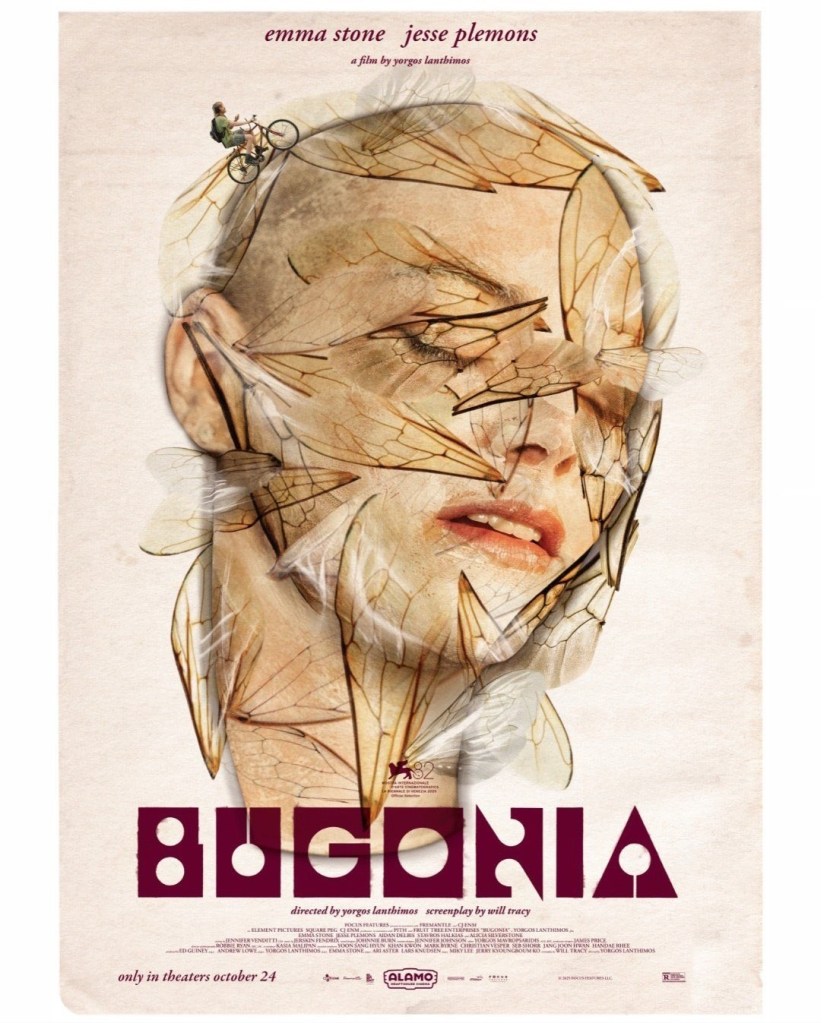
Anyway, this was good. A head-to-head between Jesse Plemons, whom I’ve liked in everything he’s done, and Emma Stone, whom I’m not particularly enthusiastic about but who’s good at her craft. Emma plays a high-ranking executive of a company involved in shady pharmaceutical stuff. Jesse Plemons plays a schizotypal, traumatized dude out in the sticks whose mother was injured somehow by said pharmaceutical company. But Jesse’s character has figured out that behind that mundane, vague corporate malfeasance is actually an alien plot to enslave mankind. Along with Jesse’s retarded cousin, they decide to kidnap Emma Stone’s character so she’ll transport them to the mothership and allow Jesse to negotiate for the sovereignty of Earth.

That’s as much as you need to know. In fact, that’s likely more than you needed to know to get into this movie. If you’re into weird stuff, watch it. It’s not the usual Hollywood garbage.

The peculiar script is a highlight. It allows compelling negotiations between Jesse’s delusional character and Emma’s, a cunning executive who finds herself under someone else’s control. Jesse’s and Emma’s acting are fantastic. Unfortunately, the third main character is Jesse’s retarded cousin, who seems out of place in every scene against these two powerhouses. I understand why the plot needed him (otherwise Jesse would have been sounding off necessary plot elements against the walls), but I think the movie would have been tighter without that character in it.

I recommend this movie. So much shit out there, you have to point out the ones that do something.

Review: The Town

Recently I became interested in the movie that Ben Affleck and Matt Damon made together and was releasing on Netflix. The Rip. It seemed like it could be entertaining. Then I watched like thirty minutes of it and realized that it was another one of those movies, like virtually all I’ve attempted to watch in the last ten years or so, that seem to be written by people incapable of producing a good script. Cringe dialogue, the subtlety of a hammer. In online mentions of this movie, people had compared it to a similar one (if only because heists and Ben Affleck were involved): The Town. Released in 2010, but somehow already looking ancient.

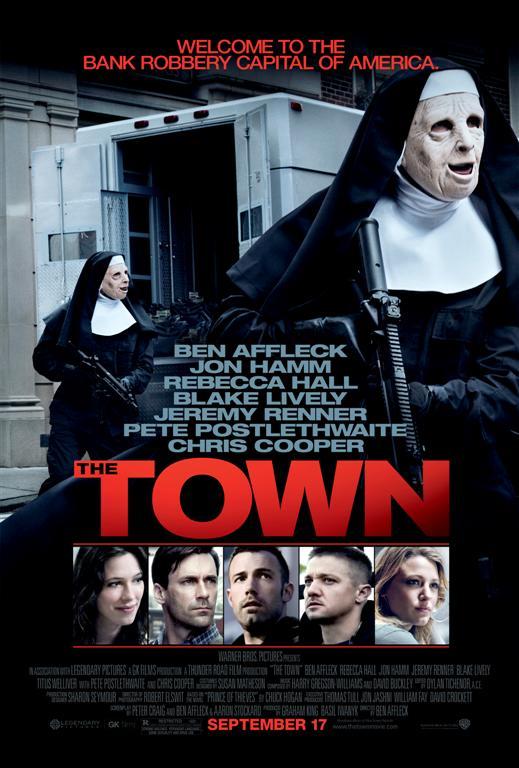
Well, The Town was fantastic. I checked it out at midnight and ended up staying up until about three in the morning. Extremely well-written script with not only unique, compelling dialogue, but also great set pieces, mirroring, and callbacks. Like a perfectly-built machine. Affleck does well, although I’ve never been much of a fan of his acting. Jeremy Renner, though, is amazing as this loose cannon who did nine years in prison and who’d rather die “holding court on the street,” as he put it, than return to jail. I never cared much for Renner’s acting, but it feels like other movies he was in, those I’ve seen at least, simply didn’t give him the chance.

As the romantic interest we have Rebecca Hall in her twenties. Gorgeous woman, always a pleasure to have her on-screen, and from the moment she first appears, you understand why a couple of the men involved would risk getting in trouble for her. We also have Jon Hamm from that old Mad Men show (which I never watched, but it was all over the place back in the day) doing very well as an FBI dude, and Blake Lively acting as a strung-out town bicycle. She honestly did great.

The movie gives a great sense of being stuck in a small town (although, as far as I could tell, it’s just part of Boston) with nowhere to go, burdened with the weight of generations, doomed to nothingness unless you dare to stick your head out in a way that could make others cut it off.

It’s very rare for me these days to watch a Hollywood movie and think, “Wow, that was great.” So I recommend this one.

Tatsuki Fujimoto 17-26

This is not a review, but a notice to those interested in the works of Tatsuki Fujimoto, author of Chainsaw Man, Fire Punch, Look Back, and Goodbye, Eri, all of which are required readings/viewings. He produced a bunch one-shot stories from ages 17-26, which have now been animated in very competent, creative ways. I can’t think of any other author who casually gets great adaptations made of random one-shots he made in his youth. Here’s the trailer.

They show Fujimoto’s range from early on. Most of his stories have in common the theme of reaching out for connection in an absurd world that often renders that connection fleeting, insufficient, or meaningless.

There’s also Look Back, a heartbreaking tale about ambition, connection, and regret. Merely mentioning what inspired it would be a spoiler. The movie has been out for a while, but I haven’t seen it yet. Probably because I’ll have to gear myself up to experience that story again.

The Chainsaw Man movie for the Reze arc is already online, and that’s a must see. This is both a fantastic and a terrible time to be a Fujimoto fan: fantastic because plenty of his stuff is getting adapted well. Terrible because the second half of Chainsaw Man, still ongoing, is unnecessary and generally bad.

Now, let’s hope that they also adapt the utter insanity that are Fire Punch and Goodbye, Eri. That last one has a plot point that I remember vividly because it made me burst out laughing with its daring, absurd brilliance.

Inio Asano, Minoru Furuya, Tatsuki Fujimoto… Asano broke down after Punpun, Furuya retired in 2016, and I suspect that Fujimoto may quit after he concludes Chainsaw Man however he decides to do so. I’ll have to check out what Shūzō Oshimi (The Flowers of Evil, Blood on the Tracks, Inside Mari, Happiness) has been doing recently.

Review: Chainsaw Man – The Movie: Reze Arc

A world where every concept is incarnated in a demon, whose power depends on how feared is the concept. The Cucumber Demon. The Blood Demon. The Typhoon Demon. The Future Demon. The Darkness Demon. The Angel Demon. The Death Demon. These fiends fight among themselves to either reign in hell or escape to Earth through possessing hapless people, usually the recently deceased. Demons hold grudges against each other and against humans in general. Humanity exists in a state of constant peril, with societies having to organize militias dedicated to the ever-present threat of a demon showing up somewhere or possessing a loved one. Some of the humans make deals with captured or semi-friendly demons, to gain some of their powers for good or ill. The cold war persists, but with the focus on achieving control of the most dangerous demons.

A winning concept, I’d say. The premise follows an orphaned teenager named Denji. He never went to school, lived with his gambler father, was manipulated by the local Yakuza into doing their dirty work for them, and finally was abandoned to die. However, a demon recently escaped from hell took pity on Denji; this fiend was the Chainsaw Demon, who had possessed a dog (I think that’s how the story goes; I have a hard time imagining Chainsaw escaping hell as a dog).

Denji had been torn into pieces, his body parts thrown into a dumpster, only for the Chainsaw Demon to give himself away as Denji’s heart, which made the teenager a human with feet in both worlds (this is extremely common in Japanese stories).

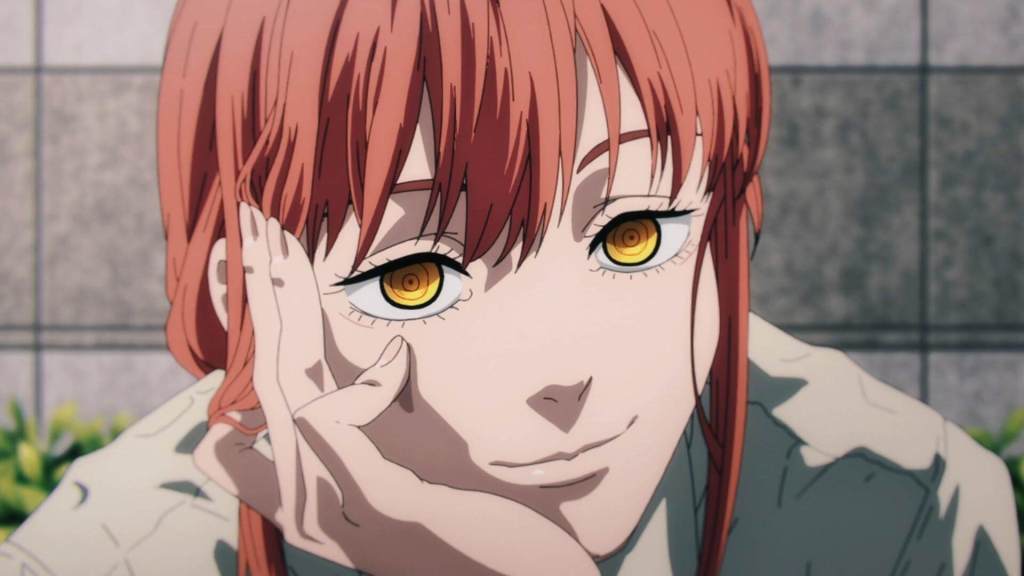
Then, the teenager gets conscripted into some special forces by a shady young woman with light-red hair.

The least I say about this person, the better.

Anyway, Denji isn’t your average protagonist. He’s half-wild, emotionally stunted, doesn’t care about the world, barely knows how to deal with people, can’t realize when he’s being manipulated (which happens constantly), and he’s solely motivated by hedonism, usually in the form of food or a cute face (or a nice pair of tits, or a nice ass), for which he’ll kill and/or die over and over again if necessary.

I quite like Denji. It has become a meme on the internet to say about Ryan Gosling’s characters that “He’s literally me.” I feel similarly about Chainsaw Man‘s protagonist.

In any case, the anime adaptation of part of the manga was a runaway success, even capturing the attention of some people that usually wouldn’t be into this stuff. But the anime series ended right at the moment when one of the most popular arcs would begin. This one involves a peculiar girl named Reze.

I’ve finished watching the movie about an hour ago. Oh, what joy. Plenty of the artistry on display was mesmerizing, some of the best animation I’ve seen in my life. The cinematography, the subtle character moments, the amazing fight scenes, the way the tension and absurdity ramps up to the point when you ask yourself how the hell did we get here. I wish the movie had been longer, but I didn’t feel like it missed any of the content of this arc. Reze’s character was done justice, which is far more than you can usually say about adaptations.

You know, it gets easy to forget that when you go to the cinema, the contract used to be that you’re giving away your attention and time to be captured by a story told by competent, passionate people. These days you watch movies, if you dare, trying to find a few entertaining moments in the torrent of politics that gets diarrhea-ed down your throat. This movie I’m reviewing is the deranged tale of two young people who were fucked from birth and who have no choice but to do the things they’re told to do, to have in exchange some semblance of normality in their lives. It also involves a myriad explosions, chainsaws growing out of a head and limbs, and a shark mount. If you enjoy Chainsaw Man, you have to watch this one. If you haven’t followed the story up to this point, you’ll have no fucking clue about what’s going on.

Great times. I posted one of the trailers for the movie in the previous post, but I’ll post it again:

Sadly, the movie would have left a perfect taste in my mouth if it wasn’t because I know that the story doesn’t end with the first part of the manga. The author, for whatever reason, created a second part featuring a new main protagonist (they switch around afterwards, but still), and although it started out very promising, it quickly devolved into shittiness. Some great moments, but plenty of lame ones. And much worse: some characters were brought back only to do a disservice to them. Others were killed unjustly. I’m waiting for that part to end so I can read it in its entirety, but right now I’m of the opinion that it shouldn’t have been created at all.

One Battle After Another, by Paul Thomas Anderson

For the last ten years or so I have avoided Hollywood movies, and movies in general, because most of what’s produced out there these days is vehicles for marxism. A couple of days ago I found out that Paul Thomas Anderson, who made Boogie Nights, Punch-Drunk Love, There Will Be Blood, The Master, and Inherent Vice, all movies that I either loved or found very interesting, had made a new one, named One Battle After Another, starred by our favorite lover of under-25-year-old women: DiCaprio himself. And the movie is based on a complex book by Thomas Pynchon, about revolutionary movements in the sixties. I was eager to see a movie set in the late sixties and early seventies, an era that has become important to me for reasons. On a personal note, P. T. Anderson is, or used to be, an intimate friend of Joanna Newsom, who is probably the living artist I respect the most (Joanna even had a role in Inherent Vice). So I figured that I finally could drag my aging ass to a movie seat.

It was fucking terrible. Pure political propaganda. P. T. Anderson, or whoever wrote the movie, used Pynchon’s book as an excuse to write a contemporary movie to shit on the US, and by extension on all countries of ethnic European origin, for controlling their borders and not being communist. In the first twenty minutes or so we see DiCaprio (I mistakenly wrote DiCrapio, and perhaps I should have left it like that) acting as the bomber for a communist, terrorist group, whose leader was the most disgusting, over-the-top example of a “black power” revolutionary I remember seeing in fiction. At first, silly me, I thought that DiCaprio’s character was undercover or something. When the black terrorist, after insulting and threatening some border guards, got to Sean Penn’s character and threatened him into getting hard, I realized that this movie was playing it straight. Abhorrent, insulting, morally-bankrupt garbage. That black communist hadn’t even met Sean Penn before; she just assumed that he would find her super hot, as in all white people are attracted to ugly, violent, nasty black women. Are black men even attracted to that?

Other than DiCaprio, the token “ally,” every single person of ethnic European origin in this movie is depicted as evil, a freak, or both. Sean Penn, who is a woketard himself, I assume was doing his best Donald Trump impression, judging by his facial mannerisms. Both DiCaprio and Sean Penn are depicted as being super turned on by the main black communist revolutionary. Sean Penn’s character even pursues her for sex, and gets pegged. Because of course he does. Later on in the movie, in an extremely lazy exchange, another character implies that he’s a closeted homosexual.

After DiCaprio’s character and this black bitch have a child, she berates him for “trapping” her, for trying to get her to act as his mommy, merely because DiCaprio’s character intends for their daughter to have a mother. In the end, this black communist, who was cheating on DiCaprio, abandons her family, murders a guard during an attack, snitches on their revolutionary group to avoid ending up in jail, and leaves the country. By the end of the movie, that fucking bastard is depicted in a sympathetic light, as if she could be redeemed. As in, “Ah, what wild youth we had. I made some mistakes, silly me.”

DiCaprio, being an “ally” ethnic European in a marxist movie, after he went out of his way to have a mixed baby, is depicted as a loser who has wasted the last thirty years destroying his brain with drugs. He spends most of the movie bumbling around, and by the end, he just happens to be in the right place at the right time, after someone else had solved the problem.

Then there’s the whole white supremacy thing. Sean Penn’s character wants to belong to a group named after Christmas (get it?), who are explicitly white supremacists. Those guys turn on Sean Penn when they realize he had a relationship with that black revolutionary bitch, and possibly fathered a child with her.

This movie features a native-American character. As a native-American character in such a marxist movie, he ends up (spoiler) massacring a group of white people named after the American revolution. If you saw that season of Fargo, by the Coen brothers, then you’ve pretty much seen that whole scene. I recall that the Coen brothers also used that season as a vehicle to tell people how terrible the Eastern Europeans were to the jews. Nevermind the fact that 95% of the Bolshevik leaders were jewish and murdered about 30 million ethnic Europeans in what came to be called the Holomodor. A subject you won’t see in any Hollywood movie, nor will you be detained for questioning.

Oh, I forgot. Spoiler, in case you care about this fucking abysmal turd of a movie: DiCaprio’s character is a literal cuck. Sean Penn’s character actually fathered DiCaprio’s daughter. Thus, DiCaprio’s took his rightful place at the bottom of the marxist hierarchy: a discarded “ally” whose efforts and resources are taken up by raising another man’s mixed baby.

Terrible, terrible film. Cinematography was fine, though, if you care about that. What perhaps disturbed me the most about the movie was the way this communist revolution, and all sorts of social revolt focusing on destroying those “evil white men,” were depicted with the moral righteousness of an eighties/nineties film that used nazis as the bad guys. DiCaprio’s “daughter” even ends up as a marxist activist herself, accompanied by uplifting music.

I’d rather eat my own shit than watch this movie again. I guess I have to write P. T. Anderson off my list.