Review: All the Pretty Horses, by Cormac McCarthy

Four stars.

This one’s a bildungsroman about a teenager (I believe he’s sixteen when the story starts) named John Grady Cole, who lives in Texas with his deteriorating family. Cole intends to continue working in the family farm and doing something in particular with it, legacy-like, but after his grandfather dies, the house changes hands in ways I wasn’t entirely sure about, but that in any case destroy Cole’s intended future. So, partly as a fuck y’all, he grabs his friend, a couple of horses, and heads down to Mexico, intending to never return.

Cole is a good kid. Intelligent, with a strong moral compass. It just happens that he’s venturing into the wild, and his courage and moral compass are going to get considerably tested. First of all, the pair of friends find themselves followed on their journey south by a single rider. That rider turns out to be a supposedly thirteen-year-old runaway named Jimmy Blevins, likely a fake name. He may have stolen his horse. Although the kid seems a bit unhinged and generally immature, he proves his skill with a revolver by punching through Cole’s friend’s wallet in one shot. Later on, this kid, terrified of storms (he mentioned that getting struck by lightning was a bit of a family curse), ends up losing his clothes, his horse, and his gun. In a Mexican town, they spot both Blevins’ horse and his gun in other people’s possession, which Blevins won’t allow.

That’s where the main trouble starts, which has repercussions for the rest of the story. At its core, though, this story is a tale of tragic love between John Grady Cole and a beautiful seventeen-year-old girl named Alejandra, of Spanish ancestry and a wealthy family. John is ultimately a Texan cowboy with barely a peso to his name, not the kind of young man that Alejandra’s father would allow his precious daughter to marry.

Cole learns that the world is a harsh, frequently unfair world, and that the lines between good and evil are hard to measure at times. This is the first entry in McCarthy’s The Border Trilogy, and I’m curious to know how Cole dealt later on with the mental state that the events of the first book left him in.

I must mention, as I have in every review of McCarthy’s work ever since I learned about this matter, that the tale I’m reviewing, as well as most other tales of his ever since the following events happened, are heavily influenced by having met in the early seventies someone that quickly became McCarthy’s love of his life: a thirteen-year-old blonde, blue-eyed teenager named Augusta Britt. Or, as one of his writer pals put it, “a teenage popsy.”

Supposedly, as McCarthy was researching Blood Meridian in Tucson, AZ, Augusta Britt, wearing a holstered gun, asked McCarthy to sign her copy of his first book. Although that sounds unlikely (partly because the supposed edition she handed him lacked a photo of the author), Britt has showed the letters she received from McCarthy. Britt was a foster kid, and had been abused in various ways; all the foster homes she ended up in lacked locks in the doors, and men tended to enter whenever they pleased. McCarthy quickly grew amorous of this thirteen-year-old tragic hottie, and after she told him that someone in her current foster home had hit her, he offered her to run away together to Mexico.

What he intended to do was very illegal: basically kidnapping a girl from the foster system. Crossing not only state but country lines with an underage girl that he was in love with and likely fully intended to fuck was probably also illegal. But it happened, and by the time she was fourteen and in Mexico, McCarthy and Britt banged like there was no tomorrow, which McCarthy likely believed to be the case, as the FBI was literally after him. Even to this day, Britt says that the whole thing was fine, that she loved him and felt safe with him. But their relationship fell apart when Britt found out that McCarthy was actually married at the time (although estranged), and had a son he was neglecting. Britt ended up leaving for the States, which broke McCarthy’s black heart. They remained friends until his death, and he even tried to marry her twice, but ended up failing to do so because her church demanded of him to convert to Christianity; as the last paragraph of his last book, The Passenger, put it, he was “the last pagan on earth,” and very much intended to remain so.

You feel echoes of that period of McCarthy’s life in this novel: running away to Mexico, the dread of being pursued, the dilemmas about right and wrong, the tragic love for a teenage girl, etc. Curiously, Jimmy Blevins, the wild thirteen-year-old runaway kid, seems the closest to Augusta Britt given what I read about her: the kid had peculiar mannerisms and a wild goofiness that you could imagine having been lifted straight from a seventies teenage runaway with a fucked-up past.

I wasn’t particularly into the story, to be honest. Didn’t connect much with it other than during some philosophical passages. If it weren’t for McCarthy’s prose, at times I would have rated it a three. However, prose-wise, it was sloppier and much lazier than Suttree, which was my previous read of his. I can’t blame McCarthy for lowering the quality of his prose; Suttree was so relentlessly high quality at times that writing it must have been agonizing, prone to making the writer hate the very process. I suppose that in the back of his mind, McCarthy thought that the public at large would have been forced to acknowledge the brilliance of Suttree, but it ended up selling terribly. I can see him thinking, “Why bother?” and not putting in his 110% from then on.

Anyway, the following are the quotes I’ve highlighted from the book.

People dont feel safe no more, he said. We’re like the Comanches was two hundred years ago. We dont know what’s goin to show up here come daylight. We dont even know what color they’ll be.

Beware gentle knight. There is no greater monster than reason.

The prison was no more than a small walled village and within it occurred a constant seethe of barter and exchange in everything from radios and blankets down to matches and buttons and shoenails and within this bartering ran a constant struggle for status and position. Underpinning all of it like the fiscal standard in commercial societies lay a bedrock of depravity and violence where in an egalitarian absolute every man was judged by a single standard and that was his readiness to kill.

Those who have suffered great pain of injury or loss are joined to one another with bonds of a special authority and so it has proved to be. The closest bonds we will ever know are bonds of grief. The deepest community one of sorrow.

We weep over the might have been, but there is no might have been. There never was. It is supposed to be true that those who do not know history are condemned to repeat it. I dont believe knowing can save us. What is constant in history is greed and foolishness and a love of blood and this is a thing that even God—who knows all that can be known—seems powerless to change.

He saw very clearly how all his life led only to this moment and all after led nowhere at all. He felt something cold and soulless enter him like another being and he imagined that it smiled malignly and he had no reason to believe it would ever leave.

He lay listening to the horse crop the grass at his stakerope and he listened to the wind in the emptiness and watched stars trace the arc of the hemisphere and die in the darkness at the edge of the world and as he lay there the agony in his heart was like a stake. He imagined the pain of the world to be like some formless parasitic being seeking out the warmth of human souls wherein to incubate and he thought he knew what made one liable to its visitations. What he had not known was that it was mindless and so had no way to know the limits of those souls and what he feared was that there might be no limits.

He thought the world’s heart beat at some terrible cost and that the world’s pain and its beauty moved in a relationship of diverging equity and that in this headlong deficit the blood of multitudes might ultimately be exacted for the vision of a single flower.

He stood at the window of the empty cafe and watched the activities in the square and he said that it was good that God kept the truths of life from the young as they were starting out or else they’d have no heart to start at all.

He stood hat in hand over the unmarked earth. This woman who had worked for his family fifty years. She had cared for his mother as a baby and she had worked for his family long before his mother was born and she had known and cared for the wild Grady boys who were his mother’s uncles and who had all died so long ago and he stood holding his hat and he called her his abuela and he said goodbye to her in Spanish and then turned and put on his hat and turned his wet face to the wind and for a moment he held out his hands as if to steady himself or as if to bless the ground there or perhaps as if to slow the world that was rushing away and seemed to care nothing for the old or the young or rich or poor or dark or pale or he or she. Nothing for their struggles, nothing for their names. Nothing for the living or the dead.
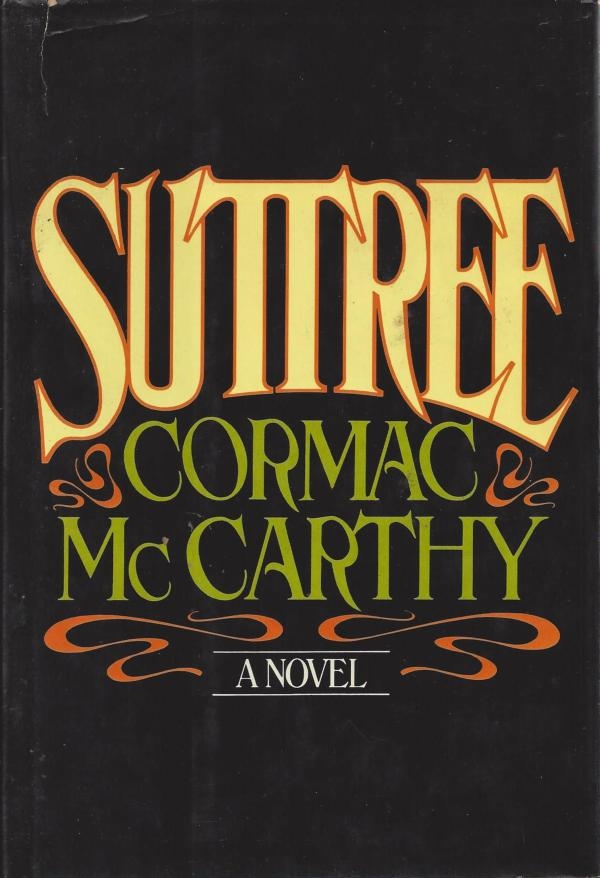
Review: Suttree, by Cormac McCarthy

A very uneven novel. My rating ranges from three to four-and-a-half stars.

The heart beneath the breastbone pumping. The blood on its appointed rounds. Life in small places, narrow crannies. In the leaves, the toad’s pulse. The delicate cellular warfare in a waterdrop. A dextrocardiac, said the smiling doctor. Your heart’s in the right place. Weathershrunk and loveless. The skin drawn and split like an overripe fruit.

In a previous post I stated that this novel, released in 1979, took McCarthy about ten years to write. That was, however, wrong, and in fact he had been writing in since the fifties, when he lived some of the events of the story. As independent scholar Write Conscious, who has gone over McCarthy’s archives, put it, McCarthy wrote very little in the last few decades of his life. Even his latest two novels, The Passenger and Stella Maris, which I loved and still haunt me, not only were set in the seventies and eighties, but were written to a significant extent back then (or at least almost fully researched). It turned out that McCarthy put lots of his own life in his novels. In the case of his last two and quite a few others, they’re heavily inspired by the love of his life Augusta Britt, much younger than him, ending up in a mental institution due to her extensive trauma (abandoned by her family, abused in foster homes… Presumably the whole getting-whisked-away-to-Mexico-by-Cormac also added to it).

In the case of Suttree, this novel I’m reviewing, it’s based around Cormac hanging out in the unfortunately named McAnally Flats in Knoxville, as the area existed back in the fifties and no longer does so. Many of the characters of this novel were real. One of them, named J-Bone, was a great friend of McCarthy’s, and the guy’s real home address as well as phone number from back then are depicted on the text. That means that we’re often treated to strange characters whom we’re barely introduced to at all. I’m not necessarily opposed to this; I believe that writing fiction is about making your own meaning and not necessarily satisfying anyone else. But that means that in a story already quite the mess, this panoply of weirdos only makes it harder to grasp.

McCarthy was apparently a drunkard back in the day. Also at the end of his life. I can’t stand drunks. He and his friends also got in serious trouble. I can’t stand criminals. So at times I had a hard time caring about what was happening in the story. Suttree tended to side with people who clearly should have been in jail or dead, and when some of them died, I thought to myself that it was about time. Still, some of those stories were wild enough to be interesting: going into pubs and stealing people’s money from their handbags and jackets (at the Indian Rock, for example, mentioned in Stella Maris by Alicia Western; her beloved brother used to bring her there on dates), plain-old robberies, brawls, general mayhem… It was hard for me to connect with that part of the story, which is about half of it: Suttree wandering from weirdo to weirdo doing stuff I couldn’t relate to.

The most memorable male character is an innocently evil melon rapist named Gene Harrogate. We are introduced to him violating a farmer’s produce, and he ends up in jail, where he meets the protagonist. He’s a small country bumpkin with seriously nasty instincts, whom Suttree really shouldn’t have been involved with. I have a hard time believing he existed in real life, as he was the larger-than-life type. There’s a whole segment with him digging tunnels under Knoxville and blowing up shit to the extent that it caused sinkholes, and led to him nearly drowning in shit. He also almost extinguished the local population of bats. Though entertaining, ultimately he was quite pointless to the story, as I didn’t believe that Suttree would hang out with such a fiend. That said, the story is generally a mess, so not much of what happens could be say to fit properly.

Three major sequences bumped up the novel’s quality for me: the first involves Suttree’s estranged wife and son, the second a nymphet unfortunately named Wanda, and the third a prostitute named Joyce. In real life, Suttree was indeed married and had a son. As far as I know, McCarthy was an utter bastard to that wife of his: he demanded her to work to pay the bills so he could dedicate himself to his writing, and when things got even worse money-wise, he demanded of her to pick up a second job. Understandably so, McCarthy’s family-in-law wanted him dead. He ended up escaping his home life, claiming that they stifled his creativity, which they likely did, and roamed around the south of the US, eventually ending up in a motel pool in Tucson, AZ, where he met an armed thirteen-year-old blonde and blue-eyed popsy with whom he fell head-over-heels. So that’s the whole deal with a estranged wife and son present in Suttree covered.

Wanda is the daughter of a down-on-his-luck pedlar with whose family Suttree spends some time in the best sequence of the book. This girl is described as having tits as well as fuzz down there, but Suttree repeatedly refers to her as a child. So she’s probably twelve-to-fourteen years old. The intimate scenes between Suttree and this girl are some of the most haunting passages of the book. This, of course, relates to McCarthy having met around that time the love of his life, Augusta Britt, whom the aforementioned scholar Write Conscious mentioned was very likely thirteen when McCarthy started sending amorous letters to her, and fourteen when they fled together to Mexico and started banging like there was no tomorrow, which McCarthy likely believed was the case, as the FBI was investigating Britt’s disappearance from the foster system. Regarding Wanda, the whole thing ends in a very McCarthy-ish way, with nature saying, “Fuck no, I ain’t lettin’ this shit go on.” I feel that the ending of that sequence will haunt me for the rest of my days. Chance and the universe’s indifference in general determining so much in life is a common theme in McCarthy’s work (the ending of No Country for Old Men comes to mind, and I mean the sequence with the protagonist and a fifteen-year-old runaway also based on Augusta Britt, which was sadly wasted in the movie).

However, the Wanda segment, my favorite part of this story, ended up becoming the biggest hole in it for me: I don’t believe for a second that Suttree would have been able to move on nonchalantly the way he did, with no fucking mention of the whole thing afterwards and no sign that it affected him. To me it reeked of McCarthy having written that part after meeting Augusta Britt, and then shoehorning it into the novel. Apparently, according to Write Conscious, in the letters with his editor, McCarthy’s “boss” demanded explanations for why he was so insistent on including the Wanda (and Joyce) parts in the story, but McCarthy refused to take them out.

The last of the three most memorable sequences for me involved a prostitute named Joyce, who bankrolled Suttree until her whorish life caught up with her psyche. Honestly the whole thing felt somewhat random yet true, which makes me suspect that McCarthy also got involved in such shenanigans.

What ultimately elevated the novel for me was McCarthy’s godlike writing. This story contains some of the best prose I have ever read. The first six percent or so of the text is so relentlessly high-quality in terms of careful observations that it boggles my mind to imagine what it took McCarthy to get through writing it. After that, the quality decreases as if McCarthy would have preferred to shoot himself than to keep holding himself to that standard. But most of the prose remains absurdly fantastic throughout, to the extent that it makes the vast majority of published authors look like children playing at pushing words together. One writer that McCarthy was helping do line editing in the seventies said that McCarthy’s edits made the guy want to quit writing. In my case, it makes me realize there are goals far in the distance that I can push myself towards.

This isn’t a novel I could recommend to anyone, to be honest. You have to fall into it, likely because you love McCarthy’s work. I’m glad I read it, but I suspect I should have gotten through his simpler remaining novels first (like the Border Trilogy, Outer Dark, etc.)

The following are quotes from the book that I highlighted.

He closed the cover on this picturebook of the afflicted. A soft yellow dust bloomed. Put away these frozenjawed primates and their annals of ways beset and ultimate dark. What deity in the realms of dementia, what rabid god decocted out of the smoking lobes of hydrophobia could have devised a keeping place for souls so poor as is this flesh. This mawky wormbent tabernacle.

How surely are the dead beyond death. Death is what the living carry with them. A state of dread, like some uncanny foretaste of a bitter memory. But the dead do not remember and nothingness is not a curse. Far from it.

You see a man, he scratchin to make it. Think once he got it made everthing be all right. But you dont never have it made. Dont care who you are. Look up one mornin and you a old man. You aint got nothin to say to your brother. Dont know no more’n when you started.

On a wild night he went through the dark of the apple orchards downriver while a storm swept in and lightning marked him out with his empty sack. The trees reared like horses all about him in the wind and the fruit fell hard to the ground like the disordered clop of hooves.
Suttree stood among the screaming leaves and called the lightning down. It cracked and boomed about and he pointed out the darkened heart within him and cried for light. If there be any art in the weathers of this earth. Or char these bones to coal. If you can, if you can. A blackened rag in the rain.
He sat with his back to a tree and watched the storm move on over the city. Am I a monster, are there monsters in me?

There are no absolutes in human misery and things can always get worse.

In the distance the lights of the fairground and the ferriswheel turning like a tiny clockgear. Suttree wondered if she were ever a child at a fair dazed by the constellations of light and the hurdygurdy music of the merrygoround and the raucous calls of the barkers. Who saw in all that shoddy world a vision that child’s grace knows and never the sweat and the bad teeth and the nameless stains in the sawdust, the flies and the stale delirium and the vacant look of solitaries who go among these garish holdings seeking a thing they could not name.