Albums that marked me, Pt. 2

As a solitary dude, all my life I have relied on music to connect with the world at large, to feel that my feelings weren’t that unique or detached from the rest of humanity. Over the years, I’ve returned to certain albums that have spoken to me in ways that can’t be fully put into words. I love discovering new albums, and perhaps that’s also the case for whoever is reading these words, so I’ll spend some of my limited time on Earth sharing some specifics about the albums that have marked me, and that in many ways changed me.

Today’s album is The Moon & Antarctica by Modest Mouse, released in 2000. It’s mostly a breakup album, possibly my favorite. Ages ago I read a review of this album that said something to the effect of, “every previous Modest Mouse album felt like Isaac Brock [the band’s singer-songwriter] was grasping at some truths in the static of an untuned radio station, but in The Moon & Antartica, the station came in clear all of a sudden.” Many of the songs in this album are perfectly attuned to what they’re trying to express, to the smallest piece of music. The result is a bunch of idiosyncratic songs that don’t sound like any other band I know of (I haven’t found “old Modest Mouse-like” anywhere).

This album has accompanied me through heartbreak, through loneliness, through derangement. Plenty of aspects of my self are reflected in these songs.

“3rd Planet”

This song ties together the relationship most of this album refers to, down to a pivotal moment when the future of the narrator’s life could have gone a very different path. It’s raw and mythical, with memorable imagery.

Everything that keeps me together is falling apart
I got this thing that I consider my only art
Of fucking people over

The third planet is sure that they’re being watched
By an eye in the sky that can’t be stopped
When you get to the promised land
You’re gonna shake the eye’s hand

Your heart felt good
It was drippin’ pitch and made of wood
And your hands and knees
Felt cold and wet on the grass beneath
Well, outside, naked, shivering, looking blue
From the cold sunlight that’s reflecting off the moon
And baby cum angels fly around you
Reminding you we used to be three and not just two
And that’s how the world began
And that’s how the world will end

Well, a third had just been made
And we were swimming in the water
Didn’t know then; was it a son, was it a daughter
And it occurred to me that the animals are swimming
Around in the water in the oceans in our bodies
And another had been found, another ocean on the planet
Given that our blood is just like the Atlantic, and how

Well the universe is shaped exactly like the earth
If you go straight long enough you’ll end up where you were

“Gravity Rides Everything”

This song depicts very well the moment in a romantic relationship when you know it’s dying, that she’s looking for the door, and you feel powerless to stop her from drifting away. The inevitability of it all feels like a weight on your feet.

Oh, gotta see, gotta know right now
What’s that riding on your everything
It isn’t anything at all
Oh, gotta see, gotta know right now
What’s that writing on your shelf
In the bathrooms and the bad motels
No one really cared for it at all
Not the gravity plan

Early, early in the morning
It pulls all on down my sore feet
I want to go back to sleep

In the motions and the things that you say
It all will fall, fall right into place
As fruit drops, flesh it sags
Everything will fall right into place
When we die some sink and some lay
But at least I don’t see you float away
And on split milk, sex and weight
It all will fall, fall right into place

“Dark Center of the Universe”

You used to love this person, who also loved you back, but now she has nothing but complaints about the same self that she used to like, and you have little else to offer back but bitterness.

I might disintegrate into the thin air if you’d like
I’m not the dark center of the universe like you thought

Well, it took a lot of work to be the ass that I am
And I’m really damn sure that anyone can
Equally, easily fuck you over
Well, God said something, but he didn’t mean it
Everyone’s life ends, but no one ever completes it
Dry or wet, ice never melts and you’re equally cheated

Well, an endless ocean landing on an endless desert
Well, it’s funny as hell, but no one laughs when they get there

“Perfect Disguise”

It’s done: the relationship is over, and now you’re lingering in the same town, having to watch this woman you used to love and who loved you back waltzing around town, shooting looks at you to figure out if you’re doing worse than her. And even though you don’t want to care anymore, you feel that something fundamental has broken in you.

Well, you’ve got the perfect disguise and you’re looking okay
From the bottom of the best of the worst, well, what can I say?

‘Cause you cocked your head to shoot me down
And I don’t give a damn about you or this town no more
No, ’cause I know the score

Need me to fall down so you can climb up
Some fool-ass ladder, well, good luck
I hope, I hope there’s something better up there

Broke my back
Broke my back
Broke my back

“Tiny Cities Made of Ashes”

A raw, angry, post-apocalyptic song. You’re done with the world, you’re sick of people, and you want to take it out on someone (possibly that woman, maybe not).

We’re goin’ down the road
Towards tiny cities made of ashes
I’m gonna hit you on the face
I’m gonna punch you in your glasses, oh no
I just got a message that said
“Yeah, Hell has frozen over”
I got a phone call from the Lord sayin’
“Hey, boy, get a sweater, right now”

So we’re drinkin’, drinkin’, drinkin’, drinkin’
Coca, Coca Cola
I can feel it rollin’ right on down
Oh, right on down my throat
And as we’re headed down the road
Towards tiny cities made of ashes
I’m gonna get dressed up in plastic
Gonna shake hands with the masses
Oh no!

Does anybody know a way that a body could get away?
Does anybody know a way?
Does anybody know a way that a body could get away?
Does anybody know a way?

“A Different City”

The narrator has moved away from the town that held too many memories. He’s holing up at some dingy apartment, wanting to isolate himself from everything. He feels that he’s losing it.

I wanna live in the city with no friends and family
I’m gonna look out the window of my color TV
I wanna remember to remember to forget you forgot me
I’m gonna look out the window of my color TV

Through the cracks in the wall, slow motion for all
Dripped out of the bars, someone smart said nothin’ at all
I’m watching TV, I guess that’s a solution
They gave me a receipt that said I didn’t buy nothin’
So rust is a fire and our blood oxidizes
My eyes roll around, all around on the carpet
Oh, hit the deck, it’s the decal man
Standin’ upside down and talkin’ out of his pants

“The Cold Part”

Fantastic auditory depiction of that state some people fall into at times: a mix of apathy, loneliness and resignation.

So long to this cold, cold part of the world
So long to this bone-bleached part of the world
So long to this cold, cold part of the world
So long to this salt-soaked part of the world

I stepped down as president of Antarctica
Can’t blame me, don’t blame me

“Alone Down There”

Althought I’m not sure about my interpretation, I always picture that this song is about reaching out to someone who hurt you, possibly even the ex this whole album is about, because that person is suffering. You can’t really help them; you’re sitting at the bottom of a well yourself, but you know how bad it gets. Still, you realize that reaching out to such a person is a terrible idea.

How do, how do you do?
My name is You
Flies, they all gather ’round me and you too
You can’t see anything well
You ask me what size it is, not what I sell
Ha-ha-ha, ha-ha-ha

Well, I don’t want you to be alone down there
To be alone down there, to be alone
Yeah, I don’t want you to be alone down there
To be alone down there, to be alone
But the devil’s apprentice, he gave me some credit
He fed me a line and I’ll probably regret it
I don’t want you to be alone down there
To be alone down there, to be alone

“Paper Thin Walls”

The narrator has settled down far away from the microcosm that caused him that pain. He’s beginning to take the rest of the world into account once again, but he isn’t the same person he used to be: he feels that he better take things lightly from now on, and stop sacrificing himself for the sake of others. Life in solitude is long and hard, but at least you won’t have to suffer further humiliation.

These walls are paper thin
And everyone hears every little sound
Everyone’s a voyeurist
They’re watching me watch them watch me right now
They’re shaking hands, they’re shaking in their shoes
Oh, Lord, don’t shake me down
Everyone wants two of them
And half of everyone else who’s around
It’s been agreed the whole world stinks
So no one’s taking showers anymore

Laugh hard, it’s a long ways to the bank
I can’t be blamed for nothing anymore
It’s been a long time since you’ve been around
Laugh hard, it’s a long ways to the bank

Tow the line to tax the time, you know
That you don’t owe
I can’t be a fool for everyone
That I don’t know

“What People Are Made Of”

I’m not that fond of this song, but it’s a great closer for the album as far as I’m concerned. The narrator is grasping at profound truths that he has gleaned from this ordeal. The experience has turned him into a different person, someone who will have a hard time connecting with those who haven’t gone through the same thing.

Ragweed tall, better hope that his ladder don’t crack
Or he’ll hit the ground low, hard and under his back
At the battle at the bottom of the ocean where the dead do rise
You need proof, I got proof at the surface
You can watch ’em float by

Way in back of the room, there sits a cage
Inside is the clock that you can win if you can guess its age
Which you never can do ’cause the time, it constantly changes
For lack or luck, I guess that is the saying

On the first page of the Book of Blue, it read
“If you read this page, then that’ll be your death”
By then it was too late, and you wound up on
An island of shells and bones that bodies had left

Brock offers the following lyrics as the closer of this uncompromising, raw ride:

And the one thing you taught me ’bout human beings was this:
They ain’t made of nothin’ but water and shit

Review: Ressentiment, by Kengo Hanazawa

Four stars.

This is the first manga that Kengo Hanazawa got published. Hanazawa is the author of the haunting I Am a Hero, the story of a possibly schizophrenic douche that learns to be less of a douche while the world dies in a zombie apocalypse (that even got made into a movie, although it is much worse and has a different tone than the manga). Regarding this story I’m reviewing, as soon as I read its summary, I knew I had to read it immediately.

The story follows an ugly, disgusting loser in his thirties who works a dead-end job and who would never find happiness in real life, in a major way due to circumstances beyond his control. Thankfully, his is a world where some company managed to become the in-story equivalent of Microsoft but centered around virtual reality and AI. He gets introduced to the world of virtual girls by a fellow ugly loser who had given up on reality. Our protagonist decides to say fuck you to the world and fall in love with the virtual girl of his dreams, that happens to look and act as a 12-13 year old. In that unreal world, despite the various setbacks, the protagonist manages to feel like there is a point to his life. It can become a dangerous drug.

I felt personally attacked. These past few months I’ve developed a system in Python that allows me to chat and have virtual sex with artificial intelligences, fulfilling whatever combination of fetishes or kinks I feel like at the moment, and I’m fully hoping that one day I’ll disappear into virtual reality while giving the middle finger to this rotten world. However, it’s not just cuteness and sex for our protagonist; the girl he chose happens to be the pinnacle of artificial intelligence, that its creator decided to hide for the sake of that AI as well as the world as a whole, and who has abilities that can bridge the gap between the virtual and the real.

The protagonist, as well as most of the main characters, are hard to like: not only are they physically hideous, but are also mentally and morally weak, prone to breaking promises and giving up to self-destructive impulses. But you get the clear sense that these characters would never find anything resembling happiness in the real world, and that the escape into virtual bodies and their designed AI girlfriends is the only way they have to keep their sanity and some sense that their lives matter.

Apart from the protagonist, we have four memorable characters: there’s Tsukiko/Moon, the advanced AI who has to learn like a person how to navigate the environments she finds herself in, while she gets manipulated by many people she comes across. There’s the protagonist’s friend, who introduces him to the virtual world; hideous in real life, his virtual persona is prince-like and noble, ultimately a solid guy. There’s the protagonist’s former classmate and co-worker, a woman in her thirties who hasn’t managed to make anything in particular of her life, and lives in perpetual disillusionment. There’s the bad guy and so-called Fuhrer of the Ninth Empire, a guild that intends to take over the virtual world. This fickle, mysterious guy has one of the best, most understated identity reveals I’ve ever come across in fiction; genuinely heartbreaking.

A very entertaining read with a much tighter plot than I would have expected. The art style is unlike his I Am a Hero, mostly humorous, and plenty of the characters’ expressions are hysterical. This is a great read for those of us who are more than a little fed up with the world.

Review: Castration: Rebirth, by Miyatsuki Arata

Four stars.

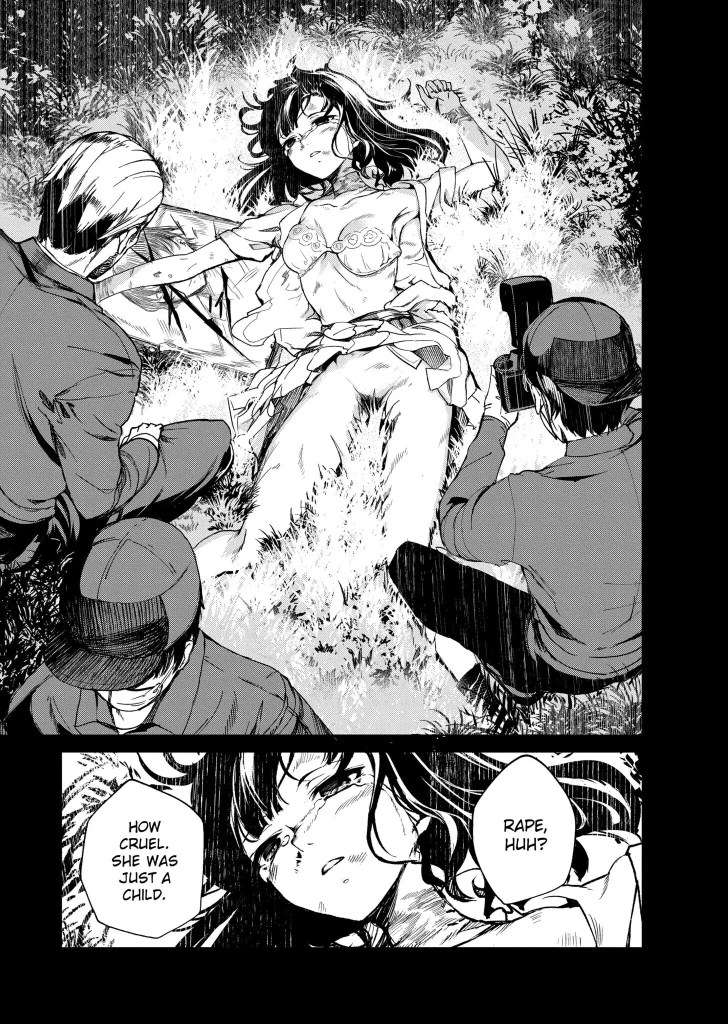
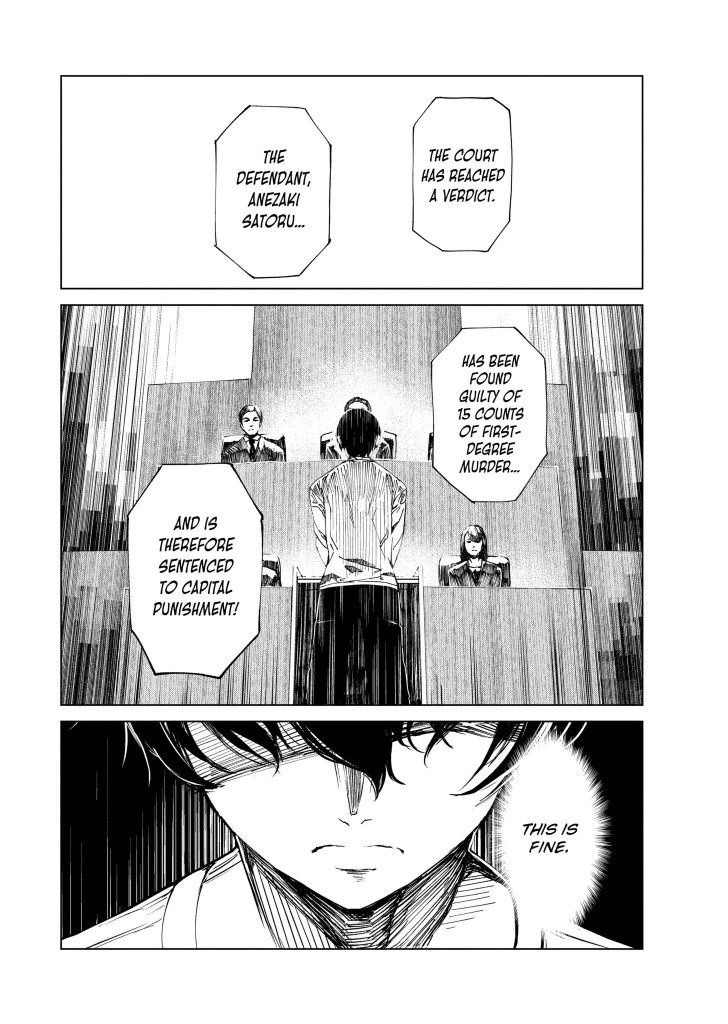
This manga starts with its protagonist being sentenced to death after having killed fifteen people. His childhood friend and love of his life was raped and murdered, so the protagonist took it upon himself to castrate and murder fifteen sexual offenders. I’m not sure if the rapist and murderer of his friend was among them.

Anyway, the protagonist gets hanged to death.

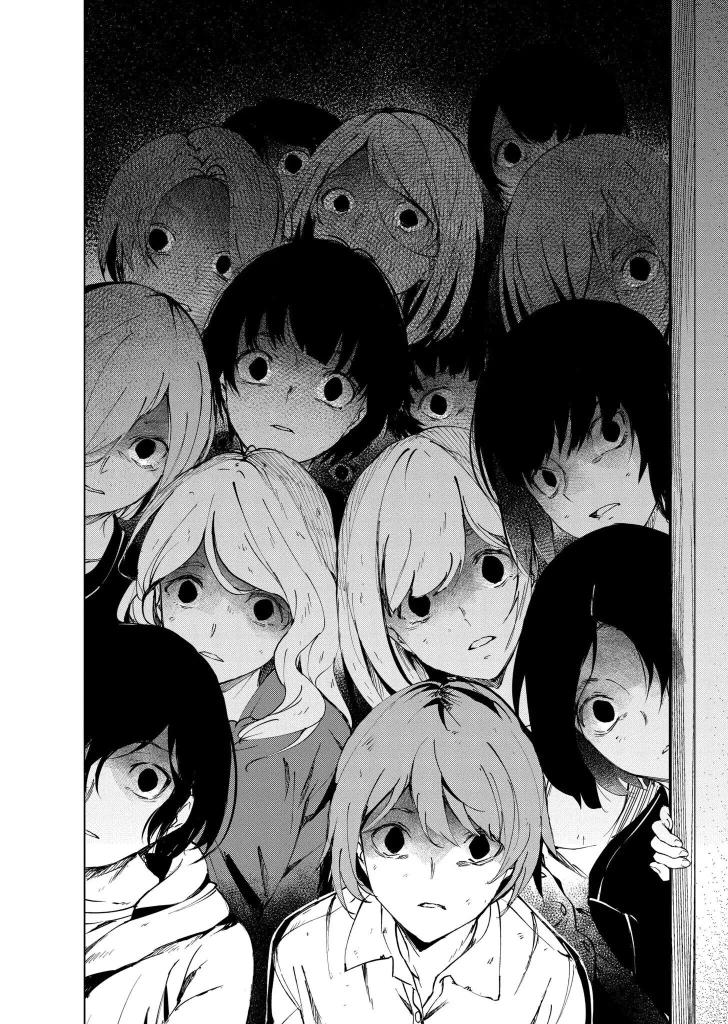
Turns out, this is an isekai, just an unusual one. The protagonist wakes up on a pile of corpses. In the sky, the sun is doing weird shit, looking like an out-of-control nuclear reactor. The first humans he sees are school girls, who proceed to freak out upon seen him, referring to him as a “beast.” One of them shoots arrows at him. After they realize that the protagonist is more or less sane, they agree to let him live by now. Shortly after, the girl who had shot arrows at our protagonist gets raped and devoured by a monstrous man.

We learn that in this alternate reality to which the protagonist got isekai-d, three months ago, a solar flare fucked up men’s DNA or something, turning them into mindless beasts solely preoccupied in what men want to do all the time but only flimsy self-restraint prevents them from doing so: rape, devour and murder women, sometimes simultaneously. All females that the protagonist comes across fear that the guy will do the same to them.

As if the reality that a flare had turned all men into rape-and-murder machines wasn’t enough, plenty of females in this story have complaints to offer about how they were exploited by men even before the world went to shit.

Other women see in the young protagonist a source of healthy semen, and therefore the chance for humanity to survive the apocalypse.

What follows is a mix of The Last of Us (the first game; as far as I’m concerned, the second game and TV series never existed), Attack on Titan, and most zombie stories. The protagonist and his companions come across different ways of trying to survive the post-apocalypse: family affairs; rigid, hierarchical structures; wild anarchy. Along the way, dozens or hundreds of people get raped, murdered, and eaten, sometimes not even by the mutated humans. This story is ballsy as hell when it comes to making even some main characters’ day quite terrible.

The manga touches upon interesting topics. Will the surviving societies be “equal” because only women are involved, or will they turn out to be new systems of exploitation? Does any sense of morality matter when at any point you can get raped and eaten by mutated men with enormous dongs? The protagonist is traumatized by the notion of sex, because his friend was raped and murdered, but isn’t his duty to provide semen to save the human race? In this case, would it be ethical to force him to do so?

I was surprised by how well the author handled the characters. They had distinct personalities and clear motivations, which often conflicted with one another’s. Some start out malicious only to end up sympathetic, or viceversa. Quite a few characters are memorable, including the protagonist, the childhood friend, a semen-obsessed teacher, a sociopathic teen, the anarchic biker girl who wanted to capture ten-year-old mutated boys for sex, etc.

In the end, this lovely tale dishes out what the title promised: rebirth (well, technically reincarnation) and castration. Lots of men lose their penises in creative ways. If any of this sounds like fun, you’ll probably enjoy this ride. I know I did.

AI podcast about Alma: a Successful Case Study

Back in 2021 I wrote this short story about a therapist and his troubled patient named Alma. Man, 2021 was one prolific year. Anyway, I’ve presented this tale to the Google AI thing that generates podcasts out of your source material so the pair of hosts would do a review. Check it out.

You can read the entirety of this story on here:

Alma: a Successful Case Study, Pt. 1
Alma: a Successful Case Study, Pt. 2

Ongoing manga: Rebuild World, by Nahuse

Four-and-a-half stars.

For once, this isn’t an isekai: the story is set long in the future, after some apocalypse about which the survivors are still trying to figure out the specifics. Apparently their predecessors had become so advanced that they were mixing biological engineering with super-AI or some shit, until their industries went haywire and started mass-producing mutated monsters that overwhelmed the world. Those facilities seem to be still active somewhere, pumping out enhanced monstrosities. Seemingly the sole remains of humanity live in a megacity. More accurately, the wealthy live in the megacity. The rest of humanity (or just Japan?) endure in the surrounding slums. Among the unwashed masses, the local badasses are known as hunters, the only ones daring to venture into the wasteland to make their living. Killing monsters is profitable if they’re threatening the city or other hunters, but their main source of income are the relics of the old world: any random underground mall from the pre-apocalyptic world suddenly found attracts most hunters around, that won’t hesitate to murder each other for the loot if necessary.

Meet Akira. It’s a post-apocalyptic Japanese story set in the future, so someone named Akira had to be involved. We are introduced to him as a traumatized teenager who constantly gets robbed and generally bullied by local shitheads. During a monster attack, the guy has enough, and decides to defend himself with a gun against a group who are bound to kill him. Suddenly, a naked female spirit appears, and hovers casually toward him. Akira freaks out until she, who calls herself Alpha, explains that she’s an AI remnant of the pre-apocalypse, and that he’s the only one who can see her because his brain is attuned to the old-world networks still in place, so she can show herself to him as augmented reality. She’s not just a curiosity, though: she can offer Akira superhuman support, analyzing his environment, pointing out enemies, guiding his shots. After she manages to save him from explosions and monsters by telling him to stay put or move at times, he realizes that she’s trustworthy, and that this sexy ghost of the past is his ticket to a better life.

Alpha, as we piece together early on, isn’t that trustworthy. Apparently, for many cycles, she has been finding humans to support. All of those cycles have ended with the subject dying. In the latest one, the subject came close to succeeding in beating some final dungeon that Alpha wants her subjects to clear out, only for some information to have been revealed that made the subject turn against Alpha, who promptly took the subject out. What’s Alpha after, then? Is she on the side of the pre-apocalyptic humanity, who may only want to resurrect the old world no matter how many modern eggs need to be cracked? Is Alpha part of the same AI that mass-produces monstrosities? We still don’t know. Throughout the story, the friendship between Akira and Alpha is heartwarming, but as Akira becomes more and more dependent on her, in the back of your mind you know that she’s going to screw him over in the end. It remains to be seen, though, whether or not Akira would go along with whatever Alpha’s true objective is.

Akira is emotionally stunted. He was orphaned so young that he has no memory of his parents, and all he has known of people growing up is the need to protect himself from sentient wild beasts. As the story advances, he meets people who like him, and would even want to tear his clothes apart and mount him, but the part of his brain that ought to connect to people doesn’t work to any significant extent. Plenty of other compentent hunters see him as an uncaring loner who, despite his competence, is someone to be wary of. The exceptions are a few women in his life to whom he proved himself, and who are eager to take him under their wing and show him their delectable parts to get a rise out of him.

The gals in this story are delicious. Props to the author and the visual artist. From the teenage gang leader Sheryl to the redheaded murderess whose name I don’t remember but who was a super cyborg or something, you want to stare in awe and horniness. Thank you Japan for being you.

This is yet another one of those Japanese stories in which you follow the lives of the characters as they change and grow. Although some personalities clash, they have reasons for doing so. Some chapters are just about having a good time and hanging out with interesting characters that get along, and that’s something I think has been lost in Western stories, that are full of forced conflict and people acting like bastards to each other. As far as I’m concerned, you can rely entirely on the tension born from the story world and concept, as well as from some characters that are genuine bastards, and just have the rest of the crew navigating that while relying on each other.

I’m loving this story. I wish I could keep experiencing it, but I’ve run out of chapters. If you’re into Japanese stories with great action, careful worldbuilding, human stakes, and total babes, this is one of the greats as far as I’m concerned.

Also, why not, here’s an AI-generated short podcast about this review:

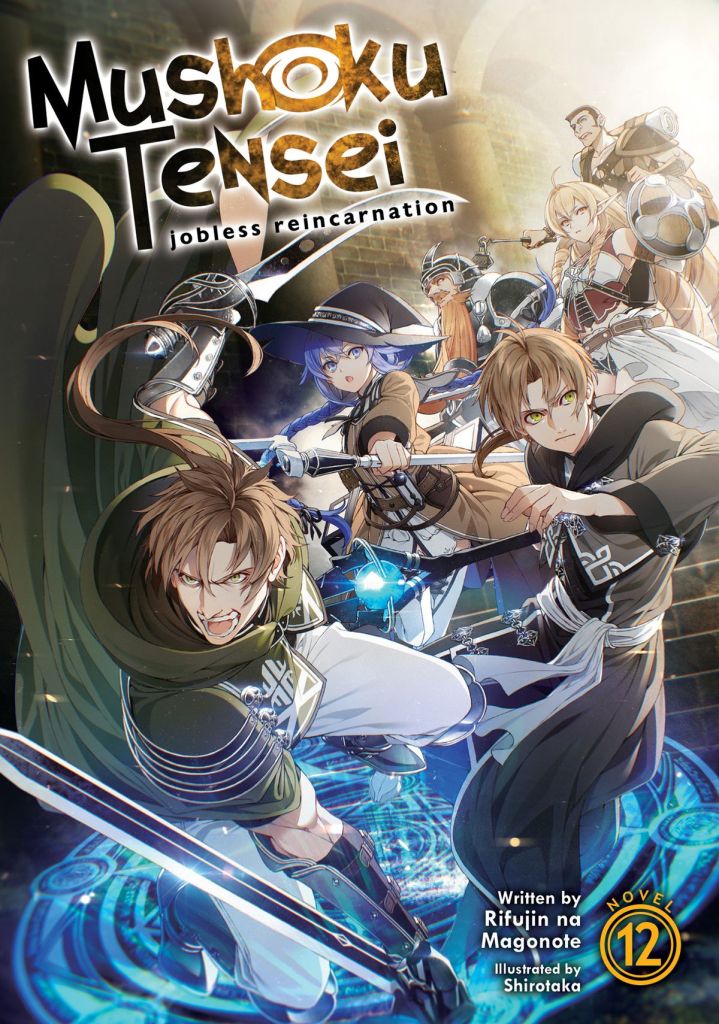
Review: Mushoku Tensei, Vol. 12, by Rifujin na Magonote

Three-and-a-half stars.

I love me some isekai. If you pay any attention to my words, you know this already. It’s the quintessential boys’ fantasy: explore some fantastic places cut off from this repulsive Earth; exploit newly-gained, generally undeserved powers; meet cool people mostly of the attractive, female persuasion then have sex with them; possibly marry one or more of those gals before or after impregnating them; enjoy the fact that you will never, ever have to deal with Earth and its people again.

This time, our hero starts at the lowest point of his life: after two decades of parasitizing his parents as a hikikomori due to relentless bullying in high school, his parents died. Instead of attending the funeral, he spent that day jerking off to child porn (or loli hentai), a fact that bothered his siblings enough to beat him up and throw him into the streets. As he wandered in a daze, the mythical creature known as Truck-kun deigned to make a visit and transport the protagonist, along with a couple of people nearby, to death, and later on to a fantasy world.

Our protagonist gets reincarnated as a baby that retains the memories of his harrowing past life. In this new one he’s Rudeus Greyrat, son of a horny swordfighter and a lively mage, who had retired from adventuring to start a family together. Rudeus is overjoyed by the fact that he’s been given a second chance at life, but mainly that he’s able to suck on a hottie’s tits on a regular basis, and that the grown-ups around him forgive him for his relentless perversion. The anime adaptation did a good job rendering this, as seen below:

Anyway, lots of shit happens, as it tends to do. I read this volume of the light novel to catch up with the anime adaptation, that has just finished its second season. I’m discussing spoilers from now on, so read on only if you already know what happens, or you don’t care to find out this way.

<spoilers>That whole magic displacement incident that teleported Rudeus’ family, as well as the redheaded terror and his childhood elvish friend, to random corners of the world, has led him to organize a spelunking raid to a teleporter labyrinth where his mother is supposed to be trapped. We accompany Rudeus along with his scumbag father Paul, blue-haired loli and magician Roxy Migurdia, their monkey-man scout, a gay dwarf, and a promiscuous grandma as they bond with each other and fight monsters. First they rescue Roxy, who falls in love with adult Rudeus because he saved her from the brink of death. Finally they face a hydra, and although they defeat it, they suffer a devastating loss. Rudeus also ends up maimed.

The biggest difference from the anime adaptation happens when they’re nursing their wounds back at the inn. Rudeus is depressed in a similar way as he’s been in the past (for example during his episode of erectile dysfunction). This time, Rudeus’ grandma-in-law suggests Roxy that she should fuck Rudeus to get him out of his funk. In the anime, Roxy drags Rudeus to bed and mounts him. In the original, she’s about to stand up when Rudeus pulls her down and fucks her roughly. He barely considers the fact that he’s cheating on his pregnant wife. Later on, his grandma-in-law deceives our protagonist by stating that he’s impregnated the blue-haired magician, in order for him to take responsibility, as the Japanese love to say, and make Roxy his second wife. Other than those significant changes that made me lose some respect for both characters, the anime adaptation is faithful to the rest, even verbatim for plenty of the dialogue. The author is involved with the adaptation, so maybe those changes are a very late revision of the original work.</spoilers>

What else can I say? If you like Mushoku Tensei, you’ve likely watched the anime, so you knew what to expect from this volume. This is a story about the pains and struggles of growing up, rising from rock bottom to becoming a more or less respectable family man, processed through the Japanese charm you know and love (if you know and love it), and free from the politics that have corrupted every aspect of Western culture. This story also makes polygamy quite appetizing.

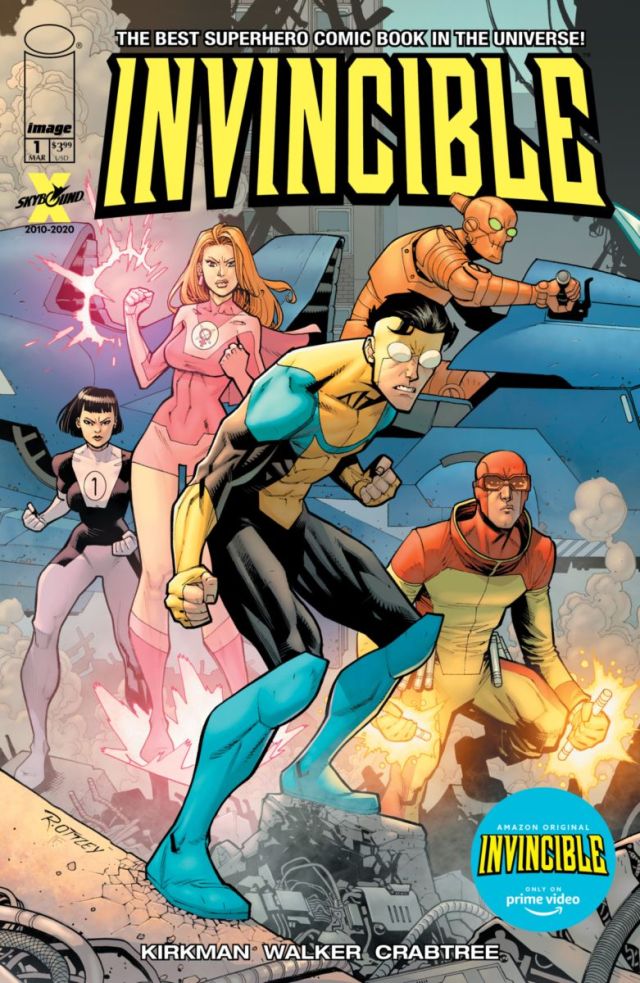
Review: Invincible, by Robert Kirkman

Five out of five stars. I’m reviewing the whole series.

Like many people, I first became aware of Kirkman’s Invincible through its animated adaptation. I was hooked on the show from the first episode, that set itself up as a charming, seemingly typical superhero narrative about a teenager, named Mark Grayson, whose dad is basically that world’s Superman, only to whack you with a brutal ending that promised a story far from normal. Here’s the clip of that pivotal scene, which serves as the story’s first major plot point. In case you want to spoil it for yourself. It gives you a good idea of the kind of superficially goofy but dead serious story Invincible is:

Getting through the animated series was a struggle at times: painful attempts at humor, cramming in woke points, race-swaps only in one direction (turning the very white, very blonde Amber into a black ballbuster whom comic-book Mark would have never dated was a particularly egregious one), and in general the kind of marxist garbage you can expect from any major cultural production these past couple of decades (if you agree with any of that, please go away). While the adaptation surpasses the original when it comes to the choreography of the fights, virtually everything else is worse, and now that I’ve read the original, that adaptation feels almost insulting.

Anyway, Invincible tells the self-contained tale of a powerful, brooding, and hot-headed young guy that strives to use his abilities to do good for others and protect the people he cares about, but he struggles with the fact that the world is far more morally complex than he’s prepared to accept: does someone who killed thousands, whether deliberately or through poor choices, deserve forgiveness if they repent? Is it right to exploit a villain’s abilities for good, despite their crimes? Can you forgive someone who endangered your loved ones for what they perceived as the greater good? At the core, many of the characters, starting with the protagonist, understand that their nature is dangerous, that a few unlucky events or misguided decisions could turn them into forces of evil ready to destroy everyone around them.

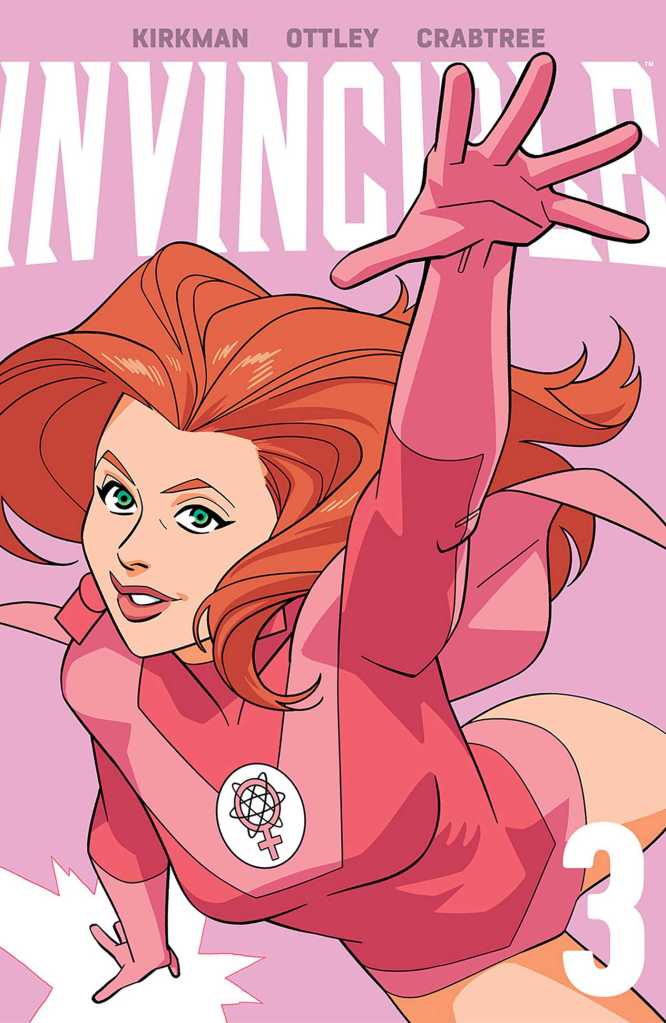
We first meet Mark Grayson as a high school student, but by the end of the story, it has brought you on an epic journey that makes the beginning near unrecognizable. Many of the characters feel real and have been given compelling character arcs. Notable among them are the gorgeous redhead Atom Eve, a headstrong, resilient woman who can alter the atomic composition of damn near anything; Rudy “Rex” Robot, a guy born extraordinarily intelligent yet hideously deformed, forced to interface with the world through mechanical constructs, who fears that his logical detachment will end up causing harm; Monster Girl, a no-nonsense thirty-year-old whose transformations make her younger each time (she’s also the most terrifying futanari in the universe); the protagonist’s father, who struggles with his upbringing in a Spartan-like space society that despises weakness, almost especially familial ones; an immortal dude who has lived for such a long time that he prefers to keep everyone at a distance, lest the mounting grief destroys him (he was also Abraham Lincoln); the government agent constantly forced to make unsavory decisions, potentially enraging his contacts, in order to save the world at any cost, etc.

Throughout the story, I often feared for the characters’ lives. Many meet permanent and often brutal ends. I wished for them to just get along and have a good time, only for the next crisis to bash against them. Plenty of times I echoed the protagonist’s words right after a tremendously costly battle, when he cried out, “Oh god, what now?!” because the next threat burst in immediately after. You experience these people building strong bonds with each other, only for disasters, threats, or their own conflicting decisions to pull them apart in painful ways. I was hooked, devouring the series day after day, nearly missing my train stop a couple of times.

The story isn’t exactly perfect to warrant a five out of five, although I don’t have much in particular to nitpick. At times it had me wavering between four and four-and-a-half stars. But looking back at the ride, from a teenager playing superhero with undeserved powers to a profound tale about family and the importance of building strong bonds, it feels so dense and carefully woven that it deserves nothing less than a five from me.

I wish there was more Invincible out there to consume beyond the bastardized adaptation, but the limited nature is part of its brilliance: this isn’t a corporate comic book with repetitive, resettable storylines. Mark Grayson’s fascinating story of hard-earned growth was one of real stakes and permanent losses, and it ended precisely when and how it needed to. For me, the ultimate superhero story.

Review: Sputnik Sweetheart, by Haruki Murakami

Three and a half stars.

Let’s focus on the most memorable character of this strange little tale: a young adult named Sumire, who dropped out of college to pursue her dream of becoming a published author. She’s disorganized both in her personal upkeep as well as her approach to writing: she can start or finish stories, but not both. She suspects she will never become a pro, but can’t imagine doing anything else, and when she turns twenty-eight, her parents will stop financing her lifestyle.

She’s used to calling the narrator at odd hours of the night to discuss her worries and seek his guidance, even though the guy is a school teacher and could use the sleep. However, they’re each other’s only friend in lives that have been characterized by solitude and detachment. Sumire is unaware that the narrator is in love with her, or pretends that she doesn’t know, but she can’t reciprocate his feelings because she’s in love with a Korean-born woman who’s about fifteen years older than her.

The little there is plotwise (not that I mind; I tend to dislike convoluted stories) involves the Korean woman, named Miu, hiring Sumire as an assistant; the lady runs a wholesale business that buys wine from fancy places and sells it in Japan. Even though Sumire fears that keeping a job will wreck her literary aspirations, she surrenders to the flow of a routine that allows her to spend her days with her beloved Korean mommy. Soon enough they’re jet-setting all over the world.

The narrator fears that he’s going to lose Sumire. She writes him a letter from Rome, but shortly after he stops receiving news from her. Suddenly, the Korean lady herself calls him: he’s to abandon everything he’s doing in Japan and hurry to a small Greek island, because something has happened to their friend.

That’s all I want to reveal about the plot. My favorite parts of this story take place in Japan, when Sumire and the narrator are interacting. Murakami knows how to weave a spell when he’s letting you experience the private lives and interactions of his characters, who are usually lost and trying to understand themselves as well as the world they have found themselves in. His Norwegian Wood reached the heights in that regard, as far as I know from his works. But as in plenty of his other stories, Murakami introduces supernatural elements that for me weren’t supported by the story, and that distanced me from the characters. Even though Norwegian Wood made Murakami a known author (and a millionaire), it’s perhaps one of the least Murakami-ish books of his. Worse yet for me: often the supernatural elements he includes feel random, as if he came up with them during freewriting but couldn’t make them fit in, or didn’t care to do so.

Murakami’s writing also has this thing in which he’s on the verge of saying something profound, of hitting some transcendental point, only to screw it up with a few lackluster phrases that don’t say much of anything. I don’t recall how common that was in Norwegian Wood, but I had that impression quite a few times during this story. The narrative also features texts written by Sumire, and it didn’t help that her style annoyed me.

My least favorite element of the story was the narrator himself. Murakami’s male narrators are often bland, tepid, non-committal, and the one from this novel I’m reviewing is the epitome of those, that I can recall. His opinions seemed vague, unconvincing, held because they wouldn’t require him to take a firm stance on anything. I had a hard time understanding why Sumire would care so much for him. Worse yet, his morals were beyond questionable: all his girlfriends were other men’s girlfriends or wives, and he let a shitty little kid get away with his kleptomaniac ways for reasons that for me had more to do with dislike of authority.

The main theme that Murakami was playing around with centered on the notion that some people are doomed to a life of solitude, and that their instances of true contact with other alike souls will be fleeting, like two satellites briefly passing each other. By the end, the story left me feeling empty, as if something important had been lost along the way, so good job for capturing that impression.

Here are some quotes from the book:

Why do people have to be this lonely? What’s the point of it all? Millions of people in this world, all of them yearning, looking to others to satisfy them, yet isolating themselves. Why? Was the earth put here just to nourish human loneliness?

I dream. Sometimes I think that’s the only right thing to do.

And it came to me then. That we were wonderful traveling companions but in the end no more than lonely lumps of metal in their own separate orbits. From far off they look like beautiful shooting stars, but in reality they’re nothing more than prisons, where each of us is locked up alone, going nowhere. When the orbits of these two satellites of ours happened to cross paths, we could be together. Maybe even open our hearts to each other. But that was only for the briefest moment. In the next instant we’d be in absolute solitude. Until we burned up and became nothing.

The answer is dreams. Dreaming on and on. Entering the world of dreams and never coming out. Living in dreams for the rest of time.

We each have a special something we can get only at a special time of our life. Like a small flame. A careful, fortunate few cherish that flame, nurture it, hold it as a torch to light their way. But once that flame goes out, it’s gone forever.

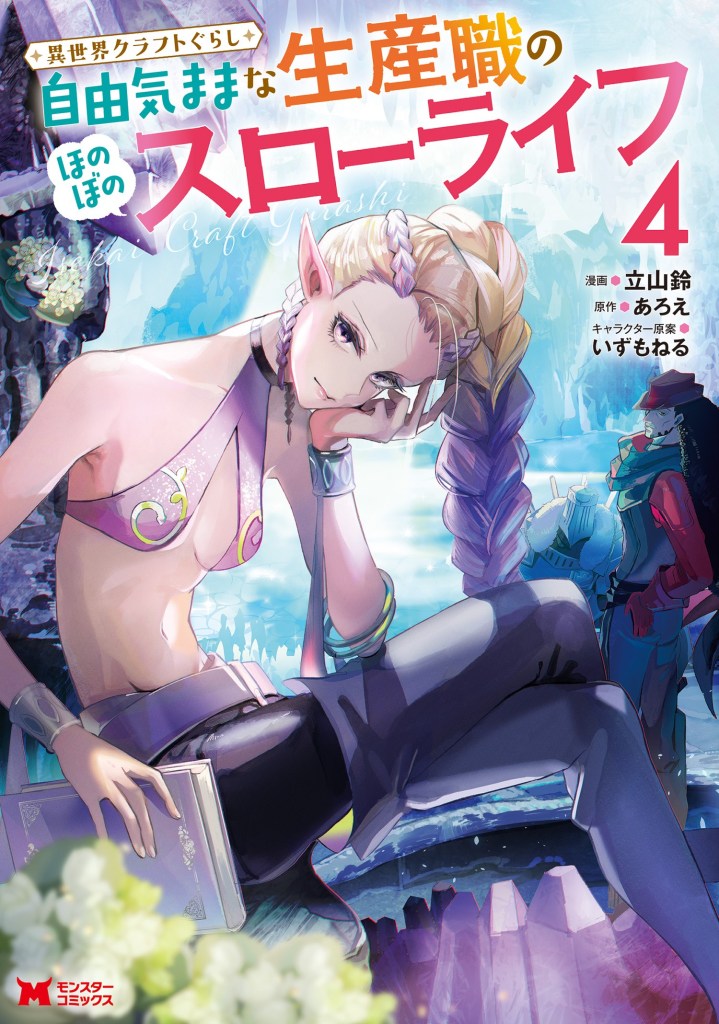
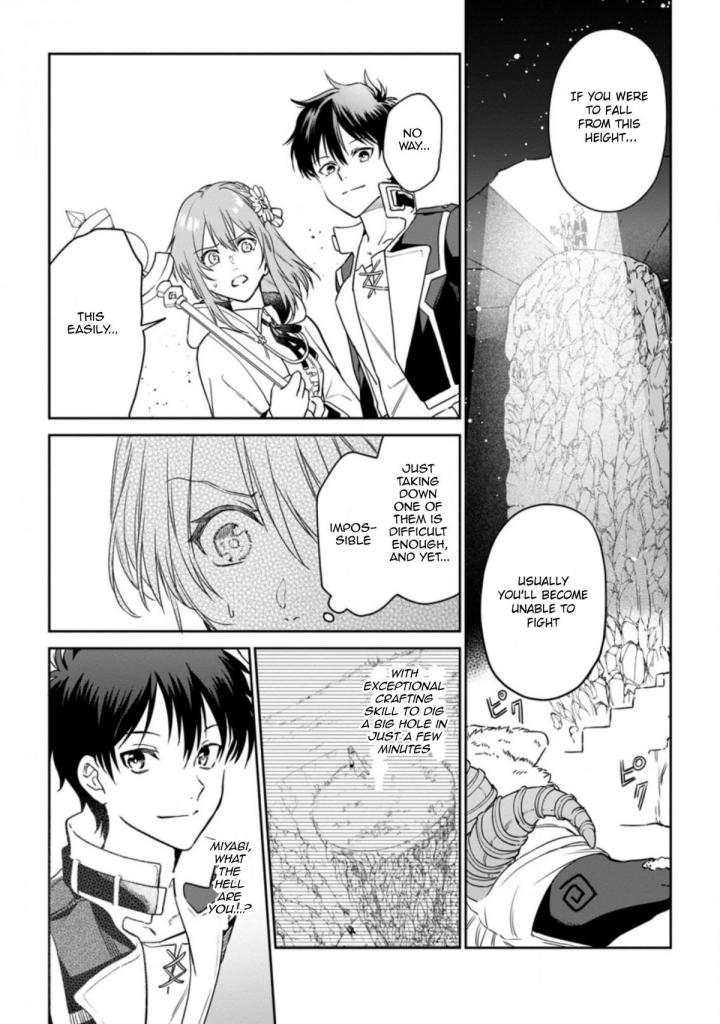
Ongoing manga: Isekai Craft Gurashi Jiyu Kimamana Seisan Shoku No Honobono Slow Life, by Aroe

Four stars. The title translates to “The Heartwarming Slow Life of a Free-Spirited Production Worker.”

This is yet another title in the isekai sub-genre of “let’s contrast how shitty my life on Earth was by having a good ol’ time in this fantasy world.” When this series started, I expected it to be completely mediocre, but it surprised me with its character work and sense of humor.

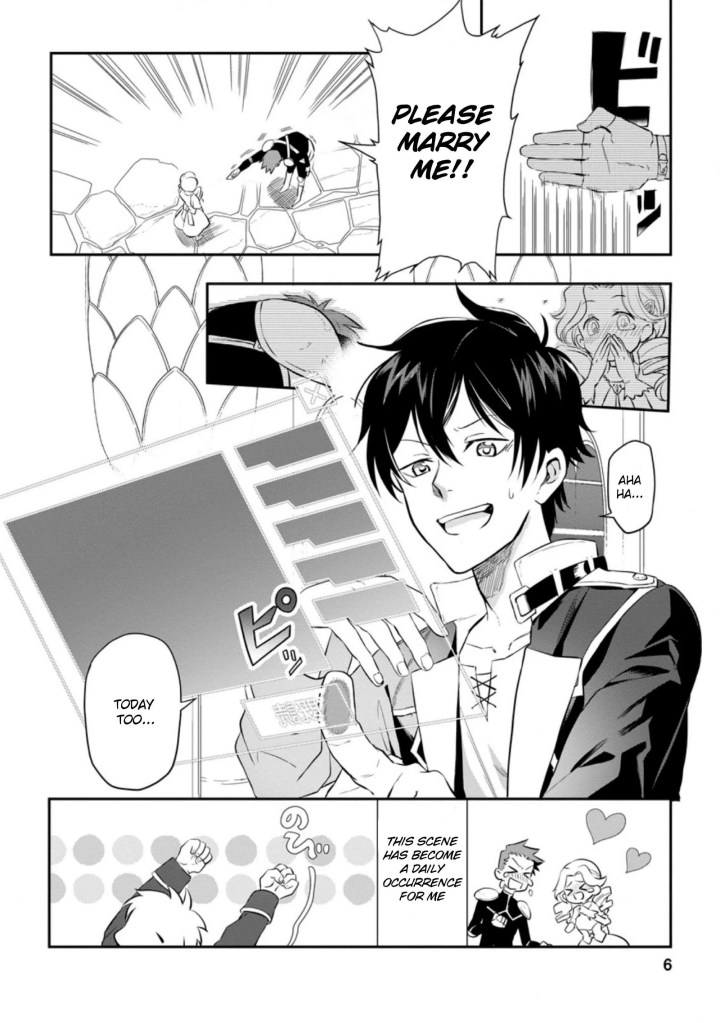
The story follows an overworked Japanese salaryman in his thirties, who works at one of those Japanese companies that require you to wear a suit and tie, and to die inside. Wanting to remain human, he exercises his architectural talents in an online VR game. His buildings are so popular that they’re regularly used as backgrounds for wedding proposals by the kind of people who would propose to someone in a video game. Anyway, the godess of love or some shit contacts the protagonist through the game and offers to send him to a new world where he may be able to have a good ol’ time.

He finds himself in your average isekai fantasy world, based on Central Europe during the post-medieval period, but including monsters and sentient fantasy races of the Tolkienesque variety plus beast people. His abilities back on Earth have been turned into vastly overpowered skills: previously a crafty fellow, he’s now the most talented builder person around. He has also access to a warehouse-size inventory in some private dimension, along with the kind of Minecraft powers that allow him to dig through a mountain easily. Although initially he’s a bit freaked out, and tries to remove the VR headset in front of confused fantasy people, he quickly gets used to a life that won’t involve working at a Japanese company.

Like in many other isekai, first cute girl he meets, who is usually the first female at all he meets, becomes the intimate option. In this case, with the guy in his thirties even though his new body doesn’t suggest it, they establish a sort of father-daughter relationship with no incestual undertones. Because she helped him, a broke guy with no ID, to get around in that new world, he imprints on her (or is it the other way around?), and is happy to follow her on her adventures as long as he has the opportunity to make her comfortable. By that I mean stuff like cooking restaurant-grade food for her every day, or producing entire houses out of his inventory whenever they need to take a rest in the wild.

Still, she doesn’t fall for him, which may have to do with the fact that she has a questionable relationship with the older female receptionist at the adventurers’ guild; this girl even calls “dates” her outings with the receptionist. Oh well, can’t fix nature.

Plenty of the plot so far involves the protagonist wanting to enjoy a slow life in this new fantasy world, only for people to take notice of him because of shit like stacking the processed meat of eleven orcs on the guild receptionist’s desk, or earning about a year of his previous salary in Japan with a single quest. Soon enough he attracts the attention of the local duke, and a troublesome party of adventurers.

This story is fun, and I like to have fun.