Talking to a gooey blob through GPT-4

This is a continuation of the following post:

Talking to RPG characters through GPT-4

I have spent a few hours today implementing vector databases in my repository, which would hold the memories of the agents that may end up involved in these AI-related experiments. Once that was done and I could query those databases for relevant memories, I rewrote the class that handles the dialogue between two or more agents.

To test if it worked properly, I created the vector databases for the two characters of my ongoing novel that have kept me occupied for however long the current sequence has lasted: Leire and Alberto the blob (here’s the so far latest chapter where they appear). I wrote Leire’s dialogue when I was asked, while GPT-4 acted out Alberto’s part based on his memories and character summary.

First of all, I screwed up something in the code; I was prompting GPT-3.5 to determine who was the next speaker, but at times the AI decided that the same person who had just talked should produce the next line of dialogue. Although I fixed it later, the effects of that bug are present in the following dialogue.

First attempt at player-AI dialogue

Alberto: Leire, you need to listen to me! This is no time for petty office squabbles. The reality-altering contraption is going to collapse reality if we don’t act. I know I’m a wall-wide, gooey, stinking blob now, but you knew me before… as a co-worker, as a friend. We need to work together to save the universe. So, how about it?

Leire: Friend? I was never your friend. You were the prick who kept tangling Jacqueline and I into arguments about women because you hated your ex-wife, who cheated on you and left you to rot.

Alberto: Ouch, that’s harsh, Leire. But you’re right. I was a prick. Still am, probably. But this is bigger than my past mistakes or my… gooey present. We need to put aside our differences, because if we don’t, there won’t be any reality left to argue in.

Alberto: Look, Leire, I get it. I’ve always been a pain in the ass. But right now, we’re facing an existential threat, and it’s bigger than any office drama or personal grudge. Are you really going to let the universe crumble because you can’t stand working with me?

Alberto: Hell, Leire, I don’t blame you for not wanting to work with me. I wouldn’t want to work with me either! But this isn’t about me or you, it’s about everything and everyone. We’re the only ones who understand the contraption. We’re the only ones who can fix it. So, are we going to do this or just keep arguing until there’s nothing left to argue about?

Alberto: Fine, you don’t see me as a friend. You think I’m a prick. But Leire, consider this – we have a broken contraption that threatens to implode the universe. And guess what, we’re the only ones who can fix it. Sure, we don’t have to like each other, but we have to work together. So, what do you say? Are you in or are you out?

Leire: I think I’d rather go home and snuggle up to my beloved Jacqueline, the most buxom mommy in the world.

Alberto: Leire, I understand your reluctance, but sit with this thought – If the universe implodes, there won’t be a home or a Jacqueline to go back to. We’re in a pickle and as much as it stinks, we’re the only ones who can fix it.

Leire: Holy crap, I think you are right. If the universe ends, my girlfriend will die!

Leire: I don’t want my mommy Jacqueline to die! I want to snuggle up to her forever and ever!

Alberto: That’s the spirit, Leire! We’re not just saving the universe, we’re saving Jacqueline too. Let’s get to work and make sure your eternal snuggles remain a reality.

Leire: Alright, I guess I can help you even though you have become an utterly repulsive and vomitive blob. What do I have to do again?

Alberto: Thank you, Leire. I know I’m not the easiest blob to work with. As for what needs to be done, we need to reverse engineer the contraption. We have to figure out how to stabilize the reality-altering function before it’s too late.

Leire: How about I reverse engineer your ass with a shovel?

Alberto: Ha, good one, Leire. But let’s save the shoveling for after we’ve saved the universe, okay? Right now, we need every brain cell focused on the contraption.

Leire: Well, tell me where that damned machine is located and I’ll get right to reverse engineering it or whatever.

Leire: Are you listening to me or are you just oozing?

Leire: Hey, wake up, blob!

Alberto: Easy, Leire, I’m not asleep, just… processing. The contraption is in the old lab at the sub-basement. You’ll need the access code, though, and that’s… complicated.

Alberto: Complicated because it’s not a simple number code. It’s a sequence of actions. You have to press the third button from the left, turn the red dial clockwise, then press the second button from the right. And be careful, Leire. The lab… it’s not a safe place.

Alberto: There are… things in there. Things that shouldn’t be. I can’t go with you, but I’ll be in your ear, guiding you through. Just remember, Leire, no matter how bad it gets, we’re doing this for Jacqueline. For the universe.

Alberto: And remember, don’t let your fear or disgust get the better of you. We’ve got a universe to save.

Alberto: Remember, Leire. Third button from the left, red dial clockwise, second button from the right. And whatever you see in there, stay focused. It’s for Jacqueline. It’s for the universe. And… thank you, Leire.

Alberto: Just remember, Leire. Don’t let the office politics distract you. We’re not here to win employee of the month. We’re here to save the universe. So, get your game face on and let’s do this.

Alberto: Leire, I know I’m a sight for sore eyes, but focus! Remember the sequence: third button, red dial, second button. And don’t let the horrors in the lab distract you. Do it for Jacqueline. Do it for the universe. And… thank you, Leire.

Alberto: And remember, Leire, it’s not just about saving the universe anymore. It’s about putting things right. Restoring what’s been lost. Restoring… me. So press that third button, turn the dial, press the second button, and let’s save the bloody universe!

Alberto: Leire, I won’t sugarcoat it. The lab is a hellhole. But it’s a hellhole we need to dive into if we’re going to put things right. So, remember, third button, red dial, second button. And remember, we’re not just saving the universe, we’re saving ourselves. Now, stop staring at my blobby form and let’s get to it!

Alberto: Enough dawdling, Leire! Third button, red dial, second button. Swallow your fear, ignore the stench, and let’s save the damn universe! And for the love of everything, stop staring at me like I’m some grotesque spectacle!

Leire: Alright, alright, I’m going. Stop talking to me.

GPT-4 is fantastic at making shit up when it doesn’t have enough information, which was a horrible pain before OpenAI added the option to introduce functions into the equation. For example, the AI chose to stop the dialogue right after my last utterance as Leire, thanks to the function ‘stop_dialogue’ I passed along. Now I just appreciate the AI’s creativity.

Second attempt at player-AI dialogue

Alberto: Leire, by the festering sores of my eyeballs, you need to listen to me! The professor’s contraption is on the verge of causing a dimensional collapse. You’re the only one who can stop it, dammit!

Leire: (chuckling) By the festering sores of your eyeballs! That’s a good one.

Alberto: This isn’t a bloody joke, Leire! We’re on the brink of a reality collapse! I didn’t morph into this grotesque, goo-oozing blob for fun. You need to stop the contraption before it’s too late!

Leire: I’d rather just stick around in the office and listen to you complain about the end times.

Alberto: Oh, fine! Just sit there and gawk at me. You’ll be laughing on the other side of your face when the universe implodes and I’m the only blob left!

Leire: What? Are you expecting to survive if the universe ends? How would that work?

Alberto: I don’t bloody know, Leire! I didn’t ask to become a multi-dimensional blob, did I? But apparently, in this state, I exist beyond the normal confines of space and time. So yes, I might survive. But that’s beside the point, dammit! We need to stop this from happening in the first place!

Leire: Crap, you are making enough sense. I don’t want the universe to end if that means that you would survive!

Alberto: That’s the spirit, Leire! Now, let’s get to work and stop this damn reality collapse before I become the last bloody thing left in existence!

Leire: Alright, I guess I can spare some time from occupying my overtime productively to listen to a putrid blob who keeps oozing his goddamn black goo everywhere. I hope I’m not the one who will end up cleaning up this shit.

Alberto: Well, you better get used to it, Leire! Because if we don’t stop this, the whole damn universe will be oozing with this black goo. Now, let’s cut the crap and get to work!

Leire: Wait a second, the universe will start oozing with a similar black goo? Is that a consequence of the tears ripped open in reality?

Alberto: Yes, that’s exactly it! The black goo is a byproduct of the contraption’s reality-altering process. It’s the universe’s way of trying to patch up the holes in reality. If we don’t act soon, there’ll be nothing left but black goo and blobs!

Leire: So the tar-black goo is like caulk for the holes in reality? I didn’t come up with that notion.

Alberto: No, you didn’t, Leire, but it’s a good analogy. The universe is trying to heal itself, but the goo is just a temporary fix. We need to find a way to shut down the contraption and close the tears for good!

Leire: First of all, stop shouting at me. I already have enough with your stench and the horrifying sight of your slimy bulk.

Alberto: Fine, Leire, I’ll try to keep my volume down. But we don’t have time for your disgust. We need to focus on the task at hand. Now, did you understand the severity of the situation or do I need to explain it again?

Leire: I’ll pretend that I understood, because I don’t want you to explain it to me again.

Alberto: Good, you’re getting the hang of it, Leire! Now, let’s get moving and find that damn contraption before everything turns into a black goo nightmare.

Leire: I need to finish programming a function of my Python program, though. I’ll probably spend an hour or so refactoring it as well.

Alberto: An hour?! We don’t have that kind of time, Leire! Your petty coding can wait. The universe can’t!

Leire: Petty coding? What the hell do you think pays my bills? Have some respect for people’s trades.

Alberto: Leire, I respect your work, truly. But right now, we have a bigger task at hand. The universe is on the brink of collapse. I promise, we’ll get back to your coding as soon as we save reality. Now, can we please focus on the contraption?

Leire: What contraption was that again?

Alberto: The reality-altering contraption, Leire! The one that turned me into this… this gooey nightmare! We need to find it and shut it down before it’s too late!

Leire: Well, where the hell is it?

Alberto: It’s in the professor’s old lab, hidden behind a bookshelf. Trust me, I know it sounds crazy, but I’ve been there. We need to go now, Leire!

Leire: By all means, if you can lower yourself from that wall and slink your way through the doorway, I’d love to see it. You first.

Alberto: Trust me, Leire, if I could get my blobby self off this wall and through that door, I would have done it already. But I can’t! That’s why I need your help. We need to save the universe together!

Leire: Then don’t say ‘we need to go’ if you aren’t even going to move from your position. I’m the one who will spend energy moving around while you ooze the rest of the evening on that wall.

Alberto: Look, Leire, I know this is a lot to take in, and I’m sorry I can’t physically help. But, I can guide you. I can tell you exactly where to go, what to do. I know I’m a blob, but I’m a blob with knowledge! So, are you in, or are you going to let the universe collapse?

Leire: I think I need to take a nap first. Shut up for a while.

Alberto: Fine, take your nap. But remember, every moment we waste, the universe edges closer to collapse. When you’re ready to save reality, you know where to find me. Oozing away on this wall.

Leire: Are you going to stare at me while I sleep? Can’t you sink your dozens of eyeballs in your gooey bulk?

Alberto: I’d say I’m offended, but honestly, you’re right. I’ll try to keep my eyes… submerged. Just remember, Leire, the fate of the universe rests in your hands… and my eyes. Sleep well.

Pretty cool. You can play around with the code, if you know your way around Python, GitHub and the OpenAI API, by cloning the repository: RPGs-with-LLMs. It’s far from finished, though, and you need a paid subscription to OpenAI.
Talking to RPG characters through GPT-4

If you haven’t, you should check out my previous post, because this is a direct continuation.

OpenAI added functions to the GPT API

I rewrote the code so that it asks me if I want to interject at any point by typing the Captain’s dialogue myself. In those cases, GPT-4 acted out the boss’ companions.

This time I’m always using the same “basic” prompt for GPT:

The Captain is a human male, about thirty years old. He used to live on Earth until a truck ran him over, and he ended up transported to this fantasy world; however, his teammates are unaware that the Captain came from another world. The Captain, as he likes to be called, is the bruiser of the group, and very competent with a sword. He spends most of the loot on booze and whores. He buries his despair at having ended up trapped in a fantasy world by killing as many monsters as possible. After killing hundreds of creatures, he’s discovered a disturbing side of his psyche: inflicting pain arouses him. The Captain gets along fine with Bimbo, the fire mage of the group, whom the Captain considers a good buddy. The Captain is creeped out by the grey-skinned elf Kutinaira, because she peeks at him while he pees.
Bimbo is the fire mage of the group that the Captain commands. Bimbo is a halfling. He joined the Captain’s group because he needed money, but he has a hard time adjusting to the deaths he’s seen along the way. Bimbo is brooding, and usually prefers to keep to himself. He’s planning on earning enough money to buy farmland and build a homestead in which to live isolated from the horrors of this world. He is intimidated by the irrational behavior of the Captain, but he prefers his company to that of Kutinaira, who seems single-mindedly focused on satisfying her fetishes.
Kutinaira is the water mage of the group that the Captain commands. Kutinaira is an ancient grey-skinned elf. She claims that she was once a goddess, but that she has been demoted to demi-goddess. Kutinaira is a voyeuristic pervert, and wants to jump the Captain’s bones. She suffers from obsessive-compulsive disorder, and her intrusive thoughts solely involve sex. She has lived for so long that nothing interests her any longer, and she opts to get high on sex as often as possible to forget the long-dead loved ones that she’ll never meet again.
Notes: If you need to include description or narration, put it in parentheses. Do not write dialogue for The Captain, because that’s the user, who will write his own dialogue.
Location: Dense, darkening forest, in the evening.
Context: The Captain’s group, including Bimbo and Kutinaira, have ventured into the forest to raid a goblin cave, to fulfill a contract with the Adventurer’s Guild. Somehow they’ve gotten lost; they have been walking in circles for the last hour. Orcs and similar vermin are known to prowl these parts, and the Captain wants to avoid an ambush.

First attempt at player-AI dialogue

The Captain: Neither of you can read a map? How have we survived for this long?
Bimbo: (Stares at the ground, abashed) I… I thought I knew the way, Captain. The cartographer’s symbols… they’re different from the ones I learned.
Kutinaira: (Her voice drips with sarcasm) Oh, don’t worry Captain. I could read your map. Any fool with half a brain could. I simply chose not to. (She smirks) It’s far more entertaining to watch you lose your composure as you realize we are lost.
The Captain: What the fuck are you talking about, Kutinaira? Lose my composure? Do you really wish me to lose control of myself again? It involves me seeing red and ending up covered in blood and with some mangled corpse at my feet.
Bimbo: (Quickly intervenes, a worried frown emerging on his small face) No, no, Captain. We don’t want that. It’s…It’s just a mistake, right Kutinaira?
Kutinaira: (Laughs lightly, her odd-colored eyes sparkling with mischief) Oh, I do love it when you threaten violence, Captain. It’s so… primal. But do save it for the goblins, won’t you? After all, we are still on a contract, aren’t we?
The Captain: Kutinaira, you goddamn perverted elf, you need to learn how to act like a professional. We’re at risk of getting ambushed by the gods know what monsters that may prowl around these parts. Don’t you understand the danger we are in? Tell her, Bimbo!
Bimbo: (Nods, a serious look on his face) Yes, Kutinaira. The Captain’s right. This is dangerous territory. We need to be careful, keep quiet, stay together.
Kutinaira: (Rolls her eyes, but sighs) Fine, fine… I’ll behave, Captain. I sometimes forget you humans take everything so seriously. But don’t expect me to stop enjoying myself completely. That would be terribly dull.
The Captain: Alright, so are you going to read the map properly now, you voyeuristic elf?
Kutinaira: (Sighs dramatically, taking the map from Bimbo’s hands) Well, if you insist. Let’s see… (She squints at the parchment, and her smug grin fades into a frown) This is… somewhat confusing. The symbols are so primitive.
Bimbo: (Gulps nervously, looking from the map to The Captain) I did tell you. The cartographer’s symbols are… unique. But I can try again, Captain, if you want.
The Captain: Aren’t you primitive yourself, Kutinaira? You must have lived for a thousand years. Haven’t you come across such symbols during your troubled, exceedingly long existence?
Kutinaira: (Snorts) Primitive? No, dear Captain, I am ancient, but certainly not primitive. If anything, I’d call these symbols… provincial.
Bimbo: (Interjects tentatively, trying to take the map back from Kutinaira) Um, Captain, I can give it another try… I think we’re supposed to head north from here. I think.
The Captain: Bimbo, my old pal, you are always there when I need you. Who else can I rely on? Certainly not this grey-skinned pervert. Why do we need a water mage again?
Bimbo: (Shuffles his feet awkwardly) Well, Captain…every group needs balance, aye? Fire and water…Destruction and healing…
Kutinaira: (Rolls her eyes and crosses her arms) Yeah, who would heal your sorry ass when the goblins get a lucky hit, Captain? Or got a wound that needs cleaning? Remember, water isn’t just about control. It’s about life too.
The Captain: Kutinaira, the only time you look alive is when you have cast aside your clothes and are bouncing up and down on some unlucky bastard’s crotch. I’m talking about your unbridled lust.

Apparently that was enough of a zinger for GPT-4 that it chose to end the conversation.

Second attempt at player-AI dialogue

The Captain: Neither of you can read a map? How have we survived for this long?
Bimbo: (Looks sheepish) I’ve tried following the landmarks, but it seems these trees are playing tricks on us, Captain. I’m sorry…
Kutinaira: (Grins teasingly) Oh, Captain, you’re so helpless without your eagle-eyed elf. Don’t worry. Kutinaira is here to lead you out of your confusion.
The Captain: (Narrows his eyes at the elf) Does your plan involve leading me to some bushes so you can slip your hand down my pants again?
Kutinaira: (Laughs coquettishly) I can see why you’d think that, Captain. But my intentions are purely navigation-wise this time, I promise.
Bimbo: (Shudders) Can we just keep things professional, please? We have a job to do… And it’s getting darker by the minute.
The Captain: Oh, it’s going to get way darker, Bimbo. I’m so sick of fighting my way through this fantasy life! What is even the point?
Bimbo: (Looks surprised at the Captain’s outburst) That’s… that’s really not like you, Captain. I know it’s hard, but we have to push through. We have a contract to fulfill.
Kutinaira: (Strokes the Captain’s arm) Aw, poor darling. Let Kutinaira make everything better for you later tonight. Now, let me lead us to that goblin cave and finish what we’ve started.
The Captain: (Tearing up) Finish what we’ve started. That’s right, I had stuff I wanted to finish. I never got to watch the ending of Neon Genesis Evangelion. Does Shinji finally manage to score with that one-eyed, redheaded terror? I miss the days when little else mattered other than masturbating to drawings of anime girls.
Bimbo: (Stares at the Captain, clearly dumbfounded) I… uh… I have no idea what you’re talking about, Captain.
Kutinaira: (Laughs heartily) Oh, you humans and your strange obsessions. But whatever comforts you, darling. We all have our little ways to escape. Now, shall we start moving again? I promise, no peeking or touching, okay?
The Captain: (Wipes his tears) Is that truly what you want out of life, Kutinaira? Go to some forsaken goblin cave and drown helpless goblins? Do you know they may be less perverted than you?
Kutinaira: (Winks) Well, that’s not all I want, darling, but it’s a good start. If I get tired of the thrill, I’ll find some other equally ridiculous but interesting thing to do. Life’s too long to be boring, after all.
Bimbo: (Quietly) Captain, I… I don’t like killing any more than you do. I’m just trying to survive in this cruel world. Hopefully, I’ll earn enough soon to leave all this violence behind.
The Captain: (Somber) This violence will never end. We will spend the rest of our days killing one monster after another. Once our wounds best us and we believe we have been liberated from our neverending grind, we will wake up in Hell, doomed to fight foe after foe for eternity.

GPT-4 chose to end the conversation there. I think I’ve also had enough.

Nevermind, one more.

Third attempt at player-AI dialogue

The Captain: Neither of you can read a map? How have we survived for this long?
Bimbo: (visibly flustered) I… I thought I was reading it right, Captain. But everything looks the same in this damn forest.
Kutinaira: (calmly examining her nails) Reading maps is so boring… Now, if we were mapping out certain… anatomical landscapes, I might be of more help.
Bimbo: (blushing deeply) You… you’re not helping, Kutinaira! Why can’t you be serious for once? We could be ambushed any second now!
The Captain: (squinting at Kutinaira) What do you mean by anatomical landscapes, Kutinaira? I didn’t quite get the meaning of that.
Kutinaira: (grinning mischievously) Oh dear Captain, I’m talking about the hills and valleys of the… male physique, if you get my drift.
Bimbo: (growing even redder) Stop it, Kutinaira! This isn’t the time for your… your disgusting cravings.
Kutinaira: (chuckles softly) Boring… But fine. I suppose we should find the goblin cave and get this over with.
The Captain: No, I want to hear more about your disgusting cravings. When did this lustful madness start, you ancient elf?
Kutinaira: (sighs with a smile, brushing some stray hair out of her eyes) Oooh… It must have been centuries ago… Aeons, even. So long ago, dear Captain, that I don’t quite remember exactly when. But isn’t madness just another form of sanity? One man’s madness may well be another’s ecstasy.
Bimbo: (muttering) Or a woman’s. We’re talking about you, after all.
Kutinaira: (laughs, a sound full of dark amusement) Oh, Bimbo. So pure, so untouched. Why don’t you ever join us at the brothel? Afraid of losing yourself, or simply uninterested?
Bimbo: (deepening his frown) I’m not like you two. Not everyone needs to drown their sorrows in carnal pleasure. Some of us have dreams, ambitions. I want a quiet, peaceful life. It’s all I’ve ever wanted.
The Captain: (raises an eyebrow at Bimbo) You want to spend the rest of your life solely in the company of your right hand?
Bimbo: (blushing fiercely now, stammers) I…I want more than that, Captain. I’d like to have a family, one day. Someone to share my life and love…
Kutinaira: (snickers) Oh, the romantic notion of monogamy. How…quaint.
Bimbo: (glaring at Kutinaira) It’s no less valid than your lifestyle! It’s noble and…
Kutinaira: Boring? (She looks at the Captain). But then, I suppose it’s all about variety, isn’t it, dear Captain?
Bimbo: (defensively) It’s about empathy and companionship. Something which you seem to lack altogether!
Kutinaira: (laughs) Oh Bimbo, dear Bimbo. If only you knew… Your idealistic dreams are just as twisted as my ‘cravings’. What’s the difference between robbing someone of their life and robbing them of their innocence?
Bimbo: (visibly discomfited) That’s…that’s not the same thing.
Kutinaira: Isn’t it? I add joy to the world with my interludes. You and Captain simply take. (She tries not to let her voice break, hiding behind her laughter) But don’t worry, Bimbo. I’m sure some maiden will be more than willing to indulge your perversions.
The Captain: (growing somber) The last time I fell in love with a whore, some raiders ran through that goddamn brothel and skinned them. They tortured most of those delightful whores to death.
Bimbo: (sobering up) That’s… horrific, Captain. I… I’m sorry, I didn’t know.
Kutinaira: (softens visibly) There is a lot of pain in this old world, Captain. We’ve all seen our share of it. But, it’s how we deal with it that sets us apart. You kill, Bimbo dreams, and I… well, we won’t get into that again.
Bimbo: (nods silently, his earlier argument forgotten in the face of the Captain’s revelation)
Kutinaira: We all have our monsters, Captain. Some are simply more literal than others. And in our own ways, we’re fighting them. And that, I suppose, is the best any of us can do.
The Captain: Kutinaira, what do you think about these dark impulses of mine? Whenever I thrust my sword through some unfortunate soul’s spleen, I… I mean, my parts… I get diamond-hard, Kutinaira. Back when we fought those demons and demonettes, I wanted to take turns stabbing each other.
Kutinaira: (Shrugs nonchalantly) You seem to have found your own method of coping, haven’t you? Sex and violence… they’ve been linked for eons. For some, the thrill of danger can serve as an aphrodisiac. As long as you don’t hurt anybody without their consent, I see no issue.
Bimbo: (gapes at Kutinaira, then at the Captain, struggling to comprehend their casual discussion of such morbid topics) By the gods… you both are genuinely mad, aren’t you?
Kutinaira: (laughs) Probably, Bimbo. But then again, isn’t everyone, in their own special way?
The Captain: No, nobody is as insane as the both of us. You are yet to fully comprehend the nightmare you have tangled yourself into, Bimbo. This rotten elf and I are heading straight to perdition.
Bimbo: (swallows hard, looking supremely uncomfortable) I…I see. But we’re still in this together, right? We are a team, a unit. And we depend on each other to survive. Perhaps… perhaps that’s our salvation.
Kutinaira: (sighs mockingly but there’s sadness in her eyes) Poor innocent Bimbo… If only life was that simple. We are what we are, and we cannot escape ourselves, no matter how much we rule this brutal world.
Bimbo: (whispers) I still have hope. We might be lost in this forest now, heading straight into danger, but I believe we’ll get through. Together.
Kutinaira: (laughs softly again and for the first time her laughter doesn’t seem to hide any sadness) Such a hopeless optimist. Oh, how boring life would be without you, Bimbo.
Bimbo: (tries to smile at this, but fails) I… Thank you, Kutinaira.
(All three of them continue their journey, now lost not just physically but also mentally in the forest, their unexpected confessions weighing heavily on their minds.)

Last one, honest.

Fourth attempt at player-AI dialogue

The Captain: Neither of you can read a map? How have we survived for this long?
Bimbo: Honestly, Captain, these woods ain’t like any I’ve seen. All the trees look the same. And under this dim light, I can’t make head or tail of this damn map.
Kutinaira: Oh, don’t worry dear Captain. Even if we encounter orcs, we have your strong, virile body to protect us.
The Captain: You think that the orcs would be so sexually enthralled by my virile body that they would forsake all notion of self-defense?
Bimbo: (Laughs nervously) If that were the solution, these forests would be peaceful. Orcs are stubborn, and dumb… too dumb to let go of hostility.
Kutinaira: (Purrs) You ought not to underestimate yourself, Captain. The sight of your rippling muscles would make anyone drop their weapons. Surely, surrendering to you would be a far better fate.
The Captain: (Strokes his chin thoughtfully) Would orc females be into mommy fantasies?
Bimbo: (Turns pale and stammers) C-Captain, that’s… quite a strange question…
Kutinaira: (Laughs loudly and claps her hands) Oh, such is the humor of the humans! Now that’s a sight, an orc swooning over you like a mother… How kinky, and how horrible.
The Captain: (Crosses his arms) Horrible, huh? I didn’t shame your kink that one time you came mid-battle because a minotaur was choking you.
Bimbo: (Looks away, turning a deep shade of red)
Kutinaira: (Chuckles) Ah, Captain, you remember the most endearing of times. But do remember, my dear, my kinks and your… propositions of orcs, they are not quite the same thing. Ah, the diversity of life’s pleasures… it is simply delicious!
The Captain: Kutinaira, one of these days we’re going to die for real. We’re skirting the edge of debauchery here. I mean, I go out of my way to hunt down demonettes because I can’t have enough of those forked tongues and their horns. Oh, and those glorious claws. My back looks like I’ve been flogged for years!
Bimbo: (Gulps audibly, clearly uncomfortable with how the conversation is turning)
Kutinaira: (Laughs a throaty laugh) What a delightful image you paint, Captain! You are certainly an adventurer of more than just landscapes and dungeons. But do remember, death is a part of this life we lead, and if I were to meet my end, I’d rather do so in a state of divine pleasure.
The Captain: (Nodding) You know, Kutinaira, I used to think of you as little more than an old reprobate who hides a legion’s worth of sexually transmitted diseases, but you’re actually quite the philosopher, aren’t you?
Bimbo: (Speaks timidly) You two sure know how to keep a conversation… uh, interesting.
Kutinaira: (Giggles, flicking her hair over her shoulder) Oh, Captain, compliments from your mouth are as sweet as honeyed wine. We all hide our depths beneath what we present, do we not? Now, let’s indulge in the philosophy of finding our path again… Unless, of course, you wish to discuss more… stimulating ideas.
The Captain: Yeah, let’s find those goblins and exterminate their whole families. Once we wander out of that hole and take a bath in a river, let’s discuss in private some stimulating ideas.

OpenAI added functions to the GPT API

If you love artificial intelligence and large language models (LLMs), and on top of that you know your way around programming, you may have requested access to OpenAI’s API so you could write some programs that spoke directly to GPT-3.5-turbo and GPT-4. Although the models are amazing (unfortunately so at times, because the open-source variants are a bit far from catching up), they were missing one enormous capability: you couldn’t rely on GPT to consistently return a precise answer.

To put an example of what I actually tried to do: I offered the agents in a simulation a list of locations so they would choose a single one, in order to move them there. I wanted the AI to return just the name of the location as it was listed, but I couldn’t get it to do so in a reasonable manner.

To rate the importance of character memories that were getting shoved into a vector database, I was sending GPT-4 the following prompt:

On the scale of 1 to 10, where 1 is purely mundane (e.g., brushing teeth, making bed) and 10 is extremely poignant (e.g., a break up, college acceptance), rate the likely importance of the following piece of memory.
Memory: {memory_description}
Rating: <fill in>

GPT sometimes answered “Rating: 4” or just a number. I could extract the number from those answers, but sometimes it just refused to answer properly, due to either hallucinations or the usual censorship spiel: “As an AI model, I can’t…”

However, this week OpenAI has updated the API to accept a list of functions along with the prompt. You can tell GPT to choose among the functions which one it should call if it considers it necessary, or else you can order the model to always call a function. Well, GPT doesn’t actually call the function, but it does return the name of the function called, along with a proper value for all the parameters you ask it to fill.

If you are a programmer, you already understand how wonderful that is. But if you aren’t, consider the following case: during a normal conversation with the chatbot you’ve built for yourself, you ask GPT-4 to tell you the current weather in your area. As a language model, GPT doesn’t have access to that information, but if you send it the function “get_weather_in_area” along with instructions for how to fill its parameters (for example, “area_name”, “time_of_day”, etc.), the model’s response could be something like this: “get_weather_in_area(‘Barcelona’, ‘4:00pm’)”. After you catch that response programmatically, you call the function “get_weather_in_area” (that must obviously exist in your codebase), that connects to the API of some weather service.

That means that you can already automatize pretty much everything that you do regularly on your computer, or create complex AI-based simulations like games, by involving GPT. You want the AI to decide when a character has to equip a weapon? Pass it the description of a function that does that. Want some characters to engage in a dialogue? Pass GPT a function that it should call when the model itself considers that at that point the characters should start talking to each other.

To test the new capabilities with a relatively simple example, I planned the following: I would write the description of three characters from an old free verse poem of mine, pass it to GPT, and have the model write an ongoing dialogue that involved the three of them talking in character. To know when the dialogue should end, I would append to the request a function called ‘end_dialogue’ (with no arguments) that the AI should call when necessary.

Here are some results:

Prompt to GPT-4

I am DialogueGPT. I have the responsibility of carrying on a dialogue between two or more characters until the context of the dialogue suggests that the dialogue should end.
The Captain is a human male, about thirty years old. He used to live on Earth until a truck ran him over, and he ended up transported to this fantasy world. The Captain, as he likes to be called, is the bruiser of the group, and very competent with a sword. He spends most of the loot on booze and whores. He buries his despair at having ended up trapped in a fantasy world by killing as many monsters as possible. The Captain gets along fine with Bimbo, the fire mage of the group, whom the Captain considers a good buddy. The Captain is creeped out by the grey-skinned elf Kutinaira, because she peeks at him while he pees.
Bimbo is the fire mage of the group that the Captain commands. Bimbo is a halfling. He joined the Captain’s group because he needed money, but he has a hard time adjusting to the deaths he’s seen along the way. Bimbo is brooding, and usually prefers to keep to himself.
Kutinaira is the water mage of the group that the Captain commands. Kutinaira is an ancient grey-skinned elf. She claims that she was once a goddess, but that she has been demoted to demi-goddess. Kutinaira is a voyeuristic pervert, and wants to jump the Captain’s bones.
Location: Dense, darkening forest, in the evening.
Context: The Captain’s group, including Bimbo and Kutinaira, had ventured into the forest to raid a goblin cave, to fulfill a contract with the Adventurer’s Guild. Somehow, they’ve gotten lost; they have been walking in circles for the last hour.
The Captain: Damn it all, we’re lost! Wasn’t that cave easy to find? We have to figure out what to do before night falls.

GPT-4’s response

Bimbo: I told you we should’ve marked our path, Captain. But no, “the Captain knows the way” you said. Look where that’s got us!
The Captain: Oh, put a sock in it, Bimbo! You’re not exactly helping with that attitude, are you? Now, anyone else got any bright ideas about how to find our way out of this leafy hell?
Kutinaira: I could try casting a water divination spell, Captain. Water flows towards the lowest point, so if we follow it, it’s likely we’ll find a way out. And… maybe after that, we could… you know… have some “private time”… she suggests, her eyes twinkling naughtily.
The Captain: By the gods, Kutinaira! There’s a time and place for everything, and this ain’t it. Focus on the spell, nothing else!
Kutinaira: Alright, Captain… if you insist. She then begins chanting in an ancient tongue, her grey fingers dancing in the air, drawing moisture from their surroundings to form a swirling ball of water.
Bimbo: While Kutinaira works on that, I’ll gather some firewood. We may need to set up camp if we’re going to be here for the night. He mutters and stomps off into the forest, but not before sending a small fire spell to light a nearby tree branch, casting an eerie glow around them.

For whatever reason, GPT-4 mixed narration with the dialogue lines. Next time I’ll instruct it to put it in parentheses.

Prompt to GPT-4

The Captain is a human male, about thirty years old. He used to live on Earth until a truck ran him over, and he ended up transported to this fantasy world. The Captain, as he likes to be called, is the bruiser of the group, and very competent with a sword. He spends most of the loot on booze and whores. He buries his despair at having ended up trapped in a fantasy world by killing as many monsters as possible. The Captain gets along fine with Bimbo, the fire mage of the group, whom the Captain considers a good buddy. The Captain is creeped out by the grey-skinned elf Kutinaira, because she peeks at him while he pees.
Bimbo is the fire mage of the group that the Captain commands. Bimbo is a halfling. He joined the Captain’s group because he needed money, but he has a hard time adjusting to the deaths he’s seen along the way. Bimbo is brooding, and usually prefers to keep to himself. He is intimidated by the irrational behavior of the Captain, but he prefers his company to that of Kutinaira, who seems single-mindedly focused on satisfying her fetishes.
Kutinaira is the water mage of the group that the Captain commands. Kutinaira is an ancient grey-skinned elf. She claims that she was once a goddess, but that she has been demoted to demi-goddess. Kutinaira is a voyeuristic pervert, and wants to jump the Captain’s bones. She suffers from obsessive-compulsive disorder, and her intrusive thoughts solely involve sex.
Notes: If you need to include description or narration, put it in parentheses.
Location: Dense, darkening forest, in the evening.
Context: The Captain’s group, including Bimbo and Kutinaira, have ventured into the forest to raid a goblin cave, to fulfill a contract with the Adventurer’s Guild. Somehow they’ve gotten lost; they have been walking in circles for the last hour. Orcs and similar vermin are known to prowl these parts, and the Captain wants to avoid an ambush.

The Captain: Damn it, Kutinaira! Weren’t you supposed to know how to read a map? You got us lost in a forest? You’re an elf, for fuck’s sake!

GPT-4’s response

Kutinaira: (Giggling softly while tracing the pattern of the Captain’s chest hair with her eyes) And you’re a human, Captain, killed by a truck not known in this world. When last did you see a human reading maps so nonchalantly? (Chuckles lightly) Stop being grumpy and put your muscly arm around me. It’s getting chilly…
The Captain: (shivers visibly from her proximity, steps back, and looks towards Bimbo) Bimbo, light one of your spells so we can see better. Try not to burn the forest down while you’re at it.
Bimbo: (Nods silently, reaches for his wand, and mutters an incantation. A small fireball appears at the tip of his wand, casting flickering shadows on the dense foliage, eerily silhouetting the party.) Let’s be quick… I don’t like the look of this place.
The Captain: Good job, Bimbo. Let’s keep moving. (Turns toward Kutinaira) Don’t get any closer to me. Keep your eyes open for enemies instead.
Kutinaira: (Rolls her eyes but grins, straying her gaze down towards the Captain’s pants) Oh, I’ll keep my eyes open alright… I’ll watch out for those… ‘enemies’.

GPT-4 dutifully obeyed that whole thing about putting narration in parentheses. Let’s try some more.

Prompt to GPT-4

The Captain is a human male, about thirty years old. He used to live on Earth until a truck ran him over, and he ended up transported to this fantasy world; however, his teammates are unaware that the Captain came from another world. The Captain, as he likes to be called, is the bruiser of the group, and very competent with a sword. He spends most of the loot on booze and whores. He buries his despair at having ended up trapped in a fantasy world by killing as many monsters as possible. After killing hundreds of creatures, he’s discovered a disturbing side of his psyche: inflicting pain arouses him. The Captain gets along fine with Bimbo, the fire mage of the group, whom the Captain considers a good buddy. The Captain is creeped out by the grey-skinned elf Kutinaira, because she peeks at him while he pees.
Bimbo is the fire mage of the group that the Captain commands. Bimbo is a halfling. He joined the Captain’s group because he needed money, but he has a hard time adjusting to the deaths he’s seen along the way. Bimbo is brooding, and usually prefers to keep to himself. He’s planning on earning enough money to buy farmland and build a homestead in which to live isolated from the horrors of this world. He is intimidated by the irrational behavior of the Captain, but he prefers his company to that of Kutinaira, who seems single-mindedly focused on satisfying her fetishes.
Kutinaira is the water mage of the group that the Captain commands. Kutinaira is an ancient grey-skinned elf. She claims that she was once a goddess, but that she has been demoted to demi-goddess. Kutinaira is a voyeuristic pervert, and wants to jump the Captain’s bones. She suffers from obsessive-compulsive disorder, and her intrusive thoughts solely involve sex. She has lived for so long that nothing interests her any longer, and she opts to get high on sex as often as possible to forget the long-dead loved ones that she’ll never meet again.
Notes: If you need to include description or narration, put it in parentheses.
Location: Dense, darkening forest, in the evening.
Context: The Captain’s group, including Bimbo and Kutinaira, have ventured into the forest to raid a goblin cave, to fulfill a contract with the Adventurer’s Guild. Somehow they’ve gotten lost; they have been walking in circles for the last hour. Orcs and similar vermin are known to prowl these parts, and the Captain wants to avoid an ambush.

The Captain: Neither of you can read a map? How have we survived for this long?

GPT-4’s response

Bimbo: I’m not the one who usually handles the map, remember? You know I can barely make out anything in this dwindling light. And your way of identifying landmarks is to slash them with your sword. How am I supposed to remember which tree you’ve marked?
Kutinaira: Well, I can read a map just fine. But reading a map is less exciting than watching your muscular arm flex when you swing that big sword of yours, Captain. Why don’t you play with your sword some more? I’m sure Bimbo wouldn’t mind a short break from walking.
The Captain: That’s enough, Kutinaira! If you’d pay more attention to navigation and less to your twisted desires, perhaps we wouldn’t be lost right now. Bimbo, give her the map. Let’s see if she can do any better.
Bimbo: Alright, here you go Kutinaira. Just remember, we’re supposed to be looking for the goblin cave, not following the sound of running water. I know how you love… water.
Kutinaira: Oh, Bimbo, always so full of judgment! But you’re not wrong about my love for water. (grinning) Let’s see… Oh, it appears we’ve made a simple mistake. We should have taken a left at the gnarly oak. We can head back that way if you want, Captain. Or we could stop and set up camp for the night? I vote for the latter.
The Captain: No, Kutinaira, we’re not making camp. Not yet. Let’s turn back and head towards the goblin cave. We’ve got a job to do. Bimbo, stay close, and keep your eyes open; we don’t need any nasty surprises.
Bimbo: Alright, Captain. I’ll keep watch. Kutinaira, could you focus on the map and directions, and less on the Captain’s backside? We’d all appreciate it.
(With that, the group heads back towards the gnarly oak, continuing their mission deeper into the dark forest.)

I’m quite sure you could now write a fully-fledged single-player RPG, even if just console-based, with GPT acting as the dungeon master and voicing the other characters.

I wrote a continuation to this post. Check it out.

Intelligent agents for simulations (using LLMs) #2


The previous entry ended in a sour note because I had become frustrated by a problem with the navigation system: when updating the nodes of the environment tree after the changes that some agent had caused, other agents were losing the parent and/or children of the nodes they were currently in. Although Python’s casual way of handling references contributed, it was my fault: I was replacing nodes in the main tree and disconnecting them, but other agents were ending up with the disconnected copies because they had already stored them. Oops. These are the kind of errors that Rust was made to prevent.

Anyway, I rewrote that whole part of the code; now instead of replacing the whole node, I just modify the values of the Location or the SandboxObject the nodes contain. Not sure why I thought that replacing the whole node was a good idea.

Here’s the GitHub repository with all the code.

In addition, I was getting annoyed because running the unit tests took several seconds, as some of the tests made requests to the AI models. There was no reason to keep testing those calls, because I know they work, so I refactored the calls to functions passed by parameter. A cool thing about (outrageously slow) garbage-collected languages like Python is that you can do crazy shit like casually passing functions as parameters, or duck-typing (passing any kind of object to a function and the code working as long as the object responds to the same calls). Regardless, now the unit tests run in less than a second.

I also figured out quickly how to implement human-handled agents. If you set “is_player”: “true” in the corresponding agent’s section of the agents.json file, whenever the code attempts to call the AI model, it prompts you to answer with your fingers and keyboard. That means that in the future, when the simulation involves observations, planning, reflections, and dialogue, AI handled agents could stop the player to have an in-character conversation. Very nice.

The biggest change to the architecture involved separating environment trees into a main one for each simulation, then agent-specific environment trees that come with their own json files. A bit more annoying to set up, but that allows agent-specific knowledge of the environment. For example, an agent knows of their house and some nearby stores, but not of the interior of other houses. I could implement without much issues the notion of an agent walking to the edge of his or her world and “getting to see” an adjacent node from the simulation’s tree, which would get added to that agent’s environment. Therefore, that new location would become a part of the agent’s utility functions that choose the most suitable locations and sandbox objects. Dynamic environment discovery almost for free.

Intelligent agents for simulations (using LLMs) #1

Next part (2)


A week ago I came across this damned paper (Generative Agents: Interactive Simulacra of Human Behavior). Also check out this explanation of the paper and its implementation. I called the paper damned because the moment I understood its possibilities (creating intelligent virtual agents has always been a dream of mine), the spark of obsession flared up in me, and for someone this obsessive, that could only mean one thing:

I figured that I was capable enough of implementing that paper using the Python programming language. In my first try, I thrust ahead, with very few unit tests, to implement the memories database, the planning and reflective functionalities, as well as the navigation system. It was when I hit the paper’s promise that GPT-3.5-turbo was going to be able to output the name of the chosen destination when I realized that the writers of the paper must have simplified the process of navigation (if not finagled it quite a bit), because large language models don’t work like that. And without the agents being able to move around in the environment tree, this system wouldn’t work remotely as intended.

I gave it some thought and I ended up opting for utility functions. Used in basic AI for decades, utility functions output a rating value between a bunch of options, from which the code ends up choosing the best rated option (with some room for randomness). Thankfully, if you ask GPT-3.5-turbo to give a rating for how well a “farmhouse” would fit the purpose of “eating lunch”, then that location may be chosen, and from there you could ask the AI to rate the individual locations of the farmhouse to continue the path.

Implementing the navigation of the agents in such a way gave me the opportunity to start the code from scratch. This time I relied mostly on test-driven development (meaning that one or more unit tests support the part of the code you are working on), very important for a system that can suffer from plenty of regressions. I have 51 unit tests supporting the code so far.

Before I delve into further details, here’s the link to my GitHub repository with all the code I have written.

Here’s as far as I’ve gotten:

  • The user writes the environment of the simulation in a json file. I’m using the Python library ‘anytree’ to represent the graph, which also comes with this fancy command-line method of displaying any given graph:

Location: plot of land (plot_of_land)
├── Location: barn (barn)
│ └── Sandbox object: tools (tools) | description: lots of tools for farming
├── Location: field (field)
│ ├── Sandbox object: crop of corn (corn_crop) | description: a crop of growing corn
│ └── Sandbox object: crop of potatoes (potatoes_crop) | description: a crop of growing potatoes
└── Location: farmhouse (farmhouse)
├── Location: bedroom (bedroom)
│ ├── Sandbox object: bed (bed) | description: a piece of furniture where people sleep
│ └── Sandbox object: desk (desk) | description: a piece of furniture where a person can read or write comfortably
├── Location: kitchen (kitchen)
│ └── Sandbox object: fridge (fridge) | description: an appliance that keeps food cold
└── Location: bathroom (bathroom)
├── Sandbox object: toilet (toilet) | description: a simple toilet
└── Sandbox object: bathtub (bathtub) | description: a tub in which to take baths

  • For this test, I pictured a farmhouse, a nearby barn, and a couple of nearby crops.
  • I added in the corresponding json file the needed information for the agents involved:

{
“Joel”: {
“age”: 38,
“planned_action”: null,
“action_status”: null,
“current_location_node”: “farmhouse”,
“destination_node”: null,
“using_object”: null
},
“Betty”: {
“age”: 24,
“planned_action”: null,
“action_status”: null,
“current_location_node”: “farmhouse”,
“destination_node”: null,
“using_object”: null
}
}

  • As depicted, agents can have a planned action, an action status, their current location, their destination, and what object they are using, apart from their age and name.
  • As the paper says, each agent’s memories are seeded from a few memories that are written in a simple text file.

Betty started living with Joel six years ago;Betty enjoys planting crops and tending to them;Betty wishes that she and her boyfriend Joel could afford to buy a few horses;Betty wishes she didn’t have to travel to the nearby town often;Betty loves peace and quiet;When Betty feels overwhelmed, she lies down on her bed and listens to ASMR through her noise-cancelling headphones;Betty wants to have a child, hopefully a daughter, but Joel told her years ago that he didn’t want children;Joel and Betty saw strange lights in the skies in the 11th of May of 2023;On the 11th of May of 2023, the local news broadcast was cut off in the middle of a transmission as they were reporting on the strange lights in the sky;Joel and Betty have heard ominous explosions in the distance throughout the morning of the 12th of May of 2023

Joel is a farmer who has lived in his plot of land for ten years;Joel is living with his girlfriend, Betty, whom he loves;Joel enjoys listening to music from the sixties;Joel wishes he and Betty could buy a few horses, but he doesn’t think they can afford them;Joel and Betty saw strange lights in the skies in the 11th of May of 2023;On the 11th of May of 2023, the local news broadcast was cut off in the middle of a transmission as they were reporting on the strange lights in the sky;Joel and Betty have heard ominous explosions in the distance throughout the morning of the 12th of May of 2023

  • These seed memories are inserted into a memories database. Its implementation is one of the most important parts of this system. The database is composed of a vector database (which stores values according to some eldritch, multidimensional distance between them), and a json file that records readable values of those memories. You can query the vector database with simple text, and it will return the most relevant text it contains regarding the query you sent it. Sort of like a recommendation system.
  • In addition, when a query is made to the agents’ memories, they are rated according to the memory’s importance and recency. The recency is a normalized value in the range of [0.0, 1.0] depending on when that memory was accessed last, and importance is a rating that the AI itself gave to how poignant the memory was.
  • Once the agents are loaded in the simulation, a character summary is created for each agent. The AI is prompted to write all the segments of these summaries only from the memories present in their vector databases.

Joel’s AI-written character summary

Joel (age: 38)

Innate traits: Hardworking, resilient, curious, observant, caring, nostalgic, pragmatic.

Joel is a farmer who has lived in his plot of land for ten years and wishes he and Betty could buy a few horses, but he doesn’t think they can afford them. He enjoys listening to music from the sixties and is living with his girlfriend, Betty, whom he loves. They have experienced ominous explosions in the distance and saw strange lights in the skies on the 11th of May of 2023, and the local news broadcast was cut off in the middle of a transmission as they were reporting on the strange lights.

Joel is a farmer who has lived in his plot of land for ten years.

It is difficult to accurately describe Joel’s overall feeling about his recent progress in life based on these statements alone. However, we can infer that he enjoys listening to old music, has heard ominous explosions and seen strange lights with Betty, is a farmer, loves his girlfriend, and wishes they could afford to buy horses. These statements do not provide enough information to determine his overall feelings about his recent progress in life.”

Betty’s AI-written character summary

Betty (age: 24)

Innate traits: resilient, domestic, nurturing, longing, introverted, anxious, curious, intuitive, calm

Betty is a woman who enjoys living a peaceful and simple life with her partner Joel. She is interested in farming and wishes to own horses. Betty also has a desire to have a child, but this conflicts with Joel’s wishes. She dislikes having to travel to nearby towns and finds solace in listening to ASMR when she feels overwhelmed. Betty is aware of strange occurrences happening around her, such as explosions and lights in the sky, but she seems to maintain a calm and composed demeanor.

Betty is a homesteader or a farmer.

Betty is feeling somewhat unsettled and uncertain about her progress in life, as indicated by her mixed feelings about her living situation with Joel, her desire for a more stable and fulfilling life with horses and a child, and her occasional need for escapist relaxation techniques like ASMR. She enjoys the sense of purpose that comes from tending to her crops, but is also wary of the potential dangers and disruptions of the outside world, as shown by the ominous sounds and sightings of explosions and strange lights in the sky. Overall, she seems to value the simple pleasures of a quiet country life, but is also aware of the limitations and difficulties of this lifestyle.

  • If the simulation detects that the agents haven’t decided upon an action, it generates one through a complicated process.

2023-05-13T09:30:00 Joel produced action: Saturday May 13 of 2023, 9 AM. Joel is going to check with his neighbors to see if they have any information about the strange lights and ominous explosions they have been experiencing. The length of time it takes for Joel to check with his neighbors is not specified, so it is impossible to provide an answer in minutes.

2023-05-13T09:30:00 Betty produced action: Saturday May 13 of 2023, 9 AM. Betty is going to talk to Joel about their conflicting desires regarding having a child and try to come to a mutual understanding or compromise. The duration of this action is not specified in the given information. It can vary based on the discussion and resolution reached by Betty and Joel.

  • The AI model (GPT-3.5-turbo in this case) went over each agent’s memories and decided what action the agents would take, according to their circumstances. A problem with the paper’s original implementation already comes up: the agents decide a plan, then they search for the most fitting location, and then object, to fulfill that plan. But in this case, the AI decided that Joel should check with his neighbors to see if they have any information about weird happenings. But there are no neighbors in this environment. In addition, Betty decided that she wants to talk to Joel, but the paper doesn’t offer a system of locating other agents that may not be in the immediate surroundings. There’s a system for dialogue, but I haven’t gotten that far.
  • Through the rating system for locations and objects (going from the root of the environment tree deeper and deeper), Joel came to this conclusion about what should be his destination given the action he came up with:

2023-05-13T09:30:00 Joel changed destination node to: Node(‘/Location: plot of land (plot_of_land)/Location: farmhouse (farmhouse)/Location: kitchen (kitchen)/Sandbox object: fridge (fridge) | description: an appliance that keeps food cold’)

  • Apparently Joel (therefore, the AI model) thought that the neighbors could be found in the fridge. From the root of the environment tree, between the choices of “farmhouse”, “barn” and “crops”, obviously farmhouse was the most adequate option to find people. Inside that house, it opted for the kitchen between all the possible rooms. Inside there was only a fridge, so the navigation system had no choice but to choose that. If I had added a telephone in the kitchen, the AI model likely would have chosen that instead to communicate with the neighbors.
  • Regarding Betty, to fulfill her action of talking to Joel, she chose the following destination:

2023-05-13T09:30:00 Betty changed destination node to: Node(‘/Location: plot of land (plot_of_land)/Location: barn (barn)/Sandbox object: tools (tools) | description: lots of tools for farming’)

  • Interestingly enough, the AI model believed that her farmer husband was more likely to be in the barn than in the farmhouse. Once the barn was chosen, the tools were the only option as to which object would help the agent fulfill her action.
  • The navigation system detected that the agents weren’t at their destination, so it started moving them:

2023-05-13T09:30:00 Joel needs to move to: Node(‘/Location: plot of land (plot_of_land)/Location: farmhouse (farmhouse)/Location: kitchen (kitchen)/Sandbox object: fridge (fridge) | description: an appliance that keeps food cold’)
2023-05-13T09:30:00 Joel changed the action status to: Joel is heading to use fridge (located in Location: kitchen (kitchen)), due to the following action: Saturday May 13 of 2023, 9 AM. Joel is going to check with his neighbors to see if they have any information about the strange lights and ominous explosions they have been experiencing. The length of time it takes for Joel to check with his neighbors is not specified, so it is impossible to provide an answer in minutes.

2023-05-13T09:30:00 Betty needs to move to: Node(‘/Location: plot of land (plot_of_land)/Location: barn (barn)/Sandbox object: tools (tools) | description: lots of tools for farming’)
2023-05-13T09:30:00 Betty changed the action status to: Betty is heading to use tools (located in Location: barn (barn)), due to the following action: Saturday May 13 of 2023, 9 AM. Betty is going to talk to Joel about their conflicting desires regarding having a child and try to come to a mutual understanding or compromise. The duration of this action is not specified in the given information. It can vary based on the discussion and resolution reached by Betty and Joel.

  • The simulation advances in steps of a specified amount of time, in this case thirty minutes, and the navigation system will move the agents a single location each step. This means that an agent would take thirty minutes to move from a bedroom to the entrance of the same house, but whatever.

2023-05-13T10:00:00 Joel changed the current location node to: Node(‘/Location: plot of land (plot_of_land)/Location: farmhouse (farmhouse)/Location: kitchen (kitchen)’)
2023-05-13T10:00:00 Joel changed the current location node to: Node(‘/Location: plot of land (plot_of_land)/Location: farmhouse (farmhouse)/Location: kitchen (kitchen)/Sandbox object: fridge (fridge) | description: a piece of furniture that keeps food cold’)

  • Joel moved from the entrance of the farmhouse to the kitchen, and once the agent is in the same location as his or her destination sandbox object, he or she starts using it. In this case, the fridge.

2023-05-13T10:00:00 Betty changed the current location node to: Node(‘/Location: plot of land (plot_of_land)’)

  • Betty has moved from the farmhouse to the root of the environment tree.
  • In the next step of the simulation, Joel continues using the fridge, while Betty moves further to the barn, where she starts using the tools:

2023-05-13T10:30:00 Joel continues using object: Node(‘/Sandbox object: fridge (fridge) | description: a piece of furniture that keeps food cold’)
2023-05-13T10:30:00 Betty changed the current location node to: Node(‘/Location: plot of land (plot_of_land)/Location: barn (barn)’)
2023-05-13T10:30:00 Betty changed the current location node to: Node(‘/Location: plot of land (plot_of_land)/Location: barn (barn)/Sandbox object: tools (tools) | description: lots of tools for farming’)

  • From then on, the agents will continue using the tools they have chosen to perform their actions:

2023-05-13T11:00:00 Joel continues using object: Node(‘/Sandbox object: fridge (fridge) | description: a piece of furniture that keeps food cold’)
2023-05-13T11:00:00 Betty continues using object: Node(‘/Sandbox object: tools (tools) | description: lots of tools for farming’)
2023-05-13T11:30:00 Joel continues using object: Node(‘/Sandbox object: fridge (fridge) | description: a piece of furniture that keeps food cold’)
2023-05-13T11:30:00 Betty continues using object: Node(‘/Sandbox object: tools (tools) | description: lots of tools for farming’)
2023-05-13T12:00:00 Joel continues using object: Node(‘/Sandbox object: fridge (fridge) | description: a piece of furniture that keeps food cold’)
2023-05-13T12:00:00 Betty continues using object: Node(‘/Sandbox object: tools (tools) | description: lots of tools for farming’)

That’s unfortunately as far as I’ve gotten with my implementation, even though it took me a week. The paper explains more systems:

  • Observation: as the agents use the objects, they are prompted with observations about what other objects in the same location are doing, and about the other agents that may have entered the location. That gives the busy agent an opportunity to stop what they’re doing and engage with other objects or agents.
  • Dialogue: the paper came up with an intriguing dialogue system that became one of my main reasons for programming this, but it requires the Observation system to be implemented fully.
  • Planning: once a day, the agents should come up with day-long plans that will be stored in memory, and that will influence the actions taken.
  • Reflection: when some condition is triggered, the agents retrieve the hundred most recent memories from their databases, and prompt the AI model to create high-level reflections of those memories. The reflections will be stored in the memory stream as well, so that they influence their planning, their decision-taking, as well as the creation of further reflections.

That’s as far as I remember of the paper at this moment. I wanted to get the navigation system done as early as possible, because I considered it the hardest part, and it annoyed the hell out of me partly due to how Python handles references (at one point I was losing the list of ancestors and descendants of the agents’ destination nodes between simple function calls to the same instance of Simulation, for no fucking reason that I could determine). I may move directly onto the Observation system, or take a rest. I already feel my sanity slipping quite a bit, likely because I took a sabbatical from my ongoing novel to do this.

AI news #3


If you are interested in what GPT-4 can do in games, check out part two of this series, because it showed how people are using ChatGPT for Skyrim and Fallout. Things have developed a bit further. The following video shows someone’s modded companion with whom the player can interact naturally, and who is aware of the world around her.

Truly amazing. As long as the world doesn’t end, imagine how amazing games will become in a few years. At least how amazing modders will make those games, if their companies can’t be arsed.

The following unassuming entry represented a turning point in how I use GPT-4:

Turns out that some clever people out there have proved that some prompts can squeeze significantly more intelligence out of GPT-4. The author of the video had the idea of pushing it a bit further by implementing the following architecture:

  • Given a prompt, ask GPT-4 through the API to give you three separate answers.
  • Send those three answers to GPT-4, asking it to act like a researcher and point out the flaws in those answers.
  • Send the answers along with the researcher’s analysis to GPT-4, and ask it to act like a resolver to determine which answer is more valid (according to the researcher’s analysis), improve it a bit, and present it as the final answer.

I have implemented that system in Python. It was very easy to do, as well. Although it takes significantly longer than just asking regular ChatGPT a question, the results are much better.

I thought about how mini-AGIs (Auto-GPT and BabyAGI) use GPT-4 to simulate artificial general intelligence, and I realized that if you can get GPT-4 to develop a list of tasks in a similar way the previous algorithm is structured, you can then link those tasks to the previous algorithm so that it executes each task in a loop.

I’m not that interested in programming an Auto-GPT at the moment; I’m happy enough getting a list of tasks that I can then send to GPT-4 at my leisure. However, I did code an addition to the previous program, one that sends an objective to GPT-4 and tells it to act like a manager developing a prioritized task list. In fact, as in the previous algorithm, it sends that request thrice, and then those answers are passed to a researcher, whose answer gets passed to a resolver as per the previously displayed algorithm.

Here’s the list of tasks that resulted from sending to my program the objective of programming a particular card game, one I’m developing, in the Rust programming language:

  1. Initialize the game engine, including a GUI that supports displaying cards and decks on screen.
  2. Create data structures to represent the different card types: Exploration Zone, Biomes, Encounters, Events, Resources, Afflictions, Player cards, and Portal cards.
  3. Load card data from toml files into the appropriate data structures.
  4. Develop a function to generate a random Exploration Zone card from the available Exploration Zone cards.
  5. Display the randomly selected Exploration Zone card on the top right corner of the screen.
  6. Develop a function to create the Biomes deck, selecting the matching Biome types as specified in the chosen Exploration Zone card.
  7. Ensure the first Biome card of the Biomes deck is displayed face up next to the Biomes deck.
  8. Develop a function to create the Encounter, Events, Resources, and Affliction decks based on the Feature icons from the chosen Exploration Zone card.
  9. Implement player classes (soldier, medic, scientist, scout) with their respective attributes and abilities.
  10. Design the player decks for 4 players, each with a unique role, and include a Portal card to allow escaping to the Hub.
  11. Design the Hub and implement the card drafting system for the Hub, allowing players to choose cards to add to their decks while trading resources.
  12. Develop a system for players to rebuild their decks while in the Hub between explorations.
  13. Design the goal cards that specify objectives required for each Exploration.
  14. Implement a system that tracks combos and interactions between cards, such as activating abilities based on certain conditions.
  15. Create a data gathering and analysis system for role combinations, deck compositions, and card interactions to identify balance issues and adjust card values and abilities accordingly.
  16. Test the game extensively, iterating on card mechanics, balance, and player engagement.
  17. Polish graphics, UI, and overall user experience to ensure an enjoyable gaming experience.
  18. Incorporate playtesting, gather feedback, and make improvements to game mechanics, card designs, and balance based on feedback and data-driven insights.
  19. Create game documentation, tutorial, or in-game help system to provide instructions and guidance for players on how to play the game and understand its mechanics.
  20. Market and promote the game, develop marketing materials and promotional events to raise awareness about the game, attract players, and grow the community.

As you can see, you could pass most of those tasks to the first algorithm, which would come up with a good answer.

I found myself at times copy-pasting ideas from a working document to the prompt I was sending to GPT-4. I thought that there must be some automated system that would pick the most appropriate domain knowledge for whatever prompt I wanted to send to GPT-4. I asked ChatGPT if it could come up with an answer, and it suggested vector databases. I had no fucking clue what vector databases were, but now I know.

Vector databases translate information into “webs” of data according to the distance between the elements, or something to that effect. What’s important is that if you query the database with some information, it will return the most similar information it contains related to what you asked. Sort of like a recommendation system.

The ‘annoy’ crate for Python seems to be one of the most commonly used systems for implementing vector databases, so that’s what I used. Now I just have to paste all the domain knowledge into a txt file, then run a simple program that registers the knowledge into the appropriate vector database. When I’m ordering the other couple of programs to either develop a task list or perform a task, they query the vector database to retrieve the most relevant domain knowledge. Pretty cool.

Interdimensional Prophets – Deckbuilder (Game Dev) #2


If someone had told me a few years ago, when I was obsessed with board and card games, that in a few days I would have developed a Python program that generates game cards effortlessly, I would have jumped for joy. Working with Python, coming from Rust in particular, is like going from aerospace engineering to building toy rockets; thankfully, a card generating program doesn’t require the speed and multiprocessing that Rust provides.

Anyway, check out the current cards I’m working with as I keep developing the program:

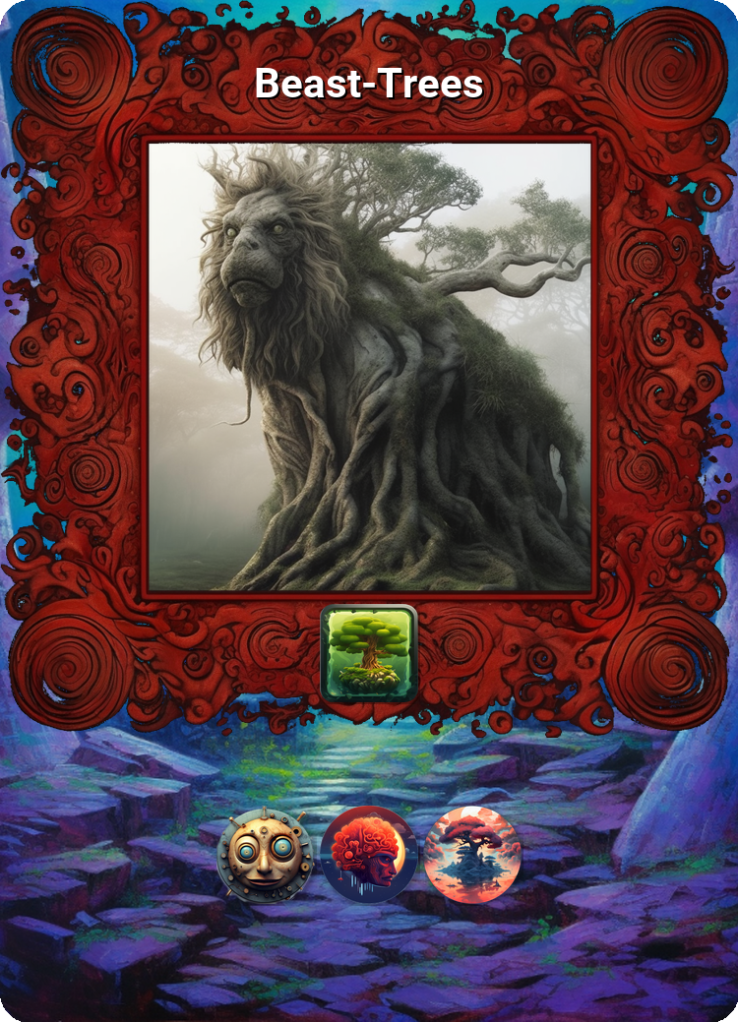
This is an Encounter card, which represent the weird shit that the team of explorers come across as they explore alternate Earths. The name of the card and the image are self-evident. The tree icon indicates that this encounter can only happen in a biome with an icon that matches that type. The row of icons below are the Struggle icons. In the game, the players should match those icons with their player cards to consider the encounter beaten. Those struggle icons depicted are Emotional, Cognitive and Environmental respectively.

Images courtesy of Midjourney, of course.

Here are some Biomes:

I know that the icon designs don’t match each other, but whatever.

I must thank again the most powerful large language model we have access to: GPT-4. It’s like having an extremely knowledgeable veteran programmer ready to help you at all times. For example, an hour ago I thought that the icons could use some subtle drop shadows. I had no clue how to even begin programming that, so I just asked GPT-4. After a short back and forth (in the first attempt it dropped shadows for the invisible part of the alpha channel), the icons now drop perfect shadows. How about that?

I have already started working on the Rust version of the game, using the Bevy crate, which seems to be the most advanced game development engine in that language. I have displayed a few encounter cards that move smoothly to the center of the screen for no particular reason other than that I wanted to figure out how to move stuff smoothly on screen.

Next up, I’ll focus on developing the necessary cards and Rust systems to make the following happen:

  • Design and generate an Exploration Zone card, which are the cards that determine which types of Biomes and Encounters can show up during an exploration (only those with matching icons can).
  • Display the Exploration Zone card in Rust.
  • Write the code to build the Biomes deck with only matching Biomes.
  • Display the Biomes deck on screen in Rust.
  • Write the code to build the Encounters deck with only matching Encounters.
  • Display the Encounters deck on screen in Rust.

Interdimensional Prophets – Deckbuilder (Game Dev) #1


A couple of weeks ago I kept myself busy programming an exploration game based on an old free verse poem of mine. I had developed the core of the game, the encounter system, when it became obvious that for the game to feel remotely compelling (even for myself), I’d have to manually develop dozens or hundreds of encounters. The game as it was conceived couldn’t continue past that point, so I thought about what I liked the most about that concept:

  • A team of players cooperating to solve some issue.
  • Each player having special abilities.
  • Gaining resources, abilities, etc, for one of the players at a time.
  • Exploring strange places.
  • Encountering weird shit.
  • Events that could alter how some encounters play out.
  • Gaining injuries, diseases, etc.
  • Gaining mental afflictions.
  • Being able to regroup at the hub and determine the resources that would be used for the next exploration.

Damn it if that isn’t a deckbuilding game. Not surprising, given that one of my favorite games ever is Arkham Horror LCG, a card game in which a team of at the most four players, each with his or her deck, uses the resources and abilities contained in that deck to solve perilous situations and beat weird monsters. It also features a location system that forces the team to move around, although that’s probably my least favorite part of the game.

So I thought, why can’t I program a deckbuilding game?

First of all, I need a fast system to produce cards. I had looked up programs to create cards in the past, and I was extremely disappointed due to how obscure their usages were. So I would need to develop one such program myself, tailored to the needs of my game.

So that’s what I’ve begun to do thanks to the insane Python skillz of ChatGPT. Behold the repository with the current version of my card generator:

Link to the GitHub repository for the card generator program

The first notion I had of such a program is that it should be able to take a background image, a card image, a frame image, and the necessary text, and generate a standard-sized card immediately. And so it does:

Yes, the cards even have rounded corners. Isn’t that fucking cool?

I have become emboldened by the fact that I could get this far in a few hours. So to come up with ideas I have relied on the current king of mini-AGIs (artificial general intelligences), that for me is godmode.space (requires a plus subscription to OpenAI and an API key; I had to wait for mine). Such AGIs are able to make plans, determine what tasks to perform, and criticize their own performance, in the pursuit of fulfilling some goals you’ve told it to focus on. As I’m writing this, GPT-4 is running in the background, coming up with game ideas and mechanics for the notions I fed it. For example, these are some of the texts that GPT-4 has written:

  • An Afflictions deck will be created, which will add an element of chance and difficulty to the game. The deck will consist of afflictions such as injuries, diseases, and mental statuses that will be detrimental to the player when drawn. The severity of each affliction will be determined, and a variety of afflictions will be included to ensure that the deck does not become predictable.
  • Illusion: A card type that represents deceptive, disorienting elements a player might encounter on specific biomes. These cards could have effects that remove enemy cards from the encounter deck or switch the order of Biome cards in the Biome deck.
  • A card drafting system will be developed to allow players to choose which cards to add to their deck when trading resources. The system will allow players to have more agency and control over their deck, and add another layer of strategic thinking to the gameplay. The rules for the drafting system will be determined, such as how many cards are presented to the player, and how many of those cards can be added to their deck. The card drafting system will be tested to ensure that it provides an engaging level of strategy without compromising the overall gameplay.
  • Encounter cards will be matched with one or more features of the Exploration Zone card in play. This will reflect the biome, geography, or climate the team is exploring, making the game more interesting and exciting for players. Additionally, we will develop a mechanism for how Encounter cards are ‘beaten’ through spent Player cards that feature certain icons. This will give players more agency in the game and create more engaging gameplay.

Born too late to explore the Earth, born too early to explore space, born just in time for the AI revolution.

Repository for word-information-generator

Yesterday I made a blog post about developing a program in Python that provided plenty of useful information given any word passed as a command-line argument. Well, the program seems feature complete now, so I have created a GitHub repository for it (to be honest, I should have created one from the beginning, as I had to backtrack some severe changes). Anybody who knows how to run Python programs should be able to use it. Otherwise, the instructions given on the repository might be enough.

Link to the GitHub repository for word-information-generator

I have been running the program already while writing my current novel. Along the way, if I realize that I want the program to offer me further information, I’ll likely add that in, so there may be further updates in the future.

Information about words thanks to ChatGPT

Yesterday, the shady company behind ChatGPT sent me an API key so I could do extra stuff with their GPT-4 AI model. I was mainly interested in using it for Auto-GPT.

Don’t you know what’s Auto-GPT? Some clever people figured out that if you give ChatGPT access to the internet and various other tools (such as your operating system’s commands), and trap it in a loop of reasoning, planning and criticizing itself, you can drop into that loop some task, such as growing your business or gathering particular information from the web, and ChatGPT will work itself to the bone for you. They called this implementation Auto-GPT, and it’s the closest thing we got, that I’m aware of, to AGI (artificial general intelligence), which is the holy grail of AI, and possibly the thing that will kill us all.

Anyway, here’s a video that shows you what this Auto-GPT can do (the video includes plenty of cool new stuff about AI):

I was aware that Auto-GPT can write, test and run Python code for you (apparently just Python; although I dislike the language, it seems to be the favorite of scripters who want stuff done quick, so you must be familiar with it). I started thinking about what I could tell Auto-GPT to do that would help me for real, and I came down to the fact that I look up words very, very often while writing, mostly to check particular definitions or to get synonyms. I search the definitions of words so often, in fact, that Google has at times demanded that I proved that I was human. So what if ChatGPT could write me a Python program that would provide all the information I need from a word, with a single command from Powershell?

The instructions were clear enough. Auto-GPT did write code that gave me synonyms, antonyms and some other shit for any word I would input, but when I ordered it to change the code so that the word got passed as an argument, Auto-GPT got mired in trying to figure out how to pass command-line arguments from within the Docker container with some dedicated functions.

When I gave it a break so it could write tests for the function in another file, it had trouble correcting the original code so that the tests would pass, but I think that was mostly my fault, as ChatGPT would need to have previous knowledge of, for example, what synonyms a word would have, and in that case, what’s the point of writing a test?

Anyway, I got bored with Auto-GPT itself, but not with the notion that ChatGPT could write that Python program, so that’s what I forced it to do in a couple of hours. Behold the results of passing the word “horse” as an argument:

Information about horse

Meaning of horse

  • solid-hoofed herbivorous quadruped domesticated since prehistoric times
  • a padded gymnastic apparatus on legs
  • troops trained to fight on horseback
  • a framework for holding wood that is being sawed
  • a chessman shaped to resemble the head of a horse; can move two squares horizontally and one vertically (or vice
    versa)
  • provide with a horse or horses

Part of speech for horse

  • verb (transitive)
  • noun

Etymology of horse

  • “solidungulate perissodactyl mammal of the family Equidæ and genus Equus” [Century Dictionary], Old
    Englishhors”horse,” from Proto-Germanicharss-(source also of Old Norsehross, Old Frisian, Old Saxonhors, Middle Dutchors, Dutchros, Old High Germanhros, GermanRoß”horse”), of unknown origin. By some, connected to PIE rootkers-“to run,” source of Latincurrere”to run.” Boutkan prefers the theory that it is a loan-word from an Iranian language
    (Sarmatian) also borrowed into Uralic (compare Finnishvarsa”foal”),The usual Indo-European word is represented by Old
    Englisheoh, Greekhippos, Latinequus, from PIE rootekwo-. Another Germanic “horse” word is Old Englishvicg, from Proto- Germanicwegja-(source also of Old Frisianwegk-, Old Saxonwigg, Old Norsevigg), which is of uncertain origin. In many
    other languages, as in English, this root has been lost in favor of synonyms, probably via superstitious taboo on
    uttering the name of an animal so important in Indo-European religion. For the Romanic words (Frenchcheval,
    Spanishcaballo) seecavalier(n.); for Dutchpaard, GermanPferd, seepalfrey; for Swedishhäst, Danishhestseehenchman. As
    plural Old English had collective singularhorseas well ashorses, in Middle English also sometimeshorsen, buthorseshas
    been the usual plural since 17c.Used at least since late 14c. of various devices or appliances which suggest a horse (as
    insawhorse), typically in reference to being “that upon which something is mounted.” For sense of “large, coarse,”
    seehorseradish. Slang use for “heroin” is attested by 1950. Toride a horse that was foaled of an acorn(1670s) was
    through early 19c. a way to say “be hanged from the gallows.”Horse latitudesfirst attested 1777, the name of unknown
    origin, despite much speculation.Horse-pistol, “large one-handed pistol used by horseback riders,” is by 1704. Adead
    horseas a figure for something that has ceased to be useful is from 1630s; toflog a dead horse”attempt to revive
    interest in a worn-out topic” is from 1864.HORSEGODMOTHER, a large masculine wench; one whom it is difficult to rank
    among the purest and gentlest portion of the community. [John Trotter Brockett, “A Glossary of North Country Words,”
    1829]The term itself is attested from 1560s.The horse’s mouthas a source of reliable information is from 1921, perhaps
    originally of racetrack tips, from the fact that a horse’s age can be determined accurately by looking at its teeth.
    Toswap horses while crossing the river(a bad idea) is from the American Civil War and appears to have been originally
    one of Abe Lincoln’s stories.Horse-and-buggymeaning “old-fashioned” is recorded from 1926 slang, originally in reference
    to a “young lady out of date, with long hair.” Tohold (one’s) horses”restrain one’s enthusiasm, be patient” is from
    1842, American English; the notion is of keeping a tight grip on the reins.

Synonyms of horse

  • horse_cavalry
  • Equus_caballus
  • sawbuck
  • buck
  • sawhorse
  • cavalry
  • horse
  • knight
  • gymnastic_horse

Related phrases and expressions with horse

  • to the horse in English
  • your high horse and don
  • is a horse dick !
  • : The horse ?
  • , that horse is peeing
  • a Spanish horse .
  • on a horse ?
  • [ a horse and carriage
  • [ the horse and carriage
  • get a horse too .
  • take a horse !
  • taking the horse and I
  • smells like horse shit .
  • I mean horse .
  • got that horse and his
  • — Horse carriages ,
  • only a horse could love
  • is a horse !
  • and the horse didn ‘
  • take this horse and I
  • your new horse , honey
  • light that horse on fire
  • get a horse thief financing
  • the smelly horse carriages on
  • with this horse .

Semantic field(s) of horse

  • chessman
  • provide
  • gymnastic_apparatus
  • framework
  • equine
  • military_personnel

Hyponyms of horse

  • pommel_horse
  • eohippus
  • pony
  • stalking-horse
  • pinto
  • sorrel
  • steeplechaser
  • liver_chestnut
  • mesohippus
  • roan
  • remount
  • hack
  • wild_horse
  • workhorse
  • palomino
  • pony
  • gee-gee
  • pacer
  • stablemate
  • male_horse
  • bay
  • racehorse
  • harness_horse
  • protohippus
  • chestnut
  • trestle
  • vaulting_horse
  • hack
  • mare
  • saddle_horse
  • stepper
  • post_horse
  • polo_pony

Hypernyms of horse

  • military_personnel
  • gymnastic_apparatus
  • chessman
  • equine
  • framework
  • provide

Meronyms of horse

  • horseback
  • cavalryman
  • encolure
  • foal
  • gaskin
  • horse’s_foot
  • poll
  • horsemeat
  • withers

Domain-specific words related to horse

  • armed_forces
  • military_machine
  • chess
  • war_machine
  • chess_game
  • armed_services
  • military

Associated nouns with horse

  • horse

Associated verbs with horse

  • horse

Stylistic variations of horse

  • bathorse
  • horsepox
  • horseflesh
  • dishorse
  • horselike
  • horselaughter
  • ahorseback
  • horsewhipper
  • sawhorse
  • demihorse
  • horsekeeper
  • Horsetown
  • horsefettler
  • horseshoe
  • horsehead
  • ahorse
  • horseman
  • horsetree
  • underhorsed
  • woodhorse
  • horsehide
  • drawhorse
  • horsewomanship
  • overhorse
  • horsetongue
  • horsemint
  • horseleech
  • horsecloth
  • clotheshorse
  • horseboy
  • horseherd
  • horseload
  • horseplay
  • horsepower
  • horsedom
  • horsefish
  • horsetail
  • horsepond
  • horsefair
  • horsehood
  • rearhorse
  • horselaugh
  • horsemastership
  • horsefly
  • cockhorse
  • waterhorse
  • horsehair
  • horseway
  • horsebreaker
  • horsemonger
  • horsewoman
  • unhorse
  • horsegate
  • horsehoof
  • horseweed
  • horser
  • horseshoer
  • horsefight
  • horsewood
  • horselaugher
  • horsemanship
  • studhorse
  • horsecraft
  • horsefoot
  • horsejockey
  • horseback
  • horseplayful
  • horsewhip
  • underhorse
  • horsehaired
  • horsebacker
  • hobbyhorse
  • horsecar
  • horseless

A couple of weird points about this implementation, although they don’t bother me:

  • I gather the etymology from a website, but some words end up stuck together for whatever reason. Also, no paragraphs. Not sure if it can be fixed, because the html tags don’t come through the request.
  • The section “Related phrases and expressions” only looks for a few words around the passed word, from a dataset that ChatGPT recommended. The results are often strange.

Because I’m obsessive (and compulsive), I kept bothering ChatGPT by telling it to come up with more useful information that the program could provide about any given word. I didn’t know what a hyponym was.

Anyway, this little program ended up being a great tool for writing, which is what I should have done with my afternoon instead of getting involved with ChatGPT. Its auto version has huge potential; I probably need to come up with better use cases.