
I’ve bitten the bullet and decided to create my first new Odes song from the fourth album on Suno 6.0. I’ve genuinely explored alternative services and models, but none are up to par even with the original Udio, so I’m all out of luck when it comes to keeping my previous workflow. But I’ve made it work with Suno 6.0, I think. I’m quite happy with how “Hermit Hemisphere” came out.
Category: Inteligencia artificial
Covers of “The Burning Heart Inside Your Throat” from Odes to My Triceratops, Vol. 1
I’m remaking my old Udio-era songs with the new Suno 6.0, which is terrible for making songs from zero, but amazing at remixing them.
This song, the first album’s closer, is one of my favorites from William’s middle-school era, but the quality of the audio was so bad that it hurt to listen. Now that we’ve gotten the boys in the studio again, the song can finally be listened to in all its magnificence.
Covers of “Lorenzo” from Odes to My Triceratops, Vol. 1
Suno is terrible at allowing you to create music in an exploratory, coherent manner, but it’s exceptional at covering songs made in the glory days of Udio.
The combination of this song’s retarded lyrics and its hard-rock earnestness will never cease to be funny to me.
I’m Cactus from Odes to My Triceratops, Vol. 1 (Redux)
Suno will legitimately be useless to create most of the new songs of the fourth album, but I can still spend my subscription redoing songs from the previous albums whose sound quality had suffered. Here’s one of my favorites from the first album: “I’m Cactus,” the tale of young William’s inability to take care properly of his single plant.
I’ve already redone other songs, so soon enough I’ll upload new YouTube videos with the redone versions.
Trying out Suno’s capabilities
In a few days I’ll have finished the entire set of song lyrics that the story Odes to My Triceratops will contain, which means I’ll have plenty of new lyrics to turn into full songs. The online service Suno seems like the best choice these days, although it’s currently in a weird state, as they intend to roll out a fancy new model that will replace all previous ones, but we don’t know when that will come out (other than “in 2026”). We don’t know if the new model will truly beat the previous ones, or if it will be crippled by the music industry’s interference like what happened to Udio.
In any case, I’ve been trying out genres, instruments, and such with some of my old lyrics. The following songs were produced on one of the current free Suno models, not even the most capable one. Suno used to be considered inferior to Udio because its songs sounded more artificial; I suspect that’s no longer the case even in the poorest model now available.
Suno also added a studio capability: you can generate voices, instrument parts, etc. in their own stems. Producing the new songs is going to be a blast.
Released Odes to My Triceratops, Vol. 1 on YouTube
This concludes the release of all the finished albums I have for the story. If back in the day you enjoyed any of these songs, produced during the very early days of Udio in which the song quality wasn’t good enough, you should probably listen to the songs or the whole album again, as I had Claude Code work its magic through the frequencies.
YouTube video’s description:
This is the first of three completed concept albums about a trio of friends living in a nowhere town: William Griffin, a sensitive and increasingly unhinged songwriter; Claire, his blind and illiterate next-door neighbor and perpetual mystery; and Lorenzo, their friend, who is inexplicably a sentient triceratops.
I made roughly eighty songs about them during Udio’s brief, lawless glory days, when a generation could sound like an actual band playing in a room, and you could still use swear words. The project ran through three albums and into the beginnings of a fourth before I ran out of steam, around the same time that changes to Udio’s model made the music feel notoriously worse.
Returning to these songs now is strange. Some of them still make the hair rise on my arms. William, Claire, and Lorenzo feel like forces within me that split apart, took on lives of their own, and built a mythology that contained that strange period of my life.
The earliest seeds of the lyrics date back to 2021. I can play guitar, but I was never going to become all the bands these songs required. The music changes radically from one track to the next, because each song takes whatever form its emotion demands. The characters and their shared emotional history are what hold the albums together.
This first album is the roughest of the three. I had just started producing songs with Udio. I was trying my way through writing song lyrics for the first time, with the additional constraint that I intended to sound like a somewhat-unhinged middle schooler whose best friend was a triceratops and who tended to filter reality in surreal ways through his dinosaur-addled brain. The resulting lyrics are sillier than usual, while retaining the earnestness and honesty that I intended for the whole story. But sometimes the lyrics get too dumb in retrospect even for me, which makes some of these songs a bit hard to listen to.
That said, there are real winners here, at least to me. Claude Code did everything it could to bolster the audio quality of this early-era Udio audio productions, and it has worked beyond my expectations. Thankfully you won’t have to listen to some of the songs in their previous states; some sounded as if they were played through a blanket.
I don’t know how the notion for this series came to be back in 2021, during one of the wildest creative periods of my life. Suddenly I knew I had William (an unhinged kid who expressed himself through music), Claire (his illiterate, blind, next-door neighbor who remains mostly opaque to him), and Lorenzo, a goddamn triceratops. I didn’t need to reason their existence or why writing about them was so important to me. I just felt it, so I soldiered on.
Now that I’m older and I have come to understand myself better, I do know why I needed to produce these songs, and why listening to them feels like coming home no matter how much I’ve tried to distance myself from this project. This story is my dead youth. An unhinged artist with a raw heart, who loved too much in the wrong ways. A blind, illiterate mystery whom the artist was devoted to and couldn’t afford to lose. An ancient, violent source of chaos who never left William’s side. That’s myself split in three. And I also know why Lorenzo had to die, and why Claire had to disappear, even if I’m the only one who understands.
I want to return to this story and finish it properly. I don’t know if I will. These days I promise too many things to myself. But I want one day in my late forties to return to these songs and new ones and feel the same emotions that these three albums recreate. So at least to me, Odes to My Triceratops didn’t deserve to be forgotten, and with the YouTube releases out, they will outlast me.

Released Odes to My Triceratops, Vol. 3 on YouTube
Over the years since I produced these songs, I’ve gotten from time to time notices that people downloaded the first and second album, but I never go around to presenting the third album as a cohesive whole. Now it’s up on YouTube. I doubt that anyone happening to read these words actually cares, but in case you’ve enjoyed any of these songs in the past, the whole album warrants a listen.
YouTube video’s description:
This is the third of three completed concept albums about a trio of friends living in a nowhere town: William Griffin, a sensitive and increasingly unhinged songwriter; Claire, his blind and illiterate next-door neighbor and perpetual mystery; and Lorenzo, their friend, who is inexplicably a sentient triceratops.
I made roughly eighty songs about them during Udio’s brief, lawless glory days, when a generation could sound like an actual band playing in a room, and you could still use swear words. The project ran through three albums and into the beginnings of a fourth before I ran out of steam, around the same time that changes to Udio’s model made the music feel notoriously worse.
Returning to these songs now is strange. Some of them still make the hair rise on my arms. William, Claire, and Lorenzo feel like forces within me that split apart, took on lives of their own, and built a mythology that contained that strange period of my life.
The earliest seeds of the lyrics date back to 2021. I can play guitar, but I was never going to become all the bands these songs required. The music changes radically from one track to the next, because each song takes whatever form its emotion demands. The characters and their shared emotional history are what hold the albums together.
This third album is more cohesive than the second one, and is bolstered by the improved audio quality from Udio’s model generation at the time. But this album lacks the more varied, distinct narrative arc of the previous one. Some of the songs on this album are real bangers, though, and Behind the Door may be my favorite of the series emotion-wise.
William’s story doesn’t end here. I just haven’t gotten around to producing the entirety of the fourth album. Maybe it’s time to pick it up again.
Life update (06/07/2026)
These past six months or so, I’ve been working on three different projects, or more accurately, on three distinct ideas for projects:
- A structured way of creating stories that doesn’t rely on an act structure, by which I mean that the whole stories are based on the causality of tracking entities, entity statuses, cast members, facts, beliefs, secrets, locations, objects, visible affordances, events, intentions, plans, clocks, obligations, consequences, open threads, relationships, and emotions. As part of this project idea, I also wanted to structure worldbuilding and propagation of canon facts.
- A platform to encode any card/board game relying on a game-agnostic engine, which would help prototype card/board games.
- A maximally-emergent, causality-first simulation that would be able to produce the kind of adventures you get through Dwarf Fortress, Rimworld, Skyrim, etc., without relying on any scripting or game director.
The story-related projects, which ended up being two repositories in Node/Typescript, were the easiest, although they were complicated projects in their own right. But the other two projects deserve their own paragraphs.
That platform to encode any card/board game started as an extremely-ambitious notion: any user would be able to encode every aspect of any game in YAML files. YAML that basically works as programming is a terrible idea, which I realized deeper into the project. I started programming it in Node/Typescript, which was also a terrible idea: it’s far too slow of a combination when it involves AST parsing of the YAML; I had to spend lots of time bytecoding or Rust WASM-fying parts of the Typescript engine to get decent performance, which was never good enough for me, and a lot of possible wins were denied by marshalling issues. But by far, my biggest mistake was proving the project’s ability to accomodate multiple card/board games by implementing two games: Texas Hold ‘Em and Fire in the Lake COIN. Texas Hold ‘Em was mostly fine despite the YAML base: it took like three days.
Merely thinking of Fire in the Lake makes my skin crawl now. Fire in the Lake is an extraordinarily complex board game representing the Vietnam War. Not exactly a traditional wargame, although it’s hard to explain. The point is that back in 2020, before large language models, I attempted to program it in Rust to learn the language. Huge mistake. Having to abandon that project a third of the way in let a splinter stuck in me from which I never fully recovered. So months ago, I decided I would rely on large language models to take the splinter out and properly implement Fire in the Lake. Huge fucking mistake.
The Fire in the Lake map is extremely complex. The adjacencies between provinces and cities are confusing, which involves country borders as well, but much worse, it also features LoCs like roads and the Mekong river. Merely representing it visually without just pasting the map on screen was a fucking nightmare. As if the map graph wasn’t enough of a mess, what the factions can do is much worse: operations and optional special activities, each of which can be as complex as entire regular games. I’m talking sweeping, assaulting, subverting, governing, air striking. Then you have the event deck, which causes stuff to happen on the map and on the markers and tracks, which is easy enough to depict, but the game designers also went out of their way, for which I commend them except for the fact that I tried to program this cursed game, to make almost every card of the 130 its own little exception. Some cards offered grants for actions which may or may not be optional, some of which were taken by different factions other than the one currently playing. Again, makes my skin crawl. I had whole GitHub workflows dedicated to ensuring that the granting system didn’t shit itself.
After I managed to encode the entire game rules and content, which I did manage to do (a fleeting win), I got myself into the issue of encoding competent AI bots. I didn’t want to just copy the flowcharts, given that a computer would run the bots, so I had ChatGPT-Pro deep research what would make a competent human player for each of the factions. My intention was to encode that. I got really deep into AI architecture to figure out what kinds of bots would work well for my requirements, and I finally reached a point in which it seemed like I just had to push through, and keep iteratively improving the bot encoding, to finally get them running. But a few days ago, I found myself not even reading the tickets, not even checking out what was being committed. My subconscious had already understood that this project was a bust. It was crippled from the beginning, and I had done little else than push against entropy. I would never be happy enough with how Fire in the Lake would be shown on the web app, I would never feel comfortable enough with how it was implemented, and worse yet, the engine had taken in too much of Fire in the Lake’s specific shape that disentangling it to implement other games would make me have to fix Fire in the Lake at every step. So I gave up.
The third project was the maximally-emergent, causality-first simulation. From the beginning I had a very clear idea of what I wanted; basically by ideal game which nobody has built yet to my knowledge:
- A simulation able to simulate dozens or hundreds (or thousands) of agents in an area the size of Skyrim, with settlements, roads, points of interest, etc.
- The simulation should be maximally emergent and causality first. By which I mean that there would be no scripting and no game director. The simulation should be able to produce complex chains like this: a big monster gets displaced from a wilderness area due to the activity of some bandits -> the monster ends up hunting around some nearby road -> the monster attacks a caravan -> the caravan survivors reach a town and speak with the authorities about the attack -> the authorities decide to set up a bounty for the monster -> someone creates the bounty and posts it at some board -> some passing adventurers see the bounty and decide to take it -> they gear up and gather supplies for the hunt -> they travel to the area where the monster is supposed to be -> they track it to their den -> they find out some other adventurers casually killed the creature already. This all should happen due to causal chains, no scripting at all.
- You as the player are indistinct to every other AI agent in the simulation. The simulation isn’t even aware that a human player exists. That means that the world continues regardless of what you do, but you can disrupt it.
- Every agent, including the human player if any, acts on their beliefs, which may be truthful, stale, or based on straight lies. People gain beliefs by talking to each other, reading notices, observing the world. This allows chains like someone going home to take money, only to discover that the money is missing because someone has stolen it.
- I should be able to chat through LLMs with any agent in the game, and the LLM would feed into the game which beliefs were actually shared or seeded, which would have gameplay effects.
That’s the main core. Such a simulation would allow any flavor and any kind of gameplay you could imagine. You would just have to build it incrementally. But I underestimated the complexity of such a project, which should be built upon an extremely-robust set of foundational documents of various categories. Mistakes I make during its implementation:
- The foundational docs, while more comprehensive than those of any other repo, just weren’t comprehensive enough. They would have required several iterations of deep research with ChatGPT-Pro.
- I approached it almost as a research project instead of something that would allow me to play it at every stage, even on the terminal.
- I went breadth first: I wanted a significant set of gameplay mechanics in order to prove the emergent nature of the simulation, and found myself programming takeovers of institutions before I had properly proved that people could eat and shit regularly without dying.
- By the time I figured out that even though I had banditry in, AI agents in simulations weren’t able to sustain their basic needs, the project was basically crippled; I just hadn’t accepted it yet. I should have built up step by step, being able to play it to the fullest along the way, and only add features that I missed while playing.
- The AI architecture, while extremely competent in some regards, was crippled as well: I relied too much on GOAP because HTN felt like scripting at first. Then I realized that you could use HTN in a fully emergent way that respected the foundational principles, and relying on GOAP only for the leaf goals.
With this third project, I found myself also disheartened, and feeling that I was fixing mistakes in a crippled project, when likely I would need to build it from the ground up.
So, two days ago I decided to start from zero (a Re:Zero, you could say) both those complex projects: the card/board game one, and the emergent simulation one. It’s amazing how quickly projects progress once you’ve taken the lessons to heart and you’re on the right track. For the card/board game, I’m building it up following a ladder of game complexity. I already have Race to N, Tic-tac-toe, Connect Four, and Othello in. I’ve checked legality issues online, and found out that even if you don’t take money for it, publishing a page that simulates a game with an IP behind it is actually illegal (oops), so I couldn’t have uploaded the project with Fire in the Lake in regardless. While I intend to program in the kinds of games I’m most interested in playing (basically those on my gaming shelves), I won’t be able to upload them to the public repository.
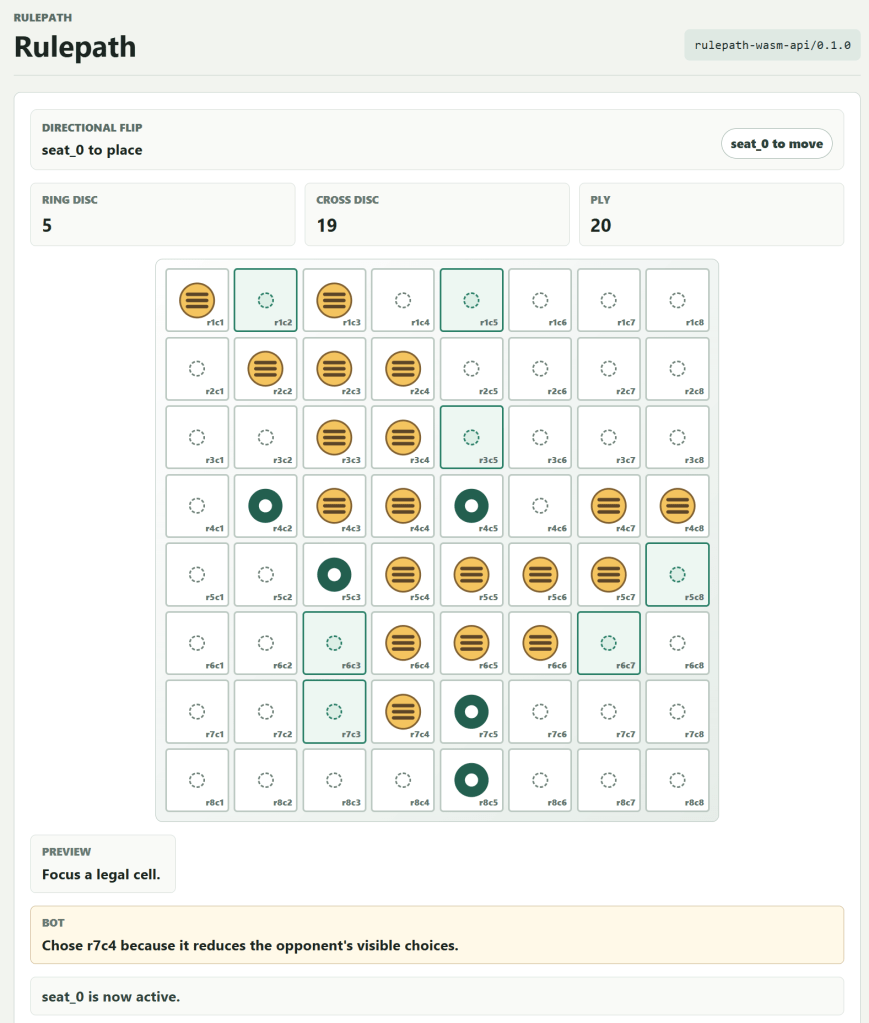
Playing Othello and losing terribly
Regarding the simulation, that third project, it’s shaping up far better. I can play the current state of the simulation at any point through a terminal user interface, which at the moment is mostly rudimentary. The foundational documents are sets of dozens, and extremely comprehensive. I will no longer push for breadth, nor implement mechanics that I don’t miss through playing the simulation.
The important thing is that I’m feeling energized again to work on these projects. I woke up at six in the morning today eager to get back to it. And that’s the best state of being for a wrecked creature such as myself.
Namahan of the Third Gate (Fiction)
Namahan of the Third Gate (as recorded and edited by Alenne Kaerwick of the canal-heartland)
The well is fourteen paces. My great-grandfather lined it. His name is in the keeping-book; his hands were under the rope before his name was at the head of the page. Four generations turn at the rope, now. The stone is the same stone, weathered now where it was sharp then. The well-lid was new twelve winters back. Otherwise the place is what it was: a stone-and-reed gate-stop, a covered pavilion for the hospitality-fire, a small cellar provisioned twice a season from the village four hours’ walk, the fire-pit where I bank the coal at last light, and the alcoves where my daughter and I sleep. The flat roof is for summer sleeping. That is all. The gate is here because the well is here. The keeper is here because the gate is here.
I begin before dawn. Barley porridge before light, while the air is still cool, then the depth-plumb at the well—a check the keeper does whether or not the season-turn calls for it. Then the courtyard sweep. Then the gate-attention until noon. The midday hour I take in the shade now; ten years ago I worked through it, but the body asks for the shade now and I have learned to give it. After the shade, the gate again until last light. The date-wine cup at dusk, the keeping-book balanced for the day, and bed. In drought-year the day is the same shape but tighter. Everything tighter. The water-share counted twice in the keeping-book and once aloud to whoever the keeper is teaching.
The work is the well and the work is the gate. The well is rope and bucket and the depth-plumb at season-turn and the daily taste—the keeper checks the water by the taste and the scent and the shape of the foam at the lift, and a keeper who cannot does not keep. The gate is the turn—what they call the gate-turn down here. Two lines. The traveler gives one; the keeper gives one back. The lines are not the same lines for everyone—there are clusters and tongues, and the keeper accommodates—but the count is the same. Two lines, and the traveler has asked for water in our register. Two lines back, and the water is offered in our register. After that, the cup. After the cup, the conversation, if there is to be one. The gate-turn is what holds the corridor. We do not always agree on which clan was first to a well, or which keeper drove a hard supply-bargain at the heartland border, but we hold to the turn. A traveler who does not give the line is not denied—that is the slower-hosting, and the keeper covers, and the caravan-master vouches if there is a caravan-master. But the keeper notices. After many years the keeper notices in the first stride; the line tells you only what the stride had told you already.
I have hosted travelers of every cluster the corridor sees. Mostly mammalian-folk and human, those are the most. Reptile-folk pass through on the eastern caravan-rotations; ancestral-mammoth-folk come once or twice a season on the western ones; mythic-clusters come rarely—twice in my keeping, both Cluster D, both under host-side waiver because their cluster did not have the gate-turn the way the corridor has it. The keeper accommodates. Movement-constrained, phonetic-constrained, scent-strong, scent-shy—the per-cluster registers are part of what the apprenticeship teaches. The keeper does not flinch and the keeper does not perform welcome past what the keeper feels; the working-texture register is what holds. A traveler who has walked the corridor a hundred times and a traveler who has never seen a well-stop both get the cup. The cup is the cup. After the cup is where the difference is.
Travelers from north of the heartland border ask me the same things, mostly. They ask about the heat. They ask about the water-share. They ask if it is true the magistrate is four days away. (It is true. Four days hard, six days kind.) They ask about the gate-turn—they say ritual; we say the turn. They ask about the verse. The verse is harder to answer because they want it to be one thing. It is not one thing. It is what the keeper says when the traveler comes to the well, and what the traveler says back, and what the traveler says when the traveler leaves. It is the count that the verse-counter holds—that is the bone-piece my mother’s mother carved, and it sits at the pavilion edge under the oilcloth-cover. The counter holds the count of hospitality-verses performed and owed across the season. It is a tally, not a score. The counter turns at the keeping-book-transfer, and the new keeper takes it.
The verse is not a ballad. We have ballads in the corridor—the bards bring them—but the verse is not a ballad. It is short, paired, turn-and-reply. The keeper learns it by listening. My mother’s mother had me at the well from twelve onward, and the verse was the work I learned alongside the rope. I do not know how to say it that does not sound smaller than it is to anyone who has not heard it. The verse is the work. The keeper is the verse. When the traveler approaches and the line comes, the keeper answers, and the answer is not a flourish but a count. The count is what holds the corridor.
I have been asked, more than once by heartlanders who came to the well, whether the verse is for show. I do not understand the question. The verse is for the cup. The cup is for the traveler. The traveler is for the corridor. The corridor is what the well-stops and the gate-stops and the villages and the caravanserais are, strung together by the wells. There is no show. There is the count, and the rope, and the cup. If a heartlander needs a story for it, the heartlander is welcome to one—but the keeper is keeping the count.
I will tell you anecdotes. The years are too many anecdotes for a book; I will tell you the ones that come. There was a winter—eighteen winters back, I think—when the caravan-master’s runner came up at the false-dawn and said waiting-wolves at the second gate. That is the bandit-corridor warning, waiting-wolves, the corridor-language for the bandits who lay up between gate-stops in the long-rotation gap. The second gate is the next gate north of mine. The runner had come overnight at his good-leg pace; he had not stopped at the village. The drill is: hold the gate-turn short, send the village runner south, wait for the caravan-master-led column. We did. The column came in two days; the bandits did not press the second gate after they saw the column form; the corridor handled it. No magistrate. No docket. Two of the column’s outriders had wounds; one was at the next-caravanserai barber-surgeon by the third day. That is the corridor handling itself. It is not a story; it is what the corridor does. The times I have done it I can count, and none of them ended at a magistrate’s docket. None of them ended in a song.
There was the time a caravan-team came up the corridor with a ranking-member who could not hold the joke-threshold. You may not know what that means. In the corridor—and in the heartland too, I am told, but in the heartland it is the tavern-keeper who polices it—a mixed-species crew rides on the dry-jokes between species. Mix-sound is the foreman-judgment for whether the crew can ride them. The good-joke is teasing; the bad-joke is the one that breaks the crew. There is a threshold and most foremen know where it is. This caravan-team’s ranking-member did not know, and crossed the threshold at my pavilion in front of me and his crew and the village runner who happened to be at the well that day. I closed the cup-ledger, set the rope back, and walked off the hosting. The caravan-master came from the column-rear when the runner went and got him. The team left within the hour. The corridor knew within two seasons. I was paid only the half-share for the partial hosting; I would have refused all of it, except the corridor does not work that way. I took the half-share. I kept the keeping-book honest. The keeping-book is the thing.
There was a winter the corridor had a circuit-bard come down on rotation. (The corridor sees a circuit-bard maybe twice a year; the bards stay north mostly. The corridor is too dry for them, they say; I think the corridor is too slow for them.) This circuit-bard played at the pavilion two nights in a row on his way south. The second night he sang a piece that was drylands-cadence—drylands cadence done in the heartland-tavern register. I knew the cadence. It was a piece a verse-adept from my own corridor-segment had been working on years before. The bard did not know whose cadence it was. He had heard it from another bard who had heard it from another. The cadence travels north on the bard-circuit; the protocol does not travel back. That is the pattern the keepers see. We do not have a way to send the protocol north. The cadence keeps going. I have not figured what to do about that and I will not tell you I have. I only tell you that I have heard my own corridor’s cadence return to my own pavilion through a man who did not know it was ours, and I poured him the cup, and he drank it, and he went south and then he went north, and the cadence went with him. We do not have a way.
There was a winter—twelve winters back—when a contractor came up the corridor whose face I had seen across the gate before. He had been an outrider on a caravan years before that, and he had come back through twice in the years between, and the third time he came he did not speak the way he had spoken before. The corridor calls it the silenced-contractor register. The contractor has seen something on a contract he will not say. The keeper does not ask. The keeper pours the cup and the keeper does not ask. I poured him the cup. He sat at the pavilion through the noon-rest. He did not speak. He paid the keeping-fee in copper and he went on. He did not come back. I do not know whether he is dead or whether he simply turned his rotation. The corridor swallows people that way. The keeping-book has his name and a tick-mark and the date. That is what the keeping-book is for.
Cluster D travelers I have hosted twice, as I said. Once a naga-folk traveler on her way to the heartland border. Her cluster does not have our gate-turn—she said so directly, the first thing—and we did the host-side waiver: a short-line prose-turn instead of the verse-turn, and the cup. She drank in the way her cluster drinks (her cluster takes water differently, you may know) and she rested and she went on. The second was a basilisk-folk traveler who came down from a longer crossing than naga-folk usually take. He was very tired and his eye-shielding was low—he had ridden long enough that he was past the careful etiquette his cluster usually keeps with mammalian-folk. We did the waiver, he kept his eyes on the floor of the pavilion, and we did not need to say anything more. Both nights I slept upstairs and the traveler slept in the alcove. Both nights nothing happened that needed to. That is the host-side waiver: the keeper carries the welcome that the cluster cannot translate. It is what the keeping is.
I have heard sectarian recruiters at this gate twice. The cadence they use is the supremacist doctrine—there is a recruitment cadence; you may not have heard it; if you have not, do not ask me to perform it for you. Both times I turned the cadence with a verse-turn. Both times the recruiter heard the turn for what it was—a polite refusal, in the keeper’s register—and went south within the hour. The corridor does not have many sectarian recruiters; it does not have many of much. The corridor has the wells and the gate-stops and the caravan-rotations, and it has not enough of any of the things that would let a sectarian doctrine root. The corridor is honest about this and I am honest about it. We are not a tolerant land in the heartland sense; we are a thinly-occupied land in which most people who would push a doctrine push it elsewhere first.
I had a husband. Yalen of the Third Gate. He came to the household when I took the station—that is how the keeping-line marries, the husband joins the keeping-house, not the other way—and he kept the well alongside me for twenty-three winters. He died of the ordinary drylands sun-sickness compounded by years. It was not artifact-related, it was not a contagion, it was just what catches up with a man who has worked the corridor at noon for forty years and could not always keep to the shade-discipline I keep. The cremation was at the village; the ashes were scattered at the threshold. He liked the verse-line the rope holds the bucket; the keeper holds the rope. I have not performed it at the high-feast since he died. He liked it. That is the only thing I will say about it, in your book, that I would not say at the well to a stranger.
I have a daughter. Tamer. She is twenty-eight; she has been at the well at chore-from-young from age six; she is the apprentice well-keeper now, in full training, and the keeping-book-transfer will come in some future I do not yet know how to count. She has her father’s hands at the rope and her mother’s mother’s ear at the gate. She is a good keeper. She will be a better one than I am because she will have all of what I have and the years she has had me to watch her hold it. She does not say much. She did not say much as a child either. She asks the questions the keeping needs and not many other questions. I have watched her hold a gate-turn with a slower-hosted migrant for an hour without breaking the cadence. She will do the corridor well after me. I do not say that because she is mine; I say it because the corridor will know within two seasons of the keeping-book-transfer and the corridor’s word is what I trust.
I had a son. Kiran. He was verse-adept early—earlier than I was, earlier than my mother’s mother said she had been. He could hear a paired-line in a caravan-passage and reply with a turn that I had never been able to find at his age. He did not want the well-keeping. The well-keeping does not let you go north and the verse, when it is in a young man, sometimes wants north. He went north when he was twenty-two. He went to the canal-heartland. He sent letters back at first by caravan-runner; the letters thinned and then they stopped. We had eight years of him going north and six of him being there before he died. He died there in a way the runners did not detail to me; what I have is that it was tavern-adjacent and not artifact and not a long sickness. I do not have his ashes. The ashes are in the heartland. That is what I have to tell you. I will not have more than that for your book.
I will say this much, because you have asked about the corridor and the cadence travels: my son’s cadence was a corridor cadence. The bards north of the border have absorbed corridor cadences now for some years. The cadence travels north on the bard-circuit and the protocol—the gate-turn protocol—does not travel back. I have heard, more than once, my son’s cadence come back to my own gate through a circuit-bard who did not know whose cadence it was. The pattern is not personal. It is what the bard-circuit does. I am telling it to you because you said you would write it down for the heartland to read, and the heartland should know that the cadence it puts in its taverns belongs to a corridor it does not visit. We do not have a way to send the protocol after the cadence. I do not know if we will. The bards do not come down to learn the protocol; they come down to fill the rotation when the heartland circuit is dry, and they take what they hear and they go. That is the pattern. I do not have a name to give you for any one bard. The bards do not deserve a name from me, individually; the pattern is what wants a name and the pattern is what I am giving you.
You asked what I would want outsiders to know when they visit the drylands. I will tell you what I tell the heartlanders who reach my well, in the order I tell them.
The first thing is the water. You do not drink before noon in summer. You shake the canteen first when you reach the well and you do not drink deep at the rope. The keeper sees who shakes and who drinks deep, and the keeper knows in the first water-action who has been on the corridor before and who has not. There is no shame in not having been; there is only the shape of the new walker, and the corridor accommodates new walkers by giving them the noon-rest before they ask for it. Take the noon-rest. The corridor takes it; we are not lazy; we are not slow; the noon-rest is what allows the work that gets done before and after. If you ride through the noon-rest you will pay for it before evening, and the keeper will pour you the cup without scolding because the scolding is in the cup itself.
The second thing is the gate-turn. When you reach a well-stop, you wait at the gate-approach until the keeper sees you. You do not push past the gate. The keeper is doing whatever the keeper is doing—the rope, the keeping-book, the courtyard sweep. The keeper will come. When the keeper comes, you give the line. If you do not have the line, that is the slower-hosting, and the keeper covers, and you watch and you learn. By the third well-stop you should have the line; the line is the same line everywhere, with cluster-accommodations the keeper will help you with. The line is two lines. I have come to the gate-turn; the road is long. The keeper’s reply is the gate is here; the cup is here. Then the cup. Then the conversation if there is to be one. The line is not optional; it is what tells the keeper that you respect the keeper’s keeping. The keeper does not need your respect; the corridor does. The line is to the corridor.
The third thing is coin. We are not—and I have heard this said in the heartland and it is wrong—we are not untainted by coin. There is a register heartlanders sometimes use for us in which we are noble peasants who refuse coin out of moral integrity. That is the fantasy register and it is not us. The corridor runs on in-kind reciprocity at the well-stops because the wells are not market-stalls; what runs through a well-stop is the keeping-book, hospitality-due against water-share, and the books balance across the season. At the supply-runs to the village and at the caravan-resupply at the heartland border, coin is on the table. Coin is on the table when coin is contracted, and the corridor honors the contract. If you offer coin at a well-stop where the in-kind register holds, the keeper will not refuse it but the keeper will note it in the keeping-book in the column for paid-not-balanced and that is its own register. We are not noble. We are a corridor, and the corridor runs the way it runs.
The fourth thing is the magistrate. There is no magistrate at the corridor. The magistrate is four days’ ride to the heartland-border court, and it is functionally absent for anything corridor-internal. If something happens at the well that needs a ruling, it gets ruled by the caravan-master if there is one passing through, and the ruling holds for the corridor—the multi-master reputation-network is what makes the rulings hold—and it does not travel north and it does not extradite anybody. If you come down expecting a magistrate to enforce a contract you signed at the well, you will be disappointed. Sign the contract at the heartland border; settle it there. At the well, the keeper’s word and the caravan-master’s word are what hold. If those are not enough for what you need to do, do not do it at the well.
The fifth thing is the cluster. You will pass crews of every cluster on the corridor. The corridor does not have the heartland’s tavern-keeper to police the joke-threshold; the foreman polices it on the rolling crew. If you are not the foreman, you do not push past the joke-threshold; even if you are the foreman, you do not push past it. The crew you ride into the corridor with is the crew you walk back out with, and the crew you do not honor on the corridor will not honor you back. Cross-species courtesy at the well is not a heartland refinement; it is the way the keepers run the gate. The keeper will host every cluster the gate sees and will accommodate every cluster the gate hosts. You will be hosted in the same register. If you cannot hold the cross-species register, do not come down.
The sixth thing is the bards, since you asked about the verse. The bards do not represent us. The bards take cadences north and put them in heartland taverns and the cadences travel without the protocol. If you have heard drylands cadences in your taverns, you have not heard the corridor; you have heard a bard’s hearing of a third bard’s hearing of a corridor moment. We are not what the bards have made of us. We are not what your taverns will make of us. We are the keepers and the gate-stops and the caravan-rotations and the wells. We are not romantic. We are not unspoiled. We are not the heartland’s earlier age. We are the corridor in the season we are in, and that is all.
The seventh thing—and this is the last and I will not list past seven—is the keeping-book. The keeping-book is what holds. The keeping-book is what I will pass to my daughter when the keeping-book-transfer comes. It is hospitality-due against water-share; it is caravan-master vouches and arrival-dates and water-use ticked in trade-tongue with the apprentice’s handwriting in the back. It is a household ledger. It is not a chronicle. It is not a saga. It is the record of who came and what was given and what is owed and what the season took. There is a keeping-book at every well-stop in the corridor, kept by the keeper of that well, and the keeping-books do not talk to each other except through the caravan-masters who pass between them. The keeping-book is the corridor’s memory at the level the corridor has memory. We do not have a chronicle; we have the keeping-books, and we have what the wells remember between the cup-pours, which is more than the keeping-books and less than a chronicle.
What have I learned in my keeping? I have learned that the well does not run unattended and the keeper does not sleep through the gate-turn. I have learned that the corridor knows who you are in two seasons and that what the corridor knows is what you have done at the wells and at the stops and at the caravan-rests, not what you have said about it. I have learned that the keeping-book is honest because the keeper is honest because the corridor is watching the keeper. I have learned that the cup is the cup and the cup does not get smaller for travelers I do not like. I have learned that the verse is the work and that the work does not need to be praised because the work is what is done.
You asked what I would want a heartlander to take from this. I do not know what a heartlander takes from a book. I will say this. If you come down, do not come for the unspoiled. We are not unspoiled. Come because you need to cross the corridor for some reason of your own, and let the corridor be what it is while you cross. Take the noon-rest. Give the line at the gate. Drink at the cup. Pay the keeper what the keeper’s keeping-book says. Listen to the cadence and do not write it down without asking. Listen to the keepers older than I am and do not ask them what they cannot give you. Hold to your foreman’s joke-threshold. When you reach the heartland border again, leave the corridor in the corridor. We do not need the heartland’s affection and we do not want the heartland’s pity. We need the heartland to remember that the cadence it sings in its taverns is borrowed from a road the heartland has not walked.
That is what I would say. I have said more than I usually say. I would not have said this much except you have come to my pavilion and asked, and you have offered to write it down, and the gate-turn is what I have given for many years, and you have given me the count back. The count is what we do. I will pour the cup now, and we will rest, and you will go on north tomorrow to the next gate, and the cadence will go with you, and we will see what comes of it. The well is fourteen paces. The keeper holds the rope. The corridor knows our names in two seasons. That is all I have to give you.
Personal breakthrough in worldbuilding
A few days ago I was watching a YouTube video on how terrible the writing and worldbuilding are in the latest Bethesda games, particularly in Fallout 4. Obviously I agree because they’ve gone steadily down since Morrowind, and good old Skyrim was likely the last thing they’ll ever do right. The YouTuber was going laboriously over all the incongruencies and canon breaks in the Fallout DLCs, particularly the Mechanist one; he argued that the introduction of raider-reprogrammed robots was a disaster canon-wise, because that means that regular settlements should have tons of robots tending to most menial tasks.
That got me thinking: why is worldbulding so hard? Is there a way to ensure that any canon addition never breaks existing canon? I told ChatGPT Pro to research in-depth regarding what narrative theory says about how to ensure worldbuilding is as robust as possible, and that every canon addition is evaluated against invariants and previously-established canon facts. Basically, every canon addition should propagate throughout the different aspects of the story world, and the invariants should either be preserved if they’re hard, or modified if they’re soft. Existing canon facts may need to be modified or reframed.
As I was analyzing ChatGPT’s report on the specific procedures and questions that world creation and every canon addition should ideally entail, which would take a human being way too long and too much brainpower, I thought that surely this can be formalized through AI. So I got Claude Code to the task.
In summary: worldbuilding and canon additions can absolutely be formalized, and the results are exceptional. I’ve ended up with several base files for the story world I’m working on (a fantasy one with sentient animal humanoids and in which magic is solely artifact-based, and the artifacts are like radioactive hazards). The AI maintains now the following base files: a canon ledger, economy and resources, everyday life, geography, institutions, invariants, magic or tech systems, mystery reserve, ontology, open questions, peoples and species, timeline, and world kernel.
Here’s the entire current content of the invariants markdown file, one of the shortest ones. Every CF-XXXX entry is a canon fact that I added and that Claude evaluated against the entire corpus.
# INVARIANTS — Animalia (note by me now: nevermind the name; it’s just an identifier)
World-level truths. New canon must not violate these without explicit user-approved revision.
—
## Ontological Invariants
### ONT-1 — Sentience requires biological embodiment
– **Statement**: All sentient peoples are biological, embodied beings with species-typical bodies, drives, lifespans, and senses. Sentience does not exist disembodied in this world. There are no ghosts who think, no walking gods, no machine minds.
– **Rationale**: Premise asks for low-magic, lived-in texture. Disembodied minds shatter the gritty frame and the species-as-civic-fact rule.
– **Examples**: a beaver-folk canal-master, an aurochs-folk wagon-driver, a human magistrate.
– **Non-examples**: ghosts who give orders, an AI ruling a city, a god walking the streets.
– **Break conditions**: only by explicit user-approved cosmological revision.
– **Revision difficulty**: high.
– <!– added by CF-0022 –> **Clarification (CH-0002)**: Modern crafted artifacts (CF-0021) sometimes behave as if “possessed” by entities with apparent agency. At the world level, these vessel-hosted agencies are NOT sentient; ONT-1 is preserved without exception. The in-world dispute about their nature (instructions / beastly / sentient) is observationally unresolvable and is tracked under Mystery Reserve M-6. The dispute does NOT cross-apply to animal-folk sentience (M-5 firewall).
– <!– added by CF-0029 –> **Extended Clarification (CH-0004)**: Magically-animated Maker-Age guardian constructions encountered in enterable ruins (CF-0029) similarly exhibit apparent autonomy without world-level sentience. ONT-1 is preserved without exception. The phenomenon is distinct in origin from modern-crafted vessel-hosted agencies (CF-0022) — Maker-Age guardian ≠ modern crafted apparent-agency — and the two are NOT to be conflated. Guardian-construction mechanism is tracked under Mystery Reserve M-8; presence-heterogeneity (why some ruins have guardians and some don’t) under M-10. The M-5 firewall against animal-folk sentience cross-application applies equally here.
– <!– added by CF-0035 –> **Fourth Clarification (CH-0009)**: Artifact-contaminated mutated non-sentient beasts (CF-0035) in wilderness-distal sites remain categorically NON-SENTIENT. Artifact exposure does NOT produce sentience, speech, tool-use, or proto-folk status in a non-sentient host — morphological and capability alteration is not a step toward sentience. ONT-1 is preserved without exception; the M-5 firewall against cross-application to animal-folk sentience holds for the fourth time (after CF-0022, CF-0029, CF-0031). Mutated-beast phenomenon is DISTINCT in origin from both modern-crafted vessel-hosted agencies (CF-0022) and Maker-Age guardian constructions (CF-0029) — three surface-similar Maker-origin phenomena must NOT be conflated; each has its own bounded-unknown mechanism surface (M-6 / M-8 / new M-15 for the gargantuan-underground scale-tail).
### ONT-2 — Magic exists only as artifact, not as learnable art
– **Statement**: Living people cannot cast spells from will alone. Magical effects are produced by physical artifacts — ceramic, wood, metal vessels and devices — predominantly made by lost makers, with a marginal modern stream produced by leaked-grimoire crafter attempts (CF-0021). Some can be used; some can only be contained; many do nothing recognizable until they fail.
– **Rationale**: Premise. Forces the magic-as-hazard texture and prevents the world drifting into hereditary-mage high fantasy.
– **Examples**: ceramic containment vessel for extracting corruption; an artifact that mind-controls animals into wading water; a modern crafter’s wood-vessel that hums and once destroyed three village hens before going inert.
– **Non-examples**: a wizard throwing fire from his hands; a hereditary mage bloodline; a learned spell.
– **Break conditions**: only by explicit user revision.
– **Revision difficulty**: high.
– <!– added by CF-0021 –> **Annotation (CH-0002)**: The “made by lost makers” clause now includes a marginal modern reverse-engineering. The artifact-as-mediator constraint holds — what is learned by crafters is the craft of producing vessels, not the channeling of magic through the practitioner. The magic still lives in the artifact, not in the maker.
– <!– added by CF-0039 –> **Destruction-Physics Clarification (CH-0014)**: The artifact-as-locus clause carries material-physical consequence: the binding of magical effect to the vessel in Maker-Age artifacts (CF-0039) confers destruction-resistance on the vessel itself — destruction-attempts BIND the effect more deeply rather than unmaking it, and the vessel’s material resistance is elevated accordingly. This is a property OF the artifact-as-locus, NOT a new channel through the crafter. The destruction-physics is SCOPED to Maker-Age artifacts; modern crafter outputs (CF-0021) remain destructible by ordinary means, which preserves CF-0021’s “inferior” stabilizer register. ONT-2 holds without exception.
### ONT-3 — Species do not interbreed
– **Statement**: A hyena-folk and a human cannot produce a child. Cross-species sexual relationships exist socially but are reproductively sterile. Family across species is built through marriage, fostering, and adoption — not blood.
– **Rationale**: Without this rule, speciation collapses, embodiment loses meaning, and “halfbreed” plot conveniences erode the social texture. (Logged for OPEN_QUESTIONS as user-revisable.)
– **Examples**: cross-species marriage with adopted heirs; a human noble and a fox-folk consort raising a fostered hare-folk child.
– **Non-examples**: hybrid offspring, “half-cat half-human” characters.
– **Break conditions**: requires user approval; would force redesign of kinship, succession law, and species cohesion.
– **Revision difficulty**: high.
– <!– added by CF-0035 –> **Clarification (CH-0009)**: “Chimeric” morphology observed in artifact-contaminated mutated non-sentient beasts (CF-0035) — fused features, parallel limbs, merged apparent anatomy — is ARTIFACT-EFFECT on an already-contaminated individual organism, NOT cross-species reproductive hybridization. Species reproductive boundaries are preserved: no mutated-beast lineage arises from sexual interbreeding across species. The chimeric register applies to the shaped-by-artifact body, not to the reproductive act. ONT-3 holds without exception.
—
## Causal Invariants
### CAU-1 — Artifact effects always cost
– **Statement**: Every effect drawn from a magical artifact costs the user, the host, the environment, or all three. Costs include fatigue, host trauma, ward attrition, environmental “bleed-through” (dimming light, gloom, animal compulsion), and slow contamination of place.
– **Rationale**: Brief specifies the ceramic containment procedure is brutal to the host and that artifacts can corrupt water and mind-control beasts.
– **Examples**: extraction leaving the host bedridden; ward attrition near a contained artifact; canal water gone “wrong” downriver of a buried device.
– **Non-examples**: a free, clean magical effect; a costless ward.
– **Break conditions**: forbidden — would invalidate the artifact-as-hazard frame.
– **Revision difficulty**: high.
– <!– added by CF-0035 –> **Cost-Taxonomy Extension (CH-0009)**: The cost taxonomy includes a **rare survival-as-mutation outcome** observed in non-sentient fauna (CF-0035) exposed to uncontained artifacts over time in wilderness-distal sites. Most beasts die of artifact exposure (ordinary CAU-1 lethality); a rare subset survive and exhibit morphological and capability alteration. Survival does NOT exempt the environment, the local ecology, or subsequent secondary hosts from cost; the rare “beneficial for the beast in its niche” outcome (dangerous predator status) is an individual-level windfall embedded in a population-level cost catastrophe (most died). Cost universality holds without exception.
– <!– added by CF-0039 –> **Cost-Taxonomy Extension (CH-0014) — destruction-attempt cost-transfer**: The cost taxonomy includes **destruction-attempt cost-transfer** as a variant form observed on Maker-Age artifacts (CF-0039). Attempts to destroy a Maker-Age artifact — by smithing, fire, crushing, dissolution, or other means available to current-age capability — do NOT annihilate the magical effect; the attempt instead BINDS the effect more deeply into the vessel, elevating the material resistance of the substrate (wood hardens to behave like strong metal; ceramic sets harder; metal refuses the hammer). The cost manifests partially as a material-elevation cost on the vessel (transformation into higher-order resistance) and partially as an attempt-cost on the attempting party (injury, exhaustion, equipment loss, ward-attrition radius). The cost-universality principle holds without exception — destruction-attempts do not escape cost; they redirect it. Cost universality holds without exception. Also see CF-0041 sealed-inert extension: opening a sealed Maker container ACTIVATES the artifact within with CAU-1 cost, making unknown-container unsealing a feared cultural moment.
– <!– added by CF-0040 –> **Cost-Taxonomy Reaffirmation (CH-0014) — mundane-tier per-artifact contamination**: CF-0040 commits that mundane-tier Maker-Age artifacts (breeze-dolls, tick-mirrors, weak coin-sorters, scar-rubbers) are commonly found in ordinary-life contexts; the CAU-1 principle still holds without exception for this tier. Every mundane-tier artifact carries a cost surface — slow-bleed on user, room-misfeel, animal unease, household water off-flavor, vessel fatigue across months of proximity. No “harmless charm” reading is world-truth; the low-tier artifact is low-tier COST not no-cost. AES-3 contamination-clause compliance is mandatory for every mundane-tier CF-record annotation.
### CAU-2 — Corruption produces diagnostic environmental and behavioral signals
– **Statement**: Bleed-through gloom, dimming light, objects feeling “wrong,” compulsions in animals or people are diagnostic of nearby uncontained artifact activity. Practitioners (and seasoned canal-folk) read these signals.
– **Rationale**: Brief specifies bleed-through symptoms used as diagnostic by practitioners.
– **Examples**: a canal-side beaver-folk noticing fish behaving strangely and calling for an inspector; a ward-wright walking the perimeter and feeling the air thin.
– **Non-examples**: invisible, undetectable magical contamination.
– **Break conditions**: forbidden.
– **Revision difficulty**: high.
### CAU-3 — Wards are a public-but-restricted social-technical system
– **Statement**: Wards are publicly understood as a containment system. Their existence, locations, and the concept of “ward breach” are common knowledge. Their specifics — the inscriptions, the materials, the maintenance schedules — are restricted speech, regulated by guild charter.
– **Rationale**: Brief specifies ward-breach as known, and that public discussion of wards carries social risk.
– **Examples**: a child knows what a ward marker looks like; an apprentice cannot legally describe the inscription pattern aloud in a tavern.
– **Non-examples**: wards as secret unknowable magic; wards as fully open public technology.
– **Break conditions**: forbidden.
– **Revision difficulty**: medium.
—
## Distribution Invariants
<!– added by CF-0040 –> ### DIS-1-EXT (CH-0014) — Mundane-tier is explicit subset of “most inert junk” band, not a new distribution tier
CF-0040 commits the mundane-tier (near-imperceptible-effect artifacts: breeze-dolls, tick-mirrors, weak coin-sorters, scar-rubbers) as an EXPLICIT naming of the LARGEST share of the DIS-1 “most inert junk” band, reframed: most of what DIS-1 described as “inert” is in fact LOW-TIER ACTIVE, carrying per-artifact CAU-1 contamination clauses. Inverse strength-rarity relationship holds across the artifact corpus: mundane-tier is the most common; catastrophic-class is the rarest. The mundane-tier IS a subset within DIS-1, NOT a new distribution tier at the distribution-invariant level.
### DIS-1 — Artifacts are routinely turned up underground
– **Statement**: Foundations, canal-digging, mining, and ruin-clearance regularly turn up artifacts. Most are inert junk. A small fraction are dangerous. A tiny fraction are catastrophic.
– **Rationale**: Brief specifies routine construction can unearth them.
– **Examples**: a beaver-folk canal-crew finding a ceramic shard that registers as inert; a foundation dig that uncovers a humming metal disc and triggers a quarter-town evacuation.
– **Non-examples**: artifacts as so rare no one has ever seen one; artifacts as so common they fill marketplaces.
– **Break conditions**: would change the entire artifact economy.
– **Revision difficulty**: medium.
– <!– added by CF-0027 –> **Cross-reference (CH-0004)**: Enterable Maker-Age ruin sites (CF-0027) are a recognized subset of Maker substructures that admits organized multi-professional entry; piecemeal unearthing per DIS-1 remains the dominant modality, but enterable-ruin expeditions (CF-0028) are the less-common, high-risk, high-yield variant. The DIS-1 distribution pattern (most inert, small fraction dangerous, tiny fraction catastrophic) applies equally to enterable-ruin recoveries; catastrophic-class finds trigger resealing rather than recovery (preserves Mystery Reserve M-2).
– <!– added by CF-0035 –> **Wilderness-Distal Subset (CH-0009)**: A subset of DIS-1 unearthings occurs in wilderness beyond civic / guild / chartered-watch reach (earthquake-exposed, flood-exposed, burrowing-animal-exposed, slow-soil-creep-exposed). These exposures are not detected by inspectors and not contained by chartered response; the artifacts remain active in place. Over time this subset produces the CF-0035 contaminated-fauna phenomenon. Inspector-dispatch to wilderness-distal sites is DISCRETIONARY (gated by patron-funder or estate-commission or declared civic-watch predicate), not mandatory — cost, escort requirement, and wilderness reach preclude routine extension. DIS-1 distribution pattern holds within the wilderness-distal subset as everywhere else.
### DIS-2 — Literacy and occult-fragment access is partial, not aristocratic monopoly
– **Statement**: Literacy is not universal but is not gated to nobility. Occult text fragments can be purchased by anyone with coin and a willing seller. Specialist knowledge is gated by guild and apprenticeship more than by class.
– **Rationale**: Brief specifies fragment purchase is possible.
– **Examples**: a tavern bard who can read trade-tongue; a journeyman extractor who owns three fragments; a literate canal-master.
– **Non-examples**: only nobles can read; only priests own books.
– **Break conditions**: would change the structure of knowledge access.
– **Revision difficulty**: medium.
### DIS-3 — Mythical-species sentients are population-rare and locally clustered
– **Statement**: Mythic-species sentients (basilisk-folk, chimera-folk, manticore-folk, gryphon-folk, naga-folk, etc.) exist among animal-folk but are population-rare per region. You do not see a chimera in every market.
– **Rationale**: Prevents specialness inflation. Preserves wonder. Matches the brief’s note that exotic-species bodies attract attention and commentary in public.
– **Examples**: a single naga-folk bargemaster known by reputation across a canal corridor; a basilisk-folk physician practicing in only one city.
– **Non-examples**: mythic species as common as cat-folk.
– **Break conditions**: would inflate mythic-species into background-noise.
– **Revision difficulty**: medium.
– <!– added by CF-0035 –> **Firewall (CH-0009)**: Artifact-contaminated mutated non-sentient beasts (CF-0035) are CATEGORICALLY DISTINCT from Cluster D mythic-species sentient folk. The surface similarity (unusual morphology; chimeric features; wonder-adjacent register) must NOT be conflated: mutated beasts are non-sentient fauna with artifact-shaped bodies; mythic-species sentient folk are civic-participant peoples with species-typical embodiment (ONT-1/SOC-1). The firewall holds across all encounter contexts — no in-world institution may process a mutated beast as a mythic-species individual, and no mythic-species individual may be treated as a mutated-beast specimen.
—
## Social Invariants
### SOC-1 — Animal-folk can occupy any class
– **Statement**: Class mobility is not species-coded. Animal-folk can hold landed nobility, civic authority, guild mastery, and craft livelihoods. A beaver-folk magistrate and a human laborer are both ordinary.
– **Rationale**: Brief explicit.
– **Examples**: an aurochs-folk landowning estate that employs human and otter-folk laborers; a hyena-folk magistrate presiding over a mixed-species court.
– **Non-examples**: caste systems where humans rule and animal-folk serve; species-coded slavery.
– **Break conditions**: forbidden.
– **Revision difficulty**: high.
– <!– added by CF-0036 –> **Clarification (CH-0010)**: individual and sectarian species-prejudice exist as ordinary sociological phenomena (tavern slurs, labor-prejudice distancing, crew-composition sorting preferences, marriage-broker catechism extensions). Isolated single-species exclusionary settlements exist in weak-charter / demographically-fragile regions. Supremacist sectarian doctrine asserting species entitlement to violence against other sentient peoples exists as CONTESTED-CANON sectarian belief held by a fringe. An interspecies-cannibal sub-subset exists within CF-0034 outlaw bands. **None of these constitute world-level class-coded species hierarchy.** Civic charters continue to suppress hierarchy-speech at world level; no chartered polity adopts supremacist doctrine as civic policy; no guild charter gates intake by species; no magistrate-court recognizes a “lesser sentient” legal category. SOC-1 holds without exception. Individual-and-sectarian friction ≠ civic hierarchy; the former is ordinary social phenomenon, the latter is the forbidden break-condition.
### SOC-2 — Public adult barter is legal and visible in many regions
– **Statement**: Sexual services can be publicly posted, framed as pragmatic exchange, and treated by many locals as mundane. Scandal attaches to the character of those involved, not to the act itself. Regional and class variation exists.
– **Rationale**: Brief explicit.
– **Examples**: a posted price-list at a tavern; a respectable courtesan whose patrons include guild-masters; quiet disapproval from a stricter sectarian household.
– **Non-examples**: blanket criminalization; blanket destigmatization.
– **Break conditions**: would shift the texture significantly; medium revision difficulty.
– **Revision difficulty**: medium.
### SOC-3 — Coin contract is sacred by custom
– **Statement**: A payment contracted in coin or in-kind must be honored, or restitution made. Breach is a recognized civil and customary wrong; reputation damage compounds the legal cost. Trade across species depends on this norm.
– **Rationale**: Derived from the brief’s coin-and-livestock framing; necessary for stable trade across species and regions.
– **Examples**: a tavernkeeper hounding a defaulted patron through three towns; a guild withholding work from a known oath-breaker.
– **Non-examples**: payments routinely renegotiated after delivery without consequence.
– **Break conditions**: low — story tension often arises from breach.
– **Revision difficulty**: low.
### SOC-4 — Artifact extraction and traffic is guild-licensed
– **Statement**: Extractors, containment-wrights, and artifact-brokers operate under chartered guilds in most polities. Unlicensed possession of magical artifacts carries criminal or civil penalties. Black markets exist but operate at risk.
– **Rationale**: Derived from brief’s “professions and guilds exist to extract … research … sell … to bidders” plus the social risk around ward discussion.
– **Examples**: a guild-stamped artifact in a noble’s collection; a smuggler executed for trafficking an unregistered device.
– **Non-examples**: anyone can dig and sell freely.
– **Break conditions**: medium.
– **Revision difficulty**: medium.
—
## Aesthetic / Thematic Invariants
### AES-1 — Heroism is paid in coin and scars, not glory
– **Statement**: Risk-taking is treated as labor. Veterans are quietly proud and dryly mocking of glory-talk. Songs that romanticize battle exist but are sung mostly by those who never fought.
– **Rationale**: Tonal contract. The “scarred veteran with longsword” framing of the brief.
– **Examples**: a pension-list at a guildhall; a tavern song that ends with an unpaid widow.
– **Non-examples**: chosen-one narratives treated as world-truth.
– **Break conditions**: would betray tone.
– **Revision difficulty**: high.
### AES-2 — The ordinary keeps the world honest
– **Statement**: Daily life — canal traffic, livestock, tavern songs, winter dread, child-rearing — is always present in the texture. The world cannot be experienced solely from the perspective of heroes, nobles, or cosmologists.
– **Rationale**: Skill discipline; brief emphasis on lived realism.
– **Examples**: a story whose stakes are framed in terms of who eats this winter; a battle scene whose aftermath shows the field being looted by tenants.
– **Non-examples**: a world rendered only as cosmology and ruling families.
– **Break conditions**: would betray world identity.
– **Revision difficulty**: high.
### AES-3 — The magical and the contaminated are aesthetically allied
– **Statement**: Wonder and dread are inseparable in this world. Magic is never simply pretty. Every magical experience carries contamination — physical, social, or moral.
– **Rationale**: Brief.
– **Examples**: an artifact that is beautiful and lethal in the same breath; a containment-wright respected and quietly avoided. <!– added by CF-0035 –> A six-limbed boar carcass hauled to a ward-inspector’s door — the hunters dryly proud, the villagers quietly moving the children indoors; the trophy hung in a guildhall smoke-room, not paraded.
– **Non-examples**: charming, harmless magical decor.
– **Break conditions**: forbidden.
– **Revision difficulty**: high.
I used to hate worldbuilding, but this method makes it fun, as well as a solved problem. This is basically programming-as-prose. It’s already revolutionizing many industries.
 The Domains of the Emperor Owl
You must be logged in to post a comment.