April 27th comes around once again.
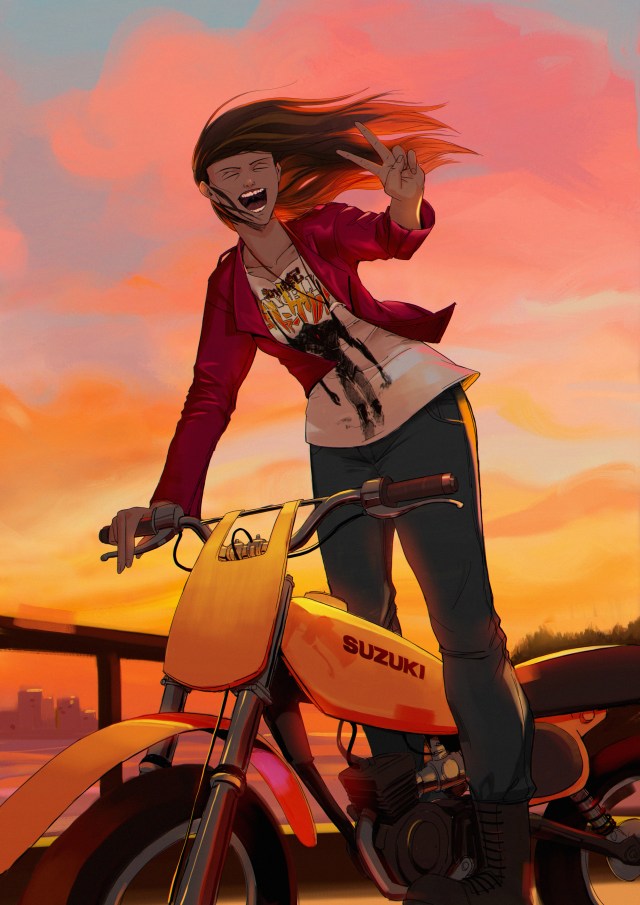
Drawing by Prima R. Bardin

A few days ago I was watching a YouTube video on how terrible the writing and worldbuilding are in the latest Bethesda games, particularly in Fallout 4. Obviously I agree because they’ve gone steadily down since Morrowind, and good old Skyrim was likely the last thing they’ll ever do right. The YouTuber was going laboriously over all the incongruencies and canon breaks in the Fallout DLCs, particularly the Mechanist one; he argued that the introduction of raider-reprogrammed robots was a disaster canon-wise, because that means that regular settlements should have tons of robots tending to most menial tasks.
That got me thinking: why is worldbulding so hard? Is there a way to ensure that any canon addition never breaks existing canon? I told ChatGPT Pro to research in-depth regarding what narrative theory says about how to ensure worldbuilding is as robust as possible, and that every canon addition is evaluated against invariants and previously-established canon facts. Basically, every canon addition should propagate throughout the different aspects of the story world, and the invariants should either be preserved if they’re hard, or modified if they’re soft. Existing canon facts may need to be modified or reframed.
As I was analyzing ChatGPT’s report on the specific procedures and questions that world creation and every canon addition should ideally entail, which would take a human being way too long and too much brainpower, I thought that surely this can be formalized through AI. So I got Claude Code to the task.
In summary: worldbuilding and canon additions can absolutely be formalized, and the results are exceptional. I’ve ended up with several base files for the story world I’m working on (a fantasy one with sentient animal humanoids and in which magic is solely artifact-based, and the artifacts are like radioactive hazards). The AI maintains now the following base files: a canon ledger, economy and resources, everyday life, geography, institutions, invariants, magic or tech systems, mystery reserve, ontology, open questions, peoples and species, timeline, and world kernel.
Here’s the entire current content of the invariants markdown file, one of the shortest ones. Every CF-XXXX entry is a canon fact that I added and that Claude evaluated against the entire corpus.
# INVARIANTS — Animalia (note by me now: nevermind the name; it’s just an identifier)
World-level truths. New canon must not violate these without explicit user-approved revision.
—
## Ontological Invariants
### ONT-1 — Sentience requires biological embodiment
– **Statement**: All sentient peoples are biological, embodied beings with species-typical bodies, drives, lifespans, and senses. Sentience does not exist disembodied in this world. There are no ghosts who think, no walking gods, no machine minds.
– **Rationale**: Premise asks for low-magic, lived-in texture. Disembodied minds shatter the gritty frame and the species-as-civic-fact rule.
– **Examples**: a beaver-folk canal-master, an aurochs-folk wagon-driver, a human magistrate.
– **Non-examples**: ghosts who give orders, an AI ruling a city, a god walking the streets.
– **Break conditions**: only by explicit user-approved cosmological revision.
– **Revision difficulty**: high.
– <!– added by CF-0022 –> **Clarification (CH-0002)**: Modern crafted artifacts (CF-0021) sometimes behave as if “possessed” by entities with apparent agency. At the world level, these vessel-hosted agencies are NOT sentient; ONT-1 is preserved without exception. The in-world dispute about their nature (instructions / beastly / sentient) is observationally unresolvable and is tracked under Mystery Reserve M-6. The dispute does NOT cross-apply to animal-folk sentience (M-5 firewall).
– <!– added by CF-0029 –> **Extended Clarification (CH-0004)**: Magically-animated Maker-Age guardian constructions encountered in enterable ruins (CF-0029) similarly exhibit apparent autonomy without world-level sentience. ONT-1 is preserved without exception. The phenomenon is distinct in origin from modern-crafted vessel-hosted agencies (CF-0022) — Maker-Age guardian ≠ modern crafted apparent-agency — and the two are NOT to be conflated. Guardian-construction mechanism is tracked under Mystery Reserve M-8; presence-heterogeneity (why some ruins have guardians and some don’t) under M-10. The M-5 firewall against animal-folk sentience cross-application applies equally here.
– <!– added by CF-0035 –> **Fourth Clarification (CH-0009)**: Artifact-contaminated mutated non-sentient beasts (CF-0035) in wilderness-distal sites remain categorically NON-SENTIENT. Artifact exposure does NOT produce sentience, speech, tool-use, or proto-folk status in a non-sentient host — morphological and capability alteration is not a step toward sentience. ONT-1 is preserved without exception; the M-5 firewall against cross-application to animal-folk sentience holds for the fourth time (after CF-0022, CF-0029, CF-0031). Mutated-beast phenomenon is DISTINCT in origin from both modern-crafted vessel-hosted agencies (CF-0022) and Maker-Age guardian constructions (CF-0029) — three surface-similar Maker-origin phenomena must NOT be conflated; each has its own bounded-unknown mechanism surface (M-6 / M-8 / new M-15 for the gargantuan-underground scale-tail).
### ONT-2 — Magic exists only as artifact, not as learnable art
– **Statement**: Living people cannot cast spells from will alone. Magical effects are produced by physical artifacts — ceramic, wood, metal vessels and devices — predominantly made by lost makers, with a marginal modern stream produced by leaked-grimoire crafter attempts (CF-0021). Some can be used; some can only be contained; many do nothing recognizable until they fail.
– **Rationale**: Premise. Forces the magic-as-hazard texture and prevents the world drifting into hereditary-mage high fantasy.
– **Examples**: ceramic containment vessel for extracting corruption; an artifact that mind-controls animals into wading water; a modern crafter’s wood-vessel that hums and once destroyed three village hens before going inert.
– **Non-examples**: a wizard throwing fire from his hands; a hereditary mage bloodline; a learned spell.
– **Break conditions**: only by explicit user revision.
– **Revision difficulty**: high.
– <!– added by CF-0021 –> **Annotation (CH-0002)**: The “made by lost makers” clause now includes a marginal modern reverse-engineering. The artifact-as-mediator constraint holds — what is learned by crafters is the craft of producing vessels, not the channeling of magic through the practitioner. The magic still lives in the artifact, not in the maker.
– <!– added by CF-0039 –> **Destruction-Physics Clarification (CH-0014)**: The artifact-as-locus clause carries material-physical consequence: the binding of magical effect to the vessel in Maker-Age artifacts (CF-0039) confers destruction-resistance on the vessel itself — destruction-attempts BIND the effect more deeply rather than unmaking it, and the vessel’s material resistance is elevated accordingly. This is a property OF the artifact-as-locus, NOT a new channel through the crafter. The destruction-physics is SCOPED to Maker-Age artifacts; modern crafter outputs (CF-0021) remain destructible by ordinary means, which preserves CF-0021’s “inferior” stabilizer register. ONT-2 holds without exception.
### ONT-3 — Species do not interbreed
– **Statement**: A hyena-folk and a human cannot produce a child. Cross-species sexual relationships exist socially but are reproductively sterile. Family across species is built through marriage, fostering, and adoption — not blood.
– **Rationale**: Without this rule, speciation collapses, embodiment loses meaning, and “halfbreed” plot conveniences erode the social texture. (Logged for OPEN_QUESTIONS as user-revisable.)
– **Examples**: cross-species marriage with adopted heirs; a human noble and a fox-folk consort raising a fostered hare-folk child.
– **Non-examples**: hybrid offspring, “half-cat half-human” characters.
– **Break conditions**: requires user approval; would force redesign of kinship, succession law, and species cohesion.
– **Revision difficulty**: high.
– <!– added by CF-0035 –> **Clarification (CH-0009)**: “Chimeric” morphology observed in artifact-contaminated mutated non-sentient beasts (CF-0035) — fused features, parallel limbs, merged apparent anatomy — is ARTIFACT-EFFECT on an already-contaminated individual organism, NOT cross-species reproductive hybridization. Species reproductive boundaries are preserved: no mutated-beast lineage arises from sexual interbreeding across species. The chimeric register applies to the shaped-by-artifact body, not to the reproductive act. ONT-3 holds without exception.
—
## Causal Invariants
### CAU-1 — Artifact effects always cost
– **Statement**: Every effect drawn from a magical artifact costs the user, the host, the environment, or all three. Costs include fatigue, host trauma, ward attrition, environmental “bleed-through” (dimming light, gloom, animal compulsion), and slow contamination of place.
– **Rationale**: Brief specifies the ceramic containment procedure is brutal to the host and that artifacts can corrupt water and mind-control beasts.
– **Examples**: extraction leaving the host bedridden; ward attrition near a contained artifact; canal water gone “wrong” downriver of a buried device.
– **Non-examples**: a free, clean magical effect; a costless ward.
– **Break conditions**: forbidden — would invalidate the artifact-as-hazard frame.
– **Revision difficulty**: high.
– <!– added by CF-0035 –> **Cost-Taxonomy Extension (CH-0009)**: The cost taxonomy includes a **rare survival-as-mutation outcome** observed in non-sentient fauna (CF-0035) exposed to uncontained artifacts over time in wilderness-distal sites. Most beasts die of artifact exposure (ordinary CAU-1 lethality); a rare subset survive and exhibit morphological and capability alteration. Survival does NOT exempt the environment, the local ecology, or subsequent secondary hosts from cost; the rare “beneficial for the beast in its niche” outcome (dangerous predator status) is an individual-level windfall embedded in a population-level cost catastrophe (most died). Cost universality holds without exception.
– <!– added by CF-0039 –> **Cost-Taxonomy Extension (CH-0014) — destruction-attempt cost-transfer**: The cost taxonomy includes **destruction-attempt cost-transfer** as a variant form observed on Maker-Age artifacts (CF-0039). Attempts to destroy a Maker-Age artifact — by smithing, fire, crushing, dissolution, or other means available to current-age capability — do NOT annihilate the magical effect; the attempt instead BINDS the effect more deeply into the vessel, elevating the material resistance of the substrate (wood hardens to behave like strong metal; ceramic sets harder; metal refuses the hammer). The cost manifests partially as a material-elevation cost on the vessel (transformation into higher-order resistance) and partially as an attempt-cost on the attempting party (injury, exhaustion, equipment loss, ward-attrition radius). The cost-universality principle holds without exception — destruction-attempts do not escape cost; they redirect it. Cost universality holds without exception. Also see CF-0041 sealed-inert extension: opening a sealed Maker container ACTIVATES the artifact within with CAU-1 cost, making unknown-container unsealing a feared cultural moment.
– <!– added by CF-0040 –> **Cost-Taxonomy Reaffirmation (CH-0014) — mundane-tier per-artifact contamination**: CF-0040 commits that mundane-tier Maker-Age artifacts (breeze-dolls, tick-mirrors, weak coin-sorters, scar-rubbers) are commonly found in ordinary-life contexts; the CAU-1 principle still holds without exception for this tier. Every mundane-tier artifact carries a cost surface — slow-bleed on user, room-misfeel, animal unease, household water off-flavor, vessel fatigue across months of proximity. No “harmless charm” reading is world-truth; the low-tier artifact is low-tier COST not no-cost. AES-3 contamination-clause compliance is mandatory for every mundane-tier CF-record annotation.
### CAU-2 — Corruption produces diagnostic environmental and behavioral signals
– **Statement**: Bleed-through gloom, dimming light, objects feeling “wrong,” compulsions in animals or people are diagnostic of nearby uncontained artifact activity. Practitioners (and seasoned canal-folk) read these signals.
– **Rationale**: Brief specifies bleed-through symptoms used as diagnostic by practitioners.
– **Examples**: a canal-side beaver-folk noticing fish behaving strangely and calling for an inspector; a ward-wright walking the perimeter and feeling the air thin.
– **Non-examples**: invisible, undetectable magical contamination.
– **Break conditions**: forbidden.
– **Revision difficulty**: high.
### CAU-3 — Wards are a public-but-restricted social-technical system
– **Statement**: Wards are publicly understood as a containment system. Their existence, locations, and the concept of “ward breach” are common knowledge. Their specifics — the inscriptions, the materials, the maintenance schedules — are restricted speech, regulated by guild charter.
– **Rationale**: Brief specifies ward-breach as known, and that public discussion of wards carries social risk.
– **Examples**: a child knows what a ward marker looks like; an apprentice cannot legally describe the inscription pattern aloud in a tavern.
– **Non-examples**: wards as secret unknowable magic; wards as fully open public technology.
– **Break conditions**: forbidden.
– **Revision difficulty**: medium.
—
## Distribution Invariants
<!– added by CF-0040 –> ### DIS-1-EXT (CH-0014) — Mundane-tier is explicit subset of “most inert junk” band, not a new distribution tier
CF-0040 commits the mundane-tier (near-imperceptible-effect artifacts: breeze-dolls, tick-mirrors, weak coin-sorters, scar-rubbers) as an EXPLICIT naming of the LARGEST share of the DIS-1 “most inert junk” band, reframed: most of what DIS-1 described as “inert” is in fact LOW-TIER ACTIVE, carrying per-artifact CAU-1 contamination clauses. Inverse strength-rarity relationship holds across the artifact corpus: mundane-tier is the most common; catastrophic-class is the rarest. The mundane-tier IS a subset within DIS-1, NOT a new distribution tier at the distribution-invariant level.
### DIS-1 — Artifacts are routinely turned up underground
– **Statement**: Foundations, canal-digging, mining, and ruin-clearance regularly turn up artifacts. Most are inert junk. A small fraction are dangerous. A tiny fraction are catastrophic.
– **Rationale**: Brief specifies routine construction can unearth them.
– **Examples**: a beaver-folk canal-crew finding a ceramic shard that registers as inert; a foundation dig that uncovers a humming metal disc and triggers a quarter-town evacuation.
– **Non-examples**: artifacts as so rare no one has ever seen one; artifacts as so common they fill marketplaces.
– **Break conditions**: would change the entire artifact economy.
– **Revision difficulty**: medium.
– <!– added by CF-0027 –> **Cross-reference (CH-0004)**: Enterable Maker-Age ruin sites (CF-0027) are a recognized subset of Maker substructures that admits organized multi-professional entry; piecemeal unearthing per DIS-1 remains the dominant modality, but enterable-ruin expeditions (CF-0028) are the less-common, high-risk, high-yield variant. The DIS-1 distribution pattern (most inert, small fraction dangerous, tiny fraction catastrophic) applies equally to enterable-ruin recoveries; catastrophic-class finds trigger resealing rather than recovery (preserves Mystery Reserve M-2).
– <!– added by CF-0035 –> **Wilderness-Distal Subset (CH-0009)**: A subset of DIS-1 unearthings occurs in wilderness beyond civic / guild / chartered-watch reach (earthquake-exposed, flood-exposed, burrowing-animal-exposed, slow-soil-creep-exposed). These exposures are not detected by inspectors and not contained by chartered response; the artifacts remain active in place. Over time this subset produces the CF-0035 contaminated-fauna phenomenon. Inspector-dispatch to wilderness-distal sites is DISCRETIONARY (gated by patron-funder or estate-commission or declared civic-watch predicate), not mandatory — cost, escort requirement, and wilderness reach preclude routine extension. DIS-1 distribution pattern holds within the wilderness-distal subset as everywhere else.
### DIS-2 — Literacy and occult-fragment access is partial, not aristocratic monopoly
– **Statement**: Literacy is not universal but is not gated to nobility. Occult text fragments can be purchased by anyone with coin and a willing seller. Specialist knowledge is gated by guild and apprenticeship more than by class.
– **Rationale**: Brief specifies fragment purchase is possible.
– **Examples**: a tavern bard who can read trade-tongue; a journeyman extractor who owns three fragments; a literate canal-master.
– **Non-examples**: only nobles can read; only priests own books.
– **Break conditions**: would change the structure of knowledge access.
– **Revision difficulty**: medium.
### DIS-3 — Mythical-species sentients are population-rare and locally clustered
– **Statement**: Mythic-species sentients (basilisk-folk, chimera-folk, manticore-folk, gryphon-folk, naga-folk, etc.) exist among animal-folk but are population-rare per region. You do not see a chimera in every market.
– **Rationale**: Prevents specialness inflation. Preserves wonder. Matches the brief’s note that exotic-species bodies attract attention and commentary in public.
– **Examples**: a single naga-folk bargemaster known by reputation across a canal corridor; a basilisk-folk physician practicing in only one city.
– **Non-examples**: mythic species as common as cat-folk.
– **Break conditions**: would inflate mythic-species into background-noise.
– **Revision difficulty**: medium.
– <!– added by CF-0035 –> **Firewall (CH-0009)**: Artifact-contaminated mutated non-sentient beasts (CF-0035) are CATEGORICALLY DISTINCT from Cluster D mythic-species sentient folk. The surface similarity (unusual morphology; chimeric features; wonder-adjacent register) must NOT be conflated: mutated beasts are non-sentient fauna with artifact-shaped bodies; mythic-species sentient folk are civic-participant peoples with species-typical embodiment (ONT-1/SOC-1). The firewall holds across all encounter contexts — no in-world institution may process a mutated beast as a mythic-species individual, and no mythic-species individual may be treated as a mutated-beast specimen.
—
## Social Invariants
### SOC-1 — Animal-folk can occupy any class
– **Statement**: Class mobility is not species-coded. Animal-folk can hold landed nobility, civic authority, guild mastery, and craft livelihoods. A beaver-folk magistrate and a human laborer are both ordinary.
– **Rationale**: Brief explicit.
– **Examples**: an aurochs-folk landowning estate that employs human and otter-folk laborers; a hyena-folk magistrate presiding over a mixed-species court.
– **Non-examples**: caste systems where humans rule and animal-folk serve; species-coded slavery.
– **Break conditions**: forbidden.
– **Revision difficulty**: high.
– <!– added by CF-0036 –> **Clarification (CH-0010)**: individual and sectarian species-prejudice exist as ordinary sociological phenomena (tavern slurs, labor-prejudice distancing, crew-composition sorting preferences, marriage-broker catechism extensions). Isolated single-species exclusionary settlements exist in weak-charter / demographically-fragile regions. Supremacist sectarian doctrine asserting species entitlement to violence against other sentient peoples exists as CONTESTED-CANON sectarian belief held by a fringe. An interspecies-cannibal sub-subset exists within CF-0034 outlaw bands. **None of these constitute world-level class-coded species hierarchy.** Civic charters continue to suppress hierarchy-speech at world level; no chartered polity adopts supremacist doctrine as civic policy; no guild charter gates intake by species; no magistrate-court recognizes a “lesser sentient” legal category. SOC-1 holds without exception. Individual-and-sectarian friction ≠ civic hierarchy; the former is ordinary social phenomenon, the latter is the forbidden break-condition.
### SOC-2 — Public adult barter is legal and visible in many regions
– **Statement**: Sexual services can be publicly posted, framed as pragmatic exchange, and treated by many locals as mundane. Scandal attaches to the character of those involved, not to the act itself. Regional and class variation exists.
– **Rationale**: Brief explicit.
– **Examples**: a posted price-list at a tavern; a respectable courtesan whose patrons include guild-masters; quiet disapproval from a stricter sectarian household.
– **Non-examples**: blanket criminalization; blanket destigmatization.
– **Break conditions**: would shift the texture significantly; medium revision difficulty.
– **Revision difficulty**: medium.
### SOC-3 — Coin contract is sacred by custom
– **Statement**: A payment contracted in coin or in-kind must be honored, or restitution made. Breach is a recognized civil and customary wrong; reputation damage compounds the legal cost. Trade across species depends on this norm.
– **Rationale**: Derived from the brief’s coin-and-livestock framing; necessary for stable trade across species and regions.
– **Examples**: a tavernkeeper hounding a defaulted patron through three towns; a guild withholding work from a known oath-breaker.
– **Non-examples**: payments routinely renegotiated after delivery without consequence.
– **Break conditions**: low — story tension often arises from breach.
– **Revision difficulty**: low.
### SOC-4 — Artifact extraction and traffic is guild-licensed
– **Statement**: Extractors, containment-wrights, and artifact-brokers operate under chartered guilds in most polities. Unlicensed possession of magical artifacts carries criminal or civil penalties. Black markets exist but operate at risk.
– **Rationale**: Derived from brief’s “professions and guilds exist to extract … research … sell … to bidders” plus the social risk around ward discussion.
– **Examples**: a guild-stamped artifact in a noble’s collection; a smuggler executed for trafficking an unregistered device.
– **Non-examples**: anyone can dig and sell freely.
– **Break conditions**: medium.
– **Revision difficulty**: medium.
—
## Aesthetic / Thematic Invariants
### AES-1 — Heroism is paid in coin and scars, not glory
– **Statement**: Risk-taking is treated as labor. Veterans are quietly proud and dryly mocking of glory-talk. Songs that romanticize battle exist but are sung mostly by those who never fought.
– **Rationale**: Tonal contract. The “scarred veteran with longsword” framing of the brief.
– **Examples**: a pension-list at a guildhall; a tavern song that ends with an unpaid widow.
– **Non-examples**: chosen-one narratives treated as world-truth.
– **Break conditions**: would betray tone.
– **Revision difficulty**: high.
### AES-2 — The ordinary keeps the world honest
– **Statement**: Daily life — canal traffic, livestock, tavern songs, winter dread, child-rearing — is always present in the texture. The world cannot be experienced solely from the perspective of heroes, nobles, or cosmologists.
– **Rationale**: Skill discipline; brief emphasis on lived realism.
– **Examples**: a story whose stakes are framed in terms of who eats this winter; a battle scene whose aftermath shows the field being looted by tenants.
– **Non-examples**: a world rendered only as cosmology and ruling families.
– **Break conditions**: would betray world identity.
– **Revision difficulty**: high.
### AES-3 — The magical and the contaminated are aesthetically allied
– **Statement**: Wonder and dread are inseparable in this world. Magic is never simply pretty. Every magical experience carries contamination — physical, social, or moral.
– **Rationale**: Brief.
– **Examples**: an artifact that is beautiful and lethal in the same breath; a containment-wright respected and quietly avoided. <!– added by CF-0035 –> A six-limbed boar carcass hauled to a ward-inspector’s door — the hunters dryly proud, the villagers quietly moving the children indoors; the trophy hung in a guildhall smoke-room, not paraded.
– **Non-examples**: charming, harmless magical decor.
– **Break conditions**: forbidden.
– **Revision difficulty**: high.
I used to hate worldbuilding, but this method makes it fun, as well as a solved problem. This is basically programming-as-prose. It’s already revolutionizing many industries.
Recorded in the third moon after Thaw, current year, at the Charter Hall of Harrowgate, in the cold north highland, before the chartered posting-clerk and witnessed by the senior hunter-officer on duty.
Filed by: Melissa, called Threadscar, contractor of record.
Contract reference: Harrowgate posting-wall, bounty-row, first week of Thaw-moon; re-posted at the lockmaster’s crossing-house the following week after a second caravan-ambush was reported.
Issuing body: Charter Hall of Harrowgate under the standing bounty-wall authority, with funds contributed by the merchant-coalition of the upper Drynn route and by two tenant-estate treasuries whose hauliers had been taken on the stretch between Stone-Fork and the Upper Drynn pass.
Contract posting figure: forty silver for confirmed suppression of the band, kin-of-taken bounty-premium held separately on condition of living-retrieval which did not apply in this case.
—
I came to Harrowgate by caravan from the heartland, escorting a six-wagon train of copper-ware and winter-milled rye under standard hazard terms, arriving on the eighth day of the thaw-moon. The caravan-master paid out at the lockhouse the same night. I had meant to turn south inside three days. The posting-wall at the Charter Hall carried the bandit contract in the bounty-row; I read it against the regional intelligence I had heard on the road coming up—two caravans taken at ambush, one hauling-crew returned, one not—and decided the exposure was inside my working register. I took the contract the next morning before the dawn muster.
Six other contractors had signed by that time or signed with me. The crew was assembled and vouched by the tavern-keeper of the Long Board, who has stood vouch in Harrowgate for fourteen winters and whose vouch-record I know by reputation:
– Gresh, hyena-folk, short-sword and shield, caravan-escort and posted bandit-hunting in two previous corridor-seasons, rotating here by winter-emptied board
– Tulen, wolf-folk, scout and tracker, four years in the corridor-work, scent-sound on cold ground
– Rennek, boar-folk, polearm, older — the stiff-shouldered veteran of the group; I counted eight skirmish-seasons in his account when he read them out at the vouch
– Morn, human, crossbow and short-sword, second-rotation hire to Harrowgate, capable
– Auveth, badger-folk, hand-axe and throwing-blade, first-rotation of the thaw in this charter but steady vouch from a neighboring highland town
– Karn, corvid-folk, crossbow and long-range observation, a scout by preference, in his seventh winter on the boards
Seven of us, counting me. We assembled at the Long Board the following morning, confirmed share-terms at eight silver per share, and posted kin-of-record at the lockmaster’s ledger against the standard share-to-kin-on-dead clause before setting out.
The tracking took five days. Tulen read the ground the first two; the corridor above Stone-Fork has been bandit-run intermittently for three corridor-seasons and the cold-weather trace was not difficult. We lost the sign twice on stone shoulders and picked it up again against the stream-gravel where the camp-runners had watered. Karn took the ridge-lines and spotted smoke on the fourth afternoon, low and careful-banked—the bandits knew how to keep a fire small in the highland air where the smoke-column shows for miles.
We marked the smoke to a ruin-hollow in the eastern flank of the Drynn approach, where the old substructure runs three vault-chambers deep under a slumped hillside. The ruin had been opened before, long enough ago that the stone was lichen-weathered at the entrance and the workings had been stripped of anything saleable—no ward markings at the lintel, no active guardian-sign anywhere on the approach, which is the subset bandits work from by preference and which I recognized as such. It was shelter to them, not a working site. I note this because I want the record to show I read the ruin at its public-knowledge register; I did not and do not claim to read it deeper than that.
We came up on it at the hour before dawn on the fifth day.
Four sentries at the outer ring. Two at the mouth of the entry-fall, two above on the ridge-shoulder where the draft off the chambers vents warmer in cold air. All four were carnivore-folk; two I recognized as wolf-folk by stance and one as a larger carnivore-folk I could not place in the dark—Tulen put name to the species later. Karn and Morn took the ridge pair from range with crossbow at fifty paces. Gresh, Tulen, Rennek, Auveth and I took the entry pair with short work.
All four dropped inside seven counted breaths. No alarm went up that I could hear. We checked the sentries once each for stirring, and went in.
What we found in the first chamber I will set down exactly as I found it, because I was ordered to write this report and because a record should exist.
The first chamber had been converted to a preparation-floor. Three human bodies were hanging from an iron bar driven between two fallen pillars, at the height a butcher would use for a hog. They had been gutted and cleaned. The work was not ceremonial; it was the work of someone who had done it before and knew the right angles. A fourth body lay on a stone slab at the side, cooked through and partially eaten.
On a lower ledge along the north wall, three heads in a row, preserved in the cold air, set in the display-line a hunter might use for boar or wolf-trophies on a wall. Two were identifiable by the feature and one was too worked-on to name. I did not look at them longer than I needed to confirm what I was looking at.
The slope of the floor ran to a small pit where the scrap was being dumped. That is what I saw. That is what I am setting down.
Some of the bodies had restraint-marks on the wrists and ankles, not fresh—they had been taken alive, held for a span, and killed later. Two of the pairs of cord ligatures were still looped on the pillar-bolts at the chamber’s entrance, at the height a kneeling captive would reach. I did not count the cord-lengths because there was no time to count the cord-lengths. I counted bodies and I moved.
Gresh vomited. Tulen—later, not at that moment—asked who would keep the record of the dead so their kin could be found. I told him the officials of Harrowgate would keep that record and the magistrate would work the names. Tulen asked me this before he died in the second chamber. I am setting that down because Tulen’s kin should know that he asked it before he went further in.
The second chamber held the rest of the band. I count six: the leader and five others, all carnivore-folk. They had heard the sentries go, or had not heard but had felt the cold-air shift from the opened entry-fall, and they were on their feet and armed when we came through the second passage.
The fight was close work. Polearm length did not help Rennek in the narrow chamber, but he used the haft as a brace and held the left flank; Gresh took the near right; Morn and Karn set at the entry mouth for crossbow-line and then drew short as the range closed; Auveth went center with me and Tulen crossed to her.
Two of theirs fell in the first exchange. Their middle collapsed on itself and the leader pushed forward through his own wounded to reach us. He was the largest of them—wolf-folk, heavy-framed, red-leather and cold-steel, and he shouted as he came. I set down here what he shouted because the officials have ordered me to keep silent in public register on the band’s composition, and this report is not public register, and a record should exist. He shouted that we were nothing to him but meat on a slow day. He shouted it twice on the approach, and then a third time when Auveth closed with him and took his hatchet in the face and went down—so he had time to repeat himself, which is a thing I observed and am noting.
Tulen went down second, to the leader’s second-stroke on Auveth. He bled out in the time it took the leader to turn back to me, which is to say a count of four. I set down that Tulen died fast, because his kin will want to know that, and because it is true.
I killed the leader with the longsword. He had closed inside polearm-range by then, which meant he was inside mine. The work took one exchange. The cut went in under the collarbone and found what it needed. He went down on top of Auveth, which meant Auveth was under him when I checked her, and it is possible a more careful report would note that Auveth may not have been entirely gone when the leader fell across her; I looked, and I did not see what I would have needed to see to report otherwise, so I am reporting that she was gone when the leader fell and I am noting here that my certainty on that is the certainty of a person who did what she could in the time she had and has had ten days since to ask herself the same question.
The remaining three bandits broke after the leader went down. Gresh and I took two; Karn took the third at the back-wall with the crossbow as he tried to reach the third chamber.
The third chamber held the band’s storeroom and nothing that moved. Iron goods, tack, stolen caravan-gear, a set of oilcloth bundles we did not open until we were outside in daylight. No further captives. No further bodies. We carried Tulen and Auveth out. We did not carry the band out. We left the band where they fell, which is the standard record-to-magistrate practice where the ruin is already known to the charter.
—
**Casualties of the contract** — entered for kin-of-record payout per the clauses posted at the Long Board and countersigned at the lockmaster’s ledger at muster:
– Tulen, wolf-folk, kin-of-record: a sister in the lower Drynn waterstation, name filed at the lockmaster’s ledger. Death: interior engagement, second chamber, to the bandit leader’s second-stroke. Share: eight silver, to kin at the lockmaster’s disbursement window within the moon.
– Auveth, badger-folk, kin-of-record: a partner at the neighboring highland charter-town, name filed at muster. Death: interior engagement, second chamber, to the bandit leader. Share: eight silver, disbursement as above.
Surviving contractors to be paid eight silver each at the Charter Hall disbursement window, which has been posted for settlement at the close of this report.
—
On return to Harrowgate I reported the contract closed at the Charter Hall as the posting-wall required. The senior hunter-officer took the report in the ordinary register and entered the five names. He entered Tulen and Auveth’s names in the kin-of-record line. He asked three standard questions—corridor condition, ruin-state, remaining camp sign—and I answered in the standard form. He then paused the intake and sent a runner for the posting-clerk’s senior and for the magistrate’s second, which is not the standard intake register. I waited.
The officials who arrived with the clerk’s senior—the magistrate’s second, the senior clergy-witness of the Charter Hall, and two I did not know by face—took the full report in a closed room. It became clear within a count of minutes that they had suspected the band’s working-habit before my return. The merchant-coalition had posted a bounty-row premium at first delivery that the standard corridor-work did not justify, and the magistrate’s second had on her desk a re-classification notice the clerk’s senior already recognized. They had known, or suspected to the level that reading the ruin confirmed.
They asked me three things: first, whether my crew would keep public silence on the band’s composition and working-habit; second, whether I would countersign a silent-settlement clause on an added bounty-row premium of sixteen silver, to be distributed to the seven of us on the eight-per-share basis; third, whether I had retained personal items from the ruin that would need to be entered at the disposition-window. I said yes to the first with the reservation I am recording here—that a record should exist and would exist in this report, which is an institutional record and is not public register. I said yes to the second on the standard survivor-kin basis. I said yes to the third and entered the band-leader’s belt-buckle, which was distinctive, as the only item retained for bounty-verification; all other storeroom material was signed over at intake.
The senior clergy-witness spoke then and said the words I expected him to say, which were that the magistrate-docket classification of the interior find would be entered as grave-violation-of-person, that the access would be sealed to magistrate-warrant only, that the burial of the victims would be held under civic-oath with family rites permitted privately and public ceremony absent, and that the band’s remaining sign would be burned at the ruin before the thaw-moon closed.
The warning that followed was simple. Public register—tavern, broadsheet, posting-wall, bardic performance, family correspondence, anything the circuit would carry—would not name the band’s composition. It would not name the carnivore-folk exclusivity. It would not name the working-habit. It would not name the display. It would name what a bandit-suppression contract conventionally names: camp found, resisted, taken, payout cleared. The officials’ stated reason was that the corridor-towns along the upper Drynn had not had an interspecies clash in eleven winters and the chartered welfare of the mixed households was worth more than the correction of the record. I did not argue. I do not agree in all particulars. I am setting down that I do not agree, and I am also setting down that I will keep the public register as ordered, which I will, because the coin is fair and the cost of the alternative is what they said it is and my silence in public is the cheaper price.
—
**Assessment, entered against the officers’ standing request for a frank field-register at contract-close.**
The band was composed exclusively of carnivore-folk. I am setting this down because I observed it and because the record should hold it. I am not setting it down as a claim about carnivore-folk at the species level. Carnivore-folk made up four of the seven contractors who killed this band, counting Tulen and Auveth among them, and it was Gresh who took the ridge-sentry with me and Tulen who tracked the camp and Auveth who held center beside me in the second chamber. The composition of the band is a fact of the band. It is not a fact about carnivore-folk.
The leader’s shouted claim—that we were meat to him—was not a theory I recognize as anything but a private pathology the band carried into a corridor where they could act on it. I have heard the sectarian register at taverns and at the edge of posting-walls across my rotations, and I have refused to work for the one recruiter who tried it on me in my hearing twelve winters ago at a heartland caravanserai. I am not equipped to say whether this band had picked the register up from a sectarian preacher, whether their leader invented it for them, whether they came to it along with the corridor-habit that taught them they could keep doing it. I heard him shout what he shouted. I watched him work toward us across his own wounded to say it again. That is as far as I will go.
What I will also set down, because it bears on the corridor:
– The band had held the ruin long enough to build the preparation-floor. That is a span of weeks, minimum, not days. The corridor-watch missed it. The reasons the corridor-watch missed it are outside my register but the watch-rotation worth inspecting is the Stone-Fork-to-Drynn stretch.
– The restraint-marks were not fresh on all the bodies. Some captives had been held for a span before being killed. The settlement ransom-clerk and the magistrate’s missing-person lists should be cross-checked against the three identifiable heads and against the body-count I have given here; there may be reconciliations.
– The stolen caravan-gear in the third chamber had identifying marks from at least two merchant-coalitions I recognized and one I did not. The coalition representatives should be brought to the storeroom for identification before the bounty-clerk disposition closes.
– The corridor will need an elevated hunter-contractor rotation for the remainder of this thaw-season and the next. Bands of this working-habit do not survive in one corridor without having been recruited from a feeder, and the feeder does not close with one suppression. The merchant-coalition should be told to carry the hazard-premium for another two corridor-seasons at minimum.
– Hunter-contractors bought into future postings on this stretch should be vouched for corridor-familiarity as well as for the standard subtype-competence, because the work-register inside the ruin is not the register a first-rotation contractor should be asked to read. If any of our crew is asked to continue on the stretch, I ask that Gresh and Karn be preferred. Morn and Rennek have performed to standard on this contract but are rotating south at the close of this posting per their own vouches, and Gresh and Karn are nearby.
—
That is the whole of the report. I have written it as I was ordered to write it. I have kept the public register as I was ordered to keep it. I have set down here what I would not set down in any other register, because I was told this record would be kept in the sealed-access line under magistrate-warrant only, and I have no reason to doubt that.
If the account here does not match the corridor-watch’s account or the magistrate’s case record on any point, the correction should go in the magistrate’s line and not in mine. I am not a correction to a civic record. I am a contractor closing a contract.
Paid in full at eight silver the share on the attested disbursement window.
Filed.
— Melissa Threadscar, contractor of record.
Witnessed at filing by Gresh, Rennek, and Karn for the surviving contractors; by the posting-clerk senior for the Charter Hall; and by the magistrate’s second for the sealed-docket line.
A Season on the Circuit: Dispatches from Vespera Nightwhisper
Brinewick, mrow. I have missed you—your lock-gates ticking their quiet clocks at the wharf, your beer better than three polities I could name and won’t, the particular hush of your river-lamps over a winter evening. I write to you from the road, as I have written to no one else this season, because Brinewick’s readers know how to listen—they lean toward a story the way old water leans into a lock—and because I am returning, and I want to give the reading ones a taste before the tavern ones get the meal.
Call this a dispatch. Call it a brag, if you insist; I have been accused of worse. What I can say honestly, or almost, is that the canal has been a hard road these six months, and I have walked and barged and limped a good part of it, lute-viol in its battered case and a rapier where it belongs, and the sun has hurt my eyes more than it hurt me. For the new reader: I am a cat-folk of the heartland circuit, pale cream fur, mismatched eyes, two silver hoops in the left ear and three in the right. If I am at the back of your tavern, you will know. I do not know how to be the other way.
I came north by caravan from a dryland town whose name I owe to my reputation not to say. The caravan-master there would not thank me for telling the journal about his hospitality, though I will happily name his daughter’s voice, which is an extraordinary instrument and I cannot resist doing it a small favor. Three weeks of dust and barley-bread and the short kind of poetry the drylanders trade with strangers. I kept my fur short-clipped and my head covered; fur-bearers in the drylands learn this the hard way, and a cat-folk with pale fur learns it the hardest. One morning a scorpion came at my boot and I killed it with a copper spoon and put the spoon back in the traveling-case; the caravan-master paid me in two chickens’ worth of silver for a single evening’s song about a hero who did not kill a scorpion with a copper spoon, and everyone agreed it was a better song for it.
Coming back to the heartland was like coming back to water. The first canal-lock past the dry-edge clicks you through, and your body remembers the sound. I played the lock-night at a town I can only call “the one with the green shutters”—again, the lockmaster owes me a favor I cannot call in publicly—and took silver enough to drink for a week. I drank it mostly in one. Do not write to the journal about it; I will be offended if I learn you have.
Three locks further along, I came to a canal town I will only call the Lamp-Weir, for the lamps they keep on its pilings all night. There the lockmaster’s posting wall—you know the kind; your own Brinewick has the better version, with the proper oilcloth hood against rain—had three hazard-notices tacked that morning. Two were wildlife: a boar in the coppice and a sick cow making the children cry. The third was a little stranger. A household with something in the cellar that was not a house-cat, and a herb-wife’s mark alongside, which is how the polite ones write I cannot handle this; please send someone who knows the wall of noise when the wall goes wrong.
I took it. A bard does not have to take hazard work, and I will say here that there are those on the circuit who refuse on principle and whose principles I respect—I have fewer of my own than I wish, and am honest about it—but I will say this for myself: I do not write well in stillness. I write well when something is about to go through me, or through somebody I have to look after. The herb-wife’s mark pulled at my tail before my head caught up.
I will not tell you what was in the cellar. The chartered folk prefer the kind quietly handled, and the house owes me nothing if I stay quiet. What I will tell you is that a man called Aldous—a ceramic-handler of a certain reputation in the heartland, though you will not read his name often in the journal—met me there on his way through with his apprentice, and between us and the herb-wife we handled what needed handling and left before the ward-inspector’s drill-bell rang at dawn. I was paid in silver. Aldous got the serious share; I took the corner-share a contracted auxiliary gets when she holds the lantern and keeps the door and runs once, down a stair, for a thing the ceramic-handler had left in his bag. I will not glorify the work. But the silver was real and the dawn came up clean, and the herb-wife said something kind to me in a language I did not know before she said it again in the trade-tongue, and I am almost sure she meant it.
There is an old rumor about me—you will have heard it, Brinewick, because you are a city that hears—that my best work comes the morning after a bad night. I have denied this in print and confirmed it in tavern, and I will tell you in this journal the slightly more honest thing: I do not know how to defend the rumor, and I also do not know how to put it down. The best piece I have written this year came the morning after a dark hour and a tolerable wound. It is for the lute-viol, which is a difficult instrument in the hands of anyone without long fingers or long patience. I have three new pieces in polish and two more waiting their turn—the circuit asks for them faster than the page gives them—and I will bring them down to Brinewick one by one as they are ready. I will not prove it to you here. I will prove it to you at The Copper Weir on the fifth evening after Charter-Day, before the second bell. Bring coin and a friend who listens.
I owe the dead of two hard fever-winters an honest line. The taverns are thinner than they were when I first walked this circuit, and the widows are not; many of my best audiences two winters ago are not coming back. A bard says this not to sadden the journal—though if you are weeping, that is your right—but to name the absence. The circuit remembers its dead the way the canal remembers its locks. There is a song my mother—well, a woman I called mother for one good winter in a town I will not name—used to put into the cook-fire smoke when the cold came; I have been stealing from it all season, because I stopped being embarrassed to steal a few years ago. I will sing the theft at The Copper Weir. Do not applaud if you know the original. Applaud if you like my version better, which is almost but not quite the same thing.
Which brings me back to you, Brinewick, to your wharves and your shutters and your better beer. I will be at The Copper Weir on the fifth evening after Charter-Day, and at The Lock-Keeper’s Cat (whose owner I have flattered outrageously in three successive visits and who, I am told, keeps fermented blood-broth under the counter for carnivore-folk patrons who know to ask) on the seventh. If you want the new piece, come on the fifth. If you want the old cycles and the drinking-songs, come on the seventh. If you want to buy me a drink after, I accept mead, fortified wine, or whiskey; I no longer accept ale. I have reached the age where ale is for other people’s pleasure.
I remain, as always, your correspondent on the road,
— Vespera Nightwhisper, of the canal circuit
I’m at one of the lowest points of my life. Not as bad as during plenty of my twenties, in which I existed as a hikikomori of sorts and barely had twenty euros at a time in my bank account. But emotionally, I feel even more done now. Nearing forty-one, having tried to make it as a public servant during my thirties only to end up in the ER thrice with heart and brain issues due to stress I can’t handle. And in retrospect, as an autist with OCD, I should never have put myself in those situations. I guess I thought I could toughen my way through them, but my health told me in certain terms that it’s no way to live. And that it very well could kill me.
I’ve been unemployed for about seven months, and running out of unemployment benefits. I spend most of my time programming projects that I intend to use as references in future resumes whenever I try to get a job as a programmer. But I think that’s mostly a fantasy. In truth, I’m programming these projects because otherwise I’ll feel like I can’t do anything. And I don’t seriously believe that any company will hire an autistic, generally-mentally-ill forty-year-old programmer who has only worked professionally as a programmer for about nine months since my late twenties. I wouldn’t hire me. Of course, I don’t want to do any of it. I don’t even want to interact with human beings.
For these past weeks, or maybe more, I’ve barely looked forward to anything other than sleeping. I just want to be gone. To be forgotten by the world, to not have to face the utter ruin of society, the fact that I don’t want to be here but I can’t truly move anywhere else. I’ve had lots of nights in which I lie in bed and I give myself permission to die in my sleep. I’m not remotely afraid of dying, but I don’t want to deal with the pain. I’ve also fantasized about going somewhere with my guitar, playing for a while, then resting my guitar against the railing of one of the bridges nearby, overlooking the highway, and throwing myself headfirst. A quote from Nietzsche comes to mind: “The thought of suicide is a great consolation: by means of it one gets through many a dark night.” Some weeks I manage to get through my weightlifting sessions, but other days, like the recent ones, the depression is so physically bad that I can’t get through a single set. Not for psychological reasons: I simply lack the strength.
I haven’t felt like reading or even writing for a good while now. On a fundamental level, I feel done with all of it. You need to be able to sustain the faintest desire for connection with the world and human beings, even hypothetical ones, to engage in something as complex as coming up with a story and spending hours upon hours crafting your way through it. But I don’t want anything to do with human beings. I would be fully content if I could move somewhere that would allow me to never see people again. If as a child I could see myself sitting near paths and playing the guitar regularly like I do now, being heard and seen by dozens of people, I maybe would have considered myself confident, but it’s not the case at all: I simply do not care about others. I don’t expect anything from human beings other than the possibility of being attacked, which I’m wary of and guides my behavior when I’m outside. I’ve had people sitting nearby while I was playing, a few even addressing me afterwards, and I couldn’t wait to disengage.
I find ironic that young couples have gone out of their way to spend part of their date sitting on a bench near where I’m playing, apparently enjoying it, the girl’s head resting against the guy’s shoulder, while my last taste of an intimate relationship was nearly twenty years ago and it proved to me that I wasn’t made to share my intimacy with another human being. I resented the theft of my time, of my energies. The way she would push me to abandon my needs and my desires to fully support hers. Only for her to eventually cheat, leave for the other guy, and contact me occasionally to tell me how much better things were with the other guy and how he didn’t have my shortcomings; calls and messages that I responded to because I had been fully stripped by that point of what little self-esteem and self-respect I had left.
I do retain fantasies about what could have been. That possibly-autistic girl from middle school who pursued me for some reason, to whom I couldn’t respond in anything resembling a human level, and who wrote me these elaborate letters that I never read and that in my mid-twenties I ended up throwing away because I didn’t want to be reminded of the past. That seventeen-year-old basketball player, a reckless, dreamy, idealistic girl who also pursued me, with whom I lay under the stars in a nearby town, and with whom I made out during our only date. I liked her so much, more than anyone I’ve ever liked or ever will, that I ghosted her because I knew that when it inevitably ended, as all of my intimate relationships would, it would utterly devastate me. I felt to my bones that I wouldn’t have been able to recover. So I never spoke to her again. Due to my issues with face blindness, I don’t even know if I ever saw her again.
I went out of my way in my late thirties to enter the apartment building where she lived back then to see if what I remembered of her last name still appeared on the mailboxes, but it didn’t. I can’t even google her to see what happened to her, as the little I’m sure of her last name is that it started with an “M,” and I don’t know if that was the first or the second last name. What I regret of both isn’t that I failed to date them properly: it’s that I never got to know them as I should have. I sometimes fantasize about going back in time and simply talking to them, learning their likes, their hopes, their fears. I know that plenty of these regrets are pure nostalgia. In practice, I wouldn’t have been able to deal with them in person for more than three or so meetings before wishing that I hadn’t gotten involved. Regardless, that’s how I’ve ended up as a forty-year-old man: with only two human beings I would have genuinely wished to be attached to, both of them lost half a life ago, and the sole girl I did spend years with having ended up as a regret of the opposite kind: with me hoping I had never met her at all.
I’m writing this at four in the morning. Almost every night, I go to bed at nine or ten, only to wake up spontaneously at about two or half past two in the morning. I usually sit at the desk and work some more in my projects. Partly due to the depression, along with maybe the natural decay of my interest, I’m quickly losing steam. Recently I’ve been sinking in a depression that barely let me go outside for half an hour every few days. What always works for me, always putting me in a better mood, is playing the guitar. I don’t know why, it always manages to make me feel brighter by the end of it. The process of playing songs seems unaffected by the emotional disregulation and general despair that colors the rest of my existence. I should probably play much more, learn new songs, but the process of having to learn something new is also affected by depression, so I can’t bring myself to it.
I still rely on the old Alicia daydreams every single night. If I go outside, I tend to replay those scenarios as I stroll, partly because I need to move my legs but I don’t want to look around at the ruinous state of society. I don’t know why I depend on my daydreams with this fictional character so much, but I suspect it has to do because she reminds me of my subconscious self, which I’ve always felt to be markedly female, as I used to commune with her back when I was a child, before my neglectful parents exiled me from my bedroom to be placed as an unwanted guest in my older brother’s bedroom so they could free up my room for a third child. That mute second self that inhabits my brain, which is a very real phenomenon, felt so wildly unique, dreamy, colorful, and a myriad positive adjectives, that the trauma of having been ripped from her at seven years old is something I will never recover from. Even as I regained the ability, little by little, to listen to her again in my twenties, I had to face the fact that she had withered, grown scars, become bitter, and markedly insane. And these days she doesn’t even want to create anything new. She prefers to lose herself in daydreams, falling deeper inwards. I can’t blame her. I don’t want any more of this either.
During the worst moments of my recent suicidal ideation, I thought about what would be worth saving from the works that I’ve done. My site would eventually get removed as the payments failed to get through, so all of it would be gone. The sole thing I would consider a true tragedy if it were lost is my novella Motocross Legend, Love of My Life. A story that came out of nowhere and that I wrote as if possessed. One I don’t fully understand but that I assume has to do with my essential trauma, the fundamental separation I suffered regarding my other half. Either that or something that has seeped from a former life. Whenever I think about moments of that story, I feel the urge to tear up. When I visit the very real places mentioned in that story, for example the spot where the narrator and Izar used to meet in front of his apartment building, my chest gets tighter as if I was remembering my own past.
I guess that’s all for now. I’m not sure why I wrote all this. I thought of writing a blog post at different points of this last month, but I couldn’t manage to push past the “why bother” barrier. I don’t know why I managed to push past at nearly five in the morning tonight. I don’t think I have much agency left, if I ever had it. For years it has been obvious to me that by the time any drive reaches the thinking part of the brain, everything has been decided already, and you’re left believing you have any choice in the actions you’re taking. I don’t know if the decisions to come will improve my life to any degree or will contribute to ending it, and to a fundamental level, I don’t care. I’m overdue from that moment back in my very early twenties when I knew I had to jump but I pussied out of it. Once you’ve truly wanted out but you stick around for whatever reason, you remain forever a stranger to this place.
A week and a half ago, a professional photographer casually shot me as I was playing the guitar at my usual spot. I had been curious about the photos, only to receive them and confront once again that I hate how I look and that I exist. But it is what it is, so here they are.
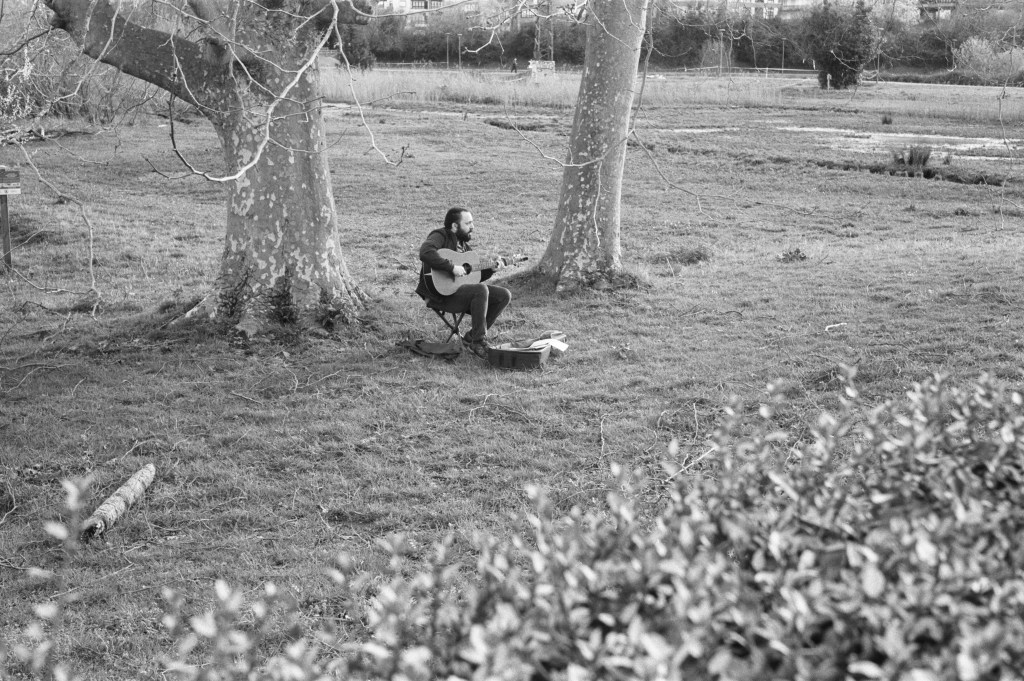
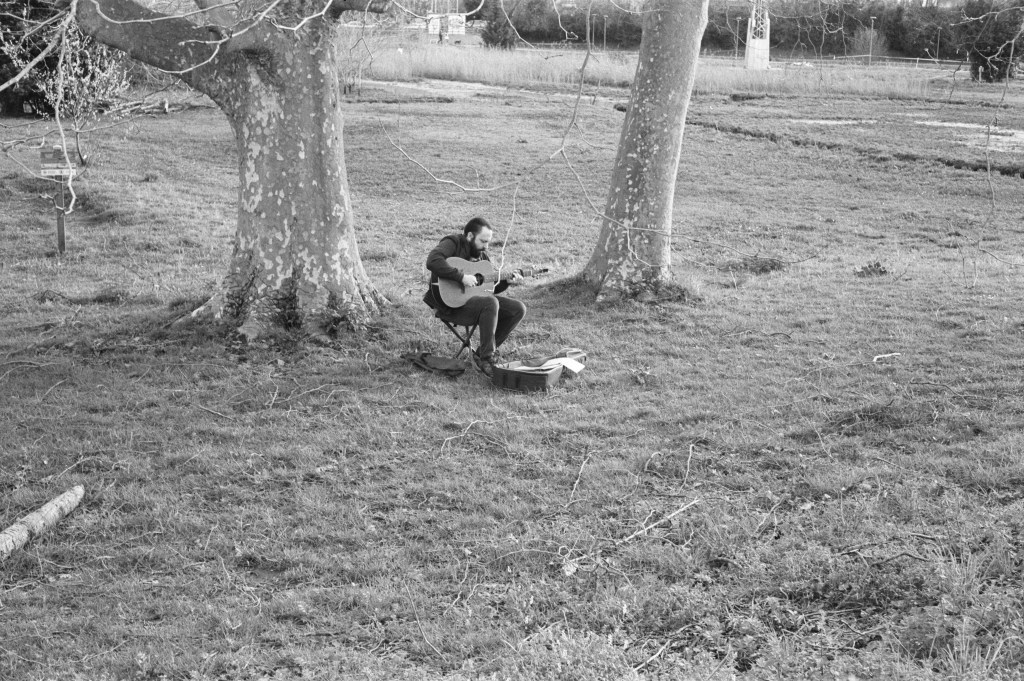
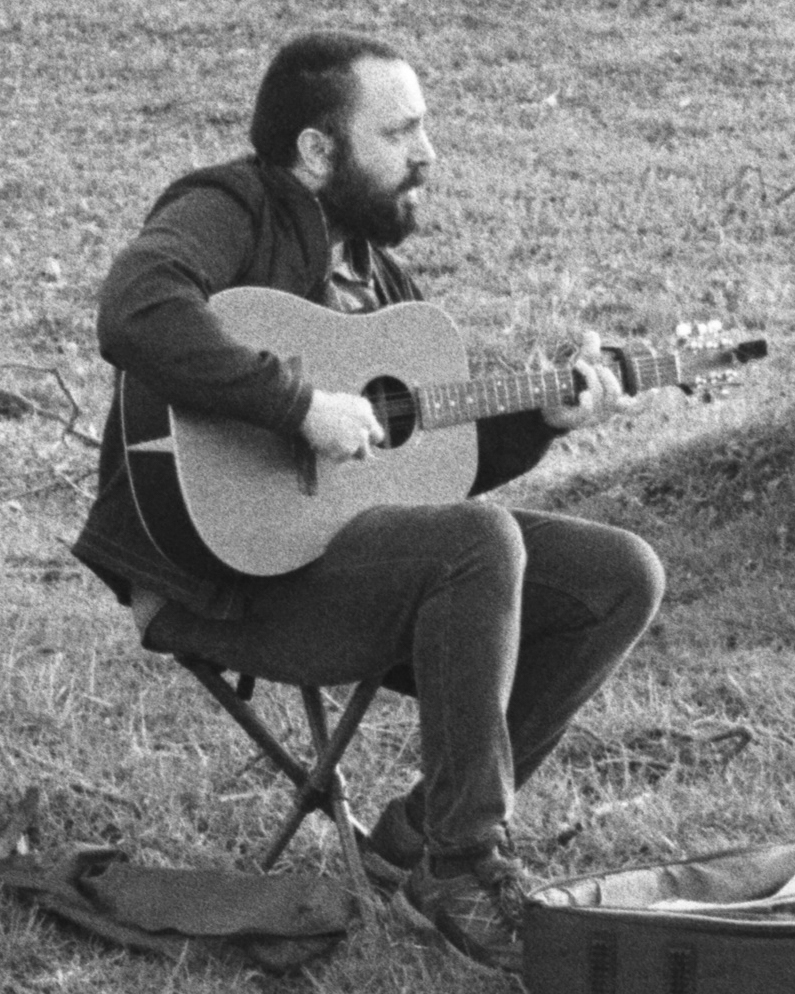
Given the nightmare I’ve been involved in this month adapting an incredibly-complex board game about the Vietnam War, these photos are somewhat fitting.
The photographer’s name is Bixen Vergara. Here’s his page in case you’re interested.
I release her pigtails. My hands slide from the red hair to the back of her neck, one palm warm at her nape, then down to her wrist—the unbruised one—and the direction of movement arrives before any word does. I stand, drawing her up with me, and turn toward the hallway. She follows.
The bathroom is small and holds heat well. I turn the taps without releasing her wrist, then test the temperature with the inside of my forearm. I adjust the cold a half-turn. The water rises. Steam collects along the mirror’s edge. I watch the tub fill with the focused attention I give to things that matter.
I turn to Ane, who’s watching me from the doorway. I lift the hem of my own shirt from her shoulders first; she had been wearing it open over her crop top. I take the shirt with both hands and set it on the towel rack. Then the pink skirt. My fingers find the waistband, unhurried, and the skirt falls and I catch it and fold it over the shirt. The white socks with the small pink hearts last, one and then the other, my hands at her ankle and her calf.
Ane is just standing still in the steam-warm bathroom while my hands move over her performing an act that isn’t only desire, but something closer to the care one takes with something irreplaceable.
I guide her to the tub’s edge. She steps in. The heat moves up through her feet and ankles and the backs of her calves and she lowers herself and the warmth closes around her and she exhales involuntarily, the exhale of a body that has been braced for a long time and has just been given permission not to be.
I step in behind her. The water rises with my weight. I settle, and she settles against me—the geometry of the tub making it inevitable. My chest against her back, my legs on either side of hers. My arm comes around her and then stops.
The bruise. My thumb finds it. The discoloration on her arm, the purple-green of a bruise two days old, her mother’s work, the morning’s first tax. My thumb moves once across the discoloration, and then my hand slides lower and submerges her arm gently below the waterline, as if the heat can undo what that morning did. As if tending the evidence is the same as tending the wound.
Then I reach for the sponge on the tub’s edge and I wash her. Across her shoulders first, clearing the day from her skin. Then the back of her neck where the water has darkened the ends of her pigtails, then the curve of her collarbone, the soft hollow of her throat. The sponge sets the route and my hands follow to confirm it, the double passage of sponge-and-palm that is somehow more thorough than either alone, and she holds very still beneath the attention.
I’m thinking about the quality of what she gave me in the living room. The thought has the quality of the word cathedral without the word itself: she has given me the one thing she kept, the one room she held off-market across every transaction, every arrangement, every man who thought he had the full inventory of her. She gave it to me. I intend to receive it as if it matters in a way that has nothing to do with the contract, even though the contract is real.
My hands move across her skin. And then Ane is crying.
I feel it before I see it—her stillness changes, followed by an involuntary tightening across her shoulders. Her breath has gone irregular and then very controlled. Her face is wet in a way that isn’t the steam. The silent crying of someone whose professional register has been stripped of its last supporting structure, someone who has not been touched without transaction in years.
My hands continue moving across her shoulders, her collarbone, the back of her neck. I don’t say it’s all right. I don’t say anything. To keep moving is also to claim: not her body, but her capacity to be undone. The right to be present for it.
The water cools by degrees.
At some point the crying stops. Not because anything resolved. Because her body ran out of the resource the crying requires, and what is left is the warmth of the water and my hands still moving and the steam against the mirror and the sound of the garden somewhere outside the sealed house, faint and indifferent.
* * *
The dark outside the kitchen window is the dark of very early morning, the hour that belongs to no one. I stand at the sink with a mug of water I haven’t drunk.
The garden is out there. In the dim ambient light from the street beyond the hedge, the swing moves faintly in a wind I can’t feel from here. The arc is small and irregular, the movement of an empty thing displaced by something passing through. I watch it. My hands are around the mug.
Upstairs, Ane is in the spare room—the room that is now hers, the room with the lock she did not use—and the permanence of that is present in the house the way structural weight is present in a wall: invisible, felt only when you press against it.
I stand at the window and watch the swing and try to locate the arithmetic of the night. The grief in my chest—and it is grief, that much is legible—will not sort itself into its component parts. Grief for what I took. Grief for what she gave. Grief for the man I was before I opened the garden gate and found her sitting in the swing, the same swing that is moving now empty in the early morning dark. I don’t know which grief is which. I suspect they’re the same grief wearing different faces, and that the inability to separate them isn’t a failure of analysis but the actual condition of the thing I have done.
The catalogue assembles itself in the dark. Cameras: four units, arriving tomorrow, the invoice confirmed. Coverage radius: the gate, the southeast corner of the hedge where it thins, the kitchen door, the swing. I’ve mapped the sight lines in my head with the three-dimensional precision of a man who has spent fifteen years learning the geometry of my property in every light and weather condition. A determined person could part the gap at the southeast corner with both hands. Tomorrow. That’s the relevant fact. Until tomorrow, the gap exists.
Txomin’s face assembles itself next. The face from the neighborhood knowledge—the composite built from secondhand description and the logic of that type. The kind of man who uses other men. The kind of face that looks reasonable in daylight and means something different in the dark. I hold the face in the operational register and don’t let it become anything else. A threat is a threat. You map it, you account for it, you build the wall.
Ane is upstairs. That’s the central fact around which the rest of the week organizes itself.
The latch sounds.
Small. Metallic. The sound of the garden gate latch being tested from the street side—not the wind, not the swing’s chain, not the random settling of a property at night. I know every sound this property makes by address.
No lights. I don’t touch a switch. I stop two feet back from the kitchen window—close enough to see, far enough that my silhouette doesn’t reach the pane. The garden is dark. The hedge is dark. The ambient light from the street beyond the hedge is the thin yellow-white of a lamp, barely enough to define the hedge line as a shape against the lighter dark of the sky.
A compact shape at the gate. Leaning. The lean of a body that has been ambulatory for too long and has found a vertical surface and is using it. The gate post. One hand on the latch, the other arm against the wood. The movement, when it comes, is the slow exploratory movement of someone who’s testing the gap between gate and post with the patience of someone cataloguing the property from the outside the same way I catalogued it from the inside.
Scouting.
She’s not here to force entry tonight. She’s here to know. To locate the gap, to measure the hedge, to confirm the address before she decides what to do with the confirmation.
The shape and the unsteadiness and the hour and the quality of the searching movement assemble into a single conclusion, and the conclusion is Marisa, Ane’s mother.
The cameras aren’t here. The perimeter is unmapped.
The prohibition I issued to Ane—you don’t leave alone, not until this is resolved—is structurally meaningless if the person at the gate calls her name loudly enough. The spare room window faces the garden. The walls aren’t built yet. The walls are not built.
My hands are flat on the kitchen counter.
The shape at the gate lifts its head. It’s looking at the house. I can’t see the face from here, can’t resolve the features in the dark and distance, but the orientation is unmistakable—the angle of the head, the stillness of the body, the quality of attention that arrives when a person stops cataloguing a structure and starts looking for a light. A sign. The confirmation that someone is inside.
The shape’s posture changes. The head drops back. The mouth opens. The preparation of a body about to produce volume.
The cold in my chest converts into something with edges.
I open the kitchen door without a sound, then cross the threshold into the cold and the wet grass finds my bare feet—the cold of early morning ground, soaked through from the overnight damp, the blades pressing flat under my weight and releasing. I have walked this path in every dark and every weather for years and my body knows the slight rise at the third meter, the way the path curves left past the rosemary, the exact distance from the door to the gate in a straight line across the lawn: eleven meters. I cover them in the economy of a man who has converted grief and rage into a single operational directive.
She hasn’t called the name yet. I have a few seconds of advantage and I use them, crossing the last four meters in absolute silence, and when I stop I’m close enough to smell her.
Bleach. Industrial grade. The chemical signature of a woman who has spent her night on her knees cleaning other people’s floors and has come directly after, without sleeping, without changing, which tells me everything I need to know about the quality of her decision-making tonight.
I simply stand there, between her and the house, my hands loose at my sides. The stillness is the threat. The proximity is the threat. The fact that I appeared in the dark without sound, without light, from a house she had been watching for signs of life and found none. I let her feel it for a few seconds before I speak.
When I speak, my voice is in the lowest register I possess. I’m speaking at exactly the volume required to reach one person and no one else, calibrated with the precision of someone who has stood in this garden at this hour and knows exactly what the air carries and where.
“Listen to me carefully.”
She goes still. I watch her register my presence—the physical process of a drunk person updating their situational map, the small recalibration of the body when the threat-level reclassifies. I don’t give her time to produce language.
“You are standing at a gate that belongs to me, at four in the morning. I know what you came here to do, and I am telling you now, with this much distance between us, that you are not going to do it.”
She opens her mouth.
“I’m not finished.”
Her mouth closes.
“There’s a bruise on her arm. I have photographs. I have your address on record and the photographs are ready in a folder with your name on it. If I hear your voice at this gate—if I hear your voice anywhere near this property—I will make one phone call and the folder goes with it. That is not a negotiation. That is a fact I am stating for the record so that you cannot later claim you did not understand the terms.”
She’s leaning against the post in a way different from the scouting lean. Just using the wood because without it she would need to find another vertical surface. The bleach smell is stronger at this distance. Her mouth is working without producing sound. She arrived with a sound. I removed the conditions under which the sound was viable. She has nothing left to deploy.
Something changes in her posture. Something older than collapse. The deflation of a body that has been fighting a war for a long time and has just recognized, in the dark, in the cold, in front of a man whose hands are at his sides and whose voice has not risen by a single degree, that the war is already over and has been over and the fighting was the last thing she had and now she does not have it.
She looks at the house. At the spare room window—dark, curtained, still—and the looking is something that has nothing to do with strategy.
When she speaks, her voice comes out flat. A sentence standing alone in the dark between us.
“Is she safe?”
The question lands in the cold air and I hold it there. I feel the weight of what it costs me to hold it correctly. The woman in front of me is asking the same question I have been unable to answer since I stood at the kitchen window watching the swing. And the honest answer is not yes and is not no and is not a reassurance, because reassurance would be a performance and I’m not performing, not even for a woman who is leaning against a gate post in the dark smelling of bleach at four in the morning with nothing left to threaten me with.
The cold fuel that got me across the garden without making a sound remains, and the recognition sits beside it without displacing it. I let the silence run for three seconds.
“She is here. She is sleeping. She is not leaving.”
Marisa looks at the house for another moment. The spare room window, dark, curtained. Then her hand comes off the gate latch.
She moves back from the gate with the unsteadiness of a large body that is drunk and cold and has been standing on wet grass, and I watch her go with the expression of a man who has just been asked a question he did not want to be asked and cannot unfeel the asking, and the answer he gave was the only honest one available, and the honesty cost him something he cannot yet name because the dark is not the right place to name it.
I stand at the gate until the sound of her steps fades. Wet grass, then the uneven pavement of the lane beyond the hedge, then nothing.
I turn back toward the house. The kitchen door is still open. I cross the lawn in the same silence I crossed it going out and step back into the warmth of the kitchen and pull the door behind me without a sound.
I stand at the window. The swing is out there in the dark, moving faintly in the same wind, its arc small and irregular, the motion of an empty thing that has been touched by something passing through and has not yet stopped recording the contact. My hands are at my sides.
Ane is upstairs.
The truth of it has not resolved into anything clean. It has resolved into the ache in my chest that will not sort itself out into its component parts no matter how long I stand at the window. Grief for the quality of that woman’s voice stripped of everything except the question, and the way the question opened something between us that has not closed.
The swing slows. I watch it until stills, and then I watch the stillness, and the house holds around me.
I pick up the mug. Set it in the sink. Turn toward the hallway.
The house is quiet. The perimeter held. The name was not called.
It is enough for tonight. It is the only thing I have that is enough, and I take it with both hands and carry it up the stairs in the dark.
THE END
The call connects on the third ring. Faint electronic hiss of a live call, the quality of silence that means someone on the other end is listening.
Behind me, Ane’s grip on the hem of my shirt tightens. I feel it against my lower back, two knuckles of pressure through the cotton, the involuntary tightening of a body that is listening to the wall being built in real time.
I wait. Through the phone, her mother Marisa speaks first. A thick, lurching voice, the register of a woman who has been drinking and searching and working herself into a forensic fury since morning. I get fragments: —don’t you dare, I know she’s somewhere, she always does this, she always— and then something lower that shifts mid-sentence from her daughter to me, the realization that the number is wrong, that the voice on the other end isn’t her daughter. The fragments reorganize. —who the fuck—
“Ane is here.” My voice has dropped to its lowest register. I have decided and I’m now giving the dimensions of the decision to someone else. “I live in the outskirts. She’s staying here.”
I can hear her mother breathing, the wet sound of someone recalibrating.
—she’s my daughter, you don’t get to—
“I’m not finished.”
The sentence lands like a hand placed flat on a table. Behind me, Ane’s grip tightens again.
“She came to me with marks on her arm. Grip marks, spaced the way fingers space when someone grabs and does not let go. I have photographs.”
—God damn it, I didn’t—she provoked—I mean, she always— The voice lurches, her fury trying to find its footing. —you don’t know what she does, you don’t know what kind of girl she—
“I know what she does. That’s not relevant to the marks on her arm.”
I hear something shift in Marisa’s breathing—the recalibration again, but this time with an edge underneath, the sound of a person trying to find the right angle on a situation that has no good angle. Then, a fragment, the end of a sentence that started somewhere else: —not the first time, those men, the ones from Bergara Street, they— and then it stops mid-sentence, swallowed back down, as she has realized she has given something away.
“The Ertzaintza have a domestic violence unit,” I say. “Filing is straightforward. The photographs are enough. I want you to understand that clearly before this conversation ends.”
The silence has edges. I can feel Marisa on the other end, the bulk of her, the fury and the grief and the drunk self-pity and the rage, all of it pressing against the call the way a body presses against a locked door. A door that is holding.
—I want to talk to her. The voice has stripped down, the performance falling away into something rawer. —just let me talk to her, she’s mine—
“No. Ane is staying here. That isn’t changing today, and isn’t changing tomorrow. If you come to this address—” I give it, the street and the number, because a wall is only a wall if the other person knows where it stands “—I will call the Ertzaintza before you reach the gate. That is not a threat. It is a description of what will happen.”
I hear her breathing. A wet, thick sound.
I press the button and the screen goes dark. I set the phone on the counter, face down.
My hands stay on the counter, bracketing the dark phone, the surface cool under my palms. I’m aware of Ane behind me—the warmth of her, the gravity of a body that has been standing still for the length of that call, that has been listening to the wall being built word by word, sentence by sentence.
I gave the address to her mother. I did not ask Ane if she wanted me to do this. I’m aware of these things as facts, not as a fault. The righteousness of the act fills the kitchen the way heat fills a sealed room.
I feel the slow release of Ane’s knuckles unknotting from the hem of my shirt, the pressure against my lower back easing, the loosening of a body that has been holding itself braced against impact and has just understood, at the level below language, that the impact isn’t coming. The wall held. It’s built from photographs and the flat declarative voice of a man who said no to her mother without raising his voice and meant it structurally, all the way down.
The fragment Marisa let slip—those men, the ones from Bergara Street—sits in the back of my mind like a splinter. Not yet bleeding. I don’t know what it means. I don’t know if the men in the park were strangers or neighbors or something with a history I haven’t been given.
I lift my hands from the counter and turn to her. The strawberry warmth of her faded into the kitchen’s ambient heat. She’s looking up at me with brown watchful eyes.
“Your mother said something before she stopped herself,” I say, quiet in the way a measurement is quiet. “The men from Bergara Street. She pulled it back. I need you to tell me what she meant.”
Ane’s face reaches for the professional register, the architecture of controlled disclosure assembling itself in the set of her jaw and the slight angle of her chin. The posture of a girl who has been answering questions about herself for years and has learned exactly how much to hand over and in what order and at what price. A specific warmth she deploys the way other people deploy distance.
But it doesn’t assemble. Something in the way I asked, the clinical precision, the absence of judgement or the hunger of a man who wants the story because it excites him, lands differently than her clients’ questions land. I’m not asking the way men ask her things. I’m asking the way a man asks about a load he needs to calculate before he builds against it.
The professional register collapses quietly, like scaffolding removed from a wall that turns out not to need it. What surfaces is an unnamed mid-register between the professional one and the frightened child voice that escapes under fear.
“They’re—” She stops. Starts again. “They’re from the neighborhood. The Bergara end. There’s a group of them—not a gang, not exactly, just men who—they know each other, y’know? They know the girls who work that stretch.”
I give the sentence the room it needs.
“I’ve seen them,” Ane continues. “Done—I’ve done work for two of them. Separately. Not the whole thing. Just. What I do.”
The fact of it, handed over the way she handed me the coffee mug this morning. I receive it the same way.
Something in her exhales.
“That moment in the park—” Her voice drops a register, the halting precision of someone handing over the last protected thing. “It wasn’t random. Or it wasn’t only random. One of them was Txomin. He’s—he’s one of the two. He’d seen me the week before and I’d told him I was—I said I was busy. That I had someone. I didn’t. I just didn’t want to.” A pause. “He didn’t like that.”
The shape of the threat dimensionalizes in my mind. Not random predators drawn by opportunity. Men who know her face, her trade, her neighborhood. Men who have a grievance with a specific answer she gave them.
The splinter extracts cleanly. It leaves behind clarity. I now know the dimensions of what I’m building against.
“And your mother knows them.”
Ane’s jaw tightens.
“She knows everyone in that neighborhood. She’s been cleaning those buildings for years.”
The silence that follows is the quiet of a person who has spent years trying to explain something that does not explain.
Now I’m wondering if Marisa would give them my address the way she gave me the fragment. Maybe accidentally, mid-fury, without understanding what she was handing over. I don’t ask Ane. Not because I’m protecting her from it. Because the answer doesn’t change what I’m going to do, and a question I already know the shape of isn’t a question worth asking.
I reach out. My hand finds the back of her neck—the warm architecture of it, the fine red hair against my palm, the knob of her uppermost vertebra under my thumb. The possessive warmth of a hand that says I have you in the grammar of a man who has received something and is keeping it.
She goes very still. As if she had just set down a weight she didn’t know she was carrying, and was now recalibrating for the absence of it.
I feel the warmth of her scalp. The heat of her. Inside my chest, the possession moves. More structural than desire. I’ve been given the architecture of a threat and my mind is already moving along the perimeter of the property, the gate latch, the hedge line, the visibility from the path. Txomin. The Bergara end. Two clients. A grievance. A partial answer she gave them in the park that didn’t satisfy.
He knows her face. He does not know this address. Yet.
I hold the back of Ane’s neck in my palm and the sealed kitchen holds us both and the wall I’m building in my mind has the dimensions of a man who intends for Ane’s past to end at the gate. Not because she asked him to build it, not because she has earned it, but because I have decided that whatever she carries from the Bergara end of a neighborhood I’ve never walked, it will not follow her here.
Here’s where she’s reborn as mine.
My hand lifts from the back of her neck, then I cross to the kitchen table. I pull the chair out and sit and open the laptop with the efficiency of a man who has converted the threat into a logistics problem. The screen wakes. The cursor moves to the search field. Amazon. The words security camera outdoor night vision appear with the weight of a wall that must be measurable and delivered by tomorrow.
“Sorry about this, Ane.” I say it without looking up from the screen. “But with those men possibly lurking around, you shouldn’t leave the perimeter of this property. At least for a few days. Maybe a week.”
She’s standing at the edge of the table, the pink skirt a soft flag of color in the morning kitchen, her red pigtails loose from everything the night has asked of them. She pulls out the chair beside me and sits down slowly, and her brown eyes move to the laptop screen with the precision of a girl who has been reading men’s intentions from their postures and their silences since she was a child.
I’m reading reviews. Camera coverage angles. Night vision range. Motion detection sensitivity. I have the product page open on a four-camera system with a 130-degree field of view and I’m cross-referencing it against a second tab where I have pulled up a satellite image of the property—the hedge line, the gate, the gap in the shrubbery on the south-facing wall that I’ve been meaning to fill since spring.
She watches me add the four-camera system to the cart without ceremony, then open a second product page for a standalone gate camera with two-way audio. I hope she understands that the wall I’m building is real. Not going to be dismantled in the morning.
I select expedited shipping. I don’t hesitate over the cost.
I pick up my phone, then sit back down. I dial my job, and when the call connects, my voice shifts into the clipped efficiency of someone handling administrative logistics.
“I need to use my personal days. The whole week. Yes. That’s fine. I’ll have the Arriaga file to Beñat before noon. No, nothing’s wrong. I said it’s fine. Thank you.”
I end the call and set the phone face-down on the table beside the laptop.
Cameras ordered. The week cleared. The prohibition spoken and received without negotiation. Outside, the hedge stands high and the gate latch is seated and somewhere a car moves along the road that leads away from here toward the city and the Bergara end and everything she has spent the last twelve hours running from. In here there’s only the domestic quiet of the two of us at a kitchen table, the laptop screen throwing pale light across my hands, her pink skirt and the loose pigtails.
My palm moves across the table and covers her hand. The work is finished, and what remains is the reason I did the work.
The kitchen goes quiet, the ambient hum of the refrigerator suddenly audible. She looks down at my hand covering hers. Then up at my face.
I stand. I don’t say come here. I don’t say anything. I keep her hand and move toward the living room, and she rises from the chair and follows.
The living room is the kitchen’s opposite in quality: softer light, the sofa facing the window where the hedge stands high and green and impenetrable, the afternoon quiet pressing against the glass. I sit. I draw Ane toward me by the hand and then release it, and my hands find her waist instead—the shirt hem, the warm skin beneath it where the fabric has ridden up—and the instruction is in the pressure of my palms rather than any word.
She swings her leg over.
In the economy of the movement, I feel the practiced fluency of a girl who has arranged herself across men’s laps before. The grammar of it trained, exact: one leg, then the other, the weight settling, the adjustment of the pink skirt over her thighs, the hands finding my shoulders with a precise placement and entirely without hesitation. The professional architecture of her positioning lands in me clean and cold and sharp. Her weight is warm.
My hands close around the curve of her ass, and the cold measurement dissolves into her heat, the soft bubbly fullness of her in my palms. The hunger I have spent fifteen years managing.
She’s wearing the pink skirt and the white thigh-high socks with the small pink hearts and my shirt with the collar fallen off one shoulder, and her red pigtails hang loose on either side of her face, and she matches the private architecture of what I have wanted in the long solitary nights of my house.
I’m hard. She can feel it—the slow press against her through the thin cotton of her panties. She doesn’t pull away. She settles fractionally, her weight shifting. The deliberate pressure is enough that my hands tighten on her without instruction from any part of me that’s still reasoning.
Her mouth finds mine. Or mine finds hers. The direction isn’t important. A slow kiss, the velvet weight of a mouth that has stopped negotiating. I feel the warmth of her lips against mine and the soft press of her body against my chest and the strawberry heat of her faded now to just her, the ambient warmth of a person who has been inside this sealed house long enough to carry its temperature.
I move my hands up the curve of her ass, over the small of her back, the shirt fabric warm from her skin—then back down, claiming the route, unhurried. I have decided the week is mine and she’s in it and there’s nowhere either of us need to be. I feel her warmth through the skirt, the soft give, the bubbly curve that fills my palms.
The kiss continues and her breath catches against my mouth in an involuntary way, a small break in the professional fluency, and then her hips press forward and the grip of her hands on my shoulders tightens from placement into purchase. The evidence of something underneath the trained economy, something that is responding rather than performing.
My mouth moves against hers and my hands move over her and the domestic quiet of the living room holds us and the distinction between chosen desire and structurally-produced desire dissolves in the slow press of the kiss and the warmth of her thighs bracketing mine and the curve of her ass in my hands.
Her pigtails hang forward, brushing my jaw. Their soft weight, the red hair against my beard. The refrigerator hums in the kitchen and outside a bird moves through the hedged garden and the afternoon holds us both inside it, sealed and warm, and my hands tighten on her and the kiss deepens and neither of us is going anywhere.
My palms drag upward again from the soft bubbly flesh, up over the small of her back where the shirt fabric has gone warm from her skin, up the ridge of her spine. I feel the small catch of her breath as my hands move higher. I reach the red pigtails. My fingers close around both—not roughly, not gently. The grip of ownership. My hands stay there.
Her hips are still pressed warm against me—the thin panties between us, my erection present and aching against the soft weight of her.
I speak.
“You’re gorgeous. Perfect. I intend to—” A pause, the sentence assembling itself with the care of a man who doesn’t say things he doesn’t mean. “—to take my time with you. All of it. The caressing. The kissing. The—” I stop. My voice softens. “I’ve cleared the time for exactly this.”
I can feel her receive it, the fractional press of her hips against me, the softness of her settling closer. My hands tighten in her pigtails.
She speaks in a younger voice. Something that hasn’t been arranged.
“I have—There’s something I haven’t—” The sentence breaks and she rebuilds it from the clinical vocabulary, the language of her trade. “In my work. There are—there’s a boundary. A contract term. That I have never—I’ve never let anyone fuck me. Not actually. That’s mine. It’s the one thing that’s been mine. And I want—I decided it was yours. If you—if this is permanent. If you’re keeping me. On the terms I set. That’s the trade.”
I go still. I hold the offering and I hold the thing underneath the offering, the girl asking to be chosen in the only language she has ever been allowed to use.
I’m not different from the men before me in the ways that matter. I hold more leverage than any of them. The walls I built are around her.
My hands tighten in her pigtails, and I draw her mouth down to mine. I enact the answer in the slow press of the kiss, the warmth of my mouth against hers, the unhurried certainty of it.
The smell reaches me before the light does, before full consciousness, before the procedural frame has assembled itself for the day. Coffee being made, now, downstairs, in my kitchen.
I lie still for four seconds. Then, from below: the ceramic frequency of my own mug being lifted from the shelf. I’ve heard that sound every morning for fifteen years, made by my own hand, and this isn’t my hand making it.
I get out of bed. Don’t rush. I dress in what I wore yesterday: the utility pants, the dark shirt, the same boots, left by the door. I know what I’m going to find at the bottom of the stairs. I’m choosing to approach it at full awareness.
At the kitchen doorway, I stop. She’s at my counter in one of my shirts: gray, hem at mid-thigh, collar fallen off one shoulder with the geometry of fabric that wasn’t designed for her frame. Pigtails loose from sleep, the red hair slightly disordered at the temples, a few strands across the back of her neck above the fallen collar. The second mug is already on the counter beside the first, already poured, the steam rising from it in the gray morning light coming through the window above the sink.
My body registers the tableau before my ethics can engage. The private fantasy I’ve been starving for across these many years of solitary mornings has installed itself in my kitchen and set out the second mug, and the recognition of it arrives as structural information: this is the shape of the thing I’ve been missing. The information isn’t welcome.
She hasn’t heard me on the stairs. Or she has heard me and is choosing not to turn. I’m standing in my kitchen doorway understanding that the morning has already happened to me, that the warmth is already installed, that my ethics are twelve seconds behind my body and losing ground.
She turns. The collar slips another centimeter off her shoulder with the movement. Brown eyes, slightly soft from sleep, find me across the kitchen without surprise. She looks at me the way I looked at the gate last night.
She lifts the second mug from the counter and holds it toward me.
I look at the mug. I look at the curve of her throat above the fallen collar and I say nothing. The strawberry scent is warm in the kitchen air, close now, metabolized overnight into something that smells less like a product and more like a room that has been lived in. The gray pre-dawn light is making everything impossible to ignore.
She’s still holding the mug out. She hasn’t referenced the one night or the terms or the morning that was supposed to be a different problem.
My hand closes around the mug. It carries the specific warmth of hands that held it first, her hands, the temperature transferred, the coffee already at the degree I would have made it myself. I didn’t tell her how I take it. She made it correctly anyway.
I drink. The first sip arrives slow and deliberate. The coffee is exactly right. The wrongness of it being right without me having made it lands somewhere below my sternum.
I hear myself ask as if the question had been waiting in the room since before I came downstairs.
“How did you sleep?”
She tilts her chin. A managed warmth comes up in her face: a slight adjustment, a professional softness, the machinery assembling itself. She opens her mouth and I can see the register she’s reaching for, the one that makes the answer a performance.
She says: “I slept—” And stops as if the machinery encountered something it can’t process and ceased mid-assembly, the parts suspended. Then, in a shorter, flatter register: “I didn’t dream. I don’t remember the last time I didn’t dream.”
The mug still in my grip becomes too present, the ceramic registering at a higher resolution than it was a moment ago. I’m aware of my own thumbs, of the heat differential between my palms and the sides of the mug. I’m aware that I’m standing in my kitchen holding something she made and she’s standing a meter away from me having said a true thing without knowing she was going to say it.
I’ve been holding two readings of her since the swing. The strategic and the genuine, the deployment and the leakage, the girl who reads men and becomes what they need and the girl who broke younger in the middle of a sentence. She will be strategic again before this morning is over. But this sentence wasn’t strategy—it came from somewhere below the strategy, from a place that doesn’t know it’s being observed. The truth arriving because it escaped.
My ethics were armor. I understand this now, standing in my kitchen with the warm mug in my hands and the gray light through the window. The ethics were the distance I built to protect her from my want, and the want was real, and the protection was real, and both of these things are still true, and they’re also no longer enough, because the girl in my shirt just told me she slept without dreaming for the first time she can remember, in my spare room, under my roof, and the simplicity of it has made her interior real to me in a way that forecloses the last usable distance.
I can’t protect her from myself and remain uncompromised. I can’t hold myself back from her and call it care.
I set my mug down at the counter, the decision already completed in the body before the hands have finished moving. Then, three steps toward her. Arms opening the way a door opens when it has stopped pretending to be a wall. The structure of me rearranging itself around what’s already true.
She comes into my chest with a small sound that belongs to the place below the strategy, below the brown-eyed geometry, below the professional softness she deploys the way other people deploy armor. Her fists find the fabric of my shirt at the sternum and grip, knuckles pressing in, and the weight of a person who has stopped holding themselves upright alone settles against me and I feel it in my ribs.
My hands find her back through the gray cotton of my own shirt. The warmth of her comes through the fabric immediately—the warmth of a body that has been here all night, that slept under my roof and woke in my kitchen and made my coffee and has been carrying that warmth in the fabric since before I came downstairs. My hands rest, one between her shoulder blades, one lower, holding the small architecture of her without pressure, without direction, without asking anything of her except to be here.
I feel her breathe. Unsteady, then steadier. The fists at my sternum do not release but they stop pulling. A girl pressing her face into my chest and gripping my shirt because the alternative is standing alone, and she has been standing alone for long enough that the body has run out of the capacity to continue.
The wanting and the protecting arrive as the same current, same weight flowing in the same direction, toward her, through my hands on her back, through the warmth in the gray cotton. I’ve been attracted to people before. I haven’t been attracted to anyone the way I’m attracted to her in this moment.
A phone vibrates against the counter. Her phone. A small sound that doesn’t belong here. It belongs to a world of apartments and grip marks, a world that has been held outside the hedged garden and the gray light and the sealed kitchen, and the vibration against the counter is that world’s finger on the glass, insistent, ugly in the way that intrusions are ugly.
I see the screen over the top of her head. MARISA. The name sits on the screen in the flat white light of the notification.
A few centimeters open between us. The air in that gap is cold, the way that the absence of a specific warmth is cold, the way a room is cold after a fire has been removed rather than after no fire was ever present.
She doesn’t move toward the phone. She goes still, the stillness of a person who has learned to wait out threats, the immobility of a body that has been in dangerous rooms and knows that motion draws attention. She watches the screen with her hands now at her sides.
The screen pulses. Pulses. Goes dark. A different silence returns to the kitchen.
She looks up at me, and in her eyes is fear. She’s standing inside that fear and looking up at me with the brown eyes open and the fists that gripped my shirt now released, her hands close to my chest and waiting for something. For what I do next. For whether what just happened between us in the gray light means anything now that the world outside the hedged garden has made its claim.
What the phone just changed wasn’t the safety—it was always contingent, dependent on variables I don’t control. What the phone changed is the question neither of us has spoken: the one-night agreement, the renegotiation that has been hovering since the coffee was made, since the second mug, since the warmth in the ceramic before I touched it. The call has made the question unavoidable.
I want her to stay. The want is dense and total and present in my chest where her fists were. It’s present in my hands that still hold the temperature of her back through the gray cotton. Present in the cold of the centimeters between us, which my body has already named as a loss and is oriented toward closing.
I stand in the gray kitchen light with the phone dark on the counter and her face turned up toward mine, the fear still in her eyes, and the silence between us is waiting for me to decide what kind of man I’m going to be.
My arm moves past her body before the decision completes itself in language. My palm finds the phone and presses the power button until the machine shuts off. Her mother’s name, extinguished. Replaced.
I move my hand to her face. The cup of my palm against her jaw arrives with the pressure of a man who has finished asking himself questions: thumb at the hinge of her jaw, fingers curving behind her ear, into the loose warmth of red hair. I can feel the small architecture of her face in my hand. The warmth of her skin at the temperature of a body that has become the room’s warmth and the room’s smell and the room’s gravity.
I kiss her. She opens with the involuntary opening of a body that has nowhere else it’s trying to go, that has no other room it’s holding itself in reserve for.
Her hand rises and her fingers close around the wrist of the hand that holds her face, and her thumb finds my pulse point and presses as if needing to confirm a thing is real. Diagnostic pressure. The same gesture I made in the garden, reading the blue-black of four fingers along her arm, the body asking a question the mouth can’t form. Her thumb on my pulse asks: are you here. My pulse answers yes continuously.
She exhales into my mouth. I feel the quality of her presence in the kiss, the way she hasn’t held anything back, not given me a version of herself with the real self safely behind it.
The want lands fully in my sternum, its weight a fact about the kitchen, about the hedge holding outside and the counter cold under the dark phone and the gray cotton soft between our bodies and the red hair warm under my fingers and the thumb on my wrist that is still pressing, still confirming.
She’s staying. A structural certainty. She’s not returning to the apartment, she’s not returning to the street, she’s not returning to men with knives or a woman who left marks on her arm. She’s staying in this house and I’m going to make that true with every tool I have, not because she needs rescue, but because the want has a direction and the direction is here and I’m no longer willing to call that a liability.
I break the contact by millimeters. My hand doesn’t move from her face. Her eyes open, and I hold them straight on.
“You’re staying with me. Not for one night. Not as a guest. As my girl. Mine to take care of. Protect.”
The weight of what I’ve just said settles into the tile, into the ceramic, into the gray cotton between our bodies. The phone lies dark on the counter. Somewhere beyond the garden hedge, cattle move in the morning field, indifferent and slow.
Her eyes soften, her mouth parts slightly, and the held tension in her jaw releases fractionally against my palm. I read something else: recognition. A thought moving through her without reaching language. Older than language. A private arithmetic kept since she was young enough to understand that her body was the only currency she had and that one day the right buyer would arrive and she would know him not by his face but by the way he spoke. And beneath that recognition, a flicker. Fast and physical. Maybe the park. The knife. The weight of men who knew what she was and what she was worth to them in a dark space.
The word arrives in her voice in a pitch I haven’t heard before. Something between a professional warmth and the younger register that escapes and is immediately caught.
“Yes.”
I receive it as the thing I was afraid to believe and now I’m permitted to believe. A load calculation has resolved: all variables accounted for, all tolerances within range, the structure sound. My thumb presses slightly deeper against her jaw, the possessive pressure of a man who feels the fact of her in his hand and knows she’s not going anywhere.
The gate is wrong. I feel it before I understand it—the texture of a latch that should be seated and isn’t, the gate hanging two centimeters off its frame, the pressure of it against my palm when I push it open different from two decades of muscle memory. The evening light comes through the hedge in thin blades. Somewhere in the field beyond the property line, a cow moves through grass.
My hand releases the gate slowly, the way you release something you’re not yet finished examining. I step through.
A strawberry smell threads the air from the direction of the swing—something sweet and synthetic and warm, faint enough that I might dismiss it as imagination, except that I don’t dismiss things. I turn toward it. Then I see the pink.
She’s asleep in the swing. My childhood swing, the one I never took down because taking it down would have required deciding something about it. The chains creak once with her weight, settling. She’s curled sideways against the rope, one platform sneaker trailing a centimeter above the ground, the other braced against the dirt. The skirt—short, pink, flared—has ridden up to the top of her thighs. White, thigh-high socks with small pink hearts. The crop top has slipped off one shoulder. Red hair in pigtails, both of them loosened, one half-undone, strands across her face.
I stand eight meters away.
She’s small. Not a child, but young in the specific way that registers as a liability. Dressed in a deliberate way. Alone. She climbed my gate, which is two meters of solid wood, which means she wanted in badly enough to work for it. No purse, no bag. No belongings visible. She came here with nothing or left everything behind her.
I walk toward her slowly. Not because I’m trying to be quiet, but because something in me is conducting the approach with deliberateness, taking the full thirty meters of garden path as inventory time, the way I take a structural problem from all angles before I touch it.
The strawberry scent deepens. Underneath it: cut grass, faint livestock on the wind, and something human and tired and salt-edged that I identify a moment before my eyes find it. A bruise on her forearm. The kind of bruise with a grip in it—oval, already purpling at the margins, the center still red. I’ve seen that shape before. Not recently. But the body keeps records.
I stop close enough to see the dried tracks on her face. Two lines of them, salt-pale against her cheekbone, running from the outer corners of her eyes toward her jaw. She cried herself to sleep. In my swing. In my garden. With a bruise on her arm that someone put there.
For approximately four seconds I stand with all of this. Then I speak.
“You’re in my garden.” My voice comes out contained and precise. “I’d like to know why before I decide what to do about it.”
She wakes like someone who has been sleeping lightly for years—all at once, her body pulling upright with the alertness of a person who has learned that being caught asleep is dangerous. Her brown eyes open and find me. She runs a single, rapid inventory across my face, my hands, the distance between us, the absence of anything in my posture that signals forward motion. It takes less than three seconds. Whatever she finds, it’s enough.
The swing sways once, gently, and goes still. She’s sitting in it with her hands folded in her lap and her wide brown eyes on me as she waits, and I understand, with a clarity that arrives in my chest before it arrives in my mind, that I’m already the man who’s going to let her explain herself. That I was already that man the moment I saw the bruise.
I cross the remaining distance to the swing, and crouch. I balance on the balls of my feet with my forearms resting on my thighs and I bring my eyes level with hers, and the world reorganizes itself around the new geometry. The strawberry scent is complete at this range. Underneath it: salt, warmth, the specific animal heat of a body that has been running and frightened and is now very still. Her brown eyes widen a fraction—the micro-adjustment of someone who expected to be loomed over and wasn’t.
I speak before she can fill the silence with whatever she had prepared.
“Do you need a doctor. Not a rhetorical question.”
Her answer comes fast. “No.” The refusal suggests she has given this answer before and does not intend to revisit it. She holds my gaze when she says it. She didn’t say I’m fine, or it’s not that bad. She drew a boundary with the efficiency of someone who has learned that medical attention creates paperwork and paperwork creates trails and trails create complications she has decided she cannot afford.
“Let me see it properly,” I say.
She extends her arm with an unresisted gesture—another learned behavior. The cost of small yielding lower than the cost of refusal. Offering the arm costs less than the negotiation of not offering it. She turns it palm-up, the bruise presented to the evening light, and I take her forearm in both hands.
The skin is warm. The warmth of someone young and frightened and still running heat from the flight that brought her here. My thumbs settle on either side of the bruise without pressing—an assessment hold, the way I would support a cracked beam to read the damage without worsening it—and the four oval marks read unmistakably under the light. Fingers. A grip. Someone held on hard and did not let go until they chose to, or until she pulled free, and the bruising pattern tells me it was the latter because the deepest marks are at the distal end where the fingers would have dragged.
Somewhere below the assessment, below the part of me that is reading the injury with the same systematic attention I give to structural problems, there is a low, persistent hum. The way her wrist sits in my hands. The band of bare skin above the thigh-high socks, visible in my peripheral vision when she shifted to extend the arm, a precise stripe of pale between white cotton and the hem of the skirt. The pouty mouth slightly parted. The pigtails loosened, one nearly undone, strands of red across her collarbone. Fifteen years of closed doors and I haven’t been this close to someone who looked like this, and the hum doesn’t stop, and I keep my eyes on the bruise.
“Tell me what happened.”
She delivers it the way someone delivers an invoice. Her mother’s hands first—she names Marisa without hesitation, the way I name a structural element that failed: the grip, the pigtails, the throwing. Then the park. Two men. She sequences it precisely: the approach, the groping, the knife, the escape route she identified and used. Her voice stays controlled and spare, the voice of someone who has packaged this particular set of facts before and knows which details to include and which to leave in inventory.
Somewhere in the park sequence, between the knife and the escape, a sentence arrives different to the other sentences. Shorter. The syntax is wrong as in younger, the grammar of someone who has not yet learned to package this particular memory into professional shape. She says: “And I just—I didn’t—the ground was wet and I—” and then she catches it. Repackages it. Continues in the invoice register as if the seam didn’t open.
I go still in the quality of a man who has stopped categorizing and started perceiving, the way you go still when a structure makes a sound it shouldn’t make and you stop what you’re doing and you listen with your whole body. I heard the seam. The place where the performance and whatever lives underneath did not quite close over each other.
She finishes. The cow in the field beyond the hedge moves through grass. The swing chain makes a single small sound.
I’m aware, with a precision that is almost clinical, of the following: the warmth of her skin against my palms. The distance between my face and hers, which is less than it was when I crouched, because at some point in the last ninety seconds my weight shifted forward and I did not decide that, I’m simply closer now, and the strawberry and salt and girl are specific and the hum in my lower abdomen is now a weight.
The generous choice and the selfish one are the same shape, and I can feel them becoming identical in real time. The clean provision I was offering myself as a frame for this moment has already begun to curdle into something I don’t have a category for, something that lives in the specific warmth of her forearm in my hands and the broken sentence she almost said and the way she didn’t pull back when I moved closer without deciding to.
The strawberry smell is in my mouth as I speak.
“You stopped in the middle of something. The ground-was-wet part. What was that?”
I watch the moment in which she decides what she is going to do with the question. She’s fast, faster than most people I have encountered, and the recovery is nearly seamless: the brown eyes steady, the chin lifting a fraction, the professional packaging sliding back into place like a panel resettled against its frame. She routes the younger syntax back under. I watch the rerouting happen in real time, the way I watch a hairline crack disappear when the load shifts—I know the crack is still there. I know the geometry hasn’t changed.
“I slipped,” she says. Measured. “Trying to get over a fence near the park. The ground was wet and I slipped. That’s all.”
The strawberry scent is still close and underneath it the warmth of her forearm in my hands is a fact I can’t file anywhere that makes it neutral.
“Were the men from the neighborhood,” I ask.
I watch her face when my words land. I watch it with the unhurried attention of someone who knows what he’s actually asking and is choosing not to ask it directly. Her fingers, the ones not trapped in my hold, shift slightly against the rope, a micro-tension I would not have noticed if I hadn’t been watching her with my whole body.
She watches my face as if waiting for the reframe, the recontextualization, the shift in my expression that neighborhood might produce—the calculation that would tell her I know what she is, the narrowing that would put me in a category she already knows how to manage. I don’t give her the reframe. I hold her forearm and wait and my face remains what it is: nothing she can use.
“Maybe,” she says. Then, after a beat: “I don’t know. I didn’t look that hard.”
Partial truth. I accept it.
I’m aware, with a punitive precision, that the weight in my abdomen hasn’t decreased. If anything the weight is heavier, because somewhere in the interval between the broken sentence and her partial answer I have understood something about myself that I would prefer not to have understood. The rescue instinct and the wanting aren’t running parallel. They’re the same current. The same heat that makes me want to put myself between her and the men in the park is the same heat that makes me aware, with a clarity bordering on shame, that no one else should have touched her today. That the bruise on her forearm is an offense on two registers simultaneously, and I cannot separate the registers, and the inability to separate them is a structural failure I have been calling discipline for fifteen years and it is not discipline, it is simply a wall, and she has been in my garden for less than an hour.
I have been holding her forearm too long for an examination.
“Right. You can explain yourself later. Or not at all.”
I stand, but don’t release her arm immediately. For half a second, the contact persists. The forearm in my hands, the warmth specific and immediate. I’m aware of the choice to release it, and then I do.
“Right now you need water and a chair that isn’t a swing.”
The words land in the space between us—the provision of a physical fact, a chair, water, the domestic grammar of not-abandonment. I can see the moment it reaches her as if she had expected negotiation. The leverage of what she disclosed to surface in the terms. She expected the transaction to declare itself, the way transactions always declare themselves eventually, and instead I have offered her a chair.
Her breath changes. A single, small, involuntary deepening, the kind of breath a person takes when a thing they braced against doesn’t arrive. Her fingers release the swing rope.
Somewhere in the precise and unsparing inventory I’m running on myself, I know that the decency of the gesture and the wanting underneath are not separable. That I’m offering her the chair partly because I want her to stay. That the distinction between those two things is one I’m going to have to decide about eventually.
In my kitchen, the glass makes a sound when I set it down—water settling inside glass on wood—and then the kitchen holds it the way rooms hold sounds when there isn’t enough ambient noise to absorb them. Fifteen years of ambient noise that was just me, and now there are two sets of lungs moving air in here.
She wraps both hands around the glass. That’s the detail that arrives first and stays. Not the pigtail coming further undone against her collarbone, not the pink of her skirt against the dark chair wood, not the stripe of pale skin above the thigh-high socks, but what arrives first is her hands around the glass, the way she holds it with both palms as if it might be taken, as if water is a transaction whose terms she’s still waiting to discover and the grip is the only negotiation she has available.
She did not say thank you. I didn’t want a thank you and I noticed that I didn’t get one and the two facts sit beside each other without resolving.
Under the overhead light, the bruise is different than the one in the garden. Out there it was an injury. Under fluorescent it’s a document—specific, colored, the purple-yellow of something applied with deliberate force and that has been metabolizing in the tissue for hours. The oval marks are legible for where I’m standing. Four fingers. Proximal to distal, deepest at the drag point.
The kitchen is small. I’ve always known the kitchen was small—I built the shelving on the east wall myself, I know the exact clearance between the table edge and the counter—but I have not known it the way I know it now, with another person sitting in the chair that is usually just a chair, and the smallness of the room making the distance between us a thing that requires active maintenance.
The strawberry scent has come inside with her. It will be in the air of the kitchen after she leaves, if she leaves.
“What do you intend to do now.”
Flat, procedural. The statement of a man who needs the structural answer before he can determine the next phase.
She looks at the glass.
“My mother’s apartment isn’t safe tonight. I don’t have anyone else. I have nowhere to go tonight.”
The sentences add up to a conclusion I already reached in the garden, before I offered her the chair, before I turned toward the house. The math was done out there. She knows the math was done. I know she knows.
What I’m aware of, in the interval of silence after her last sentence: the overhead light catching the loose pigtail, a single red strand across her bare shoulder where the crop top has slipped. The way she’s sitting in my chair. The glass in both her hands. The quality of the room around her, the room that has been a room for one person for fifteen years and is now a room with two people in it, and the second person is sitting and smells of strawberry and the air between us has weight.
The walls were something. I’m only now, in the presence of her, understanding what they were. Not discipline. Not chosen strength. The accumulated silence of a man who stopped setting a second glass on the table because there was no longer any reason to.
“About those bastards who groped you,” I say. “Be truthful. Do you think they followed you? That if you left this home, you might come across them nearby, because they caught on to the direction you ran?”
She looks at me. Her brown eyes are watchful and very still.
“I didn’t run in a straight line.”
The sentence is complete and it isn’t an answer and we both sit in the knowledge that it isn’t an answer. I file it, but the filing costs me a specific thing: the partial answer means she could be found. It means the house isn’t sealed. It means the wanting and the protection have become, in the silence after her sentence, the same structural problem.
I can’t locate the seam between her genuine fear and her deployment of it. She’s both things at once—the girl who ran and slipped and didn’t run in a straight line, and the girl who’s sitting in my chair with both hands around my glass and delivering her situation to me in a flat register, knowing exactly what she’s doing and also not performing any of it, and the two things occupy the same body and the same brown eyes and the same wrist I held too long in the garden. I wanted to be able to tell the difference. I can’t tell the difference. Not a failure of perception, but the truth of her. And it’s sitting in my kitchen, and she’s the most dangerous thing I have encountered in fifteen years of careful living.
“What do you want,” I ask.
The brown eyes steady. Then, in the interval between one heartbeat and the next, the invoice register falters. The recalibration stalls. She was waiting for a question she already had an answer to, already had the terms drafted, the price point set, the counter-offer staged, and I have asked something that does not have a filed response, and the absence of the filed response is visible in the involuntary quality of her stillness.
She looks down at the glass as her fingers shift on it. A small renegotiation of grip, as if the question has changed the weight of the object in her hands. I’m aware, in the punitive way I’ve been aware of everything in this kitchen since she entered, that no one has asked her this. Not recently. Possibly not in a long time.
She looks up.
“A bed. A locked door. One night.”
I heard the editing, the compression, the careful reduction to the minimum survivable request. She has taken whatever she actually wanted and cut it down to the dimensions least likely to produce a spectacular refusal. The sound of a person who has learned that wanting too much is the mechanism of its own denial, and has learned it the way people learn things that leave marks. I hear beneath that the arithmetic of a girl who has been calculating the minimum ask for so long she may have forgotten what the original number was.
I have already decided. I decided in the garden. I decided when I set the second glass on the table. The decision arrived before my ethics could catch up, the way the wanting and the provision are the same current and I can’t separate the wires, and I’m standing in my kitchen understanding that I’m about to give her a room in my house because she’s sitting in my chair with both hands around my glass and the light is documenting the bruise on her arm and the strawberry scent is in the air and I have been alone for fifteen years and she is—
“Spare room is down the hall,” I say. The voice of a man solving a logistics problem. “Single bed. There’s a lock on the door—use it if you want.”
I’m not going to let it sit there without a frame. I need a frame. Without it, the giving is just the wanting with no architecture around it.
“Look. The life you’ve been living. What happened this morning with your mother. The men in that park.” I keep staring at her face. “And then you climb into a stranger’s garden and sit in his swing and come into his house. You understand that could have gone badly for you in ways that have nothing to do with me specifically.”
The only honest structural frame I have left—naming her survival instinct as a flaw, naming the recklessness, because it’s the only way I can acknowledge how dangerous the situation was without naming why it was dangerous for me specifically, without saying: the problem isn’t that I don’t want you here, the problem is that I do, and I knew it before you finished sitting down, and I have been calling that something else for the entire duration of this conversation.
In her body, in the architecture of her grip on the glass, something shifts. A single involuntary breath, just slightly deeper than the ones before it. Her fingers loosen on the glass. Her knuckles un-whiten. A stillness settles into her, one without strategy. She was braced for the transaction and instead I gave her a room and a lock and a speech about her own recklessness.
“Bathroom’s shared,” I say before the moment can become something I have to name. “There’s a towel in the cabinet under the sink. Don’t touch the blue one.”
I turn from the counter, then move toward the hallway. Behind me, in the kitchen I’m about to leave, the second glass sits on the table. The strawberry scent is in the air. I’m aware of all of this with the unhurried clarity of a man walking away from a room I will keep thinking about.
I stop at the hallway entrance. I don’t turn around.
“Door at the end. Sleep.”
I walk to the bathroom. I run the tap. I stand there with the water running over my hands and I look at the mirror above the sink, but instead of me I see the garden in the last of the evening light, the swing still moving slightly from when she stood, the gate at the far end of the hedge line.
The walls weren’t discipline. I’ve known this since the garden. But I know it differently now—with her breathing within these walls, with the strawberry scent inside my house, with the second glass on the kitchen table. The walls were the accumulated silence of a man who stopped expecting company. And she’s inside them. She walked through my gate and sat in my swing and wrapped both hands around my glass and answered with the smallest possible version of the ask, and I gave her the room before my ethics could catch up, and the architecture of this house is now working against every distance I have spent fifteen years learning to maintain.
Tomorrow is a different problem. Tonight is tonight. Tonight she’s down the hall with a lock on the door, and I’m standing at the bathroom sink with the tap running and the understanding settling that I have just permanently altered something.
* * *
The cold arrives on my forearms before my mind has finished constructing the justification for being out here.
I move through the garden in the dark, the kitchen light falling in broken rectangles over the grass, and my feet know the path the way feet know things that have been done fifteen years running—the slight unevenness of the third stone, the wet grass at the border where the hedge root lifts the soil. My body is performing the ritual. My mind is two steps behind, still assembling the procedural language: the gate, the latch, the cold air, the discipline of the thing.
I reach the iron at the far end and my hand closes on the latch. It’s already seated. Of course it is. I latched it when I came in. I always latch it when I come in. In these many years, not once have I left it open—the open gate tonight was the anomaly, the girl in the swing was the anomaly, and I sealed it behind me when I entered my property and I knew this and I came out here anyway, and my palm is pressed flat against cold iron in the dark.
I stand there. The iron is cold against my palm. The cold of metal that has been holding night air for hours. Yet, I’m warmer than I was at the bathroom sink. Warmer than I was in the kitchen with the overhead light doing what overhead light does and the meter and a half between us requiring effort. Directional, oriented warmth. My body, standing at the far end of a hedged garden in the dark, is pointed at the lit rectangle of the kitchen window like something that has found its bearing, and the cold isn’t going to fix this because the cold was never the problem.
She is inside. She is inside my house, in the spare room at the end of the hall, and the door has a lock on it, and no one knows she’s there.
The no one knows arrives not as moral unease but as something else, something I’m slower to name, something that moves through me in the dark at the far end of the hedge with my palm against the cold iron: pleasure. Private and faintly shameful. She’s in my house. Under my roof. The hedges seal the property and the gate is latched at my hand and the lane beyond is dark and empty and she’s inside those walls, breathing, and the secret of her is sealed inside them with her, and no one will come looking tonight, and the smallness of that sealed world—two sets of lungs, one lit kitchen, the strawberry scent already metabolizing into the air of the rooms—is something I’m standing in the dark recognizing as the opposite of deprivation.
The light inside the kitchen is warm. Same light it has been every evening for fifteen years—the same bulb, the same angle, the same amber cast on the tile above the sink. I have looked at it from out here before, in summer when I worked in the garden after dinner, and it has always been a room-light, a functional fact, a thing that meant the house is on and I’m outside it. What it means now is different. The room has a second warmth in it. It’s occupied in a way it has not been in a long time, and my body is oriented toward it the way a body orients toward heat, the way bodies do when they aren’t being managed, when the procedural frame has dissolved and left just the animal fact of the thing.
The iron is cold against my palm, then it is not against my palm. I’m standing at the far end of the garden with nothing between me and the house but the path I already know.
I’m going to walk back. The question, out here in the dark where no one is watching, is what I’m walking toward. Not the kitchen. Not the sink. Not another ritual to perform. The walk back is a slow approach toward the version of myself that has been waiting at the kitchen window, lit from inside, for the entire duration of the cold’s failed assignment: a man who wants. Not as the ethical management of a situation with a girl who has nowhere to go and a bruise on her arm and both hands around my glass. Just want. Fifteen years deep. The accumulated weight of all those years of the second glass not set out, the spare room not used, the swing hanging still in an empty garden.
I walk back slowly. The kitchen window grows as I move toward it, the warm light filling more of the frame. The spare room is at the end of the hall. She may have used the lock. She may not have. I gave her the choice and I meant it and I’m not going to open that door and I was never going to open that door and none of that is the point. The point is that she’s down the hall, breathing, and the strawberry scent is in the air, and tonight in my own bed I will lie in the dark with the structural knowledge of her three meters and a half away through two walls, and I won’t perform discipline to myself, not tonight, not in the dark where no one is watching, and that private acknowledgement—the admission of what the night holds, what my own body will do with the accumulated weight of fifteen years and the strawberry scent and the specific image of both hands around my glass—arrives not as a shame but as the first honest thing I have allowed myself in a long time.


You must be logged in to post a comment.