Neural Pulse, Pt. 4 (Fiction)

I brandished the stun spear, then pressed its twin prongs against the figure and thumbed the trigger on the grip. With a muffled crackle dampened by my helmet, the figure crumpled, inertia dragging its limp form across the ground to carve a furrow in the earth.

We slunk closer, like wary cats, to the overturned machine. Its six metallic legs—narrow, jointed, eerily reminiscent of flesh-stripped limbs—splayed rigidly to one side. As Jing crouched, the oval beam of his flashlight skated over the reflective metal.

“Did you see it make a move to attack us?”

“If you wanted me to waste time weighing pros and cons before stunning anything that approaches,” I snapped, my voice edged, “you should’ve let Dr. Halperin carry the spear. But if someone does come at us with ill intent, she’ll try to reason with them.”

I handed the stun spear to my friend. After she wedged it under one arm, her gloved hands reclaimed the multimeter.

“If you’re going to mention me, use my title.”

Jing traced a gloved finger along the machine’s bronzy carapace.

“A robot.”

Its compound eye—a clustered dome of hundreds of bulbous diodes protruding from the chassis—glowed with amber light. Metal groaned inside the machine, the casing shuddering. We lurched backward. A sound like a steel ball grinding through clockwork innards erupted from its core. The robot righted itself. Its six spindled legs flexed, hoisting it upright before it marched between us, the amber light swaying as its gait stabilized. The container trailing us calculated a collision course with the machine, and pivoted sharply aside.

The robot led us to the sarcophagus mounted on the wall. It halted in front. We encircled the machine, dousing it in the beams of our flashlights. A flexible appendage—an antenna resembling that of some insect—emerged from the robot’s compound eye, probing the air until it brushed the sarcophagus’s casing. The robot froze.

Mara aimed her multimeter at it. Behind her helmet’s visor, an eyebrow arched. We waited as if standing before a melting block of ice, anticipating the trapped creature within to stir.

The robot retracted its antenna back into its chassis. It maneuvered its six legs in a choreographed pivot, spinning 180 degrees before trudging toward the rear of the dome, imprinting circular tracks into the sandy earth. We hurried after it.

“You plan to introduce us?” I asked.

“Would you chat with one of our robots?” Jing replied. “They likely programmed it with just enough intelligence for maintenance tasks.”

“Kirochka, stop it,” Mara said.

I stepped ahead to block the robot’s path. Stretching out a leg, I planted my boot like a barrier over its compound eye. The machine shoved against my limb, its legs thrashing. When Mara gripped the robot’s base and lifted it, its own limbs scrambled for purchase in the air.

“Heavy?” I asked.

“Like a materializer.”

She hobbled, cradling the machine, to the cargo container trailing us. Jing opened it. Mara placed the robot upside-down inside. She straightened and puffed audibly while she lighted the interior of the container as though expecting defiance. Five seconds later, she secured the lid. Behind her visor, she narrowed her eyes and exhaled sharply.

“Why bother?” I asked.

“It’s alien tech, dimwit. Who knows if they stumbled on some revolutionary method while building a maintenance bot.”

The muscles of Mara’s mouth, which I’d assumed were atrophied, curved upward. But if any hangar employee discovered the burner was missing, it would erase that smile and the ones to follow.

We were advancing toward the ramp when a muffled series of thuds distracted us. The container trailing behind us shuddered as if someone inside were thrashing against its walls. After a few seconds, it grew still.

“Poor thing,” I said.

“They programmed it to maintain this facility,” Mara replied. “We didn’t kidnap a child.”

We gathered at the summit of the ramp and lit the descent. They’d polished the curved slope of rock but left the walls raw, as excavated: overlapping sheets of smoke-gray stone, streaked with clay-colored veins like rusting metal. The angles of some outcrops neared ninety degrees, threatening to snag and tear our suits. Under my flashlight’s beam, the rock looked powdery, like the walls of an apartment abandoned for decades.

Jing and Mara stared at me as if awaiting permission to proceed. I took a few steps down the ramp to prove it would hold under our soles. Caterpillar tracks had littered the floor with crusts of dirt. When I turned, the beams of their flashlights whitened my vision.

“Stay close.”

Jing and I descended shoulder-to-shoulder, though our opposite shoulders grazed the rock walls, while Mara lagged behind. The Geiger counter shattered the silence with its crackling.

A different kind of excitement thrummed through me, distinct from the tension that had gripped me when nailing a difficult landing or overtaking another racer on a curve. What awaited us underground? How would I react to what I’d see? During missions where I’d had to land in clearings amid alien vegetation, the scientists and soldiers had infected me with their enthusiasm, but their expedition ventured forth without me. I kept the ship running in case we needed to flee, and to stave off boredom, I’d invent dangers.

“They bury their living spaces,” Jing said, and I couldn’t tell if he’d been speaking for a while. “To shield them from explorers, weather, and meteorite impacts.”

My flashlight traced with inky curves the fissures between slate-gray rock layers. In some veins, bronze-like flecks sparkled like sequins. Our beams painted shadow-drawings across the curved wall and central pillar, while five meters down the ramp, a wall of blackness loomed. How many intelligent creatures could tolerate living in this darkness?

“Mara, what kind of rock did they excavate here?”

“What’d you say?”

I glanced back, but my friend was gone. I hurried up the ramp until I collided with the woman’s outstretched fist—she’d been mapping the route as if planning a documentary.

“You vanished,” I said.

“Surprised?”

I ran my fingers over the streaked protrusions on the wall.

“I was asking about the rock.”

Mara studied me with her feline eyes, as if deciphering a joke.

“Do I look like a geologist to you?”

A couple of minutes later, as we descended, a roar of machinery assaulted us. A work shift starting at some factory. We froze mid-step, staring at each other, dazzled by the intersecting beams of our flashlights. The ramp and walls vibrated. My helmet filled with a thunderous noise, like a rock crusher grinding stones.

My ears rang, and I wanted to jam my index fingers straight into my eardrums. I hurried down the ramp, determined to stop whatever was happening.

I reached a landing that opened into a rectangular basement carved from raw rock. Four metal pillars braced the ceiling, and to the left of the entrance gaped an abyss. About twenty meters below, my beam illuminated a quivering mound of bronze-colored crushed stone.

Jing wandered dazedly. I stepped ahead, gripped the shoulder of his suit, and yanked him back. When the xenobiologist noticed the chasm, he rubbed my helmet like it was a dog’s head.

We edged cautiously toward the precipice—the source of the roar. From the ceiling of the cavity hung a fluted metal column, greasy and gleaming, terminating at the bottom in a massive drill bit. It spun relentlessly, pulverizing rock and spewing debris.

My eardrums throbbed. The floor trembled, threatening to hurl one of us into the abyss with the next violent shake.

A few meters from the edge stood a pedestal topped with a control panel. A hexagonal button jutted prominently. Crowded into the corner was a wardrobe-sized machine, forged from the same bronzy metal as the sarcophagus. A feeder tube snaked from its side. I leaned in: rubble had piled up at its base. At the machine’s front, I found a door, and when I opened it, the lattice of guides and tubes inside reminded me of a materializer.

I swept my flashlight beam across the rest of the basement, searching for hypersleep chambers, but the room was barren.

Mara, her face contorted from the noise, aimed a multimeter at the pedestal’s panel. Jing hunched nearby, staring at me through eyes narrowed to slits, his mouth twisted as if he’d bitten into a rancid almond. Someone’s voice crackled over the radio—drowned by static.


Author’s note: I wrote this novella in Spanish about ten years ago. It’s contained in the collection titled Los dominios del emperador búho.

I feel like I need to apologize for the quality of this story’s beginning. The translation improves upon the original prose, but I can’t do much regarding the rest of the awkwardness. I’ve even had to remove a few sentences whose meaning was lost to my current self. I considered removing Mara’s cryptic “If you’re going to mention me, use my title,” which I’m not sure what it refers to, and felt like an odd thing to say regardless. These days I wouldn’t write such a story, as I’m no longer in the same headspace.

Anyway, I hope that at least one person out there is getting anything out of these first few parts. As far as I’m concerned, it’s the worst first act of the six novellas I wrote back-to-back all those years ago.
The Scrap Colossus, Pt. 18 (Fiction)

Elena held out the excerpt, and I took it. I perched on the coarse, waist-high wall, legs outstretched. I would surrender to her woven spell, a meticulously crafted incantation designed to bottle up a experience that would revive its magic upon consumption.

The narrator wondered how long they had spent in the clearing as if the outer world had gone dark. From dawn to dusk, a granite sky peered through the canopy, and night blackened to tar in minutes. The narrator forgot which weekday dawned, but they wanted to forget such concepts existed.

The narrator sat on the pebbled shore of a lagoon when hunger twisted their guts. Their belly was sunken. They needed to leave the clearing for provisions. The narrator waited for a woman to surface from the stagnant water, but fifteen minutes passed without any ripple stirring the green scum and mud. That woman submerged in the lagoon as casually as if retreating to the bathroom, and whenever she returned, soaked and dripping cold water, she curled against the narrator as they peeled lichen patches from her skin.

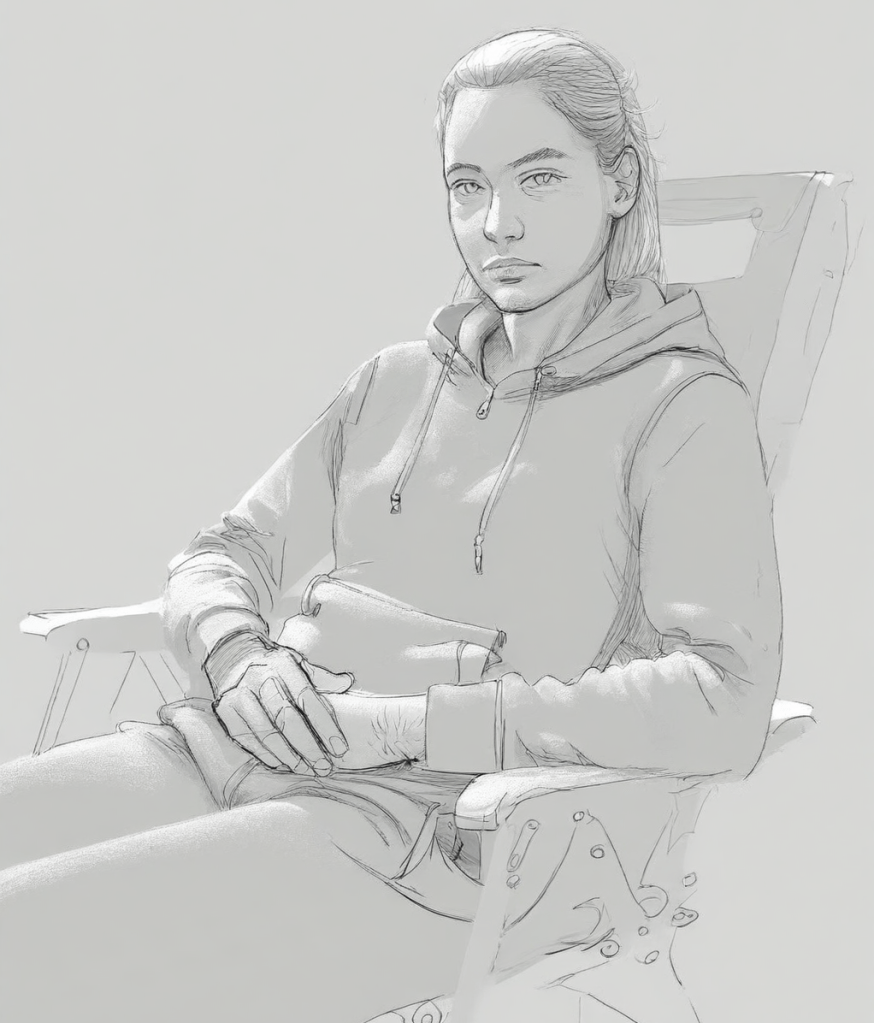
I looked up and found Elena’s pale blues fixed on me, as if scrutinizing every subtle twitch of my expression while I absorbed her writing. She lounged on the lawn chair, her hands folded over the kangaroo pocket of her hoodie.

“May I rely on your external input to learn the gender of the narrator?” I asked.

“Sure. I’m cheating you out of the full experience; a regular reader would already know. As you might imagine, I can’t start any random scene reminding them that the narrator has a penis. So does the protagonist of today’s other excerpt.”

“That makes three out of four male narrators so far. Does it mean anything?”

“That’s how the stories came out. As the conduit, I don’t question these things. If the story demands a male narrator, who am I to argue? Besides, I have no issues with my narrators’ gender. I only care if they interest me. Now, read on.”

The narrator left the clearing in darkness. Distant streetlights invaded through the passageway’s rectangle. Emerging onto the deserted street, he hurried to the opposite sidewalk’s vending machines like a thief stealing food from sleepers’ homes. Next time hunger speared him, he was kissing that woman, her legs entwined with his. The narrator’s dizziness spiked, and he rolled onto his back, gasping. He imagined himself leaving the forest again, but against the nakedness of skulking amidst cement, metal and glass, that ache for food didn’t matter.

Memories of the outside world faded like yellowing photographs. Minutes after twilight yielded to a granite dawn and birdsong, hunger cramps woke the narrator. His guts clung like an old balloon. He pictured the effort to dress, go down the trail through the trees, and hurry to the vending machines hunched and disheveled. He resolved to stay in the clearing. Sheltering there had stripped society’s makeup. He refused to breathe in its stink again even if his starved stomach devoured its own lining and spilled the acid into his core.

The woman looped her arms around the narrator’s neck and urged him to eat. He claimed he would last until hunger stopped his thoughts. She insisted he needn’t endure it. The narrator refused to leave the clearing again, and considered hunting for critters. But she brought up a better option: to feed from her. Then, she leaned back in the grass, tilting sideways. She clenched her side at kidney level and yanked until she tore a handful of white flesh out. In the gash, grooves scarred where her fingers had dug in. Blood pooled. The narrator froze as she folded his fingers around the proffered chunk of meat.

Saliva drowned his tongue. He yearned to savor that flesh as much as he longed to hold the woman against him, joining their warmth like two coals in a bonfire. As he brought the piece to his mouth, he could tell apart the white threads of fiber in the meat. Its surface had grown slick with juice from the pressure of his fingers. His teeth grazed the soft flesh. Saliva spilled from the corners of his mouth, trickling down his chin. He clenched his jaw millimeter by millimeter, the fibers taut against the tip of his tongue. Before he could refuse to feast on the woman, a hot, sap-like juice flooded his mouth. He tore off a morsel and swallowed. It left an aftertaste of turkey. The rest, he devoured, then he licked the juice off his fingers.

A crisp rip startled me from the fictive dream. Elena had torn open the pack of Príncipe chocolate cookies. She plucked one, bit into it, then chewed as crumbs clung to her lips. I imagined myself as that cookie: crushed by her teeth, then ground to fine particles that mingled with hot saliva, coalescing into a doughy pulp. It would slide down the tight, pulsing cylinder of her esophagus and into her stomach, where the pulp would dissolve in gastric acid and become her flesh and blood. A warm vibration welled within my loins.

Her white throat contracted as she swallowed. She leaned forward to pick up the carton of Don Simón from the grass, lifted it, and sipped. A droplet of orange juice escaped her mouth, but she caught it with her thumb.

“Sorry for the noise. You’ve yet to touch your peanuts. Want me to toss them?”

“Don’t worry,” I said, my voice dry. “I can survive for weeks on my fat reserves. And I’d rather not distract myself from your writing.”

Elena shrugged, then set the carton back on the ground.

“Alright. I’ll just keep munching on my cookies.”

She stuffed the remainder of the cookie into her mouth. Crumbs sprinkled her hoodie.

I returned to the excerpt. When the narrator looked up, shame flooded him. The gash in the woman’s side dripped blood down her hip, splattering the grass and pooling on the dirt. He rushed to cover the hole with his hands, but warm blood seeped between his fingers like soup. The woman calmed him, assuring him that her flesh would regrow. He wanted to laugh, but a whimper escaped. He couldn’t live off eating her. She doubted he would eat so much that he’d swallow her whole. Besides, he argued, he needed to ingest proper liquids. The woman lay on her back, then cupped one breast and squeezed the nipple. Thick milk oozed like honey.

From then on, the narrator avoided glancing at the clearing’s exit. He felt that a monstrous hunter stalked that pine-guarded trail, and if he wandered its bends and hollows, the creature would ambush him, tear his limbs from his torso, slurp the marrow off his splintered bones. He wondered how he had dared to enter and leave this clearing without realizing it. Beyond the forest, the machinery of society would grind on, its gears, lubricated with the sweat of nine-to-five drones, screeching as they pulverized bones caught in their teeth. Whenever such images and memories assailed him, patches of his brain crackled with electricity. He wanted to pinpoint those patches and scour them with bleach.

They rolled in the grass, rubbing sweat and soil onto each other’s skin as her tongue probed his mouth, and the part of his brain that believed itself in charge checked out. Sometimes his consciousness resurfaced and found him biting and tearing at her breasts, digging deeper until he should have chewed through her ribs and burst a lung, but instead, just a handspan beneath her skin lay white meat free of veins, arteries, tendons, organs, cartilage, or bones. Kissing along her nape and spine, he sank his teeth into her back and gnawed off a chunk. His mouth flooded with blood that flowed hot and coppery down his throat.

Lying beside her, his belly full, the narrator traced the contours of her ribs and pelvis with his fingertips. Her skeleton held. But whenever he bit, he found white flesh. Even so, a moment after tearing off a piece, the wound oozed blood, and minutes later, when he looked back, her body had stiched itself together. The missing bite was outlined in sticky, half-clotted threads of blood.

Once, the narrator devoured her neck to the extent that he nearly decapitated her. Another time, prying apart her labia with his tongue, as she bucked her hips to his mouth, he chewed into her womb and beyond, splitting her abdomen open to the ribs. He ate an entire thigh and ended up clutching her detached calf, foot dangling from the end. He shoved himself backward on his ass, driving his heels into the earth, and screamed. But when the narrator dared to glance back at the woman, she stood on both legs, and his hand gripped air.


Author’s note: Today’s song is “Velvet Waltz” by Built to Spill.

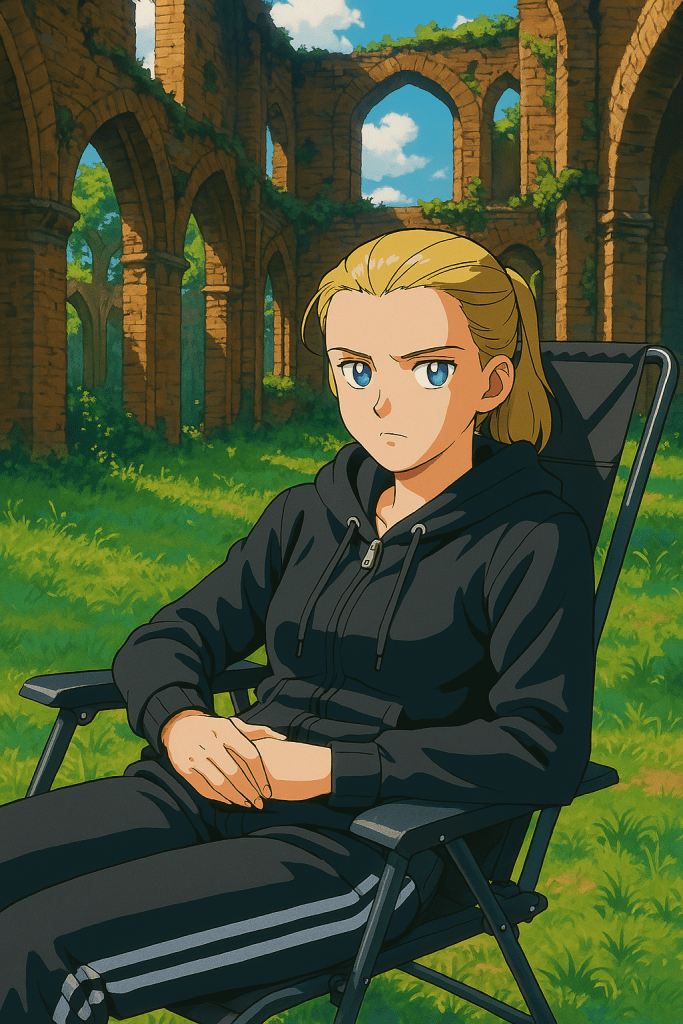
And why not, here’s a 90s anime version of that concept:

Neural Pulse, Pt. 3 (Fiction)

I ordered the helmet’s AI to enlarge the complex’s map and keep it suspended five meters ahead. The three-dimensional map skimmed the folds of sandy earth like a piece of fabric floating on the sea. We circled the hill while Jing and Mara flanked me as though trying to bolster their own courage.

At the base of the crater, the dome emerged. Starlight bathed its crystalline shell, but failed to banish the cavernous darkness of the dome’s three-meter-high mouth.

Mara aimed her camera at the tracks etched into the esplanade before the complex. These crisscrossing, overlapping patterns had been imprinted by the parallel treads of some vehicle, one that had worked around the smaller crater centered in the clearing. We approached. Jing knelt and traced the outline of one track with a gloved finger.

Mara and I continued toward the hole, which had depressed the earth in a five-meter circumference, exposing a rocky base. She focused on the crater with the camera mounted on her arm while pressing buttons along its side. The camera took photos, emitting a succession of flashes. Mara unclipped her Geiger counter from her belt and pointed it at the hole.

I listened, trying to distinguish the crackles.

“Should we be hearing it through the helmet?”

“I’m sending the signal to my suit.”

“What’s it telling you?”

The woman commanded her helmet to display the options. Mara’s gaze drifted up and down as she blinked to make selections. The Geiger counter’s staccato crackling broke into the radio frequency like an uninvited speaker.

“Does that mean it’s radioactive?” I asked.

“Slightly above the ambient radioactivity.”

“Enough to worry about?”

She shook her head.

“Not unless you’re planning to build a house on top of it.”

Jing overtook us while brandishing his thermal camera. He headed straight for the black mouth of the dome waiting about a hundred meters away. When we caught up to the man, his nerves were tugging at his smile.

“How do you think we should approach the unknown?” said the xenobiologist.

“You’re asking me?”

“I’ve studied every previous encounter, reviewed the reports, devoured the documentaries. I’ve read the novelizations for pleasure. But you’ve transported scientists to virgin planets.”

“I used to land as close as safety regulations allowed. I kept the ship running hot in case a stampede of scientists and soldiers pursued by some beast came charging out of the jungle. But it never happened. I just transported tired scientists and soldiers back.”

Jing raised his gaze to the black mouth of the dome, that loomed larger as we approached, and he furrowed his brow as if organizing his assumptions at a forced march. He swept the frontal space in an arc with the thermal camera. I stole glances at the blue-toned figures that materialized on its screen. The black mouth of the dome opened into a void. Orange hues painted the vault, which the starlight was heating. To the left of the dome, a rectangular, sarcophagus-like box mounted horizontally on the wall swayed yellow.

“Entrance twice as tall as those in our equivalent buildings,” Jing said. “Bipeds.”

“Or they just prefer to build them tall,” Mara said.

I commanded my helmet to shut off the projection of the complex’s map. About fifteen meters from the mouth of the dome, its darkness lightened to dark grays. Parallel caterpillar tracks extended inward until merging with the shadows.

Mara advanced diagonally ahead of us toward the right flank of the dome, and aimed her camera at the piece protruding from the hexagonal panels. An antenna oriented toward the skies, constructed of crystalline material.

“They communicate with their civilization, assuming they power the antenna.”

We drew close to the mouth of the dome. The angle from which the star poured its arctic-blue light eclipsed the interior.

My chest tingled as if I were venturing to explore a cavern whose ceiling hung with thousands of sleeping creatures. The evolutionary adaptations their isolated development had afforded them for survival would bewilder me, just like those videos broadcast on news programs whenever explorers uncovered another ecosystem.

I commanded my helmet to activate its flashlight. Its white beam illuminated the sandy ground and the layers of tread tracks. When Jing and Mara mimicked my action, their ovals of light danced across the earth and climbed upward through the emptiness toward the vaulted ceiling.

We ventured into a cavity, as if those who had constructed the dome had abandoned it before furnishing the interior. Jing studied the surroundings while frowning. Mara moved away toward the left flank, where the sarcophagus had gleamed in the thermal camera, and I followed the xenobiologist, who swept the oval of light from his flashlight along the curved wall. The light skimmed over the inner face of the hexagonal panels like it would over tarnished metal.

“No signs or engravings,” said Jing. “No evidence of language. Nothing that denotes the intelligence they employed to construct the building.”

As I twirled the electroshock lance like a baton, during one glance at the ground I noticed circular impressions distributed between the caterpillar tracks—the kind that a staff would make. I tapped Jing on the shoulder and pointed to the circular hollows. The xenobiologist crouched. With his index finger, he traced a pattern in the air.

“Six legs.”

We followed the hollows toward the left flank of the dome. The beams from our flashlights illuminated the golden back of Mara’s suit as she studied with an instrument the mounted sarcophagus. It had been molded from a single piece of bronzy metal. She turned, then narrowed her eyelids against the brightness of our beams.

“They built the dome with solar panels made of some photovoltaic material,” she said, “and the flow of electricity converges here. Batteries, I imagine. They siphon from the star all the energy they need. A fraction will drain into the antenna and the machine that manages communication.”

“And the rest for the habitation pods,” said Jing. “The hypersleep chambers.”

“Which we haven’t seen yet.” She pointed with her measuring device at the furthest end of the sarcophagus. “The electricity flows inside the panels toward the back of the building.”

We followed Mara as she tracked the wiring like an arrow marking the path. Our beams swept across the sandy earth, their white ovals distorting with the depressions and ridges of the caterpillar tracks.

“What will you call the aliens?” I asked, my voice electrified.

“I hadn’t thought of a specific name,” Jing said. “It would depend on their physiognomy, their culture. Though I had considered slipping in a reference to my young son, if the teams that review the nomenclature accept it.”

“Whoever discovers the aliens names them, I suppose.”

“You’re assuming your superiors will refrain from stealing your credit,” Mara said to Jing.

“I should be able to name them. But I will have co-discovered them with you ladies.”

Our beams revealed the curve at the bottom of the dome, and when lowered, the beams converged on a hole excavated in the rock beneath the layer of sandy earth. A polished stone ramp descended like a spiral staircase. I had stepped forward and opened my mouth to ask Jing’s opinion when a honey-colored glow emerged from the ramp, followed by a meter-tall figure gleaming bronze, that headed straight toward us.


Author’s note: I wrote this novella in Spanish about ten years ago. It’s contained in the collection titled Los dominios del emperador búho.

The Scrap Colossus, Pt. 17 (Fiction)

At the end of César Figuerido Street, we turned right and ascended a stretch of pavement winding along a towering wall of trees and wild undergrowth. Ferns draped their fronds over moss-covered gutters. Elena trailed close behind, gripping her backpack’s strap as she shifted the load. Her nostrils flared, her lips tightened, and sweat glimmered at her hairline. Her pale blues were fixed ahead with the determination of someone resigned to enduring torture with dignity.

“You doing alright, Elena?”

“Mm-hmm.”

“The path will level out soon.”

We crossed the road to the side closest to civilization. A middle-aged couple, the man sporting a yellow-and-white knitted earflap beanie, talked loudly in a Slavic language as they exited a parking lot and strode past us. A distant whistle blew, accompanied by a burst of cheering. Between the trunks of the trees, I glimpsed a deep-green field of artificial turf marked for football and flanked by two silvery lightning towers. Color-coded middle-schoolers pursued a ball, intending to kick it toward the opposite goal, while their relatives watched from concrete stands.

The hill flattened. Across a roundabout, dozens of headstones topped by crosses jutted out over a three-meter-tall stone wall.

“Oh, is that the cemetery?” Elena asked, her voice strained.

“It better be.”

“Are you taking me there?”

I shook my head.

“You sure? I could lie down on a slab of marble and catch my breath.”

“You’ll recover soon enough.”

“Or we could find a nice grave for you to bury me in. Save you the trouble of digging a pit in the forest. You could toss some dirt in my face and then just pretend that you never met me.”

“I’m not letting you die yet. We have a lot to talk about.”

“I guess we could bring up some topics.”

“Should I have taken you to another coffee shop instead?”

“No, I’m glad you’re showing me around. It’s a good kind of pain. I’d rather suffer than feel nothing. Besides, I think my heart rate’s approaching normal human levels. Tell me, Jon. Are any of your relatives buried there?”

“Yeah, my grandparents. Never bothered to locate their graves, though. They’re a bunch of bones now.”

We followed the path as it veered left, away from the cemetery. To our right, beyond a fenced garden, the landscape unfurled: Mount San Marcial, carpeted in rolling waves of pine and rising to a pitiful 220 meters. A titanic cloudbank, billowing over the mountain’s crest, eclipsed the chapel at its peak, that struggled to emerge from the treeline. The bluish-gray core of the cloudbank promised rain.

“The mountain looks different from here,” Elena said. “More alive.”

“We’re drawn to higher ground, where the world appears richer in meaning, where we feel safer. From a defensive standpoint, at least.”

“Is that so? Must be the Basque genes. But I get it. I wouldn’t want to be caught at the bottom of a valley when the floods come.”

Further along the sidewalk stood a three-story rectangular building composed of pale-cream bricks, its windows shuttered. Mortar lines across the facade formed a tight grid. Toki-Alai School. Rust had ravaged its fence; you could snag your clothes or scrape off your skin on the jagged edge of a post.

I looked back for Elena. She had crossed the road and stepped onto a grassy patch overgrown with weeds and tiny blossoms of yellow. Crisp white stripes ran down the side of her black joggers. Her pale neck curved elegantly, her almond-blonde ponytail dangling from the back of her head. Elena’s gaze had caught on the panorama: a sprawling array of trucks, some bright blue or red, lined in rows at a transportation yard as large as a stadium, in a stark contrast to the undulating green hills beyond.

When I approached Elena, I wished I had brought a camera, or could stop time. Sunlight cascaded down her face, sculpting her forehead, the bridge of her nose, her high cheekbones, her slightly-parted lips. From beneath the skin of her eyelids, those glacial blues glowed with an ethereal intensity. She evoked a wanderer from some bygone epic, standing before a war-torn vista. She could have been a bardic song, a lament, an ode to a fallen kingdom.

“I guess it isn’t a complete hellscape,” Elena murmured. “I have no idea where I am. This place, the fact that you exist and also have a weird mind… The more I interact with reality, the less familiar it becomes.”

A cool breeze wafted the scent of hillside grass and earth and pine, mingling with the tang of truck exhaust.

“In the spirit of sharing awkward stuff,” I said, “I regret that I will never drive a truck for a living.”

Elena whipped her head toward me, a mischievous smile tugging at the corners of her mouth, drawing dimples on her cheeks.

“What? Why?”

“Well, think of the solitude. All those hours to yourself on the open road, discovering new sights. They say the brain mainly reacts to novelty, so it can fend off predators. If you head away from home regularly, you’ll always feel alive. And imagine the conversations you could have with yourself in the driver’s seat. You could write, too, between naps, in motels or rest areas.”

“That’s a romantic and likely inaccurate portrayal of a trucker’s life. You’d have to deal with the hassle of loading and unloading cargo, navigating roundabouts in a hulk, driving at night. I picture them snagging their trailers on posts, falling asleep behind the wheel, slamming into cars, flattening old people. You’d have to sleep in rest areas, where any shithead could try to break into your cab.”

“You’d also command a multi-ton killing machine that can obliterate anything in its path, up to and including the laws of physics.”

Elena chuckled.

“Figures. You’re aching for some truckmageddon. Maybe with a side of strangling prostitutes.”

“Only a small percentage of truckers are serial killers, you know.”

“Oh, but I see it now: a trucker poet, crushed in the cab of his rig, his unpublished masterpiece scattered across the highway, pages soaked in blood. A crow would land on the rim of the shattered windshield and peck out his eyes.”

“Damn it, woman. Let’s just get to our destination.”

Past the school, a lawn caught the sunlight, forming a shimmering carpet of green. Across, set against the blue sky, loomed a pockmarked ruin, its rugged stones darkened by centuries of moss and grime. Small plants burst like wild hair from fractures and shadowed crevices.

“The hell’s this?” Elena asked. “A ruin out of nowhere?”

“Gazteluzar. Built in the sixteenth century, I believe.”

“So it was here. Gazteluzar, meaning ‘old castle.’ Quite the hyperbolic name, don’t you think? Barely qualified as a fortress.”

We crossed the lawn, our shoes treading over soft grass, and slipped under a rough archway into a courtyard. The sunlit walls rose in a jumble of irregular stones and smaller filler pieces, as if built hurriedly from nearby rocks. Bushes hugged the crumbling corners. I guided Elena toward a circular clearing enclosed by low, lichen-encrusted walls hinting at the foundations of a turret. At the circle’s center, decades of foot traffic had stripped away the grass, exposing bare stone.

Standing against a curved section of wall, a folding lawn chair faced us, its seat and backrest composed of red and navy interwoven strips of plastic webbing. In this dilapidated fortress, the chair looked like it had materialized from another dimension.

“You’ve brought a lawn chair up here?” Elena asked, amusement creeping into her voice. “Just for me to rest? What a gentleman.”

“I’ll gladly take the credit for the work of some anonymous benefactor.”

“It doesn’t even smell of stale beer or piss. The kind of neighborhood where nobody steals an abandoned chair, huh? I better take advantage of it before the owner comes along and shoos me away.”

Elena unslung her backpack and dropped it onto the ground. With a groan of relief, she sank into the creaking chair, its plastic strips sagging under her weight. Reclining with her eyes closed, she draped her arms over the armrests and stretched out her legs. After a couple of deep breaths, she turned her head and threw me a languid, heavy-lidded glance.

“You took one hell of a gamble, Johnny boy.”

“How so?”

“Bringing a woman you barely know to a secluded ruin. Most would think, ‘Does this big, bearded fellow believe I aspire to become an archaeologist?’ Nevermind that reaching this place requires an Olympic fitness level.”

“No gamble at all. You’re not most women. I brought you here because this is what you’re like.”

Elena lifted her head from the backrest. Her ivory skin accentuated those pale blues as they locked with my eyes, granting me passage through the darkness of her pupils into her abyssal void, a space preceding language, filled with black stars and white blood. Her lips curved faintly into a placid smile.

“You do understand me, don’t you? Better than anyone ever has. I should run away while I can.” She sighed, then lifted her backpack onto her lap. “But I’m fairly easy. I appreciate most places as long as they aren’t packed with people. Better than staying at home with my parents and their endless disappointment.”

Elena unzipped her backpack. Amid a crinkling of plastic, she pulled out the carton of Don Simón orange juice, unscrewed the cap, tilted her head back, and chugged. She then rested the carton on the ground between her canvas shoes. As she licked her lips, she reached into her backpack again and brought out her blue folder. She opened it and retrieved a stapled stack of papers.

“You may enjoy this one. Also takes place in a secluded clearing.”


Author’s note: today’s song is “Dear Sons and Daughters of Hungry Ghosts” by Wolf Parade.

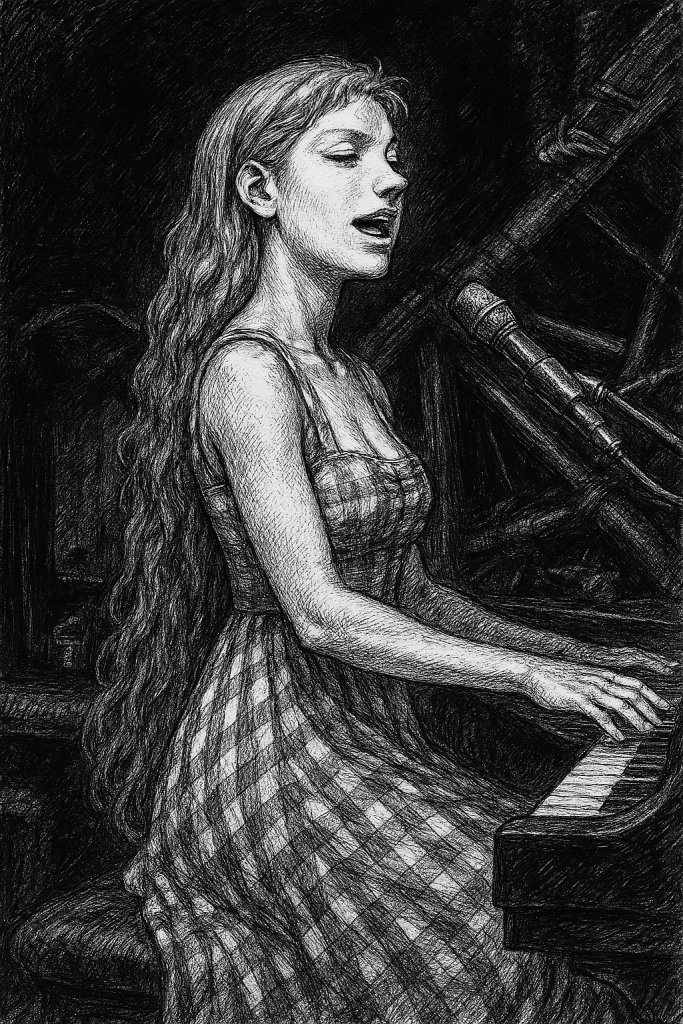
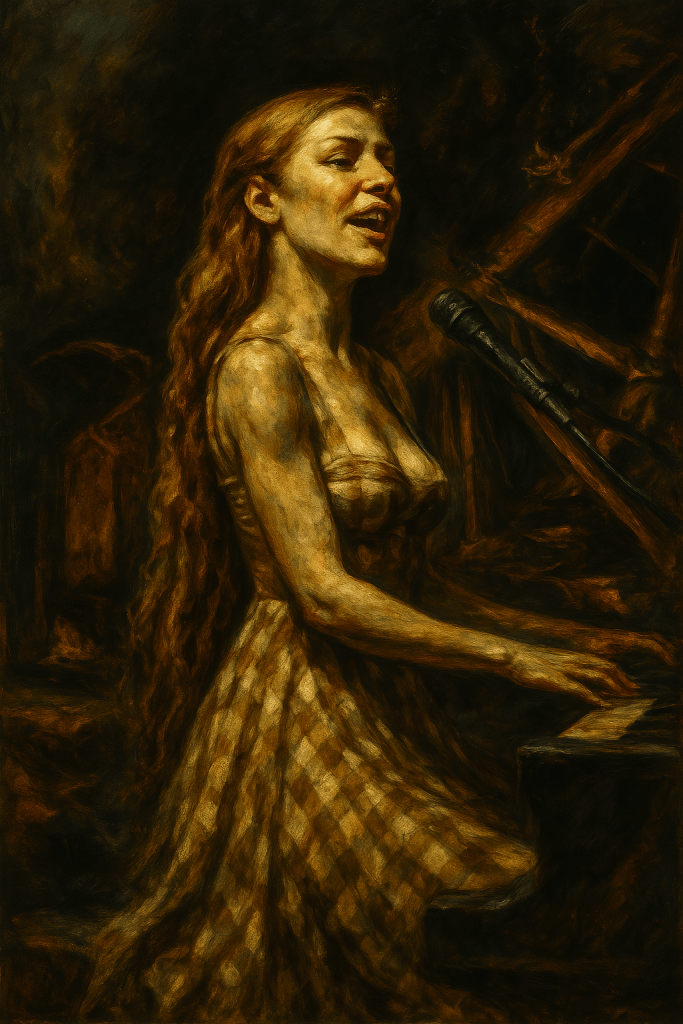
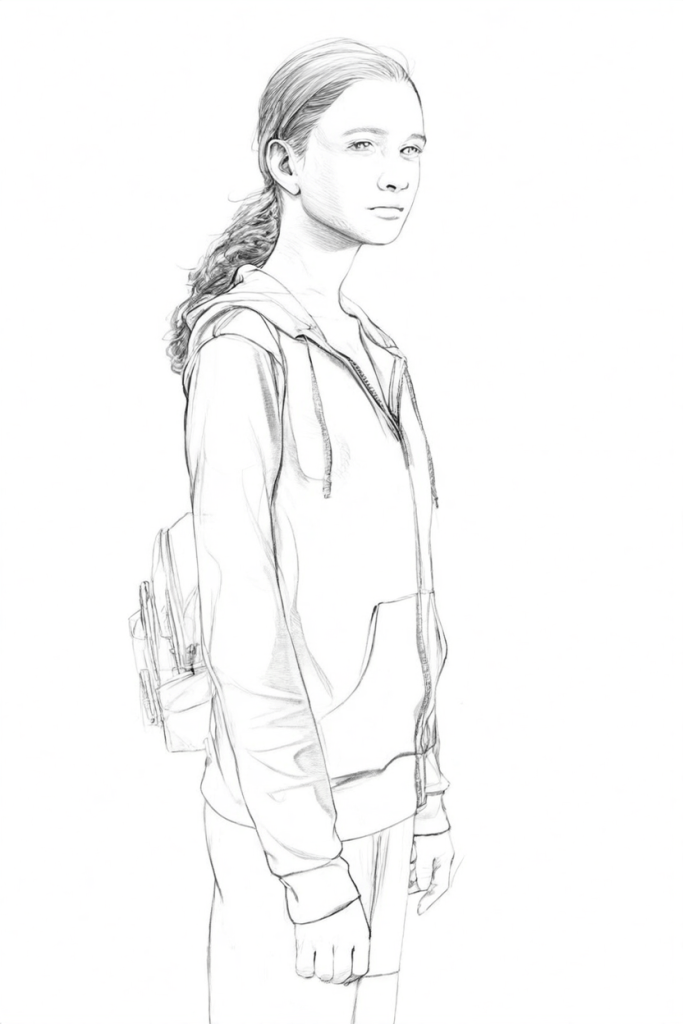
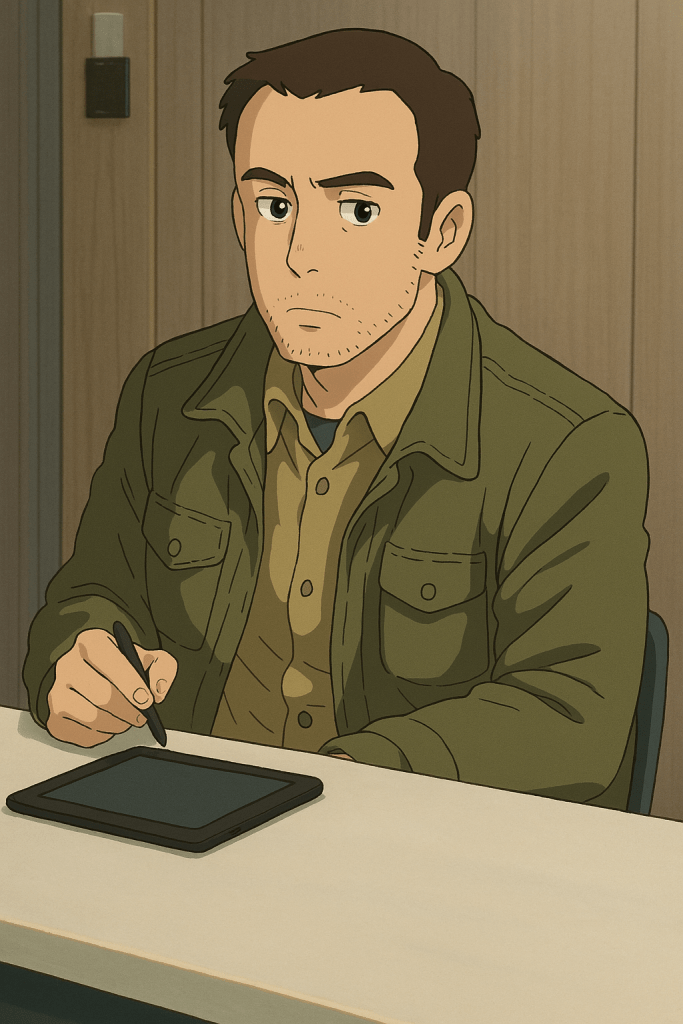
Did the Ghibli thing

In case you haven’t been around for the past couple of days, OpenAI (creators of ChatGPT, the company that has the infamous record of charging the most for one of its AI models) released a revolutionary image generation model that’s leagues above what was possible before. People have gone nuts asking ChatGPT to generate images of themselves and their families (and memes) in Studio Ghibli’s lovely style. Here is the result with a couple of old photos of mine, from around the time the events of The Scrap Colossus take place.

Credit where credit is due: Studio Ghibli is the legendary Japanese crew responsible for unforgettable films like Spirited Away, Princess Mononoke, Grave of the Fireflies, My Neighbor Totoro, Nausicaä of the Valley of the Wind, and more.

I wondered what would happened if I drew a shitty manga portrait with my mouse on Paint and told ChatGPT to make it into something professional looking in Ghibli’s style. The shocking results are below.

That mouth was supposed to be open, but other than that… Jeez.

Neural Pulse, Pt. 2 (Fiction)

Jing’s voice, which belonged to the type of neighbor who would occasionally show up offering a tub of food, invaded my helmet as if the xenobiologist had hunched over my ear.

“Can you help me?”

He had climbed the steps to the cargo compartment and was gripping the handle like the lid of a stubborn jar refusing to open. When I approached, Jing descended the steps and moved aside.

“I’ve never worked with one of these vessels before.”

I released the safety mechanism on the handle and slid the door open with a single pull. In the circular hollow, like the inside of a can, the containers waited stacked and secured with taut netting.

“Don’t worry. Nobody is born knowing.”

Jing laughed politely. I gave him space while the xenobiologist removed the containers one by one and gathered them several paces from the ship. When he crouched beside a container, I stood up next to him.

“Have you done this before?”

“I’ve been transported to many planets.”

“To an uncivilized one?”

He lifted his face to smile at me.

“That’s new.”

He sank one knee into the sandy earth and opened the container’s lid. Inside he had organized smaller containers and measuring instruments. I recognized a thermal camera.

At the top of the ladder to the cabin, the hatch to the depressurization chamber had closed. I surveyed the ship’s surroundings. Dozens of meters up the slope, the previous landing had carved descending tracks in the hillside, like the drag marks of some deep-sea monster across the abyssal floor.

“Have you seen Halperin leave?”

Jing, who was emptying the container and arranging the instruments on the sandy ground, looked up in surprise, glanced around, and shook his head.

“I’m in the cabin,” Mara said over the radio.

I bit my lower lip and took a deep breath. I climbed the ladder. Turned the hatch handle, yanked the hatch open, and entered. As hissing sounds enveloped me, I waited for the chamber to pressurize, then I opened the door to the command cabin.

Mara, seated at the control panel with her helmet and gloves on, was refreshing on a monitor the frequencies used by the station. I approached until I could distinguish the profile of her face through her helmet lens. The curvature magnified my friend’s features in a way I had never seen before, a face from which strangers expected to receive the same candor with which they treated her, but it belonged to a nervous creature.

I leaned on the upper section of the control panel.

“I suppose you’re checking to reassure yourself.”

“For now, we remain invisible.”

“With luck, we’ll return to the hangar stuffed with artifacts, long before anyone notices the ship is missing. Some days they don’t even bother to inventory the old burners. They think nobody would pilot them.”

“After that first landing, I understand.” When Mara stood up, her features twisted as if seized by a gut-wrenching cramp. “I hope we’re lucky as you say. I thought I would acclimate when we reached the planet, but my nerves are getting worse.”

We passed through the decompression chamber and descended the ladder. Jing was emptying the second container. We advanced toward him, but Mara lagged behind, contemplating the vast stretches of walnut-brown earth as if she had awakened in the middle of the night in some unknown bedroom. The landscape was crisscrossed by layers of hills and mountains that faded into purplish hues with distance. The mountain peaks jutted out bone-white like splinters.

Clustered around the xenobiologist were containers and gauges. I nudged a metal box with the toe of my boot; on its top surface, a display showed rows of numbers and codes.

“I can’t imagine what half of this stuff is for.”

“Routine equipment,” Jing said.

“But you haven’t come to explore a cave bordering on a colony, Jing. Time is pressing. By now we should be heading down toward the dome.”

Mara hurried to the closed container and opened it. She pulled out a Geiger counter. Crouching, both scientists focused on readying the equipment. Each piece of gear they set down on the sandy ground kicked up a cloud of dust that the limited gravity was slow to settle.

If only I could rub my face. I paced about ten meters away from them, longing to scout the crater alone before the two scientists appeared at the crest of the slope lugging their gear. The waiting chained me, and I pictured a hangar employee stopping before the burner’s vacant spot and reporting its absence to his superior.

“Got a moment?” Jing asked.

I approached. The xenobiologist had gotten to his feet, and from that angle, the star’s light highlighted the gray strands at the side of his head, where his black hair was still thick. With his right hand, Jing brandished an electroshock spear. Extending fifty centimeters up from the handle was an iron-gray shaft terminating in two prongs like a snake’s fangs.

Jing handed me the spear. I hefted it, turning it over as light glinted along its polished shaft.

“Planning to wake them from hypersleep?”

“It looks abandoned from the outside, but maybe someone keeps watch in shifts. Security measure. Even if we just came to say hello, no one invited us.”

I raised the spear and pressed the button. A crackling arc of sky-blue flame leaped between the prongs at the tip. When I released the button, the arc vanished, leaving a wisp of smoke that dissipated in the breeze.

“The charge will run out,” Jing said.

Mara appeared at his side. She had clipped an array of meters to her suit’s belt, among which I recognized a multimeter and a Geiger counter. She had mounted a camera on the thick, reinforced fabric of her left sleeve. It would record whatever she pointed at. The woman hid her nervousness behind an expression carved from milky quartz.

Jing programmed an empty container to follow him. He slid a pry bar through a loop on his belt and clipped on an electric screwdriver. He walked closer, each footstep kicking up a plume of dust. The container trailed the xenobiologist like a dog.

“Ready?” I asked.

As they nodded, arctic blue reflections slid up and down their helmet visors.

I marched towards the edge of the hill, tapping my suit’s shoulder with the electroshock spear.

“Let’s go say hello to those aliens and dismantle their house.”


Author’s note: I wrote this novella in Spanish about ten years ago. It’s contained in the collection titled Los dominios del emperador búho.

In case you’re thinking, ‘This is shit,’ I must admit that the beginning of the story is my least favorite part of the six novellas I wrote about ten years ago, and this scene in particular may be the most boring. It makes me cringe to think that the judges of a couple of contests read it. So if you have gotten anything of value out of this scene, the story only improves from now on, as far as I remember.

This story is something of a homage to two stories: first, Michael Crichton’s Sphere, my favorite novel as a teen. Second, the first novel I ever attempted to write: a disastrous, almost-incoherent tale about space marines doing dodgy shit, which I started when I was fifteen or so and eventually abandoned when I was twenty. I dreaded to read any excerpt of those manuscripts (I rewrote the story several times, as I had no fucking clue what I was doing), because they mainly displayed my psychotic state in that miserable period of my life.

A few years ago, as I cleaning out stuff from my youth, I threw away all my remaining copies of that manuscript. A stark contrast with an instance when I was nineteen in which I forgot a corrected manuscript in a neighboring city and I nearly had a mental breakdown until I managed to get it back. Discarding stories that don’t work, and that may even poison your current writing if you let them in again, is a way of growing as a writer. I think so, at least.

Although I thankfully remember little of those years, I recall I used to be a bit of a pantser (writing without a clear map), which I have abhorred since. Every scene in a story functions effectively only in relation to the broader constellation of planned scenes. You won’t fix it in post, trust me; by then, the words will feel carved in stone. These days not only I keep chronologically organized notes and Excel files with scene lists, but I have also adopted the “manga series” style of nailing a scene in one shot, which forces you to make all individual parts compelling in some way.

Neural Pulse, Pt. 1 (Fiction)

I tore myself from the dance between burning fuel and watching the altimeter to peer through a viewport. Jing’s profile hindered the view of the crater, its walls rising, encircled by a walnut-brown barren plain. The crests of the hills forming the crater rim gleamed bone-white, and deep within its sandstone-red base, the four-story high dome scintillated. It had been clad in hexagonal panels that reflected the star’s arctic-blue light like a kaleidoscope.

Jing smiled, and stroked the black bristles of his goatee. I focused back on the controls while monitoring our velocity. I burned half a second’s worth of fuel to dampen the descent. Every microscopic adjustment vibrated through the seat into my body; I barely needed the instruments for guidance.

Three hundred meters to touchdown. Two meters per second. The crater walls rose, hiding the dome like an inverted curtain. Jing craned his neck toward a viewport, drinking in the landscape.

One hundred fifty meters. One and a half meters per second. The ship accelerated in its descent, but I fired the thrusters in hundredth-of-a-second bursts to slow it. The altimeter dropped: seventy meters, fifty, thirty. I burned fuel, keeping the descent under two meters per second, until the landing gear touched down with a metallic screech that resonated through the cabin.

Seated at my four-thirty, Mara had turned toward me. She’d bared the whites of her eyes, pursing her lips as she waited for me to confirm her suspicions.

I cut the engine. I was checking the gauges, making sure nothing had broken, when the cabin shuddered with an indigestion. With a jolt, we slid downhill at an eight-degree angle.

I grabbed the controls. Hunched over to peer through Jing’s porthole. The slope that obscured the view of the dome—that carapace of hexagonal panels—was sliding away to the northwest.

Mara spoke over the metallic scraping sound.

“We’ve landed on a slope.”

“Thanks. I wouldn’t have realized otherwise.”

“Just making sure.”

“You’re distracting me.”

The tilt steepened to twelve degrees. One leg of the landing gear lifted a few centimeters then scraped back down the slope, while the other leg swept through the sandy ore like a breakwater. A waterfall-like roar resonated through the cabin.

I fired the thrusters for a second, which lifted us diagonally off the slope. We drifted in a parabola, moving away from the landing point—a trajectory that would roll us onto our side unless I righted the ship. I fired the lateral thrusters in bursts. On the altimeter and the velocity gauge, numbers scrolled past. For fractions of a second, I countered the roll from one side to the other, like damping the sway of a bell with gentle touches, until we were descending vertically.

Jing spoke over the roar of burning fuel.

“Solar panels, the dome cladding. And on the forecourt, caterpillar tracks.”

My right hand gripped the control, my thumb tensed over the burner button, as if I were an extension of the ship. I balanced the descent, guided by the cockpit’s vibrations while the indicators blurred. My instinct decided before I could even consider overriding it.

The landing gear touched down. The cylindrical stack of cargo bay, fuel tank, and cockpit settled, sinking us a few centimeters into the sandy ground.

The pad of my thumb rested on the burner button; my shoulders were still tense, lifted off the seatback, until I took a deep breath. The ground held.

I released the controls and wiped the sweat from my palms onto the suit’s padded kneepads. I unbuckled the crossed harness straps.

To my left, Jing met my gaze, smiling. His thinker’s forehead and the patch of scalp conquered by baldness, damp with sweat, reflected the indicators.

I glanced over my right shoulder at Mara. She had tucked her chin behind the neck ring of her suit. The look she shot me rebuked me for the landing, as if I had promised her a textbook descent. Had I promised her that? But a smile unfolded on my face all by itself. Just like a hundred times before, I had mastered gravity, plunged down the well that some rock titan sank into the fabric of space-time, but this time I’d managed it in a training ship.

I took the tin of mints from a compartment. I tilted my head back and shook the tin until three mints tumbled onto my tongue, refreshing it. I reached back over my shoulder to offer the tin to Mara.

“I would’ve preferred we hadn’t relied on luck,” she said.

“I’ve had rough landings before.”

Mara took the tin from me. She shook two mints onto her palm, picked one up between two fingertips like medication, and slipped it through the gap between her lips, stark against her pale face.

“If we’d capsized, could you have righted the craft?”

“We wouldn’t have capsized. I was flying her.”

“We would’ve needed to call for rescue. Then what?”

“We’ve landed, Mara. Breathe.”

I stood up as Jing unbuckled his harness. I made my way, hunched over, to the airlock hatch. Inside, on a sidewall, three spare suits dangled like deflated balloons. Curves of light skittered across the folds of the plastic material. The fabric shone golden from the shoulders to the gloves, down the sides of the torso, and along the outer legs, while the chest and inner thighs remained white.

I took down a helmet and seated it on my suit’s neck ring. When the lens interface activated, it projected data between me and the airlock wall, displaying my vitals in a blue font. I aligned the back of my suit with the oxygen tank feed. Engaged it. My helmet flooded with cool, light air, like the kind I’d breathed in the mountains of several planets.

As I pulled on my gloves, Mara and Jing jostled each other carelessly in the space where we could barely fit shoulder to shoulder. Jing apologized; Mara frowned. I checked the seal on the woman’s helmet. Her ashen gaze darted across my face. I ordered them to let the helmet intelligence run the suit integrity check. They scanned the results while I physically checked the seals on their suits where gloves met sleeves and pants met boots. Reflections from the overhead halogens slid across their helmet visors. I nodded.

When I pulled the lever to depressurize the atmosphere, the hatch to the cockpit slammed shut with the clang of an armored door. Hidden machinery hissed as it worked until the exterior hatch opened a crack. I pushed the hatch, maneuvered my body out through the opening, turning as I went, and my foot found the first rung of the ladder. I descended past the fuel tank.

Above me, the legs and boots of a suit, silhouetted against the violet sky, probed cautiously from rung to rung, as if fearing the next one might give way. When the curve of a landing gear strut emerged to the right of the ladder, I let go. I landed, kicking up dust.

The reconnaissance flights had led me to believe I had a grasp of the terrain, but from the ground, those hills, craters, and mountain horizons dwarfed me. The star, bottle-cap-sized, glittered an arctic blue, and when I gazed at it, the helmet’s visor tinted to protect my vision. I moved forward a few meters, my boots sinking into the sandy soil, toward the hill we would skirt. Beyond, the dome awaited.

I fidgeted like a dog waiting for a ball to be thrown. My racing heart sent a tremor through me, concentrating in my hands and feet. I wished I could have a shot of liquor to moisten my mouth.

I requested the helmet’s AI to project the map of the complex, and the AI displayed it in blue light onto the folds of sandy ground. It had extrapolated the aerial photos I’d taken of the complex into three dimensions, displayed on a grid. The hexagonal-paneled dome stood four stories tall, and in the forecourt, dominated by a smaller crater, several tracks crisscrossed like on a construction site.

I wanted to sprint up to the top of the slope and survey that carapace. It was as if I’d pulled up to the starting line of a race, waiting for the countdown to reach zero, anticipating the moment I would stomp on the accelerator.


Author’s note: I wrote this novella in Spanish about ten years ago. It’s contained in the collection titled Los dominios del emperador búho.

Today’s song is “Everything in Its Right Place” by Radiohead.

It seems all those dozens of hours playing the original Kerbal Space Program paid off.

The Emperor Owl, Pt. 17 (Fiction)

I open my eyes. The midday sun, bathing me through the branches and leaves, bleaches my vision, rendering the jagged branches like pencil sketches.

The wave of emotion has knotted my throat and weighs upon my chest, as if every tree, every blade of grass, were fighting to tell me what ails it. I clutch the folder beneath my left arm, then undo the pin holding the fold of my right sleeve and roll it up until, a few inches below the elbow, the stump of my arm emerges like a blind, white mole. The blur of scar tissue makes me shudder with the pain of having had to hide it. A pain that intensifies with every person who discovered the stump, who strained to meet my gaze while hiding their revulsion, as I fought to focus on their words and ignore their pity.

At my feet, the grass traces the scabrous blight burned into the earth by the black vomit. On the trunks of both beech trees, thick welts—where the bark shrank and withered—mark the touch of that mass of muscle and sinew.

The brook murmurs. A breeze stirs. I imagine unseen eyes watching me, but even the birds chirping from the canopy ignore me.

I open my mouth, clear my throat. How will my voice sound after such a long silence?

“I wanted to stay away. I’ve put this off for too many years. You shouldn’t have existed in this world, so I must have invented you. I wanted to forget those memories of someone impossible. If I clung to them, I’d slide down the slope toward believing in a reality different from this ugly, somber world. I tried to convince myself I’d had an accident, that doctors amputated my arm.” When I steal a glance at the stump, the tangle of scars chills me. “But you existed. It happened just as I remember, and I remember every detail.”

The sickening tide that threatens daily to submerge me washes over me. Though I blink to keep tears from surfacing, they gather behind my eyes like water against a dam.

“You warned me, and I ignored you. Most times I need to use the hand that’s missing, I become enraged, but I dodge my own blame. I tried to convince you that you were wrong, even though I knew nothing. Many nights, before falling asleep, I wonder where you are. We came to this forest, to this world, by chance. In these past decades, I’ve lived the best I could, but even the worst moments surpass how I lived before I met you.”

A cavernous echo frays. When I rise onto my tiptoes and strain my ears, the echo fades away. My legs tingle as, for a few seconds, I cling to that illusion. Will I glimpse his silhouette from the corner of my eye? Will the pins and needles prickle?

“Wherever you are, I hope you can forgive me. I convinced you to trust me, and I remember you drawing away before you vanished, knowing that what had happened would be repeated with everyone who persuaded you to escape.”

I look around. Behind me, the grassy slope climbs beneath vines that strangle some branches of the interwoven canopy. At my feet, chunks of bark, sticks, and leaves partially conceal the splatter of muck.

“Your very substance, wherever you might have come from, now flows within me. Your world doesn’t accept returns. I know what you had to endure, why you needed others to keep their distance.”

I modulate my voice to keep it from breaking. The corners of my eyes burn, and between blinks, my vision glazes over.

“Once it touches you, it contaminates you. I stopped it from killing me, but it flows through my veins, soaks my brain, stains everything I see. It supports me as much as my own skeleton.”

When I close my mouth, I wish I had just parted my lips for the last time. I relax my shoulders, but my left arm tugs my torso towards its side. I loosen that armpit until the folder slides into my hand. I crouch, open the folder, take out the drawing, and set it upon the splatter of muck, fitting it into the clearing amid the grass. I stand up and take two steps back.

In the center of the charcoal-shaded sheet, eraser strokes reveal a greasy heap of muscles and tendons hanging in strips, its surface bulging with buboes. From the heap’s left side, a fibrous, dripping appendage extends, reaching out towards me.

THE END


Author’s note: I wrote this novella in Spanish about ten years ago. It’s contained in the collection titled Los dominios del emperador búho.

Today’s song is “Velouria” by Pixies.

Four of Elena’s novellas translated. Only the stories of Siobhan and Kirochka are left.

The Emperor Owl, Pt. 16 (Fiction)

I staggered, losing my footing in the swaying motions, but managed to thrust a leg forward to catch myself before falling. I turned and retraced the trail back through the passageway between the beeches, wading through the blackness toward the house. My consciousness floated above the pain like a squirrel perched atop a pine tree that towered over an ocean of flames and columns of smoke. The black, taut skin of my right hand’s fingers tightened, and the stain spread across the palm and the back.

My mind went blank. I pitched forward and would have slammed into an oak, but I thrust my right hand out to brace against the trunk, wrinkled like an elephant’s hide. Starlight silhouetted the low-hanging branches, which draped in clusters of leaves. Though I’d pressed my fingers and palm firmly to the bark, the pressure in that arm dulled as if the limb had fallen asleep. In the darkness, beneath my blackened fingers, the bark shrank and withered. When I tore my hand away, the wood crumbled into gray sawdust.

I hunched over the trunk, blinking. I had carved a hole in the shape of my fingers, and the depression spread, rotting the bark until it crackled and broke into fragments and dust.

I reeled through the blackness. In flickers of awareness, slopes tilted up or down, the gray outlines of trees obstructed my path. Branches scraped me and struck my head—featherlight touches amid the waves of pain that my boiling blood radiated through me.

I emerged from the forest. Fifty meters away, a cone of white light swept over a grassy pasture. In sways, the beam tilted skyward, dissolving into the night.

I opened the pasture gate and climbed the slope. The beam spotlighted me suddenly, blinding me before sliding down to the chest of my sweater. At the crest of the pasture stood two figures: a bearded man in a corduroy shirt and denim jeans, accompanied by a gaunt woman whose wild, ashen mane framed a pallid face. A terrycloth robe hung from her shoulders as if draped on a coat hanger. The man gripped a flashlight in his left hand, and in his right, the long handle of a headless tool.

I froze. Did I know them? A ring of pain burned around the palm of my right hand.

The man strode toward me. Hatred twisted his weasel-like face, where the sparse hair atop his head merged with a thick, wiry beard. As the man and woman approached, they split apart to flank me. The man jabbed the tool handle in my direction.

“I hope you’ve enjoyed yourself, because this was the last time you’ll leave the house.”

I advanced toward him and raised my right hand.

The man halted, freezing the tool handle mid-air, and stared at the taut, burnished skin—black leather—that sheathed my hand up to the midpoint of my palm, which I held aloft like a greeting.

I locked eyes with him.

“I see you.”

I pressed my open hand against the man’s face. A surprised gasp escaped him as he stumbled back two steps. The curve of his upper lip, the tip and bridge of his nose, and the imprint of my four fingers on his forehead, rooster-crest-like, had all turned ashen gray. His mouth fell open, features swelling with panic. Then, parts of his forehead, nose, and upper lip crumbled into a spray of ash.

The man shrieked. He dropped the flashlight and the tool’s handle to slap his palms against his face. Borders of ash expanded across his forehead—eaten down to the bone—along the cartilaginous ducts of his nose, and over his bare teeth as though he’d been born with a cleft lip. With each smack, between screams, his skin and flesh crumbled into puffs of ash.

He crumpled to his knees. His eyeballs blackened and dried like raisins. The hollows of his nose and mouth merged, revealing bloody cavities like the ventricles of a heart. His thick tongue quivered as rotting gums released their teeth. His screams sputtered out, replaced by those of the woman beside him, hunched and shuddering. She clawed at her face, fingers sinking into flesh, shrieking through a gaping, twisted mouth.

I stepped forward. The woman, startled, tried to run, but I seized the collar of her bathrobe with my left hand. When I yanked her toward the ground beside the man, momentum sent us both crashing down—her sprawled on the grass, me kneeling.

The man had collapsed onto his side atop ash-sprinkled grass. Within the hollow shell of his skull, borders of rot spread, swallowing the ruined bone toward the nape of his neck.

The woman screamed, soles of her slippers slipping on the damp grass as she struggled to rise, but I straddled her back and shoved her face against the man’s skull, which shattered on impact into a cloud of ash. She whimpered and thrashed. I clasped her nape with my left hand, pressing her face into the ashen ring at the man’s neck—a smoldering cigarette tip. Her muffled scream choked the air. In a spasm, she wrenched her face upward to the sky. It was now coated in a layer of ash like fleece, gray and greasy, the hole of her mouth contracting and expanding as it sucked in clumps of rot.

I leaned my full weight against the nape of her neck, driving her face into the corpse’s ashen, sludgy mass between its shoulders. The woman groaned, shook, thrashed her legs. Her nails clawed at the sleeves of my sweater as the muscles in my arms quivered. I squeezed my eyelids shut; my teeth grated together.

Her body convulsed for a few seconds, then fell still. I released her head, letting it slump onto the man’s torso—a lump of thick, greasy ash—as if resting on a bed of crumbled incense stick half-charred to nothing.

I stood. My left arm flashed white with a cramp. The woman lay facedown in a frothy sludge, while the man’s corduroy shirt sagged where the flesh beneath had crumbled.

The flashlight lying to my right cast sharp outlines on blades of grass in the dark. Insects swarmed in its luminous pool. I grabbed the flashlight and swept its beam across the field as I staggered downhill toward the house.

The black stain had gloved my right hand and crept up several centimeters past my wrist. My heart pumped darkness. Half-hobbling, half-tumbling down the grassy slope, I forgot I’d ever known anything but this pain.

I entered the stable. The cows craned from their stalls, chains clinking, and fixed me with wide, glassy eyes. One stretched its neck and loosed a low, drawn-out moan.

When I halted, I swayed. My vision blurred, but I lurched toward the first stall. The cow grew frantic, stomping the stone floor, and retreated into the wooden partition as it stared with dread at the stain on my right hand. I crouched over the chains, which swept up wisps of straw as they dragged. With my left hand, I fumbled open the shackle clamped around the cow’s leg, and when I tossed the iron aside, it clanged against grimy stone. I freed the other three cows, but they lingered in their stalls. Two dipped their heads to chew hay.

My flesh seethed with pain. I hobbled to the stool by the entrance, flanked by tools propped against walls or dangling from hooks: an axe, a hoe, a saw. I grabbed the saw. Set it on the stool. Traced my fingers over its jagged teeth. Kneeling, I gripped the saw with my left hand and laid my right arm across the stool. I aligned the blade’s teeth a handspan below my elbow, close to the encroaching stain.

I swallowed, locked my jaw. With a single left-armed thrust, in a flare of agony, the teeth bit into muscle, then scraped bone.


Author’s note: I wrote this novella in Spanish about ten years ago. It’s collected in the collection titled Los dominios del emperador búho.

Today’s song is “Out of the Black” by Royal Blood.