We’re Fucked, Pt. 121 (Fiction)


The amber-and-gold glow of dawn bathes a bearded man clad in animal furs. He’s standing barefoot on grass that glistens with dew, his rugged figure framed by the maw of a cave. The man’s face bears the marks of the sun and wind, and his thick beard is matted with traces of last night’s campfire. Around his neck hangs a necklace of teeth and bones.

As the man squints against the rising sun, he raises a steaming cup of coffee to his lips and takes a sip of the bitter brew. When he lowers his gaze, a jolt of surprise shakes him, causing his hands to jerk and the coffee to splash over the rim of his cup. His eyes widen, his mouth falls agape, the tendons in his neck stiffen. A shaggy, hulking ground sloth slams against the man, thrusting him backwards into the cave. The steaming cup sails in an arc through the air, trailing streaks and droplets of coffee that gleam orange in the sunrise.

The warm weight of a body is draped over me like a heated blanket. Two hard nubs are poking my upper back as a petite bosom presses against me, and more conspicuously, a pulsating shaft is pumping inside the slippery channel of my vagina.

I stir. Although my eyelids peel open, either I have gone blind or the rolling shutters have sealed the bedroom in blackness.

Soft lips nuzzle the crook of my neck in kisses that coax ticklish shudders through my spine. I feel the rise and fall of her chest, along with the beating of her heart.

“Good morning, ma chérie,” says a light and airy voice, high as the upper notes on a musical scale.

My breath hitches in my throat, my muscles tense up. I’m trapped in this person’s grip: she has wrapped an arm under my breasts, and with her other arm, she has caught me in a headlock. Who the fuck is fucking me?!

As my panic escalates, my mind paints a picture on the canvas of darkness: vibrant, wavy copper hair cascading down; a constellation of freckles dusted over porcelain skin; coral-pink, well-hydrated lips like velvety rose petals. I relax, then lean back into Jacqueline’s embrace just as one of her hands glides down to caress my abdomen.

“And what a beautiful morning it is,” she purrs.

“D-did you fall asleep with your dick on?” I utter in a voice raspy with sleep.

My ear fills with soft giggles, the tinkling of tiny bells.

“More like passed out, after I drained myself deep inside you. No wonder I slept so soundly. Today I have woken up snuggled up to ma moitié, my erection nestled between her ass cheeks, and I figured that I could help her start the day off right.”

She’s rocking her pelvis, prodding the length of her penis inside me with a friction that brings forth a wash of slippery juices.

“Ah, ça c’est bon…” she murmurs, her voice quivering with the rhythm of her thrusts.

“Wh-whenever you grow that dick of yours, you turn into a wild beast.”

“Don’t you love to wake up to the feeling of mommy’s cock plowing your insides?”

“Of course I do. I purely pointed out a fact.”

“You’re right, though. I become a wild animal driven by the need to hold you tight and fill you up with cum. And that, mon bébé, is what I intend to do.”

As her throbbing hardness grinds inside my velvet chamber in an undulating motion, rubbing against every fold and groove, pleasure rolls up from my loins in delicious waves. A hand fondles my right breast, kneading its plump flesh. Her fingertips trace the pebbled surface of my areola, and when she pinches the nipple, a bolt of ecstasy lances through me. Her hot tongue travels upwards along my neck, leaving a trail of fire. Her lips close over my earlobe, which she nibbles in electric prickles.

Sighs and whimpers keep escaping from my throat. I reach for the back of her head and intertwine my fingers with her silky locks.

Jacqueline’s hand slithers down from my breast, along the concave plain of my abdomen. Folding my right leg, I plant my heel on her thigh to offer better access. Her hand reaches the patch of curls above my slit and begins to rub circles on my turgid clit. Meanwhile, her pulsing shaft withdraws with squelches, sluicing my arousal out and spattering it onto my inner thighs, only to plunge deep again. The furnace-like heat inside me is coiling tightly. Her swollen glans nudges my cervix, making my toes curl. The muscles of my pussy clamp around her in rhythmic spasms as if trying to suck her deeper.

I attempt to muffle my whimpering moans with the pillow, but Jacqueline’s other hand, still securing a headlock, coaxes my face towards hers. Our lips lock, and her tongue slides against mine in a velvety dance. I can’t help but moan into her mouth. Once she pulls away with a wet smack, she speaks breathlessly.

“Oh, I wish I could stare into your puppy eyes now, mon trésor, at that face distorted by lust-glazed adoration. I can’t wait to see your belly swell and your breasts engorge with milk to feed our child.”

Our child? We can’t have a child of our own. It’s not driven by the fear of miscarriage or labor fatality alone, serious as those risks may be: the spare bedroom where Jacqueline filmed some of her camming sessions has become Nairu’s room. Would we compel our Paleolithic artist to endure a screaming baby and piles of soiled diapers just so Jacqueline and I could experience the luxury of a biological offspring? What about our second child’s individuality, forced to share a bedroom growing up? Well, we could move into a bigger home, like a castle; my wealthy shapeshifter could afford it, and if necessary, I’d pester my interdimensional stalkers into paying for the renovation fees. But a baby produced from our combined genes would be ruined by a legacy of sexual deviancy. Even worse, he or she may inherit my anxiety, my intrusive thoughts, my obsessive tendencies, my self-loathing, my depression, my compulsive masturbation. That kid would be doomed to a lifetime of misery. And what if I become the sort of mother who locks herself in the bathroom with a bottle of scotch? It should be illegal to give birth in a world that is falling apart, a world from which I’ve looked forward to removing myself.

One lucky spermatozoon belonging to my French-speaking, child-adoring, shapeshifting secretary, as well as on-and-off cam girl, would pierce my egg, implanting the embryonic progenitor of an uncharted genus within my womb, a cradle that might call forth an entity hitherto unknown: perhaps an ice-breathing chimera from a prehistoric environment so distant that its memory was erased from the earth. This fetus would drain life-giving nutrients and oxygen from my body, transforming my blood into sludge and my heart into a stone like my mother did to my father, like she did to me since I emerged from her vagina squirming and screaming in indignation. Such a parasite wouldn’t wait for post-partum psychosis to prolong my agony; given the chance, it would slit open my midsection and crawl out of my guts like a creature of legend: winged, multi-legged, clawed, and with a maw of serrated teeth sharp enough to tear through the fabric of reality.

Oh, who am I kidding. Last Friday at the office, I had trouble concentrating on my code because I kept picturing the sweat glistening on mommy’s ivory-white skin, the smooth ridges of her toned thighs, the jiggle of her breasts, the roundness of her ass in my hands, and my nose bleeding again from the exertion of sucking her cock. My fingers itched with the desire to type dirty messages into her DMs and send photos of my wet cunt. I long to be ravaged into submission in the missionary position, in cowgirl, on all fours. I’m a slut-lady who serves mommy’s mammoth member, and I can’t wait for her to commandeer me as a container to concoct cum-sticky creamsicles.

Jacqueline is panting, her breathing, ragged and moist, tickling the shell of my ear. Her arms are wrapped tightly around me, pressing me closer. Her heart pounds against my back. Her cockhead batters the back of my vagina as her fingertips strum my engorged clit with growing urgency, milking waves of tingly sparks out of my nerves. I’m drooling into the pillow, pinned against the mattress, caught in a vice of bliss. I clasp my arms around hers and hold on tight. Mommy will splatter her gluey seed into me soon, maybe while twitching on top of me and whispering enticing filth.

“You’ve been loving the daily doses of mommy milk,” Jacqueline whispers, “haven’t you, mon ange?”

I turn my head enough to unmuffle myself.

“More than you know.”

“Then beg me to breed you.”

“P-please, mommy, make me your broodmare. Fill me up with your fertile spunk until I explode.”

Her breath catches in her throat.

“My love,” she pants, “you make it difficult to control myself. Don’t worry, mommy is about to give you a bellyful of babies.”

The bed creaks and groans while Jacqueline’s hips hammer at my ass with violent fervor, in meaty, echoing slaps. The pressure within me builds and builds, swelling to a fever pitch. I’m writhing, mewling. When the dam bursts and a flood of pleasure rushes through me, a sprinkle of stars flashes against the blackness. I quake from head to toe, overcome by the euphoric tsunami, but I still feel the veins of Jacqueline’s cock throbbing against my clutching walls as its length twitches. With her face buried in the crook of my neck, she lets out a long, shaky sigh, and the spasms of her climax seize her in waves. Hot gushes of her cream must be splashing deep inside me in ropey spurts.

When our orgasms ebb away, our breaths have synchronized, and our skins are melding into one lascivious, dewy whole. A peace shimmers inside me like the sunlit surface of a still lake.

Jacqueline’s fingertips draw swirls on my lower abdomen with a delicate, feathery touch. Her shrunken shaft remains lodged within me.

“Do you think I’m greedy, mon coeur?” she asks, her voice honeyed with contentment. “You’ve given me such a sweet child to love and nurture, but I want another one made of us both.”

“That’s fine. Just don’t leave me to fend off for myself in the streets.”

“How could I ever abandon my darling? You’re stuck with me, whether you like it or not.” Jacqueline caresses with her warm palm the stretch of skin between my bellybutton and pubes, as if rubbing a pregnant belly. “What do you think it’s going to be? A boy or a girl?”

“That’s assuming that the kid can’t turn into one or the other at will.”

“Oh dear. If so, she better figure it out only after she turns eighteen. What a complicated childhood would await our little person otherwise.”

“We might also end up with a genderless blob, like sentient pudding.”

Jacqueline giggles, her breath hot against my neck.

“Seriously though,” I say, “I do hope it’s a girl. I wouldn’t know how to handle a boy.”

“Oh, I know it already, Leire. It’s a girl.”

“Well, if it isn’t, let’s not try to turn him into one. My parents screwed me up enough; I wouldn’t want to do the same to another being.”

Babies, with their squishy cheeks and button noses, with their flailing limbs and drooling mouths, fling sticky mash on people when they aren’t pissing and shitting themselves, but they don’t intend to be rude; they just want for someone to wipe their bottom and put a nipple to their lips. The worst thing in the world, besides having your teeth torn out by rabid dogs, is forcing your child to confront the alienating forces of society alone. Fret not: Jacqueline and I will stand alongside him or her, safeguarding our spawn against the raiders and cannibals of the wastes.

Piano notes of bell-like clarity, cascading like crystal droplets, light up the darkness with an ethereal touch. However, that glow comes from my cellphone’s screen, resting on the nightstand beside Jacqueline. One of these days I’ll change my alarm melody; it’s unfair to associate Chopin’s Nocturnes with the mundane dread of having to wake up for work.

Merde…” Jacqueline grumbles. “Time to get up, mon lapin.”

She twists her right arm out from under the covers, and turns enough to reach over. The melody cuts off; she must have swiped across the touchscreen. Paired with a faint electronic sound, blackness descends on us again.

I could try to convince myself that I imagined the alarm going off, that I can look forward to hours in the warmth of Jacqueline’s embrace.

“Let’s pretend for a while that everyone other than you, Nairu and I have died.”

Jacqueline presses a kiss on my temple.

“Believe me, I’d rather you stay in bed all day with a pillow tucked under your hips, letting gravity do its work.”

I sigh.

“I guess I have to play along with the farce of normal life, one pointless website gadget at a time.”

Jacqueline disentangles herself gently, withdrawing her left arm from under me. She unplugs my vagina with a moist slurp. In a rustle of bedclothes, the weight of her body lifts from the mattress. Her warmth won’t linger long.

I roll over toward Jacqueline, then grope around for the switch of the nightstand lamp. When it clicks on, its light brushes across the wood-grained surface of the furniture, revealing its dark-espresso finish.

As I blink my bleary eyes against the brightness, I get a glimpse of a fiery copper mane mussed by sleep and sex, of sienna-colored freckles scattered over the milky porcelain of a lithe figure, that of a swimmer who may have emerged from a river, or the sea. Instantly she shifts into the taller, hourglass shape of Jacqueline-but-French. I want to bite into that plump derrière.

Her arms sweep upwards in a fluid motion to reach overhead, and the muscles in her arms and arched back tense as she stretches. A groan of comfort escapes her mouth.

Jacqueline gazes down at me over her shoulder, her cobalt-blues alight, her lips parted in an amorous smile.

“Go take a shower, ma lumière. I’ll wake up our little one, then prepare us three a hearty breakfast.”


Author’s note: today’s songs are “VCR” by The xx, “Bodys” by Car Seat Headrest (also this fantastic live version), and “Nocturne Op. 9 No. 2” by Chopin.

I keep a playlist with all the songs mentioned throughout this novel. A total of two hundred and one videos. Check them out.

Would you prefer to listen to this delightful chapter in audio form? Check it out.

This chapter kicks off the second-to-last sequence, titled “The Great Pretender.”
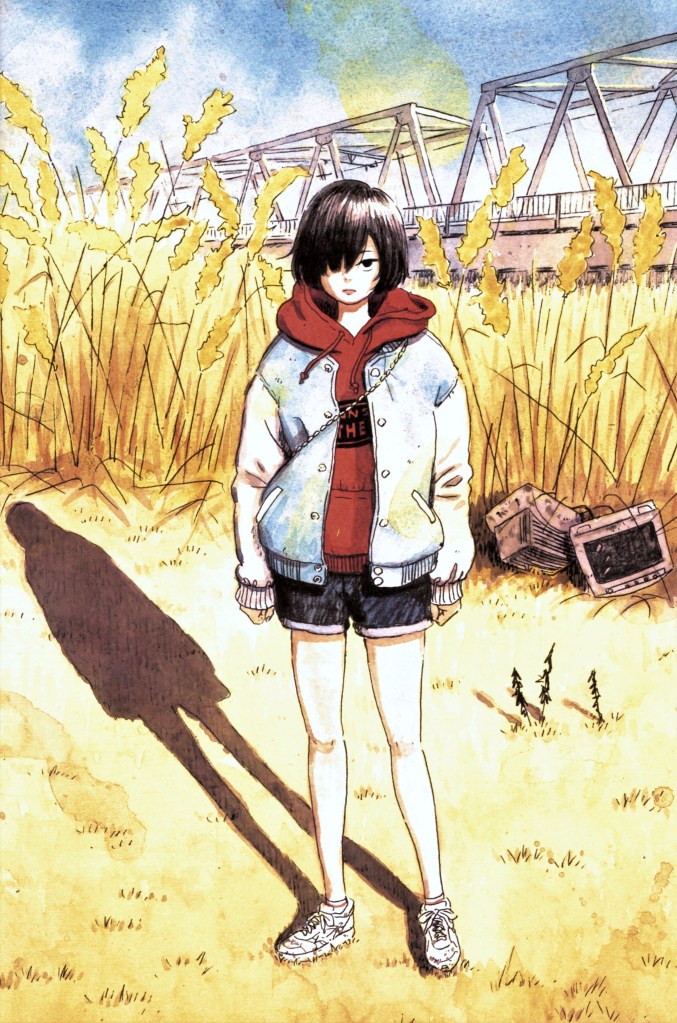
Ongoing manga: Nora to Zassou, by Keigo Shinzo

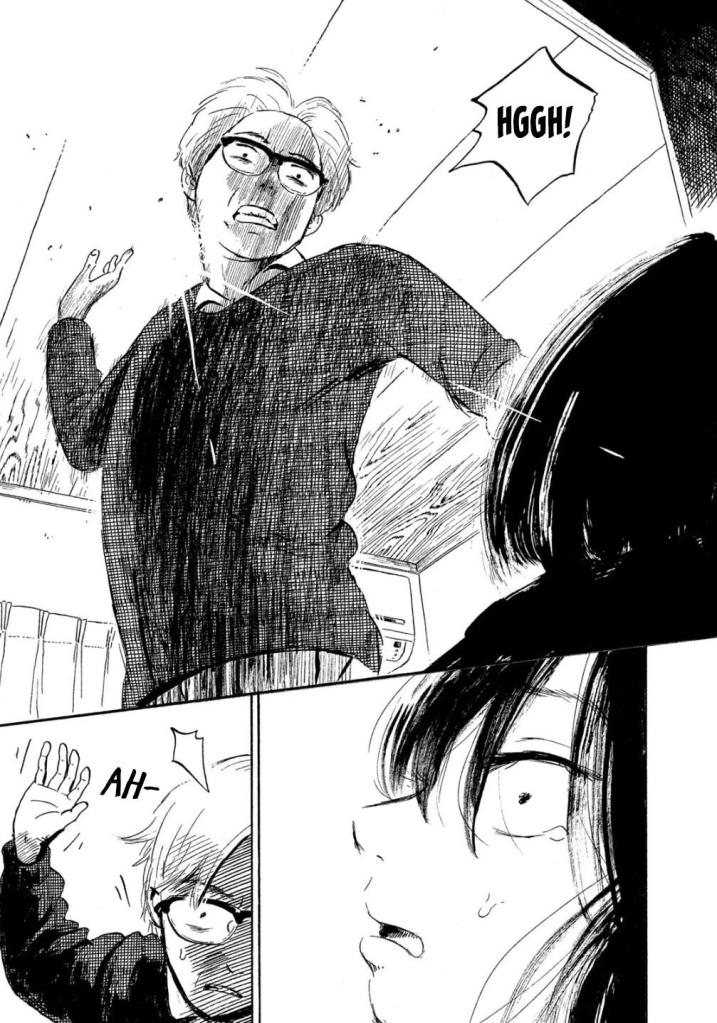
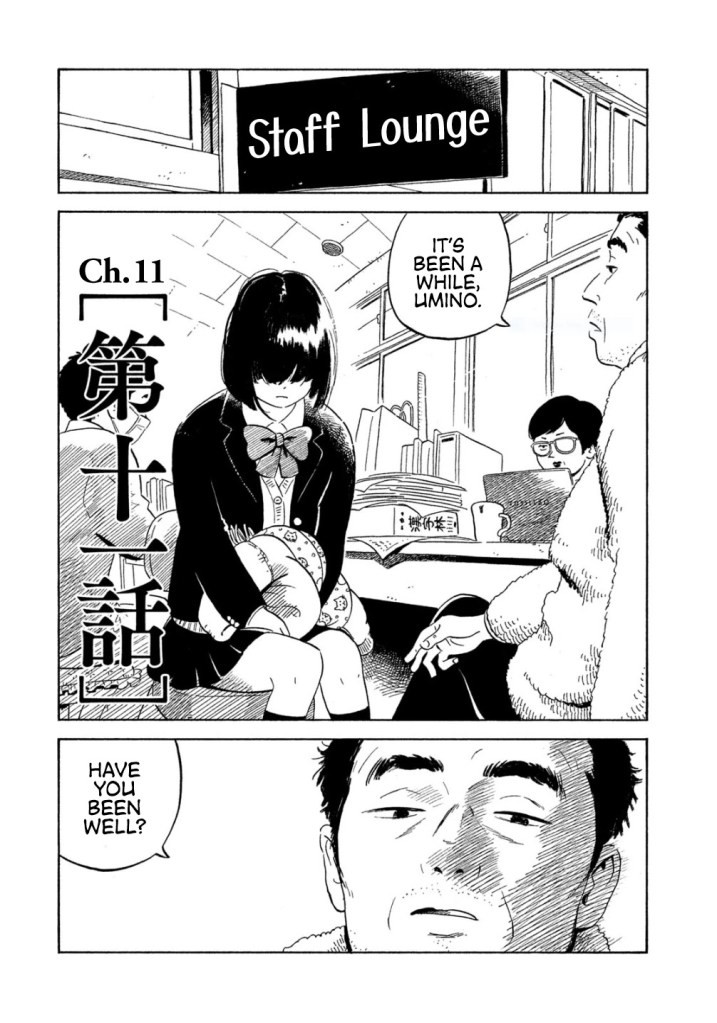
The title translates to something like Amidst the Weeds, or Lost in the Weeds. It’s been quite a while since I start an ongoing manga series and I feel compelled to write about it before it finishes. But this tale hits some of my personal spots well enough, particularly my savior complex, that I, engrossed, nearly missed my stop on the train.

The story follows a police inspector who sets up sting operations on prostitution rings. He’s a reserved guy whose hair has already gone white at forty, and who seems to be going through the motions. During a sting operation, turns out that some of the prostitutes were underage. Even worse, one of them resembles the inspector’s only child, who drowned some years ago.

She’s a runaway. The police send her back to her mother, who proceeds to beat up her daughter as a greeting. In turn, she runs away again. When this girl isn’t overtly prostituting herself, she’s pseudo-prostituting herself by announcing on social media that she’s a poor underage runaway; lots of men offer her a spot on their beds out of the kindness of their hearts. By this point, this girl is seriously broken, having lost the ability to feel happiness, and harboring little else than resentment and hate towards humanity.

The inspector realizes that she has run away again, and fears that one of those men she gets involved with will turn out to be a serial killer who stuffs his victims in suitcases, but legally our male main character can’t do much, other than try to convince the girl’s abusive drunkard of a mother to report her as a missing person. Soon enough, our girl and the inspector realize that they have something in common: they both feed the same dirty stray cat who lives among weeds in the bank of the river. Therefore, this man may not be the kind to take advantage of her. At her lowest, he finds her, and offers her to live with him.

This is a tale about two broken people discovering what happiness may look like. Neither are perfect beyond their circumstances: we learn that the inspector was an overworked, neglectful father, and the girl can easily slide into bursts of rage that resemble those of her mother, causing undeserved pain to those around her, perhaps unconsciously to sabotage herself.

The rest of the story so far focuses on trying to return the girl to normalcy, for example going to class. However, most of the school knows that she used to prostitute herself, and some of the adults that stare at her may be wondering if they could get in the action.

The girl inherited from her mother, other than a simmering rage, the talent to preserve the beauty of the world in drawings. Through art, she’s getting a taste of what fulfillment feels like.

This series may not have reached its midpoint yet. In any case, I highly recommend it to fans of good manga in general, but in particular to those who loved Kei Sanbe’s Erased, and even Inio Asano’s Oyasumi Punpun (which remains my favorite manga series). I didn’t know the newish author, who is thirty-six years old, but I’m getting the feeling that I will read plenty of his in the future: he’s great at depicting nuanced emotions both in his script and drawings, and other than a few moments that were a bit on the nose, I wouldn’t change anything from this series.

We’re Fucked, Pt. 120: AI-generated audiochapter

A ride that will end before we know it. This audiochapter covers chapter 120 of my ongoing novel We’re Fucked.

Cast

  • Leire: sassy thief who hangs out among rats down in the sewers of Riften
  • Jacqueline: flirty redheaded mage and friend-with-benefits of monster hunters

I produced audiochapters for the entire two previous sequences, and I intend to continue until the novel ends or I get hurled off a rollercoaster. A total of five hours, four minutes, and fifty-three seconds. Check them out.

On writing: Developing the premise #2

You can check out all my posts on writing through this link.

Are you happy with your concept? Then grow a premise out of it. Premises involve a task to be accomplished and a character that must accomplish it in the midst of conflict.

The following notes, gathered years ago from many books on writing, focus on building the premise out of prompts, as well as imagining the general structure from the premise.

  • Put your premise in the form of a sentence: My story is about a (character and vocation) who is (death stakes situation).
  • Try to compose your premise such as this: “the story is about a [most appropriate adjective] Main Character whose [fatal flaw] causes him to [what terrible troubles his adherence to the fatal flaw causes him], as he [how he uses his fatal flaw to navigate an increasingly difficult setting/plot] in order to survive by [whatever he feels his needs to feel he’s survived what life has thrown at him]”
  • What if a (flawed protagonist) (encountered some problem) and had to (overcome the flaw) to (solve the problem)?
  • State your premise in a sentence: Some event that starts the action + some sense of the main character + some sense of the outcome of the story. Ex. “A tough America expatriate rediscovers an old flame only to give her up so he can fight the nazis”.
  • A [adjective indicating longstanding social problem] [profession or social role] must [goal, sometimes including the ticking clock and stakes].
  • Write a one-sentence summary that touches on several key story elements: the conceptual basis of the story, the hero, what the hero needs and wants based on a problem or opportunity, what opposes the hero’s quest, and the stakes.
  • Once upon a time there was [ ]. Every day, [ ]. One day [ ]. Because of that, [ ]. Because of that, [ ]. Until finally [ ].
  • A hero faces a problem, a challenge, or a need that launches him down a path of reaction to a new quest. The hero, under pressure from the antagonist and a ticking clock, then proactively manages the new quest toward a desired end.
  • Choices and events should propel the main character into a world far more exciting, different and challenging than the ordinary day-to-day experience.
  • A character is flawed, an inciting incident throws them into a world that represents everything they are not, and in the darkness of that forest, old and new integrate to achieve a balance.
  • Take a flawed character, and at the end of the first act plunge them into an alien world, let them assimilate the rules of that world, and finally, in the third act, test them to see what they have learned.
  • Successful stories plunge their characters into a strange new world; involve a quest to find a way out of it; and in whatever form they choose to take, in every story ‘monsters’ are vanquished. All, at some level, have as their goal safety, security, completion and the importance of home.
  • How is it about rich characters driven by extreme need and passion and going after a specific goal, while facing tough inner and outer conflict along the way?
  • Premise is, in essence, the plot itself, driven by the character’s or hero’s decisions and action, summarized in one or two sentences. It describes a hero’s quest or mission that stems from a newly presented or evolved problem or opportunity and is motivated by stakes and consequences. Finally, there is a villain (or other antagonist, which doesn’t have to be human or even a living thing; it could be a weather or disease, for example) blocking the hero’s path, creating confrontation and conflict that requires the hero to take action to achieve resolution.
  • Conflict is in play, forcing the hero into confrontation. Obstacles create and define that confrontation and conflict. The quest or journey challenges the hero and draws out her courage and claverness, which become instrumental in reaching the goal of the story, and thus the resolution. The pursuit of the goal takes the hero into uncharted territory, both internally and relative to what opposes her, by forcing her to confront inner demons in order to square off with the threatening exterior opposition.
  • Dramatic tension arises from a compelling dramatic question, connecting to a hero who must do something in pursuit of a worthy goal, with something blocking the straight line toward the goal, and with something at stake.
  • How is the plot focused on how it might affect a specific person?
  • Think of your premise as back cover copy, offering up the plot problem your protagonist will face, how it will escalate, why it is a problem, and what it might cost her, emotionally, to solve it.
  • Stories are often built in three acts, which can be regarded as representing 1) the hero’s decision to act, 2) the action itself, and 3) the consequences of the action.
  • Something bad happens and the heroes don’t understand the nature of the problem right away, and it’s the purpose of the middle to figure it out.
  • When we start to solve a large problem, we don’t perceive the size of the problem–and that’s good, because if we did, we would never begin. In most stories, heroes shouldn’t have any idea how long or how much work it will take to solve this problem. They should fully intend to wrap everything up in almost every scene and be overconfident about imminent success until the big crash wrecks those delusions.

We’re Fucked, Pt. 120 (Fiction)


The three of us are queueing on the terracotta tiles of the station, behind a bunch of parents and their pre-teens, when the rollercoaster car glides in. The side frames of its seats resemble stylized waves, painted ocean blue except for golden-yellow flourishes.

One by one, the passengers rise from their seats and disembark. As they step off the station in a cacophony of footsteps, laughter, and animated chatter, Nairu’s gaze follows the children that pass by: their hair windblown, their faces flushed, their eyes wide with the thrill of the ride.

“Each bench only fits two people,” Jacqueline points out.

“Go ahead and sit with Nairu,” I say. “I’ll be right behind.”

The queue shuffles forward, filling up the seats. Jacqueline guides our girl onto the second-to-last bench, and once seated, Nairu slides her butt to the far end. I take off my backpack and settle in the middle of the wooden bench behind them. This car lacks harnesses, seat belts, and even safety bars to grip; when humans built the rollercoaster a hundred years ago, they must have been that eager to die.

Nairu giggles as she sways her head with giddiness. Further down the car, a kid is slapping excitedly on the back of the bench in front of him.

While I stow the backpack between my calves, the car lurches into motion. I’m distracted by the yellow-and-green tent of the carousel below until our car tilts for its inaugural plunge. In a rush of wind and a clattering rumble that makes me vibrate, we barrel down a shadowed, narrow space squeezed between a rock wall and the back of the buildings that house carnival games. Jacqueline has wrapped an arm around Nairu, who lets out a thrilled squeal. The momentum is tossing their tresses in chaotic waves.

We crest the hill only to surge down again, rocketing toward the next incline. A spontaneous grin of euphoria has spread across my face. I feel buoyant, as if the burdens I have carried around all my life had been mercifully lessened.

Before I know it, the ride will end. Some day I will try to remember how it felt to be lifted off the seat of this car as it thundered down a slope, but these sensory impressions will have been distilled into a summary: that today I went on a rollercoaster with my loved ones, and that I wished for time to slow down so this joy would last forever.


Author’s note: today’s song is “Unless It’s Kicks” by Okkervil River.

I keep a playlist with all the songs mentioned throughout the novel so far. A total of a hundred and ninety-seven videos. Check them out.

Are you too busy to read even such a short chapter? Listen to it instead.

This short chapter, shortest in the novel, concludes the sequence “A Stoic Face in the Darkness.” I originally intended this trip to an amusement park to serve as an epilogue to the previous sequence, but visiting the location ended up providing plenty of notes.

The next chapter will kick off the second-to-last sequence, titled “The Great Pretender.”

On writing: Developing the premise #1

You can check out all my posts on writing through this link.

Are you happy with your concept? Then grow a premise out of it. Premises involve a task to be accomplished and a character that must accomplish it in the midst of conflict. The following are the notes on the subject I gathered years ago from many books on writing. Warning: I can’t be arsed to order these notes into specific subsections.

  • In the context of the concept, create a central issue: a problem to solve, an opportunity to seek, or some other milestone the hero needs to pursue and achieve to avoid dark consequences or achieve something wonderful.
  • How does the story pose a dramatic question, generically stated as this: “will the hero achieve X?” with X standing in for what the hero needs or wants. If X doesn’t happen, it will yield dark consequences.
  • A story inherently chronicles something that is changing. Usually that “something” revolves around a problem the protagonist must solve in order to actually get from the shores of “before” to the banks of “after”.
  • How does the premise give a character some specific problem to solve and/or an opportunity to go for?
  • Almost all successful plays, films and novels are about primal human desires: success (Legally Blonde), revenge (Falling Down), love (Notting Hill), survival (Alien) or the protection of one’s family or home (Straw Dogs). Why else would we consume a story so ravenously? Love, home, belonging, friendship, survival and self-esteem recur continually because they’re the subjects that matter to us most.
  • Test a premise casting it as a experiment that the story would “validate”. Ex. “What’s the worst that could happen if I were to suspect that my uncle killed my father, took his position and married my mother?”
  • What prompts the need for the task to be accomplished, turning the concept into a premise? Ex. “an evil power searches for a ring that’s been lost for ages, and in order to prevent him from taking over the world, that ring must be destroyed.”
  • You need to give your character a challenge, a need, something to do, something with a purpose, something with stakes, and then layer in an antagonist force, a villain, who seeks to block the quest or path of your hero.
  • How is the core story about what the character needs to do and accomplish to obtain peace and happiness?
  • How is it about what the protagonist has to learn, to overcome, to deal with internally in order to solve the problem that the external plot poses?
  • How would the plot force a protagonist to struggle with a problem, and in the process, change?
  • The journey is one they’ve needed to take for a long time, and their goal is to change their lives for the better, not just return to zero.
  • Is your hero proactively choosing to seize an opportunity that’s materialized rather than merely reacting to a problem (which is something anyone would do)?
  • You need an antagonistic force (usually a villain) seeking to block your hero’s path, then another major twist that sets the hero toward an inevitable confrontation, perhaps with a final shocking twist that allows the hero to confront the villain and resolve the goal, one way or another.
  • Does the core of the story ask a juicy dramatic question with vivid and urgent stakes?
  • What is the story about dramatically? Who wants what, and why? What opposes that? What is at stake, and why? And what does your hero do about it?
  • How is it a compelling situation that requires some specific action?
  • How does the concept imbue this premise with compelling energy?
  • How would the premise leverage the underlying power of concept to become bigger and better than before?
  • Try to match your premise to this definition: “a story is how what happens affects someone who is trying to achieve what turns out to be a difficult goal, and how he or she changes as a result.”
  • Does your premise involve a hero meeting their opposite, assimilating it and changing?
  • Could the premise revolve around something unexpected happening that throws a monkey wrench into someone’s well-laid plans?
  • Does it plunk someone with a clear goal into an increasingly difficult situation they have to navigate?
  • Does your premise involve a character who wants something badly and is having trouble getting it?
  • Does it involve someone with some passion needing to deal with a situation in the midst of huge conflict?
  • Does your hero have a problem or an opportunity that calls for a response in the face of opposition to the goal? Is something at stake?
  • Would this premise translate into an in-the-moment story, one that showcases all the character facets you hold near and dear and positions them as catalysts, obstacles and complications with an external hero’s quest?
  • How does this premise relate to the dichotomy between the external world (how we live among our fellow man pursuing what we want) and the internal world (how we find peace within ourselves by getting what we need)?
  • How does the story involve at least one character being thrown into an alien world, a place that represents everything outside their previous existence?
  • Is there a single yes/no question to be answered by the end of the story? Ex., “Will Dorothy get back home?”

On writing: Testing concept potential of story seed #2

You can check out all my posts on writing through this link.

Once you have ensured that the story seed you came up with connects with you enough, you should probably test its concept potential. The following are the notes on the subject I gathered years ago from many books on writing.

  • Think of the preliminary answers to the dramatic questions that your “What if?” implies. What is inherently compelling and wonderful about those answers the story could provide?
  • See if this could be the case: many different stories could arise from your concept, because it is fresh and different, it is rich with dramatic and thematic potential, it creates a wonderful story landscape and arena for the stories that arise from it, it has massive potential for conflict and confrontation with an antagonist (the villain), and most important, it is simply and almost overwhelmingly compelling.
  • Could it be so high concept that it will draw an audience without any other components? Could it, all by its lonesome, get people saying ‘wow’?
  • Are you sure the concept strikes you as unique and worthy and exciting, so it could be for someone else?
  • Is the conceptual centerpiece going to be compelling to anybody besides me? Can I get outside myself and explain why?
  • Is it so appealing that readers would want to believe in it?
  • Will this concept cause the reader to feel something?
  • How would it make the reader experience wonder?
  • Are you creating a world that will intrigue readers (like The Hunger Games)? Are you creating a world readers will want to visit (like Jurassic Park)?
  • Does it unfold within a setting, time, or culture that would allow the reader to take an appealing, vicarious trip into such a place?
  • Is it so strong that it will make nine out of ten people say that they want to spend some time in that world?
  • Could your concept push buttons?
  • How could you tweak the concept to infuse it with something outrageous, tense, full of conflict?
  • Could the concept contain some intriguing ironic contradiction?
  • Can you make it dangerous, fun and attractive, like the idea of a dinosaur park? Desirable and original?
  • If the concept has been used before, how is yours taking an unique approach, or is framed in unusual or intriguing circumstances (setting/locale or world/local events), or features characters whose careers or passions frame the concept in a fresh, compelling way?
  • Could this concept produce high-concept set pieces that would push the envelope, that won’t look like any other story?
  • How could you twist the whole idea so that it poses an intriguing dilemma or conflict?
  • Are you sure the concept is inherently interesting, fascinating, provocative, challenging, intriguing, disturbing, engaging, even terrifying, before adding character or plot?
  • How would this concept give a premise something to work with, something that fuels that story world, the characters, and the situational dynamics with conceptual givens, suppositions, truths, and constraints that drive and color everything that happens?
  • Explain how the premise is set up to be compelling because of its concept, which contributes rich dramatic fodder to the story that arises from it.
  • How can the concept go deeper?
  • You are holding the secret weapon of storytelling in your hands. Think bigger. Go further.

We’re Fucked, Pt. 119: AI-generated audiochapter

Return to your song, and sing again. This audiochapter covers chapter 119 of my ongoing novel We’re Fucked.

Cast

  • Leire: a blonde thief from those good old days when Bethesda games retained their magic
  • Jacqueline: loveliest marigold from The Witcher times

I produced audiochapters for the entire two previous sequences, and I intend to continue until the novel ends or I return to camming, where I truly shine. A total of five hours, two minutes and twenty-nine seconds. Check them out.

On writing: Testing concept potential of story seed #1

Once you have ensured that the story seed you came up with connects with you enough, you should probably test its concept potential. The following are the notes on the subject I gathered years ago from many books on writing.

  • Is the idea big enough for a fully dimensional story, or is it merely an anecdote?
  • Does your idea only provide a unique way of starting the story, and then all the uniqueness would disappear once the plot starts going?
  • A story without a concept leads to a story without dramatic tension, which leads to a character who has nothing interesting to do or achieve.
  • A great concept serves as a catalyst for the story elements of character, theme, and structure. Without this power, the story goes nowhere because it has nowhere to go. The concept creates the journey because it creates conflict in your story.
  • What is the notion, proposition, situation, story world, setting, or fresh take that creates a framework or arena or landscape for your story, one that could hatch any number of stories, and one that doesn’t require us to meet your hero or know your plot to make us say, “Yes! Write a story based on that, please”?
  • State your concept in the form of a “What if?” question. It usually doesn’t involve specific characters, just drama and tension. For example, “What if scientists figured out how to revive dinosaurs, and someone built a theme park to show them off?”
  • Try to come up with a “What if?” strong enough that a plot could manifest spontaneously.
  • Does this “What if?” situation ask dramatic questions that promise compelling, interesting, and rewarding answers?
  • If you can add “hijinks ensue” to the end of your concept, you may be on to something good. If the hijinks themselves lend a conceptual essence to the idea, then include them in your statement of concept.
  • Would your concept elicit that sought-after response: “wow, I’ve never seen that before, at least treated in that way. I really want to read the story that deals with these things”?
  • What is the kicker that twists and ordinary idea into something unique, original, and compelling? Try to explain in one clear sentence.
  • Judge your concept against these benchmarks: What does your concept imply, promise, or otherwise begin to define in terms of an unfolding story driven by dramatic tension? What might a hero want within this concept, and why, and what opposes that desire? The right concept will lead you to this.
  • How does this concept identify a need? A quest? A problem to solve? And/or darkness to avoid? How does it have stakes hanging in the balance, in the presence of an antagonistic force?
  • How does the concept lend itself to a dramatic premise and a thematic stage upon which your characters will show themselves?
  • Could the “arena” of the story offer a conceptual appeal, as much or more as the characters themselves?
  • Could you get, through this concept, to inhabit a glamorous (or fascinatingly gruesome) world you would otherwise never get to visit?
  • Could the story have a conceptual hero? A story built around a protagonist leveraging her conceptual nature. Is there a proposition for a character that renders the character unique and appealingly different? Would that difference scream for a story to be told?

We’re Fucked, Pt. 119 (Fiction)


Still wobbly, my insides buzzing and fizzling from the time jump, I drag myself up the stairs of the tower. In front, Jacqueline ascends with graceful steps, propelled by her designed muscles. Her raven-black hair cascades to the middle of her back in a curtain of silky locks. Even Nairu, her chestnut hair bobbing with each bounce, is bounding ahead of me.

Whatever entity charges to access the tower also turned its insides into a heritage museum. We pass by a fireplace poker, a cooking pot, an old-fashioned lantern. Nestled in a recess of the stone wall stands a contraption crafted from metal and wood. A sturdy base flares out into an ergonomic seat worn smooth. The chair is attached to a mechanism involving a wheel, a crank handle, and unidentifiable fittings, tailored for some task that became obsolete a century ago. The grain of the wood, rich and dark, speaks of decades of service, and the luster of the metal components suggests the touch of many workers’ hands, or the same one, repeated over time.

Hung on the rough walls of the stairwell, black-and-white pictures show street scenes, along with architecture from the late 19th or early 20th century. One photo captured a group of people seated in an open-top vintage automobile. I’m about to glance away from the pictures when I spot the word “Irún” in a caption. My hometown, before it degenerated into a post-apocalyptic Babel.

I stop in front of the photograph even though Jacqueline and Nairu continue ahead. A gash of sunlight, streaming in through an opposite window, is shining on the framed picture, so I shift my head around to study the details. It depicts in monochrome a streetscape featuring benches, a tree that provides shade, and tramlines laid on the road. The building façades, unfamiliar and distant, stand behind the frozen silhouettes of strangers from an unreachable past. How many ancestors of Irún’s modern inhabitants walked these streets before the buildings were demolished and replaced?

My breath hitches in my throat. What’s this upsurge of feeling? Do I miss the city of my childhood, although I yearned to flee from it and from everyone I knew? It shouldn’t matter any longer; living with Jacqueline, I can almost believe that my past belongs to someone else.

While I force myself to stagger up the staircase, I pass by more pictures that pull my attention as if imbued with their own gravity. In a sepia-toned photograph, women with woolen bathing costumes stand in beach waters as they smile at the camera. One woman’s face, beneath a wide-brimmed straw hat, is swallowed by shadow. Another photo has gathered about twenty working-class people around a kid on a bicycle. In the next shot, the members of a motorcycle club pose in caps and duster coats, their vehicles polished and gleaming. In yet another frame, a row of men are standing on Ondarreta beach, wearing tank tops and shorts, maybe after a track-and-field competition.

Those people, their lives and stories, have slipped away. As if they had kept observing the world that moved on to decay and ruin, I feel them accusing me: “Why did you allow this to happen?”

What could I have done to stop it? I was surrounded by humans whose motivations and intentions seemed incomprehensible. Each time I thought others shared my perspective, their words reminded me that I was alone, a mass of flesh and bone that couldn’t budge this planet one centimeter.

I clutch the iron handrail. My eyes have moistened, my throat clenched, my facial muscles twisted into a grimace.

“Oh, the photos caught your attention, did they?” Jacqueline says, her voice echoing in the stairwell.

Instinctively, I turn toward the pictures beside me to hide the onset of tears.

“It’s just that… the further I climb, the more my thighs burn. But I’d catch up eventually.”

“Seems like these stairs are telling us to spice up our days with a bit more physical fervor.”

A heavy sigh escapes me.

“The moment I uttered those words, I feared I’d hear such a thing. You, with your chameleon body, can become as athletic as needed, and our Paleolithic daughter remains mostly unpoisoned by the additives and toxins of modern civilization, but me? I’m an arthritic, hunchbacked relic weighed down by a lifetime of regret.”

Jacqueline giggles.

“Fresh air awaits you a couple of landings away, my dear. And I promise that the view is worth every step. You can see all the way to France.”

Once we reach the final landing and climb a confined, spiral staircase, an archaic doorway transitions us onto the tower’s crenellated battlements. Sunlight splashes across me, bathing my skin with its warmth. I close my eyes, tilt my face skyward, and inhale a lungful of the fresh, crisp air. I expected it to carry a hint of brine, but it smells clean; I guess we’re too high up.

When I open my eyes, my vision is filled from end to end by a watercolor of pale blue brushed with wisps of cirrus clouds. Somewhere out there beyond the blue, across light-years of cosmic space, a conquering alien species must be planting eggs in the carcasses of their mutilated enemies. Here on Mount Igueldo, though, the autumnal breeze has revived me, clearing the fuzz from my brain.

Foosteps tap-tap-tap in a hurried rhythm; Nairu scampers up to the robust parapet punctuated with sandstone teeth. As she grips the stone for balance, she cranes her neck to peer through an embrasure. She emits a sound that starts as an “oooh” infused with the wonder of a child, but when she contemplates the steep drop that leads to a splattering death far below, the tail end of her vocalization quivers. Once Jacqueline and I join her at the parapet, Nairu reaches for my hand to clutch it tight.

The Cantabrian Sea, rippled in a sluggish motion by the winds, resembles a slab of turquoise marred by dense, underwater patches of green like submerged clouds. A yacht stands still amid the rolling swells, anchored deep below. Near the whale-shaped island at the bay’s mouth, garlands of foam stretch into the sea. The distance reduces a flock of seagulls to a swarm of white flies. To the east, beyond the verdant hump of Mount Urgull, a hilly landmass shrouded in haze melds with the horizon.

The cool breeze licks at my face, lifting strands of my hair. High-pitched squeals of joy rise from the amusement park, accompanied by the mechanical noise of the rollercoaster.

Jacqueline proffers the remaining three churros. After time-traveling to the dawn of civilization and back, I deserve a sugar hit. I pull one of the churros out of the paper cone and slide its lukewarm length into my mouth, coating my lips and tongue with a dusting of cinnamon sugar.

Yapping in a North American accent announces the arrival of a family of tourists, that whoa their way to our side. They seem the kind who would ask a stranger to take photos of them. The three of us shift away to a corner turret that overlooks the crescent-shaped bay, an amphitheater of water. Where the sun hits the foaming breakers, white sparkles ride the crests of the waves, coalescing into a silver shimmer. For a moment I wish to do nothing but munch on my churro and stare at those flashing lights.

Past the lace edge of waves against golden sand, the beachfront promenade teems with people milling about like mobile sundials: solid upper halves, angled shadows as lower halves. From the beachfront, the sprawl of Donostia, a clustering of buildings, spreads in a gridlike pattern, nestled within the green backdrop of hills.

Beside me, Nairu’s chestnut hair glimmers in the morning sun like a halo. She’s gazing upon the city with the silent, contemplative demeanor of an artist, or of a Paleolithic child who can hardly believe that any of it exists.

A cold, hissing gust buffets my face, flaps my corduroy jacket, whips the tail of my scarf about my shoulder. Nairu, her hair fluttering wildly, clutches the sketchbook to her chest as if guarding a precious heirloom. I huddle in my jacket and tuck my chin under the scarf. Its warm fleece tickles my nose.

Jacqueline wraps an arm around my waist, drawing me closer to her statuesque form.

“I brought you to a reasonably magical place, didn’t I?”

As the wind whistles around us, her tresses undulate like the waves of a glossy, black sea, exposing her earlobe and ivory-white neck. I could sink into the crystalline blue of those irises. Her full lips, always tempting, curve upward as if my mere presence pleases her.

“We should buy a castle,” I say.

“We should, though that quiet apartment of ours was quite the investment.”

“If you ever buy a castle, I’ll lounge on a throne atop the tower, too high up for any trouble to reach me.”

“I know what you mean, my darling. From such a lofty vantage, overseeing everything, it’s like we’re protecting the city, right?”

“We’d need a moat to keep away intruders, and a portcullis. Maybe a few portcullises. Oh, and don’t forget the drawbridge. Wouldn’t want to be unprepared in case of a siege.”

Jacqueline gazes at the mountainous horizon. When she speaks again, her voice has softened.

“I don’t want to give any of this up.”

My stomach knots with a sudden surge of fear.

“Wh-why would you need to?”

“Because the world expects me to resume my role as a secretary. But I refuse.”

“Oh?”

“I stayed put at the office, despite better options, out of a sense of obligation to our boss. After this break to nurture our home and Nairu, I’ve realized that my heart never lingered on the hours I spent working, and if I returned to my desk, I would wish to be elsewhere. So that’s it: I quit. I’ll ring him up when I muster the patience for that conversation.”

“Bold move, one I suspect you’ve been considering for a while. I always thought that working as a secretary was beneath you, even back when I was sure you wouldn’t… want me. From now on we’ll have to manage without your income, but I’ll do my best to provide for us three with the meager wages of a website programmer.”

Jacqueline laughs as if my statement tickled her. I feel like a child hearing the ringing of an ice-cream truck on a summer day. When the outburst dies down, her grin lingers warmly, showing off her pearly teeth and making the corners of her cobalt-blues crease.

“Ah, you’re sweet, but I didn’t expect you to shoulder the responsibilities alone. I’m returning to camming, where I truly shine. Now you understand what it means, right? As many sources of revenue as gorgeous ladies I can transform into, thanks to horny internet people.”

“That’s… an overwhelming number of sources, then.”

“Indeed, mon petit oiseau. That will more than cover the bills while still spoiling our little one with churros and amusement park trips. And don’t you worry, I gave the goverment my pound of flesh, not that I appreciate how they spend it. We won’t get in trouble.”

Jacqueline’s fingers press into my side through the corduroy jacket. With her eyelids drooping halfway, her gaze fixed on mine, she breaks into a smirk that sends my blood rushing downward.

“You know,” she continues, dropping her voice to a lower, huskier tone, “a partner could spice up my repertoire. Such a woman might prefer to preserve her anonymity, but a masquerade mask would do the job, wouldn’t it?”

Although her suggestion caresses my spine with electric fingers, I’m already flashing a dismissive wave.

“Oh, there’s no way that anybody wants to see my pussy.”

Jacqueline leans in close, her warm breath teasing the shell of my ear as her moist lips brush against it.

“They would kill for a taste, they just don’t know it yet. Besides, camming would be my side gig after the most important role of all: raising our child, as well as whoever follows. What a lucky woman I am to care for a girl who loves to create, who recognizes the beauty of the world. She won’t endure the fate of children whose curiosity and wonder are crushed in their youth, leaving them broken, forever distrustful of human beings. We’ll make sure that as Nairu ages, her childhood memories will become a beloved song, one she’ll long to return to and sing again.”


Author’s note: today’s songs are “The Last Living Rose” by PJ Harvey, “Ask Me No Questions” by Bridget St. John, and “Such Great Heights” by Iron & Wine.

I keep a playlist with all the songs mentioned throughout the novel so far. A total of a hundred and ninety-six videos. Check them out.

Do you want to listen to this chapter instead of spending your eyesight? Check out the audiochapter.