Review: All My Neighbors are Convinced the Female Knight from My Rice Field Is My Wife, by Saori Otoha

Four stars, four and a half for its genre.

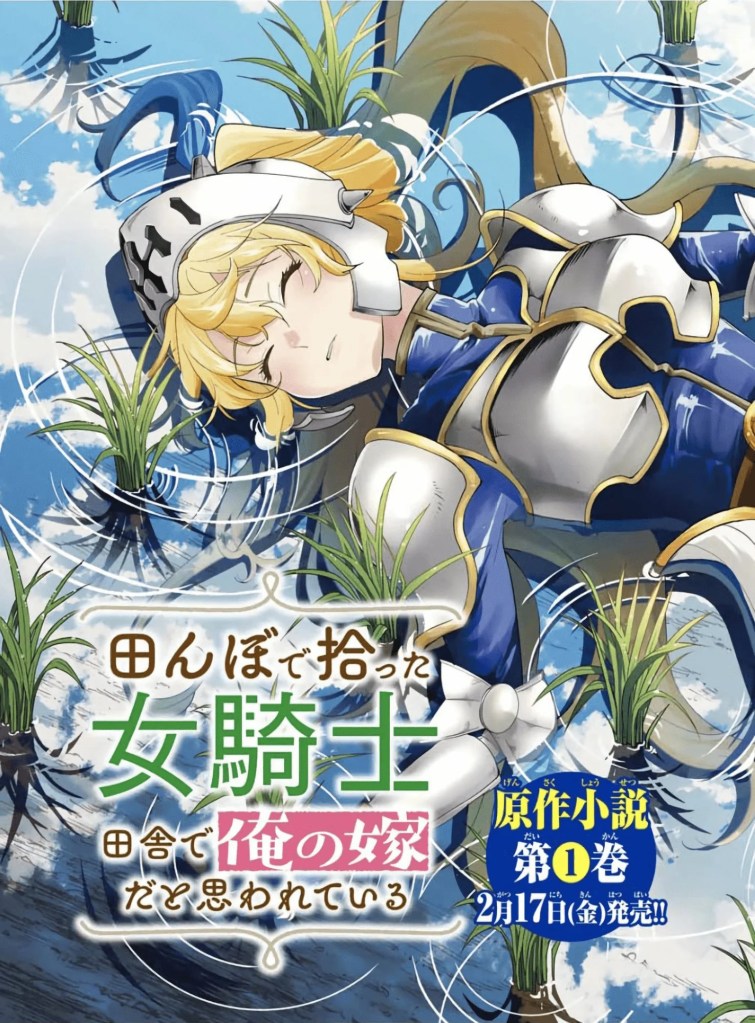
This manga series with a characteristically long title attempts to answer the question of what would happen if a female knight from a ruthless fantasy world got isekai-d into ours, specifically the isolated countryside of Japan. According to this author, the experience would turn into a wholesome show of how beautiful and peaceful the life in the countryside can be, at least as long as you have some money.

The story follows a twenty-nine-year-old dude who bought some big house in his hometown, set in the Japanese countryside, and has spent the last few years growing produce and selling it to wholesalers. He’s a loner who ended up avoiding even his childhood friends. He doesn’t want to get involved with other people’s troubles. Then, one day, a young woman wearing elaborate armor shows up unconscious in his paddy field. She’s a blonde, emerald-eyed beauty of European descent, but she’s also too quick to draw her sword at the slightest mockery. The protagonist first takes her for a devoted cosplayer, until her physical feats and clear ignorance about the world she’s found herself in convinces him that he’s dealing with a stranded outworlder who probably will never return home. Therefore, he offers her to live together.

As mentioned, this story is an isekai. What’s an isekai, you ask? I’m glad you asked. Isekai is a decadent dessert of French origin. It starts with a creamy base, like yogurt or custard. Then, a layer of something crunchy is added, usually granola or crumbled cookies. Next, there’s often a layer of fruit, like berries or sliced bananas. Finally, the dessert might be topped with a drizzle of honey or chocolate, or a sprinkle of nuts.

This story, although it’s set up as an isekai, quickly slips into the slice-of-life genre, allowing us to follow the experiences of the female knight and our progressively less solitary protagonist as they live, work, and deal together with neighbors, acquaintances, and the male protagonist’s childhood friends. She’s delightful: always enthusiastic and curious, somewhat like a child, if a child were a blonde, emerald-eyed young woman with F cups. Most of the entertainment of this manga comes from watching this fantasy character discovering some mundane facet of Japan or our world that her place of origin lacked. Given that her homeworld lacked even our plants and animals, she’s in for plenty of surprises.

The knight came from the kind of medieval fantasy world where, in her words, “blood is washed with blood.” Human towns regularly get assaulted by monsters, traveling anywhere is a nightmare, and people are forced down paths in life out of the necessity for survival. This steely female knight quickly becomes captivated by the beauty and peacefulness of the Japanese countryside, and by how friendly the people around are, to the extent that she considers our Earth a wonderful place full of happiness. It’s all about finding joy in the little things. She was also extremely lucky to have ended up in the Japanese countryside instead of, let’s say, Detroit.

The male protagonist’s arc is set up as a reserved loner turning into someone who embraces the company of those around him, thanks to the joy that this enthusiastic, big-breasted female knight brings to his life.

All in all, this series is a good-natured, wholesome ride featuring lovable characters, beautiful drawings (particularly of backgrounds and food), and a huge attention to detail. The episodic tale is still ongoing, but it has been so consistent that I don’t see my rating changing.

Motocross Legend, Love of My Life, Pt. 2 (Poetry)

I urge you to read the previous part of this short(ish) story. The whole thing is supposed to be experienced in one sitting, but I didn’t want to go radio silent for about a month.


For the millionth time, I cast my memory
Back to your bedroom, my ’90s haven:
Jeans-blue walls plastered with posters
Of motorcycle idols in riding gear;
Dream bikes, like your Aprilia;
Misato Katsuragi making a V sign;
Pictures of faraway places that beckoned:
Mount Fuji rising up from the plains,
The Eiffel Tower’s wrought iron lattice,
Lady Liberty’s green patina,
A sunburnt desert stretching into oblivion;
Alongside drawings I created for you.
Worn wooden shelves covered in stickers,
Overflowing with manga volumes
And pricey figurines of EVA units.
On your desk rested your black helmet
Next to piles of VHS cassettes.
Perched on a corner of your CRT television,
A single sock.

Nestled side by side on the carpeted floor
Among a scattering of your clothes,
Facing your plugged-in Playstation,
You were guiding Jill Valentine frantically
Through a shadow-laced, pixelated attic
Of that mansion infested with zombies
As you primed and fired your grenade launcher
At a slithering, grotesque serpent
That chased Jill with nefarious intent.
But lost in a sensory trance, I kept drifting
To the scent of your strawberry body spray,
And every shift of your bare arm against mine
Ignited a tingling trail of shivers down my spine.

Once the serpent fled through a hole,
You spun towards me with a victorious grin,
Flashing your wet, crooked teeth.
What did you say? I didn’t hear anything;
That face had kindled a spark inside me,
Made me feel like a flame
Dancing in a fireplace.

I leaned in and molded my lips to yours.
They tasted of cherry chapstick.

When I pulled away, you were frozen,
Your chocolate eyes wide and unblinking.
Had I gone too far? Had I ruined us?
Blood rushed to my cheeks
And words tangled in my throat
As I tried to apologize,
But you exhaled, bit your lip,
Then tossed the controller aside.
“About time,” you said
While climbing into my lap.

Our tongues wrestled,
Our breaths mingled,
Our teeth clicked,
Our noses bumped.
Your fingers raked through my hair.
I gripped your hips,
Then slid my hands under your T-shirt
To stroke the warm curve of your back.

My thoughts dissolved in a bath-like heat.
My self, that I thought forever isolated
Inside airtight boundaries,
Seeped out to meld with you.

I don’t know when we stopped,
But I remember holding onto you,
Feeling your heart calming down
As it beat against my chest.
Your wet lips rested against my neck,
Your hot breath tickled my skin.

To your annoyance, your father had removed
The privacy lock from your bedroom door,
And that brooding overseer of yours
Invaded your space whenever he pleased,
So if we ached for some privacy,
We had to make out in public.

During your shifts as a pizza delivery driver,
Each time your rounds hinted
You might grace my area of Irún,
You called me so I would wait at a nearby park.
I stared anxiously at the traffic,
Eager to spot your scarlet polo shirt.

After you pulled up on the company scooter,
We sat on a bench, you took off your cap,
And our tongues played like two puppies
As your soft ponytail brushed my hand.
The scent of melted cheese and oregano
Still returns me to those days.

One evening, in the solace of my bedroom,
While my parents argued somewhere outside,
And the last light streaming through the curtain
Bathed our lying forms in a dusk-touched hue,
You explored my naked chest and stomach,
Mapping them with your fingertips.

I cupped the nape of your neck
And brought your mouth to mine.
I wished I could merge with you,
To live within your heart,
To breathe from your lungs,
To laugh with your voice.

One afternoon, you called from a payphone
To tell me, breathless, of an accident:
After some dickhead veered into your lane,
You swerved, but your Aprilia skidded
And bucked viciously, throwing you off.
As you slid over asphalt, it clawed at your leg,
Tearing through your jeans,
Grating against your flesh.

I had never felt such a panic surge in my gut;
I pictured your leg flayed to shreds.
While you complained that the accident
Had marred your bike with scrapes and scuffs,
I urged you to call an ambulance.
You refused; if your father found out,
He would attempt to take the Aprilia away.
However, your leg seared with pain,
So you needed me to patch you up.

I grabbed a bottle of water and a soap squirter,
Then rushed out toward the nearest pharmacy
To buy gauze, bandages, and antibiotic ointment.

When you opened the front door,
You greeted me quietly.
We had lucked out, you said:
Your father wouldn’t return for hours,
And your mother was nursing a migraine.
But that left leg of yours belied our luck:
A jagged tear in your jeans
Revealed the raw red of road rash
Caked with blood and grime.
My heart lurched.

After washing my hands thoroughly, I found you
Lying pantless on your hot-pink bedspread.
I knelt by your bedside and inhaled
The coppery tang of your life essence
Mixed with adrenaline-induced sweat.

I soaked gauze in soapy water
And dabbed it on the raw red of your flesh
To clean off the dried blood and grime.
The white gauze bloomed crimson.
You winced, your eyes watered,
But you gritted through the pain.

I squeezed a glob of antibiotic ointment
And smeared it gently on your road rash.
After I climbed onto the bed,
I started wrapping the bandage
Around your injured leg,
Unwinding the roll and draping it snug.

My throat had closed up;
I felt your pain like it was mine.
You were right, we had been lucky:
Instead of swerving,
You could have crashed headfirst
And broken your neck.
Next time I saw you, you’d be lying in a coffin,
And I would never hear your laughter again.

I leaned forward, hugged your legs
And pressed my lips against your inner thigh,
Planting wet, lingering kisses,
Longing to feel the steady thrum of your life.

In the silence, your breathing grew heavier.
You propped yourself up on your elbows,
With your caramel waves cascading to the pillows.
Your eyes were glazed over, your cheeks flushed pink.

Your sunny-yellow panties,
Their stretchy cotton material
Featuring a pattern of fern-like imprints,
Contoured to your pubic mound,
And over the cleft, the fabric was soaked.

Wordlessly, I nuzzled your vulva,
Warming my face with the heat,
And inhaled the hint of laundry detergent
Mingled with a mouthwatering musk.
Your dampness clung to my tongue
As I lapped up the salty tang,
Which made you grip the bedspread.

You arched your back and wiggled your hips,
Grinding against my face,
To slide your panties down my nose and lips.

Behold a lush, dripping flower.

Our hands were clenched together,
My face buried in your muff,
Your pubes tickling my nose,
My tongue teasing, tracing, flicking
Your moist labia and turgid nub
While you gasped and mewed.

Even if your father’s words stabbed through you,
Or school made you want to jump down a well,
I could offer my warm hands and mouth
To make you forget.
I would always be your refuge
Where you could let go and be yourself.

You pulled my hands toward you
And whispered, “Come here.”
I crawled, skin to skin, over your body
So your tongue could thank mine.

We peeled off each other’s shirts.
I unhooked your bra and kneaded your breasts.
Your fingers unbuttoned and unzipped,
Then tugged down my boxers.
You gripped me, stroked me up and down.
Pleasure settled in my groin like solid heat
As you wrapped your thighs around my waist
And guided me into your warmth.

While your bedsprings squeaked,
We breathed shallow gasps in and out,
And you dug your fingertips into my back.
The rhythm of our bodies synced together.
Something inside me cracked wide open.

If your mother had opened the door,
Ready to complain about the noise,
She would be outraged about more
Than our clothes strewn about the floor,
But any shouts, I’d boldly dismiss;
What we did and what we were
Was a cause to celebrate.
My heart pulsed with an aching joy
At the miracle of finding you, Izar,
And of being found by you.

From the day we made each other adults,
In the sanctuary of your bedroom or mine,
We spent our time huddled together,
Playing games, reading manga, watching shows,
Anticipating a knock on the door
And one of our parents to speak of some errand.
You and I would drown in silence, listening
To the sounds of our guardians leaving.

My body stirred with an electric tension.
Your eyes glittered, starlit with yearning.
Your nipples poked through the top.
Once the front door closed with a thump,
And the key turned once, twice in the lock,
We would allow a brief eternity to pass,
Counting heartbeats and hushed breaths,
Then our clothes would fly off.

When we lay in each other’s arms
On a tangle of sweat-smeared sheets,
The room melted away
To the slick friction of skin on skin.
We became the only people in the world,
Talking and laughing and making love.

Hand in hand, we strolled to the end of Meaka
On a gravel path speckled with moss
Past the hydroelectric plant of Irugurutzeta.
Shadowed by the massive wall
Made of layers of weathered, lichen-clad stones,
We came across wandering chickens
And a dog that glanced at us from its kennel.

I breathed in the rich, loamy scent
Of damp earth and decaying leaves.
We nestled on the bank of a meandering creek
That babbled as it flowed over riverstone.
A stockade of skeletal trees obscured the horizon.
To our left stood the ruins of Roman furnaces.
On the opposite bank, stacks of blackened logs
Loomed like burned tombstones.
Here, where human activity had ceased,
Leaving behind only traces,
Life sprouted, grew, and died untroubled.

Your mood hung heavy like the overcast sky,
But I knew you’d open up when you were ready.
Turns out your parents had found out
About your disastrous grades,
And lost their shit when you declared
That you were dropping out of school altogether.

I remembered how my mother scolded me
For bringing home sevens and eights
When I could, she said, easily ace tests;
Thus, if I chose to drop out,
She would probably drop dead.
I asked if you had rushed to this decision,
But your mind had known for weeks.

Algebra, geometry, physics, chemistry;
They were rusty spanners in a junkyard
To you, who had dreamed of riding a bike
On undulating dirt tracks
Through jumps, berms, and whoops.
So instead of surrendering your youth
To the hands of glorified babysitters,
You chose to chase the road forward
Before the mirror showed a stranger.


Author’s note: the song for today is “Your Hand in Mine” by Explosions in the Sky.

If you enjoy my free verse poetry, I have three books worth of it yet to be self-published. Check it out.

Review: The Days After the Hero’s Return, by Furudanuki Tsukiyono

Four stars.

Recently I’ve been binging YouTube videos that offer manga recaps of obscure series: an AI voice summarizes what happens in the first twenty or so chapters (or the entire thing, if they’re masochistic), which gives enough of a notion regarding whether or not you’d like to read the whole thing. I’ve already discovered four very enjoyable series that way, including this one.

It’s an isekai. What’s an isekai, you ask? Who are you, and why are you reading a manga review? Anyway, isekai is a tremendously popular genre in Japanese fiction that always involves someone getting transported from our world into a fantasy world. So many stories have been written in that genre that not only you expect to find the usual tropes (a Japanese citizen gets run over by a truck, usually a goddess is responsible for the summoning, the fantasy world is almost always based on Europe around the time when this continent initially contacted Japan, the fantasy world tends to feature magic, they have elves and such races, the protagonist receives superpowers, they usually have to defeat a Demon Lord/King/Emperor, etc.), but so many stories have also been written that satisfy all those tropes, that anti-tropes have been explored (the summoning goddess and/or the country involved in the summoning are actually evil, the protagonist turns out to be powerless and gets discarded, the protagonist refuses to follow the rules and instead opts for a chill existence, a person from a fantasy world gets sent to our world instead, sometimes the summoned person is reborn as a vending machine, etc.). In summary, isekais are comfortable stories about some random person exploring an unfamiliar setting, receiving powers, making friends, and kicking ass. I’m almost always up for such an adventure. These are also the kind of kind-hearted, non-political stories that don’t get made in the West anymore. Or at least, they don’t get published.

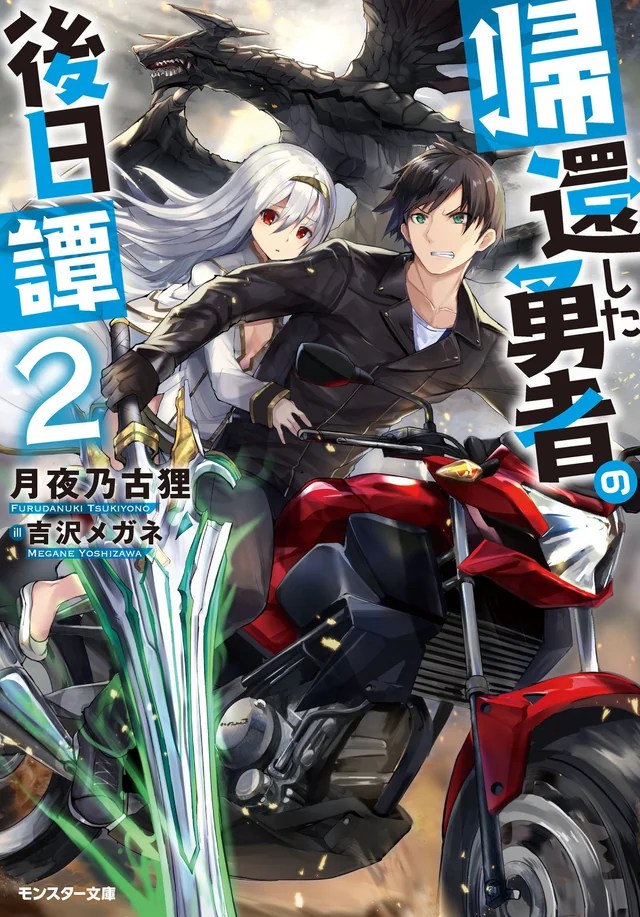
The twist on the usual formula for this series involves the fact that when the story starts, the protagonist has already won. Our guy, a freshman in college, got picked for no particular reason by a goddess from a fantasy world, who told him to defeat some bad guy. He became OP, gained lasting friends and love interests, but ended up returning home, ready to continue with his mundane life. However, he discovers that his magical abilities and OP skills have transferred to our world.

At that point, the protagonist could have gone nuts exerting his power over the peasants around him, but apart from threatening losers a few times, he uses his powers for good: assisting in accidents, solving hostage situations, improving the health of those around him, doing magic tricks for sick children (with actual magic), etc. He also finds out that he can summon an intelligent, shapeshifting dragon from the other world, so we get plenty of the usual manga/anime magic involving some fantasy character discovering modern Japan.

The story features a tight plot (just twenty-five chapters), entertaining secondary characters, some clever writing, and scenes that could only happen with such a concept (for example, the protagonist riding a motorcycle in a fantasy world, inside the magic equivalent of a hamster wheel, to barrel through a knight charge).

I didn’t have any issues with the story. So why four stars instead of five? Because the artwork is quite generic, and as an isekai, relying on known tropes to tell the story, it lacks the level of innovation that would be necessary to create a tale that can’t be easily categorized. Still, I loved the experience, and got through it in a single sitting.

Motocross Legend, Love of My Life, Pt. 1 (Poetry)


Wide awake at midnight,
As I lie in the oppressive dark,
I stretch my arm into the abyss of my mind,
Seeking the warmth of your hand.

I imagine the apartment’s buzzer ringing;
You’ve come to take me away.
I put on clothes, kiss my sleeping kids goodbye,
And rush downstairs to join you.

Garbed in your sleek red jacket,
You’re straddling the leather seat
And resting your elbows on the handlebars
Of your nineteen ninety-four Aprilia Red Rose.
Its lemon-yellow body, streaked with white,
Shimmers in the streetlights’ glow.
The sharp beam of its headlight pierces the night.

Amber radiance outlines your caramel-brown hair,
But your face is lit by an unrestrained smile
That creases the corners of your chocolate eyes,
That shows off your crooked front teeth.

Once I climb onto the pillion behind you,
I wrap my arms around your slim waist.
You start up the beast, making it rumble,
And we roll down the road.

Streetlights blur to yellow streaks
As we rocket through the streets,
Zooming past cars and trucks,
Past darkened houses and shops.

The mechanical purring of the engine
Ebbs and flows through my bones.
The crisp wind of autumn stings my cheeks;
It smells like wet pavement and gasoline.
Your jacket and wavy hair rustle,
Your laughter rings in the night.

Life is a wild and beautiful sickness.
In this universe of racing colors,
We are invincible.
Through the darkness we soar
Like two lonesome shooting stars
Tearing across the heavens.

We reach our park by the Bidasoa River,
Where freshwater meets saltwater,
And the salty scent of the sea mingles
With the aroma of pine trees and earth.

Lonely benches line the path, facing the water,
But we sit side by side on the cool, dewy grass.
Pine trees etch their silhouettes against a night sky
Bathed in the silvery glow of a full moon.

You ask me if I’m living the life I dreamed of.
I confess that things didn’t pan out like I wished:
I never became a comic book artist.
But through designing websites for corporations,
I employ what little creativity I have left,
Or at least that’s what I’d like to believe.

You ask me if I still remember us.
I tell you all the ways I do.

I was drawing my comic strip,
Sitting at the base of an oak tree
In my favorite spot of our school grounds.
The rough ridges of the bark dug into my back,
And the sunlight streamed through the leaves,
Falling in pools of amber-orange on the grass,
Bouncing off the paper in my lap.
Suddenly, there you were, towering over me
With your wild brown waves down your shoulders,
A carefree smile playing on your lips.

You asked what I was always drawing
That kept me alone and with my head down.
I tried to hide the pages, but you snatched them.
As your eyes darted over ink and graphite,
I tensed up, bracing myself for your mockery
Of the tale through which I lived vicariously.

It tracked the adventures
Of a team of heroes for hire
That drifted through the cosmos
In their ramshackle starship.

Guybrush Threepwood, mighty pirate,
Charted stars as their cunning captain;
Redheaded terror Asuka Langley
Was their fierce-eyed, unyielding gunner;
Ranma Saotome, fluid as water,
Their covert infiltration specialist.
The rest of their motley crew was filled
With characters from games, manga, and anime
That in days of solitude and sorrow
Had brought comfort and distraction.

While you flipped through the pages,
My pulse quickened, anxiety gripped me,
But you laughed out of delight.
Seated beside me, you kept reading.
Under the canopy of leaves,
Your chocolate eyes glittered
As you pointed out jokes and references
That I thought nobody but me would get.

Days later, you asked me how come
I used characters created by others.
I didn’t dare come up with my own;
What if they were stupid and lame?
Wouldn’t that mean I was talentless?

You told me I was a special kind of idiot;
Of course my first tries would suck.
Greatness takes effort, perseverance,
And a willingness to make mistakes.
If I kept working hard and learning
From the masters we both admired,
I too would one day create art
That moved hearts and minds,
That inspired others to dream and do,
But if I gave up, wallowing in fear,
I would end up like those pathetic adults
Who believed their dreams never came true
Because they didn’t wish hard enough.

That couldn’t be right, could it?
My mother always told me
That I was an intelligent boy,
Her bright, shining star,
Who’d nail every challenge
In the first try.

You invited me to your parents’ place.
I spent my, until then, best afternoon
Playing Super Metroid on your SNES
And munching on barbecue fritos.

We recorded mock radio shows
On your dad’s tape recorder.
You acted as the host
Interviewing me, your guest.

“Hello, citizens of Irún!
It’s me, Izar Lizarraga,
Your one and only radio DJ,
Bringing you a special edition
Of ‘Izar’s Takeover,’ coming live
From the studios of Channel 52.
Great lineup today, folks!
Our very own Guybrush Threepwood,
Bonafide pirate and space pioneer
Admired by millions, loved by all,
Reports to us from the ninth dimension.
How are you doing out there, Threepwood?”

“Well, it’s been quite the thrill.
I’ve been trying to find the source
Of this mysterious pink goop
That’s been popping up everywhere.
So far, it’s led to a lot of shootin’,
Scoopin’ and lootin’ in this cosmic void.”

You showed me motocross races
From your collection of videocassettes
Nestled beside your bulky TV.
Dozens of racers clad in protective gear
Darted and wove amidst the pack
Astride dirt bikes with coil spring shocks,
Their knobby tires kicking up plumes of dust.
The racers zoomed and skidded,
They surged up series of steep ramps
And vaulted in graceful arcs
Before crashing back down to earth.

The races blurred before me,
A storm of dust, noise, and fury,
But that flickering screen illuminated
Your childlike grin.

Before I met you, I wasted entire days
Secluded in my darkened bedroom.
Now that you summoned me to your side,
We made memories out of our adventures.

At the arcade, we fed coins into Bubble Bobble.
You picked the green chubby dragon, I picked blue.
Like maniacs we jumped on 2D platforms
And trapped our foes inside colorful bubbles.
As we clutched the joysticks and punched buttons,
The warmth of your arm grazed my skin.

We hit every wooded area in the city,
Where we climbed trees
And swung from low-hanging branches
Although we kept landing on our asses.
We sneaked into construction sites
To slide downhill on cardboard.

At night, we climbed the chain-link fence
Of the primary school we had attended.
Here’s where we played hopscotch,
Here’s where I drew cartoons with chalk.
We rested our plastic buckets and shovels
Inside this little square filled with sand.
That night, we shot some hoops in the shadows
Until the custodian chased us off.

How often in comic book stores
Did I distract the cashier while you slid
A volume of manga down your pants,
Securing it with the waistband of your panties?
Remember when you lit firecrackers
In one of the toilets at our middle school?
That porcelain bowl burst like a grenade.

As we lay prone on gravel,
Your lighter’s flame kissed
The tip of a hapless leaf,
That blackened and curled.
As an orange flame rippled
Like a flag in the breeze,
A white, incandescent band
Glided down the blade,
Leaving behind ashes.

One time you brought me to your home,
Your father picked a fight, I don’t recall why.
He spoke to you like scum,
Like you were no daughter of his,
And threatened to go beyond words.
After he slammed the bedroom door,
You burst into tears. I hugged you tightly.
Your warm tears soaked my shirt
As I stroked your soft hair.
You whispered that you couldn’t wait
To move far, far away.

I had also come to distrust my parents.
How many times did I hold my breath
While I pressed my ear against the door,
Eavesdropping on one of their quarrels
In case they decided to break apart my world?

I learnt how it felt to miss you for days;
You filled your afternoons after school
Studying for your motorbike license
Or working part-time as a cook at Telepizza.

One evening, lying on the grass at Aingura Park,
As the setting sun poured molten gold upon the river
And stray cats padded over our bellies,
You confessed, your eyes alight with dreams,
That you were saving up for a bike and riding gear,
That you intended to pursue your childhood dream
Of becoming a professional motocross rider,
Traveling the globe, competing at the highest level.

You made me board a bus
To an industrial park west of town.
As I meandered aimlessly
In front of workshops and warehouses,
A solitary figure emerged
Wearing white sneakers, jeans,
Padded polyester gloves,
A black motorbike helmet
With a tinted visor,
And a sleek red jacket.

You took off your carbon fiber helmet,
Freeing your caramel-brown waves.
Your eyes crinkled into half-moons
As you let out a hearty laugh.

After I met your beloved Aprilia Red Rose,
A treasure made yours from another’s hands,
You tossed me a half-helmet;
You wanted to take me on my first ride.

Weren’t you searching for a motocross bike?
Why choose this one instead?
You couldn’t resist such a bargain, you said,
And you could save up then trade the Aprilia in.

You slipped your helmet over your face,
Visor down to shield against the bugs.
The half-helmet’s padding hugged my head
As I fastened the strap under my chin.
Once I swung onto the bike behind you,
I clung to you like a koala.

You turned the ignition key
And twisted the throttle.
The engine growled and sputtered,
The exhaust let out raspy rattles.

As we raced toward an invisible finish line,
The roar of the engine echoed down
That sun-drenched industrial thoroughfare.
The bike’s rumbling quivered through me,
From my feet braced against the foot pegs
To my fingertips curled around your waist.
Spilling out the sides of your helmet,
Wind-whipped hair danced against my face.

I found the ride exhilarating, terrifying,
Like a rollercoaster, like flying.
My heart pounded, my mouth dried up.
I wanted to scream into the void
And let the thrill consume me.

What happened to that poster-size picture
I drew of you, that you hung on your wall?
Against a backdrop of blurred lines,
There you were, an anime-style Izar,
Riding your yellow-and-white motorbike,
Your caramel-brown hair flowing behind you,
Your favorite Evangelion T-shirt rippling in the wind.
Your face beamed with an open-mouthed smile,
And your chocolate eyes stared straight ahead
To wherever the road would take you.


Author’s note: the song for today is “Brown Eyed Girl” by Van Morrison.

Now that I have determined all the plot points and imagery that I want to include in the narrative, this side project of mine will likely take up to a month.

On writing: Desire line #1

You can check out all my posts on writing through this link.

Do you have a killer concept, a promising premise, and a protagonist worth a damn? Then you should determine the goal that your characters will pursue, and that will result in the plot of your story.

  • Plot, in its simplest manifestation, is all about the protagonist’s thwarted goal. He wants something, and he can’t have it, so he keeps right on trying.
  • You need to give your character a quest, a journey to take, a problem to solve, a goal to strive for. In other words, a plot. Something that presents risk, has options, has opposition and stakes hanging in the balance.
  • What is the single, overarching question the story would answer? For example, “Will the good guys manage to reach Mordor and destroy the One Ring?”
  • Can it be one of these five basic types of goals?
    • The need to win (competition, the love of another)
    • The need to stop (someone, something bad from happening)
    • The need to escape
    • The need to deliver (a message, one’s self, an item)
    • The need to retrieve (a magic ring, a hidden or lost treasure, a lost love)
  • How strong could you make the goal, based on the following Maslow-like hierarchy of needs?
    • Survive (escape)
    • Take revenge
    • Win the battle
    • Achieve something
    • Explore a world
    • Catch a criminal
    • Find the truth
    • Gain love
    • Bring justice and freedom
    • Save the nation
    • Save the world
  • What kind of goal can I give my main character that will seem impossible to reach?
  • Every story is defined by what the protagonist wants. This external goal (the Thing He Wants Most) starts out as the story’s manifestation of ultimate pleasure (even if the story’s true source of “pleasure” is really the Thing He Needs Most). Naturally, the character is headed straight toward this font of bliss.
  • The protagonist must have a worthy goal (what he needs to accomplish during the story). The goal must be concrete and measurable. He must have a believable motivation to want to carry out his goal (along with a personal need behind the external motivation).
  • Do you know what your protagonist’s external goal is, the thing he’s trying to get? What specific goal does his desire catapult him toward? Beware of simply shoving him into a generic “bad situation” just to see what he will do. Remember, achieving his goal must fulfill a longstanding need or desire –and force him to face a deep-seated fear in the process.
  • Does your protagonist’s goal force her to face a specific longstanding problem or fear? What secret terror must she face to get there? What deeply held belief will she have to question? What has she spent her whole life avoiding that she now must either look straight in the eye or wave the white flag of defeat?
  • It always come back to: what do these events mean to the protagonist? What is her true goal? Knowing this will allow you to make her goal specific to her, rather than leaving it as a surface (read: generic) goal that we all have.
  • Is her goal tired up with a core need, a passion, a dream? Is it something she must get, have, stop, reach? Is her emotional nature and spirituality tied to that goal?
  • Goals aren’t necessarily straightforward. The ones that matter aren’t so much related to the events of the story, as they are related to the reasons why your protagonist participates in these events. The true objectives of your protagonists are based on their flaws and the things they need to overcome those flaws.
  • Is the problem capable of forcing the protagonist to make the inner change that your novel is actually about?
  • How will it make things happen that will force the protagonist to make his internal change, or fail at it?
  • To intertwine with the character arc, this goal needs to be an extension or reflection of something that matters to the character on a deeper level. How is the lie/flaw at the root of that soul-deep reason?
  • How does it bring the protagonist face to face with their worst fear, the force that is going to force them to face up their underlying flaw?
  • How does the lie/flaw play out in the character’s life, and the story, through the conflict between the Thing He Needs (the Truth) and the Thing He Wants (the perceived cure for the symptoms of the Lie).
  • How is he pursuing a goal or goals that are furthering their enslavement to their lies/flaws? They’re not pursuing happiness and fulfillment holistically by addressing the lie. Rather, they’re trying to get what they want in spite of their refusal to buck up and look deep into the darkness of their own souls.
  • Does the protagonist go on this journey to solve the desire line to recognize that what he wants stands in direct opposition to what they need?
  • What is the organic, escalating scenario that forces the protagonist to confront her inner issue? How does everything the protagonist faces, beginning on page one, spring specifically from the problem she needs to solve, both internally and externally?
  • How does the protagonist think that if he can just have what he wants, all will be well?
  • How does the protagonist want to fulfill the goal real bad?
  • How could that goal mean everything to the protagonist?
  • Does this challenge represent the hero’s greatest hope and/or greatest fear and/or an ironic answer to the hero’s question?
  • How does this challenge tell who the protagonist really is?

We’re Fucked, Pt. 126: AI-generated audiochapter

A cosmic cockroach. This audiochapter covers chapter 126 of my ongoing novel We’re Fucked.

Cast

  • Leire: sassy thief who hangs out with rats in the east of Skyrim
  • Ramsés: a Roman general in a fantasy setting

I produced audiochapters for the entire three previous sequences, and I intend to continue until the novel ends or I end up sacrificed to some Lovecraftian knock-off. A total of six hours, fourteen minutes, and forty-three seconds. Check them out.

On writing: Protagonist #3

You can check out all my posts on writing through this link.

If you’ve been following my posts up to this point and you’ve done the necessary work, you should have ended up with a killer concept and a promising premise. Congraturation! But this story is still far from its happy end. The following notes, gathered years ago from many books on writing, focus on creating a worthy protagonist that will endure the slings and arrows of outrageous fortune, and that in the end will either emerge victorious or fail spectacularly.

  • Try to define specifically what the protagonist would be changing from.
  • Who is this person on the inside? What do they believe? What do they want? Where are they in their life, specifically? Your goal, as always, is to infuse what your protagonist has done with the internal reason why they did it. Never lose sight of this simple fact: it’s not just about what your protagonist did, it’s about why.
  • What does this character make sacred? How does that define the character?
  • How did the character benefit from adhering to that flaw? And what costs?
  • What is the fundamental character change of the hero? It’s what your hero experiences by going through his struggle. Weaknesses x Struggle = Change.
  • How is this character with certain weaknesses, when being put through the wringer of a particular struggle, is forged and tempered into a changed being?
  • You don’t need to know exactly how the story is going to end, but you do need to know what the protagonist will have to learn along the way, what her “aha!” moment will be.
  • Possible character arcs:
    • Young person challenging and changing basic beliefs and taking new moral action.
    • Character goes from being concerned only with finding the right path for himself to realizing he must help others find the right path.
    • From caring only about himself to rejoining society as a leader.
    • From helping a few others find the right path to forcing others to follow his path.
    • From helping a few others to seeing how an entire society should change and live in the future.
  • At the beginning of every story these elements are unconscious, then it’s possible to chart how those flaws are brought into the conscious mind, acted on, and finally fully overcome.
  • Their unconscious flaw is brought to the surface, exposed to a new world, acted upon; the consequences of overcoming their flaw are explored, doubt and prevarication set in before, finally, they resolve to conquer it and embrace their new selves.
  • The protagonist goes on a journey to overcome their flaw. They learn the quality they need to achieve their goal; or, in other words, they change. Change is thus inextricably linked to dramatic desire: if a character wants something, they are going to have to change to get it.
  • Start building the arc by starting at the end of the change, with the self-revelation, then go back and determine the starting point of the change, which is the hero’s need and desire.
  • What is the preworld / mirror moment / transformation? If you can’t build them from the idea, it’s likely not a good choice.
  • How does the key way your protagonist will change by the end of the novel tie in specifically with the premise and kicker?
  • If your protagonist would take pretty much the same action at both the beginning and end of the story, you know his Change Arc isn’t strong enough. This holds true for Flat Arcs as well. Although the character’s personal truth and integrity may hold fast throughout the story, he shouldn’t have the motive or understanding to act in the same way at the beginning as he will in the end.
  • How does the story, as the hero goes after the goal, challenge his most deep-seated beliefs?
  • The hero, whether god or goddess, man or woman, the figure in a myth or the dreamer of a dream, discovers and assimilates his opposite (his own unsuspected self) either by swallowing it or by being swallowed. One by one the resistances are broken. He must put aside his pride, his virtue, beauty, and life, and bow or submit to the absolutely intolerable.
  • The protagonist’s superficial wants remain unsated; they’re rejected in favour of the more profound unconscious hunger inside. The characters get what they need. Expecting one thing on their quest, they find themselves confronted with another; traditional worldviews aren’t reinforced, prejudices aren’t reaffirmed; instead the protagonists’ worldviews – and thus ours too – are realigned. Both literally and figuratively we are moved.
  • How do you keep in the back of the audiences’ mind for as much of the story as you can the question “will the hero do the right thing, and will he do it in time?”.
  • If the hero doesn’t change for good, can you heighten the hero’s “might-have-been” factor and lost potential while showing that the hero’s actions are his responsibility?
  • Will the world change along with the hero? If so, how?
  • What do they dread will happen if they act against their flaw? What, in their minds, will they lose, materially and socially?
  • What will happen if your character does get what they most want in the world (but not what they need)? What unexpected problems will that bring?

We’re Fucked, Pt. 126 (Fiction)


Ramsés swings the door open, revealing a concrete staircase that descends into darkness. He reaches to flick a switch. With a faint buzz, a bulb sputters to life in a rusty cage, casting a sickly yellow hue tainted by grime and dust. A lattice of pipes, ductwork, and wire mesh panels snakes across the ceiling in an organized fashion, save for a few rogue wires hanging loose. The pipes’ smoothness contrasts with the concrete’s pitted and scuffed surfaces. Deeper within, a chaotic collection of debris, including cardboard boxes, construction material, and old electronics, lies in haphazard heaps like rats’ nests.

My boss steps aside and sweeps his hand, motioning for me to enter.

“After you.”

As I stand at the threshold, dizziness engulfs my senses in a sudden wave. I clutch my notebook and pen as if they could anchor me.

“Have you lost your mind? This isn’t a conference room!”

“I never suggested we were heading to a conference room,” he replies in an untroubled voice.

“Do you intend to hold a meeting in a dungeon?”

Ramsés sighs. He aims his pointing finger at a doorless metal cabinet standing close to the base of the stairs, juxtaposed against a bundle of ribbed conduits. The cabinet houses network switches mounted on racks. Arrays of LED indicators blink yellow within an entangled mass of black cables resembling the veins of a cybernetic organism.

“You’re a programmer,” Ramsés says, “not a computer technician, but you should know what I’m pointing at.”

“That’s a network rack. I think.”

“Correct. Would a dungeon have a network rack?”

Ramsés’ belittling tone irks me.

“It would, if its owner required an internet connection.”

“Leire, I’ve just brought you to the basement level. Not a place for guests, but Jacqueline accompanied me here. Jordi as well. Afterwards, they both continued with their lives, and in the case of your woman, she even decided to quit on her own accord. So please, let’s proceed further. In the end you’ll be glad that you agreed to follow me.”

“Whatever. I warn you, though: if I see any cockroaches scuttling about, I’m out of here.”

“I don’t recall ever spotting a cockroach in the building, but just in case, don’t stare at the floor.”

I step onto the topmost stair, and then the one beneath it. Ramsés follows me in. As his keyring jingles, the door thumps behind me, followed by a click as it locks.

Down the concrete stairs I slog, while my boss plods after me. Our footsteps echo off the walls in a chorus of hollow thuds. I’m inhaling warm air heavy with the scent of neglect: the mustiness of decaying cardboard and the acrid tang of deteriorating electronic parts.

After I step off the final stair, I lumber toward the closest heap of junk, past the network rack and its array of blinking LEDs, as chunks of white styrofoam crunch and shift underfoot. Dust cloaks an overturned air conditioning unit, its casing cracked and its internal components exposed. Two dead flies and a paper cup rest nearby as if someone had nudged debris aside instead of cleaning up. What atrocity has Ramsés lured me into?

As my boss strides past me, the refuse warps the echoes of his footfalls.

“After me.”

We navigate along the perimeter of a junk pile made out of disassembled cabinetry and discarded light fixtures. My foot catches on a random brick, causing me to stumble.

A shimmer of movement on the wall to my left jerks my attention upwards. Near the ceiling, tubes and pipes running parallel, along with a tangle of electrical wires, delve into the pitch-black void of a gaping hole. Perched on its threshold, a blob of cosmic matter pulses with twinkling stars and nebulae, the purples, blues, and oranges ebbing and flowing like a living fragment of the night sky. As the amorphous form shimmies, the edges of the hole warp around this creature, bending inward.

My neck muscles tense up. I whip my gaze from the cosmic critter to my boss’ broad back.

We maneuver through a channel between two heaps of scrap that loom over me. I pick my way gingerly, hoping to dodge any sharp edges that could scrape my legs. My eyes itch from the particles floating in the stagnant air, and the soles of my sneakers stick to the grimy concrete. The ocher light casts jagged shadows through the masses of junk, but ahead, beyond the range of the bulb, only murky darkness awaits. My mind escapes to picturesque havens: a café overlooking a glittering lake, a gazebo in a lush garden surrounded by hedgerows, a rustic cabin with a crackling hearth.

“I can’t stress enough,” I rasp, “how much I’d rather hold this meeting of yours in a proper venue.”

“Noted. Just down this corridor.”

A sour, moist stench, like the aftermath of a urinary tract infection, seeps into my nasal passages and lingers on my tongue. My stomach roils. With each step, the stench grows stronger. I’m about to complain when I notice that the corridor ends in a plank, from a bookshelf or a storage cupboard, leaning against the wall like a makeshift barrier.

I narrow my eyes, and my words escape in a hiss.

“Hey, am I not supposed to notice that you’ve led me to a dead end?”

My boss’ silhouette, which takes up much of the cramped space, marches ahead undaunted.

“It looks like a dead end. That’s the point.”

Either he’s oblivious to my rising dread, or he’s feeding off it like a vampire.

“Sir, I demand to know what we’re doing here. What sane reason could you have for bringing me into this hellhole? Did you intend to take me down? Tell me why, then go ahead and make your move!”

Ramsés glances back, his face a shadowed outline.

“Leire, you’re getting on my nerves.” He grips the sides of his plank. “Give me a hand with this.”

I cross my arms.

“Sure, as soon as I build some muscle.”

Ramsés shakes his head.

“Well, aren’t you the comedian. Anyway, you’re right: you wouldn’t be of much help.”

With a grunt, he heaves the plank aside, and tilts it so it rests against a junk pile. As my eyes adjust to the dark, I glimpse a door. Its layer of paint has peeled and flaked off in patches, revealing the metal beneath.

The stench comes from behind that door, as if an ammoniac marsh were seeping from the crevices. What new horrors lurk in this mausoleum of rubbish and ruin?

I envision my boss as the leader of a cult, one that orchestrates human sacrifices in a chamber that gleams with tools for torture: knives, cattle prods, bone saws, nipple clamps. Robed worshippers, their garbs adorned with profane runes and eldritch symbols, chant in tongues while they chain me to an altar. Flickering torches cast a golden hue over their twisted faces, revealing patchwork scars and soulless eyes. As the acolytes’ chant crescendos, one by one they lunge at me. Their fingernails, curved into talons, rip through my clothing, tearing into my muscles and viscera. They gnaw on my flesh like ghouls. Ramsés, the high priest of this unholy congregation, emerges from the shadows and approaches with a whirring drill in hand, about to offer my brain as tribute to the Outer Gods.

My boss reaches into a pocket of his suit jacket and pulls out a keycard. He swipes it across the door’s handle, and a beep sounds as two green LEDs blink in sync. The lock clicks.

Within me, a primal force screams in warning: we have reached the threshold of Hades. I’m tempted to turn tail, bolt down the corridor of junk, and scramble up the concrete stairs. Instead, risking the loss of dignity and self-respect, I reach out and grab my boss’ shoulder.

“I can feel it…” I whisper, my throat closing up, “something evil behind that door, staring at us.”

Ramsés snaps his head back, then faces me in the gloom.

“Interesting. You may be hypersensitive to electromagnetic fields. Don’t worry: nothing awaits us inside, other than a miracle.”

The door’s hinges groan as Ramsés swings it open, unleashing a fetid reek that singes the membranes of my nostrils, that crawls into the deepest recesses of my lungs, that brings to mind a mound of rat corpses teeming with millions of mucky maggots. Apart from a novel hint of burned dust that could belong to an overheated computer, I inhaled this cocktail of putrefaction before, whenever Spike visited; when professor Bunnyman intruded on my peace through the toilet where I was peeing; when Alberto, transformed into a slimy blob studded with eyeballs, came to warn me about the forthcoming collapse of the universe. Although I’ve covered my nose and mouth with the crook of my elbow, a wave of nausea ripples through my gut.

Ramsés ushers me into his underground realm. The hairs on my nape bristle. When the door shuts behind us with a resonant thump, the blackness wraps around me like a shroud of primordial night.


Author’s note: today’s song is “Stuck in the Middle With You” by Stealers Wheel. I keep a playlist with all the songs I’ve mentioned throughout the novel so far. A total of two hundred and nine videos. Check them out.

Fun fact: the depicted setting is based on a network “closet” located under the psychiatric ward of the hospital where I work. Anyway, check out the audiochapter.

The novel is going on hiatus for about a week or so; my subconscious has spent the last week weaving a short narrative that I’m eager to render into a free verse poem. Since I started this novel in October of 2021, it will be the first break I take to work on a different story.

On writing: Protagonist #2

You can check out all my posts on writing through this link.

If you’ve been following my posts up to this point and you’ve done the necessary work, you should have ended up with a killer concept and a promising premise. Congraturation! But this story is still far from its happy end. The following notes, gathered years ago from many books on writing, focus on creating a worthy protagonist that will endure the slings and arrows of outrageous fortune, and that in the end will either emerge victorious or fail spectacularly.

  • Who is your protagonist before the story changes him? Change him from what?
  • What is your protagonist’s flaw or flaws?
  • Is there a notable event in his past that has traumatized him?
  • Does your protagonist have an inner problem that’s impacting his life or the lives of people he loves?
  • In some cases, a protagonist’s flaw could be seen as a lie that hurts him, caused by a traumatic event that explains that character’s motivations.
  • Examine the premise to see if the lie/problem/flaw might already be evident in the conflict.
  • How “big” is your character’s flaw/misbelief? If you made it bigger, would you end up with a stronger arc?
  • How does the flaw or problem of the protagonist relate to the story at large?
  • How does the flaw prevent the protagonist from immediately solving his problem?
  • Could the flaw be exactly the opposite of the final self-revelation and/or moral change?
  • How have you transformed this person from a generic “anyone” plunked into a dicey situation, into a specific someone, who brought the situation on himself? Not “brought on” in the finger-wagging sense, but because it’s all the things we’ve already done in our lives that have, for better or worse, landed us where we are right now.
  • How is the “new world” of the story designed to bring the protagonist’s flaws to the surface?
  • How does he get worse regarding the flaw before he gets better?
  • How does his desperation to beat the oponent bring out the worst in him?
  • What makes your protagonist unique?
  • Have you created a protagonist who is in some respect larger than life?
  • Is there some quality or talent that will allow the character to do what others do not, to succeed where others would fail?
  • Does the hero use pre-established special skills to solve problems?
  • Ask what does the person, usually the protagonist, want, what he’ll do to get it, and what costs he’ll have to pay along the way.
  • Is the hero’s primary motivation for tackling this challenge strong, simple, and revealed early on? In high-jeopardy stories, the size of the motivation must match the size of the problem. The bigger the problem, the bigger the motivation required for the hero to tackle it, and the bigger the risk of not tackling it. Ideally, the reward for doing it and the risk of not doing it will both be high.
  • How is what the character wants (conscious desire) versus what he needs (subconscious) at odds?
  • What conflicting emotions tear your protagonist apart? How could it be considered an interior war?
  • Could his inner conflict be way bigger than the outer conflict, acting as an amplifier to the outer conflict and making it much more significant?
  • What is the central inner conflict your protagonist is dealing with as it pertains to your concept? Can you increase it?
  • What would the protagonist have to overcome internally to achieve the goal?
  • How would your protagonist go through painful dilemmas?

We’re Fucked, Pt. 125: AI-generated audiochapter

They don’t crawl, they stride. This audiochapter covers chapter 125 of my ongoing novel We’re Fucked.

Cast

  • Leire: tough thief who offers you jobs down in the sewers of Riften
  • Ramsés: an Imperial general stationed away from Cyrodiil

I produced audiochapters for the entire three previous sequences, and I intend to continue until the novel ends or they put me in antipsychotic meds that turn me into a zombie. A total of six hours, four minutes, and forty-eight seconds. Check them out.