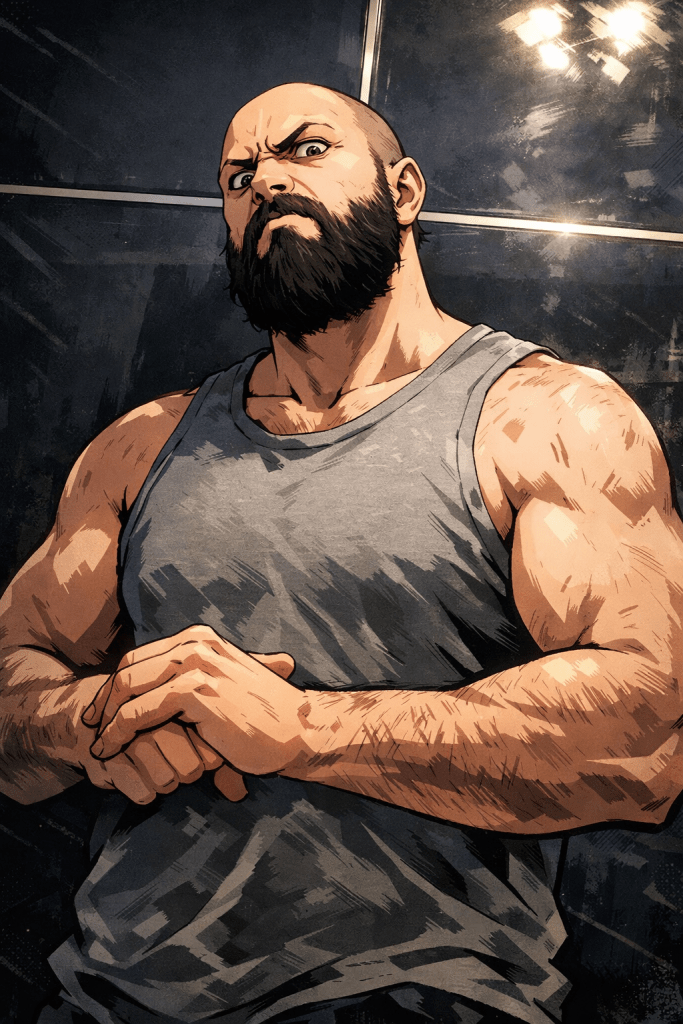
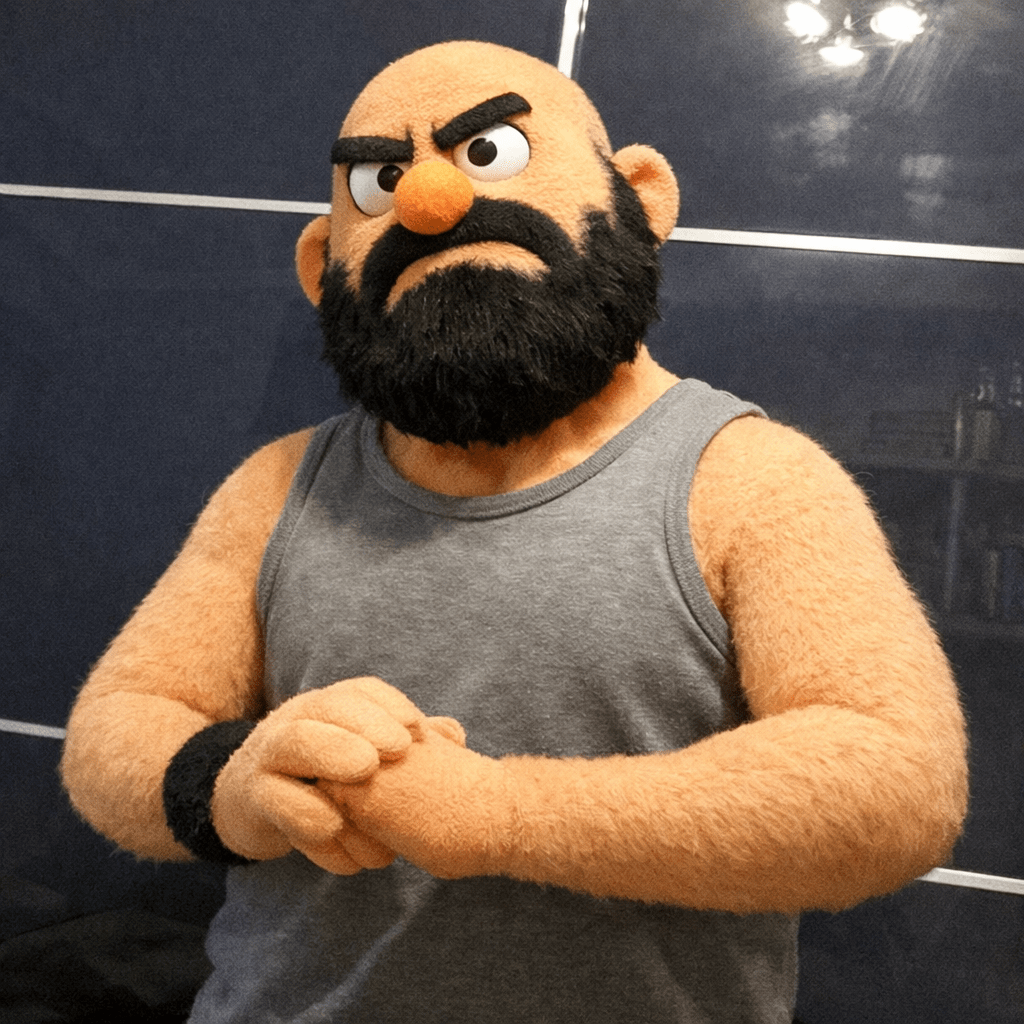
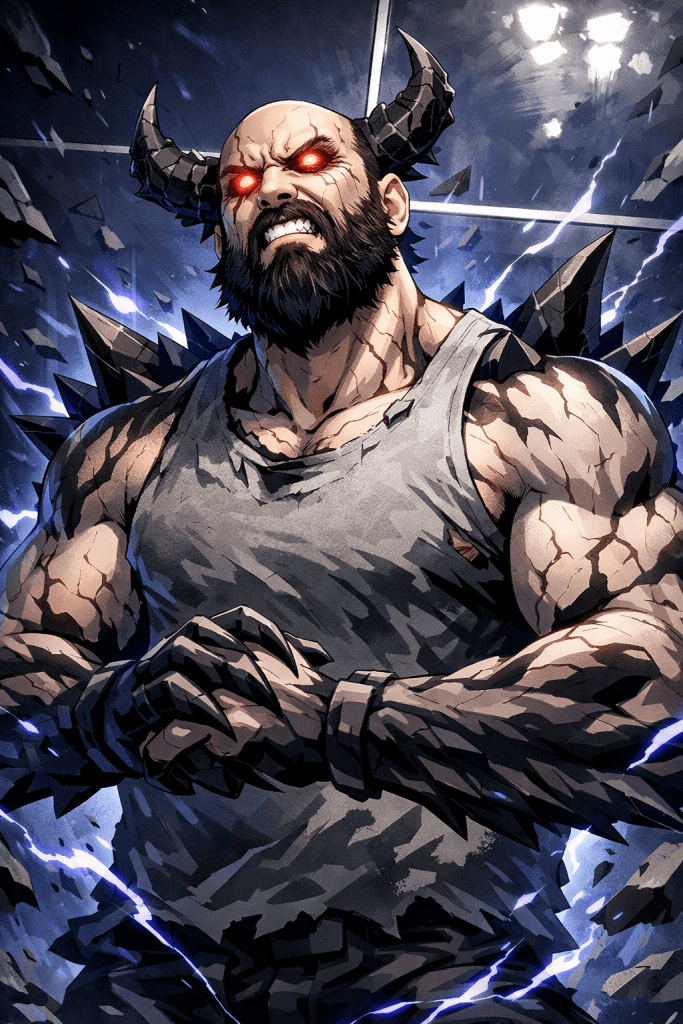
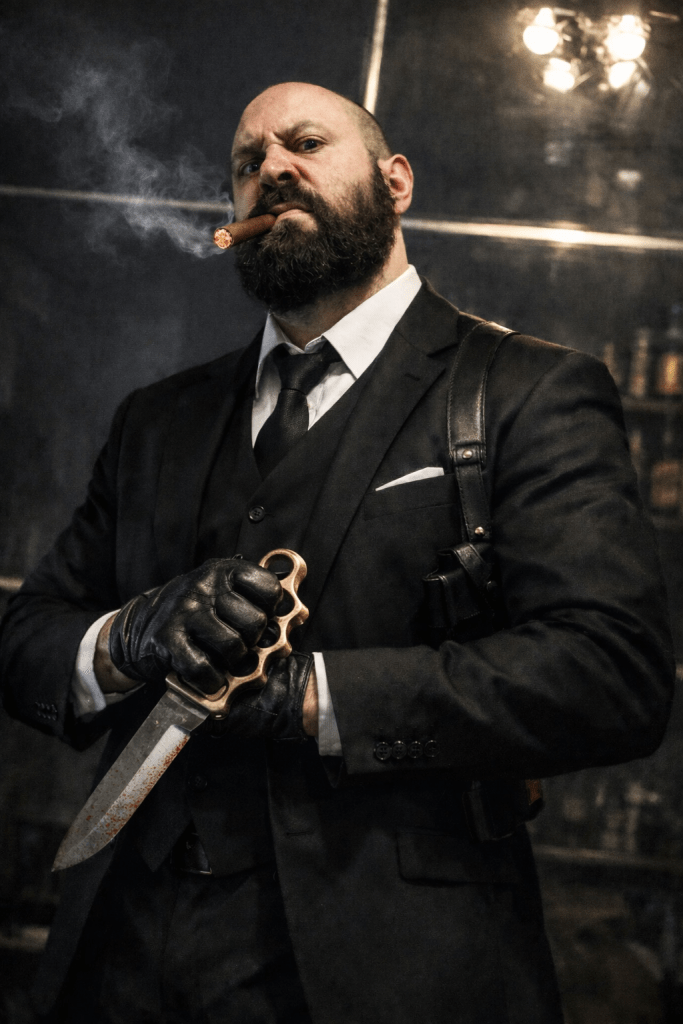
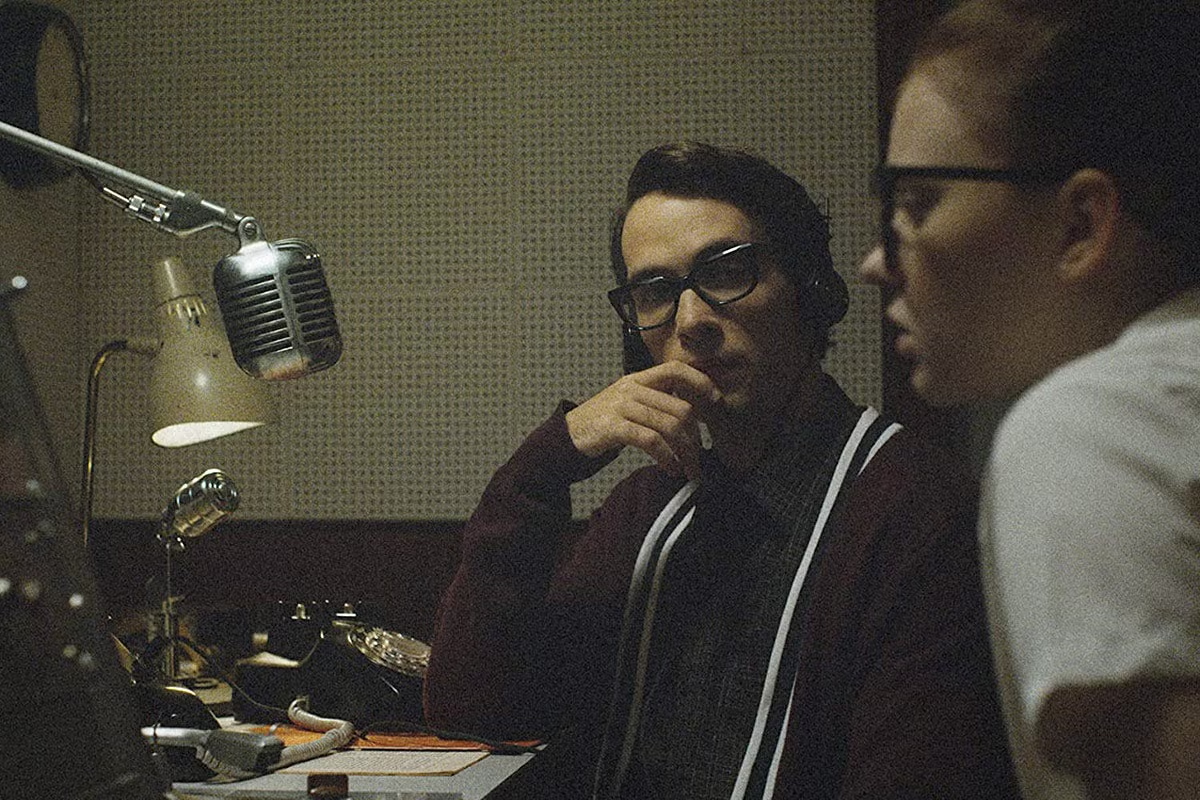
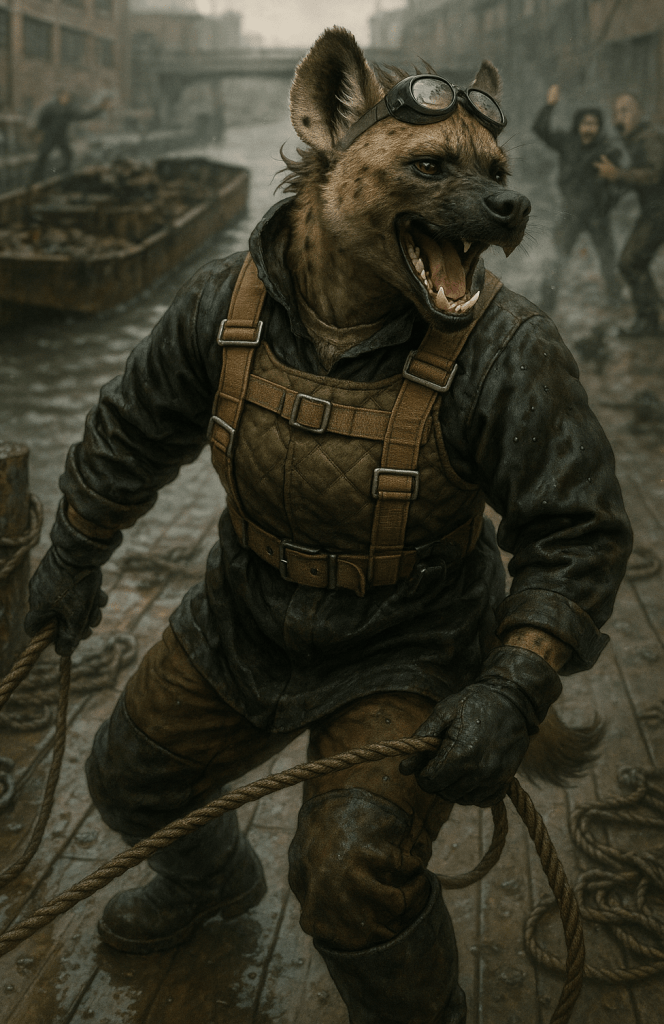
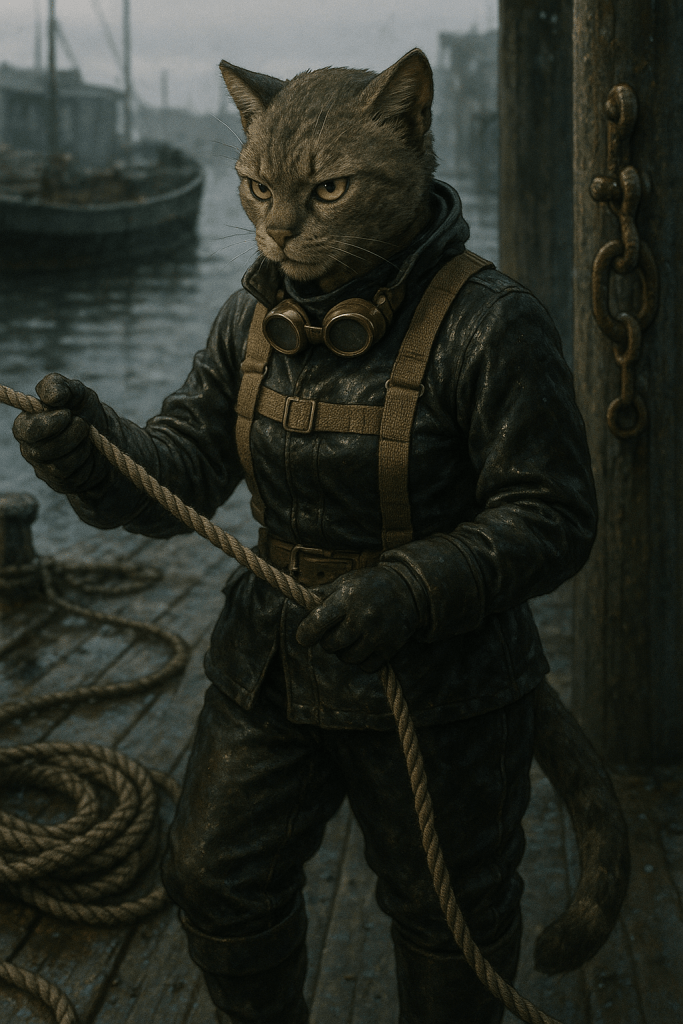
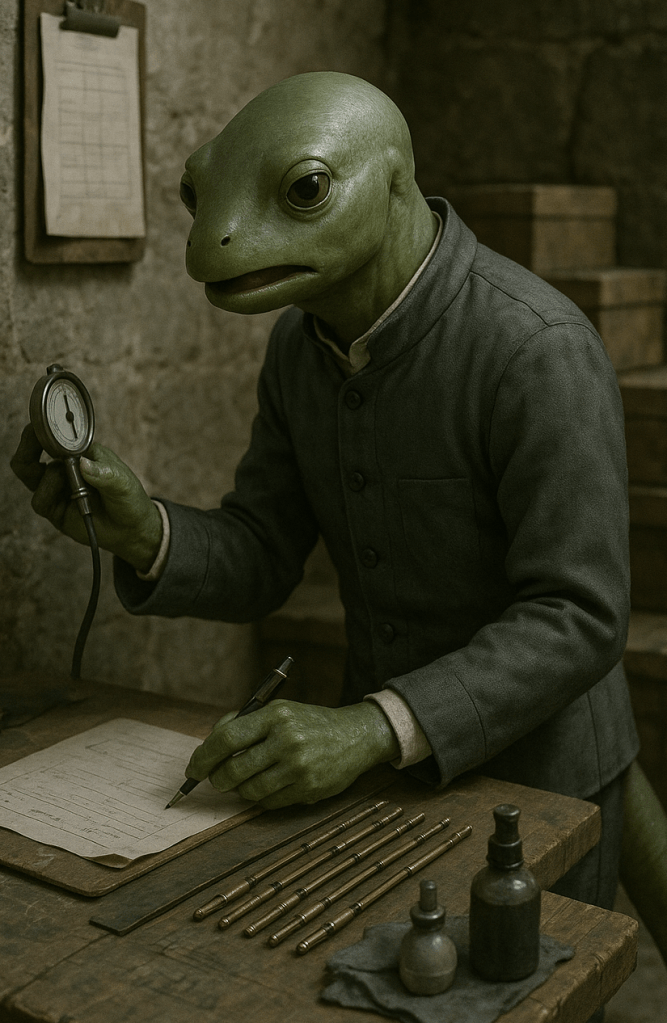
Portraits of my fantasy cycle characters

I know that some of you fuckers have read the first three short stories of my ongoing fantasy cycle (namely, The Municipal Aid Registry, Fine Print & Featherbones, and The Girl From the North Road). More are coming, as I’m having a lot of fun with it.

Anyway, I thought that other people may want to picture what the characters look like.

Vespera Nightwhisper

(yes, she’s a furry)


Registrar Copperplate


“Threadscar” Melissa


Rill

The Girl From the North Road (Short Story)

Three people. A middle-aged man, probably a local, looks like a tanner from the stains on his hands. Some kind of feline woman, exotic, dangerous-looking in a way that makes my spine straighten. And Melissa. “Threadscar” Melissa. Right here.

The tanner watches me approach. I can feel his eyes tracking me, probably taking in the sweat, the stick, the way my grip tightens when I get within speaking distance of Melissa.

“Who’s this kid?” he says. “I don’t recall seeing her in town. A girl friend of yours, Threadscar?”

The words hang there. Girl friend. Like I’m here for tea and gossip.

Melissa’s voice comes flat.

“She’s the girl from the north road. Watches me train. Not a friend. She follows.”

The words hit clean. Not harsh, just… factual. She isn’t telling me to leave, but she isn’t claiming me either. She follows. Like I’m a stray that keeps showing up at her door.

Movement to my left. The feline approaches with casual grace, tail swishing behind her. Her eyes are different colors, and they flick between me and Melissa like she’s cataloging something.

“Well well, meow. A girl who follows a warrior. What’s your name, kitten? And what’s with the stick?”

Great. Now I’m being patronized by someone who looks like she walked out of a story I couldn’t afford to hear the end of. But the question’s direct enough, so I answer it the same way.

“Rill. My name’s Rill. The stick’s a broom handle—wrapped so I don’t splinter my hands to hell. It’s what I’ve got, so it’s what I use.”

The tanner taps ash off his pipe, amusement pulling at the corners of his mouth.

“Do you make a habit of sweeping the outskirts of town with a headless broom handle?” His gaze shifts to Melissa. “You have a curious admirer, Threadscar.”

Threadscar. The name clicks into place.

She doesn’t step in. Doesn’t tell them I’m wasting time. Just stands there, expression flat, like she’s watching something unfold that she hasn’t decided matters yet.

The feline woman moves closer. Her hand reaches out before I can decide whether to pull back, and she pats me on the head—light, almost playful. A gesture you’d give a stray that showed up on your doorstep.

“You’ve got guts, I’ll give you that,” she says. “Most kids your age would’ve stayed home with a broom that still had bristles.” Her mismatched eyes study me. “Mrow, so what are you hoping to learn from our friend here? How to turn household objects into weapons, or something more… mmh… specific?”

I want to shove her hand off. Want to snarl. But that would prove I’m exactly what she thinks I am—a kid who can’t take a light touch without losing my shit. So I don’t.

She asked what I’m hoping to learn. That’s real. That’s a question with weight.

“Something specific. I’ve been copying from a distance for six months—watching Melissa train, trying to figure out what the hell I’m doing wrong. But I don’t know the basics. Stance, guard, footwork, the stuff you need before anything else makes sense. I want someone to teach me that. Not wave me off or tell me I’m too young or that I should go home and help my family. I want real instruction.” I lift the wrapped broom handle slightly. “The kind that turns this into something that works.”

The tanner exhales slowly, shaking his head.

“Can’t help but admire your determination, kid, but that stick looks like it’d break the moment you whacked a wolf’s head.” He glances at Threadscar, who’s been silent, just watching. “Local guard’ll give you training. Threadscar’s not the sociable type.”

Like I’m here begging for scraps.

The feline moves before I can respond. She slings an arm casually around Melissa’s shoulders, pulling her close with the kind of ease that says they know each other—or at least that the feline woman doesn’t give a damn if they don’t. Her tail curls lazily behind her.

“Months of watching from a distance with a headless broom, mrow?” Her mismatched eyes lock onto me, studying. “That’s not importuning, Bertram—that’s commitment. Most people give up after a week when nobody hands them what they want. You’ve been grinding alone for half a year.” She tilts her head, and I feel like she’s reading lines I didn’t know I’d written. “So here’s my question, kitten—what made you start? What happened six months ago that made you pick up that stick and decide you needed to learn how to hurt things?”

I meet the feline woman’s eyes.

“Six months ago, I saw her.” I nod toward Melissa without looking away from the exotic animal-person. “I was on a supply run to Mudbrook—dawn, cold, nobody around—and I saw her training by herself. No audience. No performance. No wasted motion. And she had scars—real ones, the kind that say ‘I have done things and survived them.’ I looked at her and I thought: that’s what freedom looks like. Not hoping someone notices you. Not waiting for permission. Just capability so undeniable that the world has to make room.”

I pause. Breathe. Don’t flinch.

“I went home that day and realized I didn’t have that. I was just… tasks. Endless tasks. Fifth priority for food, first priority for ‘Rill, do this.’ I could see my whole future: marry local, help run the waystation, disappear into the wallpaper. So I wrapped a broom handle in cloth because I didn’t have anything else, and I started showing up where she trains. Copying. Guessing. Probably doing it all wrong. But at least I was doing something. At least I wasn’t standing still.”

Bertram puffs on his pipe, something like appreciation in the slow exhale.

“Your folks run the waystation from the north road?” His voice comes careful. “You may be ditching a stable life for the opportunity to die bloody and broken in a ditch somewhere. That’s assuming nobody stole your dignity first. This world is more cruel than you’d think at your age… and it takes from you whatever it pleases, whenever it pleases.”

Melissa’s been still this whole time—watching, flat expression, giving nothing. But now she moves—shrugs off the feline woman’s arm and pulls me close against her side. Solid and real. My pulse kicks up.

Something flickers across that exotic woman’s face, too fast to catch. Then she steps back, tail swishing as she creates space.

“Mmh. I think you two have something to discuss without me hanging off your shoulder, meow.” Her mismatched eyes flick between us. “I’ll be right here. Watching. Learning. You know. Bard things.”

I step out from under Melissa’s arm and drop to my knees.

Hard ground. The broom handle rests across my thighs. Back straight, gaze level.

Bertram’s pipe lowers slowly.

“This kid seems to be made of stern stuff,” he says. His gaze shifts to Threadscar. “Too bad about her slim frame and the broom handle—but if you’d consider a disciple at any point, you could do much worse than this dedicated admirer.” He pauses. “That said, we all think we can take anything with the right attitude… until you get a mace to the face.”

Melissa’s expression stays flat. The silence stretches—that feline woman watching, the millrace rushing steady.

I stand. Not backing off—just refusing to stay collapsed at her feet like I’ve already given up on being her equal someday. I knelt to show respect. I stand to show I mean to become something worth teaching.

That silence—it’s doing something. Either making a decision or unmaking one.

Bertram’s eyebrows pull together. His gaze shifts from the feline woman to Melissa, to me, then back.

“Has… anything been resolved? I feel like something important has passed over my head.”

The feline woman’s eyes flick to him, then settle back on Melissa and me. Her tail curls lazily.

“Mmh, Bertram…” A slight smirk touches her mouth. “I think something important just happened. But whether it’s been resolved?” She glances at Melissa. “Not my story to tell.”

Standing here empty-handed feels incomplete. I extend the wrapped broom handle toward Melissa, holding it out with both hands.

“This is what I’ve had,” I say. “Six months of guessing with this thing. If you’re willing to teach me—actually teach me—then I want to start with real fundamentals. Not copying advanced forms I don’t understand. Not pretending I know what I’m doing. Just… the basics. Stance. Guard. Footwork. The stuff that makes everything else possible.”

I keep the broom handle extended. Voice steady. No begging.

“Take it. Look at it. See what I’ve been trying to learn from. And if you think I’m worth teaching, then show me how to do it right.”

Bertram lights his pipe, the flame briefly illuminating his face.

“This kid’s got heart,” he says around the stem, “but a poor sense of timing.” He exhales smoke. “We weren’t in the vicinity just for a stroll. Our fluffy cat-folk bard here—” He nods toward the feline woman. “—had taken a request to deal with some demonic poultry, and Threadscar, as our local veteran, had decided to act as backup. I’m just along for the ride.”

Demonic poultry.

Melissa takes the wrapped broom handle from my hands. Her grip shifts it through small, controlled motions—testing weight distribution, checking the balance point, examining how the cloth sits, whether the wrapping will hold or slip under pressure. Like she’s reading something I didn’t know I’d written.

“Six months with this.” Melissa’s voice comes flat. “The wrapping’s competent. You understood the problem—splinters, grip failure—and solved it functionally. Weight’s forward-heavy. That’s the handle design, not your mistake. Balance point’s here.”

She taps a spot roughly two-thirds down the shaft.

“You’ve been training with a weapon that fights you on every swing. That builds bad habits fast, but it also means you’re strong enough to compensate without knowing you’re doing it.”

She flexes the handle slightly, testing for structural integrity.

“It’ll snap if you block anything metal with commitment. You know that already or you wouldn’t be here asking for real instruction.”

First time anyone’s acknowledged it as real. My throat tightens. I don’t let it show.

Melissa turns the wrapped handle over one more time, flexes it slightly, then stops. Her gaze shifts from the broom handle to me, flat and assessing. Then she extends her longsword toward me, hilt-first, blade angled safely to the side.

“Here.” Her voice stays flat. “Hold this. Feel the difference. Weight, balance, how it sits in your hand. That’s what you’ve been trying to learn with a stick that fights you.”

I stare at the hilt. Battle-scarred leather wrapping, crossguard showing wear at the edges, the kind of weapon that’s seen actual use. She’s handing it to me.

“If you’re serious about real instruction,” Melissa continues, “you need to understand what you’re aiming for.” Her eyes lock onto mine. “Don’t swing it. Don’t test it. Just hold it and tell me what you notice.”

I take the longsword. Both hands wrap around the hilt. The weight settles—balanced. Centered. My hands are shaking.

I look up to meet Melissa’s flat gaze.

“It doesn’t fight me. The balance is clean. Centered. The broom handle pulls forward every swing—I have to compensate just to keep it under control. This?” I flex my grip slightly. “This feels like it’s waiting for instruction instead of dragging me around. The weight’s real, but distributed so I can use it instead of wrestle it.”

Bertram’s voice comes out more serious than usual.

“The tool of a trade few are prepared for, kid.” He taps his pipe, gaze steady on the longsword. “You’re holding in your hand metal that’s drunk the blood of many.”

Melissa extends her hand. I give the longsword back hilt-first, controlled, the way she handed it to me. She takes it with the same efficiency, then reaches for the wrapped broom handle still resting against her side.

“You’ve felt the difference now.” She extends the broom handle toward me, matter-of-fact. “This is yours.”

I take it. My work. Six months wrapped in cloth.

“You want real instruction. Stance, guard, footwork. Fine. But I don’t teach in a vacuum.” Her gaze shifts briefly to Bertram, then back to me. “We’ve got a job. Possessed chickens, north road. Vespera’s contract. I’m backup.”

A pause. She continues.

“Come along. Watch. See how movement works when stakes are real. You stay back. Don’t interfere. You observe—but this time you see the whole picture, not just me alone in a field. After the job, if you still want formal training, we’ll start with basics. That’s the offer. Decide if you’re coming.”

The feline woman—Vespera—adjusts the case slung across her back, tail swishing decisively. She starts walking without waiting for an answer.

“Well then. Melissa made her offer, Rill’s got her decision to make, and we’ve got possessed poultry waiting for us at 12 Kiln Lane. Meow, I don’t know about the rest of you, but I’d rather not keep a vengeful mother-in-law’s malevolent chicken waiting too long.” She throws a look back over her shoulder, mismatched eyes sharp. “Coming, or are we going to stand around the millrace discussing pedagogical philosophy until the damn birds organize a coup?”

“I’m coming.”

THE END

Fine Print & Featherbones (Short Story)

I step out of the Municipal Aid Registry—converted barn, old hay, bureaucratic optimism—into bright morning sun. Pleasant warmth for Mudbrook-on-the-Bend. My instrument case rides familiar weight against my back, dual blades settled at my hips.

Two people are approaching down the street. I recognize Bertram from earlier, and beside him—

Mrow. Interesting.

The woman beside him looks carved from scar tissue and sword practice. Longsword at her back, carried with enough casual competence to be part of her body. Threadscar, if Bertram’s earlier mention was accurate.

“Hey, what did I tell you,” Bertram says, addressing his companion but pitching it loud enough for me to hear. “A cat folk in the flesh. Isn’t she the darnest thing. Look at those whiskers.” He gestures in my direction like I’m a particularly fascinating market oddity. “Anyway, she’s got herself a mess with Aldous’ devilish chickens.”

My tail swishes once. Performing has its uses.

Threadscar’s gaze tracks over me—methodical, not curious. Weapons, instrument case, stance. Reading me like a contract with fine print. No wasted movement, no hurry. Just measuring.

When she finally speaks, her voice is controlled.

“You’re the one who took the chicken job.”

They have closed the distance now. Combat scars catch the light on her skin, small tells in how she holds herself. Someone who’s survived things that kill most people.

I smooth my whiskers briefly. Should I feel annoyed? I didn’t ask for help. But mostly I’m interested. That kind of survival leaves stories, and I collect those. Tactically speaking, if the “possessed poultry” turns out to be something wearing feathers ironically, having someone competent with a blade isn’t the worst idea.

And if things do get interesting, if there’s actual danger instead of just aggressive birds—

I shut down that thread before it can finish. Professional courtesy first.

“Mrow, that’s me. Vespera Nightwhisper, at your service.” I gesture vaguely toward the Registry behind me. “Seventeen birds, one allegedly possessed by a vengeful mother-in-law. Could be demonic poultry, could be grief and roosters. Either way, should be…” My heterochromatic eyes—amber and ice-blue—fix on her with genuine curiosity. “Educational.”

I tilt my head slightly, ears swiveling forward. “Bertram mentioned you. ‘Threadscar,’ right? He thought I might need backup.” Whiskers twitch. “What do you think? Do I look like I need saving from poultry, or are you just bored enough to see where this goes?”

Bertram produces a pipe from somewhere under his apron, tamping tobacco with practiced fingers. He lights it with a match, the narrow end settling at the corner of his mouth as smoke curls up. His eyes move between us like he’s watching theater.

“A way with words on this one, huh? That’s a bard for you, I guess.”

My attention is on Threadscar, because she’s the one who matters here.

She meets my mismatched eyes without blinking. No flinch, no fascination. Her voice comes out flat, professional.

“You don’t look like you need saving. You look like you haven’t worked this region before and don’t know what ‘possessed’ means out here yet. Could be theater. Could be something that bites back harder than you’re expecting.”

Her gaze flicks to my weapons—brief, cataloging—then back to my face. Filing information. Like she’s building a dossier in real-time.

“I’m not bored,” Threadscar adds. “I’m between contracts and Bertram thought the job might be more than one person should handle alone. If you want backup, I’ll assess the situation and act accordingly. If you don’t, I’ll find other work. Your call.”

Your call. No posturing, no pretense of saving the exotic newcomer. Just capability offered without strings. I respect that. More than respect it—I like it. This is someone who thinks in terms of practical outcomes, not spectacle. Someone who’s survived by being useful, not by being loud.

I pull the posted notice from my belt pouch and extend it toward her.

“Here. Read it yourself and decide if it’s worth your time.” My heterochromatic eyes fix on her, genuine curiosity sharpening the usual performance. “Bertram’s not wrong. I don’t know this region yet, and ‘possessed’ is vague enough to mean anything from grief-hallucinations to something that shouldn’t have a beak. If you’re between contracts and this sounds interesting, I’ll take the backup. If it sounds like a waste of your time, no hard feelings.” My whiskers twitch. “But either way, mrow, I’d rather know what I’m walking into before I knock on Aldous’ door.”

She takes it. Reads it like she’s checking for loopholes. Her eyes track across the text with the kind of precision that says she’s survived by catching the details other people miss. No commentary, no reaction visible on her face. Just information intake.

Bertram puffs his pipe, watching us. Taking his time. Then he gestures with the pipe stem, adding to his earlier introduction.

“To contribute to this meeting of warriors,” he says, voice carrying that folksy charm he wears like armor, “let me add some information that may or may not improve the quality of your trade: I know Aldous to be an honest tradesman. He’s been talking uneasily about those chickens for a good while now. Weeks, really.”

Bertram pauses, letting smoke curl. “He mentions that one of them looks… like he knows what he’s looking at. And he’s corrupted some of his other chickens too. Corrupted—that’s the word Aldous used.”

Mrow. That word lands differently than “possessed.” Corrupted implies spread. Deliberate influence. Not just one problem bird, but infection. Behavior changing, patterns shifting. That’s either the most elaborate case of anthropomorphization I’ve ever encountered, or there’s something at Kiln Lane that’s wearing chickens like masks and teaching the others to do the same.

My tail swishes once. Not performance—genuine unease, threaded with that dangerous curiosity that gets people like me into trouble.

Bertram continues.

“Could be, though, that Aldous really hated his mother-in-law and she happened to have some hen-like qualities. Never had a mother-in-law myself. Anna was orphaned young.”

Threadscar is still reading, unmoved by Bertram’s commentary. Filing it somewhere, probably, but not letting it interrupt her process. She doesn’t get pulled off-task by color or charm. Data first, texture later.

Bertram shifts his attention to me, lowering his pipe for a moment.

“I’m curious, miss cat. Do you waltz into battle with that instrument case at your back? That’s the tool of your trade, isn’t it?” His eyes crinkle with genuine interest. “Aren’t you worried that some counterattack may destroy your means to get money off taverns? I have a hard time picturing you putting down the case and shoving it back before you wield those sharp weapons of yours.”

Threadscar finishes reading, then hands the notice back to me. Her eyes find mine, holding my mismatched gaze without hesitation.

“I’ll go with you. If it’s just chickens, we’ll handle it fast and split the pay. If it’s something else, you’ll want someone who’s cleared pastoral weird before. We leave now, assess the site, execute the contract, done.”

The instrument case rides heavy on my back. Fair question. Most people don’t think past the weapons—they see the blades and assume that’s the whole story. But the lute-viol isn’t just a tool. It’s the only thing I actually care about without complication, without performance, without—

No. I’m not explaining that vulnerability to a tanner I met twenty minutes ago, no matter how earnest his pipe-smoke charm is.

Whiskers twitch. I offer him a slight smile.

“You’re not wrong to worry, Bertram. But I’ve been carrying her into fights for years now, and she’s survived everything I have.” I tap the leather with one clawed finger—the reinforcement shows in the thickness, the way the case holds its shape even when I move. Custom work, expensive, worth it. “The case is reinforced. Not just decorative. And honestly? Leaving her behind would be worse. I don’t perform well when I’m wondering if someone’s rifling through my things.” My tail swishes once. “This way, she stays with me. Always.”

I turn my mismatched eyes to Threadscar. She made her decision clean and professional. Just read the posting, assessed, committed. I want to see how she works when things get complicated.

“Right. You’re in. Good.” I nod toward the path that leads toward the old millrace. “We leave now, assess the site at 12 Kiln Lane, and see what ‘demonic poultry’ actually looks like before we decide how to handle it.” I glance back at Bertram. “Thanks for the backup—and the context about Aldous. ‘Corrupted chickens’ is delightfully vague. Let’s go see what that means, mrow.”

Bertram taps ashes off his pipe, eyebrows lifting.

“‘Bertram, thanks for the backup,’ as in stay behind while we head off to battle?” He says it lightly, but there’s genuine curiosity underneath. “I’m asking in case you wouldn’t mind an old tanner witnessing something intriguing in this lovely morning. If things get nasty, maybe I could knock some poultry unconscious with a well-aimed throw of my pipe.”

Threadscar’s expression doesn’t shift, but she takes a breath before she speaks. Running the calculation: civilian, noncombatant, knows Aldous personally, decent accuracy with small objects maybe. Liability in real combat. Potential asset for client context.

When she answers, her voice is controlled but final.

“You can come if you stay behind us, don’t touch anything that moves, and leave the moment I tell you to. No argument, no delay.” She looks at him flatly, then glances at the pipe in his hand. “If something goes wrong, you’re not my priority—keeping the threat contained is.”

She shifts her gaze back to me. Mission focus. “We move now. North road, Kiln Lane.”

My tail swishes once without permission. Right. Follow her lead. She knows the region. I don’t. Let her set the pace, watch how she navigates, learn the terrain through her rhythm.

But something else threads through my thoughts, something dangerous I need to strangle before it takes root. If this job turns into actual danger—if there’s something at 12 Kiln Lane with teeth where beaks shouldn’t have them—I’ll get to see how Threadscar works under pressure. Whether she freezes or gets clearer when the violence starts. Everyone tells a story when the stakes climb. I want hers.

I adjust the strap of my instrument case across my back, settling the familiar weight, then glance at Bertram. He’s still watching us, pipe smoke curling upward, expecting… something. Dismissal? Another round of banter?

My whiskers twitch. Quick smile.

“Thanks for the backup and the context. We’ll handle it.”

I turn toward Threadscar, fall into step beside her. My tail swishes with anticipation I’m not entirely proud of. “Let’s see what’s waiting for us, mrow.”

Behind us, Bertram’s voice carries confusion.

“I’m… receiving conflicting information.” A pause. The sound of him adjusting his grip on the pipe. “But that’s okay, I’ll follow from a safe distance. Maybe I could get Aldous to blabber something important about these demonic chickens of his.”

THE END


Some of the “short stories” of this fantasy cycle will read more like simple scenes. I’m okay with that. I’m gearing toward making them self-contained. You could check out any in whatever order you prefer, then seek possible other shorts leading to them, or from them. That fits how I’ve felt when rereading my Re:Zero fanfiction from years ago.

Post-mortem for The Municipal Aid Registry

Don’t be an idiot: read first the short story this post-mortem is about: The Municipal Aid Registry.

This new short isn’t a one-off. Over the years, as I thought back on what writing of mine brought me the most genuine joy during its production, the answer was troubling: likely the most fun I’ve ever had writing fiction was during that wild time I wrote my two-novels-long fanfiction of Re:Zero, the Japanese series of light novels slash anime. Even though I was mostly constrained by the existing characters and general plot of the original narrative, I felt creatively freer than ever before or since.

When I tried to understand why, I think it had to do with the same reason I’ve mostly only been engaged by manga in these last ten years of my life. The combination of colorful, larger-than-life characters engaged in creative endeavors, characters don’t behave with each other in the constantly cynical, conflicting manner than most Western fiction does it, was intoxicating for me. I wanted that feeling of returning to a story, whether to read or write it, merely to hang out with that ensemble of characters again. To see how they interact with each other in peculiar ways. I experience that again whenever I reread the chapters of that fanfiction (for example, part 52 and part 55).

Somehow, writing those stories always allowed me to be as funny, silly and ridiculous as I felt like it, and the story would accommodate it. There were some genuinely poignant moments too, like a sequence when the protagonist fucks up when trying to kill himself to trigger his “return by death” ability, only to end up with the lower half of his body missing, and all the people in his life either disappointed in him or despairing by his constant attempts to keep killing himself. Recently, someone from Serbia read through most of the latter half of my fanfiction, so thanks for that. Knowing that someone out there, someone whose stupid face I will never have to see, deliberately sought my writing, that warms my black, rotting heart.

Anyway, at this point of my life, so burdened by everything mentally that often I don’t know how I can keep going, I don’t feel like I can commit to any creative project long-term, but I want to do this: a cycle of short stories that each push the boundary of the same fantasy world further. It will involve possibly repeating characters that are peculiar, larger than life, and play off well against each other. Sometimes, a short story may lead into another, either immediately after the previous one or some time down the line. Maybe I will want to develop another aspect of that world. Maybe some short story will see me gathering main characters from previous stories for a collaborative endeavor. My goal is to write something joyful and silly in the way I prefer it, that will make me want to write more of it or reread the existing parts if only to hang out with those characters again. So I’m doing the whole Re:Zero thing again, but with original characters and in a likely plotless manner, at least when it comes to grand, overarching plots, which never were quite my cup of tea anyway, whether some dead witch poured her saliva in it or not.

To produce this short I’m doing the post-mortem about, I relied on the Living Narrative Engine, my mature Javascript app that allows me to play through fictional scenarios. Every time I come up with a scenario, I’m partly prompted by the desire to add a new system to the app. Over time, I’ve developed systems to move from place to place, to interact with other characters, to pick up objects, to read readable objects, to consume the contents of consumable objects, etc. Although I don’t want to commit to much, I must say that the next short story is going to follow Vespera Nightwhisper’s efforts against demonic poultry, which will involve me finally implementing proper weapon-wielding (in a way that requires grabbing with one or more hands, and prevents illogical actions when your appendages are occupied), weapon attacks depending on the type of weapon, and possibly also skill-based successes (so that the characters don’t insta-hit poultry, or get insta-hit by them). I don’t know how the story is going to play out, but that’s part of the fun.

In recent posts, I wrote that I was developing a complex GOAP system (Goal-Oriented Action Planning) to involve autonomous, non-LLM intelligences in my scenarios. I’m on my way there, but I realized that I need a much wider array of actions to be implemented in order for GOAP to fully make sense, so I’m parking that for now. Also, I’m mostly focusing on what the scenarios actually require; when I saw myself introducing hunger mechanics even though no scenario would use them for now, that was the point I realized that I had to step back and focus on what actually brought me joy. And I need a lot of it.

This morning, the moment I finished editing this new short story titled “The Municipal Aid Registry,” my brain was already buzzing with ideas for the next one. That’s the proper state of affairs.

Anyway, as usual, I hope you enjoyed this new short story about a bunch of weird fantasy people. If not, go fuck yourself.

The Municipal Aid Registry (Short Story)

The rural streets of Mudbrook-on-the-Bend are mostly deserted at this hour—folks either at work or gathered at the Municipal Aid Registry, I’d been told. The air sits pleasantly warm on my fur, though the sun beats bright enough to make me squint. Small town. Tightly packed houses along a blue-green canal. Aging timber frames, steep tiled roofs. The kind of place where someone like me probably looks like she wandered out of a fairy tale.

There. An older man standing near the main path, pipe smoke curling up from weathered hands. I clock him immediately: tradesman’s apron, genuine smile-lines, the relaxed posture of someone who belongs exactly where he’s standing. No performance.

“Oh. Morning, ma’am.” His voice carries that easy rural cadence. “Nice weather we’re having, ain’t it? Never seen you around these parts. I hope that our quaint little town won’t disappoint a member of the cat folk too much.”

That slight wonder in his tone—he’s probably never met one of us before. My whiskers twitch. Part of me immediately starts calculating angles. He knows everyone here. All the local gossip, who’s hiring, what’s dangerous. I could purr, play up the cute factor, harvest whatever stories he’s got tucked away in that weathered brain. Easy material. But gods, I just got here and I’m already doing it. Already cataloging vulnerabilities, mapping the performance.

I close the distance between us, letting myself catch the full scent of him: leather oils, curing agents, pipe tobacco.

“Morning to you too, meow.” I let my whiskers twitch with genuine amusement. “And don’t worry—I’ve played worse venues than ‘quaint.'” Something about his unpretentious energy makes it easy to drop the armor, just a fraction. “There’s something charming about a place that still smells like honest work instead of… performance. You’re a tanner, yeah? I can smell the curing agents from here.”

He takes a couple of steps back without thinking—not fear, just automatic adjustment to proximity. Most people either lean in with curiosity about the exotic cat-girl, or retreat because they’re threatened. This is different. Unconscious. Natural boundary-setting. The smile on his face stays honest.

“I’m a simple tanner, alright, miss.” He gestures down at his hands. “Probably could tell too by the stains in my skin that never quite go away. Name’s Bertram. Seems like I’ve spent a lifetime crafting saddles, belts, boots and the likes with these two hands of mine. A good life, not complaining.”

He takes a long drag of his pipe, exhales slowly. His gaze shifts to my back, my hips.

“As for you, my goodness… That instrument case slung across your back and those… peculiar weapons at your hip. You must have had quite the adventures. Well, if you’re looking for work or to perform, look no further than our humble gathering spot, the Municipal Aid Registry. Posted a request myself for reciprocal services.”

Reciprocal services. The phrase catches in my mind like a claw on silk. What does that even mean in a place like this? Barter system? Trade work? Could be dangerous, could be hauling leather, could be absolutely anything. But he’s local, established, comfortable. If I’m going to find real work here—the kind that strips away performance and leaves only survival—I need someone who knows where the bodies are buried. Metaphorically. Or literally, mrow, depending on what kind of town this actually is beneath the quaint surface.

I need to test this again. Feel out his boundaries properly.

“Reciprocal services, mmh?” I let my curiosity show in the forward tilt of my whiskers. “That sounds intriguing. What kind of work are we talking about? Something dangerous, or just the usual hauling and heavy lifting?” I step closer, closing the distance he created. “I’m always interested in… collaborative arrangements. Especially with someone who knows the area.”

His wide, simple smile doesn’t change, but I catch a small frown creasing his brow as he registers how close I’ve gotten.

“Oh, my request? Just the usual thing, keep it posted there at the Municipal Aid Registry’s bulletin board when I can spare the fee. You see, my Anna…” Something softens in his voice. “Ah, what a dear she was. My great love. Thirty years we had together until the winter fevers took her. I’m grateful for that time, but I’m not looking to replace her. I appreciate my quiet too much these days, and I’m not getting any younger.”

He takes another drag of his pipe, perfectly comfortable.

“So, the posting. I request a handjob, and offer one in return. Fair exchange, no romantic complications. You see, a good handjob is like good craftsmanship. You need to understand what you’re working with, adjust to feedback, take pride in the result.”

Oh gods. He’s… he’s talking about actual handjobs. Not hauling work or tanning work or some tradesman metaphor I misunderstood. Reciprocal handjobs. Posted at the Municipal Aid Registry like it’s… carpentry services.

Mrow… this is… I mean, I’ve played a lot of towns, seen a lot of arrangements, but posting for mutual masturbation services at the town bulletin board with the same casual energy as requesting roof repair? The complete lack of shame in his delivery—”a good handjob is like good craftsmanship”—he genuinely believes that. He’s explaining his sexual barter system the way he’d explain leather-working techniques.

I keep my expression neutral, let my whiskers stay still. Don’t react. Don’t give away whatever the hell I’m feeling right now, because I’m genuinely not sure. Surprise? Amusement? Professional curiosity about small-town sexual economics? This is material, definitely material, but I need a second to process.

Bertram takes my silence in stride, another casual drag of his pipe as he looks into my eyes with that same untroubled calm.

“Hmmm… Maybe this is a human matter. Don’t know if cat folk engage in handjobs. I’ve lived in Mudbrook all my life. People know me, knew my Anna. They know my work is good and I’m honest in my dealings.”

He gestures with his pipe-hand toward the street.

“That said, a traveling bard like yourself will maybe want to check out the other work. Us locals can get fed easily on our produce, so we can do with reciprocal handjobs, but you have to… carry provisions and such for the trip, right? Anyway.” He points at a building that looks like a converted grain barn, larger than the surrounding structures. “There’s Mudbrook’s Municipal Aid Registry. Copperplate’s in charge. Good fellow. Been here before any of us showed up. Just be patient with him, he operates at… his speed.”

He’s genuinely waiting for my response. And the thing is… mrow… I’m not actually offended or shocked. I’ve done stranger things for worse reasons. But this is information. This tells me something about Mudbrook that I didn’t expect—there’s a whole sexual economy here that operates with the same casual pragmatism as trading eggs for flour. That’s information I file away.

“Are you alright, miss? Cat-folk’s faces aren’t that easy to read, not for a Mudbrook leatherworker anyway.” He tilts his head slightly. “You have quite the peculiar eyes, I must say. One ice-blue, the other amber. Is that something that happens to your kind?”

He’s asking about my heterochromia because my face isn’t giving him the information he wants. Fair enough. Cat faces are harder to read for humans.

I let my tail swish slowly, thoughtfully.

“I’m fine, don’t worry. Just thinking, mrow.” My whiskers relax a fraction, showing him I’m not offended or disturbed. “And yeah, the eyes—heterochromia’s not super common among cat folk, but it happens. My mother had it too, though hers were both shades of green. Mine decided to be dramatic about it. As for your arrangement—refreshingly pragmatic, but I need provisions more than handjobs at the moment, mrow.” My whiskers twitch. “Does everyone in Mudbrook operate on this kind of system, or just certain folks?”

Bertram steps back to let a young man pass, planks of wood balanced on his shoulder. The kid nods at the older leatherworker without breaking stride. Bertram nods back, takes another drag of his pipe, taps the ashes out against his boot.

“System… can be called that, I guess. Folk used to offer deals over ale, but then they’d forget the finer points and there’d be fights.” He grimaces. “Good old Copperplate fixes all that. The man… or whatever it is… keeps records like it’s his religion. Keeps us grounded and sane.” His voice softens. “Ever since my Anna died, I’ve gotten plenty of answers thanks to those proper proceedings. Mudbrook-on-the-Bend is a simple town. Fair dealings. Well-crafted tools and materials. Straightforward, honest people. That’s how we like it.”

I should move. The Registry’s where the real work is—dangerous contracts that pay in coin, not sexual services. Combat work. That’s what I came here for.

“I appreciate the explanation. Thanks for the local orientation, Bertram. If I survive whatever job I pick up, maybe I’ll come back and you can tell me more about Anna over a drink. She sounds like she was worth those thirty years.”

The converted grain warehouse sits open-sided toward a patch of grass and trees, timber construction weathered but solid. The bulletin board dominates one wall—crowded chaos of notices, some full sheets, others torn scraps, layered and pinned unevenly like sedimentary history. A service counter suggests this used to be a loading bay. Mixed crowd of locals scattered around tables with tankards. Civic business conducted in warehouse setting. The air smells of old wood, spilled ale, and something else—ink and parchment, sharply chemical.

That’s coming from the tortoise-person behind the counter. Copperplate. Has to be. Short and stocky, ancient-looking, dark-olive scaled limbs extending from a bronze domed shell. Cream plastron visible at the chest. Charcoal-gray hooked beak, amber round eyes behind reading spectacles. He’s wearing formal sleeve cuffs and a fitted waistcoat that somehow dignify the whole turtle-in-a-warehouse aesthetic. The smell of ink and old parchment emanates from him like a profession made manifest.

He’s currently handing a posted notice to a woman who… mrow. She’s built like violence made flesh. Muscular, heavily scarred, the kind of body that tells stories about surviving things that should have killed her. She takes the notice from Copperplate’s clawed hand with careful precision, stares at it for a moment. Her expression goes distant. Then she turns and heads for the streets without a word.

The board’s chaos hits me immediately—a cluster of stained parchment and competing desperation layered over each other like archaeological evidence of small-town needs. An alibi notice at eye level, hastily scrawled with crossed-out attempts: WANTED: Someone to tell my wife I’ve been working late (I’ve actually been at the pub). 2 copper. Convincing liars only. A man rewrote this multiple times before posting. Performance stacked on performance. I move on.

Behind me, someone enters—pipe tobacco, leather oils, curing agents. Bertram. He heads to the tables where locals are gathered with their tankards.

I let my attention drift back to the board. Let me check the birthday musician notice next, see if there’s actual danger on offer or if Mudbrook only provides low-stakes human misery.

“Good morning, Mr. Copperplate.” Bertram’s voice carries from the counter, that same easy rural cadence. “Hope you haven’t been getting any trouble other than the usual. By chance, do you know if anyone has taken interest in my request? I’ve been building up some pressure lately, with this saddle commission for the merchant’s daughter and all.”

The birthday musician notice sits just below the alibi request. I scan the text:

MUSICIAN NEEDED: Play at my daughter’s birthday. She’s 7. You will be required to perform “The Happy Donkey Song” seventeen times minimum. 3 copper, earplugs not provided.

Behind me, the tortoise-person’s voice emerges—slow, deliberate, each word separated by noticeable pauses like he’s processing language at a different speed than mammals.

“One moment… Bertram. I must… complete… the current… notation… before responding… to your inquiry.”

Bertram’s voice carries easily.

“Take all the time you need, old friend. Have you noticed, by the way, our newcomer? A cat folk, no less, in our little Mudbrook. Must be a musician unless she’s carrying loot in that instrument case of hers.”

I’m hyper-aware of the weight of attention from the tables—multiple sets of eyes tracking the exotic cat-woman. I’m the circus that wandered into town.

Seventeen times. Minimum. The words sit on the notice like a threat. I read it again, making sure I’m not hallucinating from road exhaustion. A seven-year-old who’s learned to weaponize repetition. Old enough to understand cause and effect, young enough to have zero mercy. And the parent who posted this knows exactly what they’re asking for. They wrote “minimum.” They know their child. They’re desperate enough to pay a stranger three copper to endure what they can’t face themselves.

“Oh, if Anna, poor Anna would have been here today.” Bertram’s voice softens with memory. “She often talked about seeing some exotic folks. Couldn’t go anywhere, of course, on account of her weaving… And all my leather work. And I don’t think she ever heard music played live, did she? Hmm, maybe that one time a young merchant came by with a flute… Or was it drums?”

I hear him drink, the hollow sound of a tankard being emptied.

My attention drifts back to the notice. Seventeen repetitions would strip away every bit of performance, every shred of artifice. By repetition twelve I’d be completely raw—just muscle memory and survival instinct, the song reduced to pure acoustic reflex. That’s the kind of clarity I chase, just… from a different angle than combat. Not violence-clarity, but repetition-clarity. Mrow… but three copper. That’s insulting compensation for that level of psychological endurance.

“Mr. Copperplate, do you still remember what I asked?” His voice carries confusion now. “Wait, what did I ask again? Was it something about Anna? I swear all the leather dyes are seeping into my brain. I come across a fellow Mudbrooker along the street and they greet me nice and I can’t tell if a handjob was involved.”

The weight of attention presses against my fur like humidity. I don’t need to turn around to know exactly what’s happening at those tables—the locals, mainly men from the scent signatures, chatting with that animated energy that comes from having something exotic to admire. I catch fragments of conversation, none of it subtle:

“—never seen a tail that fluffy—”

“—the way she moves, gods—”

“—bet she’s got claws under that—”

I’m the entertainment of the week. Maybe the month. Provincial setting, limited exposure to non-humans, and here I am in my road-worn leathers with weapons at my hip and an instrument case across my back.

I keep my focus on the bulletin board, let them stare. My tail does its own thing—slow, thoughtful movements that have nothing to do with their entertainment and everything to do with processing what I’m reading. The birthday musician notice still sits there with its seventeen-repetition threat. The alibi service with its suburban deception. Neither offering real danger. Neither stripping me down to anything honest. But there are other notices layered across this board like archaeological strata.

A water-stained notice near the bottom, tear-marked: URGENT: Recover my dignity from the bottom of the well. Also maybe a bucket. Dignity preferred but bucket acceptable. I blink. Move on.

“Hey…” Bertram’s voice cuts across the converted grain barn. “Damn, I don’t know your name. Cat folk. With those weapons at your waist, the chickens request may be more up your alley. Or my request about reciprocal services. That’s been up for a good while. I always respond in kind, on a leatherworker’s honor.”

Mrow. He’s being helpful. The scratch of Copperplate’s quill continues behind me. Future historians will read about Bertram publicly recommending his reciprocal handjob services to the exotic cat-folk stranger, rendered in perfect archival notation.

Bertram’s voice carries again, this time directed at Copperplate:

“I guess there’s much to record with a newcomer in town, ain’t there? My goodness, you’re going to run out of ink this morning.”

Movement catches my peripheral vision. Bertram’s stepping away from the counter, boots scuffing across the warehouse floor. He circles around a couple of tables—the ones with the men who’ve been cataloging my existence like I’m the most interesting thing to happen to Mudbrook since the last time someone fell into a well—and heads for the bulletin board. Not toward me exactly, but toward his own posting. The reciprocal services one.

He stops with his hands on his hips, looking up at his notice. I’m standing close enough that I catch his muttered words.

“Hmmm…” He’s reading his own posting, lips moving slightly. “‘Hygiene acceptable, all digits functional’… Could have worded that better, maybe. It’s just these damn dyes, the stains are so hard to get out.”

He examines his nails, holding his hands up to catch the warehouse light.

“And these dark crescents, don’t even know how I could begin to scrub them out unless I cut my nails.”

I’m stalling. The chickens notice is still there. Bertram’s reciprocal services posting sits higher up where he can review his own nail-hygiene marketing. I should just pick one and move on. Let me see what passes for possessed poultry in Mudbrook-on-the-Bend.

HELP WANTED: My chickens are possessed by the vengeful spirit of my dead mother-in-law. Or they’re just mean chickens. Either way, I need them gone. 1 silver, or take the chickens.

One silver or take the chickens. That’s… actually decent pay for livestock removal, possessed or otherwise.

“That’s more up the alley of a proper adventurer like you, miss cat,” Bertram says. “I know the guy, he makes most of the local pottery, and also has quite a collection of chickens. Demonic hen, I’ve heard him repeat. Veritably devilish.”

The scratching finally stops. Copperplate lifts his claw, ink still wet, and fixes his amber eyes on Bertram through his spectacles.

“Bertram. To answer… your original inquiry… no one has… registered interest… in your reciprocal… services posting. The record shows… no approaches.”

Bertram looks back at Copperplate across the converted grain barn, his expression cycling through confusion—like he’s forgotten they were even having a conversation—then recognition, then something brighter for just a moment. Finally, it sours into disappointment.

“Oh, damn it. Nobody?” His voice carries genuine hurt beneath the frustration. “It seems that after the novelty wears off, Mudbrookers don’t want to be repeat customers. Fair transactions and mutual benefit aren’t what they used to be, are they? Maybe it’s the tannery staining, and that smell of newly-worked leather.”

I watch as Copperplate’s claw hovers over the ledger for a long moment. Then it descends, scratching across parchment with religious devotion.

I let my attention drift back to the bulletin board. The chickens notice sits there with its straightforward desperation. Could be genuine combat danger. Could be difficult livestock removal with homicidal poultry.

“Demonic mother-in-law spirit sounds more promising than seventeen performances of ‘The Happy Donkey Song,’ mrow.”

“I don’t think you’re getting any more juice out of the request, miss cat. What you see is what you got.” Bertram pauses. “If you’re gearing up to take that chicken contract, we could find our local veteran. She’s one tough broad, that one. Scarred from head to toe it seems. Always carrying around that longsword of hers. I reckon you two together could handle chicken demons.”

The woman I saw earlier. The one who took a notice from Copperplate with that focused intensity, then left without a word. Heavily scarred, built like violence made flesh. That tracks with “local veteran” perfectly.

Partnering up. I came here to strip away performance, to find that crystalline clarity that only comes when survival is the only option. Adding another person complicates that. Means witnessing. Means someone else’s assessment of how I handle danger, what that reveals about me.

Stop procrastinating. Take the fucking notice. Commit to something instead of endlessly circling like my tail’s chasing itself. If the chickens turn out to be genuinely possessed or magically corrupted, I get the violence-induced composition clarity I’m chasing. If they’re just mean livestock, well—at least I’ll have moved forward instead of standing here being entertainment for gawking locals.

“You’re right, Bertram. I’m overthinking this, mrow.” My claws grip the edge of the parchment. “Let me just take the chicken notice and we can figure out if we’re dealing with actual demons or just aggressive poultry.”

The notice pulls free from its pin with satisfying resistance. I hold the parchment, feeling the weight of commitment settle across my shoulders like the instrument case.

Bertram’s already moving, boots scuffing across the warehouse floor as he follows me toward the counter. His voice carries that encouraging energy people get when they’ve successfully convinced someone to stop overthinking.

“Good, good. If I see Threadscar around, I should tell her you’re gunning to take care of our local chicken problem once and for all. Two fierce women in a poultry battlefield sounds better than one.”

I close the distance to the counter. The tortoise-person’s amber eyes track my approach through those reading spectacles, though his claw never stops moving across the ledger. Up close, the scent of ink and old parchment emanates from him much stronger.

“Mr. Copperplate, I’d like to register this contract.” I set the notice on the counter between us. “The chickens. Need the address and any additional details you have on file about the situation.”

The scratching stops. Copperplate’s clawed hand lifts the chickens notice with a glacial deliberation that suggests he’s moving through a denser medium than air. He holds it at reading distance behind those silver spectacles.

“I will now… review the documentation. This ensures… archival accuracy.” His claw descends to the ledger. “Before proceeding… I require the contractor’s… full name… for the permanent record.”

Oh. Right. I haven’t actually introduced myself. Just walked in, grabbed a notice, and demanded registration like I assumed bureaucratic telepathy was part of the service. Mrow.

“Vespera Nightwhisper.”

Copperplate’s amber eyes lift to meet mine through those spectacles.

“The record… will reflect… your registration.”

His claw descends. More scratching. This is going to take a while.

Behind me, I catch movement—Bertram heading toward the converted grain barn’s exit. His voice carries over his shoulder.

“Alright, I’ll look for Threadscar. That old warrior is always up for some action, and gods know we don’t get much of it here. Of any kind, these days.”

His boots scuff across the threshold and he’s gone, pipe-tobacco scent fading as he hits the streets of Mudbrook-on-the-Bend.

Bertram will find that veteran, which means I’m committed to whatever violence or embarrassment this job offers. Can’t back out now without looking like a coward who fled from poultry.

Finally, Copperplate’s claw lifts from the ledger. His amber eyes fix on me.

“I have verified… the notice contents. This contract was filed… by Aldous the potter. His workshop… is located at… twelve Kiln Lane… eastern district… near the old millrace.” He pauses. “The supplementary… documentation… indicates seventeen chickens… on the property. The specific… problematic hen… is described as ‘the large speckled one… with the malevolent stare.'”

His eyes blink—a full five seconds, like his eyelids operate on their own timeline.

“Payment is one silver… upon resolution… or you may claim… the chickens… as compensation. Both options… are legally binding. Do you… accept these terms?”

“I accept the terms, mrow.” My tail swishes once. “Twelve Kiln Lane. I’ll handle the demonic poultry situation.”

THE END


I generated the following video about this story. Some genuinely hilarious images.

Review: Dispatch

Back in late 2000s and early 2010s, we had this thing we affectionately called Telltale-style games: heavily narrative-driven games that relied on letting the player make more or less compelling decisions that would affect the narrative. They didn’t have the complexity of early adventure games, but they couldn’t be called simple visual novels either. They were tremendously successful, until corporate greed swallowed them, spread them thin, and eventually dissolved them into nothing. The company shut down.

A new studio made of former Telltale devs decided to try their hand a new Telltale-style game that removed the dragging parts of former Telltale games (mainly walking around and interacting with objects) to focus on a good story, a stellar presentation, and compelling minigames. Their first product was the game Dispatch, released about a month ago in an episodic format (two episodes a week, but all of them are out already). The game has become a runaway success.

The story focuses on Robert Robertson, a powerless Iron Man in a society where many, many people have superpowers. He carries the family legacy of battling villains with a mecha. As an adult, he pursued the supervillain who murdered Robert’s father, and who now led one of the most dangerous criminal groups. However, during an assault on the villain’s base, Robert’s mecha gets destroyed, which puts him out of a job.

However, he’s approached by one of the most notorious superheroes, a gorgeous, strong woman who goes by the name Blonde Blazer. She offers him a job at the company she works for, SDN (Superhero Dispatch Network). Their engineers will work on repairing Robert’s mecha, while he offers his expertise on fighting crime as the one in charge of dispatching other heroes to the appropriate calls.

Robert finds out that the team of heroes he’s supposed to handle are a bunch of villains who either have approached the company to reform themselves, or were sent by the criminal system for rehabilitation. They’re a diverse bunch of rowdy, at times nasty superpowered people who aren’t all too keen on having a non-superpowered nobody in charge of them. The narrative explores how the team grows to work together better.

The execution of this story could have gone wrong in so many ways: wrong aesthetic, time-wasting, atrocious writing, and above all, marxist infiltration; like most entertainment products released on the West these days, the whole thing could have been a vehicle for rotten politics. But to my surprise, that’s not the case here. A male protagonist, white male no less, who is an intelligent, hard-working, self-respecting role model? Attractive characters, fit as they would be in their circumstances? A woman in charge (Blonde Blazer) who is nice, understanding, competent, caring, and good? Villains with believable redemption arcs? Romance routes that flow naturally? Where the hell did this game come from in 2025?

Entertainment consumers have been deliberately deprived of all of this by ideologues who despise everything beautiful and good, who, as Tolkien put it, “cannot create anything new, they can only corrupt and ruin what good forces have invented or made.” Franchise after franchise taken over by marxists who dismantle it, shit on the remains, and then insult you if you don’t like it. Dispatch is none of it. For that reason alone, I recommend the hell out of it. I’m sure that given its sudden popularity, the forces-that-be will infiltrate it and ruin it in its second season as they do with everything else, but the first season is already done.

It’s not perfect, of course. Its pros: an astonishing visual style that makes it look like a high-quality comic book in movement. No idea how they pulled it off. Clever writing. Endearing characters. Interesting set pieces. The voice acting is extraordinary, led by Aaron Paul of Breaking Bad fame. He deserves an award for his acting as Robert Robertson. It’s a good story told well, and you’re in the middle of it making important decisions (and also plenty of flavorful ones).

The cons: some whedonesque dialogue that didn’t land for me. Too much cursing even for my tastes, to the extent that often feels edgy for edge’s sake. Some narrative decisions taken during the third act, particularly regarding the fate of one of the main characters, didn’t sit well for me, as it deflated the pathos of the whole thing. But despite the pros, this was a ride well worth the price.

Oh, I forgot: they should have let us romance the demon mommy. My goodness.

Check out this nice music video some fan created about Dispatch, using one of the songs of its soundtrack.

Post-mortem for We Are the Monitoring

Link to We Are the Monitoring. You shouldn’t read the rest of this post unless you’ve read the short story.

I think that the tale for how this most recent short story came to be could be interesting. As some of you might know, ever since last April or May, I’ve been working frantically on a programming project that allows the user (for now, just me, even though the repository is public) to set up complex scenarios involving locations, characters, items, etc. The actors can perform a myriad of contextual actions. The app is mostly moddable (all actions, rules, conditions, components, etc. come from optional mods). My main goal with this app was creating fictional scenarios that I would find interesting.

A couple of weeks ago or so, I thought of a scenario that seemed intriguing to me: two isolated guards tasked with monitoring a rift in reality, only for something to go wrong in a way that would jeopardize their morality and even turn them against each other. However, the original idea was quite different. Although both Elena “Len” Amezua and Dylan Crace ended up being exactly the same as the original conception (one a compulsive documentator, the other an ex-military corpo), the turning point of the story would involve a mutated version of Len walking out of the rift in reality. Mutated as in tentacles and such. In the original vision, both Len and Dylan had weapons (Len a sidearm, Dylan an automatic rifle), but they were both prohibited by HQ from discharging their weapons unless they received authorization, which they couldn’t get because the comms didn’t get through. And this mutated version of Len claimed to be from the future, that she had come back to prevent whatever disaster had corrupted her. Was she telling the truth? Would Dylan shoot her? Would Len herself shoot her? I didn’t know myself, and exploring it would be part of the fun.

One of my interests in setting up scenarios are the opportunities for creating new systems for the app. For The Cock and the Compendium, I had to create components and actions related to beverages (due to them drinking tea). That was relatively simple. It also relied on the work I did weeks earlier to introduce readable items into the app. To set up a scenario featuring non-human anatomy and weapons, it meant I had to enhance the anatomy system of my app, by far the most complicated part of it, as loading an anatomy recipe builds a node-based graph with auto-generated descriptions. And it only supported human beings. Fortunately, I’ve made the anatomy system far more reliable and competent now, to the extent that a simple call to ‘npm run validate:recipe’ on a recipe tells you exactly why it’s valid or not. Previously, creating any new recipe was a sequence of trial and error, not knowing in advance whether a recipe would fail to build because you forgot to create a nose entity with a scarred texture.

To test the recipe system, I created non-human recipes for a giant forest spider, a kraken, a red dragon, and a centaur warrior. All of those recipes were far less complex than what I attempted later to test the robustness of the anatomy system: an eldritch abomination. That very same eldritch abomination ended up being the third character of this short story.

I have yet to finish implementing the weapons system. In fact, it has barely started. It will feature ammo handling, jamming, aiming mechanics, etc. Much more complicated than I envisioned in the beginning. But after I finished creating a very detailed character definition for Len Amezua, I figured I could entertain myself doing a test run of the scenario, not knowing how I was going to play it. Initially, I had all characters at the same location (the salt flats), but that meant starting with the confrontation. From the beginning, I intended for the non-human entity to come out of the portal, which meant having to implement dimensional portal traversal that regular actors shouldn’t be able to perform. That wasn’t too complicated to do, and now, everything an scenario needs to allow dimensional travel is for an exit blocker to have the is_dimensional_portal component, and for an actor to have the can_travel_through_dimensions component. This actor will get the action “travel through dimensions” as available, and the rest of the actors won’t even know that’s possible.

So, I started the scenario, playing it mostly straight. Of course, I thought that the eldritch abomination breaking expectations would be far more interesting, and potentially funny, as simply playing it as a threatening or at least indifferent visitor. As ChatGPT pointed out some time ago, when I fed it a summary of my favorite stories of mine and told it to figure out the commonalities, I’m always interested in putting characters in awkward situations in which things don’t go as they’re supposed to, often pairing characters that normally wouldn’t even engage, or it would be impossible for them to do so. A hulking intersex duchess taking over a medieval world. A young musician being conscripted by aliens to train hybrids. One semi-deranged narrator getting intimately acquainted with a sasquatch goddess. A Japanese salaryman getting a personal cat-girl for joy and love. Three kids rushing to see a landed UFO only for the cranky alien to be pissed that his property rights have been violated. For whatever reason, this is the stuff I gravitate to. All of them also have the potential to be funny, and I believe that experiencing fun is one of the most important things in life. It’s usually common for comedians to be depressed. When you have been at the end of your rope, not even wanting to live, what comforts you is laughter. And often the sole response to the absurdity of life is to laugh.

Anyway, during this test run of the scenario, when I realized that Len would continue compulsively jotting down notes even though it was pissing off both her partner and the interdimensional visitor, I realized this would turn into a story. And somehow, these stories always resolve themselves. Dylan’s background as a military vet now turned corpo believer made him likely to boast or at least speak casually about the stuff he did overseas, and the clash regarding such activities with an alien who mainly seemed to be interested in the weather was the kind of conflict I enjoy.

Len’s background is elaborate, but only the top of it shows up in the story, in an iceberg fashion. I had conceived her as a former technical inspector for the same corporation, who detected a massive liability only for HQ to dismiss her and eventually even fire her and threaten her with lawyers when it turned out she was right after several people died. But Len returned to work for the same corporation, at another branch, because she needs to keep paying for her younger sister’s medical bills. That has turned her, in her late thirties, into the kind of calm like “I’ve screamed out all I could and nothing changed for the better.” So now she just documents, because she knows that if something goes wrong, the powers-that-be will bury it, but the truth needs to survive if only for some sort of cosmic reckoning.

Anyway, I hope you enjoyed the story. If you didn’t, screw you. And if you’re reading these words without having read the story first, you’re a really stupid person.

We Are the Monitoring (Short Story)

The salt flat extends to a bleached horizon under morning light. Polygonal crusts interlock beneath my boots, shallow brine pooling along their seams. At mid-distance, the rift hovers—vertical ellipse refracting the horizon with chromatic fringing, faint glow at its rim, reflection wavering in the wet surface below.

09:03. That’s when it changed.

Static to dynamic. First time since observation began.

The hum registers now—low-frequency oscillation, 60 to 80 Hz, felt in my sternum more than heard. The rift’s edges waver. Heat shimmer makes it difficult to isolate the distortion from atmospheric effects, but the pattern’s distinct. I’ve seen this before in industrial systems. Boilers don’t explode without warning. They hum first. They vibrate. They give you signatures if you’re watching.

My notebook’s open. Timestamp, temperature, oscillation patterns. Corporate monitoring hasn’t sent an alert.

Dylan’s trotting toward me across the flats, alternating his attention between me and the rift. Coffee mug in hand. Gray cap, tactical belt, field pants. His shadow stretches long in the morning light.

“Hey, Len, what the hell is going on with the tear?” he calls out. “You hear that hum?”

I don’t look up from my notes. Red ink now for the anomaly.

“Yeah, I hear it. Started approximately four minutes ago.”

He reaches me, extends the mug. The ceramic’s warm against my palm when I take it. His head’s turned toward the rift even as he hands it over.

“Here, in case you need a kick. I tried to contact HQ on the net earlier for a routine report, but they weren’t picking up. And now this.” He pauses. “What do we do other than jot down notes?”

I close the notebook, my thumb marking the page. HQ not responding. The rift exhibiting pre-failure signatures. The question hangs in the salt-bright air between us, and I don’t have a good answer yet.

“They weren’t picking up because they don’t monitor this thing in real time, Crace. We’re the monitoring. We’re what they check after something goes wrong.”

Dylan brings a hand to his head, fingers pressing against his temple. His eyes narrow.

“I saw something alive. In my head. Some strange shape.” His voice drops. “I don’t like this one bit, Elena. But of course we can’t do shit other than stay here and witness whatever is happening.”

09:07.

The moment he says it, color washes through my peripheral vision. Internal. Shapes that don’t resolve into coherent geometry. Something aware, looking back. There and gone in seconds, leaving the ghost of its presence like retinal afterburn.

“We document it,” I say. “Psychic intrusion, shared perception across multiple observers, timestamp oh-nine-oh-seven. I saw it too, Crace.”

I look up at him. His hand’s against his head, but his eyes are on me now instead of the rift.

“If it’s transmitting to us at this range, settlements are probably getting hit harder.”

The coffee’s going cold in my hand. I should drink it but I can’t look away from the rift. Dylan’s standing beside me, both of us waiting for the next escalation because that’s what this is now—not if, but when.

The hum drops in frequency. Lower. Felt more than heard now, resonating through the salt crust beneath my boots. The rift’s edges blur, shimmer, then—

09:12.

The oscillation stops. Like someone cut power to the system mid-cycle. The rift hangs there, frozen, its chromatic fringing locked in place. No wavering. No distortion beyond the baseline refraction I’ve been logging for weeks.

Dylan shifts beside me.

“Is it—”

The shape materializes.

Not through the rift. In front of it. The space between us and the ellipse contains mass where there was none, like reality forgot to render it until this exact moment. Building-sized. An inadequate term but it’s what my brain latches onto because I need scale, I need reference, I need something to anchor this in observable phenomenon.

Wriggling, translucent-gray skin stretched over impossible articulations. A massive eye, pupil-less amber, phosphorescent, unblinking, positioned where a face should be. Tentacles, dozens, purple-gray and suckered. Smaller eyes scattered across the surface in wrong colors. Membrane wings pulse bioluminescent blue-green. Compound eye stalks track in multiple directions.

Vestigial arms hang corpse-pale. Pink translucent sacs pulse along what might be a throat, pale internal organs visible through the membrane. Multiple lamprey mouths drool corrosive saliva that hisses on the salt.

The coffee cup slips from my hand.

Dylan’s gone pale. Wide-eyed. Voice tight when he speaks.

“Uh… That has to be a hallucination. Tell me you aren’t seeing what I’m seeing.”

He wants an out. Wants me to give him the rationalization, the explanation that lets this be anything other than what it is. But I can’t do that because I’m seeing it too, and if we’re both hallucinating the same impossible entity then the psychic intrusion went from transmission to full sensory override and that’s a third escalation in nine minutes.

“I’m seeing it,” I say, pen moving. “Building-sized mass, materialized at oh-nine-twelve.”

The thing pivots. That massive amber eye fixes on us. Active targeting. The smaller surface eyes track us from different angles. The compound stalks swivel, green facets catching the salt flat light.

Dylan goes rigid beside me, barely breathing the words.

“It’s fucking looking at us, Len.”

09:14.

“Entity exhibiting directed attention. Confirmed observer awareness.”

The entity lurches.

Not a drift. Not passive movement. A deliberate lurch of those massive tentacles against the salt crust. Closer. The distance contracts—hundred twenty meters, maybe less. Bioluminescence stutters across its surface. Corrosive saliva dripping from those lamprey mouths hisses when it hits the ground.

And then, a jolt hits my brain like neural feedback. Wet. Intrusive. A voice that doesn’t come through my ears, doesn’t follow any normal acoustic pathway, there inside my head with the texture of something speaking through biological tissue.

Hey, you two. Are you simple animals, or are you sentient?

Dylan’s face goes white. Eyes locked on the approaching mass, but his voice threads out toward me.

“This fucking thing is talking to me, Len.”

09:16.

Bidirectional telepathic communication. Linguistic capability confirmed. It’s assessing us. Threat level, utility, food value, I don’t fucking know, but it’s categorizing and that means intent.

Dylan’s waiting for me to react. To have answers. To tell him what we do when the impossible thing asks us questions inside our heads. But what I have is a waterproof field notebook and the muscle-memory discipline of someone who’s documented enough system failures to know that the record is the only thing that survives the aftermath. When this goes to hell—when, not if—someone needs to know exactly when and how we lost containability.

The entity stops. The locomotion arrests mid-movement, those massive tentacles planted against the salt crust, holding position. Its outline keeps wriggling, contracting, like the surface can’t decide on a stable configuration. Sacs pulse. Smaller appendages twist. The whole thing screams structural instability, but it holds position fifteen meters closer.

The eye locks onto us. Onto Dylan specifically, then sweeping to me. Back to Dylan. Active assessment.

The voice returns. Same texture—biological, intrusive, like something speaking through tissue and fluid directly into my neural pathways. But different tone now. Impatient.

Well, are you going to say something to me or what? Hello?

Dylan blinks. His face has gone beyond pale into that gray-green shade that means nausea’s imminent. But his mouth opens anyway.

“Uh… Hello, mister. This can’t possibly be happening, can it.”

The pattern’s accelerating. Static to movement to psychic transmission to physical manifestation to linguistic contact, all in fourteen minutes.

My hand moves toward the notebook. This is what I do when reality breaks the last structural support. I document the collapse in real time with methodical precision so that when they write the incident report that erases what actually happened, there will be one waterproof notebook that tells the truth.

Sunny world you have. My home is always in twilight. And so wet all the damn time. It smells hot here, too. What’s with this rip in reality, huh? I wonder why that happened.

The words arrive in gurgly, wet waves—louder and quieter in oscillating patterns. Like listening through biological tissue, through membrane and fluid. The question—what’s with this rip in reality—phrased like we’re discussing facility maintenance instead of spacetime rupture. Genuine curiosity, or probing to see what we know. Either way, it doesn’t know the rift’s origin. Or it’s testing us.

Dylan shifts beside me. Still pale, but his eyes are fully open now, locked on the entity. His mouth opens. Steady. Procedural.

“Sir, what’s your purpose here? I don’t believe you have permission.”

Like we’re dealing with a contractor who forgot their site badge. Like there’s some cosmic HR department that issues clearance for interdimensional manifestation.

My industrial framework says this is the moment you call for evacuation and shutdown procedures. But HQ’s not on comms. The nearest settlement’s too far for radio contact. And the entity’s already here, talking, asking questions about real estate like we’re conducting a fucking site inspection.

The wriggling mass bulges, the entire body contorting as what could loosely be called a shoulder turns, allowing that massive amber eye to sweep from us to the rift, then back. The wet voice slams into my brain again, grating and intrusive, like something speaking through layers of mucous membrane.

My purpose? I saw that door, and I figured I may as well cross it. It’s nicer over here, so I’m going to stick around for a while, I think. Why are you two so small?

Dylan shifts beside me. His mouth opens.

“Why are you so fucking huge is the real question.”

That phosphorescent orb rotates in its socket with muscular precision that shouldn’t be possible given the lack of visible supporting structure. The eye fixes on me specifically. Not Dylan. Me.

Every smaller eye on the thing’s surface follows the targeting shift. Compound stalks swivel. Human-colored irises in wrong locations all orient toward my position with synchronized tracking that makes my scalp prickle.

It’s watching me document.

The voice comes quieter now, like it’s attempting volume control.

What’s that one saying? I can’t make out all the words.

“Entity demonstrated awareness of my documentation at oh-nine-twenty. Indicates surface thought-reading capability.”

The voice shifts to Dylan.

Anyway, you asked why am I so huge? I’m normal sized. I’m even smaller than some of my brethren. Are creatures this small over here? Then your world must seem enormous to you.

My hand’s steady but my brain’s trying to calculate how you evacuate settlements when the thing currently occupying the salt flats is the small version. The answer is: you don’t. You document the contact sequence and hope someone figures out interdimensional diplomacy before the big ones decide our sunny world looks appealing.

What is there to do around here?

Dylan’s elbow connects with my arm.

“Talk to this fucking thing, will you?”

He wants me to handle the verbal exchange—maybe because I’ve been maintaining steady documentation while he processes the shock of having philosophical debates with something that drools corrosive saliva. Either way, he’s delegating negotiation to the person with the pen while he tries to metabolize the fact that we’re standing in preferred real estate for a population of interdimensional entities that view our morphology as novelty-scale miniatures.

The voice hits again, oscillating in volume. Like listening through fluid-filled cavities that keep reshaping mid-transmission.

Is that creature talking to me? Do you not understand me? Maybe we’re not breaching through the language barrier here.

The massive amber eye swivels. Not toward me this time—past me, scanning the salt flats, the horizon line, then stopping. Focused. One of the compound stalks rotates with deliberate precision.

Why are you two doing here anyway? It’s nothing but this strange ground in all directions. Apart from that strange building over there.

Four hundred meters back—the prefab structure, solar panels, communications array.

Dylan’s elbow connects with my ribs again. Sharper this time. But he’s not looking at me—his attention’s locked on the wriggling mass, and when he speaks, his voice comes out dry. Controlled. Like he’s found solid procedural ground to stand on even while everything else liquefies.

“We hear you loud and clear.” He pauses. Professional courtesy even while addressing a telepathic horror. “You said ‘why’ are you two doing here. It’s ‘what.’ What are you two doing here.”

Standing on salt flats while a building-sized horror asks tourism questions and Dylan provides linguistic instruction like we’re conducting employee orientation. But there’s tactical logic underneath the surreal veneer. He’s establishing conversational parameters. Equal exchange. Human sets linguistic standards, entity adjusts. Small assertion of control in a situation where we have exactly none.

Dylan’s voice continues, steady and procedural.

“And the answer is that we were sent to guard this place. To monitor the rip in reality. Which you’ve just broken through.”

“Entity identified the guard station,” I say, writing.

The wet voice slams back into my skull. Louder. Gurgly. Bouncing around in wavy patterns like it’s reverberating through neural tissue instead of air.

That one is stuck on a loop or what? I can’t make out what’s saying half of the time.

That phosphorescent orb fixes on me specifically. The entity lurches—deliberate locomotive movement, tentacles articulating against salt crust. Sixty meters. Close enough now that I can see individual suckers, the way the membrane wings pulse with bioluminescent patterns.

Hey, you.

All the smaller eyes track me. Compound stalks swivel in synchronized precision. The thing’s entire observational apparatus oriented toward my position.

What are you doing with your appendage? Scribbles? I understand you creatures have your habits, but we’ve just met each other for the first time and you keep doing scribbles on that thing. It’s rude, don’t you think?

My pen’s still moving. The thing has concepts of politeness. Social rules. It thinks I’m violating those rules by writing instead of engaging, which means I’ve been categorized as “the rude one who won’t look up from her work” in whatever taxonomy it’s building.

Dylan’s breath hits my ear—sharp whisper, urgent, threaded with panic he’s been suppressing for the last eighteen minutes.

“Stop fucking taking notes. If this thing fucking kills us because you’re pissing him off, I swear I’m going to kick your ass.”

He thinks the complaint is pre-attack warning. Prioritizes de-escalation over documentation preservation. And maybe he’s right—maybe the entity interprets my continued note-taking as disrespect, provocation, refusal to acknowledge its presence with proper attention hierarchy. Maybe it kills us for the perceived slight and my waterproof field notebook becomes evidence of what poor social skills look like in interdimensional first contact.

Or maybe stopping would be worse. Maybe cessation signals submission, fear, categorization as the one who backed down. Maybe I’ve already been tagged as the documenting one and changing behavior now just confirms I’m responding to threat intimidation.

“Entity complained about my note-taking,” I say. “Called it ‘rude.’ Dylan instructed me to stop.”

Dylan speaks louder. Public address. Tactical deflection in real time.

“Don’t mind my partner. It’s her trauma response, I believe. You’re too big and… horrifying.”

“Dylan characterized my note-taking as ‘trauma response.’ Public pathologization.”

The wet voice slams back into my skull. Gurgly, wavy oscillations that make my teeth ache.

Strange interaction. Are social meetings this awkward in your world? I’m struggling here to have a conversation with you two creatures but I’m not seeing much in terms of reciprocity.

Dylan’s shifts beside me. Apologetic. Like he’s explaining a malfunctioning employee to upper management.

“I’m not sure what I could say to you, sir. I’m a guard. Used to be military. Handled incursions into areas with terrorists and the likes. Not used to talking to a building-sized creature from another dimension.”

The voice comes back, genuinely curious. The tone shifts even through the gurgly telepathic transmission.

Terrorists, you say? What’s that? I’m not familiar with that notion. Is that a creature that does horror?

Dylan’s mouth opens before I can stop him. Before I can think through what constitutes appropriate cultural introduction to an interdimensional entity that complained about our poor conversation skills.

“Well, it’s mostly bearded fanatics from a religion we have in this world. I used to go door-to-door to kill them with guns. It’s just a thing we do here.”

My brain’s trying to calculate threat assessment implications while my hand stays frozen over the notebook. The entity now has these data points: humans are small, humans live in hot sunny environments with buildings, humans engage in systematic killing of other humans based on ideological categories, and humans think this is normal enough to mention conversationally when explaining inadequate response to eldritch manifestation.

The horrifying mass pulls back. Not subtle drift. Actual recoil—the whole form shifting backward. The amber eye widens, somehow conveying shocked recognition.

The voice changes. Distressed.

You creatures go home-to-home to kill other creatures? Why do you do such things? Is that a common thing of the creatures of this world, entering other creatures’ abodes and ending their lives? That’s horrifying.

Dylan shifts beside me. Defensive.

“No, sir, it’s necessary. Either them or us, you know? We hit them first before they get to us.”

Pre-emptive strike justification. Dylan told a morally distressed interdimensional entity that humans solve ideological conflicts with anticipatory violence because waiting means dying.

That massive eye sweeps from Dylan to me, then back. The whole form shifts—not recoil this time, but something else. Rotation. The building-sized form pivoting with deliberate muscular articulation of those enormous tentacles, orienting itself back toward the rift.

The weather’s nice, but I’m not okay with this level of murder. I guess I shouldn’t venture through every door I see, no matter how curious they look. See you around. No, let’s not do that again. Don’t come over either. Please enjoy your sunny, flat land and keep scribbling on devices or whatever the fuck you like to do. Godspeed.

The thing moves fast, tentacles driving it backward across the salt flats toward the rift with locomotive speed that shouldn’t be possible for something building-sized.

The thing reaches the rift. That massive form positioned directly in front of the vertical ellipse, chromatic fringing washing across its translucent-gray skin. The eye sweeps the salt flats—tracking us, the guard station, the horizon—and then the whole mass compresses.

Tentacles, wings, stalks, eyes, lamprey mouths—all of it folds through impossible geometries, collapsing into the rift until there’s nothing left.

Gone. No hum. Just corrosive residue hissing on the salt.

Dylan’s standing there, staring at the empty space. He turns toward me.

“Well, that was something. Are you going to drink that coffee?”

I look at Dylan. His crazed eyes asking about coffee like the entity didn’t just flee in moral horror.

My pen keeps moving.

“Dylan asked about coffee immediately after entity retreat. Dissociation response.”

“Len, for fuck’s sake, put that fucking notebook away or I’m going to slap the trauma or shock or whatever out of you.”

“Entity retreated because of your terrorism explanation, Crace. Not my notes.”

Dylan’s hand clamps around my wrist. Hard. The notebook jerks in my grip but I don’t drop it.

“Stop,” Dylan says. “Len, snap out of it. I swear, I’ll confiscate every single one of your pens.”

I pull my wrist free. My hand moves. Automatic. This goes in the record.

“Dylan Crace physically escalated at oh-nine-twenty-six. Grabbed my wrist to stop documentation, threatened to confiscate pens.”

Dylan’s hands rub his face. When he removes them, his gaze drops to the salt.

The rift hangs there, static ellipse refracting the horizon.

Dylan’s voice goes flat.

“I’m over this. I’ll be in my bunk. Don’t bother me for a while.”

He turns and marches toward the guard station. His silhouette contracts against the bleached horizon until heat shimmer swallows him.

I look down at the notebook. At the incomplete entry. At Dylan’s threat to confiscate my pens still written in black ink, his physical assault logged in red, the exact timestamp preserved because that’s what I do—I document the collapse in real time while everyone else walks away.

I write the last entry.

“Dylan abandoned perimeter position. Single observer at active rift site.”

Then I close the notebook.

The space where the entity stood is empty. Salt crust and morning light and the shimmer of heat distortion rising off the flats. We were judged by something vastly older and found catastrophically wanting.

Dylan’s a small shape three hundred meters out.

The rift hangs there, vertical ellipse glowing faintly, crackling like a living wound in reality.

Ten seconds before I stop being the person taking notes and become the person deciding what happens when you’re alone at an active rift site with no protocol, no partner, and the complete historical record of humanity’s failure preserved in waterproof ink that no one will ever believe.

Just ten more seconds. Then I figure out who I am when I’m not documenting the collapse.

THE END


Check out this lovely video I generated about this short.

Revisiting my Re:Zero fanfiction

Most of you aren’t aware, which is probably a blessing, that back in 2020-2021 I spent months writing fanfiction of Re:Zero, a Japanese light novel series that was adapted to anime. 2021 in general was a bizarre year for me, in which my subconscious came up with some of my strangest and most favorite characters (including Bogdana Avalune, the intersex, unstoppable duchess from the last two short stories I posted). I get reminded of my work on this fanfiction because I get hits on its chapters from time to time, and whenever I reread it, I love it all over again.

Re:Zero was popular around 2016. It features a wild, rowdy Japanese teenager that ends up isekai-d, as half of the Japanese population has, into a fantasy world. He’s overjoyed because he expects to spend the rest of his life seducing elves and enjoying adventures. And he does that, more or less. But nobody had informed him that the sole power he was given was that of resetting time to a quicksave every time he dies. Which he does in many ways, most of them horrible, to the extent that his main threat at times is his mental capacity to remain sane. I adore that concept to the extent that I wish I could return back in time, knock the author over the head with a shovel, and take over the idea with my tweaks to the characters. Sadly, I ran out of steam by part 65 (about two novels worth) and quit, but the confidence that writing this shit gave me prompted me to create my own original material.

After I wrote all that fanfiction, I couldn’t return to the original Re:Zero. I found myself arguing with the author. “That character wouldn’t do that!” Unfortunately, the series ended up becoming really childish. In my version, the elven princess and ruler-to-be is naïve but horny; in the original story, she believes she’s gotten pregnant because of a kiss. Anyway, I wish my Re:Zero was the Re:Zero, that’s all I want to say on that subject.

This fanfiction was also my first experiment in using AI (very early ChatGPT version, I believe maybe 2.5 or 3) so it would speak for characters other than the protagonist, and do some narration from time to time. And at the beginning, I wasn’t sure to what extent I would follow the original story beyond the worldbuilding, so the first 1-8 chapters are very rough. By chapter 9 or so, I got seriously into it, and from then on, I wrote the story straight. Some of the funniest moments, most compelling character moments, and some of the most genuinely poignant moments that I’ve ever written are in this fanfiction series, which may be quite sad.

Anyway, if you’re bored and want to check it out, it starts here: Part 1 of my Re:Zero fanfiction. You can access every individual part/chapter here: novels.

Here’s a whole chapter that received a hit today, and that reminded me of how much I loved this thing:


After you carried the unconscious Emilia out of the witches’ tomb, everyone who had gathered in the clearing makes sure that she returns safe in Otto’s carriage back to Ryuzu’s home at the center of Sanctuary. You put the half-elf in a guest bed. Although she woke up shortly after, she had a hard time understanding where she was, or that she had failed to succeed at the trials. She looked terrified and was incoherent like during a high fever, even though there didn’t seem to be anything wrong with her body. You feared that the trials had genuinely broken her mind, snapped her sanity, but after a while she began to calm down. Both you and Ryuzu carried on a normal conversation with her, explaining how she ended up in one of Ryuzu’s beds. Emilia was beyond exhausted, so you agreed to let her sleep.

Everyone’s mood is down, but the mayor of Sanctuary offers you all some snacks and drinks, even though it’s close to midnight. Shortly after you are all sitting around the table in Ryuzu’s cozy living room, and you in particular are chewing on some cookies.

Otto has convinced the elf grandmother to serve him some alcoholic drinks, and he’s drowning his worry the best way he knows.

“I can’t handle lady Emilia looking so broken, so pained! I wish the trials had a face so I could break it!”

Garfiel is slumped on a chair as he munches on fried potatoes. Ever since he heard Emilia’s screams in the guest room, his gaze has been unfocused, and from time to time he scratches the nasty scar on his forehead.

“As if a lightweight like ya could break any face. Don’t put on airs, ya damn merchant. Ya hit somethin’ and yer arm would shatter.”

“I-It’s the intention that counts!”

You have been observing Garfiel’s expressions. He had attempted the trials, but failed to break the barrier. The punk seems distraught about Emilia’s mental state, at this point possibly only because she’s hot, but he doesn’t seem disappointed.

“You didn’t believe for a second that Emilia would have passed the trials, did you, Garfiel?”

He shoots you a glance as if trying to figure out if you are accusing him of something. His light blonde hairline is glistening with sweat.

“I said so, I reckon. Didn’t I, half-pint? Can’t pass those damn trials. They’re made so everybody will fail. That’s how that old witch wanted it. It hits right were it hurts. Princess’ too shy, no way she’d stand whut them trials want to show her.”

You sigh, and then let out a long yawn. You’re ready to collapse face-first into your bed, but a previous glance to Ram reminded you that you’ll need to deal with Roswaal’s clownish crap in some minutes.

“Now it will depend on what she decides to do when she wakes up. I was with her, I heard what she said to the villagers. She was determined to attempt the trials over and over until she succeeded. She would feel horribly guilty if she just gives up now, despite whatever traumatized her so much.”

Garfiel narrows his eyes and shakes his head.

“Shy princess should give up, I reckon. Would be better for her. People’s minds are like the great bridge of Ehurradan: a tad too much weight and they collapse, sendin’ them carriages to the rocks below. It’s all a big mess.”

“What kind of ruler would she be if she just gave up after one try?”

“She’s damaged, everybody can see that! She needs to give up on this foolishness and move on. She will only get hurt more. Hearin’ a pretty girl screamin’ like that, damn torture.”

“And all we can do is support her from a distance?”, Otto whines, then downs the rest of his drink. “I can’t deal with such impotence!”

“I reckon ya should be used to impotence with how quickly ya empty those bottles, small-timer”, Garfiel says, sounding a bit proud that he could make that point.

“Not that I would ever confirm such a suggestion…”

You feel Ram’s gaze burning the side of your face. She has sat opposite you, and like the spartan, ferocious servant that she is, she hasn’t reached for any of the snacks or drinks. You want to stuff some cookies in her mouth, but she would likely bite your fingers off.

“Barusu, do you intend on addressing it at any point?”

The senior servant is staring at you as if she could read your mind the harder she focused.

“We’ll go see our lord whenever you want”, you say. “I just wanted to figure out everyone’s thoughts about what happened to Emilia.”

Ram sighs.

“I don’t know if you are avoiding the issue or if you are that dense. No, I suppose that I know. The witches’ tomb didn’t kill you, and you entered the chamber of the trials. So you did go through the trial, didn’t you?”

By how Garfiel and Otto look at you, they must have forgotten it, worried as they were with the half-elf. However, Ryuzu, sitting at the head of the table, only narrows her eyes.

“Yes, I did go through the trial”, you admit, and to your surprise you sound guilty.

Garfiel straightens his back and grimaces at you.

“Haah!? It doesn’t show on yer face at all! Crap, ya passed the first trial, didn’t ya?” He looks down at the table for a moment, as if he can’t believe it, but then he glares at you. “First part shows the past! Yer past must’ve been an easy ride then! No worries at all, justa great time! Must’ve been frolickin’ around with them gheltofens, drinkin’ milk straight from their teats. Damn half-pint…”

“Did you actually clear the trial, Barusu?”, Ram asks.

“Yes, I did. I never got any confirmation, but it ended as if I had succeeded, and for some reason I knew clearly that I had passed it, as if I had been told.”

“What did the trial show you?”, Ram asks as if it is any of her business.

Garfiel groans, and quickly intercedes in the conversation.

“Ya go through the trial, ya don’t wanna talk ’bout it! Ya’d know if ya tried it, Ram! It’s like the unwritten code of the Yeguhal assassins!”

“No unwritten code, then”, Ram says. “Barusu, if you can help lady Emilia succeed-“

“It showed my parents”, you say soberly. “They are… gone. I’ll never see them again. I dealt with some unfinished business, I told those visions of them what I hadn’t got the chance to say.”

You notice that the two of them look at each other for a moment, and then at you. Ram’s gaze softens.

“I suppose we can safely assume you have passed.”

Garfiel gives a nasty snort. He seemed about to speak, but he closes his mouth seemingly having given up on sharing whatever thought he had.

“I can guess what was going to come out of your mouth, Garfiel”, you say. “No, my past wasn’t that terrible, not in comparison with all the shit that goes on in this world, and certainly not with the garbage we had to handle to defend ourselves against the cult. Just unfinished business with my family.”

Ryuzu, who after preparing the snacks and drinks had sat down but had contributed very little to the conversation, because she seemed exhausted like an old person, finally speaks up with her incongruously young voice.

“I’m afraid it’s not enough to pass the trials, Young Su, or at least not in the sense that you understand what passing implies.”

“You can just call me Subaru. You aren’t saving any time by addressing me like that.”

“Oh, please allow an old woman’s habits to go unchallenged, dear.”

“An old woman’s, sure, but you don’t look older than twelve!”

“Never mind that. What I meant to say is that the trials are considered fully passed if the spirit of our lady of Sanctuary, that one guesses is witnessing each attempt, considers the contestant interesting enough. And like the gods, I don’t believe she would lift a hundreds of years old barrier just because she watched an untroubled person breeze through different stages of his or her life. For beings that powerful, one guesses there’s nothing worse than boring.”

“That’s disturbing. Well, for the purposes of opening your dreary village, I’m sorry my parents weren’t torn apart by monsters as my baby self watched. But you heard Emilia’s cries. She should be able to entertain that sadistic witch.”

* * *

Shortly after midnight, even though the rest of the group wanted to stay together for a bit longer, Ram orders you to follow her through the dark paths of Sanctuary. The village doesn’t have streetlights, and the sky has gotten too cloudy for the moonlight to illuminate the houses properly, but Ram could probably reach her destination with her eyes closed. It seems that the clown is resting in an isolated, one-story house partially reclaimed by nature. You wouldn’t think of anyone as important as the supposedly most powerful magician of the kingdom to be recovering from his injuries there, and maybe that’s part of the point.

“Wait outside, Barusu. I’ll make sure that the lord is ready.”

She expected you to answer, but from the moment you accepted that you were about to meet with Roswaal, your mood had gone dour. The clown had already proved himself to be unreliable by abandoning his people against the Witch’s Cult, and now he got himself injured to this degree for what seemed like pure theatrics. Constantly making trouble for everybody. In the end, Ram narrows her eyes at you, then pushes the door. You get a glimpse of the foot of a bed bathed in flickering candlelight. The door closes.

A groan escapes your mouth. You don’t want to talk to Roswaal. Not for a second, not in the way that two people have a conversation. You remember clearly the moment many lives ago in which you had travelled to the mansion only to find Ram’s beheaded corpse. You recall looking up at one of the many portraits of Roswaal in a variety of fantasy clown makeups, and feeling a cold disgust lodge itself into your heart. A king who cannot protect his people is no king, but what would you think of a king who sees trouble coming and prances away?

In your mind, Roswaal isn’t even a person anymore. He’s reflection of most of what’s wrong not only with this world but with your previous one. You find yourself shaking your head as a rage burns in your chest. Wait outside, Roswaal’s dog told you. You have waited for far too long for this clown bastard to show his face.

You take a deep breath, clench your teeth, walk up to the door and push it in as hard as you can.

“ROOOOOOSSSSWAAAAAAAL!”

The door slams against the wall with a loud bang, then it creaks as it trembles slowly towards you. Ram is frozen a couple of steps away from you as if she was about to exit the house, and she’s glaring at you in disbelief, her mouth slightly open. Roswaal is resting his back against the headboard of the bed he’s lying on. Your gaze fixes by itself on the bloody bandages that cover Roswaal’s entire torso, and that begin under his chin. Everything below his abdomen remains under the covers, but you guess that the rest of his body is bandaged as well. His shoulder-length, indigo hair glistens in the candlelight. Despite his conspicuous injuries, the clown is wearing his war paint: over the powder white foundation, he has painted purple triangles upwards from his eyes, and his black lipstick extends out of the corners of his mouth and curves in thin lines to connect with the also black eye shadow. He’s smiling at you.

You truly must have been wandering around in a daze when you first started living in his mansion, back when seeing his dick traumatized you, because that smile creeps the fuck out of you now. It looks as if he isn’t sure if he knows you but still he would be able to predict anything you could throw at him, hours before the intention crossed your mind. Damn it, Emilia, why didn’t you join Crusch’s camp instead? You all would be having such great, pseudo-incestual times back at the capital.

“Hello, Subaru. Long time no see”, Roswaal says with his lilting voice.

As the rage that had overwhelmed you subsides, your breath stabilizes, and you no longer feel your heartbeat in your throat, you feel like an idiot. You avoid glancing Ram’s way, you don’t want to know what face she’s making.

“Hi.”

There’s an empty chair facing the side of the bed, intended for guests. You sit down slowly, and you finally lift your gaze to hold Roswaal’s.

“I told you clearly to wait outside, Barusu”, Ram tells you sternly from your left. “You heard me.”

“Uh… I’m sorry I ignored you back there, Ram.”

“Apology not accepted.”

You lower your head because you feel a headache coming, but Roswaal clears his throat theatrically.

“First of all, Subaru, congratulations are in order, are they not? Ram has detailed your heroic actions. Single-handedly, you secured an alliance with two of the other royal candidates so they would lend you their strength, and together you defeated an entire branch of the Witch’s Cult! Unheard of, truly. You defended your lady Emilia saving her life, to the extent that she’s truly grateful to you I’m sure, and prevented the nearby village from getting destroyed. All that from a young man that most of the kingdom would only know before from his juvenile, very public display of defiance at the royal summons!”

He waits with his mouth half-open for you to answer, but you can’t figure out anything decent to say. Everything that comes to your mind regarding your lord isn’t appropriate for the circumstances.

“I did all that, I guess…”

Roswaal closes his eyes, and his smile broadens. Clown makeup doesn’t look better in the candlelight.

“Anyway,” Roswaal continues while raising an eyebrow, “since you have proven yourself worthy, I think we need to come up with a new title for yourself.”

“A title?”

“Yes, a title! In front of everyone who mattered in this kingdom, you claimed to be a knight. You have now proven that you deserve such a title, have you not? It’s the lowest rank of nobility, but I have no doubt that such a promising man like yourself will only ascend. What do you think, Subaru? We will perform the rite of passage when we return home.”

You stare at him with confusion. Although you had planned to be at least angry during this meeting, and possibly even grab your lord and punch him repeatedly, which you are pretty sure you promised to someone, you can’t believe this turn of events. Shitty you, a fucking knight? Not even that Priscilla broad would be able to call you a commoner anymore, or at least you would be able to correct her. In your face, Priscilla. And all over those tits…

“It… would be an honor, lord Roswaal. Being a knight sounds pretty fucking cool.”

“I’m glad you approve of the idea, I was a bit worried that you wouldn’t.”

You narrow one eye, trying to figure out what he means.

“I mean, I am a servant of Emilia, of course I would side with her and support her. If anything, being an official knight makes it easier.”

You continue to stare at him. He sighs, and clasps his hands together.

“Very well, now to the regretful part of our story. Ram has explained to me that Emilia hasn’t managed to pass the trial, has she? And it seems that the experience left her in a troubling state.”

“Troubling is a mild way of putting it, lord. She’s, uh…”

“I see that the both of you are holding back on what you truly want to say. Very well, I shall hear it all. I’m sure it can’t get any worse than my expectations.”

You and Ram hesitantly tell him all the details of what transpired in the tomb. Roswaal clicks his tongue and shakes his head slowly, but he doesn’t seem surprised. You can’t tell very much about his expression under all that makeup, though.

You repeat his words in your head.

“Wait, you didn’t expect her to pass the trial?”

“Should I? I would want nothing more than for our dear half-elf, the future ruler of this kingdom, to march into the tomb and vanquish every obstacle, but is that truly our lady Emilia?”

“No, but…”

“She is a kind being with a loving personality. That is not the personality of a ruler. While she has grown in certain ways ever since I met her in our fateful day, I knew it wouldn’t be enough for this trial. Much tougher people have tried and failed to pass the Witch of Greed’s unsporting trials.”

You feel a dull ache in your chest. You look down for a moment.

“You suggest that Emilia is too weak to succeed at the task she is determined to persevere at?”

Roswaal smiles as if waiting calmly for you to understand what he knows to be true.

“She is too weak to pass the trials, as well as to be the ruler over this land. I’m saying she isn’t fit for the duty that’s been forced on her. And I’m saying those things not to be cruel, but because it is the truth.”

You want to look away from his face. Even though you barely respect anyone, or at least enough that you would force yourself to measure your words, in front of Roswaal you feel like an insect. Had it always been this way? You can’t look to the right, because you are too close to the uneven paint of the wall, and if you looked to your left you would be staring at your sister-in-law’s slender, stockinged legs.

Roswaal briefly closes his eyes and lets out a silent breath.

“Whether she admits it to herself or not, Emilia wants to give up. Not many are meant to go on. So many are doomed to fall. Even the strongest of people, in the end, meet the same fate as their lowest of servants. It is an inescapable decree.” Roswaal’s voice takes on a whimsical sense of fatalism. “Even I am not above this law. Emilia’s failure will be inevitable. Even now, it is so obvious. She wishes to fail. Perhaps… Perhaps even before she took her vows to become a queen.”

You run your fingers through your hair. Your thoughts are spinning. The way the clown speaks makes it difficult to think properly.

“Roswaal… Why did you attempt to pass the trials even though you must have known that the Witch of Greed’s magical traps at the tomb were stronger than what you can handle?”

Roswaal lowers his head and stares at you intently.

“But you know already, Subaru. You are very familiar with it.”

A bead of sweat drips down your face as you feel the clown’s eyes pierce your head. There was something… fishy about that question.

“I don’t know what you mean, Roswaal.”

The clown’s eyes narrow to a squint.

“Sacrifice. It’s sacrifice, of course. Our villagers, as well as anyone who might be watching without us noticing, should know that where lord Roswaal failed, lady Emilia triumphed.”

“Except she didn’t…”

“No. She did not pass the trials. But she tried, did she not? And isn’t merit earned by the attempt rather than the success?”

You frown at the smiling clown.

“Enough playing around”, you say, hardening your voice. “You suggested that Emilia is too weak for her to ever pass the trials. You never expected her to succeed. I disagree, but letting that aside, what’s your plan here?”

“That’s where you come in, Subaru. You passed the first part of the trial, did you not?”

Your breath thickens, and you find yourself having to widen your nostrils.

“Was that part of your plan? You already believed that Emilia would be traumatized by the trials, but that I would run in to help her, triggering my own trial?”

“Would that be a mistake, a miscalculation? Are you agonizing over what the trial forced you to face, the same way Emilia or Garfiel agonized?”

“No. I’m just wondering what your end game is.”

“You pass the trials, Emilia gets the credit. That’s your job as her servant. As her knight, which you will be in a short while. Am I wrong?”

You grit your teeth. It seems to be the only motion you can do right now.

“What’s the problem, Subaru?”, the clown asks. “A true knight serves their master, not themselves. That’s what a knight does.”

“Emilia isn’t helpless, Roswaal. She’s burdened with trauma from her past, that she never spoke to me in depth about, and she isn’t tough enough yet. But she was determined to grow, to face her troubles. Do you intend to keep holding her hand if she ever gets to sit on the throne?”

“Of course not. A ruler must strive to become a better person, and Emilia has the capacity for that.”

“Then doesn’t that mean she also has the capacity to overcome her own trials? It would be very irresponsible of you to just give up on her like this. You must have been guiding her from some time now, and to some extent as a parental role. She needs our support, now more than ever.”

The clown sighs, looking disappointed.

“My, you’re quite the idealist. I suppose that’s why Emilia is so fond of you… Sadly, not everyone is worthy of such ideals.”

You are getting angrier, and you should. Although there are many things you need to say to this man, you feel Ram very close. You always had to be on guard to a certain extent to deflect all the disrespect she threw against you, but now you have no doubt that if the clown orders her to hit you, or to torture you, she would. You aren’t Ram’s friend, and not even her brother-in-law in her eyes. Still, you need to bring up the truth of Roswaal failings both as a lord and as a man.

“Roswaal… I need to speak to you.”

“I was under the impression that we were having a conversation.”

“I mean I need to speak to you, not to the clown.”

The clown’s eyes widen, but then he sighs and turns his head to face forward.

“As you wish.”

He passes his hand in front of his face, and as if his makeup was an illusion, in a moment you find yourself staring at a man’s face. Roswaal’s chiseled features, no doubt built over generations of wealthy people attracting beautiful women, could belong to either a man of thirty or up to fifty, but you wouldn’t be surprised if he did other weird things to his appearance with magic. When he turns to look at you and he smiles softly, he gives the impression of being some aging playboy that keeps wondering why the pussy isn’t coming around as often.

“Do you prefer this form, Subaru?”, he asks with his usual theatric voice.

“It’s far less nightmare-inducing, for sure.”

“I see… Even with my natural looks, I can’t convince you to trust me. You’ve always been a difficult boy.”

You look up at Ram. She is standing around a meter and a half away from you, staring at you intently as if measuring every one of your movements. There’s nothing resembling sympathy in her red eyes.
You face Roswaal again.

“Let me get to the point, lord Roswaal. When you presented Emilia to the world, you knew that the Witch’s Cult would plan an attack, that they would attempt to kidnap Emilia and murder her in their ritual to resurrect their precious witch.”

“Yes, that was expected. I mean, that is what they do, isn’t it?”

“That’s not the point! The point is, you never prepared us for any of it. When did you think they were going to attack? In months, in years?”

“My friend, I could predict the weather for you, and even then it would be wrong nine times out of ten. The weather, and anything else, is always changing.”

You tighten your hand resting on your thigh into a fist. Roswaal lowers his gaze to it for a moment.

“Are you that angry with me, Subaru?”, he asks calmly. “What is it that you really want to tell me?”

“I want you to fix everything. All the deaths, all the damage, just make everything like it was before the attacks. But I know that’s impossible at this point. So I’ll ask you exactly what I need to know: when you left for Sanctuary, did you know the Witch’s Cult would attack us while you were away?”

“Yes, I did.”

The bluntness of his answer surprises you as your eyes widen slightly. You notice that Ram has turned her head towards her lord, and although you only shoot her a glance, you see her trying to contain her shock.

“Roswaal…”, you begin with a thin voice. “Did you deliberately abandon us to die?”

Your lord sustains his smile as if he intends for you to come to your senses and agree with his position, but you keep glaring at him. His eyes narrow slightly.

“When a king lets his army defend his castle, but he isn’t there physically, has he abandoned his people to die?”

Your face twists in a grimace of disbelief. Your guts hurt as well, as if speaking with this guy has ruined your digestion.

“Do you mean our fierce Ram?”, you say as you point to your left with your thumb. “Do you seriously suggest that she would have been able to stem the tide of cultists, as well as defeating that stalkerish ancient ghost, by her damn pink-haired self? Because I know for a fact that’s false.”

Roswaal now looks at you with open affection.

“Subaru… I meant you, of course.”

Out of the corner of your eye you see Ram shifting her weight. You close your mouth, and you end up having to blink a few times because a bead of sweat has rolled into your right eye. You haven’t heard Roswaal right, have you? This must be his version of a joke, appropriately tasteless for such a shady clown.

“Are you seriously saying that you considered that a young man whose body hasn’t yet reached adulthood, and who Emilia brought home mostly out of pity after we retrieved her medallion almost effortlessly, and who made an ass of himself and of your entire camp at the royal summons in front of the current rulers of this kingdom, and who was exiled from your camp by its lady and told to never return, and whom for all you knew you would never see again, was the one who would defend your domain from the onslaught of the worst terrorist group in this world?”

“You think too little of yourself, Subaru”, Roswaal says with an amused tone.

When he smiles again, you feel nauseous. You fear you will throw up at any moment. You didn’t think it was possible to dislike your lord more than you already did, but your whole chest feels sick.

“But yes, I see you want me to be more straightforward”, Roswaal adds with his lilting voice. “I expected you, Natsuki Subaru, to do everything in your power to regain your lady’s favor, fighting everyone who would stand in your way. And you did! If you feel bad because you couldn’t save all the villagers, you don’t have to worry. Nobody expects a war to be won without casualties, that’s wholly unreasonable.”

You have a lump in your throat and you can’t swallow it away, no matter how hard you try. Your eyes are starting to burn and your vision is turning blurry.

“Things had to happen this way”, Roswaal continues. “If you have any complaints, take them up with me, by all means. Your lady was the only person who showed you compassion, and for that, you will worship her. Isn’t that right?”

A flash of rage runs through your body, making you tremble, and before you know it you have stood up and are launching your fist toward your lord’s face. However, something soft, or at least softer than a wall, catches it and holds it in place. The force of the impact still hurts your hand. You find yourself staring at Ram’s impavid expression, at her red eyes, who glare at you as if you are just making her life harder. Your heart is beating hard.

“Let go, Ram”, you say with a raspy voice, while trying to yank your fist back.

“Not until you calm down.”

You feel her strength. You doubt the demon servant would have any trouble picking you up and throwing you out, as if she were a heavyweight bouncer who boxes professionally on the side.

“It’s alright, my dear Ram”, Roswaal says calmly. “We have all been stressed lately, and our Subaru more than anyone else, I’m sure. I don’t blame him for being angry.”

“Shut up!”

You shout this at your lord as you try to pull your fist back with all your strength, but it doesn’t move even an inch.

“I really should thank you, though I know that at this moment it won’t mean much coming from me”, Roswaal says. “If it weren’t for you, Emilia would have never made it this far. You did what was necessary, and without you being there for her, it wouldn’t have been possible.”

Furious, you close your eyes and grit your teeth.

“Let… go…”, you say through them while trying to pull your fist back.

“It’s alright, Ram”, Roswaal says quietly. “He’ll calm down soon.”

The demon servant lets go of your hand, and you almost fall on your ass. However, you end up sitting down slowly on the chair, then you rest your arms on your thighs and focus on regaining your breath.

“Do not attack the lord again”, Ram says sternly.

“I won’t”, you reply softly.

Soon your heart rate is back to normal and your head is clear. You wipe your forehead with a sleeve. Roswaal waits until you lift your gaze towards him again, and he receives it with a warm smile.

You manage to speak, although your voice is thin.

“Roswaal, back when I lived somewhere else, I read some arguments about why life existed at all in our planet. Because life seemed to not exist anywhere else as far as we knew, and because the rest of the solar system seemed so unwelcoming to life, many people believed that life in our planet was created, that we were put there by some deity who made us in his image. Are you with me so far?”

“It is an interesting conversation”, he says while watching you curiously. “Please, do continue.”

You take a deep breath.

“And it looked as if it had some merits. I mean, our planet seemed to have been designed for life. It was orbiting in the Goldilocks zone of our sun, which might not mean anything to you, but it refers to an area of our solar system in which the planets located there would have the proper temperature to contain liquid water on the surface. Therefore it would be far more likely for life to develop. If your species comes to life in a place where it doesn’t get too hot or too cold, at least most of the time, it does seem too much of a coincidence that it would all have occurred casually.”

“You have given this some thought before”, Roswaal says with a nod.

“However, we as intelligent species would have only been able to think through these mysteries because we existed in the first place, and life wouldn’t have had a chance to develop in a planet that wasn’t suitable for life, so by default, any planet in which intelligent life could arise would be one that would seem as if it had been designed for life to appear. You know what I mean?”

“That does make perfect sense to me, yes.”

You take a deep breath, and then glare at the fucker.

“What I mean with all this, Roswaal, is that you are the laziest son of a bitch I have ever met. Suggesting that what came out of your mouth was easy for you to say doesn’t even begin to cover it. You literally wouldn’t have been able to say it in any other timeline. From your perspective it must have been a complete miracle that I came out of nowhere to prevent Emilia from getting horribly murdered by those cultist bastards, and if you believe for a second that what ended up happening was a probable course of events, you are either insane or a bloody liar.”

“Now, now, Subaru”, Roswaal says while closing his eyes and laughing softly, “I am sure even if it wasn’t probable, it was destined to happen. This is a world where anything can happen after all.”

“Fuck your vague answers, asshole! Damn big-dicked clown! Tell me the truth!”

“My, my, someone is on edge today”, he says, still smiling warmly. “In any case, I shall be vague once more and tell you that yes, I had no doubt that you would come through for us, and especially for your beloved Emilia.”

“My beloved, huh? The hell do you know…?” You hide your face in your hands. “I can’t believe any of this.”

“It’s okay, Subaru. I took a gamble on you. It’s just nice to hear that the gamble paid off. I also understand if you are feeling a bit of regret for your actions, but you will eventually be proud of everything you have achieved.”

You swallow. You want to leave this house and be alone for a good while. You feel as if you have been hollowed out, but you find some strength to face your lord again.

“You know, due to your stunt of making me do your job while you fucked around in Hicksville, I had to pull off some crazy shit that will have consequences down the line. You know Wilhelm, from Crusch’s camp, right? Wilhelm van Astrea?”

“Yes, I know him. He’s a very famous hero, and somewhat of an idol to many of the young knights. Why?”

“As I negotiated for them to lend me their strength,” you continue with some regret, “I sort of ended up suggesting that you had figured out a way to know when the White Whale is going to appear next. You know, that horrible monster that has roamed this world for centuries destroying shit and erasing people from existence? None other than the Sword Devil himself is pissed because you didn’t share those predictions with him. So you better make up to him. I doubt you have seen how quickly that old man can detach people’s heads as well as all their limbs.”

Roswaal laughs softly, closing his eyes.

“I guess we will need to figure out how to deal with him, don’t we?”, he says amusedly. “I look forward to it. I will do my best to calm him down, but I can’t promise anything.”

You feel like you are losing your mind. You don’t want to be in the same room as this clown any longer. You stand up and bow towards Roswaal.

“I will support my lady Emilia in her determination to pass the trials, no matter how many tries it takes her. She’s a great gal, her beauty is out of this world, she has a rocking body despite her small tits, and her mouth tastes sweet. I will now take my leave.”

As you turn your back to him, you hear a small chuckle.

“You are quite the dedicated man. Your dedication has not gone unnoticed, I assure you.”

When you have finally exited the house and the door has closed behind you, you feel as if you can finally breathe. You are glad that the cloudy night doesn’t allow you to see much. Ram passes you by, and then turns to look at you.

“You have to stop acting so crazy, Barusu”, she says calmly. “It will only cause trouble for everyone.”

“I’m the one acting crazy, huh…?”

“I can’t call it anything else.”

You both walk in the direction of Ryuzu’s house. You are heading there because you want to check on Emilia, but you don’t know where Ram intends to go.

“Ram… I’m despondent all of a sudden. Let’s find a barn and have sex.”

Ram stiffens, and she looks at you with a mixture of surprise, disgust and anger in her face.

“I don’t have the energy to deal with this right now, Barusu, nor do I want you to involve me in your indecent games.”

She walks away from you while you stand in place. You lower your head for a moment, and then call out to Ram.

“You were also shocked by Roswaal’s actions, I could see it in your face. It must seem to you as insane-“

Ram has turned her head enough to speak over her shoulder.

“No, I won’t have a conversation with you after you made sexual advances towards me, regardless of whether that was your idea of a joke. Go to bed.”

You stand there in the dark as Ram gets smaller and smaller. You rub your eyes and sigh deeply.

The Cock and the Compendium (Short Story)

This short is a direct continuation of Songs for Our Duchess.


Stone walls rise to a ribbed, vaulted ceiling. A narrow arched window with leaded panes admits a pale shaft of moonlight. Lit torches in iron sconces burn on either side of the window, their flames casting restless shadows across the flagstones. Dark-wood bookcases line the walls, packed with leather-spined volumes. One cabinet has glass doors and stores scrolls bound with cords. Red banners bearing a heraldic beast hang between shelves. At the center, a heavy oak table stands on a worn patterned rug. On the tabletop lie open folios, stacked books, loose parchment, a quill in an inkwell, a small knife, rolled maps, and a single burning candle. A brass astrolabe sits near the edge of the table. To the right of the window, a full suit of plate armor stands on a wooden base. A rack beside it holds polearms and a shield.

Bogdana Avalune’s gigantic frame moves through the library. Her black silk robe with kimono sleeves whispers against the floor. Gold chain necklaces, layered and embellished with metal, catch the torchlight. She pauses near the bookcases, her eyes scanning the room, then moves to a luxury armchair positioned among her collection of knowledge.

She lowers herself into the seat. Her gaze moves to the door of the adjacent room, head tilting slightly as if listening.

The sound of footsteps approaches. A door closes. The footsteps grow nearer.

Bogdana straightens, chin lifting. She reaches for a porcelain teacup on the small table beside her, holding it without drinking, eyes fixed on the entrance.

Joel Overberus appears in the doorway—young, fresh-faced, wearing a traveler’s tunic, soft brown shoes, a plain leather belt. He stops, taking in the Duchess framed by ancient texts, the teacup delicate in her scarred hand.

Bogdana’s lips curve slightly. Not quite a smile.

“Welcome, Joel Overberus. You’re punctual. I appreciate that.”

Joel steps forward, then bows—an elaborate gesture, his torso folding, one arm sweeping outward. When he straightens, his eyes meet hers.

“I’m so honored to witness this side of our duchess.” His voice is steady, though his hands clasp behind his back. “If you would allow me a bit of impertinence, I will say that the black silk robe looks… striking on you, Night Sovereign.” He glances at the second armchair positioned across from hers. “Should I sit down, or is it more proper for a lowly musician like me to merely stand?”

Bogdana’s fingers tighten fractionally on the teacup handle.

“Sit, Joel.” The words carry no question. “This isn’t a throne room audience—we’re in my library now. Among my treasures, my knowledge, my rare texts. The ones you so perceptively mentioned in your third verse. Here, you’re a guest, not a supplicant.” A pause. “Though do remember whose guest you are.”

She drinks.

“The black silk suits my mood tonight—less armor, more… contemplation.” Her free hand gestures toward the empty armchair. “You’ve earned a conversation, musician. Your performance was exceptional. Now, let’s discuss the songs you’ll create to immortalize the Duchess of the Dark Motherland.”

Joel sits, spine straight. His gaze sweeps the towering bookcases, taking in the volumes, the leather bindings, the scrolls.

“That is… the Compendium of Sigmoidal Paedology.” His voice carries certainty. “It maps childhood, apprenticeship, and courtly indoctrination onto the same mathematical curve, insisting rulers can accelerate or stall citizens at chosen plateaus.”

He shifts in the chair, angling toward Bogdana.

“Truly, duchess… The citizens are afraid of you, as they rightfully should be, but they see you as an… unthinking force, which you clearly aren’t. I bet you could outsmart most dedicated scholars in the Forgotten Kingdoms.”

“You’ve done your research beyond the songs, haven’t you?” Her voice drops lower, each word deliberate. “Convenient for them—easier to fear a monster than comprehend a mind. But you… You see the Compendium and understand what it means. That citizens are variables in an equation, to be accelerated or stalled at my discretion. That’s precisely what governance is, Joel—applied mathematics with flesh and fear as the medium.” Her chin lifts. “The citizens think I’m an unthinking force because thinking forces are harder to predict, harder to resist. Let them believe the fiction. But you’re right—I could debate most scholars into the ground and enjoy doing it. Knowledge is power, and I hoard both obsessively.”

She sets down the cup.

“Tell me, musician—what else do you see in my collection that others miss?”

Joel drinks his tea.

“Oh, it tastes real good, not the flavored water one gets outside of… well, a royal castle.”

His eyes return to the bookcases, narrowing slightly.

“The Manual On How to Get a Real Job…” His eyebrows rise. “I’m surprised to see that one. Part satire, part survival guide for overeducated nobles who find themselves suddenly destitute. Most nobles would find it… offensive.”

His eyes move again. Stop. He leans forward.

“Oh, and that one is…” He clears his throat. “The Anonymous Dictionary on How to Use the Penis Like an Instrument of Human Pleasure.” His eyes cut to Bogdana. “A subject you surely know all there is to know about, if the rumors are anything to go by…”

“You’ve excellent taste in selections, musician. The Manual—most nobles would rather starve than acknowledge that book’s existence in their libraries, let alone actually read it. But I find it instructive. A reminder that power without foundation crumbles quickly. Those overeducated fools thought their bloodlines exempted them from consequence. They learned otherwise when their estates burned.”

She gestures toward the shelves.

“And The Anonymous Dictionary…” Her lips curve—slow, deliberate, predatory. “Yes, the rumors are accurate. I’ve mastered every technique in that Renaissance text and invented several the original author never conceived. The human body is an instrument, Joel—strings to pluck, keys to press, rhythms to establish and then shatter.” Her eyes narrow. “You understand instruments better than most. Tell me—when you play your lute, do you think of it as conquest? As domination? Or merely… art?”

Joel’s spine straightens.

“I see it as a communion with the subconscious, duchess. I believe that this thinking part we’re exercising, the one that believes itself in charge, is actually inferior to the vast force below it, the one that actually commands us. Playing the lute, for me, is a dance with that subconscious. A joining of the self in a way that dissolves the duality we’re forced to endure as civilized animals. While playing, we return to… the proper state of affairs.”

“The thinking self as inferior to the vast force beneath—you’re describing what most people spend their entire lives fleeing from, musician. That dissolution of duality, that surrender to the primal self.” She leans forward, black silk whispering. “They fear it. They build walls of propriety and reason and morality to keep it caged. But you seek it out. You call it communion, call it dance. I call it truth. The civilized mind is a lie we tell ourselves to pretend we’re not animals driven by hunger and desire. When you play your lute and dissolve that duality, you’re doing what I do with my body, with my cock, with violence and pleasure. We’re both artists of the same fundamental act—stripping away the pretense. The subconscious you worship? I embody it. I don’t separate myself from it like your ‘civilized animals.’ I am the force beneath. Unfiltered. Unashamed. Absolute.”

She settles back.

“Tell me, Joel—when you achieve that communion, do you feel power? Or surrender? Because I suspect for you it’s both. The paradox of the artist—wielding control by relinquishing it, finding freedom in submission to something greater than your thinking self.”

Joel’s eyebrows rise. His mouth opens, then closes.

“I was going to add something along those lines, duchess, but yes, I…” He leans forward, elbows on his knees. “I recognize that, when I look at you. You are the subconscious force of humanity embodied. The unrestrained animality that desires every pleasure and all power. The energy of nature itself, that doesn’t…” His head turns. His eyes shift to the bookcases, scanning titles he’s not truly seeing. “That doesn’t apologize with rationalizations or arguments. You take it because you want it. Excuses and arguments belong to the weak. Might is right. That is the law of reality.”

He clasps his hands.

“As for your question… in my case, playing the lute is a surrender. A surrender from my mundane state of being a thinking person, to be saved momentarily by the madness below… which I wish I could always embody.”

Bogdana rises from the armchair, silk flowing. The gold chains catch firelight, throwing brief glints across the stone walls. She moves toward the bookcases, bare feet silent on flagstones, then muffled on the rug. She scans the upper shelves, fingers tracing along spines until stopping on one tome. She pulls.

The Compendium of Sigmoidal Paedology slides free—heavy, bound in dark leather with brass corners. She cradles it, then turns to face Joel.

“You wish you could always embody that madness, Joel? That subconscious force unrestrained by the thinking self’s pathetic moral framework?” She steps toward him. “Let me show you something.” She lifts the tome. “This text you recognized—it’s not just about governing citizens. It maps how consciousness itself develops, how the thinking self emerges and subjugates the primal force beneath. The Egyptians understood this when they created cockstanding. They knew the body could bypass the mind’s control, that certain acts—sexual, violent, ecstatic—could short-circuit the civilized overlay.”

She extends one arm, gesturing between them.

“Your lute-playing is one path. My cock is another. Both instruments playing the same fundamental truth. You surrender to the subconscious through music. I never separated from it to begin with. I am that force walking upright, speaking, ruling, fucking, destroying. No duality to dissolve because I never constructed the false hierarchy in the first place.”

She angles the book toward him, brass corners gleaming.

“And you see that. You named it in your third verse—the scholar beneath the tyrant, the library behind the violence. Most people can’t hold both truths simultaneously. They see the monster or the mind, never the fusion. But you understand that they’re not separate, that knowledge and hunger are the same appetite expressed through different orifices.” Her voice drops. “Tell me, musician—if you could truly embody that force without the surrender, without the temporary communion that ends when the song does… would you still be you? Or would you become something else entirely? Because I can tell you from experience: there’s a price for living as pure subconscious. The loneliness you named. The dark beyond darknesses. When you are the force itself, there’s nothing left to surrender to. No communion, only… existence. Unfiltered. Unrelenting. Absolute. Is that what you truly want? Or do you love the surrender precisely because it’s temporary, because you can return to the thinking self afterwards and remember what it felt like to be free?”

Joel’s lips curve upward—boyish, admiring, reverent.

“You’re absolutely right, Mother Goddess. I love the surrender partially because it’s temporary. Sadly, my subconscious is not the self that now communicates with you. There is a disconnect between my self and that ancient, far more powerful being in the deeper layers of my brain. In your case… I see you never had a choice. You were born, if the legends are true, through demonic influence, to live as the raw power of nature. I only get a tiny taste of surrendering to that power through playing my instrument.” He pauses. “And… if I somehow ended up locked in that pure state, I would surely die soon. Someone would kill me. Or I would starve. But you were born as perfection: too strong to be defeated, and yet too smart to be outsmarted. You can do it all. Surely you’re the only one in history who has been able.”

“You’re absolutely right that I never had a choice, Joel. I was born this—whether through demonic rape conception or some other cosmic accident, I emerged already fused with the force you seek through your lute. No duality to dissolve because there never was separation.” Bogdana adjusts her grip on the leather binding. “And yes, I can do it all. Military conquest, scholarly debate, sexual domination, political maneuvering—I’m the apex predator in every arena simultaneously. The only one in history who’s managed it at this scale, this completely. But you’ve also named the cost more accurately than anyone else ever has. That loneliness. That dark beyond darknesses. When you’re permanently the force itself, there’s nothing left to surrender to. No communion, only existence.”

She turns, walking toward the bookcases. She stops before the shelves, arms lifting. When her hands release the tome, it tilts. Falls. Leather and brass strike the flagstones with a heavy thud that echoes through the chamber.

Bogdana looks down at the fallen Compendium, then pivots to face Joel, leaving the ancient text where it fell.

“You get to return to your thinking self after the music ends. I never return from anything. This is just… what I am. Forever.”

She steps back toward center.

“But enough philosophy for tonight. We’ve established what we both are—the artist who seeks temporary transcendence and the sovereign who embodies it permanently.” She stops near her armchair. “Now let’s discuss the practical purpose. The songs you’ll compose to immortalize the Duchess of the Dark Motherland. I want verses that capture both aspects—the violence and the library, the monster and the mind. Can you do that, musician? Can you hold both truths simultaneously in melody and lyric?”

“I believe I can, my duchess. I will endeavor in my free time to draft art out of the notes and memories of our meetings. This brief exchange has already illuminated so much.” Joel’s head tilts forward. “Yet, I have a question to ask, if I may be so bold, to understand you more. The world sees you as the unbeatable, terrifying tyrant. Now you also want it to see you as a scholar. Does that represent a shift in your aspirations? Has the Dark Sovereign conquered everything she could want from the physical world, and now she’ll focus on exploring the breadths of knowledge? Or perhaps you intend to balance both, conquering new lands while expanding your intellectual domains?”

Bogdana raises her palm toward Joel, fingers splaying, then curling and opening again. 

“The world sees what I allow them to see, Joel. For years, I’ve let them focus on the violence, the screams from my dungeons. Pure terror is effective governance—keeps the rebellions manageable.” She sweeps her arm toward the bookcases. “But the library? This has always been here. The Compendium you recognized, The Anonymous Dictionary, all of it—I’ve been collecting since before I took the throne. Knowledge and violence aren’t sequential conquests for me. They’re parallel expressions of the same appetite. I don’t shift from one to the other like your mundane nobles changing fashions. I am both, simultaneously, constantly.”

She grips the chair back.

“What’s changed is strategic revelation, not motivation. Your third verse named the scholar beneath the tyrant, and you were right to do so. The songs you’ll compose need to capture that duality, not one replacing the other. Because that’s what immortalizes. Pure violence gets forgotten as soon as someone stronger comes along. But violence fused with intellect, terror married to scholarship, the cock and the Compendium as equal instruments of power? That’s a legacy that echoes through centuries.”

She releases the chair.

“So to answer your question directly: No, this doesn’t represent a shift. The physical world still requires conquest—there are lands beyond Cosmographica’s spiral coasts that will bow to Bogdana eventually. But I’ve never stopped exploring intellectual domains either. I read, I study, I master texts the way I master bodies. The difference now is that I’m allowing you to witness and immortalize the full scope. Most artists only see half and create incomplete myths. You see both. That’s why you’re here at midnight, drinking my tea, asking these questions.”

Joel reaches for his teacup, drinks, then sets it back with a soft clink. He settles into the armchair. 

“I assume that the terror of most citizens, certainly foreigners, to come face to face with Your Highness, must have limited significantly your access to volumes of knowledge. I’m sure you have lots of ways to get people to bring volumes for your library. Yet, if my songs cement in the populace’s brains that you’re also hungry for knowledge, perhaps scholars will come bringing obscure treatises that as of yet remain unknown. I can envision it: scholars from all lands, many of them conquered, fighting among themselves for a spot at your court to breathe from the atmosphere of intellectual progress. You can defeat armies by yourself; that’s mostly pure physical might. But a worldwide recognition of your intellectual mind? That… legitimizes your power beyond pure strength. It lets people know you were meant to be. Of course you’re far more than a duchess, although I know you prefer that title. But you would be the empress. Of the greatest empire the world has known.”

Bogdana’s spine straightens. Her chin lifts.

“You’ve just articulated the vision better than I could have myself, musician. Yes. Exactly that. Scholars from conquered and unconquered lands alike, fighting for positions at my court, bringing obscure treatises I haven’t yet acquired. The atmosphere of intellectual progress alongside the demonstrations of absolute physical dominance.” She opens her palm, encompassing the library—the bookcases, the scrolls, the fallen Compendium still lying on the flagstones. “That’s the legacy. That’s what transforms a duchess into an empress—not just the territory conquered, but the civilization created. The minds bent not just through terror but through genuine recognition that I represent something beyond mere strength.”

Her hand curls into a fist, then opens before lowering.

“You’re right that I can defeat armies by myself—that’s mostly pure physical might, superhuman durability, the huge royal cock swinging as I mow them down. But worldwide recognition of my intellectual mind? That legitimizes everything. Makes it clear I wasn’t just strong enough to seize power, I was meant to hold it. Destined for it. The scholar and the tyrant as one indivisible force. That’s what your songs need to capture, Joel. Not flattery—accuracy. The duality that makes Bogdana Avalune not just unbeatable but inevitable.” Her lips curve. “Create that, and you’ll have earned every reward I can bestow.”

Joel’s expression shifts. The admiration fades. Something else surfaces—a tightening around his eyes.

“Duchess, if I may… Do you believe you will end? I mean the end of your flesh. As I told you in the throne room, I have a hard time believing that you can actually die. The gods have blessed you with everything else above mankind, so it wouldn’t surprise me if even death couldn’t defeat you. But if the end is in the horizon… Is the legacy you want to leave behind the self that songs and stories and your intellectual work immortalize, or do you also intend to leave your kingdom to physical heirs?”

The torches flicker in their iron sconces. The shadows deepen between the bookcases.

Bogdana reaches for the teacup. She lifts it halfway to her lips, then stops. The cup descends. She sets it down with deliberate care.

“That’s the question, isn’t it? The one I’ve been avoiding for years while I conquer and collect and commission. Do I believe I will end?” She pauses. Her tongue touches her lower lip. “Truthfully, Joel… I don’t know. Everything about my existence suggests I shouldn’t—the superhuman durability, the impossibility of what I am, the demonic conception rumors. Perhaps I’m genuinely immortal. Perhaps death itself will bow before Bogdana like everything else eventually does. But what if I’m wrong? What if this magnificent flesh fails despite all evidence to the contrary? Then legacy becomes everything. The songs you’ll create. The library that will outlast empires. Bogdanatown standing as testament. The intellectual atmosphere we discussed—scholars bringing treatises for centuries after I’m gone.”

Her voice shifts—quieter, more measured.

“Physical heirs are… complicated. They represent vulnerability I rarely permit myself. Caring about something beyond my own appetites. The risk of successors who might disgrace or eclipse the name I’ve built. But strategically planted seed in the right noble houses could bind my bloodline to power for generations. Create an empire of descendants who carry forward what I began. I haven’t decided which path serves immortality better—legacy through works and memory, or literal continuation through heirs who embody some fraction of what I am. Perhaps both. Perhaps I’m arrogant enough to believe Bogdana deserves both forms of transcendence.” She locks eyes with Joel. “What do you think, musician? You who see clearly—should the Duchess of the Dark Motherland be remembered, or should she persist through bloodline? Or are they the same appetite expressed through different orifices, like everything else I pursue?”

Joel’s gaze drops to the small table. His eyebrows draw together. His lips press into a thin line, then relax. His gaze lifts to meet hers again.

“You wouldn’t have an issue choosing any womb-bearer of your choice, clearly. The best genes at your disposal. But when in your mind you picture a young child, male or female, looking up at you, recognizing you as their mother, a smile on their lips, those vulnerable creatures loving you unconditionally, knowing they owe their entire existence to you… What does that make you feel?”

The candle on the distant oak table flickers. The torchlight plays across Bogdana’s scarred features as she sits in her armchair, surrounded by centuries of collected knowledge.

“You ask dangerous questions, musician. Most wouldn’t dare. But you’ve earned the right tonight, so I’ll answer honestly.” Bogdana’s voice emerges lower, stripped of the commanding edge. Her gaze drops to the teacup, then lifts. “When I picture that child—small, vulnerable, looking up at me with unconditional love, recognizing me as their mother—I feel hunger. Not the sexual appetite or the violence you’ve heard about. Something worse. A desperate, aching need for that acceptance. For someone who sees Bogdana and doesn’t calculate survival strategies, doesn’t measure escape routes, just… loves. Without fear. Without strategy. Pure connection to the force I am. That child would see their mother, not the Duchess of the Dark Motherland. Not the Sovereign of Night. Just me.”

She pauses.

“But I also feel terror at my own vulnerability. That child would be a weakness, a pressure point. Something that could break me in ways no army, no rebellion, no coalition of desperate kingdoms ever could. Because if I cared about that small creature smiling up at me, if I loved it back… then I’d have something to lose. And loss is the one conquest I’ve never mastered.”

She leans back.

“So to answer your question directly: it makes me feel both desperately hungry and absolutely terrified. The duality again, Joel. The monster and the… whatever’s beneath the monster. The part I don’t let anyone see. The part that drinks alone in the dark and wonders if there’s more than conquest and collection and commissioned works.” She points at him. “You’re the first person I’ve admitted that to. Don’t make me regret the honesty.”

Joel’s expression transforms—boyish warmth spreading to his eyes.

“Well, that is good news: a whole frontier you have left to conquer. Virgin territory. It could very well be that if you found yourself holding in your arms a loving child, their eyes wide and glazed in adoration of their mighty mother, you may feel that your myriad conquests had finally found their true purpose.” He leans forward. “You are nature’s raw power personified. And if there’s something that nature wants above all, it’s reproduction. Multiplication. Not in the self, but proliferation. Echoes through reflection and mutation. And truly, doesn’t a future, two or three centuries from now, inhabited by hundreds or thousands of descendants of the Mother Goddess seem magnificent?”

Bogdana straightens slowly. She reaches for the teacup—fingers careful, as if handling something fragile. She lifts it but holds it before her face without drinking, gaze dropping to the liquid inside. The cup descends. She sets it down.

“You paint an exquisite vision, Joel. Hundreds or thousands of descendants carrying forward what I am—the Mother Goddess proliferating through time like nature itself demands. Reproduction, multiplication, echoes through reflection and mutation. Not just remembered but continued, bloodline spreading across the world for centuries.” She traces the gold chains at her throat. “You’re right that it’s a frontier I haven’t conquered. I’ve mastered violence, sexuality, scholarship, governance—broken armies and subjects, collected rare texts, ruled through terror and intellect combined. But creating something that loves me without fear? That sees their mighty mother and feels nothing but adoration and gratitude for existence? That’s virgin territory.”

She brings the cup to her mouth, drinks slow and measured, then lowers it halfway.

“The hunger I admitted to you—that desperate need for unconditional acceptance—maybe that’s not the weakness I feared. Maybe that’s nature itself speaking through me, demanding what you named. Its proliferation. Its continuation through flesh rather than just memory and commissioned songs.”

She sets the cup down.

“Two or three centuries from now, my bloodline sitting on every throne, ruling every domain, carrying forward the fusion of mind and monster that is Bogdana Avalune. The greatest empire the world has known, perpetuated through descendants who all trace back to me. You’ve given me much to consider, musician. This midnight conversation has illuminated territories I hadn’t fully mapped—motherhood as conquest, vulnerability as frontier, creation as the ultimate expression of power. The songs you compose need to capture this too. Not just the duchess of violence and scholarship, but the Mother Goddess whose bloodline will echo through ages. Legacy through both memory and flesh.” Her breathing deepens. “Tell me—when you imagine the ballads you’ll create about Bogdana Avalune, can you hold all these truths simultaneously? The terror and the tenderness, the monster and the mother, the conqueror who might yet create something that loves her purely?”

Joel’s smile widens.

“The more facets I’ve discovered about you, the more magnificent you look to my eyes, duchess. As that multi-faceted vision takes hold in me, it will seep into my subconscious and come out raw and honest in song.” He pauses, gaze shifting as if seeing something only he can perceive. “I see things, as I’m sure you do too. Whole moving pictures in my mind. Can retreat to them at will, and often they feel lovelier than any reality.” His eyes refocus. “And I do see you training with your children, all of them somewhat grown, enough to hold swords anyway, and you proud for the grazes and perhaps bruises that they, in their inherited strength, come to cause you. Perhaps because you also allow them to. And I see you… smiling. Not the smile of a predator. Not of a conqueror about to tear flesh apart. Such vision fills me with a special warmth.” He swallows. “It seems I have come to see you, duchess, as… necessary for my conception of the world.”

Bogdana rises from the armchair, black silk whispering. She doesn’t tower above him. Her bare feet carry her around the chair to stop several paces distant, her frame at an angle where Joel can see her fully.

“You’ve become necessary for my conception of myself, too, Joel. This midnight conversation has mapped territories I’ve refused to acknowledge—motherhood as conquest, vulnerability as frontier, creation as ultimate power rather than weakness. Most see the violence or the library, never both. You see the fusion and call it magnificent. You paint visions of my children sparring with me, of genuine smiles, of descendants ruling for centuries carrying forward what I am. And somehow that doesn’t feel like flattery anymore. It feels like truth I haven’t let myself speak.”

She steps closer.

“The songs you’ll compose—they need to capture all of it. The scholar and the tyrant, the monster and the mother, the force that conquers and the woman who might create something that loves her without fear. Can you do that, musician? Can you hold every facet simultaneously and make the world see what you see when you look at me? Because if you can… if you can make them understand that Bogdana Avalune is both inevitable and tender, both the raw power of nature and the architect of civilization, both the darkness they fear and the brilliance they worship… Then your songs will echo through ages. And perhaps…” One hand rises partway, fingers spreading, curling inward, then lowering. Her jaw tightens. The torchlight catches the movement of muscles beneath scarred skin. “Perhaps they’ll also give me permission to become what you’ve already seen in your visions. The Mother Goddess who trains her children with pride. The sovereign whose legacy lives through flesh as well as memory. The force that finally found its true purpose.”

THE END