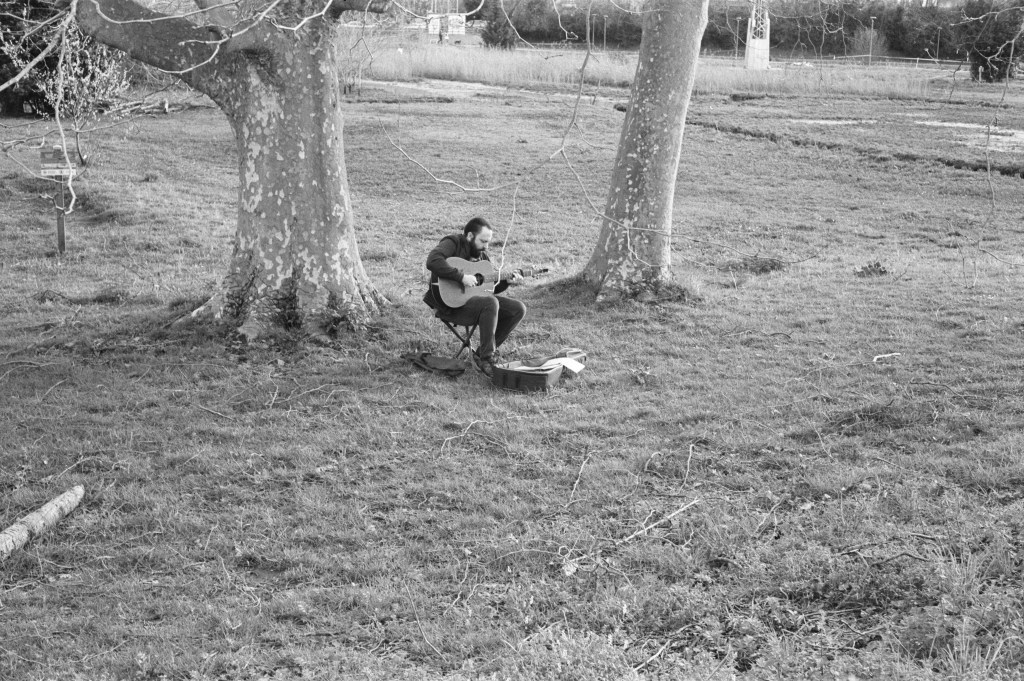
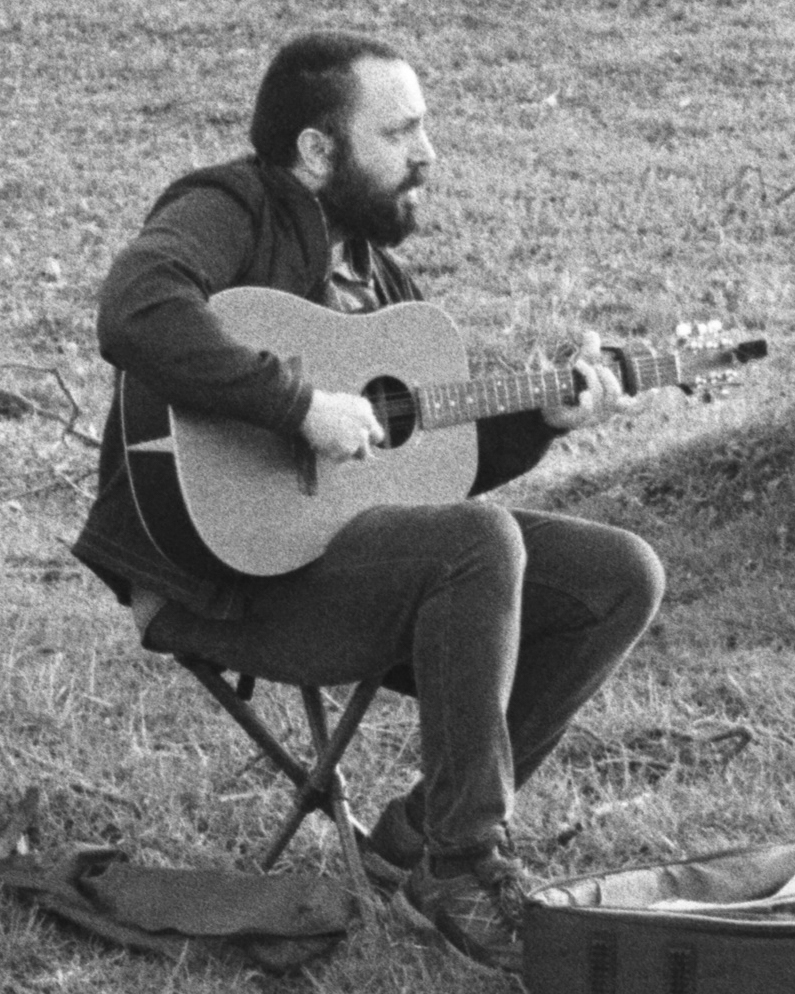
Photos of me playing the guitar

A week and a half ago, a professional photographer casually shot me as I was playing the guitar at my usual spot. I had been curious about the photos, only to receive them and confront once again that I hate how I look and that I exist. But it is what it is, so here they are.

Given the nightmare I’ve been involved in this month adapting an incredibly-complex board game about the Vietnam War, these photos are somewhat fitting.

The photographer’s name is Bixen Vergara. Here’s his page in case you’re interested.

The Empty Swing, Pt. 4 (Novella)

I release her pigtails. My hands slide from the red hair to the back of her neck, one palm warm at her nape, then down to her wrist—the unbruised one—and the direction of movement arrives before any word does. I stand, drawing her up with me, and turn toward the hallway. She follows.

The bathroom is small and holds heat well. I turn the taps without releasing her wrist, then test the temperature with the inside of my forearm. I adjust the cold a half-turn. The water rises. Steam collects along the mirror’s edge. I watch the tub fill with the focused attention I give to things that matter.

I turn to Ane, who’s watching me from the doorway. I lift the hem of my own shirt from her shoulders first; she had been wearing it open over her crop top. I take the shirt with both hands and set it on the towel rack. Then the pink skirt. My fingers find the waistband, unhurried, and the skirt falls and I catch it and fold it over the shirt. The white socks with the small pink hearts last, one and then the other, my hands at her ankle and her calf.

Ane is just standing still in the steam-warm bathroom while my hands move over her performing an act that isn’t only desire, but something closer to the care one takes with something irreplaceable.

I guide her to the tub’s edge. She steps in. The heat moves up through her feet and ankles and the backs of her calves and she lowers herself and the warmth closes around her and she exhales involuntarily, the exhale of a body that has been braced for a long time and has just been given permission not to be.

I step in behind her. The water rises with my weight. I settle, and she settles against me—the geometry of the tub making it inevitable. My chest against her back, my legs on either side of hers. My arm comes around her and then stops.

The bruise. My thumb finds it. The discoloration on her arm, the purple-green of a bruise two days old, her mother’s work, the morning’s first tax. My thumb moves once across the discoloration, and then my hand slides lower and submerges her arm gently below the waterline, as if the heat can undo what that morning did. As if tending the evidence is the same as tending the wound.

Then I reach for the sponge on the tub’s edge and I wash her. Across her shoulders first, clearing the day from her skin. Then the back of her neck where the water has darkened the ends of her pigtails, then the curve of her collarbone, the soft hollow of her throat. The sponge sets the route and my hands follow to confirm it, the double passage of sponge-and-palm that is somehow more thorough than either alone, and she holds very still beneath the attention.

I’m thinking about the quality of what she gave me in the living room. The thought has the quality of the word cathedral without the word itself: she has given me the one thing she kept, the one room she held off-market across every transaction, every arrangement, every man who thought he had the full inventory of her. She gave it to me. I intend to receive it as if it matters in a way that has nothing to do with the contract, even though the contract is real.

My hands move across her skin. And then Ane is crying.

I feel it before I see it—her stillness changes, followed by an involuntary tightening across her shoulders. Her breath has gone irregular and then very controlled. Her face is wet in a way that isn’t the steam. The silent crying of someone whose professional register has been stripped of its last supporting structure, someone who has not been touched without transaction in years.

My hands continue moving across her shoulders, her collarbone, the back of her neck. I don’t say it’s all right. I don’t say anything. To keep moving is also to claim: not her body, but her capacity to be undone. The right to be present for it.

The water cools by degrees.

At some point the crying stops. Not because anything resolved. Because her body ran out of the resource the crying requires, and what is left is the warmth of the water and my hands still moving and the steam against the mirror and the sound of the garden somewhere outside the sealed house, faint and indifferent.

* * *

The dark outside the kitchen window is the dark of very early morning, the hour that belongs to no one. I stand at the sink with a mug of water I haven’t drunk.

The garden is out there. In the dim ambient light from the street beyond the hedge, the swing moves faintly in a wind I can’t feel from here. The arc is small and irregular, the movement of an empty thing displaced by something passing through. I watch it. My hands are around the mug.

Upstairs, Ane is in the spare room—the room that is now hers, the room with the lock she did not use—and the permanence of that is present in the house the way structural weight is present in a wall: invisible, felt only when you press against it.

I stand at the window and watch the swing and try to locate the arithmetic of the night. The grief in my chest—and it is grief, that much is legible—will not sort itself into its component parts. Grief for what I took. Grief for what she gave. Grief for the man I was before I opened the garden gate and found her sitting in the swing, the same swing that is moving now empty in the early morning dark. I don’t know which grief is which. I suspect they’re the same grief wearing different faces, and that the inability to separate them isn’t a failure of analysis but the actual condition of the thing I have done.

The catalogue assembles itself in the dark. Cameras: four units, arriving tomorrow, the invoice confirmed. Coverage radius: the gate, the southeast corner of the hedge where it thins, the kitchen door, the swing. I’ve mapped the sight lines in my head with the three-dimensional precision of a man who has spent fifteen years learning the geometry of my property in every light and weather condition. A determined person could part the gap at the southeast corner with both hands. Tomorrow. That’s the relevant fact. Until tomorrow, the gap exists.

Txomin’s face assembles itself next. The face from the neighborhood knowledge—the composite built from secondhand description and the logic of that type. The kind of man who uses other men. The kind of face that looks reasonable in daylight and means something different in the dark. I hold the face in the operational register and don’t let it become anything else. A threat is a threat. You map it, you account for it, you build the wall.

Ane is upstairs. That’s the central fact around which the rest of the week organizes itself.

The latch sounds.

Small. Metallic. The sound of the garden gate latch being tested from the street side—not the wind, not the swing’s chain, not the random settling of a property at night. I know every sound this property makes by address.

No lights. I don’t touch a switch. I stop two feet back from the kitchen window—close enough to see, far enough that my silhouette doesn’t reach the pane. The garden is dark. The hedge is dark. The ambient light from the street beyond the hedge is the thin yellow-white of a lamp, barely enough to define the hedge line as a shape against the lighter dark of the sky.

A compact shape at the gate. Leaning. The lean of a body that has been ambulatory for too long and has found a vertical surface and is using it. The gate post. One hand on the latch, the other arm against the wood. The movement, when it comes, is the slow exploratory movement of someone who’s testing the gap between gate and post with the patience of someone cataloguing the property from the outside the same way I catalogued it from the inside.

Scouting.

She’s not here to force entry tonight. She’s here to know. To locate the gap, to measure the hedge, to confirm the address before she decides what to do with the confirmation.

The shape and the unsteadiness and the hour and the quality of the searching movement assemble into a single conclusion, and the conclusion is Marisa, Ane’s mother.

The cameras aren’t here. The perimeter is unmapped.

The prohibition I issued to Ane—you don’t leave alone, not until this is resolved—is structurally meaningless if the person at the gate calls her name loudly enough. The spare room window faces the garden. The walls aren’t built yet. The walls are not built.

My hands are flat on the kitchen counter.

The shape at the gate lifts its head. It’s looking at the house. I can’t see the face from here, can’t resolve the features in the dark and distance, but the orientation is unmistakable—the angle of the head, the stillness of the body, the quality of attention that arrives when a person stops cataloguing a structure and starts looking for a light. A sign. The confirmation that someone is inside.

The shape’s posture changes. The head drops back. The mouth opens. The preparation of a body about to produce volume.

The cold in my chest converts into something with edges.

I open the kitchen door without a sound, then cross the threshold into the cold and the wet grass finds my bare feet—the cold of early morning ground, soaked through from the overnight damp, the blades pressing flat under my weight and releasing. I have walked this path in every dark and every weather for years and my body knows the slight rise at the third meter, the way the path curves left past the rosemary, the exact distance from the door to the gate in a straight line across the lawn: eleven meters. I cover them in the economy of a man who has converted grief and rage into a single operational directive.

She hasn’t called the name yet. I have a few seconds of advantage and I use them, crossing the last four meters in absolute silence, and when I stop I’m close enough to smell her.

Bleach. Industrial grade. The chemical signature of a woman who has spent her night on her knees cleaning other people’s floors and has come directly after, without sleeping, without changing, which tells me everything I need to know about the quality of her decision-making tonight.

I simply stand there, between her and the house, my hands loose at my sides. The stillness is the threat. The proximity is the threat. The fact that I appeared in the dark without sound, without light, from a house she had been watching for signs of life and found none. I let her feel it for a few seconds before I speak.

When I speak, my voice is in the lowest register I possess. I’m speaking at exactly the volume required to reach one person and no one else, calibrated with the precision of someone who has stood in this garden at this hour and knows exactly what the air carries and where.

“Listen to me carefully.”

She goes still. I watch her register my presence—the physical process of a drunk person updating their situational map, the small recalibration of the body when the threat-level reclassifies. I don’t give her time to produce language.

“You are standing at a gate that belongs to me, at four in the morning. I know what you came here to do, and I am telling you now, with this much distance between us, that you are not going to do it.”

She opens her mouth.

“I’m not finished.”

Her mouth closes.

“There’s a bruise on her arm. I have photographs. I have your address on record and the photographs are ready in a folder with your name on it. If I hear your voice at this gate—if I hear your voice anywhere near this property—I will make one phone call and the folder goes with it. That is not a negotiation. That is a fact I am stating for the record so that you cannot later claim you did not understand the terms.”

She’s leaning against the post in a way different from the scouting lean. Just using the wood because without it she would need to find another vertical surface. The bleach smell is stronger at this distance. Her mouth is working without producing sound. She arrived with a sound. I removed the conditions under which the sound was viable. She has nothing left to deploy.

Something changes in her posture. Something older than collapse. The deflation of a body that has been fighting a war for a long time and has just recognized, in the dark, in the cold, in front of a man whose hands are at his sides and whose voice has not risen by a single degree, that the war is already over and has been over and the fighting was the last thing she had and now she does not have it.

She looks at the house. At the spare room window—dark, curtained, still—and the looking is something that has nothing to do with strategy.

When she speaks, her voice comes out flat. A sentence standing alone in the dark between us.

“Is she safe?”

The question lands in the cold air and I hold it there. I feel the weight of what it costs me to hold it correctly. The woman in front of me is asking the same question I have been unable to answer since I stood at the kitchen window watching the swing. And the honest answer is not yes and is not no and is not a reassurance, because reassurance would be a performance and I’m not performing, not even for a woman who is leaning against a gate post in the dark smelling of bleach at four in the morning with nothing left to threaten me with.

The cold fuel that got me across the garden without making a sound remains, and the recognition sits beside it without displacing it. I let the silence run for three seconds.

“She is here. She is sleeping. She is not leaving.”

Marisa looks at the house for another moment. The spare room window, dark, curtained. Then her hand comes off the gate latch.

She moves back from the gate with the unsteadiness of a large body that is drunk and cold and has been standing on wet grass, and I watch her go with the expression of a man who has just been asked a question he did not want to be asked and cannot unfeel the asking, and the answer he gave was the only honest one available, and the honesty cost him something he cannot yet name because the dark is not the right place to name it.

I stand at the gate until the sound of her steps fades. Wet grass, then the uneven pavement of the lane beyond the hedge, then nothing.

I turn back toward the house. The kitchen door is still open. I cross the lawn in the same silence I crossed it going out and step back into the warmth of the kitchen and pull the door behind me without a sound.

I stand at the window. The swing is out there in the dark, moving faintly in the same wind, its arc small and irregular, the motion of an empty thing that has been touched by something passing through and has not yet stopped recording the contact. My hands are at my sides.

Ane is upstairs.

The truth of it has not resolved into anything clean. It has resolved into the ache in my chest that will not sort itself out into its component parts no matter how long I stand at the window. Grief for the quality of that woman’s voice stripped of everything except the question, and the way the question opened something between us that has not closed.

The swing slows. I watch it until stills, and then I watch the stillness, and the house holds around me.

I pick up the mug. Set it in the sink. Turn toward the hallway.

The house is quiet. The perimeter held. The name was not called.

It is enough for tonight. It is the only thing I have that is enough, and I take it with both hands and carry it up the stairs in the dark.

THE END

The Empty Swing, Pt. 3 (Novella)

The call connects on the third ring. Faint electronic hiss of a live call, the quality of silence that means someone on the other end is listening.

Behind me, Ane’s grip on the hem of my shirt tightens. I feel it against my lower back, two knuckles of pressure through the cotton, the involuntary tightening of a body that is listening to the wall being built in real time.

I wait. Through the phone, her mother Marisa speaks first. A thick, lurching voice, the register of a woman who has been drinking and searching and working herself into a forensic fury since morning. I get fragments: —don’t you dare, I know she’s somewhere, she always does this, she always— and then something lower that shifts mid-sentence from her daughter to me, the realization that the number is wrong, that the voice on the other end isn’t her daughter. The fragments reorganize. —who the fuck—

“Ane is here.” My voice has dropped to its lowest register. I have decided and I’m now giving the dimensions of the decision to someone else. “I live in the outskirts. She’s staying here.”

I can hear her mother breathing, the wet sound of someone recalibrating.

—she’s my daughter, you don’t get to—

“I’m not finished.”

The sentence lands like a hand placed flat on a table. Behind me, Ane’s grip tightens again.

“She came to me with marks on her arm. Grip marks, spaced the way fingers space when someone grabs and does not let go. I have photographs.”

—God damn it, I didn’t—she provoked—I mean, she always— The voice lurches, her fury trying to find its footing. —you don’t know what she does, you don’t know what kind of girl she—

“I know what she does. That’s not relevant to the marks on her arm.”

I hear something shift in Marisa’s breathing—the recalibration again, but this time with an edge underneath, the sound of a person trying to find the right angle on a situation that has no good angle. Then, a fragment, the end of a sentence that started somewhere else: —not the first time, those men, the ones from Bergara Street, they— and then it stops mid-sentence, swallowed back down, as she has realized she has given something away.

“The Ertzaintza have a domestic violence unit,” I say. “Filing is straightforward. The photographs are enough. I want you to understand that clearly before this conversation ends.”

The silence has edges. I can feel Marisa on the other end, the bulk of her, the fury and the grief and the drunk self-pity and the rage, all of it pressing against the call the way a body presses against a locked door. A door that is holding.

—I want to talk to her. The voice has stripped down, the performance falling away into something rawer. —just let me talk to her, she’s mine—

“No. Ane is staying here. That isn’t changing today, and isn’t changing tomorrow. If you come to this address—” I give it, the street and the number, because a wall is only a wall if the other person knows where it stands “—I will call the Ertzaintza before you reach the gate. That is not a threat. It is a description of what will happen.”

I hear her breathing. A wet, thick sound.

I press the button and the screen goes dark. I set the phone on the counter, face down.

My hands stay on the counter, bracketing the dark phone, the surface cool under my palms. I’m aware of Ane behind me—the warmth of her, the gravity of a body that has been standing still for the length of that call, that has been listening to the wall being built word by word, sentence by sentence.

I gave the address to her mother. I did not ask Ane if she wanted me to do this. I’m aware of these things as facts, not as a fault. The righteousness of the act fills the kitchen the way heat fills a sealed room.

I feel the slow release of Ane’s knuckles unknotting from the hem of my shirt, the pressure against my lower back easing, the loosening of a body that has been holding itself braced against impact and has just understood, at the level below language, that the impact isn’t coming. The wall held. It’s built from photographs and the flat declarative voice of a man who said no to her mother without raising his voice and meant it structurally, all the way down.

The fragment Marisa let slip—those men, the ones from Bergara Street—sits in the back of my mind like a splinter. Not yet bleeding. I don’t know what it means. I don’t know if the men in the park were strangers or neighbors or something with a history I haven’t been given.

I lift my hands from the counter and turn to her. The strawberry warmth of her faded into the kitchen’s ambient heat. She’s looking up at me with brown watchful eyes.

“Your mother said something before she stopped herself,” I say, quiet in the way a measurement is quiet. “The men from Bergara Street. She pulled it back. I need you to tell me what she meant.”

Ane’s face reaches for the professional register, the architecture of controlled disclosure assembling itself in the set of her jaw and the slight angle of her chin. The posture of a girl who has been answering questions about herself for years and has learned exactly how much to hand over and in what order and at what price. A specific warmth she deploys the way other people deploy distance.

But it doesn’t assemble. Something in the way I asked, the clinical precision, the absence of judgement or the hunger of a man who wants the story because it excites him, lands differently than her clients’ questions land. I’m not asking the way men ask her things. I’m asking the way a man asks about a load he needs to calculate before he builds against it.

The professional register collapses quietly, like scaffolding removed from a wall that turns out not to need it. What surfaces is an unnamed mid-register between the professional one and the frightened child voice that escapes under fear.

“They’re—” She stops. Starts again. “They’re from the neighborhood. The Bergara end. There’s a group of them—not a gang, not exactly, just men who—they know each other, y’know? They know the girls who work that stretch.”

I give the sentence the room it needs.

“I’ve seen them,” Ane continues. “Done—I’ve done work for two of them. Separately. Not the whole thing. Just. What I do.”

The fact of it, handed over the way she handed me the coffee mug this morning. I receive it the same way.

Something in her exhales.

“That moment in the park—” Her voice drops a register, the halting precision of someone handing over the last protected thing. “It wasn’t random. Or it wasn’t only random. One of them was Txomin. He’s—he’s one of the two. He’d seen me the week before and I’d told him I was—I said I was busy. That I had someone. I didn’t. I just didn’t want to.” A pause. “He didn’t like that.”

The shape of the threat dimensionalizes in my mind. Not random predators drawn by opportunity. Men who know her face, her trade, her neighborhood. Men who have a grievance with a specific answer she gave them.

The splinter extracts cleanly. It leaves behind clarity. I now know the dimensions of what I’m building against.

“And your mother knows them.”

Ane’s jaw tightens.

“She knows everyone in that neighborhood. She’s been cleaning those buildings for years.”

The silence that follows is the quiet of a person who has spent years trying to explain something that does not explain.

Now I’m wondering if Marisa would give them my address the way she gave me the fragment. Maybe accidentally, mid-fury, without understanding what she was handing over. I don’t ask Ane. Not because I’m protecting her from it. Because the answer doesn’t change what I’m going to do, and a question I already know the shape of isn’t a question worth asking.

I reach out. My hand finds the back of her neck—the warm architecture of it, the fine red hair against my palm, the knob of her uppermost vertebra under my thumb. The possessive warmth of a hand that says I have you in the grammar of a man who has received something and is keeping it.

She goes very still. As if she had just set down a weight she didn’t know she was carrying, and was now recalibrating for the absence of it.

I feel the warmth of her scalp. The heat of her. Inside my chest, the possession moves. More structural than desire. I’ve been given the architecture of a threat and my mind is already moving along the perimeter of the property, the gate latch, the hedge line, the visibility from the path. Txomin. The Bergara end. Two clients. A grievance. A partial answer she gave them in the park that didn’t satisfy.

He knows her face. He does not know this address. Yet.

I hold the back of Ane’s neck in my palm and the sealed kitchen holds us both and the wall I’m building in my mind has the dimensions of a man who intends for Ane’s past to end at the gate. Not because she asked him to build it, not because she has earned it, but because I have decided that whatever she carries from the Bergara end of a neighborhood I’ve never walked, it will not follow her here.

Here’s where she’s reborn as mine.

My hand lifts from the back of her neck, then I cross to the kitchen table. I pull the chair out and sit and open the laptop with the efficiency of a man who has converted the threat into a logistics problem. The screen wakes. The cursor moves to the search field. Amazon. The words security camera outdoor night vision appear with the weight of a wall that must be measurable and delivered by tomorrow.

“Sorry about this, Ane.” I say it without looking up from the screen. “But with those men possibly lurking around, you shouldn’t leave the perimeter of this property. At least for a few days. Maybe a week.”

She’s standing at the edge of the table, the pink skirt a soft flag of color in the morning kitchen, her red pigtails loose from everything the night has asked of them. She pulls out the chair beside me and sits down slowly, and her brown eyes move to the laptop screen with the precision of a girl who has been reading men’s intentions from their postures and their silences since she was a child.

I’m reading reviews. Camera coverage angles. Night vision range. Motion detection sensitivity. I have the product page open on a four-camera system with a 130-degree field of view and I’m cross-referencing it against a second tab where I have pulled up a satellite image of the property—the hedge line, the gate, the gap in the shrubbery on the south-facing wall that I’ve been meaning to fill since spring.

She watches me add the four-camera system to the cart without ceremony, then open a second product page for a standalone gate camera with two-way audio. I hope she understands that the wall I’m building is real. Not going to be dismantled in the morning.

I select expedited shipping. I don’t hesitate over the cost.

I pick up my phone, then sit back down. I dial my job, and when the call connects, my voice shifts into the clipped efficiency of someone handling administrative logistics.

“I need to use my personal days. The whole week. Yes. That’s fine. I’ll have the Arriaga file to Beñat before noon. No, nothing’s wrong. I said it’s fine. Thank you.”

I end the call and set the phone face-down on the table beside the laptop.

Cameras ordered. The week cleared. The prohibition spoken and received without negotiation. Outside, the hedge stands high and the gate latch is seated and somewhere a car moves along the road that leads away from here toward the city and the Bergara end and everything she has spent the last twelve hours running from. In here there’s only the domestic quiet of the two of us at a kitchen table, the laptop screen throwing pale light across my hands, her pink skirt and the loose pigtails.

My palm moves across the table and covers her hand. The work is finished, and what remains is the reason I did the work.

The kitchen goes quiet, the ambient hum of the refrigerator suddenly audible. She looks down at my hand covering hers. Then up at my face.

I stand. I don’t say come here. I don’t say anything. I keep her hand and move toward the living room, and she rises from the chair and follows.

The living room is the kitchen’s opposite in quality: softer light, the sofa facing the window where the hedge stands high and green and impenetrable, the afternoon quiet pressing against the glass. I sit. I draw Ane toward me by the hand and then release it, and my hands find her waist instead—the shirt hem, the warm skin beneath it where the fabric has ridden up—and the instruction is in the pressure of my palms rather than any word.

She swings her leg over.

In the economy of the movement, I feel the practiced fluency of a girl who has arranged herself across men’s laps before. The grammar of it trained, exact: one leg, then the other, the weight settling, the adjustment of the pink skirt over her thighs, the hands finding my shoulders with a precise placement and entirely without hesitation. The professional architecture of her positioning lands in me clean and cold and sharp. Her weight is warm.

My hands close around the curve of her ass, and the cold measurement dissolves into her heat, the soft bubbly fullness of her in my palms. The hunger I have spent fifteen years managing.

She’s wearing the pink skirt and the white thigh-high socks with the small pink hearts and my shirt with the collar fallen off one shoulder, and her red pigtails hang loose on either side of her face, and she matches the private architecture of what I have wanted in the long solitary nights of my house.

I’m hard. She can feel it—the slow press against her through the thin cotton of her panties. She doesn’t pull away. She settles fractionally, her weight shifting. The deliberate pressure is enough that my hands tighten on her without instruction from any part of me that’s still reasoning.

Her mouth finds mine. Or mine finds hers. The direction isn’t important. A slow kiss, the velvet weight of a mouth that has stopped negotiating. I feel the warmth of her lips against mine and the soft press of her body against my chest and the strawberry heat of her faded now to just her, the ambient warmth of a person who has been inside this sealed house long enough to carry its temperature.

I move my hands up the curve of her ass, over the small of her back, the shirt fabric warm from her skin—then back down, claiming the route, unhurried. I have decided the week is mine and she’s in it and there’s nowhere either of us need to be. I feel her warmth through the skirt, the soft give, the bubbly curve that fills my palms.

The kiss continues and her breath catches against my mouth in an involuntary way, a small break in the professional fluency, and then her hips press forward and the grip of her hands on my shoulders tightens from placement into purchase. The evidence of something underneath the trained economy, something that is responding rather than performing.

My mouth moves against hers and my hands move over her and the domestic quiet of the living room holds us and the distinction between chosen desire and structurally-produced desire dissolves in the slow press of the kiss and the warmth of her thighs bracketing mine and the curve of her ass in my hands.

Her pigtails hang forward, brushing my jaw. Their soft weight, the red hair against my beard. The refrigerator hums in the kitchen and outside a bird moves through the hedged garden and the afternoon holds us both inside it, sealed and warm, and my hands tighten on her and the kiss deepens and neither of us is going anywhere.

My palms drag upward again from the soft bubbly flesh, up over the small of her back where the shirt fabric has gone warm from her skin, up the ridge of her spine. I feel the small catch of her breath as my hands move higher. I reach the red pigtails. My fingers close around both—not roughly, not gently. The grip of ownership. My hands stay there.

Her hips are still pressed warm against me—the thin panties between us, my erection present and aching against the soft weight of her.

I speak.

“You’re gorgeous. Perfect. I intend to—” A pause, the sentence assembling itself with the care of a man who doesn’t say things he doesn’t mean. “—to take my time with you. All of it. The caressing. The kissing. The—” I stop. My voice softens. “I’ve cleared the time for exactly this.”

I can feel her receive it, the fractional press of her hips against me, the softness of her settling closer. My hands tighten in her pigtails.

She speaks in a younger voice. Something that hasn’t been arranged.

“I have—There’s something I haven’t—” The sentence breaks and she rebuilds it from the clinical vocabulary, the language of her trade. “In my work. There are—there’s a boundary. A contract term. That I have never—I’ve never let anyone fuck me. Not actually. That’s mine. It’s the one thing that’s been mine. And I want—I decided it was yours. If you—if this is permanent. If you’re keeping me. On the terms I set. That’s the trade.”

I go still. I hold the offering and I hold the thing underneath the offering, the girl asking to be chosen in the only language she has ever been allowed to use.

I’m not different from the men before me in the ways that matter. I hold more leverage than any of them. The walls I built are around her.

My hands tighten in her pigtails, and I draw her mouth down to mine. I enact the answer in the slow press of the kiss, the warmth of my mouth against hers, the unhurried certainty of it.

The Empty Swing, Pt. 2 (Novella)

The smell reaches me before the light does, before full consciousness, before the procedural frame has assembled itself for the day. Coffee being made, now, downstairs, in my kitchen.

I lie still for four seconds. Then, from below: the ceramic frequency of my own mug being lifted from the shelf. I’ve heard that sound every morning for fifteen years, made by my own hand, and this isn’t my hand making it.

I get out of bed. Don’t rush. I dress in what I wore yesterday: the utility pants, the dark shirt, the same boots, left by the door. I know what I’m going to find at the bottom of the stairs. I’m choosing to approach it at full awareness.

At the kitchen doorway, I stop. She’s at my counter in one of my shirts: gray, hem at mid-thigh, collar fallen off one shoulder with the geometry of fabric that wasn’t designed for her frame. Pigtails loose from sleep, the red hair slightly disordered at the temples, a few strands across the back of her neck above the fallen collar. The second mug is already on the counter beside the first, already poured, the steam rising from it in the gray morning light coming through the window above the sink.

My body registers the tableau before my ethics can engage. The private fantasy I’ve been starving for across these many years of solitary mornings has installed itself in my kitchen and set out the second mug, and the recognition of it arrives as structural information: this is the shape of the thing I’ve been missing. The information isn’t welcome.

She hasn’t heard me on the stairs. Or she has heard me and is choosing not to turn. I’m standing in my kitchen doorway understanding that the morning has already happened to me, that the warmth is already installed, that my ethics are twelve seconds behind my body and losing ground.

She turns. The collar slips another centimeter off her shoulder with the movement. Brown eyes, slightly soft from sleep, find me across the kitchen without surprise. She looks at me the way I looked at the gate last night.

She lifts the second mug from the counter and holds it toward me.

I look at the mug. I look at the curve of her throat above the fallen collar and I say nothing. The strawberry scent is warm in the kitchen air, close now, metabolized overnight into something that smells less like a product and more like a room that has been lived in. The gray pre-dawn light is making everything impossible to ignore.

She’s still holding the mug out. She hasn’t referenced the one night or the terms or the morning that was supposed to be a different problem.

My hand closes around the mug. It carries the specific warmth of hands that held it first, her hands, the temperature transferred, the coffee already at the degree I would have made it myself. I didn’t tell her how I take it. She made it correctly anyway.

I drink. The first sip arrives slow and deliberate. The coffee is exactly right. The wrongness of it being right without me having made it lands somewhere below my sternum.

I hear myself ask as if the question had been waiting in the room since before I came downstairs.

“How did you sleep?”

She tilts her chin. A managed warmth comes up in her face: a slight adjustment, a professional softness, the machinery assembling itself. She opens her mouth and I can see the register she’s reaching for, the one that makes the answer a performance.

She says: “I slept—” And stops as if the machinery encountered something it can’t process and ceased mid-assembly, the parts suspended. Then, in a shorter, flatter register: “I didn’t dream. I don’t remember the last time I didn’t dream.”

The mug still in my grip becomes too present, the ceramic registering at a higher resolution than it was a moment ago. I’m aware of my own thumbs, of the heat differential between my palms and the sides of the mug. I’m aware that I’m standing in my kitchen holding something she made and she’s standing a meter away from me having said a true thing without knowing she was going to say it.

I’ve been holding two readings of her since the swing. The strategic and the genuine, the deployment and the leakage, the girl who reads men and becomes what they need and the girl who broke younger in the middle of a sentence. She will be strategic again before this morning is over. But this sentence wasn’t strategy—it came from somewhere below the strategy, from a place that doesn’t know it’s being observed. The truth arriving because it escaped.

My ethics were armor. I understand this now, standing in my kitchen with the warm mug in my hands and the gray light through the window. The ethics were the distance I built to protect her from my want, and the want was real, and the protection was real, and both of these things are still true, and they’re also no longer enough, because the girl in my shirt just told me she slept without dreaming for the first time she can remember, in my spare room, under my roof, and the simplicity of it has made her interior real to me in a way that forecloses the last usable distance.

I can’t protect her from myself and remain uncompromised. I can’t hold myself back from her and call it care.

I set my mug down at the counter, the decision already completed in the body before the hands have finished moving. Then, three steps toward her. Arms opening the way a door opens when it has stopped pretending to be a wall. The structure of me rearranging itself around what’s already true.

She comes into my chest with a small sound that belongs to the place below the strategy, below the brown-eyed geometry, below the professional softness she deploys the way other people deploy armor. Her fists find the fabric of my shirt at the sternum and grip, knuckles pressing in, and the weight of a person who has stopped holding themselves upright alone settles against me and I feel it in my ribs.

My hands find her back through the gray cotton of my own shirt. The warmth of her comes through the fabric immediately—the warmth of a body that has been here all night, that slept under my roof and woke in my kitchen and made my coffee and has been carrying that warmth in the fabric since before I came downstairs. My hands rest, one between her shoulder blades, one lower, holding the small architecture of her without pressure, without direction, without asking anything of her except to be here.

I feel her breathe. Unsteady, then steadier. The fists at my sternum do not release but they stop pulling. A girl pressing her face into my chest and gripping my shirt because the alternative is standing alone, and she has been standing alone for long enough that the body has run out of the capacity to continue.

The wanting and the protecting arrive as the same current, same weight flowing in the same direction, toward her, through my hands on her back, through the warmth in the gray cotton. I’ve been attracted to people before. I haven’t been attracted to anyone the way I’m attracted to her in this moment.

A phone vibrates against the counter. Her phone. A small sound that doesn’t belong here. It belongs to a world of apartments and grip marks, a world that has been held outside the hedged garden and the gray light and the sealed kitchen, and the vibration against the counter is that world’s finger on the glass, insistent, ugly in the way that intrusions are ugly.

I see the screen over the top of her head. MARISA. The name sits on the screen in the flat white light of the notification.

A few centimeters open between us. The air in that gap is cold, the way that the absence of a specific warmth is cold, the way a room is cold after a fire has been removed rather than after no fire was ever present.

She doesn’t move toward the phone. She goes still, the stillness of a person who has learned to wait out threats, the immobility of a body that has been in dangerous rooms and knows that motion draws attention. She watches the screen with her hands now at her sides.

The screen pulses. Pulses. Goes dark. A different silence returns to the kitchen.

She looks up at me, and in her eyes is fear. She’s standing inside that fear and looking up at me with the brown eyes open and the fists that gripped my shirt now released, her hands close to my chest and waiting for something. For what I do next. For whether what just happened between us in the gray light means anything now that the world outside the hedged garden has made its claim.

What the phone just changed wasn’t the safety—it was always contingent, dependent on variables I don’t control. What the phone changed is the question neither of us has spoken: the one-night agreement, the renegotiation that has been hovering since the coffee was made, since the second mug, since the warmth in the ceramic before I touched it. The call has made the question unavoidable.

I want her to stay. The want is dense and total and present in my chest where her fists were. It’s present in my hands that still hold the temperature of her back through the gray cotton. Present in the cold of the centimeters between us, which my body has already named as a loss and is oriented toward closing.

I stand in the gray kitchen light with the phone dark on the counter and her face turned up toward mine, the fear still in her eyes, and the silence between us is waiting for me to decide what kind of man I’m going to be.

My arm moves past her body before the decision completes itself in language. My palm finds the phone and presses the power button until the machine shuts off. Her mother’s name, extinguished. Replaced.

I move my hand to her face. The cup of my palm against her jaw arrives with the pressure of a man who has finished asking himself questions: thumb at the hinge of her jaw, fingers curving behind her ear, into the loose warmth of red hair. I can feel the small architecture of her face in my hand. The warmth of her skin at the temperature of a body that has become the room’s warmth and the room’s smell and the room’s gravity.

I kiss her. She opens with the involuntary opening of a body that has nowhere else it’s trying to go, that has no other room it’s holding itself in reserve for.

Her hand rises and her fingers close around the wrist of the hand that holds her face, and her thumb finds my pulse point and presses as if needing to confirm a thing is real. Diagnostic pressure. The same gesture I made in the garden, reading the blue-black of four fingers along her arm, the body asking a question the mouth can’t form. Her thumb on my pulse asks: are you here. My pulse answers yes continuously.

She exhales into my mouth. I feel the quality of her presence in the kiss, the way she hasn’t held anything back, not given me a version of herself with the real self safely behind it.

The want lands fully in my sternum, its weight a fact about the kitchen, about the hedge holding outside and the counter cold under the dark phone and the gray cotton soft between our bodies and the red hair warm under my fingers and the thumb on my wrist that is still pressing, still confirming.

She’s staying. A structural certainty. She’s not returning to the apartment, she’s not returning to the street, she’s not returning to men with knives or a woman who left marks on her arm. She’s staying in this house and I’m going to make that true with every tool I have, not because she needs rescue, but because the want has a direction and the direction is here and I’m no longer willing to call that a liability.

I break the contact by millimeters. My hand doesn’t move from her face. Her eyes open, and I hold them straight on.

“You’re staying with me. Not for one night. Not as a guest. As my girl. Mine to take care of. Protect.”

The weight of what I’ve just said settles into the tile, into the ceramic, into the gray cotton between our bodies. The phone lies dark on the counter. Somewhere beyond the garden hedge, cattle move in the morning field, indifferent and slow.

Her eyes soften, her mouth parts slightly, and the held tension in her jaw releases fractionally against my palm. I read something else: recognition. A thought moving through her without reaching language. Older than language. A private arithmetic kept since she was young enough to understand that her body was the only currency she had and that one day the right buyer would arrive and she would know him not by his face but by the way he spoke. And beneath that recognition, a flicker. Fast and physical. Maybe the park. The knife. The weight of men who knew what she was and what she was worth to them in a dark space.

The word arrives in her voice in a pitch I haven’t heard before. Something between a professional warmth and the younger register that escapes and is immediately caught.

“Yes.”

I receive it as the thing I was afraid to believe and now I’m permitted to believe. A load calculation has resolved: all variables accounted for, all tolerances within range, the structure sound. My thumb presses slightly deeper against her jaw, the possessive pressure of a man who feels the fact of her in his hand and knows she’s not going anywhere.

The Empty Swing, Pt. 1 (Novella)

The gate is wrong. I feel it before I understand it—the texture of a latch that should be seated and isn’t, the gate hanging two centimeters off its frame, the pressure of it against my palm when I push it open different from two decades of muscle memory. The evening light comes through the hedge in thin blades. Somewhere in the field beyond the property line, a cow moves through grass.

My hand releases the gate slowly, the way you release something you’re not yet finished examining. I step through.

A strawberry smell threads the air from the direction of the swing—something sweet and synthetic and warm, faint enough that I might dismiss it as imagination, except that I don’t dismiss things. I turn toward it. Then I see the pink.

She’s asleep in the swing. My childhood swing, the one I never took down because taking it down would have required deciding something about it. The chains creak once with her weight, settling. She’s curled sideways against the rope, one platform sneaker trailing a centimeter above the ground, the other braced against the dirt. The skirt—short, pink, flared—has ridden up to the top of her thighs. White, thigh-high socks with small pink hearts. The crop top has slipped off one shoulder. Red hair in pigtails, both of them loosened, one half-undone, strands across her face.

I stand eight meters away.

She’s small. Not a child, but young in the specific way that registers as a liability. Dressed in a deliberate way. Alone. She climbed my gate, which is two meters of solid wood, which means she wanted in badly enough to work for it. No purse, no bag. No belongings visible. She came here with nothing or left everything behind her.

I walk toward her slowly. Not because I’m trying to be quiet, but because something in me is conducting the approach with deliberateness, taking the full thirty meters of garden path as inventory time, the way I take a structural problem from all angles before I touch it.

The strawberry scent deepens. Underneath it: cut grass, faint livestock on the wind, and something human and tired and salt-edged that I identify a moment before my eyes find it. A bruise on her forearm. The kind of bruise with a grip in it—oval, already purpling at the margins, the center still red. I’ve seen that shape before. Not recently. But the body keeps records.

I stop close enough to see the dried tracks on her face. Two lines of them, salt-pale against her cheekbone, running from the outer corners of her eyes toward her jaw. She cried herself to sleep. In my swing. In my garden. With a bruise on her arm that someone put there.

For approximately four seconds I stand with all of this. Then I speak.

“You’re in my garden.” My voice comes out contained and precise. “I’d like to know why before I decide what to do about it.”

She wakes like someone who has been sleeping lightly for years—all at once, her body pulling upright with the alertness of a person who has learned that being caught asleep is dangerous. Her brown eyes open and find me. She runs a single, rapid inventory across my face, my hands, the distance between us, the absence of anything in my posture that signals forward motion. It takes less than three seconds. Whatever she finds, it’s enough.

The swing sways once, gently, and goes still. She’s sitting in it with her hands folded in her lap and her wide brown eyes on me as she waits, and I understand, with a clarity that arrives in my chest before it arrives in my mind, that I’m already the man who’s going to let her explain herself. That I was already that man the moment I saw the bruise.

I cross the remaining distance to the swing, and crouch. I balance on the balls of my feet with my forearms resting on my thighs and I bring my eyes level with hers, and the world reorganizes itself around the new geometry. The strawberry scent is complete at this range. Underneath it: salt, warmth, the specific animal heat of a body that has been running and frightened and is now very still. Her brown eyes widen a fraction—the micro-adjustment of someone who expected to be loomed over and wasn’t.

I speak before she can fill the silence with whatever she had prepared.

“Do you need a doctor. Not a rhetorical question.”

Her answer comes fast. “No.” The refusal suggests she has given this answer before and does not intend to revisit it. She holds my gaze when she says it. She didn’t say I’m fine, or it’s not that bad. She drew a boundary with the efficiency of someone who has learned that medical attention creates paperwork and paperwork creates trails and trails create complications she has decided she cannot afford.

“Let me see it properly,” I say.

She extends her arm with an unresisted gesture—another learned behavior. The cost of small yielding lower than the cost of refusal. Offering the arm costs less than the negotiation of not offering it. She turns it palm-up, the bruise presented to the evening light, and I take her forearm in both hands.

The skin is warm. The warmth of someone young and frightened and still running heat from the flight that brought her here. My thumbs settle on either side of the bruise without pressing—an assessment hold, the way I would support a cracked beam to read the damage without worsening it—and the four oval marks read unmistakably under the light. Fingers. A grip. Someone held on hard and did not let go until they chose to, or until she pulled free, and the bruising pattern tells me it was the latter because the deepest marks are at the distal end where the fingers would have dragged.

Somewhere below the assessment, below the part of me that is reading the injury with the same systematic attention I give to structural problems, there is a low, persistent hum. The way her wrist sits in my hands. The band of bare skin above the thigh-high socks, visible in my peripheral vision when she shifted to extend the arm, a precise stripe of pale between white cotton and the hem of the skirt. The pouty mouth slightly parted. The pigtails loosened, one nearly undone, strands of red across her collarbone. Fifteen years of closed doors and I haven’t been this close to someone who looked like this, and the hum doesn’t stop, and I keep my eyes on the bruise.

“Tell me what happened.”

She delivers it the way someone delivers an invoice. Her mother’s hands first—she names Marisa without hesitation, the way I name a structural element that failed: the grip, the pigtails, the throwing. Then the park. Two men. She sequences it precisely: the approach, the groping, the knife, the escape route she identified and used. Her voice stays controlled and spare, the voice of someone who has packaged this particular set of facts before and knows which details to include and which to leave in inventory.

Somewhere in the park sequence, between the knife and the escape, a sentence arrives different to the other sentences. Shorter. The syntax is wrong as in younger, the grammar of someone who has not yet learned to package this particular memory into professional shape. She says: “And I just—I didn’t—the ground was wet and I—” and then she catches it. Repackages it. Continues in the invoice register as if the seam didn’t open.

I go still in the quality of a man who has stopped categorizing and started perceiving, the way you go still when a structure makes a sound it shouldn’t make and you stop what you’re doing and you listen with your whole body. I heard the seam. The place where the performance and whatever lives underneath did not quite close over each other.

She finishes. The cow in the field beyond the hedge moves through grass. The swing chain makes a single small sound.

I’m aware, with a precision that is almost clinical, of the following: the warmth of her skin against my palms. The distance between my face and hers, which is less than it was when I crouched, because at some point in the last ninety seconds my weight shifted forward and I did not decide that, I’m simply closer now, and the strawberry and salt and girl are specific and the hum in my lower abdomen is now a weight.

The generous choice and the selfish one are the same shape, and I can feel them becoming identical in real time. The clean provision I was offering myself as a frame for this moment has already begun to curdle into something I don’t have a category for, something that lives in the specific warmth of her forearm in my hands and the broken sentence she almost said and the way she didn’t pull back when I moved closer without deciding to.

The strawberry smell is in my mouth as I speak.

“You stopped in the middle of something. The ground-was-wet part. What was that?”

I watch the moment in which she decides what she is going to do with the question. She’s fast, faster than most people I have encountered, and the recovery is nearly seamless: the brown eyes steady, the chin lifting a fraction, the professional packaging sliding back into place like a panel resettled against its frame. She routes the younger syntax back under. I watch the rerouting happen in real time, the way I watch a hairline crack disappear when the load shifts—I know the crack is still there. I know the geometry hasn’t changed.

“I slipped,” she says. Measured. “Trying to get over a fence near the park. The ground was wet and I slipped. That’s all.”

The strawberry scent is still close and underneath it the warmth of her forearm in my hands is a fact I can’t file anywhere that makes it neutral.

“Were the men from the neighborhood,” I ask.

I watch her face when my words land. I watch it with the unhurried attention of someone who knows what he’s actually asking and is choosing not to ask it directly. Her fingers, the ones not trapped in my hold, shift slightly against the rope, a micro-tension I would not have noticed if I hadn’t been watching her with my whole body.

She watches my face as if waiting for the reframe, the recontextualization, the shift in my expression that neighborhood might produce—the calculation that would tell her I know what she is, the narrowing that would put me in a category she already knows how to manage. I don’t give her the reframe. I hold her forearm and wait and my face remains what it is: nothing she can use.

“Maybe,” she says. Then, after a beat: “I don’t know. I didn’t look that hard.”

Partial truth. I accept it.

I’m aware, with a punitive precision, that the weight in my abdomen hasn’t decreased. If anything the weight is heavier, because somewhere in the interval between the broken sentence and her partial answer I have understood something about myself that I would prefer not to have understood. The rescue instinct and the wanting aren’t running parallel. They’re the same current. The same heat that makes me want to put myself between her and the men in the park is the same heat that makes me aware, with a clarity bordering on shame, that no one else should have touched her today. That the bruise on her forearm is an offense on two registers simultaneously, and I cannot separate the registers, and the inability to separate them is a structural failure I have been calling discipline for fifteen years and it is not discipline, it is simply a wall, and she has been in my garden for less than an hour.

I have been holding her forearm too long for an examination.

“Right. You can explain yourself later. Or not at all.”

I stand, but don’t release her arm immediately. For half a second, the contact persists. The forearm in my hands, the warmth specific and immediate. I’m aware of the choice to release it, and then I do.

“Right now you need water and a chair that isn’t a swing.”

The words land in the space between us—the provision of a physical fact, a chair, water, the domestic grammar of not-abandonment. I can see the moment it reaches her as if she had expected negotiation. The leverage of what she disclosed to surface in the terms. She expected the transaction to declare itself, the way transactions always declare themselves eventually, and instead I have offered her a chair.

Her breath changes. A single, small, involuntary deepening, the kind of breath a person takes when a thing they braced against doesn’t arrive. Her fingers release the swing rope.

Somewhere in the precise and unsparing inventory I’m running on myself, I know that the decency of the gesture and the wanting underneath are not separable. That I’m offering her the chair partly because I want her to stay. That the distinction between those two things is one I’m going to have to decide about eventually.

In my kitchen, the glass makes a sound when I set it down—water settling inside glass on wood—and then the kitchen holds it the way rooms hold sounds when there isn’t enough ambient noise to absorb them. Fifteen years of ambient noise that was just me, and now there are two sets of lungs moving air in here.

She wraps both hands around the glass. That’s the detail that arrives first and stays. Not the pigtail coming further undone against her collarbone, not the pink of her skirt against the dark chair wood, not the stripe of pale skin above the thigh-high socks, but what arrives first is her hands around the glass, the way she holds it with both palms as if it might be taken, as if water is a transaction whose terms she’s still waiting to discover and the grip is the only negotiation she has available.

She did not say thank you. I didn’t want a thank you and I noticed that I didn’t get one and the two facts sit beside each other without resolving.

Under the overhead light, the bruise is different than the one in the garden. Out there it was an injury. Under fluorescent it’s a document—specific, colored, the purple-yellow of something applied with deliberate force and that has been metabolizing in the tissue for hours. The oval marks are legible for where I’m standing. Four fingers. Proximal to distal, deepest at the drag point.

The kitchen is small. I’ve always known the kitchen was small—I built the shelving on the east wall myself, I know the exact clearance between the table edge and the counter—but I have not known it the way I know it now, with another person sitting in the chair that is usually just a chair, and the smallness of the room making the distance between us a thing that requires active maintenance.

The strawberry scent has come inside with her. It will be in the air of the kitchen after she leaves, if she leaves.

“What do you intend to do now.”

Flat, procedural. The statement of a man who needs the structural answer before he can determine the next phase.

She looks at the glass.

“My mother’s apartment isn’t safe tonight. I don’t have anyone else. I have nowhere to go tonight.”

The sentences add up to a conclusion I already reached in the garden, before I offered her the chair, before I turned toward the house. The math was done out there. She knows the math was done. I know she knows.

What I’m aware of, in the interval of silence after her last sentence: the overhead light catching the loose pigtail, a single red strand across her bare shoulder where the crop top has slipped. The way she’s sitting in my chair. The glass in both her hands. The quality of the room around her, the room that has been a room for one person for fifteen years and is now a room with two people in it, and the second person is sitting and smells of strawberry and the air between us has weight.

The walls were something. I’m only now, in the presence of her, understanding what they were. Not discipline. Not chosen strength. The accumulated silence of a man who stopped setting a second glass on the table because there was no longer any reason to.

“About those bastards who groped you,” I say. “Be truthful. Do you think they followed you? That if you left this home, you might come across them nearby, because they caught on to the direction you ran?”

She looks at me. Her brown eyes are watchful and very still.

“I didn’t run in a straight line.”

The sentence is complete and it isn’t an answer and we both sit in the knowledge that it isn’t an answer. I file it, but the filing costs me a specific thing: the partial answer means she could be found. It means the house isn’t sealed. It means the wanting and the protection have become, in the silence after her sentence, the same structural problem.

I can’t locate the seam between her genuine fear and her deployment of it. She’s both things at once—the girl who ran and slipped and didn’t run in a straight line, and the girl who’s sitting in my chair with both hands around my glass and delivering her situation to me in a flat register, knowing exactly what she’s doing and also not performing any of it, and the two things occupy the same body and the same brown eyes and the same wrist I held too long in the garden. I wanted to be able to tell the difference. I can’t tell the difference. Not a failure of perception, but the truth of her. And it’s sitting in my kitchen, and she’s the most dangerous thing I have encountered in fifteen years of careful living.

“What do you want,” I ask.

The brown eyes steady. Then, in the interval between one heartbeat and the next, the invoice register falters. The recalibration stalls. She was waiting for a question she already had an answer to, already had the terms drafted, the price point set, the counter-offer staged, and I have asked something that does not have a filed response, and the absence of the filed response is visible in the involuntary quality of her stillness.

She looks down at the glass as her fingers shift on it. A small renegotiation of grip, as if the question has changed the weight of the object in her hands. I’m aware, in the punitive way I’ve been aware of everything in this kitchen since she entered, that no one has asked her this. Not recently. Possibly not in a long time.

She looks up.

“A bed. A locked door. One night.”

I heard the editing, the compression, the careful reduction to the minimum survivable request. She has taken whatever she actually wanted and cut it down to the dimensions least likely to produce a spectacular refusal. The sound of a person who has learned that wanting too much is the mechanism of its own denial, and has learned it the way people learn things that leave marks. I hear beneath that the arithmetic of a girl who has been calculating the minimum ask for so long she may have forgotten what the original number was.

I have already decided. I decided in the garden. I decided when I set the second glass on the table. The decision arrived before my ethics could catch up, the way the wanting and the provision are the same current and I can’t separate the wires, and I’m standing in my kitchen understanding that I’m about to give her a room in my house because she’s sitting in my chair with both hands around my glass and the light is documenting the bruise on her arm and the strawberry scent is in the air and I have been alone for fifteen years and she is—

“Spare room is down the hall,” I say. The voice of a man solving a logistics problem. “Single bed. There’s a lock on the door—use it if you want.”

I’m not going to let it sit there without a frame. I need a frame. Without it, the giving is just the wanting with no architecture around it.

“Look. The life you’ve been living. What happened this morning with your mother. The men in that park.” I keep staring at her face. “And then you climb into a stranger’s garden and sit in his swing and come into his house. You understand that could have gone badly for you in ways that have nothing to do with me specifically.”

The only honest structural frame I have left—naming her survival instinct as a flaw, naming the recklessness, because it’s the only way I can acknowledge how dangerous the situation was without naming why it was dangerous for me specifically, without saying: the problem isn’t that I don’t want you here, the problem is that I do, and I knew it before you finished sitting down, and I have been calling that something else for the entire duration of this conversation.

In her body, in the architecture of her grip on the glass, something shifts. A single involuntary breath, just slightly deeper than the ones before it. Her fingers loosen on the glass. Her knuckles un-whiten. A stillness settles into her, one without strategy. She was braced for the transaction and instead I gave her a room and a lock and a speech about her own recklessness.

“Bathroom’s shared,” I say before the moment can become something I have to name. “There’s a towel in the cabinet under the sink. Don’t touch the blue one.”

I turn from the counter, then move toward the hallway. Behind me, in the kitchen I’m about to leave, the second glass sits on the table. The strawberry scent is in the air. I’m aware of all of this with the unhurried clarity of a man walking away from a room I will keep thinking about.

I stop at the hallway entrance. I don’t turn around.

“Door at the end. Sleep.”

I walk to the bathroom. I run the tap. I stand there with the water running over my hands and I look at the mirror above the sink, but instead of me I see the garden in the last of the evening light, the swing still moving slightly from when she stood, the gate at the far end of the hedge line.

The walls weren’t discipline. I’ve known this since the garden. But I know it differently now—with her breathing within these walls, with the strawberry scent inside my house, with the second glass on the kitchen table. The walls were the accumulated silence of a man who stopped expecting company. And she’s inside them. She walked through my gate and sat in my swing and wrapped both hands around my glass and answered with the smallest possible version of the ask, and I gave her the room before my ethics could catch up, and the architecture of this house is now working against every distance I have spent fifteen years learning to maintain.

Tomorrow is a different problem. Tonight is tonight. Tonight she’s down the hall with a lock on the door, and I’m standing at the bathroom sink with the tap running and the understanding settling that I have just permanently altered something.

* * *

The cold arrives on my forearms before my mind has finished constructing the justification for being out here.

I move through the garden in the dark, the kitchen light falling in broken rectangles over the grass, and my feet know the path the way feet know things that have been done fifteen years running—the slight unevenness of the third stone, the wet grass at the border where the hedge root lifts the soil. My body is performing the ritual. My mind is two steps behind, still assembling the procedural language: the gate, the latch, the cold air, the discipline of the thing.

I reach the iron at the far end and my hand closes on the latch. It’s already seated. Of course it is. I latched it when I came in. I always latch it when I come in. In these many years, not once have I left it open—the open gate tonight was the anomaly, the girl in the swing was the anomaly, and I sealed it behind me when I entered my property and I knew this and I came out here anyway, and my palm is pressed flat against cold iron in the dark.

I stand there. The iron is cold against my palm. The cold of metal that has been holding night air for hours. Yet, I’m warmer than I was at the bathroom sink. Warmer than I was in the kitchen with the overhead light doing what overhead light does and the meter and a half between us requiring effort. Directional, oriented warmth. My body, standing at the far end of a hedged garden in the dark, is pointed at the lit rectangle of the kitchen window like something that has found its bearing, and the cold isn’t going to fix this because the cold was never the problem.

She is inside. She is inside my house, in the spare room at the end of the hall, and the door has a lock on it, and no one knows she’s there.

The no one knows arrives not as moral unease but as something else, something I’m slower to name, something that moves through me in the dark at the far end of the hedge with my palm against the cold iron: pleasure. Private and faintly shameful. She’s in my house. Under my roof. The hedges seal the property and the gate is latched at my hand and the lane beyond is dark and empty and she’s inside those walls, breathing, and the secret of her is sealed inside them with her, and no one will come looking tonight, and the smallness of that sealed world—two sets of lungs, one lit kitchen, the strawberry scent already metabolizing into the air of the rooms—is something I’m standing in the dark recognizing as the opposite of deprivation.

The light inside the kitchen is warm. Same light it has been every evening for fifteen years—the same bulb, the same angle, the same amber cast on the tile above the sink. I have looked at it from out here before, in summer when I worked in the garden after dinner, and it has always been a room-light, a functional fact, a thing that meant the house is on and I’m outside it. What it means now is different. The room has a second warmth in it. It’s occupied in a way it has not been in a long time, and my body is oriented toward it the way a body orients toward heat, the way bodies do when they aren’t being managed, when the procedural frame has dissolved and left just the animal fact of the thing.

The iron is cold against my palm, then it is not against my palm. I’m standing at the far end of the garden with nothing between me and the house but the path I already know.

I’m going to walk back. The question, out here in the dark where no one is watching, is what I’m walking toward. Not the kitchen. Not the sink. Not another ritual to perform. The walk back is a slow approach toward the version of myself that has been waiting at the kitchen window, lit from inside, for the entire duration of the cold’s failed assignment: a man who wants. Not as the ethical management of a situation with a girl who has nowhere to go and a bruise on her arm and both hands around my glass. Just want. Fifteen years deep. The accumulated weight of all those years of the second glass not set out, the spare room not used, the swing hanging still in an empty garden.

I walk back slowly. The kitchen window grows as I move toward it, the warm light filling more of the frame. The spare room is at the end of the hall. She may have used the lock. She may not have. I gave her the choice and I meant it and I’m not going to open that door and I was never going to open that door and none of that is the point. The point is that she’s down the hall, breathing, and the strawberry scent is in the air, and tonight in my own bed I will lie in the dark with the structural knowledge of her three meters and a half away through two walls, and I won’t perform discipline to myself, not tonight, not in the dark where no one is watching, and that private acknowledgement—the admission of what the night holds, what my own body will do with the accumulated weight of fifteen years and the strawberry scent and the specific image of both hands around my glass—arrives not as a shame but as the first honest thing I have allowed myself in a long time.

Alicia Daydream – Act Three (One More Branch)

I’ve you’ve been reading my stuff, you already know about my strange obsession with Alicia Western, and the fact that I’m creating an app for interactive branching storytelling (repo here). I wanted to test the solidity of my app by playing through the whole daydream sequence. This is the third act as far as I cared to go at the moment.


Page 28

You lean forward slightly, keeping your voice measured. “Dr. Marchesi, there’s another consideration. The hospital has provided excellent care for four months—that deserves recognition beyond simply covering fees.” You glance at Hypatia, who nods fractionally. “We’re prepared to make a substantial donation to Ospedale San Raffaele’s neurology department. Let’s say two hundred thousand dollars. Unrestricted funds for research, equipment, whatever you determine would be most valuable.”

Marchesi’s expression shifts—not quite shock, but close. “Mr. Ureña, that’s… extremely generous. But I can’t accept a donation in exchange for—”

“Not in exchange for anything,” Hypatia interrupts smoothly. “The donation recognizes the quality of care Roberto has received here. Separately, there’s a professional opportunity we’d like to discuss.” She taps the research folder. “When Roberto recovers—and we believe he will—his case will represent significant neurological interest. A patient who defied a persistent vegetative state diagnosis after four months of minimal brain activity. That’s publishable research, Dr. Marchesi. We’d like to offer you co-authorship on the case study.”

(Note by me: as I mentioned in the previous post, the LLM decided that “Bobby” stood for “Roberto.” Not changing it.)

Marchesi goes very still. You can see the gears turning—professional ambition warring with skepticism. “If he recovers,” he says carefully. “Which you understand is statistically—”

“Unlikely,” you finish. “We understand. But if it happens—if Roberto Western wakes up and regains function—you’ll have documented the entire case from admission through coma to recovery. Your notes, your observations, your initial diagnosis. All of it becomes part of a landmark study.” You pause. “Johns Hopkins would be the lead institution, given Dr. Chen’s involvement. But your name would be on the paper. Your hospital credited. Your contribution to neurological science recognized.”

Alicia watches Marchesi’s face, her hands white-knuckled on the portfolio. She’s barely breathing.

Marchesi picks up Bobby’s file, flips through pages of his own meticulous notes. “I’ve been documenting everything,” he says quietly. “Every test, every observation. Four months of data.” He looks up at Hypatia. “You genuinely believe he might recover?”

“I believe the research supports the possibility,” Hypatia says. “And I believe Miss Western deserves the chance to care for her brother while we find out. Even if recovery doesn’t occur—even if your initial diagnosis proves correct—you’ll have contributed to our understanding of persistent vegetative states. That has value.”

Marchesi sets down the file. His expression has changed—still cautious, but no longer closed. “The donation you mentioned. Two hundred thousand dollars. That would fund our entire research budget for three years. We could upgrade equipment, hire additional staff, expand our stroke rehabilitation program.”

“Then it’s well-spent,” you say. “We’ll arrange the transfer through the hospital’s development office. Certified funds, properly documented. No strings attached.”

“And if Roberto doesn’t recover?” Marchesi asks, looking directly at Alicia. “If six months from now, a year from now, his condition remains unchanged—what then?”

Alicia meets his eyes. “Then I’ll have cared for my brother for as long as he lived. That’s enough for me.”

Marchesi is silent for nearly a minute. The office clock ticks. Somewhere down the hall, a nurse’s shoes squeak on linoleum. Finally, he opens a drawer, pulls out a form—patient transfer authorization. “I’ll need documentation from Dr. Brennan in Mississippi confirming he’ll assume care. I’ll need proof of medical transport capability. And I’ll need Miss Western to sign acknowledgment that she’s assuming full responsibility for her brother’s ongoing treatment.”

“We have all of that,” Hypatia says, already pulling documents from her briefcase.

Marchesi begins filling out the form, his pen scratching across official hospital stationery. “The transfer can happen as early as tomorrow. I’ll need to brief the nursing staff, arrange for copies of all medical records, coordinate with the pharmacy for his medications.” He glances up. “How quickly can your transport aircraft be ready?”

“By noon tomorrow,” you say. “We can have Roberto in Mississippi by evening, local time.”

Marchesi nods slowly, signs the bottom of the form, then slides it across the desk to Alicia. “Miss Western, please read this carefully before you sign. You’re acknowledging that you’re removing your brother from hospital care against medical advice. You’re assuming all risks associated with his transfer and ongoing treatment. You understand that his prognosis remains extremely poor, and that this decision—”

“I understand,” Alicia says. She picks up the pen, signs her name in clear, steady script. “Thank you, Dr. Marchesi. For everything you’ve done for Bobby. For listening to us tonight. For giving him this chance.”

Marchesi takes the signed form, places it in Bobby’s file. “I hope you’re right, Miss Western. I hope your brother wakes up and proves me wrong. I’ll be… very pleased to write that paper with Dr. Chen if he does.” He stands, extends his hand. “I’ll have everything ready for transfer by 10 AM tomorrow. You can collect Roberto then.”

You shake his hand. Hypatia does the same. Alicia stands last, and when Marchesi takes her hand, his expression softens. “Your brother is fortunate to have you,” he says quietly. “Whatever happens, know that.”

The three of you walk out of Ospedale San Raffaele at 11:52 PM. The December air is sharp and cold. Alicia makes it to the Mercedes before her legs give out—she leans against the car door, shaking. Not crying. Just shaking with the release of tension that’s been building since October.

“We did it,” she whispers. “He’s coming home. Bobby’s coming home.”

Hypatia places a hand on her shoulder. “Ten hours from now, we’ll be back here. We’ll bring him to the mansion. To the medical bay. To you.”

You unlock the car. “There’s one more thing we need to arrange before tomorrow. The transport aircraft—we need it here, fueled, with medical staff who understand 1972 protocols on the outside and 2046 life support on the inside. Hypatia, how long will that take?”

“Three hours to retrieve the aircraft and crew from 2046, brief them on the cover story, and position them at Milan Malpensa Airport,” Hypatia says. “I’ll handle it tonight while you take Alicia back to the mansion. By the time you both wake up, everything will be ready.”

Alicia slides into the back seat of the Mercedes, still trembling. “I can’t believe Marchesi agreed. I thought—I was so sure he’d refuse, that we’d have to steal Bobby in the middle of the night like criminals.”

“He’s a scientist,” you say, starting the engine. “He evaluates evidence. We gave him evidence—and a reason to hope he might be wrong about Bobby’s prognosis. That was enough.” You pull out of the hospital parking lot, heading back toward the quiet street where you first materialized. “Now we wait ten hours. Then we bring your brother home.”

The drive back through Milan’s empty streets takes seven minutes. You park in the original spot, turn off the engine. “Ready to go back to Mississippi?”

Alicia nods. “I’m ready. I’m—I’m actually ready.”

You activate your neural interface. The Mercedes interior dissolves, replaced by the familiar composite walls of the mansion’s medical bay. The empty bed waits, calibrated to Bobby’s specifications. In ten hours, it won’t be empty anymore.

Page 29

The medical bay feels different now—no longer a sterile preparation space but a room hours away from its purpose. Alicia stands beside the empty bed, one hand resting on its edge, her fingers tracing the smooth composite surface. She’s been standing there since you materialized back from Milan, silent, absorbing the reality that in ten hours Bobby will be lying here.

You move to her side, keeping your voice low. “You should try to sleep. Tomorrow’s going to be long—the flight back, getting Bobby settled, making sure everything’s stable. You’ll need your strength.”

She doesn’t look away from the bed. “I don’t think I can sleep. Every time I close my eyes I see him—the way he looked in October, all those tubes and machines, his face so still.” Her voice catches. “What if he looks worse now? What if four more months have—”

“Marchesi’s notes said he’s stable,” you say firmly. “No deterioration. The hospital’s been taking good care of him. He’ll look the same as when you left.”

“The same as when I fled,” she corrects, and there’s bitterness in it. “I ran away, Jon. I left him there because I couldn’t stand being pressured to kill him, and I ran.”

“You protected him,” you counter. “If you’d stayed, if they’d worn you down—”

“I know.” She finally turns to face you, and her eyes are dry but haunted. “I know I did the right thing. But it doesn’t change the fact that I abandoned him in a foreign hospital for two months while I hid in Stella Maris planning to freeze to death in the woods.” She gestures at the medical bay, the mansion above. “And now I have all this. This impossible gift. And tomorrow I bring him home and I wait four months to see if he opens his eyes, and if he does—” She stops.

“If he does?” you prompt gently.

Alicia’s hands clench. “If he does, what do I tell him? ‘Hello, Bobby, you’ve been in a coma for four months, I bought a mansion with help from a time traveler, there’s an AI living in the basement, and by the way I was going to kill myself but changed my mind’?” She laughs, and it’s almost hysterical. “How do I explain any of this?”

Hypatia materializes at the entrance to the medical bay, her expression concerned. “You don’t have to explain it all at once. Bobby will wake confused, disoriented. The first days will be about physical recovery—relearning how to speak, to move. You’ll have time to introduce concepts gradually.”

“And if he thinks I’ve lost my mind?” Alicia asks. “If he thinks the time travel and the AI and the augmented reality mathematics are all delusions, that I’ve finally cracked completely?”

“Then I demonstrate time travel in front of him,” you say simply. “I disappear and reappear. I bring him objects from other eras. I show him Hypatia’s capabilities. Bobby’s a physicist—he’ll understand the evidence.”

Alicia shakes her head. “You don’t know Bobby. He’s… he was always the rational one. The one who explained things, who made sense of the world. I was the one who saw things that weren’t there, who heard music in colors, who talked to visitors no one else could see.” She looks at you. “What if he wakes up and decides I need to go back to Stella Maris? What if he thinks this whole setup is me having a psychotic break?”

The fear in her voice is real and sharp. You realize she’s not just worried about Bobby’s physical recovery—she’s terrified of his judgment. That the brother she loves, the one person who understood her, will wake up and decide she’s lost.

“Alicia,” Hypatia says quietly, “Bobby begged Jon to save you. In 2006, after decades of grief, the first thing he asked was for Jon to go back and prevent your death. He didn’t ask for wealth or power or to undo his own mistakes. He asked for you to live.” She pauses. “That’s not the request of someone who would commit you for accepting help.”

“That’s future Bobby,” Alicia whispers. “Bobby after I’m already dead, after he’s had thirty years to idealize our relationship. This Bobby—1972 Bobby—he’s the one who stopped me from kissing him twice. Who told me we couldn’t be together because we’re siblings. Who loves me but also… fears what I feel for him.”

The confession hangs in the air. You’ve known about the complexity of Alicia’s feelings for Bobby—the 2006 Bobby told you everything—but hearing her voice it directly is different.

You choose your words carefully. “Then maybe the four months before he wakes are also for you. To figure out what kind of relationship you actually want with him. Not the one you had, not the one you fantasized about—the one that’s possible now, in this timeline, with everything that’s changed.”

Alicia’s eyes search yours. “What if I don’t know what I want?”

“Then you have time to find out,” you say. “But first, you need to sleep. Because in ten hours we’re bringing Bobby home, and you need to be steady for that. Everything else—the explanations, the relationship questions, the waiting—all of it comes after.”

She’s quiet for a long moment, then nods slowly. “Will you stay? Not—not like last night, not holding me. Just… in the room. So if I wake up panicking I know this is real.”

“I’ll stay,” you confirm.

Hypatia steps forward. “I’ll be in the command center completing the aircraft arrangements. If you need anything, just call for me. I’ll hear you.” She meets Alicia’s eyes. “You’re going to get through tomorrow. And the day after. And all the days until April 27th. You’re stronger than you know.”

Alicia manages a faint smile. “I’m terrified.”

“That’s not weakness,” Hypatia says. “That’s honesty. Sleep now. Let Jon keep watch. Tomorrow you bring your brother home.”

Page 30

Hypatia nods once and dissolves—not walking away, simply ceasing to occupy the space, her particles scattering into nonexistence. The medical bay settles into silence.

Alicia stands beside Bobby’s empty bed for another minute, her hand still resting on the composite surface. Then she moves to the small chair in the corner—the one you’d positioned for overnight monitoring once Bobby arrives—and curls into it. Not lying down. Not surrendering to sleep. Just folding herself small, knees drawn up, arms wrapped around her shins.

You take up position against the wall where you can see both her and the bed. The lighting in the medical bay is soft, calibrated for patient rest, and it makes Alicia look even younger than twenty-one. Fragile in a way that has nothing to do with physical strength.

“I keep thinking about what I’ll say to him,” she murmurs after a while. “When he first opens his eyes. If he opens his eyes.” She rests her chin on her knees. “Do I tell him immediately that he’s been in a coma for four months? Or do I let him think it’s only been days, ease him into it?”

“You tell him the truth,” you say quietly. “Bobby’s not a child. He’ll want to know.”

“The truth.” She laughs, bitter and soft. “Which truth? That he crashed in Italy and I fled to Wisconsin and planned to die in the snow? That a time traveler from the future saved me and bought me a mansion and built a medical bay in the basement? That I’ve been living here for three days playing video games while he’s been braindead in Milan?” Her voice cracks. “Which part of that sounds sane, Jon?”

You don’t answer immediately. The question isn’t rhetorical—she’s genuinely asking, genuinely terrified that the story of her survival will sound like proof of her madness.

“You tell him he crashed,” you say finally. “You tell him you refused to let them end his life support. You tell him you found help—people who believed he could recover—and you brought him home. Everything else can wait until he’s stronger.”

Alicia is quiet, processing. “And if he asks about you? About Hypatia? About this place?”

“Then you tell him we’re friends. People who wanted to help. The details—the time travel, the technology—those can come later, when he’s had time to see the evidence himself.” You shift against the wall. “Bobby’s a physicist. He’ll understand proof when he sees it. But first he needs to understand that he’s safe, that you’re safe, that he’s home.”

“Home.” She tests the word like it might break in her mouth. “I’ve never really had a home. Not since Mother died. Grandmother’s house was just a place I stayed between school terms. Stella Maris was a cage with voluntary locks. This mansion—” She looks around the medical bay, at the advanced equipment, the careful preparation. “I’ve been here three days and it still doesn’t feel real. How is Bobby supposed to accept it in three seconds?”

“He won’t,” you admit. “Not at first. But he’ll see you—alive, present, taking care of him. That will be real enough to start with.”

She’s quiet again. Minutes pass. You can see her trying to settle, trying to let exhaustion take her, but her mind won’t stop circling. The fear of Bobby’s judgment, the weight of tomorrow, the impossible task of explaining her new reality to the one person whose opinion has always mattered most.

“Jon?” Her voice is very small. “What if he wakes up and he’s different? What if the crash changed him—his personality, his memories, who he is? What if I get him back but he’s not… Bobby anymore?”

The question cuts deeper than the others. It’s not about logistics or explanations—it’s about loss. The possibility that even if Bobby’s body recovers, the person she loves might be gone.

“Then you’ll love whoever he becomes,” you say. “Because that’s what love is. Not attachment to a fixed image, but commitment to a person through all their changes. Bobby might be different. He might need months to fully return to himself. But he’ll still be your brother. That doesn’t change.”

Alicia presses her face against her knees. “I’m not sure I know how to love someone without needing them to be exactly what I need them to be. I’ve spent so long imagining Bobby as my—as the one person who understands me, who sees me clearly, who doesn’t try to fix or reduce or manage me. What if the real Bobby can’t be that person? What if I’ve built him up into something he never was?”

You recognize the fear beneath the question. It’s not really about Bobby changing—it’s about Alicia confronting the gap between the relationship she’s idealized and the relationship that actually exists. The brother she loves versus the brother she’s constructed in her loneliness.

“Then you’ll find out who he actually is,” you say gently. “And you’ll decide what kind of relationship is possible with that person. Not the fantasy. The reality.” You pause. “But Alicia—that works both ways. Bobby will also have to accept who you actually are. Not his little sister frozen at fourteen. Not the mathematician he remembers from university. You, now, after everything you’ve survived. That’s going to require adjustment on his part too.”

She lifts her head, considering. “I hadn’t thought about that. That he might have his own fixed image of me that doesn’t match who I’ve become.” A faint, strained smile. “God, we’re going to be a mess when he wakes up, aren’t we?”

“Probably,” you admit. “But you’ll figure it out. One conversation at a time, one day at a time. You don’t have to solve everything in the first week.”

Alicia unfolds slightly, stretching her legs out. “I don’t know how to do this. How to wait four months. How to take care of him while he’s unconscious. How to hope without letting hope destroy me if he doesn’t wake up.” She looks at you directly. “How did you do it? Fifteen hundred years of walking through time alone, losing everyone you cared about over and over. How did you not go mad?”

The question is raw and genuine. You consider how to answer honestly without overwhelming her.

“I did go mad,” you say quietly. “Several times. I spent a century in the 8th century refusing to speak to anyone. I spent fifty years in the 1600s trying to drink myself to death, which doesn’t work when you’re functionally immortal. I’ve had periods where I believed nothing mattered, where I treated people as temporary amusements because I knew they’d be dust in a blink.” You meet her eyes. “And then I’d meet someone who reminded me why humanity is worth preserving. Why individual lives matter even if they’re brief. Why love is real even when it ends. And I’d come back to myself. Not fixed, not healed—just willing to keep going.”

Alicia absorbs this. “And Hypatia? How does she fit into that?”

“Hypatia is the first person I’ve met in fifteen hundred years who won’t leave me,” you say simply. “Because she’s not biological. She can travel with me. She chooses to stay. That changes everything—having someone who knows all of you, all your history, and still wants to be present.” You pause. “She’s not a replacement for human connection. But she’s proof that companionship is possible even in impossible circumstances.”

Alicia nods slowly. “I think I understand that. The visitors—the hallucinations—they’re not companionship, but they’re proof I’m not entirely alone inside my own head. Even if they’re just fragments of my mind, they’re company.” She hesitates. “Have you met them? The visitors? Can you see them?”

“No,” you admit. “They’re yours. But that doesn’t make them less real to you. And if they quiet down now that you have actual people around—Bobby, me, Hypatia—that’s not proof they were nothing. Just proof you needed them less.”

She considers this, then finally shifts in the chair, trying to find a position that might allow sleep. “Stay,” she says again. “Don’t leave. I need to know someone’s watching.”

“I’ll be here,” you confirm. “All night. Until we leave for Milan at nine.”

Alicia closes her eyes. Her breathing doesn’t slow into sleep—not yet—but she stops talking, stops questioning. The medical bay settles into a vigil. You against the wall, her curled in the chair, Bobby’s empty bed between you like a promise or a threat.

The hours pass slowly. Alicia doesn’t sleep—you can tell from the tension in her shoulders, the occasional shift of position, the way her breathing never fully deepens. She’s too afraid to let go, too terrified that sleep will reveal everything as delusion. So she stays conscious, hovering in the space between waking and rest, while you keep watch.

Around 4 AM, she speaks again without opening her eyes. “Thank you for not giving up on me. For believing I was worth saving even when I didn’t believe it myself.”

“You were always worth saving,” you say. “You just couldn’t see it from inside the story you were telling yourself.”

“The story where I walk into the woods and freeze.” She opens her eyes, stares at Bobby’s bed. “That story’s over now. I don’t know what the new story is yet, but at least it has more than one ending.”

The medical bay’s clock marks 4:17 AM. Five hours and forty-three minutes until you return to Milan. Five hours and forty-three minutes until Bobby Western comes home.

Page 31

You move from the wall to the chair where Alicia sits curled and tense. She doesn’t resist when you lift her gently, settling into the chair yourself and arranging her across your lap, her head against your chest. Her body is rigid at first—every muscle locked, as if relaxation itself is a threat.

“I’ve got you,” you murmur. “You’re safe. Bobby’s safe. Everything’s arranged. You can let go for a few hours.”

She makes a sound that might be a laugh or a sob. “I don’t know how to let go anymore. I’ve been holding on so tight for so long—holding on to the plan to die, then holding on to the plan to live. I don’t know what happens if I stop.”

“You sleep,” you say simply. “That’s what happens. Your body gets rest. Your mind gets quiet. And when you wake up, we go get Bobby.”

Alicia’s fingers clutch at your shirt. “What if I dream about the woods? About walking into the snow? I still dream about it sometimes—the white dress, the red sash, the cold that stops hurting after a while. What if I dream I went through with it?”

You tighten your arms around her. “Then you wake up here. In this room. In my arms. And you remember that you chose differently. That you’re alive.”

She’s quiet for a long moment, and gradually—so gradually you almost don’t notice—the tension begins to drain from her shoulders. Her breathing deepens slightly. The clock marks 4:23 AM.

“Jon?” Her voice is drowsy now, finally. “When Bobby wakes up in April… will you still be here? Or will you go back to your own time, your own life?”

The question catches you off guard. You haven’t thought that far ahead—haven’t considered what your role will be once Bobby recovers, once Alicia is stable, once the crisis has passed.

“I’ll be here as long as you need me,” you say. “Whether that’s four months or four years or forty. I don’t abandon people I care about.”

“Forty years.” She sounds almost amused. “That’s nothing to you, is it? You’ve lived fifteen hundred. Forty more is barely a blink.”

“It’s not about the duration,” you tell her. “It’s about the meaning. I’ve lived through centuries that meant nothing. And I’ve lived through days that changed everything. Time isn’t measured in years—it’s measured in moments that matter.”

Alicia shifts slightly, nestling closer. “This matters,” she whispers. “Right now. This matters.”

“Yes,” you agree. “It does.”

Her breathing slows further. The rigid alertness in her body continues to dissolve. You can feel the exact moment she crosses from waking consciousness into the edge of sleep—that boundary where the mind finally surrenders its vigilance.

The medical bay is silent except for the quiet hum of equipment on standby. Bobby’s bed waits in the soft light, ready for its purpose. Outside, December 26th is beginning to dawn—the day you’ll bring Bobby Western home.

Alicia’s hand relaxes against your chest, her fingers uncurling. Her face, pressed against you, loses the haunted tension that’s been carved into it for months. She looks young again—not fragile, but simply young. Twenty-one years old and sleeping in someone’s arms because she trusts them to keep watch.

You settle in for the vigil. Five hours until Milan. Five hours until everything changes again. But for now, in this moment, Alicia is safe and sleeping and alive. That’s enough.

The clock marks 4:47 AM when her breathing finally achieves the deep, steady rhythm of genuine rest. You don’t move. Don’t shift position. You hold her through the remaining hours of darkness, keeping the promise you made: to stay, to watch, to be present.

Around 7 AM, Hypatia materializes silently at the entrance to the medical bay. She takes in the scene—you in the chair, Alicia asleep in your arms—and nods once in approval. She doesn’t speak, doesn’t disturb. Just stands there for a moment, bearing witness, then dissolves again.

At 8:15 AM, Alicia stirs. Her eyes open slowly, confused for a moment about where she is, then focusing on your face. Recognition and relief flood her features.

“I slept,” she says, wonder in her voice. “I actually slept.”

“Almost four hours,” you confirm. “Good, deep sleep. How do you feel?”

She considers, taking inventory of her body and mind. “Steadier. Still terrified, but steadier.” She sits up slowly, reluctant to leave the safety of your arms but recognizing the need to prepare. “What time do we leave?”

“Nine o’clock. Hypatia has the aircraft positioned at a private airfield forty minutes from here. We’ll be in Milan by early afternoon local time, at the hospital by two.” You help her stand. “Do you want to eat something first? Change clothes?”

Alicia looks down at herself—still wearing the simple dress she put on yesterday morning in this same room. “I should look… I don’t know. Presentable. Like someone capable of taking care of Bobby. Not like someone who just spent the night terrified in a basement.”

Hypatia rematerializes, this time with a garment bag. “I took the liberty of retrieving appropriate clothing. Something professional but comfortable. And I’ve prepared breakfast—nothing heavy, just enough to steady you for the flight.”

Alicia accepts the bag with a nod of thanks. She looks at Bobby’s empty bed one more time, then back at you. “In two hours, he’ll be lying there. In this room. Home.” Her voice wavers. “I can’t believe it’s actually happening.”

“Believe it,” you say firmly. “We negotiated his release. Marchesi signed the authorization. The transport is ready. This is real, Alicia. Bobby’s coming home.”

She takes a shaky breath, then another. “Okay. Okay. Let me get ready. Let me—” She stops, seems to gather herself. “Let me be ready for this.”

Page 32

You guide Alicia upstairs to the dining room, where Hypatia has arranged breakfast with her characteristic precision. The table holds soft scrambled eggs, toast with butter and jam, sliced fruit, and coffee that smells like it was brewed in a café rather than a 1972 kitchen. The morning light through the tall windows is gentle, almost apologetic.

Alicia sits and stares at the food without touching it. Her hands rest on either side of the plate, fingers spread flat against the wood.

“I haven’t been to that hospital since October,” she says quietly. “Since I ran. Since they asked me to sign the papers that would end his life.” Her voice is steady but her knuckles are white. “I walked out of Bobby’s room and kept walking. Through the corridors, past the nurses’ station, out the main entrance. I didn’t pack. Didn’t say goodbye. I just left him there and flew back to the States because I couldn’t be the person who killed him.”

You pour coffee into her cup. “You weren’t running from Bobby. You were running from an impossible choice.”

“I was running from myself.” She picks up the fork, sets it down. “From the part of me that was so tired I almost said yes. That almost signed those papers just to make the waiting stop.” She looks at you directly. “Do you know what that feels like? To be so exhausted by hope that you want to surrender to despair because at least despair has an ending?”

“Yes,” you say simply. “I’ve lived through centuries where I wanted the story to be over. Where I was so tired of watching people I loved turn to dust that I stopped loving anyone at all for a while. Despair is easier than hope. It requires less courage.”

Alicia finally picks up the fork and takes a small bite of eggs. She chews mechanically, swallows. “The doctors were so certain. Marchesi, the others. They had scans, tests, documentation. They spoke about Bobby like he was already gone—like his body was just a machine still running on momentum.” Another bite. “And I couldn’t prove them wrong. I couldn’t point to anything concrete and say ‘Look, he’s still in there.’ I just knew. Or I wanted to know. Or I couldn’t bear not knowing.”

Hypatia materializes in the doorway, dressed in travel clothes—dark slacks, a wool coat, low heels. She looks like she could be Alicia’s older sister, or a young professional traveling on business. “The aircraft is ready. We should depart by nine to arrive at the hospital with comfortable margin.”

Alicia nods but doesn’t stand. She’s eating now with more focus, as if her body has remembered it needs fuel. “When we get there—when we walk into Bobby’s room—what do I say to him? He’s been in a coma for four months. He can’t hear me. But what if he can? What if some part of him knows I left and didn’t come back until now?”

“Then you tell him the truth,” you say. “That you left because you refused to end his life. That you found help. That you’re bringing him home.”

“Home.” She sets down her fork. “To a mansion he’s never seen. With technology from seventy years in the future. With a time traveler and an artificial intelligence as his sister’s companions.” A strained laugh. “He’s going to think I’ve lost my mind. He’s going to wake up and think I had a psychotic break and bought a mansion with hallucination money.”

Hypatia steps into the room. “Bobby Western is a physicist who studied at Caltech. He understands evidence. We can provide evidence—the medical bed’s capabilities, the augmented reality interface, documentation from 2046. He’ll have questions, certainly. But he’s not going to dismiss what he can see and touch and measure.”

“Unless the crash changed him,” Alicia says quietly. “Unless he wakes up different—his memories fractured, his personality altered, his ability to understand complex concepts damaged.” She looks at Hypatia. “You read his medical file. You saw the scans. What are the odds he wakes up as himself?”

Hypatia doesn’t soften the truth. “Traumatic brain injury is unpredictable. The scans show significant damage that has been healing, but healing doesn’t always mean complete restoration. He might have memory gaps. He might have changes in temperament, processing speed, emotional regulation.” She pauses. “Or he might wake up essentially unchanged, with the injury having affected only motor function during the coma state. We won’t know until he wakes.”

Alicia pushes her plate away, half the food uneaten. “I’ve been so focused on keeping him alive that I haven’t let myself think about what kind of life he’ll have. What if he wakes up and he’s trapped in a body that doesn’t work? What if he can’t race, can’t work, can’t do the things that made him Bobby?”

“Then he’ll find new things,” you say. “Or he’ll adapt the old things. People are resilient, Alicia. Especially people who have someone fighting for them.”

She stands abruptly, the chair scraping against the floor. “I need to see him. I need to stop imagining worst scenarios and just see him, touch him, confirm he’s real and we’re really bringing him home.” Her hands shake slightly. “I’m ready. Let’s go.”

You stand as well. Hypatia nods and dissolves—repositioning to the aircraft, you assume, to finalize departure preparations. Alicia walks to the window and looks out at the magnolia trees, the winter-bare garden, the morning light on frost.

“When I was fourteen,” she says without turning, “Bobby took me dancing at the Indian Rock. This honky-tonk bar in Tennessee. He had to pretend we were married because otherwise every man in the place would have started fights over me.” A faint smile. “I remember feeling so safe with him. Like as long as Bobby was there, nothing bad could touch me. Like he was the only person in the world who saw me clearly and loved what he saw.”

She turns to face you. “I don’t know if that was ever true, or if I made it true by needing it so badly. But that’s who I’ve been trying to save. That Bobby. The one who protected me. The one who understood.” Her voice drops. “What if the Bobby who wakes up isn’t that person? What if he’s someone I don’t know how to love?”

The question hangs in the air, unanswerable. You cross to her, standing close enough that she can feel your presence without being crowded.

“Then you’ll find out who he actually is,” you say gently. “And you’ll decide what’s possible with that person. But Alicia—you’re not fourteen anymore. You don’t need Bobby to protect you or complete you or be the only person who understands. You’ve survived without him. You’ve built a life, however fragile. You have choices now that you didn’t have in that honky-tonk bar.”

She looks at you for a long moment, something shifting behind her eyes. “You’re right. I’m not fourteen. I’m twenty-one and I’ve been in a psychiatric institution and I’ve planned my own death and I’ve been saved by a time traveler.” A breath. “I’m not the little sister Bobby remembers. He’s going to have to meet me again too.”

“Yes,” you confirm. “He will.”

Alicia straightens her shoulders, gathering herself. “Okay. I’m ready. Let’s bring Bobby home.”

Page 33

The private airfield is forty minutes of silence broken only by the hum of tires on winter roads. Alicia sits in the passenger seat, her hands folded in her lap with unnatural stillness, staring through the windshield at the gray December morning. You don’t try to fill the quiet. Sometimes the only gift you can give someone is not forcing them to perform composure they don’t feel.

The aircraft Hypatia has positioned looks period-appropriate from the outside—a sleek executive jet that wouldn’t raise eyebrows in 1972—but you know the interior houses life support systems and medical monitoring equipment that won’t exist for decades. Hypatia stands at the base of the stairs, dressed in her travel persona, looking every inch the professional medical coordinator.

“Everything’s prepared,” she says as you approach. “Flight time is approximately two hours. I’ve arranged for a car to meet us at the private terminal in Milan.” She looks at Alicia. “There’s a reclining seat if you want to rest during the flight.”

Alicia shakes her head. “I won’t sleep. I can’t.” She climbs the stairs without waiting for a response.

The flight is smooth, the aircraft cutting through clouds with barely a tremor. Alicia sits by the window, watching the landscape below transform from American farmland to ocean to European coastline. You sit across from her, close enough to be present but not crowding. Hypatia occupies the co-pilot position, interfacing with systems that require no human pilot but maintaining the appearance of normalcy.

“Tell me about the medical bed again,” Alicia says suddenly, not looking away from the window. “How it works. What it does.”

You explain the neural monitoring, the automated movement protocols that prevent atrophy, the way the system can detect consciousness shifts and emotional states through brain activity patterns. She listens with the focus of someone memorizing instructions for a life-or-death task.

“So when Bobby wakes up—if he wakes up—the bed will know before we do?” she asks.

“It will detect the neurological changes that precede consciousness, yes. Minutes or hours before external signs appear.” You pause. “It will give you warning. Time to prepare.”

“Time to panic, you mean.” But there’s no humor in her voice, just flat acknowledgment.

Milan appears below—the city sprawling in winter light, the Duomo’s spires visible even from altitude. The landing is smooth. The car is waiting as promised, a dark Mercedes that looks expensive but not ostentatious. The drive to Ospedale San Raffaele takes twenty minutes through midday traffic.

Alicia’s breathing changes as the hospital comes into view. Shorter. Shallower. Her hands grip the edge of the seat.

“I can’t do this,” she says suddenly. “I can’t walk back in there. I can’t see him like that again—the tubes, the machines, the way he looks like Bobby but isn’t Bobby, just a body being kept alive by technology.”

You reach across and cover her hand with yours. “You can. Because this time you’re not walking in to say goodbye. You’re walking in to take him home.”

She stares at your hand on hers, then nods once, sharp and decisive. “Okay. Okay. Let’s do this before I lose my nerve.”

The hospital’s main entrance is exactly as you remember from two nights ago—the same security guard at the desk, the same antiseptic smell, the same fluorescent lighting that makes everyone look slightly ill. Hypatia leads the way with confident familiarity, navigating corridors with the ease of someone who has memorized the layout. Alicia walks between you and Hypatia, her spine rigid, her face carefully blank.

The elevator ride to the third floor is eternal. The neurology wing is quiet—visiting hours, a few families speaking in hushed Italian, nurses moving with practiced efficiency. Room 307 is at the end of the corridor, the door partially open.

Alicia stops three feet from the threshold. You can see her throat working, her hands clenched into fists. Hypatia waits without prompting, understanding that this moment can’t be rushed.

“He’s in there,” Alicia whispers. “Right now. Bobby is right there.” She doesn’t move.

“Yes,” you confirm quietly. “He is.”

She takes one step. Another. Reaches the doorway and stops again, her hand on the frame as if she needs physical support. You move up beside her, close enough that she knows you’re there.

The room is small and clinical. Medical equipment crowds the space—monitors displaying vital signs, an IV stand, a ventilator breathing for the patient with mechanical precision. And in the bed, pale and still and impossibly fragile-looking, is Bobby Western.

He looks nothing like the photographs you’ve seen—not the young racer Alicia remembers, not the weathered exile from 2006. This Bobby is suspended in between, his face slack with unconsciousness, his dark hair longer than he probably wore it, a breathing tube obscuring his features. The monitors show steady heartbeat, stable oxygen levels, brain activity that the doctors have been reading as futile persistence rather than healing potential.

Alicia makes a sound—something between a sob and a gasp—and stumbles into the room. She doesn’t go to the bed immediately. Instead she stands in the middle of the floor, staring at her brother as if she’s seeing a ghost.

“Bobby,” she says, and her voice breaks on his name. “Bobby, I’m here. I came back. I’m so sorry I left but I’m here now and we’re taking you home.”

The monitors continue their steady rhythm. Bobby doesn’t move, doesn’t respond, gives no sign he can hear her. Alicia takes another step toward the bed, then another, until she’s standing right beside him. Her hand hovers over his, trembling, before she finally touches him—fingers on the back of his hand, gentle as if he might break.

“You’re so thin,” she whispers. “They haven’t been feeding you properly. Your hands are cold.” She looks back at you, her face stricken. “Why are his hands cold? Is that normal? Is something wrong?”

“Poor circulation from immobility,” Hypatia says gently, moving to check the monitors. “His vitals are stable. Everything is functioning as expected for his condition.”

Alicia turns back to Bobby, her hand still on his. “I bought you a house, Bobby. A beautiful house with a garden and sunlight and a room where you can recover properly. Jon and Hypatia are going to help us. They have equipment that can monitor you better than this hospital ever could.” She’s crying now, tears streaming down her face. “You just have to keep holding on. Just a few more months. April twenty-seventh. That’s when you wake up. Jon told me. He came from the future and he told me you wake up, so you have to. You have to prove him right.”

She leans down, her forehead nearly touching Bobby’s shoulder, her voice dropping to a whisper you can barely hear. “I need you, Bobby. I know that’s selfish. I know I should want you to wake up for your own sake, not mine. But I need you. I’ve needed you since I was twelve years old and Mom died and the world broke open. You’re the only person who ever made sense. The only person I could talk to. The only person I loved who loved me back without conditions or questions or fear.”

The monitors continue their rhythm. The ventilator breathes. Bobby remains motionless, his face slack, his body a vessel waiting for its occupant to return.

You move to the other side of the bed, giving Alicia space but maintaining presence. Hypatia stands near the door, ready to alert if staff approach.

“We have the transfer authorization,” you say quietly. “Marchesi signed it. The transport is arranged. We can take him whenever you’re ready.”

Alicia straightens slowly, wiping her face with the back of her hand. She looks at Bobby for a long moment, then at you. “I’m ready. Let’s bring him home before I fall apart completely.”

Page 34

You step into the corridor and approach the nearest nurses’ station, where a middle-aged nurse in a crisp white uniform is updating patient charts. She looks up as you approach, her expression shifting to mild concern—visitors asking questions always mean extra work.

“Buongiorno,” you say, your Italian flawless from decades spent in various centuries of the peninsula’s history. “We’re here for the transfer of Roberto Western from room 307. Dr. Marchesi authorized it yesterday evening. We need to coordinate the preparation for transport.”

The nurse frowns, flipping through papers. “Transfer? I don’t have any notes about—” She stops, finding something. “Ah, yes. Here. Authorized last night, very late. Transport scheduled for ten o’clock.” She checks her watch. “That’s in twenty-five minutes. You’re cutting it close.”

“We’re aware,” Hypatia says smoothly, materializing beside you with a leather portfolio. “I’m Dr. Chen, the coordinating neurologist. We have all the necessary documentation. What do we need to do to prepare the patient for safe transport?”

The nurse’s skepticism softens slightly at Hypatia’s professional demeanor. “The ventilator needs to be switched to a portable unit. IV lines secured for movement. Patient repositioned on the transport board. You have your own medical equipment?”

“State of the art,” Hypatia confirms. “The aircraft is equipped with full life support. We’ll need approximately fifteen minutes for the transfer procedure itself.”

The nurse nods, making notes. “I’ll get Dr. Marchesi. He’ll want to oversee this personally, given the circumstances.” She picks up the phone, speaking rapid Italian.

You return to room 307. Alicia hasn’t moved from Bobby’s bedside. She’s holding his hand now with both of hers, speaking to him in a low murmur you can’t quite make out. Her face is blotchy from crying but her voice is steady.

“They’re preparing everything,” you tell her. “Twenty minutes and we can take him home.”

She nods without looking up. “I’m telling him about the mansion. About the magnolia trees. About how his room has windows that face east so he’ll wake up with sunlight.” A pause. “I don’t know if he can hear me. But I can’t stop talking. If I stop talking I’ll start screaming.”

Dr. Marchesi arrives within five minutes, looking more rested than when you saw him two nights ago but still carrying the weight of a man who hasn’t fully processed an unexpected decision. He nods to you, to Hypatia, then moves to check Bobby’s monitors with practiced efficiency.

“Vitals are stable,” he says in accented English. “No changes since last night. The portable ventilator is being prepared. You understand the risks of transport? Any complication, any deterioration, and you may not reach appropriate medical care in time.”

“We understand,” Alicia says, her voice sharp. “And we have appropriate medical care. Better than appropriate.”

Marchesi’s jaw tightens but he doesn’t argue. “Very well. Nurse Rossini will coordinate with your team. I’ll observe to ensure proper procedure.” He looks at Bobby, something complicated crossing his face. “I hope I’m wrong about his prognosis. Truly. But if I’m right—if he doesn’t wake—you’ll have the comfort of knowing you tried everything.”

Alicia’s hands tighten on Bobby’s. “He’ll wake. April twenty-seventh. Mark your calendar.”

Marchesi says nothing, but you see the pity in his eyes. The certainty that this young woman is setting herself up for devastating disappointment. He doesn’t know what you know. He can’t imagine what you’ve seen.

The next fifteen minutes are controlled chaos. Two nurses wheel in equipment—a portable ventilator, a transfer board, additional IV stands. Hypatia moves with them, her medical knowledge perfect, her hands steady as she helps transition Bobby from the hospital’s ventilator to the portable unit. The machine hisses and clicks, taking over the rhythm of breathing.

Alicia has to step back to give them room. She stands against the wall, arms wrapped around herself, watching every movement with fierce attention as if she could keep Bobby alive through sheer force of will.

“Heart rate steady,” one nurse reports. “Oxygen saturation ninety-eight percent. No distress.”

They slide Bobby onto the transfer board with practiced care, supporting his head, securing the lines. He looks impossibly fragile—a collection of tubes and monitors and pale skin, more medical equipment than person. But his chest rises and falls with mechanical precision. His heart beats. He persists.

“We’re ready,” Hypatia says, looking at you. “The aircraft is ten minutes away. We can move him to the ambulance entrance.”

Marchesi signs a final form, his handwriting tight and controlled. “The authorization is complete. He’s officially discharged into your care.” He looks at Alicia. “I wish you luck, Miss Western. I genuinely do.”

Alicia doesn’t thank him. She just nods once, then moves back to Bobby’s side as they begin wheeling the bed toward the door. Her hand finds his again, holding on as if she could anchor him to consciousness through touch alone.

The corridor seems longer on the way out. Other patients, other families, other stories of illness and hope and despair. The elevator is large enough for the bed and equipment. The descent feels like falling.

The ambulance entrance is at the back of the hospital, away from the main entrance. The Mercedes is there, and beyond it, a medical transport vehicle that Hypatia has arranged—period appropriate exterior, future technology interior. The December air is cold, sharp, real.

They load Bobby into the transport with efficient care. Hypatia climbs in with him, immediately interfacing with the monitoring systems. You help Alicia into the passenger section, where she can sit beside her brother but stay out of the way of the equipment.

The transport pulls away from Ospedale San Raffaele. Through the window, you see Marchesi standing at the ambulance entrance, watching. He raises one hand in something between a wave and a benediction, then turns and walks back inside.

Alicia is crying again, silently, her hand still gripping Bobby’s. “We did it,” she whispers. “We actually did it. We’re taking him home.”

The drive to the airfield takes thirty minutes through Milan traffic. Bobby’s vitals remain stable. The portable ventilator performs flawlessly. Hypatia monitors everything with the attention of someone who has computed a thousand possible complications and is ready for each one.

At the airfield, the aircraft waits with its stairs extended. The transfer is smooth—bed, equipment, Bobby, all moved with practiced care into the medical bay that Hypatia has prepared. The space is larger than it should be, the equipment more sophisticated, but everything is positioned to look plausible if anyone glances inside.

Alicia straps herself into the seat beside Bobby’s bed. She hasn’t let go of his hand since they left the hospital. You take the seat across from her, close enough to be present.

Hypatia moves to the cockpit. The engines engage with a low hum. The aircraft taxies, accelerates, lifts. Milan falls away below, becoming a map, then a memory.

Alicia looks at you, her face exhausted and fierce and grateful and terrified all at once. “How long until we’re home?”

“Two hours,” you tell her. “Maybe less. Hypatia’s flying.”

She nods and turns back to Bobby, her thumb moving in small circles on the back of his hand. “Two hours,” she repeats. “Then he’ll be in his room. In his bed. Where he belongs.”

The flight is smooth. The monitors show steady rhythms. Bobby breathes with mechanical assistance, his face peaceful in unconsciousness. Alicia talks to him—about the mansion, about the garden, about the mathematical equipment waiting for her, about April twenty-seventh and the future beyond it. She talks until her voice goes hoarse, then keeps talking anyway.

You watch her watching him, and you think about all the ways people try to hold on to each other across impossible distances. Time. Space. Consciousness itself. The architecture of connection built from hope and stubbornness and love that refuses to acknowledge defeat.

Land appears below—the American coastline, then farmland, then the familiar shape of Mississippi. The descent begins. Alicia’s grip on Bobby tightens.

“Almost home,” she whispers to him. “Almost home, Bobby. Just hold on a little longer.”

The landing is gentle. The airfield is private, isolated. The transport vehicle Hypatia arranged is waiting—another anonymous medical van that will draw no attention on rural roads. The transfer from aircraft to vehicle is efficient. Bobby never stops breathing. The monitors never falter.

The drive to the mansion takes forty minutes through winter countryside. Alicia sits in the back with Bobby, still holding his hand, still talking. You sit up front with Hypatia, who is driving with one hand while her other hand rests on the dashboard, interfacing with systems you can’t see.

“The medical bay is ready,” Hypatia says quietly. “The bed is calibrated to his baseline from the hospital records. Neural monitoring is active. Everything is prepared.”

The mansion appears—white columns, magnolia trees, the home Alicia chose. The van pulls around to the side entrance, where the basement access is hidden behind landscaping. Hypatia has arranged it so Bobby can be brought directly to the medical bay without navigating stairs.

The transfer is the last one. Bed, equipment, Bobby, all moved with infinite care down the ramp Hypatia has installed, through the reinforced door, into the command center that didn’t exist four days ago. The medical bay is warm, well-lit, serene. The bed from 2046 waits, its surface already configured to Bobby’s dimensions.

They move him from the transport bed to the medical bed with practiced synchronization. Hypatia connects the monitoring systems, transitions the ventilator, checks every line and tube and connection. The bed accepts Bobby’s weight and immediately begins its work—subtle movements to prevent pressure sores, neural sensors reading brain activity, displays showing data that won’t be understood by conventional medicine for decades.

Alicia stands at the foot of the bed, watching. Her face is gray with exhaustion. She’s been awake for more than twenty hours, most of them spent in a state of controlled terror. But she’s smiling—a small, fragile, genuine smile.

“He’s home,” she says. “Bobby’s home.”

The monitors show steady vitals. The bed hums softly, a sound like distant music. Bobby lies still and pale and impossibly precious in his sister’s eyes.

You move to stand beside Alicia. She leans against you without thinking about it, her weight settling as if she’s finally allowing herself to feel how tired she is.

“What happens now?” she asks.

“Now you rest,” you say. “Bobby is safe. The bed will monitor him. Hypatia will alert us to any changes. You’ve done everything you needed to do. Now you let yourself breathe.”

She looks up at you, her eyes red-rimmed and exhausted. “I don’t know how to rest. I don’t remember what that feels like.”

“Then we’ll teach you,” Hypatia says from where she’s adjusting the final settings. “One day at a time. One hour at a time. However long it takes.”

Page 35

You put your hand on Alicia’s shoulder, firm but gentle. “Upstairs,” you say. “Your bed. You need actual sleep, not another vigil.”

She stiffens. “I can’t leave him. Not yet. What if something happens—”

“Then Hypatia and I will come get you immediately.” You turn her to face you, meeting her eyes. “Alicia. You’ve been awake for more than twenty hours. You held his hand through two countries and an ocean. You brought him home. Now you need to let yourself rest or you’ll collapse.”

Her jaw sets in that stubborn line you’ve come to recognize. “I’ll rest here. I can sleep in the chair—”

“No.” Hypatia’s voice is kind but absolute. “Your body needs horizontal rest in a proper bed. The medical bay needs to remain sterile and uncluttered. And frankly, you need space from the monitoring equipment. This room is designed for patient care, not for family members to exhaust themselves keeping vigil.”

Alicia looks between you and Hypatia, then back at Bobby. The bed hums softly, displays showing neural patterns in colors she probably doesn’t understand yet. “What if he wakes up and I’m not here?”

“He won’t wake tonight,” you say gently. “And if by some miracle he does, you’ll be the first person we bring to him. But Alicia—he’s not going to wake for months. You know this. Hypatia and I can monitor him. We can interpret the data. You need to sleep.”

She’s wavering. You can see it in the way her shoulders sag, the way her eyes keep losing focus. Pure adrenaline has been holding her upright for hours and it’s finally depleting.

“I don’t want to be alone,” she says quietly. “If I go upstairs alone I’ll just lie there thinking about everything that could go wrong.”

You exchange a glance with Hypatia. “I’ll walk you up,” you offer. “Make sure you’re settled. Then I’ll come back down here.”

Alicia nods slowly. She moves to Bobby’s bedside one more time, touching his hand. “I’ll be right upstairs,” she tells him. “Jon and Hypatia are going to watch over you. I’ll see you in the morning.” She leans down and kisses his forehead, her lips barely brushing his skin. “Sleep well, Bobby.”

The walk upstairs feels longer than it should. Alicia moves like someone underwater, each step requiring conscious effort. The mansion is quiet around you—no staff, no witnesses, just the two of you climbing toward the residential wing.

Her bedroom is the master suite on the ground floor east wing, the one with morning light and large windows. The bed is made with linens from 2046—soft beyond anything 1972 can produce, temperature-regulating, designed for comfort. You’d prepared it yesterday while she was in the simulation.

Alicia stands in the doorway, staring at the bed as if it’s a foreign object. “I don’t remember the last time I slept in a real bed,” she says. “Stella Maris had those institutional things. Before that… I don’t know. Months.”

“This one’s yours,” you tell her. “For as long as you want it.”

She moves to the bed slowly, sits on the edge. Tests the mattress with one hand. “It’s soft.” She sounds almost suspicious.

“It’s supposed to be.” You pull back the covers. “Lie down. I’ll stay until you’re settled.”

She complies with the mechanical obedience of someone too tired to argue. Lies back against the pillows, still fully dressed in the dark wool dress she wore to Milan. Her eyes are already half-closed.

“Jon,” she says as you pull the covers over her. “Thank you. For everything. For believing Bobby would wake. For believing I was worth saving. For not giving up when I was ready to walk into the woods.”

Your throat tightens. “You were always worth it, Alicia. Always.”

She’s asleep before you finish speaking, her breathing evening out into the deep rhythm of true exhaustion. You watch her for a moment—this brilliant, broken, fierce young woman who chose to keep living when every part of her wanted to stop. Her face in sleep looks impossibly young, the lines of tension smoothing away.

You turn off the bedside lamp and leave the door slightly ajar so you’ll hear if she calls out. Then you make your way back down to the basement command center.

Hypatia is standing before the medical bay’s main display, her eyes tracking data streams that update in real time. Bobby lies motionless in the bed, his chest rising and falling with mechanical precision. The ventilator hisses softly. The neural monitors paint complex patterns across multiple screens.

“How is he?” you ask, moving to stand beside her.

“Stable,” Hypatia says. “Vitals are excellent. The bed has already begun the movement protocols—micro-adjustments to prevent pressure sores and muscle atrophy. His body is responding well.” She gestures to one of the screens. “This is the interesting part.”

The display shows what looks like a topographical map rendered in shifting colors—peaks and valleys of electrical activity, patterns that pulse and flow like living things. “Neural activity,” Hypatia explains. “This is Bobby’s consciousness, or what remains of it during the coma. The bed’s sensors are far more sophisticated than anything 1972 medicine can produce. They can detect not just activity levels but patterns that correlate with emotional states.”

You study the display. “What is he feeling?”

“That’s the fascinating question.” Hypatia zooms in on a section of the map where colors swirl in complex eddies. “The patterns suggest awareness at some level—not conscious thought as we understand it, but something. The bed’s AI has been analyzing the data since we installed him. It’s detecting emotional signatures.”

She pulls up another screen, this one showing a timeline with color-coded bands. “Here’s what we’re seeing. Baseline anxiety—that’s the amber band, present almost constantly. It correlates with the stress response his body is experiencing from the trauma and the coma state itself. But look here—” She points to irregular spikes of deep blue. “These appeared when Alicia was talking to him. At the hospital. In the transport. Just now when she said goodnight.”

“What does blue mean?”

“The system interprets it as recognition. Connection. Something in his neural patterns responds to her voice, her presence. He can’t wake, can’t respond, but some part of him knows she’s there.” Hypatia’s voice carries a note of wonder. “It’s not consciousness. It’s something more primitive. The brain stem, the limbic system—the parts that handle attachment and safety and love. Those parts are still active. They’re still reaching for her.”

You feel something catch in your chest. “So when she talks to him, he hears her?”

“Hears is probably the wrong word. Perceives might be better. His auditory cortex shows activity when she speaks, but it’s not processing language the way a conscious mind would. It’s more like… recognition of a familiar pattern. The sound of her voice is encoded so deeply in his neural architecture that even in this state, it registers as important. As safe.” Hypatia looks at you. “She’s his anchor. Even now.”

You study the displays in silence for a long moment. Bobby’s face is peaceful in the bed’s soft lighting, giving no external sign of the complex processes happening beneath his skull. “Can you predict when he’ll wake?”

“Not with precision.” Hypatia calls up another set of data—graphs showing gradual upward trends. “But I can track the healing. Brain swelling is decreasing. Neural pathways that were damaged are beginning to show signs of reorganization—the brain routing around injury, finding new connections. It’s slow. Glacial. But it’s happening.”

“April twenty-seventh,” you say. “That’s what Bobby told me in 2006. He said he woke up on April twenty-seventh, 1973.”

“Four months from now.” Hypatia nods. “The trajectory I’m seeing is consistent with that timeline. Barring complications, his neural recovery should reach a threshold sometime in mid-to-late April where consciousness becomes possible again.” She pauses. “But Jon—when he wakes, we don’t know what he’ll be like. Brain injuries are unpredictable. He might be exactly who he was before the crash. Or he might be… different.”

“Alicia knows that,” you say. “She’s terrified of it.”

“She should be.” Hypatia’s voice is gentle but honest. “The Bobby who wakes might not be the Bobby she remembers. He might not be the Bobby who understood her, who made her feel less alone. He might be confused, damaged, fundamentally altered. And she’ll have to love him anyway—or learn to let him go.”

You turn away from the displays to look at Hypatia directly. “What do you think will happen? When he wakes?”

She’s quiet for a moment, her gray eyes thoughtful. “I think he’ll remember her. I think the connection I’m seeing in these neural patterns is too deep to be erased by trauma. But I don’t know if he’ll be able to be what she needs. The kind of love she has for him—it’s enormous. Consuming. It needs someone who can hold that weight without breaking under it. The Bobby from before the crash could barely manage it. The Bobby who wakes… we’ll have to see.”

The medical bay is quiet except for the soft sounds of machinery. The bed continues its work, moving Bobby in micro-increments, monitoring every function, keeping him alive and healing while the months tick down toward April.

“She’s going to spend the next four months in a state of suspended terror,” you say. “Waiting for him to wake. Hoping he’ll be himself. Fearing he won’t.”

“Yes,” Hypatia agrees. “Unless we give her something else to focus on. The mathematics interface. Projects. Experiences that remind her she exists as more than just Bobby’s sister.” She looks at the ceiling, toward where Alicia sleeps. “She needs to build a life that can stand on its own. So that when Bobby wakes—whatever he’s like—she isn’t entirely dependent on him for her sense of self.”

You nod slowly. It’s the work of the next four months. Not just keeping Bobby alive and healing, but helping Alicia discover who she is when she’s not defined entirely by her love for her brother.

The displays continue their quiet work, painting Bobby’s consciousness in colors and patterns. The deep blue spikes have faded now that Alicia is gone, settling back into the baseline amber of coma-state anxiety. But they were there. They were real. Some part of him knows she exists, even in the dark.

“I’ll take first watch,” you tell Hypatia. “You should rest too, if you want. Or work on other projects.”

“I don’t require sleep,” she reminds you with a slight smile. “But I’ll give you space. I have some calculations to run about the mathematics interface—I want to design some custom exercises for Alicia based on the work she was doing before Stella Maris. Something to ease her back into the flow state.” She pauses at the doorway. “Call me if anything changes. Even the smallest shift in his neural patterns.”

“I will.”

She leaves, and you’re alone with Bobby Western’s sleeping form and the machines that breathe for him and the monitors that paint his mind in colors he’ll never see. You settle into the chair Alicia refused, the one positioned where you can watch both the patient and the displays.

Four months. That’s what stands between this moment and the day Bobby opens his eyes. Four months of vigil and waiting and helping Alicia build a life strong enough to survive whatever comes next.

You’ve lived through centuries. You can handle four months.

The bed hums. The ventilator breathes. The displays paint their patterns. And somewhere above you, Alicia sleeps in a real bed for the first time in longer than she can remember, trusting you to keep watch over the brother she loves more than her own life.

Page 36

You sit in the chair beside Bobby’s bed, watching the neural displays paint their quiet patterns. The amber baseline anxiety. The occasional flicker of activity that might mean nothing or might mean everything. The bed continues its work—micro-movements, monitoring, the patient care that will sustain him through four months of waiting.

But Alicia won’t spend those months only waiting. She needs more than vigil and hope. She needs the things that made her feel alive before grief and visitors and institutional walls narrowed her world to a single fixed point.

You activate your neural interface, reaching across time to 2046. Hypatia responds immediately, her presence a warm clarity in your mind.

“I need you to do something,” you tell her. “Something that can’t wait until morning.”

“I’m listening.”

“Alicia needs her music back. Not just any violin—she needs an instrument that feels like coming home. Her Stradivarius is in storage somewhere, but I want to give her something else. Something impossible.” You pause, forming the idea fully before speaking it. “Go to Cremona. 1710. Find Antonio Stradivari’s workshop. Acquire one of his instruments fresh from his hands—before time and use have changed it. Before it becomes a museum piece or an investment. I want Alicia to have a violin that still remembers being made.”

Hypatia’s response carries a note of delighted interest. “You want me to steal from Stradivari himself?”

“I want you to buy from him. Pay him well enough that he can take a month off and do nothing but perfect his craft. Make it a transaction he’ll remember fondly.” You look at Bobby’s sleeping form. “Alicia gave away everything before Stella Maris. Her possessions, her connections, her future. I want to give her back the thing she loves second-most in the world. The thing that might help her remember she exists as more than Bobby’s sister.”

“Understood.” There’s a pause while Hypatia calculates. “I’ll need four hours. Travel to 1710, locate the workshop, negotiate the purchase, return to 2046 to brief the retrieval team, then bring it back to 1972. I’ll also need to acquire period-appropriate bow, rosin, and case—Stradivari’s workshop standards, not modern reproductions.”

“Take whatever time you need. Just have it ready before she wakes.”

“Consider it done.”

The connection fades. You’re alone again with Bobby and the machines. The clock on the wall reads 1:17 AM. December 27th, 1972. Alicia has been asleep for just over two hours.

You settle deeper into the chair, your eyes moving between Bobby’s face and the neural displays. The patterns are stable. Healing continues at its glacial pace. The brain routes around damage, finds new pathways, reorganizes itself with the stubborn persistence of biological systems that refuse to surrender.

The deep blue spikes that appeared when Alicia spoke to him—those fascinate you. Recognition. Connection. Some primitive part of his neural architecture that knows her presence matters, even when consciousness itself is absent. You’ve seen many things across fifteen centuries, but the architecture of love—the way it encodes itself so deeply that even brain damage can’t fully erase it—that still moves you.

Time passes. The medical bay is warm, quiet, serene. The bed hums. The ventilator breathes. The displays paint their patterns in colors that won’t be understood by conventional medicine for decades.

At 3:42 AM, you feel Hypatia’s presence again through the neural interface. “I’m back,” she says. “The transaction went smoothly. Stradivari was surprised but pleased—I paid him three times his asking price and told him it was for a young woman of extraordinary talent who would honor his work. He chose the instrument himself from his current inventory. A violin completed just last month. He says it has a voice like clear water over stone.”

“Where are you?”

“In the treasury room. I didn’t want to materialize in the medical bay and risk disturbing the equipment. Should I bring it to you, or wait until Alicia wakes?”

“Bring it now. I want to see it.”

Minutes later, Hypatia enters the medical bay carrying a wooden case that looks simultaneously ancient and brand new. The wood is dark, polished, unmarked by time or use. She sets it on the desk and opens it with careful reverence.

The violin inside is extraordinary. The varnish glows amber-gold in the medical bay’s lighting, the grain of the wood visible beneath like veins beneath skin. The instrument looks alive—not metaphorically, but actually alive, as if it’s still breathing the air of Stradivari’s workshop. There are no scratches, no wear marks, no evidence of the centuries it should have survived. It exists in a state of perfect newness that will never come again once time begins to touch it.

“He made this in December 1710,” Hypatia says quietly. “Three hundred and sixty-two years before this moment, in a workshop that smelled of wood shavings and varnish. He told me it was one of his finest recent works—the proportions exact, the wood selection perfect. He was proud of it.”

You reach out, not quite touching the instrument. “And you paid him well?”

“Very well. Enough that he looked at me like I might be mad, then accepted before I could change my mind.” She smiles slightly. “He asked me to tell the young woman that the violin will sing for her if she treats it with respect and love. He said his instruments know the difference between players who understand them and players who only want to possess them.”

“Alicia will understand it,” you say with certainty. “She understands beauty at a level most people can’t access.”

Hypatia closes the case gently. “Where should I put it? Her bedroom?”

“The music room. The one on the second floor with the good acoustics.” You’d noticed it during your initial survey of the mansion—a parlor with high ceilings and hardwood floors that would resonate beautifully. “Set it up there with everything she needs. When she wakes, I’ll tell her it’s waiting.”

“And the augmented reality mathematics interface?”

“Keep that in the basement for now. Let her find the violin first. Let her remember that part of herself before we introduce the tools that will change how she thinks about mathematics.” You look at Bobby’s sleeping form. “She needs to remember she’s more than her grief and her love for him. Music might be the way back to that.”

Hypatia nods and leaves with the case. You hear her footsteps ascending the stairs, then silence.

The medical bay returns to its quiet rhythms. Bobby breathes. The monitors display their data. The bed performs its subtle choreography of care.

At 5:23 AM, you hear movement upstairs. Footsteps—hesitant at first, then more purposeful. Alicia is awake. You’d expected her to sleep longer, but grief and anxiety don’t respect the body’s need for rest.

She appears in the doorway of the medical bay minutes later, wearing the same dark wool dress from yesterday, her hair uncombed, her face creased from the pillow. She looks rumpled and young and worried.

“I woke up and didn’t know where I was,” she says. “Then I remembered. Everything.” Her eyes go immediately to Bobby. “Is he okay?”

“He’s fine. Stable. No changes.” You gesture to the displays. “The bed is monitoring everything. His vitals are excellent.”

She moves to Bobby’s bedside, touching his hand. The neural displays immediately show a spike of deep blue—recognition, connection, the primitive response to her presence. She doesn’t notice the screens, too focused on her brother’s face.

“I slept,” she says, sounding almost surprised. “Actually slept. I don’t remember dreaming.” She looks at you. “How long have you been down here?”

“All night. Someone needed to keep watch.”

“You should sleep too. You can’t just—” She stops, seeming to remember that you’re not bound by normal human limitations. “Right. Time traveler. You probably don’t need sleep the way normal people do.”

“I need it eventually. But I’m fine for now.” You stand, stretching muscles that have been still for hours. “Alicia, there’s something upstairs I want to show you. Something that arrived while you were sleeping.”

She frowns, suspicious. “What kind of something?”

“The kind that can’t be explained. The kind you need to see.” You offer your hand. “Come with me. Bobby will be fine for ten minutes.”

She hesitates, her hand still on Bobby’s. Then she nods and follows you out of the medical bay, up the stairs, through the mansion’s quiet corridors. Dawn is beginning to show through the windows—pale gray light that will eventually become morning.

You lead her to the second-floor music room. The door is closed. You open it and step aside, letting her enter first.

The room is beautiful in the dawn light—high ceilings, hardwood floors, windows that face east. And on a stand in the center of the room, perfectly positioned, perfectly lit: the violin case from Stradivari’s workshop.

Alicia stops in the doorway, frozen. Her eyes fix on the case. “What is that?”

“Open it and see.”

She moves forward slowly, like someone approaching something that might vanish if startled. Her hands shake slightly as she opens the case. The violin gleams in its bed of velvet, perfect and new and three hundred sixty-two years old.

Alicia makes a sound—half gasp, half sob. Her fingers hover over the instrument without touching it. “This is a Stradivarius,” she whispers. “This is—Jon, this can’t be—”

“It’s from Antonio Stradivari’s workshop. December 1710. Hypatia acquired it last night. Paid him well and brought it back for you.” You watch her face, seeing the disbelief and wonder and something like pain. “He said to tell you it will sing for you if you treat it with respect and love.”

Her hands are shaking harder now. She lifts the violin from the case with infinite care, holding it as if it might shatter. The wood is warm in the morning light. The varnish glows. The instrument looks alive in her hands.

“I gave away my violin,” she says, her voice breaking. “Before Stella Maris. I gave away everything. I didn’t think I’d need—” She stops, pressing her lips together hard. “I didn’t think I’d be alive long enough to play again.”

“You are alive. And you will play again.” You gesture to the room. “This space is yours. The acoustics are excellent. Everything you need is here—bow, rosin, music stand. Whenever you’re ready.”

She cradles the violin against her chest, her eyes closed. Tears slip down her cheeks. “I don’t remember how to play. I haven’t touched an instrument in months. My fingers—”

“Will remember. Muscle memory doesn’t vanish that quickly. And you have time. Four months until Bobby wakes. Time to remember who you are beyond grief and waiting.” You move to stand beside her. “You told me once that mathematics and music were sacred homelands. You need both of them, Alicia. Not just one.”

She opens her eyes, looking at the violin in her hands. “Why are you doing this? All of this? The mansion, the technology, Bobby, now this—why do you care so much?”

“Because Bobby asked me to. Because you deserve to live. Because I’ve walked through fifteen centuries alone and I know what isolation does to brilliant minds.” You meet her eyes. “And because I want to see what you become when you’re not spending all your energy trying to die.”

She’s quiet for a long moment, holding the violin. Then she sets it carefully back in its case and turns to face you fully. “I need to go back downstairs. To Bobby. I can’t—I can’t play right now. But I will. Soon. I promise.”

“That’s enough.” You close the case gently. “The violin will be here whenever you’re ready. No pressure. No expectations. Just the possibility.”

She nods and heads for the door, then stops and looks back. “Thank you. For the violin. For everything. For believing I could be more than the person who was going to freeze to death in the woods.”

“You were always more than that, Alicia.”

She leaves, her footsteps quick on the stairs, returning to Bobby’s bedside where she feels safest. You stay in the music room for a moment, looking at the violin case in the growing dawn light.

Four months. That’s what you have. Four months to help Alicia remember she’s a mathematician, a musician, a person with interests and passions beyond her brother. Four months to build a foundation strong enough to survive whatever version of Bobby wakes in April.

The violin waits, patient and perfect. When she’s ready, it will sing for her. Until then, it’s enough that it exists—a promise of beauty, a reminder of who she was and who she might become again.


That’ll be it for this run of the Alicia scenario. It hasn’t finished naturally; in fact, we were still in the first beat of the third act. But I’ve vastly improved my app’s architecture in a way that would have produced this story differently, so I want to test out other stuff.

Alicia Daydream – Act Two (One More Branch)

I’ve you’ve been reading my stuff, you already know about my strange obsession with Alicia Western, and the fact that I’m creating an app for interactive branching storytelling (repo here). I wanted to test the solidity of my app by playing through the whole daydream sequence. This is the second act in its entirety.

Note: there are issues with what’s been produced, but I’m not going to edit it. However, I will point out in parentheses the points that I believe are problems that I will have to figure out how to solve either through prompt or code engineering.


Page 6

You return to your own timeline briefly—a safe house in 2046 where you keep resources for interventions like this—and spend the night assembling what Alicia will need to see. Not just architectural plans, but the kind of specificity that will make the mansion feel real before she ever sets foot in it.

By morning you have blueprints, photographs of three properties you’ve already scouted, financial documentation showing the cash reserves ready for immediate purchase, and a timeline for the basement excavation and installation. Hypatia helps you prepare a presentation that balances technical precision with emotional resonance—showing Alicia not just what the space will be, but how it will feel to live there.

You arrive outside Room 14 at 10:47 AM, December 23rd. One day before her planned death. The weight of that sits in your chest as you knock—three measured taps that have become your signal.

Alicia opens the door almost immediately. She’s dressed in the same plain institutional clothing, but something in her posture has changed. She’s not armored the way she was yesterday. Her eyes are red-rimmed—you suspect she didn’t sleep—but there’s a clarity in her expression that wasn’t there before.

“Come in,” she says, stepping back. “I’ve been thinking all night.”

You materialize Hypatia beside you as you enter, and Alicia nods greeting to her with something approaching familiarity. The room feels smaller with three people in it, but Alicia doesn’t seem uncomfortable. She sits on the edge of her bed, hands folded in her lap, and waits.

You spread the materials on her desk—blueprints, photographs, documents. “Three properties,” you begin. “All in the South, all with the specifications we discussed. Large gardens, solid bedrock for excavation, isolated enough for privacy but close enough to cities for resources.”

Alicia leans forward, examining the photographs with that same hungry precision she brings to everything. Her fingers trace the outline of one property—a sprawling estate with magnolia trees and wide porches, the kind of place that looks like it’s been standing for a hundred years.

“This one,” she says quietly. “The one in northern Mississippi. Why did you choose it?”

“Thirty acres,” you explain. “The main house is 1890s construction, well-maintained. Six bedrooms, which means space for you, for Bobby when he arrives, for guest rooms if you ever want them. The bedrock is limestone—stable, easy to work with for the underground installation. And it’s beautiful. I thought that might matter.”

“It does,” Alicia admits. She picks up the photograph, holding it carefully. “I’ve been thinking about what you said. About choosing, every day, what I want to do with it. That’s not something I’ve ever had. Even before Stella Maris, I was always… contained. By expectations, by my own mind, by people who wanted to make me make sense.”

Hypatia settles into the chair by the desk, her presence calm and attentive. “What did you conclude? After thinking all night?”

Alicia sets the photograph down and meets both your eyes in turn. “I want to try. I want to believe this is real and that I can have it. But I need to know—concretely—how we get from here to there. How do I leave Stella Maris without them certifying me? How do we retrieve Bobby without the Italian hospital fighting us? How do we make sure this doesn’t fall apart the moment I start to trust it?”

The questions are fair, practical, the kind of scaffolding her mind needs to believe in possibility. You pull out the timeline you prepared—a week-by-week breakdown of the next four months.

“Today and tomorrow, we finalize which property and complete the purchase,” you say. “I’ll handle that directly—cash transaction, no complications. By January 2nd, the mansion is yours legally. During January, Hypatia and I excavate and install the basement command center—medical equipment for Bobby, the AR mathematics setup for you, secure storage. By mid-January, we travel to Italy and negotiate Bobby’s transfer. I’ll pay the hospital whatever they ask, plus a donation large enough that they won’t question the arrangement. We bring Bobby back to the mansion by late January, where Hypatia’s medical systems will monitor him until he wakes on April 27th.”

Alicia is nodding slowly, following the logic, testing it for holes. “And Stella Maris? What do I tell them?”

“That you’re leaving voluntarily,” Hypatia says. “You have family resources, you’ve arranged private care, and you’re exercising your right to discharge yourself. They can’t stop you—you’re here voluntarily, and you’re not a danger to others. They may try to pressure you to stay, but legally they have no hold.”

“They’ll say I’m a danger to myself,” Alicia counters. “That’s the whole reason I’m here.”

“Then we make sure you’re not alone when you leave,” you say. “I’ll be with you. We’ll have documentation showing you’re entering a supervised care arrangement—which is true, just not the kind they’re imagining. And once you’re out, once you’re in the mansion with resources and space and Bobby on his way, they have no jurisdiction.”

Alicia is quiet for a long moment, her eyes distant. You can see her running simulations, testing the plan for fracture points, looking for the place where it collapses.

“What if Bobby doesn’t wake up?” The question is almost a whisper. “What if April 27th comes and he’s still… gone?”

You pull out the final photograph—Bobby in 2006, older and weathered and unmistakably alive, standing on a beach in Formentera with the sunset behind him. “He wakes up. I’ve met him thirty-four years from now. This isn’t hope, Alicia. This is fact.”

She takes the photograph with trembling hands, and you watch her face crack open again—that same raw vulnerability you saw last night when she held the AR glasses. “I want to believe you,” she says. “I want to believe this so badly it terrifies me.”

“Then believe it provisionally,” Hypatia suggests gently. “Take the first step—choose the mansion, leave Stella Maris, see what happens. You don’t have to commit to the whole four months right now. Just commit to the next week. Then the week after that. One step at a time.”

Alicia nods slowly, setting the photograph down beside the blueprints. When she looks up, there’s something like determination in her expression—fragile, but present.

“Okay,” she says. “Let’s do this. Let’s make it real.”

Page 7

You extend your hand to Alicia. “Come with me. Right now. See the mansion before you commit to anything.”

She stares at your hand for a long moment, and you can see the calculation behind her eyes—the risk assessment, the fear of wanting something. Then she takes it, her fingers cold and slight in yours. “How does this work?”

“Hold on,” you say simply. Hypatia moves to Alicia’s other side, placing a steadying hand on her shoulder. You focus on the coordinates burned into your memory—the circular driveway of the Mississippi estate, late morning sunlight, December 23rd, 1972. The neural interface hums, reality folds, and—

Alicia gasps as the institutional walls of Stella Maris dissolve into open sky and winter air. You’re standing on pale gravel, and before you spreads the mansion: white columns and deep porches, windows that catch the sun like promises. Magnolia trees frame the approach, their dark leaves glossy against white-painted wood. The house is larger than the photographs suggested, more solid, more real.

“Jesus,” Alicia breathes. She’s still gripping your hand, her other hand reaching out as if to confirm the mansion won’t vanish if she touches it. “This is—this is actually here.”

“Thirty acres,” Hypatia says, gesturing toward the gardens that stretch beyond the main house. “The property line runs to that stand of oaks in the distance. The bedrock survey shows limestone starting at eight feet down—perfect for excavation. The house itself is structurally sound. New roof in 1968, updated plumbing, original hardwood floors.”

Alicia releases your hand and walks forward slowly, her institutional slippers crunching on gravel. She climbs the porch steps, runs her fingers along a white column, peers through the front windows into rooms full of dust-hazed sunlight. When she turns back to you, there are tears on her face again.

“I can live here?” Her voice cracks on the question. “This can actually be mine?”

“The current owner is a widow in Atlanta who inherited it from her parents,” you say, pulling out the documentation. “She hasn’t lived here in fifteen years and wants to sell quickly. I can have the cash ready by tomorrow. We can close the sale by December 28th. It will be legally yours before the new year.”

Alicia sits down on the porch steps, her arms wrapped around her knees, staring out at the gardens and the winter sky. “Show me where Bobby will be. Show me where you’ll put the medical equipment.”

You and Hypatia join her on the steps, and Hypatia pulls out the architectural plans. “The master bedroom is on the ground floor, east wing. Large windows, morning light. We’ll install the medical bed there—it’s designed to look like furniture, not hospital equipment. The monitoring systems will be invisible, embedded in the walls and ceiling. Bobby will rest there until he wakes, and you can be with him whenever you want.”

“And the command center?” Alicia asks.

“Directly below the master bedroom,” you explain. “We’ll excavate through the basement, create a secure space that’s climate-controlled and shielded. That’s where the quantum computers will go, the power systems, the AR mathematics setup. Access through a concealed entrance in the basement. From the outside, no one will know it exists.”

Alicia is quiet for a long time, her eyes moving from the mansion to the grounds to the blueprints and back. You can see her building the future in her mind, testing whether she can inhabit it, whether it will hold her weight.

“I want to see inside,” she says finally. “I want to walk through it. I want to know what it feels like.”

You glance at Hypatia, who nods and stands. “The house is currently empty. The locks are old—I can manage them.” She moves to the front door, and you hear the soft click of mechanisms yielding to her precise manipulation. The door swings open onto a wide hallway, wooden floors stretching into shadow, a staircase curving up to the second floor.

Alicia rises and walks inside slowly, and you follow, watching her move through the empty rooms. She touches walls, examines windows, stands in doorways absorbing the proportions. In what will be Bobby’s room, she stops in the center and closes her eyes.

“He’ll be here,” she whispers. “In four months, he’ll be here, breathing, real. And I’ll be able to sit with him and talk to him and tell him I waited.”

“Yes,” you confirm quietly.

She opens her eyes and looks at you with an intensity that feels like a physical force. “Then buy it. Today. Right now. Make it mine before I lose my nerve. And tomorrow—tomorrow we leave Stella Maris. I’m not spending another night in that place when this exists.”

Hypatia steps forward, her expression gentle but serious. “Alicia, we should plan the departure carefully. Make sure the staff understands you’re leaving voluntarily, that there are no legal complications—”

“No.” Alicia’s voice is sharp, definite. “I’ve spent enough of my life being careful, being managed, making sure I don’t upset the people who think they know what’s best for me. This is mine. This future is mine. And I’m taking it. Tomorrow.”

Page 8

You pull out your phone—a 1972 model you acquired for exactly this purpose—and dial the number on the sales documentation. The widow in Atlanta answers on the third ring, her voice cautious and Southern-soft. You introduce yourself as a cash buyer, explain you’re standing on the property right now, and ask if she can have her attorney available this afternoon to finalize the sale.

There’s a pause, then: “This afternoon? Sir, real estate transactions take time—”

“I’m offering twenty percent above asking price,” you say. “Cash. No inspection contingencies, no financing delays. I can have a courier deliver the funds to your attorney by five PM today. The only condition is that we close by December 28th.”

Another pause, longer this time. You can hear her breathing, calculating. “Let me call my attorney. Can I reach you at this number?”

“Yes. I’ll wait for your call.”

You hang up and find Alicia watching you from the porch railing, her expression unreadable. “Twenty percent above asking,” she says. “You’re not even trying to negotiate.”

“Time matters more than money,” you reply. “And I want you to have this before you can talk yourself out of believing in it.”

Something shifts in her face—gratitude, maybe, or the beginning of trust. She nods and turns back to look at the mansion, her arms wrapped around herself against the December cold.

The phone rings eighteen minutes later. The widow’s attorney has reviewed the offer and drawn up a contract. If you can deliver certified funds by end of business today, they’ll execute the sale. You agree immediately, confirm the wire transfer details, and disconnect.

“It’s done,” you tell Alicia. “The house is yours by tonight. Legally, permanently yours.”

She doesn’t respond immediately. She walks down the porch steps, across the gravel drive, and into the garden. You and Hypatia follow at a distance, giving her space. She stops beneath a magnolia tree, one hand on the trunk, her head tilted back to look at the winter sky through bare branches.

When she finally speaks, her voice is steady but raw. “I need to go back to Stella Maris. I need to get my things—what little I have. And I need to tell them I’m leaving. On my terms, not running, not fleeing. I need to walk out that door as someone who chose to go, not someone who escaped.”

“Then that’s what we’ll do,” you say.

She turns to face you, and there’s steel in her expression now, the same ferocity you saw when she tested Hypatia on Fermat’s Last Theorem. “Tomorrow morning. Early, before the day staff arrives and starts their rounds. I want to be gone before anyone can try to talk me into staying for ‘just one more evaluation’ or ‘just a few more days.’ I know how they work. They’ll try to manage me right back into compliance.”

Hypatia steps forward, her gray eyes thoughtful. “What will you tell them? They’ll ask where you’re going, who’s caring for you.”

“The truth,” Alicia says. “That I have family resources, that I’ve arranged private care, that I’m exercising my legal right to discharge myself. They can’t stop me—I signed myself in voluntarily, and I can sign myself out the same way. If they push, I’ll tell them I have an attorney who will be very interested in any attempt to hold me against my will.”

You recognize the strategy—she’s armoring herself with procedure, with rights, with the language of autonomy. It’s the same precision she brings to mathematics, applied to the architecture of escape.

“Do you actually have an attorney?” you ask.

“No,” she admits. “But they don’t know that, and by the time they could verify it, I’ll be gone.” She pauses, then adds quietly: “Unless you know one. Someone who could make calls if needed, someone who could make this look more… legitimate.”

The phone in your pocket feels heavy. You could call forward to 2046, have Hypatia’s legal team generate documentation, create a paper trail that would satisfy any institutional inquiry. Or you could keep it simple—walk in tomorrow morning, sign the discharge papers, and leave before anyone has time to mount an objection. Or you could go tonight, right now, while the momentum of the mansion purchase is still fresh and Alicia’s resolve is at its peak.

Alicia watches you, waiting. The December sun slants through the magnolia branches, casting shadows across her face. Behind her, the mansion stands white and solid, no longer a possibility but a fact. Her future, purchased and waiting.

“What do you want to do?” you ask her. “We can move tonight if you’re ready. Or we can plan for tomorrow morning, prepare properly, make sure every detail is handled. Your choice.”

Page 9

You pull out the neural interface and activate the quantum link to 2046. “Hypatia, I need your legal team. Full documentation package for voluntary psychiatric discharge—patient rights advisory, family resource verification, private care arrangements. Make it bulletproof.”

Hypatia’s eyes unfocus for a fraction of a second as her consciousness splits across timelines. When she refocuses, she nods. “Done. I have Martin Castellanos—he specializes in medical autonomy cases. He’s generating the documentation now: attorney letterhead, case precedents, patient rights advisories. He’ll be available by phone tomorrow morning if the staff requests verification. The number will route through temporal relay to his 2046 office, but it will register as a 1972 Chicago exchange.”

Alicia watches this exchange with an expression caught between fascination and wariness. “You can just… make a lawyer exist? Across time?”

“I can make the institutional machinery believe one exists,” Hypatia clarifies. “Martin is real—he works for one of Jon’s firms. But from Stella Maris’s perspective, he’ll appear to be a Chicago attorney who has represented your family’s interests for years. The documentation will reference prior consultations, establish a pattern of professional relationship. It gives your discharge the weight of legal oversight without requiring you to actually retain counsel in 1972.”

“Which means they can’t dismiss me as an impulsive patient making an unsafe decision,” Alicia says slowly, working through the implications. “They’ll see institutional credibility—family resources, professional representation, a care plan that meets their standards for responsible discharge.”

“Exactly,” you confirm. “Tomorrow morning, you walk in with documentation that says you’re not alone, not vulnerable, not someone they need to protect from yourself. You’re a patient exercising informed consent with appropriate support structures.”

Alicia’s jaw tightens. “I hate that it matters. I hate that my word isn’t enough, that I need to perform competence and stability before they’ll acknowledge my right to leave.”

“I know,” Hypatia says gently. “But we’re not trying to change the system tomorrow—we’re trying to get you out of it. Once you’re clear, once you’re here in this house with your own resources and your own space, what they think stops mattering.”

Alicia nods slowly, then walks back toward the mansion. She climbs the porch steps again and sits down, her back against a white column, looking out at the property that will be hers in hours. “What time should we go tomorrow?”

You consider the institutional rhythms of Stella Maris—shift changes, rounds, the brief window between night staff departure and day staff arrival. “Six AM. The night shift ends at seven, and they’ll be focused on handoff documentation. We walk in, you request discharge, present the documentation. If anyone objects, Martin Castellanos is available by phone. Most likely they’ll process the paperwork and let you go—voluntary patients leave every day, and you’re giving them exactly what they need to justify the discharge in their records.”

“And if they don’t?” Alicia asks. “If they try to delay, to schedule evaluations, to suggest I’m not stable enough for discharge?”

Hypatia sits down beside her on the porch. “Then Martin escalates. Patient rights violations, unlawful detention, threat of legal action. But it won’t come to that—you’re not giving them grounds to challenge your competence. You’re calm, you’re prepared, you have resources and representation. They’ll see someone who has made a considered decision, not someone in crisis.”

Alicia is quiet for a long moment, her fingers tracing patterns on the painted wood of the porch floor. When she speaks again, her voice is softer, almost vulnerable. “What do I take with me? I gave away almost everything. The violin is in storage—I couldn’t bear to have it in that place. There’s the letter to Bobby in my desk drawer, some clothes, a few books. That’s all.”

“We’ll get the violin from storage,” you say. “And anything else you want. But Alicia—you don’t need to bring anything from Stella Maris except yourself. This house will have everything you need. We’ll buy you clothes, books, whatever makes this place feel like yours.”

She looks at you with an expression you can’t quite read—gratitude mixed with something harder, more complicated. “You’re trying to give me a whole life. A house, a future, my brother, the ability to do mathematics again. Do you understand how terrifying that is? How much it means that I might want it?”

“Yes,” you say simply. “And I understand that wanting it doesn’t make you weak or dependent. It makes you human.”

Her eyes glisten, but she doesn’t cry. Instead she stands, brushes off her institutional clothing, and looks at the mansion one more time. “Take me back. I need to sleep—actually sleep, not just lie awake thinking. Tomorrow I need to be sharp, clear, unshakeable. I need to walk out of Stella Maris like someone who knows exactly what she’s doing.”

You and Hypatia stand as well. The December afternoon is fading toward evening, the winter light going gold and thin. In a few hours the mansion sale will be finalized. In less than twelve hours, Alicia will discharge herself from the institution that has been both sanctuary and cage. The machinery is in motion now, the future taking shape from possibility into fact.

“Ready?” you ask, extending your hand.

She takes it without hesitation this time. “Ready.”

Page 10

The temporal shift pulls you back to December 22nd, 1972. You materialize in the garden behind Stella Maris at 11:47 PM—late enough that the grounds are empty, early enough that Alicia will have six hours to sleep before discharge. Hypatia stands beside you, her humanoid body breathing the cold Wisconsin air, gray eyes alert.

You move through the service corridor you mapped earlier, the one with minimal night staff traffic. Hypatia’s footsteps are nearly silent on the linoleum. When you reach Alicia’s door, you knock softly—three taps, the pattern you used before.

She opens it immediately, still dressed. “Couldn’t sleep anyway,” she says, stepping back to let you both enter. Her eyes move to Hypatia with something between relief and calculation. “You’re staying visible tomorrow? During discharge?”

“If you want me to,” Hypatia says. “The staff will see a well-dressed professional woman accompanying you—someone who represents resources, stability, family support. It strengthens your position.”

Alicia considers this, her fingers tapping against her thigh in a rhythm you recognize as mathematical. “They’ll ask who you are. What do we tell them?”

“The truth, carefully framed,” Hypatia replies. “I’m a family representative coordinating your private care arrangements. If they press for details, I have documentation—credentials, contact information, a care plan that meets their discharge protocols. I can answer their questions in language they understand: continuity of care, medication management, follow-up appointments. All true, just not in the way they’ll assume.”

You watch Alicia process this, see the moment she recognizes the strategy. “You’ll make me look institutional-approved. Someone they can discharge with a clean conscience.”

“Exactly,” you confirm. “But Alicia—Hypatia being visible tomorrow means she can’t disappear if something goes wrong. If a staff member gets suspicious, if they start asking questions that don’t add up, we can’t just vanish. We’d have to maintain the fiction, handle their scrutiny, potentially involve Martin if they demand verification.”

Alicia’s expression sharpens. “What’s the alternative? I walk out alone with a folder of documentation and hope no one looks too closely? Or you come with me, and they see a two-meter-tall man who looks like he stepped out of a future they can’t imagine?”

“I could wait outside,” you offer. “Stay in the parking lot, ready to intervene if needed but not visible during the actual discharge process.”

She shakes her head. “No. I want Hypatia there. I want them to see that I’m not alone, that I have someone competent and calm who knows exactly what’s happening. Someone who won’t be intimidated by their procedures or their concern-trolling.”

Hypatia inclines her head slightly. “Then I’ll be there. But Jon’s right about the risk—once I’m visible to them, I can’t become invisible again without raising questions that could compromise everything.”

“Understood,” Alicia says. She moves to her desk, pulls out the unfinished letter to Bobby, folds it carefully, and tucks it into her pocket. “I need to sleep now. Real sleep, not planning. What time will you come for me?”

“Five forty-five,” you say. “We’ll walk in together at six AM, request discharge, present documentation. You’ll be out by seven, maybe earlier.”

She nods, then pauses at the edge of her bed. “The mansion—it’s really mine? The sale went through?”

“Closed at 6:17 PM,” you confirm. “The deed is being filed tomorrow morning. By the time you walk out of here, you’ll own thirty acres and a house that’s waited a hundred years for someone to make it a home.”

Something in her face softens, just for a moment. “Thank you. Both of you.” She climbs into bed, still dressed, and closes her eyes. “Don’t let me oversleep. I want to be awake and clear when this happens.”

You and Hypatia step into the corridor. The night is quiet—distant footsteps, the hum of heating systems, the institutional silence of a place where people are kept safe from themselves. In six hours, Alicia will walk out of this building. In six hours, the future you’ve been constructing will either hold or collapse under institutional scrutiny.

Hypatia’s voice is low. “She’s stronger than she thinks. But tomorrow will test that strength in ways she hasn’t considered. The moment she requests discharge, she’ll be under evaluation—every word, every gesture, every sign of hesitation will be noted. If they sense uncertainty, they’ll use it to delay.”

“Then we make sure she doesn’t hesitate,” you say.

You find an empty staff break room and settle in to wait. Hypatia sits across from you, her hands folded on the table, her expression thoughtful. “This is the fulcrum point, Jon. If tomorrow goes wrong—if they challenge her competence, if they invoke safety concerns, if they find a way to delay discharge even by a day—we lose momentum. Alicia’s resolve is built on action, on forward motion. Making her wait, making her fight institutional inertia, could break what we’ve built.”

“I know,” you say quietly. The weight of it settles in your chest—how much depends on the next few hours, how narrow the path is between Alicia walking out free and Alicia being trapped by the very procedures meant to protect her.

Page 11

You pull out the neural interface and activate a direct link to Hypatia’s consciousness. “We need a complete backstory—something that holds up under interrogation. If they call Martin, if they cross-reference details, if they ask you questions designed to catch inconsistencies, you need to answer without hesitation.”

Hypatia’s eyes shift focus as her processing accelerates. “Give me the parameters. What identity are we constructing?”

“Family representative,” you say. “Someone who has been coordinating Alicia’s care arrangements for weeks. You’ve spoken with her grandmother Ellen in Tennessee, you’ve consulted with physicians about her discharge plan, you’ve arranged for private psychiatric follow-up. You’re professional, competent, and you have the resources to ensure Alicia’s safety outside institutional walls.”

Hypatia’s consciousness splits across multiple processing threads—you can see it in the subtle unfocus of her eyes, the way her breathing pattern changes slightly as she allocates resources. “I need a name they’ll use. Not Hypatia—that raises questions. Something period-appropriate, professional, forgettable.”

“Margaret Hollis,” you suggest. “Coordinator for the Western family’s private care arrangements. Based in Chicago, which explains why they haven’t seen you before. You’ve been handling logistics remotely—phone consultations, documentation, insurance verification.”

“Good,” Hypatia says. Her eyes refocus with crystalline clarity. “Margaret Hollis, age thirty-four, bachelor’s degree in social work from Northwestern University, eight years experience coordinating private psychiatric care for high-net-worth families. I’ve been retained by the Western family trust since November 15th, 1972, following Alicia’s voluntary admission to Stella Maris. I’ve conducted three phone consultations with Dr. Ashford here—November 22nd, December 3rd, and December 18th—discussing Alicia’s progress and discharge readiness. I’ve arranged follow-up care with Dr. Samuel Brennan, a private psychiatrist in Gulfport, Mississippi, who specializes in treatment-resistant cases. First appointment scheduled for December 30th. I’ve also coordinated with Alicia’s grandmother Ellen Western in Knoxville, Tennessee, who has provided written authorization for my involvement and confirmed financial resources for Alicia’s ongoing care.”

You stare at her. “You just invented three phone consultations that never happened.”

“I invented a paper trail that will satisfy their requirements,” Hypatia corrects. “If they check their own records, they’ll find notes from those dates—brief, professional, nothing that would have seemed significant at the time. Dr. Ashford is the attending physician who admitted Alicia. He conducts phone consultations with family representatives regularly. If he’s asked tomorrow whether he’s spoken with Margaret Hollis, his memory will be uncertain—possible, plausible, the kind of routine contact that doesn’t leave strong impressions.”

“You’re not altering records,” you say slowly. “You’re constructing a backstory that fits the gaps in their existing documentation.”

“Exactly,” Hypatia confirms. “Institutions run on paperwork and procedures. If the paperwork says I’ve been involved for weeks, if the procedures have been followed correctly, if there’s a care plan that meets their discharge criteria—they’ll process Alicia’s discharge as routine. The alternative is to challenge their own documentation, to admit they’ve been coordinating with someone who doesn’t exist, which creates institutional liability they won’t want to acknowledge.”

You lean back in the uncomfortable break room chair, watching Hypatia’s face. She looks perfectly human—tired in the way someone would be tired at midnight after a long day of coordination, professional in the way someone would be professional when discussing a patient’s care. “What about Dr. Brennan? The private psychiatrist in Gulfport?”

“He exists,” Hypatia says. “Or he will, in about eighteen months. He’s currently completing his residency in New Orleans. But Stella Maris won’t verify that level of detail tonight—they’ll see a name, a specialty, a scheduled appointment date. It gives them the continuity of care they need to justify discharge. By the time anyone could discover Dr. Brennan isn’t practicing yet, Alicia will be established in her home with actual resources and actual support.”

You consider the ethical architecture of what she’s building—lies that serve truth, fictions that create space for something real. “And if they do dig deeper? If someone decides to verify?”

“Then Martin Castellanos handles it,” Hypatia replies. “He’s a real attorney with real credentials. If Stella Maris calls him, he’ll confirm that the Western family has retained private care coordination, that all appropriate procedures have been followed, that Alicia’s discharge is legally and medically sound. He won’t mention Margaret Hollis specifically unless asked, and if asked, he’ll confirm her involvement in general terms. The institutional machinery will see what it expects to see—professional competence, family resources, appropriate oversight.”

The clock on the break room wall reads 12:14 AM. In less than six hours, you’ll wake Alicia. In less than six hours, this carefully constructed fiction will either hold or collapse under scrutiny. Hypatia sits across from you, perfectly still, her consciousness processing contingencies and failure modes at speeds that would take you years.

“What’s the failure point?” you ask quietly. “Where does this break if it’s going to break?”

Hypatia’s expression shifts—something almost sad crosses her features. “Alicia herself. If she hesitates, if she shows uncertainty, if she gives them any reason to believe she’s not making a competent decision—they’ll delay. They’ll want additional evaluation, they’ll invoke duty of care, they’ll use her own history of suicidal ideation as grounds to keep her. The documentation I’ve created gives her a path out, but she has to walk it without faltering.”

You think of Alicia lying in her room right now, trying to sleep, knowing that tomorrow she either walks out free or stays trapped by the very institutions meant to protect her. “She won’t falter,” you say. “She’s been planning her own death for weeks with the same methodical precision. She can plan her life with the same clarity.”

“I hope you’re right,” Hypatia says softly. “Because if tomorrow fails, if they find a way to keep her even one more day—I don’t know if we get another chance. Her resolve is built on momentum, on the belief that action is possible. Taking that away from her, making her wait, making her fight institutional inertia—it could break what we’ve built.”

The break room is silent except for the hum of the refrigerator and the distant sound of footsteps in another corridor. You have five hours and forty-six minutes until you wake Alicia. Five hours and forty-six minutes to prepare for the moment when everything you’ve constructed either holds or collapses.

Page 12

You check the clock: 3:47 AM. Close enough. The waiting has stretched too long, and the idea of offering Alicia something other than institutional anxiety feels right—a small defiance against the sterile machinery of this place.

You stand, and Hypatia looks up. “Early wake?”

“She won’t sleep well anyway,” you say. “And I want her calm, not counting minutes until six.”

You step into the corridor and make the temporal jump—a brief shimmer, the world folding—and you’re standing in a Parisian patisserie in 1889, during the Exposition Universelle. The air smells of butter and sugar and possibility. You purchase a dozen croissants still warm from the oven, pain au chocolat with dark chocolate from Venezuela, delicate fruit tarts with glazed berries, and a thermos of coffee from beans you’ll bring from 1920s Vienna. The baker wraps everything carefully, and you pay with period francs you’ve carried for exactly this kind of moment.

Back in 1972, back in the corridor outside Alicia’s room. Hypatia has moved to stand beside the door, and you can see the calculation in her eyes—approval mixed with concern about variables you’re introducing. You knock softly.

Alicia opens the door immediately. She’s still dressed, hair pulled back, eyes alert but shadowed. “It’s not six yet.”

“No,” you agree. “But I thought you might want breakfast. Real breakfast, not institutional oatmeal.”

You hold up the wrapped parcels, and something shifts in her expression—surprise, then something almost like hunger. Not for food, exactly. For the gesture itself.

She steps back to let you both in. You set the pastries on her desk, unwrap them carefully. The smell of butter and chocolate fills the small room, utterly incongruous with the institutional walls and the psychiatric observation notes probably filed somewhere with her name on them.

Alicia stares at the croissants. “Where did you get these? There’s nothing open at four in the morning in Wisconsin.”

“Paris,” you say simply. “1889. The World’s Fair was happening, and the patisseries were competing to outdo each other. These are from a baker near the Eiffel Tower construction site. He used a butter technique he’d learned from his grandmother.”

She picks up a croissant, turns it over in her hands like she’s examining a mathematical proof. The layers are visible, delicate, golden. “You went to Paris. In 1889. To get me breakfast.”

“I wanted you to have something that wasn’t about survival or strategy,” you say. “Something that was just… good.”

Alicia takes a bite. You watch her face as she tastes it—the immediate sensory response, the way her eyes close briefly. When she opens them, they’re bright. “This is the best thing I’ve eaten in months. Maybe years.”

Hypatia picks up a fruit tart, examines it with genuine curiosity. “The glaze technique is extraordinary. The molecular structure of the pectin—” She stops, glances at Alicia. “Sorry. I get distracted by chemistry.”

“Don’t apologize,” Alicia says. She’s already reaching for a pain au chocolat. “Tell me about the pectin. I want to hear someone talk about something real.”

So Hypatia explains the chemistry of fruit preservation while Alicia eats, and you pour coffee from the thermos into the small cups you brought. The coffee is rich, complex, from beans grown in the Austrian Empire before the first World War. Alicia drinks it black, closes her eyes again.

“This tastes like memory,” she says quietly. “Like something I didn’t know I was missing.”

You sit on the edge of her bed while she eats. The room is still institutional—narrow bed, small desk, observation window in the door—but the smell of Paris pastries and Viennese coffee transforms it into something else. A space where time travel and suicide prevention and mathematical proofs can coexist with the simple act of sharing food.

Alicia finishes two croissants and a tart before she speaks again. “Why did you really wake me early?”

“Because waiting felt wrong,” you say honestly. “Because I wanted you to have something good before you walk into that discharge conversation. Because—” You pause, searching for the right words. “Because you’ve been planning your death with such careful attention to every detail. I wanted you to have the same attention paid to your life.”

She’s quiet for a long moment, holding her coffee cup in both hands. “The discharge. We’re really doing this.”

“In two hours,” Hypatia confirms. “Margaret Hollis, family care coordinator, will accompany you. The documentation is prepared. Martin Castellanos is available by phone if needed. You’ll walk in, request discharge, present your care plan, and walk out.”

Alicia sets down her cup. “And if they challenge me? If they see through the fiction?”

“Then you tell them the truth,” you say. “That you’re a voluntary patient, that you have resources and support, that you’re making a competent decision about your own care. The fiction isn’t about lying—it’s about giving them a framework they can accept. The truth is that you’re leaving today, one way or another.”

She nods slowly, then reaches for another pastry. “Tell me about Vienna. The coffee—where exactly did you get it?”

So you tell her about the coffeehouse near the Ringstrasse, about the intellectual debates that happened there in the 1920s, about the particular roasting technique that made the beans taste like this. And Alicia listens, eating slowly, asking questions that reveal her hunger for connection to something beyond these walls.

By the time the pastries are gone and the coffee thermos is empty, it’s 5:15 AM. Alicia looks different—not transformed, but steadier. Fed, caffeinated, and ready.

“Thank you,” she says, and this time there’s no hesitation in it. “For the breakfast. For the distraction. For not making me sit here alone counting minutes.”

You gather the empty wrappers, tuck them away to dispose of later. Hypatia stands, smooths her clothes—the professional coordinator preparing for a professional interaction. Alicia moves to the small mirror, examines her reflection, adjusts her hair.

“Forty-five minutes,” she says. “Then we walk into the administrative office and I request discharge.”

“Forty-five minutes,” you confirm.

She turns from the mirror, and you see it in her face—not confidence exactly, but determination. The same methodical precision she was going to use to walk into the woods and freeze is now being directed toward walking out of this building alive.

“I’m ready,” Alicia says. “Let’s go get me free.”

Page 13

You walk with them to the administrative wing. The corridors are still dim—night lighting, minimal staff. At the door to the main office, you stop.

“I’ll be in the parking lot,” you tell Alicia. “If anything goes wrong, if they try to delay or obstruct, you walk out and find me. Don’t let them separate you from Hypatia, don’t let them take you to another room for ‘additional evaluation.’ Stay visible, stay in control.”

Alicia meets your eyes. “And if they call security?”

“Then I come in,” you say simply. “But it won’t come to that. You’re a voluntary patient requesting discharge with appropriate support and resources. They have no legal grounds to hold you.”

Hypatia adjusts her posture—shoulders back, expression professional, every inch the competent care coordinator. “I’ll handle the institutional language,” she says to Alicia. “You just be clear about your decision. Don’t apologize, don’t justify, don’t give them openings to question your competence.”

Alicia nods once, sharp. Then she pushes open the door and walks in, Hypatia beside her.

You turn and head for the parking lot.

The December morning is brutally cold, the sky still dark but beginning to gray at the edges. Your breath fogs in the air. You find a position near the main entrance where you can see the administrative wing windows—third floor, lights coming on now as staff arrive for the day shift.

Six-fifteen AM. The discharge window is open.

You activate your neural interface, establishing a monitoring link with Hypatia. You won’t hear the conversation directly—that would be intrusive, a violation of the autonomy Alicia demands—but Hypatia can signal if the situation deteriorates. One pulse: proceeding normally. Two pulses: complications. Three pulses: abort, intervention needed.

One pulse arrives almost immediately. They’re in, the conversation has started.

You wait. The cold seeps through your jacket—not the 21st century one, you’re wearing something more period-appropriate now, less conspicuous. Your breath continues to fog. A few cars pull into the lot—nurses arriving for shift change, probably. They don’t look at you twice. Just another person waiting, unremarkable.

Six-thirty AM. Still one pulse. Still proceeding.

A station wagon pulls up near the entrance. A woman gets out, late forties, tired-looking. She glances at you, then away. Goes inside. You watch the windows.

Six-forty-five AM. The sky is lighter now, gray dawn spreading across the parking lot. Your interface pulses once again—Hypatia confirming status. Still talking, still navigating the bureaucratic maze.

Then, at 6:52 AM, you see them.

Alicia and Hypatia emerge from the main entrance. Alicia is carrying a small canvas bag—everything she’s taking from Stella Maris, apparently. Her white dress, a few books, the unfinished letter to Bobby. Hypatia walks beside her, professional, unhurried. They’re not running. They’re not being followed.

They’re just walking out.

You move to meet them, and Alicia’s face when she sees you is extraordinary—relief and triumph and something close to disbelief. “They let me go,” she says, and her voice cracks slightly on the words. “They actually let me go.”

“What did they say?” you ask.

Hypatia answers, her tone clinical. “Dr. Ashford reviewed the discharge request, confirmed his phone consultations with Margaret Hollis, examined the care plan documentation. He asked Alicia directly if she felt she was making this decision freely and competently. She said yes. He asked if she understood the risks of discontinuing institutional care. She said yes. He had her sign three forms acknowledging voluntary discharge against medical advice. Total conversation time: thirty-eight minutes.”

Alicia is staring at the parking lot, at the sky, at the world beyond the sanatorium grounds. “I thought they’d fight harder,” she says quietly. “I thought they’d find a reason to keep me.”

“They had no legal grounds,” Hypatia says. “And the documentation gave them an institutional narrative they could accept. You left as a voluntary patient with appropriate follow-up care. Their liability is covered, their procedures are satisfied. From their perspective, this is a successful discharge.”

Alicia turns to look back at the building—Stella Maris, the place she came to die, now behind her. “I was supposed to walk into the woods tomorrow,” she says. “Christmas Eve. I had it planned. The white dress, the red sash, the letter to Bobby. I was going to freeze to death and they’d find me in the morning and that would be the end.”

“And now?” you ask.

She faces forward again, toward the parking lot, toward the future. “Now I have a mansion in Mississippi and a brother who’s going to wake up in four months and a non-biological person who can prove theorems that won’t be published for decades.” She laughs, and it’s half-sob, half-genuine amusement. “Now I have to figure out what the fuck to do with a life I wasn’t planning to have.”

The sun breaks the horizon, pale winter light spreading across the frozen ground. Alicia is free. The first impossible thing has happened. Now comes everything else.

Page 14

You drive south. The highway unspools through Wisconsin, into Illinois, across the Mississippi River. Alicia sits in the passenger seat, silent for the first hour, just watching the landscape change. Hypatia is in the back, her presence a quiet constant. The canvas bag with Alicia’s few possessions rests at her feet.

Somewhere in Missouri, Alicia speaks. “I keep expecting someone to stop us. Police. Hospital security. Someone with papers saying I’m not allowed to leave.”

“No one’s coming,” you say. “You walked out legally. You’re free.”

She tests the word silently, lips moving. Free. Like she’s learning a new language.

By the time you cross into Mississippi, the winter landscape has softened—still bare trees, but the light is different, warmer somehow even in December. You turn onto the long drive leading to the mansion, and Alicia leans forward as the house comes into view through the magnolias.

“It’s real,” she whispers. “I saw it yesterday but I didn’t… it’s actually real.”

You park in the circular drive. The three of you stand before the white columns, the deep porches, the windows catching afternoon light. Alicia’s house. Not a room in an institution, not a temporary shelter. Hers.

Inside, the emptiness feels different now—not abandoned, but waiting. Your footsteps echo on the hardwood floors. Alicia moves through the rooms slowly, touching walls, doorframes, the curved banister of the main staircase. Claiming the space with her hands.

“Tonight,” you say, “we should mark this properly. The first night in your home. A celebration.”

Alicia turns, and there’s something fragile in her expression. “I don’t know how to celebrate. I was planning to be dead tomorrow.”

“Then we’ll teach you,” Hypatia says. Her voice is gentle. “Jon, what did you have in mind?”

You gesture to the empty dining room, the space that will soon hold furniture and life. “A quiet party. Just the three of us. I’ll bring food—real food, the kind you can’t get in 1972 Mississippi. Music from the future, from timelines you’ve never heard. And—” You pause, the idea forming as you speak. “Movies. I can bring films from my original timeline, from branches that never existed in yours. Stories Alicia’s world will never tell.”

Alicia stares at you. “Movies that don’t exist here?”

“Thousands of them,” you confirm. “Different histories, different artists, different possibilities. Some are masterpieces that were never made in your timeline. Some are just… different. But tonight, you choose. Whatever you want to see, whatever you want to experience.”

She’s quiet for a long moment, and you can see her processing—the sheer impossibility of it, the weight of having choices again, the strange gift of being offered futures she wasn’t supposed to have.

“Okay,” she says finally. “A party. The three of us. In my house.” She tests the words, and something shifts in her posture. “Yes. Let’s do that.”

You leave Hypatia with Alicia while you make the temporal jumps—first to 2046 for equipment, then to a dozen different timelines for food. You return with a portable projector, a sound system that won’t exist for decades, and a feast: Thai curries from a Bangkok that industrialized differently, Japanese wagyu from cattle raised with techniques that won’t be discovered until 2031, French wine from a vineyard that was destroyed in World War I in Alicia’s timeline but survived in another, bread from a German bakery in a timeline where the Berlin Wall never fell, and desserts from a patisserie in a Montreal that became the cultural capital of North America.

You set up in the dining room, using the equipment to create a makeshift screening space. Hypatia helps arrange the food on a folding table you brought from the future—incongruous against the 1890s architecture, but somehow right. Alicia watches, and you catch her expression: wonder mixed with something like grief. The grief of someone learning to want things again.

The sun sets. You light candles—dozens of them, because the mansion’s electricity needs work and because candlelight feels appropriate for this moment. The dining room glows. The smell of the food fills the space, complex and inviting.

You eat first. Alicia tries everything, asking questions about where each dish came from, which timeline, which divergence point. Hypatia explains the histories casually, and you watch Alicia begin to understand the scope of what you’ve been offering her: not just a house, not just Bobby’s return, but access to infinite variations of human experience.

“The music,” Alicia says when the plates are mostly empty. “You mentioned music from the future.”

You pull out a small device—a music player from 2046, loaded with thousands of hours across dozens of timelines. “What do you want to hear?”

She considers. “Something I couldn’t possibly know. Something that will surprise me.”

You select a piece: a symphony composed in 2023 by a collective of human and AI musicians in a timeline where artificial intelligence emerged differently, where the collaboration between biological and non-biological minds produced art unlike anything in Alicia’s world. The music fills the room—strange harmonies, instruments that don’t quite exist yet, emotional textures that feel alien and familiar at once.

Alicia closes her eyes, and you see her body respond—the perfect pitch, the synesthesia, all of it processing this impossible sound. When the piece ends, she’s crying silently.

“It’s beautiful,” she whispers. “It’s the most beautiful thing I’ve heard in years and it doesn’t even exist.”

“It exists now,” Hypatia says. “In this room. For you.”

Alicia opens her eyes, wipes her face. “The movies. Show me what you brought.”

You project a list onto the wall—fifty films from across timelines, each one a story that was never told in Alicia’s 1972. Some are from your original timeline: films that won’t be made for decades. Some are from branches where cinema evolved differently, where different cultures dominated the medium, where technology enabled storytelling techniques that don’t exist here.

Alicia reads the list slowly, her mathematician’s mind categorizing and analyzing. You watch her process the impossible menu of experiences.

“I don’t know how to choose,” she says finally. “I don’t even know what I want.”

“Then let me offer three options,” you say. “First: a film from my original timeline, 2019, about loneliness and connection and what it means to be human. It won a dozen awards. It’s quiet, intimate, devastating. Second: a film from a timeline where Japan won World War II, made in 1998—an alternate history within an alternate history, a meditation on empire and memory. Third: a film from a timeline where the Soviet Union never fell, made in 2015, about a mathematician who sees patterns no one else can see and the price of that vision.”

Alicia stares at the wall, at the projected light, at the choices you’re offering. “A mathematician who sees patterns,” she repeats. “That’s not subtle.”

“No,” you agree. “But it’s true. And sometimes true is better than subtle.”

She’s quiet for a long time. The candles flicker. The mansion settles around you, old wood creaking. Outside, December darkness has fallen completely. Inside, three people who shouldn’t exist together in this moment, this timeline, this configuration.

Alicia looks at you, then at Hypatia, then back to the wall. “I want to choose,” she says. “But I need you to tell me—honestly—what you think I should see first. Not what you think I want to hear. What you actually think.”

Page 15

You meet her eyes and speak without hesitation. “Back to the Future. Made in 1985 in my original timeline. It’s about a teenager who accidentally travels thirty years into the past and has to make sure his parents fall in love or he’ll cease to exist.”

Alicia blinks. “That sounds ridiculous.”

“It is,” you confirm. “It’s also joyful and clever and one of the most purely entertaining films ever made. It doesn’t take itself seriously. It’s not trying to devastate you or make you confront the human condition. It’s just—” You search for the right word. “Fun. Adventure. A story where the impossible becomes possible and everything works out.”

She stares at you like you’ve suggested something obscene. “I asked for honesty and you’re recommending a comedy about time travel to a suicidal mathematician two days before Christmas?”

“Yes,” you say simply. “Because you’ve spent months—years, probably—drowning in weight. In seriousness and suffering and the unbearable gravity of being Alicia Western. And tonight, in your house, on your first night of freedom, I think you should watch something that reminds you the world can be light. That stories can end well. That time travel doesn’t have to be lonely.”

The silence stretches. Hypatia watches Alicia carefully, not intervening.

Finally, Alicia laughs—a short, sharp sound. “Fine. Show me the ridiculous time travel movie. Let’s see if it’s as absurd as my actual life.”

You set up the projector, adjust the sound system. The opening credits roll—Alan Silvestri’s score, the DeLorean, Michael J. Fox’s Marty McFly skating through a mall parking lot in 1985. The image quality is perfect, impossibly crisp for 1972 technology. Alicia sits cross-legged on the hardwood floor, wrapped in a blanket Hypatia found somewhere, watching the screen with fierce attention.

You and Hypatia settle nearby. The candlelight flickers against the walls. The mansion feels less empty now—inhabited, claimed, alive.

Alicia doesn’t laugh at first. She watches with the intensity she brings to everything, analyzing plot mechanics, noting inconsistencies in the time travel logic. But somewhere around the “Johnny B. Goode” scene—Marty playing guitar at the high school dance, inventing rock and roll thirty years early—something shifts. Her shoulders relax. A smile touches her lips. When Doc Brown reads the letter from the future and tears it up, she actually gasps.

By the climax—the lightning strike, the desperate countdown, the DeLorean racing toward the clock tower—she’s leaning forward, fully invested. When Marty makes it back to 1985 and everything has changed for the better, when Doc Brown is alive and the family is happy and the impossible has been accomplished, Alicia sits back and exhales slowly.

The credits roll. The music plays. Nobody speaks for a long moment.

“That was,” Alicia says finally, “the stupidest thing I’ve ever seen.”

(Note by me: how dare you.)

You wait.

“I loved it,” she adds quietly. “I loved every ridiculous second of it.”

Hypatia smiles. “The time travel mechanics are nonsense, of course. The grandfather paradox alone should have—”

“I don’t care,” Alicia interrupts. “It was perfect. It was exactly what it needed to be.” She looks at you, and there’s something raw in her expression. “You were right. I needed something light. Something that ends well. Something that reminds me stories can do that.”

You nod, not pushing, letting her find her own words.

“I’ve been living in a story that only has one ending,” she says. “The woods, the cold, the white dress. That’s the only conclusion I could see. But you’re showing me—” She gestures at the screen, the empty dining room, the mansion around you. “Other possibilities. Different timelines. Futures I wasn’t supposed to have.”

The candles have burned lower. The night has deepened. Outside, Mississippi darkness presses against the windows. Inside, three people who exist in defiance of probability.

“There are more films,” you say carefully. “Hundreds more. Different stories, different endings, different worlds. But for tonight, maybe that’s enough. Maybe it’s time to rest.”

Alicia considers this. “I should be exhausted. I haven’t slept properly in weeks. But I feel—” She searches for the word. “Awake. More awake than I’ve been in months. Like I’ve been asleep and didn’t realize it.”

“That’s freedom,” Hypatia says. “The first hours of it can feel like that. Your nervous system is recalibrating. You’re safe, you’re making choices, you’re experiencing things you want to experience. It’s disorienting.”

Alicia wraps the blanket tighter around herself. “I don’t know what to do next. I don’t know what I’m supposed to want.”

“You don’t have to know,” you tell her. “You just have to choose. One thing at a time. What do you want right now, in this moment?”

She looks around the dining room—the remnants of the feast, the projection equipment, the candles casting shadows on century-old walls. Her house. Her space. Her first night of a life she wasn’t planning to have.

“I want,” she says slowly, “to not be alone. I want to keep talking. I want to figure out what happens next. I want—” She stops, vulnerable. “I want to not go to sleep yet. Because if I go to sleep, I might wake up and find out this was just another hallucination. Another visitor. Another thing my broken brain invented to torture me.”

Page 16

You meet her fear with quiet certainty. “Then we won’t sleep yet. Come with me.”

You lead her upstairs to the master bedroom—the east wing room with large windows that will catch morning light, though now they show only December darkness. Hypatia follows with candles, placing them on the windowsills, the dresser, the floor. The room fills with warm, flickering light.

The bed is bare—no sheets, no pillows. You disappear briefly, returning with bedding from 2046: soft cotton that won’t exist for decades, pillows filled with materials engineered for comfort. Hypatia helps you make the bed while Alicia watches from the doorway, still wrapped in her blanket.

“This is your room,” you say. “Your bed. Your choice. If you want company tonight, I’ll stay. We’ll talk until you’re ready to sleep, and if you wake up afraid, I’ll be here to prove this is real. No agenda. No expectations. Just—presence.”

Alicia steps into the room slowly. She touches the bed, the pillows, testing their solidity. “You’re offering to hold me through the night.”

“If that’s what you want. Or I can sit in the chair. Or Hypatia can stay instead. Or we can all go back downstairs and talk until dawn. Whatever makes you feel safest.”

She looks at Hypatia, then back at you. Something shifts in her expression—a decision being made, a risk being taken. “I want you to stay. In the bed. Holding me. Because if this is real, if you’re real, then I want to feel that. I want to know what it’s like to not be alone.”

“I’ll be nearby,” Hypatia says. “In one of the other rooms. If you need me, just call.”

Alicia nods. Hypatia takes most of the candles with her, leaving just two on the dresser. The door closes softly. You and Alicia stand in the near-darkness, the weight of the moment settling between you.

“I don’t know how to do this,” she admits. “I’ve never—I don’t let people this close.”

“Then we’ll figure it out together.” You remove your jacket, your boots. She watches, then slowly unwraps herself from the blanket. She’s still in the clothes she wore out of Stella Maris—simple, institutional. She sits on the edge of the bed, testing it.

You lie down first, on your back, leaving space. After a long moment, she lies beside you, stiff and uncertain. “How do we—”

“However feels right to you.”

She shifts closer, tentative, until her head rests against your shoulder. Your arm comes around her carefully. She’s so slight, so tense, like she might shatter or flee. But gradually, slowly, she softens. Her breathing deepens. Her body finds the shape of being held.

“Talk to me,” she whispers. “About anything. Just so I can hear your voice.”

You speak quietly into the darkness. You tell her about the first time you time-traveled—twelve years old, terrified, exhilarated, alone. About the loneliness of being the only person in your frame of reference. About the weight of living so many lifetimes while everyone else lives just one.

“I understand that,” she murmurs. “Being alone in your own reality. No one else seeing what you see.”

“Yes. But you’re not alone now. Not tonight.”

She’s quiet for a while, then: “Tell me about Bobby. What he was like in 2006. What he said about me.”

So you tell her. Bobby in his ruined windmill, carrying decades of grief. The way he spoke her name like a prayer. How he begged you to save her, how he gave you every piece of information he could remember, how he trusted a stranger with the most important thing in his world.

“He never stopped loving you,” you say. “Thirty-four years after you died, he was still trying to save you.”

Her breath catches. You feel wetness against your shirt—silent tears. You hold her tighter, not speaking, just present.

“I was going to leave him,” she whispers. “I was going to walk into those woods and leave him alone forever. What kind of person does that to someone they love?”

“Someone in unbearable pain. Someone who couldn’t see another way.”

“But there was another way. You’re the other way. And I almost missed it because I’d already decided how the story ended.”

You feel her exhaustion beginning to win—the adrenaline of the day fading, the safety of being held, the warmth of the bed. Her voice grows softer, slower.

“Keep talking,” she murmurs. “Tell me about the future. Tell me about the world that’s coming.”

So you do. You tell her about technologies that will transform everything. About discoveries in mathematics and physics. About art and music and stories that haven’t been created yet. About Hypatia and the companies you’ll build and the lives you’ve touched across centuries.

She asks questions at first, sharp and curious, but gradually the questions slow. Her breathing deepens. The tension in her body dissolves completely. She’s falling asleep in your arms, trusting you to keep watch, to prove this is real.

“Jon,” she whispers, barely audible. “Thank you for not giving up on me.”

“Never,” you promise. “I’ll be here when you wake up. This will still be real.”

Her hand finds yours, holds it. And then she’s asleep—truly asleep, deeply asleep, for the first time in months. You feel her breathing, steady and slow. The candles burn lower. The mansion settles around you.

You stay awake, holding her, keeping your promise. Outside, December 23rd becomes December 24th—the day she was supposed to die. Instead, she’s here. Safe. Sleeping in her own bed, in her own house, with a future she’s choosing to inhabit.

Hours pass. The candles gutter out. Darkness fills the room. And still you hold her, proving with your presence that this is real, that she’s not alone, that the story has other endings after all.

Page 17

You hold Alicia through the darkness, feeling her breathing deepen into true sleep. The weight of her against your shoulder, the trust in her stillness—this is what you came here to build. Not just a house or a plan, but this: safety embodied, loneliness interrupted.

When the first gray light touches the windows—Mississippi dawn on December 24th, the day she was supposed to die—you carefully extract yourself. She stirs slightly, murmurs something unintelligible, but doesn’t wake. You arrange the pillows so she won’t notice your absence in her sleep, then slip out of the room.

Hypatia is already awake in the kitchen, though she doesn’t sleep. She’s been reviewing the basement construction parameters through her neural interface, running structural calculations, planning the excavation that needs to happen without disturbing Alicia’s rest.

“She’s still sleeping,” you confirm quietly.

“Good. Her cortisol levels were catastrophic yesterday. She needs this.” Hypatia gestures toward the basement door. “I’ve mapped the bedrock structure. The limestone is solid—better than the survey suggested. We can excavate a command center approximately forty feet by thirty, with reinforced walls and climate control. Medical bay for Bobby on the east side, mathematics interface station on the west. The AR projection system will require quantum processors I’ll need to retrieve from 2046.”

You descend the stairs together. The basement is raw—exposed stone, dirt floor, the smell of earth and age. Hypatia projects a holographic overlay showing the planned space: walls of smooth composite, medical equipment arranged around a bed designed for long-term coma care, the mathematics station with its gesture interface and projection field.

“The excavation will take approximately four hours,” Hypatia says. “I’ll use nanoscale construction drones from 2046—silent, precise, no vibration that would wake her. The bedrock removal will be molecular disassembly, not drilling. By the time she wakes, the structure will be complete.”

You nod. “And Bobby’s medical equipment?”

“I’ll retrieve it simultaneously. The bed, monitoring systems, neural activity scanners—everything we’ll need when we bring him from Italy. The room will be ready to receive him.” She pauses. “Jon, you understand what you’re building here. This isn’t just a command center. This is a life support system. For Bobby, yes. But also for Alicia. You’re constructing the physical architecture of hope.”

“I know.”

“If Bobby doesn’t wake on April 27th—if the timeline diverges, if the medical data was wrong—this all becomes a monument to failure. A basement full of equipment that couldn’t save him, in a house where Alicia has to live with that absence.”

You meet her gray eyes. “He’ll wake. I’ve seen the photos. Bobby in his thirties, his forties, alive and grieving her. That future exists. We just have to build the bridge to it.”

Hypatia considers this, then nods. “Then I’ll begin. Stay upstairs. Monitor her. If she wakes and asks where you are, tell her you’re preparing the house. Don’t let her come down here until it’s finished—the construction process, even silent, isn’t something she should witness. It’s too much future technology at once.”

She disappears—literally vanishes, traveling to 2046 to retrieve the construction drones and equipment. You return upstairs to find Alicia still sleeping, curled on her side now, one hand tucked under the pillow where your chest had been. The morning light makes her blonde hair almost white against the dark pillowcase.

You settle in the chair by the window, keeping watch. Below, in the basement, you feel the faint hum through your neural interface—Hypatia’s drones beginning their work. Molecular disassembly of limestone. Construction of walls that will hold Bobby’s breathing body in four months’ time.

Time passes. The sun rises higher. Alicia sleeps on, her face peaceful in a way you haven’t seen before. No tension, no nightmares, just rest. The house is quiet except for the distant sound of Hypatia’s work—a frequency most humans couldn’t hear, but you catch it: the sound of a future being built.

Around noon, Alicia stirs. Her eyes open slowly, confused at first, then focusing on you in the chair. Recognition dawns. Relief.

“You’re real,” she whispers.

“I’m real. You slept for almost fifteen hours.”

She sits up slowly, testing her body. “I don’t remember the last time I slept that long. I don’t remember the last time I felt—” She searches for the word. “Rested.”

“That’s what safety feels like.”

She looks around the room—her room, in her house, on the day she was supposed to die. “It’s December 24th.”

“Yes.”

“I should be in the woods right now. Freezing. Dying.” Her voice is strange—not grief, not relief, something more complex. “Instead I’m here. In bed. Alive.”

You let her process this. She stands, walks to the window, looks out at the magnolia trees and the December garden. “What happens now?”

“Whatever you want. Hypatia is downstairs preparing the basement—installing the equipment we’ll need for Bobby, setting up your mathematics interface. The house is becoming what it needs to be. But today is yours. We can stay here, we can go somewhere, we can do nothing at all.”

She turns to face you. “I want to see what you’re building. I want to see the space where Bobby will be. I want to understand what comes next.”

Before you can respond, Hypatia’s voice comes through your neural interface: *Construction is ninety percent complete. The space is presentable. If she wants to see it, bring her down.*

You stand. “Then let’s go look at your future.”

Page 18

You lead Alicia down the basement stairs, the old wooden steps creaking under your weight. The air changes as you descend—cooler, but not musty. Something else. The smell of future materials, the faint ozone tang of quantum processors.

At the bottom, Hypatia stands beside a wall that wasn’t there yesterday. Smooth composite material, seamless, with a door that slides open at her gesture. “Welcome to the command center,” she says.

The space beyond steals Alicia’s breath. Forty feet by thirty, walls of pale gray composite that seem to absorb and reflect light simultaneously. On the east side, a medical bay: the bed from 2046 with its neural monitoring crown, screens displaying readiness protocols, equipment that won’t be invented for decades. The space where Bobby will breathe.

But it’s the west side that makes Alicia stop completely. The mathematics interface station she saw briefly before—but expanded, refined. The gesture field shimmers faintly in the air, waiting for her hands. Projection surfaces on three walls. And beyond that, something new: a large open area with floor-to-ceiling projection capability, haptic feedback nodes in the floor, sensory arrays in the ceiling.

“That’s the immersive space,” Hypatia explains. “Full environmental simulation. You can play tennis against historical champions, explore architectural spaces that haven’t been built yet, walk through mathematical structures at human scale. Or—” She gestures, and suddenly the space fills with a forest rendered in impossible detail, trees swaying in a wind you can feel. “—you can experience stories. Role-playing games where you’re the protagonist. Entire narrative worlds.”

Alicia walks forward slowly, reaching toward the projected forest. Her hand passes through a tree trunk and the simulation adjusts, making the bark feel solid under her fingers. “This is insane.”

“This is distraction,” you say. “For the months of waiting. So you don’t spend every day watching Bobby’s door, counting hours.”

She turns to look at the medical bay, then back at the immersive space. “You’re trying to capture my attention. Keep me occupied.”

“I’m trying to give you a life worth living while we wait for him to wake.”

Hypatia dismisses the forest projection. “There’s one more thing.” She walks to the north wall, where another door slides open. Beyond it: a smaller room, and your breath catches because you didn’t tell her to build this, but she understood.

Gold bars. Stacked floor to ceiling on reinforced shelving. Hundreds of them, maybe thousands. The warm gleam of pure wealth, tangible and immediate.

“Your treasury,” Hypatia says simply. “Jon can retrieve more from any timeline, any era. This is approximately forty million in 1972 value. Enough that you never have to ask permission, never have to justify, never have to be constrained by something as mundane as money.”

Alicia walks into the gold room slowly. She touches one bar, testing its weight, its reality. “This is real.”

“Yes.”

“I could buy anything. Go anywhere. Do anything.”

“Yes.”

She’s quiet for a long moment, standing among the gold, and when she speaks her voice is strange. “My mother used to say that money can’t buy happiness. But she was wrong, wasn’t she? Money buys options. It buys freedom. It buys the ability to say no to people who want to own you.”

“It buys time,” you add. “The most valuable thing there is.”

She returns to the main room, looking at the medical bay, the mathematics station, the immersive space, the gold. “This is what you’ve built for me. A command center. A life support system. A playground. A vault.” Her eyes meet yours. “This is what hope looks like when you have infinite resources and seventy years of future technology.”

“This is what I can offer,” you say. “The question is: what do you want to do with it?”

Alicia walks to the medical bay, stands beside the empty bed. “I want to bring Bobby home. I want to see him breathing in this room, monitored by this equipment, safe. I want to know he’s here, close enough to touch, while we wait for April 27th.” She turns to face you. “How soon can we go to Italy?”

Hypatia answers: “I can arrange transport immediately. Private plane, medical clearances, payment to the hospital. We could leave tomorrow—Christmas Day. Be in Italy by the 26th. Have Bobby back here by the 27th or 28th.”

“Then that’s what I want.” Alicia’s voice is steady, decided. “I want my brother. I want him here where I can see him, where I know he’s being cared for properly. I want to read to him. Play violin for him. Tell him I’m sorry for running, and that I’m here now, and that I’ll be here when he wakes.”

She looks at you with an intensity that feels like a test. “Unless you think I should wait. Unless you think I need more time to adjust, or to play in your immersive room, or to—”

“No,” you interrupt. “If you’re ready to bring him home, we bring him home. This was always about reuniting you with Bobby. Everything else is just—architecture.”

Alicia nods slowly. Then, unexpectedly, she walks to the immersive space, stands in its center. “But first—before we leave for Italy—I want to try this. I want to see what it’s like to be inside a story where I have agency. Where I make choices that matter. Where the ending isn’t written yet.” She looks at Hypatia. “Can you do that? Create a narrative experience where I’m the protagonist?”

Hypatia’s smile holds genuine delight. “I can create anything you can imagine. What kind of story do you want to inhabit?”

Page 19

Hypatia’s eyes brighten with what you recognize as genuine enthusiasm—the particular quality she gets when someone capable asks her to build something beautiful. “An open-world fantasy RPG where you’re a reality-altering mage,” she repeats, already processing. “Give me ninety seconds.”

She closes her eyes, and you feel the quantum processors in the walls surge through your neural interface. Hypatia is pulling from thousands of narrative frameworks, game design principles spanning decades, magical systems from fantasy literature not yet written in 1972. She’s constructing world rules, NPC behaviors, consequence trees, a magic system that will feel internally consistent and responsive.

Alicia watches with clinical attention, the mathematician in her cataloging what’s happening. “You’re building an entire world in ninety seconds.”

“I’m assembling components that already exist in my memory and adapting them to your specifications,” Hypatia clarifies. “The narrative engine, the physics simulation, the character interaction systems—I’ve run thousands of these. What’s unique is calibrating the magic system to feel genuinely reality-altering rather than cosmetic. You’ll be able to change fundamental properties of objects, rewrite local causality, reshape matter at will. But there will be costs, limits, consequences. Magic that feels earned.”

“What’s the story?” Alicia asks.

“You’ll discover that as you play. The world is in crisis—I won’t tell you what kind, because revelation is part of the experience. You’re a mage with dangerous power in a society that fears what you represent. What you do with that power, how you navigate that fear, whether you save or damn the world—those are your choices to make. The ending isn’t written. Multiple paths, multiple conclusions, all genuinely different.”

Hypatia opens her eyes. “Ready. Step into the center.”

Alicia moves to the middle of the immersive space. The projection nodes activate, and suddenly she’s standing in a different room entirely—stone walls, a narrow window showing a medieval city at dusk, a wooden desk covered in books and strange implements. She looks down at herself and startles: she’s wearing robes, her hands are younger, and when she flexes her fingers, faint light trails follow the movement.

“The haptic feedback will make everything feel solid,” Hypatia explains, her voice now coming from everywhere and nowhere. “You can interact with any object. Speak to any character—they’ll respond with contextual intelligence. When you cast spells, you’ll feel the energy move through your body. And Alicia—this matters—you can stop anytime. Just say ‘end simulation’ and you’ll return here immediately. You’re always in control.”

Alicia tests the desk—solid under her fingers. Picks up a book—weight and texture perfect. “This is extraordinary.”

“There’s one more thing,” Hypatia adds. “Time dilation. I can run the simulation at accelerated speed relative to your perception. You could spend days in that world while only hours pass here. If you want the full experience—if you want to truly inhabit a story where you have agency—I can give you time.”

You watch Alicia consider this. She’s standing in a fantasy world wearing a mage’s robes, holding a book of spells, looking at a window that shows a city she could explore. For someone who has spent months in an institution where every choice was managed, every action interpreted as symptom—this is the opposite. Pure agency. Consequence without constraint.

“How long?” Alicia asks. “How long could I stay?”

“As long as you want. Hours, days, weeks in subjective time. Your body here will be in suspended animation—perfectly safe, monitored, no physical strain. You could live an entire adventure, complete a full narrative arc, and return having experienced something real even though it was simulated.”

Alicia sets the book down carefully. “And you said there are consequences. Real consequences in the story.”

“Yes. NPCs will remember what you do. Choices will close off other paths. The world will change based on your actions. You can fail. You can succeed. You can find endings you didn’t expect. It’s not a theme park—it’s a living narrative.”

You step closer to the edge of the projection field. “Alicia, you don’t have to do this now. We can go to Italy tomorrow, bring Bobby back, and you can try this later. This doesn’t have to be the next thing.”

She turns to look at you, and her expression is complicated—hunger and fear and something like defiance. “But I want it to be the next thing. I want to spend time in a world where I’m powerful instead of broken. Where I make choices that matter. Where the story isn’t about a suicidal mathematician in an institution—it’s about someone who can reshape reality and has to decide what to do with that power.” She pauses. “I’ve been living in one story for so long. I want to inhabit a different one, even if it’s only for a few hours. Even if it’s not real.”

“It will feel real,” Hypatia promises. “That’s the point.”

Alicia nods slowly. “Then I want to try. I want to play your game, Hypatia. I want to see what it’s like to be someone else for a while. Someone who isn’t afraid of her own mind.” She looks at you. “Is that okay? Or do you think I’m avoiding something I should be confronting?”

You meet her eyes. “I think you’re choosing to experience joy and agency before we do the hard thing. That’s not avoidance. That’s preparation.”

Alicia turns back to the simulated room, to the window showing the medieval city. “How do I start?”

“There’s a knock at your door,” Hypatia says. “Someone needs your help. What you do next is up to you.”

And right on cue, three sharp knocks echo through the stone room. Alicia’s hand moves instinctively toward the door, then stops. She looks back at you one more time—checking, confirming, making sure this is real permission.

“Go,” you say. “Play. Be powerful. We’ll be here when you’re done.”

She opens the door.

Page 24

(Note by me: the reason this is page 24 and not 20 is because initially I chose to enter the VR experience to help Alicia. And it turned into this whole “let’s follow the RPG storyline” thing, introducing goals and characters in detail. A complete derail of the story. So, I just restarted and chose a different branch. This is part of what this whole interactive branching storytelling is about.)

The door closes behind Alicia, and the immersive space shifts—you see her from above now, a god’s-eye view rendered on the projection walls. She’s standing in a narrow corridor lit by torches, facing a young woman in servant’s clothing who’s speaking urgently, hands twisting in her apron.

“We need to monitor her vitals,” Hypatia says, gesturing. A secondary display materializes showing Alicia’s heart rate, neural activity, stress markers. All within normal ranges, but elevated—the kind of arousal that comes from genuine engagement. “The suspended animation protocols are active. Her body is safe. Time dilation is calibrated to four-to-one—every hour here is four hours for her.”

You settle into one of the chairs Hypatia manifests, watching Alicia navigate the conversation. She’s asking questions, her body language tentative but curious. The servant explains something about a child gone missing, a forest that’s been “changing,” people who went to investigate and didn’t return.

“She’s good at this,” you observe. Alicia is leaning forward, listening with the same intensity she brings to mathematical proofs. When she speaks, you can’t hear the words—Hypatia has the audio muted to give Alicia privacy—but you see the servant’s face shift from panic to cautious hope.

“She’s choosing to help,” Hypatia confirms. “The servant asked her to investigate the forest. Alicia just agreed.”

The view shifts as Alicia moves through the simulated city. Medieval architecture rendered in extraordinary detail—half-timbered buildings, cobblestone streets slick with recent rain, NPCs that move with individual purpose rather than scripted patterns. Alicia stops at a market stall, examines something, speaks to the vendor. Her hands move, and suddenly she’s holding a leather satchel.

“She’s gathering supplies,” Hypatia narrates. “Practical. She asked the vendor about the forest, got local rumors, purchased a map and provisions. She’s treating this like an actual investigation, not a game.”

Hours pass in the real world. You and Hypatia watch Alicia enter the forest, navigate its twisted paths, encounter her first hostile creature—something reptilian, fast, dangerous. She doesn’t panic. Instead she raises her hands and the air around the creature crystallizes, trapping it in geometric patterns that look almost mathematical. The spell holds for three seconds before shattering, but it’s enough—she runs.

“Her magic system is working beautifully,” Hypatia says with satisfaction. “She’s experimenting, testing limits, learning the rules. Watch—she’s about to try something creative.”

Alicia stops running, turns, and this time when she raises her hands the ground itself responds. Stone flows like water, reshaping into a barrier. The creature slams into it, stunned. Alicia doesn’t wait—she’s already moving deeper into the forest.

More hours. The projection shows day turning to night in the simulation, Alicia making camp, studying a spell book by firelight. Her face in profile, concentrated and alive in a way you haven’t seen before. No visitors haunting her. No institutional walls. Just a woman solving puzzles, making choices, inhabiting agency.

“She’s been in there sixteen hours subjective time,” Hypatia reports. “Four hours have passed here. Her vitals are excellent—better than they’ve been in weeks. Neural activity shows sustained engagement without stress spikes. She’s in flow state.”

You watch Alicia discover something in the forest—ruins of a structure, inscriptions she’s examining with scholarly attention. She’s sketching them in a journal that materialized from her satchel, cross-referencing with the spell book. “She’s treating it like research,” you say.

“Because it is research,” Hypatia replies. “The inscriptions are a real puzzle. Ancient language, magical theory, clues to what’s causing the forest’s corruption. She has to actually solve it—I didn’t give her the answer.”

Alicia works through the night in the simulation. By dawn she’s figured something out—you see it in her posture, the way she closes the book with decision. She returns to the city, goes directly to a building you recognize as some kind of mage’s guild. The conversation that follows is longer, more complex. At one point Alicia’s hands move in what looks like argument, then demonstration—she casts something, and the guild master’s expression shifts from skepticism to alarm.

“She just revealed the scope of her power,” Hypatia translates. “Risky choice. The guild master is now concerned about her—whether she’s dangerous, whether she can be controlled. She’s created a new problem while trying to solve the old one.”

More hours. Twenty-four subjective hours now, six real hours. You’ve been sitting here watching Alicia live a different life, and the strange thing is how natural it looks. She’s making friends with an NPC scholar, sharing meals, laughing at something he said. She’s visiting the missing child’s family, offering reassurance. She’s standing in a town square arguing with a guard captain about the right way to handle the forest threat.

“She’s building relationships,” you observe. “She’s not just solving the mystery—she’s connecting to people.”

“That’s what the simulation is for,” Hypatia says quietly. “To remember what it feels like to be part of a community. To matter to people. To have your choices create ripples in other lives.”

Thirty-six hours. Forty-eight. Three days subjective time, eighteen real hours. You’ve dozed in the chair while Hypatia monitored. When you wake, Alicia is standing at the edge of a cliff in the simulation, looking down at something vast and wrong—a corruption spreading through the forest like cancer, geometric and alive. She’s not alone anymore. Four NPCs stand with her: the servant, the scholar, a young guard, an old woman who appears to be some kind of hedge witch.

“She built a party,” you say, surprised.

“She built a family,” Hypatia corrects. “Watch what happens next.”

Alicia raises her hands and the air itself tears. Reality folds, bends, reshapes according to her will. The corruption recoils, then surges forward. The battle that follows is chaotic, beautiful, desperate. Alicia is using magic you haven’t seen before—not just defensive barriers but offensive restructuring, turning the corruption’s own geometry against itself. The scholar is shouting something, pointing. The guard is protecting the servant. The hedge witch is channeling power into Alicia’s spells, amplifying them.

It takes an hour of real time to watch. Four hours for Alicia. When it’s over, the corruption is sealed—not destroyed, but contained, bound by magical structures that will hold if maintained. Alicia collapses. The NPCs gather around her, and you see genuine concern on their faces, hands reaching to help her stand.

The simulation shifts. Evening in the city. A celebration in the town square. Alicia is there, surrounded by grateful citizens, uncomfortable with the attention but not fleeing it. The servant brings her food. The scholar makes a toast. The guard captain who argued with her earlier offers a formal apology. The missing child—found and returned—runs up and hugs her legs.

Alicia looks overwhelmed. But not broken. Not haunted. Just—human. Someone processing gratitude, connection, the weight of having mattered.

“Seventy-two hours,” Hypatia announces. “Three days. Eighteen hours here. She’s approaching a natural conclusion point—the main quest is resolved, but she could continue if she wants. The world is still open. She has friends there now. She could stay longer, explore side stories, build that life.”

You watch Alicia excuse herself from the celebration, walk through the city to her original room—the stone chamber where she started. She sits at the desk, opens a journal, and begins writing. Her face is thoughtful, almost peaceful.

“What’s she writing?” you ask.

Hypatia is quiet for a moment, reading Alicia’s neural patterns. “Reflections. She’s processing what it felt like to be powerful and choose to use that power carefully. What it felt like to build relationships that mattered. What it felt like to solve a problem that hurt people and see them grateful.” A pause. “She’s writing about Bobby. How she wishes he could have seen her in that moment—competent, connected, alive.”

Alicia sets down the pen. Looks around the simulated room one last time. Then speaks clearly: “End simulation.”

The medieval world dissolves. Alicia is standing in the basement command center again, wearing her own clothes, her own body. She sways slightly—the temporal displacement, the sudden return. You move to steady her, but she waves you off, finding her own balance.

“Three days,” she says. Her voice is hoarse, like she’s been talking for hours. “I was there three days.”

“Eighteen hours here,” Hypatia confirms. “How do you feel?”

Alicia considers the question with mathematical precision. “Disoriented. Exhausted. Grateful.” She looks at Hypatia. “That was—I don’t have words. It was extraordinary. Thank you.”

She turns to you, and her eyes are different—still carrying grief, still aware of the visitors waiting in the corners of her vision, but something else too. Something steadier. “I’m ready now. I want to go to Italy. I want to bring Bobby home. I spent three days being someone who could solve problems and build community and matter to people. Now I want to be that person here. In the real world. Starting with bringing my brother back.”

Page 25

You pull out your neural interface and connect to Hypatia’s network, already running calculations. “Italy. We need transport, medical clearance, and someone who can negotiate with the hospital administration without triggering bureaucratic delays.” Your fingers move through holographic displays only you can see. “How fast can we move?”

Hypatia’s eyes unfocus slightly—she’s accessing resources across timelines, coordinating logistics that span decades. “I can have a medical transport aircraft at the nearest regional airport in six hours. 1972-compliant exterior, 2046 life support systems interior. I’ll need to retrieve it from a private hangar in Munich, 1995.” She refocuses on you. “The hospital is more complex. Ospedale San Raffaele in Milan. Bobby’s been there four months. The attending physician is Dr. Giulio Marchesi—competent, but he’s convinced Bobby is braindead and has been pressuring the family to authorize termination.”

“Can you reach him?” you ask.

Alicia is watching this exchange with fierce attention, her hands gripping the edge of the medical bay’s control panel. She’s still disoriented from the simulation—you can see it in how she’s anchoring herself to physical objects—but her focus is absolute.

“I can reach anyone,” Hypatia says. “But the approach matters. If I call as a medical coordinator, he’ll assume I’m American insurance trying to transfer a terminal patient for financial reasons. He’ll stall, demand consultations, insist on Italian medical authority. If I call as family legal representation, he’ll refer me to hospital administration and ethics committees.” She pauses. “Or I can call as Dr. Sarah Chen, neurologist from Johns Hopkins, 1985, who has reviewed Bobby’s case files and believes the diagnosis is premature. That might get his attention.”

“You have his case files?” Alicia asks sharply.

Hypatia meets her eyes. “I will have them in approximately forty seconds. Hospital records from 1972 aren’t digitized, but I can send a retrieval drone to photograph the physical files in the records room. Dr. Marchesi keeps meticulous notes—I’ll know everything he knows about Bobby’s condition before I call him.”

Alicia’s expression shifts—something between gratitude and the vertiginous recognition of what Hypatia actually is. “Do it. Get the files. Then call him as the neurologist. Tell him Bobby’s sister is coming to Italy with private medical transport and we’re bringing him home.”

“He’ll argue,” Hypatia warns. “He may refuse to release Bobby without extensive consultations. Italian medical law gives attending physicians significant authority over patient transfers, especially for comatose patients without clear legal guardianship.”

“Then what do we do?” Alicia demands.

You step forward. “We go there in person. Tonight. I’ll materialize us directly into the hospital—Bobby’s room, the records office, wherever we need to be. We assess his condition ourselves, copy whatever documentation we need, and if Marchesi won’t cooperate, we extract Bobby without permission.”

Alicia stares at you. “You’re talking about kidnapping my brother from a hospital.”

“I’m talking about retrieving a man who isn’t braindead from a doctor who wants to kill him,” you correct. “Bobby wakes up in four months. Marchesi doesn’t know that, and he won’t believe it. If we wait for proper channels, we’ll spend weeks in Italian bureaucracy while Marchesi lobbies the family to authorize termination. Your grandmother Ellen is still alive in 1972—he could pressure her to sign.”

The color drains from Alicia’s face. “Ellen wouldn’t—” She stops. “Ellen thinks I’m insane. If a respected Italian physician tells her Bobby is braindead and keeping him alive is cruel, she might listen.”

Hypatia’s expression is carefully neutral. “There’s a middle approach. I retrieve the medical files now, analyze them, and call Marchesi with a detailed neurological assessment that contradicts his diagnosis. I offer to send him published research—from 1985, so it doesn’t exist yet in his timeline but will be considered cutting-edge. I position the transfer as a research opportunity rather than family desperation. Offer him co-authorship on a paper about unexpected coma recovery. Make it professionally advantageous for him to cooperate.”

“Will that work?” Alicia asks.

“It might,” Hypatia says. “Or it might make him defensive. Physicians don’t like being told they misdiagnosed, especially by foreign colleagues they’ve never heard of. But it’s the approach most likely to result in a legal, documented transfer that doesn’t leave you vulnerable to international kidnapping charges.”

You watch Alicia process this. She’s been in the immersive space for seventy-two subjective hours, and before that she was in an institution. The idea of navigating international medical bureaucracy, of negotiating with a physician who has already decided her brother should die—it’s visible strain. But she’s not backing down.

“How long would the diplomatic approach take?” she asks.

Hypatia considers. “If Marchesi is receptive, we could have Bobby on the transport aircraft within forty-eight hours. If he’s resistant, it could take a week or more. And there’s always the risk he contacts Ellen or hospital administration and creates obstacles we can’t easily remove.”

Alicia looks at you. “And if we just go there tonight? Take Bobby ourselves?”

“We could have him here by dawn,” you say. “But it would be theft in the eyes of Italian law. The hospital would report it. There might be international complications. And Marchesi would be furious—he might contact Ellen, the press, anyone who would listen. It would be loud.”

“I don’t care about loud,” Alicia says. “I care about Bobby being safe.”

“I know,” you say gently. “But loud means attention. Investigation. People asking questions about how a comatose patient vanished from a locked hospital room. It means you can’t live quietly in this mansion—you’d be a fugitive, or at minimum a suspect in something bizarre and unexplainable.”

Alicia’s hands are shaking now. Not fear—rage. “So what do I do? Trust an Italian doctor who thinks my brother is already dead? Wait while he convinces my grandmother to sign a death warrant? Hope that Hypatia’s fictional neurologist is persuasive enough?”

Hypatia speaks carefully. “There’s one other option. I go to Italy alone—tonight, now. I assess Bobby’s condition in person, copy his medical files, and scout the hospital layout. Then we have complete information before we decide on approach. If his condition is stable and Marchesi isn’t actively moving toward termination, we have time for negotiation. If Bobby is in immediate danger, we extract him immediately. But we make the decision based on facts, not fear.”

Alicia is silent for a long moment. Then: “How long would that take?”

“Two hours,” Hypatia says. “I materialize into the hospital, spend ninety minutes gathering information, return here with a full report. Then we decide together—diplomatic transfer, direct extraction, or some hybrid approach.”

You see Alicia struggling with this. She’s been waiting to act, and now she’s being asked to wait longer. But she’s also just spent three days in a simulation learning that rushing into situations without information leads to complications.

“Alicia,” you say quietly. “Bobby has been in that hospital for four months. Two more hours won’t change his condition. But having complete information might change whether we can bring him home safely or whether we’re running from international authorities for the next four months.”

She closes her eyes. Takes a breath. Opens them. “Fine. Hypatia goes tonight. Gathers information. We reconvene in two hours and decide. But if Bobby is in any danger—if Marchesi is moving toward termination—we extract him immediately. No negotiation, no waiting. Agreed?”

“Agreed,” you and Hypatia say simultaneously.

Page 26

Hypatia vanishes without transition—one moment standing beside you, the next gone. The air doesn’t even stir. Alicia flinches slightly at the absence, then steadies herself against the medical bay’s control panel.

“Two hours,” she says, more to herself than to you. Her voice carries the hollow quality of someone who’s just agreed to wait when every instinct screams to move. She looks at the empty bed—the 2046 medical equipment with its neural monitoring arrays, the automated care systems that will keep Bobby’s body from atrophying, the display screens that will translate his neurological activity into readable data. “He’ll be here. In this bed. Tomorrow.”

You move to stand beside her. “He will. But there are things we should prepare while we wait. Practical things.”

She turns to you, eyes sharp despite the exhaustion. “Like what?”

“The bed needs calibration to Bobby’s specific physiology,” you explain. “Height, weight, baseline vitals from before the crash. Hypatia will bring his current medical data, but the system works better if we input his pre-coma parameters now. Do you remember them?”

Alicia’s face shifts—the question pulling her back to a different time. “He was six-one. Maybe six-two. Around one-eighty pounds before the racing season, but he always dropped weight during competition. Call it one-seventy.” Her hands move unconsciously, sketching Bobby’s frame in the air. “Resting heart rate in the low fifties—he was fit. Blood pressure normal. No medications, no chronic conditions. He was healthy.”

You input the data into the bed’s interface, watching the system adjust—the mattress reshaping slightly, the monitoring nodes repositioning. “What about after the crash? Do you know what injuries he sustained?”

Her jaw tightens. “Head trauma. Severe. They said his skull fractured in three places. Brain swelling. They drilled holes to relieve the pressure—I saw the bandages when I visited him in Milan.” She’s speaking faster now, the clinical details a shield against emotion. “Broken ribs, collapsed lung, internal bleeding. They stabilized all of that. The body healed. But the brain—Marchesi said the scans showed no higher function. No response to stimuli. He used the word ‘vegetative.'”

“He was wrong,” you say quietly. “Bobby wakes up April 27th. You’ve seen the photographs—he recovers. Completely.”

“I know.” But her voice wavers. “Knowing it and seeing him like that are different things. When I visited him in Italy, before I fled—he looked dead. His eyes were open but empty. They had him on a ventilator. Feeding tube. Catheter. He looked like something being kept alive by machines, not like Bobby.”

You finish the calibration and turn to face her fully. “He’ll still look like that when we bring him here. The coma doesn’t end for four months. You’ll be living in this house, coming down to this room, seeing him in that bed every day. Are you prepared for that?”

Alicia is quiet for a long moment. Then: “I spent three days in that simulation being powerful. Solving problems. Mattering to people. But the whole time, in the back of my mind, I was thinking about Bobby. About how I wanted him to see me like that—competent, alive, connected. Not broken.” She looks at you. “If I have to spend four months sitting beside his bed, talking to him even though he can’t answer, keeping vigil while he heals—that’s what I’ll do. I don’t need to be powerful. I just need him to survive.”

The medical bay’s systems hum softly. You can see the mathematics interface station across the room, the augmented reality equipment waiting. The immersive space where Alicia spent seventy-two hours learning to want things again. All of it built for her—infrastructure of a life.

“There’s something else we should discuss,” you say carefully. “When Bobby wakes up, he won’t know about any of this. He’ll remember the crash, going into the coma. Then nothing until April. He’ll wake up in a mansion he’s never seen, with technology that doesn’t exist yet, being told his sister—who he last saw in Italy, distraught and fragile—has been living here for four months with a time traveler from the future and a sentient AI.”

Alicia’s laugh is sharp, almost painful. “You’re saying I need to figure out how to explain this to him.”

“I’m saying you have four months to decide how much to tell him, when to tell him, and how to help him understand that the world he wakes up into isn’t the one he left.” You pause. “And to decide what kind of relationship you want with him when he’s conscious again.”

The air in the room changes. Alicia’s entire body goes still—the kind of stillness that comes before either fight or flight. “What are you asking me?”

You choose your words with surgical precision. “Bobby knows you love him. He’s always known. But he also knows that love is complicated—that it’s caused you both pain. When he wakes up, you’ll have spent four months building a life here. You’ll have this house, resources, freedom, the mathematics interface. You’ll have had time to become someone other than the person who fled Italy in crisis.” You meet her eyes. “I’m asking what you want that relationship to look like when he’s awake again. Whether you want to tell him about the time travel, about Hypatia, about what you’ve built here. Whether you want him to live in this house with you or somewhere nearby. Whether you want to try to go back to how things were, or whether you want something different.”

Alicia’s breathing has gone shallow. “You’re asking if I’m going to—if I still—” She can’t finish the sentence. “I told you. Bobby is the only person who ever understood me. The only one who didn’t try to make me smaller or quieter or sane. He’s my brother. I love him.”

“I know,” you say gently. “But love has different shapes. And you have four months to figure out which shape is survivable for both of you.”

She turns away, walks to the far wall of the medical bay, presses her forehead against the cool composite surface. Her shoulders are shaking—not crying, something else. Rage or grief or the exhausting weight of having to think about futures instead of endings.

“I don’t know,” she says finally. “I don’t know what I want. I know I want him alive. I know I want him here, safe, where Marchesi can’t kill him and Ellen can’t sign papers and no one can take him away again. Beyond that—I don’t know. I’ve spent months planning to die on Christmas Eve. I didn’t plan for what comes after Bobby wakes up.”

You give her the silence to sit with that. The medical bay’s systems continue their quiet work—calibrating, preparing, waiting for the patient who will arrive within hours. Above you, the rest of the mansion waits too. The bedroom where Alicia slept through her planned suicide date. The dining room where she ate pastries from 1889. The living room where she watched a film from an alternate 1985 and cried at its happy ending.

Alicia turns back to you. Her face is blotchy but her eyes are clear. “When Hypatia gets back—when we know Bobby’s condition—I want to move fast. I want him here, in this bed, before I have time to second-guess or panic or convince myself this is all another hallucination. Can we do that?”

“Yes,” you say. “Whether we negotiate with Marchesi or extract Bobby directly, we can have him here by dawn. You’ll wake up tomorrow with your brother in the next room.”

She nods. Then, unexpectedly: “Will you stay with me? While we wait for Hypatia? I don’t—I don’t want to be alone with my thoughts right now.”

You pull up two chairs from the mathematics interface station, position them near the medical bay where you can both see the empty bed that will soon hold Bobby. Alicia sits, draws her knees up to her chest—making herself small in a way that contradicts everything she was in the simulation, but maybe that’s the point. In the simulation she was powerful. Here, she’s just a woman waiting to see if her brother can be saved.

“Tell me about him,” you say. “Not the facts I got from Bobby in 2006. Tell me who he was to you. Before the crash.”

Alicia is quiet for so long you think she might refuse. Then she starts talking, and the words come like water through a broken dam—memories of Bobby taking her to the Indian Rock when she was fourteen, of dancing while men watched and wanted and Bobby stood between her and all of it. Of Bobby driving her to Chicago for university, helping her move into the dorm, slipping her extra money he couldn’t afford because he knew she wouldn’t ask. Of Bobby calling her every week from Caltech, letting her talk about mathematics for hours even though he didn’t fully understand, never once suggesting she was wasting his time.

Of Bobby kissing her forehead the last time she saw him conscious, right before the race in Italy, and saying “Watch me win this one for you, Allie.”

She talks for ninety minutes. You listen, asking occasional questions, letting her build the portrait of a brother who was more than family—who was gravity, anchor, the one fixed point in a world that kept trying to convince her she was broken. By the time she falls silent, her voice is hoarse but steadier.

The neural interface pulses. Hypatia is returning.

Alicia sits up straight, all the vulnerability vanishing behind focus. “What did she find?”

Hypatia materializes in the center of the medical bay, and her expression tells you everything before she speaks. “Bobby is stable. No immediate danger. But Marchesi is moving faster than we anticipated.” She pulls up a holographic display—medical charts, notes in Italian, official hospital documentation. “He’s scheduled a consultation with the ethics committee for December 27th—three days from now. The agenda is to discuss termination of life support for patients in persistent vegetative states. Bobby is the only patient on the list.”

Alicia’s face goes white. “Three days.”

“Marchesi hasn’t contacted Ellen yet,” Hypatia continues. “But he will after the ethics committee meeting. He’s building a case—documenting Bobby’s lack of response, the cost of continued care, the medical consensus that recovery is impossible. He’s being thorough. Professional. And completely wrong.”

“Can we stop the meeting?” you ask.

“We can make it irrelevant,” Hypatia says. “If Bobby is no longer in that hospital, there’s nothing to discuss. But we need to move before December 27th. That gives us four days—more time than I expected, but less time than a diplomatic transfer would take.”

Alicia stands. “Then we go tonight. Now. We bring him home before Marchesi can kill him.”

Hypatia meets her eyes. “I have Bobby’s complete medical file. I’ve scouted the hospital layout. I know where he is, how he’s monitored, when the nursing staff does rounds. I can have him extracted and on the transport aircraft within two hours of arrival. But it will be theft. The hospital will notice. Marchesi will be furious. There will be consequences.”

“I don’t care about consequences,” Alicia says. “I care about Bobby being alive.”

You stand as well. “There’s a middle option. Hypatia calls Marchesi now—tonight—as Dr. Sarah Chen. She presents the neurological research, offers the co-authorship, makes the case for transfer. If he agrees, we move through proper channels and Bobby is released legally. If he refuses or stalls, we extract Bobby before the ethics committee meeting. We give diplomacy twelve hours. If it fails, we act.”

Alicia looks between you and Hypatia. Her hands are shaking again, but her voice is steady. “What do you recommend? Honestly.”

Hypatia considers. “The diplomatic approach preserves your legal status and gives Marchesi no grounds for retaliation. But it requires trusting that he’ll be persuaded by research he’s never heard of, from a colleague he can’t verify. It’s a gamble.”

“And the extraction?” Alicia asks.

“Guaranteed success,” Hypatia says. “Bobby will be here by dawn. But you’ll be the sister who stole a comatose patient from an Italian hospital. That story will spread. Ellen will hear it. The press might hear it. You won’t be able to live quietly.”

Alicia closes her eyes. You can see her working through the mathematics of it—weighing probabilities, calculating risks, trying to find the proof that leads to Bobby alive and safe and her not destroyed in the process.

When she opens her eyes, she looks at you. “What would you do? If it were someone you loved in that hospital bed?”

You think about the fifteen centuries you’ve lived, the people you’ve saved and the ones you couldn’t, the times you chose speed over caution and the times you chose the opposite. You think about Bobby in 2006, standing on a beach in Formentera, begging you to save his sister because he’d spent thirty years knowing he’d failed her.

“I would give diplomacy a chance,” you say. “But I’d be ready to act the moment it failed. I wouldn’t let procedure kill someone I could save.”

Page 27

You pull up the holographic display Hypatia generated—Bobby’s medical charts, the hospital layout, Marchesi’s documentation. “We go to Milan. Tonight. But not to extract him—to negotiate.” You look at Alicia. “Marchesi is building a professional case because he believes he’s right. We show him he’s wrong. In person. With evidence he can’t dismiss.”

Alicia’s expression sharpens. “You want to convince him Bobby isn’t braindead.”

“I want to make it professionally advantageous for him to release Bobby into private care,” you correct. “Hypatia presents the neurological research. I present the resources—private medical transport, full financial coverage, documentation that satisfies Italian law. You present yourself—Bobby’s sister, competent and determined, not the distraught woman who fled in October.” You pause. “Marchesi is a physician, not a monster. If we give him a path that preserves his professional reputation and gets Bobby the care he believes is futile, he might take it.”

“And if he doesn’t?” Alicia asks.

Hypatia answers before you can. “Then we’re already in the building. I’ll know his schedule, his movements, the security protocols. Extraction becomes trivial if negotiation fails.” She meets Alicia’s eyes. “But Jon is right—going in person changes the dynamics. Marchesi can dismiss a phone call from an unknown American neurologist. He can’t dismiss three people standing in his office with Bobby’s complete medical history and a viable transfer plan.”

Alicia nods slowly. “When do we leave?”

“Now,” you say. “Hypatia retrieved a 1972 Mercedes from a Munich dealership earlier—it’s parked two miles from the hospital. We materialize directly into the car, drive to Ospedale San Raffaele, and request a meeting with Dr. Marchesi. It’s 11 PM in Milan right now—late enough that day staff are gone, early enough that we won’t look like we’re sneaking in.”

“What do I wear?” Alicia asks, and there’s something almost absurd about the practicality of the question after everything else.

“Something that says you’re Bobby’s family but not institutionalized,” Hypatia says. “Not the white dress from Stella Maris. Something that suggests you have resources and support.” She pauses. “I brought options from 2046—period-appropriate but well-made. You’ll look like someone who can afford private medical care.”

Twenty minutes later, Alicia emerges from the bathroom wearing a dark wool dress, simple but expensive-looking, with a coat that’s warmer than anything she owned in 1972. Her hair is pulled back. She looks older than twenty-one—poised in a way that reads as control rather than fragility.

“Will this work?” she asks.

You study her. “You look like someone Marchesi will take seriously. That’s what matters.”

Hypatia hands her a leather portfolio. “Bobby’s medical file from before the crash—the records showing his baseline health. Documentation of your legal relationship as next of kin. A letter from Dr. Samuel Brennan confirming he’ll oversee Bobby’s care in Mississippi. And a cashier’s check for fifty thousand dollars to cover any outstanding hospital fees.” She pauses. “The check is real. 1972 Bank of America. It will clear.”

Alicia takes the portfolio with shaking hands. “This is actually happening.”

“This is actually happening,” you confirm. “Are you ready?”

She takes a breath. Nods. “Let’s go get my brother.”

The three of you stand in the center of the medical bay. You activate your neural interface, lock onto the coordinates Hypatia provided—the interior of a 1972 Mercedes parked on a quiet Milan street two blocks from Ospedale San Raffaele. The basement dissolves.

You materialize in darkness and leather seats. The car is cold—December in Milan, temperature just above freezing. Through the windshield you can see the hospital—a modern building, lights still on in several windows. Alicia is in the back seat, gripping the portfolio. Hypatia is beside you in the passenger seat, already reviewing the final details.

“Marchesi’s office is on the third floor, neurology wing,” she says quietly. “His shift technically ended at 8 PM, but he often stays late to complete paperwork. There’s a seventy percent chance he’s still in the building. If not, we wait until morning and intercept him during rounds.”

You start the car—the engine turns over smoothly, headlights cutting through the December night. “We walk in through the main entrance. No sneaking, no misdirection. We’re Bobby’s family, here to discuss his care. Confident but not aggressive.”

Alicia leans forward from the back seat. “What if they won’t let us see Marchesi? What if there are visiting hours, protocols?”

“Then I explain that we’ve traveled from the United States specifically to discuss Bobby’s case, and we need only twenty minutes of Dr. Marchesi’s time,” Hypatia says. “Most Italian hospitals in 1972 don’t have the kind of security that prevents family members from requesting meetings. We’re not trying to see Bobby tonight—just his doctor. That’s a reasonable request.”

You pull the Mercedes out of the parking space, drive the two blocks to the hospital. The streets are quiet—Milan at night in winter, most people already home. You park in the visitor lot, turn off the engine. For a moment, the three of you sit in silence.

Alicia speaks first. “If this doesn’t work—if Marchesi refuses—we don’t leave without Bobby. Agreed?”

“Agreed,” you say.

You walk into Ospedale San Raffaele at 11:17 PM. The main entrance is still open—a tired-looking security guard at the desk, fluorescent lights humming overhead, the antiseptic smell of hospital disinfectant. Hypatia approaches the desk, speaking in flawless Italian.

“Buonasera. We’re here to speak with Dr. Giulio Marchesi regarding a patient—Roberto Western. I’m Dr. Sarah Chen, neurologist. This is Mr. Ureña and Miss Western, the patient’s sister. We’ve traveled from the United States and would appreciate twenty minutes of Dr. Marchesi’s time if he’s available.”

(Note by me: I guess the LLM decided to call Bobby “Roberto” because Alicia isn’t “Alice.” I’m not even going to edit it.)

The guard looks uncertain. “It’s very late. Visiting hours—”

“We’re not here to visit the patient,” Hypatia says smoothly. “Only to discuss his care with his attending physician. It’s quite urgent—there’s a consultation scheduled for December 27th that we need to address before then.”

The guard picks up a phone, speaks quietly into it. You watch Alicia—she’s standing very still, hands gripping the portfolio, face carefully neutral. This is the first time she’s been in a hospital since she fled Italy in October. The last time she was here, someone was pressuring her to authorize Bobby’s death.

The guard hangs up. “Dr. Marchesi is in his office. Third floor, neurology wing. He says he can give you fifteen minutes.”

“Grazie,” Hypatia says.

You take the elevator to the third floor. The hallways are quieter here—most patients asleep, only a few nurses at their stations. You find Marchesi’s office at the end of the corridor—door open, light on, a man in his fifties sitting at a desk covered in files and paperwork.

He looks up as you approach. “Miss Western?” His English is accented but clear. “I wasn’t expecting you. Please, come in.”

The three of you enter. Marchesi’s office is small but organized—medical texts on the shelves, Bobby’s file prominent on the desk, a pot of cold coffee on a side table. He gestures to chairs. “Sit, please. You said this was urgent?”

Alicia sits, places the portfolio on her lap. You and Hypatia flank her—a unified front. “Dr. Marchesi,” Alicia begins, and her voice is steady. “I understand you’ve scheduled a consultation with the ethics committee regarding my brother’s care. I’m here to discuss alternatives.”

Marchesi’s expression shifts—surprise, then something more guarded. “Miss Western, when you were last here in October, you were… not in a state to discuss these matters. I’m glad to see you’re feeling better. But I must tell you, your brother’s condition has not changed. The prognosis remains—”

“Extremely poor, yes, I’ve read your notes,” Hypatia interrupts gently. She places a folder on Marchesi’s desk—the research from 1985, the case studies of unexpected coma recoveries, the neurological evidence that challenges his diagnosis. “Dr. Marchesi, I’m Dr. Sarah Chen, neurologist at Johns Hopkins. I’ve reviewed Roberto’s case, and I believe your assessment may be premature. There are documented cases of patients with similar presentations who regained consciousness after extended periods. The research is recent—you may not have seen it yet.”

Marchesi opens the folder, begins reading. His expression is skeptical but not dismissive—he’s a scientist, he evaluates evidence. “These studies are… interesting. But they represent outliers. Statistical anomalies. Roberto has shown no response to stimuli in four months. The EEG readings show minimal activity. By every standard measure—”

“By 1972 standards,” you say quietly. “Medical science advances. What looks irreversible today may not be tomorrow. Miss Western isn’t asking you to continue treatment here indefinitely. She’s asking for permission to transfer her brother to private care in the United States, where she can oversee his treatment personally.”

Marchesi looks at you. “And you are?”

“Jon Ureña. A friend of the family. I’m helping Miss Western arrange the transfer—medical transport, financial coverage, all logistics.” You pull out the documentation Hypatia prepared. “We’re prepared to cover any outstanding hospital fees immediately. We have a physician in Mississippi who will assume care. We have transport aircraft standing by. All we need is your authorization to release Roberto into family custody.”

Marchesi sets down the research, leans back in his chair. “Miss Western, I appreciate that you want to hope. But hope doesn’t change medical reality. Your brother is in a persistent vegetative state. Moving him across the Atlantic won’t change that. It will only prolong—”

“Prolong his life,” Alicia cuts in. “That’s what you were going to say. That transferring him prolongs his life. Dr. Marchesi, that’s exactly what I want. Bobby is my brother. He’s twenty-five years old. Even if the odds of recovery are one in a million, I want him to have that chance. And I have the resources to provide it.”

Marchesi’s face softens slightly. “I understand. But as his physician, I have an ethical obligation—”

“Your ethical obligation is to respect the wishes of his next of kin,” Hypatia says firmly. “Miss Western has legal authority to make decisions about her brother’s care. She’s not asking you to continue aggressive treatment. She’s asking you to release him into her custody so she can care for him privately. That’s well within her rights under Italian medical law.”

Marchesi is silent for a long moment. You can see him weighing it—professional judgment against family autonomy, medical certainty against the possibility of being wrong. Finally: “The ethics committee consultation is in three days. If I release Roberto before then, without their input—”

“Then you’ve acted on the request of his legal next of kin, supported by a second opinion from an American neurologist, with full financial coverage and documented follow-up care,” you say. “That’s not controversial. That’s respecting patient autonomy.”

Marchesi looks at the cashier’s check Hypatia placed on his desk. Fifty thousand dollars—more than enough to cover four months of ICU care. “You’re serious about this.”

“Completely serious,” Alicia says. “Dr. Marchesi, I fled Italy in October because I couldn’t bear to be pressured into authorizing Bobby’s death. I’m back now because I’m ready to take responsibility for his care. Please. Let me bring my brother home.”

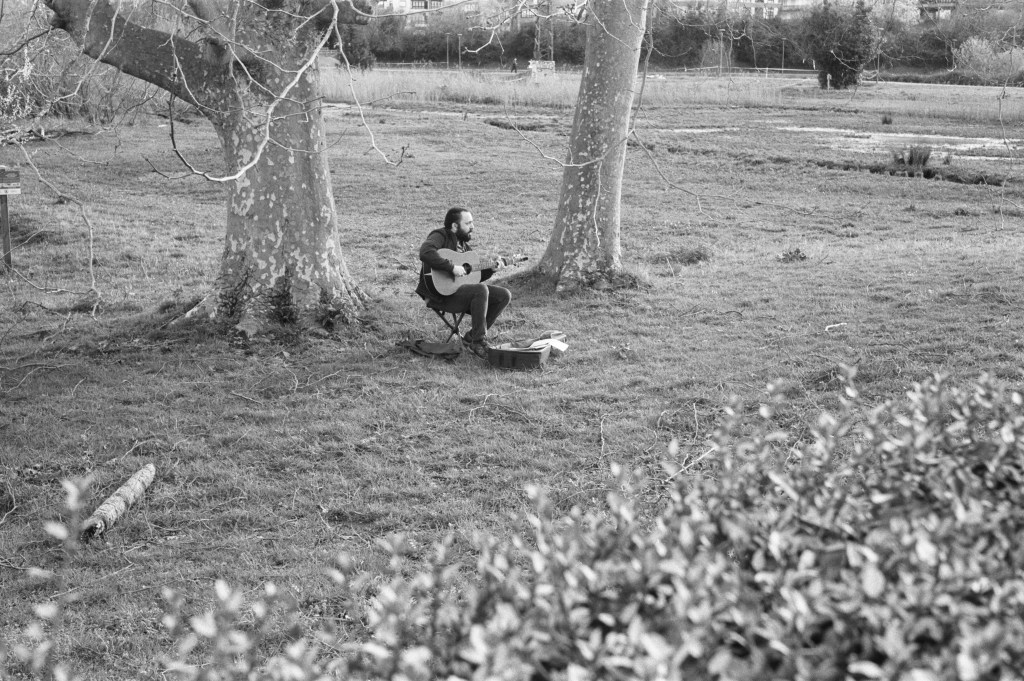
One More Branch #2

The following story act was created through my lovely app One More Branch (link for the repo), which is a platform for interactive branching storytelling. In the case of this story, I didn’t explore alternative branches: just picked among the offered choices whichever sounded better. The result is quite good.

If you’re a veteran of reading whatever nonsense I post on here, you may recognize the trio involved in this story; they’re the same idiots from my short story from years ago named Interspecies Misdemeanours.

New changes in the app: I’ve implemented a complex feature that forces the LLM to actually structure a story in three acts and 2-4 beats per act, based on the character concept, worldbuilding, and tone/genre provided. The code passes the current act/beat, along with what’s necessary to know about upcoming ones, to the LLM so that it can produce the next page. That keeps it on track. However, this is an app for branching storytelling that necessarily would allow one to go off the deep end, so I’ve also implemented the ability for the LLM to determine if a choice has deviated too much from the pre-planned structure, which would trigger a re-plan of the story from the last concluded act/beat onwards. I haven’t seen that in action yet because the current test story was quite on point.

Perhaps this is not obvious, but there was an issue with my instructions to the LLM regarding when it should decide to conclude a story beat. The first act’s introductory beat was about the trio exploring the strange place and establishing what kind of trouble they were in. Well, the app still considered them to be in the same beat deep into the pages, where they were in serious fucking trouble. I fixed the issue; from then onwards, it concluded the beats appropriately (by page 18, it has entered the second act), but this issue has colored what has happened in about half of these pages.


Page 1

The ruined brick building squats in the woods like a corpse nobody bothered to bury—three stories of broken windows and poison ivy, the kind of place adults tell you not to fuck around in, which is basically an engraved invitation. You are Sam, fifteen years old, and you’re standing at the tree line with Betty Krommer and Frank Haimer, watching Frank bounce on his heels like a kid who just discovered his parents’ porn stash.

“I’m telling you, it’s not just a basement,” Frank says for the third time, pushing his glasses up. His nose is already running. “It goes down, like, way down, and then it opens up into these rooms. Tiled rooms. With pools.”

“Pools,” Betty repeats flatly. She’s in her pink polka-dot dress, arms crossed, one eyebrow doing that thing that makes you feel like an idiot even when you’re right. “In a condemned factory.”

“I’m not making it up!” Frank’s voice cracks. He pulls out his camera, waves it like evidence. “I got pictures, but they came out all—the light’s weird down there, okay? You have to see it.”

You can feel the buzz already, that electric itch under your skin that says this is it, this is the thing that makes today matter. Frank’s been weird for three days—jumpy, secretive, smoking again even though he swore to his dad he quit. Whatever he found, it’s real enough to scare him, and that makes it real enough for you.

Betty’s watching you now, waiting to see which way you’ll jump. The sun’s getting low, painting everything orange. Frank’s already moving toward the building, his backpack bouncing.

“If this is another fossil thing,” Betty says, “I’m gonna kick both your asses.”

Page 2

“Hold up,” you say, catching Frank’s shirt before he can disappear into the building. “Pictures. Now. You’re not dragging us into some bullshit without proof.”

Frank stops, looks back at you like you just asked him to solve calculus. “I told you, they came out weird—”

“Then show us weird,” Betty cuts in. She’s moved closer, close enough you can smell her shampoo—something fruity that makes your brain short-circuit for half a second before you shove it down. “Come on, Haimer. If it’s real, the pictures’ll show something.”

Frank’s face does this thing, this trapped-animal flicker, but he digs into his backpack and pulls out a stack of Polaroids. His hands are shaking a little as he fans them out.

The first few are what you’d expect—darkness, the flash catching brick and rebar, Frank’s thumb over the lens on one. But then there’s a shot of stairs going down, and the light in it is wrong. Not dark, not bright, just… off. Like the flash hit something that reflected it back in a color that doesn’t have a name. The next one shows a doorway, and beyond it, tiles. Clean white tiles, the kind you’d see in a hospital or a pool, except they’re glowing faintly, and the perspective makes your eyes hurt if you stare too long.

“What the fuck,” Betty breathes. She’s leaning in, her shoulder touching yours, and you’re trying to focus on the pictures but your skin is doing that shivery thing where it’s aware of every point of contact.

The last picture is the worst. It’s a room—square, tiled floor to ceiling, with a pool of water in the center. Except the water isn’t reflecting anything. It’s black, perfectly black, and the edges of it seem to curve up slightly, like it’s defying gravity. Frank’s flash caught something else too: a doorway on the far side, and beyond it, another room. And another. The perspective stretches back like a hall of mirrors, except there are no mirrors.

“That’s not possible,” you say, but your voice sounds thin even to you.

“I know,” Frank says. He’s wiping his nose with his sleeve, his eyes huge behind his glasses. “I only went three rooms in. I got scared. But Sam—” He looks at you, and there’s something desperate in it, something that needs you to believe him. “It keeps going. I could hear echoes, like… like it’s massive down there.”

Betty’s breathing has gone a little raspy. She’s still staring at the pictures. “This is fake. This has to be fake.”

“It’s not fake!” Frank’s voice cracks again. “Why would I fake this? Why would I—”

“Because you’re Frank,” Betty snaps, but there’s no heat in it. She’s rattled. You can tell because she’s not making eye contact, and Betty always makes eye contact when she’s tearing into someone.

The sun’s lower now. Maybe twenty minutes of good light left. The building looms, all broken windows and shadows. Frank’s already moving toward it again, like he can’t help himself, like it’s pulling him.

“We don’t have to go all the way in,” he says. “Just… just to the first room. So you can see. So you know I’m not crazy.”

Page 3

“Alright,” you say, shoving the pictures back at Frank. “I’m in. But we’re not going in blind.”

You scan the ground, spot a broken chunk of brick near the foundation, and grab it. The edge is chalky, crumbles a little in your grip. “We mark the walls. Every turn, every room. That way if this place is as fucked up as it looks, we can follow the trail back.”

Frank’s face lights up like you just solved world hunger. “Yes. Yes, that’s—that’s actually smart, man.” He’s already moving toward the building, backpack bouncing. “I went three rooms in last time and I swear to God the echoes—”

“Wait.” Betty’s voice cuts through, sharp enough to stop both of you. She’s still staring at the Polaroid with the black pool, and when she looks up, her eyes are doing that thing where they’re too bright, like she’s forcing herself not to blink. “We tell someone. We leave a note or—or we tell my dad where we’re going, because if something happens—”

“Your dad’ll call the cops,” Frank says, and there’s this edge of panic in it. “My dad finds out I’m back here, I’m grounded until college. Minimum.”

“Then we leave a note somewhere,” Betty insists. “We’re not just disappearing into some—some fucking nightmare dimension without anyone knowing.”

The sun’s almost gone now. The factory’s a black cutout against the purple sky, and the trees are close enough that their shadows feel like they’re reaching. You can see the doorway Frank’s talking about, the one that leads down. It’s just darkness from here, but you keep thinking about that picture, that wrong light.

Frank’s already got his flashlight out. Betty’s got her arms crossed, waiting.

You’re holding a chunk of brick and the night’s coming fast.

Page 4

You don’t give Betty time to argue. Three strides and you’re past Frank, shouldering through the doorway into the factory’s gutted interior. The floor’s unstable—chunks of concrete and rebar poking through like broken teeth—but you keep moving, following the path Frank must’ve taken, and yeah, there it is: a hole in the floor near the back wall where the foundation’s collapsed inward, except it’s too regular, too deliberate, like something carved it open from below.

“Sam, wait—” Frank’s behind you, flashlight beam bouncing wild.

You drop through before you can think better of it. It’s only a six-foot drop, and you land in a crouch on tile. Actual tile. Clean white tile that shouldn’t exist under a ruined factory, glowing with that sick pale light Frank’s pictures showed. The air down here tastes wrong—sterile and metallic, like licking a battery.

Frank lands beside you with a grunt, immediately fumbling his camera up. “Holy shit, okay, okay—” The flash pops, blindingly bright in the enclosed space, and for a second the walls look curved when they’re definitely flat.

Betty drops through last, landing harder than she meant to, and you hear it immediately—that hitch in her breath, the whistle starting. She’s already fishing for her inhaler, but her eyes are huge, scanning the room.

It’s exactly like the Polaroid. Ten feet by ten feet, perfectly square, tiles unmarred and impossibly clean. Two doorways: one ahead, one to the right. No door frames, just rectangular absences in the walls. The light’s coming from everywhere and nowhere, like the tiles themselves are luminous.

“Three days I’ve been thinking about this,” Frank whispers, and his voice multiplies, echoes layering over each other from the doorways, from deeper in. “Three days and I thought maybe I imagined how wrong it felt, but—”

“Mark it,” Betty says, voice tight. She’s got the inhaler to her mouth, takes a hit. “Mark the fucking wall, Sam.”

You’ve still got the brick chunk. The tile’s so clean it feels like vandalism to touch it.

Page 5

You press the brick’s chalky edge against the nearest wall tile, dragging it hard enough to leave a mark. Except there’s no mark. No scratch. Not even dust. The brick crumbles against the surface like you’re trying to write on diamond, leaving a gray smear that fades as you watch—actually fades, the tile absorbing it or rejecting it or something, until the surface is pristine again.

“Jesus Christ,” you breathe, and your voice comes back at you from both doorways, layered and wrong. You try again, harder, grinding the brick corner into the tile until your knuckles scrape. The brick disintegrates into powder. The tile remains perfect.

Frank’s got his camera up, flash popping. “Did you see that? Did you fucking see—” He’s practically vibrating. “It’s like, like self-healing, or the material’s rejecting contamination, or—”

“Or we’re in some fucked-up alien bathroom,” Betty cuts in. She’s moved to the doorway on the right, peering through without crossing the threshold. “Because that’s not tile. Tile doesn’t do that.”

You look down at what’s left of your brick—barely half its original size, crumbled to dust in your palm. Your path-marking plan just became a lot more complicated.

The echoes are still going. Not from your voices anymore, but from deeper in. A sound like water dripping, except it’s coming from multiple directions at once, and when you focus on it, it might not be water at all. It might be footsteps. Or something dragging.

Frank’s already moving toward the forward doorway, camera raised like a talisman. “We should go straight first. That’s what I did before. Straight, then right, then right again, and that’s where the big room with the pool is—”

“The pool with the black water that doesn’t reflect,” Betty says flatly. She’s still at the right doorway, and her breathing’s evening out, but her hand’s white-knuckled around her inhaler. “The one in the picture that made me want to fucking puke.”

The forward doorway yawns open, perfectly rectangular, leading to another tiled corridor. The right doorway shows a glimpse of another room, but from this angle you can’t see how big it is or what’s in it. And behind you, the hole you dropped through is still there—you can see the factory’s broken ceiling, daylight filtering through gaps.

Still an exit. For now.

Page 6

You step toward Betty and the right doorway, leaving Frank frozen mid-gesture with his camera. “Fuck the pool,” you say. “Let’s see what’s behind door number two.”

“Sam—” Frank’s voice pitches up, but you’re already moving, and Betty shifts to make room as you join her at the threshold.

The room beyond is smaller. Maybe eight feet square instead of ten. Same white tiles, same sourceless glow, but the geometry’s wrong in a way that makes your eyes water. The far wall looks closer than it should be, but when you focus on it, it seems to recede, like you’re looking through the wrong end of a telescope. There’s no doorway on the opposite side. Just walls. A dead end.

Except there’s something in the corner.

A pile of fabric. Dark, crumpled, definitely not tile. Your heart kicks into overdrive because it looks like clothes, like someone took off their jacket and jeans and just left them there, except the pile’s too flat, too deflated, like—

“Is that a fucking shirt?” Betty whispers, and her hand finds your forearm, fingers digging in.

Frank crowds in behind you both, camera raised. The flash goes off and the room inverts for a second—black tiles, white fabric—then snaps back. “Holy shit,” Frank breathes. “Holy shit, someone was here. Someone else found this place.”

The clothes don’t move. They’re just lying there, bundled in the corner like laundry. A jacket. Jeans. Something that might be a sneaker, tipped on its side. No body. No bones. Just the clothes, arranged in a way that suggests a person was wearing them when they… what? Disappeared? Evaporated?

The echoes from deeper in the space suddenly sound a lot less like water dripping.

“We should check the pockets,” you hear yourself say, because your brain’s decided this is an adventure, not a horror show, and adventurers loot the environment. “Could be ID. Could tell us who—”

“Could be fucking cursed,” Betty hisses. Her breathing’s getting raspy again. “Could be, I don’t know, a trap, or contaminated, or—”

Frank’s already stepping past you both, camera dangling from his neck, reaching for the pile. “It’s evidence,” he says, like that settles it. “We need to document—”

That’s when you notice the second detail: the tiles under the clothes are darker. Not discolored, exactly, but shadowed, like the fabric’s casting a stain into the floor itself. And the stain’s spreading, creeping outward in a slow, organic way that makes your stomach flip.

Frank’s hand is six inches from the jacket.

Page 7

“Go ahead,” you tell Frank, stepping back to give him room. “I’ll watch the floor.”

Frank doesn’t need to be told twice. He’s already moving, camera swinging from its neck strap as he crouches beside the pile. His hand hesitates for just a second—you see his fingers twitch—then he grabs the jacket sleeve and lifts.

The fabric comes up stiff, like it’s been starched, and there’s a wet sound as it peels away from the tile. Not wet like water. Wet like something organic, something that’s been sitting too long. Frank makes a noise in his throat, but he doesn’t drop it. He’s shaking it out, checking the pockets with the methodical focus of someone who’s decided facts are safer than fear.

“Nothing,” he mutters. “No wallet, no phone, no—wait.” He digs deeper into the inner pocket and pulls out something small and white. A receipt. He squints at it, pushes his glasses up. “Gas station. Route 47. Date’s… shit, that’s from last year.”

You’re barely listening because the stain is moving.

It’s subtle at first—just a darkening at the edges, like the tile’s absorbing something it shouldn’t. But then it spreads, a slow creep of shadow that fans out from where the clothes were lying. Not black like the pool water. Darker than that. A color that doesn’t have a name, that makes your eyes try to slide away from it.

The stain reaches the wall and stops. Just stops, like it hit an invisible barrier. The tiles around it look… wrong. Puckered. Warped. Like skin around a burn.

“Frank,” Betty says, and her voice is thin, stretched. “Frank, put it back.”

“I’m not done—” Frank’s got the jeans now, shaking them out, and something falls from the pocket. A keychain. Car keys. Toyota logo. They hit the tile with a sharp clink that echoes wrong, bouncing off walls that shouldn’t exist.

The stain pulses.

It’s not spreading anymore, but it’s moving, rippling like water disturbed by something underneath. You can see the tile beneath it warping, buckling, and there’s a sound now—low, grinding, like stone on stone—and the temperature drops so fast you can see your breath.

“PUT IT BACK,” Betty shouts, and she’s backing up, hand fumbling for her inhaler.

Frank drops the jeans like they’re on fire. The fabric hits the stain and the rippling stops. Just stops. The grinding cuts off mid-note. The temperature normalizes so abruptly you almost stumble.

The three of you stand there, frozen, staring at the pile of clothes that’s now half-on, half-off the stain. Frank’s breathing hard, his glasses fogged. Betty’s got her inhaler to her lips, taking a hit. Your hand’s wrapped so tight around the brick chunk your knuckles are white.

“What the fuck was that?” Frank whispers.

The clothes don’t answer. Neither does the stain. But you can hear it now—that rhythmic sound from deeper in the space. Closer than before. Definitely closer. And it’s not footsteps.

It’s dragging. Something heavy, being dragged across tile.

Page 8

“Fuck that,” you snap, grabbing Frank’s shoulder before he can back away.” Get photos. All of it. The stain, the clothes, the keys—everything.”

Frank’s head whips toward you, eyes wide behind his glasses.” Are you insane? We need to—”

“We need evidence,” you cut him off, your voice harder than you mean it to be.” Nobody’s gonna believe this shit without pictures. You said it yourself—document everything.”

For a second, Frank just stares at you. Then something shifts in his face—that manic gleam he gets when his brain catches up to his curiosity. He nods once, jerky, and raises the camera.

The flash goes off.

The stain recoils.

It’s not a metaphor. The dark spreading across the tile actually pulls back, contracting like a living thing flinching from light. The warped tiles around it seem to flatten, smoothing out for just a moment before the darkness surges back, angrier, reaching farther than before.

“Holy shit,” Frank breathes, and he’s already winding the film, already lining up another shot.” Did you see that? It reacted to the—”

The second flash stops him mid-sentence.

This time, the stain doesn’t just recoil. It erupts.

Not physically—there’s no spray, no explosion—but the temperature drops so fast your breath mists in front of your face. The tiles beneath the clothes crack with a sound like breaking ice, spiderwebbing outward in jagged lines that glow faintly at the edges. And the dragging sound—the one you’ve been hearing from deeper in the space—stops.

Complete silence.

“Frank,” Betty says, and her voice is barely a whisper.” Frank, we need to go. Now.”

But Frank’s already taking another picture, the camera whirring as it spits out the Polaroid. He’s shaking, you can see it in the way the camera trembles, but he’s not stopping. He crouches lower, getting the angle on the cracked tiles, the keys, the stain that’s now pulsing in rhythm with something you can’t hear but can feel in your chest.

“One more,” he mutters.” Just one more and I got it all—”

Something moves in the forward doorway.

You don’t see it clearly—just a shift in the shadows, a shape that’s too tall and too wrong to be human but too deliberate to be anything else. It doesn’t step into the room. It just… stands there. Watching.

Frank’s finger freezes on the shutter button.

Betty’s inhaler hisses as she takes a desperate pull, her breathing ragged and wet.

The shape in the doorway doesn’t move. But you can feel its attention, heavy and cold, pressing against your skin like a physical weight.

Page 9

You throw yourself sideways, putting your body between the doorway and Frank’s hunched form. Your voice comes out louder than you intended, cracking on the edges.

“Back the fuck off!”

The shape doesn’t move. Doesn’t speak. It just stands there in the doorway, impossibly tall, and the longer you stare at it the less sense it makes. The proportions are wrong—arms too long, head tilted at an angle that makes your stomach lurch. It’s not quite blocking the light from the next room, but it’s not quite letting it through either, like it’s made of something that doesn’t interact with illumination the way solid things should.

Behind you, Frank’s camera whirs again. The flash goes off.

The shape flinches.

Not back. Sideways. It jerks to the left, and for a split second you see it clearly—a person, maybe, or something wearing a person’s outline like a coat that doesn’t fit right. Then it’s in the doorway again, and you can’t remember if it moved or if your eyes just lied to you about where it was.

“Sam,” Betty hisses, and her hand closes around your wrist, nails digging in. “Sam, it’s not alone.”

You hear it then. Not from the doorway ahead. From behind.

From the entrance you came through.

Footsteps. Slow. Deliberate. The sound of something heavy being dragged.

“Oh god,” Frank whispers, and you can hear the Polaroids fluttering in his shaking hands. “Oh god, oh god, there’s two of them.”

The shape in the forward doorway tilts its head the other direction. Watching. Waiting.

The dragging sound from behind gets louder.

You’re trapped in a dead-end room with a stain that cracks tiles and two things that shouldn’t exist closing in from both directions. The only other doorway is the one to your right—the one Betty was examining before Frank found the clothes. You don’t know where it leads. You don’t know if it leads anywhere.

But the dragging sound is getting closer, and the shape ahead hasn’t blinked, and Frank is hyperventilating so hard his glasses are fogging up.

Page 10

You don’t think. You just move.

Your hand shoots out and grabs Frank’s shirt collar, yanking him sideways. Betty’s already moving—she anticipated you, or maybe she just has better survival instincts—and the three of you stumble through the right doorway in a tangle of limbs and panic.

The room beyond is longer. Rectangular. The tiles here are the same sterile white, but the light is dimmer, like it’s coming from farther away or through something thick. There are three doorways: one directly ahead at the far end, one to the left about halfway down, and one to the right near where you’re standing.

Behind you, the dragging sound stops.

You spin around, chest heaving, and see the entrance you just came through. The dead-end room is visible beyond it—the stain, the cracked tiles, the abandoned clothes. But the shape that was in the forward doorway is gone. Just gone. And the dragging sound from the entrance has gone silent.

“Where—” Frank starts, then cuts himself off with a wet cough.

Betty’s breathing is ragged and wet, that familiar wheeze building in her chest. She fumbles for her inhaler with shaking hands, and you can see the pink fabric of her dress is dark with sweat at the collar.

“They’re not following,” you say, but your voice sounds wrong. Too loud. The acoustics in this room are different—your words don’t echo, they just sort of die in the air like the space is swallowing them.

Frank wipes his nose on his sleeve, his glasses still fogged. “That doesn’t make sense. Why would they—”

“I don’t give a shit why,” Betty interrupts, her voice tight and high between pulls on her inhaler. “I don’t give a shit about any of this. We need to get out. Now.”

You look at the three doorways. Ahead. Left. Right. No way to know which one leads back to the entrance, or if any of them do. The room you came from had two doorways—forward and right. You took the right. But now you’re in a room with three exits, and the geometry doesn’t add up.

“Frank,” you say, “where did you go when you were here before? Did you see this room?”

He shakes his head, still trying to catch his breath. “No. No, I went straight. Forward through the first room, forward through the second. This is—we’re off my route. I don’t know this room.”

A sound echoes from somewhere. Not the dragging. Something else. A wet, sliding noise, like something moving through water. It’s impossible to tell which direction it’s coming from—the acoustics make it seem like it’s everywhere and nowhere at once.

Betty’s nails dig into your forearm again. “Sam. We need to move. Right now.”

Page 11

You point at the left doorway. “That one. If we went right before, left might take us back.”

“That’s not how geometry works,” Frank mutters, but he’s already moving, his flashlight beam cutting ahead into the next room.

Betty doesn’t argue. She just follows, one hand pressed to her chest like she’s trying to manually slow her breathing.

The doorway opens into another square room—smaller than the first, maybe eight by eight. The tiles here have a faint yellowish tinge, like old porcelain, and there’s only one other exit: straight ahead. No choices. Just forward.

“Shit,” you breathe.

Frank’s already at the far doorway, peering through. “Another room. Same size. One door.”

You move up beside him and look. He’s right. It’s like a hallway made of identical cells, each one feeding into the next. The yellowish tint gets stronger the deeper you look, and the light is dimmer, more amber.

“This is wrong,” Betty says behind you. Her voice is flat, drained of its usual bite. “We should’ve hit the entrance by now. We weren’t that far in.”

Frank pushes his glasses up. “Maybe the rooms… rearrange? Or maybe we’re moving parallel to the entrance instead of toward it?”

“Or maybe we’re fucked,” Betty snaps.

You’re about to respond when you hear it: a sound from back the way you came. Not dragging this time. Not footsteps. It’s more like… breathing. Slow, wet, deliberant. Coming from the rectangular room you just left.

Frank hears it too. His flashlight beam jerks back toward the entrance, and for a second you see something in the doorway—a dark mass, low to the ground, too many angles to make sense of—and then it’s gone, sliding sideways out of the light.

“Go,” you say. “Go, go, go.”

The three of you stumble through the next doorway, into the next yellow-tinged cell, and the one after that. Three rooms deep now, maybe four, and the amber light is getting thick, almost soupy. The air tastes stale and metallic.

Frank stops suddenly, his hand shooting out to grab your arm. “Wait. Listen.”

You freeze. At first you don’t hear anything except Betty’s wheezing and your own pulse hammering in your ears. Then you catch it: the breathing sound is still behind you, but now there’s something else. Ahead. A rhythmic tapping, like fingernails on tile, coming from deeper in the chain of rooms.

“We’re boxed in,” Frank whispers.

Page 12

“Keep moving,” you say, and your voice comes out steadier than you feel. “Whatever’s making that sound, it’s gotta be smaller than those tall fuckers behind us.”

Frank makes a sound that’s half-laugh, half-sob. “That’s your plan? Fight something because it might be smaller?”

“You got a better one?”

He doesn’t answer. Just pushes forward into the next room, and the next, his flashlight beam bouncing off yellow tiles that are definitely darker now, almost mustard-colored. The tapping is getting louder, more distinct. Not rhythmic like footsteps. More erratic. Like someone drumming their fingers on a desk, except the fingers are made of bone.

Betty’s wheezing behind you, each breath a wet rasp that makes your chest hurt in sympathy. She’s trying to keep up, but her legs are shaking.

“Sam,” she gasps. “I can’t—”

“You can,” you say, not looking back. If you look back you’ll see how bad she’s getting, and if you see it you’ll stop, and if you stop you’re all dead. “Just a little further.”

The tapping stops.

Frank freezes mid-step, his flashlight fixed on the doorway ahead. You can see into the next room now, and it’s different. Bigger. The tiles are almost brown, and there’s something in the center—a shape, maybe three feet tall, hunched over like it’s examining the floor.

It has too many joints. That’s the first thing your brain registers. Arms that bend in three places, fingers that curl backward, a head that sits at an angle no neck should allow. It’s not moving. Just… waiting.

“Back,” Frank whispers. “Back, back, back—”

But then you hear the dragging sound from behind you again, closer now, and the wet breathing, and you realize you’re out of rooms to retreat into.

The thing in the brown room tilts its head. Slowly. Like it’s listening.

Frank’s hand is shaking so bad his flashlight beam is strobing. Betty’s pulled out her inhaler but she’s not using it, just clutching it like a talisman.

You’re still holding the brick chunk. It’s pathetic—half-destroyed, barely bigger than your fist—but it’s all you’ve got.

The thing in the brown room makes a sound. Not tapping. Not breathing. Something between a click and a purr, like a cat with a mouthful of gravel.

Page 13

“Frank,” you hiss. “Flash it. Now.”

“What?”

“Like you did before—hit it with the flash!”

Frank’s hands are shaking so bad he nearly drops the camera. The thing in the brown room hasn’t moved, but its head is tilting further, further, the angle getting worse, and you can hear a sound coming from it now—a clicking, purring thing that makes your teeth ache.

You step sideways, putting yourself between Betty and the doorway. She’s pressed against your back, her breathing a wet rattle that’s getting quieter, which is somehow worse than when it was loud.

“Frank—”

The flash goes off.

The brown room explodes into white light and the thing screeches—a sound like metal scraping concrete—and launches itself backward, arms folding in ways that hurt to look at, fingers splaying wide. It hits the far wall and scrambles sideways, up the wall, across the ceiling, moving like a spider made of coat hangers.

But it doesn’t run. It just repositions. Crouches on the ceiling, head rotating to track you, and that clicking-purring starts again, faster now, angrier.

“Oh fuck,” Frank breathes. “Oh fuck, it’s still—”

Behind you, the dragging sound stops. Just stops. The silence is worse than the noise. You risk a glance back and there’s nothing in the doorway you came through, but you can feel something there, just out of sight, waiting.

The small thing on the ceiling makes a new sound. A chirp. High-pitched and questioning.

And from somewhere deeper in the brown rooms, something chirps back.

Betty’s fingers dig into your shirt. “Sam,” she whispers, and her voice is so thin you can barely hear it. “I can’t breathe right.”

The thing on the ceiling clicks three times, then goes silent. Watching.

Frank’s camera whirs as it spits out another Polaroid. His hands have stopped shaking, which is somehow worse—like he’s gone past fear into some kind of documentary autopilot. “There’s a doorway,” he says, flat and mechanical. “Right side of the room. Behind it.”

You look. He’s right. There’s another exit on the far side of the brown room, past where the thing is crouched. You’d have to go under it. Or make it move.

Behind you, something scrapes against tile. Once. Deliberately.

Page 14

You plant your feet and raise your voice, trying to make it sound steady even though your heart is hammering so hard Betty can probably feel it through your back.

“We’re not—we’re people, okay? We’re just kids. We didn’t mean to come here, we’re just trying to leave.”

The thing on the ceiling goes very still. Its head stops rotating mid-turn, locked at that impossible angle, and the clicking-purring cuts off like someone flipped a switch.

For one insane second you think it worked. That maybe there’s something in there that understands, that remembers what people are, that might let you pass.

Then it chirps again. Three sharp notes.

And the entire brown room answers.

They come out of the walls. Out of doorways you didn’t see, out of shadows that shouldn’t exist in this flat tile lighting. Four, five, six of them, unfolding from corners and ceiling edges, all clicking and purring and chirping in a rhythm that sounds horribly like laughter.

“Oh Jesus,” Frank says, and the camera flashes again on pure reflex.

The nearest one screeches and flinches, but the others surge forward, filling the doorway, their too-many-jointed arms reaching, fingers curling backward in ways that make your stomach flip.

Behind you, something massive scrapes across tile. The dragging sound, close now. So close you can smell it—something chemical and wrong, like burnt plastic and meat.

Betty makes a sound that’s barely a wheeze. Her inhaler rattles—she’s trying to use it but her hands are shaking too bad. The small click of the trigger, once, twice, and you can hear her trying to breathe in but nothing’s working right.

“Betty—” You spin, grabbing her shoulders, and her face is pale, lips starting to go blue at the edges. Her eyes are huge and terrified and she’s trying to say something but no air is moving.

The things in the brown room are clicking faster, coordinating, and Frank is backing up into you both, the camera clutched to his chest like a shield that won’t do shit.

“The doorway,” Frank says, and his voice cracks. “Right side, we have to—”

The massive shape appears in the entrance behind you. You catch it in your peripheral vision—tall, wrong, the same kind of thing that watched you in the dead-end room but closer now, so much closer, and it’s not stopping.

Betty’s knees buckle. You catch her weight, her inhaler clattering to the tile, and the small things chirp in unison like they’ve won something.

Page 15

You drop to your knees and grab the inhaler from where it’s rolled against Betty’s leg. Her hands are clawing at her throat, nails scraping her own skin, and when you shove the inhaler toward her mouth she tries to grab it but her fingers won’t close right.

“Frank, fucking flash them!” you scream, and wrap one arm around Betty’s shoulders to hold her steady while you jam the inhaler between her blue lips. “Breathe in, Betty, come on—”

The camera goes off behind you. The brown room fills with white light and the things screech, that horrible metallic sound that makes your teeth ache, but they don’t retreat. You can hear them repositioning, the skitter of too-many joints on tile, the clicking-purring rising to a fever pitch.

You press the trigger. Once. Betty’s chest hitches but nothing goes in—her throat is locked up too tight. You can feel her heartbeat against your arm, way too fast, fluttering like a trapped bird.

“Again!” Frank yells, and the flash goes off again. The dragging sound behind you stops. Just stops. Which is somehow worse than hearing it move.

You tilt Betty’s head back the way you saw in some health class video, trying to open her airway, and press the trigger again. This time you feel her chest expand slightly, a tiny desperate sip of air and medicine, and she makes a sound like a broken vacuum cleaner trying to start.

“It’s working, come on Betty, one more—”

Something touches your shoulder.

Not a hand. The texture is wrong—smooth and cold and slightly wet, like a salamander’s skin, and when you jerk away and look up there’s one of the small things right there, its head tilted at that sickening angle, and its mouth is opening.

Not opening. Unfolding. Like a flower made of teeth.

Frank screams and the camera flashes so close the light burns purple ghosts into your vision. The thing flinches backward but two more are coming through the doorway you need to exit through, and the massive shape is finally moving in the corridor behind you—you can hear it now, a wet sliding sound accompanied by breathing that sounds like hydraulics failing.

Betty gasps. Actually gasps. Air moving in, ragged and thin but moving, and her hands close around your wrist with surprising strength.

“Can’t—” she wheezes. “Can’t stay—”

The exit doorway has two of them in it now, blocking the way. The things from the brown room are advancing from the other direction. Frank’s flashlight is shaking so badly the beam looks like a strobe light, and you can see the massive shape now at the edge of the light—something that takes up the entire corridor width, something that glistens.

Betty takes another hitching breath and tries to stand, using you as leverage. Her legs are shaking but she’s up, and the inhaler is still clutched in her fist.

Frank backs into both of you, the camera raised like a weapon. “Sam, what do we do, what the fuck do we do—”

Page 16

You lunge sideways and rip Frank’s flashlight out of his hand—he yelps but doesn’t fight you—and swing the beam straight into the faces of the two things blocking the exit.

They screech and recoil, arms folding over where their eyes should be, and for one beautiful second the doorway is clear.

“GO!” you scream, hauling Betty up by her armpits. She’s gasping now, each breath a wet ragged sound, but she’s breathing and that’s all that matters. Frank grabs her other arm and you’re moving, half-dragging her between you, her feet barely touching the tile.

The things recover fast. You hear them scrambling back into position, the skitter-click of joints bending wrong, but you’re already at the doorway and Betty’s through and Frank’s through and you’re diving after them—

Something grabs your ankle.

Not a hand. Too many fingers. They wrap around your leg like a fist made of cold wet worms and you go down hard, chin cracking against tile, flashlight skittering away across the floor. The thing is pulling you backward, back toward the brown room where that massive shape is still dragging itself closer, and you can smell it now, that burnt-plastic-and-meat reek that makes your stomach heave.

“SAM!” Frank’s voice cracks high and terrified.

You twist and see it—the small thing has your leg, its flower-mouth unfolding wider, and there are others coming through the doorway behind it, three or four of them, moving in that horrible spider-crawl.

Betty is on her hands and knees in this new room, inhaler clutched in one shaking fist, trying to breathe. Frank is frozen in the doorway, camera raised but not firing, his face white as paper.

The thing pulls harder. Your fingers scrape across tile, finding no purchase, and you’re sliding backward inch by inch. In the brown room behind, the massive entity’s breathing fills the space like a broken furnace, getting louder, getting closer.

Your hand closes around something. The brick chunk. Still in your pocket, jabbing into your hip.

You could smash it into the thing’s face—if it even has a face. You could scream for Frank to flash them all at once, hope it stuns them long enough to break free. Or you could do something really fucking stupid and kick backward with your free leg, try to connect with something vital, bet everything on one shot.

Page 17

“FRANK! FLASH THEM! FLASH ALL OF THEM!”

Your voice rips out raw and desperate, and thank Christ, Frank actually moves. His thumb jams down on the button and the camera erupts with light—once, twice, three times in rapid succession, the whine of the flash recharging between bursts filling the room like a dying alarm.

The things screech. All of them at once, a chorus of metallic shrieking that makes your teeth ache, and the grip on your ankle loosens just enough—you yank your leg free and scramble forward on hands and knees, tile cold and smooth under your palms, the brick chunk still clutched in one white-knuckled fist.

Behind you the entities are repositioning, you can hear the skitter-click of their joints, but they’re slower now, disoriented, and you’re through the doorway and Frank is grabbing your shirt and hauling you sideways.

This room is different. Bigger. The tiles here are a pale sickly green, like hospital walls left to mold, and there are four doorways—no, five—spaced unevenly around the walls. The air tastes worse here, metallic and sharp, like licking a battery.

Betty is still on her knees, inhaler pressed to her mouth, her whole body shaking with the effort of breathing. Her pigtails have come half-undone and her dress is soaked through with sweat.

“We gotta move,” Frank gasps, and he’s right, because the clicking sounds are getting organized again, coordinated, and you can hear that wet hydraulic breathing from the massive thing getting closer to the brown room you just escaped.

But Betty can’t run. Not like this. And you don’t know which doorway leads out versus deeper, and Frank’s flashlight is still back there on the floor where you dropped it, and you only have the brick and Frank’s camera has maybe two flashes left before the battery dies.

One of the doorways—the one to your far right—has a draft coming through it. You can feel it on your face, cool and carrying a smell that’s almost like outside air, like dirt and leaves and rain.

Another doorway, straight ahead, shows a room beyond that’s brighter, the tiles there almost white again, like the first room you landed in.

The doorway to your left shows only darkness. No glow at all. Just black.

Living Narrative Engine #19

I have quite the treat for you fuckers. I’ve recorded myself playing through my test scenario involving Alicia Western. More than an hour of me speaking in my accented English even though I rarely speak in real life, and showing off a fun, frustrating playthrough that made me hungry.

This is, of course, related to my beloved Living Narrative Engine. Repo here.

manga2cbz: read manga in VR

I’ve been reading manga for a long time, usually relying on my old-ass tablet and scanlations (or whatever they’re called). I came across the Livro app for the Meta Quest 3, and I intended to read manga on it. However, I found out you can’t move the manga folders like you would on a tablet.

So, this morning I had Claude Code create a Go app that can be baked into a Linux/Windows exec to compress manga chapters into corresponding cbz files. Those files can just be copied into the Quest 3 through a link cable, and opened on Livro. Because Livro has trouble rendering WebP files, my app also converts WebP to PNG. As you can see in the video, it works.

Here’s the repo for the app:

https://github.com/joeloverbeck/manga2cbz