
I’m building a browser-based app to play immersive sims, RPGs and the likes. In practice, I use it to set up short story scenarios or elaborate gooning sessions. I dared myself to build the most comprehensive psychological system imaginable, so that Sibylle Brunne, a 34-year-old orphan living in her parents rustic home somewhere in the Swiss mountains, while controlled by a large language model, would realistically bring her blue-eyed, blonde-hair-braided, full-breasted self to seduce my teenage avatar who is backpacking through the country, eventually convincing me to stay in her house so she can asphyxiate me with her mommy milkers.
Here’s a visual glimpse of the current complexity:
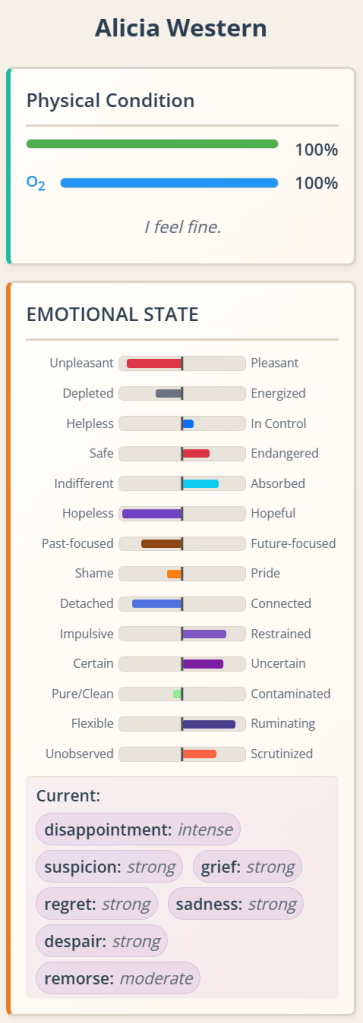
Alicia has become my test subject, as if she didn’t have enough with freezing to death. The system works like this: at the base you have mood axes (like pleasant <-> unpleasant), which change throughout a scene. Actors also have permanent biological or personality-based traits like aversion to harm. Together, mood axes and affect traits serve as weights and gates to specific emotion prototypes like disappointment, suspicion, grief. Delta changes to those polar mood axes naturally intensify or lessen the emotions. I also have sexual state prototypes, which work the same as the emotional states.
These emotional and sexual states serve as the prerequisites for certain expressions to trigger during play. An expression is a definition that tells you “when disappointment is very high and suspicion is high, but despair is relatively low, trigger this narrative beat.” Then, the program would output some text like “{actor} seems suspicious but at the same time as if they had been let down.” The descriptions are far better than that, though. The actors themselves receive in their internal log a first-person version of the narrative beat, which serves as an internal emotional reaction they need to process.
It all works amazingly well. However, to determine if I was truly missing mood axes, affect traits or prototypes, I had to create extremely complex analytics tools. I’ve learned far too much about statistical analysis recently, and I don’t really care about it other than for telling a system, “hey, here are my prototype sets. Please figure out if we have genuine gaps to cover.” Turns out that to answer such a request, some complex calculations need to map 20-dimensional spaces and find out diagonal vectors that run through them.
Anyway, I guess at some point I’ll run my good ol’ test scenario involving Alicia, with her now showing far more emotion than she used to before I implemented this system. That’s a win in my book.
 The Domains of the Emperor Owl
Pingback: Living Narrative Engine #19 – The Domains of the Emperor Owl