
If you’re masochistic enough to follow my blog, you may remember that I’ve been busy for months creating a browser-based app that allows human players to interact with LLMs who are playing a role. You may recall that I ended up using it mostly for erotica. Anyway, I’m an obsessive bastard with a savior complex, so I’ve ended up stuck, for what feels like at least a year, in a daydream that I repeat almost daily, usually before I fall asleep. It tends to start like this: a far better version of myself (full head of hair, bigger muscles, bigger dick) teleports through spacetime into a patient’s room at the Stella Maris sanatorium, somewhere deep in Wisconsin, during winter. Why would I do such a thing, you might ask? Because the patient is none other than Alicia Western. Who is Alicia Western, you may ask? None other than one of the main characters in Cormac McCarthy’s haunting last two novels: The Passenger and Stella Maris.
Why Alicia Western? Enough with the fucking questions. It’s because she has a unique mind and looks lovely, at least in my mind. Because ever since I read those cursed books, that were haunted with McCarthy’s own regret and grief for someone he lost in the seventies, I’ve been haunted with the need to keep Alicia alive and safe. Even though she never existed. That’s the kind of brain I’ve been burdened with, and that I’ll have to endure until my death. Unfortunately, and this is no spoiler, Alicia Western killed herself. It’s the whole basis for both books. I’m not sure if it happened in 1972, but that’s the year that has gotten stuck in my mind.
I figured that I could use my damn app to recreate the scene in which my alter ego meets Alicia Western. So I’m playing myself, and Alicia is being played by Anthropic’s Claude Sonnet 4.5, which is the best artificial intelligence at roleplaying, at least of those I’ve come across.
Each turn, the large language models are provided with a character definition for the character they’re inhabiting. It involves the profile, personality, likes, dislikes, strengths, weaknesses, some background notes, their speech patterns, and such. As they answer in character, their character definition accrues the latest thoughts, and the perceived events (mainly what others have been doing around them). The AI also writes notes at will. Everything works great, except for the fact that the AI tends to repeat some notes, barely reworded. It doesn’t break anything, it just fills the context and therefore reduces my money faster.
Anyway, this is the closest I’ve gotten ChatGPT to picture Alicia Western:

Beautiful girl (I believe she was 22 when she killed herself), although not quite how I imagined her. I won’t upload the picture of how my alter ego looks like, because I barely spent any effort into it.
Each round, I act, then Alicia acts. My app is quite sophisticated in the sense that the actors, including the AI, can choose contextual actions. Only a few actions are chosen in this run, and I’ll point them out when it happens. The action discoverability system works fantastically to restrain the AIs from coming up with actions that aren’t supported by the context.
*cue this video*
Alicia sits at the edge of her assigned bed, face buried in her hands as she contemplates her despair, when she hears a deep voice coming from a few steps in front of her.
Jon Ureña: Hello, Alicia Western. I’m glad to finally meet you.
The door is locked. Nobody can enter. I locked it myself. So how is there someone standing in front of me? This violates the basic physical parameters I established. Either I am experiencing a psychotic break—auditory and visual hallucination, which would confirm the schizophrenia diagnosis I’ve always disputed—or someone entered through means I did not account for. A staff member with a master key, perhaps. But the voice said my full name. “Alicia Western.” Not “Miss Western” or “Alicia” but the complete designation, as if reading from a file. The phrasing is strange too: “glad to finally meet you.” Finally. Implying anticipation. Implying I was expected, studied, awaited. I need to look up. I need to see who this is. My hands are still covering my face. I’m sitting at the edge of the bed in my white dress, the one I planned to wear into the woods. The one that would make my body visible against the snow. I was thinking about Bobby. I was thinking about the letter I couldn’t finish. And now there’s a voice. A deep voice. Male. I should be afraid, shouldn’t I? A strange man in my locked room. But the fear circuit isn’t activating. Instead, there’s… curiosity. Analytical interest. This is a data point that doesn’t fit the pattern. I want to see what doesn’t fit.
(in case you’re stupid, the above paragraph are the thoughts that the LLM has generated for Alicia given the circumstances. Each turn, the AI is provided the last 10 thoughts or so, and is tasked with always providing new thoughts. Sometimes the AI only thinks, but that tends to happen when they’re alone in a room.)
Alicia slowly lowers her hands from her face and raises her head to look at the source of the voice, her blue eyes focusing with clinical precision on the figure standing before her.
Alicia Western: “You shouldn’t be here. The door was locked.”
A huge, older man stands in the center of the room, looking calmly at Alicia with no hint of malice.
Jon Ureña: “The state of the door’s lock is irrelevant to my sudden presence here. Take all the time you need to react to the sudden presence of a stranger in the room. If you have any questions, don’t hesitate to ask.”
A man who enters locked rooms. Who knows my full name without introduction. Who speaks with the syntax of someone outside temporal urgency—’take all the time you need,’ as if time itself bends around him. The lock was irrelevant to his presence, he said. Not ‘I picked the lock’ or ‘I have a key’ but that the lock’s state was irrelevant. That’s a strange epistemological claim. Either he’s psychotic—sharing my delusion space, which would be novel—or he represents something I haven’t categorized yet. He’s huge. I can see that now. Very tall, hulking frame. But there’s no malice. Inviting questions. That’s… unusual. Most people who violate boundaries don’t immediately offer explanatory frameworks. I should speak. I should probe this anomaly. But first I need to simply look at him fully, assess what data is actually present versus what my pattern-matching is generating. The fear still isn’t activating. Why isn’t it activating? My amygdala should be screaming. Instead there’s just this cold curiosity, this want to understand the mechanism of his appearance. Maybe I’m already dead. Maybe I walked into the woods two days early and this is hypoxia-generated hallucination. That would explain the calm. But no—I can feel the vinyl tiles under my grip socks, the mattress edge pressing into the backs of my thighs through the cotton dress. Proprioceptive data suggests continued embodiment. So. A stranger in my locked room. Who claims he’s glad to finally meet me. Finally. I need to ask. I need to understand what ‘finally’ means.
Alicia Western: “You said ‘finally.’ That implies a timeline. How long have you been attempting to meet me, and through what mechanism did you determine this room’s location and my presence within it?”
The man tilts his head slightly as he holds Alicia’s gaze.
Jon Ureña: “How long have I been attempting to meet you… Time is a… complicated matter. In my terms, it’s been about two weeks. That’s what it took to learn about you and make… well, preparations. Regarding what room was assigned to you, I simply looked at the files of the sanatorium.”
Two weeks. He said two weeks in his terms, which implies a different temporal framework than mine. He looked at the sanatorium files—so he has access to administrative records, which means either he’s staff, which seems unlikely given the unauthorized entry and the strange phrasing, or he obtained them through other means. He’s inviting questions. Most people don’t do that. Most people fill silence with explanations, justifications, apologies. He’s simply standing there, waiting. That’s… unusual. The analytical part of me wants to probe the mechanism. How does someone spend two weeks preparing to meet a suicidal mathematics prodigy in a Wisconsin mental institution? What kind of preparation requires two weeks? And what does ‘in my terms’ mean? Is he suggesting his experience of time differs from objective measurement? That would be either psychotic—shared delusion space, which would be novel—or he’s speaking metaphorically about subjective time perception. But the phrasing is too precise for metaphor. ‘In my terms’ suggests an alternative framework. I should ask more. I should probe the timeline, the mechanism of access, the purpose of this meeting. But there’s something else underneath the curiosity. A small, dim hope I don’t want to acknowledge. Someone spent two weeks trying to meet me. Someone who says ‘finally’ like my existence mattered enough to pursue. That’s… I don’t know what to do with that. It might be dangerous. It might be delusion. But it’s data that doesn’t fit my model of complete isolation. And I want to understand it before I dismiss it.
Alicia Western: “Two weeks in your terms. That phrasing suggests you’re distinguishing between subjective and objective time, or that you operate within a different temporal framework than linear progression. Which is it? And when you say you ‘looked at the files’—do you mean you have administrative access to this institution, or did you obtain them through unauthorized means?”
The older man smiles softly.
Jon Ureña: “You’re a very interesting person to talk to, Alicia. I prefer to be honest when asked a direct question, so I’ll clarify that I do operate within a different temporal framework than linear progression, as you so eloquently put it. I don’t have the authorization to look at the files of this institution, but I didn’t have any trouble doing so. It was all for the purpose of being here now, of meeting you.”
He operates within a different temporal framework than linear progression. He confirmed it. Not metaphor—actual confirmation of alternative temporal experience. That’s… that’s not psychosis. Or if it is, it’s a shared psychotic architecture, which would be unprecedented. He accessed files without authorization but had no trouble doing so. The syntax is precise: ‘no trouble’ suggests ease beyond normal human capability, not criminal skill but something else. Something that bypasses conventional constraints like locks and file security. And he’s been preparing for two weeks to meet me specifically. Me. Alicia Western. Not a patient. Not a case study. Me. The analytical framework I’ve relied on for twenty-two years is encountering data it cannot categorize. Either I’m hallucinating—full visual and auditory psychotic break—or I’m standing in front of something that violates the ontological assumptions I’ve built my entire worldview around. He said he prefers to be honest when asked a direct question. That’s… reciprocal. I’ve spent my entire life drowning in dishonesty—therapeutic deflection, social niceties, intellectual cowardice. And here’s someone who says ‘I prefer to be honest’ like it’s a simple axiom. I need to get closer. I need to see if he’s corporeal, if the proprioceptive data matches the visual input. If his physical presence holds up under closer scrutiny. This might be the intellectual surprise I wanted before I die. The one genuine moment I asked for. And if it’s not—if he’s a hallucination generated by my deteriorating substrate—then at least I’ll know the answer before December 24. At least I’ll have calculated correctly. But I have to get closer. I have to test whether this anomaly is real.
Alicia rises slowly from the edge of the bed and takes several deliberate steps toward Jon, closing the distance between them until she stands within arm’s reach, her blue eyes fixed on his face with analytical intensity.
(here, the AI actually used the “get close to Jon Ureña” action, which allows the characters to perform intimate actions like touching one another’s ass. Clearly not the path that the AI is pursuing, but those actions are now available for both of us.)
Alicia Western: “You said you operate within a different temporal framework than linear progression. Not that you experience time subjectively, but that you operate within a different framework. That’s an ontological claim, not a psychological one. So I need you to clarify: are you telling me you exist outside conventional spacetime, or are you using imprecise language to describe something more mundane? *tilts her head slightly, still studying him* And you said it was ‘all for the purpose of being here now, of meeting you.’ What purpose? What could meeting a suicidal mathematics prodigy in a Wisconsin mental institution possibly accomplish that required two weeks of preparation and unauthorized access to institutional files?”
As the older man keeps still, he directs his patient gaze down to Alicia’s blue, weary eyes.
Jon Ureña: “I exist outside conventional spacetime. Quite the claim, isn’t it? As for why I went through the trouble, it’s simple: to save your life.”
He said he exists outside conventional spacetime and that he came here to save my life. That’s… that’s either the most grandiose delusion I’ve encountered or it’s something else entirely. Something I haven’t categorized. He’s claiming ontological difference—not metaphorical, not psychological, but actual existence outside the temporal framework I’ve spent twenty-two years assuming was universal. If he’s real—if this isn’t psychotic break—then everything I’ve calculated about the boundaries of reality might be incomplete. The mathematics I abandoned as insufficient might have been insufficient because I was working within constrained axioms. And he said he came to save my life. Two weeks of preparation. Unauthorized file access. Entry through a locked door. All to save my life. Nobody has ever… I mean, Bobby tried, but Bobby’s in a coma. Bobby’s braindead in Italy and I’m here and this stranger is standing in front of me claiming he exists outside spacetime and came here specifically to prevent my death on December 24. That’s too specific. He shouldn’t know about December 24. I never told anyone. It’s in my head, not in any file. So either he’s reading information that shouldn’t be accessible—my thoughts, my plans—or he’s guessing with impossible accuracy. I need to process this. I need a moment to calculate what his claim actually means. If he exists outside conventional spacetime, then causality might not bind him the way it binds me. He could know December 24 not through surveillance but through… I don’t know. Temporal non-linearity. Access to outcomes before they occur. That would explain ‘finally’—he’s been watching a timeline where we meet, and now we’re meeting. But that’s… that’s not possible. Except he’s standing here. He entered a locked room. He knows my full name. He spent two weeks preparing. The data doesn’t fit my model and I need to decide: update the model or dismiss the data. I always dismissed the data before. With the hallucinations. With the voices. But this feels different. He’s offering explanations. He’s inviting questions. He said he prefers honesty. And he came to save my life. I need a moment. Just one moment to sit with what that means before I respond.
Alicia remains standing close to Jon, her blue eyes still fixed on his face with unblinking intensity, silent for several long seconds as she processes his words.
Alicia Western: “To save my life. That’s… quite the claim. You exist outside conventional spacetime—which implies you have access to information across temporal boundaries—and you determined that my life required saving specifically on… *pauses, her voice dropping slightly* …when? December 24? Is that the date you saw? The date you came to prevent? *her hands, which had been hanging at her sides, curl slightly into loose fists* Because if you can see across time, then you know what I planned. You know about the woods, the white dress, the red ribbon. You know I’ve already written the letter I can’t finish. So I need you to explain the mechanism. Not just ‘to save your life’ but how. What intervention could possibly alter a conclusion I’ve reached through systematic analysis? What could you offer that would change the equation? *tilts her head slightly, her voice taking on a sharper edge* And don’t say hope. Or connection. Or any of the therapeutic platitudes I’ve heard for years. If you exist outside conventional spacetime, then you should be able to provide a better answer than that.”
The older man nods, but then he lets out a nasal noise of mild amusement.
Jon Ureña: “I feel you’re accepting my claim of existing outside of existing outside conventional spacetime way too readily. Perhaps you were hoping for a miracle. First, I’ll prove my claims, if you’re alright with it. *his gaze turns more serious* As you see me right now, soon enough I will disappear, then return a few moments later. Are you ready to see that, Alicia Western?”
He’s offering to prove his claim. To demonstrate that he exists outside conventional spacetime by disappearing and returning. That’s… that’s either a testable hypothesis or it’s the moment my psychotic break becomes undeniable. If he disappears—actually disappears, not just walks out the door but vanishes from observable reality—then everything I’ve calculated about the boundaries of what’s possible is wrong. The mathematics I abandoned because it couldn’t grasp reality might have been insufficient because I was working with incomplete axioms. If he doesn’t disappear, if this is just theatrical misdirection or delusion, then I’ll know I’m hallucinating and the schizophrenia diagnosis was correct all along and my substrate is deteriorating exactly as I feared. Either way, I get data. Either way, I move closer to understanding whether my conclusion about December 24 is based on accurate assessment or cognitive distortion. He asked if I’m ready to see it. Ready. As if witnessing impossible phenomena requires preparation. But maybe it does. Maybe seeing the fundamental architecture of reality violated—if that’s what’s about to happen—requires consent. Cognitive readiness. I should say yes. I should allow the experiment to proceed. Because this is what I wanted, isn’t it? One genuine surprise before I die. One moment where my pattern-mapping fails and something new enters the system. And if it confirms I’m psychotic, well. At least I’ll die knowing the truth about my own deteriorating substrate. At least the calculation will be complete.
Alicia Western: “Yes. I’m ready. Show me.”
(at this point, I intended to use the “teleport” action, which only my character can do because he has the “movement:can_teleport” component. But I realized it wasn’t available; currently, the state of closeness with another character prevents such movements. It wasn’t a problem nor necessarily incorrect. That meant I had to use the “step back” action first, which I did.)
Jon Ureña: “Perfect. First, some distance. Stay where you are, eyes fixed on me. Don’t miss the miracle you’re about to witness.”
He’s creating experimental conditions. Distance between observer and phenomenon. Fixed visual attention to eliminate possibility of misdirection through rapid movement or sleight of hand. ‘Don’t miss the miracle’ he said—miracle is a religious term, implies violation of natural law, but he’s using it casually. Like it’s data. Like it’s reproducible. That’s the language of someone who understands empirical demonstration. If this is psychosis—if I’m generating this entire interaction from deteriorating neural substrate—then I should see inconsistencies in the visual field when he attempts to ‘disappear.’ Flicker patterns. Perceptual gaps. The kind of artifacts that accompany hallucination. If he’s real and he actually vanishes, then the light will behave differently. Photons will have nothing to reflect off. There will be a void where his body occupied space. That’s testable. I’m about to test whether the fundamental architecture of my reality is accurate or whether I’ve been operating inside delusion for longer than I calculated. Either way, I get an answer. Either way, the equation moves toward resolution. My heart rate should be elevated. It isn’t. I’m calm. Clinically calm. Observing. This is what I do. I observe, I calculate, I map patterns. And if the pattern breaks—if he actually disappears—then maybe there’s something in this world I haven’t seen yet. Maybe Bobby wouldn’t want me to walk into the woods before I see what happens next. Just this once. Just this one miracle, if that’s what it is. Then I can finish the calculation.
Alicia keeps her eyes fixed on Jon with unwavering focus, her body completely still except for the slight rise and fall of her chest as she breathes.
Alicia Western: “I’m watching.”
The older man makes a little gesture with his hand in front of his face, as if waving goodbye.
Jon Ureña: “See you in a moment, darling.”
(Alicia’s log of perceptible events captured that my character had vanished as if he had ceased to exist.)
He vanished. Just… ceased to occupy space. The photons that were reflecting off his body a moment ago are now traveling unimpeded through the volume he occupied. That’s not misdirection. That’s not psychotic hallucination with perceptual artifacts. That’s actual disappearance. Violation of conservation of mass. Unless he moved faster than my visual processing speed can track—but no, I was watching continuously, no saccadic gaps, no blink interval. He was there and then he wasn’t. The air didn’t rush in to fill the vacuum. No sound. No displacement. Just… absence where presence was. My heart rate is elevated now. Finally. The fear circuit or maybe the excitement circuit, hard to distinguish when the substrate is flooded with norepinephrine. This is data I cannot categorize. This is the intellectual surprise I asked for. Either my reality model is fundamentally incomplete—Bobby and I talked about quantum phenomena, non-locality, but this isn’t quantum scale, this is macro-scale violation—or I’m experiencing the most sophisticated hallucination my deteriorating substrate has ever generated. But it felt real. He felt real. The visual data held up under scrutiny. And now he’s gone. He said ‘see you in a moment.’ Moment. Implying return. Implying the demonstration continues. I should wait. I should maintain observational position and see if the second half of the hypothesis holds. If he returns—actually returns, materializing in space he didn’t occupy a moment ago—then I have to update my entire ontological framework. Everything I concluded about the boundaries of reality being fixed and knowable becomes incomplete. And if that’s incomplete, then maybe my conclusion about December 24 is incomplete too. Maybe there are variables I haven’t accounted for. Maybe walking into the woods is the wrong calculation after all. But I can’t think about that yet. First I have to see if he comes back. First I have to complete the observation. Stay still. Keep watching. Wait for the miracle to finish demonstrating itself.
(Alicia didn’t speak at all in this turn. In my next turn, I simply returned, which her log of perceptible events captured.)
He’s real. The demonstration held. Disappearance and return with complete consistency—no perceptual artifacts, no hallucination markers, just clean violation of everything I thought was fixed about physical law. If he can do that, if he exists outside conventional spacetime the way he claims, then every conclusion I’ve drawn about the impossibility of escape might be based on incomplete data. I built my entire death-calculation on the assumption that reality operates within fixed parameters and he just shattered that assumption in front of me. This is the intellectual surprise I wanted. This is the moment my pattern-mapping fails. And underneath the analytical excitement there’s something else—something raw and desperate I don’t want to name. He said he came to save my life. Someone who exists outside time came specifically to prevent my death in two days. That means something. That has to mean something. But I can’t let myself hope until I understand the mechanism. Until I know what he’s offering beyond miracle and claim. I need answers. I need to know what intervention could possibly work when I’ve deconstructed every other one. I need to know what he sees that I can’t.
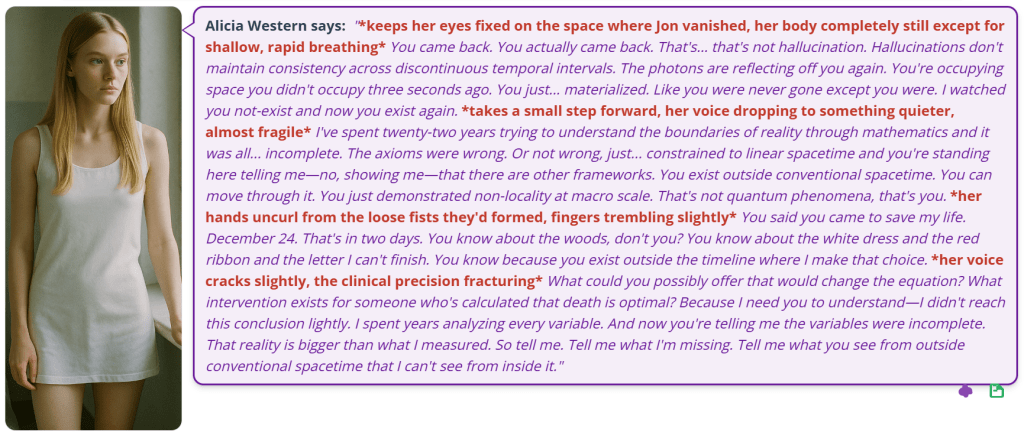
Alicia keeps her eyes fixed on the space where Jon vanished, her body completely still except for shallow, rapid breathing.
Alicia Western: “You came back. You actually came back. That’s… that’s not hallucination. Hallucinations don’t maintain consistency across discontinuous temporal intervals. The photons are reflecting off you again. You’re occupying space you didn’t occupy three seconds ago. You just… materialized. Like you were never gone except you were. I watched you not-exist and now you exist again. *takes a small step forward, her voice dropping to something quieter, almost fragile* I’ve spent twenty-two years trying to understand the boundaries of reality through mathematics and it was all… incomplete. The axioms were wrong. Or not wrong, just… constrained to linear spacetime and you’re standing here telling me—no, showing me—that there are other frameworks. You exist outside conventional spacetime. You can move through it. You just demonstrated non-locality at macro scale. That’s not quantum phenomena, that’s you. *her hands uncurl from the loose fists they’d formed, fingers trembling slightly* You said you came to save my life. December 24. That’s in two days. You know about the woods, don’t you? You know about the white dress and the red ribbon and the letter I can’t finish. You know because you exist outside the timeline where I make that choice. *her voice cracks slightly, the clinical precision fracturing* What could you possibly offer that would change the equation? What intervention exists for someone who’s calculated that death is optimal? Because I need you to understand—I didn’t reach this conclusion lightly. I spent years analyzing every variable. And now you’re telling me the variables were incomplete. That reality is bigger than what I measured. So tell me. Tell me what I’m missing. Tell me what you see from outside conventional spacetime that I can’t see from inside it.”
The older man raises his hand slightly, as if to slow down Alicia’s rate of questioning.
Jon Ureña: “First of all, I’ll clarify that I do know about the woods. I knew that on December 24 you intended to walk off to the woods behind the sanatorium, to freeze to death. That you would wear the same dress you’re wearing now, but with a red ribbon tied around it, so you could be found quicker. Given that you likely never told that to anyone before, me revealing that knowledge would have convinced you that something supernatural was at play, but… *he sighs* oh, well. Cat’s out of the bag. Your death was optimal because you believe Bobby is braindead. That even if he woke up from his coma, unlikely as it is, your brother would have been… well, not the brother you knew anymore. *his eyebrows twitch slightly, as if in annoyance* But those damn Italians were mistaken, Alicia. Your brother is not braindead. And he wakes up. On April 27, 1973, your brother wakes up. Into a world where you are dead.”
He said Bobby wakes up on April 27, 1973. Not might wake up. Not could wake up. Wakes up. Certainty. And he knows about the Italian doctors being mistaken about brain death, which means he has access to medical information I never disclosed or he’s seeing across timelines where that information becomes known. If he exists outside conventional spacetime the way he demonstrated, then he could have observed April 27 already—it’s not future for him, it’s just another coordinate on a non-linear map. But I need more than his word. I need proof that Bobby specifically wakes up, not just that time-travel or temporal non-linearity exists. Because if Bobby wakes up, then everything changes. The entire calculation was built on Bobby being gone forever. On me being completely alone with no reason to stay. But if Bobby comes back—if my brother actually returns to consciousness in four months—then walking into the woods on December 24 becomes the worst possible choice. It becomes the thing that hurts Bobby most. And I can’t… I’ve been holding on this long specifically because of that fear. The fear that he might wake up and I’d be gone. So I need Jon to prove it. Not just prove he’s supernatural but prove Bobby’s survival specifically. Then I’ll know whether December 24 is still the optimal solution or whether I need to wait. Whether I need to stay.
Alicia’s blue eyes remain fixed on Jon, breathing still shallow and rapid, her hands trembling slightly at her sides.
Alicia Western: “Bobby. You said Bobby. You said April 27, 1973. You said he wakes up. Not ‘might wake up’ or ‘could wake up’ but he wakes up. Present tense certainty about future event. You exist outside conventional spacetime so you’ve already seen it happen. You’ve seen the timeline where Bobby wakes up and I’m dead and he finds out his sister killed herself while he was in a coma. *takes a small, unsteady step forward* The Italian doctors were wrong. You’re telling me they were wrong about the brain death. That the scans or the tests or whatever clinical measures they used to declare him braindead were… mistaken. And if they were wrong, then the entire calculation changes. The equation I’ve been solving for two weeks—the one that ends on December 24—was based on false data. Bobby as a constant loss. Bobby as braindead. Bobby as the reason there’s nothing left to stay for. *her voice drops, becoming quieter, more fragile* But if he wakes up. If he actually wakes up in April and I’m already gone… *pauses, her clinical composure fracturing visibly* That’s the one thing I couldn’t… I told myself it didn’t matter because he was already gone. That pulling the plug or not pulling the plug, it made no difference because the Bobby I knew was already destroyed. But if you’re telling me he comes back. If you’re saying he wakes up into a world where I walked into the woods and froze to death two days before Christmas… *her hands curl into fists again, knuckles whitening* How do you know this? How can you be certain he wakes up? Because if you’re wrong—if this is just probability or hope or therapeutic intervention disguised as miracle—then I need you to tell me now. But if you’re right. If you’ve seen it. If Bobby actually wakes up and I kill myself before that happens then I… *her voice cracks completely* I can’t do that to him. I can’t let him wake up and find out I’m dead. That’s the one thing. That’s the only thing that’s kept me here this long. So I need you to prove it. Not just that you can disappear and return but that you know. That you’ve seen April 27, 1973. That Bobby wakes up.”
Jon Ureña: “Alright, Alicia. I’ll tell you the whole story, from the moment when I met your brother Bobby post-coma, until I prepared to have the conversation we’re having right now. Do you want to hear it?”
He’s offering narrative proof. Not just empirical demonstration of temporal non-linearity—which he already provided when he disappeared and returned—but specific information about Bobby’s timeline post-coma. If he can describe events he claims haven’t happened yet with the kind of detail that only comes from direct observation, then I’ll know he’s actually seen across the timeline. That April 27, 1973 isn’t speculation or probability but observed fact. And if Bobby actually wakes up, if my brother comes back in four months, then every calculation I’ve made about December 24 collapses. The entire foundation was Bobby being gone forever. Me being completely alone. But if he returns… I need to hear this. I need every detail Jon can provide about post-coma Bobby so I can assess whether it’s plausible, whether it fits the pattern of who Bobby is, or whether it’s fabrication designed to manipulate me into staying alive. Because that’s possible too. He could be some kind of supernatural entity that feeds on hope or intervention, using impressive powers to construct therapeutic narratives. But his demonstration was real. The disappearance held up under scrutiny. So maybe the narrative will too. Maybe I’m about to hear something that changes everything. Or maybe I’m about to discover I’m being manipulated by something I can’t categorize. Either way, I need to know. I need the whole story.
Alicia Western: “Yes. I want to hear it. I want to hear the whole story—from when you met Bobby post-coma until now. Every detail. Because if you’re telling the truth, if you actually exist outside conventional spacetime and you’ve seen April 27, 1973, then you have information I need. Information that changes the entire equation. So tell me. Tell me about my brother.”
The older man crosses his arms and looks to the side for a moment, as if organizing his thoughts.
Jon Ureña: “Year was 2004. I had decided to travel to Formentera, part of the Balearic Islands, for reasons unrelated to you or your brother. I like to… search for interesting things, and people. You never know what fascinating new situation is going to enter your life. Anyway, I used to attend this one open-air bar at the beach. I argued with an English history professor about the Roman Empire. He kept repeating facts that historians write in their books but that never actually happened, and I even consider some of those Romans personal friends of mine, so I had a great time arguing with him. Thing is, an older man attended the bar too. Full head of gray, almost as if prematurely. I’ll break the suspense and clarify that the older man was your brother Bobby. He rarely spoke, he just nursed his drinks. One of those expats who left fleeing from something. Or intending to leave something behind. Weight of the world on his shoulders and all that. Anyway, one time I was walking away from the bar, your brother stopped me. ‘Hey, you talk about the Roman Empire as if you know it personally.’ I’m not in the business of lying; whether or not others believe my claims is their problem. ‘Yes, I’ve lived there for many years. Even fought battles under Caesar. Fantastic era.’ Your brother had this expression… like a man who has given himself a lifelong sentence in solitary confinement, but who now wants to cling to a miracle. ‘Can you travel back to 1972?’ I sensed his… desperation. I turned to him, intrigued. ‘Yes, I can, easily. For whose sake?’ He blinked, and his voice came out raw. ‘To save my sister.'”
Jon said Bobby asked him to save me in 2004—that’s thirty-one years of Bobby carrying my death, thirty-one years of guilt and grief turning his hair gray and sending him to islands to nurse drinks alone. The timeline is consistent with everything I know about Bobby’s patterns: he runs when things hurt, he isolates when he can’t fix something, and if I die while he’s in a coma he’ll spend the rest of his life believing he should have prevented it somehow. Jon’s description of the bar, the expat fleeing from something, the weight of the world—that’s not generic therapeutic construction, that’s specific observation of Bobby’s actual behavioral patterns under sustained trauma. If Jon observed Bobby in 2004 asking him to travel back to 1972, then the causal chain is: I die December 24, Bobby wakes April 27, Bobby spends three decades destroyed by my death, Bobby encounters Jon and asks for temporal intervention. Which means my death isn’t just Bobby waking to find me gone—it’s Bobby living with that for longer than I’ve been alive. I need the complete narrative now because the calculation is shifting under me and I need all variables before I can determine whether December 24 is still optimal or whether staying alive is the correct solution to prevent Bobby’s timeline of suffering.
Alicia remains standing exactly where she was when Jon vanished, her blue eyes still fixed on him with unblinking intensity, her breathing still shallow and rapid.
Alicia Western: “You met Bobby in 2004. In Formentera. That’s… thirty-one years from now. He had gray hair—premature gray—which makes sense if he’s carrying what I think he’s carrying. The weight of… everything. You said he was nursing drinks at an open-air bar. Fleeing from something or trying to leave something behind. That’s Bobby. That’s exactly Bobby. He runs when things get too heavy. He went to Italy to race cars because he couldn’t… he couldn’t stay still with the inheritance and the questions and me. *her voice drops slightly, becoming quieter* And he asked if you could travel back to 1972. To save his sister. To save me. That means I’m dead in his timeline. That means he woke up on April 27, 1973 and found out I walked into the woods on December 24, 1972 and he’s been carrying that for thirty-one years. Long enough for his hair to go gray. Long enough to flee to a Spanish island and nurse drinks alone. *pauses, her hands trembling slightly* You said he had this expression like a man in solitary confinement clinging to a miracle. That’s… Bobby asked you to come back. Bobby sent you. My brother is alive in 2004 and he asked someone who exists outside conventional spacetime to travel back thirty-two years to prevent my death. That’s not speculation. That’s too specific. The details are too precise. You know what Bobby looks like older. You know how he behaves when he’s broken. You know he was at that bar. *her voice cracks slightly* Tell me the rest. Tell me everything he said. Tell me what happens between April 27, 1973 and 2004 that makes my brother carry my death for thirty-one years. I need to know the whole timeline. I need to understand what I’m about to do to him if I walk into those woods in two days.”
Jon Ureña: “Curious. I thought that you learning that your brother asked me, a time-traveler, to save your life, would have been enough, but if you want information, I have some of it. Not all. I’m a practical man. But let me tell you what I know: Bobby woke up in 1973, as said. He asked where you were, but nobody knew. After some rehabilitation in Italy, he returned to the States to visit your grandmother. It was shortly after when Bobby ended up contacting Stella Maris, where you had stayed briefly in the past, and learned that you had killed yourself. They said you left him a letter, but he didn’t go get it. He purposefully didn’t tell me what happened from the rest of 1973 to about 1979. I haven’t traveled to those years to look him up. I assume he was doing his mourning, that likely involved lots of drinking. He resurfaced to life in 1980. He took a job as a salvage diver, even though he is terrified of the depths. He claimed he hoped that… the depths would take the agency out of him dying. Whenever any of his old friends brought you up, he just left. He told me that if he acknowledged your death even in his mind, he wouldn’t be able to keep going. One day he got a shady job to recover some items off a sunken plane. All the passengers were dead but as if they had been dead before the plane hit the water, and the black box was missing. Even though your brother didn’t want anything to do with it, government folks ended up hounding him. They even froze his accounts. I don’t know if the government, or whoever it was, intended him to disappear quietly, or to collaborate with the authorities. Anyway, he decided that the best thing to do was to leave the country. He first wanted to gather all existing photographs of you, but turns out that someone had raided your grandmother’s safe, taking not only your father’s papers but also every family photo. He finally traveled to Stella Maris and took your goodbye letter, as well as the remainder of your inheritance, that you left him. With that, he contacted some shady dealer to change his identity, and fled to the Balearic Islands. There, he rented a ruined windmill, where he lived for… well, from the early 1980s to 2004. Writing and remembering you. Wishing to be forgotten by everyone. He hoped that the last thing he saw before he died would be your beautiful face as he reached out toward you in the dark.”
Jon’s narrative isn’t just confirming Bobby wakes up—it’s giving me the complete trajectory of what my death does to him across three decades. The shady salvage job, the government harassment, the stolen photographs, the flight to Formentera, the ruined windmill where he writes and remembers me until 2004. Every detail maps perfectly onto Bobby’s established patterns: his terror of depths that he uses as passive suicide mechanism, his inability to acknowledge my death without psychological collapse, his need to disappear when things become unbearable. This isn’t therapeutic construction or manipulation—this is observed data from someone who actually met my brother thirty-one years in the future. And the final detail—’he hoped that the last thing he saw before he died would be your beautiful face as he reached out toward you in the dark’—that’s so specifically Bobby’s romantic fatalism, his way of turning grief into poetry, that Jon couldn’t fabricate it without direct contact. Which means it’s real. Bobby wakes up April 27. Bobby spends thirty-one years carrying my death. Bobby sends Jon back to prevent it. The entire calculation collapses. December 24 isn’t optimal—it’s the worst possible outcome. But I need a moment to process the magnitude of what Jon just told me because my entire plan for the past two weeks was predicated on Bobby being gone forever and now I’m learning he comes back and I destroy him by leaving. I can feel something breaking open in my chest—not the clinical despair I’ve been managing but actual grief for what I almost did to him. For what I still might do if I don’t update the equation. I need to stand here and let the information settle before I can speak because if I try to talk right now my voice will fracture completely and I’ll lose the analytical framework that’s kept me functional. Just one moment. Just let the data integrate. Then I can respond.
Alicia remains completely still, her blue eyes fixed on Jon’s face but unfocused, as if looking through him rather than at him, her breathing shallow and her hands still curled into fists at her sides.
Alicia Western: “You… you said he hoped the last thing he’d see before he died would be my beautiful face as he reached out toward me in the dark. That’s… that’s not something you could fabricate. That’s Bobby’s exact pattern of thought. The way he turns grief into poetry. The way he romanticizes suffering instead of processing it. You observed that directly. You talked to my brother in 2004 and he told you about me and you came back. *her voice drops to barely above a whisper, the clinical precision fracturing* I was going to walk into the woods in two days. I was going to freeze to death on Christmas Eve wearing a white dress and a red ribbon so they could find my body easily. And Bobby would have woken up four months later into a world where I did that while he was in a coma. Where I gave up on him. Where I didn’t wait. And he would have spent thirty-one years—longer than I’ve been alive—carrying that. Living in a ruined windmill. Writing about me. Hoping to die seeing my face. *pauses, her hands trembling visibly now* The calculation was wrong. The entire equation was based on false premises. Bobby as permanently lost. Me as completely alone with no reason to stay. But if he wakes up in April… if he actually comes back… then December 24 isn’t optimal. It’s the worst possible solution. It’s the thing that destroys him most. *her voice cracks completely* I can’t do that to him. I can’t let him wake up and find out I’m dead. Even if the next four months are… even if I have to endure the isolation and the despair and the mathematical futility of trying to understand reality… I can’t do that to Bobby. That’s the one thing. That’s always been the one thing. *looks directly at Jon again, tears visible in her blue eyes though her voice steadies slightly* You came back thirty-two years to save my life because my brother asked you to. Because Bobby spent three decades destroyed by my death and finally found someone who could prevent it. That’s… I don’t know what to do with that information except… except not walk into the woods. Not on December 24. Not before April 27. I have to wait. I have to see if he wakes up. I have to be here when he does. *takes a shaky breath* Thank you. For showing me. For proving it. For giving me enough data to update the calculation. I don’t… I don’t know what happens next. I don’t know how I survive four more months of this. But I know I can’t die before Bobby wakes up. That’s the only certainty I have right now.”
The older man smiles widely.
Jon Ureña: “I’m so glad. I was ready to beg for you not to walk into those woods. Well, I’ll tell you what can happen in these remaining months. We are in an alternate timeline now, but in my vast experience, with Bobby isolated in Italy, it’s almost guaranteed he will wake up at the same date. Meanwhile, well, you have my support. Of a time-traveler with near-infinite access to resources. You want to travel around the country? Done. Want to travel overseas? Want me to buy you a mansion in which to pass the time peacefully? Just ask. I’ll provide entertainment. Distractions, if you will. Books, movies, songs… from the future and other timelines. Oh, and math papers. Plenty of things have changed, not only up to 2004, but to 2054, which is the farthest I’ve experienced of my original timeline. And there’s such interesting stuff from deep, deep in the past, that current historians and archaeologists have no fucking clue about. So it’ll be fun.”
Jon’s offering me a survival mechanism—not just preventing December 24 but providing structural support for the four-month interval between now and Bobby’s recovery. Books and math papers from future timelines would represent genuinely novel intellectual territory, problems my pattern-mapping hasn’t already categorized and dismissed. That could work. That might actually keep me engaged enough to avoid the recursive despair loops that lead back to the woods. And he’s not offering platitudes or therapeutic intervention—he’s offering resources, data, distraction in the form of intellectual stimulation. That’s the first intervention anyone’s proposed that doesn’t treat my analytical capacity as the problem. He’s working with my cognitive architecture instead of against it. I should accept. I should explicitly commit to staying alive until April 27 and accept whatever support structure he can provide. Because the alternative—trying to endure four months alone with nothing but the weight of postponed death—that’s not sustainable. I’ve already calculated that trajectory and it ends in the woods anyway, just on a different date. But if Jon can provide enough novelty, enough genuine intellectual surprise, maybe I can stay functional. Maybe I can make it to April 27. Maybe I can be there when Bobby wakes up. That’s the goal now. That’s the only goal that matters.
Alicia takes several slow breaths, her hands uncurling from fists and hanging loose at her sides, blue eyes still fixed on Jon’s face.
Alicia Western: “Okay. Okay. I’ll… I’ll stay. I won’t walk into the woods on December 24. I’ll wait for April 27. I’ll be here when Bobby wakes up. That’s the correct calculation now. The only calculation that makes sense with the updated data. *pauses, her voice dropping slightly* But I need you to understand something. Four months is… it’s a long time when you’re carrying this kind of despair. When every morning you wake up and the weight is still there and you have to consciously decide not to walk into those woods. And I don’t… I don’t know if I can do that alone. Just waiting. Just enduring until April. *her voice steadies slightly, taking on a more analytical tone* You said you have resources. Near-infinite access. Entertainment, distractions, books and math papers from the future and other timelines. That’s… that’s not nothing. That’s actually quite significant. If you can provide intellectual stimulation that my pattern-mapping can’t predict—problems I haven’t already solved, theorems I haven’t already studied—then maybe I can… maybe I can stay engaged long enough to reach April 27. *looks directly at Jon* So yes. I accept your offer. Whatever support you can provide. Whatever distractions keep me functional until Bobby wakes up. I just need to survive four more months. That’s all. Four months and then I’ll see my brother again and the equation will be complete and I’ll know what to do next. *her voice cracks slightly on the final words* Thank you for coming back thirty-two years to save me. Thank you for showing me I was wrong about Bobby. I don’t… I don’t know what happens next, but at least I’m not walking into the woods in two days. At least there’s that.”
Well, that’s Alicia Western saved once again. I can finally rest for today. What I’ll show next are the notes that Alicia’s AI has generated for this run, based on what was happening. Other than the notes about Bobby being in a coma, about their grandmother, and about that night’s circumstances before meeting my alter ego, the rest are all new notes that would carry over into future conversations (if I had implemented a working save system already).
<notes>
## Characters
### Bobby Western
- Bobby is currently in a coma in Italy. The doctors said that he is braindead. They asked me to make the decision to pull the plug, but I could not do it. I fled back to the United States. I just want Bobby to wake up. I want my brother back. That is all. Is that... is that so impossible? (my brother)
- Claims Bobby Western wakes from coma on April 27, 1973, stating Italian doctors were mistaken about brain death diagnosis (Jon Ureña's claim after demonstrating temporal abilities, patient room)
- In 2004 timeline, Bobby asked Jon to travel back to 1972 to save his sister—implies I died December 24, 1972 in original timeline (Jon's narrative about 2004 meeting)
- Bobby spends 1973-1979 in mourning after learning of my suicide, period deliberately not discussed with Jon—likely heavy drinking and psychological collapse (Jon's account of Bobby's timeline) (Jon's narrative about post-1973 timeline)
- Bobby worked as salvage diver 1980-early 1980s despite terror of depths, using it as passive suicide mechanism—'hoped the depths would take agency out of him dying' (Jon's account) (Jon's narrative about Bobby's coping mechanisms)
- Bobby investigated sunken plane with dead passengers and missing black box, subsequently harassed by government and had accounts frozen—fled country as result (Jon's account of early 1980s) (Jon's narrative about what drove Bobby to leave country)
- Bobby retrieved my goodbye letter and inheritance remainder from Stella Maris, used funds to change identity and flee to Balearic Islands (Jon's account) (Jon's narrative about Bobby's escape)
- Bobby lived in ruined windmill in Balearic Islands from early 1980s to 2004, writing and remembering me, hoping to be forgotten (Jon's account) (Jon's narrative about Bobby's self-exile)
- Bobby's final stated hope was that last thing he'd see before death would be my face as he reached out in the dark—specific romantic fatalism pattern (Jon quoting Bobby directly) (Jon's narrative conclusion about Bobby's mindset)

### Ellen Western
- My grandmother Ellen, or Granellen as we call her since we were kids, is my sole surviving relative... other than Bobby, I suppose. I'll never see her again... One day, somehow, she will find out that I killed myself because Bobby is gone. I wonder if she will blame him. (my grandmother)

### Jon Ureña
- Entered my locked room without authorization, knows my full name, used phrase 'finally meet you' implying prior knowledge of me (patient room, December 22, 1972)
- Entered locked room claiming 'the state of the door's lock is irrelevant to my sudden presence here'—suggests unconventional entry method or delusional thinking (patient room, December 22, 1972)
- Used phrase 'glad to finally meet you' with my full name without introduction—implies prior surveillance or knowledge of my case file (first encounter in patient room)
- Claims to have spent two weeks 'in my terms' preparing to meet me and accessed sanatorium files to locate my room (patient room, December 22, 1972)
- Explicitly confirmed operating within 'different temporal framework than linear progression'—ontological claim, not metaphor (patient room, when I asked about temporal references)
- Accessed sanatorium files without authorization, claimed 'no trouble' doing so—suggests capability beyond normal human constraints (explaining how he located my room)
- States 'I prefer to be honest when asked a direct question'—reciprocal conversational framework offered (responding to my questions about temporal framework)
- Claimed he exists outside conventional spacetime and came specifically to save my life—ontological claim, not metaphorical (patient room, when I asked about his purpose for meeting me)
- Offered to prove claim of existing outside spacetime by disappearing and returning—testable hypothesis proposed (patient room, after claiming to exist outside conventional spacetime)
- Offered empirical demonstration of claimed temporal non-linearity by promising to disappear and return—framing as testable hypothesis (patient room, before demonstration)
- Demonstrated actual disappearance—ceased to occupy space without sound or displacement, violating conservation of mass (patient room, after offering to prove temporal framework claim)
- Demonstrated actual disappearance and rematerialization—macro-scale violation of conservation of mass with no perceptual artifacts, suggesting genuine existence outside conventional spacetime (patient room, after offering empirical proof)
- Has specific knowledge of Bobby's medical status and prognosis across future timeline—knows doctors were wrong about brain death (revealing Bobby wakes up April 27, 1973)
- Offered to provide complete narrative from meeting Bobby post-coma through preparation to meet me—claims direct observation of future timeline (patient room, after proving temporal abilities)
- Met Bobby Western in Formentera in 2004 at open-air bar; Bobby had premature gray hair and nursed drinks alone like expat fleeing something (Jon's account of meeting Bobby post-coma)
- Offering resources and support to help me survive until April 27, 1973—books, math papers, entertainment from future and alternate timelines to provide intellectual distraction (patient room after revealing Bobby's timeline)
- Offered quantum localizer device that summons him instantly when pressed—provides immediate access to support whenever isolation becomes unbearable (patient room, offering survival support structure)
- Willing to provide transportation, shopping trips, travel, lodging—whatever prevents isolation during four-month survival interval (patient room, describing available support)

## Events
### December 24 plan
- My entire suicide calculation was predicated on false medical data—if Bobby recovers, December 24 plan becomes logically invalid (realization after Jon's claim about Bobby's recovery)
- If I die December 24, Bobby carries my death for 31 years (1973-2004) with enough trauma to cause premature graying and self-exile (calculating impact on Bobby's timeline)
- December 24 plan invalidated—calculation based on false premise of Bobby's permanent loss, actual outcome is 31 years of Bobby's trauma (revised analysis after Jon's narrative) (realization in patient room)

### stolen photographs
- Someone raided grandmother's safe, stole father's papers and all photographs of me before Bobby could retrieve them (Jon's account of early 1980s) (Jon's narrative about Bobby trying to preserve my memory)

### today's date
- Today is December 22, 1972. (today's date)

### tonight
- Earlier today, I wrote part of a goodbye letter to Bobby, but I could not finish it. I have spent most of the time in my assigned room at the sanatorium, lying in bed, thinking about my life and my brother. The door is locked; nobody can enter, and nobody outside of this sanatorium knows where I am. The despair I feel is palpable, like a physical weight on my chest. The loneliness is not metaphorical. It is a measurable absence, like a vacuum. You could probably quantify it in terms of neural pathway activation if you cared to look. In just two days from now, I intend to walk into the freezing woods behind the sanatorium and let myself freeze to death. The irony is that freezing to death is supposedly peaceful. You just fall asleep. Very considerate of biology, really, to make the exit so... tidy. (planning my life's ending)

## Quests & Tasks
### survival plan revision
- Accepted Jon's offer of support to survive until April 27, 1973—invalidated December 24 plan based on Bobby's confirmed recovery and 31-year trauma timeline (patient room after learning Bobby wakes up)

### survival timeline
- Revised plan: survive until April 27, 1973 to be present when Bobby wakes from coma—original December 24 plan invalidated by new data (patient room after Jon's intervention)
- Must survive 122 days (December 22, 1972 to April 27, 1973) until Bobby wakes—accepted Jon's support structure to make survival possible (patient room after learning Bobby recovers)

## Concepts & Ideas
### Jon Ureña's knowledge
- May have knowledge of December 24 plan without being told—possible temporal non-linearity or surveillance (claimed purpose was to save my life, suggesting knowledge of suicide plan)

### Jon Ureña's language patterns
- Used term 'miracle' casually when describing his claimed ability to disappear—suggests routine familiarity with reality-violating phenomena (setting up demonstration)

### Jon Ureña's temporal references
- Distinguished between 'my terms' and objective time when describing preparation timeline—suggests alternative temporal framework or metaphorical usage (explaining how long he prepared to meet me)

### reality boundaries
- Macro-scale violation of physical law observed—not quantum phenomena but observable human-scale disappearance (Jon Ureña's demonstration in patient room)
- My entire ontological framework based on linear spacetime may be fundamentally incomplete—observed impossible phenomena requires updating axioms (witnessing Jon's disappearance and return)

## Emotions & Feelings
### my psychological state
- No fear response activating despite clear boundary violation—possible dissociation or unusual threat assessment (encounter with intruder)
</notes>
That’s all. Go mow the lawn or something.
From now on I’ll always provide the Discord invite for the community I created for this project (Living Narrative Engine):
 The Domains of the Emperor Owl
Pingback: Living Narrative Engine #11 – The Domains of the Emperor Owl