
Elena headed toward the gate to exit Bar Palace’s fenced patio, but I reminded her that we were supposed to pay for the coffees. She followed me inside through the sliding door, and we trod over broad boards. A dozen tables populated the room, around which distinguished older ladies and men sat in ornate chairs. Overhead fixtures burnished with amber light rectangular stone columns bolstering wooden beams. Another fixture spotlighted a stone fireplace and the ornament perched on its mantle: a metallic emblem bearing Irún’s coat of arms. Vigilantiae Custos. Guardian of Vigilance. We had entered a centuries-old retreat. I beelined to the marble counter layered atop dark wood paneling, then waited for a waiter in black garb to take my money. Elena trailed behind me, blue folder clamped under her arm, and surveyed the salon with darting eyes as if she feared some threat lurked in there.
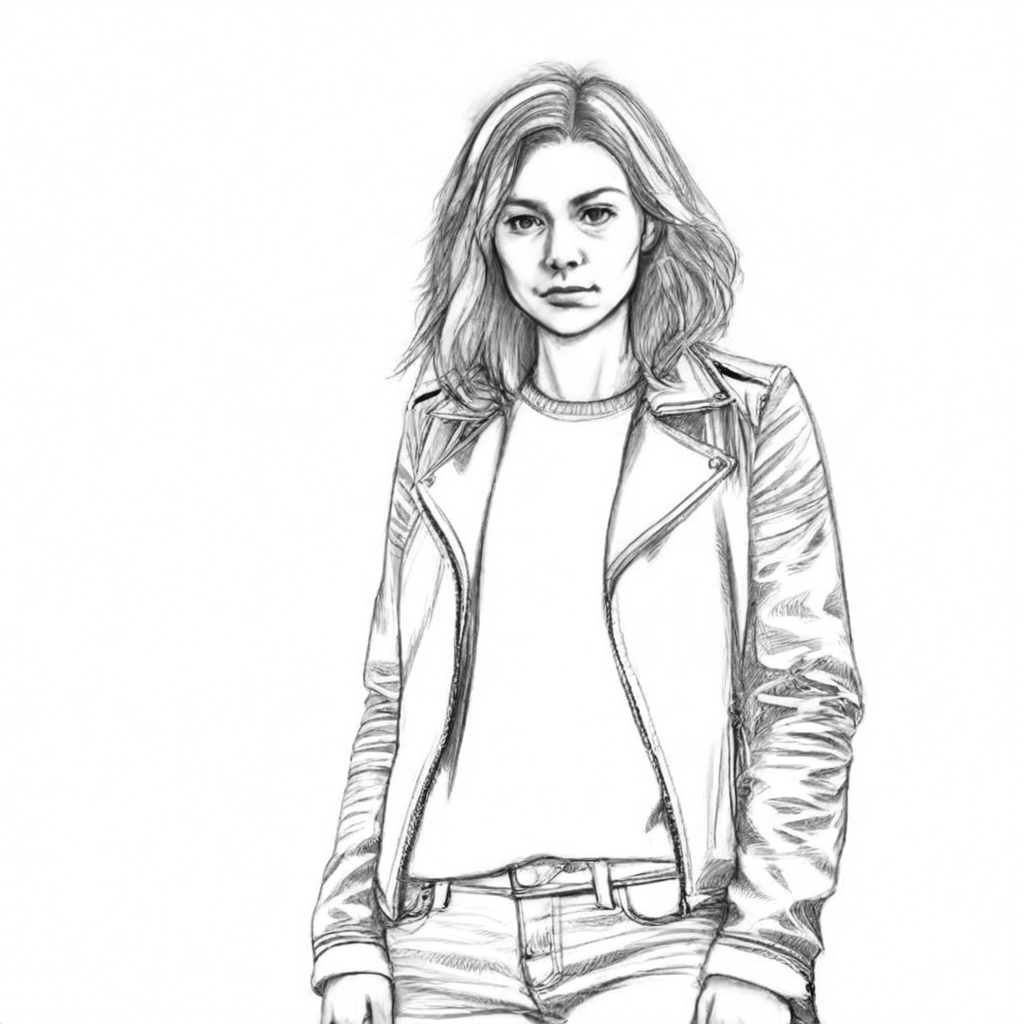
We emerged from Bar Palace onto Navarra Avenue, then stopped at the edge of the sidewalk for the traffic light to turn. After basking in the refuge of that patio, despite the intruding youth, this noisy intersection had hurled us back into civilization. Cars and buses growled past. Across the street, a cluster of teenage girls idled outside a candy store, chatting and giggling beneath a leafy tree. A cyclist avoided pedestrians as he passed the reddish-orange facade of a four-story apartment building. Beside me, the rain-scented breeze played ghostlike with Elena’s almond-blonde locks. She clutched her folder while her eyes flitted between strangers like an anthropologist visiting a foreign land. I resisted the urge to steal a glance at how her dark-wash jeans hugged her butt.
Had Elena intended for us to part ways the moment we left the coffee shop? I wanted to spend more time with her, so she’d have to dismiss me.
Although her eyes were averted, Elena’s thin voice reached out to me.
“Jon, do you like being around people?”
“Not particularly.”
“Often when I force myself to leave the apartment, I see all these men and women and kids and elders walking about like ants scurrying to and from their nest, and I think, ‘I have nothing in common with these beings.’ I must assume that minds operate behind their eyes, even though I can’t imagine their thoughts. But maybe I share the world with eight billions of shoddily-programmed automatrons that short-circuit when confronted with concepts more complicated than the weather, football, or whatever shit the mass media pumps into them. Maybe I’m the sole real person in a simulation built to trap me. It would explain the state of the world, wouldn’t it? If nobody had any fucking clue about what they’re doing.”
“As a fellow person, I can’t help but resent the implication. And that line of thinking can easily slide you into psychosis.”
The pedestrian light flicked to the walking man outline. Elena and I strolled ahead.
“As a child,” she said, “I wondered if everyone around me was acting out a role. Did they also have to put on a mask whenever they went out? Were they as scared and lonely as me? Even now, I can’t be around people for too long. When someone stares at me, I feel like a fly trapped in a jar. It makes my skin crawl. There are no common points in which I can make myself understood. When I engage people, they’re more likely than not to end up developing an instinctive dislike of me. They’re the normal ones. Always pretending, trying to impress others. Trying to impress themselves. Lying to get along, to fit in. Do they ever feel the walls closing in? Do they ever sense the void beneath their feet, or the cold, dead stars overhead?”
Iglesia Street unfolded into a downward-sloping plaza paved with gray stone. At its edge stood the white building of the Roman museum. In front, three towering cypress trees jutted upward like narrow spearheads. Elena continued her monologue.
“One of the things you discover when you’ve been alone for so long is how people can weigh you down. As if you had lived with a TV constantly on and loud, and once you turn it off, you realize that something had been drowning your genuine thoughts. That newfound silence allows contemplation similar to that our ancestors enjoyed in their so-called primitive societies. Alone, you’re free from having to conform to the expectations installed by the people you’ve allowed in, who intend for you to like and want the same things they do. Without that pressure, your true self emerges—unshackled, raw. You figure out what matters to you. What you’re willing to tolerate, sacrifice for, fight tooth and claw to defend. To get there you have to become one with the void inside. Otherwise it remains alien to you. And most people seem terrified of meeting that self, lest they end up pushed out of the collective and ejected into the cold.”
We were nearing the bronze statue of a San Marcial vivandière—a woman captured mid-stride, clad in a beret; a buttoned-down, tailored jacket; and a pleated skirt that draped over the tops of her laced boots. In her right hand, she held a fan aloft, frozen in her constant duty to wave, while she cast an unsettling smirk at passersby. Creeping verdigris etched stark contrasts along the pleats of her skirt.
“You’d think such a dynamic would be absent in couples, right?” Elena said. “Surely partners willing to accompany each other on this doomed journey would form a sanctuary in which both could grow as individuals. But no. Most couples seem like two dogs chained together. A romantic relationship censors you even worse, and before long, you end up defanged and declawed. Can’t risk upsetting your partner. Can’t risk losing them. No wonder some couples decide to have a kid, then another, and another. Filling the home with hostages. No, an individual’s freedom is too valuable to sacrifice for the sake of having a companion to fill the silence, and a warm body to fuck.”
As we descended the stairs, Juncal Church loomed fortresslike, built from sandy stone blocks, some bearing warm honey hues and others worn into ashen grays. Near the top of its bell tower, that had darkened as if singed by flames, a snow-white clockface stood out. The church endured as a relic from an era when people’s beliefs, however misguided, urged them to erect beauty that would outlive them by centuries.
Elena’s vacant gaze drifted along the stairs. She had tucked her folder under one arm, and that hand in the pocket of her jeans. When she spoke again, her voice came hoarse.
“Most people stick to you not because they’re interested, or care, but because they need that closeness, that shared warmth, the same way I need to be alone. They’d be comfortable gathered around a bench in silence, while their mere presence would desiccate me. You spoke about how many works of art have been lost because their potential creators wasted their talents, or died too young. But how many revolutionary ideas, how many discoveries we’ve missed in these societies that push their members to police each other’s thoughts? How many masterpieces have died in the womb because some nearby moron could consider them impractical or ridiculous or immoral? I’ve had to protect myself. Surely you noticed how guarded I was at the writing course, or when you first approached me at that bench. Always have a wall up. I ensure that a person will offer more than they’ll take away from me. To preserve the garden, one must first be a ruthless weed slayer. Without that, the flowers get choked and die.” Her jaw tensed as she swallowed, and she massaged her throat. “Life gets too complicated when people disgust you. You need them for the most basic things, and I endure those interactions while repeating in my mind for them to leave me the fuck alone. The responsibilities you accumulate with humans shackle you. From time to time I feel like I’ve matured enough, or grown enough callus, to tolerate experiences like that writing course, which could help me. But soon enough, everything that irritates me about human beings, their words, their noises, the myriad little humiliations, swell and swell until suddenly I can’t deal with a single extra minute of that shit. Then I need to hide from the world and everybody in it. My solution? I keep my rotten self away from others. That way nobody can hurt me, and I don’t pollute anyone else. A quarantine measure to keep the world safe, you could say. Isn’t that the epitome of altruism? The greatest good?” She sighed. “Yeah, I’ve given up. After that course, after my stories were deemed deplorable, after that fucking bitch Isabel called me out as a monster in front of everyone… I feel completely done. I hoped that other writers would understand. So I exist here, in this land, because I have no choice. I can’t just pack up and move to the forest, or the mountains. Well, I could, but I’d like to survive past twenty-eight. Honestly, I doubt I would have reached this far if my parents hadn’t taken care of me. Imagine their disappointment and regret at what I’ve turned out to be.”
I had stopped at the church entrance, and Elena, lost in her soliloquy, had copied me. The dark wooden doors split into four metal panels, each embossed with figures of robed saints or other biblical characters. Four sandstone columns with fluted shafts flanked the entrance. Their bases and capitals had eroded, exposed for centuries to the elements and the corroding darkness of the world. Above the door, a circular niche might have once housed a statue, but these days it would have been stolen. Higher up, near an oculus’ edge, some architectural oversight had forced the builders to chisel blocks and wedge them into gaps.
Elena cleared her throat.
“Man, my voice box is actually strained. I hadn’t spoken so much in years. Maybe I never had. I was holding back a shit-ton of stuff, it seems. I also like to stop and stare at beautiful buildings. To see their little details. The cracks, the mold, the weeds growing in between the stones. How much they’ve endured. And most churches beat modern monstrosities like the one built to replace the covered pelota court at Sargia.”
Elena’s pale blues stared at me with childlike interest. I held my breath as her loose locks fluttered. She arched an eyebrow, and I broke the silence.
“Elena, did our coffee meeting feel that overwhelming?”
Her fingers fidgeted with the edges of her folder, and she glanced away.
“If you’re asking whether I enjoyed your company, the answer is yes. I like talking to you, Jon. I can hardly believe you’re still willing to reciprocate. Most people that intrigue me for whatever reason, they’re like temporary bandages over a radiation burn—they stick around just long enough to realize that this broken toy can’t be patched up with positive thinking and empty platitudes and self-help books, and then they bail. But you… you don’t seem interested in fixing anything. You just want to, what? Watch the decay spread? Document the collapse? I’ve offered you a glimpse of my darkness, and you just dissected it. As if performing an autopsy on my soul and cataloguing every diseased part you found. And I was glad to let you peel back layers. That writing course debacle… Honestly, if you hadn’t come out of the experience, I may have holed up in my cave for weeks. So, did our meeting feel good? I’m not sure I know what that feels like, because I can’t get rid of this anxiety and dread. But it felt… necessary. Real. Like for once, with you, I don’t need to pretend I’m something other than a monster. Now I have to acknowledge that maybe I’m not as alone in this darkness as I thought. That maybe other people out there can look inside me and not flinch. I don’t… I don’t know what to do with that kind of understanding. In summary: congratulations, Jon. You’re the first person I’ve talked to for more than ten minutes that didn’t make me want to claw my skin off. What a relief to speak to a human being without having to pretend to be one.”
“I want to meet up again soon, Elena. I picture us visiting interesting, solitary places, and having long talks about whatever comes to mind. I also intend to read the rest of your work. Let’s see how far we can take our experiment.”
Elena slid her hands into her pockets, folder tucked under one arm. Although she tried to restrain her lips from curving upwards, they betrayed her. The muscles that framed her mouth and connected to her chin tensed, her lower eyelids pushed up, her pale blues gleamed. I yearned to induce more of her genuine smiles, drawing beauty into the world with each one. Little works of art just for me.
“That sounds an awful lot like you’re giving me permission to be exactly what I am,” she said.
“That’s exactly what I want.”
Elena glanced over her shoulder at the rounded archway, under two levels of balconies and their striped awnings, that led deeper into Erromes Plaza. She turned back to me and nodded.
“Anyway, I’m not sure if it’s morally right to inflict myself on another person, but let’s do this again.”
Author’s note: today’s song is “Fake Plastic Trees” by Radiohead.
We’re like 25,000 words in, and we haven’t even reached the middle of the first act. This is going to be a long one.
Also, because I’m from this city and I mentioned the San Marcial festivities (even though that day I either work or stay at home), here’s a video about it. Some shots even depict the itinerary of our main characters; for example, at 0:40, the church appears on the left.
 The Domains of the Emperor Owl
Pingback: The Scrap Colossus, Pt. 13 (Fiction) – The Domains of the Emperor Owl
Pingback: The Scrap Colossus, Pt. 15 (Fiction) – The Domains of the Emperor Owl