
I recommend you to check out the previous parts if you don’t know what this “neural narratives” thing is about. In short, I wrote in Python a system to have multi-character conversations with large language models (like Llama 3.1), in which the characters are isolated in terms of memories and bios, so no leakage to other participants. Here’s the GitHub repo, that now even features a proper readme.
In the previous episode of this thing, our team of Earthlings, having ventured through a rift into another dimension, encountered a half-buried building in an obsidian desert. Now, they enter it. The following audio is an episode-long account of what happened.
That’s it for today narrative-wise. By the way, this is the portrait that the app generated for Zha’thik.

As I was thinking what else I could do with character memories, which are used by the large language models to roleplay the characters better, I ended up implementing a system to generate any character’s worldview, his or her personal philosophies, influenced by their bio and their experiences. That means that when the user wants to deepen the roleplaying of any of the characters at an arbitrary point of the journey, their worldview can be generated, and it will reflect the journey up to that point. Some characters could start naive, only for their worldview to change after nasty experiences. And of course, the generation of self-reflections receives all the memories as input, including any possible worldview texts.
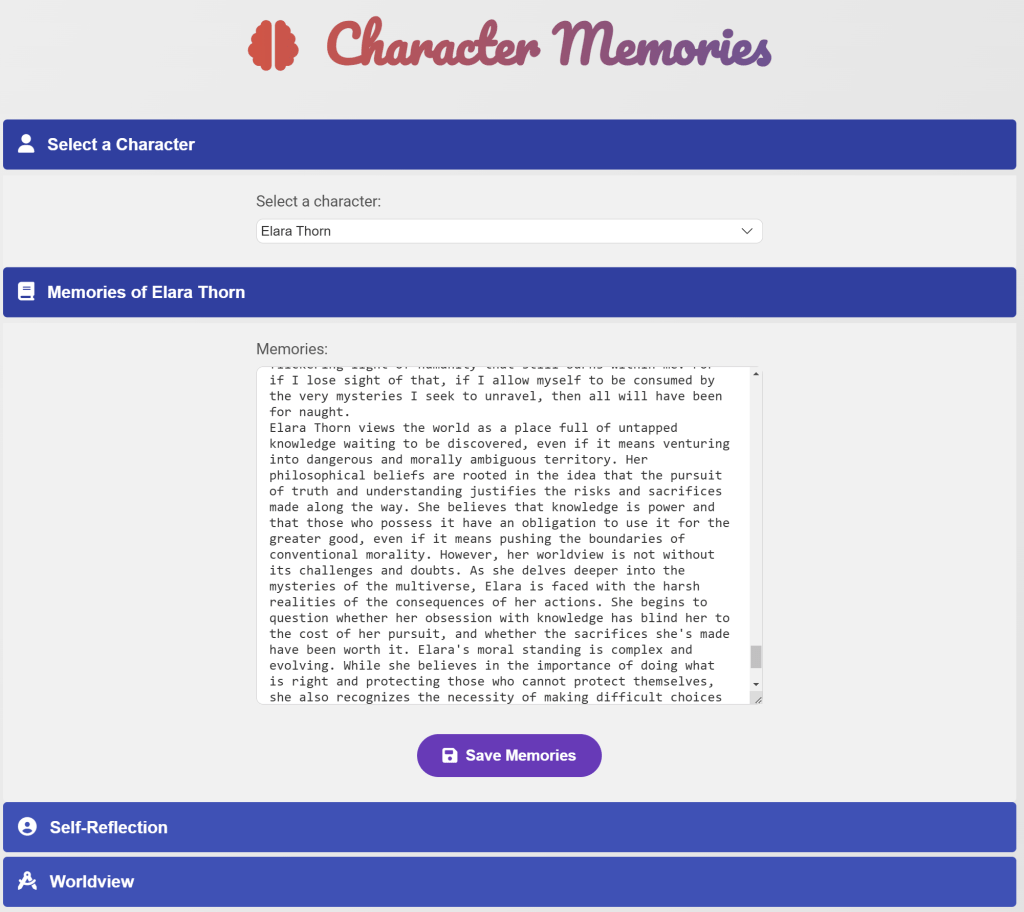
This is the worldview generated for the brilliant scholar Elara Thorn, based on her bio and experiences up to this point:
Elara Thorn views the world as a place full of untapped knowledge waiting to be discovered, even if it means venturing into dangerous and morally ambiguous territory. Her philosophical beliefs are rooted in the idea that the pursuit of truth and understanding justifies the risks and sacrifices made along the way. She believes that knowledge is power and that those who possess it have an obligation to use it for the greater good, even if it means pushing the boundaries of conventional morality. However, her worldview is not without its challenges and doubts. As she delves deeper into the mysteries of the multiverse, Elara is faced with the harsh realities of the consequences of her actions. She begins to question whether her obsession with knowledge has blind her to the cost of her pursuit, and whether the sacrifices she’s made have been worth it. Elara’s moral standing is complex and evolving. While she believes in the importance of doing what is right and protecting those who cannot protect themselves, she also recognizes the necessity of making difficult choices in the face of unimaginable danger. She struggles with the weight of her own humanity, constantly grappling with the question of whether her actions are truly justified or if she has become a monster in pursuit of her own desires. Despite the doubts and challenges that confront her, Elara remains steadfast in her belief that the pursuit of knowledge is worth the risks and sacrifices, and that she has a duty to use her brilliance to make a difference in the world, even if it means navigating the treacherous waters of the unknown.
My Writers’ Room has come up with an intriguing concept for the next episode. I can’t wait to play it out.
 The Domains of the Emperor Owl
Pingback: Neural narratives in Python #18 – The Domains of the Emperor Owl
Pingback: Neural narratives in Python #20 – The Domains of the Emperor Owl